CovertAction: Pressure in Paramaribo 1983
CIA-RDP90-00845R000100180002-6
U.S. Invades Grenada-Nicaragua Next?
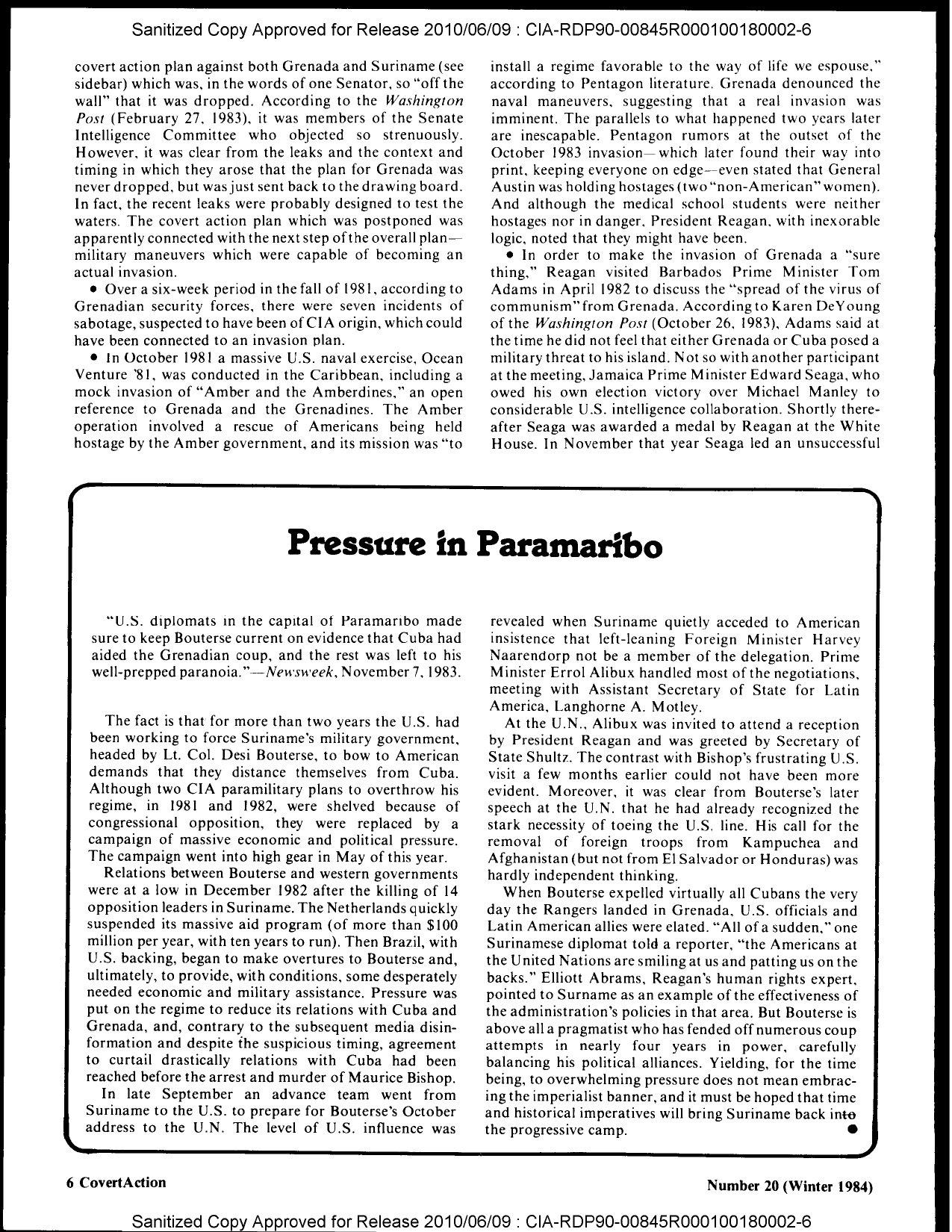
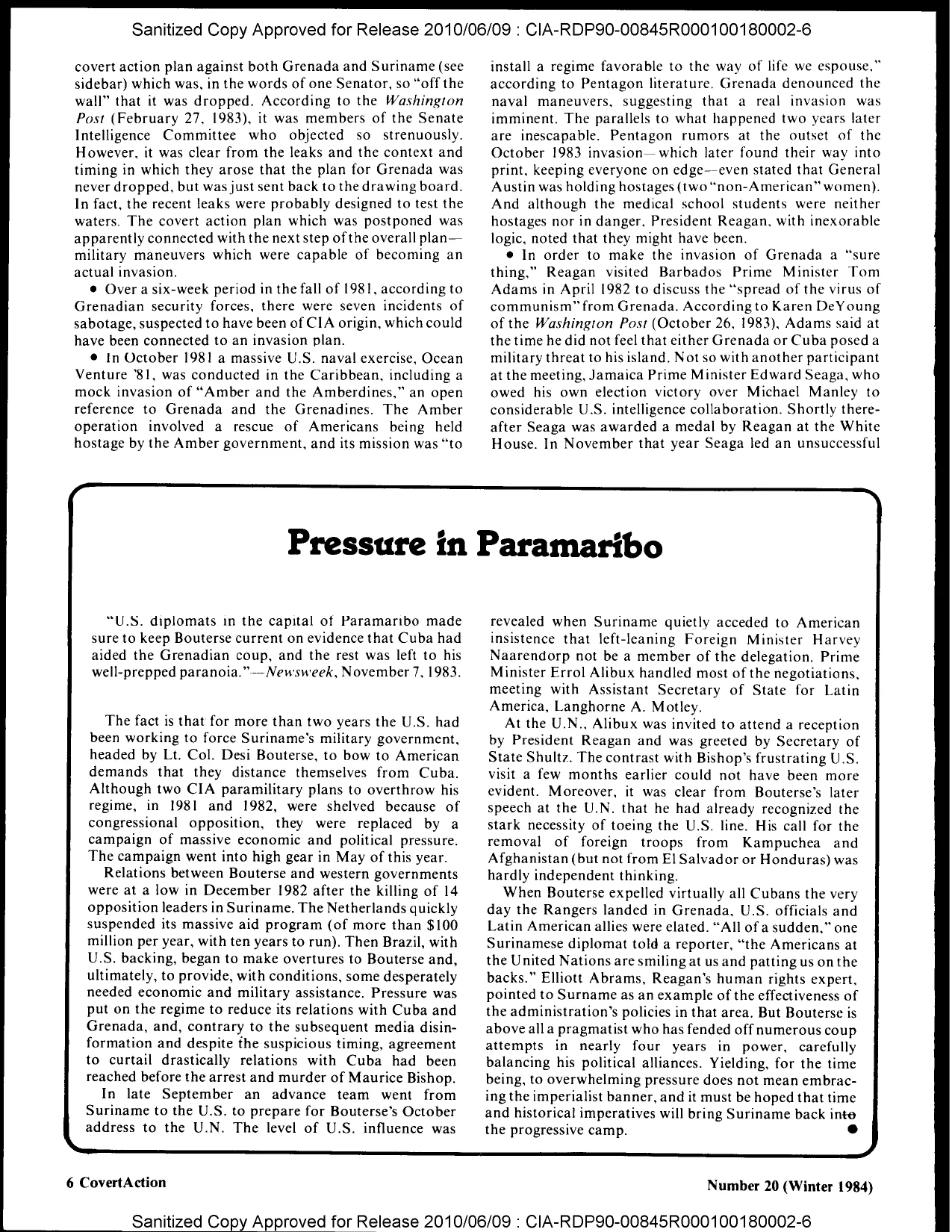
“U.S. diplomats in the capital of Paramaribo made sure to keep Bouterse current on evidence that Cuba had aided the Grenadian coup, and the rest was left to his well-prepped paranoia.” — Newsweek, November 7, 1983.
The fact is that for more than two years the U.S. had been working to force Suriname’s military government, headed by Lt. Col. Desi Bouterse, to bow to American demands that they distance themselves from Cuba. Although two CIA paramilitary plans to overthrow his regime, in 1981 and 1982, were shelved because of congressional opposition, they were replaced by a campaign of massive economic and political pressure.
Economic and Political Levers The campaign went into high gear in May of this year. Relations between Bouterse and western governments were at a low in December 1982 after the killing of 14 opposition leaders in Suriname.
- The Netherlands: Quickly suspended its massive aid program (more than $100 million per year, with ten years to run).
- Brazil: With U.S. backing, began to make overtures to Bouterse to provide economic and military assistance, conditioned on reducing relations with Cuba and Grenada.
The U.N. Delegation and U.S. Influence Contrary to media disinformation, the agreement to curtail relations with Cuba had been reached before the murder of Maurice Bishop. In late September, an advance team went to the U.S. to prepare for Bouterse’s October address to the U.N.
The level of U.S. influence was revealed when Suriname quietly acceded to American insistence that left-leaning Foreign Minister Harvey Naarendorp not be a member of the delegation. Prime Minister Errol Alibux handled most of the negotiations, meeting with Assistant Secretary of State Langhorne A. Motley.
Diplomatic Shift at the United Nations At the U.N., Alibux was invited to a reception by President Reagan and greeted by Secretary of State Shultz—a stark contrast to Maurice Bishop’s frustrating U.S. visit months earlier. Bouterse’s subsequent speech reflected this shift, as he called for the removal of foreign troops from:
- Kampuchea
- Afghanistan (Notably omitting El Salvador or Honduras from his list).
Expulsion of Cubans When Bouterse expelled virtually all Cubans the very day the Rangers landed in Grenada, U.S. officials were elated. “All of a sudden,” one Surinamese diplomat noted, “the Americans at the United Nations are smiling at us.” Elliott Abrams, Reagan’s human rights expert, pointed to Suriname as a success for the administration’s policies.
Conclusion Bouterse remains a pragmatist who has fended off numerous coup attempts by carefully balancing political alliances. While yielding to overwhelming pressure for now, it must be hoped that historical imperatives will eventually bring Suriname back into the progressive camp.
Source:
Link:
Internal Link:
Date:
December 1, 1984