FAB Air Navigation Equipment Operates on Solar Power; DECEA Explains Innovation
Juliano Gianotto – September 6, 2023
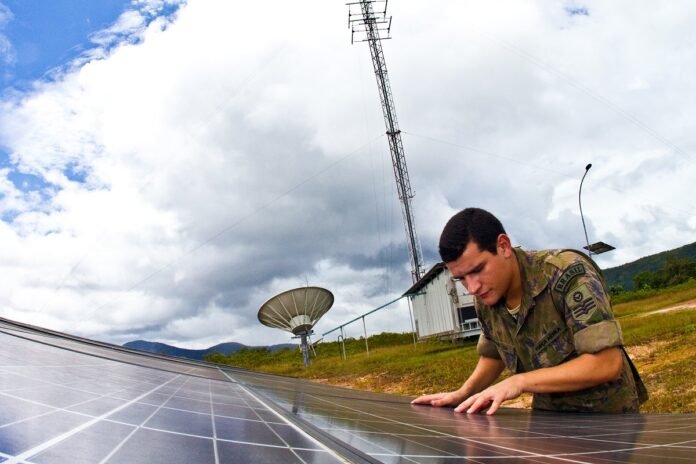
Pioneering in Brazil, the Brazilian Air Force (FAB) launched a sustainable energy generation project. The use of photovoltaic panels, which convert sunlight into electricity, became the best alternative for Surucucu (RR), where there is an Airspace Control Support Station (EACEA).
Due to the location’s characteristics, the first challenge was overcoming the continental distances and extreme isolation to install air navigation equipment that needs to operate continuously.
Implemented in 2011, the initiative ensures the operational reliability of air navigation equipment with lower operational costs, logistical effort, and environmental impact. The system includes 144 photovoltaic panels, a bank of 48 batteries, and three DC/AC frequency inverters, powering the station with an estimated 20-year lifespan.
The Surucucu station maintains communications between the Area Control Center in Manaus and aircraft crossing the region’s airways. “Flights to South, Central, and North America use the VHF, UHF, and satellite (TELESAT) communication systems installed at this location,” explains Boris Brandão, head of the Specialized Engineering Subdivision of the Fourth Integrated Air Defense and Air Traffic Control Center (CINDACTA IV).
The results have been significant: the initiative reduced diesel consumption by 65% and energy generation costs at the Surucucu station, on the border with Venezuela, by 82%.
Image: DECEA
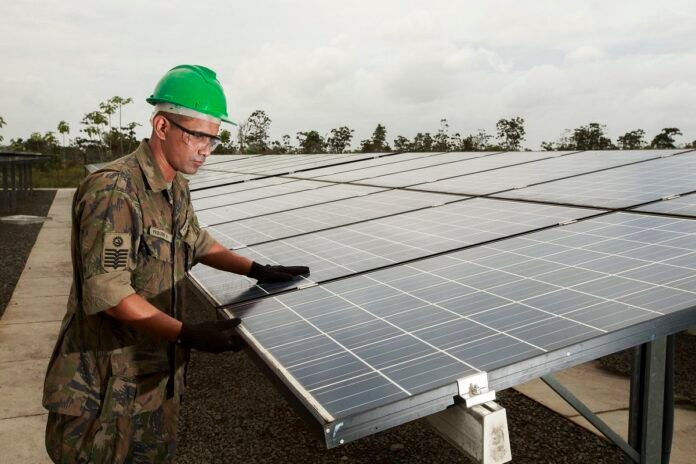
Another example is the solar plant in Tiriós, Pará, on the border with Suriname. Active since 2015, the hybrid station at the Tiriós Airspace Control Detachment (DTCEA-TS) combines photovoltaic panels with diesel generator units.
They produce up to 268 kilowatts of power and can autonomously supply DTCEA-TS for up to ten hours daily. The solar system consists of 1,072 photovoltaic panels and five banks of 24 ventilated stationary batteries, powering the station with an estimated 20-year lifespan. Since its operation, the project has achieved a 45% reduction in energy generation costs for unit maintenance.
The photovoltaic plants at Tiriós and Surucucu are off-grid, not connected to any commercial energy provider, and operate autonomously. “Over the years of using these plants, comparing them with diesel-generated power, it was possible to observe better quality electricity with fewer operational failures, contributing to the high availability of air navigation systems in the Amazon,” reports Lieutenant Colonel Aviator Fernando Rocha Rodrigues, head of CINDACTA IV’s Technical Division.
To shorten distances and reduce costs, remote monitoring equipment was installed, allowing real-time supervision and control so CINDACTA IV technicians can perform preventive and corrective maintenance without being physically present at the Surucucu and Tiriós stations.
Solar Plant Powers Detachment in Noronha
In 2014, the first solar plant was installed at the Fernando de Noronha Airspace Control Detachment (DTCEA-FN), subordinated to the Third Integrated Air Defense and Air Traffic Control Center (CINDACTA III).
The plant occupies 4,467 m² near the airport and consists of 1,644 solar modules of 245 peak kilowatts. In full operation, it can generate around 50,000 kilowatt-hours per month.
The station operates on-grid, working simultaneously with Neoenergia Pernambuco, the local utility. “The energy generated is consumed by the detachment, and the surplus is fed into the grid, providing credits for future use over a five-year period,” notes Major Engineer Andreza de Albuquerque Gomes de Santana, head of CINDACTA III’s Electromechanical Subdivision.
Estimated annual generation is 600 MWh, approximately 80% of DTCEA-FN’s consumption. This production reduces diesel consumption from Neoenergia’s Tubarão Plant, which currently supplies over 80% of the island with diesel generators.
“This represents an estimated annual savings of around 400,000 reais. Beyond the financial benefit to the Air Force Command, it also reduces diesel consumption at the Tubarão Plant, preventing the release of various pollutant gases during fuel combustion,” explains Major Andreza.
Source:
Link:
Internal Link: