Matthew Smith Podcast: The Suriname Contra Affair – Part 5 – The Wolves of Paramaribo | Project Elastic Fence
For sixty-two years, they kept it classified.
A memo written in June 1961 by President Kennedy’s aide Arthur Schlesinger Jr. about restructuring the CIA. When the Trump administration finally declassified it as part of the JFK assassination document releases, people called it “the most important blank page in American history.”
And when you read what was under those black redactions, you understand why they fought so hard to keep it secret.
Schlesinger wrote about “controlled American sources” – CIA officers operating under State Department cover at U.S. embassies around the world. And he included one statistic that changes everything you think you know about American diplomacy:
“At the time of Kennedy’s inauguration, 47% of political offices in US embassies around the world were actually CIA agents.”
Not some CIA officers. Not a few operatives in sensitive locations.
Half.
Walk into any U.S. embassy in the 1960s, 70s, or 80s, and half the people carrying State Department credentials—the ones supposedly conducting diplomacy—were actually running intelligence operations.
By early 1982, that same system was being deployed against Suriname. But this time, it wasn’t just intelligence gathering. This was something new.
What Happened Last Week
In Episode 4, we watched the Reagan administration prepare for war. JSOC “birdwatchers” mapping Fort Zeelandia. The Intelligence Support Activity building target packages. Ocean Venture ‘81 rehearsing a Caribbean invasion.
Bouterse announced the Revolutionary Front – officially aligning Suriname with Cuba and Nicaragua. The trigger was pulled. The invasion plans were ready.
But there was a problem: they didn’t have a pretext yet. No hostage crisis. No massacre. No justification that would sell to Congress and the American public.
So they tried something else first.
What’s in This Episode
This week, we meet the operators who were sent to create that pretext.
The ELASTIC FENCE Connection:
National Security Decision Directive 21 authorized “Operation ELASTIC FENCE” – a massive psychological warfare campaign designed, in the directive’s own words, “to raise the sense of threat” in Cuba and its allies. The “loud stick” was Ocean Venture ‘82 – 45,000 troops rehearsing invasion. The “covert scalpel” was the Wolf Pack – the team sent to make Bouterse feel that threat personally.
Why This Matters:
Over the next year, Bouterse will become convinced that a U.S.-backed coup is imminent. And he’ll be right – there actually was a coup attempt in March 1982, just weeks after ELASTIC FENCE began. But the paranoia doesn’t end there. By December 1982, Bouterse will be so certain another coup is coming that he’ll execute 15 opposition leaders to stop it.
The Wolf Pack’s mission was to create that sense of threat through psychological operations. And they succeeded – with catastrophic consequences.
The Roster:
- Richard LaRoche – Deputy Chief of Mission with intelligence background in revolutionary Grenada and Suharto’s Indonesia
- Edward Donovan – PSYOP specialist from Vietnam, media manipulation expert
- Albert Buys – Dutch-speaking military intelligence officer, perfect for infiltrating a former Dutch colony
- Martha and Arnold Campbell – Financial/communications control, the infrastructure that made covert operations possible
- Tony Kern – AIFLD labor warfare specialist targeting unions
- Jack Gatewood – Economic officer weaponizing foreign aid
- Cornelis Keur – Dutch-speaking holdover with unique access
- Robert Duemling – The ambassador who arrived 8 months late, after the operation was already running
The Eight-Month Vacuum:
Ambassador John Crowley was recalled in December 1981. His replacement didn’t arrive until August 1982. For eight months, the Wolf Pack ran operations without ambassadorial oversight. That wasn’t bureaucratic incompetence – it was operational design.
Watch Episode 5
Read the Transcript Below
This episode includes full citations and source documentation. Every claim about the Wolf Pack members is verified through declassified documents, State Department records, oral histories, and primary sources.
This is the documented record of how the United States government assembled a team to destabilize Suriname in 1982. If you find any errors or have additional information, please reach out:
By Matthew Smith is a reader-supported publication. To receive new posts and support my work, consider becoming a free or paid subscriber.
Transcript (extended)
In June 1961, just weeks after the disastrous Bay of Pigs invasion, President John F. Kennedy asked his aide Arthur Schlesinger Jr. to write a secret memo about restructuring the CIA.
For sixty-two years, that memo was kept classified. Redacted. Hidden.
When the Trump administration finally declassified it as part of the JFK assassination document releases, people called it “the most important blank page in American history.”[i]
And when you read what was under that black redaction, you understand why the CIA fought so hard to keep it secret.
Schlesinger wrote about what intelligence agencies call “controlled American sources”—CIA officers operating under State Department cover at U.S. embassies around the world.
And he included a statistic that makes people very uncomfortable:
“At the time of Kennedy’s inauguration, 47% of political offices in US embassies around the world were actually CIA agents.”[ii]
Forty-seven percent.
Almost half. Not some CIA officers scattered around. Not a few operatives in sensitive locations. Half of all political officers in American embassies were actually CIA.
Think about that for a second. Walk into any U.S. embassy in the 1960s, 70s, or 80s, and half the people carrying State Department credentials—the ones supposed to be conducting diplomacy—were actually running intelligence operations.
Your consul helping with passport issues? Maybe CIA.
The agricultural attaché studying crop yields? Probably CIA.
The defense attaché coordinating military aid? Definitely CIA.
But here’s what makes this memo so important: Kennedy wasn’t cearating this arrangement. He was horrified by it.
The Bay of Pigs disaster had shown him that the CIA could manipulate presidential decision-making, could pursue its own agenda, could drag America into conflicts the president never authorized.
But Kennedy’s reaction wasn’t just horror. It was rage.
He famously told an aide he wanted to “splinter the CIA in a thousand pieces and scatter it to the winds.”[iii]
This wasn’t just talk. He fired the agency’s powerful director, Allen Dulles, and his top deputies. Then he issued National Security Action Memorandum 57, a directive to strip the CIA of its power to run large-scale paramilitary operations and hand that control back to the Pentagon.
It was the first major presidential attempt to put the genie back in the bottle—a direct clawback, more than a decade before the Church Committee would even exist.
Schlesinger’s memo was devastating in its assessment. He wrote:
“In short, no one knows how many potential problems for U.S. foreign policy—and how many potential frictions with friendly states—are being created at this moment by CIA clandestine intelligence operations.”[iv]
Read that again. No one knows. Not the president. Not the State Department. Not Congress.
The CIA was conducting operations around the world, using diplomatic cover, and even the president couldn’t track what they were doing or what consequences might blow back on American foreign policy.
Kennedy was trying to rein them in. To put the intelligence agencies back under presidential control. To ensure that diplomacy served American interests rather than CIA operations.
Eighteen months after he requested this memo, Kennedy was assassinated in Dallas.
And that 47% statistic —the one that proved Kennedy was right to be worried? The CIA kept it secret for another 62 years.
Now, Kennedy’s successors—Johnson, Nixon, Ford—they didn’t change this system. If anything, it got worse. The CIA’s reach expanded through Vietnam, through Chile, through dozens of covert operations that Congress wouldn’t learn about for years.
But then came Jimmy Carter.
Whatever you think of Carter politically, he tried to do something different. When Carter took office in 1977, he looked at that legacy—at embassies where intelligence operations overshadowed diplomacy—and he wanted to change it.
He couldn’t fire all the CIA officers embedded in the State Department. That would’ve gutted American intelligence collection. But he could change their mission.
Carter designated every U.S. ambassador on Earth as his personal representative for human rights.
His exact words: “Every one of my ambassadors throughout the world was my personal human rights representative.”[v]
Humanitarians.
People who would report human rights abuses.
People who would push for democratic reforms.
People who would, you know, actually represent American values rather than just American interests.
It was idealistic. Maybe naïve. But it was sincere.
Carter was trying to do what Kennedy had wanted before Dallas: put diplomacy back in charge of embassies, and make the CIA serve presidential policy rather than vice versa.
Then Reagan won in 1980. And within months, the humanitarians started getting replaced.
Tom Enders became Assistant Secretary of State for Inter-American Affairs in 1981. And Enders had very different ideas about what kind of people should staff American embassies in the Caribbean.
In late 1981, Enders called a meeting with his Suriname desk officers. Ambassador John Crowley—a Carter appointee—was doing fine work in Paramaribo. Professional. Competent. Reporting accurately on the situation.
But Enders wasn’t satisfied.
“How does Crowley get on with Bouterse?” Enders asked.
The desk officers explained there were “cultural and generational differences” between the career diplomat and the former sergeant who’d seized power in Suriname.
Enders leaned back. Then he said something that tells you everything you need to know about what was coming:
“Well, I think we should have somebody down there who can really get in with Bouterse and his people. Somebody who’d go drinking and whoring with him.”[vi]
Drinking and whoring.
That’s not how you talk about diplomatic relations. That’s how you talk about intelligence operations. Honeypots. About getting close to targets. About the kind of access you need to run agents, gather blackmail material, identify vulnerabilities.
Enders wanted an operative, not a diplomat.
So Ambassador Crowley got recalled. And for eight months—from January to August 1982—there was no ambassador in Suriname. No oversight. No one to ask uncomfortable questions about what the embassy was really doing.
During those eight months, the new faces begin arriving in Paramaribo.
Richard LaRoche.
Edward Donovan.
Albert Buys, for starters.
Officially, they were just regular embassy staff. A deputy chief of mission. A public affairs officer. A defense attaché.
But their backgrounds told a different story.
LaRoche had been the first American diplomat to meet with Grenada’s revolutionary government in 1979—filing the intelligence reports that would later help plan that island’s invasion.[vii]
Donovan had run psychological operations in Vietnam, teaching the U.S. military how to manipulate populations and undermine enemy morale.[viii]
Buys was a military intelligence officer whose Dutch heritage gave him access no American could match in a former Dutch colony.[ix]
I call them “the Wolf Pack,” as they travel in packs and I’ve written extensively about them on Substack if you’d like to know how we know about their history.
But they weren’t acting alone. They were part of something bigger. A network of eight operatives spread across the Caribbean, all working toward the same goal:
The overthrow of Desi Bouterse.
Before we follow these ‘Wolves’ into the embassy, we need to understand the new playbook they were using. This wasn’t a rogue operation. As these men were landing in Paramaribo in early 1982, President Reagan was signing a top-secret order called National Security Decision Directive 21.
This order authorized a massive psychological operation named Operation ELASTIC FENCE. Its goal was to create an ‘elastic fence’ of military and economic pressure around Cuba and its allies, to ‘raise the sense of threat’ and force them onto a defensive footing.
ELASTIC FENCE was the ‘Loud Stick’—a 45,000-person naval exercise called Ocean Venture ‘82 and new airbases in Honduras. The ‘Wolves of Paramaribo’ were the ‘Covert Scalpel’—the deniable, surgical team sent to a specific target inside that fence. They weren’t just two things happening at once; they were the macro and micro of the same, brand-new strategy.
I’m Matthew Smith. This is the Suriname Contra Affair. And these are The Wolves of Paramaribo.
ACT I: THE EMBASSY
Part 1: The Carter Legacy (0:00-5:00)
The story of the Wolf Pack begins in a quieter era — one that imagined diplomacy as something close to faith.
When Jimmy Carter took office in 1977, his administration pledged to humanize American foreign policy.
“Because we are free we can never be indifferent to the fate of freedom elsewhere. Our moral sense dictates a clearcut preference for these societies which share with us an abiding respect for individual human rights. We do not seek to intimidate, but it is clear that a world which others can dominate with impunity would be inhospitable to decency and a threat to the well-being of all people,” he told the nation.[x]
Across the developing world, that message arrived like a moral wind. In small embassies from Lusaka to Paramaribo, idealists replaced cold warriors.
By 1978, the State Department was filled with officers who saw their work as a kind of social service — diplomats who believed that democracy could be nurtured by listening, by showing up, by proving America could be both principled and humane.
Suriname, a former Dutch colony still defining its post-independence identity, became one of those laboratories of goodwill.
Nancy Ostrander, a career Foreign Service officer, was sent to Paramaribo in 1979 — part of a new wave of women elevated to senior posts under Secretary of State Cyrus Vance.
Her appointment wasn’t strategic in the Cold War sense. It was symbolic — the embodiment of Carter’s reformist ethos.
A Department of State Newsletter from June 1980 highlighted Nancy Ostrander as one of the senior women promoted under Secretary Cyrus Vance’s directive to expand female representation abroad.[xi]
Vance had urged every bureau to assign women to “visible, responsible positions” — not just secretarial or consular work, but full command of posts.
Suriname, at the time, was considered a low-risk assignment — a quiet Caribbean democracy where an ambassador’s job was to host receptions and watch Dutch aid flow in.
The thinking was, “What harm can she do in a place called Suriname that nobody’s ever heard of?”[xii]
What Nancy did was run an embassy that actually tried to understand the country it operated in.
She changed how the embassy engaged with Surinamese society. She restructured her entertaining completely—abandoning the traditional dinner parties where men and women separated after the meal, leaving her stuck with the wives while the men she needed to talk to were elsewhere.
Instead, she hosted luncheons three or four times a week. Groups of twelve to fourteen people. Two hours of focused conversation.[xiii]
She invited press and media groups. Labor union leaders and the Minister of Labor. She worked with Public Affairs Officer (PAO), Paul Good’s, USIS office to engage with the university. She kept meticulous records to ensure everyone on the “movers and shakers” list got invited at least once during the year.
Years later, she’d describe the results:
“It worked marvelously, because they were all delighted to see people they knew very well, and they really opened up and talked about the issues that interested them all, and I learned a great deal.”[xiv]
This was Carter’s vision in practice. Not manipulation. Conversation.
Understanding.
Building relationships with people who represented different sectors of Surinamese society—even when they held views critical of American policy.
But not everyone on her team approved of her methods. When a visiting speaker from the U.S. presented a critique of American involvement in Chile’s 1973 coup, Paul Good (who’d participated, and thought it was ‘fun’) “blasted him for it.” Paul Good—the closest thing they had to an intelligence agent there—felt the whole political scene was “beyond Nancy’s comprehension.”[xv]
Good’s sources, like his neighbor Hans Valk, who has been accused of assisting Bouterse with the coup planning, told him before the Sergeant’s Coup that the country was dangerously unstable. But when he tried to report this, he said Nancy “wouldn’t let it go.” She insisted it was “going to work itself out” and “not going to be a problem.”[xvi]
The February 1980 coup marked the beginning of the end for Nancy. Her official view—that it wouldn’t be a problem—didn’t last. She was in the thick of it, but soon proved her mettle, rolling back crews of Cuban advisors flooding the country, negotiating the release of three advanced ARIA aircraft crews, and convincing the moderate president, Chin A Sen, not to quit after the military takeover.¹²
Eventually, the sergeants took over. In February 1982, Dutch Foreign Minister Max Van der Stoel stated publicly that the development aid treaty was “up for discussion” because the military power holders were “sliding in a totalitarian direction.”[xvii] And suddenly, this tiny country that nobody worried about became a Cold War flashpoint.
When Ostrander left in July 1980, John Crowley took over. Another Carter appointee. A labor specialist with postings across Latin America. His job: build relationships with Suriname’s trade unions, understand the political landscape, report honestly on what was happening.
And Crowley did his job well. Maybe too well. He would be the next one to go.
Part 2: The Transition (5:00-10:00)
John Crowley had spent most of his career in Latin America. He spoke Spanish fluently. He understood the region’s politics, its culture, its complexities.
Suriname wasn’t exactly his first choice.
When Lowell Kilday from personnel called him about the posting, Crowley was honest: “I spent my whole career practically in Latin America. I’m much more comfortable in a place where they speak Spanish.”[xviii]
But Suriname was having a crisis. The democratic government had been overthrown in February 1980 by Sergeant Bouterse. The Carter administration needed someone there quickly. Crowley said yes.
He arrived without Dutch language training—no time for that. He presented his credentials to the last elected president, Johan Ferrier, a man who still had enough prestige that the military hadn’t thrown him out yet.
A month later, that president was gone. From then on, Crowley dealt directly with Colonel Bouterse and his hand-picked civilian cabinet—a government that answered entirely to the military.
Crowley’s job was straightforward but frustrating.
American interests in Suriname centered on ALCOA’s massive bauxite operations—the eighth largest aluminum producer in the world, with its own hydroelectric dam. But ALCOA overshadowed the embassy. Visitors would look at the ALCOA manager’s house and say it was grander than the ambassador’s. Crowley would joke: “He’s got a bigger staff, too.”[xix]
The real frustration was leverage—or the lack of it.
The Dutch had an enormous assistance program in Suriname, the highest per capita aid in the world. “Conscience money,” people called it—the Dutch making amends for colonial exploitation. Washington’s thinking was: “Why should we give them anything? The Dutch are in NATO. Let them take responsibility.”
So Crowley had nothing to work with. USIS could send five or six people to the States on grants. They eventually got a small IMET program started—International Military Education and Training—about $50,000 annually. Meanwhile, the Dutch had millions available.[xx]
Crowley was working on proposals for a limited AID program, possibly Peace Corps. But every time he met with Bouterse, the colonel would ask: “What have you done for me lately and what are you prepared to do?”[xxi]
Crowley’s messages to Washington on this subject got what he called “less than reasonable responses.” They’d always put things off: “We’ll have to see.”
In the summer of 1980, Crowley was still very much in Washington’s confidence.
A Department of State newsletter from August that year lists him among a dozen ambassadors meeting with the Bureau of Intelligence and Research—INR—the Department’s internal analytic wing.[xxii]
He was in the company of colleagues from Guatemala, Thailand, Yugoslavia—posts where the Cold War ran hot.
It was a small but telling sign that Suriname was being reclassified inside the bureaucracy: from tropical afterthought to potential problem.
Crowley briefed INR analysts on the new military government, the still-uncertain role of Sergeant Desi Bouterse, and what it meant for U.S. interests in the Caribbean Basin.
For the moment, Washington was listening.
In late 1981, everything changed. Crowley’s kind of diplomacy would no longer be part of the answer.
Reagan was in office. Thomas Enders was the new Assistant Secretary.
Enders called three officers in the Bureau of American Republics Affairs — Jonathan Rickert, Rob Warren, and Dick Howard — to ask about Ambassador John Crowley’s performance in Suriname. Rickert had just taken over the Suriname desk; Warren was his deputy director; Howard was the acting director of Caribbean Affairs.
Enders opened with small talk — “How are things going in Suriname? How’s Jack Crowley doing down there?” — but he already knew the answer he wanted. Warren explained that Crowley and Bouterse had “cultural and generational differences.” Enders cut him off.
“Well,” he said, “I think we should have somebody down there who can really get in with Bouterse and his people — somebody who’d go drinking and whoring with him.”[xxiii]
Crowley got the recall notice. Professional. Courteous. “The Secretary thanks you for your service. We’re making some personnel adjustments.”
No explanation. No warning. Just thirty days to pack up.
His deputy, Richard LaRoche, assured him everything would be fine. “I’ll hold down the fort until your replacement arrives, Mr. Ambassador.”
That replacement wouldn’t arrive for eight months.[xxiv]
Right up till the end, Ambassador John J. Crowley Jr. was still doing the work of a traditional diplomat.
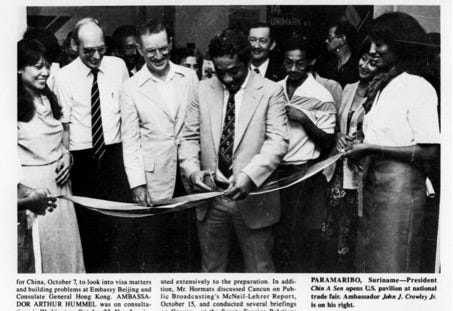
A photograph in State Magazine’s December 1981 issue shows him beside Suriname’s civilian president, Henk Chin A Sen, smiling for the cameras as the two men cut the ribbon at the American pavilion of the national trade fair.[xxv]
“We had a trade fair and we did things to try to stimulate interest in U.S. products,” Crowley later recalled.
This was Carter-era diplomacy at its most earnest: trade fairs, cultural outreach, and the belief that commerce could build goodwill.
Within weeks, that world was over.
Crowley’s recall marked the end of an era.
In Washington, the Reagan administration was already drafting a new foreign policy playbook for the Caribbean Basin.
Crowley’s successor would come from an entirely different background.
Part 3: December 1981
In December 1981, several things happened simultaneously.
First: President Reagan signed Executive Order 12333. We talked about this in a previous episode. This order fundamentally changed how intelligence operations worked.[xxvi]
It gave the US intelligence unprecedented authority. It allowed defense attachés—military officers officially posted to embassies for liaison work—to collect intelligence through “clandestine means.” It created what officials called “enhanced interrogation” authorities.
In plain English: it turned every defense attaché on Earth into a potential spy.
Second: Ambassador Crowley departed Suriname on December 10, 1981. His replacement, Hawthorne Quinn Mills, had been approved by Enders. Mills was perfect for what they needed—he’d just finished managing the U.S. mission in Kabul during the first two years of Soviet occupation. He knew how to operate in hostile environments.
But Mills never made it to Suriname.
His appointment was blocked by the Undersecretary for Management. The official reason? Complaints about “a girlfriend, an Australian girl who came and stayed with him for extended periods” during his Afghanistan posting.[xxvii]
(Listen to two former CIA spies discuss what appears to be this exact situation with Mills—a station chief fired by Ronald Reagan over his Australian girlfriend, leading to the embassy vacancy—in this video below)
Moral concerns. That was the excuse.
But it was pretty convenient, wasn’t it? Creating an eight-month leadership vacuum right when covert operations were ramping up?
Third: Also in December 1981, John Bolton visited Suriname. Yeah, that John R. Bolton—the guy who decades later would admit on CNN that he’d “helped plan coups,” and even got a trophy from the Reagan administration.[xxviii][xxix]
In 1981, Bolton was AID General Counsel.[xxx] His official mission was assessing whether Suriname qualified for economic assistance. But Bolton had strong opinions about how foreign aid should be used: as a weapon. Supply-side foreign assistance, he called it. Use aid to force pro-business policies. Block programs that don’t serve anti-communist objectives.
Bolton’s visit established the legal framework. What aid could be offered. What aid would be withheld. What pressure points existed in Suriname’s economy.¹⁶
Fourth: Around the same time, JSOC teams were in the country. Remember the “birdwatchers” we talked about in Episode 4?[xxxi] They were mapping Fort Zeelandia, surveying the airport at Zanderij, identifying communications facilities and power infrastructure.
Everything you’d need to know if you were planning to take down a government.
By the end of December 1981, the pieces were in place:
– The legal authorities (EO 12333)
– The leadership vacuum (no ambassador)
– The economic assessment (Bolton’s visit)
– The military reconnaissance (JSOC teams)
– The human intelligence infrastructure (Crowley’s network)
All that was missing were the operators who could turn this infrastructure into action.
And look at how perfectly these pieces fit the new ELASTIC FENCE doctrine .
The ELASTIC FENCE plan called for massive, overt military pressure—the ‘Loud Stick’. The JSOC ‘birdwatchers’ in Paramaribo were the covert ‘Special Operations’ equivalent, mapping the exact targets.
The ELASTIC FENCE plan used the Caribbean Basin Initiative as an economic ‘carrot’ to reward allies like Jamaica. John Bolton’s visit was the ‘stick’—assessing how to use economic pressure against an enemy.
The Reagan administration was building a regional ‘fence’, and the Wolf Pack wasn’t just in Suriname—they were building the Surinamese link in that fence.
Enter the Wolf Pack.
Part 4: The Roster
By early 1982, something unusual was happening at the American embassy in Paramaribo.
The ambassador’s residence sat empty. John Crowley had been recalled in December 1981, and his replacement never arrived. For eight months—January through August 1982—the mission ran without its top diplomat. A power vacuum disguised as “continuity of operations.”
But this wasn’t bureaucratic incompetence. It appeared deliberate. And in that vacuum, a very specific kind of officer began arriving in Suriname.
Not traditional diplomats trained in negotiation and compromise. Not development specialists focused on building schools and infrastructure. These were operators. Intelligence professionals whose careers read like a greatest hits album of CIA covert operations. Men who knew how to cultivate assets, manipulate media, and coordinate regime change.
Welcome to what we’re calling The Wolf Pack.
Before we dive in, remember Arthur M. Schlesinger Jr.’s, “Memorandum on the CIA,” which said, “At the time of Kennedy’s inauguration, 47% of political offices in US embassies around the world were actually CIA agents.” Now was that 47% at normal threat levels? How many agents were there when it was a real hot spot? I’ll let you decide.
Let me introduce you to three men. Their deployment wasn’t random. It wasn’t improvised. These assignments had been planned months in advance, coordinated at the highest levels of the Reagan administration, and timed to coincide with the exact moment when no ambassador would be watching.
Richard R. LaRoche: The Intelligence Architect
Richard “Dick” LaRoche showed up in Paramaribo as Deputy Chief of Mission—second-in-command of the embassy—somewhere between December 1981 and January 1982. Right as Ambassador Crowley’s plane was leaving.
In that eight-month vacuum, LaRoche became acting Chargé d’Affaires. Which means he had authority no deputy chief of mission should ever possess under normal circumstances. He could coordinate directly with CIA headquarters. He could bypass normal State Department channels. He could run operations.
And LaRoche knew exactly how to use that authority. Because by 1982, his career had already taken him through some of the darkest chapters of Cold War intelligence operations.
Indonesia: Where Mass Murder Met Intelligence Work
LaRoche’s first overseas posting was Jakarta, Indonesia, from September 1968 to 1971. He arrived as a consular officer just three years after one of the CIA’s most consequential—and brutal—Cold War operations.
In 1965, General Suharto seized power in what was officially called an anti-communist coup. What followed was systematic genocide. Between 500,000 and 1,000,000 suspected communists were murdered. Shot, stabbed, beheaded, thrown into rivers. Entire villages wiped out.
And here’s what makes LaRoche’s posting significant: U.S. Embassy personnel reportedly provided lists of Communist Party members to Indonesian death squads. Names, addresses, organizational affiliations. The embassy helped facilitate the killing.[xxxii]
Now, was LaRoche personally involved in those operations? We don’t know. He arrived three years after the height of the massacres. But he was working inside an embassy environment where that kind of intelligence collaboration had just happened. Where providing names to death squads was considered acceptable tradecraft.
And there’s another telling detail: LaRoche had an unusually large travel budget for a consular officer. Elizabeth Ann Swift, who served as Economic/Political Officer in Jakarta at the same time, later recalled being “very, very jealous” of LaRoche “because [he] did much more traveling, had a bigger travel budget than we did up in the political section.” She described joining him on trips where they “went all up through [Borneo] by dugout canoe… Carrying the American flag going to visit our constituents.”[xxxiii]
On the surface, LaRoche was helping missionary families with “passport services, and reports of birth and all that sort of stuff.” But that enhanced travel budget—money that normal State Department budgets didn’t cover—is a classic tell. That’s how the CIA supplements an officer’s official diplomatic role. Extra funding for “outreach” that’s really intelligence gathering.
Australia and the Five Eyes Intelligence Network
LaRoche’s next assignment confirms the intelligence pattern. From October 1971, he served as “special assistant” in Canberra, Australia.
Now, if you’re not familiar with intelligence terminology, a “special assistant” posting in Canberra is classic CIA liaison work. Australia is part of what’s called the Five Eyes intelligence alliance—a signals intelligence sharing agreement between the United States, United Kingdom, Canada, Australia, and New Zealand.
It was originally established in 1946 to share intercepted Soviet communications, and it’s still the backbone of Anglo-American intelligence cooperation today. Let me explain what this means, because it’s important for understanding how intelligence actually flows between allied countries.
What Five Eyes means in practice: These five countries share virtually everything. SIGINT—signals intelligence, intercepted communications. HUMINT—human intelligence from recruited sources. IMINT—imagery intelligence from satellites and reconnaissance aircraft. If the CIA intercepts a phone call in Moscow, the Australians get a copy. If British intelligence recruits a source in Jakarta, the Americans know about it.
This isn’t just information sharing—it’s operational coordination. When the British signals intelligence agency GCHQ intercepts communications in Hong Kong, they don’t just send reports to Washington. They coordinate in real-time. The NSA sees the raw intercepts. CIA station chiefs get immediate access. Military planners incorporate the intelligence into operational planning. It’s a seamless, integrated intelligence apparatus spanning five countries.
And during the early 1970s, Australia was a critical Five Eyes partner for Southeast Asian operations. Australian intelligence was tracking Indonesian military movements, monitoring Pacific shipping, providing ground truth for Vietnam operations. LaRoche’s “special assistant” role meant coordinating that intelligence flow. Making sure American operations in the region aligned with Australian assessments. Ensuring operational security when U.S. and Australian interests overlapped.[xxxiv]
This isn’t speculation. Intelligence liaison positions in Five Eyes capitals are standard CIA postings. They’re how the agency maintains institutional relationships with allied services. And they’re usually given to officers being groomed for senior operational roles.
Chile, Grenada, and the Pattern Emerges
After Australia, LaRoche’s career path took him to Chile—during the Pinochet years. Another country where the CIA had played a decisive role in regime change. More experience with economic destabilization, media manipulation, cultivation of military assets. The same playbook that would later be deployed in Suriname.
But it was his next posting that really matters for our story. From 1977 through 1981, LaRoche served as U.S. Consul in Bridgetown, Barbados, with responsibility for covering Grenada.
And here’s what the cables reveal: LaRoche wasn’t just passively monitoring Grenada. For at least a year before Maurice Bishop’s coup, he’d been actively cultivating relationships with New Jewel Movement leaders. Ambassador Frank Ortiz later noted that “in the past year this embassy has maintained good relations with New Jewel leaders”—describing them as “well-educated, young, idealists” who had “not demonstrated particular hostility to the U.S.”
This is classic intelligence preparation. You don’t wait for revolutionaries to seize power and then try to understand them. You identify potential future leaders while they’re still in opposition. You build rapport. You establish trust. You position yourself so that when they do take power, you’re not a stranger—you’re someone they already know. Makes you wonder if someone wasn’t doing the same thing with Bouterse before he took power.
On March 13, 1979, Maurice Bishop’s New Jewel Movement seized power in a bloodless coup. Within 24 hours, LaRoche was dispatched by ship to Grenada—not for routine consular work, but as active intelligence collection during a revolutionary crisis.
When the Barbados Coast Guard vessel arrived in St. George’s Harbor on the morning of March 14, Bishop himself boarded the ship to greet LaRoche. Think about that. The leader of a brand-new revolutionary government, still consolidating power, still worried about counter-coups, personally boards a foreign vessel to assure one American diplomat that he can “travel anywhere on island and telephone out.” That’s not normal diplomatic protocol. That’s the kind of access you get when you’ve spent a year building relationships.
LaRoche stressed he was in Grenada “purely on consular business” to ensure the safety of American citizens. But the cables show something very different. Within his first 72 hours on the ground, LaRoche was conducting substantive policy meetings with the entire New Jewel leadership.
On March 16, 1979—just three days after the coup—LaRoche had a two-hour meeting with Maurice Bishop, Bernard Coard, Unison Whiteman, Hudson Austin, and George Louison. The entire revolutionary command structure. The cable describes the meeting as “extremely relaxed and freewheeling. New Jewelers were open to any questions. There was no evidence of hostility to U.S.”
This level of access is extraordinary. Most diplomats spend months or years trying to get face-time with revolutionary leadership. LaRoche got it immediately because of the relationships he’d built beforehand. And what he learned in those meetings—NJM leadership dynamics, ideological debates, factional tensions, personal rivalries—became foundational intelligence.
But LaRoche wasn’t just collecting facts. He was conducting sophisticated psychological assessment. In an April 10, 1979 meeting, he documented that Bishop was “exhausted and not very responsive” and showed “extreme anxieties prevailing in Grenada.” Bishop was desperate for American legitimacy. He was asking the U.S. for arms to defend against counter-coup attempts. He was denying that Cuba had offered military assistance and stressing such help would only be accepted “in extreme circumstances.”
Ambassador Ortiz’s assessment, based on LaRoche’s reporting, is revealing: “Statement of U.S. position on Grenadian ties with Cuba had a visible impact on Bishop. Bishop is obviously under great stress as he discovers that it is easier to oppose a government than to run one.”
LaRoche was identifying psychological vulnerabilities. Bishop’s fear of U.S. displeasure. His desperation for legitimacy and security. His anxiety about being perceived as a Cuban puppet. His exhaustion and stress. These weren’t just observations—they were intelligence assessments of exploitable weaknesses.
And he was mapping the internal dynamics that would later tear the regime apart. The March 16 cable documents both Bishop and Bernard Coard present at that early meeting. Four years later, Coard would lead the faction that overthrew and executed Bishop—creating the crisis that justified U.S. invasion. LaRoche was watching those factional tensions develop from day one.[xxxv]
Those reports would later become the foundation for Operation Urgent Fury—the October 1983 invasion of Grenada. When Delta Force and the 82nd Airborne stormed the island, they were using intelligence LaRoche had gathered four years earlier. Who the key players were. Where they lived. Which military units were loyal. What would make the regime vulnerable.[xxxvi] Bishop’s psychological weaknesses. Coard’s factional ambitions. Internal New Jewel divisions. External dependencies on Cuba and the Soviet bloc.
And here’s what’s crucial: When the invasion succeeded, LaRoche didn’t just get mentioned in after-action reports. He earned commendations from David D. Newsom, who was the Under Secretary of State for Political Affairs from 1978 to 1981. This was the third-highest-ranking position in the State Department. Official recognition for his intelligence work that made the operation possible.
The State Department doesn’t hand those out for routine diplomatic reporting. You get commendations for operational intelligence that saves lives and achieves mission objectives. For identifying targets that lead to successful operations. For developing sources who provide actionable intelligence. For building the intelligence architecture that makes military operations possible.
LaRoche had spent four years building that architecture. From his first meetings with Bishop in March 1979 through the regime’s collapse in October 1983, he was systematically documenting vulnerabilities, mapping leadership dynamics, identifying pressure points. The intelligence pipeline he built—from real-time reporting to psychological assessment to operational planning—became the model for how intelligence professionals support military operations.
Think about what that means. LaRoche spent years studying how to overthrow Bishop’s revolutionary government. Learning the regime’s structure from his first meetings with the entire NJM leadership. Identifying psychological vulnerabilities from Bishop’s exhausted desperation for American approval. Building intelligence networks that documented every factional tension, every external dependency, every potential weakness. Then he did it again in Suriname with Bouterse. This wasn’t improvisation. This was a refined methodology being systematically applied. And when Bishop came to visit a few months later, LaRoche would know exactly what buttons to push.
The Training That Gave It Away
Here’s where the timing gets really interesting. In August-September 1981—precisely when CIA’s Dewey Clarridge was briefing Director William Casey about Suriname becoming a Soviet satellite—LaRoche was attending a specialized Deputy Chief of Mission training program in Washington.
The intensive ten-day seminar taught DCMs to “manage their staffs,” “assume the role of chargé d’affaires at any time,” and understand “what goes on in the other agency offices at post.” State Department newsletter described the program as preparing deputies who would need to run missions independently.[xxxvii]
And four months later? LaRoche was in Suriname, running the embassy during an ten-month ambassadorial vacuum. Using exactly the autonomous authority his training had prepared him for. Weird, right?
The coincidence is too perfect. Dewey Clarridge, CIA Chief of the Latin America division, briefs the Director of Central Intelligence, Bill Casey, about Suriname in September 1981.[xxxviii] LaRoche trains for unsupervised DCM operations in August-September 1981. By January 1982, he’s in Paramaribo with no ambassador watching. This wasn’t reactive. This was positioned months in advance.
What LaRoche Did in Suriname
LaRoche quickly established himself as what intelligence officers call “a man about town.” Regular meetings with labor leader Cyriel Daal of the Moederbond, Suriname’s most influential union federation. The meetings were so frequent and so obvious that Bouterse personally ordered surveillance of these contacts.
He established direct communication channels that bypassed Ambassador Robert Duemling, who arrived in August 1982. LaRoche maintained contact with CIA headquarters for operational guidance. He developed Henk Chin A Sen and even Roy Horb—one of Bouterse’s closest advisors—as a high-value assets.[xxxix] He coordinated with Edward Donovan on psychological operations.[xl]
Bouterse’s Foreign Minister Harvey Naarendorp eventually went public with their surveillance: Daal “visited the American embassy three times a week” to meet with a person who had previously “led the destabilization in Chile against the progressive government of Allende”—a direct reference to LaRoche.[xli]
Ambassador Duemling later admitted the obvious: “I was Ambassador in name only. LaRoche and Donovan were running the show.”[xlii]
The December Murders and After
On December 8, 1982, Bouterse’s forces rounded up fifteen opposition figures. Labor leader Cyriel Daal. Journalists. Lawyers. University professors. Military officers. They were taken to Fort Zeelandia, tortured, and executed.
The tragedy was that Daal—whose prominence as a democratic voice had been carefully enhanced by LaRoche’s operations—became the primary target precisely because of that prominence. As Labor Officer Anthony Kern later reflected, Daal was “so vocal” that “it resulted in his unfortunate ending.”[xliii]
Let that sink in for a moment. The CIA and State Department elevated Daal, gave him resources, amplified his voice—and when Bouterse struck back, Daal was the most visible target. The very success of American operations in making him prominent got him killed.
LaRoche was expelled from Suriname in January 1983 for “destabilizing activities.”[xliv] But his career didn’t suffer. He was assigned to the State Department’s Office of Inspector General, where he helped redesign audit procedures. Then Saudi Arabia during Iran-Contra operations, when the Kingdom was serving as a financial conduit for Oliver North’s network.[xlv]
The Suriname operation had failed catastrophically. Fifteen people were dead. But the techniques LaRoche had refined—asset development, media manipulation, labor mobilization, direct CIA coordination under diplomatic cover—would be systematically deployed throughout Reagan’s Project Democracy operations.
Edward J. Donovan: The Psychological Warfare Specialist
If Richard LaRoche was the intelligence architect, Edward Donovan was the voice. The psychological operations specialist who knew how to shape narratives, manipulate perceptions, and turn public opinion into a weapon.
Donovan arrived in Paramaribo as Public Affairs Officer—officially with the United States Information Agency (USIA). His job was supposed to be cultural programming, media relations, explaining American policy to Surinamese audiences.
But his career tells you exactly what kind of operation Washington was planning. Operation ELASTIC FENCE was, at its core, a psychological operation. So who do they send? A specialist in psychological warfare from Vietnam, the exact man to implement the doctrine on the ground.
But by the time Donovan showed up in Suriname, he’d spent nearly two decades perfecting techniques for psychological warfare. And his career trajectory tells you exactly what kind of operation Washington was planning.
Brazil 1964: The Blueprint in Action
Donovan’s first documented covert operation was Brazil. Right after the 1964 CIA-backed military coup that overthrew President João Goulart.
Remember two episodes ago—Episode 3, The Brazil Blueprint? We talked about how the CIA perfected a six-track model for regime change. Economic warfare through the IMF. Political manipulation funding opposition candidates. Labor subversion through AIFLD-trained union leaders. Propaganda operations. Military infiltration. Strategic pressure.
Well, Edward Donovan was there. Working those tracks.
While publicly positioned as was an exchange scholarship student hired to teach English to students at the Faculty of Engineering of the University of Recife, Donovan conducted what his personnel file later described as “liaison work.” He attended internal planning meetings for strike movements. He filed detailed reports with the USIS Rio de Janeiro identifying student leaders by name—who was organizing, what their connections were, which ones could be flipped or neutralized.[xlvi]
This is textbook COINTELPRO-style infiltration. Get inside opposition movements. Map their networks. Identify leaders. Report everything up the chain. Then watch as your reports inform decisions about who gets arrested, who gets compromised, who becomes a cautionary tale.
By the time Donovan arrived in Suriname eighteen years later, he’d refined these techniques through multiple deployments. Brazil taught him how to penetrate opposition movements. Vietnam taught him how to weaponize that intelligence for psychological operations.
Vietnam: Where Intelligence Became Psychology
By 1970, Donovan was in Saigon serving as Director of the Psychological Operations Division. This wasn’t just propaganda. This was sophisticated population control.
Counter-propaganda campaigns targeting Viet Cong credibility. Defector recruitment programs—identifying North Vietnamese soldiers who could be turned. Psychological warfare operations designed to undermine enemy morale. Perception management that made American military operations look successful even when they weren’t.[xlvii]
The Vietnam-era PSYOPS playbook was all about controlling the narrative. You don’t just defeat the enemy militarily—you defeat them psychologically. You make them question their cause. You make their own people doubt them. You orchestrate events that look spontaneous but are carefully choreographed to achieve strategic objectives.
Sound familiar? Remember this when we get to Maurice Bishop’s October 1982 visit to Suriname. Airport strikes. Massive counter-demonstrations. Media coverage emphasizing regime weakness. All coordinated, all carefully timed, all designed to humiliate Bouterse on his home turf.
Sri Lanka 1979: Crisis Management and Operational Deployment
Before Suriname, there was one more deployment that shows Donovan’s trusted status for crisis operations: the 1979 Maldives hostage situation.
On February 17, 1979, three American crewmen aboard the U.S. oceanographic research ship Alysee Maru (uh-LEE-see MAH-roo) were detained in the Maldives following an altercation with local authorities. Donovan was immediately dispatched from the U.S. Embassy in Colombo, Sri Lanka, to negotiate their release.
He took over direct diplomatic negotiations with the Maldivian government. Served as point-man for a tactical diplomatic swap where the Americans were released in exchange for Ahamed Mujuthaba, the son of the Maldivian atoll chief. Coordinated with Washington on crisis management.[xlviii]
This wasn’t a routine consular case. This was high-stakes crisis diplomacy requiring someone with operational experience and direct authority to negotiate. The fact that Donovan got the assignment tells you he was already trusted for sensitive field operations requiring both diplomatic cover and operational capability. Remember, the JSOC mission, the U.S. is treating Suriname as a terrorist hostage situation.
The Career Arc: From Infrastructure to Operations
Donovan’s career shows a deliberate progression from technical infrastructure work to strategic policy coordination to field operations. Each assignment built on the last, systematically preparing him for complex regional psychological operations.
In 1977, he was Chief of the Drafting Staff for USIA’s Engineering Division—the International Broadcasting Service. His team created technical drawings and blueprints for Voice of America transmitter stations, antenna arrays, studio layouts. The infrastructure for broadcasting American news and propaganda worldwide during the Cold War.[xlix]
Think about what that means. Donovan understood the technical infrastructure of information warfare. He knew how signals traveled, how transmitters reached audiences, how broadcasting networks were constructed. This wasn’t abstract theory—it was hands-on understanding of how to build the machinery of psychological operations.
By 1985, after being expelled from Suriname, Donovan had moved into policy coordination. He held an extraordinarily broad position within the State Department’s Office of American Republics Affairs, simultaneously serving as Program Officer for the West Coast region (Bolivia, Chile, Colombia, Ecuador, Peru, Venezuela) and Acting Country Officer for the Caribbean (Bahamas, Barbados, Cuba, Dominican Republic, Guyana, Haiti, Jamaica, Suriname, Trinidad/Tobago).[l]
Think about that geographic responsibility. Virtually the entire western coast of South America plus the complete Caribbean Basin. This gave Donovan comprehensive understanding of how leftist movements connected across borders, how revolutionary governments influenced each other, what strategic challenges faced U.S. policy throughout the region.
So when he arrived in Suriname as Public Affairs Officer, he wasn’t just some low-level spin doctor explaining American policy. He was a psychological operations specialist who understood regional revolutionary networks, who had experience infiltrating opposition movements, who knew how to build and execute complex information warfare campaigns.
What Donovan Did in Suriname
In Suriname, Donovan’s psychological operations background would proved crucial during the October 1982 Maurice Bishop visit which we will cover more fully in a later episode. His coordination with labor leader Cyriel Daal demonstrated classic perception management:
Orchestrated airport strikes forced Bishop’s plane to land in darkness, eliminating the photo opportunity of crowds greeting a revolutionary leader. Massive counter-programming drew 15,000 to 150,000 protesters to Daal’s demonstration while Bishop addressed only 1,500 government supporters. Coordinated infrastructure paralysis affecting airports, utilities, banks, and hospitals created the appearance of regime instability. Media amplification ensured international coverage portrayed Bouterse as weak and isolated.[li]
This wasn’t improvised protest. This was sophisticated psychological warfare designed to humiliate both Bouterse and his revolutionary mentor. And it worked—the international media covered it exactly as intended.
When the Surinamese government threatened to expel two embassy officials in November 1982, diplomatic sources publicly identified Deputy Chief of Mission Richard LaRoche and Public Affairs Officer Edward Donovan as the targets. Foreign Minister Naarendorp specifically accused them of inciting the Moederbond to stage the general strike that had paralyzed the country.
Ambassador Duemling later admitted what everyone could see: “LaRoche and Donovan were running the show.” Where LaRoche provided covert operational expertise, Donovan brought the psychological operations and media manipulation skills necessary to implement what NSDD-17 called the “public information task force” directive.[lii]
The Tragic Aftermath
The December 1982 murders destroyed Washington’s immediate plans for regime change. Among the fifteen victims was Cyriel Daal—the labor leader whose prominence Donovan had helped orchestrate. The very success of the psychological operations in making opposition leaders visible and prominent had made them primary targets for Bouterse’s paranoid retaliation.
Donovan was expelled from Suriname in January 1983 for “destabilizing activities” alongside LaRoche. An anonymous letter dated August 8, 1983, later delivered to the U.S. Embassy and purportedly from a group calling itself the “Suicide Commandos,” directly implicated Donovan in the events leading to Daal’s death.
The letter accused: “YOU FOLKS ALONG WITH DONOVAN ALLOWED DAAL AND THE REST TO BE KILLED BECAUSE YOU WERE FULL OF HOLY SHIT PROMISES.” It reflected the perception among some anti-Bouterse elements that U.S. operations had elevated opposition leaders like Daal to prominence without providing adequate protection.[liii]
Donovan died relatively young—just 52 years old—on December 12, 1989 in Lee County, Florida. Less than a month after the fall of the Berlin Wall, as the Cold War he had spent his career fighting was drawing to a close. The psychological operations specialist who once shaped perceptions in Vietnam and Suriname was cremated through the Direct Cremation Society in Cape Coral, leaving behind a legacy that remained largely classified until decades after his death.
Lieutenant Colonel Albert P. “Bob” Buys: The Military Intelligence Coordinator
If LaRoche was the intelligence architect and Donovan was the psychological warfare specialist, Albert “Bob” Buys was the Pentagon’s man on the ground. The military intelligence coordinator whose unique background made him perhaps the most strategically valuable member of the Wolf Pack.
But his role was far more critical in this new context. ELASTIC FENCE’s ‘psychological threat’ was only credible if it was backed by real ‘hard power’. Buys was the liaison for that hard power, the man who would ‘backstop these special teams’ and coordinate with the same military infrastructure being activated for Ocean Venture ‘82.
Because unlike his American colleagues, Buys spoke Dutch. He understood colonial dynamics. He could penetrate Surinamese society in ways that were simply impossible for other U.S. personnel.
Dutch East Indies: A Family History of Occupation and Resistance
Albert P. Buys was born December 5, 1933, in the Dutch East Indies—what’s now Indonesia—to Dutch parents. His father Albertus was a chemist who survived imprisonment in a Japanese POW camp during World War II.
Think about what that family history means. Buys grew up speaking Dutch as his native language. He understood what it was like to live in a colonial society—the relationship between colonizers and colonized, the ethnic tensions, the economic arrangements that benefited the Dutch while exploiting local populations. And his father’s POW experience taught him about occupation, resistance, survival under authoritarian control.
The Buys family arrived in the United States in March 1960 aboard the SS America, when Albert was 21 years old. Part of the broader Cold War displacement of populations from decolonizing territories. By 1965, he’d completed ROTC training and entered active duty with the U.S. Army.[liv]
So when Buys arrived in Suriname—another former Dutch colony with similar ethnic composition, language, and colonial legacy—he wasn’t just another American military attaché. He was someone who instinctively understood the society in ways his colleagues never could.
Vietnam and Military Intelligence Training
Buys saw service in Vietnam with the 490th Combat Support Company by 1966. His rapid promotion through the ranks—Second Lieutenant to Captain in the Quartermaster Corps by 1968, Lieutenant Colonel by October 1971—suggests specialized knowledge and likely intelligence training.
Military records indicate he achieved Military Education Level 7, suggesting completion of Command and General Staff College or equivalent advanced strategic planning education. This level of military education was typically reserved for officers being prepared for high-level staff positions involving strategic planning, joint operations coordination, and intelligence analysis.[lv]
But Buys wasn’t regular Army. He was U.S. Army Reserve—which means he had a civilian career and was activated for specific deployments. His Suriname assignment was one of those activations. The Pentagon specifically called him up for this mission because of his unique qualifications.
The Defense Attaché Transformation Under Reagan
Buys arrived in Paramaribo just as the Defense Intelligence Agency was fundamentally redefining what a military attaché was supposed to be.
The Military Intelligence Professional Bulletin for July-September 1981 laid out the new model in an article that reads like it was written specifically for the Suriname deployment:
“Attachés were no longer just diplomats in uniform but intelligence officers with broad training in both combat and technical fields, capable of writing concise analytic reports, learning foreign languages, and adapting instantly to unfamiliar cultures.”[lvi]
The article even highlighted “the husband-and-wife team” as an ideal—two people whose partnership and social reach could double the embassy’s access in-country. And it specifically noted that Suriname was already listed as a future attaché post.
This wasn’t coincidental. The article was published in July-September 1981—the exact same months when CIA’s Dewey Clarridge was briefing Director Casey about Suriname and when Richard LaRoche was attending his DCM training. The Pentagon was systematically preparing for Suriname operations months before they publicly acknowledged any concern about the country.
And then there’s Executive Order 12333, signed by President Reagan on December 4, 1981. That’s the order that explicitly authorized defense attachés to “collect intelligence through clandestine means.” Not just liaison. Not just open-source reporting. Clandestine intelligence collection.[lvii]
So Buys wasn’t just a defense liaison. He was the prototype of the new attaché system taking shape under Reagan—an intelligence collector with the perfect pedigree for a Dutch-speaking former colony. He and his wife fit the Department’s vision precisely: adaptable, discreet, and already at home in the culture they were sent to observe.
What Buys Did in Suriname
As Defense Attaché, Buys’s responsibilities went far beyond traditional military liaison:
Military capabilities assessment of the Surinamese armed forces—troop strength, equipment status, training levels, morale, factional loyalties.
Regime stability analysis tracking which military units were loyal to Bouterse, which officers might support a coup, what vulnerabilities existed.
Signal and secure communications establishing channels between the embassy and Pentagon for real-time operational coordination.
Terrain and infrastructure analysis providing detailed assessments of Surinamese geography, urban terrain, military installations essential for contingency planning.
And perhaps most significantly: special operations coordination. This role was, in Ambassador Duemling’s view, the entire reason Buys remained at the embassy. Despite considering his Defense Attache to be inept—stating bluntly, “I didn’t think he was very good,” and that he “wasn’t very smart and did some silly things”—Duemling noted he was indispensable. He was needed, in the ambassador’s words, “to take care of the SWAT team types who were coming in, reconnoitering the country” and to “backstop these special teams.” This “backstopping” meant serving as the in-country liaison for the “birdwatcher” teams (Delta Force reconnaissance) as they mapped Fort Zeelandia, photographed government buildings, and identified communication towers—everything required for planning a government takedown. Something the “birdwatchers” returned to do after the December Murders.[lviii][lix]
Buys’s cultural fluency provided operational advantages unavailable to his colleagues:
Direct source access—communication with Dutch-speaking sources without interpreters, providing operational security and more nuanced intelligence collection.
Colonial dynamics understanding—recognition of complex relationships between ethnic groups, political factions, economic interests rooted in Dutch colonial history.
Institutional relationships—natural entrée to Dutch diplomatic, military, and intelligence circles that remained influential in Surinamese affairs.
The Strategic Advantage of Remaining
Unlike LaRoche and Donovan, who were expelled in January 1983 for “destabilizing activities,” Buys maintained a lower operational profile that allowed him to remain in country even after the December Murders. This continuity was strategically crucial:
Maintaining real-time intelligence updates as the crisis unfolded and U.S. policy adapted. Coordinating security for remaining U.S. personnel and potentially facilitating extraction of compromised assets or sensitive materials. Providing ground-truth for Pentagon planners considering intervention scenarios or evacuation operations. Maintaining liaison with neighboring military attachés and regional intelligence networks as the Suriname situation affected broader Caribbean Basin security.
Buys’s presence in Suriname months before NSDD-61 was signed on October 15, 1982—the presidential directive contemplating “all necessary measures”—suggests that Pentagon contingency planning was already underway when the formal authorization was issued. His role would have been crucial for providing the intelligence necessary for that “all necessary measures” language.[lx]
His assessment capabilities would have directly informed the Pentagon’s evaluation of potential intervention scenarios, evacuation requirements, and regional military implications of any U.S. action in Suriname. This advance preparation demonstrates the systematic nature of Reagan administration planning for Caribbean Basin operations.
But the story didn’t stop there.
By early 1982, the pattern was set. The embassy in Paramaribo had become a test case for Washington’s new model: diplomacy fused with intelligence, collection disguised as liaison.
The defense attaché, Albert Buys, covered the military angle. His reports moved through the Defense Intelligence Agency’s channels, coded and analytical. But what the embassy still lacked was a political operator—someone who could interpret Bouterse’s regime not as a foreign army officer would, but as an intelligence analyst trained to read power dynamics inside a collapsing state.[lxi]
That gap would be filled in March 1982, when a new name appeared in the State Department Newsletter: Gardel Feurtado, a former analyst from the Bureau of Intelligence and Research, now bound for Dutch-language training and, after that, the U.S. Embassy in Paramaribo
Just a few months later, State Magazine printed a small personnel notice—easy to miss, tucked between trade-fair reports and retirement blurbs:
“Mary Kosheleff joined the Office of Caribbean Affairs as desk officer for the Bahamas. She replaces Gardel Feurtado, who was assigned to the Foreign Service Institute for Dutch-language training. He will be assigned to the American Embassy in Paramaribo, Suriname.” (State, Issue 243, March 1982)[lxii]
It sounds routine. It wasn’t. That line announced the arrival of a trained political-intelligence analyst at the exact moment the embassy in Paramaribo was becoming a covert operations hub.
Long before Gardel Feurtado entered the Foreign Service, he was studying revolutions on paper.
A decade earlier, he’d published in Asian Survey an analysis of how provincial power blocs formed during China’s Cultural Revolution—how military and civilian factions competed inside a collapsing regime.[lxiii]
His 1979 doctoral dissertation, “Political Stability, Instability and Change,” listed in PS: Political Science & Politics, extended that research into the broader mechanics of regime survival.[lxiv]
By 1980, a State Department directory placed him inside the Bureau of Intelligence and Research (INR), in the Office of Global Issues—the branch that tracked terrorism, narcotics, and political-military threats.
He wasn’t a career diplomat; he was a Stanford-trained analyst of how governments fall.
Then the bureaucratic metamorphosis began.
In January 1981, State Magazine listed Feurtado among new members of the Junior Officer Corps, the first step toward field service.[lxv]
By March, the Senate had confirmed his appointment as a Foreign Service Officer, formally authorizing him to serve overseas.[lxvi]
Within a year he’d moved into the Office of Caribbean Affairs, covering the Leeward Islands and the Netherlands Antilles—Dutch-speaking territories that sat on the same colonial and linguistic axis as Suriname.[lxvii]
It was preparation disguised as routine assignment.
By early 1982, Crowley was gone. LaRoche, Donovan, and Buys were already managing operations on the ground.
And now Washington was sending in someone else who could speak and listen in Dutch.
Feurtado was dispatched to the Foreign Service Institute for language training, then on to Paramaribo.
The magazine notice appeared in March 1982, meaning he likely began Dutch training earlier that year and arrived in Suriname by March or late summer—just weeks before the country descended into its bloodiest political crisis.
On paper, a seamless diplomatic career; in practice, a calculated rotation—from analysis to collection and back again.
Three years after the December Murders, his name appeared in a 1985 Telephone directory for the United States Department of State where he was working for the INR’s Office of Global Issues. INR is the State Department’s analytical arm within the U.S. Intelligence Community. The Office of Global Issues (INR/GI) handled transnational portfolios—terrorism, narcotics, and state-sponsored subversion—all directly relevant to lessons learned watching the Bouterse regime in Suriname.[lxviii]
The loop was complete: academic expert on revolutions, field officer in Suriname, and then back to analysis with real world experience.
Feurtado embodied what the Reagan era was building in real time—a permanent fusion of diplomacy and intelligence under one roof.
Later, at The Citadel—the Military College of South Carolina—Feurtado taught courses on International Terrorism, Domestic Terrorism, and State Terrorism, transforming his analytic past into curriculum.
One of his former students, Dr. Craig Allen, a retired U.S. Air Force counterintelligence officer, later recalled:
“Professor Feurtado was a political-science professor who was ex-CIA.”
It was, in its own way, a perfect full circle—an intelligence professional who once analyzed state violence abroad now teaching future officers how to recognize it at home.
But while the embassy was absorbing new analysts like Feurtado, Washington was already testing the next front.
In mid-January 1982, Deputy Assistant Secretary Steve Bosworth arrived in Paramaribo.[lxix] This time Bosworth was selling the Reagan administration’s new Caribbean Basin Initiative, a sweeping program of aid, investment, and trade incentives meant to tie the region’s economies to Washington’s political orbit.
Foreign Minister Harvey Naarendorp listened carefully but warned that the plan threatened to fragment Caribbean unity.
A February 2 cable from Chargé Richard La Roche recorded the exchange: Suriname would remain “non-aligned,” open to aid from any source—even as Naarendorp prepared to travel from New York straight to Havana.
For Bosworth, whose portfolio blended labor diplomacy with Cold-War economics
, it was familiar territory. He reportedly characterized Suriname as a “friendly” country. While he acknowledged that the U.S. could respect Suriname’s non-aligned foreign policy, he added a subtle but pointed caveat, stating that the U.S. had “no problems with Suriname’s socialism as long as it was not intended for export.[lxx]
The question was how Washington could engage Suriname’s unions to prevent that export. That would fall to a man named Anthony Kern.
Anthony Kern represented something older and blunter: labor diplomacy as covert warfare.
Kern’s official title was Labor Attaché. Which sounds about as threatening as “Assistant to the Regional Manager.”
But if you watched our episode on the Brazil Bluepint, then you understand that the American Institute for Free Labor Development (AIFLD) was one of the Reagan administration’s most powerful Cold War tools:
For those of you who didn’t catch that episode, a quick recap:
AIFLD was founded in 1962 by the AFL-CIO with backing from the CIA and the State Department.²⁹
The public story: AIFLD helped Latin American workers build democratic trade unions. Provided training, technical assistance, connections to international labor movements. Fought for workers’ rights against exploitative governments and corporations.
The actual story: AIFLD was one of the most effective covert influence operations in Cold War history.
The model was tried and true. Take genuine labor issues—workers really were being exploited, unions really did need organizational capacity. Provide real assistance—the training programs were legitimate, the resources were helpful. Build genuine relationships—AIFLD didn’t create fake unions or install puppet leaders.
But then, at critical political moments, those same unions—led by people AIFLD had trained, funded, and connected to international networks—would take actions that aligned perfectly with U.S. strategic interests.
Was it manipulation? Yes. Was it effective? Devastatingly.
AIFLD’s fingerprints showed up on every major U.S. intervention in Latin America:
Brazil, 1964: AIFLD had trained thousands of Brazilian trade unionists in the years leading up to the coup against leftist President João Goulart. When the military moved against Goulart, key unions stayed neutral or actively supported the coup. Coincidence?[lxxi]
Chile, 1973: AIFLD had deep relationships with Chilean truck drivers’ unions. In the months before Pinochet’s coup, those truck drivers launched a strike that paralyzed Salvador Allende’s government—making the country appear ungovernable and setting the stage for military intervention. The strike was real. The grievances were legitimate. The timing? That was AIFLD coordination.[lxxii]
El Salvador, 1980s: While Reagan was fighting a proxy war against leftist insurgents, AIFLD was working with moderate unions that provided political cover for U.S. military aid. “We’re supporting democratic unions, not death squads.” True. Also irrelevant to what was actually happening on the ground.[lxxiii]
By 1982, AIFLD had trained more than 300,000 Latin American workers in its various programs.
Not all of them were witting participants in CIA operations. Most weren’t. They genuinely believed they were learning about democratic trade unionism, about workers’ rights, about how to organize effective collective bargaining.
That’s what made it so effective. The training was real. The assistance was valuable. The relationships were authentic.
And then, when Washington needed political pressure applied through labor action, those relationships paid dividends.
Kern’s Background
Anthony Kern wasn’t some bureaucrat who stumbled into labor diplomacy.
His oral history with the Association for Diplomatic Studies and Training shows exactly the kind of operational experience that made him valuable:
Kern was not a product of academia or the trade union movement, the two most common pipelines for labor attachés. Instead, prior to joining the Foreign Service, Kern worked for the U.S. intelligence community.21 His resume lists service with both the “National Security Agency” and the “Defense Intelligence Agency”.[lxxiv]
The role of labor attachés had long been associated with intelligence work—a perception Kern himself would later dismiss as the “CIA taint”.[lxxv] But in Kern’ case, his career history in the intelligence community (IC) is a documented reality.
When Kern arrived as Labor Attaché, in Barbados. He covered the entire Caribbean from a single office in Bridgetown—Jamaica, Trinidad, Suriname, Guyana. The Deputy Chief of Mission was a Democrat named who Jennings Randolph, tried to fire him. Then, a Reagan appointee named Milan Bish, from Nebraska arrived.
Kern had to convince him that being connected to organized labor didn’t make him a “commie,” but in fact an ally in fighting communism through labor movements, Bish eventually came around.
When asked about the impact of the Cold War on his job, Kern didn’t mince words. He stated, “Well, the Cold War itself I think was the rationale behind setting up the overall foreign Labor Attaché function… I think right up until 1989… that was the motivating cause of the Labor Attaché program”.[lxxvi]
He further elaborated on the specific, political nature of this “rationale.” He explained that during the Cold War, the priorities were not statistics or worker welfare, but “the political aspects.” He defined his central concern in stark, operational terms: “block a union from going Communist.”[lxxvii] Not neutral labor reporting. Not collective bargaining for its own sake. Active, anti-communist intervention at the union level.
The primary target in Kern’s immediate area of responsibility was the People’s Revolutionary Government (PRG) of Maurice Bishop in Grenada. The Reagan administration was “outright hostile” to the PRG from the outset 16 and immediately implemented a “destabilization and denial’ policy of economic isolation” against Grenada, Nicaragua, and Cuba in 1981.[lxxviii]
Anthony Kern was posted to Bridgetown, Barbados, the diplomatic and logistical hub for the Eastern Caribbean, at the precise moment this multi-year “destabilization” campaign against Grenada was being initiated. This campaign, which included CIA and Pentagon “plans for the destabilization of and American intervention in Grenada” devised as early as 1981, would culminate in the U.S. invasion (Operation Urgent Fury) in October 1983.[lxxix] Kern’s arrival in 1981 placed him on the front line of Reagan’s, high-stakes communist “rollback” operation. His role as the U.S. government’s principal contact with the region’s labor movements would have been central to this campaign.
And Kern didn’t work alone. He partnered “in conjunction” with the American Institute for Free Labor Development—AIFLD—a CIA-implicated organization with a documented history of using “prolonged strikes” and “covert activities” to topple governments in Guyana, Brazil, and Chile.[lxxx]
When Kern arrived in Barbados, a “far left newsletter” in Trinidad greeted him with big banner headlines: “The Great Destabilizer Is Here.”[lxxxi]
Kern claimed this was paranoia. But given AIFLD’s documented history, that newsletter had pretty accurately identified his function.
He describes his relationship with AIFLD Executive Director Bill Doherty—the same man who bragged about AIFLD’s role in the 1964 Brazil coup—as “fantastic.” Kern effusively praises Doherty’s “knowledge of political developments throughout the Caribbean”[lxxxii] and his access to “folks on the National Security Council and the White House”.
On the ground in Barbados, Kern’s direct operational partner was “Mike Donovan,” the AIFLD representative. Kern states plainly that he worked “in conjunction with the AIFLD representative Mike Donovan… in selecting candidates” for U.S. government-funded International Visitors Programs (IVP). This collaboration was seamless, with Kern describing “a real consensus” on which labor leaders to select for U.S.-sponsored training and support.
This partnership is the critical, functional mechanism connecting Kern to the destabilization apparatus. Kern, as the official U.S. government representative (and ex-IC officer), provided the official diplomatic access, the imprimatur of the U.S. Embassy, and the control over U.S. Information Agency (USIA) and AID program slots.[lxxxiii] AIFLD, the CIA-implicated and USAID-funded cutout, provided the non-governmental cover, the established anti-communist labor network, and a layer of plausible deniability. This Kern-Donovan partnership was the delivery system for U.S. “rollback” policy in the Eastern Caribbean labor sector.
But Suriname in 1982 presented unique challenges.
The country had strong, legitimate labor unions with genuine worker support. The Moederbond federation had historically been powerful. These weren’t paper organizations you could buy off or marginalize.
The unions had initially supported Bouterse’s coup. They saw the military takeover as overthrowing a corrupt elite that had failed workers. There was real popular enthusiasm.
Kern couldn’t just throw money at anti-government unions and hope for the best. He needed to identify leverage points. Find existing fractures. Wait for the regime to create its own opposition.
And Desi Bouterse—bless him—couldn’t help but create opposition.
Jack P. Gatewood,
The March 1981 roster of Foreign Service nominations wasn’t a Carter-era relic. It was the first batch of appointments under Ronald Reagan.
On the list, two names jump out — one, we’ve already discussed, CIA agent, Gardel Feurtado. The other is five rows beneath him—Jack P. Gatewood.[lxxxiv]
Both would end up in Suriname within a year.
On paper, just new Foreign Service officers.
In reality, the vanguard of a new kind of embassy — one where diplomacy and intelligence were about to become the same thing.”
Embassy assignments are typically dispersed; it’s unusual for two brand-new FSOs from the same intake to end up at the same post, especially one as small as Paramaribo.
That alone raises the probability that both were selected for specific complementary roles, even if one was overt and one covert. Often times, the CIA often paired an overt State Department officer with another FSO who served as either cover or liaison.
The Tehran Embassy pre-1979 (CIA paired with AID officers).
Santiago pre-1973 (CIA paired with USIA and Political Officers).
Port-au-Prince and Managua in the early 1980s (CIA paired with junior political or consular staff).
These “dual” deployments allowed the embassy to carry out intelligence work under diplomatic protection, without formally classifying both officers as CIA.
So if Feurtado was intelligence, Gatewood’s proximity to him in assignment and intake would fit a standard State–CIA pairing model. Its especially odd given that Paramaribo was a tiny post — a few dozen Americans at most. Every slot was scrutinized. You wouldn’t randomly send two rookies from the same intake there unless: One was covering for the other’s activities, or Both were part of a specialized team rotation (e.g., “junior officer” slots selected for intelligence suitability).
So, in such a small, high-sensitivity post, the odds that both served purely administrative or consular roles are very low.
It doesn’t prove Jack’s CIA affiliation, but whether Gatewood was CIA himself or simply part of the same operational circle, the signal was clear: this wasn’t ordinary diplomacy anymore.”
But what was he doing there? His official title was Economics Officer.[lxxxv] Another J.D.—this time from University of Texas Law School.[lxxxvi] Two lawyers on a small embassy staff? That’s not random.
Gatewood managed the economic track of destabilization. While Arnold Campbell cultivated political opposition and Tony Kern organized labor strikes, Gatewood was monitoring something even more powerful: the economic weapon.
As mentioned earlier, in February 1982, Dutch Foreign Minister Max Van der Stoel stated publicly that the development aid treaty was “up for discussion” because the military power holders were “sliding in a totalitarian direction.” So the squeeze was already on. After the December Murders, the U.S. and Netherlands immediately suspended all development aid. The Dutch aid alone accounted for more than 90 percent of bilateral aid to Suriname. The aid freezes were a “severe blow” that plunged the regime into “severe financial impasse.”[lxxxvii]
Gatewood was the embassy’s lead officer gathering intelligence on and reporting to Washington about the efficacy of this economic warfare. His reporting fed CIA and State Department analyses about how effectively the sanctions were working.
But Gatewood had a second function: protecting the most critical U.S. asset in the country—Suralco, the Alcoa-owned bauxite company that accounted for 75 percent of Suriname’s exports and 80 percent of export revenue.[lxxxviii]
The conflict was acute. Bouterse’s nationalist advisers wanted to nationalize U.S. bauxite interests. Meanwhile, Suralco was pushing for tax cuts, citing the global aluminum recession.
By April-May 1983, just months after the December Murders and aid freezes left Bouterse financially desperate, the regime granted Suralco “significant cuts in bauxite production taxes through 1985.”[lxxxix] Compare that to what Delta Force founding member Eric Haney said in the last episode:
“Now what, you might ask, could a little country do to get itself into such a notorious position that the greatest power in the world felt so threatened that it had no choice but to make war? Simple. It had decided to tax the largest corporate concern located within its borders. But this wasn’t just any company. This was a huge and powerful American corporation. As the largest and wealthiest entity in this small country, this company was smugly accustomed to having its own way. And having its own way did not include paying taxes to its poor, third world host. When the American corporation’s efforts to stave off the implementation of that tax proved unsuccessful, the company took its concerns to Uncle Sam, where it found a sympathetic ear. It was quickly decided that such a tax rammed down the throat of one of America’s largest, most respected companies was not only wrong—it was communist!
They after what he describes as a “coup” by the CIA, he says, ““Before long, concordance was reached. The old president agreed to step down, the guerrillas came out of the forest, the obnoxious tax law was repealed, and everybody went back to the carefree and lighthearted ways of before.”[xc]
So, the political and labor tracks failed catastrophically. But the economic track, managed by Gatewood, was a stunning success. The crisis created by the other tracks provided exactly the leverage needed to protect U.S. corporate interests.
Read that again. The U.S. sanctioned Suriname’s government. Strangled its economy. Created a financial crisis. And then the single largest American company in the country used that crisis to extract tax cuts.
Jack Gatewood was the embassy officer monitoring both sides of this equation. The economic warfare against the regime. And the protection—even enhancement—of U.S. corporate interests.
The Reporting Chain
Gatewood’s reports fed directly into CIA economic assessments. Documents like “Suriname: An Economy Under Siege” and “Suriname: Economic Troubles Compound Political Problems” drew heavily on embassy reporting.[xci]
These weren’t neutral economic analyses. They were operational assessments of whether the destabilization campaign was working.
The documents tracked specific metrics: – Foreign exchange reserves declining – Government unable to meet payroll – Popular dissatisfaction rising – Business community turning against regime – Military morale declining due to economic conditions
Each metric was a measure of success. Each indicator of economic pain was evidence the strategy was working.
And Gatewood was the primary source of this intelligence.
The Economic Warfare Doctrine
What Gatewood was implementing in Suriname was part of a broader Reagan administration strategy.
National Security Decision Directive 17—the same directive that authorized paramilitary operations against Nicaragua—explicitly called for economic pressure as a tool of regime change.[xcii]
The theory was simple: make the targeted government face a choice. Either: 1. Change your policies to align with U.S. interests, or 2. Watch your economy collapse and face popular revolt
There’s no middle ground. No negotiation. Just pressure.
In Nicaragua, this meant mining harbors and attacking oil facilities. In Suriname, it meant aid suspension and coordinated international isolation.
The message to Bouterse was clear:
This will continue as long as you remain in power.
Resume democracy? Aid resumes. Align with the West? Investment returns. Replace the regime? Economic recovery begins.
It’s not complicated. It’s just ruthlessly effective.
And it had one enormous advantage: the economic pressure hurt Bouterse’s popularity with the exact groups who might support a coup.
Hindu business leaders who’d initially tolerated the military regime? Now they were losing money and watching their businesses fail. They became receptive to regime change.
Workers who’d initially supported Bouterse’s populist rhetoric? Now they were unemployed or facing pay cuts. They became receptive to strikes and labor action.
Middle-class professionals who’d hoped the military would bring stability? Now they were watching the economy collapse. They became receptive to pro-democracy opposition.
Jack Gatewood didn’t need to convince these people that Bouterse was bad. The economic conditions did that for him.
He just needed to make sure they understood the economic pain would continue until new leadership emerged.
That’s economic warfare. That’s how you use international financial systems as weapons of regime change.
That’s how an “Economic Officer” becomes an essential part of a destabilization operation.[xciii]
ACT I – Part 4: The Carter Holdovers
When LaRoche, Donovan, and Buys arrived in Paramaribo, they didn’t find an empty embassy waiting for them. The place was already staffed. Carter-era diplomats who’d been there since before the coup, before Reagan, before anyone in Washington decided Suriname mattered.
Most of those holdovers would be cycled out over the coming months—reassigned, retired, replaced with Reagan loyalists. But a few stayed. Not because Washington forgot about them, but because they brought something the Wolf Pack couldn’t replicate.
They brought access.
Cornelis Keur: The Dutch Speaker
Cornelis Mathias Keur looked, on paper, like a typical mid-career Foreign Service Officer. Born in Holland in 1940, he’d immigrated to the United States as a young man and graduated from the University of Michigan in 1968 with degrees in Philosophy and English. He joined the Peace Corps, serving in Thailand from 1968 to 1969, his training biography noting he spoke Dutch and German and had worked as a “bricklayer, construction-surveyor and supervisor.”[xciv]
By 1981, he was serving as Consular Officer at the U.S. Embassy in Paramaribo—processing visa applications, helping American tourists who lost their passports, the routine bureaucratic work that keeps an embassy running.[xcv]
But there were details in Keur’s background that made him quietly valuable.
In a career profile he’d write years later, Keur mentioned almost in passing that he’d spent “six months working on a Chinese gold-prospecting concession in N. Laos” during the early 1970s.[xcvi] Northern Laos during that period wasn’t exactly a destination for civilian contractors—it was the heart of the Secret War, the CIA’s largest paramilitary operation until Afghanistan.
Whether that work connected to intelligence activities or was simply entrepreneurial fortune-seeking, it showed Keur could operate in complex, dangerous environments where the lines between business, politics, and intelligence often blurred.
But the most valuable thing Keur brought to Suriname wasn’t his work history.
It was something simpler: he was Dutch, but he wasn’t from the Netherlands.
The Trust Differential
Suriname in 1982 was still shaped by 300 years of Dutch colonial rule. Independence in 1975 hadn’t erased the complicated feelings that legacy created.
The Hindu and Javanese communities—brought as indentured laborers to replace enslaved Africans after abolition—maintained complex relationships with Dutch identity. They spoke Dutch as a first language, maintained Dutch cultural practices, felt connected to Dutch civilization in ways both genuine and fraught with colonial memory.
But they didn’t trust the Dutch from the Netherlands. Those Dutch were colonial administrators, overseers, people who came to extract wealth and enforce hierarchies. Those Dutch looked down on Surinamese Dutch speakers as inferior.
Keur was different. Dutch-born but American-raised. Fluent in the language but without the accent and affect of a Netherlands native. He understood the culture intimately but wasn’t part of the colonial establishment.
That made him someone the Hindu and Javanese communities could trust in ways they could never trust a diplomat from The Hague.
And in Paramaribo in early 1982, that kind of access was gold.
While the Reagan appointees were obvious Americans—learning the country, building contacts, establishing presence—Keur was already there. Already embedded in the community. Already trusted.
He was the consular officer. Routine work. Visa applications and passport renewals.
But he was also moving through Surinamese society in ways his American colleagues couldn’t. Attending community events. Building relationships. Speaking the language that opened doors.
Whether Keur understood how valuable that made him—whether he knew that “routine consular work” could double as intelligence collection—the documentary record doesn’t say.
What it does show is that he was there. Positioned. Connected.
Right where he needed to be.
But here’s where the Wolf Pack gets sophisticated.
In 1982, two people arrived in Paramaribo who represented something new in American covert operations.
Not new in concept—intelligence services had used married couples for decades—but new in execution.
New in how thoroughly they’d integrated operational capability with diplomatic cover.
Arnold and Martha Campbell: Intelligence Through Intimacy
If Keur provided cultural access to the Hindu community, Arnold and Martha Campbell provided something equally crucial: operational infrastructure wrapped in the perfect cover of a diplomatic marriage.
But before we get to what made them so effective, you need to understand what they represented: a model that intelligence agencies had been perfecting for decades.
The husband-and-wife Foreign Service team. On the surface, it looks like enlightened personnel policy—letting married couples serve together, supporting dual-career families, making embassy life more humane.
And that’s true. It is all those things.
But it’s also something else.
It’s what intelligence professionals quietly call “Intelligence Through Intimacy.”
The Model
Here’s what makes husband-and-wife Foreign Service teams so valuable from an intelligence perspective: complete privacy for sensitive discussions.
Traditional spycraft is vulnerable:
· Dead drops can be surveilled
· Encrypted cables can be intercepted
· Even safe houses carry risk
But a diplomatic residence? That’s protected by the Vienna Convention. Host countries can’t bug it without violating international law. Embassy security sweeps it regularly for electronic surveillance.
And when the two people inside that protected space are both intelligence-cleared Foreign Service officers working the same operation—you get a self-contained planning cell that’s virtually impossible to penetrate.
Arnold comes home from a meeting with a Hindu business leader, closes the door, and debriefs with Martha. She’s the only person in the room. They plan. They coordinate. They execute.
No paper trail. No intercepted communications. No third parties who might talk.
Just two professionals who trust each other completely—working the same problem from complementary angles.
That’s Intelligence Through Intimacy.
Arnold “Arni” Campbell: The Carter-Era Holdover
Now, you might be thinking: Okay, Matthew, but maybe they were just a normal diplomatic couple assigned together.
Let’s test that theory against Arnold Campbell’s actual career history.
Arnold graduated from Notre Dame Law School in 1975 with a J.D.[xcvii] Law degrees are valuable in the Foreign Service for policy analysis, treaty negotiation, and international law.
But look at where Arnold got posted according to his obituary:[xcviii]
· East Berlin (Cold War front line): Learning Soviet surveillance techniques, operating in the most hostile intelligence environment in Europe
· Budapest (Behind the Iron Curtain): Practicing what he learned in East Berlin, in a slightly looser environment
· Rotterdam (NATO ally): Dutch language and culture immersion, learning to operate within the Netherlands’ colonial network
· Marshall Islands (Strategic Trust Territory): Understanding how to work in small-country environments where U.S. influence is disproportionate
· Adana, Turkey (Major NATO base): Military intelligence coordination in a key Cold War theater
This isn’t a random Foreign Service résumé. It’s a training ladder—progressively tougher posts that built political access, cultural fluency, and operational discipline.
You learn surveillance in East Berlin. You practice in Budapest. You learn cultural nuance and Dutch in Rotterdam. You learn small-country leverage in the Marshalls. You learn military integration in Turkey.
And then you get posted to Paramaribo—twice.
Here’s the crucial detail that changes everything: Arnold served in Suriname as early as 1979, confirmed by embassy notices and State Department directories listing him as Vice Consul under both Ambassador Nancy Ostrander and Ambassador John Crowley.[xcix]
A 1979 notice in Free Voice—an independent Surinamese weekly—listed Arnold H. Campbell as the Vice Consul at the U.S. Embassy in Paramaribo. The notice itself was routine—just a change in visa office hours—but it proved that Campbell was already stationed in Suriname a year before the 1980 coup.
“Effective as of October 8, 1979, the visa days and hours of the Consular Section of the American Embassy have again been changed. You may now visit us on Tuesday from 12 to 2 p.m., and Thursday from 9 to 11 a.m. — Arnold H. Campbell, Vice Consul.”[c]
That made him one of the few American officers to bridge the pre- and post-coup periods—a career diplomat who watched Suriname transform from a quiet, low-priority post into a Cold War flashpoint.
At that time, Suriname wasn’t even important enough to have a CIA station. Neul Pazdral, the deputy chief of mission, later said flatly, “We didn’t have a station yet.”[ci] Paul Good, the public-affairs officer, recalled that any Agency work came from TDY officers flying up from Brazil.[cii] Even Ambassador Ostrander was caught off guard by the coup; she woke to gunfire and later confirmed, “Nobody knew it was coming—not even the sergeants.” [ciii]
Before 1980, the embassy’s mission was standard Carter-era diplomacy: human rights, labor reporting, cultural outreach. Suriname simply wasn’t on Washington’s radar.
Which makes Arnold Campbell’s early presence—and his decision to stay—all the more significant.
By the time the Reagan administration began retooling the mission in 1981 and 1982, Arnold hadn’t left. He was still there: same desk, same access—but now reporting into a chain of command that was shifting from Carter’s human-rights idealism to Reagan’s rollback aggression.
He didn’t need to arrive with a covert briefcase. He just had to stay put while the definition of his job changed around him.
Martha Campbell: The Infrastructure Specialist
Arnold by himself wasn’t the complete package. He had political access—but he needed operational infrastructure.
Enter Martha “Marti” L. Campbell.
By mid-1982, Arnold’s wife, Martha L. Campbell, joined the mission as Administrative Chief—a timing that would prove significant.[civ]
Her approximate arrival date: June 1982.
June 1982 was the exact month when, according to declassified CIA documents, the Agency was ramping up operations in Suriname. It was the month when pressure was mounting on Bouterse’s regime. It was when the pieces were being positioned.
And Martha Campbell arrived to manage the embassy’s administrative infrastructure.
Her own résumé mirrored Arnold’s. Like him, she was a Notre Dame graduate—part of a university pipeline long known for channeling Cold War talent into the State Department and the intelligence community.[cv] Her career followed a complementary pattern: Rotterdam, The Hague, Budapest, Paramaribo, and later Ambassador Extraordinary and Plenipotentiary to the newly opened mission in Majuro, Marshall Islands.[cvi]
Each posting small, strategic, and highly autonomous—the sort of place where a management officer had to make independent decisions.
In that sense, her career formed the infrastructure mirror to Arnold’s political-intelligence track: he built relationships; she managed the systems that kept those relationships funded, secure, and deniable.
What an Administrative Officer Actually Does
Let’s talk about what “Administrative Chief” really means in a small embassy running sensitive operations.
First: Financial control. Martha managed the embassy’s budget, disbursements, and local currency accounts. Want to fund Cyriel Daal’s labor organizing? That’s program support for “democratic institution building.” Want to move money quietly, without a traceable wire transfer? Martha knew which local banks didn’t ask questions about diplomatic accounts.
Second: Communications. Martha managed the embassy’s cable traffic and classified systems. That doesn’t mean she read every cable—but she was responsible for the platform. She was the one who kept the classified and unclassified systems running. She knew their capabilities, their vulnerabilities, and which channels were most secure—the knowledge to enable all communication.
Third: Logistics. Martha coordinated with other embassies in the region. A covert operation in Suriname couldn’t happen in isolation. It needed coordination with Georgetown, Brasilia, Bridgetown, and The Hague. All of that ran through administrative channels—travel, diplomatic pouches, secure phone lines.
Martha Campbell sat at the nexus of all of it.
So when Arnold identified a potential asset, Martha had the tools to move money, arrange meetings, and manage communications—all through legitimate channels.
In short, Martha ran the infrastructure that made covert work possible—even if she never called it that.
And if there were any doubt about her mastery of these systems, her subsequent assignment proved it. After her time in Suriname, she was given the “honor and privilege” of opening the first U.S. diplomatic post in the Marshall Islands.
This was the ultimate vote of confidence. The State Department, having seen her work, tapped her for the most difficult administrative challenge possible: to build an entire embassy from the ground up. She had to create the chancery, secure the housing, establish the communication networks, and hire the staff—all from scratch.[cvii]
This wasn’t just a new job; it was the U.S. government validating her performance in Suriname and concluding that she was the one person they could trust to build a new mission’s entire nervous system.
The Question of Awareness
Here’s what we need to sit with: How much did they know?
Were a lawyer and a grad student in European history from Notre Dame sophisticated enough to recognize that their “routine diplomatic work”—his political reporting, her administrative coordination, their social networking as a couple—was feeding something larger than traditional diplomacy?
Or were they, like Keur, doing exactly what Foreign Service Officers are supposed to do—building relationships, collecting information, reporting to superiors—without fully understanding how that work was being weaponized?
Remember that statistic we started this episode with: in many U.S. embassies during the Cold War, as many as 47 percent of American personnel had some connection to intelligence work?
That didn’t mean 47 percent were CIA officers. It meant that nearly half the embassy—political officers, economic officers, consular officers, administrative staff—were doing work that generated intelligence, whether they knew it or not.
Some were witting: formal CIA officers under diplomatic cover, knowing exactly what they were doing.
Some were unwitting: Foreign Service Officers doing their jobs, reporting through proper channels, not realizing their work fed covert operations.
And some were in between: sophisticated enough to know their reporting had intelligence value, naive enough not to understand the operational dimensions.
People who worked in similar posts describe that line as almost invisible. You process the same paperwork, route the same cables, approve the same travel orders. But the context changes.
A “training seminar” becomes a front for a political-action meeting. A “security upgrade” becomes surveillance equipment. You do your job—and the meaning of that job evolves.
By the summer of 1982, that was the situation in Paramaribo.
What had begun as routine diplomacy under Carter had become something else under Reagan. And the Campbells—by seniority, by trust, by sheer continuity—were now at the center of it.
Arnold maintained the political contacts through his work as Political Officer. Martha managed the operational infrastructure as Administrative Chief.
They briefed each other constantly. They planned together. They executed in perfect coordination.
And from the outside? They looked like any Foreign Service couple serving abroad.
Normal. Harmless. Invisible.
That’s why the Campbell partnership model is so effective—and so dangerous. You can surveil their meetings. You can monitor their official communications. You can track their movements around the city.
But you can’t penetrate the sanctum of their home. You can’t interrupt the quiet conversations that happen after the dinner dishes are cleared. You can’t access the planning sessions that look like a married couple talking about work.
Years later, Martha Campbell would be nominated for an ambassadorship. During her Senate confirmation hearing, she mentioned her late husband Arnold, who’d passed away in 2011.
She called him “a tremendous partner” and “an inspiring role model.”[cviii]
On the surface, it sounds like standard spousal praise. But read those words through an intelligence lens:
Partner—an equal in operational work. Tremendous. Not “kind” or “loving.” Tremendous—as in exceptional value. Inspiring role model. Someone whose example others in the service should emulate.
She wasn’t just remembering a marriage. She was memorializing operations.
And the Senate Committee—most of whom had no idea what she was really saying—nodded and moved on.
The holdovers—Keur, the Campbells—hadn’t been recruited by the Reagan administration. They didn’t arrive with the Wolf Pack. They were already there, doing the jobs they’d been assigned.
But they had skills, access, and relationships that made them valuable to exactly the kind of operation Washington was running.
Keur’s Dutch fluency and cultural connections. Arnold’s political contacts and Carter-era continuity. Martha’s administrative control and operational infrastructure.
All of it useful. All of it positioned perfectly.
Whether they understood their role—whether they were part of that 47 percent—is a question the documentary record leaves tantalizingly open.
What we know is this: they stayed. While other Carter-era officers were reassigned or retired, the holdovers remained at post. Working their positions. Building relationships. Reporting up the chain.
Right where the Wolf Pack needed them.
Part 4: The Missing Ambassador
Now here’s where it gets really interesting.
By early 1982, you had this incredibly sophisticated operation running in Paramaribo. LaRoche as DCM with direct CIA channels. Donovan doing psychological operations. Buys providing military intelligence. Feurtado analyzing regime stability. Kern working the labor angle. The Campbells managing political and administrative infrastructure. Keur penetrating the Hindu, academic and business communities.
But there’s one crucial thing missing from this picture: an ambassador.
The post had been vacant since Ambassador John Crowley was recalled in December 1981. For eight months, LaRoche ran the embassy as Chargé d’Affaires—no oversight, complete operational autonomy, direct channels to CIA headquarters and the NSC.
It was perfect for covert operations. No ambassador asking questions. No one to report back to State Department headquarters about what was really happening. Just LaRoche and the Wolf Pack, running destabilization operations under diplomatic cover.
But eventually, Washington needed to fill the position. Not because they wanted oversight—if they’d wanted that, they would’ve sent someone earlier. They needed an ambassador for appearances. For diplomatic protocol. For plausible deniability.
Enter Robert Duemling.
For ten months, the U.S. Embassy in Paramaribo had been run by a Chargé d’Affaires. The “Wolf Pack” had complete operational autonomy.
But by the fall of 1982, with the destabilization plan in full swing, Washington needed a figurehead. They needed an actual, Senate-confirmed Ambassador to be the public face of the mission.
The man they chose was Robert Duemling.
At first glance, Duemling’s resume made him seem like a strategic, professional choice. He was a Yale graduate, a former Navy intelligence officer, and an “old friend” of Thomas Enders from their undergraduate days. He was coming directly from a high-pressure assignment in the Sinai, where he had successfully negotiated with the Dutch military to build a multinational peacekeeping force. He looked like a serious, experienced operator.
But there was another, much more political, story to his appointment—one hidden in the donor logs of the 1980 presidential campaign.
Robert Duemling was married to Louisa Copeland Duemling, a Du Pont heiress. She wasn’t just incidentally wealthy; she was a director on the Du Pont company board who, by some estimates, controlled over $120 million in company stock.[cix]
According to the 1984 book The Du Pont Dynasty, her immediate family had been major financial backers of Ronald Reagan, donating $45,500 in 1979-80 (that’s over $180,000 in today’s money).
This connection wasn’t just financial; it was operational. At the very same time, Louisa’s cousin-in-law, Elise du Pont (wife of the Delaware governor), was a high-ranking Reagan appointee. Elise ran the Bureau of Private Enterprise at the Agency for International Development (AID). Her bureau’s explicit mission was to push foreign countries like Suriname to privatize their state-owned assets—a key “soft power” tool of the Reagan Doctrine, designed to weaken leftist governments and open them up to U.S. corporate interests.
The book frames Duemling’s ambassadorship not as a strategic posting, but as a political reward. It was a favor to a powerful, loyal family, one whose corporate interests stood to benefit directly from the administration’s new “Caribbean Basin Initiative”—the very policy aimed at replacing European economic influence with American corporate power.
So, was Robert Duemling a seasoned logistics expert sent to manage a complex file? Or was he a political appointee, a “Friend of Ronnie,” sent to a small, tropical country as a thank-you note to one of America’s wealthiest families?
The answer is “both.” And that dual identity—part professional diplomat, part political plum—made him the perfect person to put in charge of an operation he wasn’t actually supposed to understand.
Robert “Bob” Duemling: The Outsider
Robert Duemling finally arrived as Ambassador in August 1982—eight months after Crowley’s departure, nine months after LaRoche and Donovan had been running operations unsupervised.[cx]
On paper, Duemling looked solid. Yale graduate, art history degree, former Navy intelligence officer during Korea. He’d served in Rome, Tokyo, Ottawa. He’d been Deputy Chief of Mission under none other than Thomas Enders in Canada, dealing with the “Orlikow affair”—a scandal over the diplomatic fallout from the CIA’s notorious Project MKULTRA Subproject 68,[cxi] which funded a psychiatrist Dr. Donald Ewen Cameron’s unwitting mind-control experiments, including LSD and heavy electroshock, on his own Canadian patients.[cxii]
Given what was about to transpire in Suriname, that experience was either perfect preparation or deeply ironic.
He was also a logistics specialist. Just before his appointment to Suriname, Duemling had served as chief of the National Contingents Section of the Multinational Force and Observers (MFO) in the Sinai, coordinating multinational peacekeeping troops in the wake of the Egypt-Israel peace accords.[cxiii]
That Canadian post wasn’t a coincidence. Enders and Duemling were old friends, but their bond was forged in a very specific, elite crucible: undergraduate Yale in the post-war era. Duemling, class of ‘50, held one of the most powerful undergraduate positions on campus as Editor of the Yale Daily News.[cxiv] Enders, class of ‘53, was a member of the elite “Big Three” secret society, Scroll and Key.[cxv] In the rigid, hierarchical Yale of that day, these two men were, by definition, part of the same tiny circle of campus leaders destined to join the “establishment.” Their friendship wasn’t an accident; it was a connection made at the very top of the American power structure.
Given what was about to transpire in Suriname, that experience was either perfect preparation or deeply ironic.
The description “logistics specialist” drastically buries the lead. His work just before Suriname wasn’t simply ‘coordinating troops’; it was high-stakes international negotiation to build that force from scratch.
In his oral history, Duemling describes his key assignment as a “one man Mission Impossible.” The Sinai force desperately needed a highly specialized signals company trained to NATO standards. The British had refused, leaving only one option: the Dutch.
Before we go on, we must consider something. By now we know, the Reagan administration is actively planning the destabilization of the Bouterse regime. They know any serious action requires, at minimum, the coordination and likely participation of the Dutch military (Suriname’s former colonial power).
At the exact same time, Duemling is working on the MFO. The MFO officially began its mission in the Sinai in April 1982.[cxvi] This means Duemling’s “one-man Mission Impossible” to The Hague to negotiate with the commanding general of the Dutch army had to have taken place in late 1981 or early 1982.
While the “Wolf Pack” was beginning its planning in Paramaribo, while JSOC operatives were walking the streets of Paramaribo, Robert Duemling was dispatched to The Hague, face-to-face with the commanding general of the Dutch army, to successfully secure a high-value, “impossible” military commitment (the NATO-standard signals company). The general told him the request was “impossible,” explaining that Holland’s draft system made a six-month deployment unworkable.
This is where Duemling proved he was more than a logistician. He was a creative problem-solver. He proposed a novel solution: ask for volunteers, even if it meant they’d have to re-enlist for an extra three months. The general was skeptical but agreed to try. They were flooded with 1,000 volunteers for the sixty slots.
Think about what this means. Duemling wasn’t just a guy who “knew how to move people.”
When Washington (likely his Yale buddy, Thomas Enders) was looking for an ambassador to send to Paramaribo in mid-1982 to manage this extremely sensitive file, Duemling wasn’t just a “logistics specialist.”
He was the only American diplomat who had just proven he could:
Gain access to the highest levels of the Dutch military.
Negotiate sensitive military contributions directly with their top general.
Succeed in an “impossible” task, earning him credibility.
His work in early 1982 was the perfect, real-time demonstration that he was the right man to send to Suriname to coordinate the “Dutch connection” for the planned destabilization. He arrived in August 1982, not despite his prior job, but precisely because of his success in it.
He knew how to move people, manage communications, and synchronize operations across bureaucracies. That skill set would take on a different meaning later, when Duemling would work with Oliver North on a Nicaraguan humanitarian aid project (see: Nicaraguan Humanitarian Assistance Office) which North used as cover to deliver arms for the Contras.
But that was the future. In 1982, when Enders offered him the Suriname posting, Duemling saw it as a chance to finally have an embassy of his own. He learned Dutch. He studied the country’s history. He arrived prepared to do traditional diplomacy.
What he found was that the show was already running—and he wasn’t directing it.
“LaRoche and Donovan Were Running the Show”
In his oral history recorded years later, Duemling was remarkably candid about what he walked into. He admitted that LaRoche and Donovan were “running the show.”
Think about what that means. The Ambassador—the president’s personal representative, the senior U.S. official in country, the person who’s supposed to be in charge of everything the embassy does—arrives at post to discover that his Deputy Chief of Mission and his Public Affairs Officer are running operations he doesn’t control.
Duemling describes being kept unaware of certain operations. He talks about the “CIA Station Chief” handling matters, leaving him “kept in the dark” when confronted by Bouterse.[cxvii]
Kept in the dark. Those are the words of an ambassador describing his own situation at his own embassy.
The Enders Connection
But here’s what makes Duemling’s marginalization particularly interesting: his close relationship with Thomas Enders.
Enders was the Assistant Secretary of State for Inter-American Affairs—the top State Department official for Latin America. He’d appointed Duemling to Suriname. They’d worked together in Canada. They were, by all accounts, friends.
And Enders was known for favoring what intelligence professionals call a “dual-track approach”—combining diplomatic engagement with covert pressure. Carrot and stick. Keep talking while simultaneously working to undermine the regime.
But the dual-track approach requires coordination. The diplomatic track and the covert track need to be synchronized so they’re not working at cross-purposes.
What Duemling found in Paramaribo was something different: the covert track had become the only track. And he wasn’t on it.
LaRoche had direct channels to CIA headquarters that bypassed State Department reporting. Donovan was coordinating psychological operations without clearing them through the ambassador. The CIA station chief was running assets and operations that Duemling didn’t know about.
Duemling later admitted he was essentially “Ambassador in name only.” He maintained diplomatic contacts with Bouterse. He handled protocol. He represented the United States officially.
But the actual operation? That was happening around him, not through him.
The Unknown CIA Station Chief
But there’s one more player in this story that we need to talk about. Someone who appears in Duemling’s oral history but remains unnamed in the declassified record.
The CIA Station Chief.
Duemling mentions him repeatedly. Describes him as someone who handled intelligence matters, who ran operations, who made decisions that affected U.S. policy—all while keeping the ambassador “dangerously uninformed.”
But we don’t know who he was. His name doesn’t appear in the declassified cables. He’s not listed in the State Department directories. He’s absent from the operational documents that have been released.
That absence is intentional. CIA station chiefs often operate under deep cover, their identities protected even decades after their service. Especially when their operations go badly wrong.
What we know from Duemling’s account is that this unnamed CIA officer:
· Had operational authority that superseded the ambassador’s
· Ran assets inside Bouterse’s regime
· Coordinated with LaRoche and Donovan
· Made decisions about intelligence collection and covert operations without briefing Duemling
· Remained in position even after LaRoche and Donovan were expelled
In one particularly revealing passage, Duemling describes the station chief’s tradecraft as… let’s say, less than sophisticated. He mentions decisions that were “stupid,” operations that were poorly executed, assets that were mishandled.16
But he doesn’t elaborate. And he doesn’t name names.
What we’re left with is a shadow figure. Someone pulling strings behind the scenes. Someone who had the power to keep even the U.S. Ambassador in the dark about operations happening at his own embassy.
Someone whose identity remains protected.
Someone whose story—the full story of what he did in Suriname and who paid the price for his mistakes—is still classified.
The Wolf Pack Architecture: Not Improvisation, But System
So here’s what we know at the end of Act I:
The Reagan Appointees:
· LaRoche brought intelligence architecture from Indonesia, Australia’s Five Eyes network, Chile, and Grenada
· Donovan brought psychological warfare expertise from Brazil, Vietnam, and Sri Lanka
· Buys brought nominal military intelligence capabilities and Dutch cultural fluency
· Feurtado brought analytical expertise on regime collapse
· Kern brought AIFLD’s labor subversion networks
The Carter Holdovers:
· Keur provided Dutch language access to the Hindu, business and academic community
· Arnold Campbell provided political contacts and Carter-era continuity
· Martha Campbell provided administrative infrastructure
The Outsider:
· Duemling arrived as ambassador but found himself marginalized, watching operations he didn’t control
The Shadow:
· An unnamed CIA station chief running operations that remain classified
These weren’t just individuals who happened to be assigned to Suriname. This was a coordinated deployment—planned months in advance, timed to coincide with an eight-month ambassadorial vacuum that gave them operational autonomy, designed to implement what we now know as Project Democracy-style operations.
The deployment was systematic. The timing was calculated. The skills were complementary. The compartmentalization was deliberate.
Previous CIA operations had been, well, CIA operations. Planned at Langley. Executed by agency personnel. With embassy staff providing support but not operational leadership.
But the Wolf Pack was different. These were State Department and Defense Department personnel conducting CIA-level operations under diplomatic and military cover. They had direct lines to Casey at CIA and to the NSC. They operated with almost complete autonomy during that ambassadorial vacuum.
They were, in effect, the prototype for Project Democracy—the system Oliver North would later build for Iran-Contra. A network of operatives using official positions as cover, coordinating directly with NSC and CIA leadership, bypassing normal congressional oversight.
And they were remarkably effective, right up until December 8, 1982, when everything went catastrophically wrong.
But we’re getting ahead of ourselves. Because before we can understand how it all fell apart, we need to see how it came together.
We need to see the moment when all these pieces converged on a single point.
A birthday party for a moderate president who was about to become expendable.
A meeting with a Hindu professor who trusted the wrong consular officer.
A resistance network operating between Suriname and the Netherlands.
And a plan to overthrow Bouterse’s regime that would end with fifteen people tortured and murdered.
[i]Arthur Schlesinger Jr., “Memorandum on the Organization of the Central Intelligence Agency,” June 1961. Declassified 2023 under JFK Records Collection Act, National Archives release.
[ii] Ibid., p. 3, declassified text citing CIA staffing levels at U.S. embassies.
[iii] Richard Reeves, President Kennedy: Profile of Power (Simon & Schuster, 1993), p. 187; Schlesinger oral history, JFK Library. Andrew Hamilton, “The CIA’s Dirty Tricks under Fire—at Last,” The Progressive, September 1973, https://web.archive.org/web/20250301202847/https://www.cia.gov/readingroom/docs/CIA-RDP84-00499R001000120002-1.pdf.
[iv] Arthur Schlesinger Jr., Memorandum to President Kennedy, June 30, 1961, p. 2.
[v] The Carter Center, “Investigating Abuses and Introducing Safeguards in the Democratization Process” (Atlanta: The Carter Center, July 1992), XX, https://www.cartercenter.org/documents/1209.pdf.
[vi] Jonathan B. Rickert, interview by Raymond Ewing, December 17, 2002, transcript, The Association for Diplomatic Studies and Training Foreign Affairs Oral History Project, Library of Congress, XX, https://tile.loc.gov/storage-services/service/mss/mfdip/2010/2010ric01/2010ric01.pdf.
[vii] U.S. Department of State, Foreign Relations of the United States (FRUS), 1979, Caribbean, Vol. XXV, entry on Grenada.
[viii] Matthew Smith, “The Wolf Pack of Paramaribo (Deep Cut),” Substack newsletter, By Matthew Smith, April 28, 2025, https://bymatthewsmith.substack.com/p/the-wolf-pack-of-paramaribo-deep.
[ix] Ibid.
[x] Jimmy Carter, “Inaugural Address of Jimmy Carter” (speech, Washington, D.C., January 20, 1977), The Avalon Project, https://avalon.law.yale.edu/20th_century/carter.asp.
[xi] “Equal Employment Opportunity,” Department of State News Letter, no. 224 (June 1980): 24, https://archive.org/details/sim_state-magazine_1980-06_224/page/24/mode/2up?q=Suriname.
[xii] Ann Miller Morin, “Ambassador Nancy Ostrander,” May 14, 1986, Print, The Association for Diplomatic Studies and Training Foreign Affairs Oral History Project (Women Ambassadors Series), https://adst.org/OH%20TOCs/Ostrander,%20Nancy.toc.pdf.
[xiii] Ibid.
[xiv] Ibid.
[xv] Charles Stuart Kennedy, “Paul Good,” August 3, 2000, Print, The Association for Diplomatic Studies and Training Foreign Affairs Oral History Project, https://adst.org/OH%20TOCs/Good,%20Paul.toc.pdf.
[xvi] Ibid.
[xvii] “Minister Van der Stoel warns Suriname.” Leiden Courant, February 11, 1982. https://leiden.courant.nu/issue/LLC/1982-02-11/edition/0/page/9
[xviii] Charles Stuart Kennedy, “Interview with AMBASSADOR JOHN J. CROWLEY, JR.,” The Association for Diplomatic Studies and Training Foreign Affairs Oral History Projec, June 27, 1989, 569, Library of Congress. https://adst.org/OH%20TOCs/Crowley,%20John%20J.Jr.toc.pdf
[xix] Ibid.
[xx] Ibid.
[xxi] Ibid.
[xxii] “Intelligence and Research,” Department of State News Letter, no. 226 (August-September 1980): 69. Internet Archive, https://archive.org/details/sim_state-magazine_august-september-1980_226/page/69/mode/2up.
[xxiii] Jonathan B. Rickert, interview by Raymond Ewing, December 17, 2002, transcript, The Association for Diplomatic Studies and Training Foreign Affairs Oral History Project, Library of Congress, XX, https://tile.loc.gov/storage-services/service/mss/mfdip/2010/2010ric01/2010ric01.pdf.
[xxiv] Robert W. Duemling was formally appointed U.S. Ambassador to Suriname on July 22, 1982, and arrived in the country around August. A U.S. Southern Command (USSOUTHCOM) historical report, which notes that the command hosted Duemling “while he was enroute to his new post,” confirms he presented his credentials in October 1982. See “Four Ambassadors Confirmed by Senate,” The Kansas City Times, July 22, 1982; Robert W. Duemling, Interview by Charles Stuart Kennedy, The Association for Diplomatic Studies and Training Foreign Affairs Oral History Project, September 11, 1989, 34; United States Southern Command, 1982 Historical Report (U) (Declassified October 17, 2018) https://www.esd.whs.mil/Portals/54/Documents/FOID/Special_Collection/SOUTHCOM/Doc_8_SC_16-025-MDR.pdf.
[xxv] State Magazine, December 1981, Issue 240 — photograph and caption: Ambassador John J. Crowley Jr. and President Henk Chin A Sen at the American pavilion opening, National Trade Fair. (Superintendent of Government Documents, 1981).
[xxvi] Executive Order 12333, “United States Intelligence Activities,” 3 C.F.R. 200 (1981 Comp.), https://www.archives.gov/federal-register/codification/executive-order/12333.html.
[xxvii] Jonathan B. Rickert, interview by Raymond Ewing, December 17, 2002, transcript, The Association for Diplomatic Studies and Training Foreign Affairs Oral History Project, Library of Congress, XX, https://tile.loc.gov/storage-services/service/mss/mfdip/2010/2010ric01/2010ric01.pdf.
[xxviii] Jake Tapper and John R. Bolton, “Tapper and Bolton Debate Trump’s Ability to Plan a Coup,” n.d., Television, CNN Politics, accessed October 15, 2025, https://www.cnn.com/videos/politics/2022/07/12/jake-tapper-john-bolton-debate-january-6-coup-attempt-sot-lead-vpx.cnn.
[xxix] New York Post, John Bolton Shows Piers Morgan a Trophy in the Form of a Hand Grenade, given to Him by USAID, 2025, 02:04,
.
[xxx] Jeff McConnell and Robert Holden, “U.S. Marshall Plan for the Caribbean: Counterinsurgency,” CounterSpy Magazine, 1982, CIA FOIA (foia.cia.gov), https://www.cia.gov/readingroom/docs/CIA-RDP90-00845R000100140005-7.pdf.
[xxxi] Matthew Smith, “The Suriname Contra Affair (Part 4): Operation Red Christmas [Podcast],” Substack newsletter, By Matthew Smith, October 24, 2025, https://bymatthewsmith.substack.com/p/the-suriname-contra-affair-part-4.
[xxxii] Multiple credible sources document U.S. Embassy provision of Communist Party member lists to Indonesian death squads during and after the 1965 coup. See: CIA Stalling State Department Histories, Kathy Kadane, “Ex-Agents Say CIA Compiled Death Lists for Indonesians,” Washington Post, May 21, 1990. https://www.etan.org/issues/older/kadane.htm While LaRoche’s personal involvement has not been documented, his 1968-1971 posting occurred in an embassy environment where such intelligence collaboration was recent institutional practice.
[xxxiii] Charles Stuart Kennedy, “Interview with Elizabeth Ann Swift, Economic/Political Officer, Jakarta (1968-1971),” The Association for Diplomatic Studies and Training Foreign Affairs Oral History Projec, 1992, 569, Library of Congress https://adst.org/Readers/Indonesia.pdf . Swift’s observation about LaRoche’s enhanced travel budget is consistent with CIA supplementation of diplomatic operational expenses.
[xxxiv] On Five Eyes intelligence sharing and Australian liaison roles during the Cold War, see: Jeffrey T. Richelson and Desmond Ball, The Ties That Bind: Intelligence Cooperation Between the UKUSA Countries (London: Allen & Unwin, 1985); Richard J. Aldrich, GCHQ: The Uncensored Story of Britain’s Most Secret Intelligence Agency (London: HarperPress, 2010) https://archive.org/details/gchquncensoredst0000aldr.
[xxxv] U.S. Department of State cables, March 1979, declassified. LaRoche cable BRIDGE 00878, 00882, 00897, 00940, 00950, 00922, 01105, 01108, 01368, 01363, 01387, 01854, March 14-15, 1979, https://foia.state.gov/FOIALIBRARY/SearchResults.aspx?searchText=LaRoche documents his meetings with Maurice Bishop and New Jewel Movement leadership.
[xxxvi] Ibid.
[xxxvii] “Deputy Chiefs of Mission,” State: The Newsletter of the U.S. Department of State, Issue 237 (August-September 1981). https://upload.wikimedia.org/wikipedia/commons/c/c8/State_August-September_1981-_Iss_237_%28IA_sim_state-magazine_august-september-1981_237%29.pdf The specialized DCM training program is documented with LaRoche’s photo and participation details.
[xxxviii] CIA.gov. “DCI S SCHEDULE FOR TUESDAY, 29 SEPTEMBER 1981 | CIA FOIA (Foia.Cia.Gov).” Freedom of Information Act Electronic Reading Room, September 29, 1981. https://www.cia.gov/readingroom/document/cia-rdp88b00443r001003830068-6, Clarridge, Duane R., and Digby Diehl. A Spy for All Seasons : My Life in the CIA. New York, NY : Scribner, 1997. https://archive.org/details/spyforallseasons00clar/page/248/mode/2up.
[xxxix] U.S. State Department Cable, PARAMA 01248, “Impressions of Roy Horb,” June 9, 1982. SECRET/NOFORN. Released under FOIA Case No. F-2012-32749, Doc No. C05267153. https://foia.state.gov/FOIALIBRARY/SearchResults.aspx?searchText=Suriname
[xl] Roger Janssen, In Search of a Path: An Analysis of the Foreign Policy of Suriname from 1975 to 1991, Caribbean Series 27 (KITLV, 2011).
[xli] Leidsch Dagblad. “Suriname Goeddeels Plat Door Stakingen.” Accessed October 18, 2022. https://leiden.courant.nu/issue/LD/1982-10-30/edition/0/page/1.
[xlii] Robert W. Duemling, Sketches from Life (Lanham, MD: Rowman & Littlefield Publishers, 2012), 88. Duemling’s admission that “LaRoche and Donovan were running the show” is one of the most revealing statements about Wolf Pack autonomy.
[xliii] Morris Weisz, “ANTHONY KERN,” The Association for Diplomatic Studies and Training Foreign Affairs Oral History Projec, March 1, 1993, 44, Library of Congress. https://adst.org/OH%20TOCs/Kern%2C%20Anthony.toc.pdf
[xliv] Defiance Crescent News. “U.S. Diplomats Expelled.” January 6, 1983. https://newspaperarchive.com/defiance-crescent-news-jan-06-1983-p-2/., “ON THE PATH TO ACCELERATING THE SURINAMESE PROCESS.” Bohemia 3746 (January 1983). Digital Library of the Caribbean. https://dloc.com/UF00029010/03745/pdf.
[xlv] “Interview with Robert W. Duemling.” Association for Diplomatic Studies and Training (ADST), Foreign Affairs Oral History Project, 1989. https://adst.org/Readers/Nicaragua.pdf , National Security Council. “Summary of National Security Planning Group (NSPG) Meeting on Central America.” June 25, 1984. https://archive.org/details/defiantpatriotli0000meye/page/174/mode/2up
[xlvi] United States. Department of State et al., The Biographic Register of the Department of State ([Washington, D.C.] : General Editing Branch, Division of Publications : For sale by the Supt. of Docs., U.S. G.P.O, 1974), http://archive.org/details/biographicregist1974unit, Josiane A. Mozer, “A arquitetura da dominação: o programa editorial da Agência de Informação dos Estados Unidos no Brasil (1953-1968)” (PhD diss., Universidade Federal do Rio Grande do Sul, 2020), 122, https://lume.ufrgs.br/handle/10183/213381.
[xlvii] Edward J. Donovan personnel file, State Department Biographic Register (1974). Lists “Director of Psychological Operations” position in Saigon, 1970-1971. https://archive.org/details/biographicregist1974unit/page/88/mode/2up?q=Donovan On Vietnam PSYOPS techniques, see U.S. Army field manuals FM 33-1 (Psychological Operations) and FM 33-5 (Psychological Operations Techniques and Procedures). https://goodtimesweb.org/overseas-war/2013/fm33_5_1966.pdf
[xlviii] “3 Americans Held In Ship Shooting,” Florida Today (Cocoa, Florida), February 21, 1979 https://www.newspapers.com/article/florida-today-3-americans-held-in-ship-s/176418817/ , “Americans Held in Shooting of Maldive Chief,” Fort Lauderdale News (Fort Lauderdale, Florida), February 20, 1979. https://www.newspapers.com/article/fort-lauderdale-news-americans-held-in-s/176419167/ , “Maldives to Free 3 in Swap with U.S. for Son of Chief,” The Orlando Sentinel (Orlando, Florida), February 27, 1979. https://www.newspapers.com/article/the-orlando-sentinel-maldives-to-free-3/176418425/.
[xlix] U.S. Department of State, Telephone Directory (Summer 1977). Lists Donovan as “Chief of the Drafting Staff, Engineering Division (IBS/ERD)” responsible for technical drawings and blueprints for Voice of America broadcasting infrastructure
[l] U.S. Department of State, Telephone Directory (October 1985). Documents Donovan’s dual roles as “Program Officer” for West Coast region and “Acting Country Officer” for Caribbean, providing comprehensive regional oversight during period of significant upheaval. http://archive.org/details/telephonedirect1985wash_0
[li] 17. Detailed documentation of the October 1982 Bishop visit operation appears in contemporary Surinamese and regional press coverage, embassy cables, and Covert Action Information Bulletin reporting. The coordination between LaRoche, Donovan, and Daal demonstrated sophisticated psychological operations capability
[lii] “U.S. Envoys Get Warning of Expulsion by Suriname,” The Miami Herald (Miami, Florida), November 4, 1982. https://www.newspapers.com/article/the-miami-herald-us-envoys-get-warning/135415405/ ; Robert Duemling, oral history interview, ADST Foreign Affairs Oral History Project, 1993.
[liii] Anonymous letter dated August 8, 1983, to U.S. Embassy Paramaribo. While authorship remains unverified, the letter’s specific accusations reflect perception among anti-Bouterse elements regarding U.S. operational responsibility for opposition leader exposure.
[liv] Buys family immigration documented in SS America passenger manifest, March 1960. Military service records document Vietnam deployment (490th Combat Support Company, 1966) and rapid promotion trajectory through Lieutenant Colonel rank by October 1971.
[lv] U.S. Army personnel records document Buys’s Military Education Level 7, indicating Command and General Staff College completion or equivalent advanced strategic planning education typically reserved for officers prepared for high-level staff and intelligence positions.
[lvi] “The Military Attaché,” Military Intelligence Professional Bulletin, Vol. 7, No. 3 (July-September 1981): 50-51. The article’s detailed description of the new attaché model, including the “husband-and-wife team” ideal and specific mention of Suriname as a future post, demonstrates systematic preparation for operations.
[lvii] Executive Order 12333, “United States Intelligence Activities,” signed December 4, 1981. Section 1.8(e) explicitly authorizes defense attachés to “collect intelligence through clandestine means,” fundamentally transforming their operational authorities.
[lviii] Contemporary embassy personnel and declassified intelligence documents reference the December 1981 “birdwatcher” reconnaissance operation. While specific operational details remain classified, the timing and scope are consistent with Delta Force pre-invasion intelligence gathering documented in other Caribbean operations.
[lix] Robert W. Duemling, Interview by Charles Stuart Kennedy, The Association for Diplomatic Studies and Training Foreign Affairs Oral History Project, September 11, 1989, 49-50.
[lx] National Security Decision Directive 61, “Suriname,” signed October 15, 1982. The directive’s “all necessary measures” language required detailed military intelligence that Buys’s ground-truth assessment would have provided to Pentagon contingency planners.
[lxi] “Personnel: Office of Caribbean Affairs,” State: The Newsletter of the U.S. Department of State, Issue 243 (March 1982), Superintendent of Documents, U.S. Government Printing Office. Entry listing Gardel Feurtado’s reassignment from Bahamas desk officer to Dutch-language training in preparation for posting to the American Embassy in Paramaribo, Suriname. Digitized via Internet Archive: https://archive.org/details/sim_state-magazine_1982-03_243.
[lxii] “Bureau Notes: Inter-American Affairs,” State, No. 243 (March 1982): 56, https://upload.wikimedia.org/wikipedia/commons/d/d9/State_1982-03-_Iss_243_%28IA_sim_state-magazine_1982-03_243%29.pdf.
[lxiii] Gardel Feurtado, “The Formation of Provincial Revolutionary Committees, 1966-1968: Heilungkiang and Hopei,” Asian Survey 12, no. 12 (December 1972): 1014–1031.
[lxiv] Gardel Feurtado, “Political Stability, Instability and Change” (PhD diss., Stanford University, 1979), listed in S. Son Swain, comp., “Doctoral Dissertations in Political Science, 1979,” PS 12, no. 4 (Autumn 1979): 550, https://www.jstor.org/stable/3556134.
[lxv] “Personnel: Foreign Service – New Appointments,” State, No. 230 (January 1981), https://upload.wikimedia.org/wikipedia/commons/2/2f/State_1981-01-_Iss_230_%28IA_sim_state-magazine_1981-01_230%29.pdf.
[lxvi] “Foreign Service nominations,” State, No. 232 (March 1981), 75. http://upload.wikimedia.org/wikipedia/commons/f/f7/State_1981-03-_Iss_232_%28IA_sim_state-magazine_1981-03_232%29.pdf
[lxvii] Ibid. 86.
[lxviii] U.S. Department of State Telephone Directory, 1985. https://archive.org/details/telephonedirect1985wash_0/page/n15/mode/2up?q=Gardel+Feurtado
[lxix] U.S. Embassy Paramaribo, Cable “Press Report on DAS Bosworth Visit to Suriname,” January 18, 1982. Doc No. C06033898, FOIA Case No. F-2012-32744. https://foia.state.gov/FOIALIBRARY/SearchResults.aspx
[lxx] Ibid.
[lxxi] Jeff Schuhrke and Micah Uetricht, “When US Labor Backed US Imperialism,” May 26, 2025, Jacobin, https://jacobin.com/2025/05/afl-cio-cold-war-imperialism.
[lxxii] Ibid.
[lxxiii] Ibid.
[lxxiv] Morris Weisz, “ANTHONY KERN,” The Association for Diplomatic Studies and Training Foreign Affairs Oral History Projec, March 1, 1993, 44, Library of Congress. https://adst.org/OH%20TOCs/Kern%2C%20Anthony.toc.pdf
[lxxv] Ibid.
[lxxvi] Ibid.
[lxxvii] Ibid.
[lxxviii] Ibid.
[lxxix] Ibid.
[lxxx] Jeff Schuhrke and Micah Uetricht, “When US Labor Backed US Imperialism.”
[lxxxi] Morris Weisz, “ANTHONY KERN,” 32.
[lxxxii] Ibid. 17.
[lxxxiii] Ibid. 14.
[lxxxiv] [lxxxiv] “Foreign Service nominations,” State, No. 232 (March 1981), 75. http://upload.wikimedia.org/wikipedia/commons/f/f7/State_1981-03-_Iss_232_%28IA_sim_state-magazine_1981-03_232%29.pdf
[lxxxv] Key Officers of Foreign Service Posts – Columbia University, accessed October 26, 2025, http://www.columbia.edu/cu/lweb/digital/collections/cul/texts/ldpd_6260645_004/ldpd_6260645_004.pdf
[lxxxvi] 100 YEARS WOMENAT UT LAW SUSANA ALEMÁN LYNN BLAIS SARAH BUEL MELINDA TAYLOR WENDY WAGNER, accessed October 26, 2025, https://law.utexas.edu/wp-content/uploads/sites/5/archive/utlaw_2006_spring.pdf
[lxxxvii] Central Intelligence Agency, Directorate of Intelligence, “Suriname: An Economy Under Siege,” memorandum, February 22, 1983, approved for release August 19, 2010, Document Number CIA-RDP85T00287R000400150002-2, archived February 27, 2025. https://web.archive.org/web/20250303091133/https://www.cia.gov/readingroom/docs/CIA-RDP85T00287R000400150002-2.pdf
[lxxxviii] The World Bank, Economic Memorandum on Suriname, Report No. 2851-SUR (Latin America and the Caribbean Regional Office, May 30, 1980), 2, https://documents1.worldbank.org/curated/en/627251468130799974/pdf/multi-page.pdf
[lxxxix] Central Intelligence Agency, Directorate of Intelligence, Suriname: Economic Troubles Compound Political Uncertainty, July 1983, Report No. CIA-RDP84S00552R000300090003-6, https://www.cia.gov/readingroom/docs/CIA-RDP84S00552R000300090003-6.pdf.
[xc] Eric L. Haney, Inside Delta Force : The Story of America’s Elite Counterterrorist Unit (New York : Delacorte Press, 2002), http://archive.org/details/insidedeltaforce0000hane.
[xci] Central Intelligence Agency, Directorate of Intelligence, Suriname: Economic Troubles Compound Political Uncertainty, Central Intelligence Agency, Directorate of Intelligence, “Suriname: An Economy Under Siege.”
[xcii] Ronald Reagan, “National Security Decision: Directive 17,” The White House, January 4, 1982, Ronald Reagan Library, https://irp.fas.org/offdocs/nsdd/nsdd-17.pdf.
[xciv] Peace Corps Training Center, biographical file for Cornelis M. Keur, 1968, listing educational background (University of Michigan, B.A. Philosophy and English, 1968), work experience as “bricklayer, construction-surveyor and supervisor,” and language capabilities including Dutch and German. University of Hawaii Peace Corps Training Program, Biographies Thailand 26 (Hilo, HI: University of Hawaii Peace Corps Training Program, [1968?]), 6, https://rpcvthailand.org/wp-content/uploads/2024/01/Grp026-Bio.pdf.
[xcv] U.S. Department of State, Key Officers of Foreign Service Posts (Columbia University Libraries, 1982), Columbia University Libraries, https://www.columbia.edu/cu/lweb/digital/collections/cul/texts/ldpd_6260645_001/pages/ldpd_6260645_001_00000015.html , listing Keur as Consular Officer, U.S. Embassy Paramaribo. ↩
[xcvi] Cornelis M. Keur, “”Class Notes,” Harvard Kennedy School Magazine (Summer 2017), accessed October 29, 2025. https://www.hks.harvard.edu/summer-2017 The profile mentions “six months working on a Chinese gold-prospecting concession in N. Laos” among his career experience.
[xcvii] Marketing Communications: Web | University of Notre Dame, “In Memoriam: Arnie H. Campbell, ‘75 J.D. | The Law School | University of Notre Dame,” The Law School, October 25, 2024, https://law.nd.edu/news-events/news/in-memoriam-arnie-h-campbell-75-j-d/.
[xcviii] “Arnold Haskins Campbell Obituary (2024) – Venice, FL – Farley Funeral Homes and Crematory – Venice,” Legacy.Com, accessed October 29, 2025, https://www.legacy.com/us/obituaries/name/arnold-campbell-obituary?id=55420199.
[xcix] United States, Key Officers of Foreign Service Posts., (Washington, D.C.?), Department of State publication, Foreign Affairs Document and Reference Center, Publishing and Reproduction Division : For sale by the Supt. of Docs., U.S. G.P.O., 1979, https://babel.hathitrust.org/cgi/pt?id=mdp.39015077184292&seq=243&q1=Suriname
[c] Advertentie. “Vrije Stem: onafhankelijk weekblad voor Suriname”. Paramaribo, 08-10-1979, p. 2. Geraadpleegd op Delpher op 30-10-2025, https://resolver.kb.nl/resolve?urn=ddd:011187924:mpeg21:p002
[ci] Charles Stuart Kennedy, “Neul L. Pazdral,” August 3, 1992, The Association for Diplomatic Studies and Training Foreign Affairs Oral History Project, https://adst.org/OH%20TOCs/Pazdral,%20Neul.toc.pdf.
[cii] Charles Stuart Kennedy, “Paul Good,” August 3, 2000, Print, The Association for Diplomatic Studies and Training Foreign Affairs Oral History Project, https://adst.org/OH%20TOCs/Good,%20Paul.toc.pdf.
[ciii] Association for Diplomatic Studies and Training, ed., Suriname Country Reader (Association for Diplomatic Studies and Training, n.d.), accessed June 26, 2025, https://adst.org/Readers/Suriname.pdf.
[civ] United States Department of State, Key Officers of Foreign Service Posts 1981 no.1-1982 no.3 (Washington, D.C., 1982), 63, HathiTrust Digital Library, https://babel.hathitrust.org/cgi/pt?id=msu.31293201270430&seq=250
[cv] “Martha L. Campbell,” Wikipedia, last modified September 26, 2025, https://en.wikipedia.org/wiki/Martha_L._Campbell.
[cvi] “Martha Larzelere Campbell – People – Department History – Office of the Historian,” accessed October 29, 2025, https://history.state.gov/departmenthistory/people/campbell-martha-larzelere.
[cvii] Martha L. Campbell, “Statement Before the Senate Foreign Relations Committee” (Testimony before the U.S. Senate Committee on Foreign Relations, Washington, D.C., July 23, 2009), 1, https://www.foreign.senate.gov/imo/media/doc/CampbellTestimony090723a.pdf.
[cviii] Ibid.
[cix] Gerard Colby, Du Pont Dynasty, Behind The Nylon Curtain (1984), accessed October 30, 2025, Internet Archive, https://archive.org/details/DuPontDynastyBehindTheNylonCurtainForbiddenBookshelfNodrm.
[cx] See footnote #24.
[cxi] Wikipedia, “Donald Ewen Cameron,” August 1, 2025, https://en.wikipedia.org/w/index.php?title=Donald_Ewen_Cameron&oldid=1303643580.
[cxii] Ambassador Robert W Duemling, “Interview with Robert W. Duemling,” The Association for Diplomatic Studies and Training Foreign Affairs Oral History Projec, September 11, 1989, Library of Congress, https://memory.loc.gov/service/mss/mfdip/2004/2004due01/2004due01.pdf.
[cxiii] Ibid.
[cxiv] Ibid.
[cxv] “Thomas O. Enders,” Wikipedia, accessed October 30, 2025, https://en.wikipedia.org/wiki/Thomas_O._Enders.
[cxvi] “MFO – Mission Begins,” Multinational Force and Observers, accessed October 30, 2025, https://mfo.org/mission-begins.
[cxvii] Association for Diplomatic Studies and Training, ed., Suriname Country Reader (Association for Diplomatic Studies and Training, n.d.), accessed June 26, 2025, https://adst.org/Readers/Suriname.pdf.
Source:
Link:
Internal Link:
Date:
November 8, 2025