A Pain in the ANSUS
The Misfire of a Mercenary Coup

March 19, 1986: Headlines coinciding with the publication of “Brokers of Death,” Jürgen Roth’s new book, splashed across the Leidsch Dagblad, a regional Dutch newspaper in South Holland: “Millionaire pays for coup in Suriname.”
Reporters Bob Mantiri and Hans Hoogendijk delve into the shocking developments:
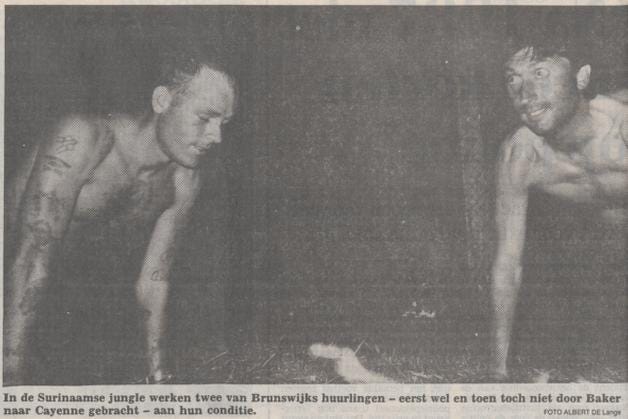
Around 50 mercenaries from Britain, Canada, and West Germany are reportedly undergoing intensive commando training in French Guiana. Their mission: to topple the regime of Suriname’s ruler, Desi Bouterse, under the leadership of Canadian Captain Zack.
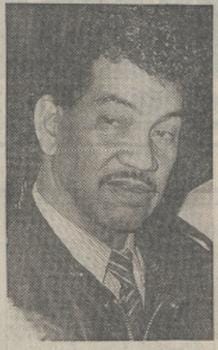
The operation is ostensibly funded by the Surinamese ANSUS Foundation, headquartered in Amsterdam and led by George Baker, a local coffee shop proprietor. Baker’s recent trip to French Guiana has sparked speculations about his involvement.
Baker has always denied any involvement in recruiting mercenaries for Ronnie Brunswijk’s Surinamese jungle command. Yet, he remains ever-active. “I continue to arrange things, that is my nature,” he tells his acquaintances who are curious about his business affairs. His café, ‘Downtown’ on Oude Hoogstraat, serves as the hub where he networks and arranges his contacts. Operating freely from here, the local police see no reason to intervene.
Baker’s connections are vast and diverse, spanning continents and histories. He maintains ties with former soldiers from Portugal, who fought in Africa, mercenaries from Wales and the Wadden Islands and CIA agents. Baker, who proudly calls himself a successful businessman, often schemes about deploying fighters to conflict zones like Bolivia and other hotspots. This eclectic mix of successful businessmen, Vietnam vets, and ex-Portuguese soldiers, whom he fondly refers to as his old pals, congregate in his coffee shop before heading off to Suriname, which he considers his ‘headquarters.’ Reliable sources say that his café staff’s main job is just to keep things running smoothly.
In Amsterdam, these ‘mercenaries’ gather to receive their supplies, travel expenses, and a bonus of around 100 dollars after their victorious returns. This setup allows Baker to profit from the Surinamese power struggle while keeping up appearances as a simple café owner. His true activities, though, extend far beyond brewing coffee, including the creation of the American-Suriname Investment Bank, through which he launders large sums of money,1 placing him and the ANSUS Foundation at the heart of clandestine operations.2
The plot thickens with the revelation that Baker has secured a funding source— a Surinamese millionaire with significant stakes in bauxite mining. Amidst these revelations, there’s speculation that the millionaire bankrolling this audacious plot might be motivated by a personal vendetta against Bouterse, possibly related to the execution of his son. Roth’s findings suggest that both French and Dutch intelligence are in the loop, with neither service objecting to the coup’s objectives (Elsewhere we learn that the FBI had infiltrated ANSUS as a part of their own ongoing investigation3).
According to Roth, the resistance against Bouterse’s regime is gaining momentum, with the ANSUS Foundation seeking to position itself as a key player in the liberation movement. The narrative becomes even more tangled with revelations of the mercenaries’ backgrounds, including their leader, Captain Zack, known for his extreme right-wing views and extensive combat experience. It is unsurprising when we learn of Baker’s plans to “…create a white, autonomous enclave in Surinam, with luxury hotels and so forth. That enclave will be required to invest part of its wealth in Surinam. As an example, just look at the German community in Brazil.”4
The operation’s cost is estimated to run between 2.5 to 7 million guilders, with promises of lucrative bauxite concessions serving as part of the payment to the arms supplier. Yet, the plan’s execution hinges on the formation of a government-in-exile and navigating Dutch legal constraints to ensure no Surinamese nationals participate in the coup.
The coup strategists aim for minimal violence, planning to capture Bouterse and seize control of the nation’s broadcast stations. They anticipate little resistance from the Surinamese population, many of whom long for liberation from Bouterse’s oppressive regime.
There’s a lot to unpack here, so let me help to simplify things:
- Leadership Change: The day before Roth’s book dropped, former Secretary General of the Surinamese Mother Union, Glenn Tjong Akiet (who you may remember visiting with clinical psychiatrist and weekend warrior Dr. John) became the new leader of the Council for the Liberation of Suriname. He replaced Henk Chin A Sen who cited financial pressures and claimed to be returning to his medical practice.5 In his press conference, Glenn states, “I don’t want to remain Gandhi. I would rather die fighting,”
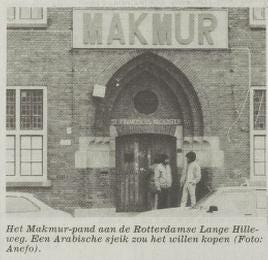
- New Militant Groups for Change: Paul Somohardjo (who also supported Dr. John’s coup in 1984) left the Council. He’s started two new groups called Fighters for Democracy and Justice Pendawa Lima. He’s convincing refugees from Suriname seeking safety in the Netherlands to join his cause, offering them a place to stay if they can pay and donate their weapons to his cause. He’s in negotiations to offer those weapons to a group of 300 Angolan mercenaries to take back Suriname.6 His headquarters is a monastery where Glenn Tjong Akiet’s new, more action-focused Council is also based.The Makmur Foundation headquarters. Source: The Free People: Democratic-Socialist Daily Newspaper.
- Seeking a New Government: George Baker is working with the Makmur Foundation, also led by Paul Somohardjo, to create a government-in-exile ready to step in. Paul is a bit like a Surinamese Oliver North, but with way cooler clothes and hairstyle to match. No longer operating in an official capacity on the Council, he can now adopt more unconventional approaches. Paul likes to publicly downplay the relationship with Baker, “”He comes to parties here sometimes…But he has nothing to do with possible coup plans and American mercenaries.”7
- Unknown Millionaire with a Motive: In Suriname, there’s only a few wealthy men who can fund a coup and have a personal grudge against Bouterse for killing their son. One is Edgar Wijngaarde, once a celebrated soccer player and later successful in business, including insurance, hotels, and casinos. His fury was palpable when he left the Council in ‘83, criticizing its members for focusing on financial compensation rather than action, especially after the tragic loss of his son Frank, a journalist executed by Bouterse. Sandew Hira mentioned an Emile Wijngaarde (unsure if related), as “the greatest defender of capitalism in Suriname,” and possibly connected with the insurrection before the December massacre.8 Another possible supporter is Somradj Robby Sohansingh, known for his business in the crushed stone industry. The profound personal losses and considerable resources of these men position them as the alleged candidates behind the funding of a coup aimed at bringing about change.
By all outward appearances, the ANSUS Foundation had champagne tastes on a beer budget. When representatives of the enigmatic David Randolph Enterprises visited a few months earlier, they literally handed Baker a playbook with two options: direct action—attacking vital targets in Suriname to quickly and effectively overthrow Bouterse in a one-time operation (costing around $6 million), or engaging in unconventional warfare, necessitating the establishment of a national liberation movement through phased actions.
Desperate for money and inclined towards direct action, George Baker decided to fund his coup the old-fashioned way—by going to the bank and asking for money. On February 21st, 1986, two weeks before Roth’s book dropped, Baker drafted a letter to the management of AMRO Bank. What follows is a recreation of that letter, using excerpts and quotes provided by the Dutch newspaper, Het Parool.9
To Whom It May Concern,
First of all, we would like to introduce ourselves. We are a young organization that advocates for a free and independent democratic Suriname, with all our efforts aimed at this objective. Partly in view of the successful results achieved in recent years, we can say that the organization and realization of the liberation and reconstruction of our country will not take much longer. We possess excellent quality military expertise, acquired through targeted campaigns, published in, among others, Soldiers of Fortune, the Herald Tribune, etc.
The remarkable aspect of our journey is the interest from multinationals in supporting our goals. It is less surprising when one considers that these multinationals do not offer their help without expectations; in exchange, they anticipate acquiring rights to the minerals and raw materials of Suriname. It is imperative to understand that this is precisely what we aim to avoid: the minerals and raw materials belong to the Surinamese people, and it will remain that way. We are cognizant of the fact that assistance cannot be entirely free and noble; indeed, some resources such as weapons, equipment, and information necessitate significant financial investment. To give you an idea of the magnitude of such costs, we can provide estimates based on information given to us by foreign contacts. Read: an Intelligence Agency.
Given the recent speech by the President of the United States, Ronald Reagan, in his State of the Union address, where he pledged support to all freedom fighters everywhere in their fight against communism, and considering a recent statement by him in an interview with the Washington Post, we believe that victory over Bouterse’s regime is imminent.
Our immediate need is financial capacity to procure weapons. The contacts for possible arms deliveries are established, as well as the blueprint for our strategy, which we intend to follow. We will offer preferential treatment to those who have materially supported us, with interests in Suriname’s trade.
It is critical to recognize that Gaddafi’s Libya is targeting army leader Bouterse with dubious intentions. Thwarting these schemes is crucial, as Gaddafi’s success could spell catastrophe for Suriname and inadvertently create a springboard for the United States—a scenario based on fact, not conjecture.
To further our cause, we require financial means to acquire armaments. The groundwork is laid, with contacts and plans in place for armament acquisition and the subsequent strategy. Those who have substantively aided us will be duly recognized and prioritized in our emerging Suriname. In return, we assure our benefactors the highest degree of confidentiality and anonymity. We extend our hopes for your indispensable support towards an autonomous and democratic Suriname.
Sincerely,
George Baker
President, ‘ANSUS-FOUNDATION’
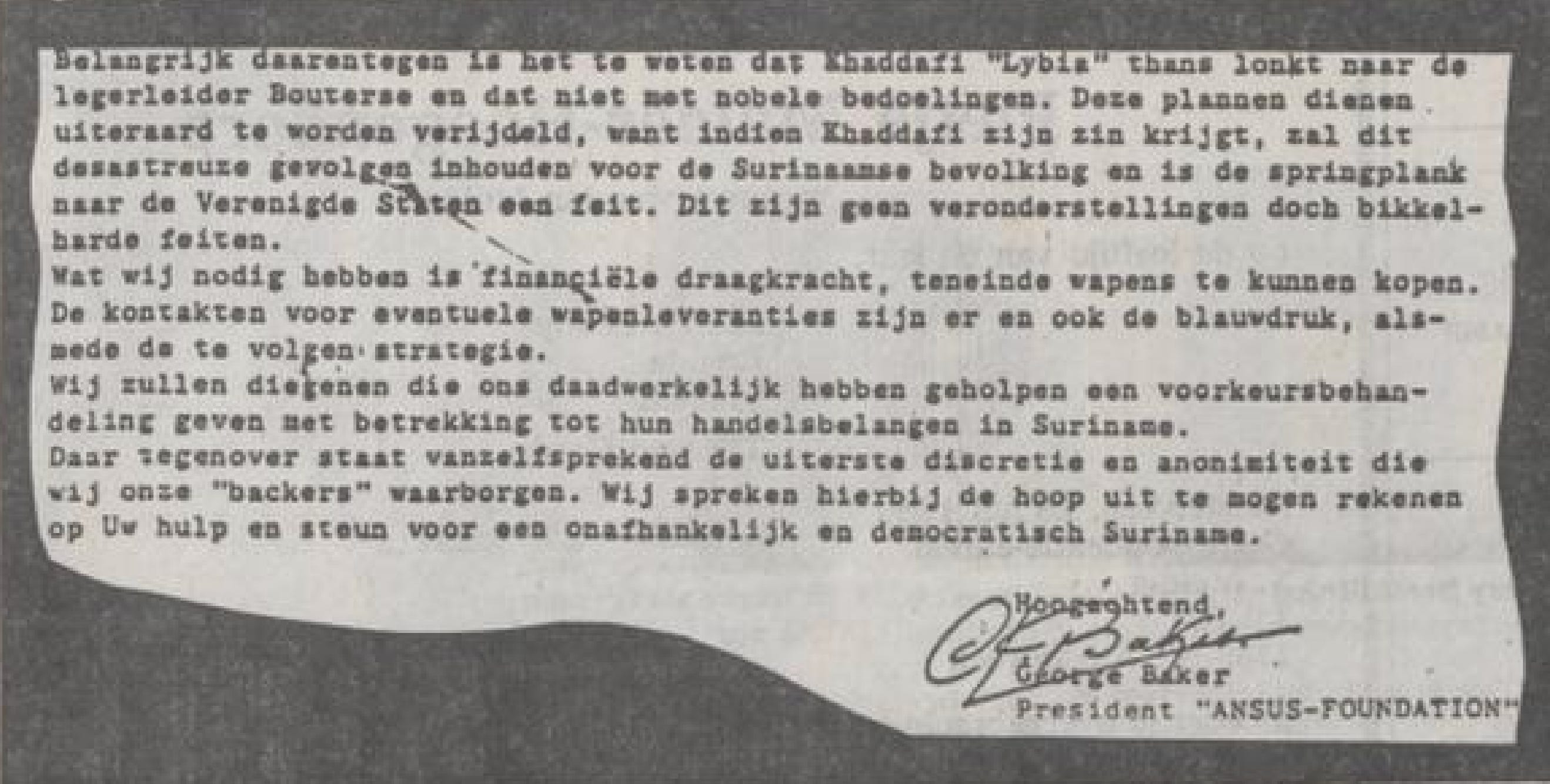
I’ve taken the liberty of highlighting a few segments of the letter that are of particular interest. Baker claims that multinational corporations are interested in supporting the coup to gain access to the minerals and raw materials of Suriname (likely bauxite). They are not named, but it narrows the list. Additionally, he asserts that the detailed invasion plans provided to him, which ANSUS plans to follow, were furnished by Intelligence Services. This is the first admission by Baker to have been working with intelligence sources. Although not named, his letter goes on to reference President Reagan’s speeches in support of freedom fighters against communism. The implication appears to be that David Randolph Enterprises, the entity that delivered the invasion plans, were, in fact, American Intelligence services.
ANSUS seemed hell-bent on direct action but when their offers from the banks were rebuffed, they were forced to settle for a budget-friendly choice: the MacMillan Group. As the old saying goes, “The thing about free advice is you get what you pay for”—a principle that applies to mercenaries as well. Upon learning that having an officer was an ANSUS prerequisite, the MacMillan Group “promoted” a former cook in the British army to “major” to fulfill this requirement, then proceeded to hire the bloodthirsty Captain Zack and his neo-Nazi associates.10
Things appeared to have been going smoothly, however, when it comes to surprise coups, there is such a thing as too much press. First Baker opted to participate in a comprehensive German TV documentary, at which time, many Surinamese retracted their support. Next, Roth’s exposé dropped and the element of surprise was utterly lost.11 Bouterse was also no longer as vulnerable as he had been immediately after the coup, having received economic, technical, and military assistance from Brazil—a friendly surrogate used by the White House and the CIA to address the Bouterse problem. It seemed ANSUS would need to return to the drawing board, necessitating a shift to more unconventional strategies.
On the next episode, I’ll tell you about the first time we heard about “the black Robin Hood” in Suriname and how Civil Wars get started.
Links
Leidsch Dagblad. “Miljonair Betaalt Coup in Suriname.” March 19, 1986. Historische Kranten, Erfgoed Leiden en Omstreken. https://leiden.courant.nu/issue/LD/1986-03-19/edition/0/page/7.
Verkerk, Corrie, and Frans Peeters. “‘Een Gek’ Die Geflipte Huursoldaten Werft.” Het Parool, November 4, 1986. https://www.delpher.nl/nl/kranten/view?query=%22George+Baker%22+Suriname&coll=ddd&resultsidentifier=ABCDDD:010832574:mpeg21:a0057&page=1&identifier=ABCDDD:010832574:mpeg21:a0121&cql%5B%5D=%28date+_gte_+%2201-01-1979%22%29&cql%5B%5D=%28date+_lte_+%2201-01-2015%22%29.
Verkerk, Corrie, and Frans Peeters. “‘Een Gek’ Die Geflipte Huursoldaten Werft.” Het Parool, November 4, 1986. https://www.delpher.nl/nl/kranten/view?query=%22George+Baker%22+Suriname&coll=ddd&resultsidentifier=ABCDDD:010832574:mpeg21:a0057&page=1&identifier=ABCDDD:010832574:mpeg21:a0121&cql%5B%5D=%28date+_gte_+%2201-01-1979%22%29&cql%5B%5D=%28date+_lte_+%2201-01-2015%22%29.
Kooij, Willem van der. “‘Successful Missions Will Be Paid Well,’” July 29, 1986. https://www.dropbox.com/scl/fi/t30eztkk3osvfzfk9qbtp/Section4.pdf?rlkey=ss718sc105q4y2a8nvyr4hqd3&st=zn53h476&dl=0.
Federal Bureau of Investigation. “Series 4: FOIA Request No. 1632770: Tommy Lynn Denley.” Information Management Division, Federal Bureau of Investigation, May 22, 2024. https://www.dropbox.com/scl/fi/t30eztkk3osvfzfk9qbtp/Section4.pdf?rlkey=ss718sc105q4y2a8nvyr4hqd3&st=zn53h476&dl=0.
Leidsch Dagblad2. “Chin A Sen Stapt Op Als Voorzitter.” March 14, 1986. Historische Kranten, Erfgoed Leiden en Omstreken. https://leiden.courant.nu/issue/LD/1986-03-14/edition/0/page/5.
Leidsch Dagblad. “Coupe-Aanbod Angolezen Aan Surinaams Verzet.” April 24, 1986. Historische Kranten, Erfgoed Leiden en Omstreken. https://leiden.courant.nu/issue/LD/1986-04-24/edition/0/page/15.
Het Vrije Volk: Democratisch-Socialistisch Dagblad. “Huurlingenleger Zou Rekenen Op Miskito-Indianen.” Gevonden in Delpher. Accessed July 17, 2024. https://www.delpher.nl/nl/kranten/view?query=%22George+Baker%22+Suriname&page=2&cql%5B%5D=%28date+_gte_+%2201-01-1979%22%29&cql%5B%5D=%28date+_lte_+%2201-01-2015%22%29&coll=ddd&redirect=true&identifier=ddd:010948862:mpeg21:a0164&resultsidentifier=ddd:010948862:mpeg21:a0164&rowid=1.
Hira, Sandew. Balans van een coup : drie jaar “Surinaamse revolutie.” Rotterdam : Futile, 1983. 156. http://archive.org/details/balansvaneencoup0000hira.
Het Parool. “Bedelbrief in de Strijd Tegen Bouterse.” July 29, 1986. Gevonden in Delpher. https://www.delpher.nl/nl/kranten/view?coll=ddd&identifier=ABCDDD:010831809:mpeg21:p003.
According to Frits Hirschland, In 1989, Hans Jörg Schimanek, Reinhard Rade, and Hubert Lorenz, all affiliated with neo-Nazi groups, were involved in a plot to assassinate Brunswijk in Suriname. Their mission was allegedly organized by an agent of the Surinamese Criminal Investigation Department (CID) based at the Surinamese Consulate in Amsterdam. The neo-Nazis attempted to infiltrate the Jungle Commando by presenting themselves as military experts and obtained Surinamese visas through a diplomat. They were arrested upon arrival and deported to French Guiana, thanks to intelligence from French authorities. Despite being expelled, Schimanek later returned, seeking to re-establish contacts and offer military support to the Jungle Commando, including weapons procurement. Local authorities expressed frustration over their inability to take harsher measures against the neo-Nazis due to legal constraints. Schimanek’s background included connections to right-wing extremist circles in Austria and previous arrests for neo-Nazi activities and illegal possession of weapons.
Algemeen Dagblad. “‘Veel Surinamers Wilden Met Baker in Zee Gaan.’” Gevonden in Delpher. Accessed April 5, 2024. https://www.delpher.nl/nl/kranten/view?coll=ddd&identifier=KBPERS01:003057002:mpeg21:a00063.
Date:
September 2, 2025