Like a Moth to the Flame
Drawn Back to Suriname’s Secrets
Oct 16, 2024
I thought I was done writing about Suriname. In fact, I’d started working on my next project—an alchemical memoir titled SurrealEstate about what happened after we returned home from South American and my ongoing quest to untangle my mother’s claims. Then, something unexpected happened.
A few weeks ago, I learned about a storyteller event called The Moth coming to Iowa. I bought a ticket, excited to take part. The idea was simple: tell a 3-5 minute impactful story aligned with the event’s theme. Before the event, I attended a warm-up in Des Moines, where a local version was having its inaugural kickoff in Highland Park.
The sun was setting through a plate-glass window in a coffee shop when I arrived. The light was so blinding behind the MC that she looked like she was in witness protection. Only one name was on the sign-up sheet, so I scrawled mine beneath hers and took a seat toward the back. A tray of complimentary charcuterie sat on the counter next to the espresso machine while I struck up a conversation with a couple beside me—a psychologist and his wife. They were eager to tell stories but hesitant about whether today would be the day. Soon after, three guys walked in, one wearing a set of elven ears that looked like they’d been acquired from a Spencer’s Gifts in Middle-earth.
The MC kicked off the evening, and the woman ahead of me went first. She wore a hat with an emoji—one eye open, one eye closed. It reminded me of a recent book club discussion about how good writers should move through the world with one eye open to events around them, and one eye closed, looking inward for understanding. After she finished reading from her iPad, it was my turn.
Over the years, I’ve struggled with endings to my stories (as you’ll see), often because I’m still living them. But that night, I arrived with a solid opening, a strong closing, and plenty of room for improvisational jazz in between. With few others signed up to speak, the five-minute window loosened.
It was the first time in ten years I told a story to a live audience—my stories, forged through hard-earned lessons. Ten minutes and a round of applause later, I was hooked. After intermission, the MC invited new storytellers or repeats from earlier. I returned to the stage and decided to summarize some lessons from growing up in Suriname. For the next twenty minutes, I took off the governor and blew minds with stories about a tiny country on the northern shoulder of South America—the epicenter of an international battle for control over resources, cocaine, and power.
But for me, this was more than a trial run. It was the first time I shared not just the story of my life, but my story as an over-the-top researcher who spent decades uncovering hidden plots to take over a country no one in America seems to have ever heard of, and trying to make them care.
The next morning, I saw that someone had been busy commenting here on Substack.
Operation Suriname Recap for New Readers
For those new to my work, Operation Suriname is an exploration of the events I lived through in Suriname from 1985 to 1987, at the height of the Iran-Contra affair. During that time, Suriname experienced a series of attempted coups and a brutal civil war. We’ve been investigating the intersection of the Iran-Contra affair and these coups to uncover any hidden connections or other factors that may have been at play.
I noticed a familiar name in the comments—Sander Peeters. Why did that sound so familiar? Reading through them, this guy was having a conversations with Dan Rogers, our old neighbor from South America! And, he had managed to track down not only Frits Hirschland (the Falco producer turned Ronnie Brunswijk’s press secretary), plus a cameraman from Soldier of Fortune? Had I just found a Dutch doppelgänger I’d never met?
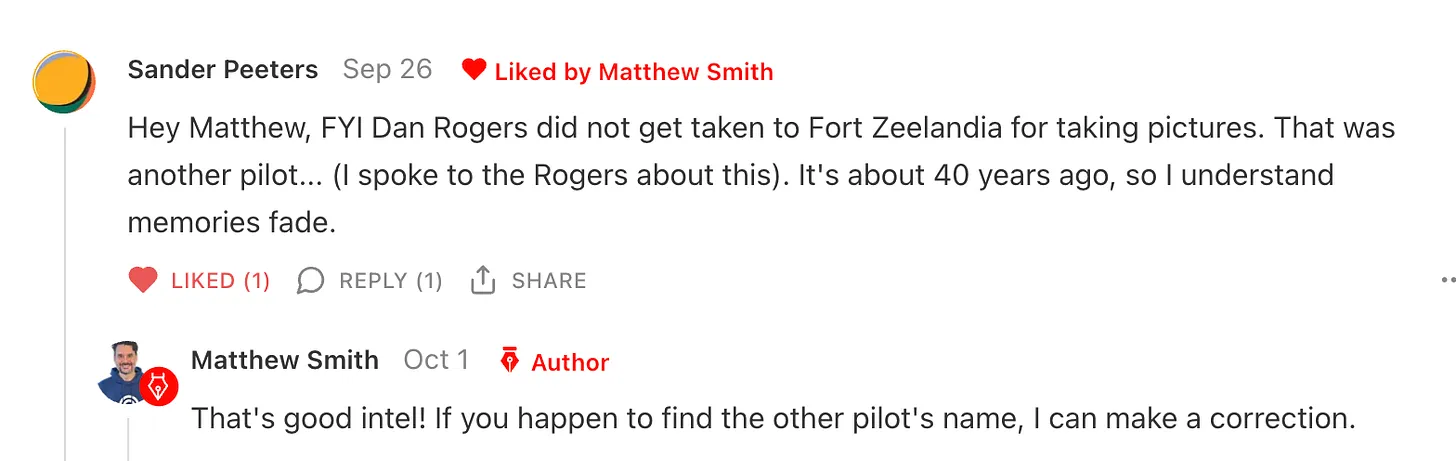
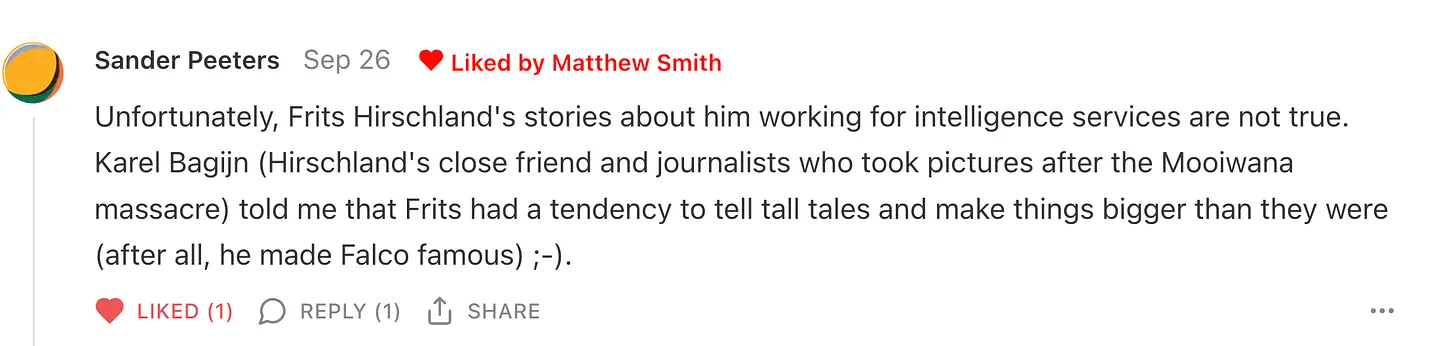
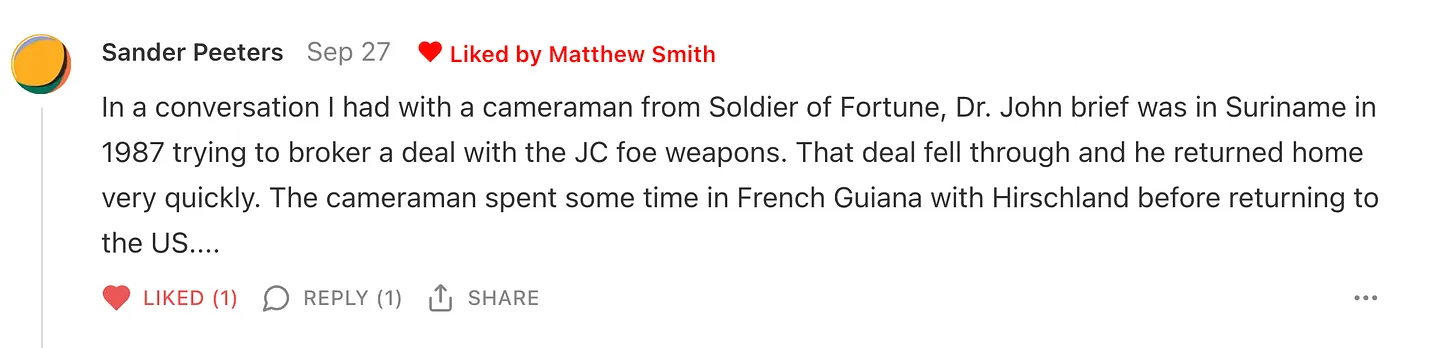
Not long after, I got a Facebook friend request from Sander, and a quick glance at his profile revealed a shared acquaintance—my childhood friend Matt, from Suriname. Even more, Sander attended the same grade school I did, the American Cooperative School in Paramaribo, which my father ran. After accepting his request, I sent him a message to introduce myself.
It turned out we had more in common than just grade school teachers. Sander is a published author on the history of Suriname. He was writing part two of his series when he came across my research on Dr. John. Our similarities didn’t stop there. He was best friends with the boy next door, Dan Roger’s son, while I was living next to Bouterse and the Minister of Finance. Sander’s neighbor? The brother of Henk Chin A Sen’s, the former president of Suriname—who was also his dentist.
Over the last few weeks, Sander and I exchanged a flurry of messages, eventually deciding to schedule a Zoom call to share our research. Just when I thought I’d read everything there was to know about Suriname, Sander surprised me with even more.
He’s in touch with many of the mercenaries, journalists, and veterans I’ve written about in Operation Suriname, and he has access to Dutch intelligence files (it helps when you’re fluent in multiple languages and have family abroad!). A few of those journalists have recently subscribed to our Substack (if you’re reading this… welcome! I’m a big fan.).
Within days, Sander sent me his book and a preview of his next volume. I highly recommend it—his work is right up there with Ellen de Vries and Roger Janssen for my money. But things got even juicier. Sander shared some explosive information I’ll be exploring in future posts. Namely, a secret operation run by Ronald Reagan that suggests, after the December Murders in Suriname, when Reagan was restrained by the Boland Amendments, he decided to turn Bouterse into his own puppet regime with a little help from his friends in Brazil.
For some time, I’ve suspected that America’s Project Democracy and its shadowy ties to Nicaragua might have deeper connections to Suriname’s coups and cocaine smuggling. Sander provided photographic proof that the same mercenaries Dr. John worked with in Nicaragua shifted their efforts to Suriname, even while the Iran-Contra scandal was breaking wide open with the Ollie North hearings. The same “cockroaches” running drugs and guns found refuge under Bouterse, who needed the extra revenue.
In the meantime, I want to share some thoughts.
I believe this story needs to be told as a documentary or web series. The type of producer who could really do it justice would be someone like Oliver Stone or Leon Neyfakh of the Fiasco podcast. I’m also thinking of people like Jody Avirgan, who hosted This Day in Esoteric Political History, ESPN’s 30 for 30 Podcasts, and the FiveThirtyEight Politics Podcast. His parents, journalists Tony Avirgan and Martha Honey, were directly involved in the events I’ve been researching. In fact, as you’ll see soon, Dr. John was working with men accused of trying to assassinate Jody’s parents.
Here’s how you can help:
If you know anyone who may have information on the topics we’re exploring, or if you have connections to people who could help turn this story into a visual or audio medium, I’d love to hear from you.
In the meantime, Sander and I will be hard at work piecing together the puzzle of Suriname to understand why it still matters today. Stay tuned!
Source:
Link:
Internal Link:
Date:
October 26, 2025