Living in the Shadow of a Strongman
The Final Act: Ending Our Dependence on Political Saviors
Aug 14, 2024
Into a corrupt political system, a charismatic figure bursts onto the scene like a glitter bomb at a formal dinner, capturing the imagination of a nation desperate for change. This isn’t just about one man or one country – it’s a story repeating itself across the globe, and it has more to do with us than we might think.
He’s hailed as a man of the people—funny, outspoken, and seemingly untainted by the entrenched elite. His rise to power is unprecedented, fueled by a gift for saying exactly what people want to hear. Draining swamps, making things great again—he hits all the right notes of political promises. The establishment trembles as he rails against the old guard, accusing them of selling out to foreign interests and ignoring the needs of ordinary citizens. He has little regard for public norms—or for anything outside himself, for that matter.
When he finally seizes power, the people cheer. Here is a leader who will shake things up, someone not beholden to the traditional political class or foreign puppet masters. He is the people’s champion, their voice in a system that has long ignored them. But here’s the thing about power—it’s like that leftover curry in your fridge: leave it too long, and things start to get… funky.
As we watch this story unfold—not just in one country, but across the globe, time and time again—we must ask ourselves: Why do we keep falling for strongmen, and what does it say about our democracy? It’s a pattern as old as politics itself, but in our modern world, the stakes have never been higher.
But as with any explosive entrance, the glitter eventually settles, and the real show begins.
When Glitter Bombs Go Nuclear
As the years pass, troubling signs emerge. The strongman has strong appetites that need to be satisfied. Allegations of serious misconduct surface—sexual, legal, and political. Whispers of backroom deals with billionaires, authoritarian regimes, and abuses of power grow louder. The economy, despite grand promises, shows mixed results, while fortunes boom for those in the leader’s inner circle. Yet his core supporters remain steadfast, dismissing every accusation as a witch hunt orchestrated by enemies both foreign and domestic. Any criticism is seen as an attempt to subvert the country’s return to greatness.
Yet, as history shows time and again, the gap between promises and reality can be as wide as the Mariana Trench.
When legal challenges arise, our vaunted leader and his allies work tirelessly to deny, delay, and obstruct. They cry foul, claiming political persecution. The justice system, they argue, is rigged against them. Laws are made for the weak, who cannot govern themselves, not our Strongman, who pushes them to their limits and changes them when necessary. As the evidence mounts, he retreats further into conspiracy theories, doubling down with counter-accusations.
And as this familiar recipe for disaster starts to simmer, we’re left wondering: how do countries continually end up back in this kitchen? But while the leader’s tactics may seem uniquely brazen, they’re actually following a well-worn path – a political playbook that’s been reshuffled more often than a street corner shell game.
In the face of mounting evidence and eroding support, our embattled leader resorts to a time-tested tactic: simplifying a complex world into easily digestible sound bites.
The playbook we’ve described isn’t just a relic of the past or limited to smaller nations. We’re seeing it unfold in real-time across the globe, even in the heart of Europe. Take modern Hungary under Viktor Orbán, for instance.
Orbán has explicitly worked towards dismantling democracy in favor of what he calls “Christian democracy” – a thinly veiled euphemism for autocratic rule. His vision? A world where a select few – usually white, heterosexual men – control the lives of women, racial and ethnic minorities, and gender minorities. All in the name of returning to what they consider a “traditional” worldview.
This isn’t just political maneuvering; it’s a deliberate attempt to roll back the clock on social progress. Orbán’s government has systematically eroded press freedoms, rewritten the constitution to consolidate power, and used the specter of immigration to stoke fear and division. Sound familiar?
What makes Orbán’s case particularly alarming is the openness with which he pursues this agenda. There’s no pretense of upholding democratic values – instead, he proudly proclaims his intention to create an “illiberal state.” It’s a stark reminder that the strongman playbook isn’t just alive and well, it’s being updated for the 21st century.
The Hungary example serves as a warning: this isn’t just about far-off lands or historical curiosities. It’s happening here and now, in developed nations we once considered bastions of democracy. If we’re not vigilant, if we don’t address the root causes that make strongmen appealing, we may find our own democracies slipping away, one “reform” at a time.
The Black-and-White TV in a 4K World
Even as our Strongman’s grip on power begins to slip, he refuses to go quietly, raging against his opponents and vowing retribution against those who have wronged him. His most ardent followers, convinced of his innocence and righteousness, stand ready to take to the streets in his defense.
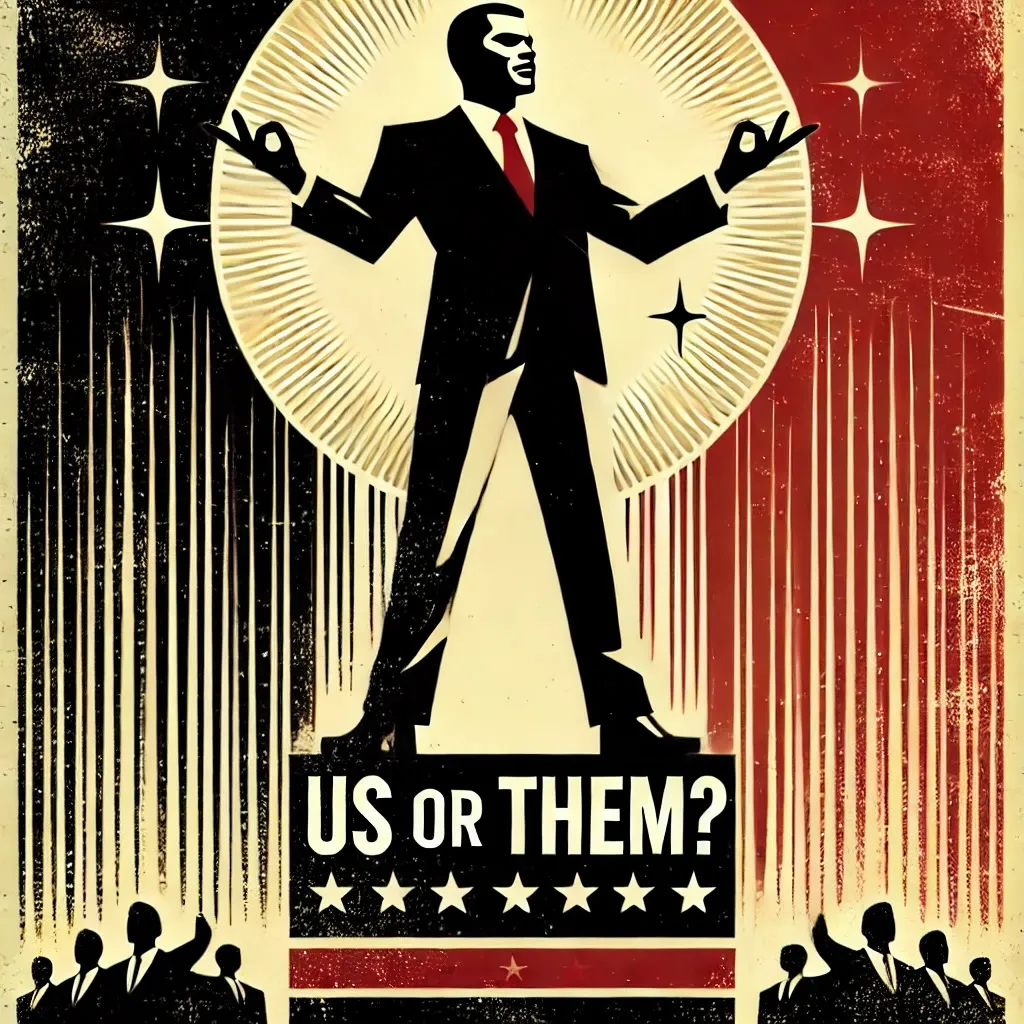
In a world of nuance and complexity, the strongman offers the comfort of simplicity. It’s like watching a black-and-white TV in a 4K world – sure, you’re missing a lot of detail, but at least everything’s clear cut. Good guys and bad guys. Us and them. No messy in-betweens.
The nation finds itself at a crossroads, its dreams of healthy democratic institutions strained to the breaking point. The black-and-white worldview crashes headlong into the technicolor reality of a diverse, interconnected planet. It’s like trying to fix a smartphone with a hammer – you might make a lot of noise, but you’re probably doing more harm than good.
Meanwhile, everything hangs in the balance. Will the people embrace the full spectrum of an increasingly complex reality, or retreat into the comforting simplicity of a world that no longer exists – if it ever did? The answer to this question may well determine the future of their world.
Now, I know what you’re thinking. “Is this about… ?” No. (But not a bad guess!) We’re not talking about any recent American political circus here. This is the story of Desi Bouterse and the nation of Suriname. But, you’re right to think it’s so much more than that.
This is a story about America’s weird fascination with strongmen and cowboys on white horses. It’s about how we’ve somehow convinced ourselves that torture, rape, and murder are tolerable as long as someone dangles the carrot of eradicating “godless communism” and its liberal cousins—socialism and Marxism—off the end of a stick.
It’s a tale of excess— what happens when good ideas go bad. When American exceptionalism morphs into plain old nationalism. When American idealism and religious freedom twist into materialism and tyranny. When a desire for surplus becomes hoarding excess, when support becomes control, and when the knowledge of how to change human consciousness becomes a tool for mind control and manipulation.
This isn’t just Suriname’s story. It’s a blueprint we drafted in a mad-scientist’s laboratory and handed to our intelligence community to implement over and over again throughout the 20th century. It’s a playbook we’ve used so many times, you’d think we’d have it memorized by now. Bouterse’s rise to power in 1980 wasn’t just a random event in a small South American country. It was another chapter in this ongoing saga. Here’s a guy who led a coup, promising to fight corruption and bring prosperity. Sound familiar? It should. We’ve heard this song before, yet we keep dancing to it.
At first, Bouterse tried to play both sides. He’d flirt with leftist ideas from Cuba and Grenada, then backpedal when the U.S. started giving him the side-eye. But caught between American paranoia about communism and actual Marxists calling him weak, Bouterse did what strongmen do best: he doubled down on power and fear.
Before you could say “human rights violation,” Bouterse was running Suriname like it was his personal playground. Corruption, unlawful detentions, torture—all the greatest hits of dictatorship. The darkest note? December 1982, when he had 15 of his critics arrested, tortured, and killed his political adversaries. It was his way of saying, “Don’t mess with me. I’m a real one.” Subtle as a sledgehammer, right?
But here’s the kicker: despite all this, Bouterse managed to reinvent himself and mount a comeback. In 2010, he actually got elected president. Legitimately! It’s like watching a villain become the hero in a really messed up movie. The appeal of a strongman who can vanquish the threat is coded into our DNA. Of course, the past has a way of catching up. Legal battles, convictions, more legal battles. But through it all, his supporters stood by him. They cried “witch hunt!” at every turn. Sound familiar? It should. We’ve seen this play out on our own soil.
So what can we learn from this mess? For starters, it’s not as simple as “populist leaders bad, democracy good.” Life’s messier than that. Bouterse didn’t come out of nowhere. Men like him rarely have over the last century. He also didn’t begin as the strongman. Remember, this was a guy who loved animals, sports and dancing. There’s a reason people fell in love with him.
Let’s break it down:
- Entrenched interests are like ticks—they don’t let go without a fight. The English didn’t exactly hand over the keys to the colonists with a smile. After the Civil War, Southern landowners lobbied the president and wriggled out of promises made to freed slaves faster than you can say “40 acres and a mule.” And when Caribbean countries tried to redistribute colonizer’s wealth to benefit working people, they suddenly found themselves facing torture squads, puppet regimes, and Deep State coups.
Whether it’s colonial powers, post-Civil War landowners, or modern-day Wall Street, the big players always try to rig the game in their favor. America casts the largest shadow now, and we’ve got to own the chaos we’ve caused if we ever hope to return to a government by and for the people. Because whether it’s bankers in New York or bureaucrats in Washington, entrenched interests will fight tooth and nail to keep their power—and they’re playing with loaded dice. - Transparency? What transparency? The covert ops run by Oliver North, George H. W. Bush, and the Reagan administration didn’t just bend the rules—they snapped them over their knee in the name of God and freedom. Military decisions were influenced by biker Nazis, end-times prophets, and the First Lady’s astrologer, for crying out loud. If the public had known the real carnage—not just the glossy versions in Soldier of Fortune or sanitized Sunday sermons—they’d have stormed Washington with pitchforks. Instead, the president just re-classified everything, making it easier to deceive us than to govern responsibly.Fast forward to the Bush era and the WMD fiasco in Iraq. Selective transparency at its finest—they cherry-picked intelligence like it was a buffet, serving up only what fit their pre-cooked narrative. It was less about truth and more about finishing Daddy’s war.
And the Democrats? Obama talked a big game about transparency, but his administration set records for denying Freedom of Information Act requests and zealously pursued whistleblowers. It was like he was auditioning for “1984” instead of leading the land of the free.
Then came Trump, cranking the opacity dial to 11. From refusing to release tax returns to the “fake news” saga, it was like watching a reality show where the truth got voted off in the first episode and alternative facts won the crown.
Both parties have their sins when it comes to transparency, competing to see who can keep us in the dark the longest. But even in all this murk, there are beacons of light. Take the FBI’s Information Management Division, for example. In my work on Operation Suriname, their Public Information Officer was exceptional. They got materials out in weeks, not decades. Without that transparency, much of what happened with the Suriname coup plotters would’ve stayed buried deeper than Jimmy Hoffa.
The takeaway? We can’t trust either party to be transparent, but there are individuals who believe in it. We’ve got to be those people, demanding openness no matter who’s in power. In a democracy, information isn’t just power—it’s oxygen. And right now, we’re all gasping for air, trying to separate truth from the smokescreen of political theater.
|Remember: in the game of democracy, if you’re not at the table, you’re on the menu. So let’s pull up a chair and demand our seat. The truth is out there—we just need to be stubborn enough to dig for it. And in doing so, we’re not just uncovering facts; we’re building a stronger, more resilient democracy. One where sunlight truly is the best disinfectant, and where the antidote to doubt and division is a healthy dose of transparency. - We failed to address the fundamentals, and more importantly, we forgot our own history. Nicaragua, Grenada, and Suriname weren’t just geopolitical chess pieces—they were fledgling nations trying to establish new democracies free from colonial rule. Sound familiar? It should, because we were once in their shoes—refugees escaping war-torn Europe, struggling to form a new nation.
We conveniently forgot how bloody our own rebellion was, how long it took to establish our constitution, and how our democracy came in fits and starts, including a brutal civil war. Yet, when these countries tried to forge their own path, we suddenly developed amnesia, expecting them to figure it out immediately, as if democracy were a one-size-fits-all solution.
These nations were attempting to create a middle way—a democratic socialism that balanced innovation with social safety nets. But instead of supporting this through diplomacy, we stifled their growth, acting less like mentors and more like schoolyard bullies, demanding they play by our rules or face the consequences.
We showed little empathy for a region with a shared history of colonial exploitation. Instead of healing divisions, we perpetuated them, backing wealthy elites and military force to maintain control. We lost sight of the fact that democracy is a complex, evolving system, not something that can be imposed overnight.
Rather than fostering political innovation and learning from these nations, we turned a blind eye to their struggles while propping up foreign interests. And when things inevitably exploded, we were left wondering why these countries couldn’t just “get with the program,” and why we have so much chaos at our southern border.
It’s time to ask ourselves: are we truly spreading democracy, or are we just imposing a new form of colonialism dressed up in red, white, and blue? - Our thinking was more black and white than a 1950s TV show. Throughout this saga, we’ve seen a stunning lack of nuance. Many of our representatives—senators and spooks alike—couldn’t tell you the difference between a Marxist, a communist, and a socialist if their lives depended on it. To them, they were all just “commies,” deserving of disdain or a coup. The number of far-right mercenaries with ties to white supremacist organizations was staggering. When I researched the participants—the actual mercenaries, politicians, and monied interests behind these operations—it became clear that the so-called Deep State interests were largely Evangelical Christians, especially Baptists. Given their fundamentalist teachings, this isn’t surprising.Why should we be surprised? How different is King David killing 200 Philistines and slicing off their foreskins to prove himself to Saul from Dr. John slitting Sandinistas’ throats to impress Contras and CIA handlers? Both men believed they were doing God’s work, that they were the good guys. Where are the pre-Constantine Christian pacifists who refused conscription by the Empire? Church is now religious ROTC. We sing “Onward Christian Soldiers,” marching into war with the cross of Jesus leading the way. In my church, we were told to be fully committed, sold-out for Christ. Men were given broadswords as a symbol of their solemn commitment to lead their households as Christian warriors. I saw gun collections and prepper gear that could have out-armed the entire Surinamese rebellion—and these weren’t even the extremists.
So why are we surprised when men from these ranks take it upon themselves to eradicate evil as they see it, even though they’ve never been to these countries, nor understand the people, culture, or politics? And that’s the clincher: when you squelch curiosity and paint the world in stark terms of good and evil, you miss the important distinctions—like the difference between a morel and a poisonous false morel. There are true friends and great ideas amongst groups that look and believe wildly different things. Rigid fundamentalist thinking doesn’t just lead to mistakes; it leads to dangerous decisions, where the lack of understanding breeds actions that harm far more than they help. - The Strongman: Our Shadow and the Path to Wholeness. From a Jungian psychology lens, our fascination with strongmen isn’t just about power—it’s a mirror reflecting our collective psyche. We project onto these figures the traits we’ve been taught to value: strength, decisiveness, dominance. But in doing so, we reveal our shadow: the qualities we’ve repressed or feared—empathy, vulnerability, cooperation.
This split creates an unstable society, perpetually seeking an impossible ideal while neglecting the wisdom in our shadow. The solution? Integration. It’s about embracing both light and shadow, traditionally masculine and feminine, strength and vulnerability.
True societal strength comes not from strongmen, but from doing the hard work of integration:- Recognizing the strongman as our collective projection
- Acknowledging our shadow and its wisdom
- Integrating these parts in ourselves and our systems
- Redefining strength to include empathy and cooperation
- Building institutions that embody this wholeness
This path isn’t easy, but it’s transformative. By integrating what we’ve projected and repressed, we create a society that’s truly strong—not because it’s led by a powerful figure, but because it’s built on the complete wisdom of all its members.The antidote to the strongman isn’t just transparency or self-empowerment—it’s embracing our full selves, shadow and all. Real strength lies not in simplistic promises, but in the rich, challenging path of wholeness. It’s time to stop seeking saviors and start integrating our collective wisdom
The strongman’s tactics may be as old as politics itself, but their enduring appeal speaks to something deeper in our collective psyche. As someone who lived through Bouterse’s reign in Suriname, I’ve seen firsthand how this cycle plays out—and trust me, it’s not a ride any of us want to take again.
It’s easy to wonder, “How could anyone support leaders like Bouterse?” The answer lies in real, pressing issues: inflation, poor healthcare, random violence. When mainstream politicians ignore these problems, people turn to those who promise solutions—enter the strongman.
These figures prey on human fear, which thrives in uncertainty. Conspiracy theories don’t spawn in a vacuum; they start with a kernel of truth. In the absence of facts, strongmen create narratives to “close the loop” of uncertainty, leading us down dark paths.
Transparency is our antidote. By demanding and providing clear, verifiable information, we can nip speculation in the bud. This isn’t just about politics—it’s about integrating the shadow aspects of our society that we’ve long ignored, a process of collective healing that Carl Jung emphasized.
To create resilient democracies and avoid repeating the mistakes I witnessed in Suriname, we must:
- Ensure transparency in our institutions
- Address root problems: economic insecurity, social instability, and political corruption
- Recognize the strongman as our collective projection
- Redefine strength to include empathy and cooperation
- Build systems that embody wholeness, not just power
We can’t just hope another Bouterse doesn’t show up. We need to build a society that works so well that strongmen’s promises sound hollow. This means staying informed, getting involved, and pushing for real change.
History doesn’t have to repeat itself, but if we don’t learn from it and do better, we’re just setting ourselves up for the next strongman on a white horse. The path forward isn’t about finding the perfect leader to save us. It’s about recognizing our collective power and responsibility.
By embracing transparency, addressing root issues, and integrating our societal shadows, we can create a democracy resilient to the allure of strongmen. The power to change isn’t in them—it’s in us. We just need to believe it and act on it. Let’s not let the lessons of Suriname go to waste—the stakes in our modern world have never been higher.
Source:
Link:
Internal Link:
Date:
October 26, 2025