Rending the Veil of Ignorance
From Dusk to Dawn
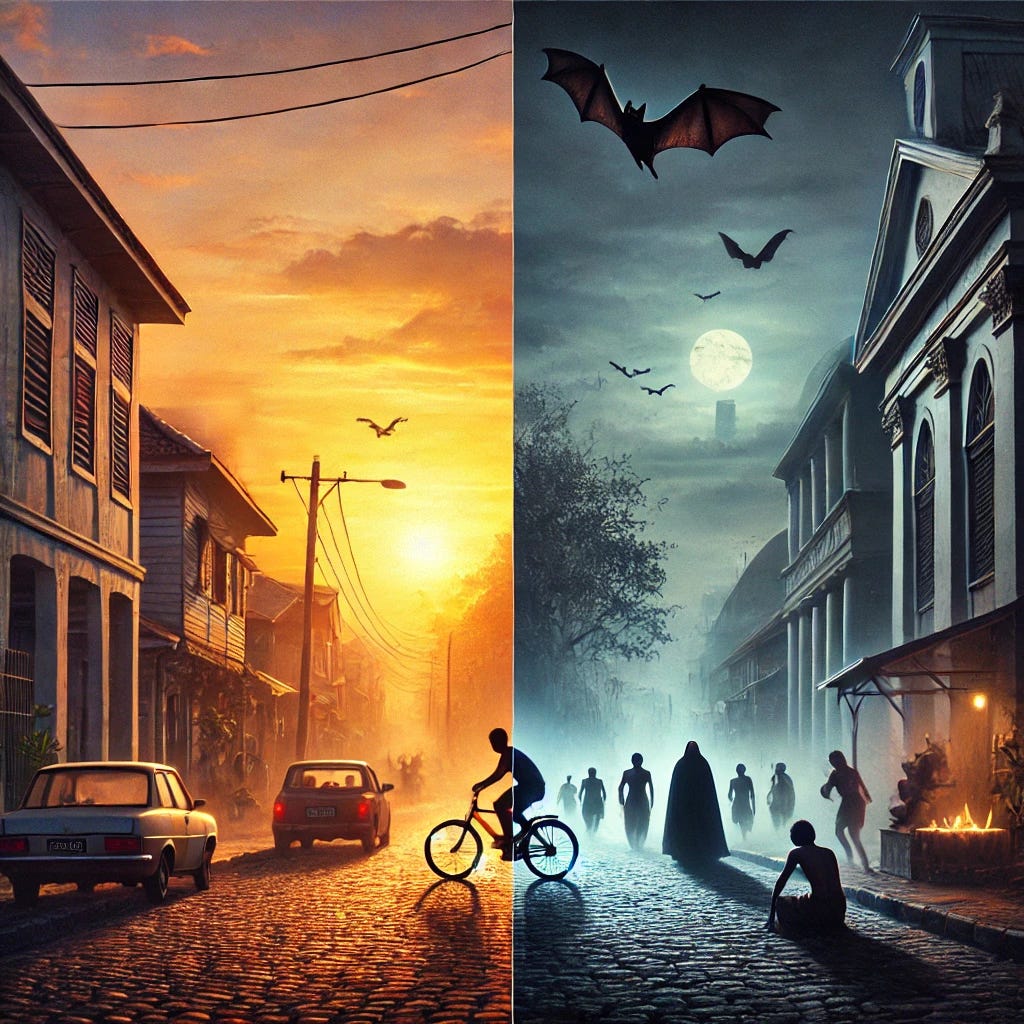
Dawn and dusk hold my most vivid memories of Suriname. At 5:00 am on the morning after a sleepover, the streets lay empty, my bike’s wheels swerving and bouncing over the cobblestones before pulling a rooster tail of gravel on side streets. The cool morning air brushed my cheeks like a feather, and for a moment, I was king of Paramaribo, and heaven was here and now.
At dusk, the pendulum swung violently in the opposite direction. Cars sped homeward, passing on the shoulder, veering into oncoming traffic, beep-beeping at anyone smaller. One December evening in 1986 stands out, perhaps because a dog-faced bat walloped me in the head as I veered off on a side quest whilst homeward bound.
That evening, I found myself alone, pedaling down a lonesome single-lane road into the forest. Ruts carved by daily rains gouged the gravel, which fought back a counter-coup of its own from thin blades of grass. Pumping the pedals feverishly, standing in the saddle, my bike swayed side to side. Then, rounding a bend, my world shifted.
It began with a stench so potent, so visceral, that I nearly retched. The odor, acrid and primal, was like nothing I’d ever encountered—a scent bypassing rational thought to strike somewhere deeper, more instinctive.
Then I saw them—figures dressed in somber funerary garb, silhouetted starkly against the dimming sky. They moved with somber purpose, their actions heavy with ritual grief. In the clearing before them rose a structure commanding attention: a funeral pyre, logs stacked crisscross like childhood building blocks or a bonfire for American pep rallies. But no celebration stirred here.
I dismounted, pushing my bike forward by its handles, legs trembling not from exertion but dawning realization. This was my first funeral and nothing like my parents described with my aunt. The scale, the solemnity—this was a community mourning, their sorrow palpable even from where I stood.
Frozen in place, I watched flames lick up the pyre’s sides. The fire grew, hungry and insistent, sending plumes of dark smoke spiraling skyward into twilight. That smoke seemed to carry the weight of unspoken stories, cut short lives, a tragedy my senses grasped but understanding could not.
Then one mourner turned, spotted me—a pale-faced outsider witnessing their private anguish. Our eyes met across that distance, and I felt the full brunt of my otherness. An intruder, however unintentional, on sacred ground.
That fleeting connection was metaphor for my whole Surinamese experience: always peripheral, observing a world’s complexity and conflict I could never truly understand or join. The dancing flames reflected in the mourner’s eyes held all the pain and resilience of a nation teetering on the brink.
I turned my bike, heart pounding, and pedaled away, the rising smoke’s image lingering—a solemn banner against the darkening sky. That evening’s gloom gathered, leaving me with the sense of having glimpsed something profound, transcending my grasp yet demanding to be remembered. The dog-faced bat’s earlier strike seemed trivial now, a fleeting shot across the bow compared to what I’d witnessed.
Paramaribo’s lights beckoned in the distance, but the darkness I left cradled secrets haunting my dreams for years after.
That December, Suriname’s unemployment peaked at 30%. Poverty ravaged so deeply that many could no longer afford proper burials. The destitute left loved ones’ remains in burial grounds, surrendering them to the state’s overworked disposal crews. Deep from the interior, Maroon families journeyed to give birth in Paramaribo’s hospitals. When babies didn’t survive, their tiny lifeless forms were unceremoniously stacked in coffins, five at a time, for hasty burial.1
I was oblivious then, focused on mundane pursuits like swim lessons at Parima Pool, the country’s lone 50-meter competition venue. For months, I diligently trained—treading water, hauling weighted dummies up from the depths, swimming laps submerged—all toward that coveted Red Cross certification.
The night before my final exam, Parima shuttered. The country ran out of chlorine, they said. At the time, we simply shrugged, chalking it up as another quintessential Surinamese quirk. Looking back, I see it now: the pool’s closure, those barren store shelves, the inability to properly mourn—all harbingers of the supply lines choking the capital, of a population bracing for siege, if not outright invasion.
In Christian circles, we strive to be “in the world, but not of it.” Even, it seems, when that world devolves into economic free-fall, coups, and planned invasions unfolding all around us. We see only what we are trained to see: signs of the end-times, prophecy or humanity’s sin nature.
That very December, my parents decided to fly to Quito for a missions conference on childhood education at the prestigious Alliance Academy International. Dad, admittedly naive about global teaching styles after his American seminary training, leapt at the chance to learn from educators worldwide.
The trip also afforded my siblings and me a sorely needed reprieve back in the States for Christmas. While my sister and I thrived in Suriname, my older brothers floundered. A family respite, my parents reasoned, might reignite their fading flames.
We were dropped stateside with our grandparents while Mom and Dad carried on to Ecuador. Recently, I asked my father about that trip’s suspicious timing—our exodus coinciding with Suriname’s declared state of emergency.
“What are the odds we just happened to leave the country when reports surfaced that Brunswijk secured explosives to bomb Paramaribo stores?” I pressed. “Citizens were panic-buying, bracing for the capital’s overthrow. Queues stretched for blocks. How lucky were we to miss all that?”234
Dad’s brow furrowed. “I’m not sure what you’re implying, but neither your mother nor I had any clue what was happening.”
“I’m not implying anything,” I assured him. “I’m just gobsmacked that we could be so obliviously ensconced in our own little world!”
His tone softened. “Well, we weren’t the only ones. I don’t recall any missionaries discussing an uprising, either.”
And there’s the rub—I believe him. Because caught up in my childhood innocence, I too remained blind to the encircling chaos. It’s a key reason I’m driven to document this era, to shed light on my shrouded memories.
My mother’s high school revelations shattered my naiveté. “No way,” I stammered upon learning the truth. “I lived through this. I was there! How could I have been so utterly unaware?” But now, I see it happening again, but this time in America. People see only what they want to see.
There’s a common misunderstanding about fundamentalist Christians like us—that we’re dim-witted simpletons. Far from it; our family had more degrees than a thermometer. We are, however, willfully ignorant. We create our own insular reality, our own news sources, our own authorities interpreting the world’s happenings.
Our self-imposed bubbles were so impermeable that when seventeen Maroons were slaughtered in Paramaribo amid 8,000 civilians fleeing the war zone into French Guiana, the rumblings of imminent invasion didn’t reach our heedless ears. Existing, but not of that existence, we drifted, oblivious, in our manufactured Eden.
While I was enjoying my first Big Mac in Miami, weeks before Christmas, events were unfolding in Suriname that would shape the nation’s future and inch closer to the end of our time in Suriname. The Council for the Liberation of Suriname, emboldened by Brunswijk’s rebels, issued a brazen call for a “Grenada-style invasion” to topple Bouterse’s regime.
As Dutch Prime Minister Ruud Lubbers sat in the Catshuis, his official residence, he couldn’t shake a gnawing sense of unease. The plan before him shared elements of an earlier, failed coup attempt in July of that year. Would this audacious move plunge Suriname into chaos, undoing years of careful decolonization?
The next day brought a sobering reality check. Defense Minister Van Eekelen received a crucial briefing: Zanderij Airport, their primary target, was a fortress. Machine guns and armored vehicles stood ready, a formidable obstacle to their plans. Yet, in the face of these ominous reports, Chief of Naval Staff Carl Brainich von Brainich-Felth remained resolute, his optimism unwavering.
Lubbers, a master of political chess, began to move his pieces. He reached out to key party leaders, testing the waters of support. The reactions were a mixed bag: skepticism from VVD’s Voorhoeve, enthusiasm from PvdA’s Kok, indecision from D66’s Van Mierlo, and cautious neutrality from CDA’s De Vries. The specter of international law loomed large, especially in light of the controversial American invasion of Grenada just three years prior. But this was different – they had a direct plea from the Surinamese government.
As Dutch politicians debated, an elite American military team touched down in the Netherlands. Their mission? To fine-tune an invasion plan of breathtaking boldness. Hercules aircraft and helicopters would launch from a behemoth landing ship, paratroopers raining from the sky over Zanderij, their targets the anti-aircraft guns and nearby military police barracks. Meanwhile, a battalion would storm Paramaribo, hunting for the elusive military strongman.
The plan seemed to share intel with Tommy Lynn Denley’s earlier, ill-fated attempt. Both schemes zeroed in on Zanderij Airport, both relied on ships laden with scuba gear for frogmen. Even the cast of characters aligned: Navy SEALs in Denley’s plot, Dutch marines in this one. Both counted on the crucial support of Ronnie Brunswijk and his Jungle Commandos, with English mercenaries waiting in the wings. Ambassador Robert “Bob” Barbour, even hinted in his intel briefings that U.S. Marines were already on standby in French Guiana.
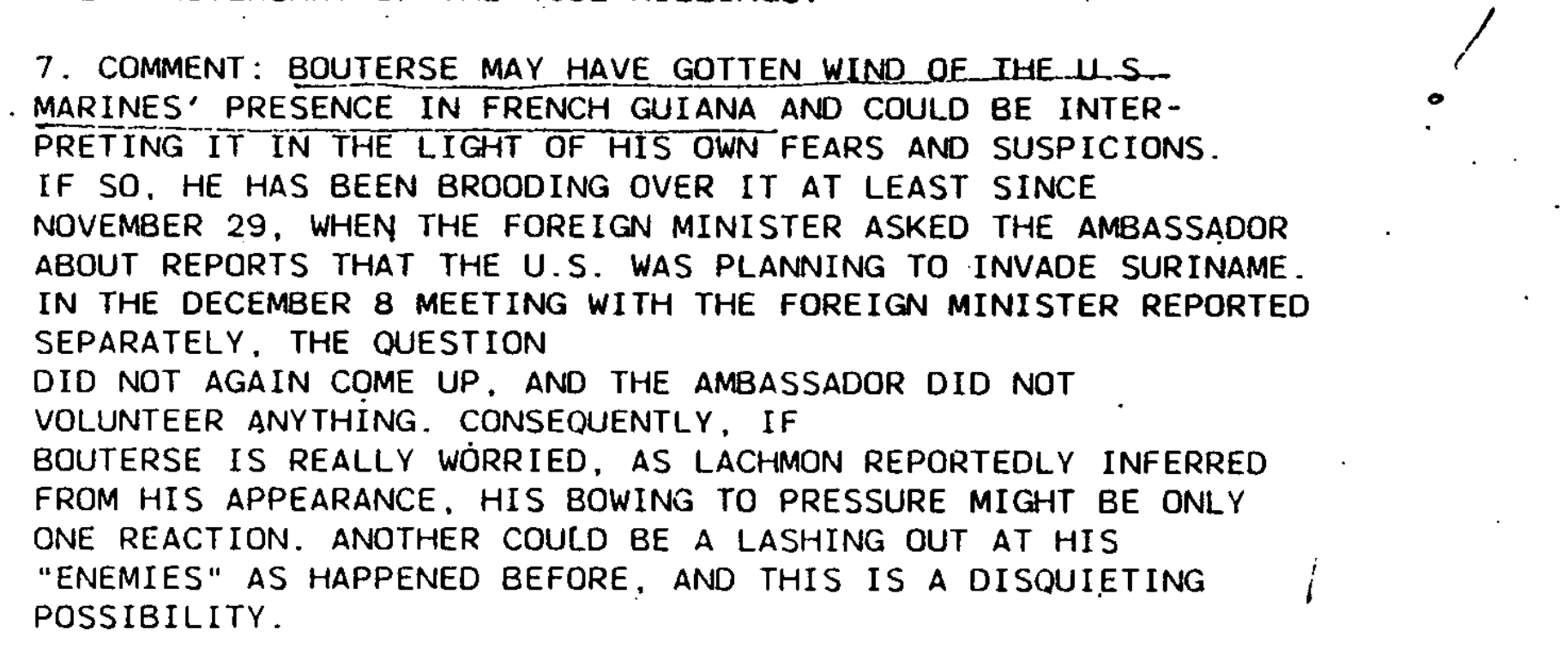
The clock was ticking. Sixty hours – that’s all it would take to set the invasion in motion. Marines and helicopters would deploy from a US naval base in Florida via the Roosevelt Roads naval base in Puerto Rico to the coast of Suriname, their true mission shrouded in secrecy under the guise of a routine exercise. A Dutch frigate, flanked by smaller American vessels, would take up position off Suriname’s coast. Frogmen stood ready to neutralize military police posts along the Suriname River.
But then, in a twist worthy of a Monty Python sketch, the entire operation ground to a halt. The culprit? Marine holiday leave schedules. With Christmas rapidly approaching, this seemingly mundane detail threw a wrench into the gears of the invasion machine, forcing a postponement beyond January 15, 1987. As the carefully laid plans unraveled, President Reagan received word of the Dutch restraint.
The diplomatic fallout was swift and severe. Accusations flew from the Surinamese government, painting the Netherlands as puppeteers pulling the strings of insurgents. The situation reached a boiling point in January 1987 when the Dutch ambassador was unceremoniously expelled, shattering already fragile relations.
Decades later, the veil of secrecy lifted. Historical records and Reagan’s own diaries revealed the audacious plan in all its detail. The Dutch, novices in the world of military interventions, had leaned heavily on American expertise. In a final irony, it was not geopolitics or moral qualms that stayed their hand, but the prosaic reality of scheduling conflicts.5
Links
Ruggenberg, Rob. “Suriname Ontkent Bestaan van Illegale Begraafplaats.” Leidse Courant, December 24, 1986. Historische Kranten, Erfgoed Leiden en Omstreken. https://leiden.courant.nu/issue/LLC/1986-12-24/edition/0/page/7.
The Ottawa Citizen. “Suriname Declare State of Emergency.” December 3, 1986. https://www.newspapers.com/article/the-ottawa-citizen-suriname-declare-stat/127401137/
Leidse Courant. “Surinaamse Leger ‘Zuivert’ Albina.” December 2, 1986. Historische Kranten, Erfgoed Leiden en Omstreken. https://leiden.courant.nu/issue/LLC/1986-12-02/edition/0/page/7.
Leidse Courant. “Inwoners van Paramaribo Moeten Nu in Actie Komen.” December 4, 1986. Historische Kranten, Erfgoed Leiden en Omstreken. https://leiden.courant.nu/issue/LLC/1986-12-04/edition/0/page/5.
Redactie/ANP. “Nederland Overwoog Militaire Inval Suriname.” de Volkskrant, November 8, 2011. http://web.archive.org/web/20111111111125/https://www.volkskrant.nl/vk/nl/2844/Archief/archief/article/detail/1060293/2010/11/20/Verlos-ons-van-Bouterse.dhtml.
Date:
September 2, 2025