Strategic Skies Over Suriname
The EC-135 Incident and Cold War Geopolitics (1980)
Apr 17, 2025
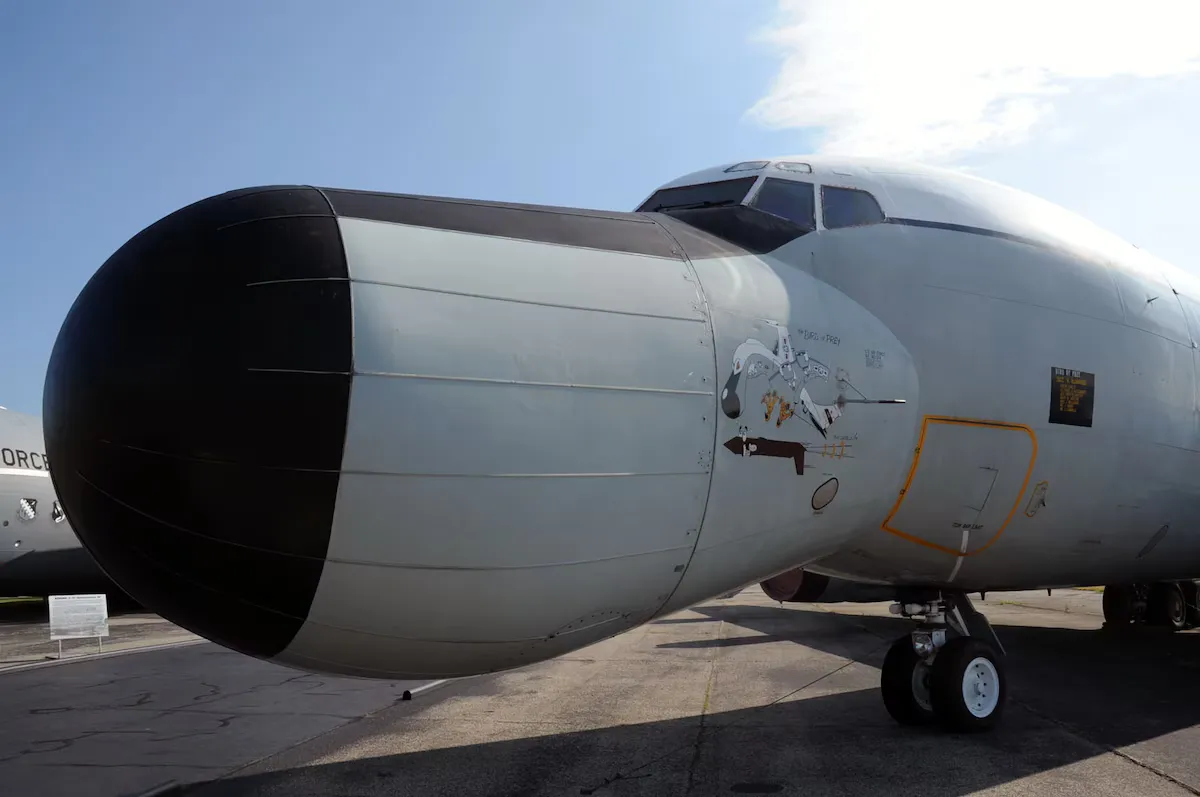
Summary: In February 1980, a little-noticed operational overlap between a routine U.S. military satellite support mission and a sudden military coup in Suriname triggered an unexpected convergence of Cold War strategic interests and local geopolitical upheaval. This analysis integrates newly surfaced oral history testimony and declassified Department of Defense materials into the timeline of U.S.-Surinamese relations and the broader Cold War context, highlighting how an incident in a peripheral theater exposed vulnerabilities in global strategic support architecture and contributed to an evolving understanding of comprehensive national security.
EC-135 and E-4 Aircraft (1960s–1980s) – Operations and Suriname Connection
EC-135 Variants and Roles (1960s–1980s)
The Boeing EC-135 was a series of modified C-135 Stratolifter aircraft (a cousin of the Boeing 707) equipped for specialized communication and command missions. Multiple variants were developed in the 1960s to support U.S. strategic forces:
- EC-135A/C “Looking Glass” – Served as continuous airborne command posts for the Strategic Air Command (SAC). Starting on February 3, 1961, SAC kept at least one EC-135 airborne 24/7 under Operation Looking Glass. These aircraft carried a battle staff and high-powered communications to direct nuclear forces (ICBMs, bombers, etc.) if ground command centers were destroyed. Looking Glass flights accumulated over 281,000 accident-free hours in nearly 30 years. The EC-135C and related variants also included the Airborne Launch Control System, meaning onboard crews could launch Minuteman ICBMs via radio if needed.
- EC-135J “Nightwatch” – In the mid-1960s, three EC-135J aircraft (modified KC-135Bs) were configured as the National Emergency Airborne Command Post (NEACP), codenamed Nightwatch, to serve the U.S. President and National Command Authority. These planes stood ready at Andrews AFB to evacuate leadership and direct forces during a surprise nuclear attack. They were operational until the Boeing E-4 began replacing them in the 1970s.
- EC-135H “Silk Purse” and EC-135L “Scope Light/Blue Eagle” – These variants provided mobile command posts for U.S. theater commanders. Silk Purse EC-135Hs supported U.S. European Command; Scope Light/Blue Eagle EC-135s supported Pacific or Atlantic command missions. Other specialized aircraft included EC-135K “Head Dancer” and EC-135Y (USCENTCOM airborne command platform).
- EC-135N/EC-135E “ARIA” – The Advanced Range Instrumentation Aircraft (ARIA) program began in 1967–68 with eight EC-135N models equipped with a distinctive “Droop Snoot” radome for satellite telemetry. These aircraft supported the Apollo program and other missile/space tests, relaying data from spacecraft or warheads over remote regions. After Apollo ended, the planes were upgraded to EC-135E and continued supporting ICBM tests, satellite launches, and foreign missile monitoring. In early 1980, the EC-135 ARIA’s unique capabilities remained indispensable. While direct satellite-to-ground telemetry was advancing, comprehensive global coverage, especially for sensitive reconnaissance missions requiring physical data recovery (like film capsules) or telemetry from remote oceanic regions, still relied heavily on these specialized airborne platforms. The full global satellite relay network (like the Tracking and Data Relay Satellite System – TDRSS, which only began deployment in the 1980s and achieved full operational capability later) was not yet mature, making the ARIA fleet a critical, if transitional, bridge for strategic intelligence gathering. By the late 1980s, ARIA missions declined with the rise of more advanced satellite-to-satellite telemetry systems.
Strategic Importance: These EC-135 variants were critical to Cold War command-and-control (C3), enabling real-time communication, continuity of nuclear force control, and space-based surveillance. EC-135Cs offered a survivable airborne launch capability; EC-135Ns and Es served as mobile downrange stations and relay points for strategic data—especially vital before the global satellite network matured. Their operations formed a robust, redundant communication grid designed to preserve command integrity through all stages of potential nuclear conflict.
E-4 Aircraft: The Next Generation Command Platform
To overcome EC-135 limitations in space, EMP hardening, and communications capacity, the U.S. developed the E-4A/B “Nightwatch” based on the Boeing 747.
- E-4A (1974): The first three aircraft entered service in 1974, replacing EC-135J aircraft in the NEACP role. E-4As mirrored EC-135 functionality with enhanced crew capacity, long-endurance flight, and expanded command space.
- E-4B (1979–1980): Introduced satellite communication enhancements via the SHF/EHF satellite terminal dome, direct connectivity with DSCS networks, and EMP shielding. By 1985, four E-4Bs had replaced the EC-135 in the NEACP role, with one on 24/7 alert at all times. E-4Bs also served as backup command centers during presidential trips and could support the Looking Glass mission if needed.
The E-4 series signified a modernization of Cold War airborne command doctrine. With aerial refueling and robust communication gear, these aircraft could coordinate nuclear retaliation, conventional operations, or global command functions in a range of crisis scenarios.
Case Study: The 1980 Suriname Coup and the EC-135 Crisis
The Coup and the Aircraft
On February 25, 1980, a group of Surinamese non-commissioned officers led by Sergeant Desi Bouterse staged a successful coup d’état, overthrowing the incumbent government. The coup caught both the Surinamese government and the U.S. Embassy largely by surprise. Suriname, at the time, was not a high-priority intelligence target for the U.S., meaning there was a limited intelligence footprint on the ground. This lack of advance warning and deep situational awareness magnified the challenge of protecting U.S. assets and personnel once the coup began.
At that precise moment, two U.S. Air Force EC-135 ARIA aircraft were stationed at Paramaribo-Zanderij International Airport—a geographically advantageous location for staging missions to support U.S. satellite launches and retrieve data, such as photographic film capsules from polar-orbiting reconnaissance satellites, over the South Atlantic. Their mission involved flying out over this region to retrieve these capsules, a vital component of early U.S. satellite reconnaissance capabilities before digital imagery and direct relay became standard.
According to oral histories by Neul L. Pazdral (Deputy Chief of Mission) and Paul Good (Public Affairs Officer), the EC-135 crews—approximately 26 U.S. servicemen in uniform—were trapped in the capital as the coup unfolded. The U.S. Embassy, hampered by a communications blackout, scrambled to negotiate their release.
U.S. Embassy Response and Tactical Risk
Eventually, Pazdral secured safe passage for the crews from Bouterse himself. However, the crucial U.S. satellite launch the ARIA aircraft were tasked to support was delayed, and the planes’ strategic mission was compromised. The unexpected presence of two large, electronics-laden U.S. military aircraft on the ground in the midst of a sudden and unpredictable regime change posed serious diplomatic and operational risks. The incident, though ultimately resolved without loss of life or equipment, created an acute vulnerability within U.S. satellite surveillance operations and highlighted the potential for local political instability to impact global strategic missions.
Strategic Repercussions in Command Architecture
The FY 1977 DoD report contextualizes the mission’s importance. It details how EC-135s and their successors, the E-4Bs, were integral to the Minimum Essential Emergency Communications Network (MEECN), which supported:
- Continuity of nuclear command and control
- Coordination of the Single Integrated Operational Plan (SIOP)
- Recovery of physical satellite data during the pre-digital era, a critical intelligence function.
While the EC-135 ARIA aircraft in Suriname were not ALCC variants like “Looking Glass,” they were undeniably part of a vulnerable transitional system. They operated within an airborne network essential to U.S. nuclear deterrence and strategic intelligence. Their unanticipated entrapment in a small Caribbean country demonstrated how seemingly peripheral regions and actors could temporarily jeopardize vital components of the global U.S. command and intelligence architecture.
Beyond the immediate mission compromise, the EC-135 ARIA incident in Suriname served as an object lesson. It underscored how seemingly localized political instability in ‘low-threat’ regions could unexpectedly impact global strategic operations and expose vulnerabilities in the support infrastructure for critical U.S. command, control, and intelligence functions. Such incidents contributed to an evolving understanding within the defense establishment, feeding into broader strategic reviews during the Carter and early Reagan administrations. This awareness emphasized the need for more robust contingency planning, enhanced intelligence gathering in ostensibly minor theaters, and a comprehensive approach to securing the entirety of the strategic architecture, including its vital, though sometimes less heralded, support elements. The Zanderij incident became a data point illustrating the complex interplay between local events and global superpower readiness.
Timeline Integration:
- 1976–1977: DoD begins transitioning to E-4B AABNCP aircraft; EC-135s in various roles, including ARIA, remain critical due to ongoing technological dependencies.
- February 24–25, 1980: Two EC-135 ARIA aircraft refuel and overnight in Paramaribo, Suriname, prepared for a satellite support mission.
- February 25, 1980 (early morning): Sergeant’s Coup begins. Military forces loyal to Bouterse seize key government buildings and Zanderij International Airport.
- February 25–26, 1980: EC-135 ARIA crews are effectively trapped in Paramaribo; U.S. Embassy, facing communication difficulties and an unclear situation, negotiates for their safe release and the departure of the aircraft.
- February 26, 1980 (or shortly thereafter): Aircraft and crews depart Suriname; the U.S. satellite launch they were supporting is delayed due to the incident.
Conclusion:
The EC-135 episode in Suriname is a revealing case study in Cold War logistics, intelligence shortcomings, and strategic vulnerability. These ARIA aircraft—integral to the satellite data recovery architecture of the era—were caught off guard by an unexpected coup in a geopolitical theater not typically considered a flashpoint. Their presence, stranded status, and the subsequent mission delay highlight how the Cold War’s global command and intelligence infrastructure could be significantly impacted by local instability and unforeseen events. The incident also vividly illustrates the strategic importance of transitional airframes like the EC-135 ARIA during a period when next-generation systems like the E-4B and comprehensive satellite relay networks were not yet fully mature or universally deployed. Ultimately, the events in Suriname underscored that seemingly routine missions, when thrust into the geopolitical spotlight by events beyond their immediate scope, could reveal critical seams in superpower strategic preparedness and influence future defense posture.
Citations
- Paul Good, Public Affairs Officer, U.S. Embassy Paramaribo (1979–1981). Oral History Interview, Association for Diplomatic Studies and Training (ADST), Suriname Reader. https://adst.org/Readers/Suriname.pdf
- Neul L. Pazdral, Deputy Chief of Mission, U.S. Embassy Paramaribo (1979–1981). Oral History Interview, ADST Suriname Reader. https://adst.org/Readers/Suriname.pdf
- U.S. Department of Defense. Annual Defense Department Report, FY 1977. Declassified as CIA-RDP83B01027R000200150016-3. https://www.cia.gov/readingroom/docs/CIA-RDP83B01027R000200150016-3.pdf
- National Museum of the U.S. Air Force. “Boeing EC-135C Looking Glass.” https://www.nationalmuseum.af.mil/
- Federation of American Scientists (FAS). “EC-135 Looking Glass.” https://nuke.fas.org/
- Wikipedia contributors. “Boeing EC-135,” Wikipedia, https://en.wikipedia.org/wiki/Boeing_EC-135
- Wikipedia contributors. “Boeing E-4,” Wikipedia, https://en.wikipedia.org/wiki/Boeing_E-4
- Johns Hopkins University Applied Physics Laboratory. “Advanced Range Instrumentation Aircraft (ARIA) History.” https://www.jhuapl.edu/
- U.S. Air Force Fact Sheet – E-4B National Airborne Operations Center. https://www.af.mil/
- The Tactical Air Network. “Nightwatch: The Air Force’s Doomsday Jet,” March 2, 2017. https://tacairnet.com/2017/03/02/nightwatch-the-air-forces-doomsday-jet/.
- Hopkins III, Robert. “The History Of American Presidents Flying Aboard Doomsday Planes.” TWZ (blog), June 1, 2021. https://www.twz.com/40661/the-presidents-and-the-doomsday-planes.
Note: Primary oral histories and DoD documents were cross-referenced with publicly available military archives and declassified sources for historical accuracy.
Source:
Link:
Internal Link:
Date:
October 26, 2025