The Code That Cracked a Cold War Secret
Inside CIA Job 84B00049R
Aug 14, 2025
You know that feeling when you’re digging through old papers in someone’s attic and you stumble across a shoebox that changes everything? That’s exactly what happened when I started following a seemingly random string of numbers and letters: 84B00049R.
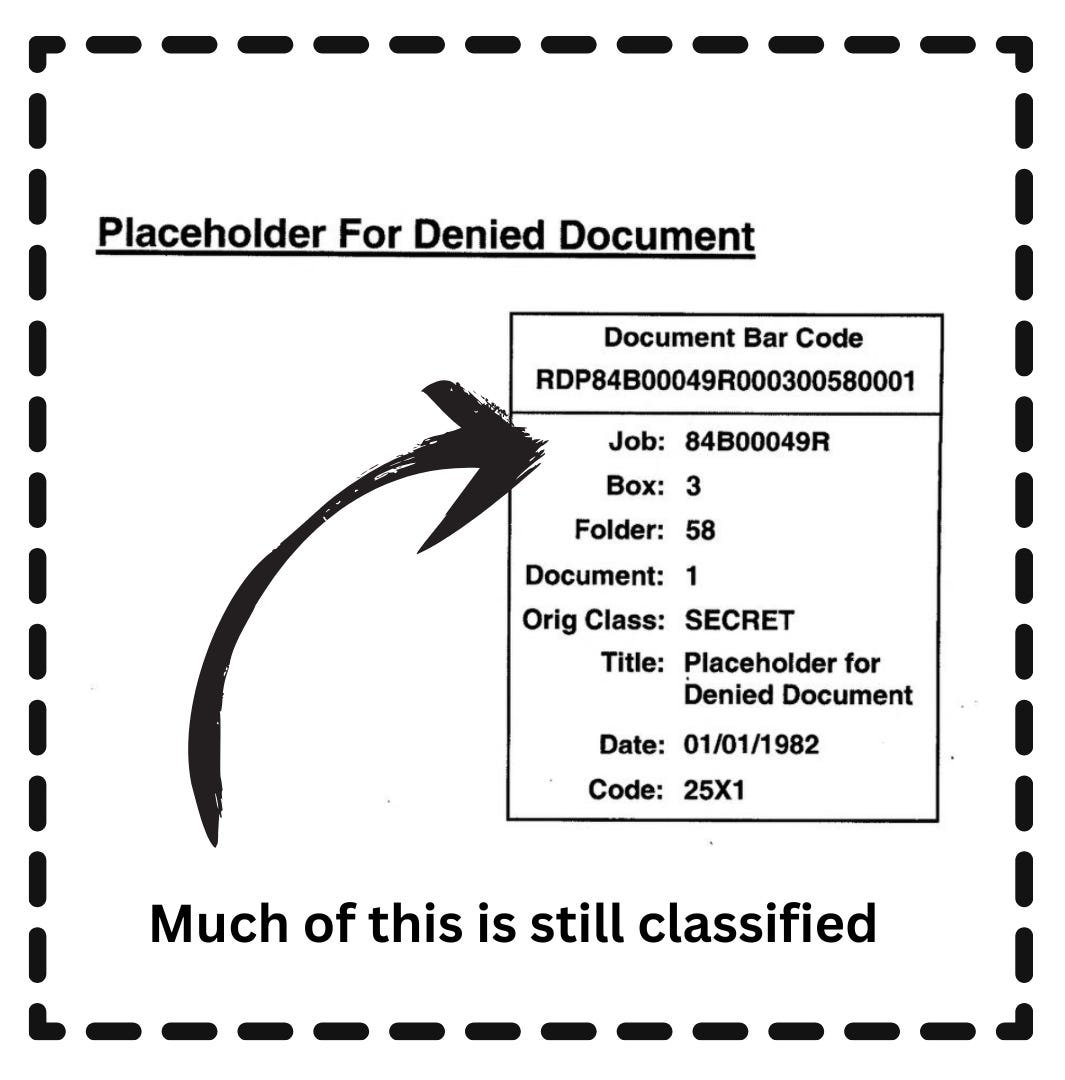
Most people would glance at that alphanumeric code and move on. But if you’re hunting for Cold War secrets, those nine characters are like finding a treasure map. They’re the CIA’s filing system breadcrumbs that lead you straight to one of the Reagan administration’s most audacious—and largely unknown—covert operations.
By Matthew Smith is a reader-supported publication. To receive new posts and support my work, consider becoming a free or paid subscriber.
The target? A tiny South American country most Americans couldn’t find on a map: Suriname.
The Shoebox That Started It All
See, 84B00049R isn’t just any CIA job number. It’s the designation for what the Agency calls “DCI Subject Files”—basically, the CIA Director’s personal filing cabinet for the really important stuff. And in 1981-82, William Casey’s cabinet was stuffed with Suriname intelligence.
When I first started tracking 84B00049R, it was in a State Department Bureau of Intelligence and Research paper (published two days after the December Murders) about International Terrorism and the plot to assassinate Pope John Paul II. For some strange reason, within the 84B00049R files, there was a folder titled “Suriname, & INF/NSC Meeting” listed alongside other folders covering topics like the MX Missile Program, Counterintelligence and Central America. As I dug deeper into the 84B00049R files, I realized that the common thread wasn’t just geography—it was Soviet-backed terrorism. Suriname was seen as a potential terrorist training ground because of Bouterse’s links to Cuba, which explained why it was filed alongside counterintelligence and Central America materials.
I did a quick “Command F” in my 1982 research document and found 33 references scattered across declassified documents. But here’s where it gets interesting—when I cross-checked with different file formats and dug into URLs, footnotes, and metadata, that number jumped to 55. Those missing 22 references? They were hidden in the digital equivalent of fine print, the kind of places that only show up when you’re really hunting.
That told me this wasn’t just routine intelligence gathering. This was systematic, coordinated tracking of a major operation.
And man, was something big brewing.
The Dominoes Reagan Couldn’t Let Fall
Picture this: It’s 1982. Reagan’s in the White House, worried sick about communist dominoes falling across the Caribbean. You’ve got Cuba ninety miles from Florida. Nicaragua’s gone full Sandinista. Grenada’s building an airport runway that could handle Soviet bombers. And now Suriname—this little Dutch colony that most people have never heard of—is cozying up to Havana and Moscow.
Desi Bouterse, the sergeant who’d seized power in a 1980 coup, was taking “advice and some limited military assistance from the Castro regime.” Cuban intelligence officers were setting up shop in Paramaribo. Planes were being loaded in Libya with arms bound for Suriname.
But here’s what really freaked out Washington: Suriname wasn’t operating in a vacuum. While Constantine Menges was surfacing in Suriname files on July 13th, 1982, the Cubans were simultaneously building that airstrip in Grenada, and the Contras were ramping up pressure in Nicaragua.
The airstrips were key as Castro was sending fighters to Angola to help fight alongside the Soviets. Suriname’s Zanderij International Airport offered the perfect refueling spot. Reagan’s team was playing three-dimensional chess across the Caribbean Basin, and Suriname was becoming the third node in what they saw as a coordinated Cuban/Soviet expansion.
The intelligence was crystal clear: Suriname was becoming “a new Grenada” or “a new Cuba” in South America. The first Soviet beachhead on the continent.
Reagan wasn’t having it.
84B00049R: A Pattern in the Paperwork
My research uncovered those 55 discrete references to “84B00049R” in declassified records—spanning direct mentions, footnotes, and embedded citations in National Security Council briefing materials. And the pattern? It’s like a roadmap to a covert operation.
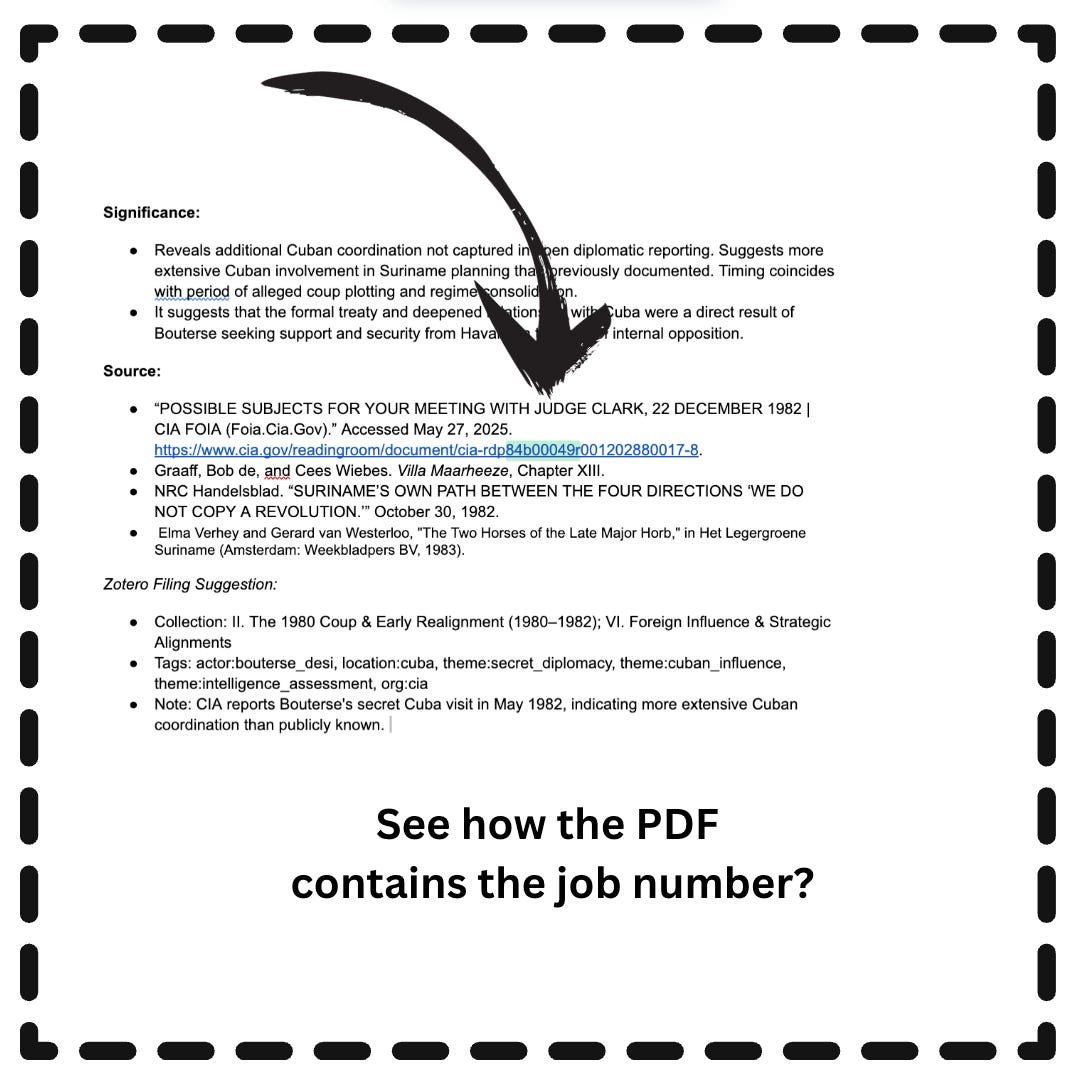
June 8, 1982 — Job # 84B00049R is linked to documents regarding the testimony of the Army’s Assistant Chief of Staff for Intelligence, Major General William E. Odom, before the House Permanent Select Committee on Intelligence (HPSCI) regarding a super secretive “rogue” unit called the Intelligence Support Activity (ISA).
July 13, 1982 — Constantine Menges surfaces in 84B00049R-linked documents, just two days before U.S. intelligence reports Cuban and Soviet infrastructure projects in Suriname. Menges pens another widely circulated Job # 84B00049R document three weeks later entitled: “SURINAME: THE GROWING DANGER.”
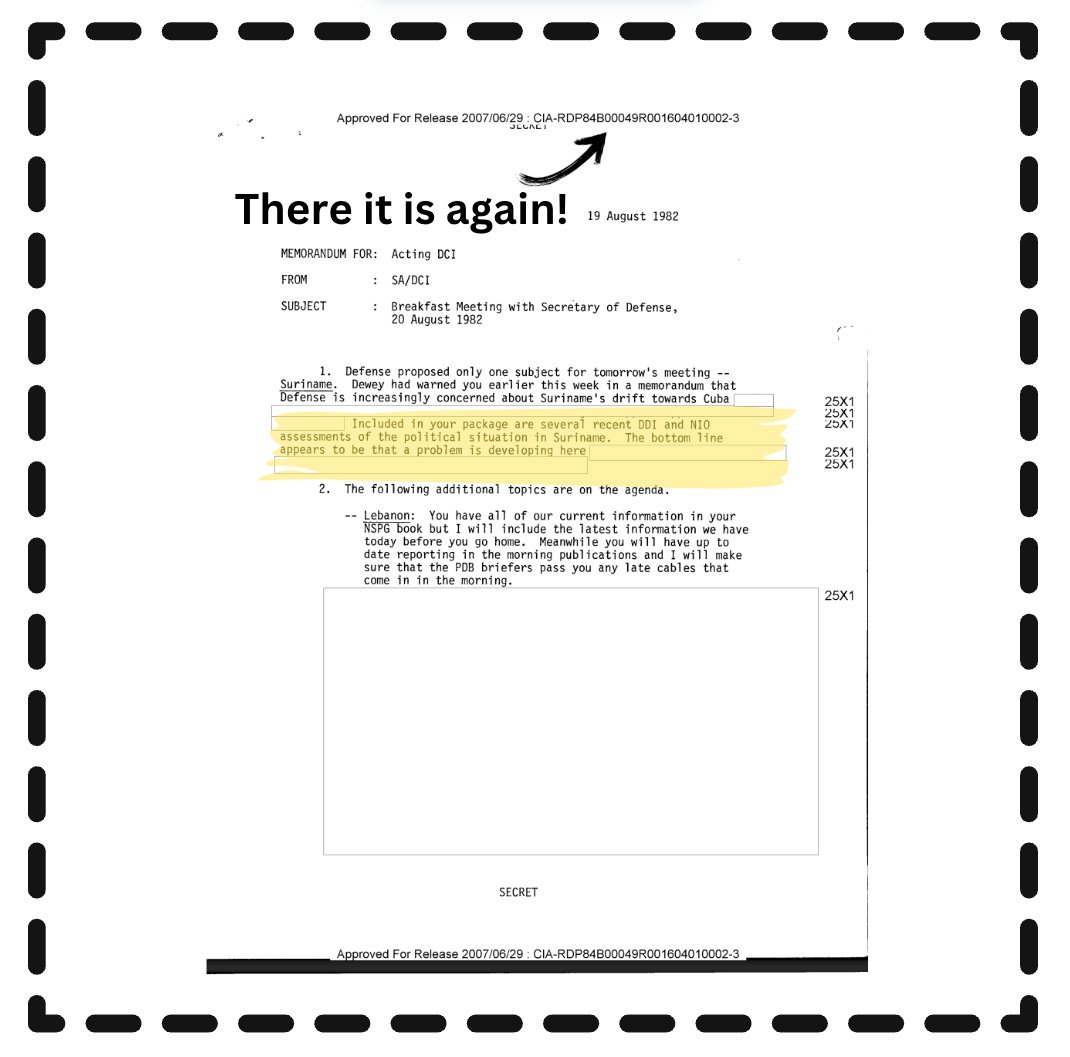
August 13, 1982 — Reagan, Clark, and the NSC convene on “Suriname: Current Situation“in another Job # 84B00049R briefing that falls on the same day as known Caribbean Basin policy meetings. A few days later, a Job # 84B00049R memo about Breakfast meeting about Suriname with the Secretary of Defense reads “bottom line appears to be that a problem is developing here.”
November 5, 1982 — A secret document for Secretary Shultz hat discusses the secret meeting between Mayor Roy Horb, former President Henk Chin A Sen, members of ALCOA and the CIA (with large sections about the visit redacted) is yet another Job # 84B00049R document. The timing? Just weeks before the infamous December Murders.
These aren’t random. They form a timeline of operational awareness, suggesting that Suriname was being monitored in real time alongside larger regional crises. The synchrony is telling—Suriname briefings happening the same month as Grenada escalation and Nicaragua planning suggests the NSC was sequencing options: overt intervention for Grenada later, coercive diplomacy for Suriname now.
The Coup That Wasn’t (Or Was It?)
In May–June 1982, internal Reagan administration discussions — some involving North, Menges, and Clark — touched on destabilization scenarios. Suriname was a candidate. The idea: use psychological operations, labor destabilization and foment popular uprisings to squeeze Bouterse, coordinate covert pressure, and, if necessary, back a coup.
By November, the 84B00049R files show intense activity. Agenda items. Memos to Shultz about Bouterse. Pre-positioning for something big.
Then came December 8–10, 1982: fifteen prominent critics of the regime were executed in what became known as the December Murders. U.S. briefings in the 84B00049R file shifted overnight from policy papers to after-action assessments.
But here’s the thing that haunts me about those files: they cluster heavily around November 5, 1982—just weeks before Bouterse’s brutal crackdown. Were those briefings trying to prevent the killings? Exploit the chaos they’d create? Or were the murders themselves the end result of months of U.S. pressure that backed Bouterse into a corner?
Whether Washington’s coup plans were shelved or simply overtaken by events remains an open question. But the temporal overlap between coup planning meetings and major Suriname incidents is now on record.
The Secret Meeting That Changed Everything
Here’s where it gets crazy. In late December 1982, the Dutch reached out to assistant secretary of state for European affairs, Lawrence Eagleburger. They wanted help with the Suriname situation. Eagleburger took the idea to the Secretary of State, George Shultz who writes about it in his autobiography.
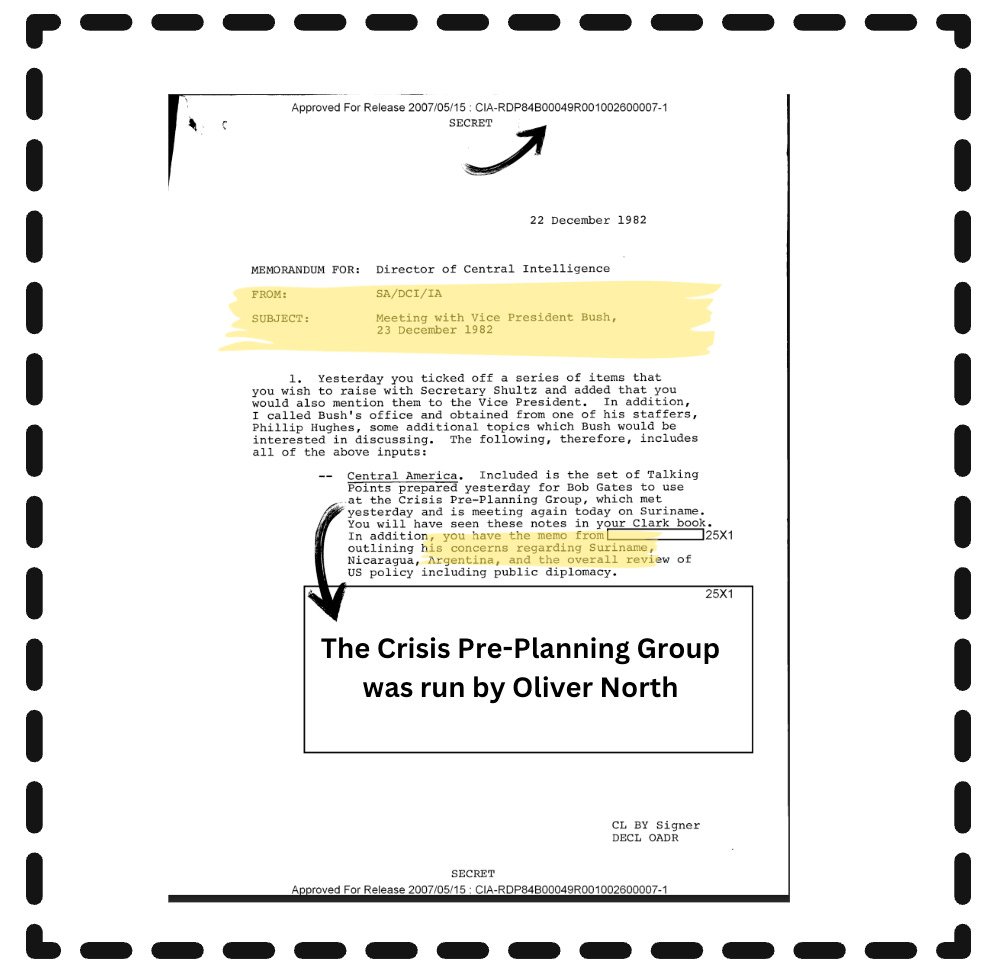
Later in the day, there was a meeting of the Crisis Pre-Planning Group. This group was established earlier that year in May, chaired by Vice President Bush and ran by Oliver North as representative of the NSC Staff. The CPPG functioned as the “engine room” for crisis management. The CPPG was where theoretical threats became actionable plans—and Suriname had just made the list.
At that meeting, Assistant Secretary of State for Inter-American Affairs, Tom Enders pitched the idea of the Dutch sending their forces to invade Suriname with the U.S. Navy running cover to prevent the Cubans from coming to Bouterse’s assistance.
Vice President Bush had been debriefed on the situation the day before, as you can see below. And… what do we have here? Sure enough: Job 84B00049R. The plan was approved and a delegation including Ambassador Stephen Bosworth to The Hague to formally propose a joint U.S.-Dutch military intervention to “get rid of these guys in Surinam.”
“I went to the Netherlands on a quiet mission with a general from the White House and met with the Dutch foreign minister and Dutch prime minister with Reagan’s personal approval and asked if they would be prepared to join with us in a military expedition to get rid of these guys in Surinam. They said no. They said our public would never support it and we just can’t do it. So, I turned around and went home and reported to the White House what their reaction had been and that was kind of my last official act there.“
The Paper Trail That Almost Disappeared
This is where 84B00049R becomes your best friend as a researcher. Every major document tied to this operation carries that job number. It’s all there, filed under 84B00049R, creating a breadcrumb trail through one of the most sensitive operations of the Reagan era.
The fact that we can see Job 84B00049R stamped on documents from June through December 1982 means someone at the highest levels was tracking this operation across six months of escalating tension. This wasn’t ad hoc crisis response—this was systematic monitoring of a priority target that had earned its own dedicated filing system in the CIA Director’s personal files.
I’ve been building a complete archive of every 84B00049R document I can find. The pattern is so clear now that I can almost predict which months will have missing files just by looking at the gaps. When you see intense activity in November but radio silence in early December, you know something got buried deeper.
But here’s the thing that keeps me up at night: we’re only seeing pieces. National Security Decision Directive 61—the October 1982 order that likely authorized the whole Suriname pressure campaign—remains completely classified. The full NSPG meeting minutes where Reagan signed off on the plan? Also buried. Near the close of 1983, USSOUTHCOM activated an Operational Planning Group to develop a Suriname contingency plan, designated USCINCSO CONPLAN 6106. There’s still so much we don’t know.
What We Know vs. What’s Still Hidden
What 84B00049R reveals:
- Coordinated pressure campaign across multiple agencies
- U.S. and Dutch leverage operation with invasion threats
- Detailed contingency planning involving paratroopers and naval forces
- Real-time monitoring leading up to the December Murders
What’s still classified:
- NSDD-61 and its actual authorization scope
- Full NSPG meeting minutes with Reagan’s sign-off
- The decision-making process around proceeding or aborting
- Detailed intelligence on Cuban/Soviet activities that justified the operation
- The full file on the USSOUTHCOM Operational Planning Group’s Suriname contingency plan, designated USCINCSO CONPLAN 6106
Why This Matters Right Now
Look, I get it. Suriname in 1982 feels like ancient history. But this story reveals something crucial about how American power actually works when the cameras aren’t rolling.
This wasn’t about Suriname, really. It was about proving that Reagan’s team could outmaneuver the Soviets without firing a shot. They created and backed pro-democracy “indigenous resistance” organizations. They used Brazil as a proxy. They leveraged regional relationships. They deployed the threat of force without actually using it. And it worked—Suriname backed away from the radical path, Cuba kept a low profile, and the Soviet “beachhead” never materialized.
The extreme secrecy around NSDD-61 tells you everything. This operation was so sensitive that even now, 40+ years later, the details remain locked away. Which makes me wonder: what other operations are hiding behind seemingly random job numbers in government filing systems?
The Hunt Continues
The hunt for the rest of this story isn’t just academic. Somewhere in those classified files is the answer to whether the December Murders were a tragic accident or the inevitable conclusion of a pressure campaign that went exactly as planned.
And if we can crack the 84B00049R code for Suriname, imagine what other operations are hiding behind other job numbers. Every covert action, every secret negotiation, every off-the-books operation has a paper trail. You just need to know where to look.
I’m building a public library of all 84B00049R-related documents from 1980 to 1987. The goal: to piece together the operational picture, identify gaps, and follow the paper trail into related NSC and CIA job numbers.
If the 1982 coup plan existed in a more complete form, it’s likely cross-referenced with:
- NSDD-61 and NSSD 11-82 (Caribbean Basin policy directives)
- Reagan Library NSC files in Box 7 and Box 12
- CIA Directorate of Operations cables archived under regional terrorism or Soviet expansion headings
A Call to Researchers
If you have experience with Reagan-era intelligence collections, or if you’ve located stray 84B00049R citations in other regional files, we want to hear from you. The hunt for the rest of this story will be public—and collaborative.
Because sometimes, the smallest file number in the index turns out to be the biggest story. Sometimes a random string of numbers and letters can unlock secrets that reshape how you understand American foreign policy.
And sometimes, if you’re willing to dig through enough digital filing cabinets, you find that the most important operations are the ones most people never heard of.
Got leads on Reagan-era intelligence files? Know where to find more 84B00049R references? Hit me up. This story isn’t over—it’s just getting started.
Source:
Link:
Internal Link:
Date:
October 26, 2025