The Ghost and the Machine (Part IV)
Resolving the Peter (van Haperen) Problem
Apr 26, 2025
Introduction: A Necessary Reckoning
Peter van Haperen is the most difficult witness in the story of Project Democracy’s shadow war in Suriname. He is both a conduit of startling insider knowledge and a figure who embodies the unreliability, contradictions, and moral gray zones that defined clandestine operations during the Cold War. In this final installment, we confront his contradictions directly, examine how his testimony fits within the broader operational pattern of the era, and explain why the case against the architects of Project Democracy in Suriname ultimately stands even without depending on him as a “perfect” witness.
The Context: Project Democracy and the Council for the Liberation of Suriname
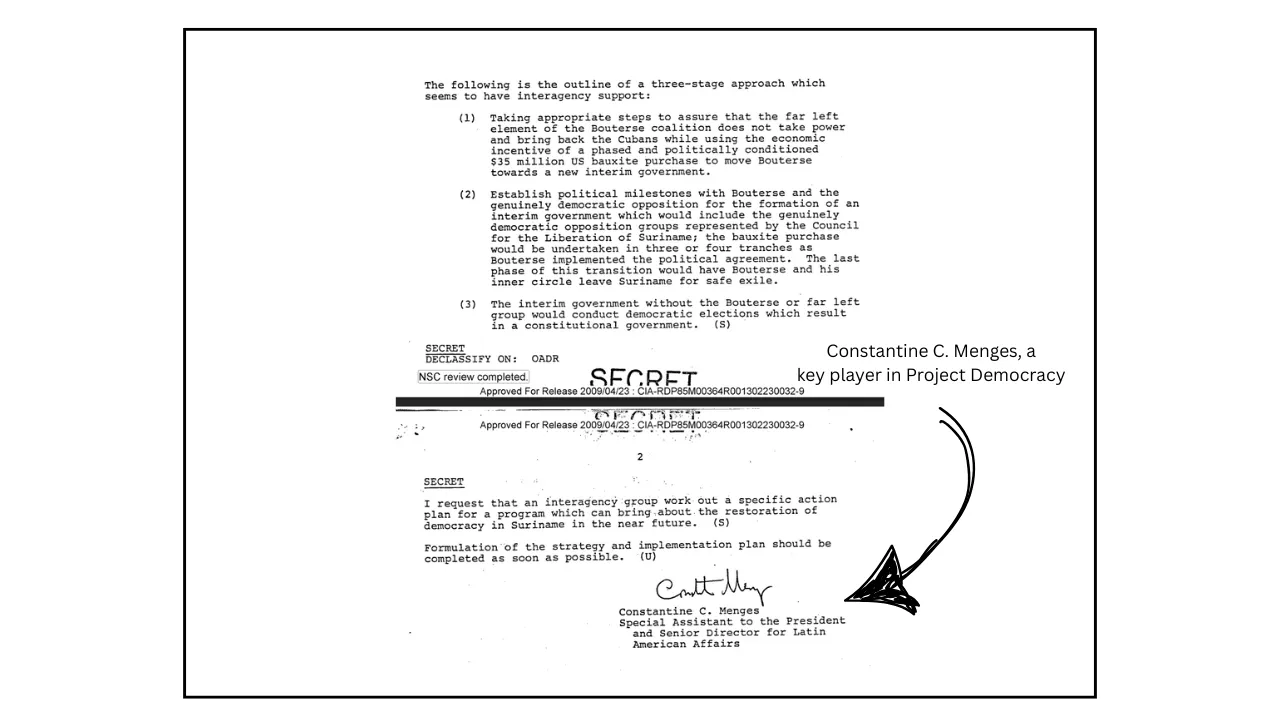
Newly declassified documents reveal that Constantine Menges, the architect of Project Democracy, was exploring financial incentives to remove Dési Bouterse and replace him with the Council for the Liberation of Suriname (CLS). This direct linkage between CLS and North/Menges confirms that efforts to destabilize Suriname were sanctioned at the highest levels of the Reagan administration.
Further reinforcing this point, the 1985 National Endowment for Democracy (NED) Annual Report disclosed that the NED, through the Free Trade Union Institute (FTUI), had been covertly funding the Council for the Liberation of Suriname throughout the 1983-1985 period. This provided a legal, “above ground” support structure parallel to covert operations.
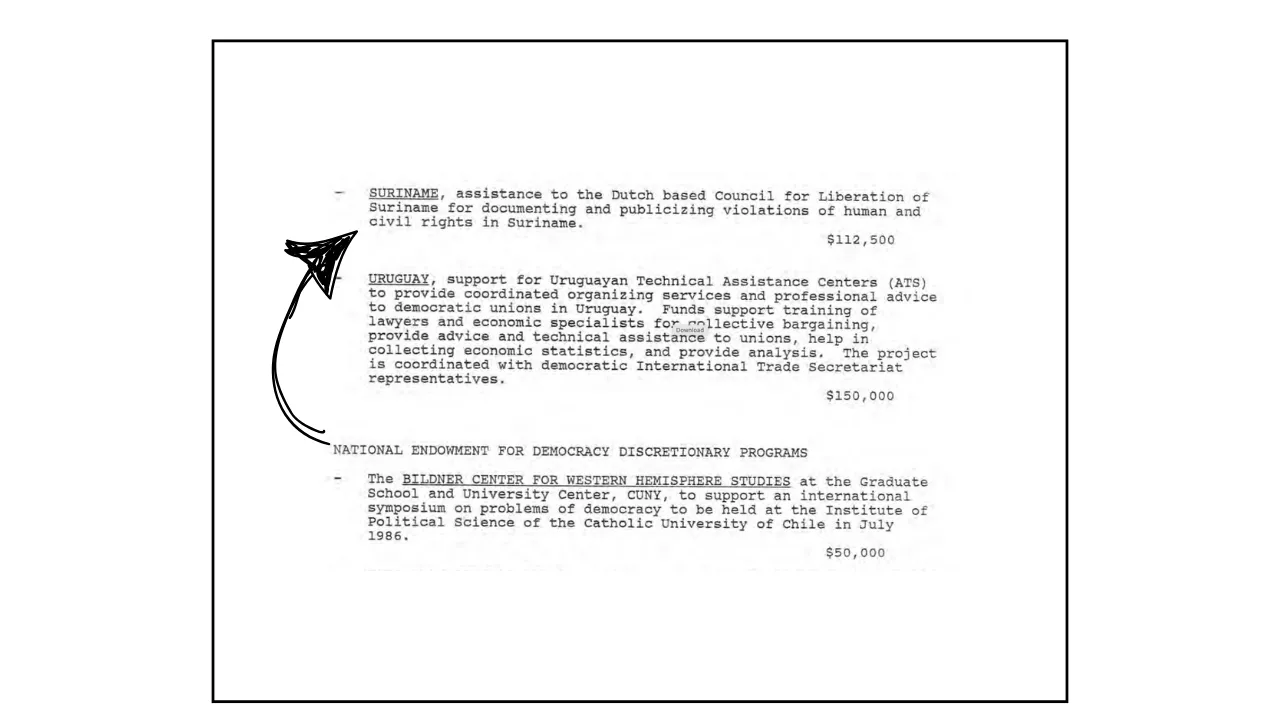
Thus, the Council for the Liberation of Suriname was not a rogue faction — it was an instrument of U.S. strategy, blending public and clandestine channels to achieve regime change.
The Pattern: Who Were the Other Operators?
When we analyze the people the CLS hired or partnered with, a striking pattern emerges:
- Dr. John Charles McClure: A former FBI most-wanted fugitive, Pagan biker gang member, and neo-Nazi turned clinical psychiatrist.
- George Baker (ANSUS Foundation): A drug dealer, brothel owner, and would-be creator of a white enclave in Suriname’s jungle.
- Tommy Denley: A small-time hustler who targeted his girlfriend’s injury settlement to fund mercenary operations.
- Hector Tellez: Partnered with Denley; his brother, a Chicago cop, was convicted in a murder-for-hire plot against a millionaire.
- Ronnie Brunswijk: The “Black Robin Hood,” a former bodyguard and guerilla leader, whose press secretary, Frits Hirschland, had been a pop music producer.
In this gallery of rogues, Peter van Haperen fits perfectly. Far from discrediting the case, his presence confirms the operating model: disposable, flawed, plausibly deniable assets working in the gray space between crime, intelligence, and politics.
The Role of Flawed Assets: How Intelligence Operated in Suriname
Van Haperen exemplifies a known method in covert operations:
- Dual-use operatives: Individuals who could perform clandestine missions but, if caught, could be disavowed as “criminals” or “opportunists.”
- Manufactured Denial: Dutch intelligence (BVD) publicly disavowed van Haperen while quietly acknowledging that individuals acting “in the Dutch interest” received unofficial support.
- Narrative Shaping: Figures like van Haperen were allowed to leak partial truths mixed with fabrications, muddying the waters and protecting core operational secrecy.
Peter’s contradictions — his lawsuits, disappearances, con artistry — mirror precisely what Project Democracy required: ghosts who could not be officially traced back to Washington or The Hague.
Why the Case Stands
Even removing Peter van Haperen entirely, the case for U.S. and Dutch-backed efforts to overthrow Bouterse remains overwhelming:
- CLS’s documented links to Project Democracy architects.
- NED’s confirmed funding of CLS in 1983-1985.
- Verified patterns of clandestine training, weapons thefts, and arms movements.
- Overlapping timelines between Surinamese resistance, Belgian terror groups, and covert Miami-based training programs.
- Parallel operations in Florida (Castro, Gonzalez, etc.) following the same model.
Van Haperen provides texture, not dependency. His story, for all its flaws, fits the operational blueprint confirmed by hard evidence.
Conclusion: The Ghost and the Machine
Peter van Haperen is less a smoking gun than a perfect reflection of the machine that built him — a Cold War network of deniable assets and broken men, where loyalty was secondary to plausible deniability. To demand a “perfect” witness is to misunderstand the nature of covert operations themselves.
In the hidden war for Suriname, Peter van Haperen was not the exception. He was the rule.
Source:
Link:
Internal Link:
Date:
October 26, 2025