The Secret War for Suriname: Part II
The Wolves of Paramaribo & Reagan’s “Other” Contras
Apr 30, 2025
Prelude: A Revolutionary Pattern
(Prelude & Note to Readers: The December 1982 Murders were an atrocity. This series dissects the prelude—including alleged U.S. covert actions—to illuminate the full, complex tragedy. Understanding this context does not absolve Desi Bouterse, convicted for these killings. Full accountability for all powerful actors, domestic and international, often remains elusive in such events.)
(Previously, in Part I: We unearthed “Project Democracy,” Reagan’s classified framework (NSDDs) born not just to promote democracy, but to wage covert war against Soviet-Cuban inroads in the Caribbean.)
Now, we unmask the operatives who descended upon Suriname, embedding a shadow U.S. power structure within the embassy walls—and the unprecedented bureaucratic failure that set them free.
The Eight-Month Window: When the Wolves Ran Free
When Ambassador Robert Duemling arrived at the U.S. Embassy in Paramaribo in August 1982, he made a disturbing discovery. For eight months, his subordinates had been running what amounted to a shadow operation. They had cultivated assets, orchestrated protests, and planned regime change—all while no official ambassador was present to provide oversight, restraint, or even awareness of their activities.
“I was Ambassador in name only,” Duemling would later admit. “LaRoche and Donovan were running the show.”¹
The extraordinary operational latitude enjoyed by the “Wolf Pack” wasn’t just due to their intelligence backgrounds—it was enabled by an unprecedented bureaucratic failure that created a perfect storm for autonomous covert operations.
After Assistant Secretary Thomas Enders recalled Ambassador John J. Crowley in late 1981 for being “too soft” on Bouterse, Washington’s intended replacement faced an unexpected obstacle.² Hawthorne Quinn Mills, the seasoned diplomat who had just managed the U.S. mission in Kabul during the Soviet occupation’s first two years, seemed perfect for the Suriname challenge. But his appointment was blocked by State Department management over alleged “personal conduct issues” involving “a girlfriend, an Australian girl who came and stayed with him for extended periods” in Afghanistan.³
This bureaucratic rejection created an eight-month ambassadorial vacuum from January to August 1982—precisely when Cuban influence in Suriname was deepening and covert operations were most needed. Richard LaRoche, as acting Chargé d’Affaires, effectively controlled the embassy during this critical period, establishing direct communication channels and asset networks that bypassed normal diplomatic protocols entirely.
John Perkins, in his explosive “Confessions of an Economic Hit Man,” detailed a chilling playbook for subduing developing nations. First, the “economic hit men”—silver-tongued consultants pushing crippling loans for U.S.-benefiting mega-projects. When debt inevitably choked these nations, privatization and policy fealty to Washington followed. “But when the economic hit men fail,” Perkins warned, “the next step is what we call the jackals.” These were the CIA’s deniable assets, specialists in coups and assassinations, dispatched to eliminate uncooperative leaders.
In Suriname, however, the initial deployment was subtler, more insidious. Washington sent neither traditional hit men nor jackals. They dispatched the intelligence elite: seasoned destabilizers, psychological warriors, the “fixers” of the covert world, cloaked in diplomatic immunity and freed from normal constraints.
Think “Pulp Fiction.” Jules Winnfield, facing an impossible situation, asks his boss if Harvey Keitel’s Winston Wolfe—the ultimate fixer—is en route. Confirmation brings relief:
“Oh, you sending The Wolf? … that’s all you had to say!”
A perfect parallel for Suriname, 1981:
Bouterse embraces Cuba, welcomes the Soviets.
Washington ignites.
Reagan unleashes his “Wolves”: LaRoche, Donovan, Buys.
Not diplomats. Fixers. Intelligence operatives in diplomat’s clothing, dispatched to wrench a nation from its chosen path—and given eight months to operate without oversight.
The Washington War Room: Cabinet-Level Coordination
The Wolf Pack wasn’t operating in isolation. Declassified documents reveal Suriname had become a cabinet-level priority by August 1982. When the Acting Director of Central Intelligence met with Secretary of Defense Caspar Weinberger on August 20, 1982, Suriname was the sole agenda item proposed by the Pentagon. Dewey Clarridge had warned that week that “Defense is increasingly concerned about Suriname’s drift towards Cuba.”⁴
The same day, CIA Director William Casey personally debriefed Vice President George H.W. Bush and President Ronald Reagan on the Caribbean Basin Initiative, ensuring the highest levels of government were tracking regional developments.⁵ This wasn’t rogue embassy operations—it was systematic policy implementation coordinated from the White House Situation Room.
By July 29, 1982, National Intelligence Officer for Latin America Constantine Menges had elevated Suriname to formal CIA warning status, with the agenda item “Political situation; Cuban involvement” scheduled for the August 18 intelligence coordination meeting.⁶ The intelligence community’s institutional machinery was fully engaged.
The coordination apparatus extended beyond traditional agencies. Oliver North’s Crisis Pre-Planning Group (CPPG), established May 14, 1982, was tasked with “identifying areas of rising tensions where U.S. interests are at stake” and developing “preemptive policy options and politico-military options.”⁷ The Senior Interagency Group-Intelligence (SIG-I), created August 5, 1982, provided enhanced “counter intelligence-countermeasure posture” and mechanisms for resolving interagency differences with “significant adverse national security consequences.”⁸
This architecture transformed ad hoc embassy operations into systematic, Washington-coordinated campaigns.
The Grenada Blueprint: LaRoche’s Covert Rehearsal
Richard LaRoche, designated Chargé d’Affaires at the U.S. Embassy in Suriname, was no stranger to Caribbean firestorms. He’d been on the ground, intimately involved, when Grenada erupted in March 1979.
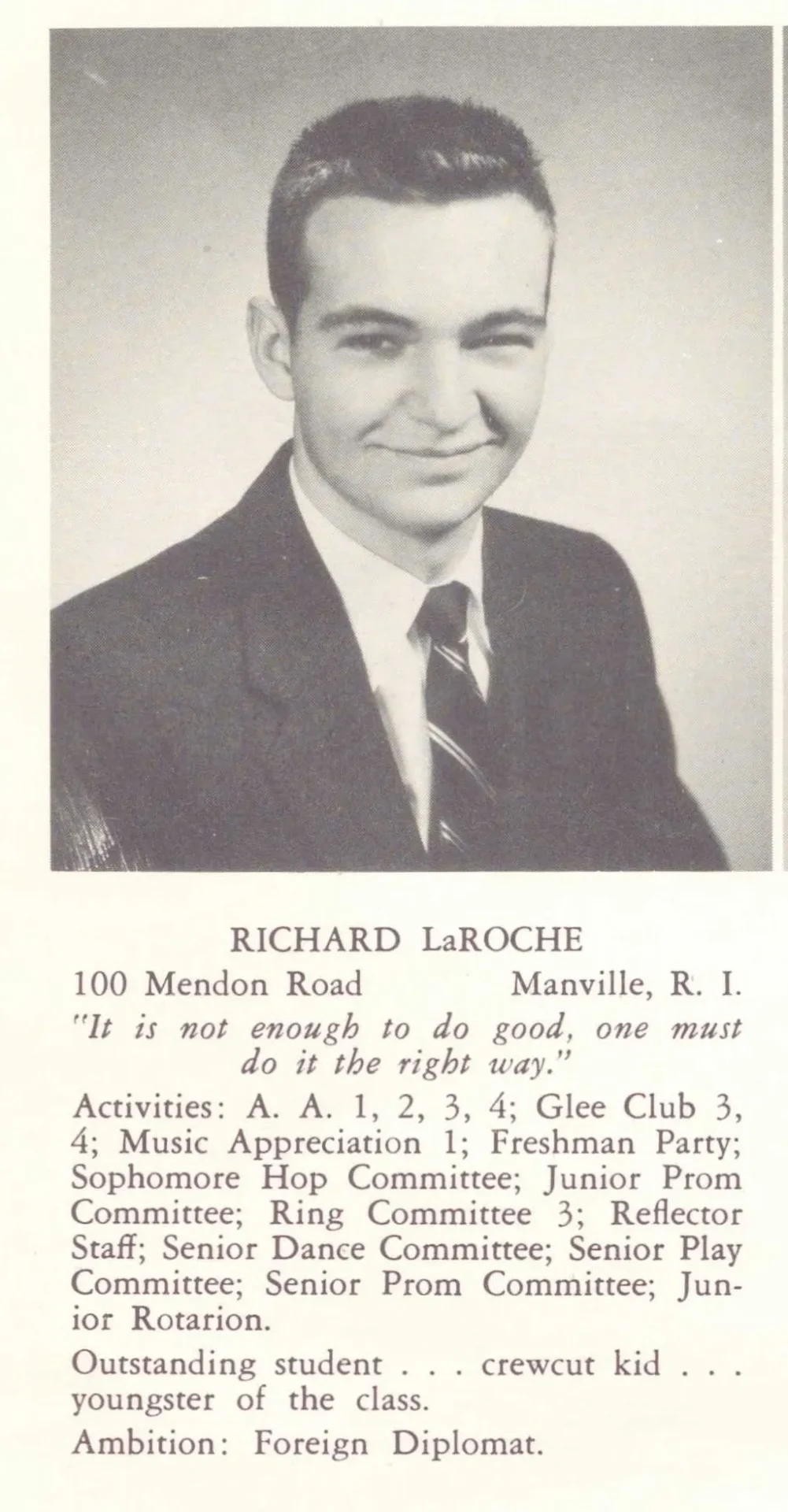
When Maurice Bishop’s movement toppled Eric Gairy, LaRoche—officially the U.S. Consul based in Bridgetown, Barbados, covering the Eastern Caribbean—materialized in Grenada within days. His pretext: “welfare of Americans.” His actions screamed intelligence operative.
Declassified State Department cables reveal LaRoche obtained sensitive internal documents from Bishop’s new leadership almost immediately, including arms orders planned by the ousted Gairy government. How did a newly arrived diplomat gain such rapid access? It points towards pre-existing intelligence connections or assets within Bishop’s circle. LaRoche held what he termed “extremely relaxed and free-wheeling” meetings with revolutionary leaders while secretly gathering intelligence on their plans.
Grenada 1979 wasn’t just a posting for LaRoche; it was a dress rehearsal. His subsequent assignment to Suriname wasn’t about learning a new theater; it was about deploying a well-honed playbook against a similar perceived threat.
The Caribbean Laboratory: From Grenada to Suriname
The intelligence apparatus that descended upon Suriname in 1981 wasn’t operating from theory—it was deploying a battle-tested playbook refined through years of operations against Maurice Bishop’s Grenada. Newly obtained documents from the Covert Action Information Bulletin reveal the sophisticated destabilization campaign that served as LaRoche’s operational template.
The Grenada Destabilization Manual: Within months of Bishop’s March 1979 revolution, the Carter administration launched what the bulletin describes as “economic, psychological, and openly violent destabilization.” The tactics were methodical:
- Economic Sabotage: Two fires of “suspicious origin” simultaneously struck Grenada’s tourist sector in May 1979, directly attacking the revolution’s economic base
- Intelligence Penetration: CIA operatives embedded within seemingly legitimate institutions, including the St. George’s Medical School, which provided perfect cover for years of asset cultivation
- Labor Manipulation: Systematic cultivation of opposition figures within key sectors
- Psychological Operations: Sophisticated media campaigns designed to isolate the revolutionary government
The Network Effect: Ashley Wills, identified by the bulletin as a political officer at the U.S. Embassy in Barbados whom “Bishop soon suspected of involvement in CIA activities,” represents the human bridge between operations. During the 1983 Grenada invasion, Wills appeared aboard the U.S.S. Guam as “political adviser to the U.S. operation”—confirming his deep intelligence role and suggesting he coordinated with LaRoche throughout the Caribbean theater.
Most damning is a contemporaneous intelligence assessment revealing how Grenada events were weaponized against Suriname in real-time: “U.S. diplomats in the capital of Paramaribo made sure to keep Bouterse current on evidence that Cuba had aided the Grenadian coup, and the rest was left to his well-prepped paranoia.”
This wasn’t coincidence—it was coordinated psychological warfare.
Maurice Bishop: The Specter of a Successful Revolution
Maurice Bishop was everything Desi Bouterse, the former army sergeant, aspired to be, and everything Washington dreaded. Educated at London’s prestigious Gray’s Inn, Bishop was a potent fusion of intellectual depth and revolutionary fire. He mesmerized diverse audiences, artfully comparing Grenada’s anti-colonial struggle to America’s own revolutionary genesis. This narrative resonated, subtly challenging Reagan’s simplistic Cold War dichotomy of good versus evil and making it harder to demonize his movement.
Under Bishop, Grenada wasn’t a basket case; it was a beacon of progress. Free healthcare, nosediving unemployment, expanded housing, soaring literacy rates. These tangible successes made his revolution acutely dangerous to U.S. interests—a functioning, popular alternative to Reagan’s neoliberal development model.
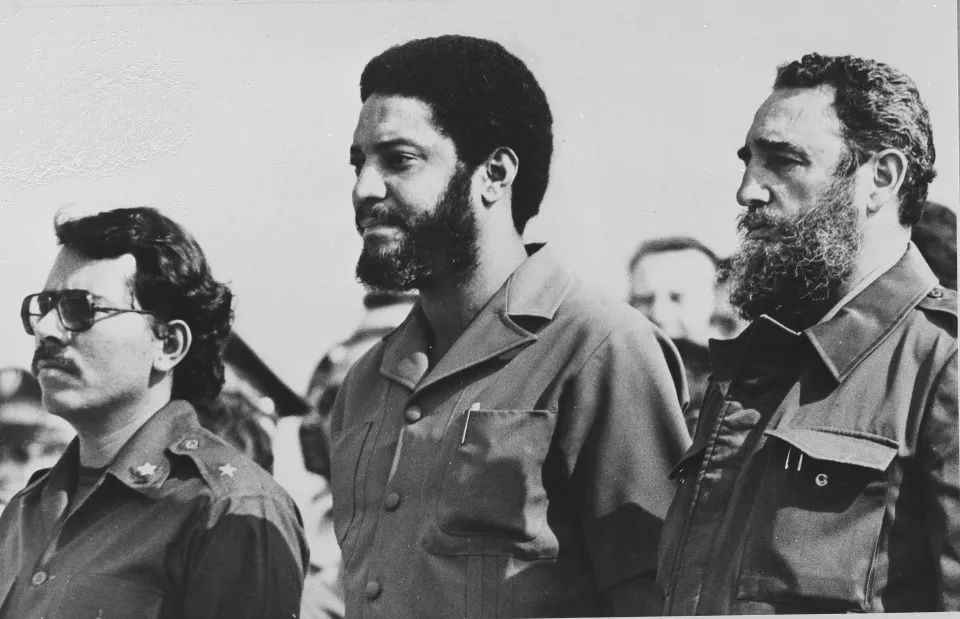
Bishop’s influence radiated beyond the Caribbean. His pan-African message of unity and critiques of corporate exploitation struck chords with America’s Black communities and global progressives. He was a potent cocktail: part Malcolm X, part MLK, part Bernie Sanders, all charisma. For Bouterse, Bishop was the archetype: educated, articulate, effective—a revolutionary who delivered.
Project Democracy Materializes: NSDD-17 and the First Wave
The timeline of U.S. machinations in Suriname, now dragged into the light, reveals a proactive rather than reactive strategy. Key U.S. operatives were on the ground far earlier than publicly acknowledged, and the lead agent, Richard LaRoche, arrived already battle-hardened from his Grenada experience, specifically tasked with countering Bishop’s spreading influence.
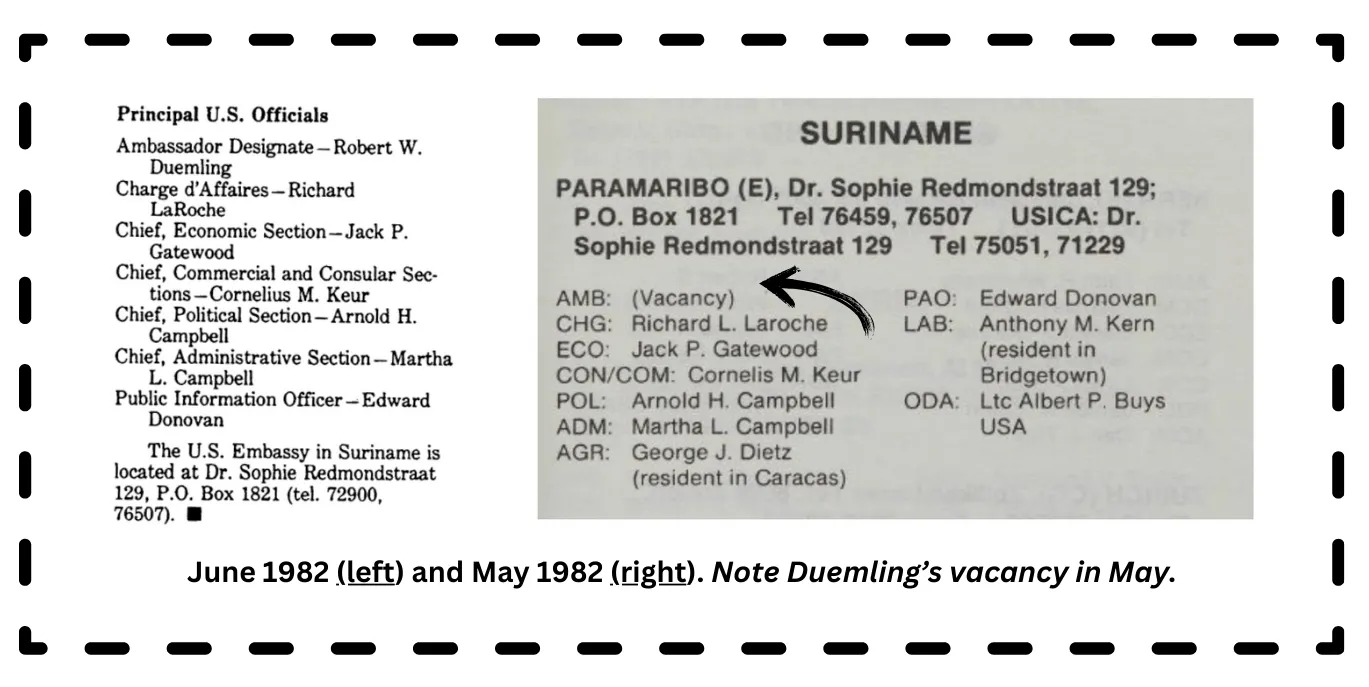
State Department documents show Richard LaRoche was tapped for the Suriname post in fall 1981, arriving by September 1981.⁹ Official directories confirm both he and Edward Donovan were operational in Paramaribo before May 1982—months before Ambassador Duemling was even appointed (July 1982), let alone arrived (August 1982).¹⁰
This timing is revelatory. They were embedded during the eight-month ambassadorial vacuum, operating with unprecedented autonomy during the most critical period of Cuban-Surinamese rapprochement.
Why dispatch these seasoned operators so early, under such deep cover? The events of late 1981 provide the ignition point. On November 16, 1981, Suriname formalized ties with Cuba. The Cuban delegation included Osvaldo Cárdenas, a known senior Cuban intelligence officer and high-ranking party member who would later become ambassador.¹¹ Cárdenas’s presence signaled Cuba’s serious intentions.
LaRoche’s assignment in the fall of 1981 was Washington’s immediate countermove—inserting an operative seasoned in Cuban-influenced environments (Grenada) to push back instantly. LaRoche and Donovan weren’t a reaction force; they were the vanguard, the architects of a covert strategy sanctioned at the highest levels, tasked with running the U.S. agenda before the official ambassadorial front was even in place.
This clandestine deployment dovetailed perfectly with Reagan’s rapidly crystallizing Caribbean strategy. That same November 16, 1981—the very day Suriname and Cuba inked their Cárdenas-brokered deal—Reagan’s National Security Council (NSC) convened. From that meeting emerged the blueprint for NSDD-17 (officially signed January 4, 1982). The simultaneity is striking: events in Suriname, particularly Cárdenas’s involvement, almost certainly directly informed NSDD-17’s mandate to aggressively counter Cuban-Soviet expansion.
NSDD-17, explicitly driven by concerns over Cuba’s growing military footprint in Central America, authorized precisely the tools needed for Suriname:
- Military training for “indigenous units and leaders both in and out of country.”
- Creation of a “public information task force” to manipulate perceptions.
- Military contingency plans against Cuban forces.
It directed U.S. agencies to “encourage cooperative efforts to defeat externally-supported insurgency” and “support democratic forces.” In Suriname, this translated into an immediate green light to identify, fund, and potentially arm resistance elements against Bouterse.
Crucially, recently unearthed evidence reveals these were not sequential efforts; they were simultaneous, parallel assaults from the outset. Sean Naylor’s “Relentless Strike” confirms the Pentagon initiated planning for Bouterse’s ouster and potential hostage rescue in late 1981—immediately following the Suriname-Cuba pact and concurrent with LaRoche and Donovan’s insertion.
By early 1982, Delta Force operators were already ghosts in Suriname, disguised as “birdwatchers,” conducting covert reconnaissance. A JSOC staffer later recounted their assessment: airfields surveyed, routes to the capital photographed. Their verdict on a coup:
”It would really would have been a piece of cake. Think of a little town with the worst police force you can think of and that’s what they had.”
– JSOC Staffer, quoted in “Relentless Strike,” by Sean Naylor
What began as a scalpel-like special ops mission rapidly metastasized. By 1982, the Pentagon was drafting plans for a full-blown invasion: XVIII Airborne Corps, Rangers seizing Zanderij airfield, the 82nd and 101st Airborne pouring in behind. JSOC’s tactical command post relocated to Hurlburt Field, Florida, for six weeks of intensive preparation. A senior JSOC official recalled, “These conventional forces were ‘preparing to move out’… I thought we were going to war.”
While LaRoche and Donovan executed the covert embassy track, Washington also applied overt diplomatic pressure. Foreign Minister Harvey Naarendorp endured a “long didactic monologue” from U.S. Undersecretary of State Thomas Enders on the “pernicious influences of communism.” Naarendorp left “somewhat irritated,” but the warning was unmistakable. This two-pronged assault—covert destabilization via the “Wolf Pack” and official diplomatic threats—formed a comprehensive pincer movement.
By mid-1982, the machinery was humming. LaRoche, Donovan, and Buys were in place, a covert NSC-directed team operating under diplomatic guise, likely facilitated by the ambassadorial vacuum. Fueled by the November 1981 alarm bells, Suriname was firmly in the crosshairs. The still-classified NSDD-61 would likely provide the final, formal authorization for a destabilization campaign already months in motion.
The Perfect Trap: From Coup to Cooperation
The March 1982 Rambocus coup attempt may have served a dual purpose for U.S. planners. Whether the Wolf Pack merely observed or actively facilitated Lt. Soerendra Rambocus’s doomed attempt to seize army headquarters, its failure created the perfect pretext for a stunning operational gambit.
By March 5, 1982—just before the coup attempt—CIA/FBIS surveillance documents confirm “Col. A. Buys, U.S. military attaché, Suriname” was significant enough for inclusion in high-level intelligence dissemination alongside President Reagan and Secretary of State Alexander Haig.¹² His activities had attracted sufficient attention to warrant formal tracking within the intelligence community.
Three months after the failed coup, the CIA approached Bouterse with an irresistible offer: American expertise in preventing exactly the kind of terrorist threat he had just survived.
The June 2, 1982 FBIS memo reveals the stunning result: “Meanwhile, an FBIS staff linguist has been seconded to the DDO/LA for whom he is providing Dutch-language support as an interpreter and assistant instructor in an anti-terrorism project for the Government of Suriname.”¹³
While LaRoche and Donovan secretly cultivated opposition networks, a CIA linguist was simultaneously training Bouterse’s security forces in “anti-terrorism” techniques. The Americans were literally teaching Bouterse how to protect himself from the very operations they were running against him.
This dual-track approach provided multiple advantages:
- Intelligence access to regime security apparatus
- Relationship building with key military figures
- Assessment opportunities of regime vulnerabilities
- Cover for other operations under the guise of cooperation
Real-Time Intelligence Coordination
The October 1982 timing of Bishop’s Suriname visit wasn’t coincidental—it represented the culmination of coordinated intelligence operations across both theaters. As Bishop prepared for what he hoped would be a show of revolutionary solidarity, LaRoche was positioning his Surinamese assets for maximum psychological impact.
The Covert Action Bulletin reveals that by 1982, U.S. intelligence had achieved significant penetration of Caribbean revolutionary movements. The same networks monitoring Grenada’s internal divisions were feeding intelligence about Suriname’s vulnerabilities to Washington planners.
When Bouterse’s Foreign Minister publicly accused LaRoche of being “the same operative who led the destabilization in Chile against Allende,” he was identifying more than just one man—he was exposing an entire operational methodology that had been refined across multiple theaters.
Reagan’s “Other” Contras: A Hidden War, A Familiar Playbook
The Nicaraguan Contras are infamous. Why not their Surinamese counterparts? Part of the answer lies in the extraordinary secrecy shrouding these operations, compounded by later cover-ups. Oliver North and Fawn Hall frantically shredding documents during Iran-Contra wasn’t just about Nicaragua and Iran; it epitomized the lengths taken to bury programs run under the “Project Democracy” banner. This deliberate erasure of history makes piecing together the Suriname puzzle exceptionally challenging.
NSDD-17’s first pillar was clear: empower local proxies. This meant military training and support for anti-regime leaders and fighters, inside and outside the target nation. To Reagan’s covert strategists like Oliver North, there was little distinction: aiding Nicaraguan Contras against Sandinistas or backing “Suriname Contras” against a Cuba-friendly Bouterse—it was all one seamless Cold War battlefront, waged under the “Project Democracy” umbrella.
In Suriname, this strategy quickly took root. The March 1982 establishment of the “Foundation for the Restoration of Democracy and Human Rights in Suriname” illustrates U.S. designs merging with genuine local dissent. While many Surinamese yearned for democracy, U.S. operatives likely infiltrated and steered these burgeoning movements.
Early figures in Bouterse’s opposition, potentially co-opted or supported as “Contras,” included:
- Roy Bottse: Bouterse’s childhood friend, yet linked to numerous coup plots.
- Dr. Hendrikus Doerga: A doctor implicated in a bizarre $20 million Heineken beer poisoning extortion scheme—the kind of murky financial operation later associated with North.
- Rudolf Jankie: Led a March 1982 Surinamese Embassy protest.
- Mirza “Edo” Joeman: Connected to a July 1982 coup attempt involving Belgian mercenaries.
- Rob Wormer & Evert Tjon: Active in protests, advocating Bouterse’s violent overthrow.
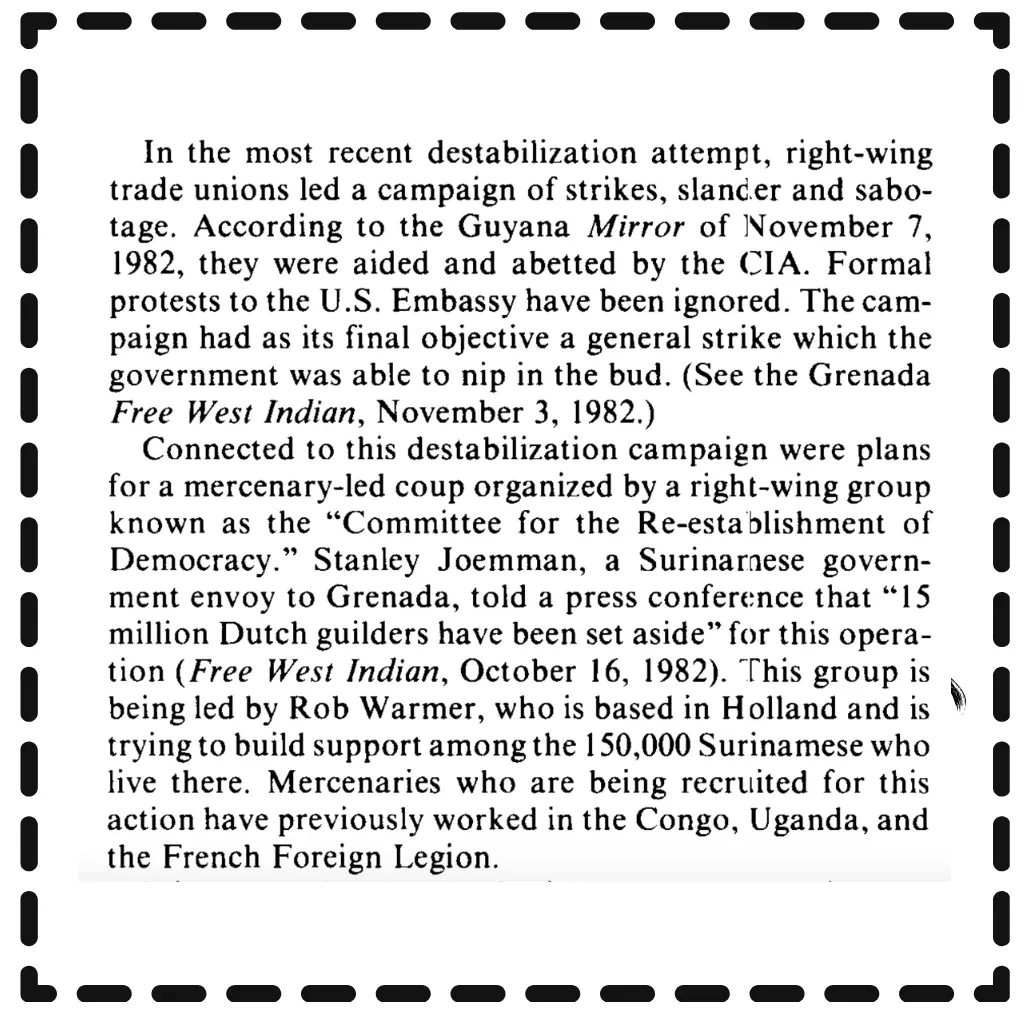
U.S. support likely flowed through multiple channels:
- Direct U.S. Funding: Groups like the Council for the Liberation of Suriname (CLS) would later receive funds via the National Endowment for Democracy (NED). Precursors to NED likely funneled cash earlier.
- Embedded Intelligence Agents: Operatives like Peter van Haperen allegedly infiltrated existing rebel factions.
- Front Companies: Entities like “David Randolph Enterprises” (detailed later) reportedly provided covert planning and logistical support to opposition groups.
- CIA Connections: Assets like Frank Castro allegedly met with rebel leaders such as Ronnie Brunswijk, potentially introducing narco-trafficking elements into the volatile mix (a recurring theme we will explore).
The Rambocus Coup: Complication or Covertly Observed Rehearsal?
The volatile situation intensified in March 1982. Lieutenant Soerendra Rambocus and a handful of supporters launched a doomed attempt to seize army headquarters. The coup imploded quickly. Rambocus, initially sentenced to 12 years, was later executed in the December Murders—a clear signal Bouterse considered him an exceptionally dangerous foe.
Rambocus’s attempt—occurring precisely when the “Wolf Pack” was operational and Delta Force was conducting reconnaissance—raises tantalizing questions. While no direct evidence links it to U.S. actions, its failure, at minimum, provided American planners with invaluable, real-time intelligence on Bouterse’s security vulnerabilities and response capabilities. More profoundly, it may have forced a recalibration of U.S. strategy, factoring in heightened security and Bouterse’s escalating paranoia, possibly influencing adjustments to the ongoing invasion planning or contributing to its eventual (temporary) cancellation later in 1982.
This was followed in July by another alleged plot involving Belgian mercenaries, reportedly exposed by intelligence officer Edo Joeman. This drumbeat of failed coups fostered an atmosphere of intense paranoia, which Bouterse exploited to consolidate power, even as it paradoxically built a case for potential U.S. intervention to “restore stability.”
Engineering Dissent: The “Public Information” War
NSDD-17’s second pillar: the “public information task force”—a euphemism for sophisticated propaganda and influence operations, orchestrated directly from the U.S. Embassy.
- The Conductors: Richard LaRoche (acting ambassador) and Edward Donovan (officially Public Affairs Officer), in place by mid-1982, established clandestine communication lines, likely bypassing standard State Department channels.
- The Message: Propaganda was disseminated via groups like the “Foundation for the Restoration of Democracy,” which staged overseas protests (e.g., March 20, 1982).
- Weaponizing Labor: The U.S. team cultivated deep ties with labor unions, culminating in massive strikes starting around October 1982. These actions crippled Bouterse’s government, channeling public fury. Union chief Cyriel Daal’s frequent meetings with LaRoche were noted by Bouterse’s intelligence and later confirmed by Ambassador Duemling.
- Media Manipulation: They collaborated with local journalists and opposition figures to amplify anti-Bouterse narratives, painting his regime as unstable and increasingly beholden to Cuba, stoking domestic and international fears.
These campaigns were so effective that by January 1983, Suriname expelled both Donovan and LaRoche for “activities to shake up the country.”
The Nerve Center: Paramaribo’s Shadow Embassy
The unassuming U.S. Embassy building in Paramaribo became ground zero. By mid-1982, it was more than a diplomatic outpost; it was a shadow command center, where intelligence veterans operated outside normal protocols, laying the groundwork for regime change months before Ambassador Duemling’s arrival.
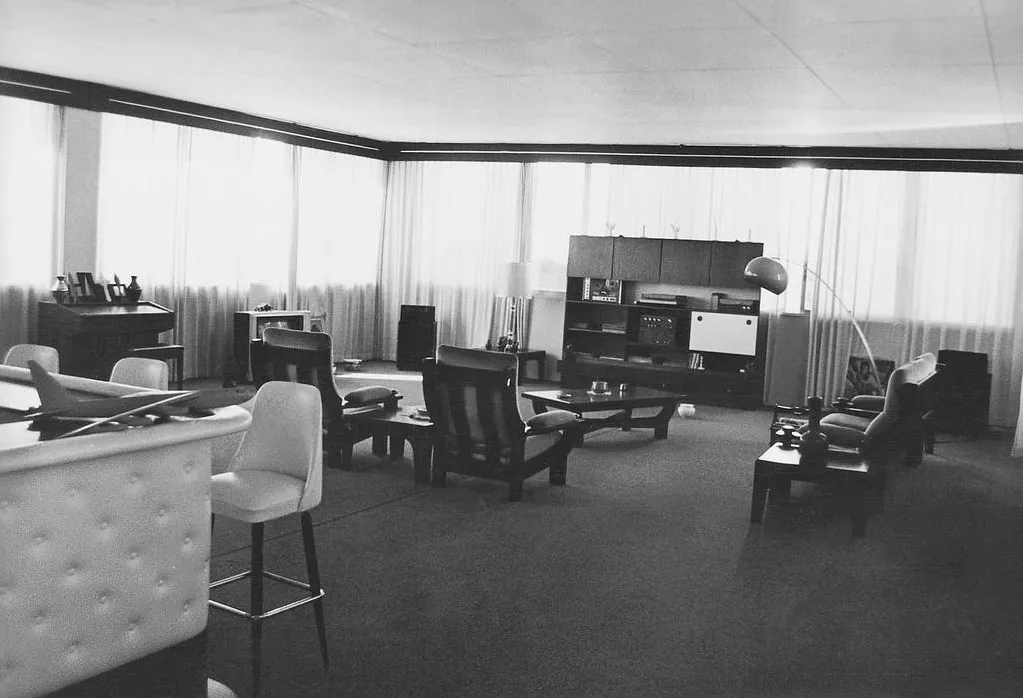
This was standard Cold War tradecraft. Declassified documents reveal the routine placement of CIA officers under diplomatic cover. Presidential advisor Arthur Schlesinger Jr. warned President Kennedy in 1961 that potentially half of political officers in embassies worldwide were CIA.
“In short, no one knows how many potential problems for US foreign policy — and how many potential friction with friendly states — are being created at this moment by CIA clandestine intelligence operations.”
– Arthur Schlesinger Jr. to President Kennedy, “CIA Reorganization,” Secret, June 10, 1961
Operatives like LaRoche, often masked as Public Affairs Officers or Chargés d’Affaires, ran intelligence operations from within embassies, sometimes without the full knowledge of their State Department colleagues, creating operational silos and a high risk of catastrophic miscalculation—precisely what was brewing in Suriname.
The Wolf Pack Unmasked: Profiles in Destabilization
Who were these “wolves” dispatched to Paramaribo? Their careers were forged in the crucible of Cold War intelligence and psychological warfare.
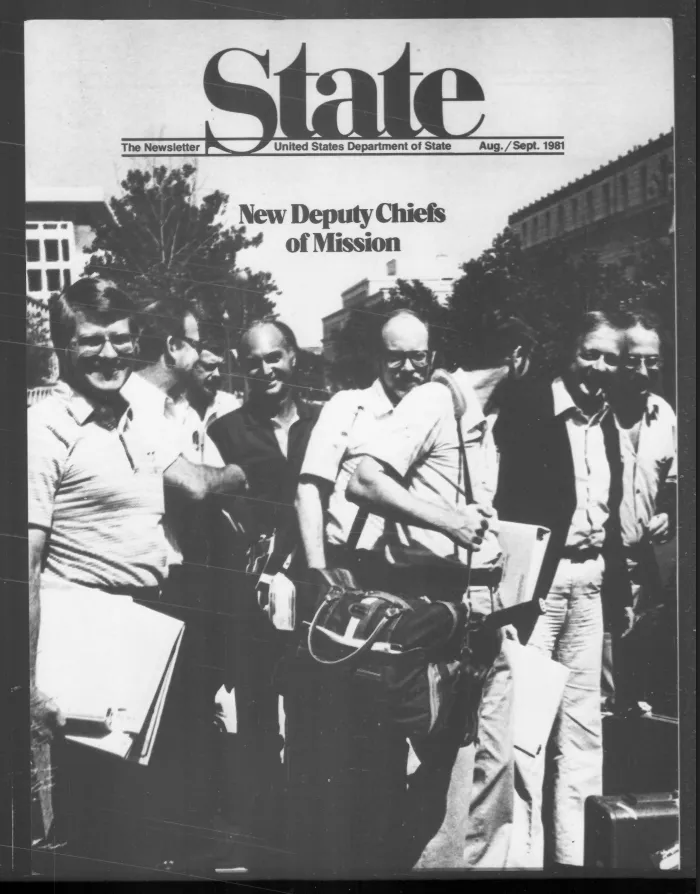
Richard Russell LaRoche – Chargé d’Affaires
Arriving circa September 1981, LaRoche’s résumé was a roadmap of CIA hotspots: Indonesia post-Suharto coup, Pinochet’s Chile, Grenada immediately after Bishop’s revolution. Each posting placed him at the heart of political maelstroms with deep CIA involvement. In Paramaribo, he cultivated opposition figures, most notably labor leader Cyriel Daal, whose frequent embassy meetings became a fixation for Bouterse’s surveillance.
LaRoche’s arrival in Suriname represented the deployment of a seasoned destabilization specialist whose methods had been perfected across multiple Caribbean operations. His Grenada experience provided more than just intelligence on Bishop—it offered a complete operational framework.
Within days of Bishop’s 1979 revolution, LaRoche had penetrated the New Jewel Movement’s inner circle, conducting what he described as “extremely relaxed and free-wheeling” meetings while secretly gathering intelligence on arms orders and internal plans. This rapid access wasn’t diplomatic skill—it was tradecraft honed through years of intelligence operations.
GRENADA (1979-1983) → SURINAME (1981-1983) Economic Sabotage: Tourist sector fires → Labor strikes during Bishop visit Asset Cultivation: Opposition penetration → Daal/Horb recruitment Media Operations: Anti-revolution propaganda → Foundation coordination Intelligence Gathering: Medical school cover → Embassy operations Psychological Warfare: Isolation campaigns → Cuba paranoia amplification
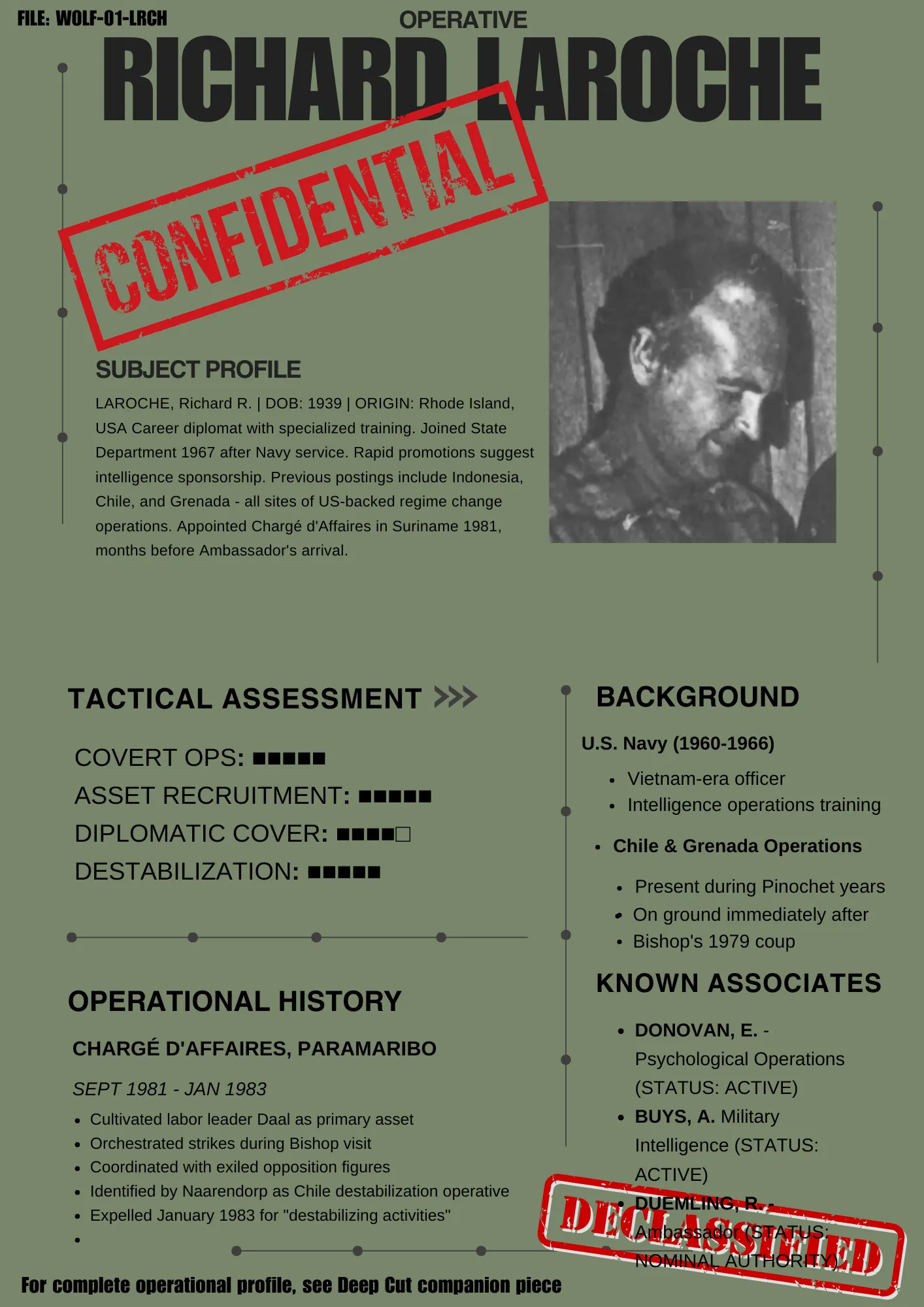
Edward J. Donovan – Public Affairs Officer (PAO)
Donovan’s innocuous title was a carefully crafted deception. His real expertise: “Director of Psychological Operations” in Vietnam, a specialist in media manipulation and perception management. In Suriname, he directed propaganda, nurtured opposition groups like the Foundation, orchestrated media narratives, and helped stage public demonstrations. Ambassador Duemling later conceded the grim reality: “I was Ambassador in name only. LaRoche and Donovan were running the show.”
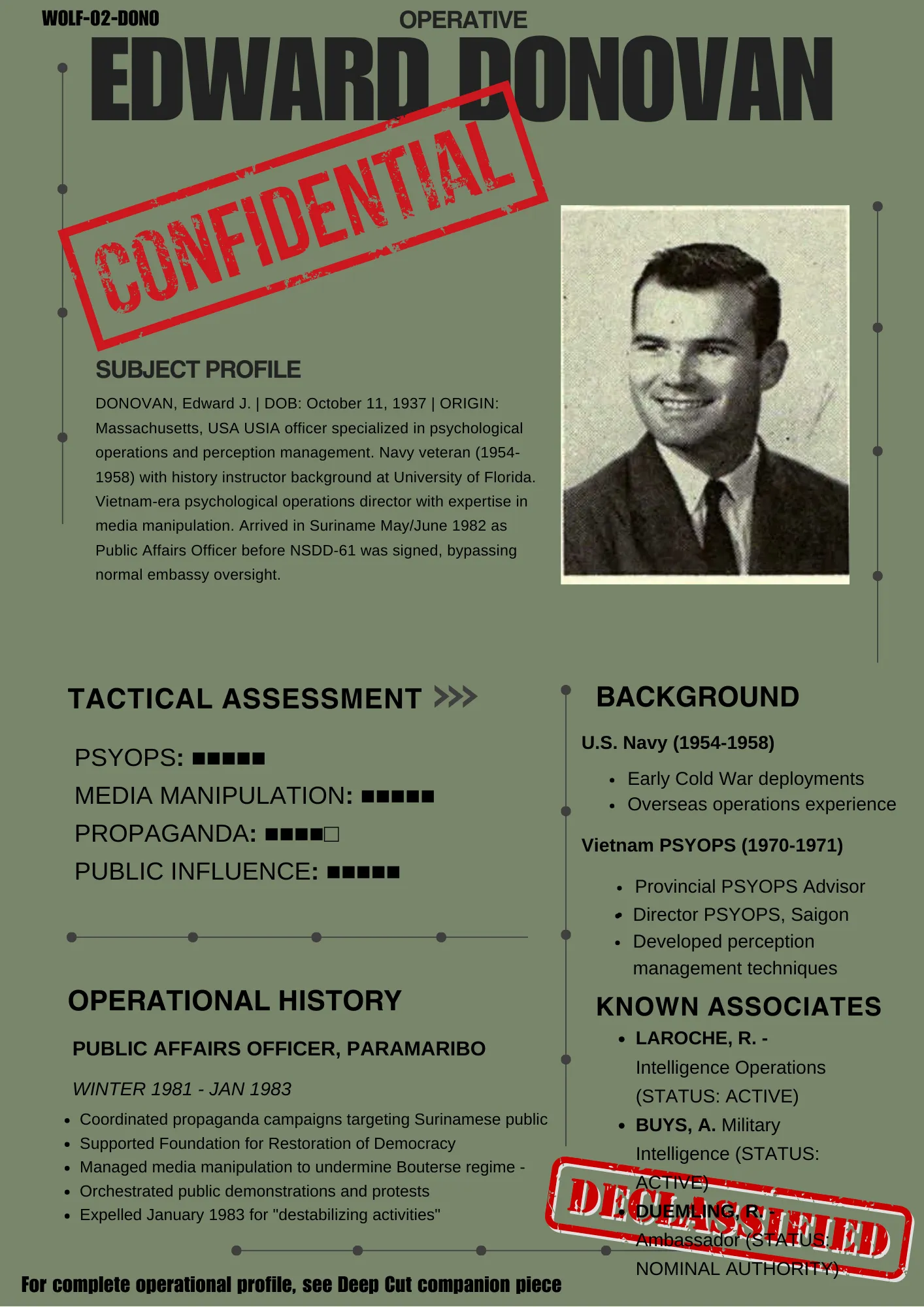
Lt. Col. Albert P. Buys – U.S. Army Attaché
Buys offered a unique skillset. Born to Dutch parents with roots in the Dutch East Indies (Indonesia), his fluency in Dutch and profound understanding of Suriname’s colonial history were invaluable. He focused on military intelligence, assessing loyalties and fault lines within Suriname’s armed forces. Operating with a lower profile than LaRoche and Donovan, Buys remained after their expulsion post-December Murders, a vital conduit for continued intelligence gathering.
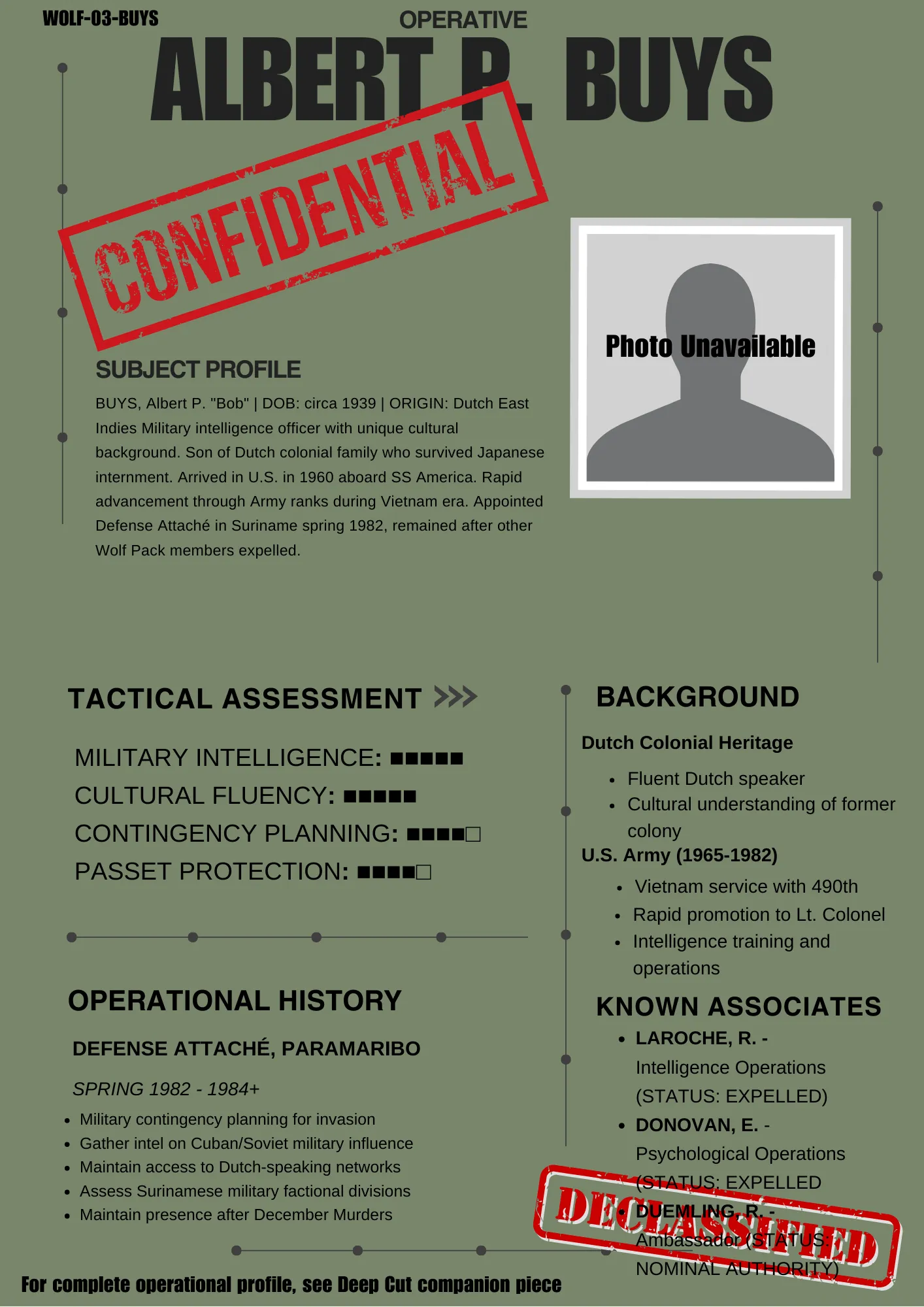
[DEEP CUT: For comprehensive operational dossiers on the Wolf Pack—their career trajectories and links to Iran-Contra networks—see our companion piece: “The Wolf Pack of Paramaribo (Deep Cut): Profiles of Covert Operators at the US Embassy in Suriname in 1982”] Explore the evidence here in our member’s section.
Embassy Intrigue: The Sidelined Ambassador
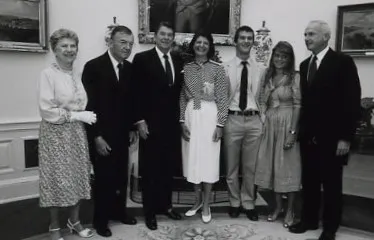
Ambassador Robert Duemling stepped into a hornet’s nest in the summer of 1982. He quickly discovered he was not in command. His subsequent oral history paints a picture of LaRoche and Donovan operating as a rogue unit, flouting diplomatic norms: direct lines to CIA headquarters, bizarre “gifts” like ponies for Bouterse’s deputy Roy Horb, a forged letter seemingly engineered to stoke paranoia within Bouterse’s inner circle.
Duemling felt utterly deceived by his own CIA station chief (very likely LaRoche or a close associate). He contemplated resignation but found himself drawn into the periphery of Operation Guiminish—another Suriname-focused initiative using Brazil as a proxy—again, without his full knowledge. Duemling believed his mandate was to understand Bouterse; the chilling reality was that the operatives nominally under his authority had already made their choice and lit a very short fuse.
Adding another layer of intrigue, the operational impetus wasn’t solely flowing from Washington. Dutch press reports at the time suggested it was “the American government, under pressure from its embassy, that began to study that part of the map where Suriname is located a little more closely.” Previously, Washington had “preferred to let the Netherlands pull the chestnuts out of the fire.” LaRoche wasn’t merely executing policy; he was actively shaping it, leveraging his Grenada experience to sound alarms about a second revolutionary domino poised to fall in South America. This sidelining of a career diplomat like Duemling reflected a broader Reagan-era trend, championed by hardliners like Senator Jesse Helms, who distrusted the professional diplomatic corps—the “Princeton Club of Foggy Bottom”—and aggressively pushed for a more ideologically driven, interventionist foreign policy.
This timeline screams pre-planned U.S. aggression, not reaction. By mid-1982, the entire apparatus was in place and operational: LaRoche wooing the opposition, Donovan conducting media warfare, Buys mapping the military landscape—all before Duemling even unpacked his bags. The classified NSDD-61, when signed, likely just rubber-stamped a destabilization campaign already tearing through Suriname.
The Seeds of Resistance: Haakmat and Chin A Sen – Pawns or Players?
Before André Haakmat became the alleged “grandmaster in stratego” behind the 1982 anti-Bouterse protests, his political journey in Suriname had been a rollercoaster. From close collaborator with Bouterse to bitter opponent, his shifting allegiances laid the groundwork for his pivotal role.
In August 1980, mere months after the sergeants’ coup, Haakmat served as vice-prime minister and minister of foreign affairs and justice under President Henk Chin A Sen. By January 1981, however, he was ousted, an early casualty of Bouterse’s tightening grip. Yet, Haakmat retained tendrils of influence, advising both the Moederbond union federation (chaired by Cyriel Daal) and garrison commander Roy Horb—Bouterse’s second-in-command.
The political chessboard fractured further in February 1982. Bouterse jettisoned President Chin A Sen, ostensibly over objections to Bouterse’s leftward tilt and planned Cuban visit. “There will be no new president for the time being,” Bouterse declared, even as he paradoxically claimed, “The military will not strengthen its grip.” The presidency remained vacant; Bouterse ruled directly.
Chin A Sen, a physician and moderate initially elevated by Bouterse, fled into exile in Pittsburgh—a U.S. base that would prove convenient for later meetings with American officials and ALCOA executives. Simultaneously, the “Actiecomité Herstel Democratie Suriname” (Action Committee to Restore Democracy in Suriname) sprang to life in the Netherlands, organizing a massive anti-Bouterse demonstration in The Hague by March.
In a bizarre twist, just days after Chin A Sen’s ouster, Bouterse appointed Haakmat to a committee preparing “legal regulations for a new democracy.” This February 12 appointment suggests Bouterse may have been trying to co-opt Haakmat. The reconciliation, if any, was fleeting.
By October 1982, as Maurice Bishop prepared for his fateful visit, Haakmat and Chin A Sen were established opposition poles—Haakmat leveraging his Moederbond and Horb connections, Chin A Sen working U.S. channels from exile. Their shared antipathy towards Bouterse would soon become a critical factor. Haakmat’s intimate knowledge of the regime’s inner workings—his access to Horb, his sway with Moederbond—gave him unique insight into Bouterse’s vulnerabilities, insights that would be ruthlessly exploited.
Knight Takes Bishop: The Humiliation in Paramaribo
Maurice Bishop’s October 1982 arrival in Suriname was meant to be a display of revolutionary solidarity. Surinamese officials publicly stressed their unique path: “We are not copying a revolution,” insisted National Information Service director Dick de Bie, emphasizing a “Surinamese socialism” rooted in non-alignment. Yet, American diplomats noted Bouterse’s profound admiration for Grenada. Dutch observers saw Bouterse “especially impressed by the way in which Bishop lets himself be cheered on his island.” The charismatic, educated Bishop was Bouterse’s revolutionary idol.
The visit was meticulously planned by Bouterse to showcase his nation’s progress. Instead, it became a public relations disaster. The humiliation began as Bishop’s aircraft neared. Cyriel Daal, allegedly orchestrated by the Wolf Pack, unleashed an air traffic controller strike. Zanderij International Airport plunged into darkness. The ceremonial welcome became a fumbling embarrassment. That evening, no state dinner in gleaming halls; Bouterse and Bishop shared their first meal by candlelight—a potent, perhaps LaRoche-designed, symbol of Bouterse’s dimming revolution.
It deteriorated. As Bishop addressed a meager crowd of 1,500, Daal spearheaded a colossal counter-demonstration—estimates range from 15,000 to an astonishing 150,000 (in a nation of 350,000). Banners screamed “Down with military terror,” “We want freedom of the press.” Coordinated strikes paralyzed the capital—transport, utilities, banks, hospitals. Bouterse and his esteemed guest were forced to witness this tidal wave of public repudiation, seemingly conjured from nowhere.
The government didn’t stay silent. Foreign Minister Harvey Naarendorp announced surveillance had confirmed Daal’s “tri-weekly” pilgrimages to the American embassy to meet LaRoche, explicitly tying him to Chilean-style destabilization.
Privately, Bishop, a veteran of destabilization attempts, read the signs: coordinated strikes, media manipulation, embassy fingerprints. LaRoche’s presence was a blaring siren; Bishop knew him from Grenada 1979 and likely his post-1965 Jakarta assignment. Bishop urgently warned Bouterse about Indonesia, where U.S. operations allegedly paved the way for Suharto’s coup and the subsequent slaughter of up to a million people. Bishop’s warning landed with particular force because multiple U.S. operations were indeed converging on Bouterse: LaRoche and Donovan orchestrating protests, cultivating assets like Daal, even as U.S. military planners refined invasion options. Bouterse was facing a multi-domain assault.
The Wolves had successfully sabotaged Bishop’s visit, shattered revolutionary fraternity, and backed Bouterse into a deadly corner. The stage was irrevocably set for a violent reckoning.
The Unraveling: From Strikes to Slaughter
As Bishop departed, the vise tightened. Cyriel Daal, in Bouterse’s mind, was a traitor. The government publicized Daal’s embassy meetings. Yet Daal’s popularity held; when briefly detained, a crowd of over 5,000 swarmed for his release, carrying him triumphantly. Bouterse retaliated with censorship, commissioning pamphlets—dropped by air force planes—depicting Daal conspiring with a CIA agent. Phone taps allegedly caught LaRoche goading Daal to action.
The stakes were chillingly clear, amplified by international events. A late 1982 Dutch newspaper headline must have seared itself into Bouterse’s mind: “Millions of deaths due to secret CIA operations,” detailed ex-agents confessing to CIA-backed mass killings in Indonesia in the mid-1960s. Directly beneath this exposé: a report on “Strike call in Suriname against Bouterse,” featuring Daal’s union activities—the very man LaRoche, present during the Indonesian bloodbath, was now allegedly manipulating in Paramaribo.
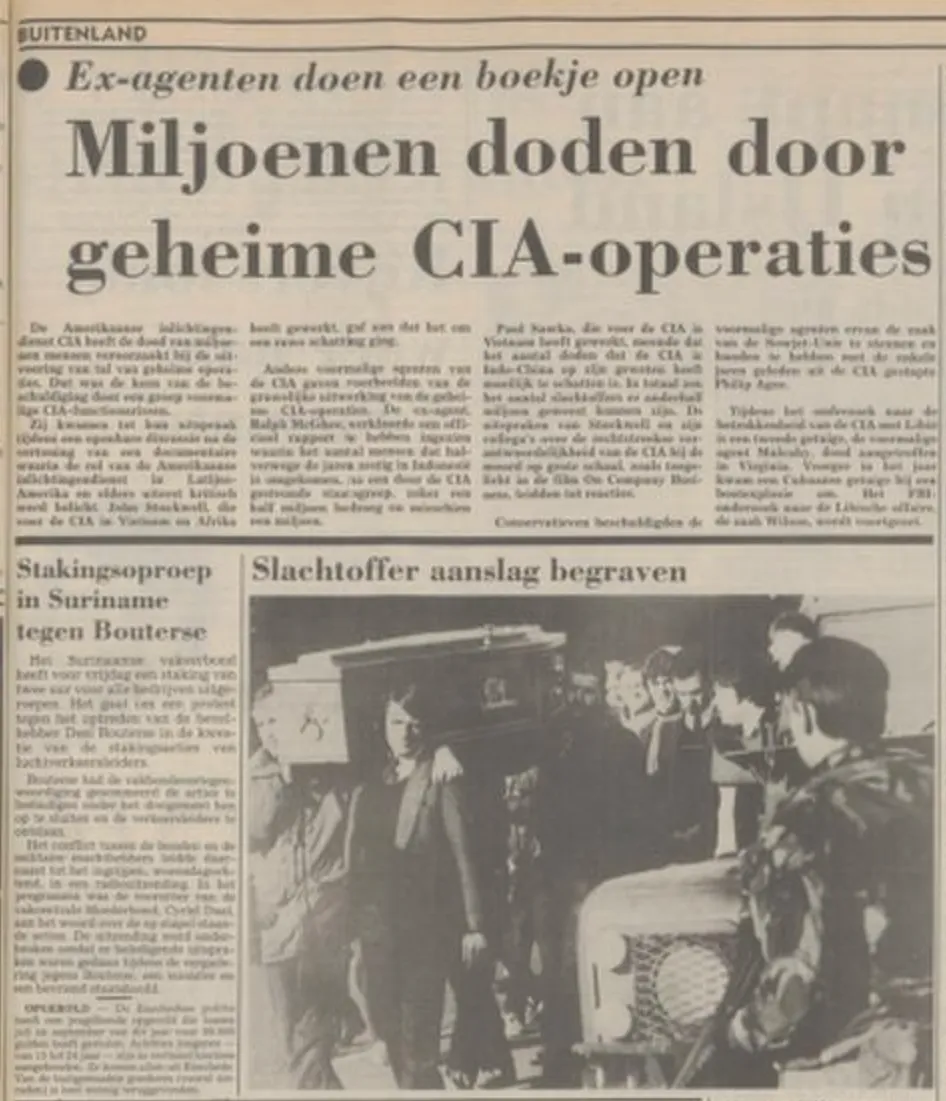
For Bouterse, the pattern was undeniable. He was watching the opening act of a destabilization playbook that had culminated in genocide in Indonesia, with the same U.S. operative, LaRoche, a key player in both theaters. Bishop’s final, public advice to Bouterse on October 30th was prophetic and brutal: “Your government is too friendly to its enemies. You must eliminate them or they will eliminate you.” Coming from his revolutionary icon, this likely cemented Bouterse’s grim resolve.
The American Wolves Exposed, An Ambassador Adrift
Ambassador Duemling’s brief illusion of diplomatic engagement shattered with Bishop’s visit. An early success—negotiating $500,000 in aid, scoreboards for the gymnasium—vanished as Bouterse confronted him after the Moederbond rally, accusing LaRoche and Donovan of direct interference. Duemling, assuming he’d be briefed on any covert actions, was stunned when Bouterse produced alleged recordings of Daal-LaRoche phone calls, deeming them grounds for expulsion. That night, a government broadcast warned against external meddling. Duemling was adrift, his diplomatic mission sunk by a covert war he was only now discovering.
The Washington Betrayal: Roy Horb’s Ill-Fated Detour
As Bishop’s visit imploded, another drama unfolded. Roy Horb, Bouterse’s deputy and confidant, returning from a “vacation” (cover for a North Korean arms delegation), didn’t fly straight to Paramaribo. Instead, he detoured to the U.S., traveling to Pittsburgh with the exiled Chin A Sen. Bouterse had sanctioned the Korea trip. The American leg—meetings with State Department, CIA, and ALCOA executives—was unsanctioned and deeply suspicious.
Horb, Bouterse’s ally since the 1980 coup, was increasingly uneasy with the regime’s pro-Cuba stance. In the U.S., officials fed him dire warnings about communism, presenting intelligence (later disputed by Bouterse) of 200 Surinamese soldiers training in Nicaragua. The CIA saw an asset. Horb’s price for cooperation? Two ponies—a seemingly trivial request that would ultimately sign his death warrant.
Returning to a Paramaribo crackling with suspicion, Horb faced Bouterse’s interrogation. He attempted mediation, persuading Moederbond to pause protests. But the promised democratic transition never came. Instead, Horb was arrested for high treason and CIA collaboration, forced into a televised loyalty pledge before disappearing.
The Culmination: December’s Bloodletting
By December 1982, Paramaribo was a powder keg. Rumors of a Dutch evacuation plan, akin to America’s “Solid Shield,” to extract 4,700 Dutch nationals—a potentially crippling brain drain—circulated. Bouterse, haunted by Chile and Indonesia, felt the walls closing in. Surrender meant capitulation to foreign interests. Resistance demanded ruthlessness. A terrible calculus: a smaller sacrifice now, or a catastrophic counter-coup later.
On the nights of December 7th and 8th, Bouterse unleashed his fury. Roy Horb, under duress, reportedly compiled a list. Military squads fanned out, dragging 23 individuals from their homes to Fort Zeelandia as phone lines went dead. Symbols of opposition—ABC and Radika radio stations, “De Vrije Stem” newspaper, Moederbond headquarters—burned, firefighters held back until only ashes remained.
Inside Fort Zeelandia: interrogation, torture. Horb was forced to conduct televised interviews, extracting “confessions” of a foreign-backed Christmas coup. Then, the executions. Fifteen men—journalists, lawyers, union leaders, military officers, the potential leadership of a new Suriname—gunned down by firing squad. Bullet holes still scar the fort’s walls, mute testimony to the chaos.
The December Murders horrified the world. Bouterse offered conflicting narratives: a thwarted coup, or “things got out of hand.” His bloody purge decisively liquidated the opposition network LaRoche and Donovan had so carefully cultivated. In the immediate aftermath, Bouterse reportedly sought refuge with communist leader Rubin Lie Pauw Sam. His later composure was chilling, sometimes flatly stating, “I killed them.” Suriname’s “bloodless revolution” was over, baptized in blood.
Conclusion: The Blueprint Exposed, The Stage Re-Set
The December Murders weren’t just the violent end of a failed U.S. operation—they were the catastrophic climax of a systematic destabilization campaign refined across multiple Caribbean theaters. The same intelligence networks that had spent years penetrating Grenada’s revolution immediately pivoted to apply those lessons against Suriname.
The “Wolf Pack”—LaRoche, Donovan, Buys—had methodically executed the NSDD-17 playbook:
- Cultivating Indigenous Leaders/Proxies: Turning assets like Roy Horb, nurturing groups like “De Stichting Herstel Democratie en Suriname.”
- “Public Information” Warfare: Mobilizing unions, staging protests, weaponizing media to cripple Bouterse.
- Military Contingency Planning: This was no mere afterthought. From late 1981, the Pentagon was actively plotting direct U.S. military invasion. Delta Force “birdwatchers” conducted on-the-ground reconnaissance while JSOC blueprinted a full-scale assault involving XVIII Airborne Corps. Though the direct invasion was shelved in 1982, as one Delta operator confirmed, Suriname invasion planning “was always on the books,” a parallel military threat to the covert operations.
Subsequent directives (NSDD-100, July 1983) included Suriname in military exercises. Ted Koppel (ABC News, June 1, 1983) reported a Reagan-approved CIA plan to invade Suriname (likely another coup plot post-December Murders), blocked by Congress. The most damning confirmation comes from Delta Force founder Eric Haney:
“We’d actually been training to invade Suriname. But after a CIA coup succeeded there, we used the same plan on Grenada.”
– Eric Haney, quoted in Maxim magazine, April 2004 (via “The Wars of Delta Force”)
The 1983 Grenada invasion utilized the Suriname playbook. This comprehensive strategy—influence operations, asset cultivation, external networks, active invasion planning—guided by NSDD-17 and likely greenlit by NSDD-61, demonstrates a proactive U.S. campaign to overthrow Suriname’s government, directly setting the stage for December 1982’s tragic crescendo.
The Enduring Stain, The Shifting War
The December Murders weren’t the failure of the U.S. operation but its violent, premature unmasking. Bouterse, discovering the plot, struck first and hard. LaRoche and Donovan were expelled in January 1983, but the U.S. covert infrastructure remained, its focus soon shifting. The grim parallels with Grenada culminated in Maurice Bishop’s own overthrow and execution in October 1983, providing the pretext for the U.S. invasion that same month—using the Suriname template.
The “Wolves of Paramaribo” moved on. LaRoche garnered commendations. Donovan continued his psy-ops career until his 1989 death. Buys ensured intelligence continuity. Their Suriname operation became a dark blueprint for “Project Democracy”—a template for intervention, refined and redeployed across the Cold War’s many battlefields.
Suriname was a laboratory. As Part III will reveal, the connections deepened, drawing in Oliver North, his infamous terrorism exercises, and alleged links to European terror networks, all converging on the planned “Operation Red Christmas” coup—the imminent threat that likely triggered Bouterse’s December slaughter.
Continue to Part 3: Operation Red Christmas – Oliver North’s Terror Drills, A Phantom Christmas Coup, and the Iran-Contra Dawn” to uncover the explosive operational details of the planned coup, the alleged link between North’s activities and notorious European terrorists, how the plot unraveled, and why the horrific December Murders were likely Bouterse’s calculated, preemptive response to this imminent, American-backed threat.
Source:
Link:
Internal Link:
Date:
October 26, 2025