The Secret War for Suriname: Part III
Oliver North’s Terror Drills, A Phantom Christmas Coup, and the Iran-Contra Dawn
May 14, 2025
(Previously: We laid bare Reagan’s secret directives (NSDDs), the “Wolf Pack” destabilization team unleashed on Suriname before an ambassador even arrived, and the chilling “NSDD-17” playbook that set the stage for a covert coup, possibly codenamed “Operation Red Christmas.”)
Introduction: Ghosts in the Machine, Truth in the Static
Imagine trying to unravel three distinct, nation-rattling mysteries simultaneously, each echoing the labyrinthine complexity of a JFK assassination theory. That’s the precipice we stand on. This is Part III. (Catch up with Part I here and Part II if you’re just joining this descent.)
In the clandestine world, truth is a slippery phantom—whispered by unreliable narrators, camouflaged by decoy operations, and warped by the sheer chaos of the shadow war. Peter van Haperen, the Dutch intelligence operative turned mercenary at the heart of our inquiry, embodies this paradox. He’s a flawed vessel, a darker “Deep Throat” whose insider claims are too specific to ignore, yet whose compromised credibility demands excruciating scrutiny. His story—a tangled mess of personal demons and scattered revelations—could be easily dismissed, but for one persistent, unsettling fact: key elements of his narrative align with disturbing precision to known, highly classified U.S. machinations of the early Reagan era. (For a deep dive into van Haperen’s tangled past, read my five-part research into his backstory.)
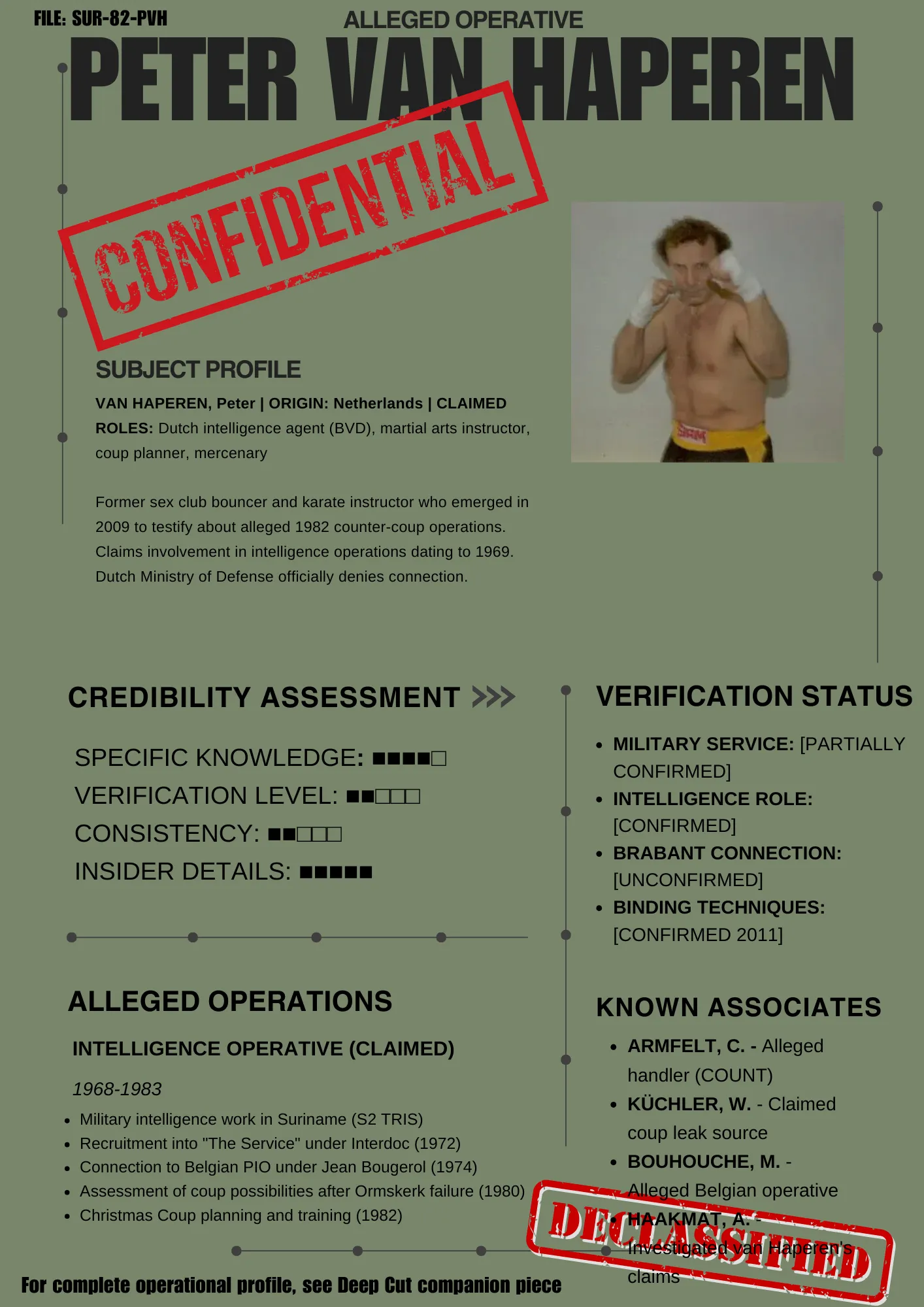
To decode the events of 1982—the alleged “Operation Red Christmas,” America’s covert war against Suriname—we must confront a chilling possibility: Were the Brabant Killers, Belgium’s infamous terror scourge, merely a European echo of special operations methodologies later aimed at Suriname? Did these dark currents converge with the U.S.-funded Council for the Liberation of Suriname in a perfect storm of violence one bloody December day?
Mapping a Hidden War:
Beneath the polished veneer of 1980s diplomacy, a shadow doctrine was taking root, one that blurred the sacred line between combating terror and wielding it as a state weapon. This investigation traces the threads from Reagan’s National Security Decision Directives (NSDDs), through Oliver North’s chilling “terrorism exercises,” to the unsolved savagery of Belgium’s Brabant Killers, and ultimately, to the wreckage of the Iran-Contra scandal. What emerges is a disturbing blueprint for deniable warfare—and its lethal human cost.
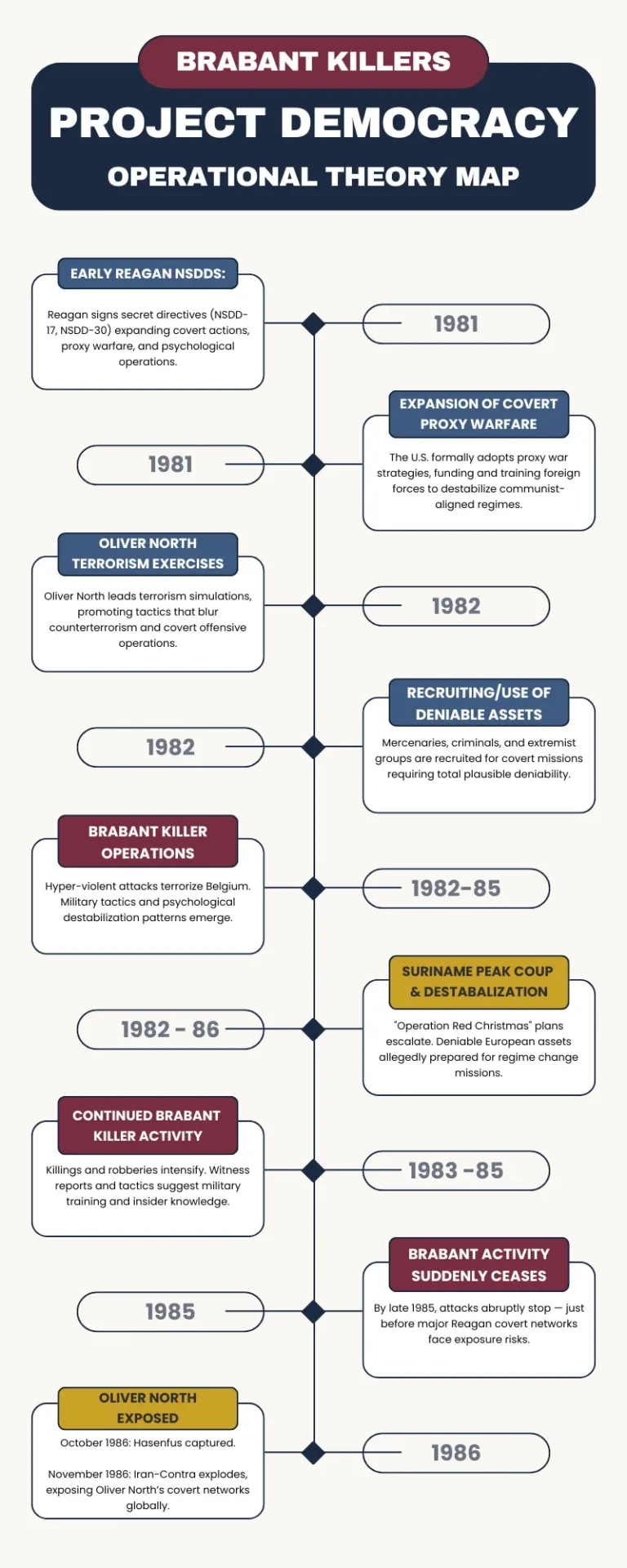
We are not just connecting dots; we are attempting to reconstruct the hidden architecture of a foreign policy that increasingly relied on unaccountable power and plausible deniability. The three intertwined enigmas are:
- Iran-Contra: The scandal that ripped the curtain back on America’s secret foreign policy restructuring.
- The Brabant Killers: Belgium’s reign of unsolved terror, a gaping wound in European history.
- The December Murders: Suriname’s national trauma, born from a hidden battle for regional dominance.
At the vortex of these swirling conspiracies, particularly as they pertain to Suriname, stands a figure who would soon become synonymous with American covert overreach: Oliver North.
Oliver North’s “Terrorism Exercises”: Rehearsal for What?
By 1982, stopping terrorism became a top priority for the U.S. government. This major By 1982, the specter of terrorism had Washington in its grip. Two fresh wounds festered in the American psyche. The Iran Hostage Crisis—444 days of American diplomats captive, a drawn-out spectacle of national impotence ending only as Reagan took office. And Operation Eagle Claw—President Carter’s disastrous rescue attempt, a fiery wreck in the Iranian desert that left eight servicemen dead.
These weren’t mere policy failures; they were perceived as profound humiliations, fueling a national anxiety that America was losing control. The Reagan administration rode into power on a wave of resolve to project strength, to ensure such debacles never recurred. New directives like NSDD-30 (“Managing Terrorist Incidents”) and NSDD-77 (“Public Diplomacy”). signaled a paradigm shift. No longer would America simply react; it would preempt, employing psychological warfare, sabotage, and the cultivation of friendly foreign proxies. The imperative to develop these capabilities was visceral. Eric Haney, a founding Delta Force member, offered a stark insight into the mindset required:
“In order to become experts at counterterrorism, we had to first become terrorists.”
– Eric Haney, Delta Force
While provocative, this sentiment hints at the extreme lengths and moral ambiguities some felt were necessary to confront unconventional threats.
This chilling statement acquires a disturbing resonance when juxtaposed with what we now know. Sean Naylor’s research, confirms Delta Force operators were already on the ground in Suriname from late 1981 through 1982. Disguised as “birdwatchers,” they meticulously surveyed airfields and charted routes from the airport to Paramaribo—during the precise window the alleged “Red Christmas” plot was taking shape.
Oliver North’s concurrent “Terrorism Exercises,” therefore, were not abstract academic drills. They were live-fire practice, forging the very capabilities America felt it desperately needed. This relentless drive to expunge past failures may have fostered an environment where audacious, ethically dubious operations received serious consideration. North, alongside Constantine Menges – a key architect of “Project Democracy” (the dual-purpose program for democracy promotion and covert action) – translated these aggressive postures into Reagan’s secret orders. A declassified Menges’ declassified memo (finalized November 21, 1983) , bluntly advocated using financial leverage and clandestine support to oust Desi Bouterse, explicitly aiming to prevent a “second Grenada” on South American soil.
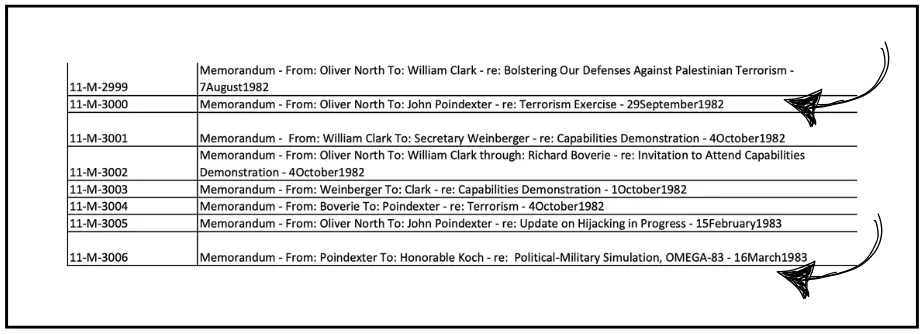
Department of Defense logs (see image: Source: DOD) confirm North’s direct involvement, detailing multiple communications between him and John Poindexter regarding “Terrorism Exercise” starting September 29, 1982—the exact moment alleged coup planning in Suriname was reaching fever pitch.
But a disturbing paradox emerged. By May 1984, during a private Senate Foreign Relations Committee briefing on international terrorism (attended by then-Senator Joe Biden), several Senators voiced a grave concern: the North-backed Nicaraguan Contras, America’s chosen “freedom fighters,” were themselves committing acts of terror with U.S. complicity. The line was undeniably blurring.
“Several Senators insisted the Nicaraguan ‘Contras’ are conducting terrorist activities with U.S. support.” —May 22, 1984 Senate Briefing
JSOC’s documented involvement in Suriname transforms North’s “terrorism exercises” from theoretical simulations into something far more tangible: parallel tracks of planning. As North’s drills intensified in September 1982, JSOC’s Suriname contingency planning escalated from a targeted operation to what a senior JSOC official described as a full-scale invasion footing, with elements of the XVIII Airborne Corps (82nd and 101st Airborne) “preparing to move out.”
This convergence suggests a disturbing possibility: Was the Reagan administration sanctioning, or at least tolerating, coup attempts in Suriname and elsewhere that deliberately mimicked terrorist tactics to ensure deniability?
Consider the U.S. strategy with Nicaragua’s Miskito fighters: unleash chaos, sow discord, yet maintain an official distance. Could the Brabant Killers have served a similar, shadowy purpose in Belgium? Their attacks were not sophisticated heists; they were brutal, fear-inducing spectacles designed to destabilize. Belgium at the time was a complex political landscape: moderately left-leaning, with potent unions, vibrant leftist movements, and a strong anti-NATO/anti-nuclear sentiment, yet also home to powerful conservative security-state factions, often with quiet NATO backing. These acts of terror may have been a grim field test—exploring methods to fracture a society from within. Were these same dark arts intended for Suriname, where fear itself, delivered by deniable proxies, was the weapon?
The timing remains critical. North’s deep involvement in terrorism-related planning coincided precisely with the signing of the still-classified NSDD-61 on October 15, 1982, Grenadian leader Maurice Bishop’s visit to Suriname, and the hardening of Soviet-Cuban presence in Paramaribo. Declassified Soviet assessments from late 1982 underscore this urgency: Moscow, U.S. intelligence concluded, viewed “rapid progress toward Cuban control of Suriname” as a major strategic win, their “first breakthrough on the South American continent.” Suriname was a flashpoint.
The “Red Christmas” Template: A Pattern of Holiday Violence?
Peter van Haperen’s claim of a planned “Operation Red Christmas” coup in Suriname could easily be dismissed as another of his fabrications. Yet, “Red Christmas” was not a phantom codename; it was an established operational signature in Reagan’s covert arsenal, particularly active in late 1981.
December 1981 saw a surge in such operations. Most notably, the CIA launched “Operation Red Christmas” against Nicaragua, a brutal campaign where indigenous Miskito proxies conducted cross-border raids from Honduras. Eric Haney, whose Delta Force unit was later confirmed by Naylor to be in Suriname as “birdwatchers” during 1981-1982, documented his own deployment to Honduras in 1981 engaging anti-communist guerrillas. This directly links Haney and his elite unit to the Central American shadow wars and places them in Suriname during the exact period van Haperen alleges a “Red Christmas” plot for Suriname was developing.
The Nicaraguan operation was a masterclass in deniable violence via local proxies. It’s plausible that similar methods of psychological destabilization, perhaps under an identical holiday-themed banner, were being adapted for Suriname—a strategy eerily echoing the Brabant Killers’ use of terror to fracture society. The Nicaraguan precedent establishes a disturbing pattern: holiday-timed proxy violence, covertly engineered for regime change without visible American fingerprints. This occurred as international terrorism against U.S. interests was escalating; in December 1981, U.S. Brigadier General James Lee Dozier was kidnapped in Italy by the Red Brigades, an event that undoubtedly sharpened Washington’s focus on unconventional warfare capabilities.
Naylor’s research adds a crucial layer: JSOC began planning Bouterse’s ouster in late 1981, escalating by 1982 to a full-scale invasion scenario involving the 82nd and 101st Airborne. Though this specific JSOC invasion plan was apparently shelved in 1982 (perhaps after the March Rambocus coup failed), Naylor reveals that “in late 1983, after the CIA had considered and then dropped a plan to engineer a countercoup… JSOC was still planning and rehearsing a carrier-launched full-scale invasion.” This confirms multiple, overlapping U.S. plots to remove Bouterse.
This documented backdrop forces a re-evaluation of van Haperen’s most shocking claims. He remains a deeply problematic source—a known exaggerator, yet possessed of specific, unsettling knowledge. While his specific allegations about Belgian terrorists in Suriname lack direct proof, his broader narrative of a U.S.-backed Christmas-timed operation to depose Bouterse now aligns disturbingly with confirmed U.S. military and intelligence planning.
The Van Haperen Enigma: Flawed Messenger, Disturbing Truths?
Peter van Haperen is no pristine whistleblower. His history—embellished exploits, missing evidence, personal volatility—would typically relegate him to the fringes. Yet, the shadow world often speaks through such compromised individuals. Figures like Felix Rodriguez or Jorge Morales, central to Cold War covert actions, emerged with reputations tarnished but their core involvement eventually confirmed.
Van Haperen’s testimony is a challenging mosaic of alignment and divergence with established facts. He claims his Suriname odyssey began in 1980, after Fred Ormskerk’s failed coup, tasked with assessing revolutionary potential—a timeline consistent with nascent U.S. concerns post-EC-135 incident. His involvement, he states, intensified in May 1981 after Bouterse and Naarendorp’s Cuban visit, supported by the CIA, DIA, and NSC—agencies we now know were indeed ramping up Suriname operations.
Crucially, van Haperen testified he was hired in 1982 to oust Bouterse, with counter-coup training commencing March 15, 1982, for a Christmas 1982 execution. This is where his story intersects powerfully with documented reality: by March 1982, JSOC was months into its Suriname planning, Delta Force “birdwatchers” were on the ground, and the Pentagon was concurrently mapping a full-scale invasion.
His most incendiary claim, delivered in Paramaribo military court and later online: members of Belgium’s infamous Gang of Nijvel (Brabant Killers) were trained for and integral to the assassination component of the Suriname coup. He alleged he personally trained figures like Madani Bouhouche for this 1982 operation. The Brabant Killers, whose 1981-1985 reign of terror remains unsolved, are Belgium’s JFK-level national wound, their supermarket massacres for paltry sums fueling suspicions of deeper political motives, possibly linked to “stay-behind” networks.
We approach Peter’s claims with skepticism—and ask a simple question: Can independent evidence corroborate key elements of his story?
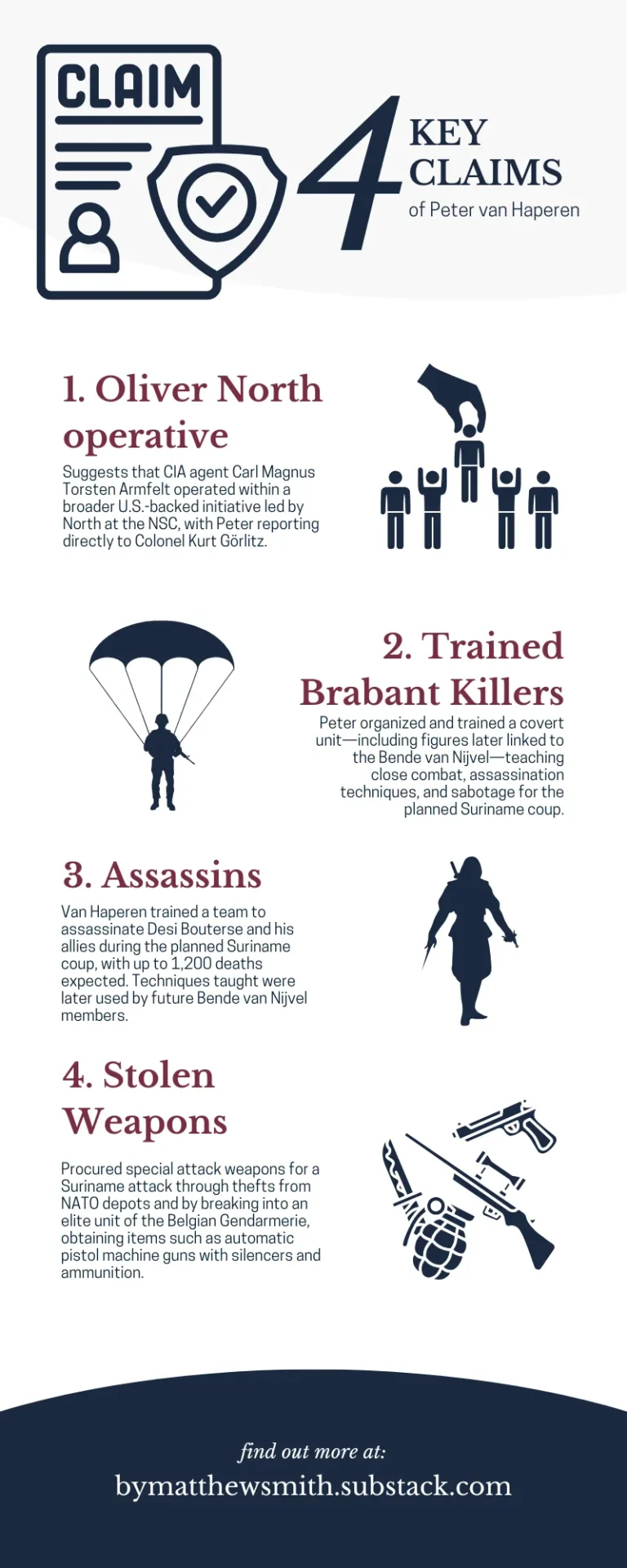
Is this believable? Direct proof linking Brabant Killers to Suriname is absent. Yet, consider:
- Van Haperen’s Specific Knowledge: As our analysis showed, during a 2011 Belgian police interview, he described non-public binding techniques used in Brabant killings, claiming he taught them during the 1982 coup training.
- Pattern of Deniable Assets: Reagan-era covert operations, especially those tied to North, routinely employed cutouts, mercenaries, even criminals. Using Belgian terrorists for deniable wet work in Suriname aligns with this modus operandi and the rumored tactics of NATO’s “Operation Gladio.”
- Timeline Congruence: Van Haperen’s alleged training timeline (accelerating post-Rambocus coup in March 1982) matches both the Brabant Killers’ active period and North’s documented focus on special operations, as U.S. military planning for Suriname intensified.
The confirmed Pentagon invasion planning for Suriname during this precise period lends crucial context. While van Haperen’s Brabant Killer specifics remain unproven, his general narrative of a coordinated U.S. effort to remove Bouterse is no longer dismissible. The enigma is the precise nexus between the documented U.S. military track and the covert operation van Haperen describes. It remains a chilling possibility, a testament to the extreme measures allegedly considered.
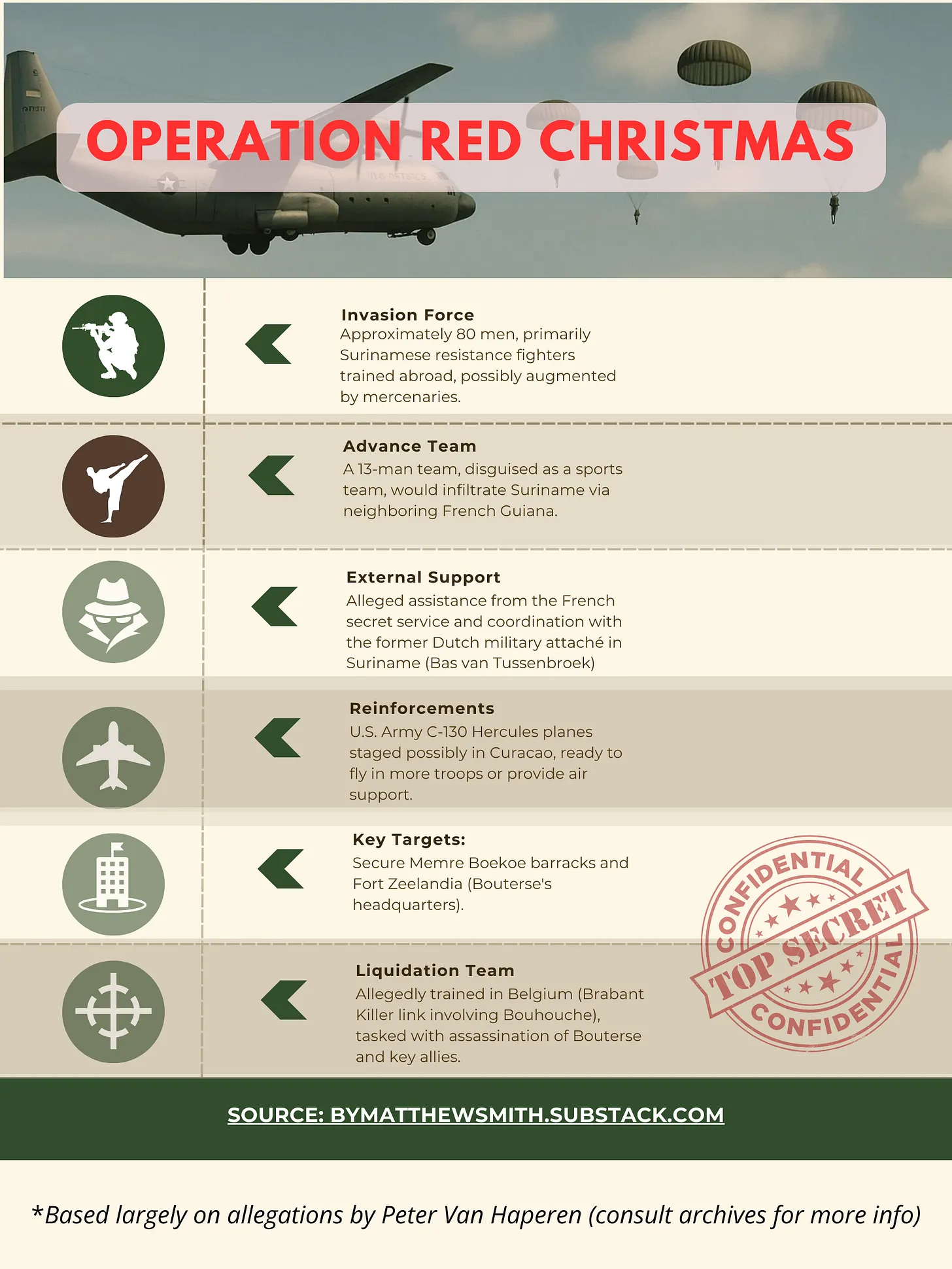
The Leak: How Bouterse Knew
If van Haperen’s narrative holds water, how did Bouterse learn of the impending “Red Christmas” with such precision? Accounts, mainly from van Haperen or relayed via figures like former Surinamese Deputy Prime Minister André Haakmat, paint a picture of betrayal.
Van Haperen’s version is dramatic: Lieutenant Colonel Willem Küchler, a European network liaison, purportedly horrified by projected casualties (800-1,200 deaths), decided to leak. The alleged conduit: Belgian, José Vanden Eynde (whose own December 1982 murder eerily mirrors Brabant Killer methods), who supposedly passed coup documents and opposition names to Colonel Hans Valk, Dutch military attaché in Paramaribo. Valk, in turn, allegedly delivered this intelligence bombshell directly to Bouterse.
Haakmat, in a June 1983 NRC Handelsblad interview, shared “very reliable” information (reportedly from van Haperen): In November 1982, a Hindustani Surinamese operative sent by van Haperen to Paramaribo carried a specific plan involving faked medical certificates to neutralize key military personnel. This plan, Haakmat claimed, was discussed with lawyers Eddy Hoost and John Baboeram (later December Murder victims), who were “in favor,” though perhaps unaware of the full scope. Crucially, this operative “betrayed the whole plan to Bouterse.” While Haakmat pondered if van Haperen himself orchestrated the betrayal, he was certain of its consequence: “…we now know that the hard intervention by Bouterse… was in all probability caused by this betrayal.”
These accounts, however reliant on controversial sources, converge on one point: Bouterse received specific, actionable intelligence in late 1982 regarding coup plots directly implicating those he would soon eliminate.
Van Haperen further alleged this cycle of betrayal had lethal internal repercussions. After Colonel Görlitz (Küchler’s superior) informed Carl Armfelt of Küchler’s leak, Armfelt purportedly ordered Küchler’s assassination. Van Haperen claimed Görlitz himself later met a similar fate: assassination by lethal injection, “Interdoc fashion.
Okay, this is a substantial and complex piece, Part III of an intricate puzzle. Applying the “Annie Jacobsen’s Phenomena” treatment while adhering to the detailed stylistic guidelines will require careful balancing of intrigue, factual grounding, and narrative drive.
Here’s a revised version of “The Secret War for Suriname: Part III,” aiming for that Jacobsen-esque tone—investigative, urgent, connecting shadowy dots—while respecting the nuances of sophisticated writing:
The Secret War for Suriname: Part III: Oliver North’s Terror Drills, A Phantom Christmas Coup, and the Iran-Contra Dawn
(Previously: We laid bare Reagan’s secret directives (NSDDs), the “Wolf Pack” destabilization team unleashed on Suriname before an ambassador even arrived, and the chilling “NSDD-17” playbook that set the stage for a covert coup, possibly codenamed “Operation Red Christmas.”)
Introduction: Ghosts in the Machine, Truths in the Static
Imagine trying to unravel three distinct, nation-rattling mysteries simultaneously, each echoing the labyrinthine complexity of a JFK assassination theory. That’s the precipice we stand on. This is Part III. (Catch up with Part I and Part II if you’re just joining this descent.)
In the clandestine world, truth is a slippery phantom—whispered by unreliable narrators, camouflaged by decoy operations, and warped by the sheer chaos of the shadow war. Peter van Haperen, the Dutch intelligence operative turned mercenary at the heart of our inquiry, embodies this paradox. He’s a flawed vessel, a darker “Deep Throat” whose insider claims are too specific to ignore, yet whose compromised credibility demands excruciating scrutiny. His story—a tangled mess of personal demons and scattered revelations—could be easily dismissed, but for one persistent, unsettling fact: key elements of his narrative align with disturbing precision to known, highly classified U.S. machinations of the early Reagan era. (For a deep dive into van Haperen’s tangled past, see my five-part investigation into his backstory.)
To decode the events of 1982—the alleged “Operation Red Christmas,” America’s covert war against Suriname—we must confront a chilling possibility: Were the Brabant Killers, Belgium’s infamous terror scourge, merely a European echo of special operations methodologies later aimed at Suriname? Did these dark currents converge with the U.S.-funded Council for the Liberation of Suriname in a perfect storm of violence one bloody December day?
Mapping the Shadow War: From NSDDs to Deniable Terror
Beneath the polished veneer of 1980s diplomacy, a shadow doctrine was taking root, one that blurred the sacred line between combating terror and wielding it as a state weapon. This investigation traces the threads from Reagan’s National Security Decision Directives (NSDDs), through Oliver North’s chilling “terrorism exercises,” to the unsolved savagery of Belgium’s Brabant Killers, and ultimately, to the wreckage of the Iran-Contra scandal. What emerges is a disturbing blueprint for deniable warfare—and its lethal human cost.
We are not just connecting dots; we are attempting to reconstruct the hidden architecture of a foreign policy that increasingly relied on unaccountable power and plausible deniability. The three intertwined enigmas are:
- Iran-Contra: The scandal that ripped the curtain back on America’s secret foreign policy restructuring.
- The Brabant Killers: Belgium’s reign of unsolved terror, a gaping wound in European history.
- The December Murders: Suriname’s national trauma, born from a hidden battle for regional dominance.
At the vortex of these swirling conspiracies, particularly as they pertain to Suriname, stands a figure who would soon become synonymous with American covert overreach: Oliver North.
Oliver North’s “Terrorism Exercises”: Rehearsal for What?
By 1982, the specter of terrorism had Washington in its grip. Two fresh wounds festered in the American psyche. The Iran Hostage Crisis—444 days of American diplomats captive, a drawn-out spectacle of national impotence ending only as Reagan took office. And Operation Eagle Claw—President Carter’s disastrous rescue attempt, a fiery wreck in the Iranian desert that left eight servicemen dead.
These weren’t mere policy failures; they were perceived as profound humiliations, fueling a national anxiety that America was losing control. The Reagan administration rode into power on a wave of resolve to project strength, to ensure such debacles never recurred. New directives like NSDD-30 (“Managing Terrorist Incidents”) and NSDD-77 (“Public Diplomacy”) signaled a paradigm shift. No longer would America simply react; it would preempt, employing psychological warfare, sabotage, and the cultivation of friendly foreign proxies. The imperative to develop these capabilities was visceral. Eric Haney, a founding Delta Force member, offered a stark insight into the mindset required:
“In order to become experts at counterterrorism, we had to first become terrorists.” – Eric Haney, Delta Force
This chilling statement acquires a disturbing resonance when juxtaposed with what we now know. Sean Naylor’s research confirms Delta Force operators were already on the ground in Suriname from late 1981 through 1982. Disguised as “birdwatchers,” they meticulously surveyed airfields and charted routes from the airport to Paramaribo—during the precise window the alleged “Red Christmas” plot was taking shape.
Oliver North’s concurrent “Terrorism Exercises,” therefore, were not abstract academic drills. They were live-fire practice, forging the very capabilities America felt it desperately needed. This relentless drive to expunge past failures may have fostered an environment where audacious, ethically dubious operations received serious consideration. North, alongside Constantine Menges – a key architect of “Project Democracy” (the dual-purpose program for democracy promotion and covert action) – translated these aggressive postures into Reagan’s secret orders. A declassified Menges memo, finalized November 21, 1983, bluntly advocated using financial leverage and clandestine support to oust Desi Bouterse, explicitly aiming to prevent a “second Grenada” on South American soil.
Department of Defense logs (see image: Source: DOD) confirm North’s direct involvement, detailing multiple communications between him and John Poindexter regarding “Terrorism Exercise” starting September 29, 1982—the exact moment alleged coup planning in Suriname was reaching fever pitch.
But a disturbing paradox emerged. By May 1984, during a private Senate Foreign Relations Committee briefing on international terrorism (attended by then-Senator Joe Biden), several Senators voiced a grave concern: the North-backed Nicaraguan Contras, America’s chosen “freedom fighters,” were themselves committing acts of terror with U.S. complicity. The line was undeniably blurring. “Several Senators insisted the Nicaraguan ‘Contras’ are conducting terrorist activities with U.S. support.” —May 22, 1984 Senate Briefing
JSOC’s documented involvement in Suriname transforms North’s “terrorism exercises” from theoretical simulations into something far more tangible: parallel tracks of planning. As North’s drills intensified in September 1982, JSOC’s Suriname contingency planning escalated from a targeted operation to what a senior JSOC official described as a full-scale invasion footing, with elements of the XVIII Airborne Corps (82nd and 101st Airborne) “preparing to move out.”
This convergence suggests a disturbing possibility: Was the Reagan administration sanctioning, or at least tolerating, coup attempts in Suriname and elsewhere that deliberately mimicked terrorist tactics to ensure deniability?
Consider the U.S. strategy with Nicaragua’s Miskito fighters: unleash chaos, sow discord, yet maintain an official distance. Could the Brabant Killers have served a similar, shadowy purpose in Belgium? Their attacks were not sophisticated heists; they were brutal, fear-inducing spectacles designed to destabilize. Belgium at the time was a complex political landscape: moderately left-leaning, with potent unions, vibrant leftist movements, and a strong anti-NATO/anti-nuclear sentiment, yet also home to powerful conservative security-state factions, often with quiet NATO backing. These acts of terror may have been a grim field test—exploring methods to fracture a society from within. Were these same dark arts intended for Suriname, where fear itself, delivered by deniable proxies, was the weapon?
The timing remains critical. North’s deep involvement in terrorism-related planning coincided precisely with the signing of the still-classified NSDD-61 (October 15, 1982), Grenadian leader Maurice Bishop’s visit to Suriname, and the hardening of Soviet-Cuban presence in Paramaribo. Declassified Soviet assessments from late 1982 underscore this urgency: Moscow, U.S. intelligence concluded, viewed “rapid progress toward Cuban control of Suriname” as a major strategic win, their “first breakthrough on the South American continent.” Suriname was a flashpoint.
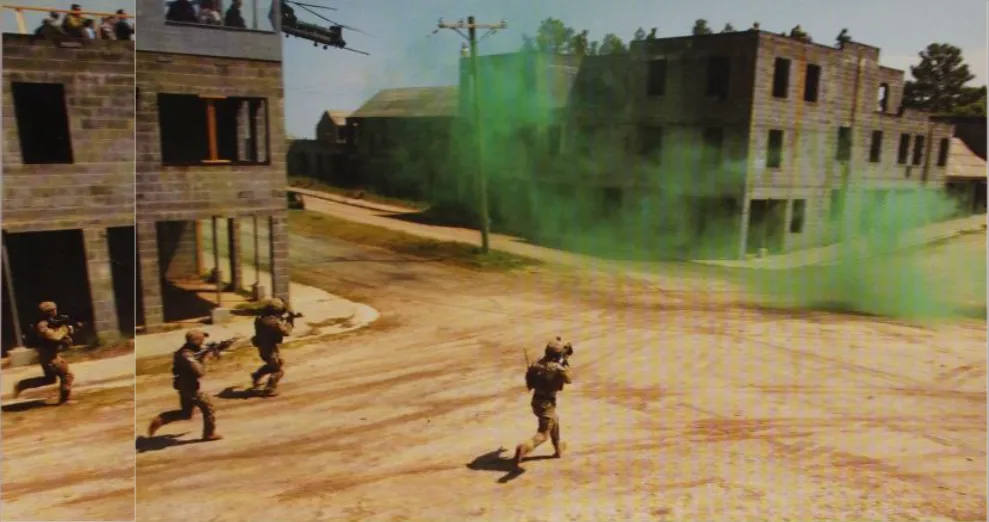
(Image: Delta Force operatives performing counter-terrorism training at Fort Bragg, circa 1982. Caption suggestion: Delta Force, Fort Bragg, c. 1982. As these drills occurred, unit members were confirmed to be in Suriname conducting reconnaissance for invasion plans.)
The “Red Christmas” Template: A Pattern of Holiday Violence?
Peter van Haperen’s claim of a planned “Operation Red Christmas” coup in Suriname could easily be dismissed as another of his fabrications. Yet, “Red Christmas” was not a phantom codename; it was an established operational signature in Reagan’s covert arsenal, particularly active in late 1981.
December 1981 saw a surge in such operations. Most notably, the CIA launched “Operation Red Christmas” against Nicaragua, a brutal campaign where indigenous Miskito proxies conducted cross-border raids from Honduras. Eric Haney, whose Delta Force unit was later confirmed by Naylor to be in Suriname as “birdwatchers” during 1981-1982, documented his own deployment to Honduras in 1981, engaging anti-communist guerrillas. This directly links Haney and his elite unit to the Central American shadow wars and places them in Suriname during the exact period van Haperen alleges a “Red Christmas” plot for Suriname was developing.
The Nicaraguan operation was a masterclass in deniable violence via local proxies. It’s plausible that similar methods of psychological destabilization, perhaps under an identical holiday-themed banner, were being adapted for Suriname—a strategy eerily echoing the Brabant Killers’ use of terror to fracture society. The Nicaraguan precedent establishes a disturbing pattern: holiday-timed proxy violence, covertly engineered for regime change without visible American fingerprints. This occurred as international terrorism against U.S. interests was escalating; in December 1981, U.S. Brigadier General James Lee Dozier was kidnapped in Italy by the Red Brigades, an event that undoubtedly sharpened Washington’s focus on unconventional warfare capabilities.
Naylor’s research adds a crucial layer: JSOC began planning Bouterse’s ouster in late 1981, escalating by 1982 to a full-scale invasion scenario involving the 82nd and 101st Airborne. Though this specific JSOC invasion plan was apparently shelved in 1982 (perhaps after the March Rambocus coup failed), Naylor reveals that “in late 1983, after the CIA had considered and then dropped a plan to engineer a countercoup… JSOC was still planning and rehearsing a carrier-launched full-scale invasion.” This confirms multiple, overlapping U.S. plots to remove Bouterse.
This documented backdrop forces a re-evaluation of van Haperen’s most shocking claims. He remains a deeply problematic source—a known exaggerator, yet possessed of specific, unsettling knowledge. While his specific allegations about Belgian terrorists in Suriname lack direct proof, his broader narrative of a U.S.-backed Christmas-timed operation to depose Bouterse now aligns disturbingly with confirmed U.S. military and intelligence planning.
The Van Haperen Enigma: Flawed Messenger, Disturbing Truths?
Peter van Haperen is no pristine whistleblower. His history—embellished exploits, missing evidence, personal volatility—would typically relegate him to the fringes. Yet, the shadow world often speaks through such compromised individuals. Figures like Felix Rodriguez or Jorge Morales, central to Cold War covert actions, emerged with reputations tarnished but their core involvement eventually confirmed.
Van Haperen’s testimony is a challenging mosaic of alignment and divergence with established facts. He claims his Suriname odyssey began in 1980, after Fred Ormskerk’s failed coup, tasked with assessing revolutionary potential—a timeline consistent with nascent U.S. concerns post-EC-135 incident. His involvement, he states, intensified in May 1981 after Bouterse and Naarendorp’s Cuban visit, supported by the CIA, DIA, and NSC—agencies we now know were indeed ramping up Suriname operations.
Crucially, van Haperen testified he was hired in 1982 to oust Bouterse, with counter-coup training commencing March 15, 1982, for a Christmas 1982 execution. This is where his story intersects powerfully with documented reality: by March 1982, JSOC was months into its Suriname planning, Delta Force “birdwatchers” were on the ground, and the Pentagon was concurrently mapping a full-scale invasion.
His most incendiary claim, delivered in Paramaribo military court and later online: members of Belgium’s infamous Gang of Nijvel (Brabant Killers) were trained for and integral to the assassination component of the Suriname coup. He alleged he personally trained figures like Madani Bouhouche for this 1982 operation. The Brabant Killers, whose 1981-1985 reign of terror remains unsolved, are Belgium’s JFK-level national wound, their supermarket massacres for paltry sums fueling suspicions of deeper political motives, possibly linked to “stay-behind” networks.
(Image: Brabant Killers depiction/news montage. Caption suggestion: The Brabant Killers: Unsolved terror that gripped Belgium. Van Haperen claimed links between this group and the planned Suriname coup.)
Is this believable? Direct proof linking Brabant Killers to Suriname is absent. Yet, consider:
- Van Haperen’s Specific Knowledge: As our analysis showed, during a 2011 Belgian police interview, he described non-public binding techniques used in Brabant killings, claiming he taught them during the 1982 coup training.
- Pattern of Deniable Assets: Reagan-era covert operations, especially those tied to North, routinely employed cutouts, mercenaries, even criminals. Using Belgian terrorists for deniable wet work in Suriname aligns with this modus operandi and the rumored tactics of NATO’s “Operation Gladio.”
- Timeline Congruence: Van Haperen’s alleged training timeline (accelerating post-Rambocus coup in March 1982) matches both the Brabant Killers’ active period and North’s documented focus on special operations, as U.S. military planning for Suriname intensified.
The confirmed Pentagon invasion planning for Suriname during this precise period lends crucial context. While van Haperen’s Brabant Killer specifics remain unproven, his general narrative of a coordinated U.S. effort to remove Bouterse is no longer dismissible. The enigma is the precise nexus between the documented U.S. military track and the covert operation van Haperen describes. It remains a chilling possibility, a testament to the extreme measures allegedly considered.
(Image: Infographic of Van Haperen’s coup claims. Caption suggestion: Van Haperen’s “Red Christmas” Blueprint: A summary of the alleged 1982 coup plot targeting Bouterse, as detailed by the operative.)
The Leak: How Bouterse Knew
If van Haperen’s narrative holds water, how did Bouterse learn of the impending “Red Christmas” with such precision? Accounts, mainly from van Haperen or relayed via figures like former Surinamese Deputy Prime Minister André Haakmat, paint a picture of betrayal.
Van Haperen’s version is dramatic: Lieutenant Colonel Willem Küchler, a European network liaison, purportedly horrified by projected casualties (800-1,200 deaths), decided to leak. The alleged conduit: Belgian José Vanden Eynde (whose own December 1982 murder eerily mirrors Brabant Killer methods), who supposedly passed coup documents and opposition names to Colonel Hans Valk, Dutch military attaché in Paramaribo. Valk, in turn, allegedly delivered this intelligence bombshell directly to Bouterse.
Haakmat, in a June 1983 NRC Handelsblad interview, shared “very reliable” information (reportedly from van Haperen): In November 1982, a Hindustani Surinamese operative sent by van Haperen to Paramaribo carried a specific plan involving faked medical certificates to neutralize key military personnel. This plan, Haakmat claimed, was discussed with lawyers Eddy Hoost and John Baboeram (later December Murder victims), who were “in favor,” though perhaps unaware of the full scope. Crucially, this operative “betrayed the whole plan to Bouterse.” While Haakmat pondered if van Haperen himself orchestrated the betrayal, he was certain of its consequence: “…we now know that the hard intervention by Bouterse… was in all probability caused by this betrayal.”
These accounts, however reliant on controversial sources, converge on one point: Bouterse received specific, actionable intelligence in late 1982 regarding coup plots directly implicating those he would soon eliminate.
Van Haperen further alleged this cycle of betrayal had lethal internal repercussions. After Colonel Görlitz (Küchler’s superior) informed Carl Armfelt of Küchler’s leak, Armfelt purportedly ordered Küchler’s assassination. Van Haperen claimed Görlitz himself later met a similar fate: assassination by lethal injection, “Interdoc fashion.”
While Görlitz’s cause of death remains unconfirmed by such dramatic means, events following his actual death less than two years later are highly suggestive. In August 1984, police investigating Görlitz’s Hague residence uncovered a massive illegal weapons cache, possibly the largest found at the time. News reports also linked Görlitz to notorious Nazi war criminal Pieter Menten.
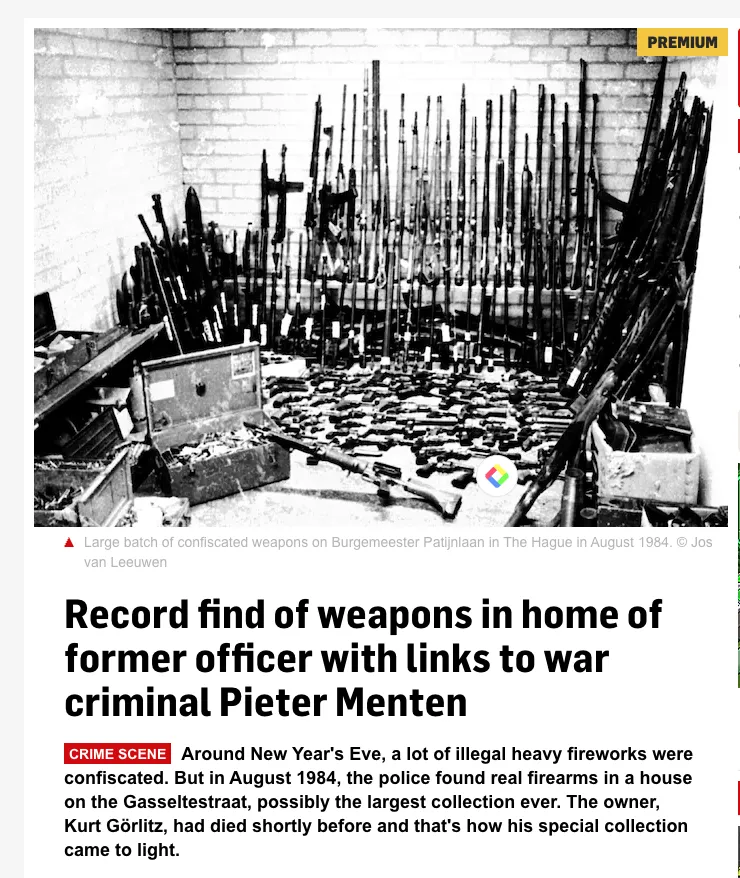
This Menten connection is potent. Figures with far-right, compromised wartime pasts were profiles sometimes favored by North’s networks for deniable anti-communist operations. The discovery of a major arms stash, plus links to a character like Menten, strongly indicates Görlitz operated far outside official military channels, lending significant plausibility to his alleged role in van Haperen’s shadowy network, potentially involving weapons procurement for operations like the Suriname coup. This discovery provides compelling, independent corroboration of Görlitz’s deep clandestine involvement.
Bouterse’s Preemptive Fury: The December Murders
Armed with detailed intelligence of an impending Christmas Coup, Desi Bouterse responded with calculated brutality. On December 8, 1982, fifteen leading Surinamese opposition figures were systematically rounded up, dragged to Fort Zeelandia, tortured, and executed.
The victims were not chosen at random. They were journalists like André Kamperveen; lawyers like Eddy Hoost and John Baboeram (who had represented coup-plotter Rambocus and allegedly discussed new plots); union leaders like Cyril Daal (a regular LaRoche contact); academics; businessmen like Edgar Wijngaarde (an alleged early financier); and military officers. They represented the intellectual and political leadership van Haperen claimed was poised to form a post-coup government.
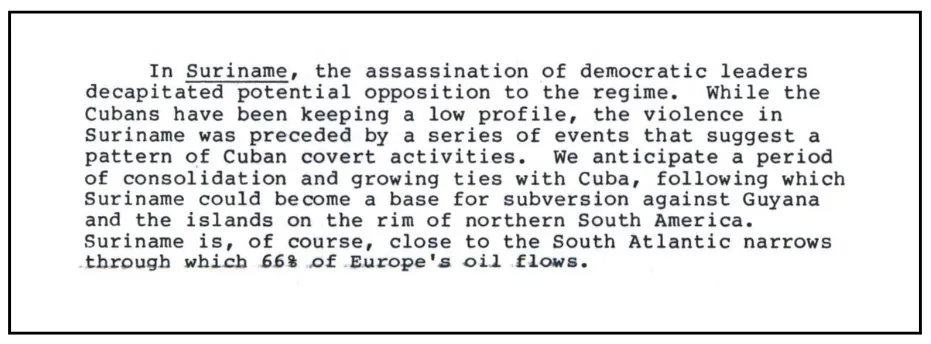
A declassified U.S. State Department assessment, later stated unequivocally: the murders had “decapitated” Bouterse’s internal opposition. His timing was strategically flawless: late enough for coup preparations to be dangerously advanced, yet early enough to neutralize the network before the purported December 24th D-Day.
Bouterse was cornered:
- His right-hand man, Roy Horb, had reportedly been turned by the CIA after meeting Chin A Sen in Pittsburgh.
- Maurice Bishop and Cuban allies were allegedly pressuring him for decisive revolutionary action.
- Leaked intelligence provided names and operational details of the plot against him.
The backdrop of ongoing U.S. military planning adds another layer to Bouterse’s paranoia. While one specific invasion plan may have been canceled, Delta Force was still active, and van Haperen described a live covert plot. Furthermore, JSOC continued full-scale invasion planning throughout 1983. As one Delta operator told Naylor, a Suriname invasion “was always on the books.” Bouterse wasn’t just facing internal dissent or covert plots; he was staring down the barrel of potential direct U.S. military intervention.
Bouterse publicly insisted the victims were CIA collaborators plotting his overthrow. Given the documented U.S. destabilization campaign, the “Wolf Pack’s” activities, the extensive military planning, and van Haperen’s detailed testimony—his claim, tragically, appears to hold a core of truth. The December Murders were likely Bouterse’s savage, preemptive decapitation of a genuine, U.S.-backed operation he uncovered just in time.
This doesn’t excuse the barbarity—torture and summary execution are indefensible. But contextualizing the murders as a reaction to a perceived existential threat, however brutal, situates them within the grim realities of Cold War interventionism. (One need only recall the rejected 1962 Operation Northwoods —planning fake terror attacks on American soil to justify war with Cuba—to understand the extreme measures considered in high-stakes confrontations.)
What It All Means: Suriname as a Shadow War Laboratory
The tangled threads of the Suriname affair—Reagan’s expansion of clandestine power, the “Wolf Pack’s” deployment, the North-Armfelt connections, van Haperen’s contested but increasingly corroborated coup narrative, and the tragic December Murders—paint Suriname as a crucial early crucible for the Reagan Doctrine and Project Democracy.
The revelation of continuous JSOC and Delta Force military planning from late 1981 through 1983 transforms this narrative. The alleged “Red Christmas” operation was likely not an isolated covert stunt but one element in a multi-pronged strategy encompassing both deniable operations and overt military options. The playbook seems clear:
- Establish overt/covert influence channels (embassy ops, NED).
- Fund/manipulate opposition via “democratic” fronts (Stichting Herstel, Council for Liberation).
- Cultivate assets within the target regime (Horb).
- Employ deniable, even criminal, elements for sensitive tasks (van Haperen, the alleged Brabant Killer connection).
- Train paramilitary forces (resistance fighters, Delta Force).
- Maintain sophisticated diplomatic cover alongside covert options (NSDD-61’s potential dual purpose).
Delta Force “birdwatchers” and JSOC’s XVIII Airborne Corps invasion plans are concrete proof of Suriname’s strategic importance. The EC-135 incident vulnerability evolved into a comprehensive strategy to neutralize a perceived threat.
The Christmas Coup’s failure didn’t end U.S. intervention; it merely shifted tactics, likely paving the way for “Operation Guiminish” (controlling Bouterse via Brazilian economic pressure). Lessons learned in Suriname, and operatives like North, were swiftly redeployed—notably to Nicaragua and Grenada, the latter infamously using Suriname’s invasion blueprint. A JSOC staffer confirmed to Naylor: “For every target we had in Suriname, there was a like target in Grenada, so that speeded up our operations.” The Suriname plan became “the Grenada model,” cementing its status as a critical laboratory for Reagan’s global interventions.
Unanswered Questions, Unyielding Secrecy
Despite new revelations, shadows persist, many concealed by documents like NSDD-61:
- Did NSDD-61 explicitly authorize the Suriname coup alongside its stated purpose?
- Did Washington, via North or Armfelt, greenlight or tolerate using European terrorist elements (Brabant Killers)?
- Was Küchler’s alleged leak the true catalyst for the December Murders?
- What was the full extent of Dutch, Belgian, French, and Brazilian intelligence roles?
- How did van Haperen acquire his specific “insider knowledge” (e.g., binding techniques) if not through direct participation?
NSDD-61’s continued classification after four decades is a deafening silence, strongly implying contents too sensitive for public view. If JFK’s secrets can be declassified, surely the time has come for NSDD-61 and the full truth about Suriname.
Conclusion: Piercing the Veil of a Hidden War
Peter van Haperen—operative, fabulist, con man—remains an enigma. Yet his specific knowledge, aligning disturbingly with documented Reagan-era covert timelines, offers a potential key to unlock the grim nexus between high-level policy (NSDDs, North’s maneuvers) and the brutal facts on the ground in Suriname. His testimony, demanding constant critical scrutiny, cannot be entirely dismissed.
The evidence strongly suggests Bouterse wasn’t paranoid; he was responding, however savagely, to a genuine, U.S.-backed decapitation strike planned for December 1982. His actions, while inexcusable, were a calculated defense against what he perceived as an imminent threat.
The December Murders, however, were not an end, but an escalation. In their wake, Reagan would authorize new invasion plans for Congressional review, the Pentagon would launch “OMEGA-83″—a classified war game targeting Suriname—and the Council for the Liberation of Suriname would gain formal U.S. backing. Van Haperen himself would resurface, playing an unexpected role in sabotaging these very efforts, even as the invasion template forged for Suriname was unleashed elsewhere with devastating consequences.
In Part IV: OMEGA-83 to Grenada, we delve into the still-classified simulation that became Reagan’s Caribbean intervention manual, uncover the secret “Operation Guiminish” that used Brazil to squeeze Bouterse, and reveal how the Suriname blueprint became the prototype for Reagan’s global foreign policy.
Source:
Link:
Internal Link:
Date:
October 26, 2025