The Secret War for Suriname: Part IV
From OMEGA-83 to Grenada
May 21, 2025
This is the fourth installment in our ongoing investigation into covert U.S. operations in Suriname during the Reagan years. Parts I-III explored the foundations of Project Democracy, the “Wolf Pack” team, and the alleged “Red Christmas” coup that led to the December Murders.
Introduction: After the Blood, The Game Evolves
The sun crept over Paramaribo on December 9, 1982, casting long shadows over a nation irrevocably scarred. Fifteen men – the intellectual and moral spine of Suriname’s opposition – lay dead inside Fort Zeelandia. The December Murders. Desi Bouterse had made his choice: brutal violence over negotiation, a bloody answer to whispers of a foreign-backed coup.
But in the hushed corridors of Washington, the game wasn’t over. It was merely transforming. The methodical elimination of America’s key Surinamese assets didn’t halt U.S. ambition; it forced a desperate, strategic pivot. The Reagan administration, its “Wolf Pack” team exposed and its carefully woven network in tatters, faced a full-blown crisis. State Department cables would later admit the stark truth: the murders had “decapitated” any viable internal challenge to Bouterse.
This installment rips the veil off Washington’s response: how the ashes of the “Red Christmas” disaster fueled a new, audacious phase in Reagan’s Caribbean war—a strategy forged in a highly classified simulation, a war game that would not only reshape regional geopolitics but birth operational templates later unleashed across the globe.
The Council for Liberation: A Ghost Government Rises
The March 1982 coup attempt, led by Surendre Rambocus, was meant to birth a “National Liberation Council.” It failed, its promise dissolving into the humid air. But the idea, the blueprint for an alternative Suriname, didn’t die. It went dark, only to re-emerge, phoenix-like, from the carnage of the December Murders.
Just weeks after the killings, on January 8, 1983, the Council for the Liberation of Suriname officially materialized. Its nerve center: the modernist housing project of Bijlmer in Amsterdam-Zuidoost, home to exiled Surinamese president Henk Chin A Sen. This was no amateur affair. It boasted a Presidium for grand strategy, a Secretariat for the nuts and bolts, and a Cabinet mirroring a real government: Legal, Political, Social, Financial-Economic, and Communication Affairs. Names like Ir. A. Sewradsingh (former UN ambassador), Glenn Tjong Akiet, Fred Marter, and Ab Judell (the unofficial voice to the press) populated its ranks.
Almost immediately, two faces of the opposition stared back:
- The Council: The public, diplomatic front, hungry for international legitimacy.
- The Liberation Movement: The shadow arm, itching for armed revolution.
This duality was by design, offering the Council a veneer of plausible deniability while keeping the wolves of war leashed but ready. Chin A Sen might publicly disavow mercenaries, but behind closed doors, figures like Peter van Haperen dangled the promise of a military solution. For the U.S., the Council was a godsend: a potential democratic government-in-waiting, a deniable channel for covert aid, a way to fight Bouterse without leaving American fingerprints.
“The Gun Was Loaded”: Washington’s Invasion Blueprint
By January 1983, CIA Director William Casey wasn’t just thinking about Suriname; he had a plan—a detailed, direct military intervention to topple Bouterse. It wasn’t a whim. It was the culmination of contingency planning that had been churning throughout 1982. Casey walked this audacious proposal into Congress, seeking the green light for a covert war.
George Shultz, Reagan’s Secretary of State, was aghast. He’d later write in his memoirs, Turmoil and Triumph,
“It was a harebrained idea, ill thought out, without any convincing likelihood of success and with no analysis of the political consequences at home or internationally.”
The sheer gravity of these invasion plans is underscored by Ambassador Robert Duemling. Barely six weeks after the December Murders, Duemling, desperate to be with his hospitalized wife, sought leave from Paramaribo. “It was not until I returned,” he recounted, “that I realized what was going on. At the highest level of the U.S. government people were talking about invading Suriname. This was about eight months before we actually invaded Grenada.”
When pressed if the invasion plan was a live threat, the gun “loaded and ready to be fired,” Duemling’s confirmation was chilling: “That’s right. It was part of ‘Let’s roll back Communism or let’s not allow further inroads.’ By this time, after the slaughter, with Bishop riding high in Grenada and the Cubans increasing their influence in Suriname, the situation in that part of the world was looking very unpleasant to the Reagan administration.”
The President himself was watching. Duemling recalled his quarterly briefings with National Security Advisor William Clark: “He would push across the desk copies of telegrams and messages that had R.R. written in the upper corner. Ronald Reagan was following on a daily basis what was happening in Suriname.”
Even more startling, Duemling revealed a covert military presence already on the ground: “We had Delta Teams surreptitiously introduced into the country to make assessments and take pictures and gather intelligence. I knew about this because I had them in the Embassy, ostensibly to assist us with some contingency plans.”
Then, a stunning roadblock. The House Intelligence Committee slammed the brakes on Casey’s plan. Ted Koppel, in a June 1, 1983, ABC News report, would later reveal that Congress had explicitly forbidden a CIA invasion of Suriname, an invasion already rubber-stamped by President Reagan.
Direct intervention was dead in the water. Reagan needed Plan B. He needed OMEGA-83.
OMEGA-83: The War Game That Changed Everything
As Congress was killing Casey’s invasion dream in early 1983, a different kind of war was being plotted in the secure rooms of Washington. Department of Defense declassification logs whisper of a “Political-Military Simulation, OMEGA-83,” referenced in a March 16, 1983, memorandum from Deputy National Security Advisor John Poindexter.
OMEGA-83 wasn’t just another war game. It was an evolutionary leap in crisis planning at the highest level of national security—approaching the gravity of nuclear war preparations. Earlier plans (1981-82) were merely tactical: infiltration routes, body counts, target lists. OMEGA-83 was grand strategy. It fed on the raw intelligence smuggled out by those covert Delta Force teams, but its core objective was far more complex: to solve the riddle Ambassador Duemling had posed to the Pentagon—what happens after the invasion? How do you govern? How do you stabilize a fractured nation?
The simulation likely unfolded within a highly classified facility in the Washington, D.C. area—possibly at the Pentagon, the National Defense University, or one of the many secure compartmented information facilities (SCIFs) scattered across the national security apparatus. The same period saw Delta Force operatives conducting intensive counter-terrorism training at Fort Bragg—the unit that Eric Haney confirmed was “training to invade Suriname” before the plan was repurposed for Grenada.
The names attached to OMEGA-83 read like a future indictment in the Iran-Contra affair: John Poindexter, Constantine Menges, Robert McFarlane. Here, in this simulated Caribbean crisis, they weren’t just moving pieces on a board; they were forging networks, testing methodologies, and crafting a comprehensive intervention playbook—a terrifyingly efficient fusion of military, political, economic, and diplomatic pressures designed to dismantle regimes deemed hostile. This was a template for global power projection.
While the full, chilling scope of OMEGA-83 remains locked behind classification walls, a May 6, 1983, letter from CIA Director William Casey to JCS Chairman General John Vessey (unearthed via FOIA) confirms the Agency’s deep involvement. Casey, unable to attend personally, dispatched his own from the Office of Global Issues and other CIA departments to inject their expertise into the simulation.
The genesis of OMEGA-83 traces back to the February 1980 EC-135 incident—the “Snoopy-nosed” spy planes caught vulnerable during the Sergeants’ Coup (detailed in Part I). That near-disaster triggered a seismic shift in U.S. strategic thought. Carter’s PD-58 (Continuity of Government) morphed under Reagan’s aggressive hand into NSDD-47, NSDD-55, and the deeply enigmatic NSDD-61.
OMEGA-83 didn’t exist in a vacuum. Reagan’s NSDD-17 had already unsheathed the dagger of covert force in the Western Hemisphere, all under the banner of “supporting democratic movements.” NSDDs 47 and 55 laid the logistical tracks for emergency mobilization. OMEGA-83 was the locomotive, taking this machinery of readiness and pointing it squarely at active intervention.
Key architects of America’s shadow wars converged for OMEGA-83:
- Oliver North: Already steering the PD/NSC-58 continuity of government group and running parallel terrorism simulations, North brought the raw, bloody lessons of the failed “Red Christmas” coup into OMEGA-83’s scenarios. His involvement is particularly significant given his concurrent leadership of terrorism exercises beginning in September 1982 (Document 11-M-3000)—precisely when the alleged “Red Christmas” coup planning was reaching its peak. As we explored in Part II, these weren’t merely theoretical exercises. North was developing Red Cell teams—specialized units trained to think and act like terrorists to test American vulnerabilities.
- John Poindexter: Then a Rear Admiral, the Deputy National Security Advisor was a linchpin, the interagency conductor.
- Constantine Menges: A CIA national intelligence officer for Latin America (1981-83), soon to be Reagan’s Special Assistant for the region, bringing his regional expertise.
- Robert McFarlane: Deputy National Security Advisor, he would have been in the thick of running the simulation, ensuring its conclusions translated into actionable policy.
The timing suggests a disturbing possibility: while Red Cell teams practiced terror attacks on American targets domestically, their methodologies might have been deployed overseas through cutouts like Peter van Haperen’s alleged mercenary networks. The Brabant Killers, whose precise military-style attacks terrorized Belgium with seemingly minimal financial motive, potentially represent the dark mirror of these simulation tactics brought to life.
OMEGA-83 synthesized these parallel tracks—combining Delta Force’s boots-on-the-ground intelligence from Suriname (confirmed by Ambassador Duemling), North’s terrorism exercise playbook, and the political leverage of regional proxy warfare. The exercise approached nuclear war game levels of seriousness—simulating not just military actions but potential escalation ladders with the Soviet Union, political fallout, media management, and post-intervention governance challenges.
These men weren’t just playing. They were building a blueprint for interventions that carried existential risk. The operational templates forged in OMEGA-83 would soon be ruthlessly deployed across the Caribbean Basin, with Grenada serving as the first full-scale test of its conclusions.
Deeper Evidence: OMEGA-83 Declassified
Want to see the primary sources behind our investigation? I’ve compiled a comprehensive research dossier on OMEGA-83 with the assistance of advanced AI research tools, including full citations, document analysis, and timeline verification. Explore the evidence here in our member’s section.
The Blueprint of Controlled Sabotage: A Dance of Doomed Coups
What’s particularly striking about the post-December Murders period is a recurring pattern of coup planning and controlled sabotage that appears to have been a deliberate strategy. At approximately six-month intervals, coup plans would develop and then mysteriously collapse:
- July 1982: The Action Committee for the Restoration of Democracy backed Belgian mercenaries → Leaked to Bouterse by Edo Joeman. Collapsed.
- December 1982: “Red Christmas” operation → Leaked. Ended in the December Murders.
- April 1983: “Easter Coup” led by Roy Bottse with American mercenaries → Undermined when Bottse (allegedly an intelligence asset himself) grew suspicious of operative Peter van Haperen. Collapsed.
- July 1983: An invasion planned with 300 Florida-based mercenaries. → Sabotaged when van Haperen vanished in June with 300,000 guilders of Council funds. Collapsed.
This wasn’t just bad luck. This rhythm of hope and betrayal suggests a far more sophisticated, sinister game: controlled opposition. Allow plots to fester, gather intelligence on Bouterse’s security, map opposition networks, ratchet up psychological pressure, and then, at the critical moment, pull the plug. This strategy kept Bouterse off-balance and provided Washington with a constant stream of intelligence and potential pretexts for intervention, all while maintaining deniability. It was a deadly refinement of Cold War destabilization, a flexible toolkit of calibrated chaos.
Peter van Haperen seemed to be the ghost in this machine, particularly in 1983. Even after the Easter Coup was scuttled in April because Roy Bottse couldn’t verify van Haperen’s credentials, van Haperen was still training resistance fighters from May 10-24 in Gasselte, Netherlands. Reports paint a surreal picture: “Men posing as athletes… Evening exercises held in uniform on the obstacle course of the Schipborg military training ground. Men had complete kit bags with combat outfits.”
Then, on June 15, 1983, as the July operation neared its launch, van Haperen disappeared. With him went 300,000 guilders (over $1 million today) of the Council’s money. That same day, Pieter Meyer, an Operation Black Tulip whistleblower who had threatened to expose the Dutch’s role in Bouterse’s rise to power, warning that “heads are going to roll,” died in a car accident deemed suspicious by many.
Coincidence? Or was van Haperen a “control asset”—infiltrating, observing, and then surgically dismantling operations at the most opportune moment for his handlers?
The Dual Track Strategy: Operation Guiminish
While the cycle of sabotaged coups kept Bouterse looking over his shoulder, OMEGA-83 was exploring a radically different path. What if, instead of direct American force, regional proxies could do the heavy lifting?
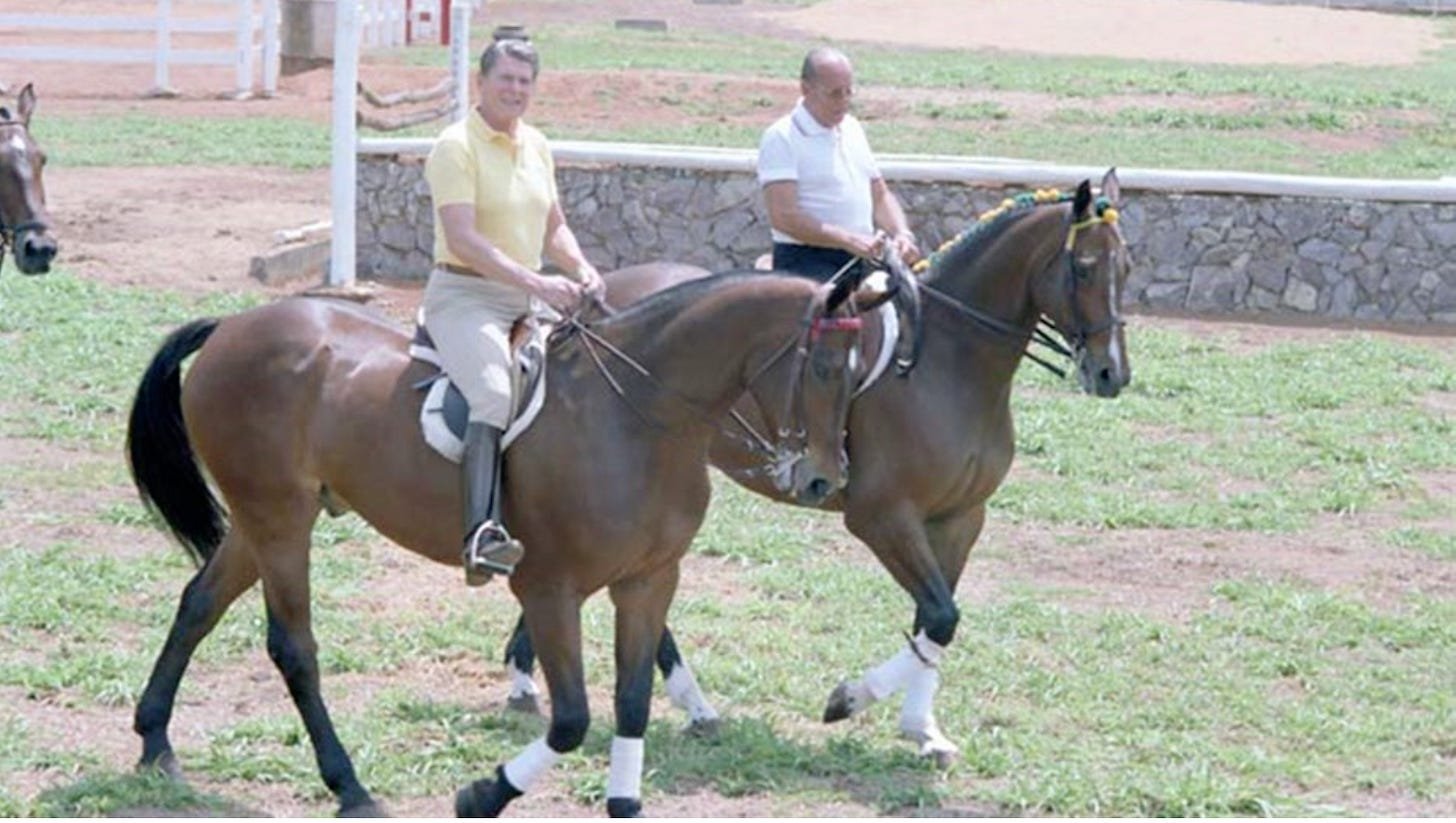
This was the genesis of “Operation Guiminish,” cryptically named after a horse gifted to Reagan by Brazilian President João Figueiredo. Reagan’s own diary entry from April 11, 1983, sketches the audacious plan:
“NSC meeting – Bill C. back from quick secret trip to Venezuela & Brazil. We had a plan which required their cooperation to take Surinam back into the family of Am. States before it becomes a Cuban patsy. Venezuela couldn’t go along. Pres. of Brazil had an idea somewhat different than ours, but I believe different. So, operation ‘Guiminish’ is born. We’ll know before the month is out whether it has succeeded.”
The “Bill C.” was National Security Advisor William Clark, dispatched on a covert diplomatic mission. This diary entry confirms that just days earlier, on April 4, 1983, Reagan had personally vetoed the direct U.S. invasion plans for Suriname. The strategy was shifting.
This dual-track approach – dangling the sword of intervention while extending an olive branch through a proxy – was a hallmark of Reagan’s evolving covert playbook. Brazil provided diplomatic cover, allowing the U.S. to publicly condemn Bouterse while avoiding the international firestorm of a direct invasion. Meanwhile, the constant hum of JSOC planning and Delta Force reconnaissance ensured Bouterse couldn’t simply ignore the pressure. This model—regional proxies, U.S. leverage—was scalable, a template for projecting American power far beyond its direct military reach, soon to be seen in Nicaragua, Egypt, and Saudi Arabia.
Most striking was the timing: Operation Guiminish launched simultaneously with the “Easter Coup” plotting in April 1983. Washington was playing both sides:
- Track 1: The Military Threat (Easter Coup, July invasion plans).
- Track 2: Brazilian Diplomatic Squeeze (Operation Guiminish).
The controlled demolition of coup attempts by assets like van Haperen ensured the military threat remained credible, a loaded gun to Brazil’s diplomatic head, without prematurely toppling Bouterse, which could have derailed the delicate Brazilian negotiations. Operation Guiminish was a masterful synthesis: the threat of JSOC force, the covert networks of the “Wolf Pack’s” successors, all channeled through Brazil’s diplomatic might. This elegantly sidestepped Duemling’s “nation-building” nightmare. Brazil, a regional power, could offer security and economic guarantees the U.S. couldn’t, effectively outsourcing the messy post-intervention phase.
On that same April 11, 1983, William Clark, Reagan’s National Security Advisor, drafted a remarkable memorandum to Ambassador Motley, instructing him to deliver the following message to President Figueiredo on behalf of President Reagan:
“1. I congratulate You on your proposal concerning your neighbor, and accept partnership in Operation Guiminish. We must prevent Mr. Bouterse from allowing Suriname to become the next Soviet-Cuban military base in our hemisphere.”
The memo laid it bare: Brazil would flood Suriname with military, economic, and cultural aid to supplant Cuba. The U.S. would foot the bill for Brazil. Bouterse’s price for survival? Expel the Cubans and Soviets, possibly even key figures in his own government like Naarendorp, Sital, and Alibux. The carrot: “Bouterse’s personal protection and national security must be guaranteed, if he cooperates.”
Note: For a deep dive into Operation Guiminish, read my article here in our member’s section or Frank Naarendorp and Dennis E. Levens comprehensive report here (Dutch).
The Brazilian Ultimatum: Venturini’s Mission
Brazil moved with lightning speed. On April 15-17, 1983, Brazilian General Danilo Venturini landed in Paramaribo. His message to Bouterse, while diplomatically phrased, was unmistakable: Brazil would not tolerate Cuban influence on their doorstep. Figueiredo had instructed Venturini to make it clear that if Suriname allowed Cuban influence to grow, Brazil would consider them an enemy rather than a friend.
The stick came with a tempting array of carrots: unlimited credit, military training, Brazil buying half of Suriname’s rice exports, a ban on Surinamese exile activity in Brazil, even satellite relays of Brazilian football.
Bouterse blinked. He assured Venturini that “Suriname would not become a platform for the East-West conflict,” vowing “Suriname for the Surinamese” and “South America for South Americans.” Cuban ties would be purely formal.
The effect was instantaneous. “The next day, a hundred Cubans flew home,” one report noted. “Since then, Suriname has received Brazilian military assistance, including six new armored reconnaissance vehicles.” Brazil’s velvet glove, backed by America’s iron fist, had achieved what direct U.S. threats had not—a significant rollback of Cuban influence, without firing a single American shot.
The Pentagon Debate: Duemling’s Warning in the War Room
Even as Operation Guiminish bore fruit, the Pentagon’s war machine kept grinding. In the summer of 1983, Ambassador Duemling was summoned to an extraordinary face-to-face with the Joint Chiefs of Staff.
“I was invited to address the Joint Chiefs and went to their secure area in the Pentagon,” Duemling later recalled. “Every member of the Joint Chiefs, with the exception of one who was represented by his Deputy, sat around the big open square table with a number of subordinates around the wall—there were sixty people in the room…The Chairman thanked me for coming and asked me to open the discussion on whether the U.S. should invade Suriname. We discussed that for an hour and fifteen minutes.”
Despite JSOC’s confidence, built on years of reconnaissance, Duemling’s warnings about the aftermath resonated with a military leadership still haunted by Vietnam. His depiction of Suriname as a “nightmare of a little country from the government’s point of view,” and his stark warning that “all that would happen would be that Uncle Sam would pick up the can of worms,” hit home.
Tactically, Duemling conceded, it was feasible: “The defenses…were extremely modest…a strike force of approximately 200 paratroopers should be sufficient to take complete control.” But strategically, he argued against it:
- Diplomatic Blowback: “I did not feel the threat was sufficient to justify the expenditures, the military risks, to say nothing of the down-side political situation in terms of the OAS…”
- No Post-Invasion Plan: “No discussion had taken place about what would be done after the country had been occupied…Who will run the country?”
- The Governance Quagmire: “It was very fractured culturally, ethnically and economically…a nightmare…Uncle Sam would pick up the can of worms.”
The Joint Chiefs, Duemling said, “thanked me for confirming certain judgments that they had already made. That was the last that was ever heard of invading Suriname.” Or so it seemed. The very fact this meeting occurred months after OMEGA-83 and the launch of Guiminish screamed “parallel tracks.” The diplomatic dance continued, but the military option remained on the table, a constant, unspoken threat.
Project Democracy Integrated: The November Blueprint
By late 1983, the strategy sharpened. On November 21, hot on the heels of the Grenada invasion, NSC official Constantine Menges (an OMEGA-83 alumnus) laid out a three-step knockout punch for Bouterse:
- Economic Leverage: Use a $35M U.S. bauxite deal to force Bouterse to negotiate with the Council for Liberation of Suriname (CLS).
- Interim Government: Back the CLS to form a transitional authority.
- Exile and Elections: Arrange Bouterse’s departure and stage democratic elections.
This wasn’t just Menges’s idea; it had interagency backing in Washington. A working group was proposed. The U.S. was now officially betting on the Council for the Liberation of Suriname. The two tracks—diplomatic pressure and covert support for opposition—were merging into one integrated weapon, the full realization of Project Democracy’s initial vision.
From Suriname to Grenada: The Template Unleashed
By October 1983, Operation Guiminish was working. Bouterse, squeezed by Brazil, was distancing himself from Cuba. U.S. anxieties about Suriname eased, but another Caribbean fire was igniting.
October 14, 1983: Grenada’s revolutionary Prime Minister Maurice Bishop—who had stood with Bouterse during Suriname’s 1982 turmoil—was overthrown by hardliners. Days later, he and his allies were executed. The echoes of Suriname’s December Murders were deafening.
October 25, 1983: U.S. forces stormed Grenada in Operation Urgent Fury. The official line: rescue American medical students. The unspoken truth, revealed by Delta Force founder Eric Haney in a stunning 2004 Maxim magazine quote:
“We’d actually been training to invade Suriname. But after a CIA coup succeeded there, we used the same plan on Grenada.”
The “CIA coup” Haney mentioned was likely a mischaracterization of the successful pressure campaign via Guiminish, not an actual overthrow. But the operational transplant was real. The chaos of Urgent Fury, what Colonel John T. Carney Jr. dubbed “the military equivalent of a Japanese Kabuki dance created by three or four choreographers speaking different languages,” was a brutal field test of the multi-agency model simulated in OMEGA-83. The communication breakdowns and inter-service friction in Grenada laid bare the very seams OMEGA-83 was designed to identify and mend. Suriname was the lab; Grenada was the unintended, bloody experiment.
This candid admission confirms what the documentary evidence suggests: the military plans developed for Suriname throughout 1982-83 weren’t abandoned—they were repurposed for Grenada. The operational templates, logistics, force requirements, and even specific tactical approaches developed for the Suriname intervention became the blueprint for the Caribbean’s most significant U.S. military action since the Dominican Republic intervention of 1965.
The fingerprints of the Suriname playbook were all over Grenada:
- Combined service operations (Army, Navy, Air Force, Reserves, National Guard).
- Aggressive psychological operations (leaflets, radio, loudspeakers).
- Military action welded to political messaging.
- A laser focus on neutralizing Cuban presence.
Constantine Menges, fresh from OMEGA-83 and now Reagan’s Latin America advisor, was a key planner for Grenada, arguing it preempted a Soviet-Cuban military bastion, even hinting it averted a potential missile crisis.
The smoking gun linking the two operations lies in a declassified State Department document, “Post-Grenada Strategy” (November 1983). It explicitly cites Bouterse and Suriname’s “new (if tentative) direction” following Grenada. It advises a “small effort—probably in the economic area” by the U.S. towards Suriname to encourage Bouterse if he “holds to his course.” Crucially, it mandates coordination with the Dutch and Brazilians for any U.S. overture—the precise architecture of OMEGA-83 and Operation Guiminish. The template was proven. What worked on one island would now be leveraged against the other.
The Missing Piece of Iran-Contra: Suriname’s Dark Legacy
The Suriname operation isn’t just a historical footnote. It’s a Rosetta Stone for understanding Reagan’s covert wars and the men who waged them—men who would soon be infamous for Iran-Contra.
Oliver North, architect of continuity of government plans and terrorism exercises that mirrored Suriname’s turmoil, became the operational maestro of Iran-Contra. John Poindexter, OMEGA-83’s coordinator, fell from grace as National Security Advisor over the scandal.
These were not coincidences. The DNA of Iran-Contra—parallel funding, deniable assets, compartmentalized terror—was spliced in the Suriname crucible. The lessons in circumventing Congress, in maintaining plausible deniability, directly informed the decision to defy the Boland Amendment in Nicaragua.
NSDD-17 planted the seed. Suriname was the greenhouse. “The Enterprise”—that private, parallel foreign policy machine of Iran-Contra, blending official might with private cash and deniable proxies—had its shakedown cruise in the Caribbean. The Council for the Liberation of Suriname, nourished by NED and FTUI funds, was an early prototype of using ostensibly independent groups as U.S. policy instruments. The blurred lines that defined Iran-Contra were first sketched in Suriname.
The NSDD-61 Connection: Still Classified After Four Decades
Despite a slow drip of declassifications, National Security Decision Directive 61 remains stubbornly entombed in government vaults, forty years after Reagan signed it on October 15, 1982—just weeks before the December Murders. Its timing, alongside other aggressive NSDDs targeting perceived communist inroads, is provocative.
Ostensibly, NSDD-61 dealt with securing the National Emergency Airborne Command Post (NEACP)—the “Doomsday Plane.” Yet, its enduring, exceptional secrecy screams of something more. Other NEACP directives from the era are public. PD/NSC-58 is declassified. But NSDD-61’s very title remains redacted in official indexes. The NSA’s May 2025 “Glomar” response (neither confirming nor denying records) to my FOIA request on U.S. operations in Suriname (1981-1983), citing national security, only deepens the mystery. We know it was active until May 1991. What secrets does it still protect?
Its issuance date, the OMEGA-83 war game that followed, its temporal link to both Suriname and Grenada planning—all point to NSDD-61 as a potential master key to Reagan’s covert Caribbean strategy.
Convergence: The Stage is Set
Suriname, 1982-83: This was the crucible. Reagan’s early “Project Democracy” concepts were forged here into hard operational realities, a bridge to a global shadow war. Operation Guiminish may have temporarily nudged Bouterse from Cuba’s embrace, but the story was far from over.
By late 1983, a chilling convergence was underway. The templates minted for Suriname were being simultaneously deployed in Nicaragua, Grenada, and whispered of elsewhere. The networks, money flows, and tactics refined in OMEGA-83 were metastasizing into a vast, interconnected system that would define Reagan’s Third World battleground for the rest of the decade.
U.S. intelligence itself, in April 1983, saw “rapid progress toward Cuban control of Suriname” by late 1982 as a major Soviet victory, “the first breakthrough on the South American continent.” This perceived threat fueled the inferno of U.S. operations.
The “Post-Grenada Strategy” memo explicitly wove these theaters together. The Moiwana massacre on November 29, 1986—39 civilians slaughtered by Bouterse’s forces—and Reagan’s subsequent refusal (December 11, 1986 diary entry) of a Dutch request for U.S. military transport to help remove the “brutal dictator” is a disturbing coda. Why shield Bouterse then? What leverage did Washington hold? Or he on them?
The path from OMEGA-83, through Oliver North’s terrorism exercises, to the broader anti-communist crusade in Latin America is now clearer.
Next: Part V – The Nicaragua Connection. We will trace how the mercenary armies, intelligence cutouts, and clandestine funding pipelines built for Suriname became vital cogs in Reagan’s wider war—a shadow infrastructure leading inexorably to Iran-Contra, and secrets still fighting to stay buried.
Sources and Further Reading
Declassified Government Documents
- Casey, William J. Letter to Gen. John Vessey re: OMEGA-83 (May 6, 1983). CIA FOIA Electronic Reading Room.
- Department of Defense MDR Release Log (2008–2017). Entries 11-M-3006/3007 re: Pol-Mil Simulation OMEGA-83 (Feb–Mar 1983).
- Duemling, Ambassador Robert W. “Interview with Robert W. Duemling.” The Association for Diplomatic Studies and Training Foreign Affairs Oral History Project, September 11, 1989. https://memory.loc.gov/service/mss/mfdip/2004/2004due01/2004due01.pdf.
- Howe, Jonathan T. “Eastern Caribbean Security.” Tillman, Jacqueline: Files – Grenada – Urgent Fury (03/03/1983-10/21/1983). Washington, D.C.: United States Department of State, ca 1983. RAC Box 3. Ronald Reagan Presidential Library. https://www.reaganlibrary.gov/public/digitallibrary/smof/nsclatinamericanaffairs/tillman/R3/40-564-56020916-R3-038-2019.pdf
- Menges, Constantine C. “Suriname–Immediate Next Steps and an Interagency Process to Define a Strategy,” November 21, 1983. CIA Records Search Tool (CREST), Document Number: CIA-RDP85M00364R001302230032-9. U.S. National Archives and Records Administration (NARA). https://www.cia.gov/readingroom/docs/CIA-RDP85M00364R001302230032-9.pdf.
- Naarendorp, Frank, and Dennis E. Levens. “‘OPERATIE GUIMINISH,'” October 2022. https://www.starnieuws.com/temp/9198beb14243a06af6b8cae63bba36ae.pdf
- National Security Council. “Post-Grenada Strategy” (November 1983). Document 130, FRUS, 1981-1988, Volume IV, Soviet Union, January 1983–March 1985.
- Poindexter, John. NSC Memo (title classified) re: OMEGA-83, March 16, 1983 (via DoD MDR log).
- Reagan, Ronald. White House Diary – April 11, 1983 Entry. Ronald Reagan Presidential Library.
- U.S. Department of State; National Security Council; ACDA. “Falklands Crisis: Implications for U.S. National Interests and Policies in Latin America.” Interagency Group Memorandum + National Security Council paper, June 18, 1982.
- U.S. Department of State, Office of the Historian. “Foreign Relations of the United States (FRUS), 1981–1988, Volume IV, Soviet Union, January 1983–March 1985.” Document 41, CIA Memorandum, “Meeting The Soviet Challenge in the Third World,” April 1983.
Published Accounts and Secondary Sources
- Binnenlandse Veiligheidsdienst (BVD). “Kwartaaloverzicht binnenlandse veiligheidsdienst: 4e KWARTAAL 1985.” Government Document/Report. Gravenhage [The Hague], Netherlands: Ministerie van Binnenlandse Zaken, January 1986.
- Blum, William. Killing Hope: U.S. Military and CIA Interventions Since World War II. Common Courage Press, 2004.
- Carney, John T. Jr. No Room for Error: The Covert Operations of America’s Special Tactics Units from Iran to Afghanistan. Ballantine Books, 2002.
- Haakmat, Andre. De Revolutie Uitgegleden: Politieke Herinneringen. Amsterdam: Uitgeverij Jan Mets, 1987.
- Haney, Eric. “The Wars of Delta Force.” Maxim Online, May 22, 2006. https://web.archive.org/web/20060522125829/http://www.maximonline.com/articles/index.aspx?a_id=5730.
- Kamp, Rende van de. Onder vreemde vlag. Uitgeverij Aspekt, 2006.
- Kengor, Paul. “Secrets of Suriname: Another Reagan-Administration Cold War Success Story.” Institute for Faith & Freedom, 2008.
- Kengor, Paul and Clark-Doerner, Patricia. The Judge: William P. Clark, Ronald Reagan’s Top Hand. Ignatius Press, 2007.
- Los Angeles Times Archives. “Constantine Menges, 64; National Security Aide for Latin America.” Obituary, July 20, 2004.
- McClure, John L. Soldier without Fortune: True Firsthand Account of a Free-Lance Mercenary in Central America. New York: Dell, 1987.
- Peeters, Sander. Tropic Thunder in Suriname: Volume 1 – From Independence to “Revolution” and Countercoups, 1975-1982. Helion and Company, 2023. https://www.vitalsource.com/products/tropic-thunder-in-suriname-sander-peeters-v9781804513248.
- Peeters, Sander. Tropic Thunder in Suriname: Volume 2. Helion and Company.
- Verhey, Elma, and Gerard van Westerloo. “Chin A Sens bevrijdingsraad en de Surinaamse variant van de Varkensbaai.” In Het Legergroene Suriname. Originally published in Vrij Nederland, March 12, 1983. Amsterdam: Weekbladpers BV, 1983.
Intelligence Assessments
- CIA National Intelligence Estimate. “Suriname: Bouterse’s Leftward Drift.” (SNIE 87.4-84, declassified 2009).
- CIA Memorandum, “Meeting The Soviet Challenge in the Third World,” April 1983 – identified “Rapid progress toward Cuban control of Suriname” as the “first breakthrough on the South American continent” for Soviet foreign policy by the end of 1982.
- Motley, Tony. “Report on General Venturini’s Mission to Suriname,” April 20, 1983.
Contemporary Media Coverage
- Amigoe. “Den Haag Ontwierp Blauwdruk van Coup.” Gevonden in Delpher. Accessed December 27, 2024. https://www.delpher.nl/nl/kranten/view?coll=ddd&identifier=ddd:010640948:mpeg21:a0005.
- Amigoe. “Den Haag Verijdelt Invasie Suriname.” July 13, 1983, 158 edition. Gevonden in Delpher. //www.delpher.nl/nl/kranten/view?coll=ddd&identifier=ddd:010640932:mpeg21
- Bagijn, Karel. “Invasie Suriname in de Maak.” Algemeen Dagblad. Via Delpher archive.
- Birmingham Post-Herald. “CIA Surinam Plot Charged.” July 1, 1983.
- Casper Star-Tribune. “Thousands Protest Alleged CIA Plot.” July 1, 1983.
- De Telegraaf. “Robin Hood En De Revolutie In De Jungle.” Gevonden in Delpher. Accessed October 27, 2024. www.delpher.nl/nl/kranten/view?coll=ddd&identifier=ddd:011207293:mpeg21:a0748.
- The Guardian. “Suriname Radical Leader Removed in US-Backed Coup.” June 14, 1983.
- Jack Anderson, MetroMedia News, 1983 – via CIA FOIA (noting U.S.-Brazil vs USSR-Suriname alignment).
- Leidsch Dagblad. “Chin a Sen in Nederland ‘Voor Suriname Regering in Ballingschap.'” December 28, 1982. Historische Kranten, Erfgoed Leiden en Omstreken. https://leiden.courant.nu/issue/LD/1982-12-28/edition/0/page/6.
- Leidsch Dagblad. “Gesprek over National Verzet Tegen Bouterse.” December 29, 1982. Historische Kranten, Erfgoed Leiden en Omstreken. https://leiden.courant.nu/issue/LD/1982-12-29/edition/0/page/7.
- Leidsch Dagblad. “Invasiegroep Suriname Oefende in Nederland.” July 14, 1983. Historische Kranten, Erfgoed Leiden en Omstreken.
- Leidsch Dagblad. “Raad Opgericht Voor Val Surinaams Regime.” December 30, 1982. Historische Kranten, Erfgoed Leiden en Omstreken. https://leiden.courant.nu/issue/LD/1982-12-30/edition/0/page/6.
- Leidse Courant. “Waarom Affaire-Valk Maar Het Beste in de Doofpot Kon Belanden.” August 4, 1983. Historische Kranten, Erfgoed Leiden en Omstreken. https://leiden.courant.nu/issue/LLC/1983-08-04/edition/0/page/10.
- Nieuwsblad van het Noorden. “Anonymous Organizers: Invasion of Suriname Thwarted at the Last Moment.” Gevonden in Delpher. Accessed October 27, 2024. https://www.delpher.nl/nl/kranten/view?coll=ddd&identifier=ddd:011010764:mpeg21:p005.
- Nieuwsblad van het Noorden. “Invasie in Suriname Op Laatste Moment Verijdeld.” Gevonden in Delpher. Accessed December 27, 2024. https://www.delpher.nl/nl/kranten/view?coll=ddd&identifier=ddd:011010764:mpeg21:a0065.
- Nieuwsblad van het Noorden. “Weekblad: ‘Anti-Bouterse-Groep Trainde in Noorden.'” Via Delpher archive. Accessed December 27, 2024. https://www.delpher.nl/nl/kranten/view?coll=ddd&identifier=ddd:011010760:mpeg21:a0044.
- Schumacher, Peter. “Duivelse Methoden Nodig Tegen Bouterse.” NRC Handelsblad, February 2, 1983. Via Delpher archive.
- Washington Post Archive. “Suriname Keeps Foreign Policy in Balance.” Oct 13, 1983 (discusses U.S.-Brazil initiative).
Digital Archives and Research Resources
- National Security Decision Directive (NSDD) Index, Reagan Administration. Federation of American Scientists (FAS).
- PAXsims (Rex Brynen), Conflict simulation and peacebuilding blog – discussion of 1983 war games.
- Spartacus Educational. “Eulalio Francisco Castro Paz (Frank Castro).”
- tueriesdubrabant.1fr1.net. “Bouhouche, Madani – Page 19.” Accessed December 27, 2024. https://tueriesdubrabant.1fr1.net/t152p450-bouhouche-madani.
Source:
Link:
Internal Link:
Date:
October 26, 2025