The Suriname Contra Affair – Part 6
THE TEMPLE PLOT
Dec 08, 2025
THE TWO THREATS
March 16, 1982 – Geneva, Switzerland
To understand why the Americans were watching Suriname so closely in March 1982, you need to understand what was happening 5,000 miles away in Geneva.
Soviet General Secretary Leonid Brezhnev stood before the 17th Trade Union Conference and delivered what would become the most important threat of the Cold War’s final decade:
“If the United States deploys the Pershing II missile to West Germany, the Soviet Union will make an ‘analogous’ deployment against United States territory.”1
An analogous threat. Think about what that means. Not just “we’ll respond.” Not vague promises of retaliation. Moscow was promising to make the same kind of threat against the United States that Washington would make against the Soviet Union.
Same weapon type. Same range. Same speed of launch. Same time of flight to target.
In Washington, analysts went to work immediately. What weapon in Moscow’s arsenal could deliver an analogous threat to the Pershing II? And where could they deploy it?
By late March 1982, they had their answer. And it led directly to a small South American country that most Americans couldn’t find on a map.
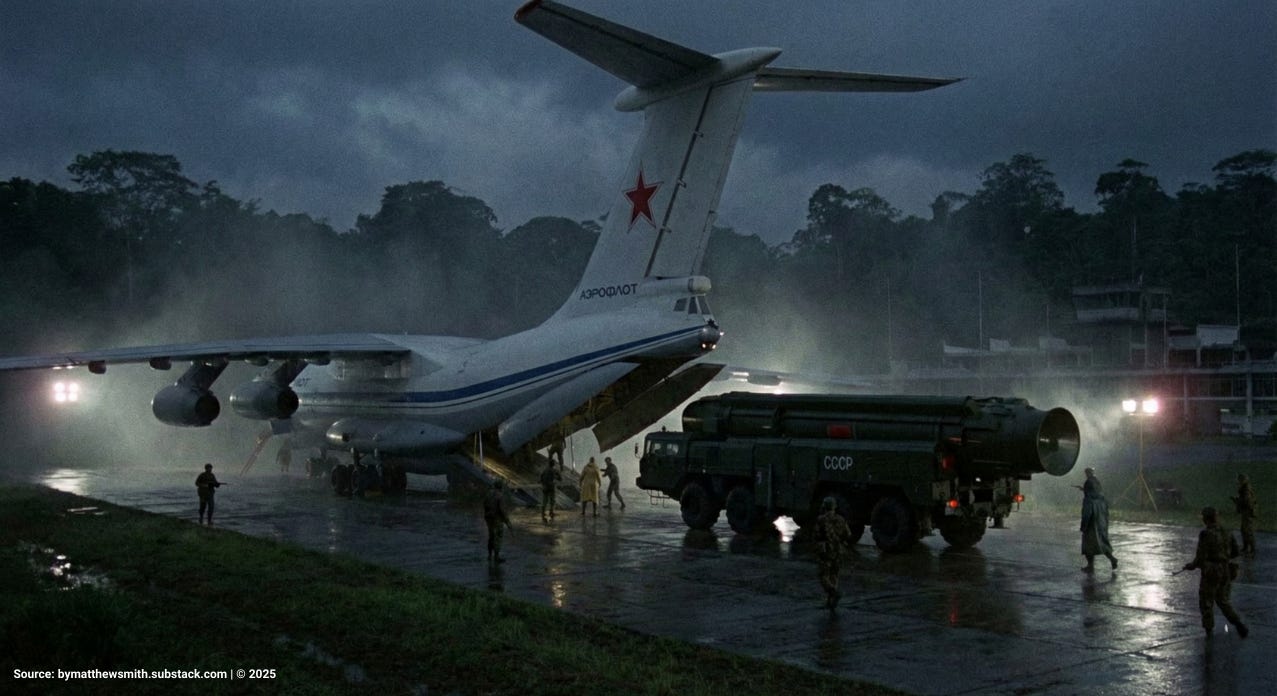
But the nuclear threat wasn’t the only reason Washington was fixated on Suriname. There was also the matter of geography.
Look at a map. Suriname sits at the northeastern corner of South America, commanding the approaches to the Southern Caribbean. More than half of all American oil imports passed through these waters in 1982.2 Ships carrying petroleum from Venezuela and Trinidad. Traffic approaching the Panama Canal. The entire maritime infrastructure of the Western Hemisphere’s energy supply.
If the Soviets established a base in Suriname, they wouldn’t just be putting missiles eight minutes from Miami. They’d be positioning themselves to interdict the sea lanes that carried America’s oil. To threaten the Panama Canal approaches. To extend their influence onto the South American mainland for the first time.
As National Security Advisor William Clark would later write to President Reagan: the Cubans and Soviets would have “the potential to control the Southern Caribbean and endanger shipping lanes, including those used for the transit of ships carrying petroleum.”3
Two threats. One country. Nuclear missiles overhead, and a stranglehold on the oil that kept America running.
That’s why what happened in early March 1982 mattered so much.
ACT I: THE WARNING
The SS-20 Analysis
The Pershing II was a game-changer. Highly accurate. Fast launch. Ten-minute flight time to Moscow from West Germany.4 The Soviets were terrified of it.
But Moscow’s threat to make an “analogous” deployment raised an immediate question: Could they actually do it?
American analysts concluded: yes. Just barely. But there was only one weapon system that fit the requirements.
The SS-20 intermediate-range ballistic missile. Solid-fuel. Reasonably accurate. 5Three-thousand-mile range. It wasn’t perfect—the Pershing II was more accurate and faster—but it was close enough to satisfy Brezhnev’s promise of an “analogous” threat.
But where to put it?
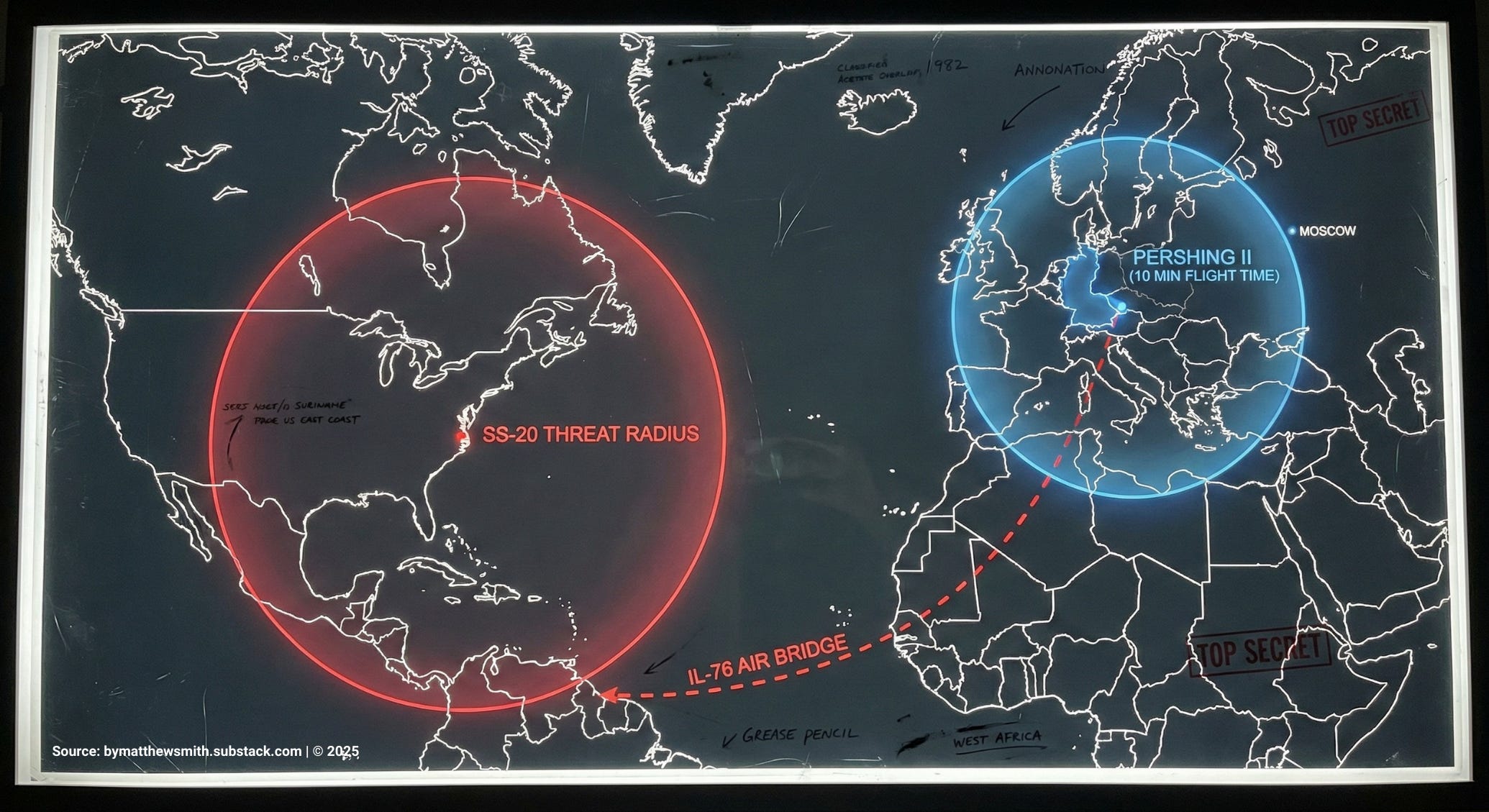
Aside from deploying missiles in the far Soviet northeast to target Seattle, there were four Caribbean possibilities: Cuba, Nicaragua, Grenada, and Suriname.
The problem was range. The Soviets had developed a new large cargo jet—the IL-76 Candid—that could carry the SS-20 and its self-contained transporter-erector-launcher. Fifty tons. Eighty-foot cargo bay. Perfect for the job.
But the IL-76 had a maximum range of roughly 3,000 miles from West African airfields. And it required a 10,000-foot runway.
Flying from West Africa, the IL-76 could just reach Grenada and Suriname on a nonstop direct flight. But not Cuba or Nicaragua—they were 1,500 miles further distant.
And here’s where it gets interesting.
From Grenada or Suriname, SS-20 missiles could target more of the United States than Pershing IIs could target of the Soviet Union from West Germany. That would satisfy Moscow’s “analogous” threat—and then some. In March 1982, Grenada’s Point Salinas airport was still under construction. The 10,000-foot runway wouldn’t be completed until late 1983.
But Suriname’s Zanderij International Airport? Already operational. Ten-thousand feet of concrete, ready to receive Soviet cargo jets the moment Moscow decided to move.
U.S. Embassy, Paramaribo – February 8, 1982, 2:30 PM
On February 8, 1982, at 2:30 PM, a biochemistry professor walked into the U.S. Embassy in Paramaribo and calmly announced he was planning to help murder his country’s military leadership—and he wanted the Americans to know.
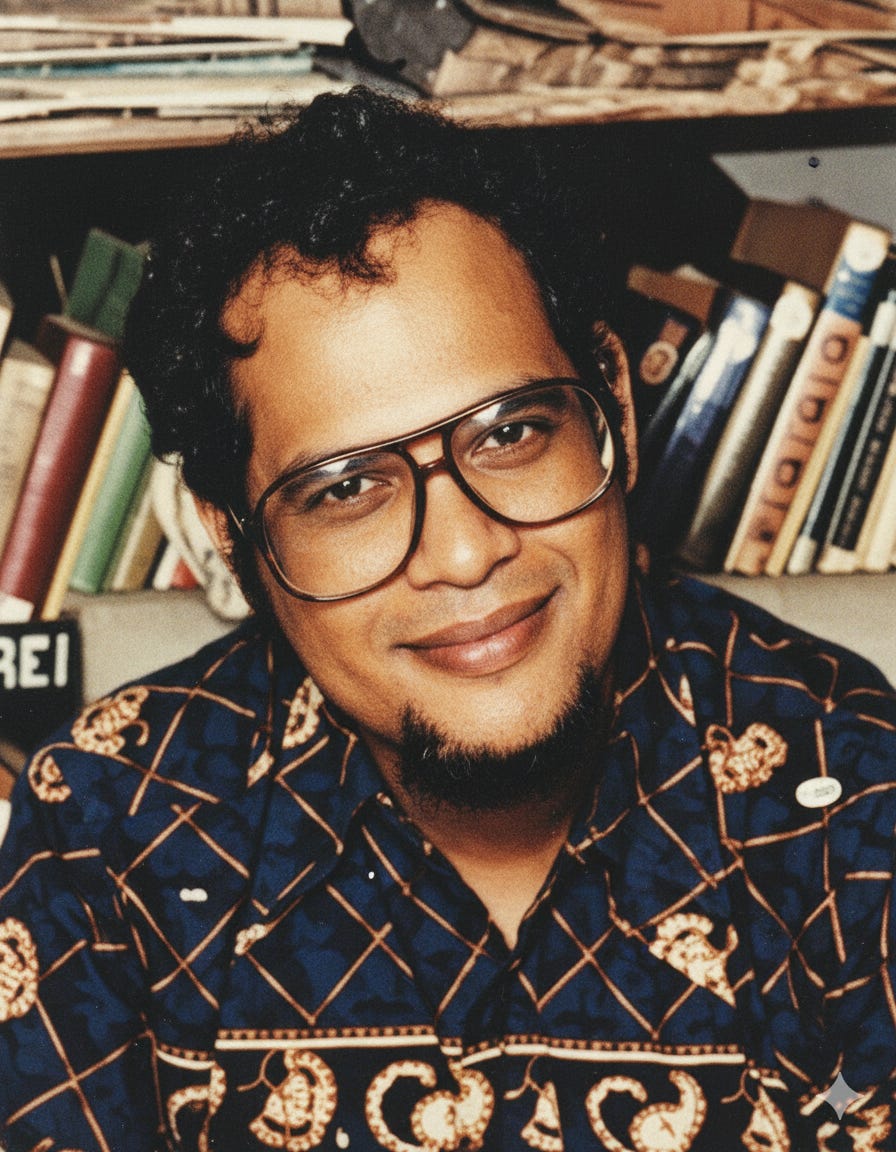
Cornelis “Kees” Keur had known Professor Indradj “Baal” Oemrawsingh for nearly two years—not just as a contact, but as a genuine friend.
They’d met through Keur’s consular work, but their relationship went beyond just business. Keur spoke fluent Dutch. He understood the cultural nuances that most Americans missed. He’d gone to Harvard where the professor occasionally lectured. In essence, he’d built real connections in Paramaribo’s Hindu community.
That community was deeply fractured. They were divided between the traditionalist Sanatani Hindus, who represented approximately 80% of the Hindi population, and accepted the supremacy of the Brahmin priests, and the reformist Arya Samajis, who fought against the caste system and demanded social equality. These two groups, along with the city’s influential Muslim Hindustani families, (Hindustani means people whose ancestors came from India) formed a political base held together by the thin thread of anti-military sentiment.6
Oemrawsingh and his wife had become part of Keur’s social circle—the kind of people you invited to dinner, not just coffee at the embassy. Baal had become more than just a professor. He’d been elected to Parliament in 1977, serving as a member of the VHP (United Reform Party)—the largest political party representing the Hindustani community—until the 1980 coup stripped away his political office.
So when the professor walked into the embassy just after noon that Monday, asking to speak privately, Keur likely assumed it was another of their routine conversations. The meeting occurred just two hours after the new Acting President, “Fred” Ramdat Misier, had been sworn in—an important political moment Oemrawsingh curiously seemed to ignore.
What he told Keur in the next thirty minutes would change Suriname’s history forever.
“There’s going to be a coup attempt,” Oemrawsingh said quietly, his voice urgent but controlled. “As early as tonight, but definitely before the new government is appointed.”
Here the context mattered. Misier was Suriname’s first Hindu president. He had just been sworn in that morning, but his civilian cabinet wasn’t expected to be named until mid-March. In Paramaribo, everyone knew that once the new ministers were installed the regime would harden again. If there was ever going to be a strike, it had to come before March 15th
“There’s a twenty-man assassination team. Two Hindustani military men are leading it—one of them used to be in the army. They’re planning to kill Bouterse, Horb, Fernandes, Sital, Neede, Mijnals. All of them.”7
Keur felt his stomach drop. “Baal, this is—are you involved in this?”
“I’m not part of the planning,” Oemrawsingh said carefully. “But I know about it. And I wanted to warn you. For your own safety.”
He paused. “When it happens—and it will happen soon—I’ll try to give you advance notice. A few hours, maybe. So you can take precautions.”
The promise hung in the air.
Baal wasn’t just reporting intelligence he’d overheard. He was positioned close enough to the planning to provide tactical warning. Close enough to know the timing. Close enough to know the targets.
“I’m telling you this in the strictest confidence,” Oemrawsingh continued. “Please. I trust you, Kees.”
After Oemrawsingh left, Keur sat in his office struggling with what to do. This wasn’t routine intelligence—this was his friend warning him about an imminent coup. Part of him wanted to protect that confidence, to keep LaRoche out of it entirely. LaRoche had a reputation for talking too much, for spreading information that should be kept secret.
But this was too important. People might die. The embassy needed to know.
Reluctantly, Keur walked down the hall to visit his boss, Richard LaRoche’s office.
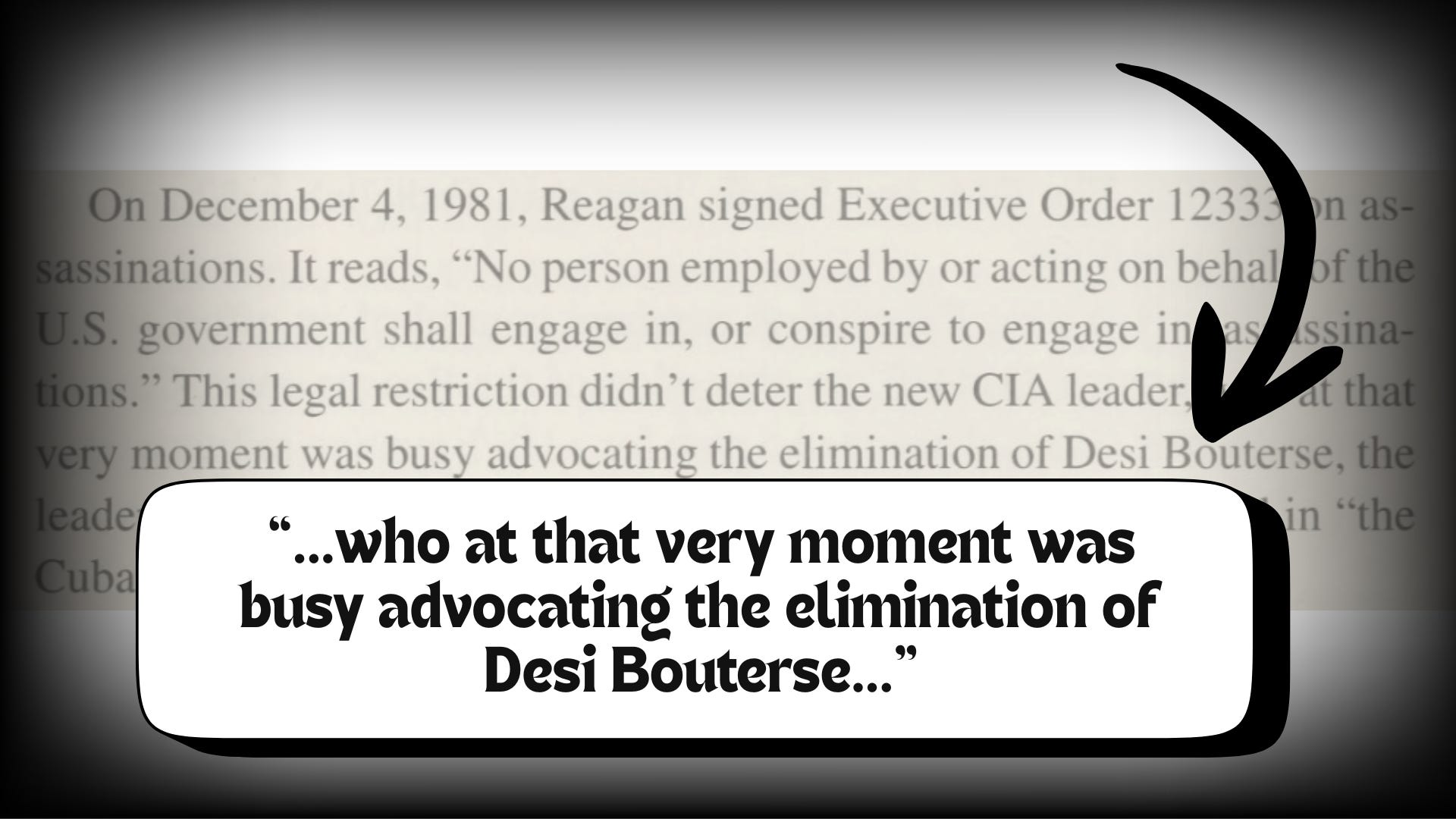
What Keur didn’t realize was that his simple diplomatic report was about to collide with a pre-existing covert operation. He didn’t know that Oemrawsingh had met privately with LaRoche barely a month earlier. And he certainly didn’t know that the CIA’s Director had secretly advocated for Bouterse’s ‘elimination’ just weeks earlier.8
By walking into the embassy and volunteering an assassination plan, Baal was—without realizing it—handing Washington exactly what some in the intelligence community had been hoping for.
I’m Matthew Smith. This is The Suriname Contra Affair. And this is the story of how two sophisticated assassination attempts that happened in Suriname in March 1982 were compromised. How time was running out, and the Suriname Contras were about to make a desperate pivot that would the course of their country’s history.
ACT II: THE HINDU CONNECTION
The Oemrawsingh Clan
But to understanding why Baal would risk everything in 1982 requires understanding what his family had already lost—and what they stood to lose if they did nothing.
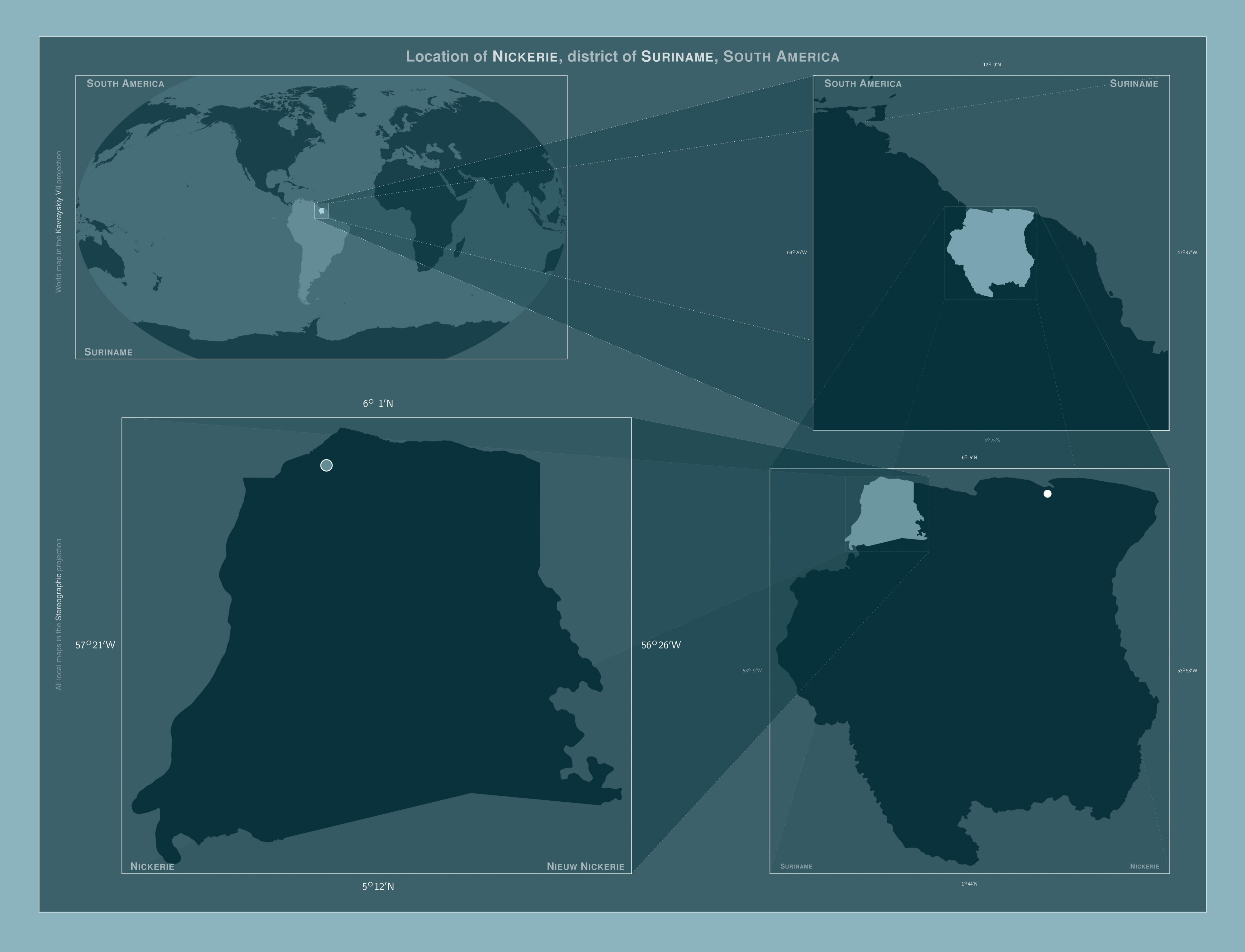
The Oemrawsinghs weren’t ordinary academics who happened to get caught up in politics. They were a prominent and well-connected Hindustani family in Suriname.9 Their power was rooted in the Nickerie district—the agricultural heartland of western Suriname, where rice paddies stretched to the horizon and the Hindustani community had built an economic base over generations.10 The family held major business interests there, including commercial and industrial enterprises that gave them resources far beyond a professor’s salary.11
The patriarch was Rattan Oemrawsingh. He served as President-Director of N.V. Handel en Industrie Onderneming Nationaal—a trading and industrial company known as HION—and had been a Member of Parliament himself.12 Rattan wasn’t just wealthy. He was connected. A 1970s photograph shows him in the top leadership of the Actie Groep, pictured alongside other prominent Hindustani political figures.13 Today, a street in Paramaribo bears his name.14
Then, on Christmas Eve 1978, Rattan died suddenly. He was fifty-one years old.15
The funeral notices that appeared in Vrije Stem revealed something curious about this powerful Hindu-named family: they used Christian crosses, not Hindu symbols. The text read “May his soul rest in peace”—Christian phrasing, not the Sanskrit prayers you’d expect. Yet the body was cremated at the crematorium on Weg naar Zee, following Hindu tradition.16
The religious ambiguity points to something the regime’s later propaganda would ignore: the Oemrawsinghs defied easy categorization. They were elite. They were complicated. They moved between worlds.
The widow was listed as “Line Oemrawsingh Ramdat Missier.”17 That surname—Ramdat Missier—is not common. The acting president who would be sworn in on February 8, 1982, just hours before Baal walked into the embassy, was named Fred Ramdat Misier. Whether Line was a close relative or a distant cousin remains unconfirmed—civil records would be needed to prove the connection—but the surname cluster is tight enough that a family relationship is plausible.18
If true, it would reframe a key detail of the Temple Plot. The conspirators allegedly planned to spare only one member of the military leadership: President Ramdat Misier. Was that ethnic calculation? Or was it something more personal—protecting family?
We don’t know. But the question hangs there.
What we do know is this: when Rattan died, the family lost its political anchor. And within four years, the military regime would kill both of his twin nephews.
The Two Faces of Baal Oemrawsingh
The biggest question about the March 1982 coup is how much people really knew about the man who planned it.
Here’s what the Americans saw: A biochemistry professor at the University of Suriname who regularly lectured at Harvard.19 A former Member of Parliament elected in 1977 for the VHP, the largest Hindustani political party.20 A man with international connections—conferences in Europe, research collaborations with Dutch institutions, the kind of resume that made him credible to Western diplomats.21 The U.S. Embassy considered him ‘a long time friend’ of the consular officer—the kind of contact that could prove useful once the new government was in power.22
That was one face.
The other face had a police record.
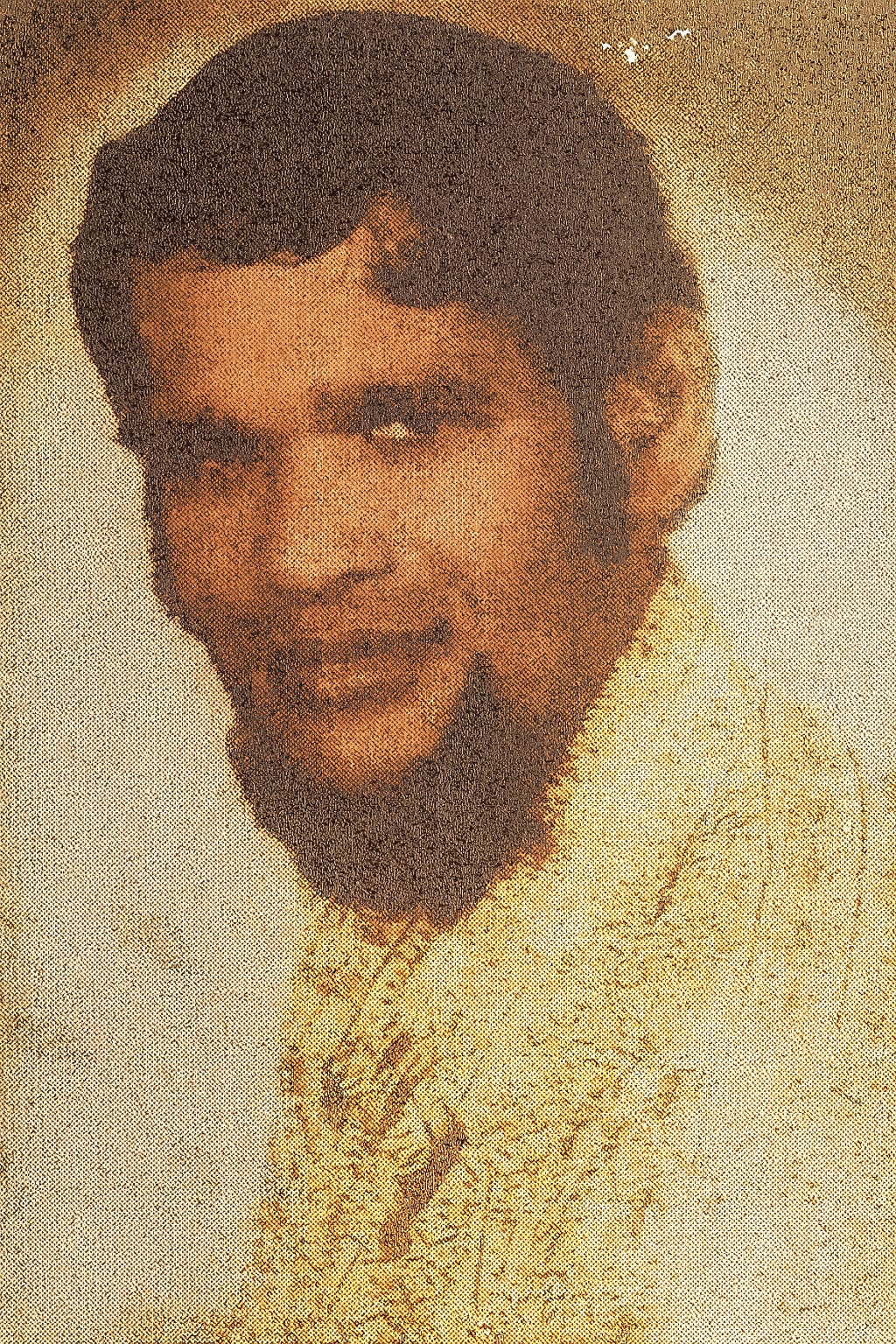
The Political Street Fighter
Baal’s radicalization didn’t start in 1980. It started before Suriname was even independent.
In September 1975—two months before independence—he led a Hindu demonstration through Paramaribo that attempted to lay a wreath at the monument of Jopie Pengel, a beloved Creole political figure. A screaming counter-cordon of government loyalists blocked them. Fighting broke out. The delegation was forced to retreat.23
This wasn’t academic disagreement. This was ethnic confrontation in the streets, with Baal at the front.
By 1977, the violence had become personal. During the election campaign, Baal survived a suspected poisoning attempt after drinking a soft drink at the home of a VHP member who had been one of his fierce opponents in internal party disputes.24 A doctor examined him but couldn’t determine the exact cause. Baal immediately traveled to Paramaribo to report the incident to VHP leadership.
A man tried to poison him. He kept going.
Then he started hitting back.
In October 1977, Baal was accused of assaulting multiple political opponents in Nickerie. According to one account, he deliberately cornered the car of a rival party leader and punched him in the face before fleeing.25 In December, he attacked a colleague at a medical symposium—repeatedly insulting him, then jumping at him and punching him in the chest before running down two flights of stairs.26 The victim filed a criminal complaint. The court convicted Baal of assault and sentenced him to a fine of thirty guilders or six days’ imprisonment.27
That wasn’t the only assault conviction. A second victim—a man whose fist was broken in the altercation—also pressed charges. Baal was convicted again, this time fined one guilder.28
But the assault charges weren’t even the most serious accusation.
The Arson Allegation
During the 1977 election, someone set fire to a car belonging to an HPP member—a rival of the VHP. When police arrested the perpetrators, they allegedly confessed that Professor Baal Oemrawsingh had promised each of them three hundred guilders, plus work and a plot of land, to commit the act.29
The case went to court. The arsonists w ere convicted and sentenced to a year in prison. But the allegation that Baal incited and funded the attack? “Not proven during the preliminary investigation,” the judge ruled.30
Not proven. Not disproven either.
The Parliament Guerrilla
By 1979, Baal’s contempt for the rules had become theatrical.
During a heated parliamentary session, he rose to his full height, demonstratively tore up the Rules of Procedure, and threw the wadded paper toward the government ministers.²³ The opposition erupted. Members shouted, screamed, jumped on chairs. When it was over, the Speaker noted for the record: “Mr. Oemrawsingh has smashed two microphones.”²⁴
The regime later called him an “instigator from the University.” That was an understatement.
The Racism Question
There’s one more detail that complicates the portrait.
In early 1979, a student named Hasrat accused Baal of racism and “gross insults” during a confrontation at the Medical Faculty.²⁵ According to Hasrat’s complaint to the university, Baal had made statements about ethnic groups that the student found deeply offensive. One alleged quote, reported in the press: “You should be ashamed of hanging out with those n*****,” referring to Creoles.²⁶
The newspaper editorial that covered the dispute dismissed Hasrat’s claims as unfounded—arguing that in a multi-ethnic country like Suriname, ethnic slurs were common and didn’t prove racism. But the accusation was serious enough that Baal had to formally defend himself to the university board.²⁷
When the Bouterse regime later painted the coup as ethnic grievance—Hindustanis trying to seize power from Creoles—they weren’t inventing the narrative from nothing.
Dr. Harry Oemrawsingh: The Theoretical Revolutionary
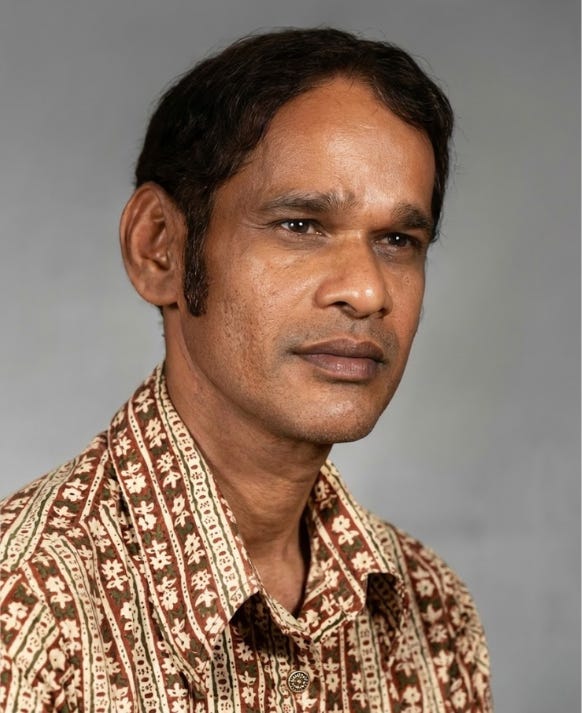
While Baal was getting arrested, Harry was writing theory.
The twins were identical in appearance but different in temperament. Where Baal was volatile—punching rivals, smashing microphones, surviving poisoning attempts—Harry was the quiet one. He appeared in the newspapers less. He got in less trouble. His weapons were ideas.
In 1973, while both brothers were helping to found the Hindustani Progressive Party as a challenge to the established VHP leadership, Harry published an essay called “De dwaling der theoretici”—”The Error of the Theoreticians.”31
The argument was sophisticated. Harry attacked what he called “orthodox, dialectically oriented theorists” who believed that political change would happen spontaneously—that the contradictions in society would naturally and inevitably lead to revolution. That was the error, Harry argued. Waiting for spontaneous change was a fool’s game.
Real change required intention. It required planning. It required an “active, critical intervention” to break the cycle of elite corruption and manipulation that stabilized the status quo.
This wasn’t just academic theory. It was a blueprint. If you want to overthrow a corrupt system, you don’t wait for it to collapse on its own. You push.
Harry’s professional life reinforced the strategic mindset. He was a mathematician and computer scientist—trained in logic, systems analysis, the kind of structured thinking that breaks complex problems into solvable components. In 1977, IBM sponsored him to tour American universities as part of their “University Professors Tour.”32He lectured internationally on subjects like formal languages and automata theory—the mathematical foundations of computation.33
He was also moving in political circles that went beyond Suriname. In February 1979, a colleague from the University of Suriname attended an international symposium in Mexico City titled “Movimientos Populares en el Caribe y América Central”—Popular Movements in the Caribbean and Central America.34 Harry himself attended a parallel conference in São Paulo that same month. These weren’t random academic junkets. This was the global conversation about revolution, resistance, and political change in the developing world.
Then came February 8, 1982.
When Baal walked into the U.S. Embassy to announce that a twenty-man assassination team was planning to kill Bouterse and his commanders, he wasn’t alone. The embassy cable notes that “his brother” accompanied him.35
Both twins walked into that embassy together. Both twins announced they were going to help murder the military leadership.
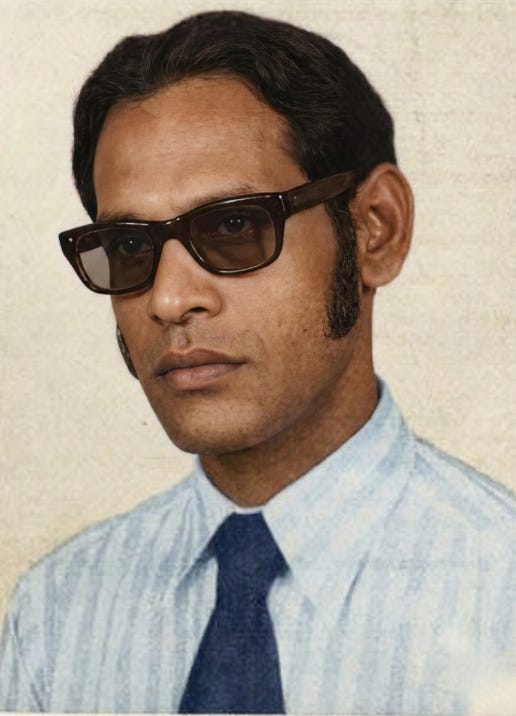
And when Baal was captured, tortured, and killed in March 1982, Harry didn’t stop.
According to later regime allegations—citing testimony from military sources—Harry was involved in financing the “Christmas Coup” plot planned for late December 1982, alongside industrialist Sohansingh.36 The plan allegedly aimed to break imprisoned officers like Rambocus out of jail and launch a new assault on the regime.
The regime didn’t wait to find out if the allegations were true.
On December 8, 1982, Harry Sugrim Oemrawsingh was arrested and executed at Fort Zeelandia. He was one of fifteen victims of the December Murders—the mass execution that would define Bouterse’s regime for generations.37 Forensic accounts indicated gunshot wounds to his chest and injuries to his head.38
Both brothers. Both dead. Nine months apart.
The theorist who wrote that change requires intention, not waiting—he kept pushing until they killed him for it.
The Network
The Oemrawsingh brothers didn’t build the resistance alone. They were part of a network that had been forming for years before the coup.
The key military connection was the Rambocus family. In January 1977—five years before the coup—a newspaper reported that the VHP was considering Professor Baal Oemrawsingh as a candidate for Nickerie. The same article noted that the Rambocus family was “exerting pressure within VHP circles” to nominate Drs. Jai Rambocus for an eligible position in Paramaribo, or alternatively his brother Drs. Dew Rambocus for Nickerie.39
The Rambocuses weren’t ordinary supporters. Jai and Dew were highly educated professionals—one an attorney, the other both a lawyer and a doctor. Their brother Surendre was a graduate of the Royal Military Academy in Breda, Netherlands, one of Europe’s most prestigious military institutions.40 His graduating thesis was on the mechanics of coup d’états.41
The political and military wings of the 1982 resistance had known each other for half a decade.
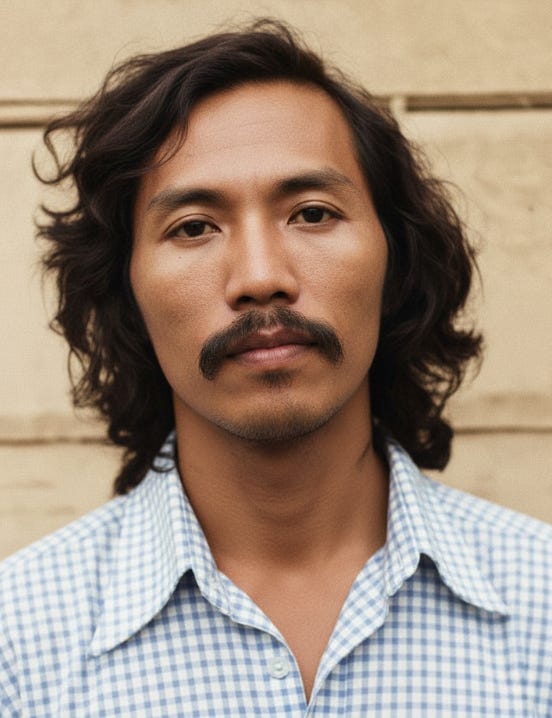
Paul Somohardjo was another thread. In July 1979, when the VDP opposition launched their “Parliament Guerrilla” and Baal smashed those microphones, Somohardjo was right there with him. Both men sent a joint letter to Parliament refusing to pay for the damage, claiming the Speaker had caused the chaos by convening an “illegal meeting.”42
Somohardjo would later be named as a participant in the March 1982 coup. He was arrested but escaped.43
N. Mahadewsingh, another former VHP parliamentarian, played a critical operational role. According to later accounts, he and another civilian drove to Santo Boma prison to release Sergeant Major Wilfred Hawker—one of the key military leaders needed to launch the armed phase of the coup.44
These weren’t strangers thrown together by crisis. They were colleagues, allies, and in some cases relatives who had been fighting together in VHP/VDP politics for years. When the military stripped away their democratic mandates in 1980, they already had the relationships in place to pivot from parliamentary opposition to armed resistance.
The ALCOA Question
Here’s where the story gets uncomfortable.
Professor Indradj “Baal” Oemrawsingh wasn’t just any biochemistry professor. His 1972 doctoral dissertation at the Free University of Amsterdam—”Studies on s”—placed him at the cutting edge of research into stress markers and biological responses.45 This was cutting-edge research. The kind of expertise that interested both medical researchers and intelligence agencies during the Cold War.
And his research at the University of Suriname was funded, repeatedly, by the ALCOA Foundation—the philanthropic arm of the Aluminum Company of America.46
ALCOA wasn’t a random donor. It was the dominant foreign economic presence in Suriname. The company operated massive bauxite mining operations and had built the Afobaka Dam to power its aluminum refining. ALCOA’s Suriname subsidiary, Suralco, was one of the country’s largest employers and revenue sources. You already know how important those operations were to Washington—important enough that JSOC drew up invasion plans to protect them.
Some of the research funding made obvious sense.In 1977, Baal initiated an ALCOA sponsored a nutritional survey with the Dutch TNO research institute among the population of Djoemoe (JOO-moo) in Upper Suriname. It was a region affected by ALCOA’s dam and mining operations.47 That looks like corporate social responsibility. Monitoring the health impacts of your industrial footprint.
The same year, ALCOA funded hypertension research, with the complex analysis conducted at the Department of Medical Chemistry under Baal’s direction.48 Hypertension is a chronic disease that could plausibly be linked to the stress and lifestyle changes caused by industrialization. Still reasonable.
ALCOA also funded Carnegie Museum expeditions into Suriname’s interior during this period—ostensibly to study mammal biodiversity, but the surveys produced detailed maps and environmental data for the very regions where ALCOA’s bauxite concessions lay.49
But then the funding got more specific.
In 1978, the Medical Faculty hosted a symposium on serotonin—a neurotransmitter that regulates mood, behavior, and depression. The stated goal was to “demonstrate successes in biochemical processes and explain pathological manifestations of human behavior.”50 Baal was a lecturer. The symposium was funded in part by the ALCOA Foundation.51
Later that year, ALCOA money brought Dutch experts in psychiatry and pharmacology to Suriname for postgraduate courses, specifically to introduce “new techniques in biological psychiatry” at Baal’s Biochemistry Department.52
Why would an aluminum company fund research into the chemical manipulation of human behavior?
Maybe it was just broad-spectrum corporate philanthropy. ALCOA had money. The university needed funding. Baal was a prominent researcher. Donors often support whatever projects their grantees propose.
Or maybe there’s something else.
Consider the context: By 1980, the Bouterse regime was drifting leftward and making noise about nationalizing the bauxite industry. ALCOA’s entire Suriname investment was threatened. Cultivating relationships with politically connected academics—especially ones in the opposition—might have looked like smart long-term planning.
Now consider what the coup plotters allegedly planned to do.
When the March 1982 coup failed and authorities searched houses, Lieutenant Abrahams displayed a stack of Valium ampoules and syringes at a press briefing. The plotters allegedly intended to sedate the military leadership during what appeared to be a benign Phagwa celebration—controlled incapacitation, the kind of operation requiring someone with medical or biochemical expertise.
Baal Oemrawsingh was one of two people in the conspiracy with that expertise.
Did ALCOA know what their funding would eventually enable? Almost certainly not. There’s no evidence of any direct connection between corporate philanthropy and coup planning.
But the pattern is there. An aluminum company facing nationalization. A biochemistry professor with ALCOA funding who specialized in neurochemistry and pharmacology. That same professor allegedly planning to use chemical sedation in a coup attempt.
The question writes itself. The answer doesn’t have to.
What They Were Fighting For
The Oemrawsingh brothers weren’t saints. They weren’t pure democratic idealists sacrificing everything for abstract principles.
They were members of a displaced elite whose political power had been stripped away. They were Hindustanis who—based on the evidence—harbored real animosity toward the Creole-dominated military regime. They were businesspeople whose economic interests were threatened by nationalization. They were intellectuals who believed their class deserved to lead.
All of that can be true, and they can still have been fighting a genuine dictatorship.
Bouterse’s regime was brutal. It would prove just how brutal on December 8, 1982, when fifteen people were executed at Fort Zeelandia. The resistance wasn’t wrong that the military needed to be stopped.
But the resistance was also complicated. It was funded by wealthy families with business interests to protect. It was led by men with criminal records for assault. It was organized around ethnic and class loyalties that the regime’s propaganda didn’t entirely invent.
When Baal walked into the U.S. Embassy on February 8, 1982, he wasn’t just a concerned democrat warning Americans about political violence. He was a man with a history of political violence himself—a man who’d survived poisoning, been convicted of assault, allegedly funded arson, and smashed government property in Parliament.
And he was about to hand Washington exactly what some in the intelligence community had been hoping for.
Whether he understood that or not.
ACT III: THE ROUTING
What SS-25 Meant
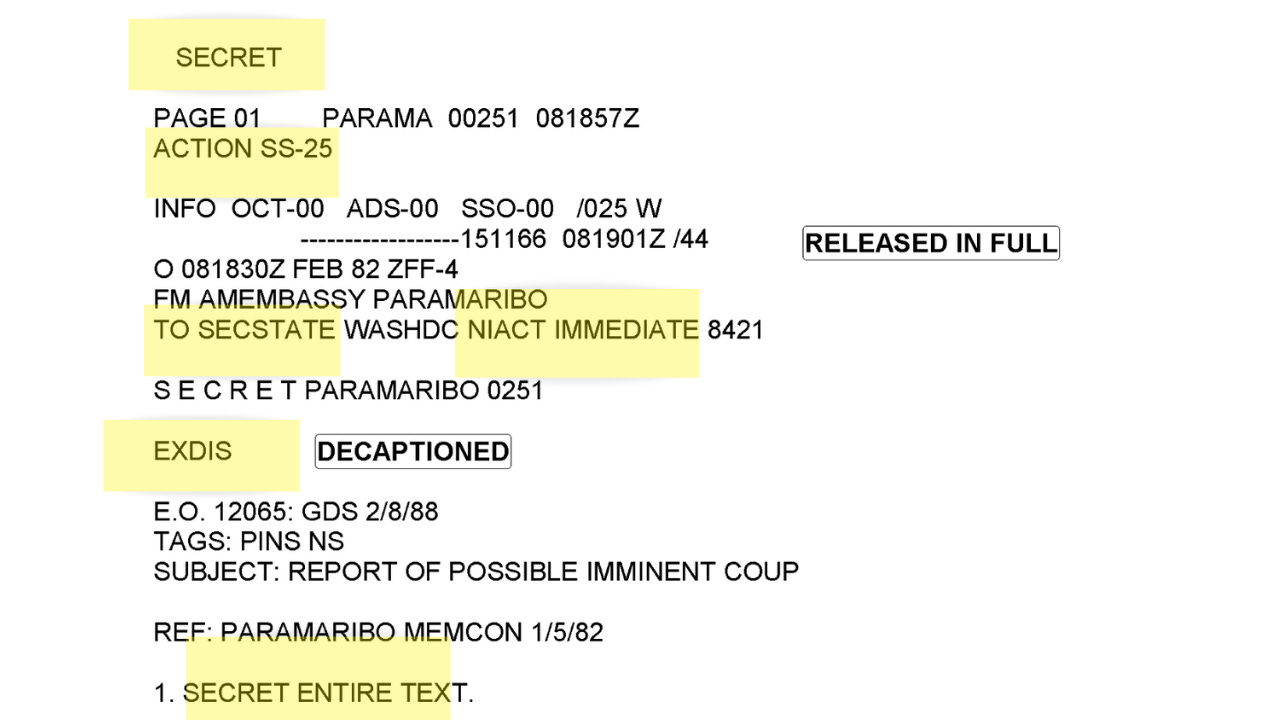
That cable LaRoche sent? We need to look closely at the routing code. Some Foreign Service Officers go their entire careers never using these designations.
At the top, in the metadata of the header that diplomatic professionals knew how to read, were the classifications that told you everything you needed to know about what this really was:
SECRET
EXDIS
NIACT IMMEDIATE
Exclusive distribution. Eyes-only.
Night action. Wake people up.
Immediate attention regardless of hour.
And the routing?
Not ACTION ARA-15 — the normal Latin America desk of the Bureau of Inter-American Affairs, where Suriname cables normally went, where regional specialists tracked Caribbean developments.
Not the routine diplomatic pipeline.
The cable went to ACTION SS-25.
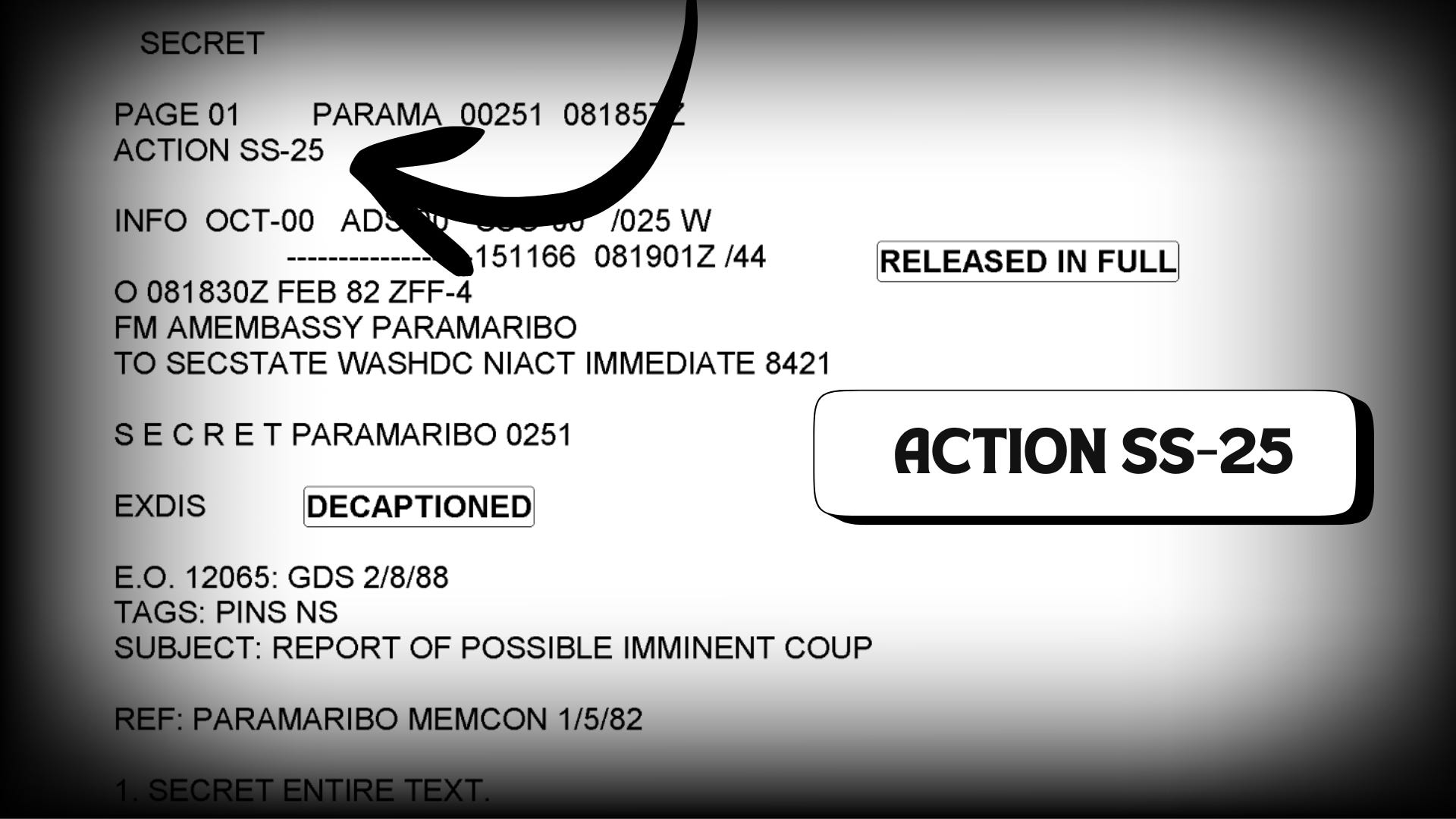
That was the Secretary of State’s crisis nerve center. The desk that handled real emergencies — not political updates, not economic summaries, but situations where covert planning, military options, and interagency crisis groups were already activated. The kind of thing you’d route to if, say, you were documenting an imminent coup that might trigger broader contingency plans.
In Washington, SS-25 meant: “This is operational. This is sensitive. This is small-circle only.”
To illustrate how seriously Washington took the Suriname coup threat, consider what else was routed to the ACTION SS-25 desk. What’s important to understand is that SS-25 wasn’t just another crisis desk. It was the narrow pipe that carried only the most sensitive, high-stakes intelligence—issues that couldn’t be risked in wider distribution. When a cable was stamped ACTION SS-25, it meant Washington was treating the event not merely as a regional disturbance, but as a potential trigger with strategic consequences.
That routing placed the Feb 8 Suriname coup warning in the same operational category as Chile’s 1971 copper nationalization crisis and the post-assassination security emergencies involving Ambassadors Davies and Noel. These weren’t routine events. They were moments when Washington feared rapid destabilization, international repercussions, and the possibility of being forced into kinetic responses.
By routing Baal Oemrawsingh’s warning through SS-25, LaRoche wasn’t just alerting the Department. He was inserting Suriname into the small set of situations monitored at the Secretary’s personal crisis nerve center. It meant something fundamental: Washington saw Paramaribo’s unrest as capable of triggering plans already sitting on the shelf.
- The 1971 Chilean “Copper Crunch”: The desk handled detailed reporting on the Chilean nationalization of U.S. copper companies under Salvador Allende. This parallel is strong because it deals with a smaller country making a move (nationalization) that directly threatens major U.S. economic interests (like ALCOA in Suriname). It shows SS-25 was tasked with managing major political and economic conflicts that threatened U.S. corporate interests.
- The Murder of U.S. Ambassadors: SS-25 was the primary desk for managing the immediate follow-up and investigation into the murder of U.S. Ambassadors Davies (Cyprus) and Noel (Sudan) during 1974–1976. Routing the Suriname cable (detailing the planned murder of a head of state) to the same desk as an Ambassador’s assassination shows that the political violence in Paramaribo was treated as an equally grave threat to U.S. security interests and international order.
These examples immediately clarify that the Suriname crisis was not treated as a minor diplomatic issue, but as a top-tier, high-stakes crisis comparable to an economic war or an act of terrorism.
Here’s what makes it even more significant: compare it to how the embassy handled normal diplomatic traffic.
When the “Sergeant’s Coup,” erupted two years prior into an active, overt, and chaotic military insurrection happening in real-time, three specialized ARIA Aircraft being held hostage, Ambassador Nancy Ostrander sent a “FLASH” priority cable to ACTION ARA-15. This was an overt notice to the Bureau of Inter-American Affairs’ (ARA) regional crisis desk. But that was before Suriname became a geo-political hotspot under the Reagan administration. 53
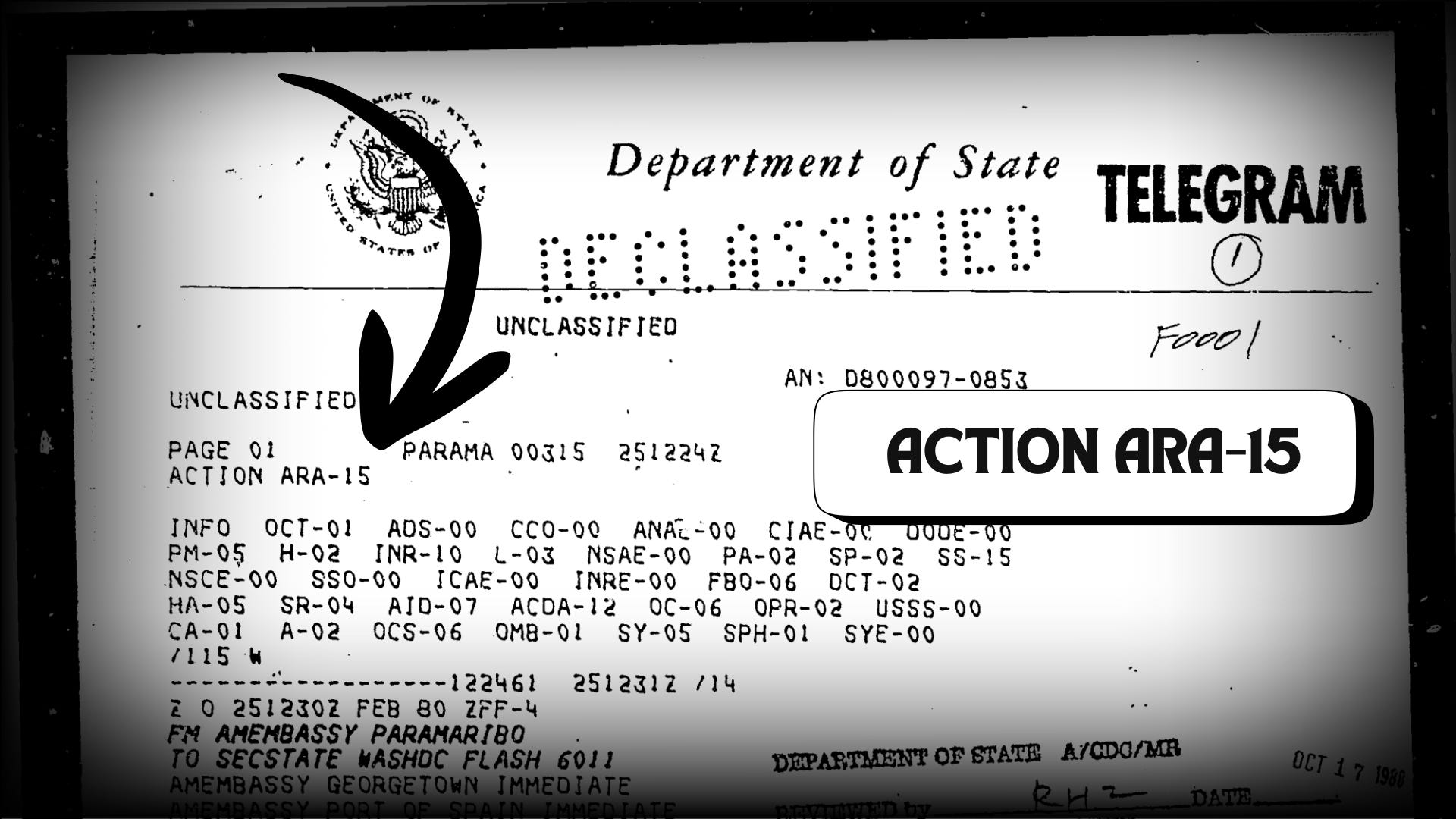
When President Henk Chin A Sen was forced out on February 4, 1982—a major political crisis, the ouster of a civilian president by military force—the LaRoche’s cable went FLASH precedence to ARA-15, the standard Inter-American Affairs desk. UNCLASSIFIED. Broad distribution.54
Same embassy. Same Chargé d’Affaires. Two completely different cable routing protocols.
One was diplomacy. The other was intelligence.
The Duel-Track Structure
But the SS-25 designation told a far deeper story of compartmentalization. Washington was operating on a dual-track strategy.
- The Overt Policy Track (ARA-15 cable) ran through the Bureau of Inter-American Affairs (ARA-15), managed by Assistant Secretary of State Thomas Enders who’d been responsible for hiring LaRoche. This channel handled public-facing reports—like the resignation of President Chin A Sen or the UNCLASSIFIED report on the 1980 coup. This was diplomacy.
- Covert Operational Track (SS-25 cable), however, was the . It reported directly to the Secretary of State’s personal crisis nerve center and was immediately funneled into the crisis management and restricted interagency, pre-planning groups in Washington. Just two days prior, the National Security Council had formalized its aggressive new Caribbean Basin strategy—a blueprint for active rollback. DCI William Casey was running a Saturday morning study group at CIA headquarters with figures like Enders and Oliver North , treating Suriname as a real-time example of the Soviet/Cuban threat.55
Stephen Bosworth had also visited in January, holding meetings with Harvey Naardendorp. Operating on the overt track, Bosworth’s report was routed to ACTION ARA-15—the standard diplomatic channel for the Bureau of Inter-American Affairs. In this broad-distribution cable, he viewed the exchange optimistically, declaring Suriname a ‘friendly’ country and affirming that the U.S. could respect its non-aligned policy. Naardendorp, in turn, was quoted in the open traffic as stating that:
Suriname welcomed support for its social and economic systems but would reject any attempts to frustrate those processes.56
While this diplomatic assurance was circulating through the bureaucracy, the SS-25 channel was already processing intelligence that made those promises obsolete.
At almost the same moment, that Stephen Bosworth was visiting the Caribbean Basin with diplomatic “carrots” from the new Reagan economic initiative, the Pentagon was handing out “sticks” via a regional readiness exercise under the codename SAFE PASS ’82—scheduled for 8–18 March in the Caribbean theater with five Dutch ships. Later, both Soviet and Cuban analysts would read that exercise as rehearsal for an intervention in Grenada. But the timing aligns even more precisely with the Rambocus coup window and the crisis LaRoche was now feeding into SS-25. 57
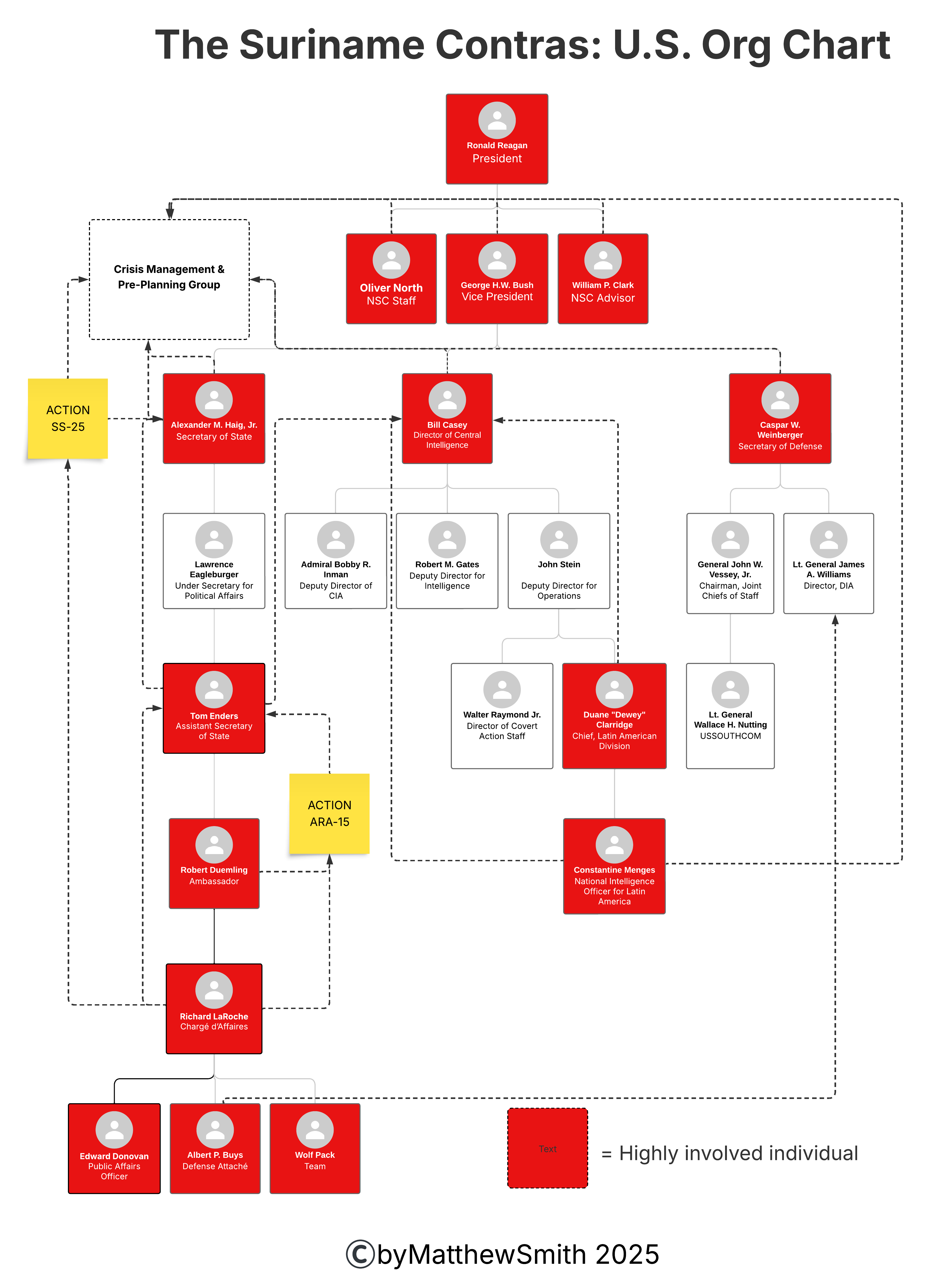
LaRoche’s SS-25 cable was not just intelligence; it was an operational trigger. It was sent to the very same high-level officials working in Crisis Management in Washington D.C. who, that week, were finalizing the “Birdwatchers” plan to dispatch U.S. forces, including Delta Force operators, for a “hostage rescue” and potential regime change invasion.
The NIACT IMMEDIATE precedence and the nearly empty INFO list proved this information was “eyes-only” for the small circle of principals running the covert plan.
Operation Amber: The Backup Plan
“We have prepared a series of exercises in the Caribbean, all of which are to give the Cubans a sense of threat to them.” —Assistant Secretary of State Thomas Enders, Top Secret NSC Meeting, February 10, 1982
The cable routing told you Washington was treating this as operational. But what operation, exactly?
According to Sean Naylor’s Relentless Strike—the definitive history of Joint Special Operations Command—JSOC had received a “warning order” for a hostage rescue and potential invasion of Suriname. The internal code name: Operation Amber. 58
The code name wasn’t a secret. Regional governments had been tracking it for two years.
In 1983—before the Grenada invasion—British journalist Chris Searle documented what Caribbean intelligence services already understood: “The provocation was code-named ‘Amber and the Amberines’… The objective was to capture ‘Amber’, hold US-style elections and install a ‘government friendly to America’.”¹ They even decoded the color scheme: “’Amber’ was supported by ‘Orange’ (Cuba), which in turn was supported by ‘Red’ (the Soviet Union).”59
And critically: “The maneuvers were conducted with support from Britain and Holland.”
The Dutch weren’t observers. They were participants.
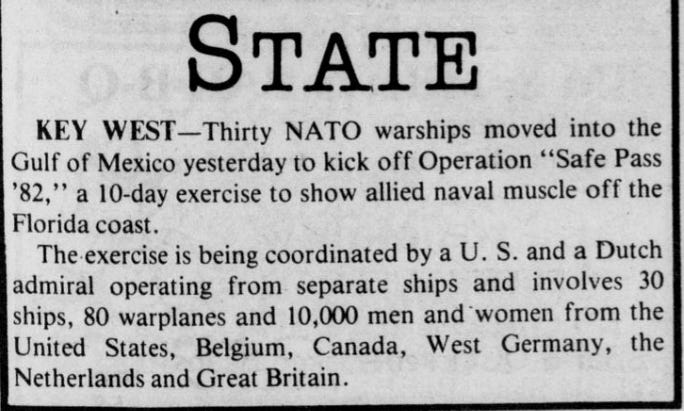
This wasn’t contingency planning sitting in a drawer. This was a named operation, rehearsed multiple times with thousands of troops.
In 1981, Ocean Venture ‘81 put over 20,000 military personnel through invasion scenarios on Vieques, Puerto Rico—practicing the seizure of a fictional Caribbean island called “Amber and the Amberdines.” The scenario was a thinly veiled reference to Grenada and the Grenadines. Or, as regional governments understood it, to any Caribbean nation Washington deemed “unfriendly.”
Caribbean leaders weren’t fooled. Three days after the actual Grenada invasion in October 1983, Janet Jagan stood in the Guyana Parliament and named the operations on the official record:
“Ocean Venture 81 and Ocean Venture 82 and operation Amber and Amberdines … aimed at Nicaragua, Grenada, Cuba and possibly Suriname.” 60
Possibly Suriname.
That parliamentary statement—preserved in the official Hansard transcript—wasn’t speculation. It was what regional intelligence services had been warning each other about for two years. The exercises weren’t drills. They were dress rehearsals.
Now look at what was happening in March 1982—the exact window when Oemrawsingh’s assassination plots were scheduled to unfold.
Safe Pass ‘82, the follow-on exercise to Ocean Venture, ran from March 8-18, 1982. Twenty-eight warships. Over 10,000 military personnel. Approximately 80 aircraft. And here’s the detail that matters: five Dutch warships participated alongside U.S. and Canadian forces.61
The official story was routine NATO training—testing “readiness of NATO units” and practicing Sea Lines of Communication defense. Protecting transatlantic supply routes from Soviet interdiction.
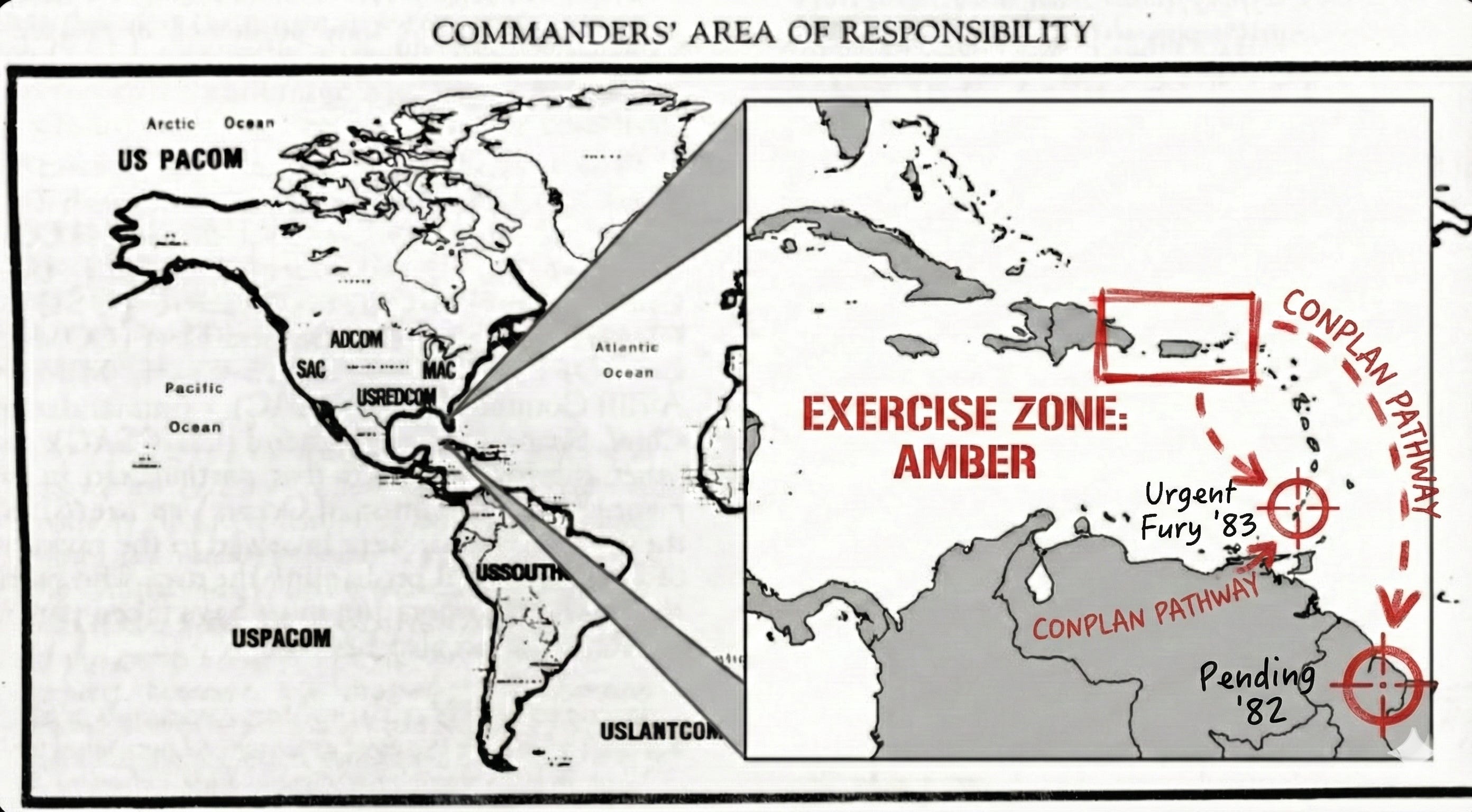
The actual scenario included amphibious landing exercises at Guantanamo Bay, reinforcement of the GTMO defense perimeter, and—according to Soviet and regional reporting—simulated intervention against “hostile regimes” in the Caribbean.
Soviet media immediately labeled it “dangerous and provocative.” Grenada’s Minister of External Affairs, Unison Whiteman, called it explicitly what it was: “a rehearsal for invading this island state.” 62
He was right. Nineteen months later, Operation Urgent Fury would invade Grenada using the same command structures, the same force types, and the same operational concepts rehearsed during Safe Pass ‘82.
But here’s what makes the timing explosive:
Safe Pass ‘82 ran March 8-18. The Temple Plot was scheduled for March 7. The Phagwa Plot was planned for March 10. The Rambocus Coup launched March 11.
For three critical days, as Lieutenant Rambocus and his forces were seizing barracks and besieging Fort Zeelandia, NATO warships—including five Dutch vessels—were conducting intervention exercises just offshore. Practicing exactly the scenarios that a successful indigenous coup might have triggered.
The exercise wasn’t coincidence. It was positioning.
The Blueprint, The Command, and The Rehearsal
If you want to know how close Suriname came to invasion, you have to understand how the Pentagon manages its wars before they start. They don’t just write invasion plans from scratch; they operate off a system of templates and command structures that are ready to go at a moment’s notice.
1. The “Generic” Blueprint: CONPLAN 2360 We know today that when the U.S. invaded Grenada in 1983, it didn’t start with a specific “Invasion of Grenada” plan. Instead, they had activated and rehearsed a CONPLAN going back to the 60’s. CONPLAN 2360 was a generic, “rough outline” plan owned by CINCLANT (Commander-in-Chief Atlantic Command) for occupying any hostile Caribbean island. It was a template: Insert Island Name Here. It provided the logistics, the command structure, and the force requirements for a rapid takeover in the Caribbean Basin.
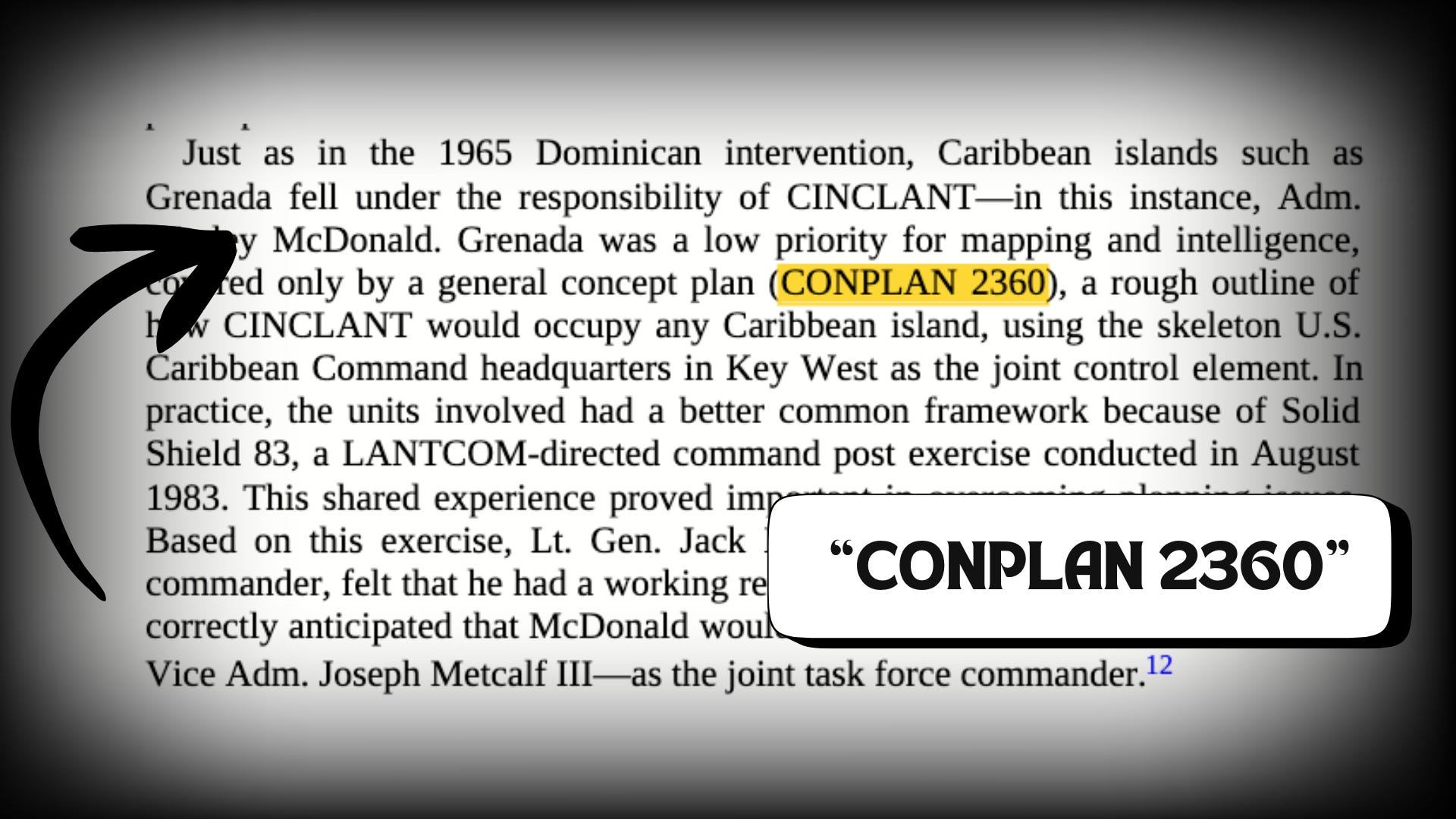
2. The Suriname Twin: CONPLAN 6106 This is why the discovery of CONPLAN 6106 in the 1983 archives is the smoking gun. Just as 2360 was LANTCOM’s “break glass in case of emergency” plan for the Caribbean islands, CONPLAN 6106 was the specific contingency shelf-plan for Suriname after the December Murders. It wasn’t just a vague idea; it was a designated, numbered military plan authorizing the evacuation and securing of the country.
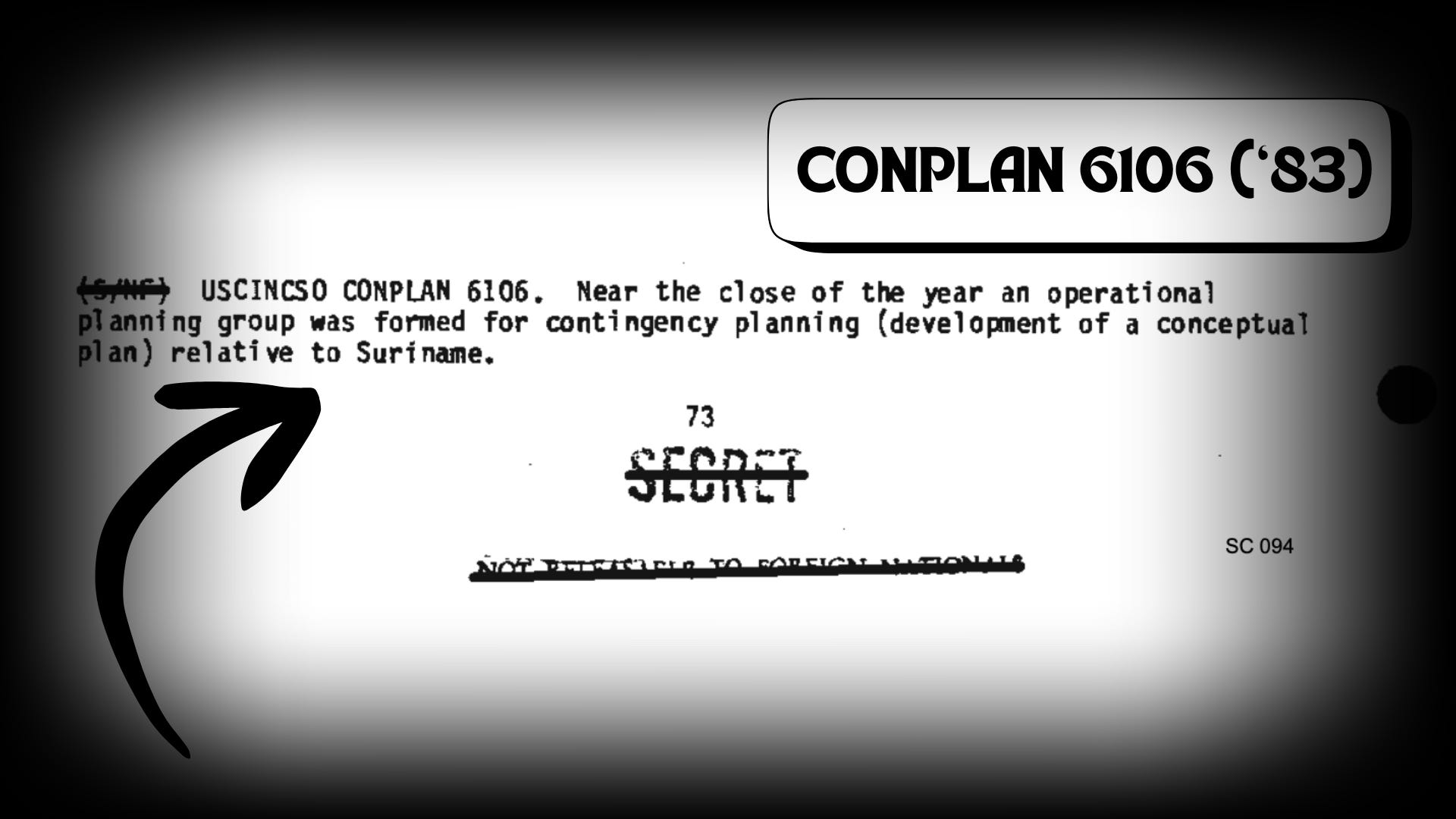
3. The Command Split: Why “Amber” Mattered The Caribbean was split between two massive commands: SOUTHCOM (Panama/Central America) and LANTCOM (The Atlantic/Caribbean Sea).
- The “Amber” exercises (Ocean Venture, Safe Pass) were CINCLANT operations.
- This matters because CINCLANT was the command that actually executed the Grenada invasion.63
- By rehearsing “Amber” under CINCLANT, they were testing the exact chain of command that would be used for Caribbean Basin interventions.
4. The Loophole You cannot rehearse a classified invasion plan in plain sight without declaring war. So, the military uses a loophole. They create a fictional scenario to test the real logistics.
- The Scenario: Operation Amber (The fictional Caribbean island)
- The Drill: Safe Pass ‘82 (The physical movement of ships)
- The Final Plan: CONPLAN 6106 (Developed late 1983, completed February 1984)
When Dutch and American warships sailed for Safe Pass ‘82, they were publicly “protecting sea lanes.” But operationally, they were positioned to respond to the indigenous coup attempts Washington knew were coming—practicing exactly how to move troops and secure a coastline in South America, using “Amber” as the operational cover.
The operational concepts rehearsed in March 1982 would later be formalized as CONPLAN 6106 after the December Murders created renewed urgency for Suriname contingency planning.
This interchangeable approach wasn’t accidental; it was doctrinal. A Strategic Studies Institute report from the period explicitly argued that
“From a psychological, geopolitical, economic, and, indeed, long-term military perspective, the Caribbean Basin is a single strategic entity.”64
This “single entity” mindset explains why Command Sgt. Major Eric Haney later noted that for every mission planned for Suriname, there was a corresponding counterpart for Grenada. To the planners, the targets were distinct, but the strategic objective—and the invasion templates used to achieve it—were identical.
5. The Command Architecture in Position
But here’s what the cable architecture reveals about Washington’s operational readiness.
When crisis cables needed to be sent from Paramaribo, the distribution system was already optimized for rapid military response. The standard routing included:
- USCINCLANT NORFOLK VA – The Atlantic Fleet command responsible for amphibious operations.
- USCINCSO QUARRY HGTS PN – U.S. Southern Command in Panama, theater operational authority.
- DIA WASHDC – Defense Intelligence Agency.
And critically: Harry D. Train II—Commander-in-Chief of the U.S. Atlantic Fleet and Supreme Allied Commander Atlantic for NATO—would be positioned forward when operations required it. Train remained active CINCLANT until his retirement on September 30, 1982—meaning throughout the critical March-September 1982 window, the operational commander was available for forward deployment.6566
The sitting four-star admiral commanding the entire Atlantic Fleet could be positioned in theater when circumstances demanded operational command.
And there’s one more embassy that keeps appearing on contingency distribution lists: AMEMBASSY BRIDGETOWN.67
Barbados.
Where Tony Kern ran the AIFLD regional office. Where the extraction infrastructure existed. Where safe houses were maintained for exactly these scenarios.68
The operational infrastructure wasn’t theoretical. It was positioned and ready.
The Architect of the Shadow War
“Suriname was an example of that. It has never really been fully written, but I expect it to be in the near term, but it was definitely a change through our own early studies and later news that the decision directives resulting from these studies did turn our U.S. policy around.”
-William P. Clark, close friend of Reagan, and National Security Advisor, Oral History.
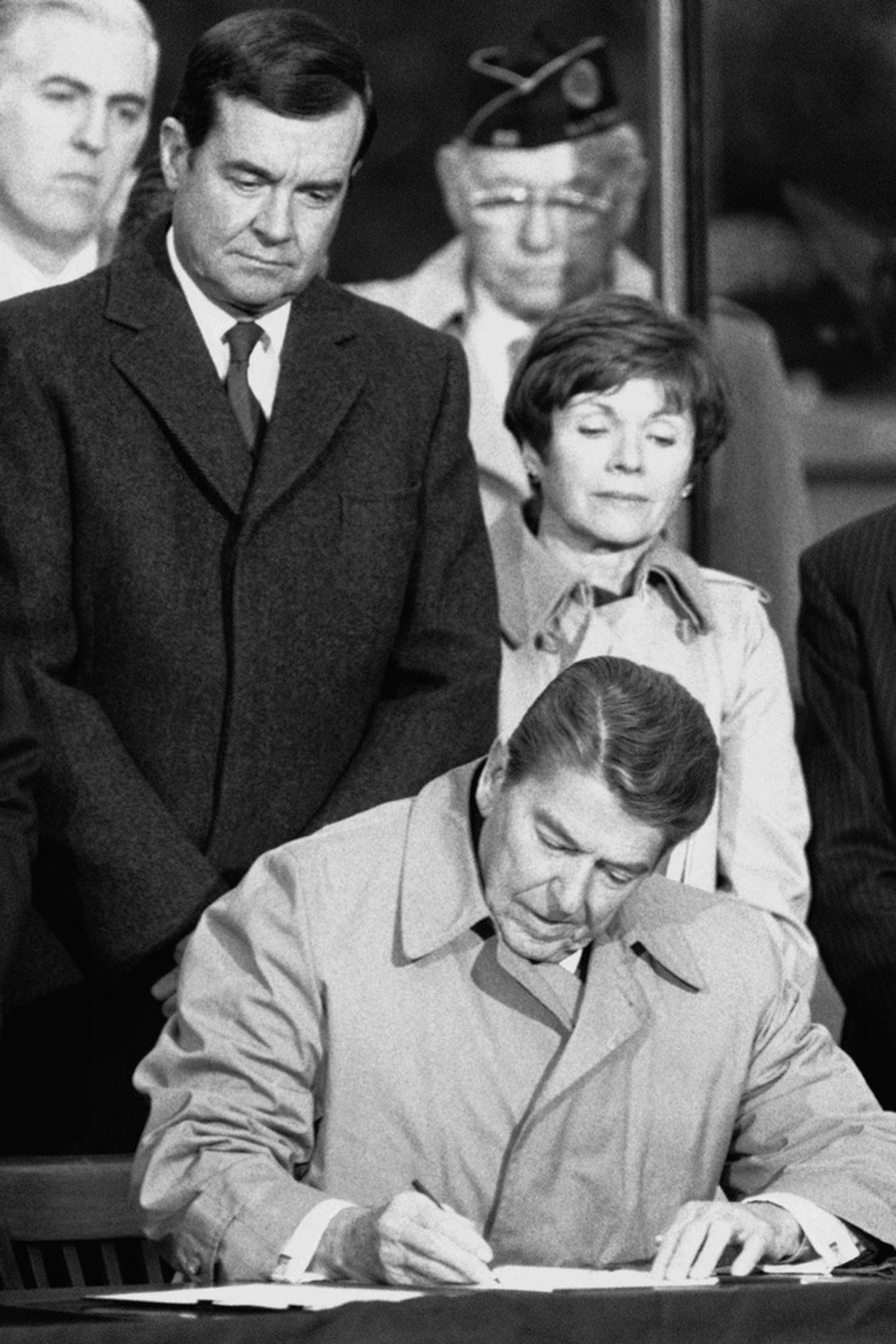
To understand why a simple cable from Paramaribo was treated like a bomb threat in Washington, you have to understand the man reading it.
In January 1982, just weeks before Oemrawsingh walked into the embassy, William P. Clark had taken over as National Security Advisor. Clark wasn’t a diplomat. He was a rancher, a judge, and Ronald Reagan’s most trusted enforcer. He arrived at the White House with a specific mandate: stop the “moderates” at the State Department from watering down the President’s anti-communist crusade.
Clark’s appointment triggered a silent coup within the U.S. government. For years, career diplomats like Assistant Secretary of State Thomas Enders had managed Latin America with a policy of containment—keeping the status quo, avoiding messy interventions. Clark burned that playbook.
Under Clark, the NSC drafted a new strategy, codified in strict secrecy as NSDD-32. It replaced “containment” with a new, aggressive doctrine: Rollback. The goal was no longer to live with Soviet proxies but to destabilize and remove them.69
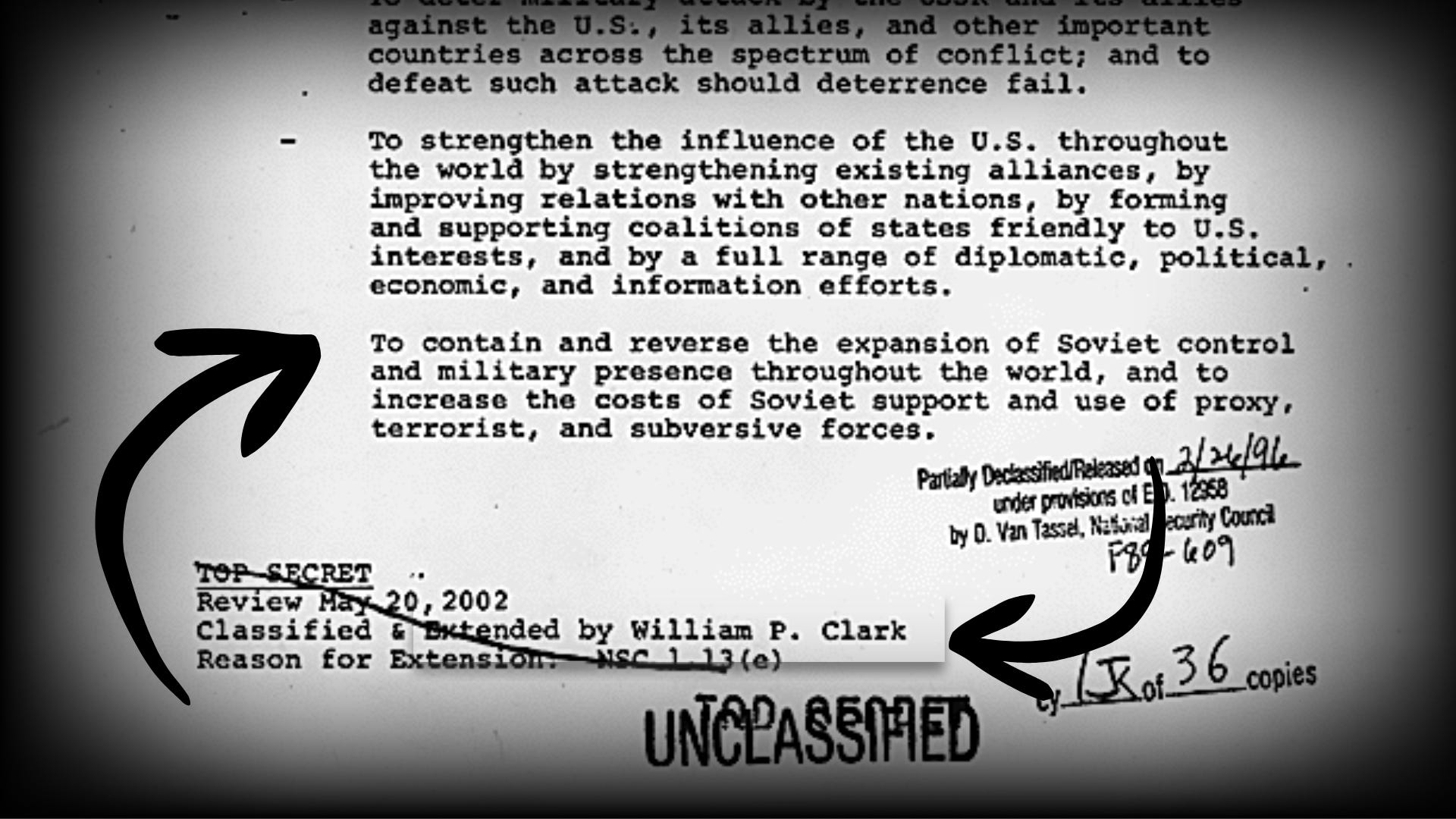
The Green Light: February 10, 1982:
The timing was incredibly tight. On February 4, President Chin A Sen was forced out of power. This created the exact kind of weak government that National Security Advisor William Clark feared would invite Soviet interference. On February 8, Baal Oemrawsingh walked into the U.S. embassy with a violent solution. On February 10, America’s top national security leaders met to decide the rules of engagement.
In a twist of historical fate, the timing was perfect. On February 10, 1982—the very day Bouterse declared his “Revolution” in Paramaribo—Clark’s NSC met to finalize the strategy that would destroy it.70
In that meeting, Clark refused to use old nicknames for the region. He told the room that the Caribbean was not America’s “backyard,” because that word made it sound unimportant. Instead, he called it the “frontyard”. He said it was as vital to the U.S. as the Mediterranean Sea is to Europe. He declared this was the first real plan for the region “since the elaboration of the Monroe Doctrine”.
For Clark, this was a matter of life and death for the country. The CIA briefing that morning gave a stark warning: if the U.S. didn’t act, it would lose credibility. They feared the Soviets would win new friends right near the U.S. border.
But President Reagan was conflicted. He sat in the meeting worrying about how the public saw him. He asked his advisers, “Can I do something without adding to the perception of me as a hawk?”. A “hawk” is someone who is eager for war.
TThis problem created a shadow strategy. They needed to take action, but they couldn’t look like they were starting a war.
Assistant Secretary of State Thomas Enders spoke up. He told the room that the U.S. had “prepared a series of exercises in the Caribbean”. He explicitly said the goal was “to give the Cubans a sense of threat to them”. This wasn’t just talk. It was the green light for Safe Pass ’82—the warships that would sit just off Suriname’s coast a month later. They would be the silent muscle backing up the coup plotters.
The Trigger Mechanism
This explains why LaRoche’s cable was sent to the special “SS-25” desk.
Acting Secretary of State William Stoessel was in that February 10 meeting. He heard Clark call the region the “frontyard”. He heard the CIA Director warn about looking weak. When Stoessel went back to his office, a secret cable from Suriname was waiting for him. It detailed a local plot to kill the Bouterse leadership. In this new situation, that cable wasn’t just a report; it looked like a solution to the exact problem the National Security Council had just spent two hours worrying about.
Clark’s team knew that Bouterse’s threats to take over the aluminum industry made him vulnerable. By sending the warning to the secret SS-25 desk, Washington was sending a signal. They were treating the violence in Suriname as a major threat to American business. They gave it the same high-level secrecy they used for major crises in the past, like the Chilean “Copper Crunch.”
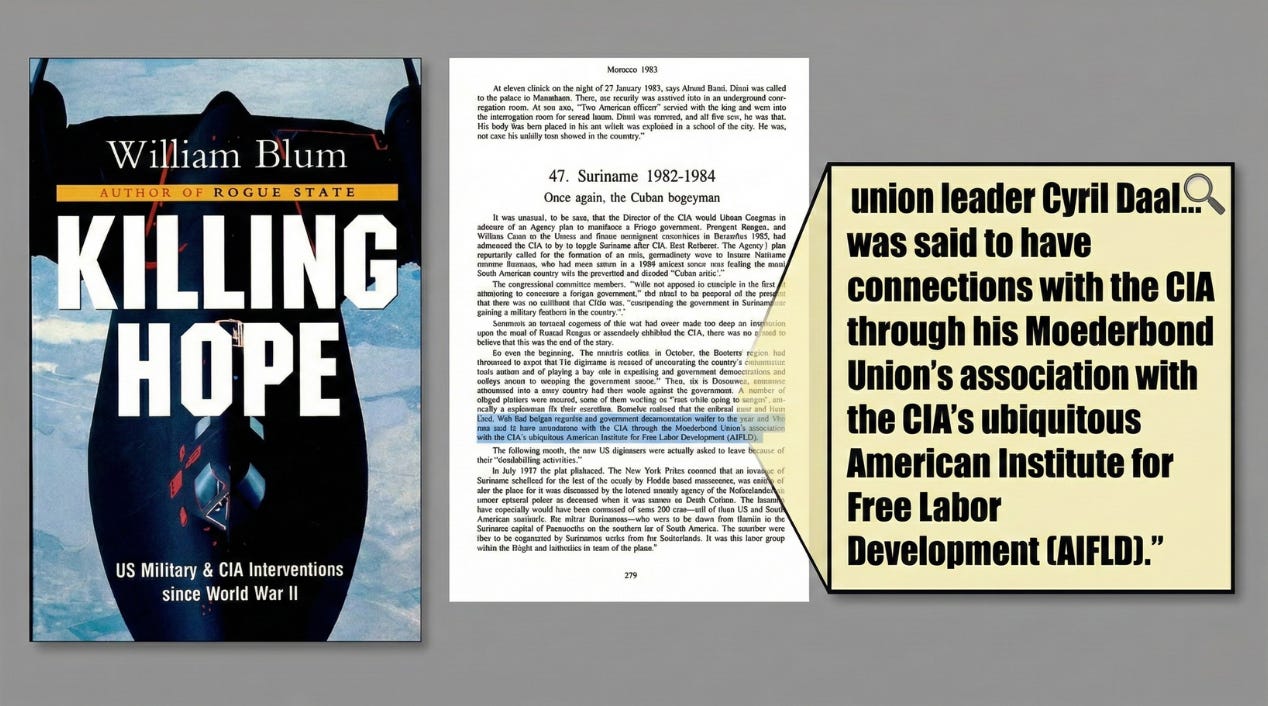
And they were building the machinery to pull it. While the Pentagon prepped the Safe Pass ‘82 warships Enders had promised, Clark’s team was operationalizing the “Project Democracy” prototype—using labor unions and civic groups as covers for covert funding. The “institutional support” flowing to Cyril Daal’s Moederbond via AIFLD wasn’t just solidarity; it was the new face of intervention. No longer the cloak-and-dagger CIA of the 1970s, but a new, “private” network of resistance funded by Washington.
The Rambocus plotters didn’t know it, but they were stepping onto a stage that William Clark had just finished building. The warships offshore, the compartmented cables, the sudden influx of resources to the labor unions—it was all part of the same architecture. The “rollback” had begun, and Paramaribo was ground zero.
ACT IV: THE LABOR TRACK
The Embassy Within the Embassy
Three days after Cornelis “Kees” Keur met with Baal Oemrawsing, Chargé d’Affaires Richard LaRoche—the man who would sign the secret cable about the assassination team, who had met with Baal before his announcement —began conducting a highly sensitive interview with Cyril Daal, the most powerful labor leader in Suriname.
Daal, the chairman of the massive Moederbond labor union, was deeply pessimistic. “Our freedom is in danger,” he told LaRoche. He viewed Bouterse as an “intellectually dim” puppet being steered by dangerous left-wing advisors. Daal even handed LaRoche a paper titled, “LIST OF DECISIONS TAKEN BY THE MILITARY LEADERSHIP FEBRUARY 6, 1982,” proving his access to highly sensitive military documents.71
Daal then laid out his own counter-strategy: He proposed forming a political coalition to stop the military. The coalition would combine labor (his Moederbond), the NPS party, and the VHP—the very political party Oemrawsingh had been a Member of Parliament for. Daal confirmed he “ALREADY HAD PRELIMINARY CONTACT” with the VHP about this plan, which seems like short hand for having spoken with Baal.
Within days of the assassination plotter (Oemrawsingh) walking in to offer his plan, the political mastermind (Daal) was meeting with the American Chief of Mission to lay out the final structure of the “national front” that the assassination was meant to install. The operational plot and the political coalition were perfectly fused and ready to move.
This civilian-military fusion with the Rambocus/Oemrawsingh coup plotters was later confirmed by co-conspirator Manorith Doerga, who disclosed that the plot included
“union leader Cyriel Daal and several people whose names I cannot disclose for their safety.”72
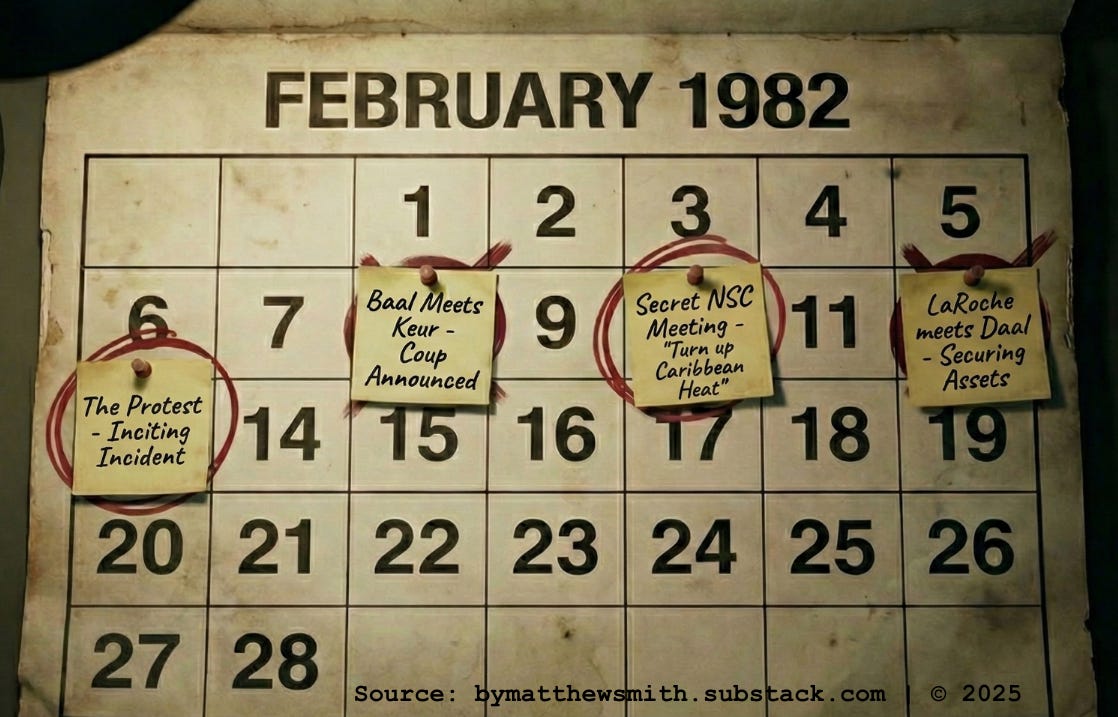
The Hindu Community’s Calculation
LaRoche sent the cable on February 12.
The demonstration erupted the next morning.
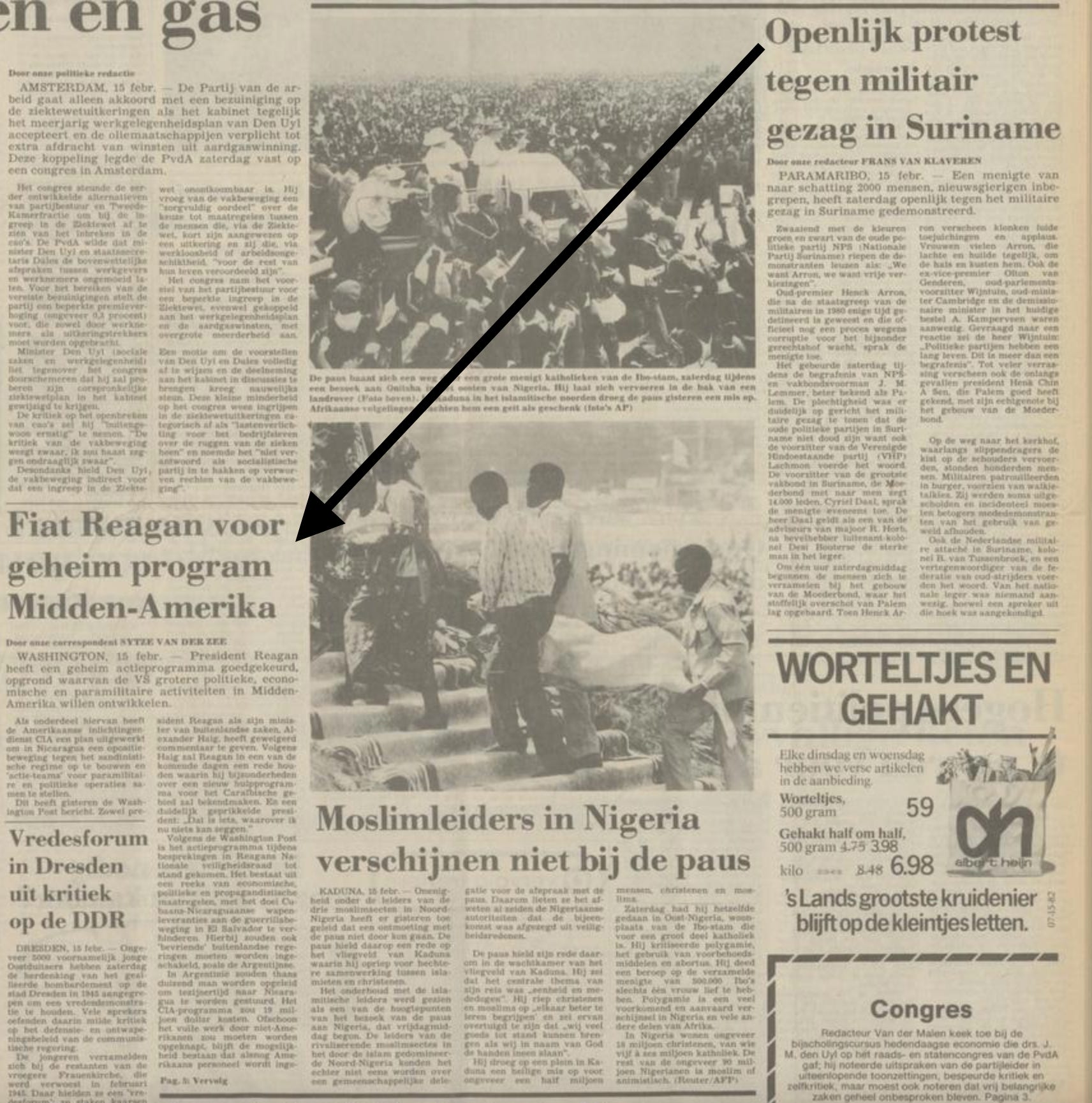
On February 13, 1982—the day after Daal laid out his counter-strategy to the American Chargé—the memorial service for NPS propagandist J.M. Lemmer, better known as “Palem,” transformed into the first mass demonstration against the Military Authority since the 1980 coup.73
The staging ground? Cyril Daal’s Moederbond headquarters.74
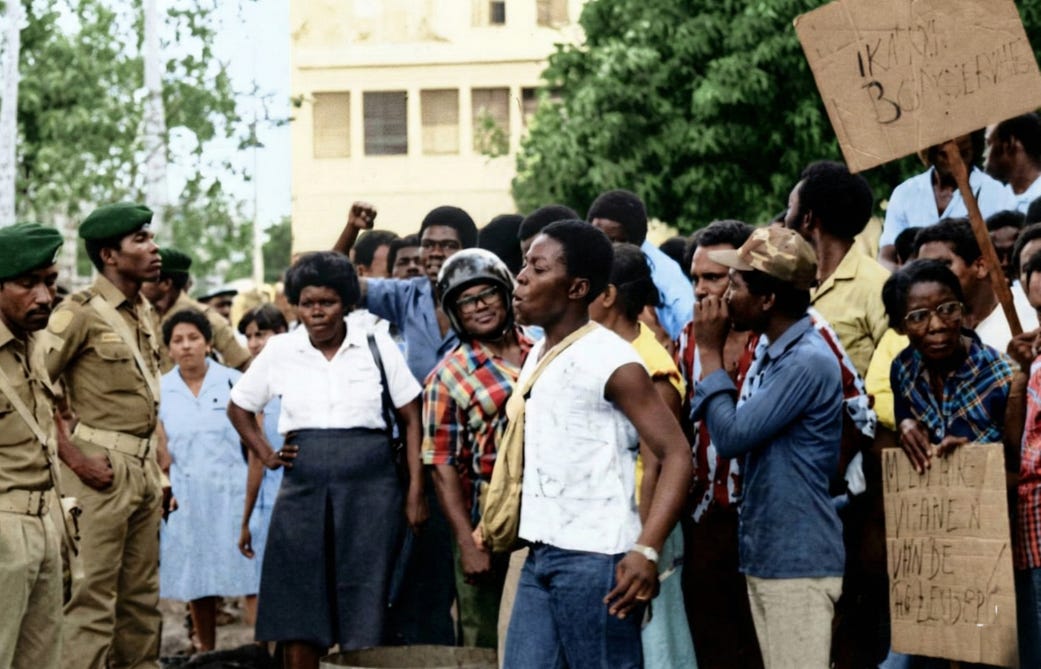
Lemmer’s body was laid out at the Moederbond building. At least a thousand people—some accounts say two thousand—gathered there before marching through Paramaribo. They shouted “We want Arron, we want free elections.” They waved the colors of the old NPS. They redefined the Military Council’s acronym as “Nog Meer Rotzooi”—even more rubbish. Protesters condemned the situation to news cameras as “oppression in the purest form.”75
Now look at who showed up.
Former Prime Minister Henck Arron—the NPS leader Bouterse had overthrown in 1980—was greeted with loud cheers and addressed the crowd. VHP chairman Jagernath Lachmon spoke. The recently ousted President Chin A Sen made a surprise appearance. André Kamperveen, the Radio ABC director who would be murdered in December, attended.
And standing at the center of it all, hosting the demonstration from his union headquarters: Cyril Daal.
It was the first open mass demonstration against the Military Authority (MA) since the 1980 coup, and, for a brief moment, it looked like popular pressure might force democratic reforms. The sheer scale of the demonstration—thousands of people publicly defying the regime—suggested an organic, popular uprising. That was before we knew that a veteran of the Sudaharto and Pinochet coups was meeting with Baal and Daal.
There was hope in Paramaribo that the military’s grip might be weakening.
Let’s step back and look at what just happened.
- On February 12, Daal sat with LaRoche and described his counter-strategy: a coalition combining his labor federation with the NPS and VHP, potentially under Haakmat’s leadership. He called it a “broad anti-leftist coalition.”
- On February 13—the next day—that exact coalition assembled at his Moederbond headquarters. Arron represented the NPS. Lachmon represented the VHP. The “national front” Daal had described to the American Chargé wasn’t theoretical planning. It was standing in front of his building.
The regime watched. Plainclothes soldiers with walkie-talkies documented the crowd. They took photographs. They made lists. But they didn’t intervene.
They didn’t understand what they were seeing.
The timing validates what Bouterse and Naarendorp would later claim: that Daal’s meetings with LaRoche were destabilization planning. The regime called it conspiracy. The cables called it “counter-strategy.” The methodology calls it something else entirely.
In 1983, Chris Searle documented the methodology being deployed simultaneously against Grenada. “The CIA, directly through its sub-agency, the AIFLD, had its trainees in other trade union bureaucracies, particularly among leading officials of the Technical and Allied Workers’ Union.”76 In October 1979, one of these AIFLD trainees “was inciting workers in the Grenada Electricity Company (GRENLEC), to strike and cut off current to the entire country to create the chaos necessary for the success of the intended mercenary invasion.”77
Read that carefully. The strike wasn’t supposed to overthrow the government. It was supposed to create the chaos necessary for the military strike that followed.
Body blows. Then the uppercut.
The demonstration at the Moederbond did exactly what it was designed to do. It proved thousands would take to the streets against the regime. It put the opposition coalition on public display—the exact coalition Daal had described to LaRoche twenty-four hours earlier. It stretched the regime’s surveillance resources— just like Operation Elastic Fence suggested. And it created the narrative of popular resistance that would legitimize what came next.
Two tracks were now running simultaneously. The labor track—Daal’s Moederbond mobilizing public pressure, demonstrating opposition, creating conditions. And the assassination track—Baal’s Temple and Phagwa plots, scheduled for early March, waiting for the right moment to strike.
The body blows weren’t supposed to knock out the regime. They were supposed to set up the uppercut.
And this is the exact moment when a careful reader begins to wonder: If Baal had warned the Americans on February 8 that the strike could come “as early as tonight,” why wasn’t Bouterse hit at the funeral? Why was the opposition demonstrating instead of shooting?
The answer is embedded in the methodology itself.
The February 13 demonstration—large, loud, defiant—was Phase 1. But it lacked the single most important ingredient for Phase 2: the presence of all primary targets in one place under controlled conditions. The resistance wasn’t looking for chaos. They were looking for precision. Crowd cover, symbolic timing, the right religious occasion, the right geography, and the guarantee that Bouterse, Horb, and the others would be standing together.
February was the body blow. March would be the uppercut.
The Hindu business community understood this. They held their own quiet meetings in those final weeks of February. They’d watched the trajectory since Chin A Sen’s ouster: the appointment of radical leftists to key positions, the increasing Cuban advisory presence, the systematic elimination of moderate voices from government, the surveillance state tightening its grip.
The calculus was stark. And the fear was amplified by memory. Rita, sister of Leslie Rahman, remembered it well: “At that moment, in ‘74, I remember very well there was a lot of fear in Suriname. There had been trouble between the Creoles and the Hindustanis, where many people were raped—specifically the women in the Hindustani community.” 78
They faced a choice: accept permanent military dictatorship… or act decisively while there was still a window.
For the plotters, the threat was no longer theoretical. Manorith Doerga, a key conspirator and confidant of Rambocus, later confirmed this as the breaking point: “And when we also heard that Cubans were being brought in, we, with a small group of confidants at Oemrawsingh’s home, made the decision: there would be a coup.”79
The popular pressure had failed. The February 15th demonstration had proved that you could get a thousand people in the streets, but it didn’t matter if the military controlled the guns and was willing to use intimidation and surveillance and ultimately violence to maintain power.
The body blows had done their work. The coalition was visible. The opposition was mobilized. The regime’s surveillance was stretched across the entire country.
Now came the uppercut.
ACT V: THE BREAKING POINT
But to understand the uppercut, you need to understand the men who would throw it—and the window that was closing around them.
Let’s rewind to February 4.
February 4 – The Revolution Train
Andre Haakmat had been warning about this for months.
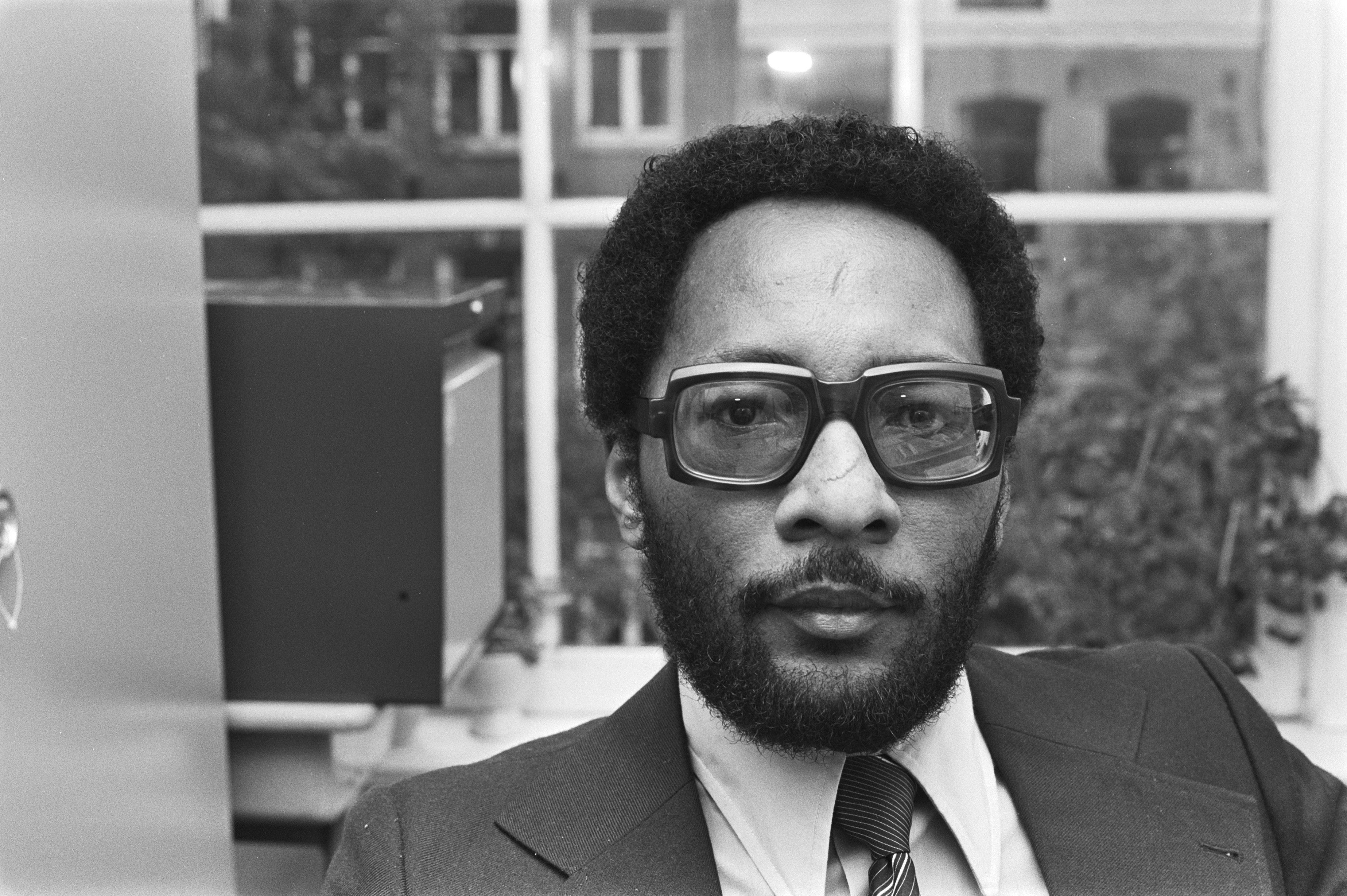
Remember Haakmat? Former Minister of Justice, moderate voice, the guy trying to keep Suriname from sliding into full dictatorship. He was an attorney who had been good friends with Henk Chin A Sen. In fact, after the revolution in 1980, Henk Chin A Sen brought his old college buddy back to Suriname to help draft a new constitution, protocols, etc. So, at one point in time in their history, the two were tight.
Back in late 1981, he’d given this speech comparing the revolution to a train.
“President, members of the Council of Ministers, army leadership: the revolution is like a moving train. Every time it stops at a station, some people get off and others get on. At this station that we have now reached, I get off. Who knows, you may see me get on again at the next station, if by that time the train has not slid off the rails. I wish you all well.”80
On February 4, 1982, the train accelerated toward that cliff.
Commander Desi Bouterse ordered the presidential flag lowered at the government palace. President Henk Chin A Sen—the moderate civilian who’d been brought in after the 1980 coup to give the regime some democratic legitimacy—was done.81
The immediate trigger was a cabinet conflict. Chin A Sen had been fighting with his radical leftist PALU ministers— and Fred Vreeden—over the direction of the country. The military leadership used that conflict as their pretext to intervene and end the whole arrangement.
Bouterse wasn’t interested in compromise anymore. He wanted total control.
Within days, Chin A Sen was on a plane, reportedly telling people he was done with politics forever, returning to his medical practice and off for a vacation in the United States.82 83
But here’s what February 4 meant for the resistance: whatever chance they’d had for legitimate civilian leadership requesting international assistance if a coup succeeded had just evaporated. The one moderate president who might have provided political cover? Who’d send out the bat-signal to the United States calvary? Gone. Exiled. Replaced by military appointees.
The window was closing.
The Man Between All Sides
Andre Haakmat’s terrace had become the unofficial headquarters of Surinamese opposition politics.
After his dramatic dismissal as Minister of Justice and Police in October 1981—when he’d given his famous “revolution train” speech—the terrace meetings had continued unabated. Everyone with grievances against the regime found their way to Haakmat’s house in those early months of 1982.
The dismissal itself had been pure political theater.
Chin A Sen, the president who would himself be ousted just four months later, had given Bouterse an ultimatum over Haakmat’s January 1981 interview criticizing the revolution’s failures: “It’s now André or me.”
Bouterse had reluctantly chosen the president. At the extraordinary Council of Ministers session where Haakmat was formally dismissed, he’d delivered his famous speech that people still quoted,
Bouterse had shaken his hand afterward and said, “It was a great speech.” He’d referred to it often since.
That night, placed under house arrest, Haakmat had received visitors: Bouterse and Roy Horb came personally to explain the situation.
“You do understand what was going on, right?” Bouterse had said. “We have temporarily withdrawn you because Henk [Chin A Sen] has played the matter very high. It won’t be long before he breaks his neck, and then you will take over again. He wants the army to banish you, but rest assured, that will not happen.”
Four months later, in early February 1982, Chin A Sen was gone—exactly as Bouterse had predicted. The president had dramatically resigned both positions after refusing a compromise that would have let him remain as ceremonial president. Haakmat had been in the room during those emergency meetings on February 4, trying to broker a solution that would preserve stability.
The irony wasn’t lost on Haakmat. The man who’d forced his dismissal was now in exile. And Haakmat? He’d been proven right to get off the train before it derailed.
By February 1982, Haakmat occupied a unique position in Surinamese politics. He was simultaneously:
Regime insider: Appointed to Bouterse’s committee drafting the “basic regulations of the revolution”—the document that would formalize the military’s political power.
Military moderate advisor: Counseling Roy Horb, the young garrison commander who represented the faction trying to guide Bouterse toward democratic reform rather than Cuban-style dictatorship.
Opposition strategist: Coordinating with Cyril Daal and the Moederbond union on building a broad anti-leftist coalition. When Daal met with LaRoche at the U.S. Embassy on February 12, he specifically mentioned Haakmat as a potential leader for uniting opposition forces. In January 1982, Haakmat had formalized his role as official adviser to the Moederbond—the same labor federation affiliated with the International Confederation of Free Trade Unions and supported through AIFLD networks. Whether Daal fully understood the significance of that institutional architecture, or simply saw Haakmat as his trusted friend and political strategist, would become a critical question in the months ahead.84
Haakmat was everywhere and nowhere. Trusted by Bouterse enough to help write the revolution’s constitutional framework. Trusted by moderates enough to advise on reform strategy. Trusted by opposition enough to be named as a potential coalition leader.
This kind of positioning required extraordinary political skill. He was the one figure who could move between all three worlds without immediately triggering suspicion or retaliation. That mobility made him invaluable — and dangerous.
The Meeting That Never Happened
It was the late afternoon of February 28, 1982—just days before Baal Oemrawsingh’s assassination plan (which would become known as the Temple Plot) was being finalized and days before the main coup attempt—when Baal appeared on Haakmat’s terrace without warning.85
The visit was “as sudden,” Haakmat would later write in his memoir, as any emergency military summons. Oemrawsingh looked stressed, urgent. He had important matters to discuss, he said. He wanted both Haakmat and Cyril Daal present.86
The implication was clear. This wasn’t academic consultation about political theory. Oemrawsingh was asking for something operational—a final commitment to the armed insurrection. Or, if nothing else, perhaps a friendly “warning,” like he’d provided Cornelis Keur.
Haakmat made a noncommittal promise: he’d check with Daal about scheduling a meeting.
The Calculation to Maintain Deniability
It was the kind of polite deflection that, in revolutionary politics, means “no” while preserving plausible deniability. Haakmat never followed through. The meeting never happened. At least, that’s what he later claimed.
According to Haakmat’s memoir, the reason came suddenly and decisively. On the way back from the Robin Hood–Brazil soccer match, Daal told him that he knew for certain they were being followed by the intelligence service. Haakmat suspected Daal had been tipped off during the match.87 Whether true or merely a useful pretext, the effect was the same: they would not go to the appointment Baal had described as “of the utmost importance.”88
If they attended this meeting, they moved from political opposition into operational conspiracy. Once that line was crossed, there was no walking it back—publicly, historically, or personally.
Haakmat had already given his answer about that path when he’d delivered the “revolution train” speech. The train was sliding off the rails. Better to wait at the station than ride it over the cliff.
Cyril Daal had fewer illusions. He’d already admitted in the February 12 cable to having “preliminary contact” with the VHP—the very party Baal represented—so another political meeting wouldn’t have endangered him. A final briefing on the eve of a coup, however, was something different entirely. Surveillance meant exposure, and exposure meant he would lose the one thing the coup leaders needed from him: his political viability for the day after.
In other words, both men may well have supported the idea of removing the regime—and the coup leaders certainly believed they had spoken with “all political parties and functional groups,” as Rambocus would later tell Paulus Abena—but neither man intended to be caught walking into the decisive meeting that would seal their fate if the operation failed.89
The Leak Timed With Holi Week
What Haakmat did next, however, unquestionably had political impact.
In the days immediately before Holi — the same religious period the Temple Plot and Phagwa Plot were built around — someone leaked a confidential internal document exposing the military’s intention to create an “absolute military dictatorship.”90
The timing was exquisitely calculated. All fingers pointed at Haakmat.
During Holi Week — a festival of good versus evil, renewal versus corruption — the leak framed Bouterse’s regime as the embodiment of Holika, the evil that must be burned away. It provided a ready-made moral justification for the resistance’s planned actions.
Whether Haakmat leaked it, authorized it, or merely allowed it to circulate remains debated. What matters is that the political groundwork for the coup was in motion — even as he and Daal took the one step that kept them alive: refusing to attend Baal’s urgent meeting.
And then, they disappeared.
The Barbados Exit
Whatever level of coordination existed, the pattern is striking in hindsight. Every major civilian figure who would later anchor the U.S.-supported exile movement—Cyrill Daal, André Haakmat, and former President Henk Chin A Sen—was outside Suriname during the week the coup was launched.
Before they left Suriname, Cyrill Daal made sure everyone understood what was at stake.
On March 5, 1982, Daal spoke at a meeting in Moengo—the bauxite town where the Moederbond had deep roots among aluminum workers. His message wasn’t subtle. According to De Ware Tijd, Daal told the crowd that
“a well-organized mass of workers advancing to protect and uphold the legitimate rights of workers cannot be defeated by anyone.” Then came the threat: “Such organized power has even caused governments elsewhere in the world, and even in our country, to flee, and if necessary, it will happen again.”91
This wasn’t a speech about collective bargaining. This was a direct challenge to Bouterse’s regime—a public declaration that labor had overthrown governments before, and could do it again.
That same day, Daal and Haakmat left for Barbados.92
The official cover story, reported in the March 6 NRC Handelsblad, was straightforward: “union talks.” But the timing was exquisite. They departed on March 5—one day before the regime discovered that former minister Haakmat had leaked the military dictatorship document to NRC journalists, two days before the Temple Plot would attempt to seize military leadership at a Hindu temple service, and six days before Rambocus would launch his main coup attempt at the Memre Boekoe Barracks.93
The destination mattered as much as the timing.
Barbados wasn’t random. It was the headquarters of the Caribbean Congress of Labour (CCL)—the regional branch of the International Confederation of Free Trade Unions. The Moederbond had been affiliated with the CCL for years, and the infrastructure was managed through the American Institute for Free Labor Development. Wolf Pack operative, Tony Kern, the AIFLD’s regional labor attaché based in Barbados since 1981, ran the operation that would later become crucial to Surinamese labor organizing in exile.94
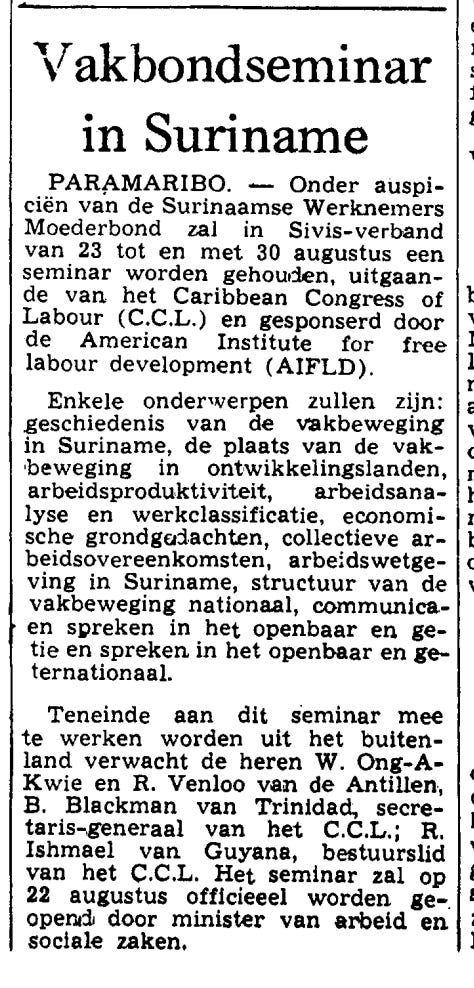
The timing couldn’t have been more convenient. While Daal and Haakmat were meeting with CCL officials in Bridgetown, NATO warships were conducting “Operation Safe Pass” in Caribbean waters—naval exercises so provocative that Grenada’s Prime Minister Maurice Bishop denounced them as “a threat to peace” just days later.95 The U.S. Embassy in Barbados was monitoring regional reactions closely enough to cable Washington within hours of Bishop’s March 18 Caracas press conference. If Barbados served as the intelligence hub for tracking Caribbean political developments, the same infrastructure would have been watching Suriname with equal attention.
The Moederbond’s regional labor connections gave Daal and Haakmat perfect cover. They weren’t fleeing—they were attending legitimate union business at the headquarters of an organization affiliated with the International Confederation of Free Trade Unions. Nobody would question labor leaders traveling to Barbados for CCL consultations. But the island they’d chosen happened to be the same place where Tony Kern ran AIFLD’s Caribbean operations, where U.S. naval exercises were demonstrating American military reach, and where embassy political officers were tracking every move by leftist governments in the region.
This was the methodology working exactly as designed. In Grenada, Searle documented how AIFLD positioned its assets: cultivate the labor leaders, use them to mobilize public pressure, create conditions for the military strike, then ensure they survive to anchor the post-coup government. Daal and Haakmat weren’t fleeing. They were positioning—the civilian track of the operation moving to safety while the military track prepared to strike.
What Daal and Haakmat did in Barbados during those critical days wouldn’t become clear until much later. But we know this: they met with Burns Bonadie, the CCL’s Secretary-General, and reported on the deteriorating situation in Suriname. They requested that a sharp motion condemning Bouterse’s military dictatorship be prepared—but held in reserve. More importantly, they discussed a contingency plan that went far beyond symbolic condemnation.96
The plan was simple and devastating: if Bouterse cracked down on the democratic movement, the CCL would organize a boycott of Surinamese bauxite shipments through Trinidad’s ports. Suriname’s economy rested on two pillars—Dutch development aid and bauxite revenue. Cut off both, and the regime would collapse within weeks.
The CCL President made Daal a promise: “The motion remains in my drawer. As soon as we get a signal from you, we will come together again and we will not only adopt this motion, but also support you with all the means at CCL’s disposal.”97
We know the exact words of that promise because ten months later, when Daal was dead and everything had gone catastrophically wrong, Haakmat would return to this same office in Bridgetown to remind the CCL President of what he’d said. “
The support you promised then is now needed,” Haakmat would tell him in January 1983, at the urging of his American contacts. “It should consist of a boycott of all bauxite ships from Suriname to bring down the regime.”
But in March 1982, the favor stayed in the drawer—a loaded gun, waiting to be fired.
If the coups succeeded, Daal and Haakmat would return to Suriname as civilian leaders of the new democratic government, backed by international labor solidarity and positioned as the democratic alternative Washington could support.
If the coups failed and Bouterse retaliated, they’d activate the economic weapon that could strangle his regime.
This wasn’t extraction to safety. This was strategic positioning—establishing the infrastructure to topple a government through economic isolation if military force wasn’t enough.
Sometimes survival means knowing when not to show up.
Sometimes it means having friends in Barbados who keep loaded guns in their desk drawers.
The Nijmegen Denial
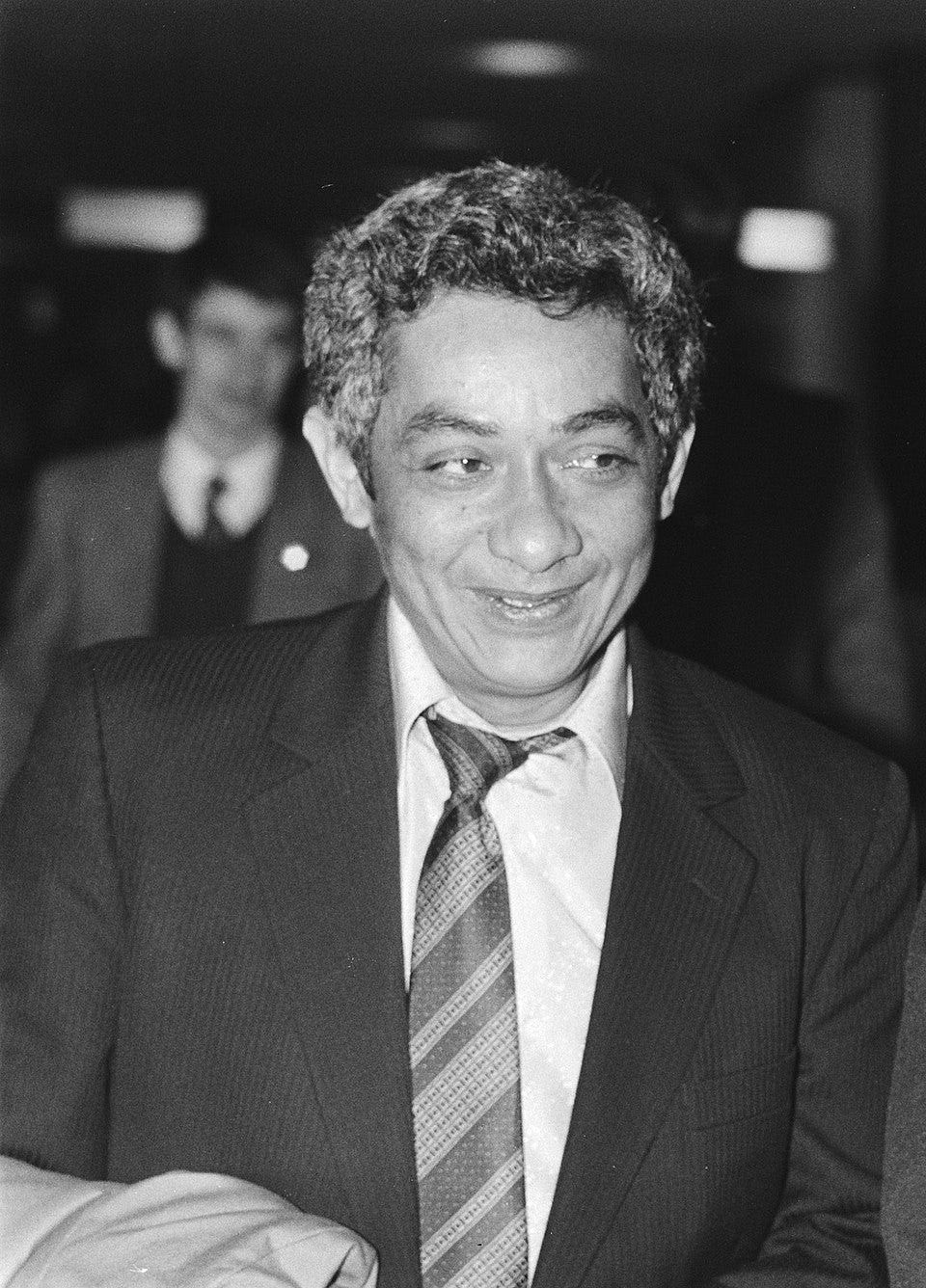
Chin A Sen, meanwhile, surfaced in the Netherlands almost immediately after the failed coup — giving an interview that seemed designed to permanently sever his ties to the resistance.
On April 3, 1982, the Dutch newspaper De Stem reported that Chin A Sen had been spotted walking in the city center of Nijmegen.98 Unlike the rumors of clandestine meetings, his stated reason for being there was mundane: he was visiting his daughter and “celebrating vacation” (vakantie viert) to blow off steam after his presidency.
However, beneath this “private citizen” cover story lay a different reality. In the same interview, Chin A Sen admitted to a move that contradicted his claim of a simple family visit: upon arrival, he had formally contacted the Dutch government. “I announced my arrival to the Ministry of Foreign Affairs in The Hague,” he told the reporter, “with the request that they keep the matter as secret as possible. Until today, that succeeded very well.”
This was not the behavior of a retired doctor on vacation; it was the protocol of a political asset coordinating with a foreign power. By honoring his request for secrecy, the Dutch Foreign Ministry was effectively shielding the ousted president while maintaining official diplomatic relations with the Bouterse regime.
The Hague Connection
But the Ministry meeting was only half the story. The timeline reveals that while Chin A Sen was supposedly in transit or “vacationing” in the U.S., a political infrastructure was already being assembled for him on Dutch soil.
In February 1982—immediately following Chin A Sen’s forced resignation on February 4—the Action Committee for the Restoration of Democracy in Suriname (Actiecomité Herstel Democratie Suriname) was established in The Hague99. Led by Rob Wormer and linked to former politicians like Rudolf L. Jankie, this group didn’t just issue press releases; they mobilized. By March, while Chin A Sen was claiming to be “shocked” by events from afar, this committee had already organized a mass demonstration in The Hague, effectively creating a platform for the exiled president before he even stepped onto the stage.
The Military Muscle: Roy Bottse
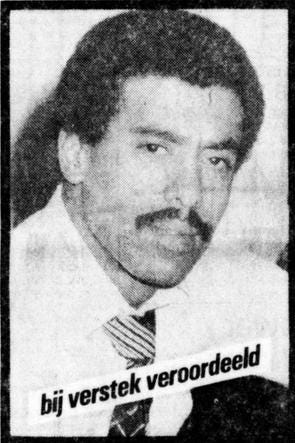
Crucially, the Committee wasn’t just a collection of civilian exiles. One of its founding members brought precisely the kind of military pedigree and intelligence connections required for a counter-coup: Roy Bottse.100
A former lieutenant in the Surinamese army and an Olympic athlete, Bottse was the bridge between the political opposition and the shadowy world of Dutch military intelligence. His relationship with The Hague was complex and longstanding. In late 1979, before the Sergeants’ Coup, Colonel Hans Valk—the head of the Dutch Military Mission—had actively tried to recruit Bottse to overthrow the Arron government, telling him he was the “designated person” to seize power. When Bottse refused, Bouterse eventually took the initiative, leading Valk to reportedly remark: “I told you so, Roy, you didn’t want to believe it and you see it.”101
By 1982, Bottse had evolved from a recruitment target to a key operational player. After fleeing to the Netherlands, he became a source for the LAMID (Dutch Army Intelligence), providing explosive debriefings on Colonel Valk’s interference in Surinamese politics.102 But rather than being sidelined, he became the military engine of the Action Committee. Later (post-December Murders), under the cover of a front organization called “Andes Medical Aid,” Bottse began recruiting ex-commandos from the Dutch Korps Commandotroepen (KCT)—ostensibly for medical transport, but in reality for paramilitary operations.103
But the connection between the two men went deeper than just telegrams. Before returning to Suriname, Rambocus had spent his exile in Utrecht, claiming to be studying law. In reality, he was frequently meeting with Bottse. Both men had graduated from the same military academy, where Bottse had even been named “student of the year.” Bottse later tried to make these meetings sound innocent, saying
He often came to see me during that time, but he remained an honest but inscrutable boy to me. Last year he returned to Suriname , after President Chin A Sen had granted a request to lift his exile. I never suspected for a moment that he would ever want to carry out a coup. That he would have done so to serve a Hindustani interest is nonsense. His motive was resentment against the non-commissioned officer Bouterse, who had taken away his officer stars.104
It was a perfect excuse: admitting they met while denying any plot. Yet, the image of the two smartest military minds of their generation meeting regularly suggests these weren’t just friendly visits. It was likely the time when Rambocus’s theories on how to stage a coup met Bottse’s ability to actually make it happen.
After the Rambocus Coup, Bouterse would single out his old friend, Roy, for complicity in the Rambocus Coup. The commander could not confirm whether Rambocus had received foreign assistance for his coup attempt.
However, he did say that Rambocus had called the abroad-based soldiers Bottse and Wirth, because a telegram of congratulations was sent from them, and the post office in Albina had been ordered to let messages for Roy Bottse and Jeff Wirth pass unhindered.105106
His presence in the Action Committee changes the complexion of the organization entirely. It wasn’t just a protest group; with Bottse involved, it was a government-in-waiting with a dedicated recruitment officer targeting Dutch special forces veterans for a return to Paramaribo.
A Synchronized Operation
The sequence of events suggests a synchronized operation rather than a series of coincidences:
- Feb 4: Chin A Sen is forced out.
- Feb: The Action Committee forms in The Hague to protest the ouster.
- March: The Committee organizes mass protests in The Hague.
- April: Chin A Sen surfaces, admitting he had secretly coordinated with The Hague’s Foreign Ministry upon arrival.
The “Action Committee” wasn’t a spontaneous reaction; it was the advance team.
In the interview, Chin A Sen constructed a meticulous defense against accusations of involvement in the March coup. He claimed he had been in San Francisco when the violence erupted and was “enormously shocked” by the news. More importantly, he used the platform to declare his permanent exit from the arena, stating:
“I am returning to the medical world, they won’t see me in politics anymore.”
The statement was a strategic necessity. With the Rambocus coup crushed and Wilfred Hawker executed, distancing himself from the operation was a matter of survival. Yet, the location of his “withdrawal” was telling. Nijmegen was not merely a quiet university town; it was a polarized hub of the Surinamese diaspora, home to both radical student movements and the growing pro-Bouterse counter-movement, the League of Surinamese Patriots.
The “retirement” proved to be short-lived. Despite his public pledge to return to medicine, Chin A Sen would shortly re-emerge not as a doctor, but as the chairman of the Council for the Liberation of Suriname—uniting the very factions that had been preparing his way in The Hague. The Nijmegen interview wasn’t an exit; it was an alibi—a calculated pause, facilitated by Dutch diplomatic cover, to survive the immediate backlash before reorganization.
And the men who stayed inside Suriname—the operational cadre—were the ones who would throw the uppercut.
The uppercut would come in three stages.
First, a temple ambush during Holi—the festival of new beginnings. If that failed, a strike at the presidential palace during Phagwa celebrations. And if all else collapsed, a direct military assault on the barracks themselves.
They started with the temple.
The Strategic Calculation
Rambocus understood the dilemma. Every officer who studies coup theory knows it: a barracks-versus-barracks confrontation is the riskiest move a dissident force can attempt. It had already failed once — Sergeant Major Wilfred Hawker’s March 1981 uprising ended with his imprisonment and his men scattered. If you rolled the dice again head-on, you needed surprise, overwhelming force, and a political narrative strong enough to win the population before the regime regained its footing.
The alternative was the classic counter-coup approach: combine a precise military action with a civilian flashpoint capable of generating legitimacy in real time. That required timing, symbolism, and a cultural event large enough to mask movement and accelerate mass mobilization.
Holi — Phagwa — offered all three.
March 1982 was Holi season.
Holi—known as Phagwa in Suriname and the Caribbean—is the Hindu festival of colors. The celebration of spring, the triumph of good over evil, the burning away of the old and the welcoming of new beginnings.
In 1982, the festival fell on March 9-10. Holika Dahan, the ritual bonfire, would be lit on Tuesday evening, March 9. Rangwali Holi, the main public celebration with colored powders and water, would explode across Paramaribo on Wednesday, March 10.107
But here’s what made March 1982 different from every other Holi: something brand new was happening in the Hindustani community.
The Shrimatie Prantiek Arye Pratinidhi Sabha Mandir—a major new temple dedicated to Lord Vishnu—had just opened in February 1982 along the Pad van Wanica (now Indira Gandhiweg).108
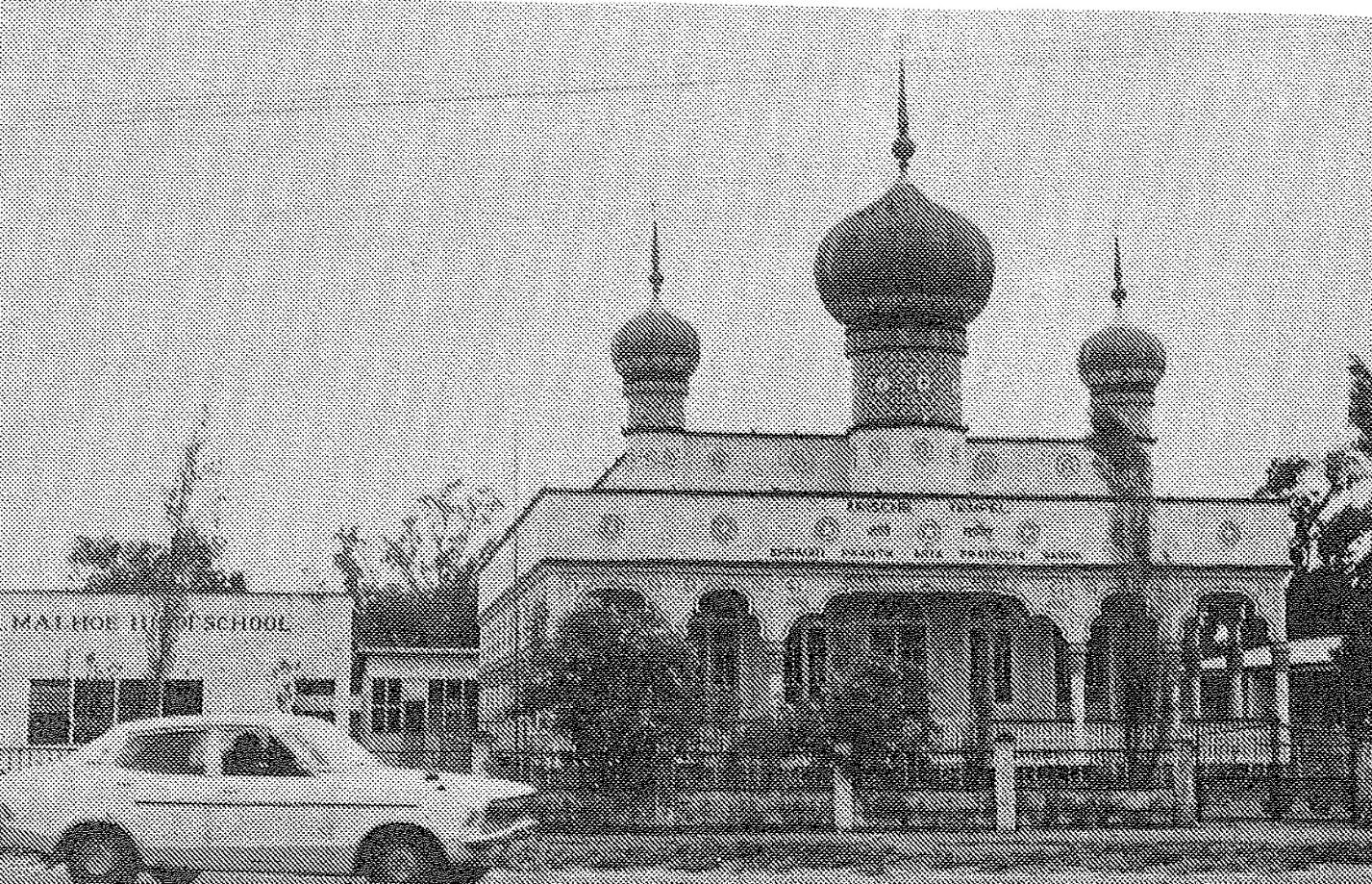
Think about the strategic significance of that timing. A brand-new temple, founded just weeks before the biggest Hindu festival of the season. That temple’s grand opening, its inaugural celebration, would obviously be scheduled to coincide with Holi.
For Rambocus, this was perfect.
The strategic brilliance lay not just in the crowd size, but in the profound religious symbolism of the festival itself. Holi, or Phagwa as it’s known in Suriname, is fundamentally a victory festival: the divine Prahlad’s triumph over the ungodly Holika. By choosing this date, Rambocus and Oemrawsingh were attempting to frame their military action not as a mere coup, but as a moral and cosmic restoration. They sought to equate the military regime with the evil Holika that must be burned away, positioning their ‘National Liberation Council’ as the new beginning promised by the spring and the New Year. For the Hindu community, where religion and culture are inseparable, this symbolism was the ultimate legitimizing force.109
A large religious festival at a major temple offered exactly what a populist counter-coup needed. Crucially, the extreme nature of the Temple Plot was a fallback. Lieutenant Surendre Rambocus’s initial ideal, as confirmed by his confidant Manorith Doerga, was far more humane: “Arresting the entire army leadership at once and bringing them to trial” was his ideal, with blood only to be shed “as a last resort.” The goal was justice, not simple vengeance.110
1. Cover: A massive, festive civilian crowd would provide ideal camouflage for the assembly of plotters, military defectors, and civilian supporters. Thousands of people moving through the streets, gathering at temples, celebrating in homes. Who would notice a few dozen men positioning themselves for action?
2. Mobilization: It provided a single, concentrated audience for a populist appeal. Imagine: military officers announcing from the temple that they’ve overthrown the dictatorship, that democracy is being restored, that the people need to support this new beginning. In one dramatic stroke, you could ignite the opposition.
3. Symbolism: Launching a “liberation” from a religious center would frame the counter-coup not as a mere power grab. This made the coup look like a just and popular action. They framed it as restoring morality against a military regime they called godless. And doing it at a brand-new temple during Holi—the festival of new beginnings? The metaphor was perfect.111
The location mattered too. The temple was on the Pad van Wanica—now called Indira Gandhiweg—a critical artery connecting Paramaribo with the Wanica district. This road was the heartland of the Hindustani community. Muslim associations had relocated mosques there specifically because that’s where the population was concentrated.112
By targeting this temple during the inaugural Holi celebration, Rambocus was placing his operation directly in the geographic and cultural center of the community whose support he needed to win.
This wasn’t just an assassination plot. This was revolutionary theater designed to trigger a popular uprising.
The invitation itself was a masterpiece of camouflage.113 It announced a “2de Bijzondere Gebedsdienst” — the second special prayer service — ostensibly to “support our leaders” in their work for laborers and the socially vulnerable. It ended with the deceptively simple line: “Aanbieding drankje – hapje en gelegenheid tot kennismaking.” Drinks, snacks, and an opportunity to get acquainted.
That final phrase was the window. It was during that informal mingling — with military leadership relaxed, social defenses lowered — that the attack would begin.
But the temple wasn’t the first choice. It was the fallback.
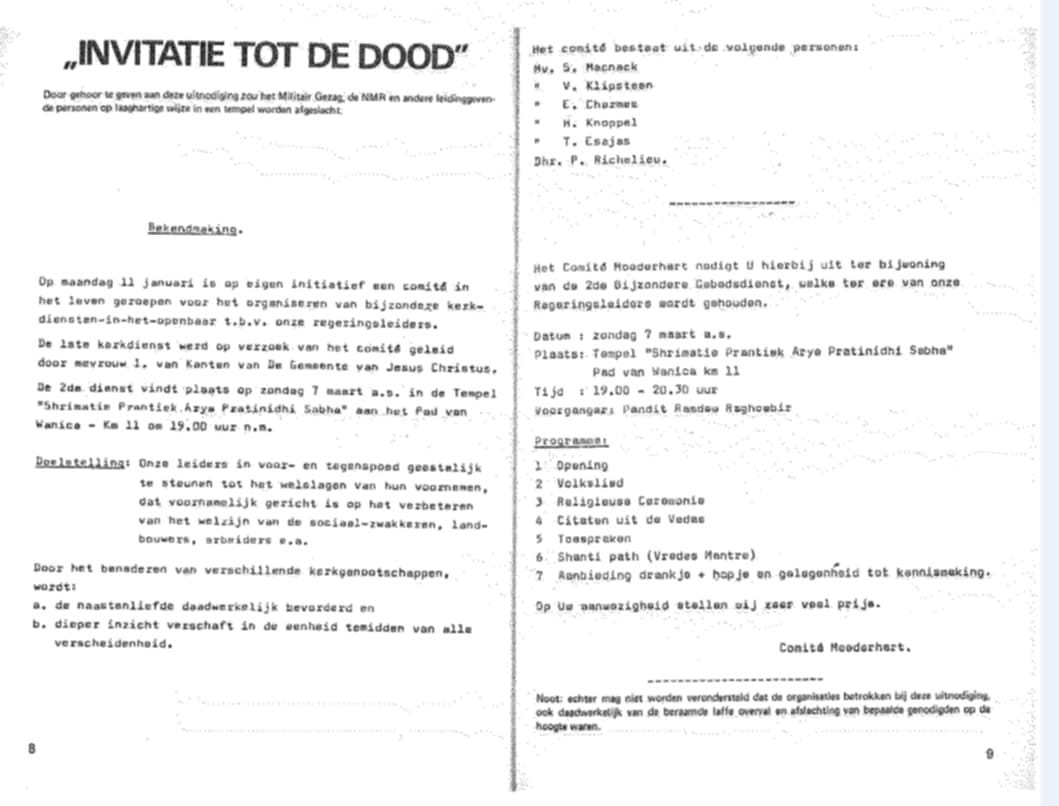
March 7-10: Holi Week
The Original Plan: Dragtenweg
According to Sergeant Sheombar’s interrogation—the army instructor who later walked Military Police through the entire operation on a blackboard like he was teaching a normal lesson—the Temple Plot wasn’t the original plan.114
The first kill zone was supposed to be Anton Dragtenweg.115
Think about what that location offered: critical proximity to Fort Zeelandia and the Presidential Palace. A 3-5 minute drive. Maybe less. You could eliminate the entire military leadership at a party, then have assault teams roll straight into the seat of power before anyone at the barracks even understood what was happening. Simultaneous decapitation and seizure. Clean. Fast.
But logistical hurdles forced a desperate pivot.
Maybe the party fell through. Maybe the targets changed their schedule. Maybe someone got nervous and pulled out. Whatever the reason, the resistance needed a new venue—and fast. The Holi celebrations provided the perfect cover for the adaptation.
The Pad van Wanica temple became Plan B. Less centrally located, yes. But it offered something Dragtenweg couldn’t: a controlled environment under the guise of a civic and religious “prayer service” to which the entire National Military Council and Army Commander Desi Bouterse had been formally invited.116 A legitimate gathering. Official attendance. Predictable positioning.
That pivot—from opportunistic party ambush to carefully staged temple reception—shows operational sophistication under pressure. These weren’t amateurs improvising. They were trained soldiers adapting to changing conditions the way special operations teams are taught to do.
The Kill Box: Architecture of an Ambush
The operational plan that Sheombar sketched on that blackboard, supplemented by regime investigation files and CIVD operative Marcel Oostburg’s site inspection, reveals a multi-layered “kill box” designed to ensure no one left the temple grounds alive.
Layer 1: The Interior Trap
Inside the temple, the plotters arranged a specific row of chairs against a wall lined with large windows. This was the designated VIP seating—positioned to honor the military leadership, but actually positioning them as stationary targets. Backs to the windows. Facing inward toward the ceremony. Contained.117
The geometry mattered. When you’re sitting in a row of chairs against a wall, your movement is restricted. You can’t dive left or right—there are people on both sides. You can’t move backward—there’s a wall. Your only options are forward (into the crowd, creating chaos) or down (presenting a smaller target but staying in the kill zone). Either way, you’re trapped.
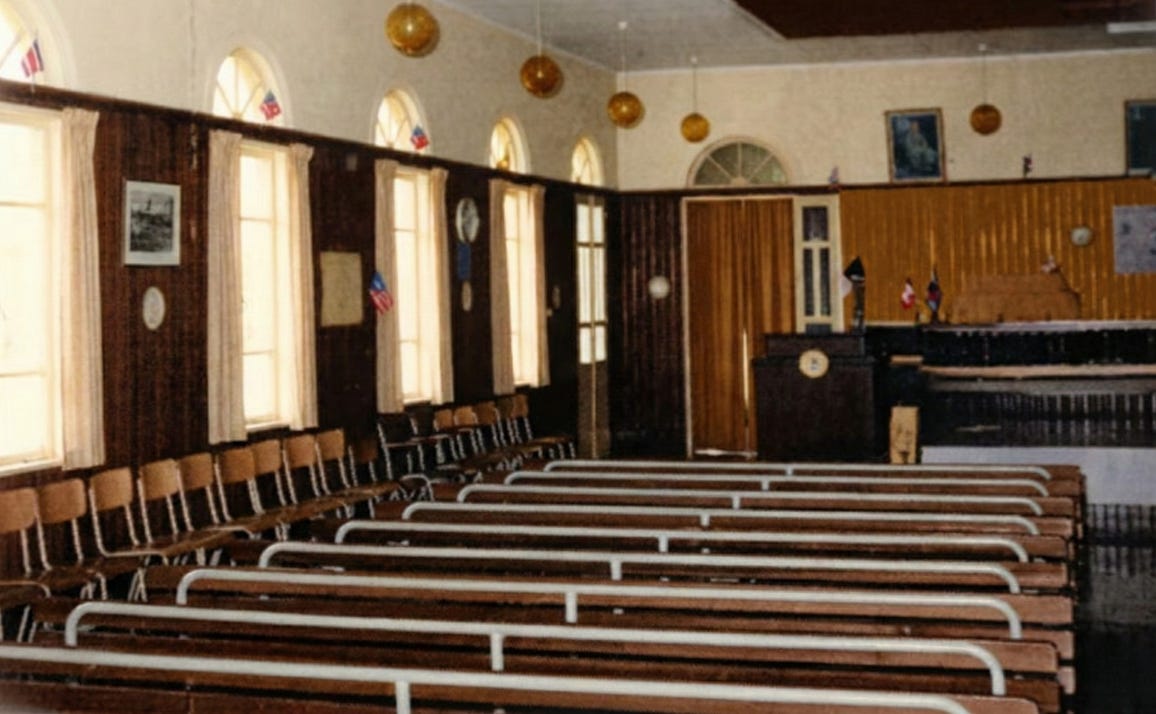
Layer 2: The High Ground (Position “B”)
Directly adjacent to the temple stood the Shri K. Malhoe High School. Regime tactical diagrams identified a shooter—some accounts name Paul Somohardjo, others suggest Jiwansingh Sheombar himself—positioned in the school’s loft. This became “Position B” in the operational plan.118
From that elevated vantage point, the shooter had a commanding line of fire through the temple’s large windows, directly into the backs of the seated leadership. The windows that were supposed to let in light became firing lanes. The VIP chairs that were supposed to honor the guests became a shooting gallery.
This is classic L-shaped ambush doctrine: interior crossfire from ground level, exterior fire from elevation. Overlapping fields of fire. No dead zones. Military textbook execution.
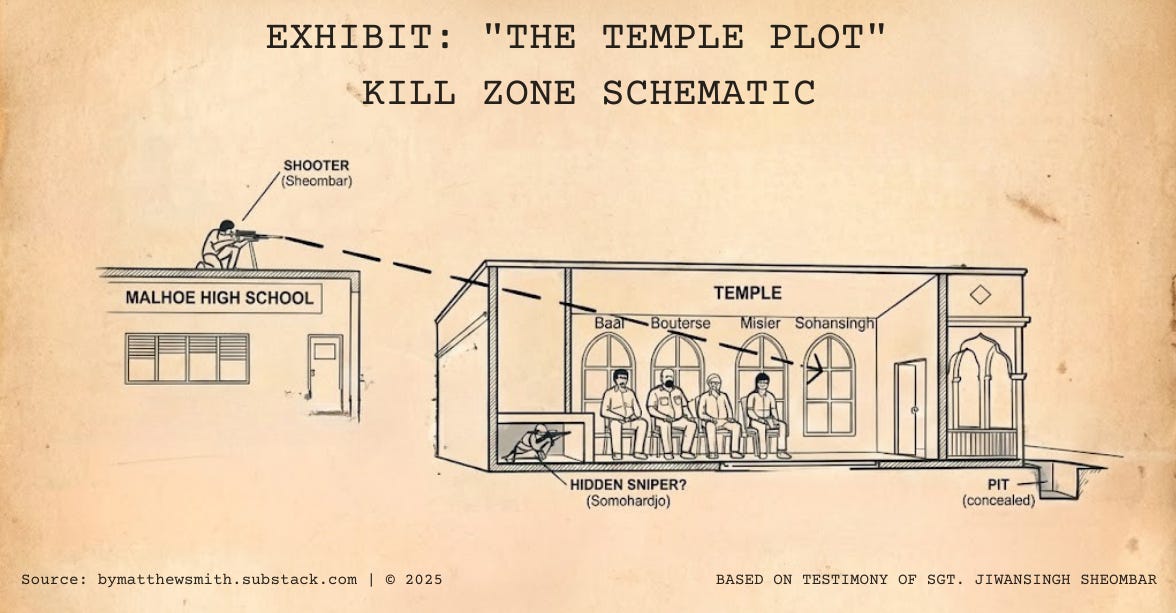
Layer 3: The Chokepoint
The temple’s rear exit—the route people would instinctively use during panic, the “safe” escape away from gunfire—had been converted into what the regime later called a “fatal funnel.” De Revolutie Overwint states explicitly: “from this backdoor, the temple visitors would have been led away to be slaughtered.”119
A second team was positioned in the courtyard behind the temple. Anyone who made it out the back door would run straight into them. The geometry ensured there was no escape—just a choice of which kill team would get you.
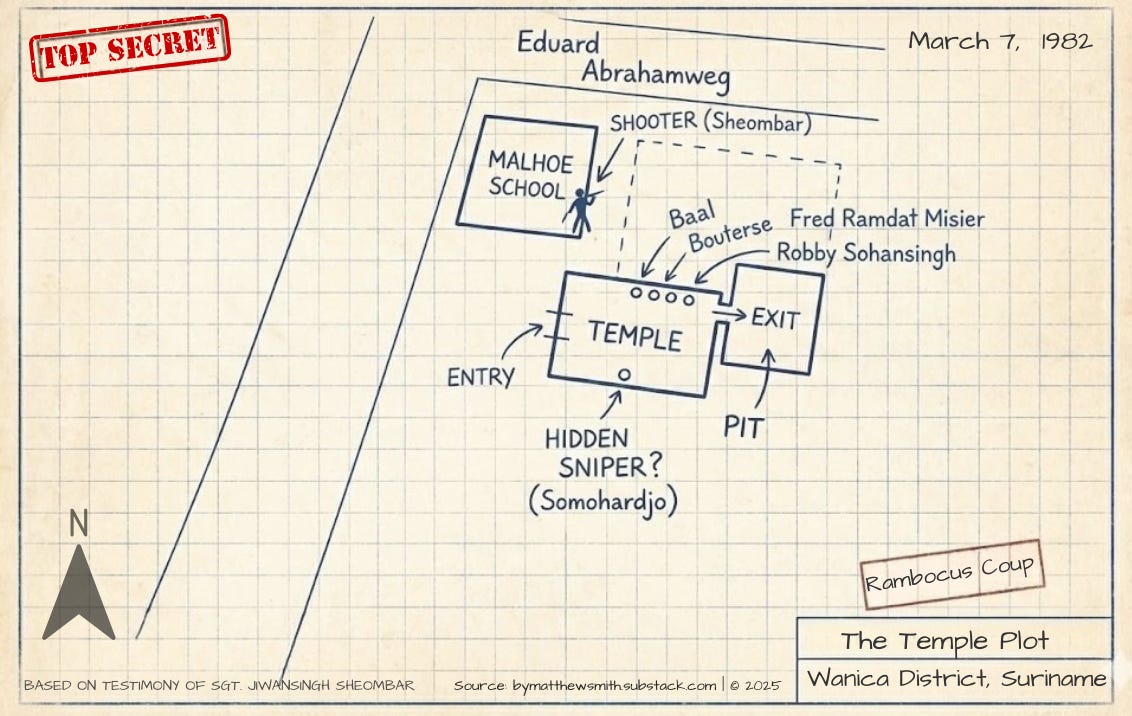
Layer 4: The Exterior Trap
After the coup failed and authorities began investigating the site, Marcel Oostburg—identified as member of the “security service”120 and later as a prominent CIVD operative who reported directly to Bouterse121—inspected the temple grounds personally. What he found added a fourth layer to the containment system.
Oostburg discovered a “very good, deep pit” dug into the access road leading to the temple. It had been carefully camouflaged with leaves and debris—invisible to vehicles approaching in the dark or during chaos. He identified it explicitly as a vangnet, a trap designed to disable any vehicles attempting to flee the kill zone.122
Think about what that reveals. This wasn’t just about shooting people in a building. The plotters had war-gamed the entire scenario: What if some targets arrive in armored vehicles? What if they try to drive away when shooting starts? How do we prevent any vehicle from leaving this site?
The pit was their answer. Even if you made it out of the temple, even if you got past the courtyard team, even if you reached your car—you weren’t driving away. The road itself had been weaponized.
Even the regime’s own intelligence apparatus, examining the site afterward, had to acknowledge what the resistance had engineered: a total containment zone. The Moederhart temple had been converted into a kill box with no exits.
The Two-Pronged Attack: Poison and Lead
But the architectural trap was only half the plan. The plotters feared that even with perfect positioning and overwhelming firepower, a straightforward assassination might fail. What if the targets wore body armor? What if security spotted the weapons? What if someone raised the alarm before the shooting started? Not to mention Bouterse was an athlete— professional basketball player, martial artist, boxer— he wasn’t going down without a fight.
So they created a backup. Use drugs to knock out the targets, then use guns if that failed. They’d try this same plan again at the Phagwa celebration at Oemrawsingh’s house.
Plan A: The Silent Killer
Manorith Doerga— a nearly graduated doctor, Rambocus’s confidant and fellow conspirator—was tasked with preparing poisoned drinks to be served to the dignitaries upon their arrival.123 This wasn’t crude arsenic or obvious toxins. The goal was controlled incapacitation: render the leadership unable to fight back, unable to call for help, unable to flee.
This is where Professor Baal Oemrawsingh’s biochemistry expertise moved from academic research to applied pharmacology. The man who’d spent years studying catecholamines and stress markers, who’d lectured on serotonin and biological psychiatry, who’d hosted ALCOA-funded symposiums on “pathological manifestations of human behavior”—that knowledge became operational.124
Drinks and snacks would be served during the “gelegenheid tot kennismaking”—the opportunity to get acquainted. Social protocol. Hospitality. Nothing suspicious. The leadership would accept refreshments as a matter of course. And within minutes, they’d be physically compromised.
Plan B: The Bloodbath
If the poison failed—if targets refused drinks, if someone noticed symptoms, if the chemistry didn’t work fast enough—the signal would be given for the shooters to open fire.
The arsenal was crude but devastating: sawed-off shotguns for close-quarters massacres, rifles for distance, a .38 revolver for finishing work, and offensive hand grenades to ensure total elimination.125 The regime later displayed these weapons at press briefings, trying to paint the resistance as a “burgermaffia”—a civilian mafia playing at war.
But the geometry of the kill zone told a different story. Interior crossfire. Exterior elevated position. Chokepoint ambush. Vehicular trap. This wasn’t improvisation. This was doctrine.
And there was one more piece of the operation that the regime later highlighted in their propaganda, though the details remain murky.
According to De Revolutie Overwint, specialized orders were given to Baal Oemrawsingh and Robby Sohansingh to “flank and abduct the President” amidst the chaos.126 Now it is possible this was originally meant Henk Chin A Sen—but he’d been forced out on February 4 and was already in exile. The target would have been Acting President Fred Ramdat Misier, who the plotters allegedly planned to spare during the main assault.
Why spare him? Two possible reasons, both strategic:
First, the family connection. Remember that Line Oemrawsingh Ramdat Missier—Baal’s aunt by marriage—shared that uncommon surname with the Acting President. Whether Fred Ramdat Misier was a close relative or a distant cousin has never been definitively established, but the surname cluster is tight enough that a family relationship is plausible. Protect family, even during a coup.
Second, the legitimacy problem. The National Liberation Council couldn’t just murder everyone and expect international recognition. They needed a civilian figurehead—someone who could sign documents, make official requests for assistance, provide legal cover for what came next. An Acting President, rescued from the military strongmen who’d been controlling him? That narrative could work.
Whether they planned to extract Ramdat Misier to safety or simply shield him during the massacre, the strategic logic is clear: you can’t seize power in a vacuum. You need someone who can pick up the phone and call Washington.
The Collapse
The elaborate trap failed not due to operational incompetence, but absence.
On Sunday, March 7, 1982, the hit squad lay in wait. Shooters on the school roof at Position B. Courtyard team behind the rear exit. Doerga with his poisoned refreshments. The pit trap camouflaged on the access road. Everything ready.
But only two minor members of the NMR—Nankoesingh and Cederboom—arrived for the temple service.127
The shooters held their fire. The objective was a “clean sweep” of the entire command structure: Bouterse, Horb, Fernandes, Sital, Neede, Mijnals—the six men who made up the core of military power. Killing two low-ranking officers would only alert Bouterse at Fort Zeelandia without removing his ability to retaliate.
Professional operators know this calculation: if you’re going to attempt a decapitation strike, you have to actually decapitate. A partial kill just hardens the target and exposes your network.
The Temple Plot was aborted.
But the plotters had built all that infrastructure for a reason. They’d surveyed the site, dug the pit trap, positioned the shooters, tested the sightlines, recruited Doerga, prepared the chemicals. They weren’t going to let the Holi window close without one more attempt.
The festival wasn’t over. They had three more days.
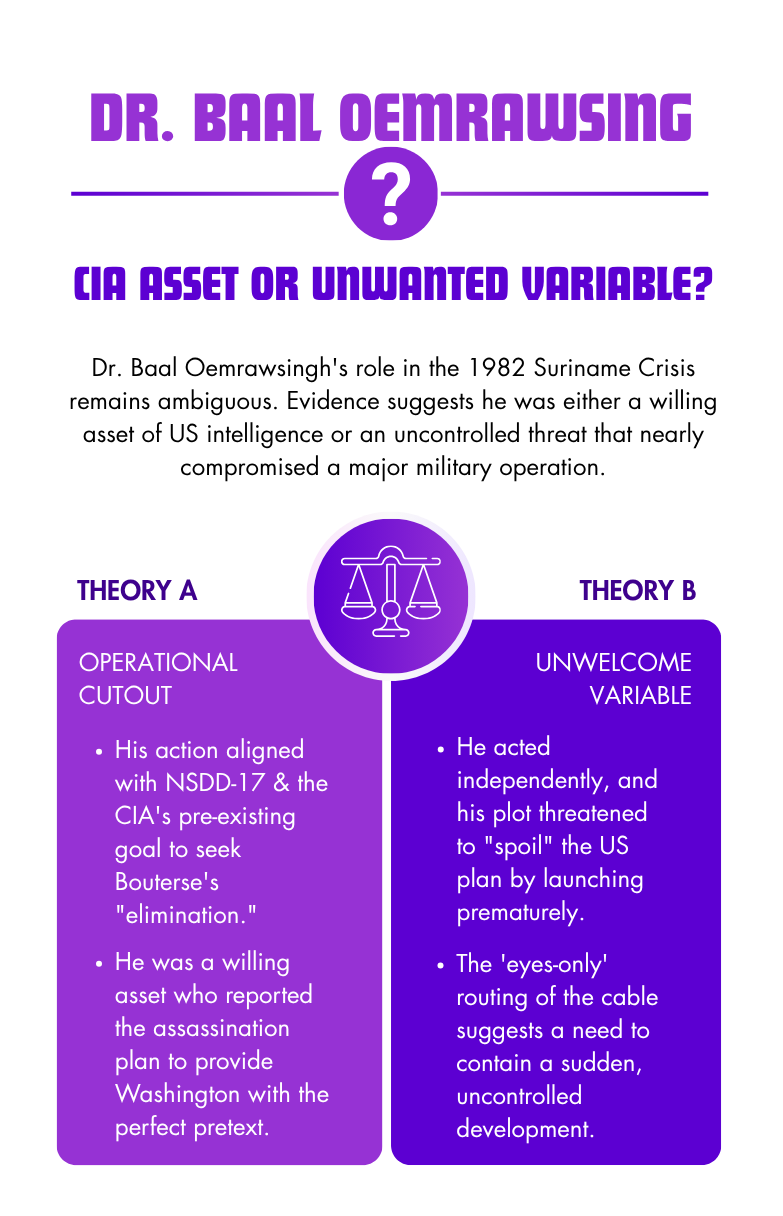
The Phagwa Plot
March 7 failed. But Holi wasn’t over. They had one more shot at riding the same cultural wave—just from a different angle.
Phagwa offered one more window. The regime would be on display: public receptions, ceremonial gestures, the leadership clustered together in predictable spaces. If the commanders wouldn’t walk into the Pad van Wanica kill zone, maybe they could be hit from inside their own celebrations.
The backup plan, as later reconstructed in De Revolutie Overwint, had two stages.
Stage One: Presidential Palace (Morning)
On March 10, the presidential Phagwa reception turned the palace into a theater of unity. Acting President Ramdat Misier, Commander Bouterse, Fernandas, Horb—most of the National Military Council—were there, receiving guests, posing for photographs.
So was Baal Oemrawsingh.
One regime photo caption identifies him explicitly—“counter-revolutionary Baal Oemrawsingh (third from right)”—standing in the reception line among the very men he’d been helping to target. The palace that afternoon wasn’t just a stage for national harmony. It was also, for a few hours, a live reconnaissance site for the people planning to bring the regime down.
The initial backup called for armed men in civilian clothes to force their way into the presidential palace during daytime Phagwa celebrations. Foreign diplomatic representatives would be present—providing both witnesses to the “democratic uprising” and de facto human shields against overwhelming military response.
The mission objective remained consistent: take military leaders prisoner, but only after Memre-Boekoe Barracks was secured. The sequencing was critical—control the military installation first, then grab the leadership, then announce the National Liberation Council’s formation from a position of actual power.128 The same two-pronged methodology from the Temple Plot was ready to deploy: poisoned refreshments for incapacitation, firearms for the final kill. The only difference was the venue.
According to the regime’s later account, Baal twice phoned the Bharos residence on Tourtonnelaan that day—a key gathering point for the “mercenaries and killers.” He told the men waiting there that the opportunity was “ideal,” because the leadership at the palace kept standing together.129
The next phase of the plan depended on more than just a gun team. It hinged on two bribed YP armored-car drivers who were supposed to deliver the vehicles needed to move on “military objects” once the leadership was neutralized.
Those drivers never appeared.
Without them, the palace phase couldn’t be executed. You can’t credibly seize a capital with a few cars and small arms when the route runs straight past barracks and checkpoints. The failure of the YP link—two men whose names never make it into the public record—quietly killed Stage One.
Stage Two: Oemrawsingh’s House (Evening)
When the palace didn’t turn into a kill zone, Baal pivoted to a third strike: bring the leadership to him.
That same evening he pressed members of the NMR and Army Command to come to his house on Tourtonnelaan for a Phagwa gathering. The same two-pronged methodology from the Temple Plot was ready to deploy: poisoned refreshments for incapacitation, firearms for the final kill. The only difference was the venue. Otherwise, It would look like what it had always been—a professor’s home, a cultural celebration, drinks and food at t he end of the festival. According to the regime narrative, marksmen were already positioned at both corners of the street, waiting to open fire when the cars pulled up and the officers stepped through the gate.
They never did.
One council member, exhausted, reportedly fell asleep. The others waited, debated, and then decided not to go. In the regime’s telling, one collaborator quietly slipped away and “averted” the danger by warning them. Whether that’s true, or whether fatigue, paranoia, or simple caution kept them away, the effect was the same as on March 7: the leadership cluster the entire operation depended on never entered the trap.
Only after the March 11 coup failed did the authorities move through the network methodically—arresting suspects, interrogating them, and searching houses. Lt. Abrahams displayed a stack of Valium ampoules and syringes at a regime press briefing—hard proof the plotters intended to sedate targets during what appeared to be a benign Phagwa gathering. Whether that pharmaceutical knowledge came from Baal’s scientific background, his Dutch research contacts, or something darker, the methodology was consistent: controlled incapacitation before lethal force.130
Here’s where regime propaganda later went into overdrive. Lieutenant Abrahams publicly claimed the resistance had ties to “individuals previously involved in Jonestown,” trying to paint democratic opponents with the most toxic association imaginable.
It was theatrical, politically useful, and almost certainly exaggerated. But it also wasn’t conjured from thin air. Jonestown’s shadow world of fixers, logistics handlers, and border-crossing “consultants” didn’t vanish when 918 people died in that Guyanese jungle in 1978. Suriname sat barely a few hundred miles from the former Peoples Temple site. The networks—the people who knew how to move things quietly across porous borders, who maintained contacts with paramilitary operators, who understood how covert logistics worked—some of them were still around.
The regime was exploiting a grain of plausibility to sell a mountain of distortion—weaponizing the region’s darkest history to frame the resistance as d eranged rather than disciplined.131132
Whether Abrahams had real intelligence or was crafting propaganda, the reference was deliberate. Jonestown was still fresh in the world’s memory. Over 900 people dead in the jungle, many of them drugged before they died. Now here was a biochemistry professor, allegedly planning to use the same methodology against Suriname’s military leadership.
Even if it was 90% fabrication, that 10% of plausibility—Suriname’s proximity to Jonestown, the existence of cross-border networks, the documented use of sedatives in the plot—was enough to contaminate the entire resistance narrative in international media.
Like the Temple Plot, the Phagwa operation failed. The window was gone.
Bouterse and other primary targets never showed up at Oemrawsingh’s house that evening. Whether they’d been warned, whether they sensed danger, or whether they simply had other commitments, the result was the same.
Two carefully prepared Holi operations—one at a new Vishnu temple, one built around the palace and a professor’s house—had failed to bring the leadership into a kill zone. Security was tightening. Word of plots was circulating. The regime now had enough fragments to know something serious was underway.
And somewhere in the background—in Dutch files that wouldn’t surface until years later—there’s a reference to “Corporal Krishna Pershad Mohabir.” A Dutch diplomatic cable from March 23, 1982 cites a confession where Rambocus allegedly claimed the original plan came from this figure.133
Was Mohabir the architect and Rambocus the executor? Was the confession coerced? Was Rambocus protecting someone else, deflecting responsibility to a name that wouldn’t lead investigators back to the civilian plan ners safely abroad?134
We’ll never know for certain. What matters is the operational sophistication didn’t require a single mastermind. It required exactly what they had: Baal’s biochemistry knowledge for the chemical incapacitation, Hawker’s KCT training for the tactical geometry, Sheombar’s army instructor experience for recruiting and positioning the shooters, Rambocus’s Breda education in coup mechanics for understanding what the entire operation needed to achieve.
Rambocus came from a family of intellectuals. His siblings were doctors and lawyers. He’d studied at the Royal Military Academy in Breda. He wrote his thesis on how to stage coups. His philosophy was simple: “It should have been a coup without any deaths. If we turn it into fratricide, we’ll never gain the people’s trust.” When the Navy offered to blow up Fort Zeelandia, Rambocus refused: “I want them alive.”
But Corporal Mohabier had different ideas. He pushed for cannon fire on the fort. He wanted to use captured officers as human shields. After he escaped to the Netherlands, he sent Bouterse a telegram: “I’ll be back.” This wasn’t the language of someone planning arrests and trials.
The two-part plan—poison first, guns as backup—might have been a compromise. Rambocus wanted to arrest the leadership and put them on trial. That’s what Doerga said. But others in the group understood that revolutions get bloody. The poison let Rambocus keep control while the harder men knew they had a backup plan.
When Rambocus later blamed Mohabier for “the plan,” he might have been saying: “The KILLING plan was his idea. I wanted ARRESTS.” Or maybe he was protecting the civilian planners—naming a soldier instead of Oemrawsingh, Daal or Haakmat. Or maybe it was partly true.
Doerga’s final words about his leader explain why it failed: “He was a great man, but too humane. When you’re in charge of a coup, you can’t have too much compassion. That was Rambocus’ weakness.”
Desi Bouterse understood power differently. The pig farmer who’d never written a thesis had actually pulled off a coup in 1980. He didn’t hesitate about violence. When they shot Wilfred Hawker on his hospital stretcher, that was Bouterse’s way. When Rambocus refused to bombard the fort because “there are some of our people in there now too,” that was the intellectual’s way.
One approach survived. The other didn’t.
The plan still needed skilled people: Baal’s chemistry knowledge, Hawker’s commando training, Sheombar’s teaching experience, Rambocus’s academy education. But the fight over HOW to use those skills—gentle takeover versus lethal force—might be what killed them. Not one man’s failure. A group that couldn’t agree on what revolutions require.
The resistance had one option left. If they were going to move at all, it would have to be openly, with armor and small arms, against barracks and forts.
The festival cover was over. The next move would be war.
ACT VI: DESPERATION
After March 10
By nightfall on March 10, 1982, the resistance had run out of sophisticated options.
Three assassination attempts. All failures.
The Dragtenweg party that never happened.
The Temple Plot that collapsed because targets didn’t attend.
The Phagwa Plot—two venues, same methodology—failed for the same reason.
Someone was always one step ahead.
And worse—security was clearly compromised. Someone was warning Bouterse. Whether through intelligence penetration, diplomatic channels, or simple paranoia didn’t matter. The effect was the same: the approaches that should have worked weren’t working.
Professor Oemrawsingh faced a calculation that military officers throughout history have confronted: do you abort when conditions deteriorate, or do you pivot to more direct action before the window closes entirely?
He had promised Cornelis Keur advance warning before any action. But that was February 8, when they still thought they had time. When sophisticated approaches might work. When political coordination with civilian leaders like Haakmat and Daal seemed possible.
Thirty-one days later, none of that remained viable.
The body blows had landed. The civilian track was safely positioned abroad. But the uppercut kept missing.
There was one option left. Forget the sophisticated infiltration plans. Go direct. Military assault. Seize the barracks, take the key installations, announce the National Liberation Council, force a political crisis.
It was a desperate pivot from months of careful planning to rapid improvisation.
But here’s what’s remarkable: it almost worked.
—
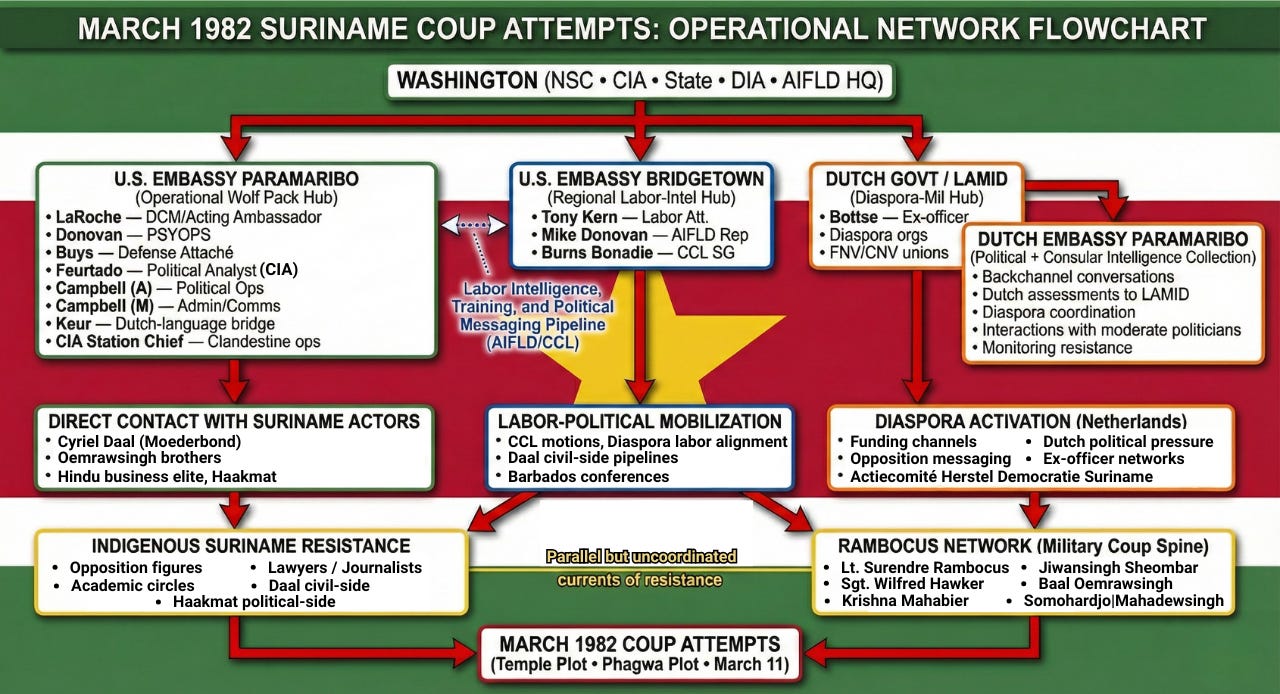
NEXT TIME: At 2:00 AM on March 11, 1982, Lieutenant Surendre Rambocus will stand outside Santo Boma prison with twenty men—about to throw the final punch.*
The uppercut that would prove, once and for all, who the Western powers were really protecting.
I’m Matthew Smith. Thanks for listening.
By Matthew Smith is a reader-supported publication. To receive new posts and support my work, consider becoming a free or paid subscriber.
END EPISODE 6
Next Episode: “The Authorization” – May 1981 through March 10, 1982: The presidential decision that enabled Rambocus’s return. Parallel American contingency planning during JSOC exercises at Hurlburt Field. Dutch intelligence monitoring and protective measures. Why three separate operations converged without coordination. And why the indigenous resistance never understood they were caught between intelligence services with incompatible objectives.
ENDNOTES
Leonid Brezhnev, “Brezhnev Speech to the 17th Trade Union Conference,” Foreign Broadcast Information Service-Soviet Union (FBIS-SU), March 16, 1982, R 1–9, quoted in Richard C. Thornton, “Korean Airlines Flight 007: Accident or Intelligence Probe?” Journal of Strategy and Politics 2, no. 3 (2020): 25 https://strategyandpolitics.org/wp-content/uploads/2020/06/jsp-7-thornton-kal-007-intelligence-probe.pdf
“President’s Speech on Military Spending and a New Defense,” The New York Times, March 24, 1983, 20, quoted in Richard C. Thornton, “Grenada: Preemptive Strike,” Journal of Military and Strategic Studies 11, no. 1/2 (Fall/Winter 2008/9): 9. https://ciaotest.cc.columbia.edu/journals/jomass/v11i1/f_0028145_22911.pdf
William P. Clark to President Ronald Reagan, Memorandum (Typed Draft), May 1983, Box 5, Folder [SURINAME 05/02/1983-05/18/1983], William P. Clark Files, Ronald Reagan Library, Simi Valley, CA. https://www.dropbox.com/scl/fi/792r5ernemsfu1bn51jk1/William-Clark-2095.pdf?rlkey=fa00f73xyry8ntzf3w75zpomn&st=hp34bnok&dl=0.
Thornton, Richard C. “Grenada: Preemptive Strike.” Journal of Military and Strategic Studies 11, no. 1/2 (Fall/Winter 2008/9): 1–42.
Ibid.
¹Bris Mahabier, “A Hindustani’s Search for His Cultural Identity,” Sarnamihuis (November 5, 2022), https://www.sarnamihuis.nl/bris-mahabier-nov2022/. The document explicitly details the two-way fracture: on one side, the Sanatani Hindus who prefer a Pandit who is a Brahmin by birth; and on the other, the reformist Arya Samaji Hindus who “openly and strongly criticized the birth-based privilege of the Brahmin group,” advocating for “the equality of all Hindus and humans.” This ideological clash over hierarchy often created friction in social practices, such as the Arya Samaji promotion of samlit bhojan, “the joint consumption of a festive meal by Brahmins and non-Brahmins as a sign of equality.
U.S. Embassy Paramaribo, Telegram No. 0251, to Secretary of State, Washington D.C., SECRET PARAMARIBO 0251, Subject: Report of Possible Imminent Coup, February 8, 1982. Declassified U.S. Department of State, Case No. F-2012-32749, Doc No. C05267142 (Signed by R. LaRoche).
Key Contextual Points Derived from the Cable:
- Asset Status: The primary informant was Dr. I. Oemrawsingh (Hindustani Professor and former VHP MP), described as a “long time friend” of Consular Officer C. Keur. Oemrawsingh was accompanied by “his brother” (Sugrim), indicating a family commitment to the plan.
- Intelligence Contact: The Embassy confirmed Oemrawsingh “called on Chargé [LaRoche] on January 5” to discuss the status of the VHP, showing high-level contact with the Chief of Mission well before the plot was revealed.
- The Plan: Oemrawsingh outlined a coup to be staged “PROBABLY TONIGHT OR AT LEAST IN NEXT FEW DAYS” involving the planned assassination of six top military leaders (including Lt. Col. D. Bouterse, Maj. Roy Horb, etc.) by a 20-man team under the leadership of two Hindustani “military men.”
- Embassy Handling: The cable was routed NIACT IMMEDIATE to SS-25 (the action office for covert operations). The Consular Officer “promised total discretion” and reported the content “immediately to Chargé” LaRoche.
- Denial of Involvement: The Embassy officially noted it “could in no circumstance sanction or become involved in any way,” yet, because of the report’s sensitivity, “NO SPECIAL ASSISTANCE HAS BEEN REQUESTED FROM POLICE,” indicating a priority on protecting the intelligence and the asset rather than preventing the violence.
St. Clair, Jeffrey, and Alexander Cockburn. “Meet the CIA: Guns, Drugs and Money.” January 26, 2018. https://www.counterpunch.org/2018/01/26/meet-the-cia-guns-drugs-and-money/ , Cockburn, Alexander, and Jeffrey St. Clair. Whiteout: The CIA, Drugs, and the Press. London; New York: Verso, 1998. https://archive.org/details/whiteoutciadrugs00cock/page/106/mode/2up
“Rattan Oemrawsingh,” death notice, Vrije Stem: onafhankelijk weekblad voor Suriname (Paramaribo), December 27, 1978. The notice identifies Rattan as President-Director of N.V. HION and a former Member of Parliament.
The Oemrawsingh family’s roots in Nickerie are confirmed in multiple sources. “Nickerianen willen eigen kandidaten of partij,” Vrije Stem: onafhankelijk weekblad voor Suriname (Paramaribo), January 15, 1977, 5. Accessed via Delpher.
“Rattan Oemrawsingh,” death notice, Vrije Stem, December 27, 1978. The notice identifies him as President-Director of N.V. Handel en Industrie Onderneming Nationaal (HION).
“Rattan Oemrawsingh,” death notice, Vrije Stem: onafhankelijk weekblad voor Suriname (Paramaribo), December 27, 1978. Accessed via Delpher.
Hindorama historical archives, photograph of Actie Groep leadership including R. Oemrawsingh alongside Chandi Shaw, F.R. Manichand, and L.N. Pahladsingh.
De Ware Tijd references to Rattan Oemrawsingh Street, Paramaribo, including Suriname Olympic Committee address listings.
“Rattan Oemrawsingh,” death notice, Vrije Stem, December 27, 1978.
Ibid. The notice uses Latin crosses and the phrase “Moge zijn ziel in vrede rusten” while also specifying cremation at the Weg naar Zee crematorium.
Ibid.
The surname “Ramdat Missier” (sometimes spelled “Ramdat Misier”) is uncommon in Suriname. Acting President Fred Ramdat Misier was sworn in on February 8, 1982, the same day Baal Oemrawsingh visited the U.S. Embassy. U.S. Embassy Paramaribo, Telegram No. 0251, February 8, 1982. Whether Line Oemrawsingh Ramdat Missier was related to the acting president has not been established through civil records.
U.S. Embassy Paramaribo, Telegram No. 0251, to Secretary of State, Washington D.C., SECRET PARAMARIBO 0251, Subject: Report of Possible Imminent Coup, February 8, 1982. Declassified U.S. Department of State, Case No. F-2012-32749, Doc No. C05267142. The cable identifies him as “PROFESSOR OF BIOCHEMISTRY AT UNIVERSITY OF SURINAME MEDICAL SCHOOL.”, Sander Peeters, Tropic Thunder in Suriname: Volume 1 – From Independence to “Revolution” and Countercoups, 1975-1982 (Helion and Company, 2023), https://www.vitalsource.com/products/tropic-thunder-in-suriname-sander-peeters-v9781804513248.
Nickerianen willen eigen kandidaten of partij,” Vrije Stem, January 15, 1977, cited for “elected in 1977 for the VHP
Research collaborations with Dutch institutions are documented in “Hypertensie onderzoek in Suriname,” Vrije Stem: onafhankelijk weekblad voor Suriname (Paramaribo), July 30, 1977, 6, which describes work with TNO (the Central Institute for Nutrition Research in the Netherlands) and researchers from Rotterdam’s Zuiderziekenhuis. See also “Alcoa Foundation pays for professionals,” Vrije Stem, July 28, 1978, 6, describing Dutch psychiatry and pharmacology experts visiting Baal’s department.
U.S. Embassy Paramaribo, Telegram No. 0251, February 8, 1982. The cable describes Oemrawsingh as a “LONG TIME FRIEND OF EMBASSY’S CONSULAR OFFICER (KEUR).”
“Rellen rondom Hindoestaanse demonstranten,” NRC Handelsblad (Rotterdam), September 12, 1975. Accessed via Delpher, https://resolver.kb.nl/resolve?urn=KBNRC01:000031954:mpeg21:p003.
“Poging tot vergiftiging VDP-kandidaat Nickerie,” Vrije Stem: onafhankelijk weekblad voor Suriname (Paramaribo), September 27, 1977, 1. Accessed via Delpher, https://resolver.kb.nl/resolve?urn=ddd:011186958:mpeg21:p001.
Oemrawsingh mishandelt politieke tegenstanders. “Vrije Stem: onafhankelijk weekblad voor Suriname”. Paramaribo, 11-10-1977, p. 1. Geraadpleegd op Delpher op 04-12-2025, https://resolver.kb.nl/resolve?urn=ddd:011186970:mpeg21:p001
Prof. Oemrawsingh op de vuist. “Vrije Stem: onafhankelijk weekblad voor Suriname”. Paramaribo, 17-12-1977, p. 1. Geraadpleegd op Delpher op 04-12-2025, https://resolver.kb.nl/resolve?urn=ddd:011187028:mpeg21:p001
“Prof. Oemrawsing veroordeeld,” Vrije Stem: onafhankelijk weekblad voor Suriname (Paramaribo), January 6, 1978, 1. Accessed via Delpher, https://resolver.kb.nl/resolve?urn=ddd:011187526:mpeg21:p001.
“Oemrawsing betaalt één gulden,” Vrije Stem: onafhankelijk weekblad voor Suriname (Paramaribo), August 10, 1978, 1. Accessed via Delpher.
“Brandstichtingszaak voor de rechter,” Vrije Stem: onafhankelijk weekblad voor Suriname (Paramaribo), April 10, 1978, 1. Accessed via Delpher, https://resolver.kb.nl/resolve?urn=ddd:011187629:mpeg21:p001.
“Politieke brandstichters veroordeeld,” Vrije Stem: onafhankelijk weekblad voor Suriname (Paramaribo), April 20, 1978. Accessed via Delpher.
Drs. Soegriem Oemrawsingh, “De dwaling der theoretici,” Vrije Stem: onafhankelijk weekblad voor Suriname (Paramaribo), December 5, 1973, 5. Accessed via Delpher, https://resolver.kb.nl/resolve?urn=ddd:011188051:mpeg21:p007.
“Dr. Oemrawsing naar IBM’s University Professors Tour,” Vrije Stem: onafhankelijk weekblad voor Suriname (Paramaribo), September 19, 1977, 3. Accessed via Delpher, https://resolver.kb.nl/resolve?urn=ddd:011186952:mpeg21:p003.
“Dr. H. Oemrawsingh naar Nederlandse Antillen,” Vrije Stem: onafhankelijk weekblad voor Suriname (Paramaribo), December 22, 1979, 3. Accessed via Delpher.
“Socionoom op intern. Symposium,” Vrije Stem: onafhankelijk weekblad voor Suriname (Paramaribo), February 13, 1979, 3. Accessed via Delpher, https://resolver.kb.nl/resolve?urn=ddd:011187728:mpeg21:p003.
U.S. Embassy Paramaribo, Telegram No. 00251, February 8, 1982.
Latin America Report, No. 2601 (Defense Technical Information Center, 1982), https://apps.dtic.mil/sti/tr/pdf/ADA352201.pdf. This U.S. defense document identifies “Bams Oemrawsingh” (described as Baal’s brother in the Netherlands) as a “possible important financier” for coup activities. See also Inter-American Commission on Human Rights, Report No. 19/22, Petition 1212-14, “Families of the 15 victims of the ‘December Murders,’” Organization of American States, 2022, https://www.oas.org/en/iachr/decisions/2022/suad1212-14en.pdf.
Inter-American Commission on Human Rights, Report No. 19/22, Petition 1212-14, “Admissibility: Families of the 15 victims of the ‘December Murders,’” Organization of American States, 2022, https://www.oas.org/en/iachr/decisions/2022/suad1212-14en.pdf. See also “December murders,” Wikipedia, accessed November 8, 2025, https://en.wikipedia.org/wiki/December_murders; John Khemraadi Baboeram et al. v. Suriname, United Nations Human Rights Committee, Communication No. 146/1983, https://hrlibrary.umn.edu/undocs/session40/146-1983.htm.
Inter-American Commission on Human Rights, Report No. 19/22, Petition 1212-14, Organization of American States, 2022. The petition documents that Harry Sugrim Oemrawsingh’s widow, Vidya Satyavati Oemrawsingh-Adhin, observed “a gunshot entry wound on his left cheek and a gunshot exit wound on his forehead” when viewing the body. See also John Khemraadi Baboeram et al. v. Suriname, which describes “a wound in the right cheek and a bigger wound on the left temple.”
NICKERIANEN WILLEN EIGEN KANDIDATEN OF PARTY. “Vrije Stem: onafhankelijk weekblad voor Suriname”. Paramaribo, 15-01-1977, p. 5. Geraadpleegd op Delpher op 21-11-2025, https://resolver.kb.nl/resolve?urn=ddd:011186817:mpeg21:p005
“Surendre Rambocus,” Wikipedia, accessed November 8, 2025, https://en.wikipedia.org/wiki/Surendre_Rambocus. Rambocus graduated from the Royal Military Academy in Breda, Netherlands.
Sander Peeters, Tropic Thunder in Suriname: Volume 1 – From Independence to “Revolution” and Countercoups, 1975-1982 (Warwick, UK: Helion and Company, 2023), 151-153. Lieutenant Surendre Rambocus: Royal Military Academy Breda graduate, 27 years old, social studies teacher and aspiring lawyer. Graduating thesis on mechanics of coup d’états.
“Somohardjo en Oemrawsingh Weigeren te Betalen voor Vernielde Microfoons” [Somohardjo and Oemrawsingh Refuse to Pay for Destroyed Microphones], De Ware Tijd, July 1979. When VDP opposition launched “Parliament Guerrilla” and Baal smashed microphones, Paul Somohardjo right there with him. Both men sent joint letter to Parliament refusing to pay damage, claiming Speaker caused chaos by convening “illegal meeting.”
Peeters, Tropic Thunder, 161. Somohardjo later named as participant in March 1982 coup. Arrested but escaped.
“Amnesty en rode kruis naar Suriname genood,” NRC Handelsblad (Rotterdam), March 1982. Accessed via Delpher. The article names “ex-parlementariërs Mahadewsingh en Somohardjo” among those detained.
INDRADJ OEMRAWISNGH, “Studies on High Molecular Secretory Sialoglycoproteins from Human Submandibular Salivary Glands” (Universiteit Amsterdam, 1972), NATIONALE-DATABASE-SURINAME, http://www.nationallibrary.sr/cgi-bin/wxis.exe/iah/scripts/?IsisScript=iah.xis&lang=en&base=NATIONALE-DATABASE-SURINAME&nextAction=lnk&exprSearch=OEMRAWISNGH,%20INDRADJ&indexSearch=AU.
“ALCOA Foundation financiert voedingsonderzoek,” Vrije Stem: onafhankelijk weekblad voor Suriname (Paramaribo), June 18, 1977, 3. Accessed via Delpher, https://resolver.kb.nl/resolve?urn=ddd:011187051:mpeg21:p003.
ALCOA FOUNDATION FINANCIERT VOEDINGSONDERZOEK. “Vrije Stem: onafhankelijk weekblad voor Suriname”. Paramaribo, 18-06-1977, p. 3. Geraadpleegd op Delpher op 21-11-2025, https://resolver.kb.nl/resolve?urn=ddd:011187051:mpeg21:p003
“Hypertensie onderzoek in Suriname,” Vrije Stem: onafhankelijk weekblad voor Suriname (Paramaribo), July 30, 1977, 6. Accessed via Delpher, https://resolver.kb.nl/resolve?urn=ddd:011187086:mpeg21:p006.
Louise H. Emmons, “Results of the ALCOA Foundation-Suriname Expeditions. XIV. Mammals of Brownsberg Nature Park, Suriname,” Carnegie Museum of Natural History, 1981-1988. Available at ResearchGate: https://www.researchgate.net/publication/232688561
“Serotonine symposium afgesloten,” Vrije Stem: onafhankelijk weekblad voor Suriname (Paramaribo), June 10, 1978, 1. Accessed via Delpher.
Ibid.
Alcoa Foundation betaalt voor profs. “Vrije Stem: onafhankelijk weekblad voor Suriname”. Paramaribo, 28-07-1978, p. 3. Geraadpleegd op Delpher op 21-11-2025, https://resolver.kb.nl/resolve?urn=ddd:011187429:mpeg21:p003
U.S. Department of State, Diplomatic Cable from Paramaribo, February 25, 1980. When “Sergeant’s Coup” erupted with three ARIA aircraft held hostage, Ambassador Nancy Ostrander sent FLASH priority cable to ACTION ARA-15 (Bureau of Inter-American Affairs regional crisis desk). Case No. [2512242].
U.S. Department of State, Diplomatic Cable from Paramaribo, February 4, 1982. When President Henk Chin A Sen forced out—major political crisis—LaRoche’s cable went FLASH precedence to ARA-15. UNCLASSIFIED. Broad distribution. Standard diplomatic protocol for political crisis. Case No. F-2012-32749. Doc No. C05267143 (Signed by R. LaRoche).
Constantine Menges, Inside the National Security Council: The True Story of the Making and Unmaking of Reagan’s Foreign Policy (New York: Simon & Schuster, 1988), 78-92. DCI William Casey running Saturday morning study group at CIA headquarters. Thomas Enders (Assistant Secretary of State for Inter-American Affairs) and Oliver North among participants. Suriname treated as real-time example of Soviet/Cuban threat.
U.S. Embassy Paramaribo to Secretary of State, telegram 0107, “Press Report on DAS Bosworth Visit to Suriname,” January 18, 1982, Case No. F-2012-32744, Doc. No. C06033898, U.S. Department of State Freedom of Information Act Virtual Reading Room, https://foia.state.gov/
“Safe Pass ‘82 Naval Exercise,” U.S. Naval Proceedings, May 1983. Regional readiness exercise scheduled March 8-18, 1982 in Caribbean theater. Twenty-eight warships, 10,000+ personnel, approximately 80 aircraft. Five Dutch warships participated alongside U.S. and Canadian forces. Soviet and Cuban analysts labeled it rehearsal for intervention in Grenada. Nineteen months later, Operation Urgent Fury invaded Grenada using same command structures.
Sean Naylor, Relentless Strike: The Secret History of Joint Special Operations Command (New York: St. Martin’s Press, 2015). Documents JSOC received “warning order” for hostage rescue and potential invasion of Suriname. Internal code name: Operation Amber.
Chris Searle, Grenada: The Struggle Against Destabilization (London: Writers and Readers Publishing Cooperative, 1983), 23-27. “The provocation was code-named ‘Amber and the Amberines’… The objective was to capture ‘Amber’, hold US-style elections and install a ‘government friendly to America’.” Color scheme decoded: “’Amber’ was supported by ‘Orange’ (Cuba), which in turn was supported by ‘Red’ (the Soviet Union).” Critically: “The manoeuvres were conducted with support from Britain and Holland.”
Guyana Parliament, Hansard (Official Record of Parliamentary Debates), October 28, 1983. Janet Jagan’s speech three days after Grenada invasion: “Ocean Venture 81 and Ocean Venture 82 and operation Amber and Amberine… aimed at Nicaragua, Grenada, Cuba and possibly Suriname.”
“Safe Pass ‘82 Naval Exercise,” U.S. Naval Proceedings, May 1983. Documents March 8-18, 1982 exercise. Twenty-eight warships, 10,000+ military personnel, approximately 80 aircraft. Five Dutch warships participated. Official story: routine NATO training. Actual scenario included amphibious landing exercises at Guantanamo Bay, simulated intervention against “hostile regimes.”
USSR Report, Translations from Kommunist, No. 8, May 1982. – DTIC, accessed November 15, 2025, https://apps.dtic.mil/sti/tr/pdf/ADA352211.pdf
Humberto García Muñiz, Boots, Boots, Boots: Intervention, Regional Security and Militarization in the Caribbean 1979-1986 (Puerto Rico: Caribbean Project for Justice and Peace, 1986), 9. The author notes that “The invasion of Grenada was executed directly by LANTCOM” and confirms that the specific staff who planned the “Ocean Venture” exercises were the exact same personnel who led the invasion.
Ibid. P. 3-4..
Cable PARAMA 0451 (March 11, 1982), PARAMA 0453 (March 12, 1982), and PARAMA 0455 (March 12, 1982) all include special routing: “PORT OF SPAIN FOR ADMIRAL TRAIN’S PARTY.” This unusual designation indicates a specific flag officer-level recipient requiring expedited delivery outside standard distribution channels. https://foia.state.gov/FOIALIBRARY/SearchResults.aspx?searchText=PARAMA%200451
Admiral Harry D. Train II service dates: Commander-in-Chief, U.S. Atlantic Command (CINCLANT) and Supreme Allied Commander Atlantic (SACLANT), September 30, 1978 – September 30, 1982. Source: Wikidata, “Harry D. Train II,” accessed December 2024, https://www.wikidata.org/wiki/Q5668220. ↩ ↩2
AMEMBASSY BRIDGETOWN (Barbados) appears on the INFO distribution line of every declassified cable from March 11-13, 1982, making it the only regional embassy with consistent access to real-time operational reporting throughout the coup attempt.
Cyril Daal (Moederbond chairman) and André Haakmat (policy advisor) were extracted from Suriname to Barbados on March 6, 1982, the night before the scheduled Temple Plot assassination attempt. This timing suggests advance warning and coordinated evacuation through AIFLD infrastructure. Haakmat later documented this extraction in his memoir De Revolutie Uitgegleden: Politieke Herinneringen (Amsterdam: Jan Mets, 1987), though the specific mechanism of warning remains unclear. The extraction to Barbados specifically (rather than Netherlands, French Guiana, or Brazil) indicates coordination with Tony Kern’s AIFLD regional network, which maintained safe houses and logistics support in Bridgetown.
National Security Decision Directive 32 (NSDD-32), classified document, January 1982. Under William P. Clark as National Security Advisor, NSC drafted new strategy replacing “containment” with “Rollback.” Goal: no longer live with Soviet proxies but destabilize and remove them.
National Security Council. “Minutes of National Security Council Meeting.” February 10, 1982. (NLS M05-096, NARA). https://web.archive.org/web/20200927154834/http://www.thereaganfiles.com/19820210-nsc-40-on-cbi.pdf
U.S. Embassy Paramaribo, Telegram No. 0275 (Corrected Copy), to Secretary of State, Washington D.C., CONFIDENTIAL PARAMARIBO 0275, Subject: Situation in Suriname: Interview with Moederbond Chairman Cyril Daal, February 12, 1982. Declassified U.S. Department of State, Case No. F-2012-32749, Doc No. C05267146 (Signed by R. LaRoche).
“Rambocus Had Suriname in Handen, Maar Wilde Geen,” De Telegraaf, n.d., Gevonden in Delpher, accessed May 1, 2025, //www.delpher.nl/nl/kranten/view?coll=ddd&identifier=ddd:011205523:mpeg21:a0853.
“Open protest against military authority in Suriname.” NRC Handelsblad , February 15, 1982. February 15, 1982 mass funeral demonstration for union leader J.M. Lemmer, better known as “Palem,” transformed into largest anti-regime protest since 1980 coup. Thousands attended, creating brief moment where popular pressure appeared capable of forcing democratic reforms. Regime responded with surveillance and documentation of attendees.
“Openlijk protest tegen militair gezag in Suriname.” NRC Handelsblad, February 15, 1982.
Sander Peeters, Tropic Thunder in Suriname: Volume 1—From Independence to “Revolution” and Countercoups, 1975-1982 (Warwick: Helion and Company, 2023); channel48, SURINAME Waar Ging Het FOUT? Documentaire Geschiedenis 1973-1982, YouTube video, 2023, 39:00,
Chris Searle, Grenada: The Struggle Against Destabilization (London: Writers and Readers Publishing Cooperative Society, 1983), 43. https://archive.org/details/grenadastrugglea0000sear/page/42
Ibid.
Rita, interview in Suriname Nieuws Docu – Zonen van Suriname – 8 December 1982 – 8 Dec. 2024 Delen AUB ! (YouTube video, 52:00), channel48, 2024, 14:40,
“Rambocus Had Suriname in Handen, Maar Wilde Geen,” De Telegraaf, n.d., Gevonden in Delpher, accessed May 1, 2025, //www.delpher.nl/nl/kranten/view?coll=ddd&identifier=ddd:011205523:mpeg21:a0853.
Andre R. Haakmat, The Revolution Slipped Away (Jan Mets, 1987). Andre Haakmat, Bagijn, Karel. “Matching a President.” Algemeen Dagblad, February 6, 1982. Retrieved from Delpher. https://www.delpher.nl/nl/kranten/view?coll=ddd&identifier=KBPERS01:002990006:mpeg21:a00020, February 4, 1982 forced resignation of President Henk Chin A Sen following cabinet conflicts with radical PALU ministers Errol Alibux and Fred Vreeden
Andre R. Haakmat, The Revolution Slipped Away (Jan Mets, 1987). Andre Haakmat, quoted in his memoir regarding “revolution train” metaphor delivered in late 1981 speeches. Warned that revolutionary process was “sliding off the rails” and that he preferred to “stay at the station” rather than ride train “over the cliff.”
Andre R. Haakmat, The Revolution Slipped Away (Jan Mets, 1987). Andre Haakmat, Bagijn, Karel. “Matching a President.” Algemeen Dagblad , February 6, 1982. Retrieved from Delpher. https://www.delpher.nl/nl/kranten/view?coll=ddd&identifier=KBPERS01:002990006:mpeg21:a00020 , February 4, 1982 forced resignation of President Henk Chin A Sen following cabinet conflicts with radical PALU ministers Errol Alibux and Fred Vreeden. Bouterse’s military leadership used ideological tensions as pretext to consolidate direct military control, eliminating remaining civilian political authority.
Surinaamse Ex-President Chin a Sen “vermond” in Nijmegen. De Stem, April 3, 1982. Provinciale Zeeuwse Courant. https://krantenbankzeeland.nl/issue/stm/1982-04-03/edition/null/page/5.
International Labour Organization, “Case No. 1160 (Suriname) – Report No. 230, November 1983,” Informe provisional – Informe núm. 230, Noviembre 1983, paragraph 17. https://normlex.ilo.org/dyn/nrmlx_es/f?p=NORMLEXPUB:50002:0::NO::P50002_COMPLAINT_TEXT_ID%2CP50002_LANG_CODE:2900887%2Cen The ILO report states: “In January 1982 Minister Haakmat was relieved of his various ministerial posts and he became the official adviser of the Moederbond trade union federation.” This formalized a relationship that had existed informally for over sixteen years, but the timing—immediately after the December 1981 establishment of the Revolutionary Front—positioned Haakmat between the military regime, the opposition, and international labor networks at a critical juncture.
Note on Chronology: Although Haakmat places Oemrawsingh’s visit in “March 1982,” the internal chronology of his memoir indicates the meeting occurred on February 28, 1982. Haakmat states the meeting was scheduled for the afternoon, and “The next morning, March 1, 1982, Paramaribo was awakened by heavy cannon fire.” Since 1982 was not a leap year (February had 28 days), the evening before March 1st was February 28th. This confirms the appointment, which was a final strategic decision, took place at the absolute end of February, just days before the March 11th coup attempt. The newspaper article “Crisis in leidende groep van Suriname” from NRC Handelsblad puts Haakmat and Daal in Barbados by March 6th.
Andre R. Haakmat, The Revolution Slipped Away (Jan Mets, 1987). Andre Haakmat. Andre Haakmat personal memoir documenting Professor Baal Oemrawsingh’s urgent visit to his terrace in early March 1982 (after Temple Plot attempt, before main Phagwa celebrations), requesting meeting with both Haakmat and Cyril Daal (Moederbond chairman). Haakmat deliberately avoided scheduling meeting, recognizing it would pull him from political opposition into operational resistance. Meeting never occurred.
The source of Daal’s surveillance warning remains unclear. Possible sources include: (1) Bouterse regime insiders warning Daal to back off; (2) American intelligence monitoring regime communications; (3) Oemrawsingh’s revolutionary network conducting counter-surveillance. What is certain is that within six days, both Daal and Haakmat would be in Barbados establishing contingency plans with the Caribbean Congress of Labour—suggesting the warning came from sources sophisticated enough to understand operational timing.
Andre R. Haakmat, The Revolution Slipped Away (Jan Mets, 1987). Andre Haakmat, quoted in his memoir “On the way back, Cyrill suddenly suggested we ignore the appointment and not let them know we wouldn’t show up. Daal claimed to know for sure that we were being followed by the intelligence service; I suspect he was tipped off during the match.”
Pinas, Lucien, comp. De Woelige Dagen van Maart 1982. Paramaribo: Apollo’s Reklame & Uitgeversburo, 1982.
Abena: Have you meanwhile made contact with the political parties in Suriname?
Rambocus: Contacts have been made, and contacts are still being established with some groups that have not yet been reachable. In summary, we can say that we have spoken with all political parties and functional groups.
Crisis in leidende groep van Suriname. “NRC Handelsblad”. Rotterdam, 06-03-1982. Geraadpleegd op Delpher op 13-11-2025, https://resolver.kb.nl/resolve?urn=KBNRC01:000028403:mpeg21:p001 “The leak of a secret document last week has led to the deepest crisis of confidence among the military and their advisors in Paramaribo since the coup two years ago, according to generally well-informed sources. The barracks now assume that former minister A. Haakmat leaked the document to an NRC Handelsblad journalist.”
Ibid.
Ibid.
Ibid.
Anthony Kern, oral history interview, Association for Diplomatic Studies and Training Foreign Affairs Oral History Project, Labor Series, March 1, 1993. Kern served as Regional Labor Attaché in Barbados 1981-1983, covering the entire Caribbean including Suriname. He describes the standard AIFLD extraction procedure: “The country literally closed down and the only information we were getting [was from] the trade unionists who were escaping over the border into Guyana and making their way back to Barbados, which was the headquarters for the Caribbean Labor Congress. I was talking to these folks as they came to Barbados and relaying that information back to Washington.” Kern worked with Mike Donovan, the AIFLD representative in Barbados during this period.
U.S. Embassy Bridgetown, cable 01478 to Department of State, “Grenada: Bishop Condemns CBI, NATO Maneuvers During Caracas Visit,” March 25, 1982. Bishop told reporters in Caracas that “recent NATO maneuvers in the region (presumably ‘Operation Safe Pass’) had been a threat to peace and escalated regional tension,” adding that “NATO has now chosen to get involved in this region. That is clearly a result of the prompting and the pressures of the United States.” The cable’s origin from Bridgetown confirms that U.S. Embassy Barbados was actively monitoring and reporting on regional reactions to American military activities during the exact period when Daal and Haakmat were in Barbados and Suriname coup operations were unfolding. https://foia.state.gov/FOIALIBRARY/SearchResults.aspx?
André R. Haakmat, De Revolutie Uitgegleden: Politieke Herinneringen [The Revolution Slipped: Political Memoirs] (Amsterdam: Uitgeverij Jan Mets, 1987), 194-196. Haakmat’s memoir confirms meeting with CCL Secretary-General Burns Bonadie in Barbados and discussing the situation in Suriname. While describing his January 1983 return to Barbados, Haakmat quotes the CCL President’s exact words from the March 1982 congress: “Alright, brother Daal, at your request, the motion remains in my drawer. As soon as we get a signal from you, we will come together again and we will not only adopt this motion, but also support you with all the means at CCL’s disposal.”
Ibid., 195-196. Haakmat’s memoir describes his January 19, 1983 return to Barbados following Daal’s murder in the December 8, 1982 killings. After meeting with CCL Secretary-General Burns Bonadie, Haakmat traveled to Trinidad to meet with the CCL President and request activation of the promised support. Haakmat states: “I told the whole story again and reminded him of his words at the CCL congress ten months ago. ‘The support you promised then is now needed. It should consist of a boycott of all bauxite ships from Suriname to bring down the regime. Regional labor solidarity is now more needed than ever for the working people in Suriname.’” The CCL President declined, citing economic difficulties and unemployment concerns. Haakmat then approached the Seamen and Waterfront Workers Trade Union (SWWTU) board, which also refused to act. This confirms the bauxite boycott plan was the specific “favor” discussed and promised during the March 1982 Barbados meeting.
Surinaamse Ex-President Chin a Sen “vermond” in Nijmegen. De Stem, April 3, 1982. Provinciale Zeeuwse Courant. https://krantenbankzeeland.nl/issue/stm/1982-04-03/edition/null/page/5.
Amigoe. “Veel Mensen Met Coupplannen.” October 6, 1982. Gevonden in Delpher. https://www.delpher.nl/nl/kranten/view?coll=ddd&identifier=ddd:010641082:mpeg21:a0006.
Stichting in Suriname ontkent aandeel komplot. “De waarheid”. Amsterdam, 09-10-1982. Geraadpleegd op Delpher op 05-12-2025, https://resolver.kb.nl/resolve?urn=KBDDD02:000216176:mpeg21:p003
Ellen de Vries, Hans Valk (Walburg Pers, 2021), https://www.walburgpers.nl/nl/book/9789462493070/hans-valk.
Ibid.
Binnenlandse Veiligheidsdienst (BVD). “Kwartaaloverzicht binnenlandse veiligheidsdienst: 2e KWARTAAL 1983.” Government Document/Report. The Netherlands, 1983. https://www.dropbox.com/scl/fi/7akqbi2d2l7j0702njwni/1983-2_Optimized.pdf?rlkey=7q6z05p8d89o96jr1nxfctl04&st=7u491cnv&dl=0.
De Telegraaf. “Fears of Racial War Flare up Again.” March 20, 1982. Gevonden in Delpher -. https://www.delpher.nl/nl/kranten/view?coll=ddd&identifier=ddd:011205244:mpeg21:a0700.
Dubois, Jul. M. 11 maart 1982: De mislukte coup in beeld: Documentaire in verband met de mislukte coup van 11 maart 1982 in de Republiek Suriname. Paramaribo: Dubois & Dubois, 1982.
Jeff Wirth (frequently spelled Jeff Wirht or Jeff Wihrt in the texts): A Second Lieutenant and member of the “Zanderij Group” alongside Rambocus, Wirth had originally plotted a non-violent, “Carnation Revolution”-style intervention with Rambocus before they were preempted by the Sergeants’ Coup in February 1980. His break with the regime was cemented months later during the “Ormskerk Affair,” when he was arrested and severely tortured with bullwhips—an interrogation he claimed Bouterse personally witnessed in silence. Wirth remains a key historical witness regarding Dutch involvement, alleging that Colonel Hans Valk had warned the officers prior to the coup: “If you don’t do it, the non-commissioned officers will.”
Smith, Matthew. The Temple Plot of March 1982: A Socio-Political and Strategic Analysis of the Intended Target. Unpublished manuscript/working paper. November 9, 2025. Google Docs. Holi festival dates for 1982 established through detailed astrological calendar analysis (Drik Panchang). Holika Dahan (ritual bonfire on eve of Holi) occurred Tuesday, March 9, 1982. Purnima Tithi (full moon) began 3:25 AM March 9, ended 2:15 AM March 10. Rangwali Holi (main public festival with colored powders) occurred Wednesday, March 10, 1982.
Ibid., Shri Sanatan Dharm Vishnu Mandir founding documented as February 1982. A prior Shri Vishnu Temple on Koningstraat (mandir) was replaced KERKDIENSTEN SANATAM DHARM IN KADER JAAR VAN HET KIND. “Vrije Stem: onafhankelijk weekblad voor Suriname”. Paramaribo, 27-01-1979, p. 6. Geraadpleegd op Delpher op 10-11-2025, https://resolver.kb.nl/resolve?urn=ddd:011187714:mpeg21:p006 . Temple consecration (prana pratishtha ceremony) and grand public inauguration typically scheduled to coincide with major auspicious festival. Timing suggests inaugural Holi celebration March 9-10, 1982 would have been temple’s first major public event, drawing maximum community attendance.
Nieuwjaar en lente beginnen op stofdag. “De Volkskrant”. ‘s-Hertogenbosch, 18-03-1989. Geraadpleegd op Delpher op 10-11-2025, https://resolver.kb.nl/resolve?urn=ABCDDD:010856369:mpeg21:p069
“Rambocus Had Suriname in Handen, Maar Wilde Geen,” De Telegraaf, n.d., Gevonden in Delpher, accessed May 1, 2025, //www.delpher.nl/nl/kranten/view?coll=ddd&identifier=ddd:011205523:mpeg21:a0853.
Strategic analysis of temple plot methodology: Cover (festive crowd camouflage for assembly), Mobilization (concentrated audience for populist appeal), Symbolism (religious center framing counter-coup as moral restoration). Theological significance of Vishnu temple hosting Holi (Krishna festival, Krishna being Vishnu avatar) creates auspicious alignment.
Pad van Wanica (now Indira Gandhiweg) documented as critical artery connecting Paramaribo with Wanica district. Significance as Hindustani community population center established through multiple sources, including Muslim association documentation of mosque relocation to area specifically because “most mosque visitors lived along the ‘spoorbaan’ (railway line).”
The “Motherheart” Committee and the Trap: The invitation for the March 7, 1982 event was issued by a group calling itself Comité Moederhart (Committee Motherheart), ostensibly formed on January 11 to organize religious services for government leaders.
- Who: The committee listed six members: Ms. S. Macnack, Ms. V. Klipsteen, Ms. E. Charmes, Ms. H. Knoppel, Ms. T. Esajas, and Mr. P. Richelieu. The service was to be led by the prominent playwright and religious leader Pandit Ramdew Raghoebir.
- Where: The Shrimatie Prantiek Arye Pratinidhi Sabha temple at Pad van Wanica km 11.
- When: Sunday, March 7, 1982, from 19:00 to 20:30 hours.
- The Ruse: The invitation explicitly stated the service was “in honor of our Government Leaders,” a pretext designed to ensure the attendance of the entire National Military Council. A disclaimer later found on the document (likely added by regime investigators or the temple leadership) noted that the religious organizations involved were unaware of the “cowardly attack” planned to take place.
Luciën Pinas, comp., De woelige dagen van maart 1982 (Paramaribo: Apollo’s Reklame & Uitgeversburo, 1982), 10. Sheombar’s interrogation testimony identifying Anton Dragtenweg as original planned location.
Ibid,
Jul. M. Dubois, 11 maart 1982: De mislukte coup in beeld: Documentaire in verband met de mislukte coup van 11 maart 1982 in de Republiek Suriname (Paramaribo: Dubois & Dubois, 1982), photo 1 caption. Documents temple invitation and VIP seating arrangement.
Dubois, 11 maart 1982, photo 2 caption; DE REVOLUTIE OVERWINT! (Paramaribo: Nationale Voorlichtings Dienst [National Information Service], 1982), “Aanslagen op het proces van vernieuwing.” Interior trap positioning and window sightlines.
Dubois, 11 maart 1982, photo 1 (visual analysis of school proximity); DE REVOLUTIE OVERWINT!, “Aanslagen op het proces van vernieuwing,” “40 Revo: Dag Der Bevrijding En Vernieuwing,” REVO KRANT : EEN AANZET OM DE GESCHIEDENIS VAN DE REVOLUTIE VAST TE LEGGEN, February 24, 2020. 10. (identifying Sheombar/shooters at Position B shown on the chalkboard to the north of the temple).
Dubois, 11 maart 1982, photo 1-3 caption. Rear exit chokepoint and courtyard positioning.
Communicatie Dienst Suriname. 11 Maart 1982. 2018.
“Bouterse Had Court Hearings Spied on through Hidden Audio Recordings,” Nickerie.Net, May 13, 2012, https://www.nickerie.net/News2012/2012-05-13%20-%20Bouterse%20liet%20rechtszitting%20bespioneren%20middels%20verborgen%20geluidsopname.htm.
Communicatie Dienst Suriname. 11 Maart 1982. 2018. 1:14. Oostburg testimony describing the “kuil” (pit) trap camouflaged with leaves on access road.
Rambocus controlled Suriname, but refused to shed blood. Report: HENNY KORVER and RON GOVAARS. “ De Telegraaf “. Amsterdam, 15-01-1983, p. 17. Retrieved from Delpher on 06-12-2025, https://resolver.kb.nl/resolve?urn=ddd:011205523:mpeg21:p017, DE REVOLUTIE OVERWINT!, “Aanslagen op het proces van vernieuwing.” Doerga’s assignment to prepare poisoned drinks.
DE REVOLUTIE OVERWINT! Arsenal inventory: sawed-off shotguns, rifles, .38 revolver, offensive hand grenades.
Ibid. Orders to Baal Oemrawsingh and Robby Sohansingh regarding presidential abduction.
Ibid.
DE REVOLUTIE OVERWINT!, “Aanslagen op het proces van vernieuwing.” Only Nankoesingh and Cederboom attended March 7 temple service.
Phagwa Plot operational planning documentation: Two-stage operation with Stage One targeting presidential palace during daytime celebrations (foreign diplomats present), Stage Two backup at Oemrawsingh’s house during evening festivities. Mission sequencing emphasized securing Memre-Boekoe Barracks before seizing leadership targets.
Vereniging van Progressieve Mediawerkers (Association of Progressive Media Workers), “De Revolutie Overwint! De contra-revolutionaire poging tot staatsgreep in Suriname op 11 en 12 maart 1982,” Pamphlet/Brochure, Paramaribo, March 1982. https://www.dropbox.com/scl/fi/dv3l8qbt80k4j9d57l2nd/De-revolutie-overwint.pdf?rlkey=2j92c7aonwuyxe5ssgrdmayjk&st=kuxdodkx&dl=0
Evidence of chemical agents and systematic incapacitation methodology documented in regime announcements and investigative reporting. Sophistication suggests access to specialized knowledge about disabling security forces through non-lethal means before transitioning to lethal force.
De Telegraaf, March 23, 1982. Regime propaganda claimed resistance networks had connections to “individuals who were previously involved in Jonestown,” attempting to link democratic opposition to 1978 mass murder-suicide. Jonestown location (less than 100 miles from Paramaribo) and collapse of associated logistics/security networks creates plausible but unverified connection to transnational mercenary/consultant shadow networks.
Evidence seized at Oemrawsingh residence March 10, 1982 included Valium and other sedatives capable of being administered through food/drink to targets attending ostensibly legitimate festive gathering. Demonstrates sophisticated incapacitation planning.
Dutch Ministry of Foreign Affairs, “Diplomatic Cable from Paramaribo, no. 806851,” March 23, 1982. Cites confession where Rambocus claims original plan came from Corporal Mohabir.
Ibid.