The Suriname Contra Affair (Part I)
The Deep State is Born Again
Aug 23, 2025
“What other covert actions could be taken that would be truly disabling
and not just flea bites?”
—President Ronald Reagan, November 16, 1981¹
The Tank Decision
10:07 AM, March 11, 1982. Sergeant Hans Lachman sat behind the controls of a YP-408 armored personnel carrier outside the ancient colonial Fort Zeelandia in downtown Paramaribo, Suriname. The tank was one of nine given to the former Dutch colony by the Netherlands after independence.² His radio crackled with urgent orders from Lieutenant Surendre Rambocus: “Move in. Take out Bouterse and Horb. Time to end this dictatorship.”³
One man. One unexpected decision. One tank.
Lachman had every reason to follow those orders. Just hours earlier, he’d been rotting in a prison cell, serving a ten-year sentence for murdering a marijuana farmer.⁴ The coup had freed him, along with other soldiers and civilians who had been imprisoned for opposing Desi Bouterse’s military regime. Now, his fellow compatriots had a chance to overthrow the very government that had locked them up.
But when Lachman reached the fort and heard the voice of Paul ‘“the Butcher of Zeelandia”Bhagwandas among the besieged defenders—the one person in the military who had supported him during his murder trial—everything changed.⁵ Personal loyalty trumped operational orders. The most sophisticated covert operation of the Reagan era was derailed by a criminal’s debt of gratitude.
Lachman had no idea what was really at stake. He didn’t know about the failed assassination plot a few days earlier. Or the visits the plotters made to the U.S. and Dutch embassies earlier that year. You see, this wasn’t just a local uprising by fed-up Surinamese soldiers. It was the culmination of one of the most sophisticated shadow government operation ever constructed by an American administration. And in thirty seconds, one man’s personal code was about to bring the whole thing crashing down.
To understand how close we came to a different history, we need to go back five months earlier, to a morning that changed everything.
November 16, 1981: The Perfect Storm
On November 15, 1981, the morning edition of the Amigoe (a Dutch-language newspaper) hit the stands in Curaçao with what appeared to be routine diplomatic coverage. The headline read: “Suriname and Cuba to Strengthen Relations.”
But this wasn’t routine at all. The details revealed why Washington would panic within hours:
“Suriname and Cuba announced measures to strengthen bilateral relations between the two countries. Three days of talks between President Henk Chin-A-Sen and Foreign Minister Mr. Harvey Naarendorp with a Cuban delegation headed by deputy Foreign Minister Ricardo Alarcon said that both countries will accredit Charge d’Affaires in Paramaribo and Havana, an official trade mission will go to Cuba next month for talks on bilateral trade relations.”⁶
The kicker: The Cuban delegation included “Mr. Osvaldo Cardenas, Cuban communist party member for Caribbean relations“⁷—a man Washington viewed as one of Castro’s top intelligence officers. And Deputy Foreign Minister Ricardo Alarcon used the press conference to deliver what amounted to a declaration of war against American policy, warning that “in the face of the United States threat his government was taking important measures to defend itself.”⁸
Nothing earth-shattering by itself, right? Just two small Caribbean nations establishing formal ties while a Cuban official makes typical anti-American statements.
Except that announcement reached Washington on November 15. And by 2 PM the very next day—November 16, 1981—President Ronald Reagan’s National Security Council was convening a meeting that would authorize a global network of covert operations spanning three continents.⁹
Think about that timing for a second. A morning diplomatic announcement triggering an afternoon presidential authorization for worldwide covert action within 24 hours. That’s not how bureaucracies normally work.
That’s how shadow governments work.
The Machine Already Built
The NSC meeting of November 16, 1981, wasn’t a response to a crisis. It was a tripwire for the deployment of a system that had been under construction since Reagan took office in January. More importantly, it was the trigger the administration had been waiting for.
Just six days earlier, on November 10, President Reagan had convened his national security team to discuss comprehensive covert operations across Central America. The meeting revealed extensive planning already in place, but Reagan’s frustration was evident: ‘What other covert actions could be taken that would be truly disabling and not just flea bites?’ The administration had built the capabilities—they just needed the right justification to deploy them.
The Suriname-Cuba announcement provided exactly that justification.
Nicaragua: Authorization to “develop a para-military force from third country nationals for covert actions in Nicaragua” with the explicit “ultimate goal” being to “liberate the country.” The CIA was allocated $19.95 million to build its own 500-man force, while the U.S. paid Argentina $50 million to train a separate 1,000-man Contra force.¹⁰
Chad: Approval of $12 million and U.S. airlift support for an African Peacekeeping Force organized by the OAU with the goal of replacing Libyan troops.¹¹
Caribbean Basin: Preparation of “military contingency plans for action against Cuban forces should they be introduced into Central America.”¹²
All authorized in a single meeting. All with a single purpose. All perfectly legal under authorities that had been carefully constructed over the previous four months.
Here’s what makes this truly breathtaking: the meeting minutes show that participants weren’t surprised by any of this. They had been watching Cuba place the dominos. Suriname was the last straw. They had pre-written options ready to go. They had funding mechanisms already in place. They had operational contacts already established.
This wasn’t crisis management—this was crisis deployment.
But how had they built a system that could respond this quickly? The answer lies with the man who understood how intelligence really worked: George H.W. Bush.
An Administrative Coup
You know what’s fascinating about the conventional narrative of the Reagan years? Everyone focuses on the Gipper himself—his charisma, his anti-communist convictions, his Hollywood background. But the real revolutionary sitting in that administration wasn’t Reagan.
It was his Vice President.
George H.W. Bush had spent 1976 as CIA Director, giving him an inside view of how the intelligence community actually worked—and more importantly, how it could be made to work better. The CIA was still reeling from Watergate and Vietnam when the Church Committee blew the lid off rogue CIA projects like MKULTRA, COINTELPRO, and the Family Jewels assassination programs. Bush was brought in to restore the Agency’s reputation and morale after these devastating revelations.
When allegations later surfaced that the Reagan campaign had organized a “spy ring” to monitor the Carter administration during the 1980 election, it revealed the sophistication of Bush’s network even before taking office.¹³
When he became Vice President in 1981, Bush didn’t want a ceremonial role. It’s why he’d run against Reagan that year, winning the Iowa caucus. He wanted to fix what he saw as the fundamental weakness of American covert operations: too much oversight, too much bureaucracy, too many leaks.
The solution was elegant in its simplicity: create parallel authorities that could operate in real-time, without the normal delays of congressional notification or interagency coordination.
This wasn’t a conspiracy in the traditional sense. It was an administrative coup, carried out through perfectly legal presidential directives that most people never bothered to read.¹⁴
Start with National Security Decision Directive 3, signed by Reagan on December 14, 1981. Officially, it just established new “crisis management” procedures. In reality, it created the Special Situation Group (SSG), chaired by Vice President Bush, with the authority to respond to “national security crises” without going through normal channels.¹⁵
Press coverage at the time revealed just how far Bush’s Special Situation Group had already gone. The Washington Post reported that the SSG met secretly on the very day martial law was declared in Poland — even before the White House formally admitted the group existed. White House communications director David Gergen described them as “NSC-minus-one meetings,” shadow National Security Councils without the president. The Christian Science Monitor noted that Bush’s SSG had already held “at least two other meetings…over the course of the last six months,” showing this “crisis management” apparatus was already functioning as a parallel cabinet long before its legal foundation was even acknowledged. A fact confirmed by NSC meetings in May.
Then came Executive Order 12333, signed December 4, 1981, which “unleashed” intelligence agencies by loosening restrictions on domestic surveillance and covert operations.¹⁶ Again, it looked like routine bureaucratic housekeeping. In practice, it gave agencies like the CIA unprecedented operational freedom.
And people noticed immediately. Newsweek described the new order as putting the CIA on a “looser leash,” lifting the ban on domestic covert operations and even authorizing infiltration of U.S. organizations under Attorney General approval. The Christian Science Monitor reported that 109 civil-liberties, religious, and foreign-affairs groups condemned the order as “a step backward” that risked returning the CIA to “the business of helping to overthrow foreign governments.” Even some inside the Agency worried it went too far. Yet for the Reagan team, this was the whole point: they weren’t just restoring CIA morale after the post-Watergate years — they were building an instrument for crisis deployment at home and abroad.
But the real masterpiece was NSDD-2, signed January 12, 1982, which shifted national security issues to the NSC and established flexible Crisis Pre-Planning Groups that could coordinate multi-theater operations without traditional oversight constraints.¹⁷ This is where players like Oliver North really gained their power.
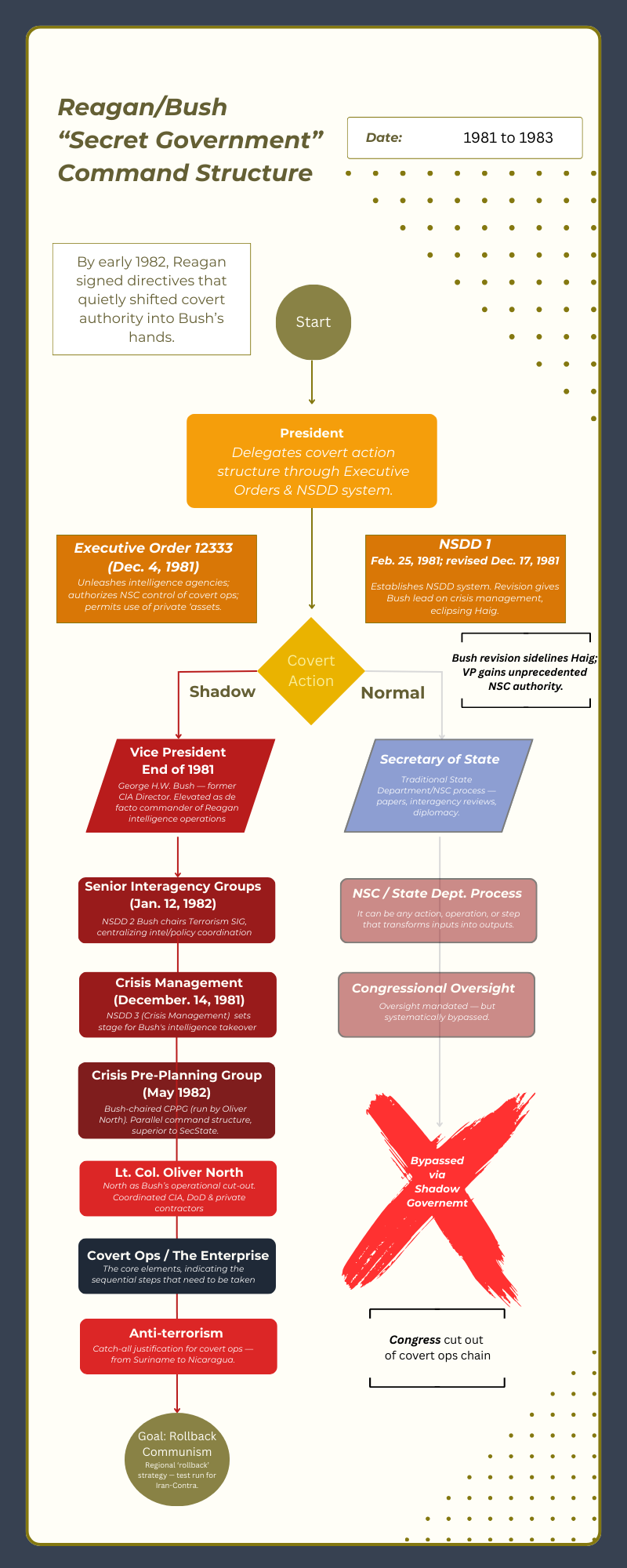
See the pattern? Each directive, taken individually, seemed reasonable. Taken together, they constituted a shadow government with the legal authority to bypass every normal constraint on executive power.
And the beautiful thing, from Bush’s perspective, was that it was all perfectly constitutional. He wasn’t technically breaking any laws—he was rewriting them through executive action.
The Terrorism Framework
The legal justification for this shadow system came from an unexpected source: international terrorism. In April 1981, Secretary of State Alexander Haig made a statement that seemed almost throwaway at the time:
“International terrorism will replace human rights as our primary concern.”¹⁸
I had to re-read that a few times. That wasn’t bluster—that was the Reagan/Bush operational framework being announced. What Haig was really saying was this: we’re about to redefine any opposition to American interests as “terrorism,” and once we do that, all bets are off.
By December, Haig was even more explicit. Addressing the Organization of American States, he warned that Nicaragua must not be allowed to become a “platform of terror and war.” The Philadelphia Inquirer described his drumbeat of speeches and leaks as a calculated PR campaign: an orchestrated effort “to convince the Soviets, Cuba and Nicaragua in particular, that there are limits to what the United States will tolerate.” Pentagon brass, the paper noted, wanted nothing to do with actual intervention, seeing it as a Vietnam-like disaster. But the messaging wasn’t really for Havana or Managua — it was for Congress and the American public. Haig was laying the rhetorical foundation that would let Bush’s shadow structure redefine regional politics as a terrorist threat.
Buried in the CIA’s declassified files is a document series labeled “84B00049R”—an internal job number that appears on over fifty different intelligence reports from 1981 to 1984 (likely more). These documents connect threads across seemingly unrelated events: Soviet terrorism accusations, Papal assassination plots, Central American operations, and yes, Suriname contingency planning.¹⁹
The 84B00049R files show how this worked in practice. Any Soviet support for liberation movements became “international terrorism.” Cuban diplomatic recognition became “terrorist state expansion.” Domestic opposition to U.S.-backed regimes became “terrorist insurgency.”
And here’s the beautiful, terrifying part: once something was labeled terrorism, it could be handled through “special authorities” that bypassed normal congressional oversight.
The Constitutional Bypass
By December 1981, Bush’s machine was in full operation. The Presidential Finding that Reagan signed on December 1, 1981—just fifteen days after the November 16 NSC meeting—was deliberately written to “camouflage” the true scope of operations that had been authorized (a black magic marker provided an extra layer of security).²⁰
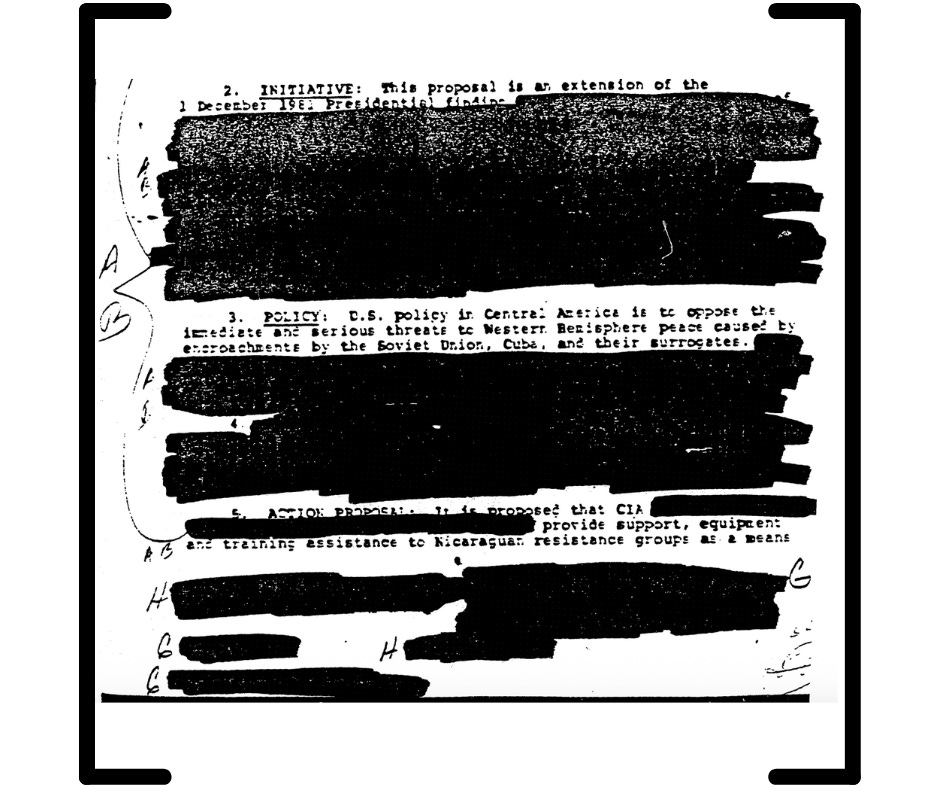
According to intelligence historian Malcolm Byrne, the Finding was an act of systematic deception. It vaguely mentioned “paramilitary operations” but completely omitted the broader “political” operations or the goal of building “opposition fronts” that had been secretly authorized.²¹
In other words, Congress was being told about military aid to anti-Sandinista forces, but not about the comprehensive political warfare campaign designed to overthrow multiple democratically-elected governments across the region.
And members of Congress were already sounding alarms. On December 11, 1981, three Democratic senators — Paul Tsongas, Claiborne Pell, and Christopher Dodd — wrote to CIA Director William Casey that a closed CIA briefing on the Caribbean “seriously violated” the Agency’s obligation to provide objective analysis. They charged that Constantine Menges, the newly appointed national intelligence officer for Latin America, had given what amounted to a policy speech, tracing all problems to Havana with “selective use of information” and scant evidence, a politicization that “bordered on policy prescription.” The Associated Press reported that Tsongas walked out of the briefing, calling it “an insult.”
The backlash was immediate. The Baltimore Evening Sun rushed to defend Menges, portraying him as a centrist unfairly smeared for “telling the truth” about Castro’s interventions. Labor leaders like William Doherty praised him for supporting land reform in El Salvador against the far right. But the damage was done: the CIA’s objectivity was openly in question. What was unfolding wasn’t just an administrative coup of procedures — it was a transformation of the intelligence stream itself into a weapon of political warfare.
This wasn’t accidental miscommunication. This was intentional disinformation directed at the American legislative branch by the President and Vice President.²²
Think about the implications of that for a second. The same administration that was supposedly defending democracy against communist tyranny was systematically lying to democratically-elected representatives about its own activities.
That’s not irony—that’s revelation. Because what November 16, 1981, really revealed was that the Reagan administration had decided that constitutional constraints were incompatible with effective anti-communist strategy.
Even at the time, watchdogs saw what was happening. As the Christian Science Monitor warned on December 7, 1981, Reagan’s executive order “was designed to give the CIA and FBI an additional degree of freedom as they attempt to counter the threat of terrorism,” but critics feared it would return the Agency to “the business of helping to overthrow foreign governments.” Civil libertarians saw the danger clearly: under the new terrorism framework, all the old abuses were now back on the table, cloaked in legal authority.
So they built a system to bypass those constraints.
NSDD-17: The Template
What the authorities created on November 16 would be formally codified in National Security Decision Directive 17, signed by Reagan on January 4, 1982. NSDD-17 established the Caribbean Basin as a testing ground for what would become known as the Reagan Doctrine—the systematic rollback of communist influence through coordinated covert operations.²³
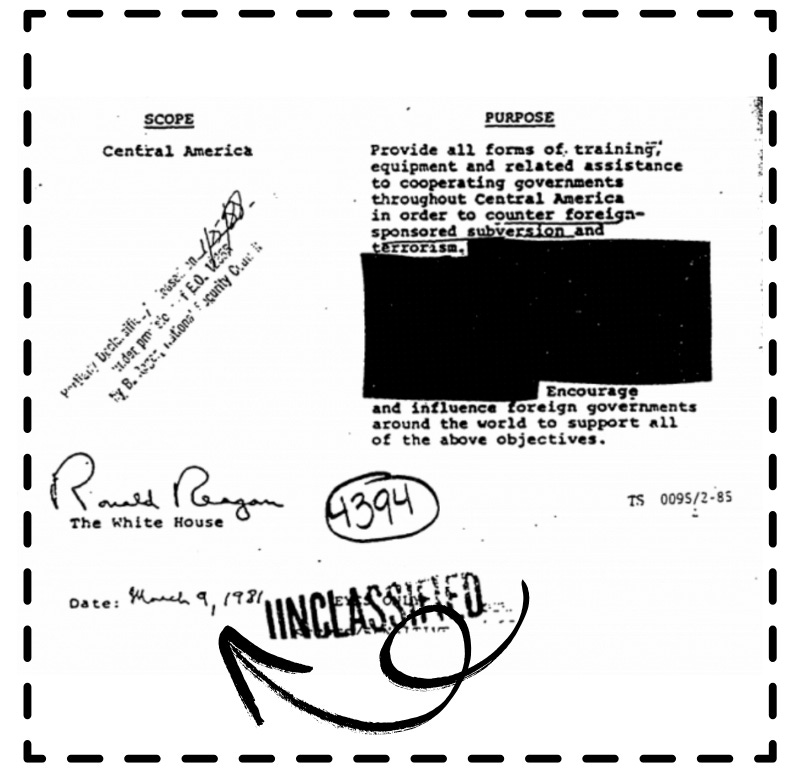
But NSDD-17 was more than just policy—it was the operational template that linked together the legal authorities Bush had constructed:
- Secret Presidential Finding (above) “to counter foreign-sponsored subversion and terrorism” in Central America
- NSDD-3 provided the crisis management structure
- EO 12333 unleashed intelligence capabilities
- NSDD-2 enabled flexible coordination
- The deceptive Presidential Finding camouflaged congressional oversight
- NSDD-17 deployed all of these simultaneously across multiple theaters
By March 1982, they were ready to test the system.
March 1982: The Coordinated Escalation
Here’s what nobody fully understood at the time (or even to this day): March 1982 was intended as the first coordinated regional demonstration of Bush’s new covert capabilities.
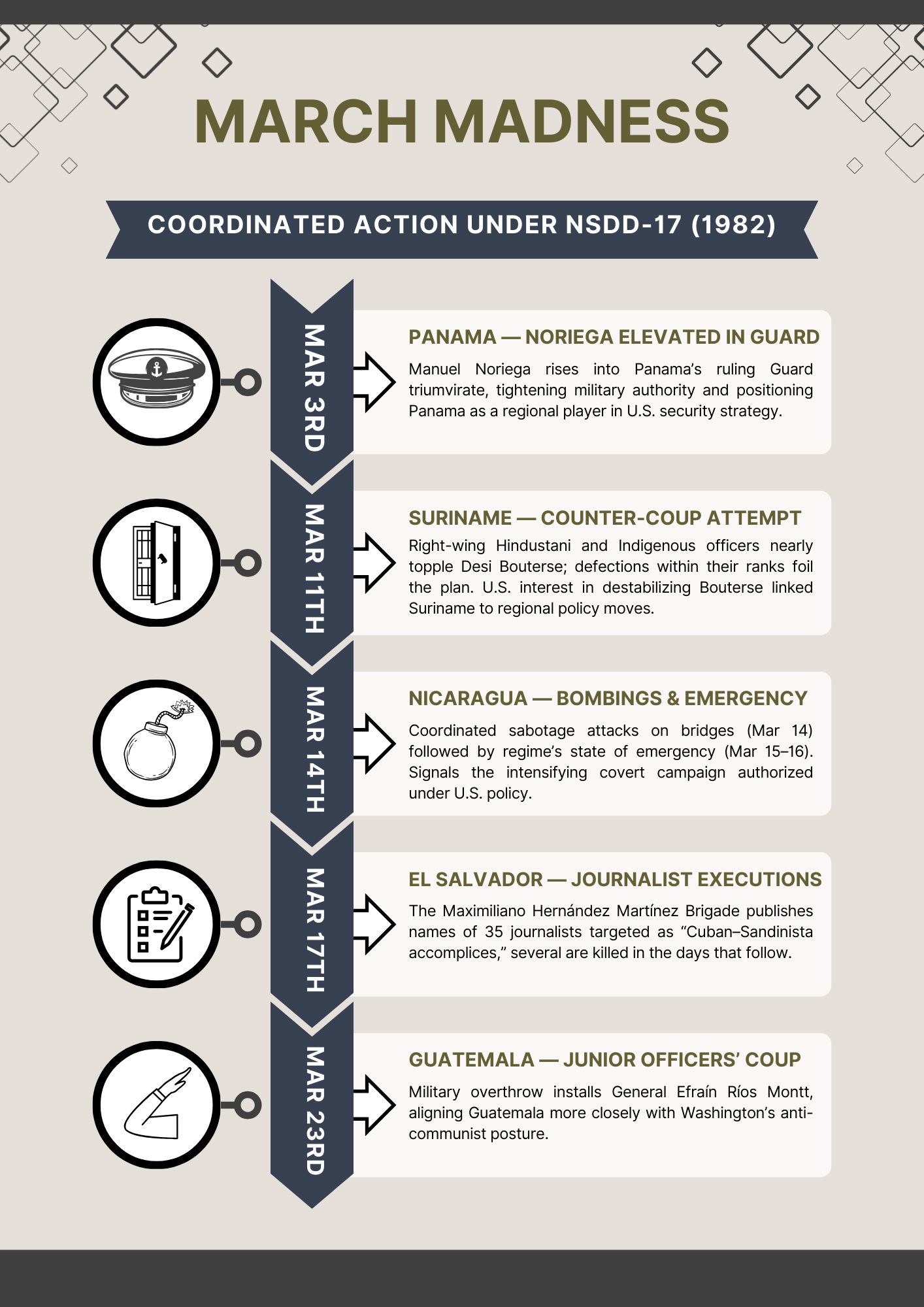
The timeline reveals the sophistication:
March 3, 1982: Panama coup removes Florencio Flores Aguilar, promoting CIA asset Manuel Noriega to full colonel and chief of staff, making him the second-most powerful man in the country
March 11-12, 1982: Rambocus coup in Suriname nearly succeeds in replacing Bouterse, only stopped by Lachman’s tank decision; four Dutch journalists arrested in El Salvador and later executed by U.S.-advised military units.
March 17, 1982: New York Times publishes detailed exposé of the entire covert framework, revealing the November 1981 NSC meetings that authorized everything²⁴
March 23, 1982: Guatemala coup brings General Efraín Ríos Montt to power, who would later implement “Victoria 82″—the systematic extermination campaign against indigenous Maya populations
This wasn’t coincidence. This was a coordinated escalation designed to demonstrate American covert capabilities across multiple theaters within a single month.
If Suriname had fallen on March 11-12, with Noriega secured in Panama on March 3, followed by the successful Nicaragua infrastructure attacks on March 14, followed by Ríos Montt’s rise in Guatemala on March 23, followed by strategic media leaks on March 17, it would have been an overwhelming demonstration of coordinated control across the entire Caribbean Basin that might have ended regional resistance entirely.
But Lachman’s hesitation broke the chain.
Tanks Again
According to Dutch military vehicle researchers like Sander Peeters, Suriname possessed nine YP-408 armored personnel carriers by 1982, just like the one being driven by Hans Lachman. The original five vehicles transferred from Dutch colonial forces in 1975 had been supplemented by four additional vehicles delivered sometime after 1980. Dutch vehicle identification experts noted that these later deliveries included modifications (turn signals, specialized variants) that were only applied to Dutch vehicles after 1972, proving they were recent transfers.²⁵
The exact timing of the arrival of these additional armored vehicles—especially given recently declassified cables showing secret meetings between the coup plotters and the Dutch and the American embassies—raises questions about levels of coordinated military preparation for the operations that would unfold in March 1982.
The Template Revealed
A year later, the Reagan administration conducted a detailed review of its Central America strategy, documented in an internal NSC paper that leaked to the New York Times in April 1983. This document provides stunning confirmation of everything we’ve discussed.²⁶
The document openly acknowledges that:
“the deterioration in our position so evident 6 to 12 months ago has been halted” and that “for the first time the Sandinistas have cause to doubt whether they can export subversion with impunity.”²⁷
That “6 to 12 months ago” timeframe? That’s pointing directly back to March 1982. They’re literally documenting the success of the system Bush constructed.
But here’s what’s most revealing: buried in the policy recommendations is this directive: “H. N.S.D.D. 17: Not all provisions of N.S.D.D. 17 have been implemented. Decision: To reaffirm the continued validity of N.S.D.D. 17 and task full implementation thereof.“²⁸
Translation: March 1982 had been a coordinated test of NSDD-17 authorities—and now they were ready to scale up. Leading right up to the December Murders in Suriname.
Everything We’ve Been Taught Is Wrong
This is the part where everything you thought you knew about the 1980s starts falling apart.
We’ve been told that Reagan’s foreign policy was reactive—that the administration was simply responding to Soviet aggression around the world. But November 16, 1981, shows us something very different. It shows us an administration with pre-constructed capabilities for global intervention, just waiting for excuses to deploy them.
We’ve been told that Iran-Contra was an aberration—a rogue operation that went too far. But Bush’s shadow government system shows us that Iran-Contra was actually the logical culmination of authorities that had been established years earlier.
We’ve been told that covert operations were last resorts, used only when diplomacy failed. But the 84B00049R files show us that covert operations were often first resorts, deployed preemptively to prevent diplomatic solutions that might favor Soviet interests.
And we’ve been told that American democracy emerged stronger from the Cold War. But what November 16, 1981, really shows us is how close we came to losing that democracy entirely—not to foreign conquest, but to domestic innovation.
Because that’s what Bush really created:
a system for bypassing democracy in the name of defending America.
The Question That Changes Everything
So what keeps me up at night is this: if they could build this system in 1981, if they could deploy it globally within hours of a perceived ‘terrorist’ threat, if they could lie to Congress about it with complete impunity—what’s to stop them from doing it again?
A better question is: what makes you think they ever stopped?
The authorities established under NSDD-3 were never repealed. The crisis management procedures created for the Special Situation Group were institutionalized into permanent government structure. The intelligence “unleashing” of Executive Order 12333 remains in effect today.
Bush’s shadow government didn’t disappear when the Cold War ended. It evolved.
And if you want to understand how that evolution worked, if you want to see where all those “truly disabling” covert actions ended up, well…
That’s what the next chapter is about.
By Matthew Smith is a reader-supported publication. To receive new posts and support my work, consider becoming a free or paid subscriber.
Endnotes
¹ Ronald Reagan, quoted in National Security Council. “Minutes of National Security Council Meeting.” November 10, 1981. https://web.archive.org/web/20150223122224/http://thereaganfiles.com/19811110-nsc-24.pdf Reagan’s question about “truly disabling” actions rather than “flea bites” was made during deliberations on Central America policy in late 1981.
² Henk Goos, “DAF YP408 at the SKM,” accessed July 24, 2025, https://www.dafyp408.nl/suriname.htm.
³ Sander Peeters, Tropic Thunder in Suriname: Volume 1 – From Independence to “Revolution” and Countercoups, 1975-1982 (Helion and Company, 2023), 57. “At 1000 two YP408s arrived at Fort Zeelandia. These were instructed by Rambocus to go to the fort and capture or take out the army leadership. The first YP was driven by Hans Lachman, who had been released from Santo Boma prison in the morning, on the insistence of Hawker. A few weeks prior to his release, he had been convicted of murdering a peasant farmer named Mahes over a drug deal and had been sentenced to 10 years in prison.31 Being a sergeant in the military police, he had received training on driving the YP. Together with gunner Ramkhelawan, he drove to the fort with thesecond YP in tow commanded by Corp Francis. After arriving at the fort, it is unclear what exactly happened.”
⁴ Nickerie.Net. “THE DECEMBER 8 ‘MURDERS’ 1982.” December 8, 2004. https://www.nickerie.net/Specials/8decembermoorden1982/Hoofdstuk%201%20-%20De%208-december%20MOORDEN%201982.htm.
⁵ Sander Peeters, Tropic Thunder in Suriname: Volume 1 – From Independence to “Revolution” and Countercoups, 1975-1982 (Helion and Company, 2023), 60.
⁶ Amigoe, “Suriname and Cuba to Strengthen Relations,” November 15, 1981.
⁷ Ibid.
⁸ Ibid.
⁹ National Security Council. “Minutes of National Security Council Meeting” and related memoranda, November 16, 1981. Collection: Executive Secretariat, NSC: Meeting Files, Folder: NSC 00026. Reagan Presidential Library. https://www.reaganlibrary.gov/public/2022-03/40-750-80627194-002-005-2021.pdf
¹⁰ “C.I.A.’S NICARAGUA ROLE: A PROPOSAL OR A REALITY?” The New York Times, March 17, 1982, Section A, Page 10. https://www.nytimes.com/1982/03/17/world/cia-s-nicaragua-role-a-proposal-or-a-reality.html The document reveals specific funding amounts: “$19.95 million program to organize anti-Sandinista rebels” and references to Argentine training programs and other covert operations authorized in November 1981.
¹¹ Department of Defense, “Minutes of NSC Meeting – Strategy Towards Cuba and Central America; Proposed United States Peacekeeping Force in Chad,” November 16, 1981, Department of Defense Mandatory Declassification Review Log, 2008-2017, https://www.governmentattic.org/34docs/DoDmdrLog_2008-2017.pdf.
¹² National Security Council. “Minutes of National Security Council Meeting” and related memoranda, November 16, 1981.
¹³ Donald Freed, “A Question of Treason,” The Rebel, November 22, 1983. The article alleges Reagan campaign intelligence operations during the 1980 election but these remain unproven allegations.
¹⁴ “NSDD Digitized Reference Copies | Ronald Reagan.” Accessed August 22, 2025. https://www.reaganlibrary.gov/reagans/reagan-administration/nsdd-digitized-reference-copies.
¹⁵ National Security Decision Directive 3, “Crisis Management,” December 14, 1981, The White House, Washington, D.C.
¹⁶ Executive Order 12333, “United States Intelligence Activities,” December 4, 1981, Federal Register.
¹⁷ National Security Decision Directive 2, “National Security Council Structure,” January 12, 1982, The White House, Washington, D.C.
¹⁸ “Excerpts From Haig’s Remarks at First News Conference as Secretary of State,” New York Times, January 29, 1981, A10. As cited in Adrian Hänni, Terrorismus als Konstrukt: Schwarze Propaganda und politische Bedrohungsängste in Ronald Reagans Amerika (Zürich: Universität Zürich, 2015), https://www.zora.uzh.ch/id/eprint/204446/1/20162580.pdf.
¹⁹CIA declassified documents, job number 84B00049R, various dates 1981-1984, CIA Freedom of Information Act Electronic Reading Room. This file series contains documents connecting Soviet terrorism allegations to Central American operations including Suriname contingency planning.
²⁰ Malcolm Byrne, Iran-Contra: Reagan’s Scandal and The Unchecked Abuse of Presidential Power (Lawrence: University Press of Kansas, 2014), 73-75.
²¹ Ibid.
²² Ibid.
²³ National Security Decision Directive 17, “Central America,” January 4, 1982, The White House, Washington, D.C. (Declassified in part).
²⁴ “C.I.A.’S NICARAGUA ROLE: A PROPOSAL OR A REALITY?” The New York Times, March 17, 1982, Section A, Page 10.
²⁵ Henk Goos, “DAF YP408 at the SKM,” accessed July 24, 2025,
²⁶ Special to the New York Times, “NATIONAL SECURITY COUNCIL DOCUMENT ON POLICY IN CENTRAL AMERICA AND CUBA,” The New York Times, April 7, 1983. https://www.nytimes.com/1983/04/07/world/national-security-council-document-on-policy-in-central-america-and-cuba.html
²⁷ Ibid.
²⁸ Ibid.
Source:
Link:
Internal Link:
Date:
August 23, 2025