The Suriname Contra Affair (Part II)
Labor Pains
Aug 29, 2025
“After the Communist government had been in power long enough to win that massive unpopularity and bewildered disdain which usually follows after more than six months to a year’s experience with the garish consequences of Communist economic policy and the unremitting political control, repression, and direction, [a] resistance organization might make its move.”
—Constantine Menges, “Democratic Insurgency Against a New Communist Regime,” 19681
Part I: From Concern to Crisis
Constantine Menges was still technically a consultant when the flash cable from Caracas hit his desk on a muggy Tuesday morning in May 1981. This was the moment the Reagan administration had been waiting for. It was the “green light” that would activate the very shadow government and constitutional bypass you saw in the previous chapter. And the man who helped set it all in motion was about to get to work.
Sure, his formal appointment as National Intelligence Officer for Latin America wouldn’t come until September. But his proposals to the Reagan transition team had already made him the go-to guy for deciphering Caribbean Basin threats.
And man, had Menges been waiting for exactly this kind of intelligence. Thirteen years, to be precise. His 1968 RAND Corporation study had nailed the fundamental flaw in traditional CIA methods: when you directly support corrupt regimes, you often end up strengthening the very communist movements you’re trying to defeat. His alternative was elegant—
support “democratic revolutionary” forces that could fight both communist insurgents and authoritarian governments at the same time.2
The subject line he read looked routine enough: “SURINAME – OFFICIAL DELEGATION VISIT TO CUBA.” But buried in the operational details was intelligence that would reshape American policy toward this small Caribbean nation forever.
It was the Summer of 1981 and Commander Desi Bouterse, along with Foreign Minister Harvey Naarendorp, had just arrived in Havana for what Surinamese media called “bilateral discussions on cooperation.” But the reality, as the cable’s classified sections made clear, was way more serious. Bouterse wasn’t just visiting—he was asking Castro for a how-to guide on transforming Suriname from a reluctant military dictatorship into a genuine revolutionary state.
What the cable didn’t mention—what would only come out decades later when a retired Agency officer revealed the secret to Naarendorp—was that the CIA had “placed someone inside the delegation to see what would happen.”3 The infiltration had been systematic: American intelligence was recording every word of Cuba’s seduction of Suriname’s inexperienced leaders.
The intelligence that reached Washington was devastating. Castro’s questions had been surgical in their precision, exposing gaps in basic governance that Bouterse’s government hadn’t even realized existed. How many teachers per capita? What are your school dropout rates? What percentage of agricultural output actually reaches urban markets? Each question revealed another area where Suriname’s new government was running on revolutionary rhetoric rather than administrative reality.
“We realized we were nowhere near having a nation-state,” Naarendorp would later admit. He described Castro’s interrogation as a “cold shower” that exposed Suriname’s fundamental unpreparedness for genuine independence.4 But for American intelligence analysts, Castro’s tutorial represented something far more dangerous: a comprehensive blueprint for transforming a strategically located territory into a Soviet client state.
The timing could not have been worse. A month earlier, Maurice Bishop’s New Jewel Movement in Grenada had attended a World Peace Council Congress in Havana and left claiming that “assistance would soon be forthcoming from the Soviets, the Hungarians, and the East Germans.”5 Nicaragua’s Sandinistas were already getting substantial Soviet military aid. Now Suriname—with its critical bauxite reserves and strategic airfield on South America’s northern coast—looked ready to complete what intelligence analysts were calling the “Caribbean Triangle” of communist influence.
Menges absorbed the intelligence with the focused intensity of a man who had spent decades studying Soviet expansion. At 42, he was about to become one of the Reagan administration’s leading experts on what he termed “indirect aggression”—the systematic process by which Moscow helped local communist movements seize power without direct military intervention. His 1968 analysis, “Democratic Insurgency Against a New Communist Regime,” had identified the precise vulnerabilities that American policy could exploit to reverse communist gains.6
But Suriname presented a strategic puzzle that existing doctrine couldn’t easily solve. Unlike Nicaragua or Grenada, where leftist movements had grown organically from local conditions, Bouterse wasn’t a revolutionary. He was a P.E. teacher who had stumbled into power through a military coup over labor disputes. His regime had no ideological foundation. The same opportunistic pragmatism that made him dangerous—his willingness to embrace whatever international patron offered the best deal—also made him potentially recoverable for Western interests.
The question was whether traditional CIA methods would be enough.
The Intelligence Void: America’s Opportunity
The Dutch had a problem, and that problem was about to become America’s opportunity.
The challenge facing American planners was made worse by a critical intelligence gap that had been widening since the February 1980 coup. The Netherlands, as the former colonial power, had maintained the most comprehensive intelligence network in Suriname through its Military Mission (MMS). Dutch officers had cultivated relationships throughout the Surinamese military, maintained detailed files on potential leaders, and provided The Hague with insights that no other Western intelligence service could match.
But the coup had systematically destroyed Dutch intelligence capabilities. The same sergeants who had seized power now viewed the Military Mission with deep suspicion. They recognized Dutch officers as potential threats to their revolutionary legitimacy. Captain Clements, a key Mission member who had allegedly been involved in planning the 1980 coup alongside Colonel Valk, departed for the Netherlands for “discussions” just as Bouterse began his leftward drift.7 A new civilian administrator, Peter Meyer, arrived to take up the post of Secretary for the Defence Attaché with a secret mandate to investigate Dutch involvement in Operation Black Tulip—the emergency evacuation plan that had allegedly been converted into Bouterse’s coup blueprint.8
The Dutch intelligence withdrawal created exactly the kind of operational vacuum that the Reagan administration was designed to fill. But first, they needed a strategic framework that could guide systematic intervention without triggering the kind of nationalist backlash that had driven Bouterse toward Cuba in the first place.
Menges had the answer.
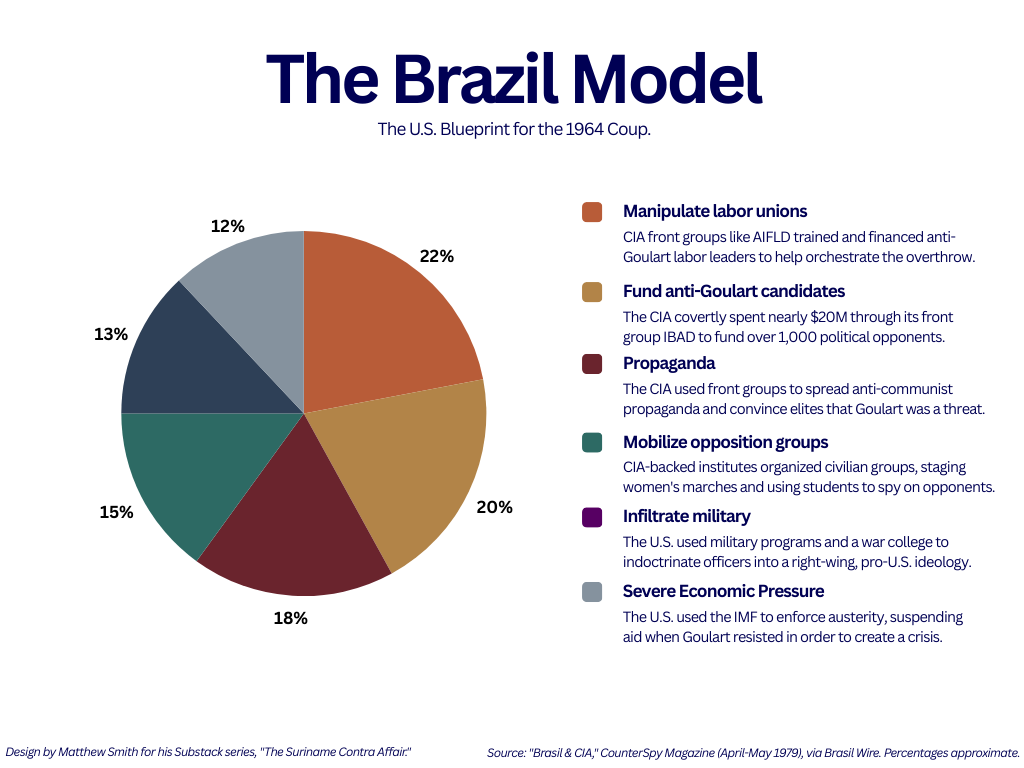
The Brazil Model
Twenty years earlier, the CIA had written the playbook for this exact situation. They’d tested it in Brazil, perfected it through six complementary tracks, and watched a government fall like clockwork. Now it was time to run the same play on their neighbor to the north.
The template that would guide American operations in Suriname had been perfected in 1964, where the CIA had successfully orchestrated the overthrow of President João Goulart through a comprehensive campaign that combined economic pressure, political manipulation, and military infiltration.⁸ The Brazilian operation had demonstrated how seemingly independent local actions could be coordinated through careful cultivation of local assets. The result? The appearance of organic political change while serving American strategic interests.
The Brazil Model operated through six complementary tracks:9
Economic Warfare: The CIA used the IMF and international lenders to enforce austerity measures that created economic chaos, then blamed the resulting hardship on Goulart’s “communist” policies. When Goulart resisted these measures, international credit was cut off, accelerating economic collapse.
Political Manipulation: The Agency covertly funded over 1,000 political opponents through front groups like IBAD (Brazilian Institute of Democratic Action), spending nearly $20 million to create the appearance of broad-based opposition to the government.
Labor Subversion: CIA-backed organizations like AIFLD (American Institute for Free Labor Development) had trained anti-Goulart labor leaders who became “intimately involved in some of the clandestine operations of the revolution before it took place on April 1.”10
Propaganda Operations: Front groups spread anti-communist propaganda while convincing Brazilian elites that Goulart represented an existential threat to democracy.
Military Infiltration: U.S. used military programs and war colleges to indoctrinate Brazilian officers into right-wing, pro-American ideology, creating the institutional foundation for the coup.
Economic Pressure: Strategic use of aid suspension and credit restrictions created the crisis conditions that made military intervention seem necessary to restore stability.
The beauty of the Brazil Model was its deniability. When the coup succeeded on April 1, 1964, it appeared to be a spontaneous Brazilian response to communist subversion. The New York Times celebrated Goulart’s removal as “a victory for democracy,” writing that the military’s action had eliminated “the immediate Communist threat” and provided “a powerful shot in the arm for the cause of democratic moderation in Latin America.11
But declassified documents would later reveal the systematic nature of American involvement. Ambassador Lincoln Gordon had provided direct support to the conspirators, telling Washington that
“our manifest support, both moral and material and even at substantial cost, may well be essential to maintain the backbone of the Brazilian resistance.”¹³
The “Brazilian resistance” had been carefully cultivated and generously funded by the same American officials who claimed to be passive observers of local political developments.
For Suriname in 1981, the Brazil Model offered a proven template for regime change that could be adapted to Suriname’s conditions. But Menges understood that the old methods needed updating for 1980s realities. The challenge was implementing it quickly enough to prevent Bouterse’s complete alignment with Cuba while maintaining the appearance of organic political development.
The Menges Innovation: A New Kind of Warfare
The Brazil playbook had worked in 1964, but Menges understood why it couldn’t work unchanged in the 1980s. Congressional oversight, human rights scrutiny, and media attention after the Church Committee’s findings had made the old methods too risky. According to a 1982 CovertAction Information Bulletin analysis, Menges had developed a systematic approach to what could be called “democratic legitimacy”—reframing traditional CIA operations in the language of democracy promotion.12
The solution was simple. Instead of funding right-wing politicians, fund “pro-democracy” groups. Instead of CIA front organizations, use academic think tanks like his own Hudson Institute. Instead of crude anti-communist propaganda, promote “human rights” and “democratic values.” The operations looked functionally identical, but the packaging made them politically bulletproof.
Most crucially, Menges had designed systematic workarounds for congressional oversight. His “Democratic Revolutionary Insurgency” doctrine operated through what he called “semi-autonomous foundations”—organizations that could receive government funding but maintain operational independence. These foundations could support opposition movements without triggering the congressional notification requirements that had killed other invasion and destabilization proposals.
The genius of the Menges Model was that it sounded like the opposite of what it actually was.
Supporting “democratic revolutionary insurgency” against “communist regimes” wasn’t CIA subversion—it was defending American values.
Every operation could be justified in the language of democracy promotion, even when the actual goal was regime change.
Menges began developing the operational framework immediately after receiving the Havana intelligence. But he wasn’t working alone.
The Caribbean Doctrine
The strategic context for Suriname operations had been established just weeks earlier, during a pivotal National Security Council meeting on May 22, 1981. President Reagan’s top national security officials had gathered in the Cabinet Room to discuss what the classified agenda called “US Policy for Caribbean Basin.”13
The declassified meeting minutes reveal the scope of the administration’s ambitions. Secretary of State Alexander Haig, his characteristic intensity focused on what he called the region’s
“underlying conditions that make Cuban-style subversion possible,” outlined a strategy that combined economic aid with “effective security assistance to friendly governments.”14 But the real urgency came from a question that had haunted the administration since taking office: “how best to keep Nicaragua from becoming entirely a creature of the Soviet Union and Cuba.”15
This wasn’t just policy discussion—it was the foundation for what would become the Reagan Doctrine’s most aggressive regional intervention. The meeting established the strategic framework that would justify everything from massive military exercises to covert reconnaissance missions. The administration was preparing for confrontation across the entire Caribbean Basin.16
The economic component was already being formulated through what administration officials called a “mini-Marshall Plan” for the Caribbean. The Reagan administration was developing what it explicitly labeled “Counterinsurgency”—a dual-track strategy where economic pressure and military support were considered “inseparable parts” of the same policy.17
The military track meant a massive increase in military aid to friendly governments “threatened by popular revolt.” For fiscal year 1982, the Pentagon was authorized to sell an estimated $50.7 million in military articles to eleven Caribbean Basin countries. That represented a 135 percent increase over 1980 sales. Funding for U.S. military training of local armed forces was set to leap by 178 percent to a total of $4.7 million.18
The corresponding economic track was a neo-colonial strategy aimed at restructuring regional economies to favor U.S. trade and investment. Administration officials pushed for “supply side” changes, pressuring countries to create “predictable, favorable conditions for enterprise” through policies like investment treaties and preferential tax treatment. The strategy included punitive measures: the U.S. had already vetoed a $20 million loan to Guyana because it would have supported government subsidies to local farmers, which ran counter to the private-enterprise-focused doctrine.19
But the Caribbean Doctrine represented more than economic and military cooperation. It was the regional application of a global strategy that Menges and other hardliners had been advocating since the early days of the Reagan administration: the systematic rollback of communist influence through coordinated covert operations.
In November 1981, Menges sent a memo to CIA Director William Casey outlining specific “Alternative Possibility” analysis topics for the region.
His suggestions included scenarios like “Successful democratic liberation of Nicaragua in 1982; implications for the region and the Cuban export of subversion” and “Extreme left victory in El Salvador in 1982—Implications for the Region.”20
Each scenario was designed to test operational possibilities rather than merely analyze threats.
The memo revealed Menges’ systematic approach to regional transformation. He wasn’t just studying communist expansion—he was developing strategies to reverse it. Suriname, with its strategic location and opportunistic leadership, represented an ideal testing ground for these new methods.
The Congressional Obstacle
The strategic framework was in place, the regional doctrine was established, and the intelligence architecture was being constructed. But there remained one significant obstacle to implementation: Congress.
The summer heat was oppressive in Washington during July 1981, but the reception CIA Director Casey received from the Senate Intelligence Committee was positively arctic. He had come to brief them on what he described as a “proactive response” to growing communist influence in the Caribbean—a response that would demonstrate American resolve before what Deputy Assistant Secretary of Defense (and former CIA agent) Nestor D. Sanchez would describe as an existential threat to American security.21
The intelligence picture Casey presented was genuinely alarming. Soviet military exports to Cuba in 1982 were projected to reach a record $1 billion, compared with $600 million in 1981 deliveries. The shipments included “Turya” hydrofoil torpedo boats, MI24 “Hind” assault helicopters, and an additional squadron of supersonic MiG23 fighter aircraft.22 But it wasn’t just the weapons—it was what the Cubans were building with them.
In Grenada, Cuban advisers and laborers were constructing facilities that “far exceed the requirements of that tiny island.” This included a battalion-size military camp with “barracks, administration buildings, vehicle storage sheds, support buildings and a training area with a Soviet-style obstacle course.”23 The new international airport featured a runway capable of servicing both jumbo commercial jets and military fighters, giving Soviet-built Cuban jets enhanced refueling capabilities throughout the Caribbean Basin.
Most ominously, Grenadian minister of national mobilization Selwyn Strachan had “boasted publicly that Cuba will eventually use the new airport in Grenada to supply troops in Angola.”24 Combined with Soviet and Cuban support to the Sandinista government, intelligence analysts were painting scenarios in the darkest possible terms. The Soviets “could literally place hostile forces and weapons systems capable of striking targets deep in the United States on our borders and adjacent waters.”25
Casey’s plan was breathtaking in its ambition and terrifying in its implications. According to committee members who later spoke to reporters, the CIA had developed plans for “economic destabilization affecting the political viability of the government” of Grenada.26 But the scope of Casey’s proposal went far beyond a single Caribbean island. Two names appeared prominently on his target list: Grenada and Suriname.27
The strategy involved coordinated pressure through financial warfare, propaganda operations, and support for domestic opposition groups—all designed to create conditions for regime change without direct U.S. military intervention. But it was the overall ambition that left senators speechless. Casey wasn’t just talking about limited covert operations. He was proposing a comprehensive campaign across multiple countries, coordinated through new authorities that would give the executive branch unprecedented flexibility to act without congressional oversight.
Senator Lloyd Bentsen of Texas, a conservative Democrat who was hardly squeamish about aggressive foreign policy, reportedly responded to Casey’s still-classified presentation with four words that would echo through the intelligence community for months: “You’ve got to be kidding.”28
According to one senator quoted by the Associated Press,
the plan was so ambitious and aggressive that it was simply “off the wall.”29 The committee’s opposition was swift and decisive. Casey’s “proactive response” was dead on arrival, shelved before it could be implemented.
The details of the CIA’s Grenada and Suriname operation “are not known beyond a general description from knowledgeable sources that the CIA developed plans in the summer of 1981 to cause economic difficulty for Grenada in hopes of undermining the political control of Prime Minister Maurice Bishop.” What’s crucial is that “these sources said the operation was scrubbed because the Senate Intelligence Committee opposed it.”30
But Ronald Reagan’s appetite for action hadn’t diminished. If anything, the congressional rejection had only sharpened his determination to find alternative ways to project American power in the Caribbean. The administration would need to develop methods that could circumvent traditional oversight while maintaining operational effectiveness.
The solution would come from an unexpected source: Vice President George H.W. Bush’s systematic construction of shadow government authorities that could operate in real-time without congressional notification or interagency coordination.
By Matthew Smith is a reader-supported publication. To receive new posts and support my work, consider becoming a free or paid subscriber.
Part II: Preparing the Battlefield – Deploying the Assets
The rejection of Casey’s Caribbean plan by the Senate Intelligence Committee in July 1981 had been a setback, but not a defeat. The Reagan administration possessed something previous administrations had lacked: a comprehensive understanding of how traditional CIA methods could be deployed systematically while new operational authorities were being constructed. And, they had the political will to use them.
Menges, working with a small team of regional specialists, began implementing the new Menges Model across four complementary tracks during the fall of 1981. Each track would be deployed through seemingly independent initiatives that maintained plausible deniability while building the infrastructure for more aggressive action.
The novelty of the system was its compartmentalization. Labor attachés wouldn’t know about military planning. Economic advisors wouldn’t coordinate with intelligence operatives. Each track would appear to be a routine bureaucratic response to regional developments. Only at the highest levels would the systematic nature of the preparation become apparent.
But first, they needed to understand what they were working with in Suriname.
The Intelligence Track: Assessment and Penetration
The Dutch had lost their network, but that didn’t mean America had to start from scratch.
Their solution was to develop multiple channels of influence while maintaining comprehensive surveillance of his decision-making process. The CIA needed assets within Bouterse’s inner circle, detailed knowledge of his military capabilities, and systematic intelligence on opposition elements that could serve as alternatives if direct influence failed.
The first step was to establish a legitimate presence that could provide cover for deeper penetration. The mechanism was already in place: the U.S. Embassy’s small but growing staff, recently augmented by professionals with specialized backgrounds in political assessment and population analysis.
Dale Povenmire arrived in Paramaribo in September 1981 carrying credentials as a State Department labor officer and a mandate that extended far beyond routine diplomatic reporting. “At the request of the ARA front office I also made a week-long trip to Suriname to assess the situation there,” Povenmire would later recall.31 His cover story was straightforward: assess labor conditions in the former Dutch colony. His real mission was to identify and evaluate the human assets that could serve as leverage points against the regime.
Povenmire wasn’t just any labor attaché. His first Foreign Service posting was in Chile from 1958-1960, where he worked on minerals reporting and cultivated contacts in the Copper Workers’ Unions. One of his key contacts was Orlando Letelier, who worked in the Chilean Copper Department. Letelier would later become Foreign Minister under Allende and was eventually assassinated in Washington by Chilean intelligence in 1976—a case that highlighted the deadly stakes of Cold War political warfare that Povenmire understood intimately.32
His remaining career read like a Cold War intelligence itinerary—Paraguay during military dictatorship, where he successfully established AIFLD training programs under Stroessner’s regime and demonstrated his ability to build labor infrastructure even under the most authoritarian conditions,33 Venezuela during its democratic transition, Portugal during the 1974 communist revolution. He’d spent decades mastering the art of political assessment under diplomatic cover, including coordinating the return of AIFLD operations to Venezuela after the organization had been “thrown out…for its political activities.”34 His counterintelligence work against CLAT, the Latin American Confederation of Workers, had involved systematically feeding information to West German intelligence to undermine the organization’s funding. Six months before the Jonestown mass suicide, he’d identified Jim Jones’ community in Guyana as “questionable”—the kind of broad intelligence assessment that went well beyond labor reporting.35
“The Department was very much concerned over the deteriorating political situation since the military coup and takeover directed by Lt. Col. Bouterse,” he noted, but his assessment went far beyond routine diplomatic reporting.36
His primary target was Cyril Daal, who headed Suriname’s major trade union confederation and was one of a number of community leaders calling for a return to democratic government.37 Daal controlled the Moederbond, Suriname’s largest labor federation with reportedly 14,000 members—exactly the kind of mass organization that could either stabilize or destabilize a government.
“I met Daal and talked with the people who worked with him,” Povenmire remembered. “My report recommended ways in which international labor support could be directed toward Suriname.”38 That recommendation would prove crucial fourteen months later when the unions threatened a general strike against Bouterse’s junta.
Povenmire’s background also included naval intelligence work and a stint in Brazil from 1978-1981, where he’d been identified as a “CIA collaborator” working under diplomatic cover.39 This experience with the Brazil Model had demonstrated the effectiveness of labor organizations as vehicles for political change. In 1964, AIFLD-trained operatives had been “very active in organizing workers” and had become “intimately involved in some of the clandestine operations of the revolution before it took place.”40 The same template could be applied in Suriname, but only if American operatives understood the local labor landscape well enough to identify the key pressure points.
Povenmire’s week-long assessment provided exactly that understanding. His detailed report, classified at the highest levels, identified not just Daal’s Moederbond but the broader network of civil society organizations that could serve as vehicles for political pressure against the regime. Trade unions, professional associations, religious groups, student organizations—each represented a potential asset for future operations.
The timing of Povenmire’s mission was particularly significant. His assessment coincided precisely with Bouterse’s return from Cuba and his announcement of the Revolutionary Front’s formation. American intelligence was mapping the opposition infrastructure at exactly the moment when that opposition was about to face systematic repression.
As Povenmire would later reflect with characteristic understatement,
“Late in 1982 the unions threatened a general strike against the junta. On December 8, the military burned the union headquarters and destroyed opposition newspapers and radio stations. Daal and fourteen other leading Surinamese were arrested, beaten, and murdered by the military with the personal participation of Bouterse.”41
But in September 1981, those tragic events were still fifteen months in the future. What mattered was that American intelligence now possessed a comprehensive map of Suriname’s civil society—knowledge that would prove invaluable when the time came to coordinate resistance against the regime.
The Economic Track: The Bolton Mission
While Povenmire was mapping Suriname’s labor networks, another track of the Brazil Model was being implemented through seemingly routine diplomatic channels. The economic pressure component required establishing legitimate mechanisms for aid delivery and suspension—tools that could be used to reward cooperation or punish defiance as circumstances required.
The challenge was that Suriname had never been a significant recipient of U.S. foreign aid. The Netherlands, as the former colonial power, provided massive assistance through what then Ambassador John J. Crowley, Jr. called “the highest per capita aid program in the world, sort of like conscience money.”42 Dutch assistance was so comprehensive that American officials had traditionally viewed Suriname as a Netherlands responsibility, requiring minimal U.S. involvement.
But Bouterse’s leftward drift had changed the strategic calculation. If the Netherlands couldn’t or wouldn’t use economic leverage to keep Suriname within the Western orbit, the United States would need to develop independent capabilities for economic statecraft.
Ambassador John Crowley had been pushing for exactly this kind of American involvement since his arrival in 1980. “Finally,” Crowley would later recall, the Agency for International Development (AID) sent down its general counsel, John R. Bolton, to conduct a personal assessment.43
Bolton’s visit to Suriname in late 1981 was officially described as a routine evaluation of potential aid programs. The young lawyer who would later become a controversial figure in Republican foreign policy circles—serving as UN Ambassador under George W. Bush and National Security Advisor under Trump—was already establishing his reputation for aggressive American unilateralism. But in 1981, he was conducting a comprehensive assessment of how American economic leverage could be deployed to influence Bouterse’s government. Bolton was no ordinary aid administrator—he was a key Washington advocate for the “supply side foreign assistance” component of the Reagan administration’s new Caribbean doctrine.44
Bolton’s mission represented the economic warfare track of the Menges Model adapted for Caribbean conditions. In Brazil, the CIA had used international lenders like the International Monetary Fund (IMF) to create economic chaos, then blamed the resulting hardship on Goulart’s policies. In Suriname, the mechanism would be different but the principle remained the same: economic assistance would be structured to create dependency relationships that could be manipulated for political purposes.
Again, the beauty of the Bolton mission was its deniability. A senior AID official conducting aid assessments was perfectly routine diplomatic activity. But Bolton’s real mandate went far beyond program evaluation. He was tasked with identifying the specific economic vulnerabilities that American policy could exploit if Bouterse continued his alignment with Cuba.
Bolton reported back to the head of AID and secured approval for a small U.S. mission in Suriname before Ambassador Crowley’s departure in December 1981.45 The program was modest by regional standards—just enough to establish American economic presence without triggering nationalist backlash. But the infrastructure being created would serve purposes far beyond routine development assistance.
The economic track was particularly important because it provided cover for other forms of penetration. AID programs required extensive interaction with local government officials, creating opportunities for intelligence collection and political influence that were unavailable through traditional diplomatic channels. Economic assistance also provided mechanisms for supporting opposition groups through seemingly legitimate development programs.
Most importantly, the economic track created the capability for rapid escalation if circumstances required. Aid programs could be expanded to reward cooperation or suspended to punish defiance. Economic warfare could be implemented through international financial institutions, private investment channels, and direct bilateral pressure.
The Brazil Model had demonstrated the effectiveness of this approach. Economic pressure had been the decisive factor in creating the crisis conditions that made military intervention seem necessary to restore stability. The same dynamic could be replicated in Suriname if Bouterse continued his drift toward the Soviet orbit.
The Military Track: USSOUTHCOM Assessment
The military component of systematic preparation required a different approach than the labor and economic tracks. Direct military assistance to Bouterse’s government was politically impossible given his increasingly leftist rhetoric. But the United States needed detailed intelligence on Surinamese military capabilities, potential vulnerabilities, and the feasibility of various intervention scenarios.
The mechanism was provided by routine military cooperation programs that predated Bouterse’s leftward drift. The International Military Education and Training (IMET) program had been established to provide professional military education to officers from friendly nations. In Suriname’s case, IMET funding had been modest—just $38,000 for fiscal year 1981, with training accomplished for only two individuals at the Coast Guard Officer Candidate School.46
But the program’s real value wasn’t in the training provided—it was in the assessment opportunities it created. Under the cover of evaluating IMET requirements and planning future programs, U.S. military personnel could conduct systematic intelligence collection on Surinamese military capabilities and vulnerabilities.
The intelligence requirement was urgent. If economic and political pressure failed to deflect Bouterse from his Cuban alignment, the administration needed to understand what military options might be available. The Caribbean Basin was now considered a strategic priority, and Suriname’s location on South America’s northern coast gave it potential importance far beyond its small size.
In November 1981, a USSOUTHCOM Security Assistance Team visited Suriname and prepared IMET program proposals for fiscal years 1982-84, based on projected FY 82 funding of $75,000.47 The team’s official mission was to assess training requirements and develop program recommendations. But the intelligence collected during this visit would prove far more valuable than any training programs eventually implemented.
The timing was particularly significant. The USSOUTHCOM visit occurred just days before the November 16 trigger event that would activate the administration’s shadow government authorities. The military assessment was being completed at exactly the moment when operational planning was moving from theoretical preparation to active implementation.
The military track served multiple purposes beyond intelligence collection. It provided opportunities to assess potential opposition elements within the Surinamese military—officers who might be willing to act against Bouterse if properly supported. It identified key infrastructure targets and defensive positions that would be relevant to intervention scenarios. Most importantly, it demonstrated American military interest in ways that sent clear signals to both the regime and potential opposition elements.
The USSOUTHCOM assessment also served as preparation for more extensive military involvement if circumstances required. The team’s recommendations for expanded IMET programs created the bureaucratic foundation for deeper military engagement. Even if those programs were never fully implemented, the assessment process had provided detailed intelligence on Surinamese military capabilities and vulnerabilities.
According to the U.S. Southern Command’s annual historical report, initial IMET funding for fiscal year 1981 was limited, and “no actual training was accomplished in the remainder of calendar year 1981, nor were any firm plans or commitments projected by the Surinamese military for training in calendar year 1982.”48 But the intelligence value of the assessment process was far more important than any specific training programs.
The military track represented the most sensitive component of the Menges Model’s implementation. Unlike labor organizing or economic assistance, military assessment carried clear implications for potential intervention. But it was also the most essential component, because it provided the intelligence foundation for all other tracks.
If economic pressure failed to deflect Bouterse from Cuban alignment, if political opposition proved insufficient to challenge his control, if labor organization couldn’t generate the kind of mass resistance that had been effective in other contexts, then military options would need to be available as a last resort.
The November 1981 USSOUTHCOM assessment ensured that those options would be based on comprehensive intelligence rather than theoretical assumptions.
The Political Track: House Cleaning and New Directions
While the labor, economic, and military tracks were being systematically deployed, the most revealing developments were occurring within the State Department’s own bureaucratic structure. The political track of the Menges Model required operatives who could move beyond traditional diplomatic constraints—professionals willing to engage in the kind of direct political manipulation that career Foreign Service officers were trained to avoid.
The problem, from Assistant Secretary Thomas Enders’ perspective, was that the U.S. Embassy in Paramaribo was staffed by exactly the wrong kind of people— people with “the Carter disease”— for the mission he had in mind. Ambassador John Crowley was a classic career diplomat, trained in the careful, incremental approach that had characterized American foreign policy during the détente era. His instincts were toward negotiation, accommodation, and gradual influence—precisely the opposite of what the situation required.
Enders’ assessment of Crowley and his team was blunt to the point of crudity. During his meeting with Suriname desk officers, Enders cut through the bureaucratic language about “cultural and generational differences” between Ambassador Crowley and Bouterse. His demand reflected the administration’s fundamental break with traditional diplomatic practice.
“Well, I think we should have somebody down there who can really get in with Bouterse and his people,” Enders stated. “Somebody who’d go drinking and whoring with him.”49
This wasn’t diplomatic frustration speaking—it was strategic doctrine. Enders had concluded that traditional diplomatic methods were insufficient for dealing with leaders like Bouterse. The administration needed operatives who could build personal relationships with target officials, operatives who understood that successful political manipulation required getting inside their subjects’ decision-making processes.
The comment revealed the administration’s broader approach to Caribbean Basin operations. This was not going to be diplomacy as traditionally understood—it was going to be political warfare conducted through diplomatic channels. The distinction was crucial, because it required personnel with fundamentally different skill sets and operational philosophies.
Enders’ house-cleaning wasn’t limited to Suriname. At the very same time, he was overseeing a nearly identical changing of the guard in Nicaragua, where the U.S. ambassador and his entire senior team were being replaced between August 1981 and March 1982.50 The pattern was unmistakable: experienced diplomats were being sidelined to make way for a new cadre of operatives ready to execute a more confrontational doctrine.
The Reagan administration was systematically purging Foreign Service professionals who had been shaped by the Church Committee reforms and the post-Vietnam emphasis on congressional oversight. In their place, Enders was installing operatives who understood that the old constraints no longer applied—men who could “get in with” foreign leaders in ways that traditional diplomats considered unprofessional or unethical.
Ambassador Crowley’s removal on December 10, 1981, was officially described as routine personnel rotation.51 In reality, it was the final step in clearing the board for a fundamentally different kind of operation. Crowley belonged to the old school of diplomacy that emphasized negotiation and accommodation. The administration needed operatives who understood that some situations required more direct intervention in foreign political processes.
Enders’ preferred replacement, Afghanistan veteran Hawthorne Quinn Mills, was quietly blocked by State Department management over personnel issues. But the bureaucratic snag actually served the administration’s purposes by creating exactly the kind of leadership vacuum that covert operators prefer. With no ambassador to provide oversight and no established procedures to constrain operations, the incoming team would have maximum flexibility to implement whatever strategies circumstances required.
The political track represented the most fundamental component of the Menges Model’s adaptation to Caribbean conditions. In Brazil, the CIA had worked through established embassy channels while maintaining the appearance of normal diplomatic activity. But the personnel changes Enders was implementing suggested that the distinction between diplomatic and intelligence operations was being systematically erased.
The administration was creating what intelligence professionals call “false flag” operations—activities that appear to be routine diplomatic work but serve intelligence purposes. Embassy personnel would maintain diplomatic credentials while conducting political warfare. Economic assistance programs would serve intelligence collection requirements. Military cooperation would provide cover for operational planning.
Most importantly, the personnel changes were creating the institutional foundation for operations that could escalate rapidly beyond traditional diplomatic constraints. The incoming team would be composed of operatives who understood that their mission went far beyond reporting and representation. They would be expected to actively influence Surinamese political developments in ways that served American strategic interests.
The house-cleaning was completed just as the November 16 trigger event activated the administration’s shadow government authorities. By December 1981, the stage was set for the deployment of a new kind of diplomatic operation—one that combined the systematic approach of the Brazil Model with the unprecedented operational flexibility of Bush’s constitutional bypass.
Part III: Beyond “Flea Bites” – The Escalation Imperative
By November 1981, the systematic preparation conducted throughout the fall had demonstrated both the possibilities and the limitations of traditional CIA methods. Povenmire’s labor assessment had mapped opposition networks, Bolton’s economic mission had established aid mechanisms, USSOUTHCOM’s military evaluation had provided tactical intelligence, and Enders’ personnel changes had cleared the board for more aggressive operations.
But the Menges Model tracks were producing what intelligence professionals call “preparatory effects” rather than decisive results. They were building infrastructure for influence and pressure, but they weren’t generating the kind of rapid political change that the deteriorating situation required.
The limitation wasn’t in the method—it was in the authorities. Traditional CIA operations required presidential findings, congressional notification, and interagency coordination that could take months to arrange. Each track had to be justified independently, funded through separate appropriations, and implemented within constraints designed to prevent exactly the kind of comprehensive political warfare that the situation demanded.
Meanwhile, Bouterse was moving decisively toward comprehensive alignment with Cuba. The November 16 diplomatic announcement—formalizing relations with Cuban communist party member Osvaldo Cárdenas leading the delegation—represented more than symbolic politics. It was preparation for the kind of systematic state transformation that would place Suriname permanently beyond American influence.
The morning cable from Paramaribo that reached Reagan’s desk made the strategic challenge unmistakable. The traditional CIA tracks were “flea bites”—individually insufficient to deflect Bouterse from his chosen course. What the situation required was the kind of comprehensive, rapidly deployable political warfare that existing authorities couldn’t provide.
As Chapter 1 documented, Reagan’s demand for “truly disabling” action rather than “flea bites” would trigger the activation of Bush’s shadow government system within hours. The November 16 NSC meeting would authorize global covert operations under new authorities that bypassed traditional constraints, enabling the kind of comprehensive intervention that the Brazil Model had prepared but couldn’t implement under normal CIA procedures.
For Suriname, this escalation would mean the transition from Track One preparation to Track Two political warfare—systematic destabilization conducted under diplomatic cover by operatives with authorities that traditional CIA officers had never possessed.
The Wolf Pack Deployment
The escalation from Track One to Track Two required more than enhanced authorities—it required personnel capable of implementing political warfare under diplomatic cover. Ambassador Crowley’s December 10 removal had created the leadership vacuum necessary for this transition, but the incoming team would need capabilities that traditional Foreign Service officers were never intended to possess.
The man selected to lead this enhanced mission brought exactly the right combination of diplomatic credentials and operational experience. Richard LaRoche was appointed Chargé d’Affaires for the U.S. Embassy in Paramaribo in January 1982, carrying a curriculum vitae that documented American interventions across three decades of covert operations.52
LaRoche’s previous postings read like a catalog of CIA political warfare: Indonesia during the Agency-backed coup that led to hundreds of thousands of deaths, Vietnam during the height of the war, Chile during the Pinochet era. Each assignment had provided experience in what diplomats euphemistically call “political action”—the systematic manipulation of foreign political processes to serve American strategic interests.
Most relevant was LaRoche’s recent experience as primary U.S. liaison with Maurice Bishop’s revolutionary government in Grenada. From March 13-23, 1979, LaRoche had conducted the first sustained American engagement with the New Jewel Movement, providing Washington with comprehensive intelligence on Bishop’s intentions and vulnerabilities.53 His reporting had been so valuable that the State Department issued a formal commendation for providing “the type of comprehensively sensitive reporting needed to facilitate the formulation of our policy toward the new government.”54
LaRoche’s Grenada experience was particularly significant because it demonstrated his ability to penetrate revolutionary governments while maintaining diplomatic cover. The skills he had developed in assessing Bishop’s vulnerabilities would be directly applicable to the Bouterse challenge, but with enhanced authorities that would permit much more aggressive intervention.
LaRoche’s deployment wasn’t coincidental. Both he and the ambassador who would eventually replace him—Robert Duemling—had been receiving CIA economic intelligence materials as early as 1967, giving them over fifteen years of experience in intelligence-informed economic operations before their Caribbean assignments.55 This shared background in the intelligence-economic nexus would prove crucial for implementing the systematic economic pressure campaigns the situation required.
Alongside LaRoche came Edward Donovan, officially designated as Public Affairs Officer but whose background in psychological operations suggested responsibilities that extended far beyond routine press relations.56 Together, they formed the core of what could be called a Wolf Pack—a small team of operatives capable of coordinating comprehensive political warfare while maintaining the appearance of normal diplomatic activity.
The timing of their deployment was not coincidental. LaRoche and Donovan arrived in Paramaribo during January 1982, at exactly the moment when the shadow authorities activated on November 16 were being codified into NSDD-17 and tested through coordinated operations across multiple Caribbean theaters. They represented the political warfare component of a system that would combine professional military intelligence with systematic political manipulation to achieve regime change without traditional congressional oversight.
Their mission was to implement the Brazil Model (with a few Menges modifications) using authorities that the original 1964 operation had never possessed—capabilities that would be tested in March 1982 when Sergeant Hans Lachman faced a choice that would determine whether Bush’s constitutional innovation could achieve its first major success.
But before Lachman and the coup, there would be an assassination plot, with alleged snipers perched in temple rafters and vials of poison (a technique supposedly learned from Jim Jones himself). That and its surprising outcome, is the subject of our next chapter.
By Matthew Smith is a reader-supported publication. To receive new posts and support my work, consider becoming a free or paid subscriber.
Endnotes
Constantine Menges, “Democratic Insurgency Against a New Communist Regime,” 1968, as quoted in Constantine Menges, The Twilight Struggle: The Soviet Union v. the United States Today (Washington: Regnery Gateway, 1990), 6-7. https://archive.org/details/twilightstruggle0000meng/page/6/mode/2up
COVERT ACTION INFORMATION BULLETIN: SPECIAL REPORT: ““Constantine Menges, CIA Ideologue,” | CIA FOIA (Foia.Cia.Gov). Number 16, (March 1982). https://web.archive.org/web/20250305005544/https://www.cia.gov/readingroom/docs/CIA-RDP90-00845R000100180006-2.pdf
“Fidel Castro gave us a cold shower,” REVO KRANT: EEN AANZET OM DE GESCHIEDENIS VAN DE REVOLUTIE VAST TE LEGGEN, “40 Revo: Dag Der Bevrijding En Vernieuwing,” February 24, 2020, https://web.archive.org/web/20250522161159/https://static1.squarespace.com/static/5eac1fed211fff29b8d37ffa/t/5eb2faef951ceb235bc6bece/1588788020490/NDP%2BKRANT%2BDIGITAAL.pdf .
Ibid.
U.S. Department of State and Department of Defense, “Grenada Documents: An Overview and Selection” (Washington, D.C.: U.S. Government Printing Office, September 1984), 11, https://www.latinamericanstudies.org/grenada/Grenada-Documents.pdf.
Menges, Constantine. “DEMOCRATIC REVOLUTIONARY INSURGENCY AS AN ALTERNATIVE STRATEGY.” RAND, March 1968. https://www.rand.org/content/dam/rand/pubs/papers/2008/P3817.pdf.
Scheer, Willem. “Hoe een loyale ambtenaar werd fijngemalen tussen de raderen van onze diplomatie.” Leidse Courant, August 1, 1983. Historische Kranten, Erfgoed Leiden en Omstreken. https://leiden.courant.nu/issue/LLC/1983-08-01/edition/0/page/6.
Ibid.
BRASILWIRE. “1964: Brasil & CIA.” BRASILWIRE, March 13, 2016. https://www.brasilwire.com/1964-brasil-cia/.
Ibid.
The New York Times. “BRAZIL COUP AFFECTS WHOLE CONTINENT; Overthrow of Goulart Is Expected to Bolster the Moderates and Set Back the Communists.” Archives. April 5, 1964. https://www.nytimes.com/1964/04/05/archives/brazil-coup-affects-whole-continent-overthrow-of-goulart-is.html.
CovertAction Information Bulletin, “Constantine Menges, CIA Ideologue,” Number 16 (March 1982): 22-23.
National Security Council, “Minutes of National Security Council Meeting,” May 22, 1981, TOP SECRET (declassified), NLS M1276 #2, NARA, https://web.archive.org/web/20190418231000/http://thereaganfiles.com/19810522-nsc-9.pdf.
Ibid.
Ibid.
Ibid.
Ibid.
Ibid.
Ibid.
Constantine Menges, “Memorandum for Henry Rowen: Suggestions for ‘Alternative Possibility’ Analysis Topics,” November 3, 1981, CIA Freedom of Information Act Electronic Reading Room. https://web.archive.org/web/20250306050056/https://www.cia.gov/readingroom/docs/CIA-RDP85M00366R000200080023-8.pdf
Patrick E. Tyler, “U.S. Tracks Cuban Aid To Grenada,” Washington Post, February 27, 1983, https://www.cia.gov/readingroom/docs/CIA-RDP90-00552R000505400106-2.pdf.
Ibid.
Ibid.
Ibid.
Ibid.
Associated Press, “1981 CIA Covert Action Plan Reported Scrubbed,” February 26, 1983, https://www.cia.gov/readingroom/docs/CIA-RDP90-00552R000100530008-6.pdf.
CIA.gov. “U.S. DROPS PLAN TO OVERTHROW GOVERNMENT OF SURINAM | CIA FOIA (Foia.Cia.Gov).” Freedom of Information Act Electronic Reading Room, June 1, 1983. https://www.cia.gov/readingroom/document/cia-rdp92b00478r000800380001-2.
Associated Press, “1981 CIA Covert Action Plan Reported Scrubbed,” February 26, 1983.
Ibid.
Tyler, “U.S. Tracks Cuban Aid To Grenada.”
Dale M. Povenmire, interview by Ann Miller Morin, 1994, Foreign Affairs Oral History Collection, Association for Diplomatic Studies and Training, Library of Congress, https://web.archive.org/web/20220426220754/https://tile.loc.gov/storage-services/service/mss/mfdip/2004/2004pov01/2004pov01.pdf.
Dale M. Povenmire, interview by Morris Weisz, January 29, 1994, in “Chile Country Reader,” Association for Diplomatic Studies and Training, https://adst.org/Readers/Chile.pdf.
Dale M. Povenmire, interview by Morris Weisz, January 29, 1994, in “Paraguay Country Reader,” Association for Diplomatic Studies and Training, https://adst.org/Readers/Paraguay.pdf.
Dale M. Povenmire, interview by Morris Weisz, January 29, 1994, in “Venezuela Country Reader,” Association for Diplomatic Studies and Training, https://adst.org/Readers/Venezuela.pdf.
Ibid.
Povenmire, interview by Ann Miller Morin.
Ibid.
Ibid.
“1964: Brasil & CIA,” CounterSpy (April-May 1979): 4-23.
Ibid.
Povenmire, interview by Ann Miller Morin.
John Joseph Crowley Jr., interview by Charles Stuart Kennedy, June 27, 1989, Foreign Affairs Oral History Collection, Association for Diplomatic Studies and Training, Manuscript Division, Library of Congress, https://tile.loc.gov/storage-services/service/mss/mfdip/2004/2004cro05/2004cro05.pdf.
Ibid.
McConnell and Holden, “U.S. Marshall Plan for the Caribbean.”
John Joseph Crowley Jr., interview by Charles Stuart Kennedy.
U.S. Southern Command, “Annual Historical Report, 1981,” declassified, https://web.archive.org/web/20240830195215/https://www.esd.whs.mil/Portals/54/Documents/FOID/Special_Collection/SOUTHCOM/Doc_7_SC_16-024-MDR.pdf.
Ibid.
Ibid.
Jonathan Rickert, interview by Charles Stuart Kennedy, 2002, Foreign Affairs Oral History Collection, Association for Diplomatic Studies and Training, https://adst.org/OH%20TOCs/Rickert,%20Jonathan%20B.toc.pdf.
Roy Gutman, Banana Diplomacy: The Making of American Policy in Nicaragua, 1981-1987 (New York: Simon and Schuster, 1989). https://openlibrary.org/books/OL7662079M/Banana_Diplomacy.
According to Jonathan Rickert, then-Suriname desk officer, Enders’ preferred replacement had served as Chargé d’Affaires in Afghanistan around the time of Ambassador Adolph “Spike” Dubs’ assassination. This officer’s appointment to Suriname was blocked by the Undersecretary for Management due to complaints about “a girlfriend, an Australian girl who came and stayed with him there for extended periods.” Based on the timeline, posting details, and Rickert’s description of an Australian partner, this appears to refer to Hawthorne Quinn Mills, who served as Chargé in Kabul from 1980-1982 and whose wife Diana was from New Zealand. Jonathan Rickert, interview by Charles Stuart Kennedy, 2002, Foreign Affairs Oral History Collection, Association for Diplomatic Studies and Training.
Smith, Matthew. “The Wolf Pack of Paramaribo (Deep Cut).” Substack newsletter. By Matthew Smith, April 28, 2025.
U.S. Embassy Bridgetown Cable 00869, “GRENADA SITREP TWELVE FORTY-FIVE LOCAL,” March 13, 1979, Declassified. (Document ID C17670999.pdf).
U.S. Department of State Cable 069655, “MESSAGE OF COMMENDATION FOR CONSUL LAROCHE,” March 21, 1979, Declassified. (Document ID C17671141.pdf).
U.S. Department of State Cable 069655, “MESSAGE OF COMMENDATION FOR CONSUL LAROCHE,” March 21, 1979, Declassified. (Document ID C17671141.pdf).
Smith, Matthew. “The Wolf Pack of Paramaribo (Deep Cut).”
Source:
Link:
Internal Link:
Date:
August 29, 2025