Operation Grasshopper: the opening of the inland of Suriname through the air
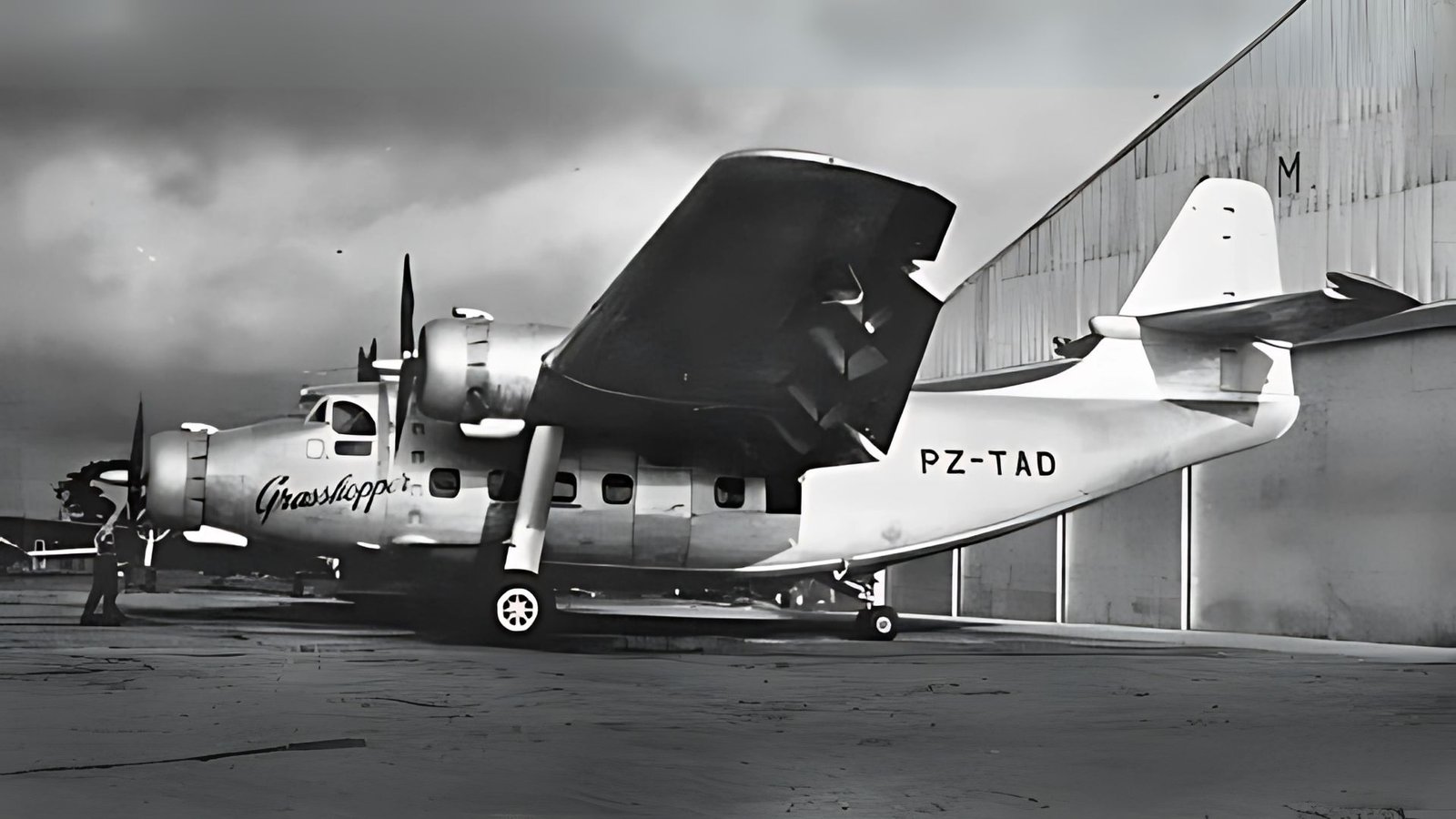
During the 1950s the aviation in Suriname came into a new phase: part of a large development program was the opening of the rain forest-covered inland by the construction of airstrips. These airstrps were mainly used for the search of minerals. A number of U.S. aircraft and companies played an important role during this operation.
Aviation in Suriname before 1947
Being a Dutch colony since the 17th century, the economy of Suriname (or Dutch Guiana) was dominated until the 1920s by coffee, cotton and wood production. However, compared to the Dutch East-Indies (now Indonesia), the West Indies (Suriname and Antilles) played a minor role, due to their small population. With the Atlantic Ocean as an almost unbridgeable barrier, Dutch airline KLM concentrated from the 1920s on pioneering the air-route to the Dutch East-Indies. It wasn’t until 1934 that KLM started to operate in the West-Indies, with the Antilles as a main base. Suriname, however, had been a destination for scheduled U.S. air services since the 1920s.
The first aircraft in Suriname arrived on August 3, 1922, when a small Lévy-Lepen R flying boat of Transport Aérien Guyanais landed in the capital city Paramaribo from French Guyana1. From 1923 to 1929 water-based aircraft visited Suriname frequently. From mid-1929, Paramaribo was added as a stop on the flights from the New York-Rio-Buenos Aires Airlines (NYRBA) aircraft operating the air route the airline was named after. NYRBA used Consolidated Commodore flying boats, which used the Suriname River at Paramaribo for landings. In 1930 Pan American Airlines (PAA) took over the NYRBA operations, and also established the first domestic air service in Suriname: Paramaribo–Nickerie.
If wasn’t until 1939 that an airfield for land-based aircraft was constructed in Suriname, at the Zanderij savannah about 40 km south of Paramaribo. KLM West-Indisch Bedrijf (KLM West-Indies branch) extended the Curacao-Port of Spain (Venezuela) service once a week to Paramaribo using the Lockheed Super Electra. The Dutch government provided financing for the construction of the airfield. KLM had been in preparation for launching a transatlantic (mail) service, but the German invasion of the Netherlands in May 1940 upset these plans. Notably, in November 1939, eight USAF Boeing YB-17s, under the command of Gen. Delos C. Emmons, on their …
Full article can be buyed? https://www.aahs-online.org/pubs/journals/journal_template.php?vol_no=v57n1
Source:
Link:
Internal Link: