‘Reagan Doctrine’ Promoting Wider Role For CIA
By PATRICK E. TYLER and DAVID B. OTTAWAY Washington Post
WASHINGTON — Joao Baptiste, a soldier in the Angolan rebel army of Jonas Savimbi, watched in horror one day last August as a Soviet-made tank broke through the dense bush in eastern Angola, fired at his fellow guerrillas and crushed one of them beneath its treads.
Armed only with an automatic rifle and a grenade, Baptiste scrambled up the side of the tank, yanked the turret lid up and dropped the grenade into the hatch, according to accounts later told and retold in Washington.
The explosion stopped the tank’s attack against the members of Savimbi’s lightly armed guerrilla army, which has been fighting the Soviet-armed and Cuban-backed Marxist regime for a decade.
Such tales of heroic “freedom fighters” pitted against vastly superior Soviet weapons have captured the imagination of President Reagan and provided the administration with an emblem for a new direction in U.S. foreign policy that conservatives have begun calling “the Reagan doctrine.”
It is a doctrine that seeks to roll back Soviet and Cuban gains in the Third World by supporting anti-communist insurgencies. To translate theory into practice, the administration has turned to a CIA reinvigorated and greatly expanded under the activist leadership of William Casey.
Since Reagan tapped him to head the agency in 1981, Casey has become perhaps the most influential CIA director since Allen Dulles in the 1950s in shaping U.S. foreign policy. He has used that influence and his own belief in covert operations to expand CIA paramilitary involvement in Nicaragua, Afghanistan, Cambodia and now Angola.
The resignation this month of CIA Deputy Director John McMahon, who reportedly was wary of U.S. entanglements in the Third World, appears to have removed one of the principal brakes in the agency against such operations.
The ‘208 Committee’
In five years on the job, Casey has rebuilt the CIA into a controversial instrument for carrying out operations. The agency’s annual budget for secret missions far exceeds $500 million, far higher than at any time since the Vietnam War.
The administration’s request for $70 million in military aid for the contras fighting the Sandinista government of Nicaragua would push the sum even higher.
In recent months, the administration has established a secret interagency committee to oversee the increasingly complex patchwork of covert operations. Although formally nameless, the group meets in Room 208 of the Old Executive Office Building next to the White House and sometimes refers to itself as the “208 Committee.”
Its members — midlevel officials at the White House, CIA and State and Defense departments — are the micromanagers of Washington’s new secret diplomacy, supervisors of a widening array of local conflicts around the globe in which U.S. and Soviet interests collide.
These brushfire wars — “low-intensity conflicts” in military jargon — have grown in importance on Reagan’s foreign policy agenda in his second term.
According to interviews with a range of officials in and out of government — many of whom asked not to be identified — the 208 Committee meets periodically to determine which weapons will be shipped, which secret warehouse goods used, which middlemen will deliver them to clandestine airstrips.
The committee sets budgets, goals and timetables for each operation; the CIA serves as the principal agent. Decisions are ratified by the National Security Planning Group, consisting of the president and his key national security affairs advisers.
They have plenty to do, according to informed sources. Around the globe, the CIA’s new activism can be seen in a number of ways other than its covert paramilitary role. In Chad, the agency helped engineer the rise to power of Hissene Habre. In Liberia, it provided security assistance to President Samuel Doe. In Ethiopia, Suriname and Mauritius it has dabbled in opposition politics.
Reverse Image
The newest and most sensitive covert program targets Libya. CIA and Pentagon planners are working with the opposition and Libya’s pro-U.S. neighbors to destabilize the regime of Col. Muammar Qaddafi, whom the administration denounces as a patron of international terrorism.
At its heart, the Reagan doctrine seeks a historic turnabout in which U.S. aid underpins a new generation of national liberation struggles aimed at throwing off what conservatives have dubbed “Soviet colonialism.”
The policy, coincidentally, mirrors a Soviet doctrine unveiled a quarter-century ago. In 1960, Soviet party leader Nikita Khrushchev warned the West that Moscow’s military muscle would be thrown behind “wars of national liberation” in the Third World, where leftist groups were struggling against colonial or pro-U.S. regimes.
The resort to an increasing number of CIA-run undercover operations has raised concern in Congress that covert action with obscure U.S. objectives is becoming a substitute for a well-defined foreign policy.
Much congressional anxiety centers on the concern that covert paramilitary operations — secret wars — are initiated by the White House, which then informs congressional oversight committees that are powerless to intervene.
Conflicting Views
Recent presidential rhetoric has elevated the U.S. commitment to these anti-communist movements from moral and political backing to the resounding proclamation in Reagan’s State of the Union message last month:
“America will support… with moral and material assistance your right not just to fight and die for freedom but to fight and win freedom.”
In his speech Feb. 26 justifying the administration’s military budget, Reagan used a map with arrows darting across the globe to pinpoint pro-Soviet Marxist regimes around the world. “We set out to show that the long string of governments falling under communist domination was going to end. And we’re doing it,” he said.
Despite this apparent escalation in administration commitment, officials acknowledge that neither the CIA nor any branch of the armed services is gearing up to make a military victory possible through major U.S. support for any of these insurgencies. Nor is there much belief in the intelligence community that military victories are likely in the conflicts, even with increased CIA support.
Proponents of the Reagan doctrine argue that the potential for real military gains is being undercut by bureaucrats at the CIA, the State Department and the Pentagon who are leery of involving the United States in uncertain wars with uncertain public support.
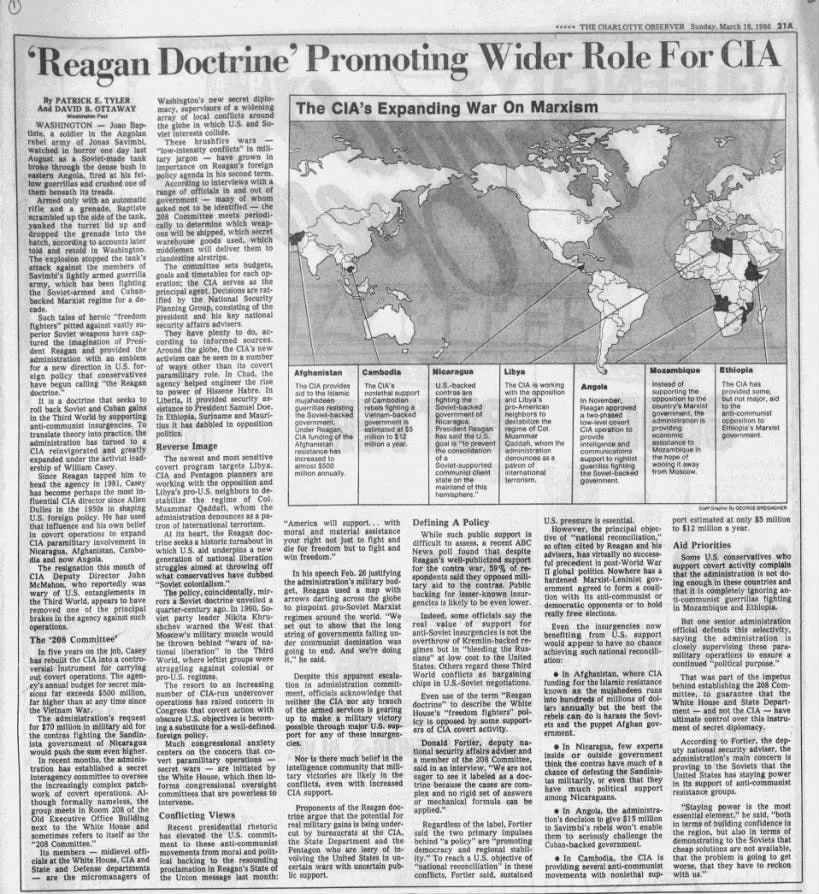
The CIA’s Expanding War On Marxism
(Sidebar Summary)
| Country | CIA Activity |
| Afghanistan | Provides aid to Islamic mujahedeen. Funding has increased to almost $500 million annually. |
| Cambodia | Nonlethal support of rebels fighting Vietnam-backed government, estimated at $5 million to $12 million a year. |
| Nicaragua | U.S.-backed contras fight the Soviet-backed Sandinistas. Goal is to prevent a “Soviet-supported communist client state.” |
| Libya | Working with opposition and neighbors to destabilize the regime of Col. Muammar Qaddafi. |
| Angola | Reagan approved a two-phased covert operation to provide intelligence, communications, and support to rightist guerrillas. |
| Mozambique | Providing economic assistance to the Marxist government in hopes of wooing it away from Moscow. |
| Ethiopia | Provided some minor aid to anti-communist opposition to the Marxist government. |
Defining A Policy
While such public support is difficult to assess, a recent ABC News poll found that despite Reagan’s well-publicized support for the contra war, 59% of respondents said they opposed military aid to the contras. Public backing for lesser-known insurgencies is likely to be even lower.
Indeed, some officials say the real value of support for anti-Soviet insurgencies is not the overthrow of Kremlin-backed regimes but in “bleeding the Russians” at low cost to the United States. Others regard these Third World conflicts as bargaining chips in U.S.-Soviet negotiations.
Even use of the term “Reagan doctrine” to describe the White House’s “freedom fighters” policy is opposed by some supporters of CIA covert activity.
Donald Fortier, deputy national security affairs adviser and a member of the 208 Committee, said in an interview, “We are not eager to see it labeled as a doctrine because the cases are complex and no rigid set of answers or mechanical formula can be applied.”
Regardless of the label, Fortier said the two primary impulses behind “a policy” are “promoting democracy and regional stability.” To reach a U.S. objective of “national reconciliation” in these conflicts, Fortier said, sustained U.S. pressure is essential.
However, the principal objective of “national reconciliation,” so often cited by Reagan and his advisers, has virtually no successful precedent in post-World War II global politics. Nowhere has a hardened Marxist-Leninist government agreed to form a coalition with its anti-communist or democratic opponents or to hold really free elections.
Even the insurgencies now benefiting from U.S. support would appear to have no chance of achieving such national reconciliation:
- In Afghanistan, where CIA funding for the Islamic resistance known as the mujahedeen runs into hundreds of millions of dollars annually, the best the rebels can do is harass the Soviets and the puppet Afghan government.
- In Nicaragua, few experts inside or outside government think the contras have much of a chance of defeating the Sandinistas militarily, or even that they have much political support among Nicaraguans.
- In Angola, the administration’s decision to give $15 million to Savimbi’s rebels won’t enable them to seriously challenge the Cuban-backed government.
- In Cambodia, the CIA is providing several anti-communist movements with nonlethal support estimated at only $5 million to $12 million a year.
Aid Priorities
Some U.S. conservatives who support covert activity complain that the administration is not doing enough in these countries and that it is completely ignoring anti-communist guerrillas fighting in Mozambique and Ethiopia.
But one senior administration official defends this selectivity, saying the administration is closely supervising these paramilitary operations to ensure a continued “political purpose.”
That was part of the impetus behind establishing the 208 Committee, to guarantee that the White House and State Department — and not the CIA — have ultimate control over this instrument of secret diplomacy.
According to Fortier, the deputy national security adviser, the administration’s main concern is proving to the Soviets that the United States has staying power in its support of anti-communist resistance groups.
“Staying power is the most essential element,” he said, “both in terms of building confidence in the region, but also in terms of demonstrating to the Soviets that cheap solutions are not available, that the problem is going to get worse, that they have to reckon with us.”
Source:
Link:
Internal Link:
Date:
March 16, 1986
Categories:
Iran–Contra affair, Mercenaries, Military & Intel, Soft War, State Sponsored Terrorism, U.S. Interventions