Solar panels ensure the operation of air navigation equipment in the Amazon
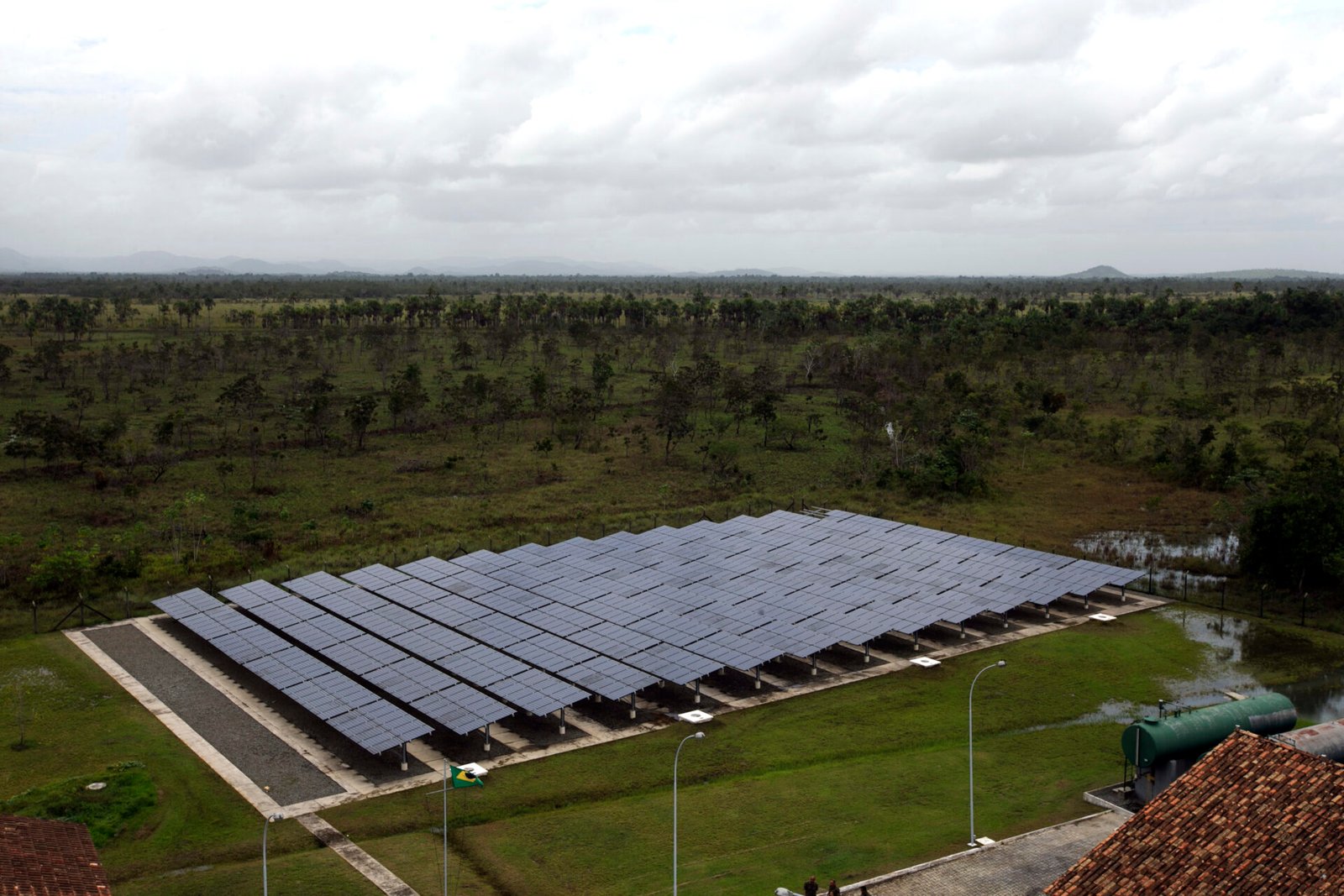
On the border with Suriname, 750 km from Manaus, lies Tiriós, a village in the far north of Pará. Surrounded by the Amazon rainforest and sharing space with indigenous communities, Tiriós is considered a strategic location, serving as a route for regular commercial flights to Central and North America, and hosting an Airspace Control Detachment (DTCEA-TS).
Subordinated to the Fourth Integrated Air Defense and Air Traffic Control Center (CINDACTA IV), the DTCEA-TS is responsible for maintaining essential equipment for air navigation, air defense, and meteorological control in the Amazon region. The unit’s radar is one of the first in the region to detect aircraft coming from the north, with a range of 250 miles, capable of monitoring the airspace along the borders with the Guianas and Suriname.
To ensure the operational reliability of air navigation equipment at lower operational costs, with reduced logistical effort and environmental impact, the Brazilian Air Force (FAB) invested in a sustainable energy generation project, considered a pioneering initiative in Brazil. “The use of photovoltaic panels, which convert sunlight into electricity, became the best alternative for Tiriós, as well as in Surucucu (RR), where there is an Airspace Control Support Station (EACEA),” explains the project’s creator and head of the Technical Subdepartment (SDTE) of the Airspace Control Department (DECEA), Colonel Engineer Dalmo José Braga Paim.
The solar plant is one of the most promising energy alternatives of the new millennium. It is inexhaustible, renewable, and strategic for environmental preservation, as it produces no pollutants. All these advantages are combined with a reduction in diesel fuel consumption.
According to the commander of CINDACTA IV, Colonel Aviator Nilo Sérgio Machado de Azevedo, the greatest challenge in Tiriós is logistical. “The difficult geographic location and lack of commercial electricity are some characteristics of the region, and the only means of access is by air.”
To ensure the operation of air navigation equipment, it was necessary to provide its own power, initially using a thermal matrix based on diesel fuel with three generator units. “Pollution from fuel consumption, human effort, maintenance costs for machines and parts, and the difficulties of transporting diesel by cargo plane led us to seek an alternative solution for electricity generation,” justifies the head of the Specialized Engineering Subdivision of CINDACTA IV, engineer Boris Brandão.
According to a study by the unit’s technicians, using the energy resources available locally, solar energy would be the cleanest, most reliable, and most economical option.
Operation
Active since November 2016, the hybrid station integrates photovoltaic panels with diesel generator units. They produce up to 268 kilowatts of power and can autonomously supply the DTCEA Tiriós for up to ten hours daily. The solar energy absorption system consists of 1,072 photovoltaic panels and five banks of 24 ventilated stationary batteries, which power the station’s load with an estimated lifespan of 20 years. The logistics for implementing the station involved about 210 tons of material, ten months of transport, and five months of assembly, occupying an area of approximately 2,400 m².
Since its operation, the project has allowed a 45% reduction in energy generation costs for maintaining the unit. “The investment, around three million euros, including equipment purchase and installation logistics, is expected to be recovered within seven years,” explains engineer Boris.
Strategic Importance of Tiriós
“Units like Tiriós, equipped with radars, meteorological stations, and telecommunications systems, provide air defense and air traffic control information to CINDACTA IV,” says Colonel Nilo.
The complexity of the structure is justified by the strategic importance of the region: in addition to being a route for regular commercial flights to Central and North America and monitoring significant traffic of smaller aircraft like air taxis, the Amazon region has an extensive border, making it vulnerable to illicit trafficking.
According to the commander of CINDACTA IV, the unit’s importance is also linked to regional development and integration. “Tiriós fits into the FAB’s Dimension 22 campaign to control, defend, and integrate the country. In addition to providing meteorological, telecommunications, and radar information, the unit supports indigenous communities.”
Benefits
To shorten distances and reduce costs, remote monitoring equipment was installed, allowing real-time supervision and command so that CINDACTA IV technicians can perform preventive and corrective maintenance without physically being at the detachment. “Although the cost of a lamp is insignificant, transporting it to Tiriós is extremely expensive, as access is only by plane. Therefore, to minimize logistical demands and maximize the lifespan of the equipment, long-lasting self-sustaining alternatives were adopted,” emphasizes Colonel Paim.
Operating at 100% capacity, the hybrid system has proven safe, reliable, and economical, significantly reducing operational failures. “Previously, with only generator units, 22,000 liters of fuel were needed per month, requiring monthly maintenance visits due to material wear. With solar energy, only 12,000 liters of fuel per month are used, requiring just two preventive visits per semester, as the equipment is monitored remotely,” counts Boris.
According to the head of the Technical Division of CINDACTA IV, Colonel Aviator Arthur Carlos Guedes Naylor Junior, compared with other sources, solar energy became the best alternative, reducing generator use and providing sustainable, low-failure power. “The quality and reliability of the energy supplied by photovoltaic panels have resulted in significant economic and environmental benefits,” he celebrates.
Social Communication Department of DECEA
Report: Denise Fontes – Journalist
Photos: Fábio Maciel