TERRORISM: Still Searching for the Smoking Gun: Are ‘Outlaw States’ Simply Surrogates?
CIA-RDP91-00587R000200890021-2
This is a formatted OCR transcription of the original article from the Los Angeles Times, published on July 14, 1985. It was written by David Atlee Phillips, a high-ranking former CIA officer and founder of the Association of Former Intelligence Officers.
LOS ANGELES TIMES
14 July 1985 By David Atlee Phillips WASHINGTON
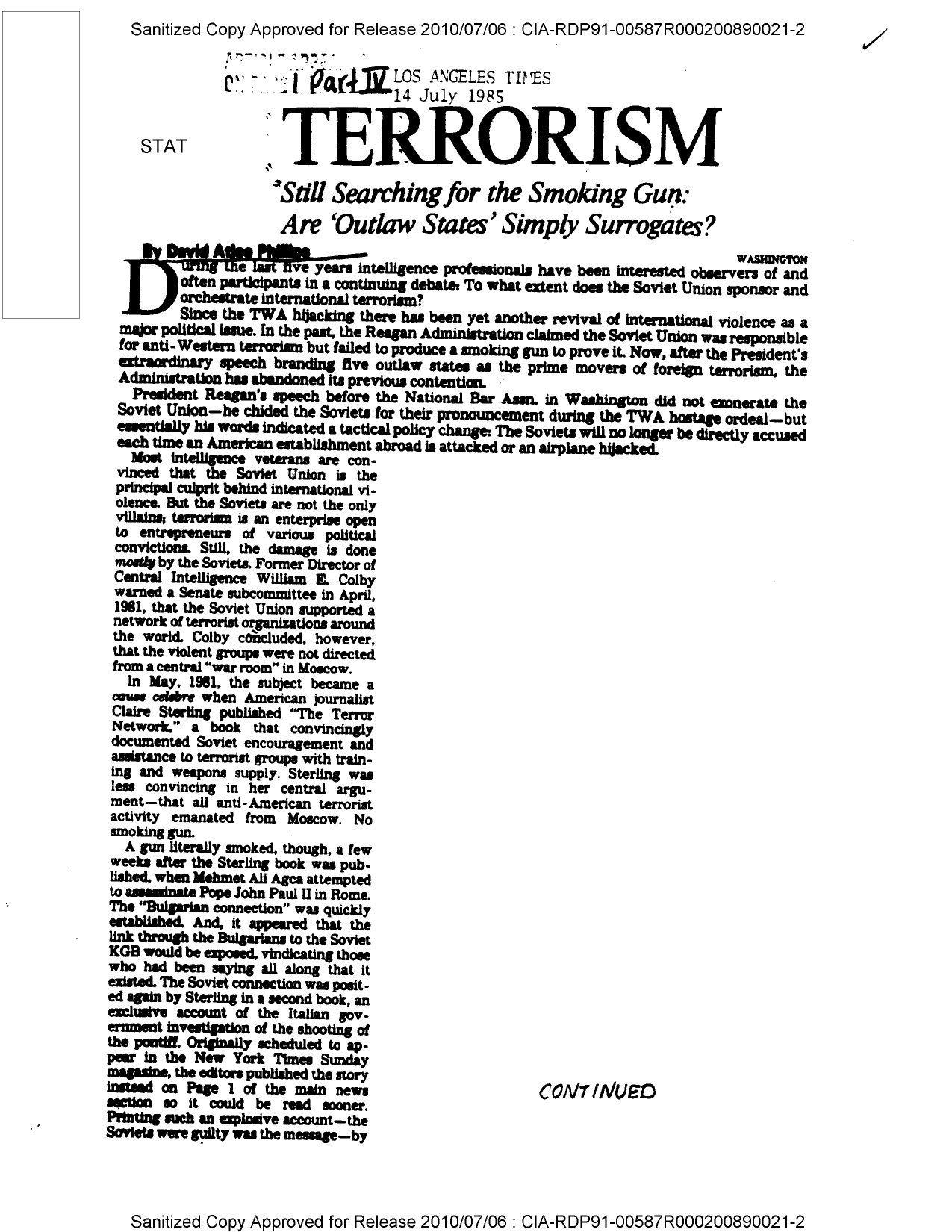
During the last five years intelligence professionals have been interested observers of and often participants in a continuing debate: To what extent does the Soviet Union sponsor and orchestrate international terrorism?
Since the TWA hijacking there has been yet another revival of international violence as a major political issue. In the past, the Reagan Administration claimed the Soviet Union was responsible for anti-Western terrorism but failed to produce a smoking gun to prove it. Now, after the President’s extraordinary speech branding five outlaw states as the prime movers of foreign terrorism, the Administration has abandoned its previous contention.
President Reagan’s speech before the National Bar Assn. in Washington did not exonerate the Soviet Union—he chided the Soviets for their pronouncement during the TWA hostage ordeal—but essentially his words indicated a tactical policy change: The Soviets will no longer be directly accused each time an American establishment abroad is attacked or an airplane hijacked.
Most intelligence veterans are convinced that the Soviet Union is the principal culprit behind international violence. But the Soviets are not the only villains; terrorism is an enterprise open to entrepreneurs of various political convictions. Still, the damage is done mostly by the Soviets. Former Director of Central Intelligence William E. Colby warned a Senate subcommittee in April, 1981, that the Soviet Union supported a network of terrorist organizations around the world. Colby concluded, however, that the violent groups were not directed from a central “war room” in Moscow.
In May, 1981, the subject became a cause celebre when American journalist Claire Sterling published “The Terror Network,” a book that convincingly documented Soviet encouragement and assistance to terrorist groups with training and weapons supply. Sterling was less convincing in her central argument—that all anti-American terrorist activity emanated from Moscow. No smoking gun.
A gun literally smoked, though, a few weeks after the Sterling book was published, when Mehmet Ali Agca attempted to assassinate Pope John Paul II in Rome. The “Bulgarian connection” was quickly established. And, it appeared that the link through the Bulgarians to the Soviet KGB would be exposed, vindicating those who had been saying all along that it existed. The Soviet connection was posited again by Sterling in a second book, an exclusive account of the Italian government investigation of the shooting of the pontiff. Originally scheduled to appear in the New York Times Sunday magazine, the editors published the story instead on Page 1 of the main news section so it could be read sooner. Printing such an explosive account—the Soviets were guilty was the message—by someone who was not a New York Times reporter was highly unusual.
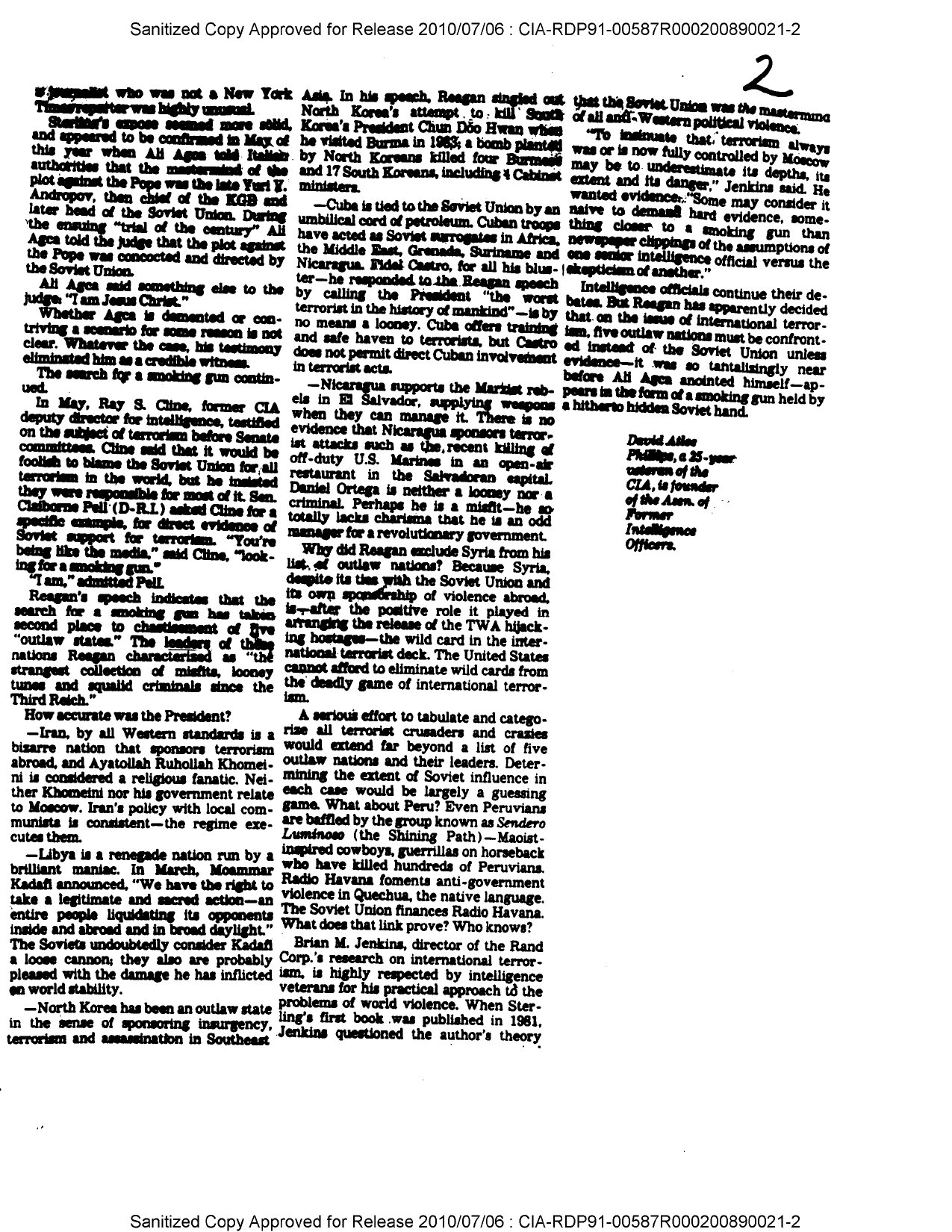
Sterling’s expose seemed more solid, and appeared to be confirmed in May of this year when Ali Agca told Italian authorities that the mastermind of the plot against the Pope was the late Yuri Y. Andropov, then chief of the KGB and later head of the Soviet Union. During the ensuing “trial of the century” Ali Agca told the judge that the plot against the Pope was concocted and directed by the Soviet Union.
Ali Agca said something else to the judge: “I am Jesus Christ.”
Whether Agca is demented or contriving a scenario for some reason is not clear. Whatever the case, his testimony eliminated him as a credible witness. The search for a smoking gun continued.
In May, Ray S. Cline, former CIA deputy director for intelligence, testified on the subject of terrorism before Senate committees. Cline said that it would be foolish to blame the Soviet Union for all terrorism in the world, but he insisted they were responsible for most of it. Sen. Claiborne Pell (D-R.I.) asked Cline for a specific example, for direct evidence of Soviet support for terrorism. “You’re being like the media,” said Cline, “looking for a smoking gun.”
“I am,” admitted Pell.
Reagan’s speech indicates that the search for a smoking gun has taken second place to chastisement of five “outlaw states.” The leaders of these nations Reagan characterized as “the strangest collection of misfits, looney tunes and squalid criminals since the Third Reich.”
How accurate was the President?
- Iran, by all Western standards is a bizarre nation that sponsors terrorism abroad, and Ayatollah Ruhollah Khomeini is considered a religious fanatic. Neither Khomeini nor his government relate to Moscow. Iran’s policy with local communists is consistent—the regime executes them.
- Libya is a renegade nation run by a brilliant maniac. In March, Moammar Kadafi announced, “We have the right to take a legitimate and sacred action—an entire people liquidating its opponents inside and abroad and in broad daylight.” The Soviets undoubtedly consider Kadafi a loose cannon; they also are probably pleased with the damage he has inflicted on world stability.
- North Korea has been an outlaw state in the sense of sponsoring insurgency, terrorism and assassination in Southeast Asia. In his speech, Reagan singled out North Korea’s attempt to kill South Korea’s President Chun Doo Hwan when he visited Burma in 1983; a bomb planted by North Koreans killed four Burmese and 17 South Koreans, including 4 Cabinet ministers.
- Cuba is tied to the Soviet Union by an umbilical cord of petroleum. Cuban troops have acted as Soviet surrogates in Africa, the Middle East, Grenada, Suriname and Nicaragua. Fidel Castro, for all his bluster—he responded to the Reagan speech by calling the President “the worst terrorist in the history of mankind”—is by no means a looney. Cuba offers training and safe haven to terrorists, but Castro does not permit direct Cuban involvement in terrorist acts.
- Nicaragua supports the Marxist rebels in El Salvador, supplying weapons when they can manage it. There is no evidence that Nicaragua sponsors terrorist attacks such as the recent killing of off-duty U.S. Marines in an open-air restaurant in the Salvadoran capital. Daniel Ortega is neither a looney nor a criminal. Perhaps he is a misfit—he so totally lacks charisma that he is an odd manager for a revolutionary government.
Why did Reagan exclude Syria from his list of outlaw nations? Because Syria, despite its ties with the Soviet Union and its own sponsorship of violence abroad, is—after the positive role it played in arranging the release of the TWA hijacking hostages—the wild card in the international terrorist deck. The United States cannot afford to eliminate wild cards from the deadly game of international terrorism.
A serious effort to tabulate and categorize all terrorist crusaders and crazies would extend far beyond a list of five outlaw nations and their leaders. Determining the extent of Soviet influence in each case would be largely a guessing game. What about Peru? Even Peruvians are baffled by the group known as Sendero Luminoso (the Shining Path)—Maoist-inspired cowboys, guerrillas on horseback who have killed hundreds of Peruvians. Radio Havana foments anti-government violence in Quechua, the native language. The Soviet Union finances Radio Havana. What does that link prove? Who knows?
Brian M. Jenkins, director of the Rand Corp.’s research on international terrorism, is highly respected by intelligence veterans for his practical approach to the problems of world violence. When Sterling’s first book was published in 1981, Jenkins questioned the author’s theory that the Soviet Union was the mastermind of all anti-Western political violence. “To insinuate that terrorism always was or is now fully controlled by Moscow may be to underestimate its depths, its extent and its danger,” Jenkins said. He wanted evidence. “Some may consider it naive to demand hard evidence, something closer to a smoking gun than newspaper clippings of the assumptions of one senior intelligence official versus the skepticism of another.”
Intelligence officials continue their debates. But Reagan has apparently decided that on the issue of international terrorism, five outlaw nations must be confronted instead of the Soviet Union unless evidence—it was so tantalizingly near before Ali Agca anointed himself—appears in the form of a smoking gun held by a hitherto hidden Soviet hand.
David Atlee Phillips, a 25-year veteran of the CIA, is founder of the Assn. of Former Intelligence Officers.
Date:
July 14, 1985