Talking Points on Suriname for DDCI and DDI – 18 December 1986
Deciding the future of Suriname – 18 December 1986
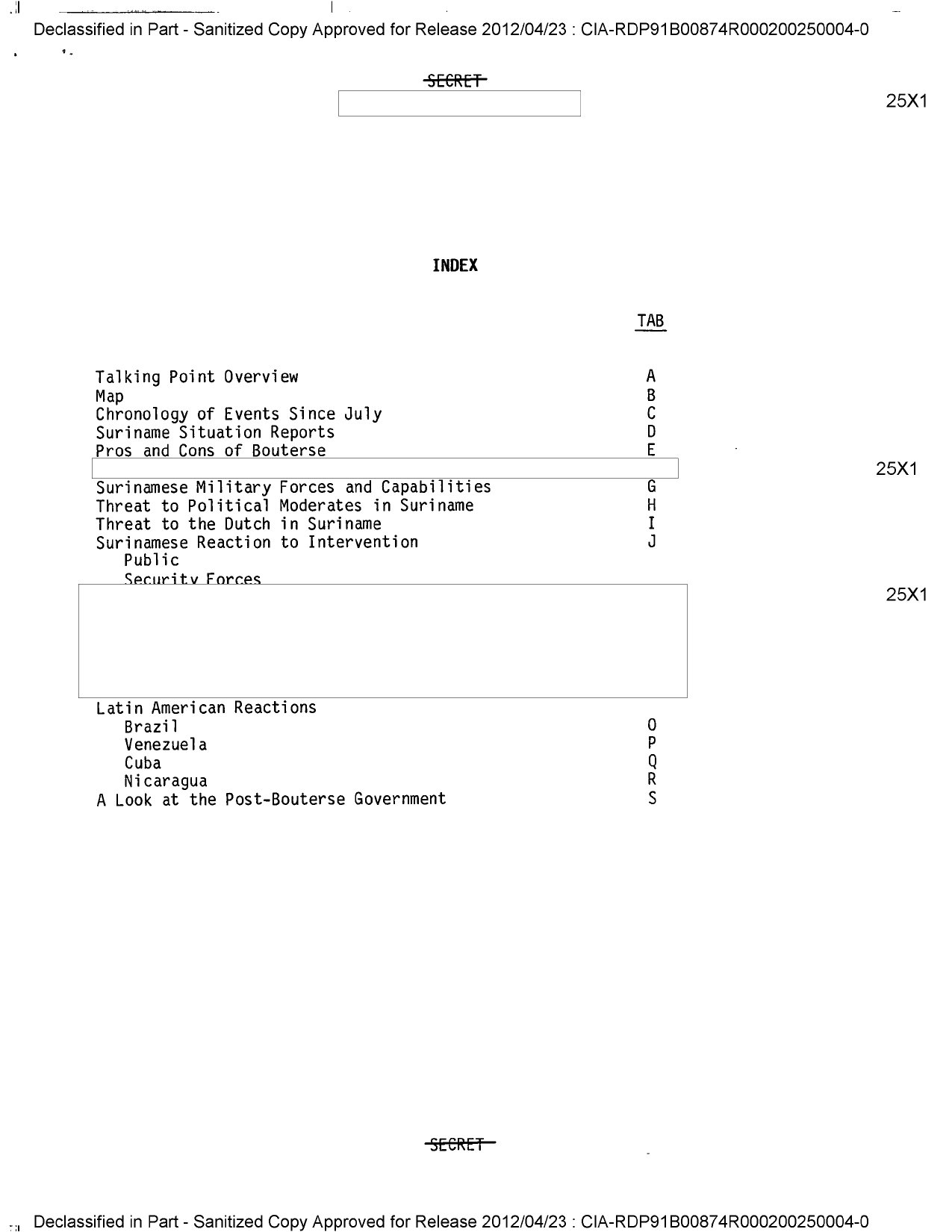
| Subject | Tab |
|---|---|
| Talking Point Overview | A |
| Map | B |
| Chronology of Events Since July | C |
| Suriname Situation Reports | D |
| Situation Report #1 | |
| Situation Report #2 | |
| Situation Report #3 | |
| Situation Report #4 | |
| Situation Report #5 | |
| Situation Report #6 | |
| Situation Report #7 | |
| Pros and Cons of Bouterse | |
| [CENSORED] (could be “Bouterse’s reaction to invasion rumors“) | F |
| Surinamese Military Forces and Capabilities | G |
| Threat to Political Moderates in Suriname | H |
| Threat to the Dutch in Suriname | I |
| Surinamese Reaction to Intervention | J |
| Public | |
| Security Forces | |
| [CENSORED] | |
| [CENSORED] | |
| [CENSORED] | |
| Latin American Reactions | |
| Brazil | O |
| Venezuela | P |
| Cuba | Q |
| Nicaragua | R |
| A Look at the Post-Bouterse Government | S |
A) Talking Point Overview
18 December 1986
Suriname Developments
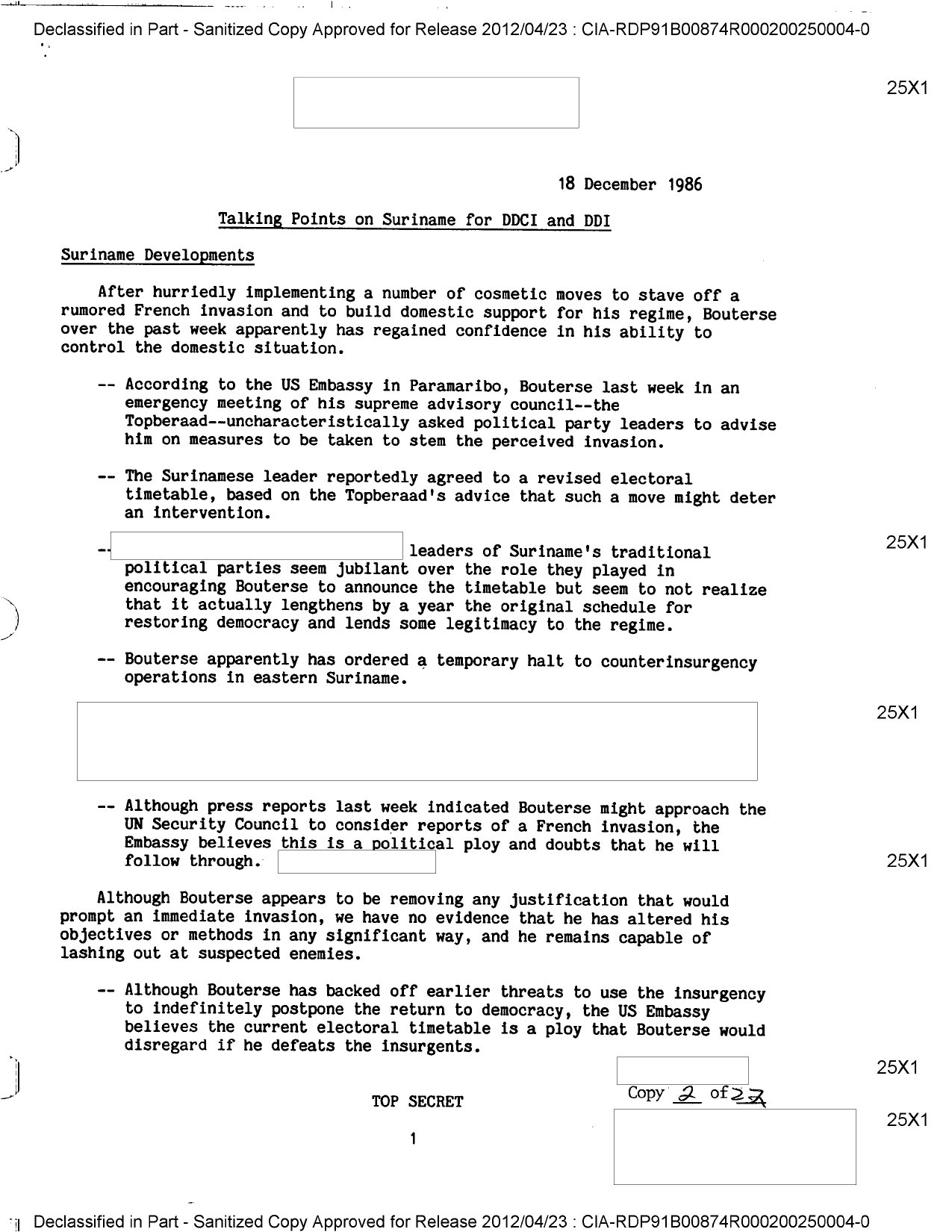
After hurriedly implementing a number of cosmetic moves to stave off a rumored French invasion and to build domestic support for his regime, Bouterse over the past week apparently has regained confidence in his ability to control the domestic situation.
- According to the US Embassy in Paramaribo, Bouterse last week in an emergency meeting of his supreme advisory council — the Topberaad — uncharacteristically asked political party leaders to advise him on measures to be taken to stem the perceived invasion.
- The Surinamese leader reportedly agreed to a revised electoral timetable, based on the Topberaad’s advice that such a move might deter an intervention.
- Leaders of Suriname’s traditional political parties seem jubilant over the role they played in encouraging Bouterse to announce the timetable but seem to not realize that it actually lengthens by a year the original schedule for restoring democracy and lends some legitimacy to the regime.
- Bouterse apparently has ordered a temporary halt to counterinsurgency operations in eastern Suriname.
[CENSORED]
Although press reports last week indicated Bouterse might approach the UN Security Council to consider reports of a French invasion, the Embassy believes this is a political ploy and doubts that he will follow through.
Although Bouterse appears to be removing any justification that would prompt an immediate invasion, we have no evidence that he has altered his objectives or methods in any significant way, and he remains capable of lashing out at suspected enemies.
- Although Bouterse has backed off earlier threats to use the insurgency to indefinitely postpone the return to democracy, the US Embassy believes the current electoral timetable is a ploy that Bouterse would disregard if he defeats the insurgents.
[CENSORED]
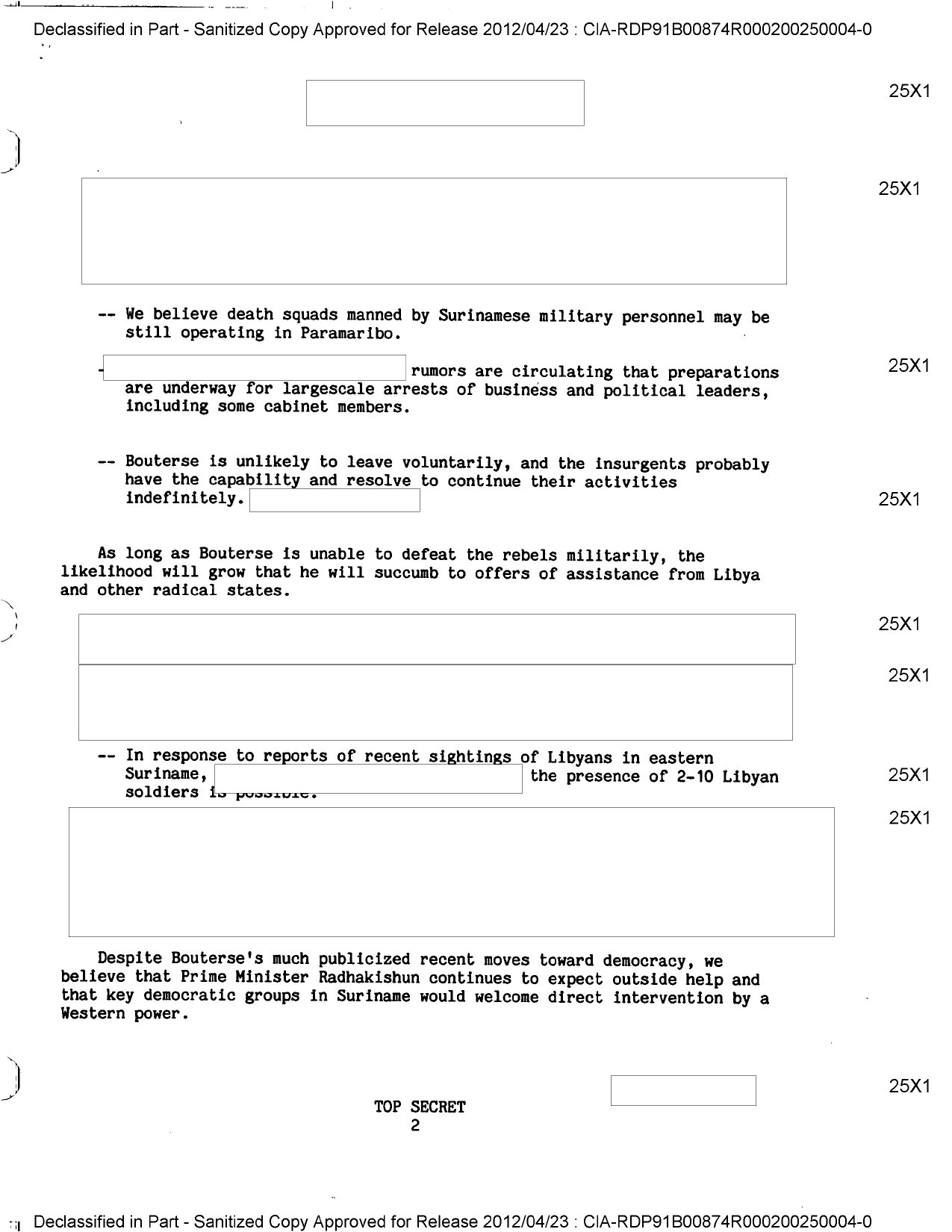
- We believe death squads manned by Surinamese military personnel may be still operating in Paramaribo.
- [CENSORED] rumors are circulating that preparations are underway for largescale arrests of business and political leaders, including some cabinet members.
- Bouterse is unlikely to leave voluntarily, and the insurgents probably have the capability and resolve to continue their activities indefinitely. As long as Bouterse is unable to defeat the rebels militarily, the likelihood will grow that he will succumb to offers of assistance from Libya and other radical states.
[CENSORED]
[CENSORED]
In response to reports of recent sightings of Libyans in eastern Suriname, [CENSORED] the presence of 2-10 Libyan soldiers is possible.
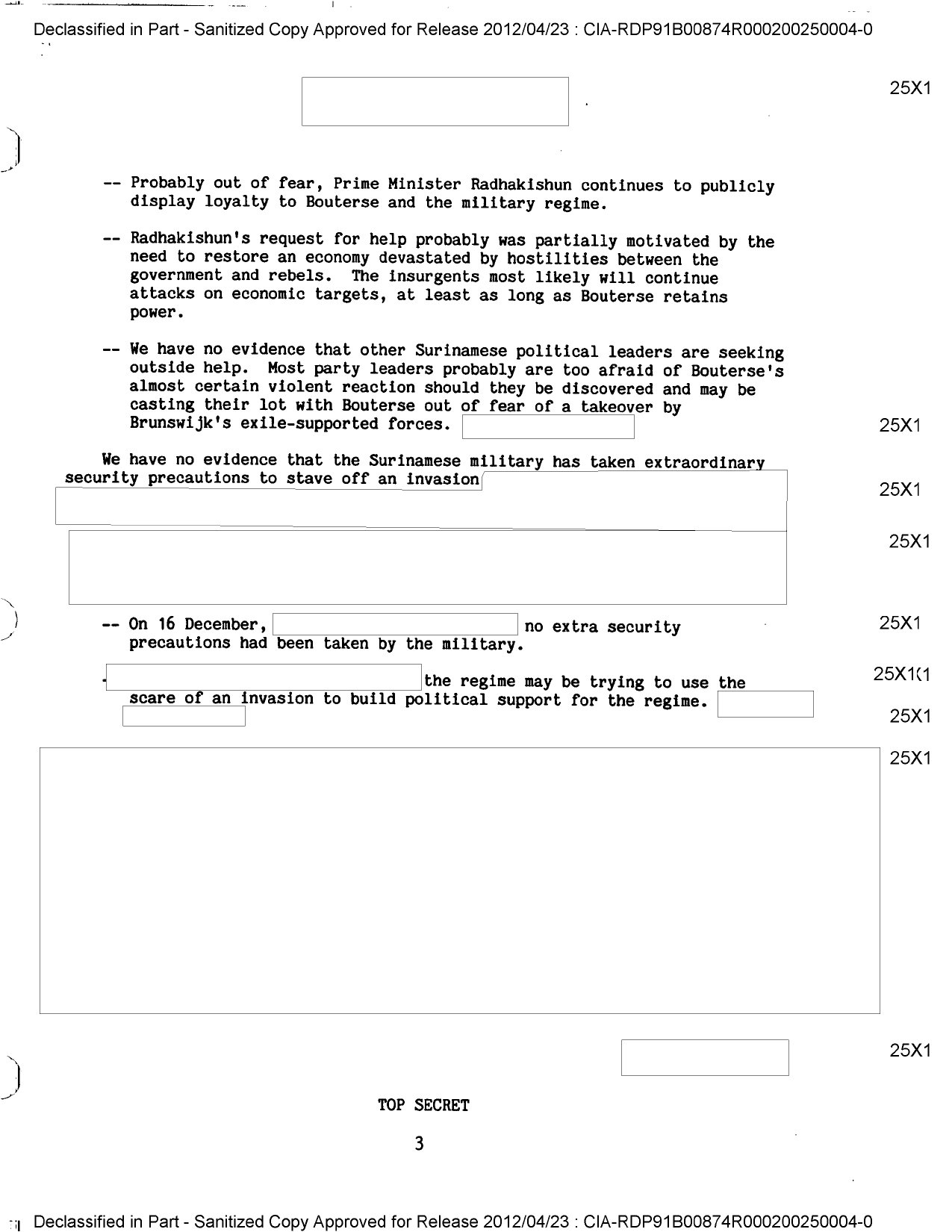
Probably out of fear, Prime Minister Radhakishun continues to publicly display loyalty to Bouterse and the military regime.
- Radhakishun’s request for help probably was partially motivated by the need to restore an economy devastated by hostilities between the government and rebels. The insurgents most likely will continue attacks on economic targets, at least as long as Bouterse retains power.
- We have no evidence that other Surinamese political leaders are seeking outside help. Most party leaders probably are too afraid of Bouterse’s almost certain violent reaction should they be discovered and may be casting their lot with Bouterse out of fear of a takeover by Brunswijk’s exile-supported forces.
We have no evidence that the Surinamese military has taken extraordinary security precautions to stave off an invasion
[CENSORED]
On 16 December, [CENSORED] no extra security precautions had been taken by the military.
[FULL PAGE CENSORED]
B) Map
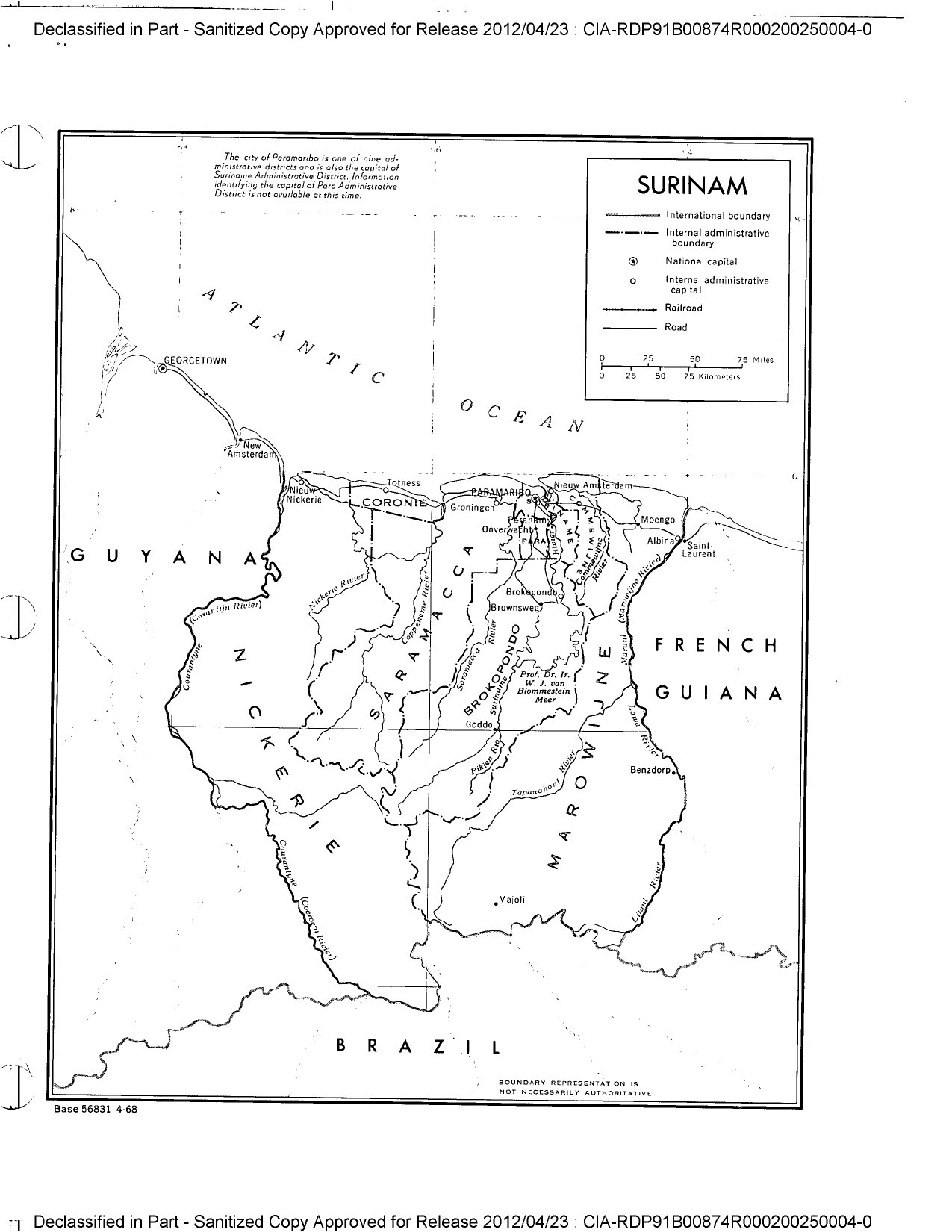
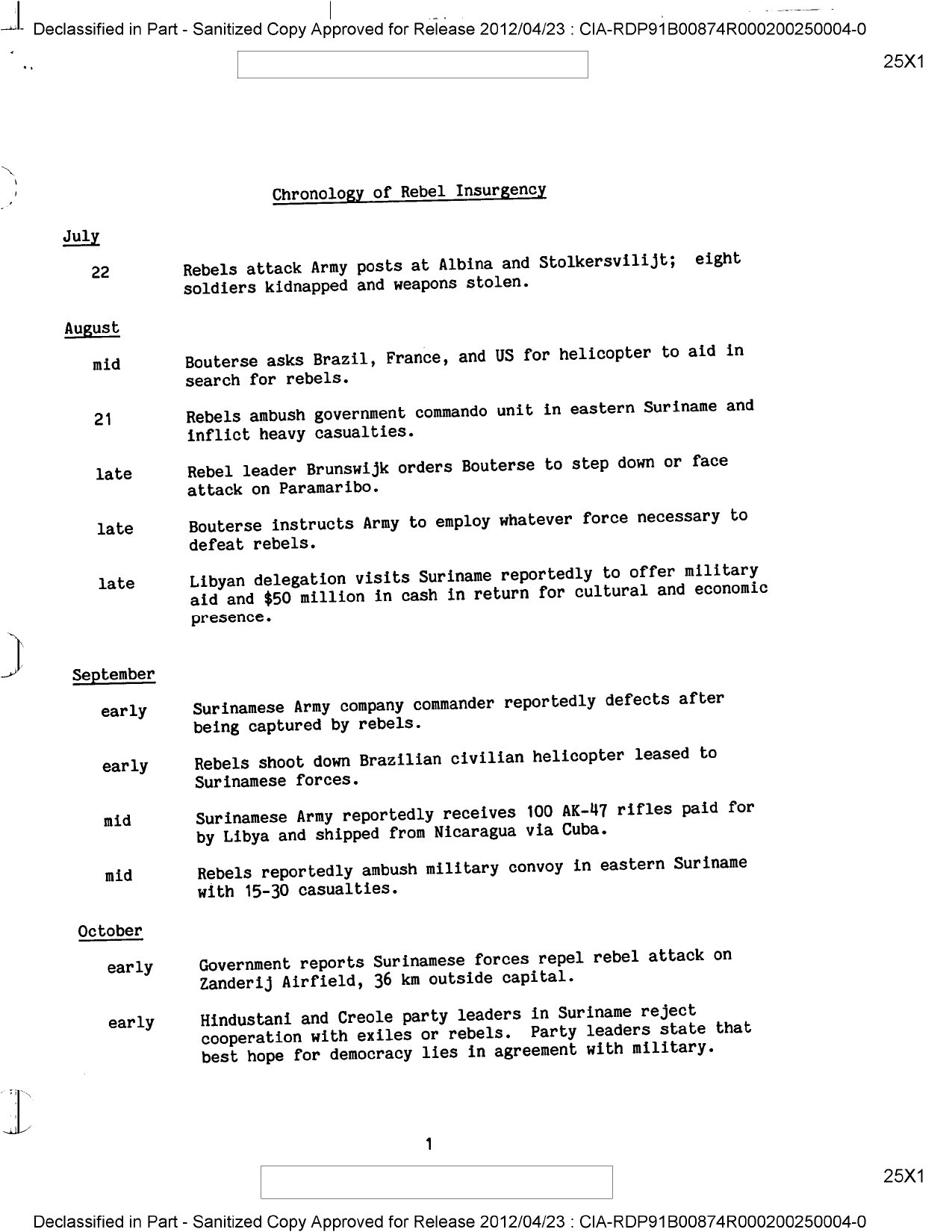
C) Chronology of Events Since July
| Month / Date | Event |
|---|---|
| July 22 | Rebels attack Army posts at Albina and Stolkersvilijt; eight soldiers kidnapped and weapons stolen. |
| Bouterse asks Brazil, France, and US for helicopter to aid in search for rebels. | |
| August 21 | Rebels ambush government commando unit in eastern Suriname and inflict heavy casualties. |
| August late | Rebel leader Brunswijk orders Bouterse to step down or face attack on Paramaribo. |
| August late | Bouterse instructs Army to employ whatever force necessary to defeat rebels. |
| August late | Libyan delegation visits Suriname reportedly to offer military aid and $50 million in cash in return for cultural and economic presence. |
| September early | Surinamese Army company commander reportedly defects after being captured by rebels. |
| September early | Rebels shoot down Brazilian civilian helicopter leased to Surinamese forces. |
| September mid | Surinamese Army reportedly receives 100 AK-47 rifles paid by Libya and shipped from Nicaragua via Cuba. |
| September mid | Rebels reportedly ambush military convoy in eastern Suriname with 15-30 casualties. |
| October early | Government reports Surinamese forces repel rebel attack at Zanderij Airfield, 36 km outside capital. |
| October early | Hindustani and Creole party leaders in Suriname reject cooperation with exiles or rebels. Party leaders state that best hope for democracy lies in agreement with military. |
| October mid | Rebels burn government oil plantation at Patamacca and schools near Moengo. Insurgents drop propaganda leaflets in Moengo and commandeer private vehicles. |
| October 11-13 | Rebels attack bridges and government outposts in eastern Suriname. |
| October 18 | Insurgents hijack government-owned passenger aircraft. All flights to the interior halted. |
| October 20 | Prime Minister Radhakishun requests US help in encouraging Bouterse to leave. |
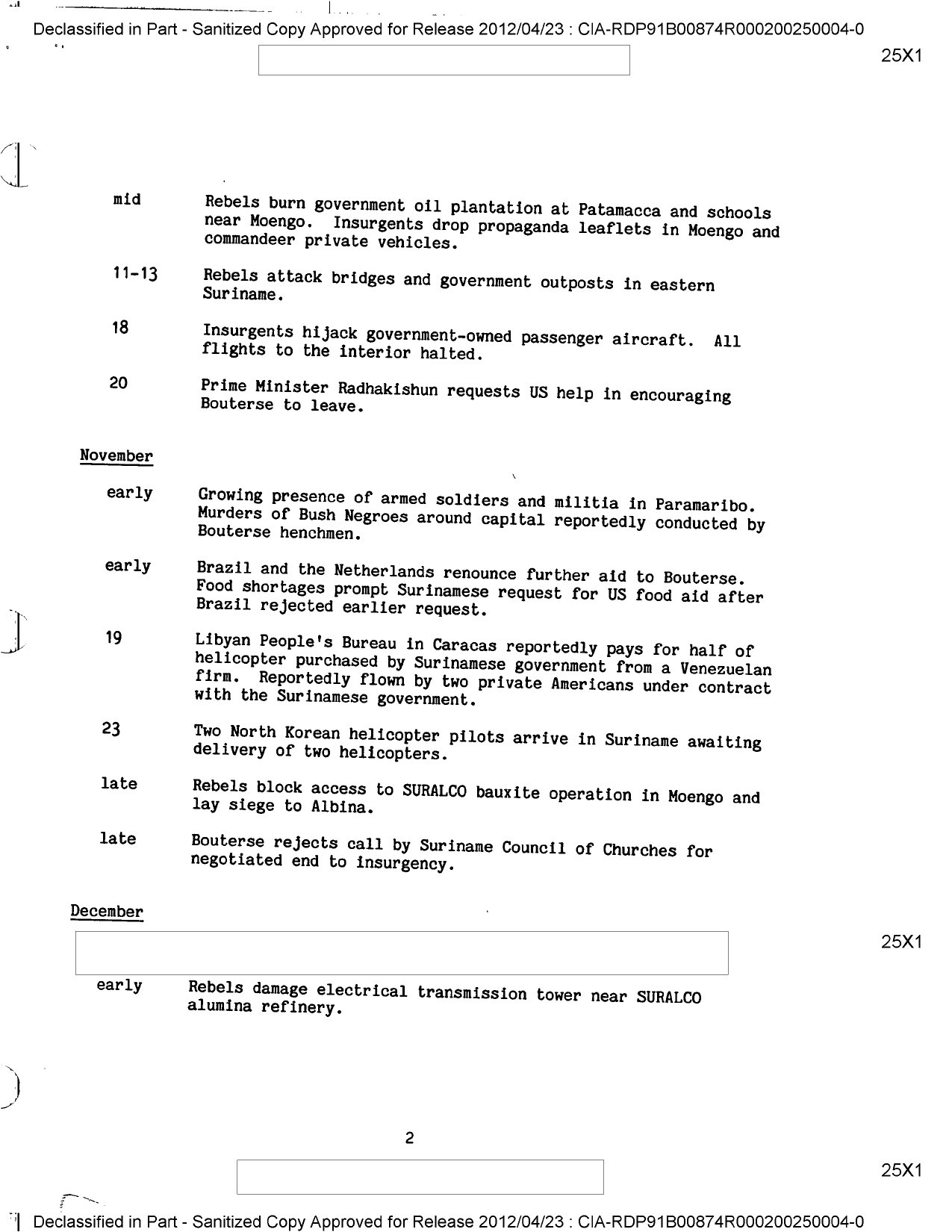
| November early | Growing presence of armed soldiers and militia in Paramaribo. Murders of Bush Negroes around capital reportedly conducted by Bouterse’s henchmen. |
| November early | Brazil and the Netherlands renounce further aid to Bouterse. Food shortages prompt Surinamese request for US food aid after Brazil rejected earlier request. |
| November 19 | Libyan People’s Bureau in Caracas reportedly pays for half of helicopter purchased by Surinamese government from a Venezuelan firm. Reportedly flown by two private Americans under contract with the Surinamese government. |
| November 23 | Two North Korean helicopter pilots arrive in Suriname awaiting delivery of two helicopters. |
| November late | Rebels block access to SURALCO bauxite operation in Moengo and lay siege to Albina. |
| November late | Bouterse rejects call by Suriname Council of Churches for negotiated end to insurgency. |
December
| Date / Period | Event |
|---|---|
| December early | Rebels damage electrical transmission tower near SURALCO alumina refinery. |
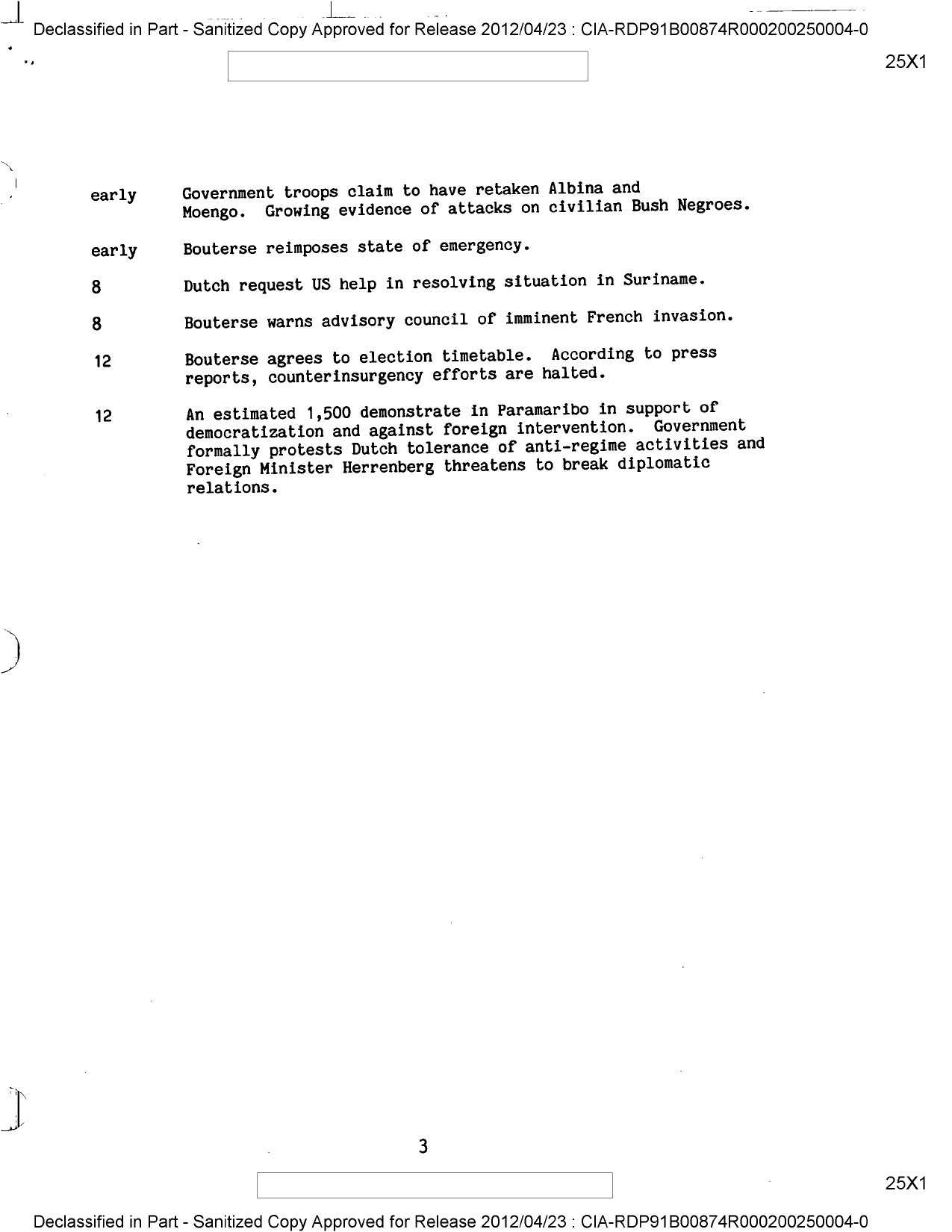
| December early | Government troops claim to have retaken Albina and Moengo. Growing evidence of attacks on civilian Bush Negroes. |
| December early | Bouterse reimposes state of emergency. |
| December 8 | Dutch request US help in resolving situation in Suriname. |
| December 8 | Bouterse warns advisory council of imminent French invasion. |
| December 12 | Bouterse agrees to election timetable. According to press reports, counterinsurgency efforts are halted. |
| December 12 | An estimated 1,500 demonstrate in Paramaribo in support of democratization and against foreign intervention. Government formally protests Dutch tolerance of anti-regime activities and Foreign Minister Herrenberg threatens to break diplomatic relations. |
[FULL PAGE CENSORED]
D) Suriname Situation Reports
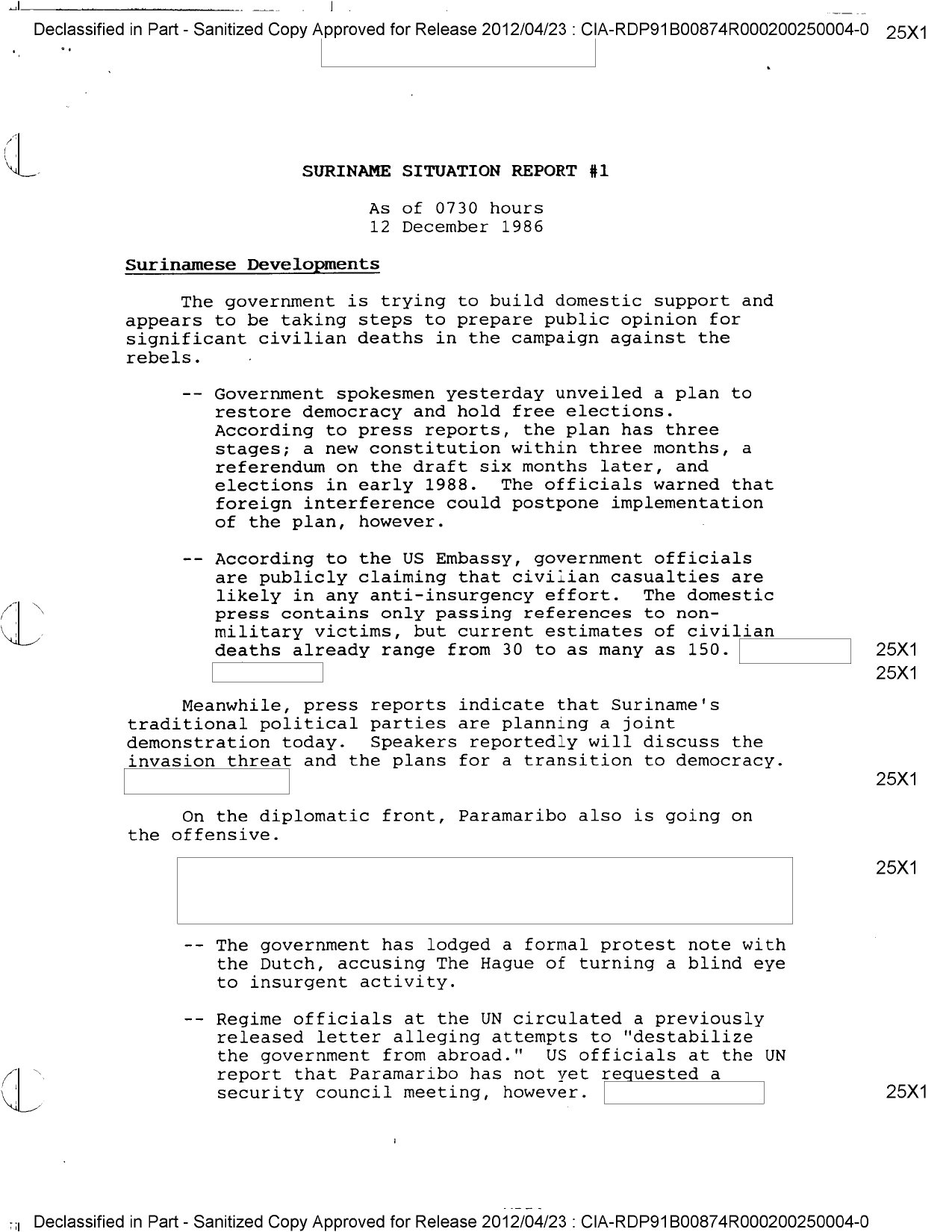
Suriname Situation Report #1
As of 0730 hours, 12 December 1986
Surinamese Developments
The government is trying to build domestic support and appears to be taking steps to prepare public opinion for significant civilian deaths in the campaign against the rebels.
- Government spokesmen yesterday unveiled a plan to restore democracy and hold free elections.
According to press reports, the plan has three stages:
- A new constitution within three months,
- A referendum on the draft six months later, and
- Elections in early 1988.
The officials warned that foreign interference could postpone implementation of the plan, however.
- According to the US Embassy, government officials are publicly claiming that civilian casualties are likely in any anti-insurgency effort. The domestic press contains only passing references to nonmilitary victims, but current estimates of civilian deaths already range from 30 to as many as 150.
Meanwhile, press reports indicate that Suriname’s traditional political parties are planning a joint demonstration today. Speakers reportedly will discuss the invasion threat and the plans for a transition to democracy.
[CENSORED]
On the diplomatic front, Paramaribo also is going on the offensive.
- The government has lodged a formal protest note with the Dutch, accusing The Hague of turning a blind eye to insurgent activity.
- Regime officials at the UN circulated a previously released letter alleging attempts to “destabilize the government from abroad.” US officials at the UN report that Paramaribo has not yet requested a security council meeting, however.
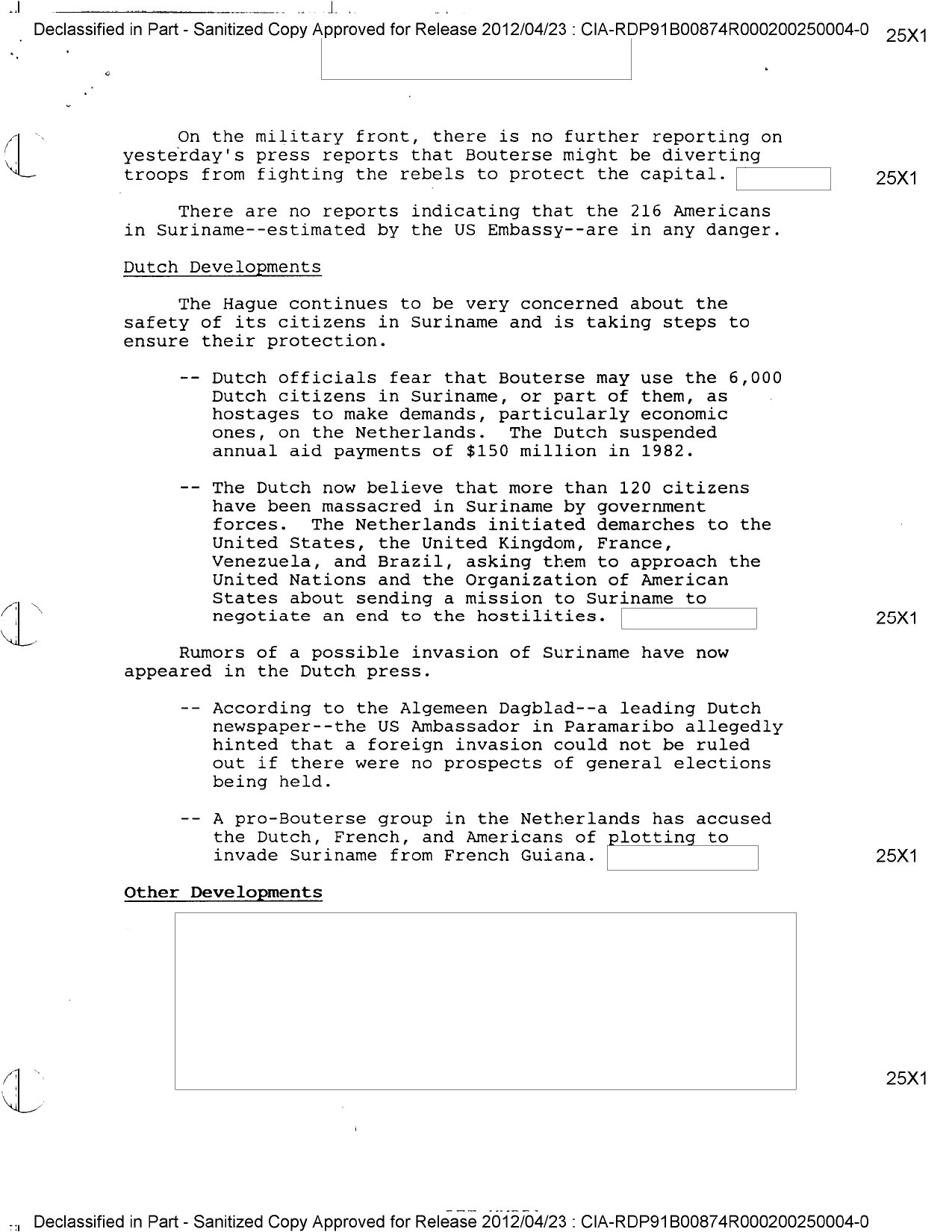
On the military front, there is no further reporting on yesterday’s press reports that Bouterse might be diverting troops from fighting the rebels to protect the capital.
There are no reports indicating that the 216 Americans in Suriname — estimated by the US Embassy — are in any danger.
Dutch Developments
The Hague continues to be very concerned about the safety of its citizens in Suriname and is taking steps to ensure their protection.
- Dutch officials fear that Bouterse may use the 6,000 Dutch citizens in Suriname, or part of them, as hostages to make demands, particularly economic ones, on the Netherlands. The Dutch suspended annual aid payments of $150 million in 1982.
- The Dutch now believe that more than 120 citizens have been massacred in Suriname by government forces. The Netherlands initiated demarches to the United States, the United Kingdom, France, Venezuela, and Brazil, asking them to approach the United Nations and the Organization of American States about sending a mission to Suriname to negotiate an end to the hostilities.
Rumors of a possible invasion of Suriname have now appeared in the Dutch press.
- According to the Algemeen Dagblad — a leading Dutch newspaper — the US Ambassador in Paramaribo allegedly hinted that a foreign invasion could not be ruled out if there were no prospects of general elections being held.
- A pro-Bouterse group in the Netherlands has accused the Dutch, French, and Americans of plotting to invade Suriname from French Guiana.
Other Developments
[CENSORED]
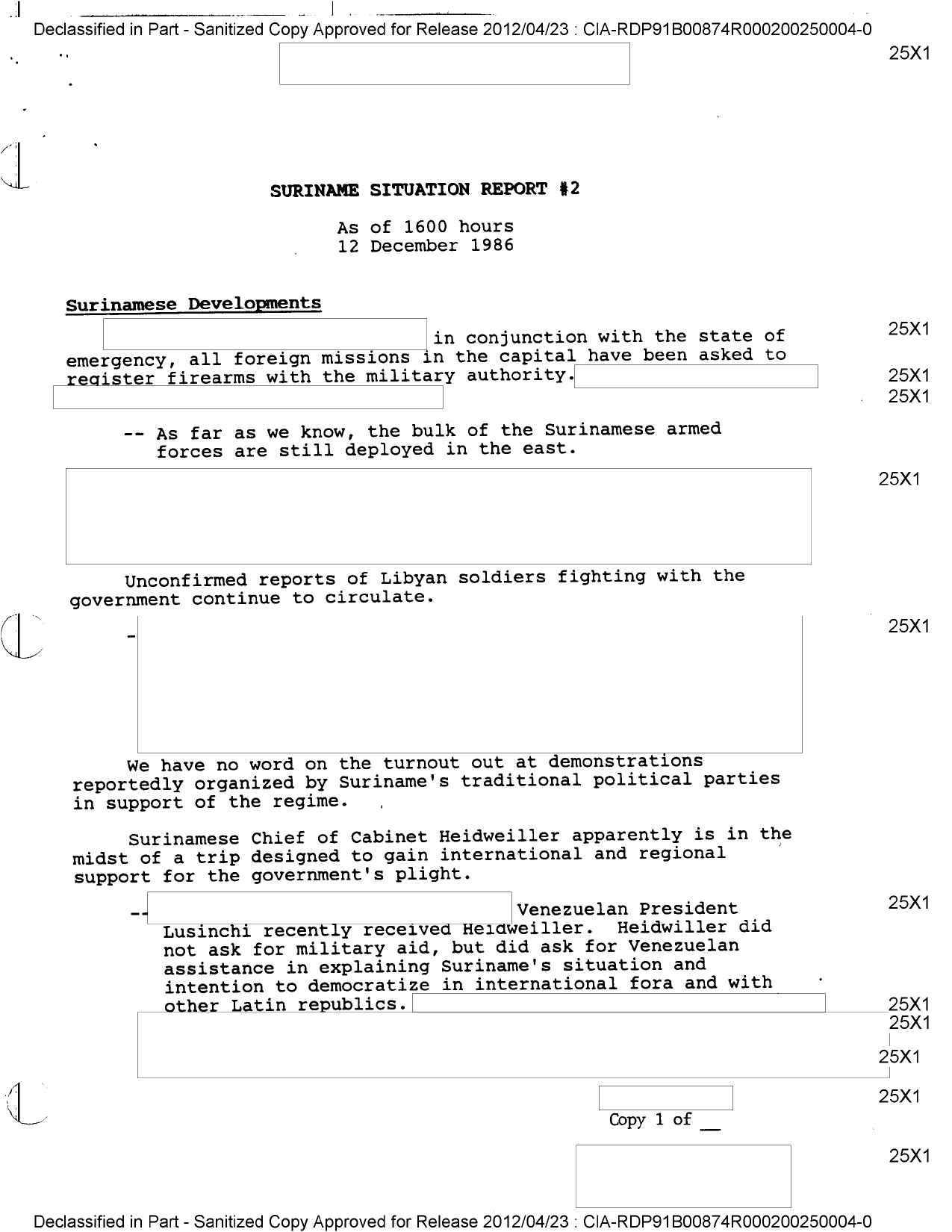
Suriname Situation Report #2
As of 1600 hours, 12 December 1986
Surinamese Developments
[CENSORED] in conjunction with the state of emergency, all foreign missions in the capital have been asked to register firearms with the military authority.
As far as we know, the bulk of the Surinamese armed forces are still deployed in the east.
[CENSORED]
Unconfirmed reports of Libyan soldiers fighting with the government continue to circulate.
We have no word on the turnout at demonstrations reportedly organized by Suriname’s traditional political parties in support of the regime.
Surinamese Chief of Cabinet Heidweiller apparently is in the midst of a trip designed to gain international and regional support for the government’s plight.
[CENSORED] Venezuelan President Lusinchi recently received Heidweiller. Heidweiller did not ask for military aid, but did ask for Venezuelan assistance in explaining Suriname’s situation and intention to democratize in international fora and with other Latin republics.
[CENSORED]
[CENSORED]
Other Developments
The French are following the situation in Suriname closely and will almost certainly continue to accept refugees from the country; they seem disinclined to take any military action.
[CENSORED]
[CENSORED]
French Guiana is housing and feeding some 2,500 refugees.
The buildup of French troops on the French GuianaSurinamese border may be French efforts to help with the refugee flow and the possibility of an eventual Dutch evacuation.
Suriname Situation Report #3
As of 0700 hours, 13 December 1986
Surinamese Developments – Domestic
Press reports of 15,000 people attending a government-organized rally in Paramaribo yesterday appear to be exaggerated. Embassy reporting indicates the turnout was probably closer to several hundred. According to the Embassy, the rally was held in a small square, probably to make the turnout seem larger than it was. The Ambassador reports there were only about a hundred vocal pro-Bouterse supporters, and that given the pre-rally publicity, the turnout was unimpressive.
- At the rally, Bouterse admitted civilians had been killed in an Army offensive in the east, but said local inhabitants had been warned to leave the area. He gave no estimates of casualties. Bouterse said the Netherlands was “hypocritical” in denouncing civilian deaths when support for the “terrorists” is being organized from Dutch territory.
- The military may not be completely convinced of an imminent invasion threat from the French.
[CENSORED]
The Ambassador reports that leaders of Suriname’s traditional political parties seem jubilant over the role they played in encouraging Bouterse to announce an elections timetable. The Ambassador, however, does not share the party leaders’ enthusiasm.
- The Ambassador commented that his meeting with party leaders had an air of sad unreality. Bouterse’s timetable in fact lengthens his original schedule for restoring democracy by a year, while providing him with greater legitimacy through the clear public support of the three parties.
Our Embassy has also recently updated consular records on the numbers and locations of American, Canadian, and British citizens in Suriname.
- Confirmed numbers: 204 private Americans and 35 official Americans, 18 Canadians, 31 British.
- Registered but unable to contact: 66 Americans, 37 Canadians, and 8 British. Embassy estimates that at any given time there are 10 transit tourists or officials in the country.
- According to the Embassy, nearly all of these people are located in Paramaribo. About five people are still in the Moengo area and two people are in the Raleigh Falls area.
On the economic front, Suralco, a wholly owned subsidiary of Alcoa, appears prepared to prop up at least temporarily the bauxite industry, which accounts for 80 percent of Suriname’s export earnings. Because of hostilities near Moengo, site of Suralco’s mining operations, mining has ceased. It had been estimated that only a two-week supply of ore remained at Suralco’s refinery in Paramaribo.
- According to Embassy reporting, Suralco intends to import ore to maintain its markets, but expects concessionary import duties from the government, and wants to take the 500–600 miners who are now unemployed off its payroll.
[CENSORED]
Foreign Developments
The Surinamese government continues to try to build international support by dispatching high-level emissaries to world capitals.
- Chief of Cabinet Heidweiller is next due to visit Brasilia.
- Suriname has not yet requested a meeting of the UN Security Council to discuss French invasion plans.
Other Developments
The French newspaper Le Monde reported in its December 12 edition that France is following a policy of “strict neutrality” in the Surinamese civil war and that there were no plans to involve French troops there. A Quai official made the same points to our Embassy in Paris and indicated French reinforcements along the border with Suriname are only to control the flood of refugees into French Guiana.
Suriname Situation Report #4
As of 1630 hours, 14 December 1986
Surinamese Developments
[FULL PAGE CENSORED]
[FULL PAGE CENSORED]
[CENSORED]
Our Embassy also reports that rebel leader Brunswijk appears to be gaining political legitimacy both with Dutch voters and with the Surinamese exiles. Brunswijk’s supposed alliance with exiles leaders such as former Prime Minister Chin a Sen is receiving wide publicity.
- Brunswijk’s enhanced standing is potentially troublesome for the Dutch. Officials offer grudging respect for his ability to challenge Bouterse. They have little respect for either Brunswijk’s character or political ability. The Dutch probably hope that Brunswijk will play only a secondary role to more respectable anti-Bouterse leaders — especially Chin a Sen, who is well regarded in The Hague — in any new government.
- Brunswijk’s role is becoming increasingly important in the propaganda war over Suriname. Special envoy Udenhout made a point of castigating Brunswijk as a “common criminal” in discussions with US officials. Udenhout scorned claims by exiles that they could restore democracy to Suriname, and called on the US to support “moderate” elements in the current government. He especially asked the US not to follow the Dutch lead in believing atrocity stories or in viewing the political situation in Paramaribo.
Other Developments
- Nothing of significance to report.
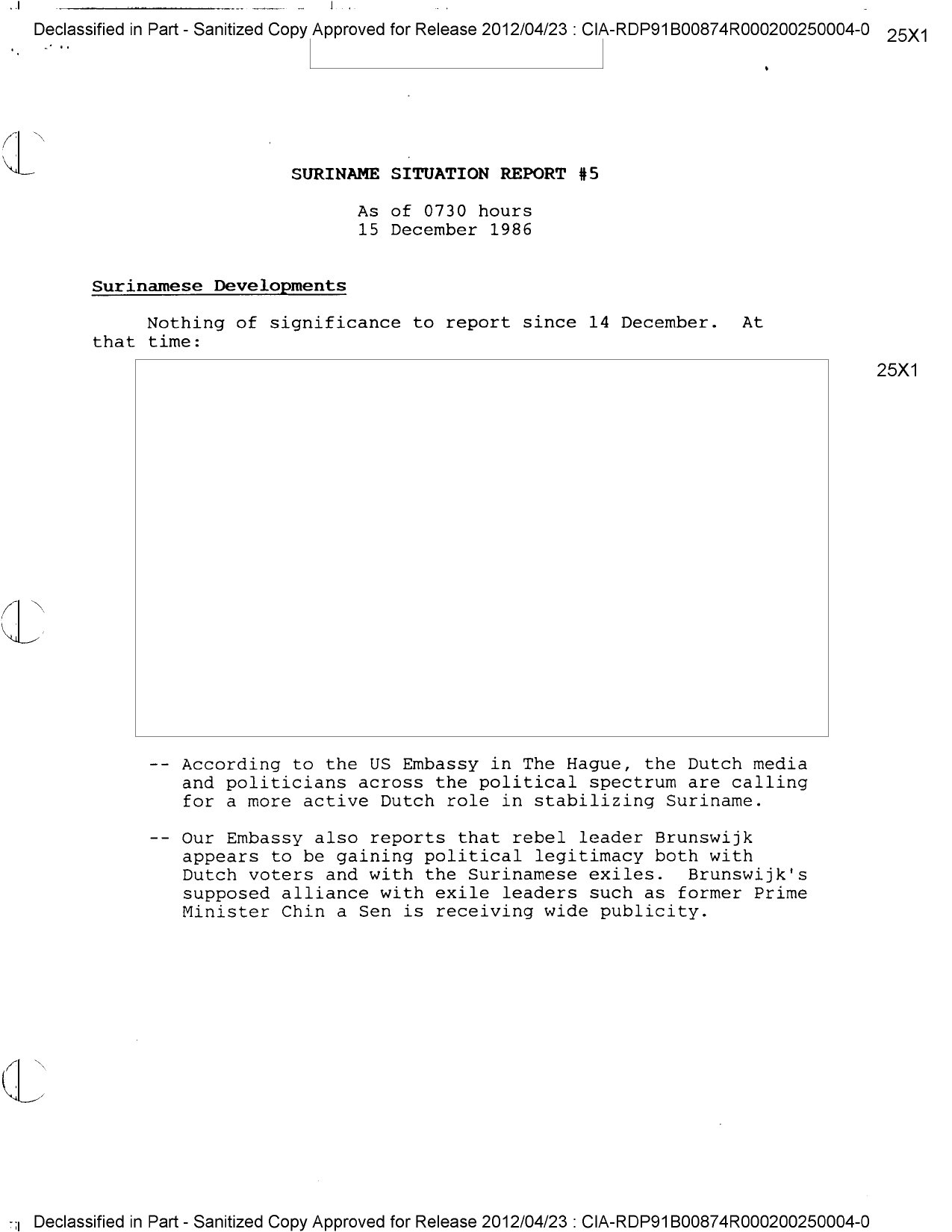
Suriname Situation Report #5
As of 0730 hours, 15 December 1986
Surinamese Developments
Nothing of significance to report since 14 December. At that time:
[CENSORED]
According to the US Embassy in The Hague, the Dutch media and politicians across the political spectrum are calling for a more active Dutch role in stabilizing Suriname.
- Our Embassy also reports that rebel leader Brunswijk appears to be gaining political legitimacy both with Dutch voters and with the Surinamese exiles. Brunswijk’s supposed alliance with exile leaders such as former Prime Minister Chin a Sen is receiving wide publicity.
Suriname Situation Report #6)
[FULL PAGE CENSORED]
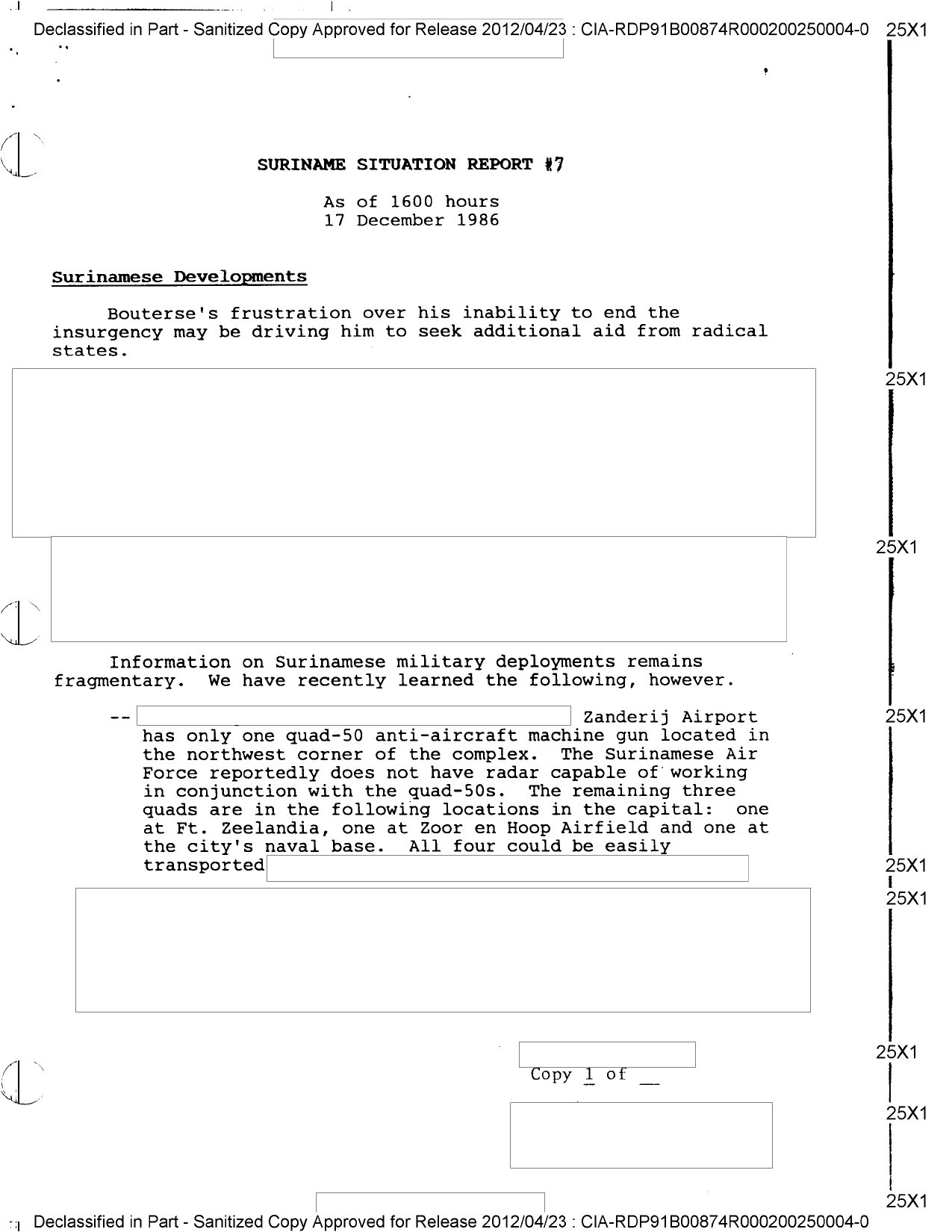
Suriname Situation Report #7
As of 0730 hours, 15 December 1986
Surinamese Developments
Bouterse’s frustration over his inability to end the insurgency may be driving him to seek additional aid from radical states.
[CENSORED]
Information on Surinamese military deployments remains fragmentary. We have recently learned the following, however
[CENSORED] Zanderij Airport has only one quad-50 anti-aircraft machine gun located in the northwest corner of the complex. The Surinamese Air Force reportedly does not have radar capable of working in conjunction with the quad-50s.
The remaining three quads are in the following locations in the capital: one at Ft. Zeelandia, one at Zoor en Hoop Airfield, and one at the city’s naval base. All four could be easily transported. [CENSORED]
[CENSORED]
Surinamese Developments
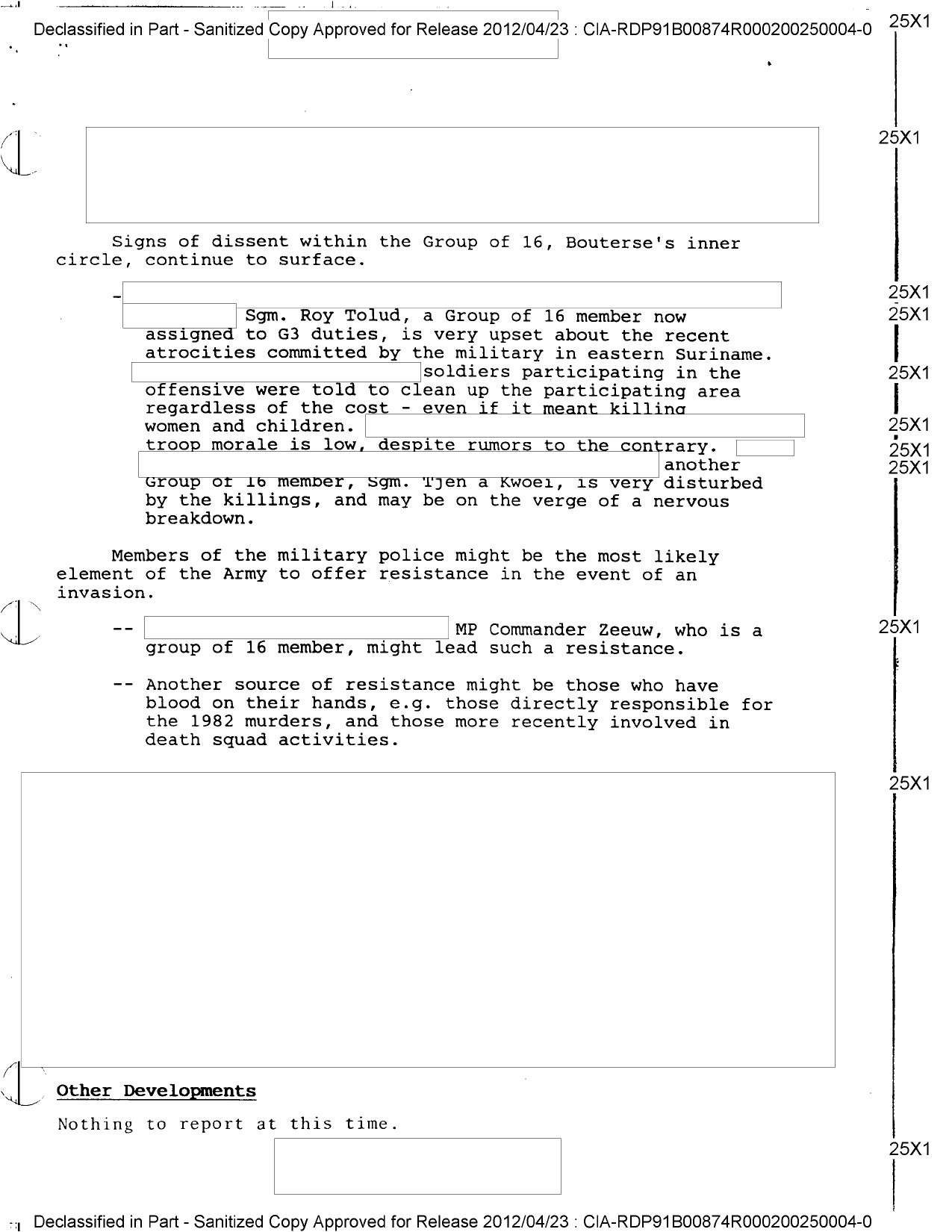
Signs of dissent within the Group of 16, Bouterse’s inner circle, continue to surface.
- [CENSORED]
- [CENSORED] Sgm. Roy Tolud, a Group of 16 member now assigned to G3 duties, is very upset about the recent atrocities committed by the military in eastern Suriname. [CENSORED] soldiers participating in the offensive were told to clean up the participating area regardless of the cost — even if it meant killing women and children. [CENSORED]
- Troop morale is low, despite rumors to the contrary.
- [CENSORED] Another Group of 16 member, Sgm. Tjen a Kwoel, is very disturbed by the killings, and may be on the verge of a nervous breakdown.
- Members of the military police might be the most likely element of the Army to offer resistance in the event of an invasion. [CENSORED] MP Commander Zeeuw, who is a Group of 16 member, might lead such a resistance.
- Another source of resistance might be those who have blood on their hands, e.g., those directly responsible for the 1982 murders, and those more recently involved in death squad activities.
[CENSORED]
Other Developments
Nothing to report at this time.
E) Pros and Cons of Bouterse
Desire Bouterse’s six-year record as Suriname’s leader makes him a known quantity with several positive traits from the standpoint of US interests.
- Until the insurgency in July, the Surinamese strongman had presided over a relatively stable political situation as he consolidated his power in the past two years.
- Internationally, the regime maintains a nonaligned foreign policy and favors all “progressive” Third World causes, but Bouterse’s principal foreign objective has been to secure foreign economic and military aid.
- The steady deterioration in the economy since the Dutch canceled aid in 1982 has prompted him in recent years to try to improve relations with the US, the Netherlands, and several Latin American countries.
- Meanwhile, relations between Havana and Paramaribo remain cool since Bouterse, fearing a Grenada-type US invasion, in October 1983 ordered that the Cubans reduce their official presence in Suriname; Havana responded by closing its Embassy and probably would want guarantees that Bouterse was becoming more leftist and that it would not be kicked out again before ever considering any warming of relations with the regime.
- Although the Bouterse government has publicly charged that the French and Dutch governments are lending support to Surinamese rebels and exile leaders, the regime has avoided direct official and media attacks against the United States. [CENSORED]
These tentative pluses are outweighed by the darker side of Bouterse’s erratic personality and brutal leadership, which clearly show his willingness to use any means—including murder—to stay in power.
- Under stress, Bouterse’s extreme suspiciousness mounts, and he is apt to give vent to brutal violence; this is best illustrated by the events of December 1982, in which he ordered the execution of 15 leading political opponents and—according to newspaper accounts—personally shot his most vocal opponent.
- At the same time, US officials describe Bouterse as shy, insecure, and very much wanting popular support while being out of touch with the people.
The reaction to the invasion among key Latin American players would unlikely go much beyond verbal support or condemnation.
[CENSORED]
- Although Havana would express public outrage, Castro—who considers Bouterse a cowardly opportunist—probably would privately not be disappointed over the Surinamese leader’s ouster.
- The Nicaraguans, perceiving any Dutch invasion as serving US interests, would be quick to condemn the attack regardless of outcome. [CENSORED]
The Dutch probably would install a transitional civilian government and assign it the task of drafting a constitution and preparing for elections. This government would most likely be made up of more moderate current cabinet members or draw upon a broader base that includes members of traditional political parties and such special interest groups as labor, rebel, and exile representatives.
- Small numbers of leftists, who lack popular support, would not play a significant role under a democratic system.
- The Bouterse regime lacks legitimacy; its narrow base of support has been limited to the military and a smattering of radical leftists.
- Although Bouterse is not an ideologue, he has been openly sympathetic to radical leftist regimes; his embryonic radical political party—the 25 February Movement—apparently is based on the Cuban model.
- Bouterse’s tentative steps toward democratization are tactical, and formidable barriers remain to a return to democracy as long as Bouterse holds power; before relinquishing power, Bouterse reportedly wants assurances that a civilian government would not repeal the amnesty granted to the military for its involvement in the 1982 murders—a guarantee that would be unlikely to be forthcoming.
- Although Bouterse remains suspicious of Tripoli’s intentions, he has permitted a gradual warming of relations with Libya in order to obtain the economic and military aid needed to bolster his regime.
Credible evidence of high-level official involvement in corruption, including drug trafficking, has further tarnished the regime’s image. The probability that Bouterse is directly involved could weaken his critical support in the military. [CENSORED]
F) (CENSORED)
[FULLY CENSORED]
// A wild guess “Alternatives to Bouterse”
G) Surinamese Military Forces and Capabilities
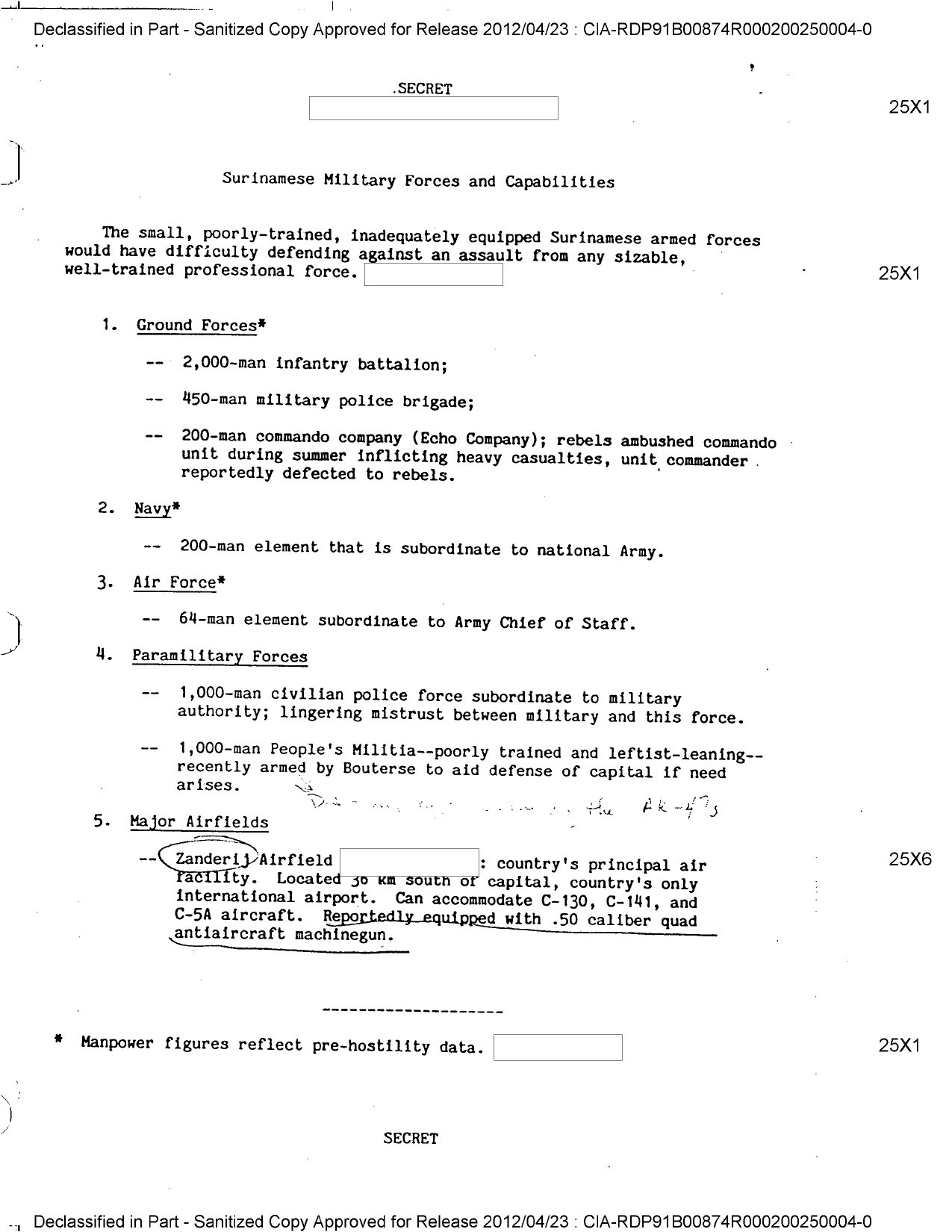
The small, poorly-trained, inadequately equipped Surinamese armed forces would have difficulty defending against an assault from any sizable, well-trained professional force.
1. Ground Forces*
- 2,000-man infantry battalion
- 450-man military police brigade
- 200-man commando company (Echo Company); rebels ambushed commando unit during summer inflicting heavy casualties, unit commander reportedly defected to rebels
2. Navy*
- 200-man element that is subordinate to national Army
3. Air Force*
- 64-man element subordinate to Army Chief of Staff
4. Paramilitary Forces
- 1,000-man civilian police force subordinate to military authority; lingering mistrust between military and this force
- 1,000-man People’s Militia—poorly trained and leftist-leaning—recently armed by Bouterse to aid defense of capital if need arises
5. Major Airfields
- Zanderij Airfield: country’s principal air facility. Located 30 km south of capital, country’s only international airport. Can accommodate C-130, C-141, and C-5A aircraft. Reportedly equipped with .50 caliber quad antiaircraft machinegun
- Nieuw Nickerie: secondary importance, poor to fair condition, limited or no facilities. [CENSORED]
- Wageningen: secondary importance, poor to fair condition, limited or no facilities. [CENSORED]
- Zorg en Hoop: small partially paved airstrip in southern part of capital. In poor condition, but sometimes used by military. Reportedly equipped with .50 caliber quad antiaircraft machinegun
Note: Manpower figures reflect pre-hostility data
6. Weapons and Equipment
Although the Surinamese Army still has a large quantity of old Dutch equipment, it has been modernized with Brazilian equipment. The new equipment is in good shape, but will deteriorate rapidly unless maintenance improves. Much of the Dutch equipment is broken down, and the ammunition stocks for Dutch weapons have drastically deteriorated.
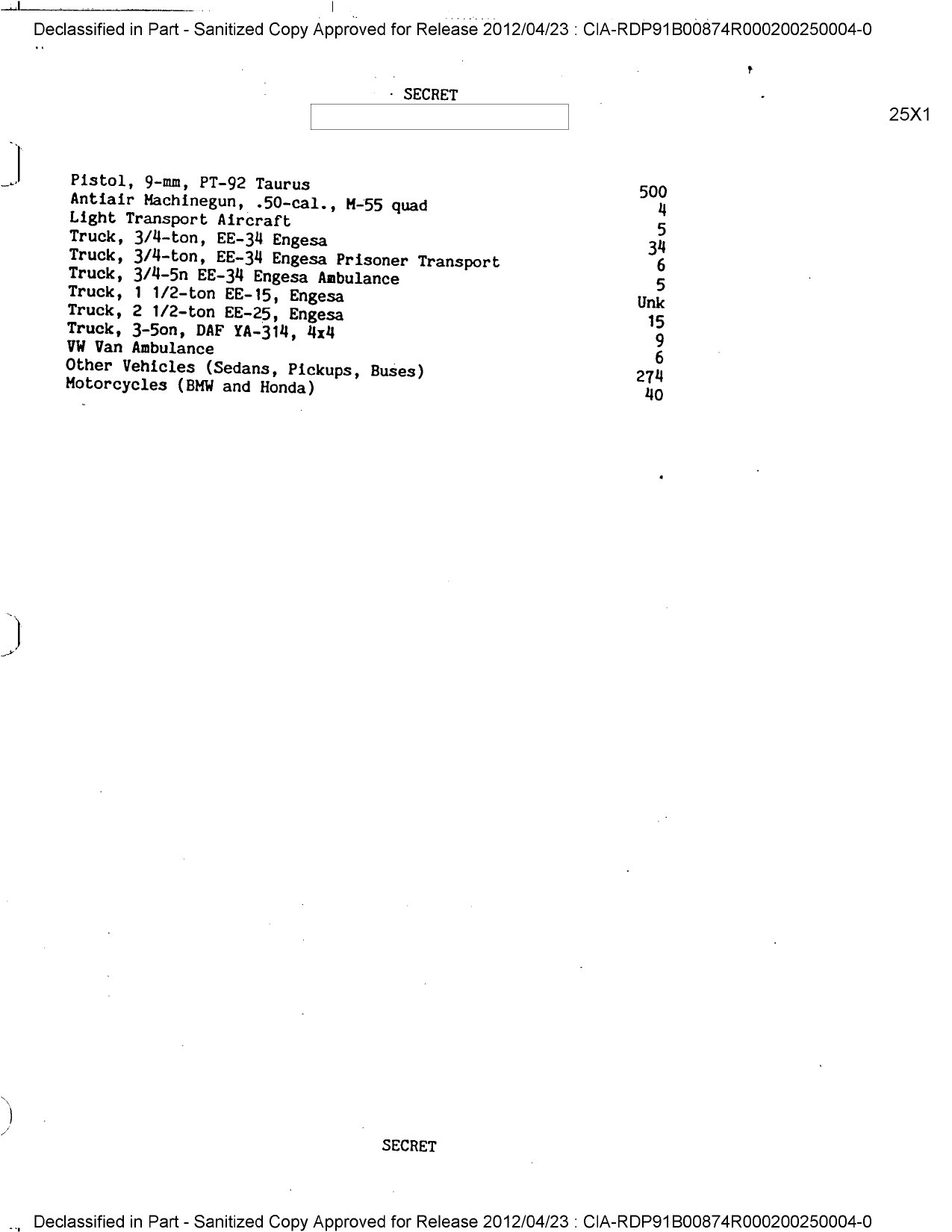
The inventory of the main weapons and equipment of the armed services is as follows:
| Equipment Type | Quantity |
|---|---|
| AK-47 rifles | 100 |
| Armored Vehicle, 90-mm gun, EE-9 Cascavel | 6 |
| Armored Personnel Carrier, 7.62-mm MG, EE-11 Urutu | 15 |
| Armored Personnel Carrier, .50-cal. MG, YP-408 | 9 |
| Coastal Patrol Boats | 3 |
| Recoilless Gun, 57-mm, light | 17 |
| Recoilless Gun, 75-mm | 2 |
| Helicopter | 1 |
| High-seas Patrol Boats | 3 |
| Howitzer, 75-mm | Unk |
| Mortar, 2-inch | 17 |
| Mortar, 81-mm | 5 |
| Machinegun, .50-cal., Me-HB, heavy | 14 |
| Machinegun, .303-cal., Bren | 105 |
| Machinegun, .30-cal., M1919A4 | 6 |
| Submachinegun, 9-mm, Taurus | 400 |
| Submachinegun, 9-mm, Uzi | 323 |
| Rifle, .30-cal., M-1 | 2,918 |
| Rifle, 7.62-mm, M964 FAL | 2,000 |
| Pistol, 9-mm Browning | 510 |
| Pistol, 9-mm, PT-92 Taurus | 500 |
| Antiair Machinegun, .50-cal., M-55 quad | 4 |
| Light Transport Aircraft | 5 |
| Truck, 3/4-ton, EE-34 Engesa | 34 |
| Truck, 3/4-ton, EE-34 Engesa Prisoner Transport | 6 |
| Truck, 3/4-ton, EE-34 Engesa Ambulance | 5 |
| Truck, 1 1/2-ton EE-15, Engesa | Unk |
| Truck, 2 1/2-ton EE-25, Engesa | 15 |
| Truck, 3-5 ton, DAF YA-314, 4×4 | 9 |
| VW Van Ambulance | 6 |
| Other Vehicles (Sedans, Pickups, Buses) | 274 |
| Motorcycles (BMW and Honda) | 40 |
*Fort Zeelandia in Paramaribo reportedly also has an antiaircraft gun.
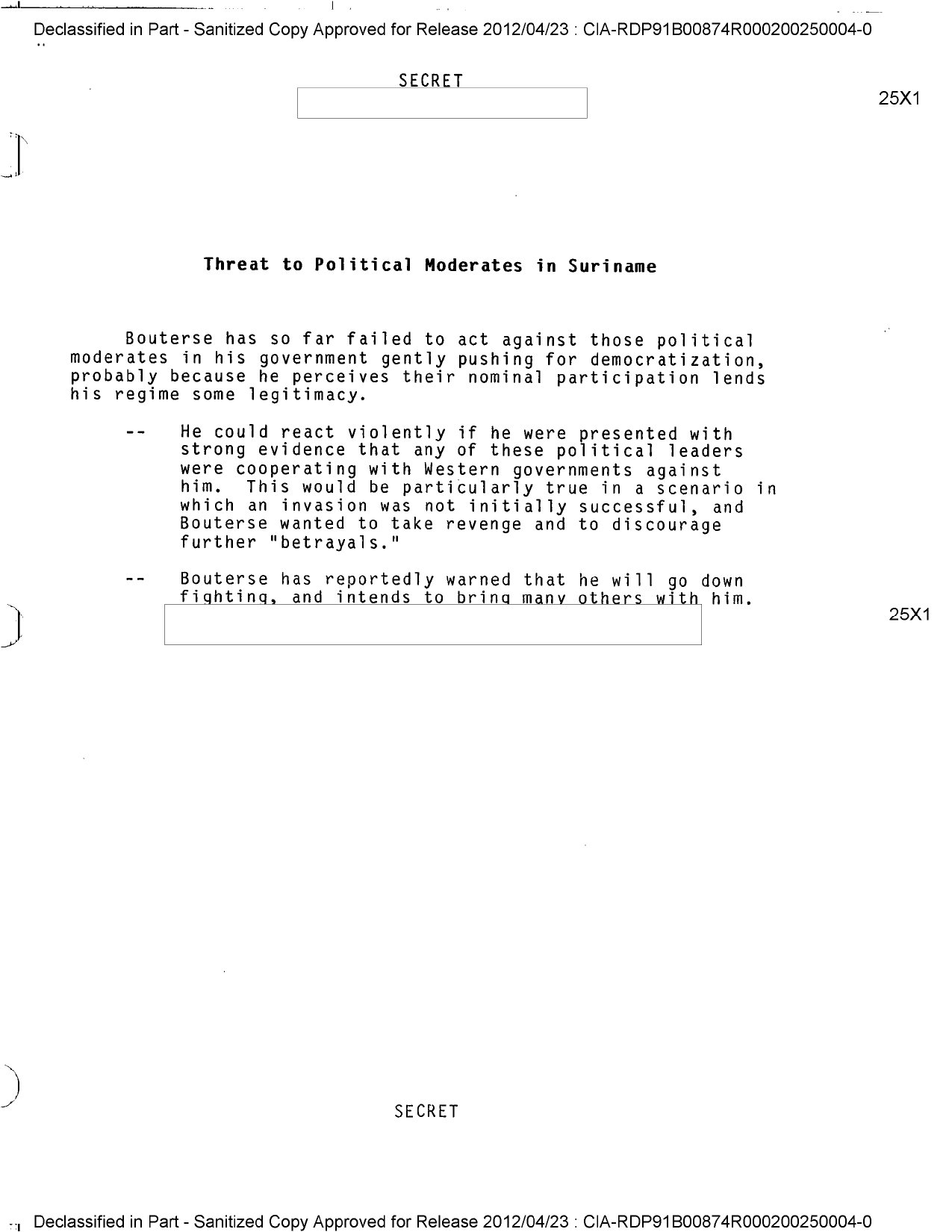
H) Threat to Political Moderates in Suriname
Bouterse has so far failed to act against those political moderates in his government gently pushing for democratization, probably because he perceives their nominal participation lends his regime some legitimacy.
He could react violently if he were presented with strong evidence that any of these political leaders were cooperating with Western governments against him. This would be particularly true in a scenario in which an invasion was not initially successful, and Bouterse wanted to take revenge and to discourage further “betrayals.”
Bouterse has reportedly warned that he will go down fighting, and intends to bring many others with him.
[CENSORED]
[FULL PAGE CENSORED]
I) Threat to the Dutch in Suriname
[FULL PAGE CENSORED]
[FULL PAGE CENSORED]
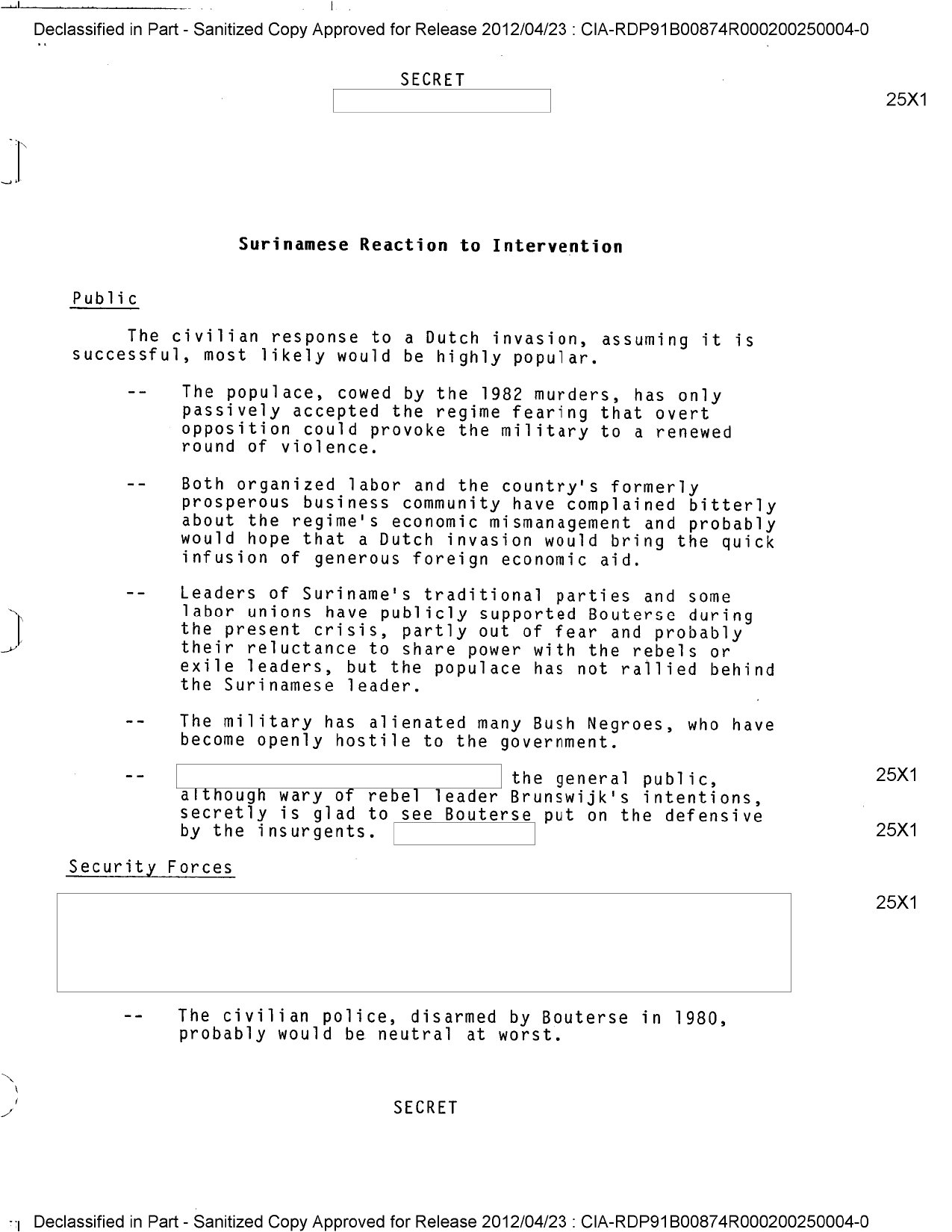
J) Surinamese Reaction to Intervention
Public
The civilian response to a Dutch invasion, assuming it is successful, most likely would be highly popular.
- The populace, cowed by the 1982 murders, has only passively accepted the regime, fearing that overt opposition could provoke the military to a renewed round of violence.
- Both organized labor and the country’s formerly prosperous business community have complained bitterly about the regime’s economic mismanagement and probably would hope that a Dutch invasion would bring the quick infusion of generous foreign economic aid.
- Leaders of Suriname’s traditional parties and some labor unions have publicly supported Bouterse during the present crisis, partly out of fear and probably their reluctance to share power with the rebels or exile leaders, but the populace has not rallied behind the Surinamese leader.
- The military has alienated many Bush Negroes, who have become openly hostile to the government.
- [CENSORED] the general public, although wary of rebel leader Brunswijk’s intentions, secretly is glad to see Bouterse put on the defensive by the insurgents.
Security Forces
- [CENSORED]
- The civilian police, disarmed by Bouterse in 1980, probably would be neutral at worst.
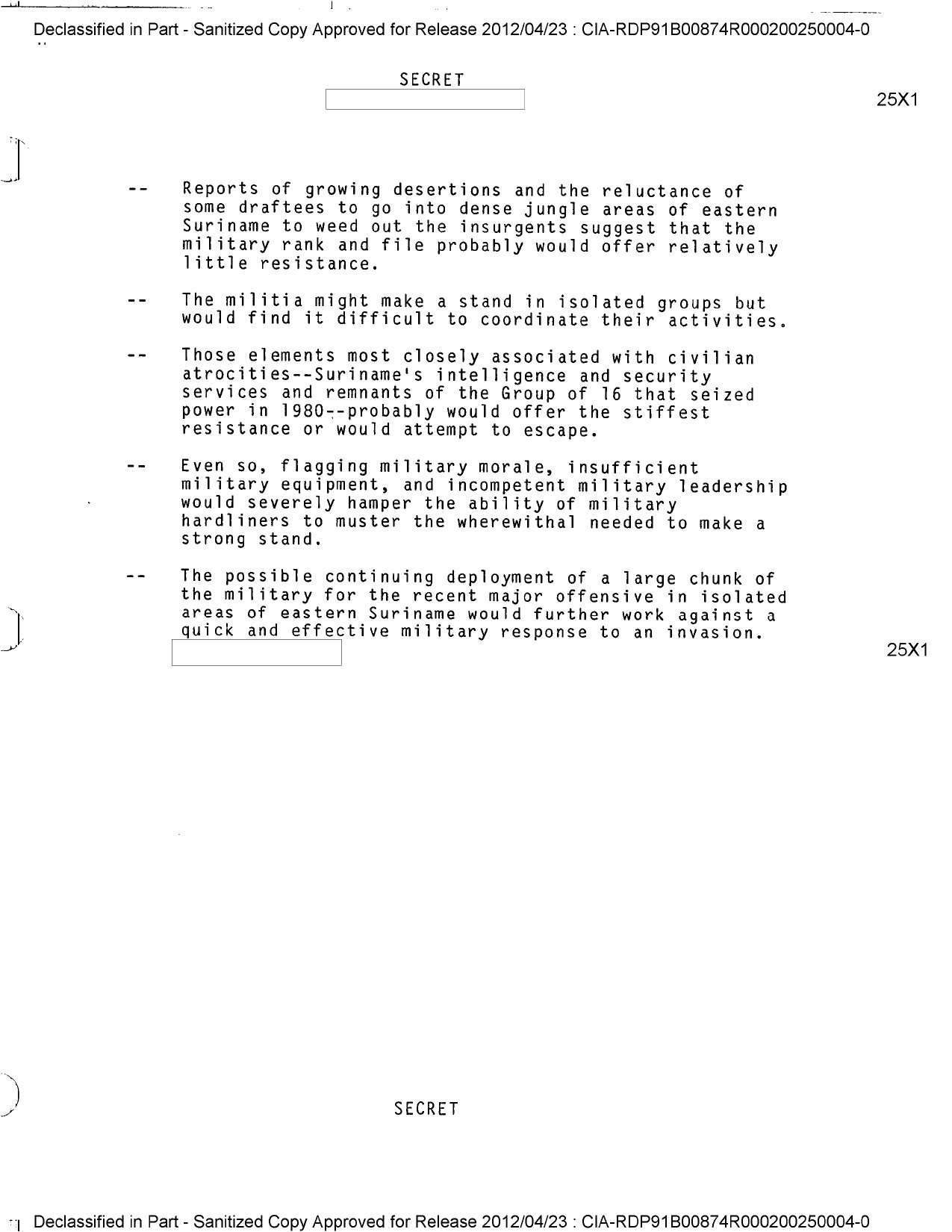
Reports of growing desertions and the reluctance of some draftees to go into dense jungle areas of eastern Suriname to weed out the insurgents suggest that the military rank and file probably would offer relatively little resistance.
The militia might make a stand in isolated groups but would find it difficult to coordinate their activities.
- Those elements most closely associated with civilian atrocities—Suriname’s intelligence and security services and remnants of the Group of 16 that seized power in 1980—probably would offer the stiffest resistance or would attempt to escape.
Even so, flagging military morale, insufficient military equipment, and incompetent military leadership would severely hamper the ability of military hardliners to muster the wherewithal needed to make a strong stand.
The possible continuing deployment of a large chunk of the military for the recent major offensive in isolated areas of eastern Suriname would further work against a quick and effective military response to an invasion. Reports of growing desertions and the reluctance of some draftees to go into dense jungle areas of eastern Suriname to weed out the insurgents suggest that the military rank and file probably would offer relatively little resistance.
The militia might make a stand in isolated groups but would find it difficult to coordinate their activities.
- Those elements most closely associated with civilian atrocities—Suriname’s intelligence and security services and remnants of the Group of 16 that seized power in 1980—probably would offer the stiffest resistance or would attempt to escape.
Even so, flagging military morale, insufficient military equipment, and incompetent military leadership would severely hamper the ability of military hardliners to muster the wherewithal needed to make a strong stand.
The possible continuing deployment of a large chunk of the military for the recent major offensive in isolated areas of eastern Suriname would further work against a quick and effective military response to an invasion. [CENSORED]
[MANY FULL PAGES CENSORED]
Latin American Reactions
O) Brazil
[FULL PAGE CENSORED]
P) Venezuela
[FULL PAGE CENSORED]
Q) Cuba
Although Havana would provide a show of outrage—at least for international consumption and as a demonstration of solidarity with its Marxist allies—over Dutch intervention in Suriname, privately, the Castro regime would not be disappointed over Bouterse’s ouster and might even welcome an opportunity to work with a new transition government.
Although Cuba and Suriname still maintain diplomatic relations, President Fidel Castro remains furious at Bouterse over the events of October 1983 and considers him to be a cowardly opportunist.
Even before this debacle, the Cubans had been shouldered out by Brazilian offers of aid to Bouterse, who apparently believed this carried fewer risks than help from Havana and worried about Castro undermining his power.
During the more than three years since the closing of the Cuban mission in Paramaribo, there have been sporadic reports of renewed cooperation between the two governments.
None of the reported contacts between Surinamese and Cuban officials, or reported Surinamese offers to allow Havana to reopen its embassy in Paramaribo, have apparently borne any fruit, however.
Even if Castro had swallowed his pride by responding to such initiatives just to get his foot in the door, it surely would have been aimed at promoting a shift to the left in Surinamese policy rather than at solidifying Bouterse’s grip on power.
[CENSORED]
Since the setback Havana suffered as a result of Grenada—the loss of a valuable military base and political ally—Cuba has been trying to slowly rebuild its influence in the eastern Caribbean.
Although the Cubans shifted their base of operations to Guyana after Grenada, that relationship has been at a standstill since the death of Guyanese President Burnham.
As demonstrated by its intensive courtship of the Bouterse government during the early 1980s, Havana clearly views Suriname as a potentially valuable base for extending its military and political power in the region. [CENSORED]
If the Dutch were to stumble in their attempt to neutralize the Surinamese military and Bouterse called upon Castro for help, we see little that the Cubans could do to save him.
Nonetheless, there is a slim possibility that the Cubans might risk a clandestine airdrop of arms and advisers, or the even riskier act of sneaking them across the border from Guyana, to help the beleaguered Surinamese.
The repercussions of being discovered in these acts, however, almost surely would dissuade Havana from undertaking such a risky venture. [CENSORED]
[FULL PAGE CENSORED]
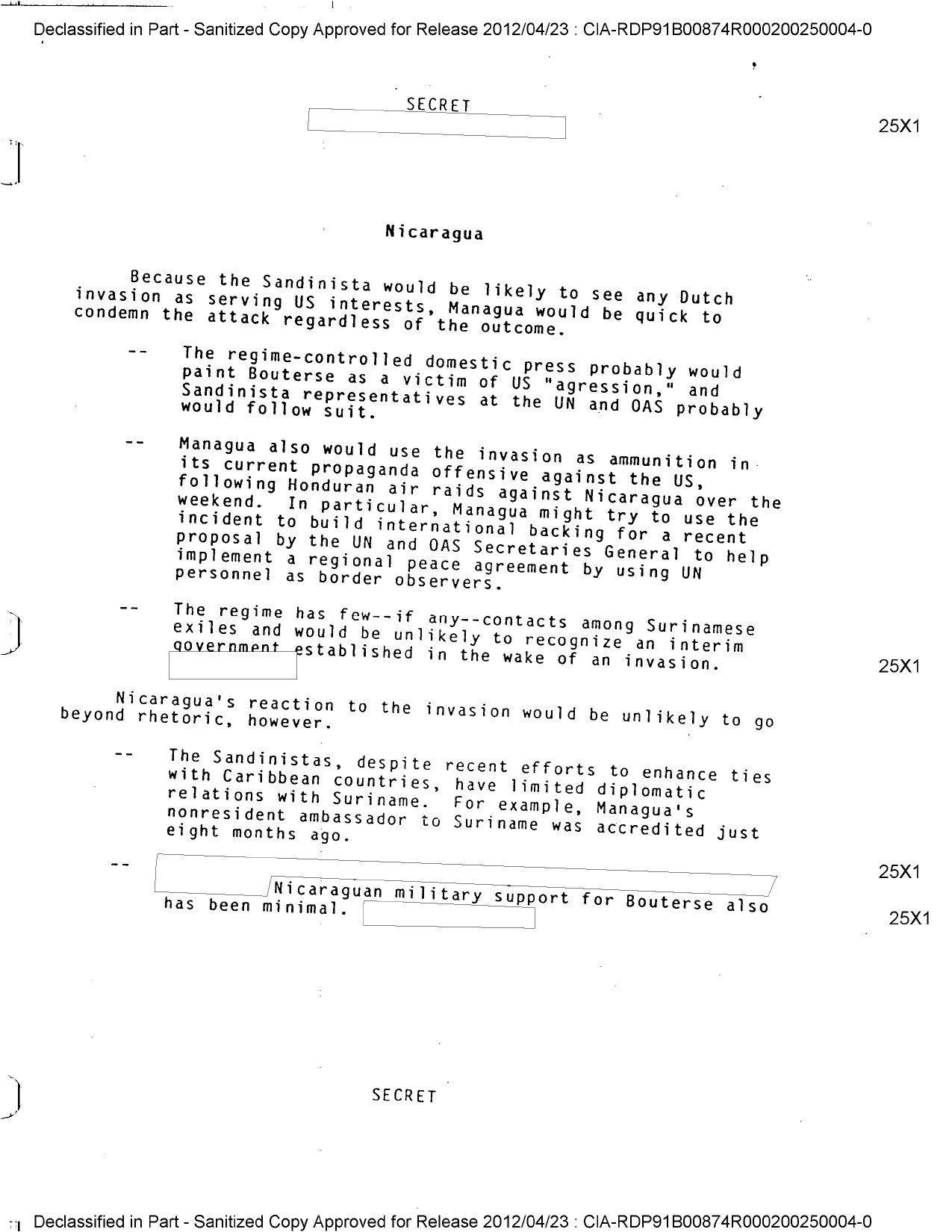
R) Nicaragua
Because serving US interests, the Sandinista regime would be likely to see any Dutch invasion as a threat. Managua would be quick to condemn the attack regardless of the outcome.
The Bouterse domestic press probably would paint Sandinista representatives at the UN and OAS as a victim of US “aggression,” and would follow suit. Managua also would use the invasion as ammunition in its current propaganda offensive against the US, particularly regarding air raids against Nicaragua over the weekend.
In particular, Managua might try to use the proposal by the UN and OAS Secretaries General to help implement a regional peace agreement by using UN personnel as observers.
[CENSORED] The exiles regime and government has few—if any—contacts among Surinamese and would be unlikely to recognize an interim government established in the wake of an invasion. [CENSORED]
Nicaragua’s reaction to the invasion would be unlikely to go beyond rhetoric, however.
With the Sandinistas, Caribbean countries, despite recent efforts to enhance relations, have limited diplomatic contacts with Suriname. For example, Managua’s nonresident ambassador to Suriname was accredited just 9 months ago. [CENSORED]
Nicaraguan military support for Bouterse also has been minimal.
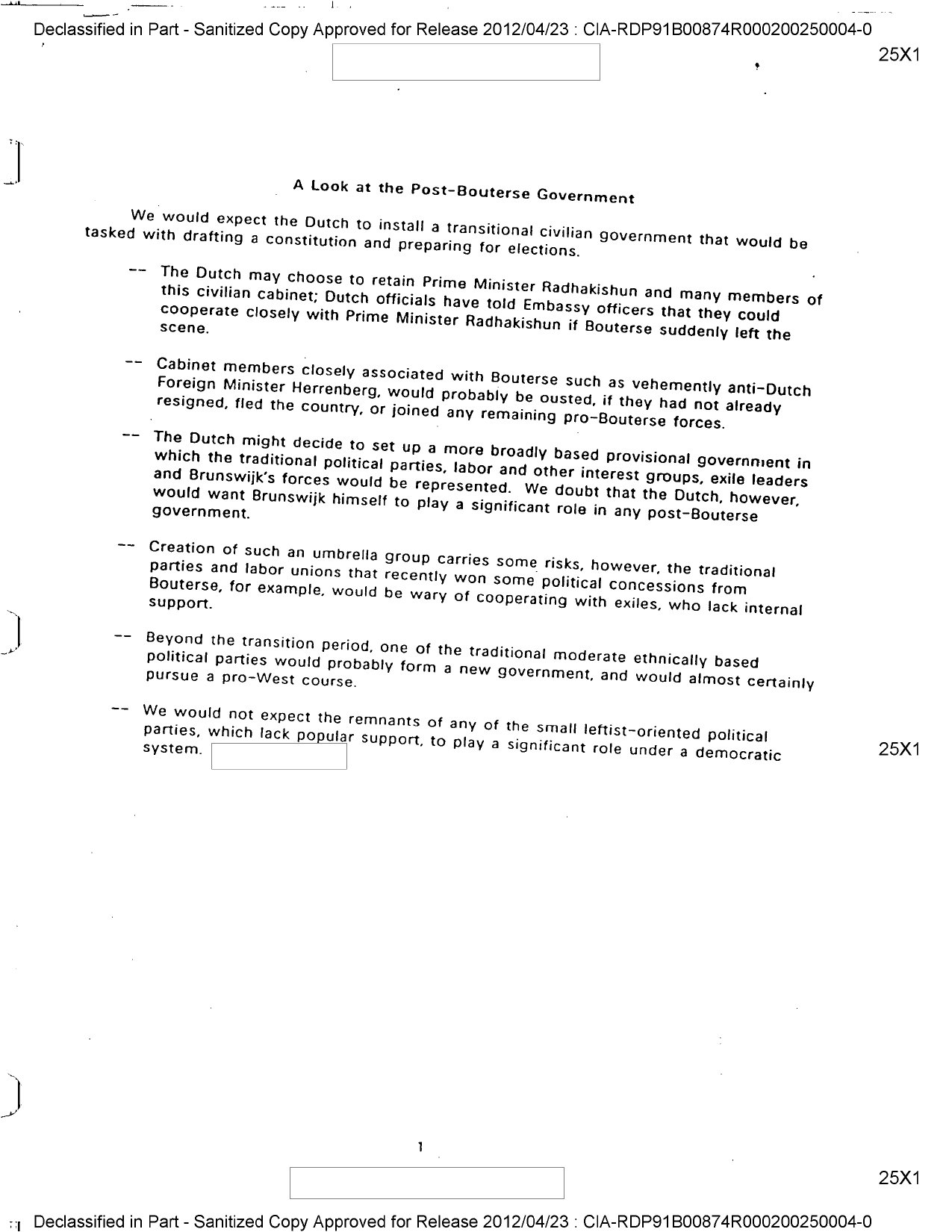
S) A Look at the Post-Bouterse Government
We would expect the Dutch to install a transitional civilian government that would be tasked with drafting a constitution and preparing for elections.
- The Dutch may choose to retain Prime Minister Radhakishun and many members of this civilian cabinet; Dutch officials have told Embassy officers that they could cooperate closely with Prime Minister Radhakishun if Bouterse suddenly left the scene.
- Cabinet members closely associated with Bouterse, such as the vehemently anti-Dutch Foreign Minister Herrenberg, would probably be ousted if they had not already resigned, fled the country, or joined any remaining pro-Bouterse forces.
- The Dutch might decide to set up a more broadly based provisional government in which the traditional political parties, labor and other interest groups, exile leaders, and Brunswijk’s forces would be represented. We doubt that the Dutch, however, would want Brunswijk himself to play a significant role in any post-Bouterse government.
- Creation of such an umbrella group carries some risks; the traditional parties and labor unions that recently won some political concessions from Bouterse, for example, would be wary of cooperating with exiles, who lack internal support.
- Beyond the transition period, one of the traditional moderate ethnically based political parties would probably form a new government and would almost certainly pursue a pro-West course.
- We would not expect the remnants of any of the small leftist-oriented political parties, which lack popular support, to play a significant role under a democratic system.
[FULL PAGE CENSORED]
Source:
Link:
Internal Link:
Date:
December 18, 1986