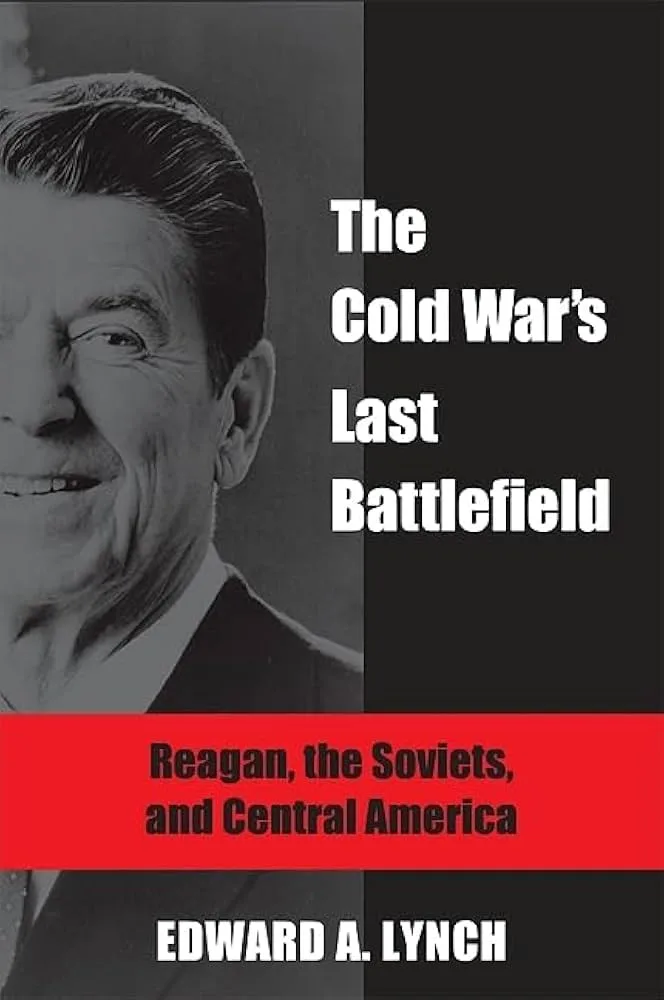
The Cold War’s Last Battlefield: Reagan, the Soviets, and Central America – Edward A. Lynch
Reagan, the Soviets, and Central America
Preface
Why a Book on Central America?
More than twenty years have passed since the nations between Mexico and Panama dominated the headlines of American daily newspapers. Throughout the 1980s, it was barely possible to watch a news report on television, listen to a member of Congress, or pass a magazine rack without being compelled to learn something about El Salvador, Nicaragua, the “contras,” the “death squads,” or the controversy surrounding U.S. policy in the region. So dominant a place in American consciousness did the region command that the 1984 movie version of science fiction author Arthur C. Clarke’s 2010 began with a crisis in Central America that threatened to escalate into World War III.
Having reached Clarke’s year of crisis, however, we hear very little about Central America, and we have no foreboding of crisis there. Indeed, one of the two major players in Clarke’s fictional crisis, the Soviet Union, no longer exists. Since the 1980s, other crises, from Somalia to Bosnia to Rwanda to Chechnya and ultimately to Ground Zero and the Pentagon have all but erased Central America from the public mind. This is true even as some of the players from the 1980s, such as the presidents of Costa Rica and Nicaragua, have reappeared and regained the offices they held twenty years ago.
The crises in El Salvador and Nicaragua did not have the same dramatic resolutions as crises elsewhere. There was no Berlin Wall to topple. There were no live broadcasts of electronic warfare as there were in both wars in Iraq. Changes in government in Central America did not result in statues of dictators being pulled down. The Americans who contributed to the positive outcomes in Central America never stood under a “Mission Accomplished” banner to receive the congratulations and thanks of a president. Crisis resolution in Central America was decidedly untelegenic, in an age that more and more demanded compelling pictures.
Perhaps that is why, in the twenty years since the end of the Central American crisis, there has not been a book-length treatment of what happened in the region in the 1980s and what it meant for the region, for the United States, and for the world. While many library shelves are filled with books on the civil wars of Central America, virtually all were written while the wars were going on and while U.S. policy toward the region was being formulated. In fact, many of the books on Central America were designed to influence the debate over U.S. policy. While timely, they lack the perspective that two decades can bring.
This is not to say that the researcher is without source materials. There are excellent country studies available on El Salvador, Nicaragua, Grenada, Guatemala, and so on. Some authors have focused on U.S. policy toward Latin America or the developing world as a whole and treat Central America in passing. The major U.S. policy makers, from Ronald Reagan to George Shultz to Oliver North, have all written memoirs in which they devote as least some space to the issues of Central America. There are some very good treatments of U.S. foreign policy in the 1980s, as well as authoritative accounts of the end of the Cold War. Such treatments, for the most part, either do not mention Central America or fail to assign the region its proper place in the global conflict between the United States and the Soviet Union.
I hope to fill a significant (and surprising) gap in the academic and political literature with this book. Starting with the 1979 revolutions in Nicaragua and El Salvador, and working toward the emergence of democracy in both countries in 1990, I present a comprehensive treatment of how the Soviet Union and the United States came to be involved in civil wars in Central America and what especially American involvement was intended to bring about, as contrasted with the actual results of that involvement.
The Argument
President Ronald Reagan perceived a double threat to the United States in the bloody and bitter conflicts in Central America in the 1980s. On the one hand, Reagan believed that the Soviet Union, working mostly through Cuba, had taken a strong interest in Central America and was determined to use the conflicts in the region to weaken, and possibly threaten, the United States. Reagan was determined to stop Soviet intervention in Central America and to reverse the diplomatic and strategic gains that the Soviets had already made when Reagan came into office. Reagan believed that promoting democracy in Central America was the surest way to counter the efforts of the Soviets.
On the other hand, Reagan was similarly determined to implement policies in Central America that were significantly different from those of earlier administrations. Reagan rejected the traditional Cold War notion among American policy makers that the best defense against a Communist threat from the left was a strong dictatorship of the right. For Reagan, the desire for freedom was a universal human aspiration. And this desire for freedom existed not only in the political realm, but also in the economic. Put differently, Salvadorans, Nicaraguans, and others, in Reagan’s mind, wanted the opportunity to see prosperity, both for themselves and for their countries. Reagan shared their aspirations.
The president’s desire to see free and prosperous nations in Central America, however, put him on a collision course with many members of the foreign policy bureaucracy, including members of his own Cabinet. Some of Reagan’s closest advisors had considerably less enthusiasm than Reagan did for democracy, and even less enthusiasm for the prospect of a region filled with countries that were prosperous enough to have no particular need for American assistance. At the same time, Reagan’s administration also included those who desired freedom and prosperity for Central America as much as Reagan himself. These divisions, particularly given Reagan’s management style, resulted in an internal war in Washington that coexisted with the shooting wars of Central America. Thus, there were two axes of conflict over Central America being played out at the same time. The interplay between these two struggles provides a recurring subplot in the narrative that follows.
Finally, I argue that Reagan saw not only crisis in Central America, but also opportunity. In fact, there were several opportunities. First, the United States could experiment with a new kind of counterinsurgency operation in El Salvador, with possible applications elsewhere. Second, Nicaragua provided an opportunity to remove a nation from the Soviet orbit. Third, promoting democracy in Central America permitted a Republican President to co-opt the language and policy of human rights that Jimmy Carter had hoped to make a Democratic monopoly. Fourth, promoting free market economic policies and, Reagan believed, promoting the prosperity that such policies would surely bring, would weaken the U.S. foreign policy bureaucracy, consistent with Reagan’s spoken goal of weakening the federal government overall.
The Plan of the Book
Much of the literature on U.S. foreign policy, and many of the debates over U.S. foreign policy in the 1980s, revolved around the distinction between a “globalist” approach and a “regionalist” approach. For the latter, the problems of Central America, like those of South America, Africa, the Middle East, or almost any other region of the world are best looked at through a focused perspective. Put differently, regionalists believe that crises in El Salvador or Nicaragua are more likely to have a Salvadoran or Nicaraguan set of origins and explanations. Understanding of a current crisis, therefore, is most likely to come from a thorough understanding of the country’s specific history and specific current reality. To a large degree, this was the approach of the administration of Jimmy Carter, and his foreign policy aides were particularly adamant about seeing Latin America through a regional lens.
For globalists, Central America was most appropriately seen as a battlefield in the larger worldwide struggle between the United States and the Soviet Union. Globalists, for the most part, paid less attention to the internal roots of conflict in places like El Salvador and Nicaragua than to the efforts of outsiders (Cuba, the Soviet Union, etc.) to exacerbate such problems for their own global purposes. The priority for U.S. foreign policy makers, therefore, was to remove the outside influences first, then tackle the ongoing internal problems, such as poverty, disease, repression and hopelessness. Reagan’s rhetoric and policy decisions, for the most part, place him in the globalist camp. In the first chapter, I look at the world in 1980 as Reagan saw it. It was a world filled with challenges to democracy, capitalism, and American power, with many of these challenges either created by Soviet policy or made worse by the Soviets and/or their surrogates.
But experts in U.S. foreign policy have discovered a cross-cutting dichotomy in the making of that foreign policy, sometimes referred to as the “level of analysis” problem. Especially since the publication of Remaking Foreign Policy: The Organizational Connection (Graham Allison & Peter Szanton, 1976), scholars of foreign policy and international organization are less likely to perceive U.S. administrations as unitary actors. Therefore, such analysts are less likely to try to ascribe a single purpose, or even a single set of purposes, to all of the myriad actions of U.S. foreign policy makers.
In the second chapter, I build on the notion that policy making is the result of political struggles between different government officials, who are often motivated to struggle by differences in ideology and/or ultimate goals. The Reagan administration is an excellent laboratory for such study, for two reasons. First, the administration was plagued to an unusual degree by internal disagreement. I was on hand to witness much of this disagreement during a crucial period in the Reagan administration. Second, Reagan never had much success in preventing members of his administration from leaking inside information to the media. Thus, there is a permanent record of clues to the disagreements from the pages of major newspapers.
My own analysis of the divisions within the Reagan administration focused on differences in ultimate goals among the players. Some members of the Reagan administration, including Reagan himself, wished to promote prosperity and autonomy among actual and potential American allies. This goal was based on the ideological stance that prosperous democracies are natural allies of each other and that, in a world largely populated by democracies, the United States will always have numerous allies in time of need. Others in the administration, most notably Secretary of State George Shultz, favored outcomes that left potential American allies dependent on the United States to at least some degree. Shultz did not share Reagan’s confidence that other nations would willingly work to achieve American goals and was more comfortable being in a position to use carrots and sticks to secure cooperation.
To a large degree, the internal differences I describe resemble analyses based on IR theory (idealists versus realists), on ideology (conservatives versus pragmatists) or on differences in institutional culture (ideologues versus bureaucrats). Such analyses have been used to explain the divisions within the Reagan administration since the time it began. I believe that the way I categorize the members of Reagan’s foreign policy apparatus is more successful in explaining what decisions were made and why. Chapter 2 provides an explanation of the workings of U.S. foreign policy. Along with chapter 1, it provides essential background for the narrative that follows.
The third chapter provides a snapshot of El Salvador at the time of Reagan’s inauguration in January 1981. This was a key moment in Salvadoran history, since the leftist rebels in the country had declared that January 10 would be the date for their “Final Offensive” to seize power from the country’s military-civilian junta. This chapter provides background on El Salvador to demonstrate what had brought the country to the brink of a rebel victory and what steps Presidents Carter and Reagan took to prevent that victory. Chapter 4 focuses on Nicaragua at the time of Reagan’s ascension to power, providing a brief history of the Sandinista movement and the interactions of the Sandinistas and the U.S. government in the late 1970s and early 1980s.
In Chapter 5, we see the U.S. government slowly move from a reactive to a proactive course in Central America. The appearance of the contras in Nicaragua, and the decision of the Reagan administration to provide covert support, as well as the full-scale support for democratization in El Salvador, undertaken at the same time, provide most of the material for this chapter. It was during the early 1980s that the seeds of future conflict were sown, both in Central America and inside the Reagan administration.
The sixth chapter treats the U.S.-led invasion of Grenada in October 1983. While not geographically in Central America, the island nation became an integral part of discussions of the future of Central America, both before and after U.S. troops stormed the island and overthrew its pro-Soviet government. The naked use of U.S. military power against an unfriendly government in the Western Hemisphere, the impotence of the Soviet Union and Cuba in the face of American power, and the muted response from the global community all played their part in future dealings between the Sandinistas and the U.S. government.
Chapter 7 traces the origins of Reagan’s most serious blunders in the Central American saga. It begins with the discovery that American agents had mined Nicaraguan harbors, setting off a huge controversy both in Washington and among America’s European allies. The fallout changed the political balance in Central America and also within the Reagan Administration. Later in the chapter, we see the maneuverings resulting in the passage of the Boland Amendment, the interpretation of which would be at the center of the Iran-contra scandal.
The mining of the harbors reignited the debate over Central America policy in the United States. Chapter 8 analyzes that debate, showing the major players on both the pro- and antiadministration sides. The chapter treats the goals and methods of Reagan’s opponents and also the ways in which the administration and its allies sought to counter the impact of antiadministration groups on public opinion. We will see that, by the end of 1986, administration efforts were paying off, with noticeable swings in public opinion toward Reagan’s position.
Then the hammer fell. In chapter 9, the Iran-contra scandal is examined, from its inception with Reagan’s miscalculation about congressional seriousness to stop U.S. support for the contras. The breaking of the scandal in November 1986, the months of hearings before the Iran-contra Joint Committee, and the climax of the scandal during the testimony of LTC Oliver North provide the narrative for this chapter. For a time, it seemed that Reagan’s preoccupation with Central America and with his desire to find funds for the contras would lead to his impeachment.
Yet Reagan emerged from the scandal unharmed and, to the surprise of many, so did the contras. Chapter 10 chronicles the long process of resolving the Central American crisis, from the various “peace plans” offered by U.S. and Central American officials to the resurgence of the contras, in spite of everything, in 1987 and 1988. Much to the consternation of his own supporters, Reagan seemed willing to settle for a negotiated solution in Nicaragua. Chapter 11 brings the story to a close. Reagan insisted that the Sandinistas uphold their many promises to ease political restrictions and to hold a free election. This constant diplomatic pressure, combined with economic and military pressure (a trade embargo and continued support for the contras) ultimately forced the Sandinistas to hold that election, soon after Reagan left office. In the meantime, El Salvador underwent political changes that emasculated both the extreme left and the extreme right in that country.
The chapter also chronicles how Reagan failed to win the struggle within his own administration and had to settle for an uneasy compromise, which only someone as optimistic as Reagan could view favorably. Chapter 12 brings the story of Central America into the twenty-first century, showing how the events and decisions of more than twenty years ago still affect the region. Among other lasting effects, two of the region’s presidents from the 1980s have recently returned to power. Their reappearance shows not only how much is still the same but also how much has changed in Central America.
The final chapter shows that the story is not yet over. The issues over which Reagan and his opponents fought during the 1980s have not yet been resolved. In fact, they reappeared, in only slightly different form, after the terrorist attacks of September 11, 2001. In many ways, the internal struggles of the Reagan administration were replayed in that of George W. Bush, and the epilogue provides some glimpses into the key foreign policy decisions of the latter Bush administration, providing suggestions for further research.
A Note on Sources
This book is the result of many different kinds of research, not all of which permit traditional sourcing methods. My own notes from the time I spent in Reagan’s Office of Public Liaison in 1983 and 1984 provided a starting point. Public documents on Central America, from my office, from the State Department Office of Public Affairs, from other agencies of the Executive Branch, and from Congress also provided useful information. I supplemented these research sources with several visits to the Reagan Presidential Library in Simi Valley, California, from 2005 to 2008. Some of my former colleagues were willing to share their memories and ideas. I also compiled and researched virtually every article written on Central America from every major newspaper in the U.S. for the 1980s.
For the most part, I have provided enough information in the text to permit the curious reader to follow up and retrace my steps. It is far less confusing to most readers, and far more conducive to an appealing narrative to say, for example, “A Washington Post editorial at the time criticized Reagan’s decision . . .” than to end thousands of sentences in this book with a numbered footnote. (Given the advances in electronic and online indices, such allusions will be more than enough to permit double checking.) Where I present information that relies solely on my memory of events, I have said so. I do not think readers will find such information contradicted by written sources. What is more important, where I have drawn conclusions, I have identified them as my own and not presented them as indisputable.
Acknowledgments
This book owes its existence to the assistance of many people, both in the 1980s and in the last few years. I suppose I should start with Ambassador Faith Ryan Whittlesey, who was Ronald Reagan’s Assistant for Public Liaison in 1983. She hired me to work in the Office of Public Liaison as a consultant on Central America. In that role, I gave speeches and conducted briefings on Central America for groups that visited the White House. I also wrote a series of newsletters, The White House Digest, and managed the vetting of these newsletters through the State Department, Defense Department, and Central Intelligence Agency. Faith’s confidence in me permitted me a front-row seat to the internal divisions of the Reagan administration. The experience provided the motivation to learn more about the administration that I briefly served and was the early impetus for this book.
While at the White House, my efforts to understand U.S. foreign policy and, at times, to influence its direction, were assisted by friends and colleagues such as Robert Reilly and Burgess Laird in Public Liaison, Otto Reich in the State Department, Constantine Menges and John Lenczowski in the National Security Council, Antonia Chambers, Dan Fisk, Margaret Calhoun and Saul Singer on Capitol Hill, and all of the officials who anonymously reviewed my White House Digests and made useful comments on them. My friends and former colleagues at the Heritage Foundation, the Staunton Group, and the National Forum Foundation also contributed to the experiences and researches that find expression in this volume. Surprising as it may seem to those who were not present, one heard plenty of criticism of Ronald Reagan in these circles, as well as praise, helping to provide the balance I hope my book achieves.
The idea for this book came to me in 2005, as I prepared for my sabbatical leave from the Department of Political Science at Hollins University. Hollins provided generous support for my research, through the Cabell Fund, the Sowell Fund, and the regular travel and research grants. This book would not have been possible without such support, nor without the conscientious efforts of my faculty colleagues who staff the committees doling out such support. Hollins also provided research assistants and, more importantly, the institutional culture that tolerates a full-time professor spending time on research. If my friends at other colleges and universities are any guide, I have no reason to take that proresearch culture for granted.
At the Reagan Library, Diane Barrie prepared for each of my visits, met me when I arrived to make sure each visit was maximally profitable, and followed up with additional materials when they became available. The staffs at the Hollins University Library and at Alderman Library at the University of Virginia helped me to wade through the thousands of pages of newspaper articles, books, and government documents that were necessary to substantiate my conclusions.
Lori Fuller at Global Academic Publishing is as professional and friendly an editor as I could hope to have examining my work. I am also thankful to two anonymous reviewers retained by Global Academic Publishing for making helpful suggestions. I trust they will see their advice heeded in the chapters that follow. I am, of course, solely responsible for any errors.
Finally, living with a writer is a challenge in itself. For unwavering support, for invaluable perspective and for putting up with it all, thanks to my wife and son.
Prologue
Ronald Reagan Issues a Warning
And suddenly it dawned on me, those who would read this letter a hundred years from now will know whether those missiles were fired. They will know whether we met our challenge. Whether they have the freedoms that we have known up until now will depend on what we do here.
Ronald Reagan, describing a letter to the people of 2076 he was asked to write.
When former California governor Ronald Reagan launched his bid for the Republican nomination for president in 1976, taking on Gerald Ford, the incumbent president, Reagan based his run largely on his dissatisfaction with Ford’s foreign policy. Reagan was particularly skeptical of the goals of then secretary of state Henry Kissinger. Foreign policy was the topic of many of his speeches and radio addresses while he was out of office.
These statements by Reagan demonstrate a remarkable consistency with the opinions that Reagan expressed, and the actions he took, while president. Moreover, the Reagan Library has the original drafts of most of Reagan’s speeches and radio addresses from the 1970s, and they show that Reagan did his own research and wrote his own speeches, from scratch. For most of that period, he did not have a staff.
While the future president did not speak much about Central America or the Caribbean before January 1981, his words on this area show that he considered the Western Hemisphere an important theater in the ongoing global competition with the Soviet Union. For example, speaking about the leftist government that came to power on the Caribbean island of Grenada in 1979, Reagan said, “Totalitarian Marxists are in control of Grenada where Cuban advisors are now training guerrillas for subversive action against other countries, such as Trinidad and Tobago, Grenada’s democratic neighbor.”
Reagan’s last comment also demonstrated his interest in seeing democratic governments emerge from the authoritarian pasts of countries in Central America and the Caribbean. He commented in the same speech, “In El Salvador, Marxist-totalitarian revolutionaries, supported by Havana and Moscow, are preventing the construction of a democratic government.”
While most elected leaders focused on more immediate threats to American security in other parts of the world, Reagan had the advantage of looking toward the future. In that future, he saw the potential for great danger in the actions of Soviet surrogates and other Marxists in the Western Hemisphere. In words that he would repeat, in one form or another, many times during his presidency, Reagan asked in 1980, “Must we let Grenada, Nicaragua, El Salvador all become additional ‘Cubas,’ eventual outposts for Soviet combat brigades? Will the next push of the Havana-Moscow axis be northward to Guatemala and thence to Mexico, and south to Puerto Rico and Panama?”
Before he became president, Reagan had several crucial connections in his mind. Soviet aggressiveness was connected with the vulnerability of the United States in its own hemisphere. Cuba’s increasingly subversive role in the Caribbean was connected with the global strategic goals of the U.S.S.R. Lack of democracy in places like Nicaragua and El Salvador was connected with the rise of Marxist guerrilla movements. Totalitarianism, in Cuba, Nicaragua, or Grenada was connected with likely aggression toward democratic neighbors. Demonstrations of irresolution by the U.S. government in one part of the world were connected with greater challenges to the United States in another part of the world. Perhaps what is most important, the security of the United States was connected with friendly neighbors to the South.
Reading the original writings of Ronald Reagan, unfiltered by the well-meaning but sometimes heavy-handed staff he would have as president, one is struck by the all-encompassing vision that Reagan had of the world of the 1970s. He saw challenges from the Soviet Union in every corner of the world, including the Caribbean. He believed that the Soviet Union was the implacable enemy of democracy, and it would have to be met with a global response. (His critics would charge that Reagan’s worldview was terribly simplistic and unsophisticated and that the connections he made were evidence of a too-rigid ideology.)
Central America may not have been a frequent preoccupation of Reagan’s before he became president, but when he did turn his attention to this hemisphere, it was to place the issues and crises of the Western Hemisphere into his vision of a global struggle between Communism and democracy, between the Soviet Union and the United States, and between evil and good. Reagan was determined to have a positive influence on this struggle, and his instinct was to start at the core of the problem, which for him was in Moscow. Reagan probably did not expect that Central America would occupy center stage for so much of his presidency.
Indeed, looking at the world through American eyes as Reagan ran for president, one could easily be forgiven for relegating Central America to the back burner. But it was in Central America that Reagan faced his first foreign crisis as president. It was in Central America that Reagan first saw the opportunity to roll back Soviet influence. And it was in implementing his policies for this region that he would stumble into a crisis that threatened his presidency. Reagan’s warnings about Central America in the 1970s are worthy of attention. The region would become, against all odds, the part of the world where Reagan’s global crusade to weaken the Soviet Union would first take shape.
Page 23-26
1. What Reagan Faced
Once we have Latin America, we won’t have to take the United States, the last bastion of capitalism, because it will fall into our outstretched hands like overripe fruit.
Ronald Reagan, quoting Lenin
Imagine it is 1980, and you have gathered a random selection of five hundred people, made up of political scientists, historians, members of Congress, geopolitical experts, and the first hundred individuals listed in the Boston telephone directory. You have told them that in eleven years’ time, the Cold War would be over, that there would be a clear winner of the Cold War, and that one of the two antagonists would no longer exist and then asked them to predict which superpower would be the winner.
The overwhelming majority would have predicted the Soviet Union.
The world that Ronald Reagan faced when he ran for president in 1980 seemed to be increasingly hostile to the continued existence of the United States as a free and independent country. As overly dramatic as that statement sounds today, twenty years after the end of the Soviet Union, a look at the world as it existed in 1980 will serve to illustrate just how daunting the geopolitical challenges were for America as its citizens prepared to elect a president.
Among these challenges, a couple of small-scale and low-intensity guerrilla wars in Central America may not appear to loom large. Yet this region would become the site of the first serious effort to roll back the area of Soviet influence in the world, and as such, it would become a vital part of the drama that ended the Cold War in the 1980s and early 1990s. The significance of Central America in 1980, however, was obscured by other contemporary events that seemed more immediate and more threatening to the United States.
On the surface, Latin America, and Central America in particular, would not seem to be a promising area for Soviet intervention. Given Central America’s proximity to the American mainland, interference by the Soviets could be expected to bring an immediate and decisive American response that would almost certainly result in an embarrassing Soviet retreat. In 1962, just such an outcome had followed the Soviet attempt to deploy nuclear missiles in Cuba. On other occasions, the U.S. government had used military force to reverse, or forestall, what American officials saw as threatening encroachments by outside powers. (Such uninvited forays by countries outside the Western Hemisphere were exactly what the Monroe Doctrine was designed to prohibit.)
Since the Soviet Union could hardly compete with America at such a geographic disadvantage, the Communist superpower spent the first fifteen years of the Cold War doing not much more than waiting for an indigenous leftist revolution to provide it with an opportunity, a policy that bore fruit with the alliance with Fidel Castro in 1960. While the Cuban Missile Crisis had resulted in the withdrawal of missiles from the island, ending the ability of the Soviets to directly threaten the United States from Cuba, the Castro regime emerged from the crisis with a guarantee that the U.S. government would not try to overthrow it. Thus, Cuba still provided many opportunities and possibilities for the Soviets to threaten U.S. interests indirectly, using the Communist island as a base.
The region had other conditions besides its susceptibility to Cuban interference that recommended it as a suitable place for the Soviets to challenge the United States. In 1978, Latin America boasted only two democratic countries, Venezuela and Colombia. Every country south of the Rio Grande was plagued by poverty, disease, illiteracy, and the despair that comes from decades of wide and seemingly unbridgeable gaps between the tiny wealthy elite and the vast poor majority. Nearly every country in Latin America suffered from chronic political instability. Every country in Latin America contained an intellectual elite and a large percentage of the general population who blamed the United States for its problems. In many cases Latin American countries had recent memories of American military or economic intervention. Many had dictators in power who repeatedly proclaimed their allegiance to the United States.
Societal institutions that had stood for decades as anti-Communist bulwarks in Latin America were growing weaker in the 1970s. Landed aristocracies in several Latin American countries were shrinking in size and waning in political influence, thanks in part to the land reform programs that were a significant (and well-intentioned) part of President John F. Kennedy’s Alliance for Progress. Large business owners, as they grew closer and closer to American business interests, also grew less and less influential in their own capital cities. In fact, American-linked businesses grew vulnerable to punitive legislation from governments unwilling to challenge American businesses directly but more than willing to pursue their proxies.
At the same time, reform-minded, non-Communist politicians found themselves the first victims of military dictatorships. Latin American Communists had long experience with acting in secret and going into hiding, an experience that moderate political leaders did not share. Thus, the latter were much more vulnerable to repressive actions. Their vulnerability was heightened by the Communists’ practice of betraying their less radical comrades to the military authorities. Military governments in Latin America also found centrist politicians more amenable to taking positions in military governments. For the most part, the centrists were well-intentioned, and in some cases they did serve to soften the harshness of dictatorial rule, but their presence in regimes that menaced human rights discredited them and the parties that they represented. Another anti-Communist bulwark was weakened.
Finally, the Roman Catholic Church in much of Latin America was also sharply divided. While the old-style right-wing Catholic cleric was almost a thing of the past in the 1970s, some specimens still existed. They were opposed by a much larger number of priests, nuns, and hierarchy who were willing to challenge those in power with demands for greater religious freedom and more economic opportunity. A small percentage of activist clergy and religious embraced “liberation theology,” an attempt to merge the Gospel with the writings of Karl Marx. Liberation theology would have a great impact on U.S. foreign policy in Nicaragua, where the presence of Marxist priests in the government would confuse, and often totally paralyze, American policy makers. Elsewhere, the new theology divided the Catholic Church so that the institution’s voice in the public sphere became garbled, confused, and ineffectual.
As the 1970s progressed, what was surprising was not that there was strong Soviet interest in the continent and the geopolitical opportunities that it contained but that a concerted effort by the Soviets to gain allies in the Western Hemisphere had taken so long to appear. The Soviet Union had never entirely ignored the region, as evidenced by its embrace of Fidel Castro, and its efforts to promote or support revolutionary activity in Guatemala in the 1950s, Bolivia and the Dominican Republic in the 1960s, and Chile in the 1970s. But these earlier Soviet efforts had been halfhearted and tentative. Often, the Soviets seemed more risk-averse in Latin America than elsewhere. Soviet officials evidently considered Latin America an area where they would have to be completely reactive and opportunistic.
But there is another possibility. Soviet geopolitical planners might have seen Latin America as a place where significant intervention would have to wait until the U.S. government was completely preoccupied with crises in other parts of the world. As Reagan prepared to run for president in 1980, America had reached exactly that level of preoccupation, as a tour of the world of 1979–1980 shows.
[…]
Page 34-45
Latin America: The Cold War Moves Closer to Home
From this willful blindness, the Soviet leadership learned that using proxies, and especially Cuban proxies, was extremely useful in covering their own involvement. Ambiguity about Soviet involvement in the many trouble spots of the late 1970s was a major asset in the Soviets’ efforts to overwhelm the U.S. with geopolitical challenges, while simultaneously preventing decisive American action. Since Cuban proxies were obviously of most use in Latin America, it became almost inevitable that Latin America would become a central front in the Cold War in the 1970s and 1980s.
Yet at the very time that the Soviet leadership was turning its eyes toward Latin America, the Carter foreign policy team was turning away. Memos from the early days of the Carter administration reveal that Carter’s national security assistant for Latin America stated on March 14, 1977: “[W]e do not need a Latin American policy, and I hope that in the future, we will not have one.” Nor was this view limited to one assistant. Summarizing the discussion of foreign policy principals for President Carter, National Security Advisor Zbigniew Brzezinski wrote on 31 March: “The participants agreed that we should not have a different policy for the hemisphere than we have for the rest of the world” (emphasis in original.). Carter’s top foreign policy advisors saw no special national security requirements for the region closest to the United States.
In 1978, the Soviet Union perceived yet another good reason for thinking that more intensive intervention in Latin America might bear fruit. President Carter’s first important policy decision regarding the Western Hemisphere was to press for Senate ratification of the Panama Canal treaties. Carter used every public relations tool at his disposal to press wavering senators for a vote in favor of ratification. The treaties were ratified in the spring of 1978, by close votes, and the Panama Canal issue was one of the few foreign policy “successes” of the Carter years.
The initial reaction in much of Latin America to Carter’s effort to disengage the U.S. government from the Panama Canal was positive. But in Havana and Moscow, leaders saw the American effort somewhat differently. The president of Panama in 1978 was Omar Torrijos, a dictator who had close ties to Fidel Castro. During the Senate hearings on ratification of the Canal treaties, it was disclosed that Torrijos had been involved in running guns to Marxist revolutionaries in Central America, smuggling drugs to the United States at the behest of Cuba, and laundering money for extremists of both the Right and the Left. Moreover, Torrijos and Manuel Noriega, his chief lieutenant, had crushed democratic movements in Panama. Even some Americans who supported the eventual restoration of the Canal to Panama resisted returning such a valuable asset to such an unsavory and potentially dangerous dictator.
The Carter administration’s apparent lack of scruples about doing business with the thoroughly corrupt and dictatorial Torrijos regime induced Castro and Brezhnev to conclude that the U.S. government was determined to withdraw, at any cost, from its most important strategic asset in Latin America. Such determination indicated that less valuable allies and assets in the region would be jettisoned, too, if the pressure to do so were sufficient. In March 1979, the Soviets closely watched American reaction to the disclosure that a full Soviet combat brigade was stationed in Cuba. In spite of strong and urgent protests from congressmen and senators of both parties, the Carter administration minimized the importance of Soviet combat troops ninety miles from U.S. soil.
In the immediate aftermath of the Panama Canal treaty ratification, Castro got more directly involved in promoting revolution in Latin America, and especially in Central America. While the Castro regime had supported Marxist revolutionary movements in Latin America since the early 1960s, much of this aid had consisted of small amounts of money or weapons and was designed more to induce a repressive response from the targeted government than anything else. Castro himself had usually kept his regime’s involvement an official secret. In 1978, however, Castro invited (some of the participants would later say that “summoned” was a better word) revolutionary leaders from El Salvador and Nicaragua to separate meetings in Cuba. In both cases, the revolutionary leaders had been active for more than a decade but had made little headway against the governments of the two Central American republics.
Among the reasons for their lack of progress was disunity. Nicaragua had three separate Marxist rebel movements in 1978; El Salvador had five. At the meetings with Castro, the Cuban dictator insisted that the separate guerrilla movements merge. According to some accounts, Castro threatened death to any revolutionary leader who did not go along. All accounts agree that Castro promised substantial military and financial assistance, once the merger was completed. (Given Castro’s complete dependence on the Soviet government at the time, it is unthinkable that he would have made such commitments without Soviet acquiescence.) Soon after receiving Castro’s “offer,” the Sandinista factions merged, and the Farabundo Martí Front for National Liberation (FMLN) was formed in El Salvador. At the same time, both movements became more serious threats to the pro-American governments they opposed.
Grenada’s Marxist Revolution
A combination of long-prevailing conditions, and Castro’s intervention, culminated in three crucial revolutions in the Caribbean region in 1979. All of them altered U.S. foreign policy in the region, although this was not evident when they took place. The first revolution occurred in March on the island of Grenada. A Marxist movement overthrew the corrupt and increasingly erratic regime of Eric Gairy, who had ruled Grenada since the country’s independence from Great Britain in 1974. Gairy was an almost perfect caricature of a right-wing dictator. He was personally corrupt and encouraged corruption among his subordinates. He sought to protect himself from criticism from democratic countries by professing anti-Communism and support for the United States.
The New Jewel Movement was founded in 1973 by Maurice Bishop, a British-trained lawyer and, later, a Cuban-trained Marxist. After forcing Gairy to flee the country, Bishop installed himself as president and implemented a relatively mild program of Marxist reform in Grenada. However, Bishop’s ties with Castro and with the Soviet leadership grew closer very quickly. In early 1980, Bishop visited Castro in Havana and made arrangements to receive economic and military assistance from the Cuban leader.
As captured documents later revealed, Bishop used the assistance he received to build a much larger army, capable of threatening his democratic neighbors. Bishop’s regime also began work on a large new airstrip, capable of accommodating Soviet troop transports and heavy bombers. With Grenada alongside major sea lanes into the Caribbean, the mere construction of such a large airstrip was worthy of concern. But with the other dramatic developments in other parts of the Caribbean, Bishop’s nascent threat in 1979 went virtually unnoticed.
Nicaragua’s Sandinista Revolution
On July 19, the second Caribbean Marxist revolution of the year ended with the triumphal march of the Sandinistas into Managua, Nicaragua. The previous day, long-time dictator Anastasio Somoza had fled the country. His departure marked the end of forty-five years of Nicaraguan governments dominated by the Somoza family. Like Gairy in Grenada, the Somozas made much of their supposedly close relationship with the United States government, and the last of the Somozas was invariably referred to as a “pro-American” dictator. The reality was somewhat more complicated. While the Somozas did indeed support the United States, it was less clear that the United States supported the Somozas. It is more accurate to say that the U.S. government tolerated the Somoza family, as it had tolerated the shah of Iran, both for its strong anti-Communism and for pursuing economic policies that prevented genuine economic growth.
Somoza’s rule began to unravel in December 1972, after a devastating earthquake hit the capital city of Managua. During the relief operations, Pittsburgh Pirates baseball player Roberto Clemente was killed. His death and the dramatic pictures of the ruined city focused American attention on the plight of Nicaraguans, resulting in large contributions of aid. It soon became clear, however, that Somoza was trying to make money from the disaster, by directing aid funds for reconstruction to areas where he and his friends owned land. There was considerable anger among American members of Congress and Nicaraguan businessmen, two groups that had formerly tolerated the human rights abuses and stultifying economic polices of the Somoza regime.
Somoza had made many other powerful enemies by the late 1970s. His country was the first to send a diplomatic mission to the new state of Israel in 1948, garnering the Somoza family the enduring hatred of the Palestinian Liberation Organization. In 1961, Nicaragua was a staging area for the Bay of Pigs invasion, a fact that Fidel Castro did not forget. During the negotiations over the Panama Canal treaty, Anastasio Somoza tried mightily to interest the U.S. government in a new, sea-level canal through Nicaragua. This earned him the hatred of Omar Torrijos. Somoza continued to believe, however, that his anti-Communist rhetoric and “friendship” with the United States would bring the Americans to his aid if his regime faced real difficulties.
In making this assumption, Somoza lost sight of the fact that, while his relationship with the United States was all-important to him, it was not a high priority for people in the U.S. government. In fact, the Carter administration came into office with plans to use Nicaragua and Iran as showcases for America’s new commitment to human rights as a foreign policy priority. Soon after taking the oath of office, Carter cut off military assistance to Nicaragua, citing the regime’s poor human rights record. At the same time, several committees of the U.S. House of Representatives began holding hearings on human rights abuses in Nicaragua. These hearings often provided a forum for the most radical opponents of the regime, including members of the Marxist FSLN.
Carter’s Nicaragua policy, however, was not consistent. Aid was restored in 1978, as the military threat from the Sandinistas grew more serious. On August 22, 1978, the Sandinistas made their boldest stroke in the war up to that time, an attack on the National Palace in Managua. Shooting their way into the seat of the Nicaraguan government, the guerrillas held 1500 people hostage, including many members of the Nicaraguan Congress. They demanded the release of fifty-nine colleagues from prison, $1 million in cash, and safe passage out of the country. For all of his tough talk about standing up to Communists, Somoza gave in to the FSLN’s demands almost immediately. The attackers went to Cuba, where they received a hero’s welcome.
The spectacle of Somoza having to give in to the demands of the FSLN after a strike at the very heart of the Nicaraguan government made the dictator look weak, as did the tepid support he received during the crisis from the U.S. government. The following month saw the beginning of a general insurrection in the most populous departments of Nicaragua. Somoza responded with air strikes on civilian population centers suspected of supporting the FSLN. Somoza’s heavy-handed response to the insurgency brought another cut-off of U.S. assistance.
Also contributing to the American response was the success of the FSLN in presenting the world with a broad front of opposition to Somoza. While U.S. policy makers, both in Congress and in the Executive Branch, might have shied away from openly supporting a Marxist movement (indeed, the Somoza family had counted on exactly such reluctance for the previous forty-five years), they were reassured by the presence of non-Marxists in the anti-Somoza coalition. Business leaders, church leaders espousing liberation theology, and other seeming moderates stood alongside the Sandinista leadership in denouncing Somoza and promising to work together to build a new government “of neither the right nor the left” for the Nicaraguan people. After Somoza’s departure, power rested in the hands of a five-person government of national reconstruction (GNR). The GNR featured prominent non-Communist moderates.
Within months of the Sandinista triumph, however, it was becoming clear that the FSLN leaders had no intention of keeping their promises to bring democracy to Nicaragua. In early 1980, prominent moderates were expelled from the ruling Council of State, and Eden Pastora, who had led the raid on the National Palace, was also in opposition to the Sandinista regime. The regime was increasing its pressure on the country’s independent newspaper, on the Catholic Church (in spite of the fact that the Church had supported the revolution, and the Bishop of Managua marked the Sandinista victory by saying a Victory Mass in Managua), and on independent businesses.
Much more ominously for the United States, the FSLN began to strengthen their ties to Cuba and the Soviet Union. The regime also made increasingly obvious efforts to export their revolution to other countries in Central America. Arms shipments and other forms of support began to flow from the Sandinistas to Communist revolutionaries in Honduras and El Salvador.
Much of the debate over Nicaragua in the 1980s revolved around whether the U.S. government, through its supposedly hostile actions, had driven the Sandinistas into the arms of Cuba and the Soviet Union. The actual events show anything but U.S. hostility. American Secretary of State Cyrus Vance himself negotiated Somoza’s departure. The U.S. government recognized the Sandinista government immediately. On September 2, 1979, Carter welcomed Sandinista President Daniel Ortega, along with other top-ranking Sandinistas, to the White House. By the end of their meeting with Carter, the Sandinistas had a commitment of $118 million in U.S. aid.
The Sandinistas and their supporters would later contend that the Sandinistas’ embrace of Fidel Castro and the Soviet Union came only after Nicaragua was attacked by counterrevolutionaries in the pay of the American Central Intelligence Agency (CIA). This conclusion is not supported by the facts either. High-level contacts between the Sandinistas and Castro began even before the former had come to power. Then in March 1980, Ortega and Tomás Borge, head of Sandinista internal security, traveled to Havana and received firm promises of support from Castro. By the end of 1980, the Sandinistas were supporting Communist guerrilla movements in El Salvador and Honduras, and their leaders were speaking openly of a “revolution without frontiers.” The Sandinistas had adopted a policy of hostility to the United States and its allies before Reagan became president.
El Salvador’s Democratic Revolution
The Sandinistas’ interest in fomenting revolution in El Salvador was particularly revealing of their intentions, since El Salvador in 1980 was not ruled by a typical right-wing military dictatorship like that of Somoza. In October, El Salvador became the site of the third Caribbean revolution of 1979. Unlike the first two, however, the revolution in El Salvador was non-Communist and promised genuine democracy for the small Central American nation.
El Salvador’s 1979 revolution was a nightmare for Americans accustomed to easily identifiable, black-and-white characters in stories from Latin America (evil landowners versus dedicated land reformers; evil military dictators versus progressive democratic reformers). The upheaval was, first of all, fairly peaceful, since the departing military regime was sufficiently corrupt and rotten to fall without much violence. But what was more confusing for many Americans, what followed can best be described as a leftist (or at least leftish) civilian-military junta, a seeming contradiction in terms.
The postrevolutionary Salvadoran government was led by José Napoleón Duarte, the former mayor of San Salvador, whose reform credentials were unimpeachable. Duarte had been elected president in 1972 but had been forced into exile by the military. As a political activist for the left-leaning Christian Democratic Party, he had opposed military governments in the past and had been jailed and tortured by members of the Salvadoran military. The junta that took power in 1979 included other reformers with similar antimilitary credentials.
But the junta also contained a number of high-ranking military officers, some of whom had opposed democracy in the past. The division in the Salvadoran military mirrored the divisions in Salvadoran society. Again, for many American experts on Latin America, military officers came in only one variety: right-wing, antidemocratic, personally corrupt caricatures.
Opposing the civilian-military junta was the Faribundo Martí Liberation Front (FMLN), an armed guerrilla group made up of the five revolutionary groups pressured and bribed into unity by Fidel Castro. In large part, it was fear of the progress of the FMLN that prompted a number of military officers to forsake their colleagues in 1979 and join the prodemocracy junta. For some of these defecting military men, support for democracy was merely a cynical tactic, designed to fool the U.S. government into providing military and economic assistance. For others, the motivation was the genuine belief that only democracy could effectively counter the promises of the Marxist FMLN.
By 1979, it was clear to most Salvadorans that if the country were forced to choose between a traditional right-wing military dictatorship and a leftist revolutionary movement such as the FMLN, the latter would be the winner. Thus, when a third option appeared in 1979, in the form of the center-left junta, most analysts expected the threat from the FMLN to diminish. Exactly the opposite occurred. The FMLN leadership, along with their backers in Havana, in Moscow and (after July 1979) in Managua, concluded that the 1979 coup was testimony to their strength and redoubled their efforts to overthrow the Salvadoran regime.
An important part of their effort was to discredit the junta by denying its democratic credentials. Propaganda from Moscow and Havana consistently referred to the government in San Salvador as a “military dictatorship,” as though there had been no change at all in October. It was this characterization of the Salvadoran government that dominated American newspaper accounts of events in the country well into 1980. As the visibility of the civilian President Duarte increased, the American media took to describing the government as “military-dominated.” Both designations had the effect of making Americans reluctant to support the anti-Communist side.
The Salvadoran government did little to help its own cause. Transforming the Salvadoran military from an instrument of repression for a tiny governing elite, which had been its role for decades, into a force capable of fighting a sophisticated and well-armed guerrilla insurgency was a slow and difficult task. It was made all the more difficult by the tenacity of corrupt generals who enriched themselves while refusing to take the field against the guerrillas. Even senior officers who were not corrupt were unused to the rigors of a full-scale guerrilla war. (Frustrated U.S. military advisors would complain about the “nine-to-five” mentality of the Salvadoran military.)
Also contributing to the cause of the guerrillas were stunning human rights outrages attributed to the military. On March 24, 1980, the archbishop of San Salvador, Oscar Romero, was gunned down while in the act of saying Mass. Romero had been critical of both the Salvadoran government and the FMLN, but since his assassins wore military uniforms, the crime was generally attributed to the army. In December, four American church women, who had been working with Salvadoran peasants opposed to the junta, were raped and murdered. Again, both sides had a motive for killing the women, but the evidence linking the murders to members of the military was stronger.
While President Duarte condemned these actions and promised swift justice to the guilty, he seemed powerless to even insure that the crimes would be investigated, let alone insure punishment for the guilty. Throughout 1979 and 1980, civilian deaths in El Salvador’s civil war mounted. Death squad became the term commonly used for groups of off-duty military officers and other disgruntled right-wing Salvadorans who killed with impunity. The spectacle of a Salvadoran military unwilling to face armed insurgents, but willing to kill labor leaders, teachers, nuns, and social workers fanned the flames of Marxist revolution in the country and insured that the FMLN would have a strong base of support in the United States.
Preparing for Reagan
Meanwhile, the cooperation of the Sandinistas in Nicaragua made shipment of arms and material to the FMLN easier, and the guerrillas made significant advances in 1979 and 1980. The Carter administration responded to the near-crisis situation in the country with substantial military and economic assistance and increasingly strong statements of support for President Duarte. With the election of Ronald Reagan in November 1980, the FMLN foresaw a much firmer U.S. response to its challenge to the pro-American Salvadoran government. The FMLN leadership decided to present the incoming anti-Communist president with a fait accompli. On January 10, 1981, the FMLN launched what it called its “Final Offensive” to overthrow the civilian-military junta. It did so with the full and vocal support of the Nicaraguan Sandinistas. The latter’s support prompted the Carter administration to suspend economic assistance to Nicaragua on January 17, 1981.
Thus, Ronald Reagan inherited a Central America already in severe turmoil. From the day that Reagan announced for president, to the day he took office, Nicaragua had gone from being a staunch American ally to being an even more staunch ally of Cuba and the Soviet Union. El Salvador changed from a stable, if not terribly valuable, American ally to a nation under siege from a Communist insurgency that was at least as radical as the Sandinistas. Both Guatemala and Honduras faced the harrowing choice between right-wing governments and left-wing insurgencies. Grenada, situated near the southeastern entry point of the Caribbean Sea, was also a Soviet ally.
And in the middle of 1980, in the midst of the Iranian hostage crisis, the Soviet invasion of Afghanistan, spreading leftist revolution in Central America and southern Africa, and double-digit inflation and gas lines, Fidel Castro unleashed a terrifying new weapon in his ongoing war with the United States. On April 22, Castro opened the port of Mariel to anyone desiring to leave the country. Within days, a flood of refugees was headed toward south Florida. Eventually, 120,000 Cubans would enter the United States. Even under the best of circumstances, such a sudden flood of refugees would have had staggering consequences for the communities bearing the brunt of the human tide.
But in addition to the tens of thousands of honest and freedom-loving Cubans who came to the United States, Castro sent thousands of violent criminals, mental patients, and terrorists. The dictator virtually emptied his prisons and insane asylums and sent the inmates to the unsuspecting, and totally unprepared, residents of south Florida. The impact was devastating and was made more so by the slow and hesitant response from the Carter administration. It was not until May 14 that Carter ordered a blockade of private boats from Cuba. The refugees continued to pour in until Castro closed the port of Mariel in September.
Breaks in the Clouds
In spite of the bleak picture presented above, there were signs of hope in 1980. By the time that Reagan was elected, it was plain that he would have other world leaders to work with who were every bit as anti-Communist as he was. In October 1978, Karol Wojtyla, a Polish cardinal, became Pope John Paul II. His election would sow the seeds of Communism’s eventual implosion in Eastern Europe. In May 1979, Conservative Party leader Margaret Thatcher became prime minister of Great Britain. Like Reagan, she used harsh terms to criticize Soviet Communism, and she foreshadowed in England the orthodox capitalist reform that Reagan brought to the United States.
There were also signs of weakness in the U.S.S.R. Given the aggressiveness and seeming confidence of the Soviet Union in 1980, it was possible to ignore the glaring weaknesses that were beginning to become obvious in that country. In 1981, President Reagan received a top-secret CIA assessment of the Soviet Union (a summary that I saw when I worked in the White House in 1984). The document described appalling conditions in the Soviet Union, including rampant alcoholism and sharply rising abortion rates. Alone among industrialized countries, Soviet citizens in 1981 actually had a declining life expectancy. Food shortages and long lines were becoming endemic. Shortages of medical supplies were so severe that hypodermic needles were delivered to hospitals with instructions for sharpening and derusting.
It is possible that the very seriousness of the problems the Soviets faced in the late 1970s and 1980s prompted their leaders to take such enormous risks as the invasion of Afghanistan. The Soviet Union was by no means doomed in 1981. While it managed to hide many of its weaknesses, its aggression and adventurism were very real. The Soviet leaders worked to provoke a crisis in the United States before their country’s own internal crises overwhelmed them.
As he prepared to take the Oath of Office, President-elect Ronald Reagan could barely look at a globe without seeing an area of crisis for the United States or an area in which the country appeared to be in retreat. In his autobiography, Reagan described his first night in the White House: “I peeked into the Oval Office as its official occupant for the first time. I felt a weight come down on my shoulders, and I said a prayer asking God’s help in my new job.” Certainly few in Latin America doubted that he would need the help of the Almighty to tackle the challenges awaiting him in America’s own hemisphere.
And Reagan would face two further challenges, which I will describe in the next chapter. First, Reagan would have to overcome daunting domestic obstacles to creating a strong anti-Soviet foreign policy. These would include a weakened military and devastating economic problems. Even more discouraging was the reluctance of many Americans to criticize the Soviet Union, or even to use the word Communism. Before Reagan could act in Central America, he would have to reconquer the language of international relations.
The second challenge would be almost as difficult. For Reagan to impose his vision of a foreign policy based on freedom on his enemies, he would first have to impose that vision on much of the foreign policy bureaucracy of the United States. Throughout his eight years in the White House, Reagan faced not only the possibility of war outside the United States but also the daily reality of war within his own administration.
3. Opening Moves
The “Final Offensive,” 1981
Page 82-87
Reagan did not regard El Salvador as a sideshow, unworthy of his attention. Rather, he saw the country as an important area of confrontation between the United States and the Soviet Union. He made this clear early on in his campaign for president, asking the Chicago Council of World Affairs in March 1980: “Must we let . . . Grenada, Nicaragua, El Salvador, all become additional Cubas, new outposts for Soviet combat brigades? . . . These humiliations and symbols of weakness add up.” With this and other, similar statements during the campaign, Reagan made it plain that El Salvador would be part of his global struggle against Communism. (Indeed, some authors blame Reagan’s fiery rhetoric for emboldening military and right-wing elements in El Salvador in 1980. Even the deaths of Archbishop Romero and the four American churchwomen would be laid at Reagan’s feet, although they all took place before he became president.)
As we saw in chapter 1, El Salvador was only one of many difficult global challenges Reagan faced when he became president. But for the new president, most of the challenges had the same cause, which was Soviet interference, driven by the Soviets’ determination to decisively swing the global balance of power in their direction. It was, in Reagan’s opinion, Carter’s naïve assumption that the Soviets were worthwhile global partners that had led to significant strategic reverses for the United States in such far-flung sites as Ethiopia, Yemen, Afghanistan, and Nicaragua. These reverses were not, in Reagan’s eyes, evidence of a coming shift in the cycle of hegemonic dominance. They were, much more simply, the results of bad U.S. policies, which Reagan was determined to change.
The administration began its effort carefully. Some additional military advisers were sent to El Salvador, and the administration indicated that there would be no more than fifty-five in the country at any given time. The U.S. aircraft carriers Eisenhower and Kennedy staged routine (and temporary) maneuvers in the Caribbean, near Cuba. The U.S. Army practiced amphibious landings at the American military base at Vieques, in Puerto Rico. The American military task force stationed at Key West was renamed “Caribbean Command.” In addition, the Reagan administration tried to raise the cost of anti-Americanism for Fidel Castro. The embargo of Cuba was tightened, a propaganda offensive against Cuba was begun, and Reagan directed Voice of America to prepare a plan for starting regular American broadcasts to Cuba, on the model of Radio Free Europe.
As these measures were put into place, they seemed to bear fruit almost immediately. The administration’s initial objective, stopping the flow of arms from Nicaragua into El Salvador, was met. With two American carriers in the Caribbean, Castro found it temporarily impossible to send contraband weapons to Nicaragua. It was even deemed too risky for the Soviets to send more arms to Cuba. The New York Times, decidedly unfriendly to Reagan’s hard line during the campaign, ran two articles in March 1981 saying that the government of El Salvador was gaining the upper hand, while the FMLN was losing popular support. During this period of early optimism, Sen. Charles Percy (D-IL), chair of the Senate Foreign Relations Committee, promised support for Reagan’s Central America initiatives and said boldly that the United States should do “whatever was necessary” to prevent a Communist takeover in El Salvador.
But this initial success was deceptive. U.S. officials did not know if the halt in the arms flow was due to American actions or simply a planned pause, as the Salvadoran guerrillas and their supporters absorbed the failure of the Final Offensive. The evidence is that neither Reagan nor his secretary of state, Alexander Haig, thought that fending off Communist attacks on El Salvador would be quick or easy. Reagan received the Pentagon’s bleak assessment of the military situation in the spring of 1981. The guerrillas, according to the report, in spite of their failure in January, were strongly supported in some parts of the country. El Salvador’s economic woes were crippling the military.
Worst of all, the Salvadoran army itself was completely unprepared, strategically and psychologically, for the demands of a nationwide counterinsurgency campaign. Most of its soldiers were underpaid, undertrained draftees. The officers, with some noteworthy exceptions, were less able and far less willing, to confront armed guerrillas than they were able and willing to threaten unarmed villagers and peasants, which had been the role of the Salvadoran military for decades. The army operated on a nine-to-five timetable, with most of the officers leaving their posts and heading for San Salvador every Friday. Turning the Salvadoran army into an effective counter to the Cuban and Soviet supported and trained FMLN would take time.
Division Early on in the Reagan Administration
Some in the military’s top leadership were reluctant to escalate the war before knowing exactly what the intentions of the new American administration were. Unfortunately, in spite of very clear language from Reagan and Haig, who said that the United States would “draw a line in the sand” in El Salvador, there were other voices in the administration that sounded very different.
At first, these voices were heard only in the secret, internal discussions of foreign policy in the White House Cabinet Room. Some Cabinet members opposed risky and forceful action on El Salvador, which, they said, would detract from attention to Reagan’s domestic agenda of tax cuts and budget changes. Success on these domestic issues, some argued, was crucial to Reagan’s presidency and threatened by action on an issue as potentially unpopular as military aid to El Salvador. Secretary of Defense Caspar Weinberger repeatedly expressed concern that El Salvador could become an area where the United States ended up committing troops, without the requisite popular support. The furor in Congress and the Washington media over the assignment of 55 U.S. advisors to El Salvador seemed to justify the worst fears of Reagan’s political advisors.
While no one in the Cabinet suggested abandoning El Salvador, powerful members of the administration backed a step-by-step policy. Vice President George H. W. Bush, CIA Director William Casey, and National Security Advisor Richard Allen, along with Chief of Staff Jim Baker and Deputy Chief of Staff Michael Deaver, all supported the slow approach, with frequent pauses in U.S. actions to permit rethinking and reevaluating what was happening in El Salvador. Even presidential counselor Ed Meese, who frequently sided with conservatives outside the administration, was unenthusiastic about involving the Reagan administration in El Salvador.
Sometimes the differences of opinion resulted in contradictory policies being pursued simultaneously. While Haig was ratcheting up U.S. pressure on the FMLN, and its backers in Managua and Havana, Allen met in Miami with an official of the Cuban government, at the invitation of columnist Jack Anderson, who was a friend of the Cuban official. When word of the Allen meeting leaked out, including the fact that the Cuban official said Castro was eager to improve relations with the United States, it seriously undermined Haig’s ongoing effort to portray Castro as an unrepentant and dangerous neighbor.
Other divisions in the administration also made it out into the open. Some of the differences were over the basic ideological underpinnings of the Reagan policy. Richard Hallaway, undersecretary of defense, for example, made the statement: “Democracy means something different to Central Americans than to North Americans. They never practice ‘liberal democracy’ in the true sense of the word; instead the Iberian heritage had created a much more traditional society, so you cannot expect the Central Americans to adopt our kind of political system.” Elliott Abrams, assistant secretary of state for human rights, later inter-American assistant secretary, justified dictatorship in a 1985 interview: “It is perfectly plausible that you have an efficient and effective dictatorial government which is quite ruthless and effective in putting down all opposition, reformist and revolutionary. When these regimes loosen up their control, revolutionary pressure grows rather than reduces.”
Other differences emerged over methods to achieve desired goals in El Salvador. Early in the Reagan administration, Haig received an offer to talk secretly with the FMLN from Mexico’s ambassador to the United States. Haig, according to his account of the exchange, “exploded.” “No longer,” I said, “would Washington deal secretly with insurgents seeking to overthrow legal governments in the Western Hemisphere. Moreover,” I continued, “in the next four years, the Americas would see a determined U.S. effort to stamp out Cuban-supported subversion.”
Yet within weeks of making this pronouncement, Haig’s top deputy for Latin America, Thomas O. Enders, gave a speech in Philadelphia in which he pledged that the United States would pursue goals in El Salvador virtually identical with those of the Carter administration. Reagan administration priorities, he said, would include human rights, democracy, land reform, and a negotiated end to the “civil war” in El Salvador. Enders insisted that El Salvador was not primarily a part of the East-West competition. Instead, “just as the conflict was Salvadoran in its origins, so its ultimate resolution must be Salvadoran,” meaning the sort of negotiations that Haig had angrily rejected with the Mexican ambassador.
Earlier that same spring of 1981, the Reagan administration published an inch-thick White Paper on Communist interference in El Salvador that sought to prove that the conflict in El Salvador was anything but “Salvadoran in its origins,” as Enders insisted. Copies of the White Paper were delivered to every office on Capitol Hill, to every Latin American Embassy in Washington, to every U.S. Embassy in Latin America, and to every NATO country. Administration officials traveled to Western European capitals to hand deliver the bound evidence of Soviet, Cuban, and Nicaraguan intervention in El Salvador and to solicit support for administration efforts to stop the intervention and to punish those responsible for it.
Although the White Paper received considerable criticism, and did contain some errors, it was a remarkable effort not only to demonstrate outside interference in El Salvador but also (perhaps unintentionally) to educate the American people on the difficulty of interpreting raw intelligence data. Americans patient enough to read the White Paper, and to listen to the criticisms, learned that satellite photos are subject to interpretation, that accounts from defectors are often suspect, and that even official statements from Communist officials can be read in different ways. The White Paper was not conclusive; the paper itself noted that most sensitive intelligence information was not included. At best, it was a request for trust from the American people in the fact that Reagan did have a strong basis for his actions in El Salvador and was not making up reasons for hostility to the Salvadoran rebels.
In this regard, it was unfortunate that the Wall Street Journal, normally reasonably friendly to Reagan, ran an article in early June 1981 in which Jon Glassman, the State Department official principally responsible for drafting the White Paper said that the document was “misleading and over embellished.” He added that when Haig had told the House Foreign Affairs committee in mid-May that massive shipments of arms were coming to El Salvador, he did so against the advice of State Department and CIA officials, who later insisted that Haig had exaggerated.
Reagan’s hard line did have its proponents in the administration as well. Jeane Kirkpatrick, U.S. ambassador to the UN, was unstinting in her efforts to draw attention to Communist interference in El Salvador and the necessity of doing something forceful about it. She was joined by Edwin Meese, Undersecretary of Defense Fred Iklé and, after Richard Allen’s departure in January 1982, by new National Security Advisor William Clark. Iklé made perhaps the most bellicose statement when he said in December 1981 that Nicaragua’s frequent violations of Honduran territory, for the purpose of delivering arms to El Salvador, could be construed as a violation of the Rio Treaty’s ban on intervention. The treaty, Iklé reminded his listeners, provided for “joint action against an aggressor nation in the case of an external attack.”
National Security Advisor Clark, for his part, brought to the NSC staff Constantine Menges, a former CIA analyst and known hard-liner on Central America. Under Clark, the NSC would become the center of hardline anti-Communism in the Reagan administration. As such, the staff would fight long and bitter wars against other Executive Branch agencies inclined to take a less belligerent line. Such internecine conflict would become one of the hallmarks of the Reagan administration.
Page 150-151
Danger to the United States in Grenada
With a population of fewer than ninety thousand, and a land area comparable to Rhode Island, even the most paranoid Cold Warrior might have had difficulty seeing Grenada as much of a threat to the United States. But there was indeed danger in Grenada, which took two forms.
First, Grenada’s location, off the coast of Venezuela near the eastern tip of the South American continent, placed the country astride important trade routes coming from the Atlantic. Oil tankers from Nigeria and the Persian Gulf (and from Venezuela) and cargo ships laden with strategic minerals from southern Africa all sailed past Grenada. Throughout the 1980s, Cuba had a large contingent of combat troops helping the Communist government of Angola to fend off an anti-Communist revolution. There were no large transport planes in either the Soviet or Cuban air forces that could fly fully loaded from Cuba to Angola without stopping for fuel. However, any likely stopping point between Cuba and Angola was a country that did not allow military aircraft to land or refuel. This involved a lot of time-consuming deception on the part of the Cuban military and complicated the Cuban war effort in Angola. Grenada, however, is just within reach of Angola.
In addition, a Grenada with two airports would have made an ideal transit point for Cuban and Soviet agents traveling to Suriname or Guyana, both of which had governments that the Soviets and Cubans were courting, and both of which, being on the mainland of South America, would have provided myriad opportunities for further subversion. Moreover, Grenada was in a perfect position to act as a transit point for arms shipments to Central America, either by the Soviets or by Muammar Qaddafi, who also had close ties to the Bishop regime.
The second threat emanating from Grenada was less direct but serious enough to place Ronald Reagan’s plans for the Caribbean in jeopardy. A heavily armed Grenada, closely allied with the Soviets and Cubans, and taking advantage of the Communist countries’ logistical and power-projection capabilities, was a serious threat to the other small island nations of the eastern Caribbean. These were some of the countries that Reagan hoped could pull themselves out of dependency on the United States with the help of the Caribbean Basin Initiative. If nations such as Dominica, St. Kitts-Nevis, or St. Lucia had to suddenly create armed forces large enough to defend themselves from a new regional threat, they would be forced to beg the U.S. government for help and would sink even further into subservience. This was directly counter to Reagan’s hopes for the region. Such a threat fit nicely into the plans of some foreign policy professionals in the Reagan administration, however. As we will see, Reagan’s eventual decision to invade Grenada would divide his administration along familiar lines.
Page 164-172
Fallout: The Shots Heard around the World
Understood. I have removed the subheadings and the bracketed image placeholder. This version contains only the text you provided, with the fragmented words joined and the page/chapter markers removed.
Soon after combat operations ended, Shultz launched a successful bureaucratic offensive. He replaced the position of ambassador to the eastern Caribbean, which had been filled by Milan Bish, a friend and appointee of Ronald Reagan, with a full-time ambassador to Grenada. Shultz immediately filled this new position with his own appointee, a career Foreign Service officer and someone who shared Shultz’s view of the desirability of leveraged allies. While the rest of the Reagan Cabinet was celebrating a U.S. victory over Soviet Communism, Shultz was thinking primarily of how to establish State Department control over the newly liberated Grenada.
Initial reaction to the invasion of Grenada, from members of Congress, from the British, from the United Nations, and from Ronald Reagan’s political enemies was wholly and loudly negative. The reaction from those most directly affected, however, was completely and wholeheartedly positive. U.S. and OECS troops were greeted with garlands of flowers, with fruit, with wild cheering, and with tears of joy. For the citizens released from days of confinement, following years of oppression, no questions of international law or geopolitics clouded their exhilaration.
Grenada’s neighbors were also thrilled. In a stunning public relations coup, the administration brought Prime Minister Eugenia Charles to Washington, and she accompanied Reagan as he went before reporters to announce the beginning of Operation Urgent Fury. Charles spoke after the president, and made the case that, with a Soviet ally in Grenada, no one in the eastern Caribbean was safe. Charles, not Reagan, insisted that the operation was not an invasion, but rather a rescue, of Grenada and of Grenada’s neighbors. An articulate black woman, defending Reagan, was a powerful symbol and helped to convince Americans of the need for the operation.
The students at the medical college began to arrive back in the United States on Thursday afternoon, October 27. With the entire U.S. media watching, the students came down the steps of the transport planes at a base near Charleston, South Carolina. Once off the planes, some of the students knelt and kissed the ground. In multiple interviews with the three major television networks, reporters tried to get the students to confirm what the college president had said, that they were in no danger. Instead, the students had nothing but praise for the U.S. military and nothing but gratitude and relief to be home safe.
The impact of the students’ emotional arrival in the United States was heightened by the fact that the military did not take any reporters with them to Grenada and in fact imposed a quarantine on the island to make sure no one came or left once the operation began. (In fact, a ship full of reporters that tried to land on the island on Wednesday was turned back by U.S. warplanes.) The purpose of the quarantine was to maintain the element of surprise and to keep Hudson Austin and his colleagues from leaving the island. But it had the effect of making the returning students the first Americans, other than military spokesmen, to speak to the American people about the invasion.
First impressions are lasting ones. To this day, when Americans think of Grenada, they think of students kissing the tarmac in South Carolina. Major media representatives, furious at being denied the opportunity to shape a major news story, tried to turn their exclusion into a major controversy. To their consternation, they found that most Americans had serious doubts about trusting the media with sensitive military information. One Washington Post reporter later said at a forum that I attended on media bias that had she known about the pending invasion, it would have been on the front page the next day. Many in the media reacted to this unwelcome dose of reality by becoming even more adversarial toward Reagan. (Three years later, when the Iran-contra scandal broke, I saw two TV reporters high-fiving one another in a Senate office building and saying, “It’s payback time for Grenada!”)
Reagan’s enemies in Congress were similarly embarrassed. For some, the days just before and after the invasion were times of almost acrobatic flip-flopping. House Speaker Tip O’Neill, for example, after a White House briefing, patted the president’s arm and said, “God bless you, Mr. President.” On the morning of the invasion, O’Neill told reporters, “It’s not time for the press of America or we in public life to criticize our country when our Marines and Rangers are committed.” But after fighting was over, O’Neill decided that he was against the invasion after all. “We can’t go the way of gunboat diplomacy,” he said. “[Reagan’s] policy is wrong. His policy is frightening.” Later, he would insist that Reagan ordered the invasion to divert attention from the massacre at the Marine barracks in Beirut. Still later, O’Neill said that the invasion was justified to save American lives.
Other congressional Democrats also expressed misgivings in the early going. Senator Charles Matthias of Maryland insisted that peaceful means had not yet been exhausted and that a “resort to arms” was not justified. Future presidential candidate John Kerry (D-MA) said that Grenada was “a bully’s show of force against a weak Third World nation.” One by one, the Democratic presidential candidates for 1984 took stands against the invasion.
Opposition from Reagan’s enemies became far more muted, however, after the students returned home and kissed the ground. Even liberal Democrats began reporting that their calls were running 10 to 1 or better in favor of the invasion. Congressman Robert Torricelli (D-NJ) reported, “I hardly get a call in my office about Grenada where people don’t mention the Iranian hostage situation.” Polls found that 65 percent of Americans favored the action, and, what is more important, 91 percent of Grenadians supported it, and 85 percent of Grenadians believed that the purpose of the invasion was to rescue Grenada from the Cubans.
Reagan took full advantage of the wave of favorable publicity. Two weeks after the invasion, Reagan hosted a group of the rescued medical students and some of the soldiers who rescued them. One of the students, who had been on TV kissing the tarmac, described how the experience had changed his political views: “Prior to this experience, I had held liberal political views which were not always sympathetic with the position of the American military. . . . I have learned a lot from this experience. It’s one thing to view an American military operation from afar and quite another to be rescued by one.”
Some of Reagan’s enemies continued to react to the invasion, and to the American victory, with hysteria. I saw much of this hysteria firsthand. As an analyst for the Heritage Foundation, I made a number of media appearances in the days following the invasion. One professor from Howard University dismissed the joyous reaction of the Grenadians as evidence that the islanders had “internalized the oppressor.” He described this as a sort of mass-induced Stockholm Syndrome, in which oppressed people decide that they really want to be exactly like those who keep them down. When I pointed out that the United States had never been the colonial master of Grenada and had never been aligned with the Bishop regime, which had done the actual oppressing, he replied that Grenadians could not be expected to understand that.
In other debates and radio call-in shows, a number of people objected when I said that the Grenadian people had welcomed the invasion. The Grenadian people, I was told, do not know what is best for them. The American students’ joyous reaction was also dismissed. Many of the American students, I was told, were really CIA agents. What impressed me most then, and many years later, was the near panic that accompanied leftists’ consideration of what had just happened in Grenada. George Shultz may have had his spokesman declare that the invasion was not part of the East-West confrontation, but leftists in the United States knew better.
There was also a certain amount of hysteria and panic in Havana and Moscow. Caspar Weinberger described Soviet reaction as “intense and infuriated.” Early reports on TASS, the official Soviet government news agency, showed maps of Granada, not Grenada, and suggested that American troops were invading southern Spain. Pravda, the Soviet newspaper, editorialized a few days later that the invasion of Grenada showed that the Reagan administration wanted “to introduce the methods of the American Wild West, when all problems are solved by the shot of a gun.” Castro, after initially failing to believe the reports that the invasion was taking place, ordered his troops on the island to fight to the death, an order most of the Cubans disobeyed.
The Soviets soon seemed to accept the invasion as a fait accompli, muted their rhetoric about it, and even tried to suggest that the alliance between Grenada and the Soviet Union was not that strong. But for all of their apparent nonchalance, the Soviets knew that an important change in the global balance of power had just taken place, the ripple effects of which were incalculable, but clearly negative. The ripples were not long in making their appearance. Among the first actions of Paul Scoon was to break diplomatic relations with Cuba and the Soviet Union.
Before the second day’s fighting was over, Cuba lost another potential ally in the region. Desi Bouterse in Suriname had recently expressed his admiration for “what the leaders of [Cuba and Grenada] are trying to do.” He had also signed a mutual assistance treaty with Castro and had hired Cuban technicians to work in Suriname. On October 26, Bouterse gave the Cuban ambassador six days to leave the country and declared that henceforward, Cuba would have lower diplomatic status in Suriname. More than one hundred Cubans were expelled. Bouterse also suspended all Cuban aid projects, saying that “a repetition of developments in Grenada should be prevented here.”
There was a flurry of speculation that the Grenada invasion was merely a warm-up for an invasion of Nicaragua. Had that been the case, the Sandinistas could have found very little comfort in the actions of some of their Communist “allies.” Shortly after the invasion, the Soviet Union advised the Sandinistas that, in the event of an invasion of Nicaragua, they could not count on Soviet military assistance. Castro, for his part, decided to pull a substantial number of his advisors out of Nicaragua, without telling the Sandinistas. In late November, the Sandinistas asked the Salvadoran guerrillas leaders in Managua to leave the country.
The Grenada invasion yielded mountains of physical and documentary evidence supporting Reagan’s beliefs about the dangers lurking there. The island was a virtual storehouse of weapons, from the most basic to the quite sophisticated. The Calivigny barracks alone contained enough weapons and ammunition to equip as many as ten thousand soldiers. More than 1 million rounds of ammunition were found under a false floor in the Cuban Embassy. Not only were the Cuban construction workers identified as Cuban regular army troops, but documents found on the island also pinpointed the units to which the 684 Cubans belonged. Besides the Cubans, there were 49 Soviets, 10 East Germans, 3 Bulgarians, 15 North Koreans, and 17 Libyans in residence.
American forces also found so many documents, from the Grenadian, Cuban, and Soviet governments that they had to account for them in tons, not pages. Never before had researchers had such a complete record of the Communist takeover of a country. The documents included five arms agreements, documentation on how greater restrictions would be placed on Grenadians, discussions of how to use friends such as Congressman Ron Dellums (D-CA) to mute criticism in the United States, plans for subversion of Caribbean neighbors, and even NJM ambitions involving mainland South American countries Suriname and Guyana.
The Reagan administration moved quickly to make the best use of this evidence. Members of Congress were invited to travel to Grenada and see the documents and weapons for themselves. Many of the weapons were brought to Andrews Air Force Base in Maryland, where anyone who wished to could ride a shuttle bus from the parking lot to the warehouse, as I did, examine the weapons, handle them, and peruse a selection of the captured documents.
For most of those who did so, the evidence was conclusive. One of Reagan’s sharpest critics in Congress, Rep. Mike Barnes (D-MD), concluded after visiting Grenada that American citizens “were in danger or had a reasonable basis to believe they were in danger because a small group of hoodlums had taken over this country.” Rep. Don Bonker (D-WA) added: “[The arms cache was] far more extensive that what I had expected, both in terms of the documentation, about the complicity of Cuba, North Korea, the Soviet Union.” Pointing to the Cuban weapons, Sam Stratton (D-NY), another liberal critic of the president, admitted: “This alone justifies what Reagan did.”
Still, some of Reagan’s enemies refused to be persuaded. My liberal companion on my trip to Andrews Air Force Base insisted that the weapons might have been “planted” by the CIA. Liberal newspapers in the United States focused on what they saw as the illegality of the action. The New York Times, having called the invasion “a pathetic little war,” editorialized, “[The invasion] demonstrates to radicals in Central America that only logistics, not laws or treaties, will determine the means the United States is ready to employ against them.” The Washington Post added: “The United States has trampled on non-intervention, the doctrine that is the sine qua non of hemispheric relations.” Liberal editorials also insisted on the equivalence between Grenada and Afghanistan. The New York Times said that “the cost [of the invasion] is the moral high ground: a reverberating demonstration to the world that America has no more respect for laws and borders, for the codes of civilization, than the Soviet Union.”
What is most interesting, some liberal commentators implicitly supported the original State Department position that it would have been better to rescue the students and leave the Communist regime in place. The Times asked stiffly, even given a threat to the American students, which they were not willing to concede, “Could 1,000 troops not have seized the school or brought the students out fast? Rescue did not require occupation.”
Sol Linowitz, a former Carter official, in an op ed piece in the Wall Street Journal, asked, “If there was evidence of a real threat to security and stability in the region, should it not have been put before the OAS for action pursuant to the provisions of the Rio Treaty?” In a similar vein, the Times said on November 10: “Cuban aggression to promote ‘the export of terror’ would indeed justify a vigorous response. A great power that wants respect for its values as well as its power would have marshaled its diplomatic and economic might to contain the threat.” I believe these commentators wished that Reagan had dealt with Grenada the way that American presidents since Franklin Roosevelt had dealt with the Soviet Union: with containment.
Despite the comparisons between Grenada and Afghanistan, U.S. troops left Grenada on December 15, 1983, less than three months after they landed. (At the time, Soviet troops were about to begin their fifth year of occupation of Afghanistan). On December 19, Grenada held elections for a democratic government (something Afghans would not get to do until 2004.) Since 1983, Grenada has held four elections. In every case, the losing parties have turned over the powers of government without delay and without incident. Far from being a threat to its neighbors, Grenada no longer has an army, only a largely unarmed police force. Those neighbors, far from becoming dependent clients of the United States, are able to pursue their own destinies. Eugenia Charles was even able to force trade concessions from the U.S. government in the 1990s.
When the twentieth anniversary of the invasion came around, a number of retrospective articles appeared. One of Reagan’s former critics paid such a visit to Grenada in 2004. He quoted a St. George’s cab driver: “Please don’t call it an invasion. It was a rescue mission. Mr. Reagan saved us.” The author continued: “For the rest of the tour, [the driver] recounted horror stories of life and death under the Marxist academics and petty thugs whose best efforts had produced a bloody coup. He told of terror and mutilations, the rule of the machete, hunger, shots and screams, neighbors disappearing in the night. Every other Grenadian echoed the same thoughts. . . . Somewhere on Grenada, there may have been someone who didn’t like Reagan, but I couldn’t find him.”
Reagan’s willingness to use force had its most immediate impact in Central America. In El Salvador, the FMLN found that after October 1983, only forced impressments would fill their ranks. (For many of the Communists’ potential supporters, fighting the Salvadoran military and possibly having to face U.S. Marines were two very different things.) With the rebels weakened and disheartened, the road to democracy seemed wider and smoother as El Salvador headed toward presidential elections in March 1984.
In Nicaragua, as we have seen, the Sandinistas faced abandonment from both of their Communist patrons, as well as a growing contra army and the genuine fear of a U.S. invasion. The government’s first official reaction came within a week of the invasion, when Tomás Borge, the Sandinista interior minister, told the U.S. ambassador, “If the U.S. ever wants to get American students out of Nicaragua, please call me and I will facilitate their departure.” Less glibly, the Grenada invasion prompted the Sandinistas to indicate a heightened interest in precisely what the Reagan administration saw as a basis for a political settlement.
But there was one front in the Central America struggle where the Grenada operation brought only a temporary and uncomfortable truce: the war within the Reagan administration. For the supporters of natural allies, Grenada was a triumph. But for the leveraged allies’ side, the liberation of Grenada and its Caribbean neighbors from U.S. dominance was a setback, and one they did not intend to see repeated in Central America. In fact, those with a preference for leveraged allies did not immediately give up on Grenada. The U.S. Agency for International Development dawdled so much on finishing the Port Salines airstrip that it prompted even a member of McFarlane’s inner circle to comment in a secret memo that “[AID’s] heart is, in fact, not in it.” In a January 25, 1984, memo to Shultz, McFarlane wrote: “I would like to discuss further with you the selection of the appropriate ‘pro-consul’ to fill this critical role [in Grenada].” McFarlane did not even bother to mark the memo “secret.”
Thus, the struggle for power between the Reagan administration’s “natural ally” faction and its “leveraged ally” faction extended to Grenada, before the shooting even stopped. The island quickly became a sideshow, however, as both factions of the administration set their sights on the opportunities for control or for freedom presented by the elections in El Salvador and the contra war in Nicaragua. The fortunes of the Reagan administration in the two countries were about to diverge.
Page 211-245
The Iran-Contra Scandal,
1986–1987
This is almost too absurd to comment on.
Defense Secretary Caspar Weinberger, when first informed of the NSC effort to contact “moderate” Iranians.
Here is the text with unnecessary breaks, fragmentations, and page markers removed, formatted for a clean and continuous reading experience:
Legacy of Frustration
The series of actions that would eventually lead to the Iran-contra scandal began while President Ronald Reagan was sick. On July 18, 1985, Reagan was in Bethesda Naval Hospital, recovering from surgery. Then-National Security advisor Robert McFarlane came to the hospital with what Reagan described as “exciting” news. McFarlane told the president that he had been contacted by members of the Israeli government, who had given McFarlane a message from a group of Iranians who were anticipating the death of Ayatollah Khomeini.
These Iranians wished to start a quiet relationship with officials in the U.S. government, with an eye to reestablishing formal relations once the ayatollah was out of the way. Reagan possessed intelligence that indicated that the jockeying for power in the post-Khomeini Iran was already well under way. Reagan also knew the horrible toll that war with Saddam Hussein was imposing on the Iranian economy, and he had reports that the ayatollah was gravely ill.
With a population of 60 million, a large share of the world’s known oil reserves, a large army and navy, a government with close relationships with innumerable anti-American terrorist groups, and two borders with the Soviet Union, Iran was not a country that the United States could afford to ignore. If there was indeed a looming power struggle, it would be the height of irresponsibility for the U.S. government to remain a spectator. McFarlane’s talks with the Israelis seemed to provide an opportunity for the United States to be considerably more than that.
These large strategic issues, however, seemed to pale in Reagan’s mind next to the tantalizing possibility that the “moderate” Iranians might be able to secure the release of seven Americans held hostage in Lebanon by terror groups affiliated with Hezbollah, which derived most of its funding from Iran. Indeed, if one element of Reagan’s presidency can be singled out as the “cause” of the Iran-contra affair, it was his single-minded insistence that the U.S. government do more to free these seven people.
Just days before Reagan’s 1985 cancer surgery, Reagan had faced his own hostage crisis, with the two-week ordeal of dozens of Americans who had been on a hijacked TWA flight from Greece. During the days of their captivity, Reagan felt the horrifying sense of helplessness, uncertainty, and pressure that comes from seeing, all too clearly, the limitations of American power. The June 1985 crisis ended largely through the good offices of Syrian president Hafaz Assad; Reagan was painfully aware of this.
Both Reagan and his close advisors have related that he began dozens of meetings of the National Security Council by insisting on an update on efforts to secure the release of the Beirut hostages. The answer, all too often, was that there simply was not much that the U.S. government could do, other than pay ransom, make political concessions, or attempt a dangerous and possibly disastrous rescue mission. Reagan himself had ruled out all three of these options, as well as a fourth option, which was to infiltrate terrorist groups to gain better intelligence. Reagan had signed an executive order prohibiting employees of the U.S. government from involvement in assassination. Terrorist groups, for the most part, require would-be members to commit murder even to be considered.
Given Reagan’s persistent questioning of his NSC staff about the hostages, and their frustration at having to give him the same negative answers, it is perhaps not surprising that the hostages in Lebanon became part of McFarlane’s discussions with the Israelis who claimed to be in touch with the Iranians interested in opening a relationship with the United States.
The detailed story of McFarlane’s dealings with the moderate Iranians, of how other U.S. officials got involved, of the weapons used by the United States as bait or as rewards, and of the failure of McFarlane’s operation to free the seven hostages (only three were eventually freed), is beyond the scope of this book. This summary serves only as background to the Iran operation’s sequel, the use of money from Iran to fund the Nicaraguan contras. To a large degree, the scandal occurred because Reagan was frustrated on a number of counts.
One area of frustration for Reagan was what he saw as the micromanaging interference in U.S. foreign policy by Congress. Reagan sometimes refers to Congress in his Autobiography as “a committee of 535” and laments the passing of the era in which “politics stopped at the water’s edge.” We have seen numerous examples in the earlier chapters of this book of members of Congress and senators second-guessing even the most sensitive foreign policy operations of the Reagan administration, carping after a foreign policy setback, and even offering foreign heads of state the opportunity to negotiate behind Reagan’s back (most famously in the case of the “Dear Commandante” letter to Daniel Ortega). Even for the decisions that were popular with the American people, such as the invasion of Grenada, some members of Congress vilified the president and sought to place Reagan on the same moral plane as the leaders of the Soviet Union.
There was no area in which Reagan’s policies were the subject of more interference than Central America. Yet, other than undermining the power of the Soviets, there was no foreign policy goal to which Reagan himself was more committed than thwarting the designs of Communists in Central America. This goal, it seemed at the time, was more important to Reagan than maintaining a correct, working relationship with Congress. If he had to forgo the latter to achieve the former, it seemed he would do so.
After Democrats in Congress won the October 1984 showdown over aid to the contras, Reagan made it clear, to his staff and to the American people, that he did not consider the verdict of Congress to be final. Somehow or another, Reagan was determined to keep the contras alive, in the field, and a part of the Nicaraguan political equation, until he could persuade Congress to reverse itself. The Cabinet and the NSC were told to find ways to keep the contras alive, with repeated admonitions to do nothing illegal. Reagan kept the pressure on his aides on this issue, as he did with the hostage issue. Under these circumstances, it is understandable that a member of his staff might try to find a way of achieving Reagan’s goals in Central America and with regard to the hostages, even if it seemed shady.
Reagan’s Management Style
None of the above, however, detracts from the central truth of the Iran-contra scandal: Reagan should have known better. Much of the blame for the crisis lay in the president’s well-known management style, sometimes referred to as “hands off,” sometimes as “detached,” and sometimes as “irresponsible.” Reagan himself acknowledges in his memoirs that he set the broad outlines of policy and then left the details to his staff. By itself, this is not blameworthy; indeed, many respected experts on management suggest exactly this style. However, such experts add that it is absolutely necessary to have systems in place to oversee staff members and to insure that they are doing nothing that will reflect badly on the boss.
This is where, in my opinion, Reagan failed most notably. Reagan said later of his instructions to his staff about keeping the contras funded: “I repeatedly insisted that whatever we did had to be within the law, and I always assumed that my instructions were followed.” A better plan would have been for Reagan to assign a different staff member, ideally someone from the attorney general’s office, to check up on the foreign policy staff, so that he would not have to “assume” that his aides were remaining on the right side of the law.
Backing up a step further, Reagan plunged himself into the dangerous waters of covert, nongovernment funding in October 1984, when he failed to veto the appropriations bill that contained the Boland Amendment. With that veto, Reagan would have risked a partial government shutdown and the chaos such an interruption brings, less than a month before his reelection. He would have had to stake his political future on his ability to persuade the American people that the issue was important enough for a disruptive veto. But while Reagan was facing reelection, so was every member of Congress, and one-third of the senators. And unlike Reagan, most of them were not ahead twenty points or so in public opinion polls. Put differently, Congress had more to lose from a government-shutting confrontation than Reagan did. In the end, Reagan had to defend his Central America policies anyway to avoid the premature end of his political career, and he had to do so on terms largely dictated by his opponents.
Many of the analyses of the Iran-contra scandal focus on the role of the National Security Council and the wide powers it received during Reagan’s presidency. The Tower Commission stated, for example: “The arms transfers to Iran and the activities of the NSC staff in support of the contras are case studies in the perils of policy pursued outside the constraints of orderly process.” Later in the report, they placed the blame for the lack of order on Chief of Staff Don Regan, saying: “More than any other Chief of Staff in recent memory, [Regan] asserted personal control over the White House staff and sought to extend this control to the National Security Advisor. He was personally active in national security affairs and attended almost all of the relevant meetings regarding the Iran initiative. He, as much as anyone, should have insisted that an orderly process be observed.”
Even Reagan’s most ardent defenders do not claim that Reagan ran the White House staff well. But veterans of his administration assign the blame for a rogue National Security Council on different people. Constantine Menges pointed the finger at Shultz. The staff of the NSC is supposed to manage the paper flow on foreign policy matters and oversee the decision-making process. Menges insisted that only the NSC is structurally capable of acting as “honest broker” and insuring that the views of State, Defense, CIA, the Joint Chiefs of Staff and other foreign policy-making agencies are taken into account when decisions have to be made.
Starting in 1983, Shultz used Michael Deaver to bypass the National Security Council with increasing frequency. In his memoirs, Menges lists seven different occasions, just on Central America, in which Shultz or other officials in the State Department launched important foreign policy initiatives without going through the NSC. Shultz essentially did not believe in having an independent NSC staff at all. In Shultz’s memoirs, he recounts suggesting that the NSC staff report to the secretary of state, instead of to the president. According to Casey, Shultz later used the Iran-contra revelations to try to have himself named National Security advisor while still serving as secretary of state.
These are not esoteric bureaucratic distinctions. Shultz’s apparent goal was to render the State Department answerable to no one in the conduct of foreign policy. State should be not just the lead foreign policy agency, but the only foreign policy agency. He wanted to avoid scrutiny of his decisions by anyone from Defense, CIA, or another part of the Executive Branch. For Menges, it was Shultz who was the real “lone wolf” in the administration. Shultz, for his part, insists that having an agency other than the State Department involved in foreign policy led to the botched Iran initiative.
Both Menges and Shultz miss the point. Achieving a harmonious balance between State and the NSC, or between any other competing agencies of the Executive Branch is, unavoidably, the job of the president himself. As the Tower Commission put it, “The NSC system will not work unless the President makes it work.” Reagan acted correctly when he directed McFarlane, after the latter had first broached the idea of using the Israelis to contact the Iranians, to inform Shultz and Weinberger of the plan and seek their input. But he waited too long to do so. By the time Shultz and Weinberger were brought in, Reagan was already committed to the plan as the best hope for freeing the American hostages.
Reagan made an even more basic mistake in not discussing the plan with any members of Congress. His reason for avoiding congressional leaders was that too much information was leaked from Capitol Hill. (This was a very legitimate fear. As the Iran-contra hearings were winding down, Congressman Les Aspin (D-IL), a member of the Armed Services Committee leaked sensitive information about U.S. dealings with Saudi Arabia. The ensuring outrage prompted some members of the committee to avoid briefings where Aspin was present to avoid being blamed for leaks that were his fault.) Both parts of the Iran initiative, influencing potential moderates and freeing the hostages, required absolute secrecy. However, Reagan could have asked one or two conservative congressmen or senators to the White House and solicited their opinion. In so doing, Reagan could have gotten a feel for the potential political dangers in the initiative. As a matter of fact, such a meeting would likely have led to the demise of the initiative, since most conservatives on Capitol Hill would have seen it as a straight arms-for-hostages swap and argued forcefully against it. In the end, Reagan wanted the plan to work so badly that he evidently let the wish rule the thought.
The Background: Keeping the Contras Alive
At the time that Congress voted to cut off aid to the contras just before Reagan’s re-election, the rebels in Nicaragua were becoming more successful. The establishment of UNO (United Nicaraguan Opposition) in 1984 resulted in more coordinated efforts in the field, and the assignment of Bosco Matamoros as the contras’ permanent Washington representative kept the issue alive on Capitol Hill. At the same time, the rebels began to replace some former National Guard field commanders with former Sandinistas, improving their image both in Washington and in Nicaragua.
The confusing attitude of the Reagan administration toward the contras’ cause was particularly damaging. While no one could doubt that Reagan was personally committed to aiding the rebels, his secretary of state said before the crucial October 1984 vote that losing funding would be “no disaster.” Congressional aides spoke to me in late 1984 about officials of the CIA actively lobbying congressmen to cut off contra funding, or at least assign it to a different agency. With few exceptions, Cabinet officials spoke rarely, and often ineffectually, about the need for contra funding. In some cases, including meetings of the Outreach Working Group that I attended, ranking officials would refuse to discuss the contras, even after Reagan had committed his administration to their cause.
After the October 1984 contra aid cut off, some Reagan administration officials paid lip service to getting the funds restored but talked about funds for “buying out” or “phasing out” the contras. Menges reports that State’s Latin America bureau “hoped for a compromise that would provide the Administration with what some termed a ‘face-saving way of phasing out the contras in the context of a peace agreement.’” When additional contra aid came up on Capitol Hill in April 1985, McFarlane persuaded Reagan to announce that if the aid were approved, he would not spend any of it for sixty days, allowing time for a peace initiative to take place. Congressional Democrats took the offer as a sign of weakness and ended up voting for only $27 million, none of which could be used for arms. Even this smaller amount of aid was defeated on April 23 (by two votes). With this loss, McFarlane and Poindexter began looking for alternatives to congressionally voted aid. Another element of the Iran-contra scandal was in place.
Reagan’s tragic misjudgments, which gave rise to the Iran-contra crisis, were his assumptions that first, Congress did not really mean to cut off the contras completely, and consequently left a loophole in the Boland Amendment for the NSC; and second, that even if Congress were serious, that the contras could be legally funded in some other way long enough for Reagan to persuade Congress to change its mind. Perhaps he believed in October 1984 that his coming landslide victory would be read as a mandate for his foreign policies, including aid for the contras.
Whatever Reagan’s thinking, it became clear early in 1985 that getting off-the-books funding for the growing contra army would be a major undertaking. Moreover, it would be fraught with potential scandal, since administration officials would almost certainly have to engage in questionable financial transactions and deal with unofficial, shadowy arms suppliers. At the very least, members of the Reagan administration would have to turn a blind eye to such activities, while making sure the various congressional oversight committees were kept blind to covert contra funding as well.
No one with any experience in the workings of the U.S. government, and especially the workings of the leak-prone Reagan administration, could have seriously believed that millions of dollars could be raised, transferred, and spent on the contras’ behalf and kept secret. Even had the administration kept its own secrets better, the contras themselves were certain to reveal that they were receiving funding. Indeed, to do their own fundraising, the contras would have to assure potential donors that they were still viable, in spite of the official U.S. aid cutoff. Such assurances would, necessarily, involve details of ongoing funding.
Early Reports of Continuing Funding
In April, Jack Wheeler, a globe-trotting expert on anti-Communist insurgencies, wrote an op-ed for the Wall Street Journal titled “The Contras Can Still Win with Private Aid.” In the piece, Wheeler called on Reagan to publicly and openly ask the American people to contribute money to organizations committed to help the contras. The Washington Times said in May 1985 that it would try to raise the entire $14 million just voted down in Congress. Putting its own money on the line, the paper pledged one hundred thousand dollars to “those seeking freedom” in Nicaragua.
On August 8, 1985, the New York Times reported that a hitherto unknown NSC aide, LTC Oliver North, had been involved in raising money for the contras and giving them military advice. The paper said that it received the information from “senior Reagan Administration officials and members of Congress.” In retrospect, what is surprising is not that the information was leaked, but that it took ten months for the leak to appear.
The House Permanent Select Committee on Intelligence, chaired by Lee Hamilton (D-IN), opened an investigation, although in the same Times article, some congressmen said they doubted that any laws were being broken. In September, National Security Advisor Robert McFarlane met Hamilton in the committee’s sound-proofed Capitol hearing room and offered repeated assurances that North had not given military advice, nor was he involved with soliciting funds. McFarlane repeated his “deep personal conviction” that no one on the NSC had violated the law in a letter to Hamilton. The committee dropped its investigation. Not all of Hamilton’s Democratic House colleagues were so easily satisfied. Michael Barnes (D-MD), the ultra-liberal chair of the Western Hemisphere Subcommittee of the House Foreign Affairs Committee, sent a letter to McFarlane later in August, demanding all records concerning North’s involvement with the contras, their funding, or their military operations.
Reagan himself played an active role in efforts to find private and foreign contributors to the contras. Indeed, Reagan almost had to be personally involved, given the ambiguities of the Boland Amendment. Whatever agencies might or might not be restricted in their actions by Boland, one thing that was clear was that the president himself was not bound by it. But Reagan obviously could not handle the day-to-day management of whatever funds came from foreign governments. North later recounted how completely unprepared he was for such as assignment. He had to find out from Casey how to set up an offshore account, what a wire transfer was, and how to keep track of the money going in and out. (At one point, Casey handed North a blank accounting notebook and said simply, “Keep good books.”)
Officials of the Reagan administration were less circumspect in soliciting funds from foreign governments. The first such solicitation was from the Saudis. In February 1985, McFarlane met with Saudi prince Bandar bin Sultan, and told him that the contras needed money. The prince responded with a commitment of $24 million, although the contras actually received far less. The pledge itself, however, was useful in helping the contras raise money from other sources.
A process for Americans to give money to the contras also appeared after the congressional aid cutoff. Carl Channel, usually known as “Spitz,” established the National Endowment for the Preservation of Liberty (NEPL) and the American Conservative Trust and worked closely with conservative groups and some officials of the Reagan administration. The NEPL was ostensibly designed to purchase nonlethal supplies for the contras, such as bandages and boots. Reagan was well aware of Channel’s efforts. On January 30, 1986, Reagan met with eighteen donors to the NEPL in the Roosevelt Room of the White House. North and Elliott Abrams also appeared at the briefing, in which the donors were told that their money would be used to insure positive public relations for the Nicaraguan Resistance. Reagan did not deny helping Channel and the NEPL. In fact, he told reporters in May 1987, “As a matter of fact, I was very definitely involved in the decisions about support to the freedom fighters. It was my idea to begin with.” Other administration officials dispute the last part of Reagan’s statement.
Bron:
Link:
Interne Link:
Date:
July 2, 2013
Categories:
Tags:
Boxes:
Years:
Meta
Cover image: Ronald Reagan, head-and-shoulder image (1981). Courtesy of the
Library of Congress, Prints and Photographs Division, Washington, DC, 20540.
Published by State University of New York Press, Albany
© 2011 State University of New York
All rights reserved
Printed in the United States of America
No part of this book may be used or reproduced in any manner whatsoever
without written permission. No part of this book may be stored in a retrieval
system
or transmitted in any form or by any means including electronic, electrostatic,
magnetic tape, mechanical, photocopying, recording, or otherwise
without the prior permission in writing of the publisher.
For information, contact State University of New York Press, Albany, NY
www.sunypress.edu
Production by Eileen Meehan
Marketing by Michael Campochiaro
Library of Congress Cataloging-in-Publication Data
Lynch, Edward A.
The Cold War’s last battlefield : Reagan, the Soviets, and Central America /
Edward A. Lynch.
p. cm. — (Global academic publishing book)
Includes index.
ISBN 978-1-4384-3949-5 (hardcover : alk. paper)
1. United States—Foreign relations—1981–1989. 2. United States—Foreign
relations—Central America. 3. Central America—Foreign relations—United States.
4. United States—Foreign relations—Soviet Union. 5. Soviet Union—Foreign
relations—United States. 6. Cold War. I. Title.
E876.L94 2011
973.927—dc22 2011009299
10 9 8 7 6 5 4 3 2 1