Soviet Geopolitical and Military Interests in Grenada and Suriname – 21 April 1983
Summary
The trend toward closer relations between the USSR and Grenada has accelerated in the past year. These growing bilateral links underscore Moscow’s broad strategic interest in undermining the US position in the hemisphere. The ongoing airfield construction project in Grenada will improve the island’s capability to support Soviet forces and can be used to sustain Cuban interventionism in the hemisphere and in Africa. If proposed port development programs materialize, Grenada could also support Soviet naval forces.
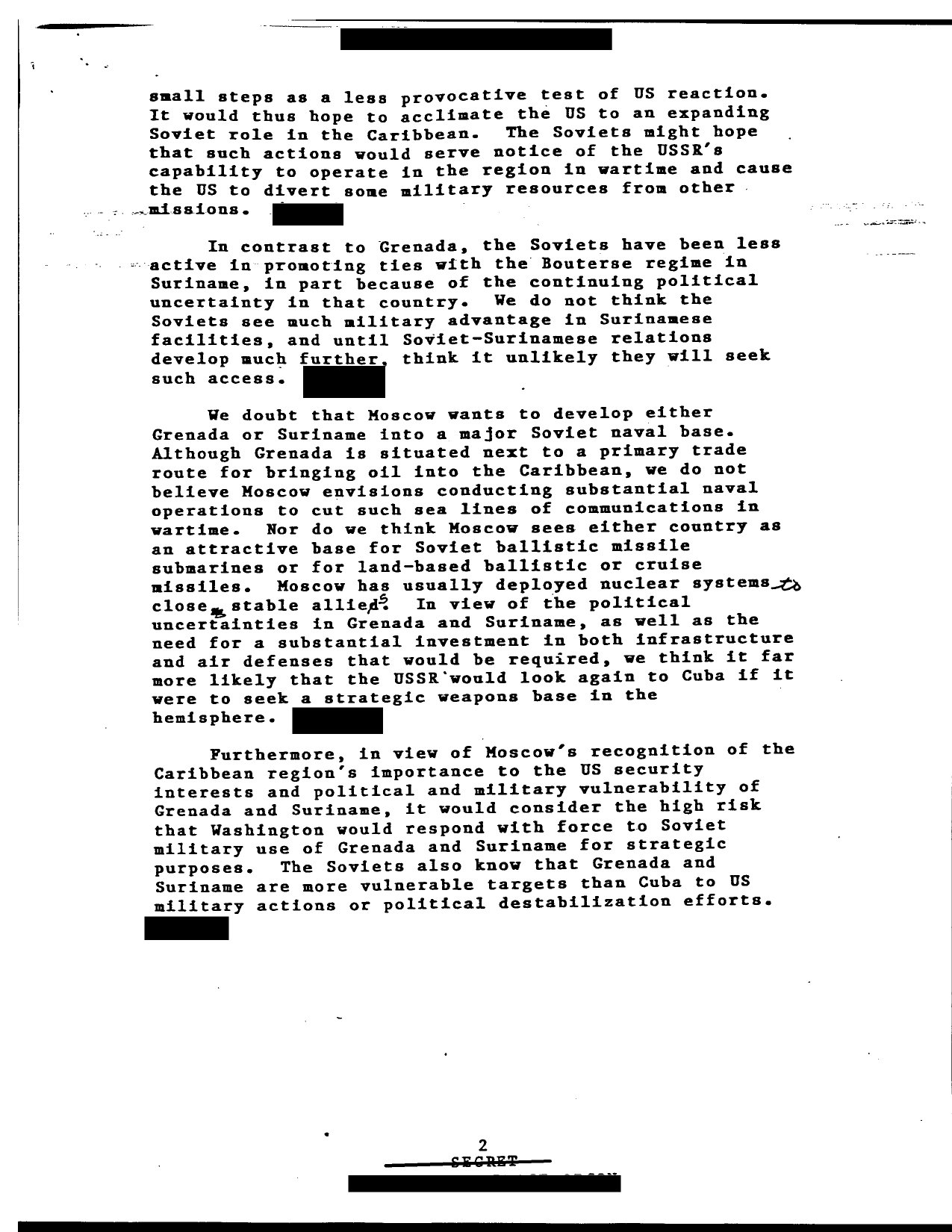
It is possible that the Soviets will make some limited use of Grenada for periodic deployments of maritime reconnaissance or ASW patrol aircraft such as the TU-95 Bear D or TU-142 Bear F, or for occasional visits by naval combatants. Moscow may undertake such [CENSORED] small steps as a less provocative test of US reaction. It would thus hope to acclimate the US to an expanding Soviet role in the Caribbean. The Soviets might hope that such actions would serve notice of the USSR’s capability to operate in the region in wartime and cause the US to divert some military resources from other missions.
In contrast to Grenada, the Soviets have been less active in promoting ties with the Bouterse regime in Suriname, in part because of the continuing political uncertainty in that country. We do not think the Soviets see much military advantage in Surinamese facilities, and until Soviet-Surinamese relations develop much further, think it unlikely they will seek such access.
We doubt that Moscow wants to develop either base, Grenada or Suriname, into a major Soviet naval [CENSORED]. Although Grenada is situated next to a primary trade route for bringing oil into the Caribbean, we do not believe Moscow envisions conducting substantial naval operations to cut such sea lines of communications in wartime. Nor do we think Moscow sees either country as an attractive base for Soviet ballistic missile submarines or for land-based ballistic or cruise missiles. Moscow has usually deployed nuclear systems to close stable allied [CENSORED].
In view of the political uncertainties in Grenada and Suriname, as well as the need for a substantial investment in both infrastructure and air defenses that would be required, we think it far more likely that the USSR would look again to Cuba if it were to seek a strategic weapons base in the hemisphere. Furthermore, in view of Moscow’s recognition of the Caribbean region’s importance to US security interests and the political and military vulnerability of Grenada and Suriname, it would consider the high risk that Washington would respond with force to Soviet military use of Grenada and Suriname for strategic purposes. The Soviets also know that Grenada and Suriname are more vulnerable targets than Cuba to US military actions or political destabilization efforts.
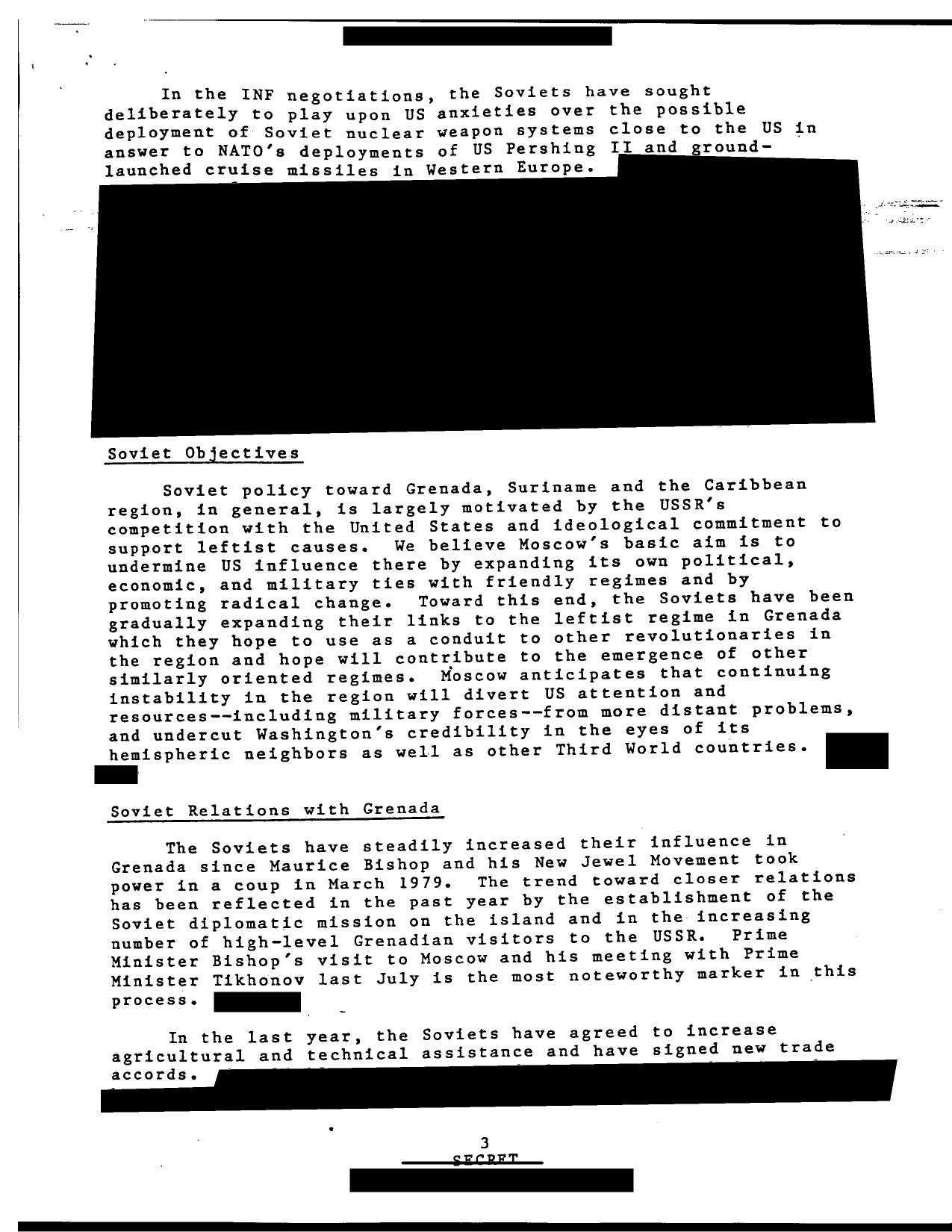
In the INF negotiations, the Soviets have sought deliberately to play upon US anxieties over the possible deployment of Soviet nuclear weapon systems close to the US in answer to NATO’s deployments of US Pershing II and ground-launched cruise missiles in Western Europe.
[CENSORED]
Soviet Objectives
Soviet policy toward Grenada, Suriname, and the Caribbean region, in general, is largely motivated by the USSR’s competition with the United States and ideological commitment to support leftist causes. We believe Moscow’s basic aim is to undermine US influence there by expanding its own political, economic, and military ties with friendly regimes and by promoting radical change. Toward this end, the Soviets have been gradually expanding their links to the leftist regime in Grenada, which they hope to use as a conduit to other revolutionaries in the region and hope will contribute to the emergence of other similarly oriented regimes. Moscow anticipates that continuing instability in the region will divert US attention and resources—including military forces—from more distant problems, and undercut Washington’s credibility in the eyes of its other Third World countries and hemispheric neighbors.
Soviet Relations with Grenada
The Soviets have steadily increased their influence in Grenada since Maurice Bishop and his New Jewel Movement took power in a coup in March 1979. The trend toward closer relations has been reflected in the past year by the establishment of the Soviet diplomatic mission on the island and in the increasing number of high-level Grenadian visitors to the USSR. Prime Minister Bishop’s visit to Moscow and his meeting with Prime Minister Tikhonov last July is the most noteworthy marker in this process.
In the last year, the Soviets have agreed to increase agricultural and technical assistance and have signed new trade accords.
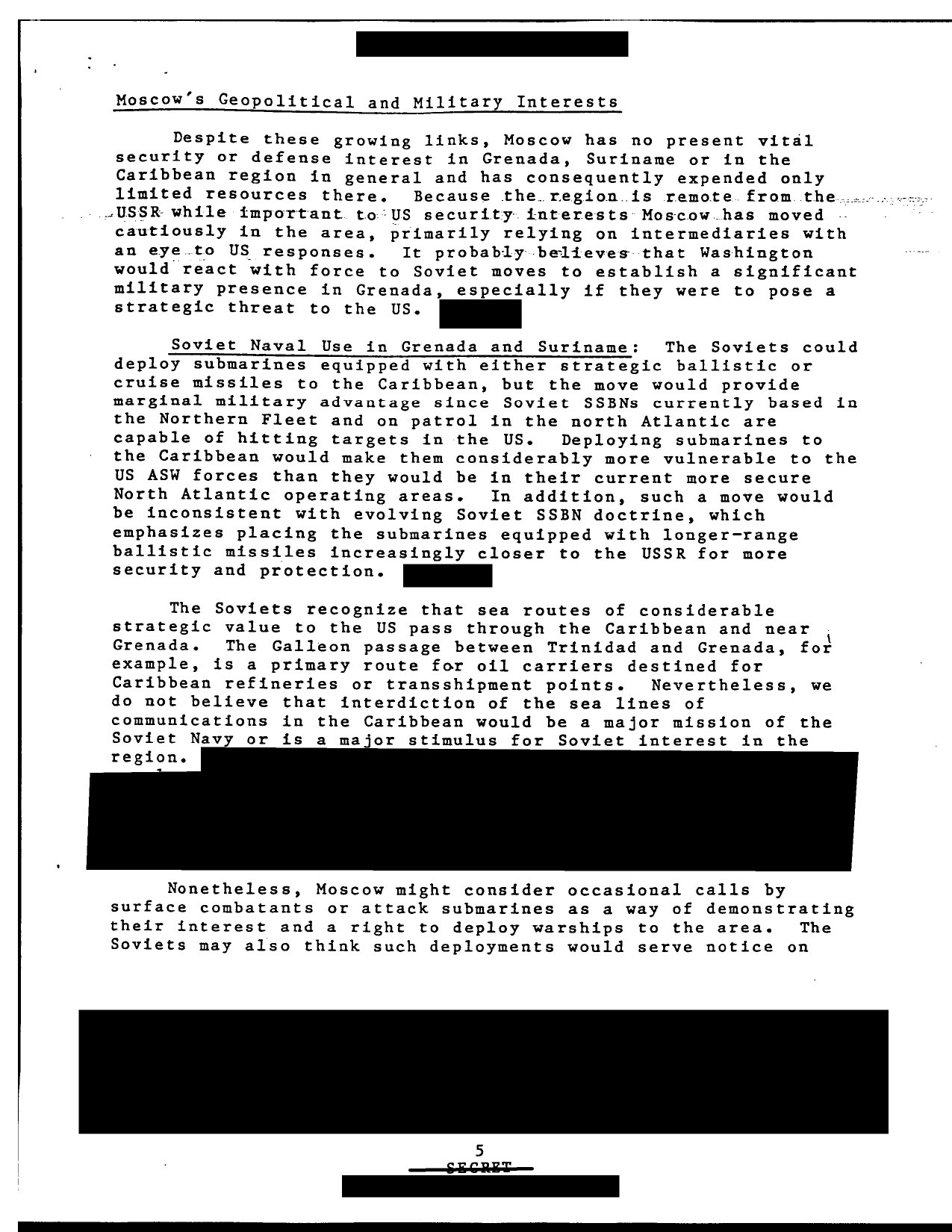
Moscow’s Geopolitical and Military Interests
Despite these growing links, Moscow has no present vital security or defense interest in Grenada, Suriname, or in the Caribbean region in general and has consequently expended only limited resources there. Because the region is remote from the USSR while important to US security interests, Moscow has moved cautiously in the area, primarily relying on intermediaries with an eye [CENSORED] to US responses. It probably believes that Washington would react with force to Soviet moves to establish a significant military presence in Grenada, especially if they were to pose a strategic threat to the US.
Soviet Naval Use in Grenada and Suriname
The Soviets could deploy submarines equipped with either strategic ballistic or cruise missiles to the Caribbean, but the move would provide marginal military advantage since Soviet SSBNs currently based in the Northern Fleet and on patrol in the North Atlantic are capable of hitting targets in the US. Deploying submarines to the Caribbean would make them considerably more vulnerable to ASW forces than they would be in their current, more secure North Atlantic operating areas. In addition, such a move would be inconsistent with evolving Soviet SSBN doctrine, which emphasizes placing the submarines equipped with longer-range ballistic missiles increasingly closer to the USSR for more security and protection.
The Soviets recognize that sea routes of considerable strategic value to the US pass through the Caribbean and near Grenada. The Galleon passage between Trinidad and Grenada, for example, is a primary route for oil carriers destined for Caribbean refineries or transshipment points. Nevertheless, we do not believe that interdiction of the sea lines of communications in the Caribbean would be a major mission of the Soviet Navy or is a major stimulus for Soviet interest in the region.
Nonetheless, Moscow might consider occasional calls by surface combatants or attack submarines as a way of demonstrating their interest and a right to deploy warships to the area. The Soviets may also think such deployments would serve notice on [CENSORED] Washington of the USSR’s capability to operate in the region in wartime and might cause the US to divert some military resources from other missions.
The Soviets already have a small naval force in the Caribbean. Usually this consists of one or two research ships and an auxiliary vessel mainly serving intelligence-gathering purposes. From time to time, the Soviets deploy naval task groups to show the flag, cruise in the Gulf of Mexico, and exercise with the Cuban Navy, whose forces and facilities are currently being upgraded. The most recent task group visits—which typically consist of a guided-missile cruiser and frigate—took place in April 1981 and November 1982–January 1983.
Facilities in Grenada and Suriname are currently inadequate for providing significant logistical support for these types of combatants. Nevertheless, since Soviet warships generally are supported by their own naval auxiliaries and do not require the use of local naval facilities, they could visit Grenada and Suriname. The Soviets could provide some logistic support in either Grenada or Suriname by upgrading the local facilities or by temporarily deploying naval auxiliaries outside the local ports. Auxiliaries used in this manner, however, can only perform limited services. In the event that the Soviets wanted to supplement their afloat logistics with land-based support as they do elsewhere, in our judgment they would be more likely to use existing Cuban facilities.
Port Facilities in Grenada:
The commercial port of St. George’s on Grenada’s west coast is currently the only facility that could accommodate Soviet naval vessels or Cuban ships. It is a natural deep harbor and has been used by Soviet cruise ships as well as by Cuban merchant ships to ferry arms and personnel to and from Grenada. There are no facilities for providing shipboard electricity or bunkering at St. George’s, which has only a limited storage area, and the port is usually congested.
The Soviets and Grenadians might see an advantage to having a port facility in addition to St. George’s. For example, they might consider the more isolated Grenville to be more secure for the servicing of naval ships. Nevertheless, the construction of a major port would clearly be both costly and protracted. Grenville is a small town 20 miles from St. George’s, separated by mountains and rugged terrain. However, a small functioning airfield—Pearls—is nearby. Construction of a deepwater port there would be a long and difficult task—a large reef lies off the coast, and the shoreline is littered with large boulders. Labor force, technical support, and equipment would have to be imported.
Port Facilities in Suriname:
Paramaribo, Suriname’s major port facility, is located on the Suriname River over 12 kilometers from the coast. The river channel has a maximum depth of about 22 feet, although the anchorage at the port is 18 to 33 feet deep. The three wharfs at Paramaribo, from 300 to 1800 feet long, could accommodate vessels drawing up to 20 feet (the size of a small frigate), but there are no cranes present and only a minor repair capability available at the port. Without additional dredging, the river channel probably would not be sufficiently deep to allow most Soviet naval vessels or submarines to reach Paramaribo. Significant construction of shore facilities would also have to be undertaken before Soviet naval vessels could use the port for logistical support.
[CENSORED]
Suriname’s only other active port, New Nickerie, is located on the western coast and is also a short distance upriver. The approach to the port is only 5 to 6 feet deep, however, which would rule out its use by the type of naval vessels the Soviets operate in the Caribbean.
Soviet Air Use of Grenada and Suriname
Soviet air operations from Grenada and Suriname would only marginally improve the USSR’s surveillance capabilities in the Atlantic. If TU-95 (Bear D) naval reconnaissance aircraft or TU-142 ASW patrol aircraft were based in Grenada or Suriname, they could reach a small section of the eastern South Atlantic not now covered by Bear Ds that stage out of Cuba or Angola. We doubt that the Soviets are interested in such reconnaissance or ASW capability, in view of the absence of significant Soviet or US naval activity in this area. Moreover, last year TU-95 aircraft deployments were shifted to a more secure and improved airfield in Cuba, suggesting that Moscow envisions this facility as sufficient for the foreseeable future. It is possible, however, that the Soviets may see Grenada and Suriname as potential backup facilities for the TU-95 or TU-142 deployments in the region. This element of redundancy would be consistent with their practice elsewhere in the Third World.
The Point Salines Airport in Grenada will have the capability to serve as a base for Soviet strategic bombers or receive TU-22M (Backfire) bombers after one-way strike missions from the USSR. It clearly lacks the range to fly to [CENSORED]. Moreover, training activities of the Soviet TU-22M bombers have not included in-flight refueling or Arctic training, and their subordination and exercise activity suggest that they are intended for use against NATO countries and China. In any case, the Soviets do have long-range strategic bombers that can reach the US from bases in the USSR on two-way strike missions.
Air Facilities in Grenada:
The new international airport, Point Salines, on Grenada’s southern coast is scheduled for completion by early 1984. We are unaware of any direct Soviet involvement in the project; Cuba has provided the bulk of the labor and equipment for the construction of the $80 million facility. More than half of the proposed approximately 9,000-foot runway has already been surfaced, and the remainder is expected to be finished this year. Construction of the airport terminal building, fuel storage area, and other support facilities is also underway.
The new airport is intended to provide a boost to Grenada’s sagging tourist industry by enabling direct flights from overseas points. Although ostensibly designed for commercial use, the airport will also be able to accommodate most of the military aircraft in the Cuban and Soviet inventories. MIG-21 and MIG-23 fighters as well as AN-26 short-range transports even now would be capable of operating from the approximately 5,000 feet of completed runway.
Grenadian officials have generally denied that the airport will be used for military purposes, and Andropov has publicly referred to it as a civil airport, but the heavy Cuban involvement in the project suggests Havana sees strategic advantages in it. The Cubans probably will want to use it as a stopover point for Cubana Airlines IL-62 transports that regularly ferry Cuban troops to and from Africa. The Cubans might also want to be able to deploy some military fighter aircraft to the island, particularly in case the New Jewel Movement’s hold on power came under serious threat.
Air Facilities in Suriname:
Zanderij International Airport, located about 50 kilometers south of Paramaribo, has an 11,000-foot runway that would be capable of handling most Soviet-built civil or military aircraft. The airfield is equipped with modern navigational equipment. There is also a smaller civilian airport in Paramaribo, but its runway is less than 3,000 feet.
None of the Cuban Air Force’s MIG fighters have sufficient ferry range to reach Suriname directly from Cuba—a distance of over 1,600 miles. Moreover, only a few types of Cuban military or civilian transport aircraft are capable of reaching Suriname. With a stop in Grenada, however, they could easily make the trip.
Land-Based Systems:
We believe the Soviets are unlikely to deploy land-based strategic systems in Grenada or Suriname such as the SS-20 intermediate-range ballistic missile or the SSC-X-4 ground-launched cruise missile. This is primarily because they know that such a move would almost certainly trigger a direct conventional military confrontation with the United States in an area where the US has military preponderance.
In addition, the Soviets would have to overcome significant political and logistical constraints before deploying strategic weapons to these countries. Although the USSR is developing closer political relations with the leftist regimes in Grenada and Suriname, Moscow’s continuing caution in dealing with them suggests that it is still uncertain about their long-term staying power. Except for Cuba in 1962, the Soviets have not deployed nuclear weapons outside the territories of their close communist allies, where both stable friendly regimes along with Soviet combat troops serve to guarantee their security.
The two countries also lack the basic infrastructure, such as roads and support facilities, to accommodate land-based ballistic missiles such as the SS-20, and their development would be a costly and protracted task. Moreover, construction of a normal SS-20 base with nine launcher garages would take at least a year and would be quickly detected by satellite surveillance. Furthermore, Moscow would have to install air defense systems in both countries if it was to ensure that its military facilities there would not be highly vulnerable to US attack. In view of these considerations, in our judgment it would be much more likely that the USSR would turn to Cuba if it again were to deploy strategic systems in the hemisphere.
Soviet Political Calculations
The Soviets almost certainly would see more political than military advantages from a successful expansion of their military presence to Grenada or Suriname. The Soviets would view US acceptance of their presence—particularly if it involved strategic nuclear weapons—there as another demonstration of the change in the global power balance in their favor. They would hope that such a development would embolden revolutionaries in the Caribbean region and elsewhere in the hemisphere to intensify their challenge to the US.
The Soviets might also see their military expansion in Grenada and Suriname as a way to probe the limits of the US-Soviet 1962 understanding without challenging it directly. They could probe US resolve by military deployments such as port calls or naval reconnaissance flights, or initially by even less controversial moves such as direct arms deliveries and establishment of Soviet military training missions. Such incremental steps have long been a hallmark of the Soviet approach in the Third World.
They might see Washington’s acceptance of a growing military presence in these countries—especially represented by the occasional deployment of naval combatants or aircraft—as an indication of a lack of will to check more ambitious Soviet military moves in Cuba. The Soviets might also calculate that Soviet military presence in Grenada would bolster Castro’s confidence in the USSR’s willingness to protect him from US military moves.
The Soviets may even consider that some ambiguous preparations for deployment of land-based nuclear weapons in the Caribbean would create an international crisis situation that could cause a breakdown in the US domestic consensus behind the INF deployments in Western Europe and provoke a crisis within NATO over this issue. Moscow could defend such “analogous” action by claiming that the US plan to deploy Pershing missiles in Western Europe had rendered Soviet-American understandings in Cuba inoperative. We think, however, that if Moscow undertook such a course it would be more likely to do so in Cuba than in Grenada. Suriname would be even less likely. This is because Moscow has a close political relationship with Castro and because Cuba has a superior infrastructure (i.e., ports, airfields, and military facilities)—and particularly has a strong air defense capability.
Weighed against these potential political benefits, however, Moscow would have to recognize that a significant Soviet military expansion in Grenada and Suriname would have a major negative impact on its relations with the US. The Soviets are almost certainly aware that such a move would bring new strains to US-Soviet relations, rally domestic support in the US for stronger and more assertive defense policies, and jeopardize remaining US-Soviet contacts.
Moscow would also have to consider the prospect of direct US military actions against significant Soviet military expansion in either Grenada or Suriname, particularly if it involved strategic weapons. In view of such developments as the US warning against sending MIG aircraft to Nicaragua, the Soviets are aware of the growing US resolve to resist further Soviet probes or advances in the Western Hemisphere.
In the event of direct US military response to Soviet moves, Moscow would be forced to choose between a global confrontation with the US or retreating. The Soviets are aware that another retreat in the hemisphere would be a major setback to their own credibility in the region and elsewhere in the Third World.
Although the Soviet-US understanding barring Soviet strategic military use of Cuba does not extend to Grenada or Suriname, in our judgment, Moscow anticipates that the [CENSORED] administration would quickly unilaterally extend it to both of these countries if challenged there. Moreover, the Soviets are aware of the US ability to bring superior conventional military pressure to bear in the Caribbean and probably believe Washington sees this area as ideal for a military confrontation with the USSR. Furthermore, they know that Grenada and Suriname would be a much more vulnerable target for US military or destabilization efforts than Cuba.
Date:
April 21, 1983