The Island Paradise that’s becoming a Communist Stronghold
International Outlook
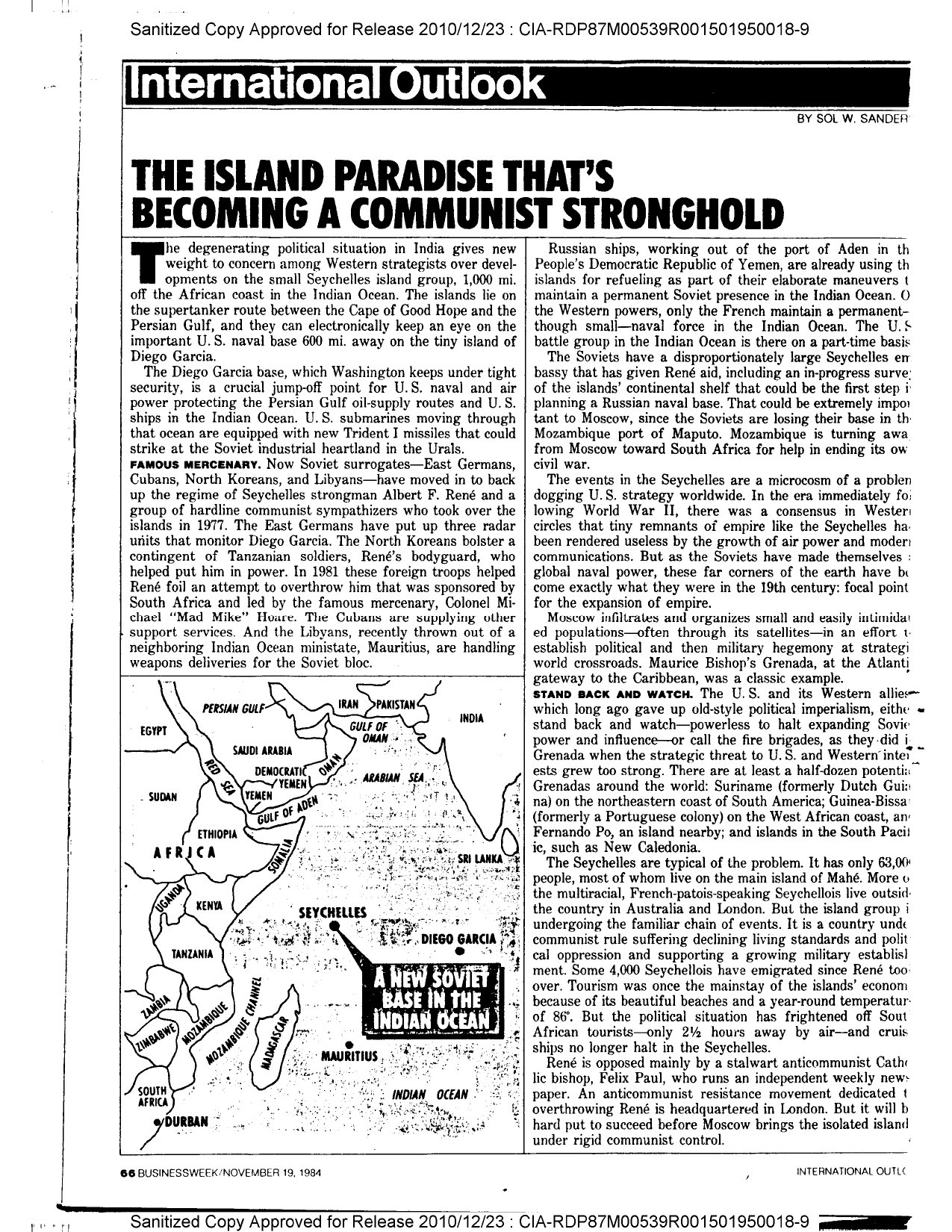
The degenerating political situation in India gives new weight to concern among Western strategists over developments on the small Seychelles island group, 1,000 mi. off the African coast in the Indian Ocean. The islands lie on the supertanker route between the Cape of Good Hope and the Persian Gulf, and they can electronically keep an eye on the important U. S. naval base 600 mi. away on the tiny island of Diego Garcia.
The Diego Garcia base, which Washington keeps under tight security, is a crucial jump-off point for U.S. naval and air power protecting the Persian Gulf oil-supply routes and U. S. ships in the Indian Ocean. U. S. submarines moving through that ocean are equipped with new Trident I missiles that could strike at the Soviet industrial heartland in the Urals.
FAMOUS MERCENARY
Now Soviet surrogates—East Germans, Cubans, North Koreans, and Libyans—have moved in to back up the regime of Seychelles strongman Albert F. René and a group of hardline communist sympathizers who took over the islands in 1977. The East Germans have put up three radar units that monitor Diego Garcia. The North Koreans bolster a contingent of Tanzanian soldiers, René’s bodyguard, who helped put him in power.
In 1981 these foreign troops helped René foil an attempt to overthrow him that was sponsored by South Africa and led by the famous mercenary, Colonel Michael “Mad Mike” Hoare. The Cubans are supplying other support services. And the Libyans, recently thrown out of a neighboring Indian Ocean ministate, Mauritius, are handling weapons deliveries for the Soviet bloc.
Russian ships, working out of the port of Aden in the People’s Democratic Republic of Yemen, are already using the islands for refueling as part of their elaborate maneuvers to maintain a permanent Soviet presence in the Indian Ocean. Of the Western powers, only the French maintain a permanent—though small—naval force in the Indian Ocean. The U.S battle group in the Indian Ocean is there on a part-time basis.
The Soviets have a disproportionately large Seychelles embassy that has given René aid, including an in-progress survey of the islands’ continental shelf that could be the first step in planning a Russian naval base. That could be extremely important to Moscow, since the Soviets are losing their base in the Mozambique port of Maputo. Mozambique is turning away from Moscow toward South Africa for help in ending its own civil war.
The events in the Seychelles are a microcosm of a problem dogging U. S. strategy worldwide. In the era immediately following World War II, there was a consensus in Western circles that tiny remnants of empire like the Seychelles had been rendered useless by the growth of air power and modern communications. But as the Soviets have made themselves a global naval power, these far corners of the earth have become exactly what they were in the 19th century: focal points for the expansion of empire.
Moscow infiltrates and organizes small and easily intimidated populations—often through its satellites—in an effort to establish political and then military hegemony at strategic world crossroads. Maurice Bishop’s Grenada, at the Atlantic gateway to the Caribbean, was a classic example.
STAND BACK AND WATCH
The U.S. and its Western allies, which long ago gave up old-style political imperialism, either stand back and watch—powerless to halt expanding Soviet power and influence—or call the fire brigades, as they did in Grenada when the strategic threat to U. S. and Western interests grew too strong.
There are at least a half-dozen potential Grenadas around the world: Suriname (formerly Dutch Guiana) on the northeastern coast of South America; Guinea-Bissau (formerly a Portuguese colony) on the West African coast, and Fernando Po, an island nearby; and islands in the South Pacific, such as New Caledonia.
The Seychelles are typical of the problem. It has only 63,000 people, most of whom live on the main island of Mahé. More of the multiracial, French-patois-speaking Seychellois live outside the country in Australia and London. But the island group is undergoing the familiar chain of events.
It is a country under communist rule suffering declining living standards and political oppression and supporting a growing military establishment. Some 4,000 Seychellois have emigrated since René took over. Tourism was once the mainstay of the islands’ economy because of its beautiful beaches and a year-round temperature of 86°. But the political situation has frightened off South African tourists—only 2½ hours away by air—and cruise ships no longer halt in the Seychelles.
René is opposed mainly by a stalwart anticommunist Catholic bishop, Felix Paul, who runs an independent weekly newspaper. An anticommunist resistance movement dedicated to overthrowing René is headquartered in London. But it will be hard put to succeed before Moscow brings the isolated islands under rigid communist control.
Source:
Link:
Internal Link: