An Appraisal of the Interim Government in Suriname 1980
MEMORANDUM
Military and Political Developments
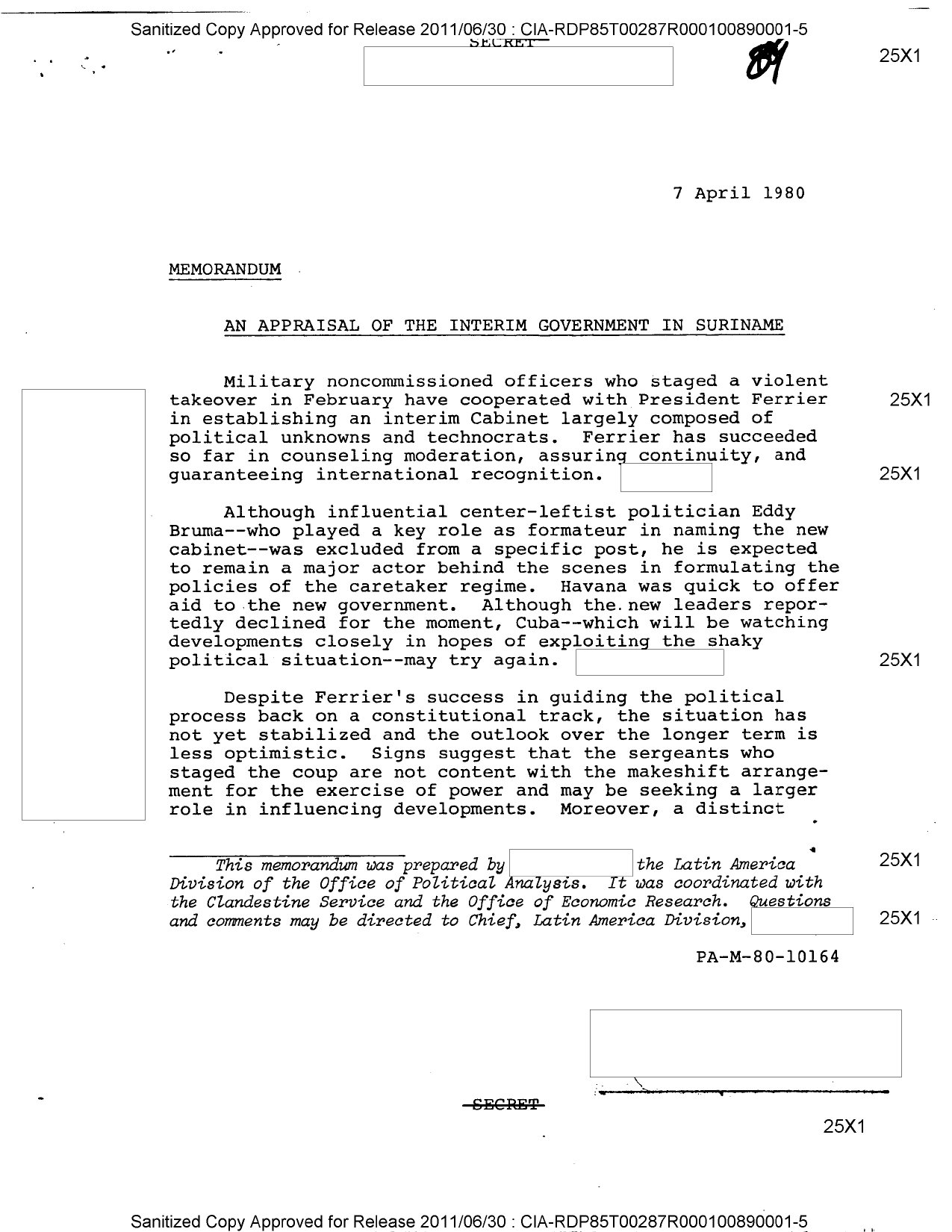
Military noncommissioned officers who staged a violent takeover in February have cooperated with President Ferrier in establishing an interim Cabinet largely composed of political unknowns and technocrats. Ferrier has succeeded so far in counseling moderation, assuring continuity, and guaranteeing international recognition.
Although influential center-leftist politician Eddy Bruma—who played a key role as formateur in naming the new cabinet—was excluded from a specific post, he is expected to remain a major actor behind the scenes in formulating the policies of the caretaker regime.
Havana was quick to offer aid to the new government. Although the new leaders reportedly declined for the moment, Cuba—which will be watching developments closely in hopes of exploiting the shaky political situation—may try again.
Despite Ferrier’s success in guiding the political process back on a constitutional track, the situation has not yet stabilized, and the outlook over the longer term is less optimistic. Signs suggest that the sergeants who staged the coup are not content with the makeshift arrangement for the exercise of power and may be seeking a larger role in influencing developments.
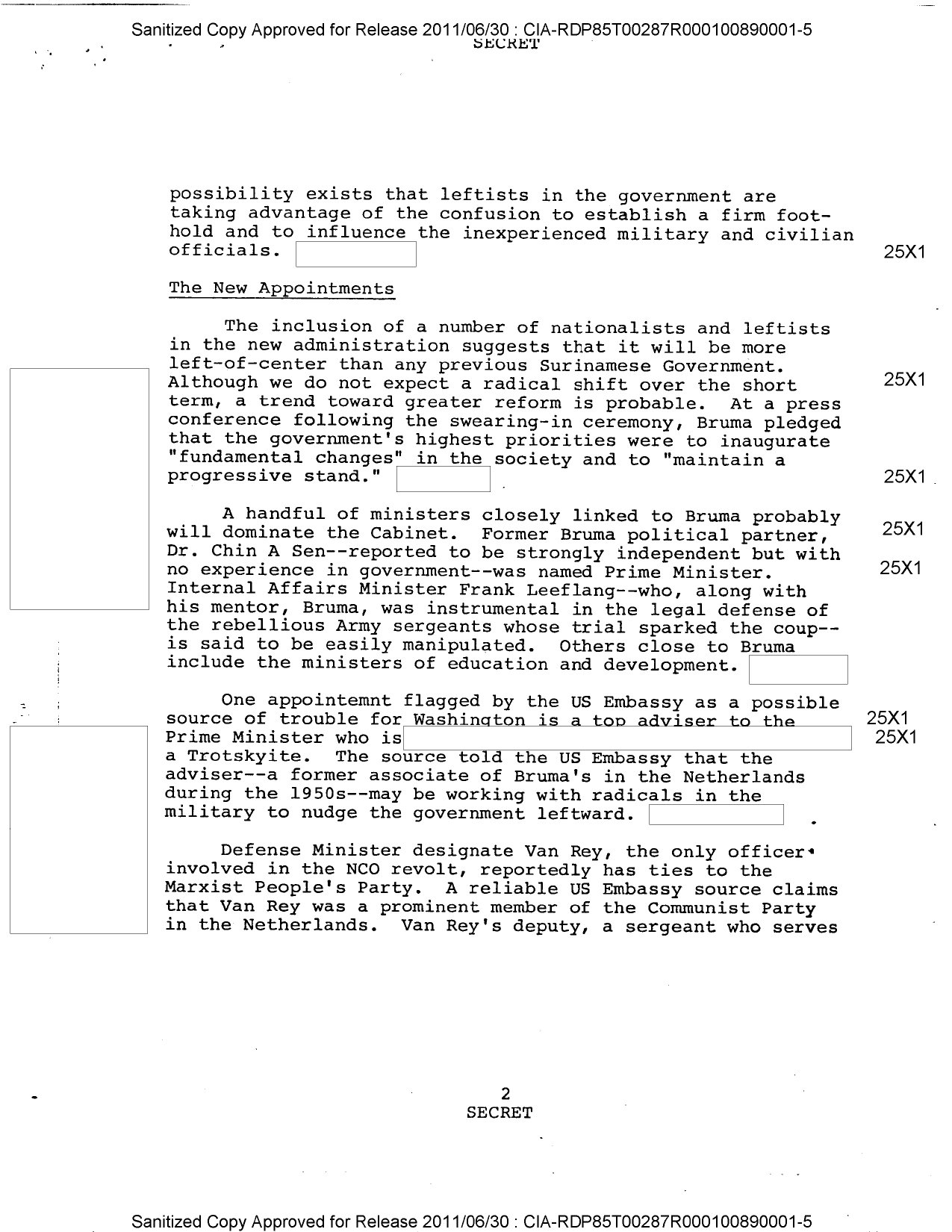
Moreover, a distinct possibility exists that leftists in the government are taking advantage of the confusion to establish a firm foothold and to influence the inexperienced military and civilian officials.
The New Appointments
The inclusion of a number of nationalists and leftists in the new administration suggests that it will be more left-of-center than any previous Surinamese government. Although a radical shift is not expected in the short term, a trend toward greater reform is probable.
At a press conference following the swearing-in ceremony, Bruma pledged that the government’s highest priorities were to inaugurate “fundamental changes” in society and to “maintain a progressive stand.”
A handful of ministers closely linked to Bruma are likely to dominate the Cabinet:
- Dr. Chin A. Sen, former political partner of Bruma, was named Prime Minister. He is reported to be strongly independent but has no prior government experience.
- Frank Leeflang, appointed Internal Affairs Minister and closely associated with Bruma, is said to be easily influenced. He, along with Bruma, played a key role in defending the rebellious Army sergeants whose trial sparked the coup.
- Ministers of Education and Development are also considered close to Bruma.
Some appointments have raised concern internationally:
- A top adviser to the Prime Minister, formerly associated with Bruma in the Netherlands during the 1950s, is a Trotskyite. The US Embassy reports he may be working with radicals in the military to nudge the government leftward.
- Defense Minister designate Van Rey, the only officer involved in the NCO revolt, reportedly has ties to the Marxist People’s Party and was a prominent member of the Communist Party in the Netherlands. His deputy, a sergeant on the newly formed National Military Council (NMC), may also have leftist sympathies.
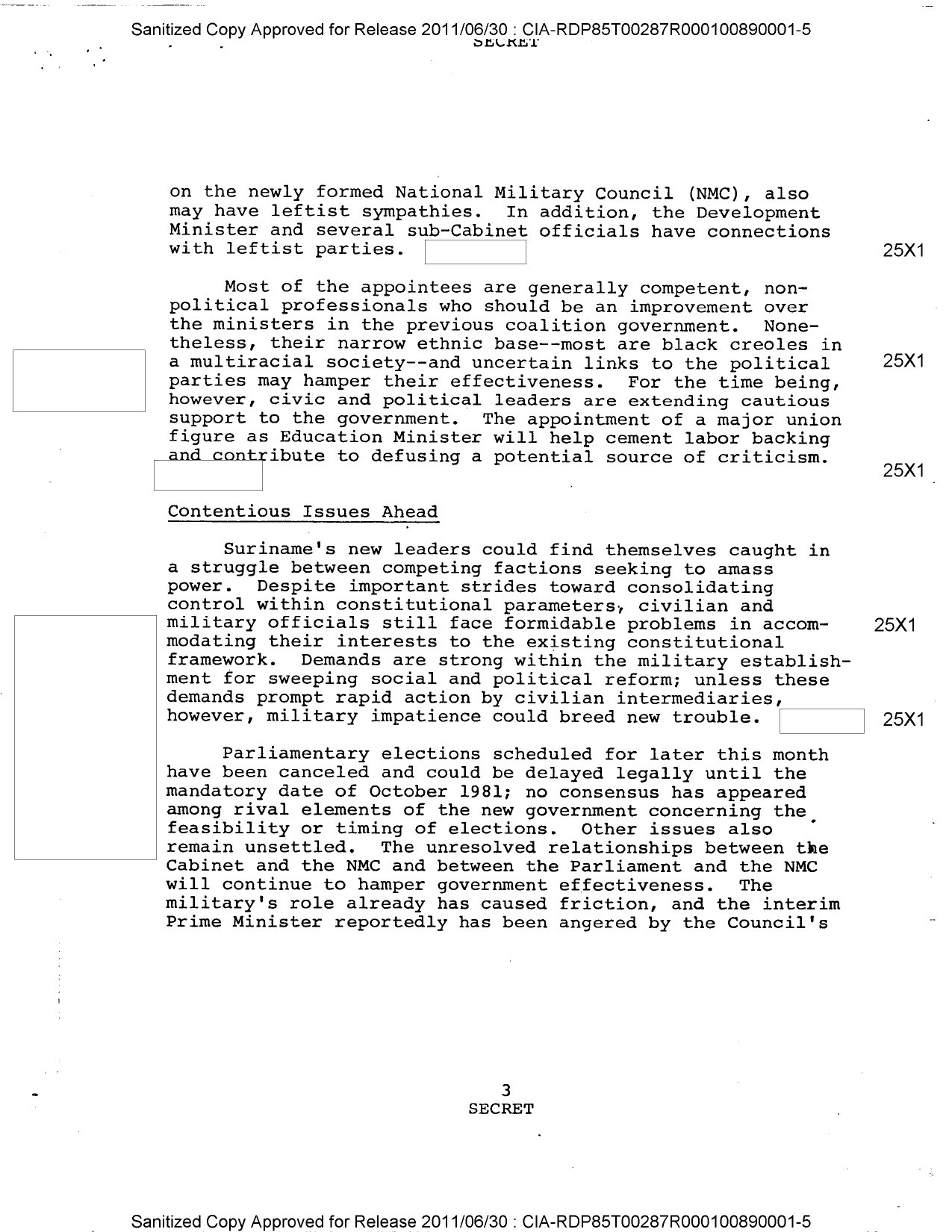
- The Development Minister and several sub-Cabinet officials have connections with leftist parties.
Most appointees are competent, nonpolitical professionals, expected to be an improvement over the previous coalition government. However, their narrow ethnic base—mostly black Creoles in a multiracial society—and uncertain links to political parties may hamper their effectiveness.
For now, civic and political leaders are extending cautious support to the government. The appointment of a major union figure as Education Minister is expected to strengthen labor backing and help defuse potential criticism.
Contentious Issues Ahead
Armed forces leaders continue to push for a larger role in political affairs. Prior to the coup, the NCOs complained of the inertia within the highly fractious political system and criticized the 39-man legislature for corruption, cronyism, and bureaucratic inactivity.
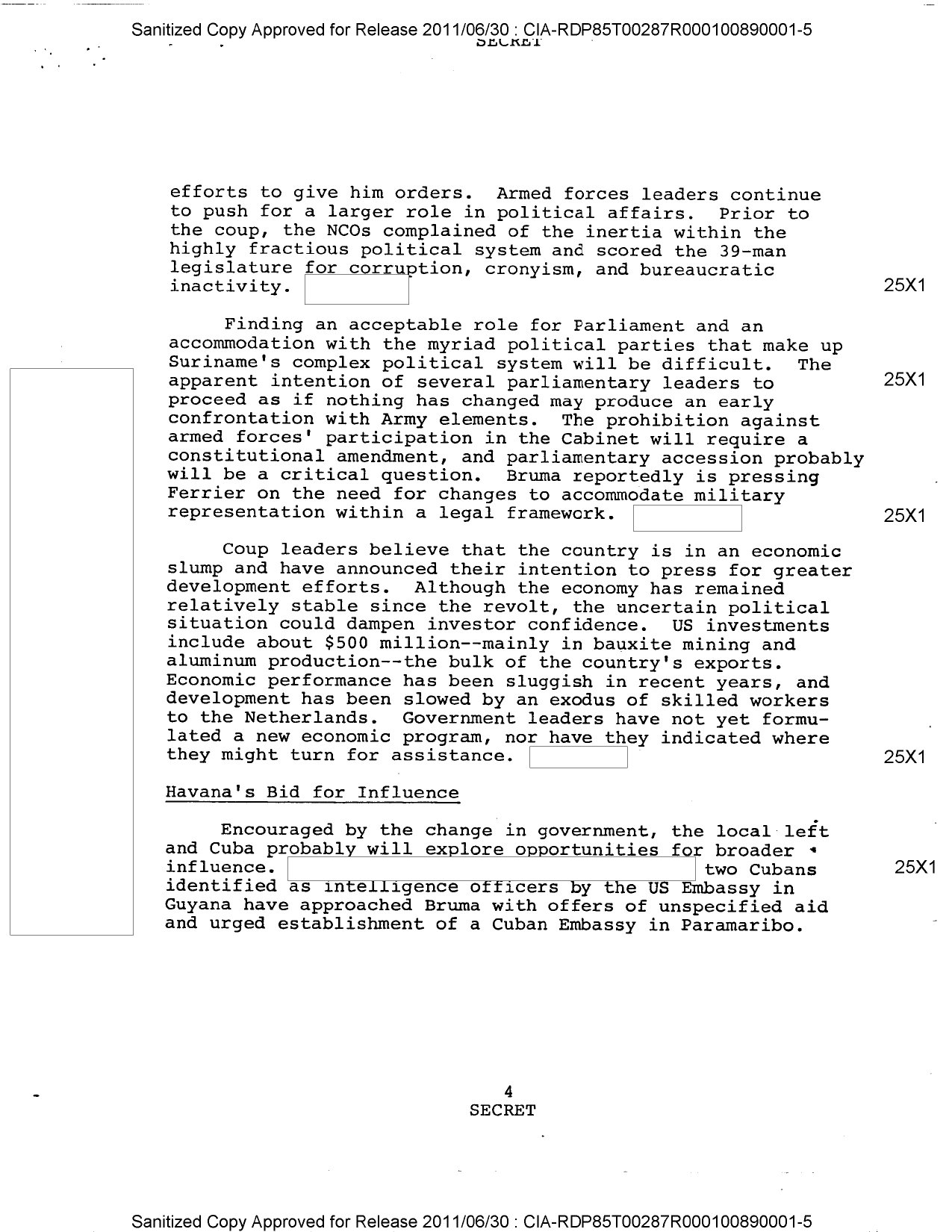
Finding an acceptable role for Parliament and accommodating the myriad political parties that make up Suriname’s complex political system will be difficult. The apparent intention of several parliamentary leaders to proceed as if nothing has changed may produce an early confrontation with Army elements.
The prohibition against armed forces’ participation in the Cabinet will require a constitutional amendment, and parliamentary approval will likely be a critical question. Bruma is reportedly pressing Ferrier on the need for changes to accommodate military representation within a legal framework.
Coup leaders believe that the country is in an economic slump and have announced their intention to press for greater development efforts. Although the economy has remained relatively stable since the revolt, the uncertain political situation could dampen investor confidence.
US investments include approximately $500 million—mainly in bauxite mining and aluminum production—the bulk of the country’s exports. Economic performance has been sluggish in recent years, and development has been slowed by an exodus of skilled workers to the Netherlands. Government leaders have not yet formulated a new economic program, nor have they indicated where they might turn for assistance.
Havana’s Bid for Influence
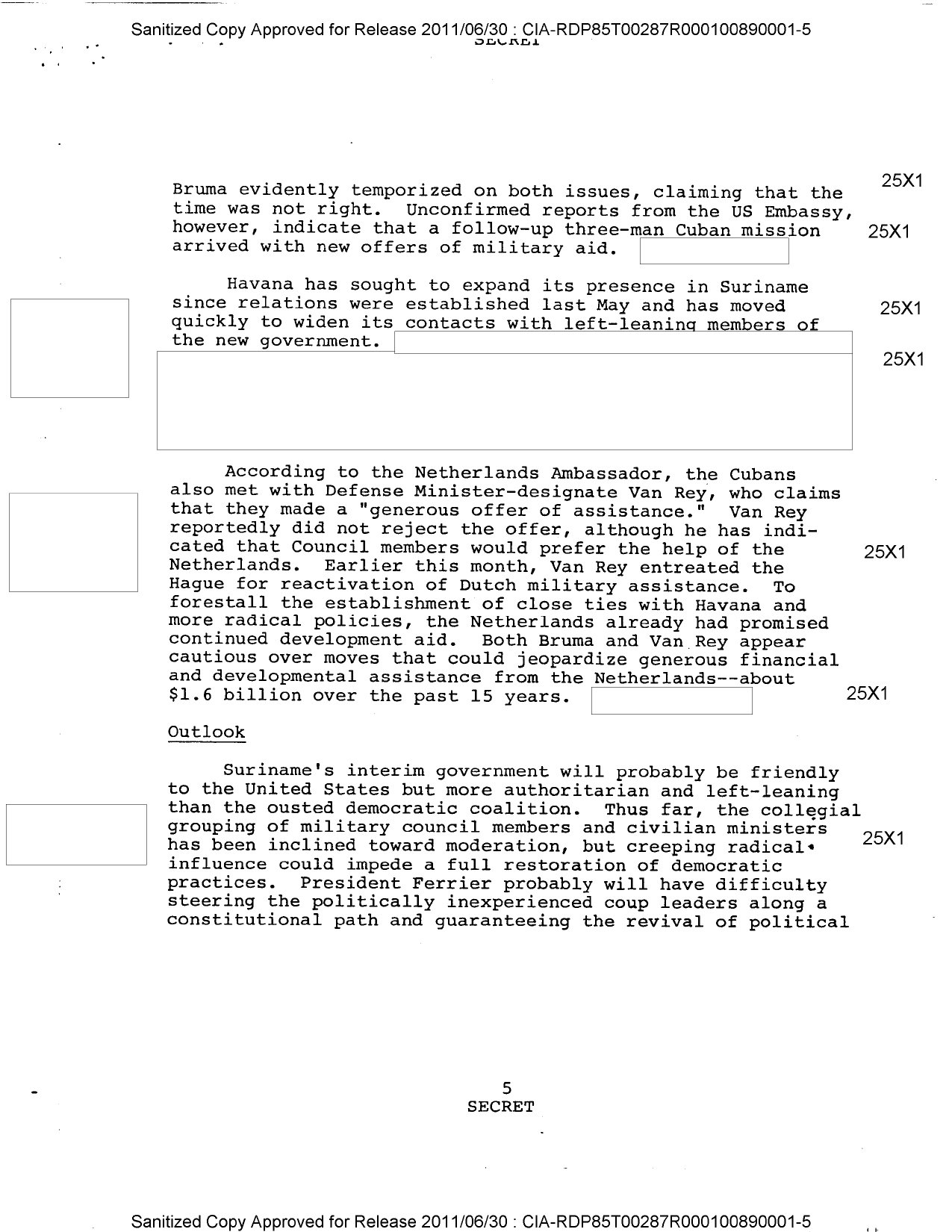
Encouraged by the change in government, the local left and Cuba are likely to explore opportunities for broader influence. Two Cubans, identified as intelligence officers by the US Embassy in Guyana, have approached Bruma with offers of unspecified aid and urged the establishment of a Cuban Embassy in Paramaribo. Bruma reportedly temporized on both issues, claiming that the time was not right.
Unconfirmed reports from the US Embassy indicate that a follow-up three-man Cuban mission arrived with new offers of military aid. Havana has sought to expand its presence in Suriname since relations were established last May and has moved quickly to widen its contacts with left-leaning members of the new government.
According to the Netherlands Ambassador, the Cubans also met with Defense Minister-designate Van Rey, who claims they made a “generous offer of assistance.” Van Rey reportedly did not reject the offer, although he has indicated that Council members would prefer the help of the Netherlands. Earlier this month, Van Rey entreated The Hague for reactivation of Dutch military assistance.
To forestall the establishment of close ties with Havana and more radical policies, the Netherlands had already promised continued development aid. Both Bruma and Van Rey appear cautious over moves that could jeopardize generous financial and developmental assistance from the Netherlands—approximately $1.6 billion over the past 15 years.
Outlook
Suriname’s interim government will probably be friendly to the United States but more authoritarian and left-leaning than the ousted democratic coalition. Thus far, the collegial grouping of military council members and civilian ministers has been inclined toward moderation, but creeping radical influence could impede a full restoration of democratic practices.
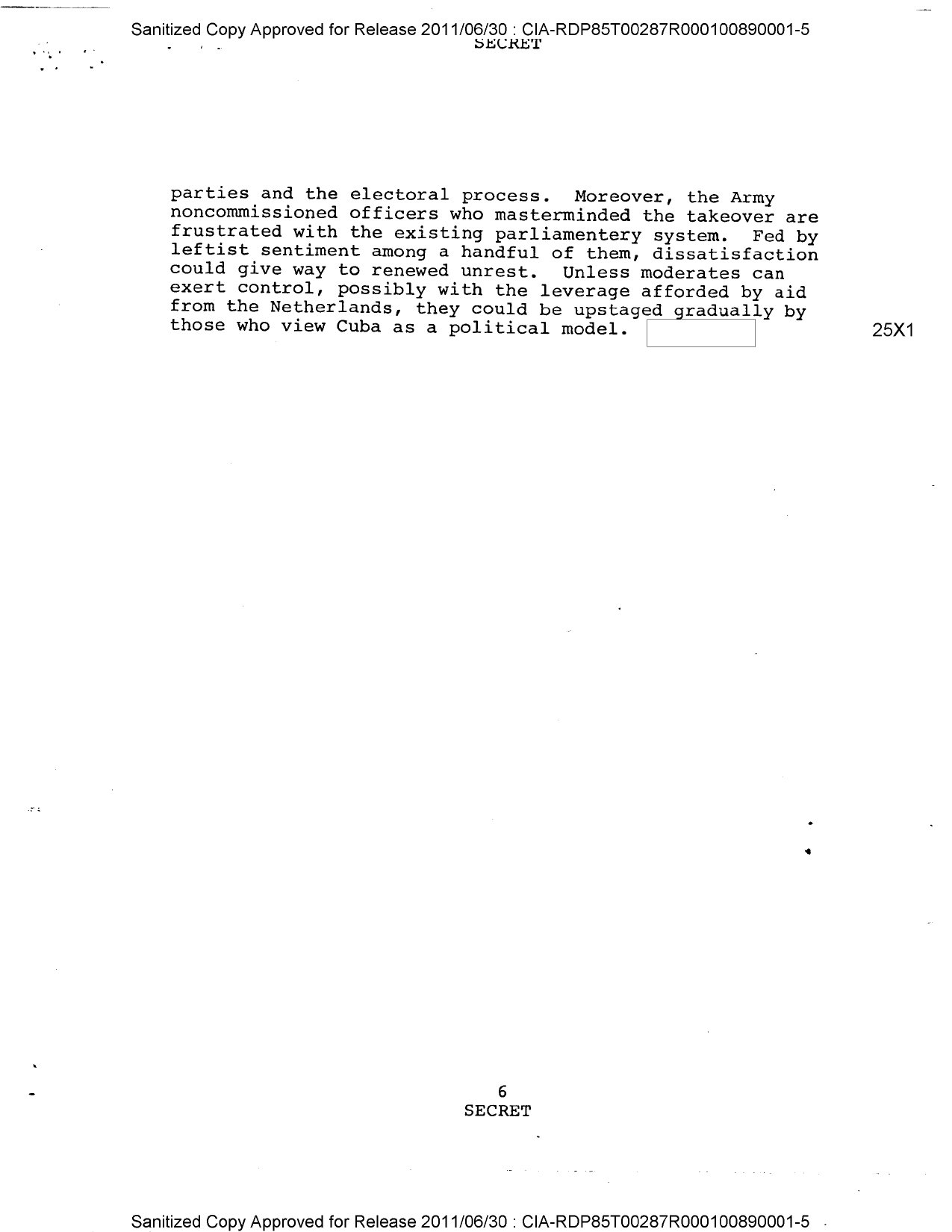
President Ferrier will likely face difficulty steering the politically inexperienced coup leaders along a constitutional path and guaranteeing the revival of political parties and the electoral process. Moreover, the Army noncommissioned officers who masterminded the takeover are frustrated with the existing parliamentary system. Fed by leftist sentiment among a handful of them, dissatisfaction could give way to renewed unrest.
Unless moderates can exert control—possibly with the leverage afforded by aid from the Netherlands—they could gradually be upstaged by those who view Cuba as a political model.
Distribution:
- Original – Amb. Bowdler
- 2 – Prod. Staff
- 3 – OPA Front Office
- 4 – OPA/LA
- 1 – NIO/LA
- 1 – NIC Staff
Prepared by:
This memorandum was prepared by the Latin America Division of the Office of Political Analysis. It was coordinated with the Clandestine Service and the Office of Economic Research.
Questions or Comments:
May be directed to the Chief, Latin America Division.
Source:
Link:
Internal Link:
Date:
October 26, 1980