Briefing for DCI for NSC Meeting on 10 February 1982
CIA-RDP84B00049R000200380007-7
[Approved For Release 2007/07/17 : CIA-RDP84B00049R000200380007-7]
SECRET DDI 25X1
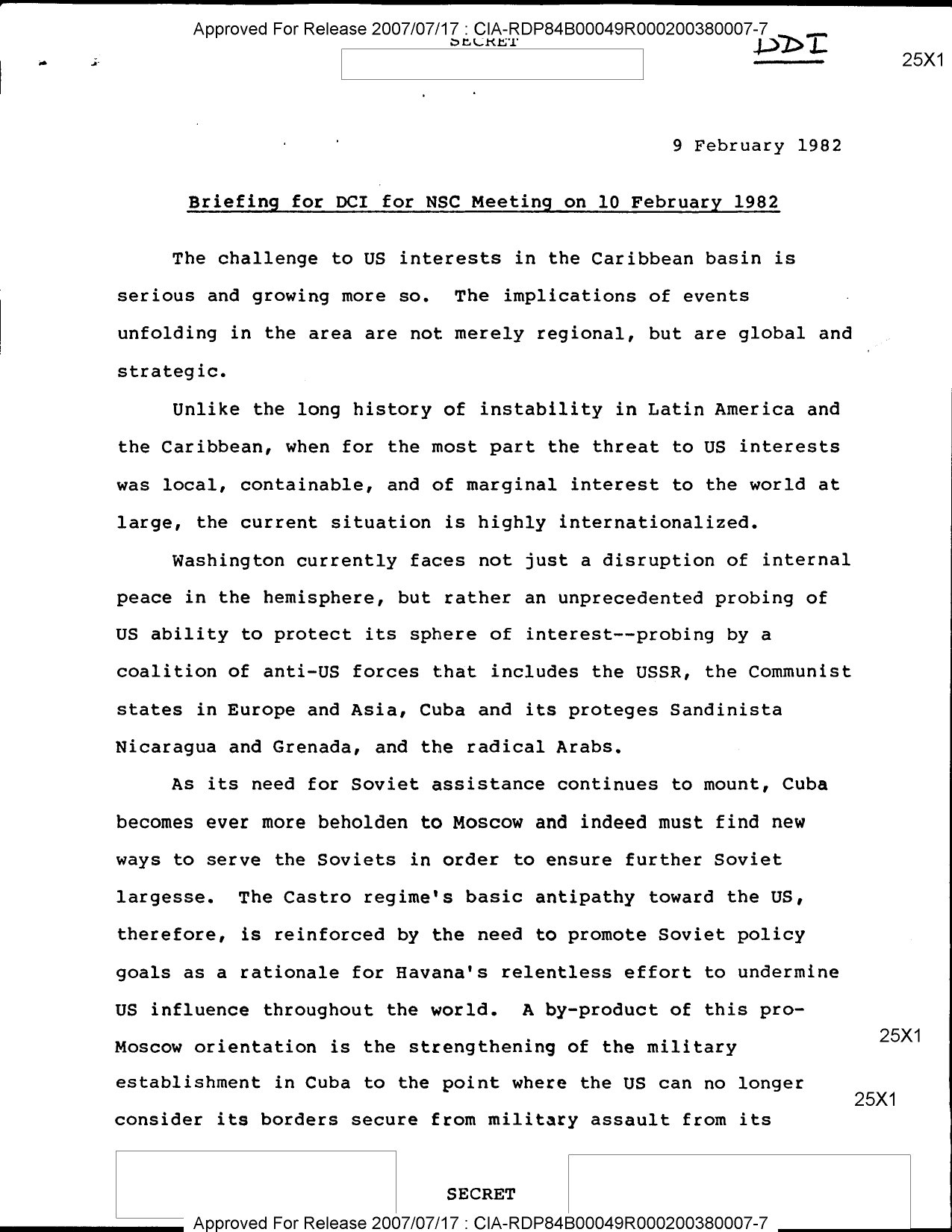
9 February 1982
Briefing for DCI for NSC Meeting on 10 February 1982
The challenge to US interests in the Caribbean basin is serious and growing more so. The implications of events unfolding in the area are not merely regional, but are global and strategic.
Unlike the long history of instability in Latin America and the Caribbean, when for the most part the threat to US interests was local, containable, and of marginal interest to the world at large, the current situation is highly internationalized.
Washington currently faces not just a disruption of internal peace in the hemisphere, but rather an unprecedented probing of US ability to protect its sphere of interest—probing by a coalition of anti-US forces that includes the USSR, the Communist states in Europe and Asia, Cuba and its proteges Sandinista Nicaragua and Grenada, and the radical Arabs.
As its need for Soviet assistance continues to mount, Cuba becomes ever more beholden to Moscow and indeed must find new ways to serve the Soviets in order to ensure further Soviet largesse. The Castro regime’s basic antipathy toward the US, therefore, is reinforced by the need to promote Soviet policy goals as a rationale for Havana’s relentless effort to undermine US influence throughout the world.
A by-product of this pro-Moscow orientation is the strengthening of the military establishment in Cuba to the point where the US can no longer consider its borders secure from military assault from its immediate neighbors. Neither can the US consider military action against Cuba without calculating significant losses in personnel and equipment as the price of intervention.
By willingly linking Cuba so closely to the USSR, the Castro regime has precluded any bilateral solution to bilateral problems. Rather than dealing with Havana in a vacuum, the US must now deal with the Cubans in a superpower context. There have been no indications that there is any weakening of Cuban-Soviet ties; indeed, the trend is markedly in the opposite direction.
A major outcome of this marriage of Cuban revolutionary ideology to Soviet resources is the ability of the Cubans to promote military and paramilitary operations around the world at US expense. Cuba’s growing links to the radical Arab states enhances this ability as we have seen in Cuban-Iraqi cooperation in Grenada and Cuban-PLO activity in Nicaragua. As radical Arab influence grows in Havana, Cuba will become increasingly tied to radical Arab policy goals and terrorist activities. As a result, Cuba is better able now to foster violent revolution in this hemisphere than at any time in the past.
Adversaries of the US are responding to more than the vulnerabilities of the divided nations in Central America and of the depressed states of the Caribbean. They see also an opportunity to pound a wedge between the US and its allies. Mexico, the country with which we must have the most favorable relationship if we are to have peace and security at home, is already alienated from Washington on the issues of Central America and Cuba, and is likely to become more of a political adversary if current trends continue.
Our European allies are less than supportive as well, and susceptible to the blandishments of radicalized socialists and their political spokesmen.
Failure to rise to the challenge will be very costly for the US. The hemisphere’s political landscape will be altered dramatically if the governments under Communist attack are left to fend for themselves against the multinational revolutionary threat. Even with the current level of US support, eventual victory by the Salvadoran guerrillas is a strong possibility. Such a development would invite still more brazen interference in the region, and US credibility as a world leader would suffer accordingly.
Moreover, hostile forces operating with impunity in this region have military significance for the protection of the Panama Canal and the Caribbean sealanes. Cuba, already the number one military force in Latin America, is receiving increasingly advanced materiel from the USSR. Nicaragua is being armed by its Communist benefactors. And Grenada—where Cuba is building an airport and training an armed force—makes no secret of its willingness to serve anti-US interests.
The particulars of the threat differ in Central America and in the Caribbean, but the states in each area face the similar problem of inability to handle it alone. In Central America, the immediate need is security. These weak governments cannot successfully fend for themselves in the face of outside intervention on behalf of an internal enemy.
For the most part, the island-states’ problems are economic; the security problem is incipient or only on the horizon. The recent history of Grenada—now a Cuban client—exemplifies the unpreparedness of these states to manage the responsibilities associated with sovereignty. Their colonial heritage leaves them unpracticed in the concept of national defense and far from ready to defend their territory. Their meager resources give them no natural economic or social viability.
To prosper, or even to survive at a civilized level, they require association with some political-economic entity able to deal from strength in the international sphere. Their bent is pro-Western, but lacking payoff from that stance, these small states may turn in another direction, especially if the Communist world seems to show a greater ability to follow through with assistance.
The competition is uneven. The Soviet-Cuban alliance has to prove “reliable” in only one or two places—Grenada, for example—for a demonstration effect. The West, however, is under challenge for the region’s welfare. And even US successes will have mixed fallout. The recovery of Jamaica—widely regarded as a US client—will stimulate envy and a sense of inequity in other pro-West countries such as Barbados, Trinidad, and Dominica.
But the competition has important long-range implications; this is more clearly seen in the immediate threat to Central America. The outcome of the competition there will tell whether the US in the foreseeable future is to continue to exist surrounded by friendly or at least neutral neighbors. The trends are adverse; unchecked, they will lead to continual diversion by hostile activity in what now is broadly accepted as the US sphere of influence. So diverted, the US will have lost credibility as leader of the West, as dependable ally, and as defender against Soviet encroachment.
These trends have substance, as recent history and current events show unmistakably. The willingness and ability of Cuba and its associates to invest in the creation and defense of sibling Communist states are no longer a matter of analysis or conjecture. We are watching the process unfold in Nicaragua, where the Sandinistas have gained relatively unchallenged domination because of continuing foreign guidance and assistance.
With 20,000 active-duty troops plus a militia reserve force of an additional 20,000, the Sandinistas possess by far the largest armed force in Central America. Their 25 T-55 tanks provide a strong advantage in armor over their neighbors, and the expected arrival in coming months of MIG aircraft will likewise give them air superiority. The dominant Cuban influence is reflected in Havana’s nearly 6,000 advisers, some 1,800 of whom are military/security personnel.
The Sandinistas’ mounting concern about raids by anti-regime bands operating largely from Honduras increases the likelihood that Managua will move decisively against “counterrevolutionary” camps in that country. This preoccupation will also further the recent trend toward stepped up repression of leading moderates in the private sector, the independent media, among opposition politicians, and throughout the Atlantic Coast region.
This zone in particular has witnessed in recent weeks a massive campaign by the Sandinistas to depopulate the territory bordering Honduras in an effort to create a cordon sanitaire to facilitate defense against anti-Sandinista guerrillas. Entire Indian villages have been evacuated and burned, and the inhabitants relocated to camps away from the border. Those who resist have been arrested, and in some cases killed.
Meanwhile, the Sandinistas continue to rely on their Cuban mentors for their strategy, material and manpower needs, and defense against anti-Sandinistas while serving as a launching pad for revolution in the rest of the region. This is reflected especially in the continuing heavy flow of arms and equipment from Havana to Nicaraguan ports, in the frequent reciprocal visits of officials and advisers, and in the increasing numbers of Nicaraguans going to Cuba for all varieties of military, political, technical, and educational training. Both their subversive activities and their continuing arms buildup make Cuba and Nicaragua a growing threat for the neighboring states.
El Salvador is only the most visible victim of this assault. Without more assistance, the Salvadoran government is in for a continued war of attrition, in which violence-related economic decline, armed forces’ casualties, and international condemnation of the government will operate in the guerrillas’ favor over the longer term. Extensive foreign support to the guerrillas will ensure their continuing durability over this period.
In the meantime, the guerrillas recognize that 28 March national elections could set back their efforts, at least temporarily. Consequently, they are attempting to expand their areas of control and their operations in a concerted effort to disrupt the electoral process. Current and projected activities of insurgent forces are designed for psychological as well as military impact, and thus include:
- Stepped-up attacks on power lines, gas-storage facilities, and other infrastructure.
- Raids on military installations, small towns, and outlying neighborhoods of key municipalities.
- Assassinations of public figures.
At the same time, the guerrillas and their political associates are waging an international public relations campaign around their “new” proposal for a negotiated solution. They have garnered extensive international support for this ostensibly reasonable and moderate demarche. There is no information, however, to indicate that the guerrillas seek anything more from the proposal than to buy time, improve their international image, buttress unity among themselves, and foster divisions within the civilian-military coalition.
Many of the same trends already have emerged in Guatemala. Guerrilla activity there has increased sharply since last fall, reflecting a major growth in the strength of the insurgents, whom we now estimate to number some 4,500. There are also indications that Cuba and Nicaragua are beginning to provide greater support to Guatemalan guerrillas through stepped-up arms shipments and increased training. Last month Havana renewed efforts to promote guerrilla unity by hosting leaders of the four active insurgent groups. Although the mobile tactics employed by the military are producing some successes against the insurgents, these and other measures taken to date are not likely to reverse the guerrillas’ momentum.
The Cubans and Nicaraguans are also laying the groundwork for an eventual insurgency in Honduras by pushing for unity among Honduran leftists and accelerating guerrilla training. The transition to civilian rule there could be a positive development over the long term, but the initial period of adjustment may represent an additional element of tension in Honduras’ already unsettled political climate.
Costa Rica’s democratic traditions are being severely tested by the country’s most serious economic crisis since World War II and by the increasing activity of domestic radical leftists, some of whom have links to Cuba and Nicaragua. Notwithstanding these developments and the continuing spillover effects of regional turmoil, the prospects for more stable leadership after President-elect Monge takes office in May make it likely that the country can weather the storm for the next few years.
In Panama, after an initial period of uncertainty following Torrijos’ death, military and political leaders have worked together to maintain the ruling structure. The current leadership will be less sympathetic than Torrijos to Cuban and Nicaraguan troublemaking in the region, will monitor more closely activities by those countries in Panama, and will concentrate on preparations for national elections in 1984.
BRIEFING – THE CARIBBEAN
Political instability caused in part by serious economic problems poses the chief threat to US interests in the Caribbean. In most of the English-speaking countries, traditional political institutions are being further weakened by chronic and growing middle-class emigration and by emerging youth majorities increasingly sympathetic to the left.
The Caribbean is experiencing the greatest economic difficulties of the post-World War II period. Some negative indicators are:
- Skyrocketing oil costs have cut sharply into export earnings, adding heavily to debt burdens.
- Declining commodity prices have eroded income in the labor-intensive agricultural sector.
- Foreign investment has slowed or stagnated in most of the countries.
- Real economic growth has been increasingly sluggish.
- Unemployment has risen steadily, exceeding 30 percent in some areas.
Elected governments have been ineffective at meeting the rising expectations of youth-dominated populations. So far, outside economic assistance generally has been inadequate to halt the downward trends.
US Interests and Concerns
The United States has substantial economic interests in the Caribbean, including:
- Some $12.5 billion in direct private investment and $12.2 billion in annual trade.
- Nearly 50 percent of US oil supplies transit or originate in the Caribbean.
- Some 65 percent of US bauxite and 21 percent of alumina supplies are derived from the region.
- The Caribbean is the second largest source of illegal migration to the United States, after Mexico.
The strategic value of the area is heightened by its proximity to the southern shores of the United States, vital shipping lanes, and access to the Panama Canal.
Cuban Influence
Since 1975 Cuba has moved quickly and effectively to exploit regional trends that favor the expansion of its influence. Election upsets over the past few years have clearly been a setback to Havana’s aims of establishing a strong foothold in the region. Nevertheless, the Castro regime continues to court radical leftists with the intention of exploiting potential opportunities as they arise.
With the exception of Grenada—and possibly Suriname—Cuba has little direct influence in the large majority of Caribbean countries. Despite its isolation in the region, Cuba believes that long-term trends are working in its favor and that Grenada’s example will prove attractive to likeminded radicals.
Havana is promoting Grenada as a showcase of Cuban-aided development in the region. It has contributed aid valued at more than $50 million—most of it identified with two controversial projects: the Point Salines international airport project and the installation of the new 75 KW Radio Free Grenada facility.
The 9,000-foot (2,700 meters) airport will be able to handle most of the aircraft in the Cuban and Soviet inventory. It will also enable the Cubans to fly directly to Angola or Libya without refueling elsewhere. The first 5,000 feet (1,500 meters) of the airstrip is now being asphalted and it should be ready for daytime use by late this year. The medium wave transmitter for Radio Free Grenada is being installed with Soviet assistance and should be on the air soon, blanketing most of the southeastern Caribbean.
The Eastern Caribbean
Elections in the English-speaking islands have demonstrated the resiliency of democratic traditions by reinforcing moderate and conservative leadership. Yet the underlying economic slide bodes ill for prospects of political stability.
- Most islands have serious economic problems, increasing their vulnerability to internal or externally fomented subversion.
- Saint Lucia, facing an election in May, has been embroiled in a bitter struggle between moderates and leftists. Moderates have the edge so far, but the shaky economic situation is not reassuring for forces opposed to radical solutions.
- Saint Vincent and Dominica remain ripe for political unrest because of their unfavorable economic circumstances and fragile political institutions.
- The ability to contain any serious security threat is hindered by the weakness of the small constabulary forces on most islands.
Jamaica
The Seaga Government, after nearly 18 months in office, has achieved only modest results so far in reviving Jamaica’s economy.
- Jamaica will require a continued heavy infusion of external aid to keep the recovery program on track.
- Seaga is counting on continued IMF support to boost imports and underwrite his export promotion plans.
- Economic growth in 1981 was barely positive for the first time in eight years, but it was far below the target of three percent.
- The downturn in the world market for bauxite has been a severe blow to Seaga’s ambitious plans to increase foreign exchange earnings. Purchases for the US Strategic Reserve stockpile are preventing a further downturn in sales.
- Strikes in the bauxite industry have further dampened an already bleak export picture.
- Political violence has dropped off sharply, but the government remains highly vulnerable to leftist-inspired terrorism because of the poor state of Jamaican security forces.
Seaga has swung Jamaica firmly into the US camp and he is closely linked with US policies in the area. His effectiveness in reviving the Jamaican economy will be watched closely by other English-speaking islands which are counting on US help in warding off the appeal of radical, pro-Cuban elements.
If Seaga’s gamble fails, public opinion on the island can be expected to turn increasingly unfavorable, possibly scuttling his chances for a second term.
Guyana
The “cooperative socialist” economy of longtime President Forbes Burnham is in a shambles, with the once-important bauxite industry facing collapse.
- Burnham, who has not hesitated to employ repression, is not likely to be ousted any time soon since he controls the security forces and faces a demoralized and fragmented opposition.
- Loss of strategically important refractory grade bauxite is not of immediate concern to the US because of the depressed metals industry.
- Burnham is suspicious of both the Soviet Union and Cuba and unlikely to get significant help from either. Also, he fears giving Venezuela any pretext to impose a military solution on their territorial dispute. He also does not want to jeopardize any chance, however slight, of future US aid.
The Dominican Republic
Presidential elections scheduled for May are likely to test the fragile democratic fabric of the second largest Caribbean republic. Senator Salvador Jorge Blanco, a member of the ruling party’s left wing, is widely expected to win.
- The opposition is likely to run ailing former President Balaguer, but the party is in disarray—in part because of Balaguer’s frequent absences for medical attention.
- The bitter struggle between Jorge Blanco and President Guzman, who wanted his vice president as the party flagbearer, leaves the door open to possible maneuvers by Guzman’s followers to block Jorge Blanco’s election.
- The armed forces—long the arbiter of politics here—are wary of Jorge Blanco but appear opposed to intervention as long as their interests are not threatened.
- The attitude of military leaders—and the nature of Jorge Blanco’s campaign—will weigh importantly in shaping the outcome.
Cuban and Soviet efforts to unite the factionalized left have met little success, but limited violence could occur because of the tense political atmosphere that prevails at election time.
Suriname
Army strongman Colonel Bouterse recently deposed the moderate civilian leadership in a power play that could lead to a leftward shift.
- The political situation remains unstable because of conservative opposition and divisions within the army itself in response to Bouterse’s actions.
- Current labor support may turn to opposition as workers aggressively vie with the military for a greater share of shrinking economic resources.
- The outlook for the economy, heavily dependent on bauxite exports, is poor, and a cutoff of Netherlands aid is probable if the regime swings radically leftward.
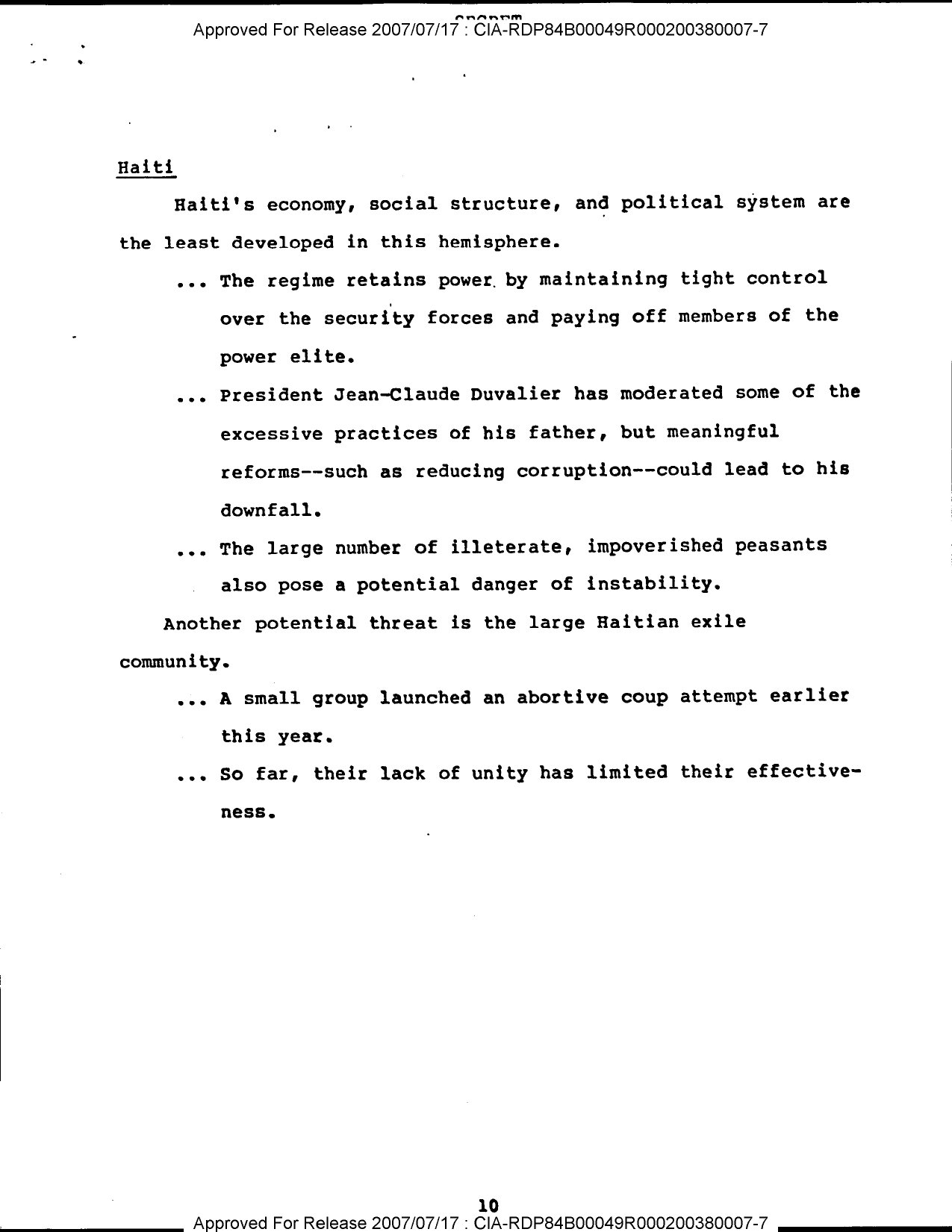
Haiti
Haiti’s economy, social structure, and political system are the least developed in this hemisphere.
- The regime retains power by maintaining tight control over the security forces and paying off members of the power elite.
- President Jean-Claude Duvalier has moderated some of the excessive practices of his father, but meaningful reforms—such as reducing corruption—could lead to his downfall.
- The large number of illiterate, impoverished peasants also pose a potential danger of instability.
- Another potential threat is the large Haitian exile community.
- A small group launched an abortive coup attempt earlier this year. So far, their lack of unity has limited their effectiveness.
Source:
Link:
Internal Link:
Date:
February 10, 1982