Cuban International Activities Inimical to US Interests 1982
CIA-RDP84B00049R001202840038-9
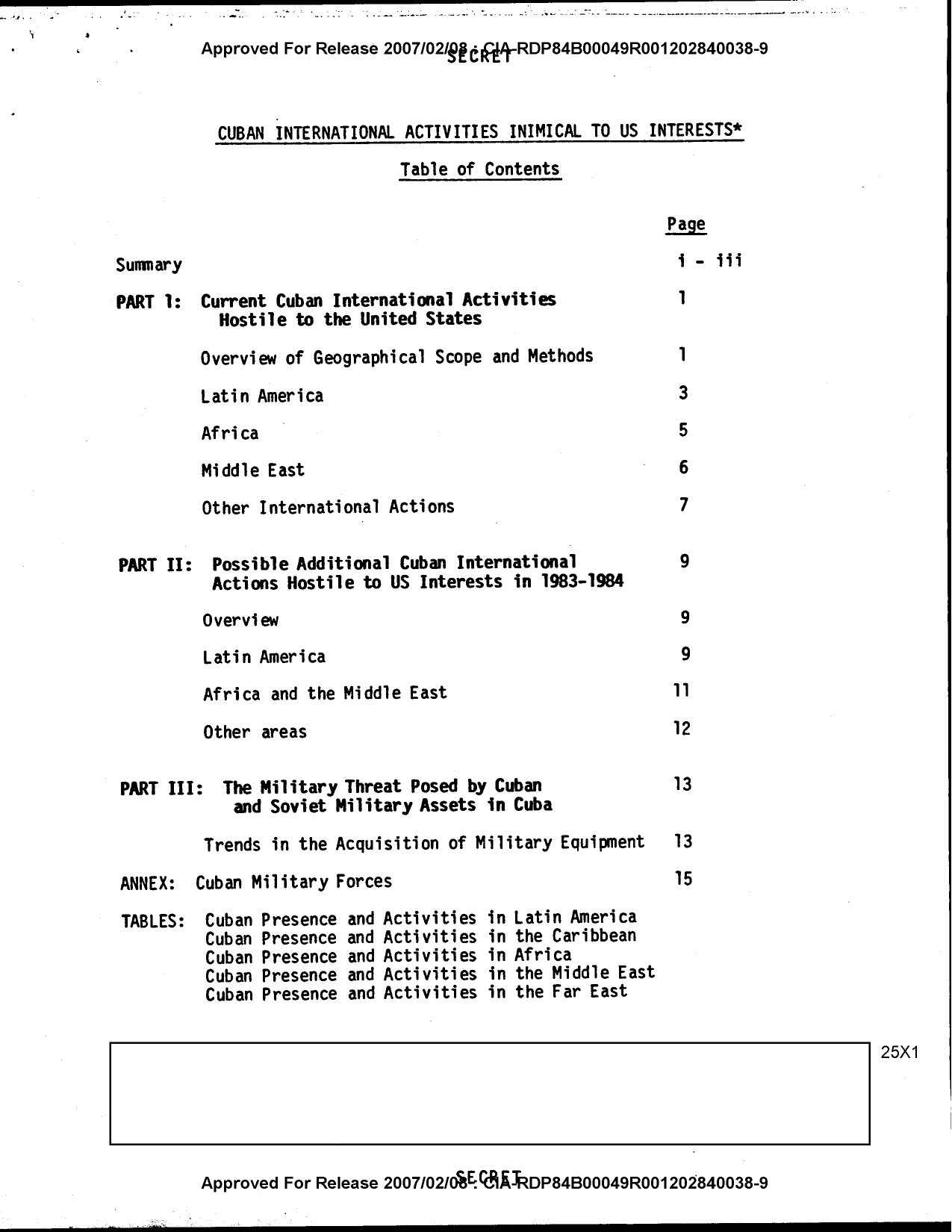
Table of Contents
PART I: Current Cuban International Activities Hostile to the United States
- Overview of Geographical Scope and Methods
- Latin America
- Africa
- Middle East
- Other International Actions
PART II: Possible Additional Cuban International Actions Hostile to US Interests in 1983-1984
| Section | Page |
|---|---|
| Overview | 9 |
| Latin America | 9 |
| Africa and the Middle East | 11 |
| Other areas | 12 |
PART III: The Military Threat Posed by Cuban and Soviet Military Assets in Cuba
- Trends in the Acquisition of Military Equipment 13
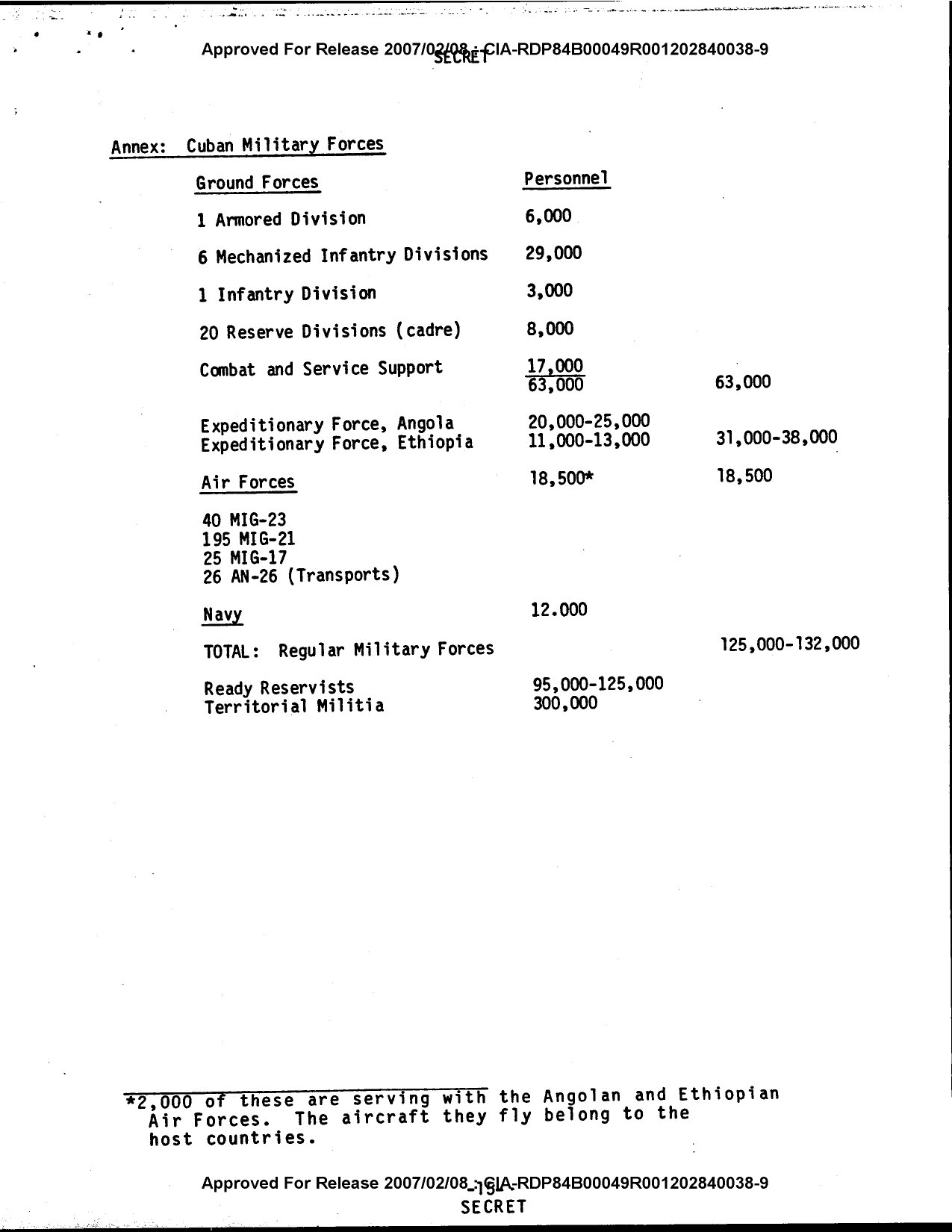
ANNEX: Cuban Military Forces 15
TABLES:
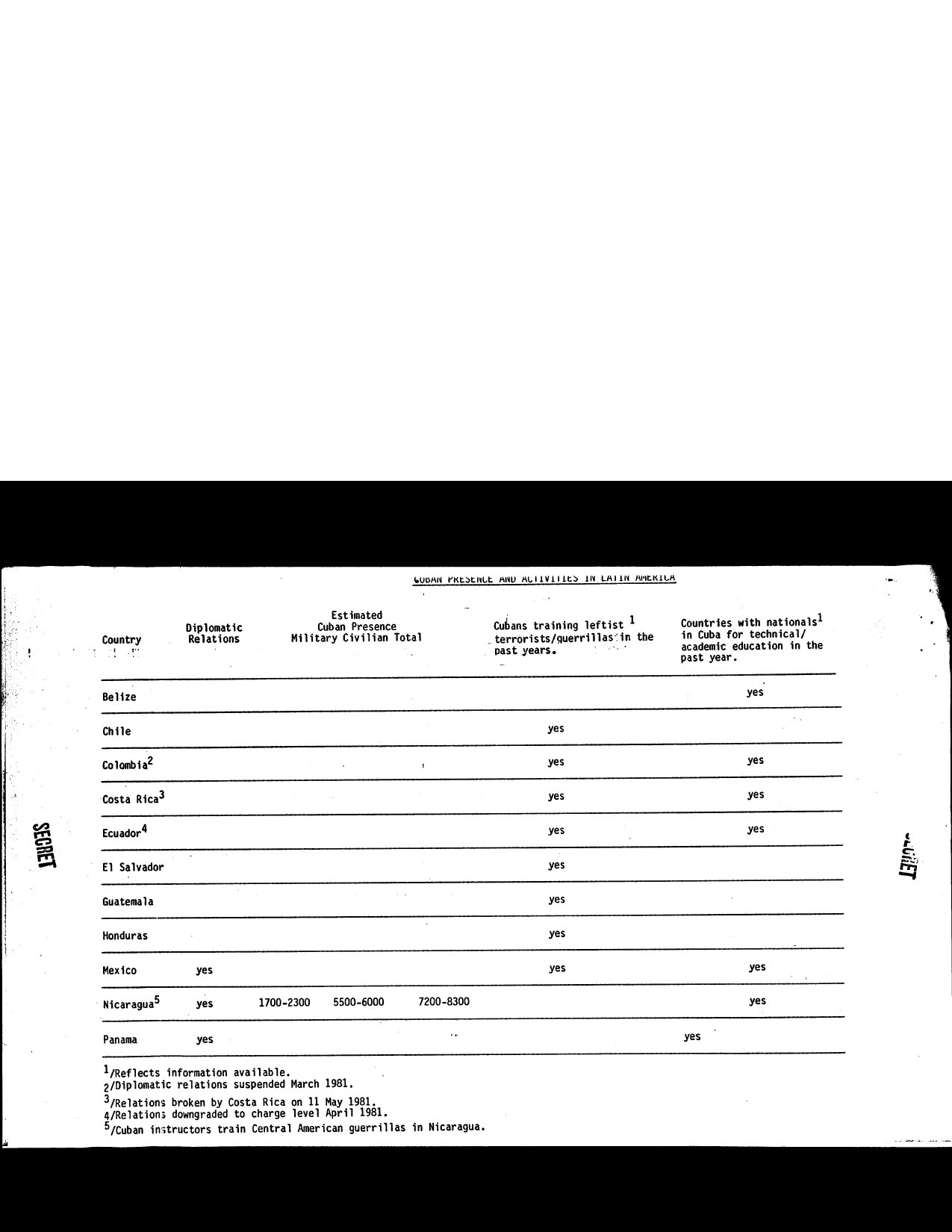
- Cuban Presence and Activities in Latin America
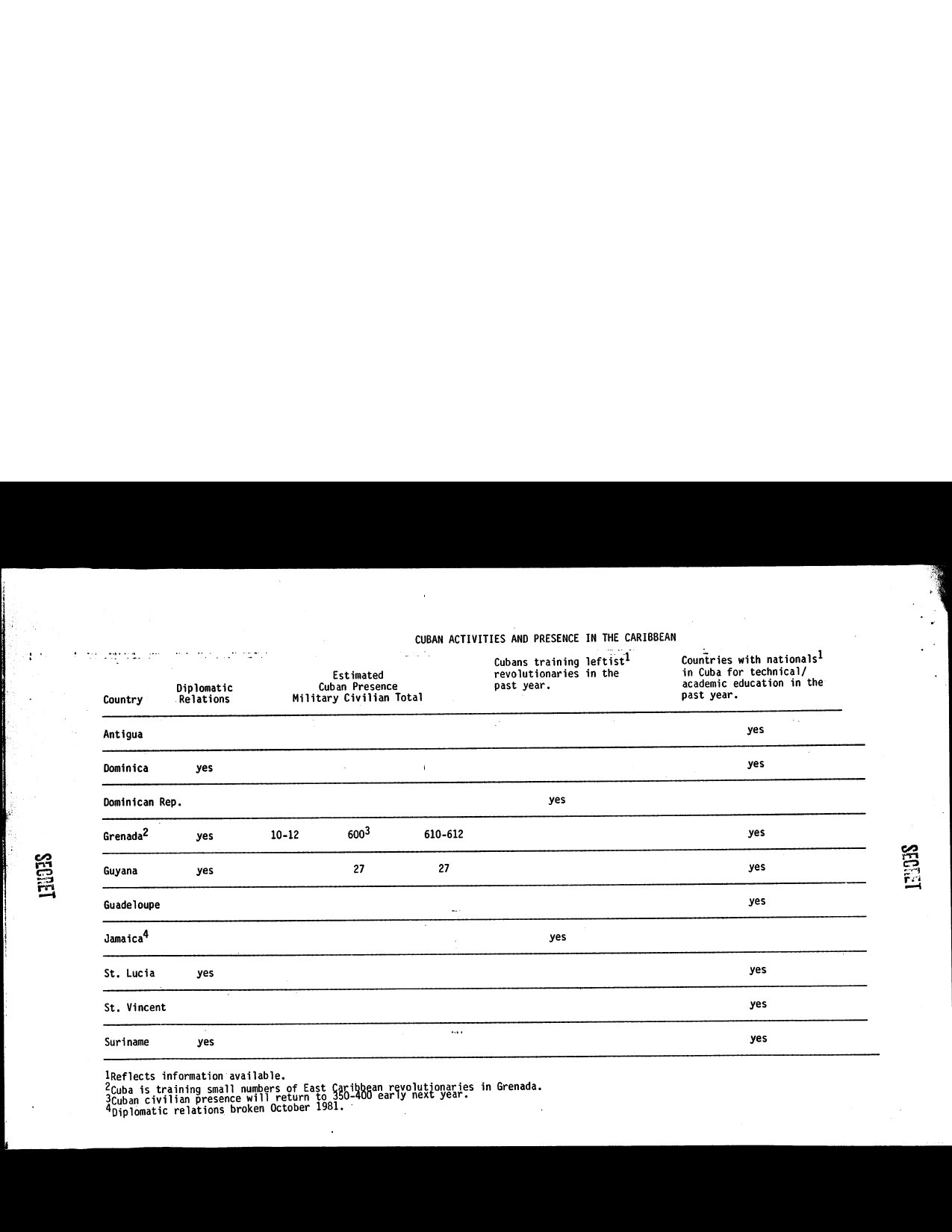
- Cuban Presence and Activities in the Caribbean
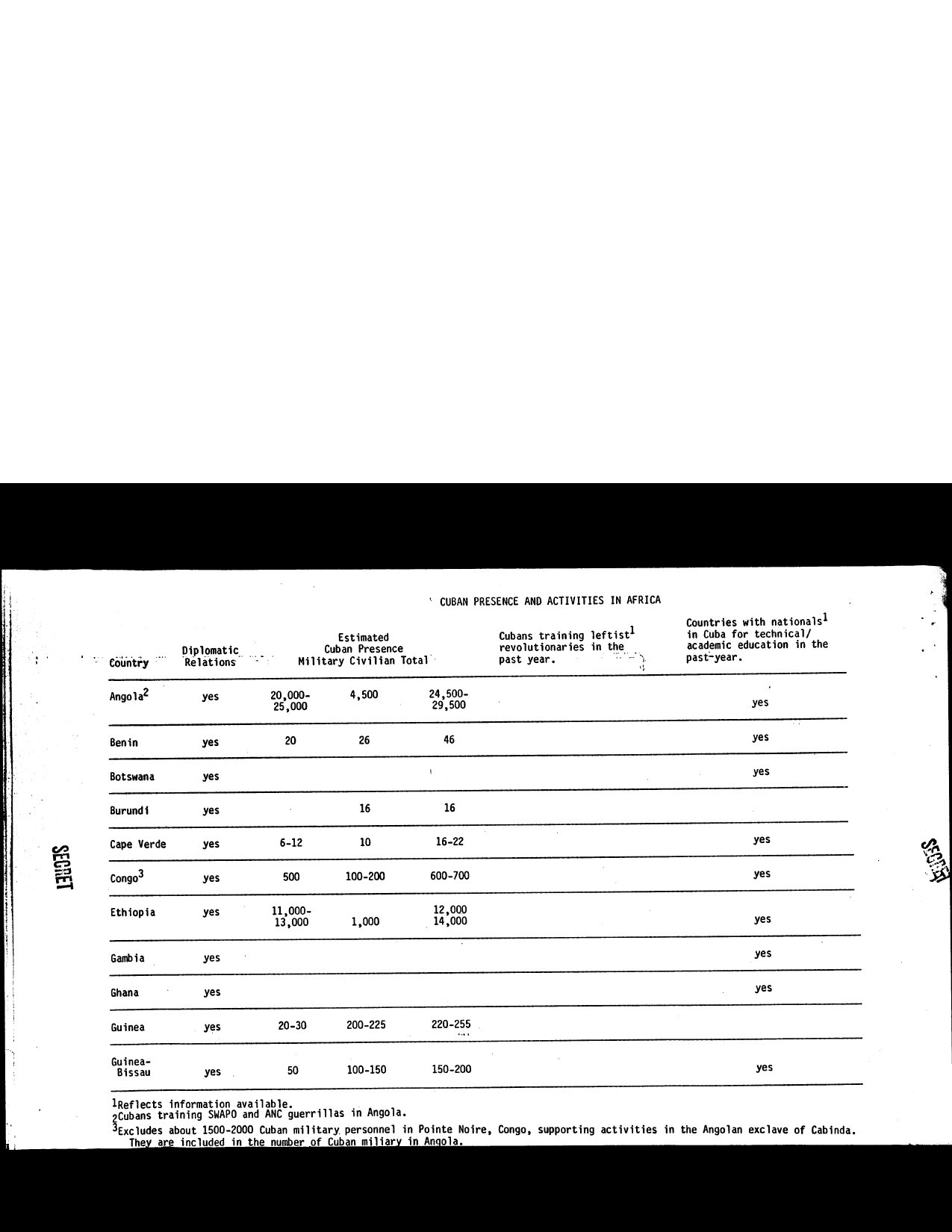
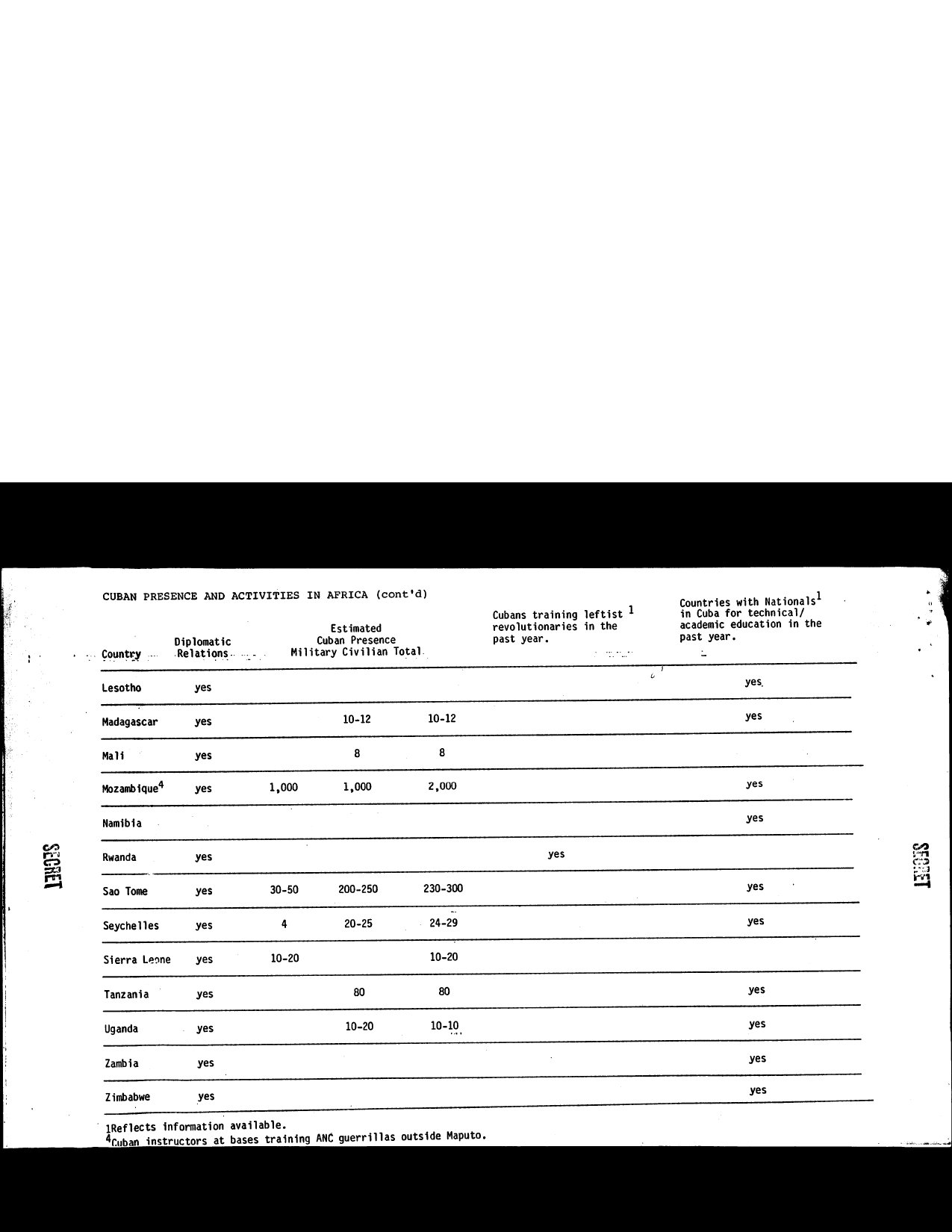
- Cuban Presence and Activities in Africa
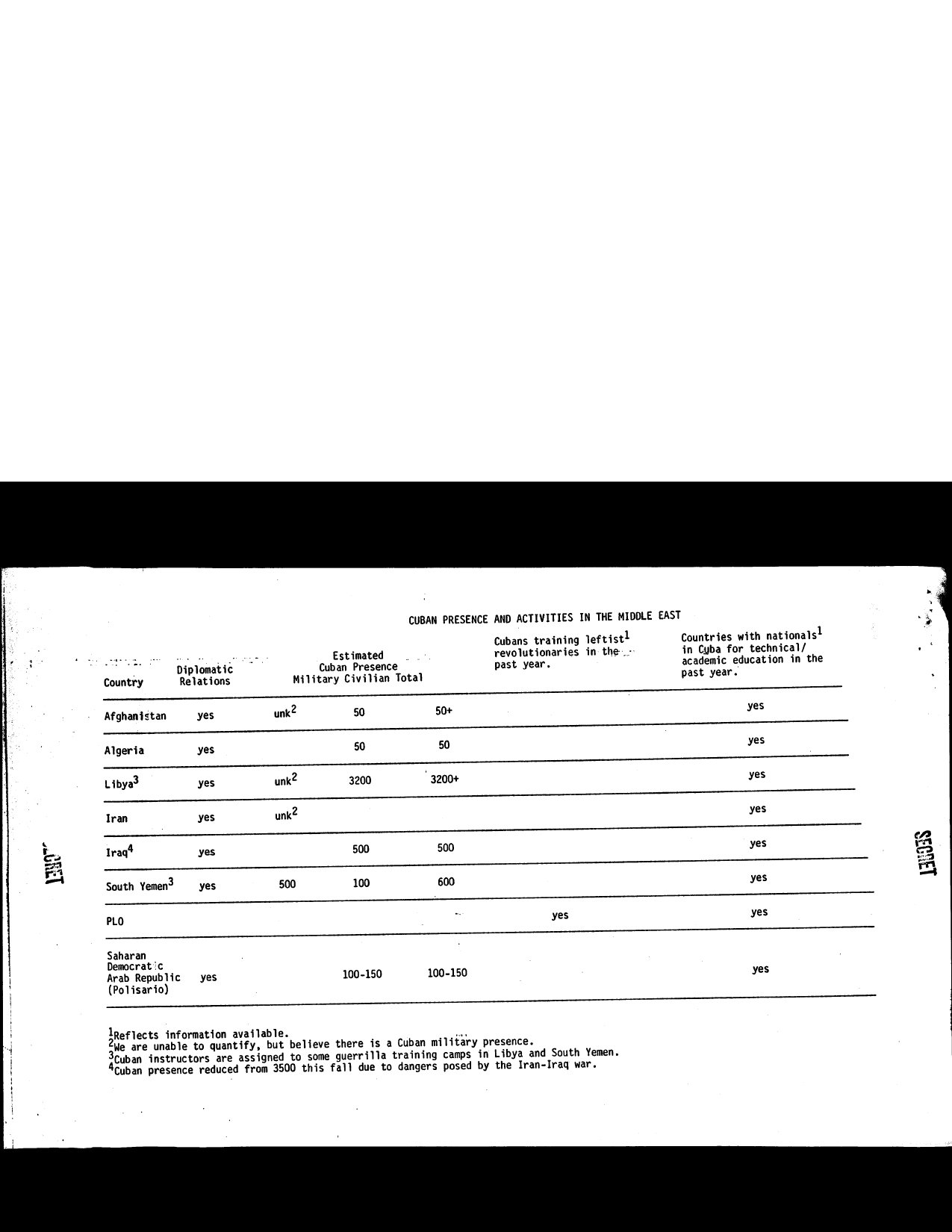
- Cuban Presence and Activities in the Middle East
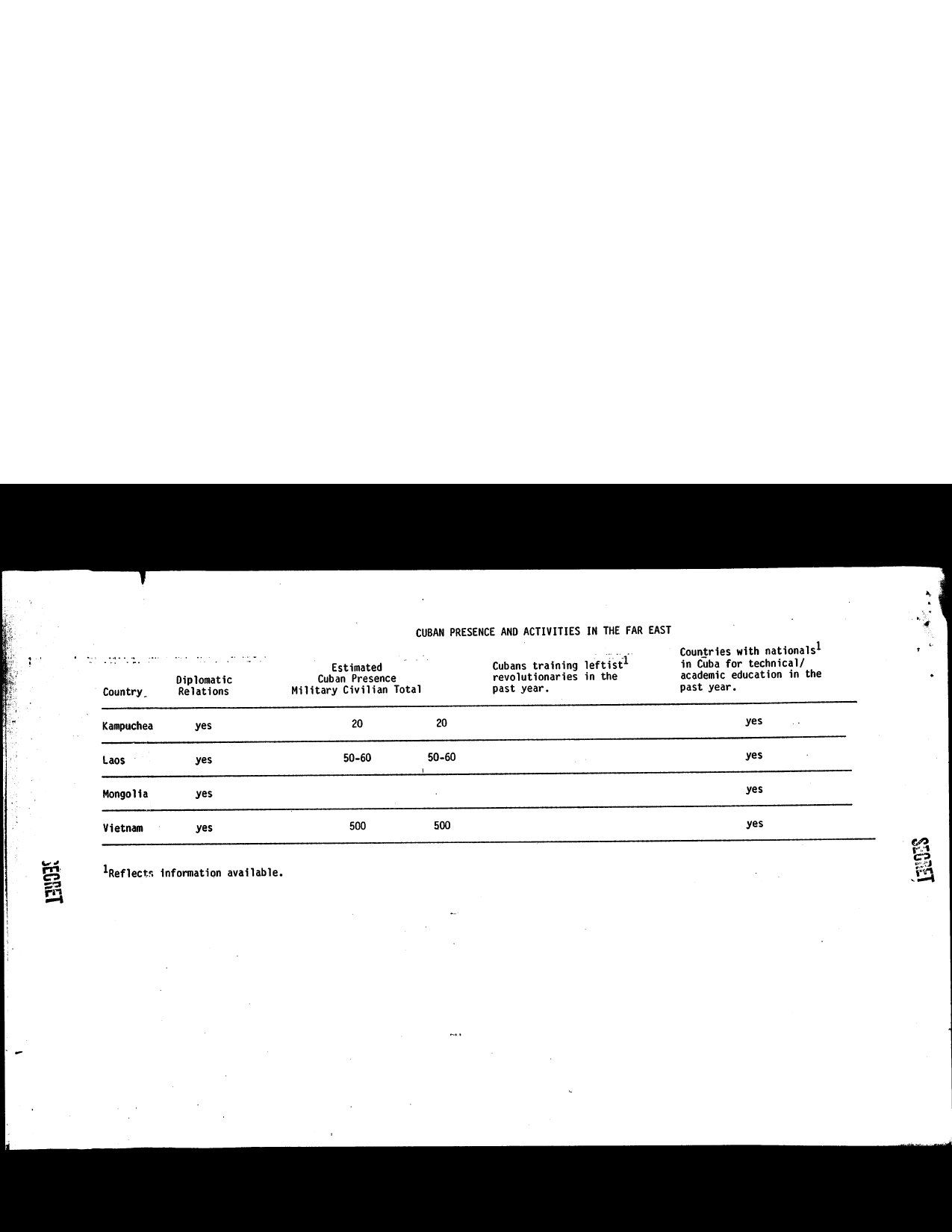
- Cuban Presence and Activities in the Far East
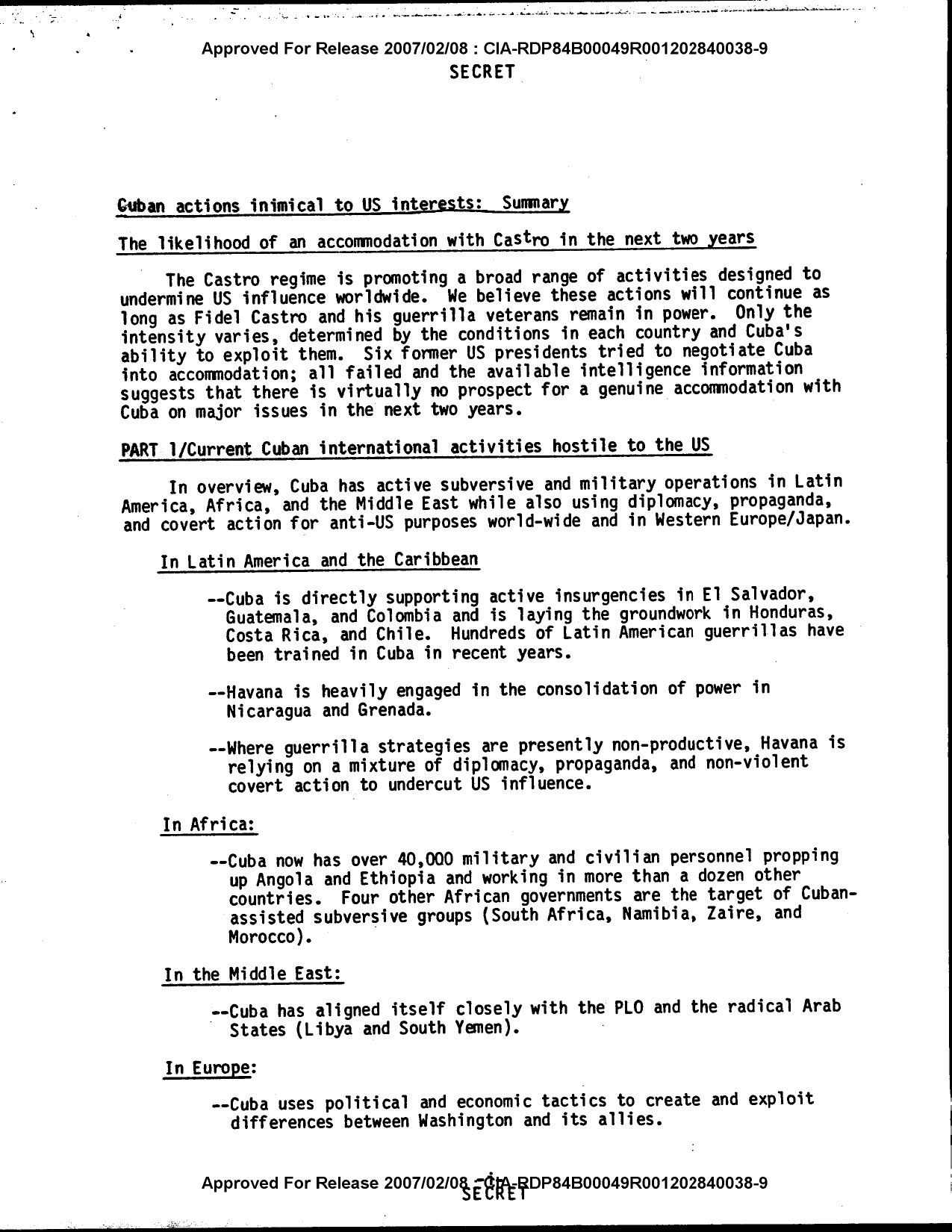
- Cuban Actions Inimical to US Interests: Summary
The likelihood of an accommodation with Castro in the next two years
The Castro regime is promoting a broad range of activities designed to undermine US influence worldwide. We believe these actions will continue as long as Fidel Castro and his guerrilla veterans remain in power. Only the intensity varies, determined by the conditions in each country and Cuba’s ability to exploit them. Six former US presidents tried to negotiate Cuba into accommodation; all failed and the available intelligence information suggests that there is virtually no prospect for a genuine accommodation with Cuba on major issues in the next two years.
PART 1: Current Cuban International Activities Hostile to the US
In overview, Cuba has active subversive and military operations in Latin America, Africa, and the Middle East while also using diplomacy, propaganda, and covert action for anti-US purposes worldwide and in Western Europe/Japan.
In Latin America and the Caribbean:
- Cuba is directly supporting active insurgencies in El Salvador, Guatemala, and Colombia and is laying the groundwork in Honduras, Costa Rica, and Chile. Hundreds of Latin American guerrillas have been trained in Cuba in recent years.
- Havana is heavily engaged in the consolidation of power in Nicaragua and Grenada.
- Where guerrilla strategies are presently non-productive, Havana is relying on a mixture of diplomacy, propaganda, and non-violent covert action to undercut US influence.
In Africa:
- Cuba now has over 40,000 military and civilian personnel propping up Angola and Ethiopia and working in more than a dozen other countries. Four other African governments are the target of Cuban-assisted subversive groups (South Africa, Namibia, Zaire, and Morocco).
In the Middle East:
- Cuba has aligned itself closely with the PLO and the radical Arab States (Libya and South Yemen).
In Europe:
- Cuba uses political and economic tactics to create and exploit differences between Washington and its allies.
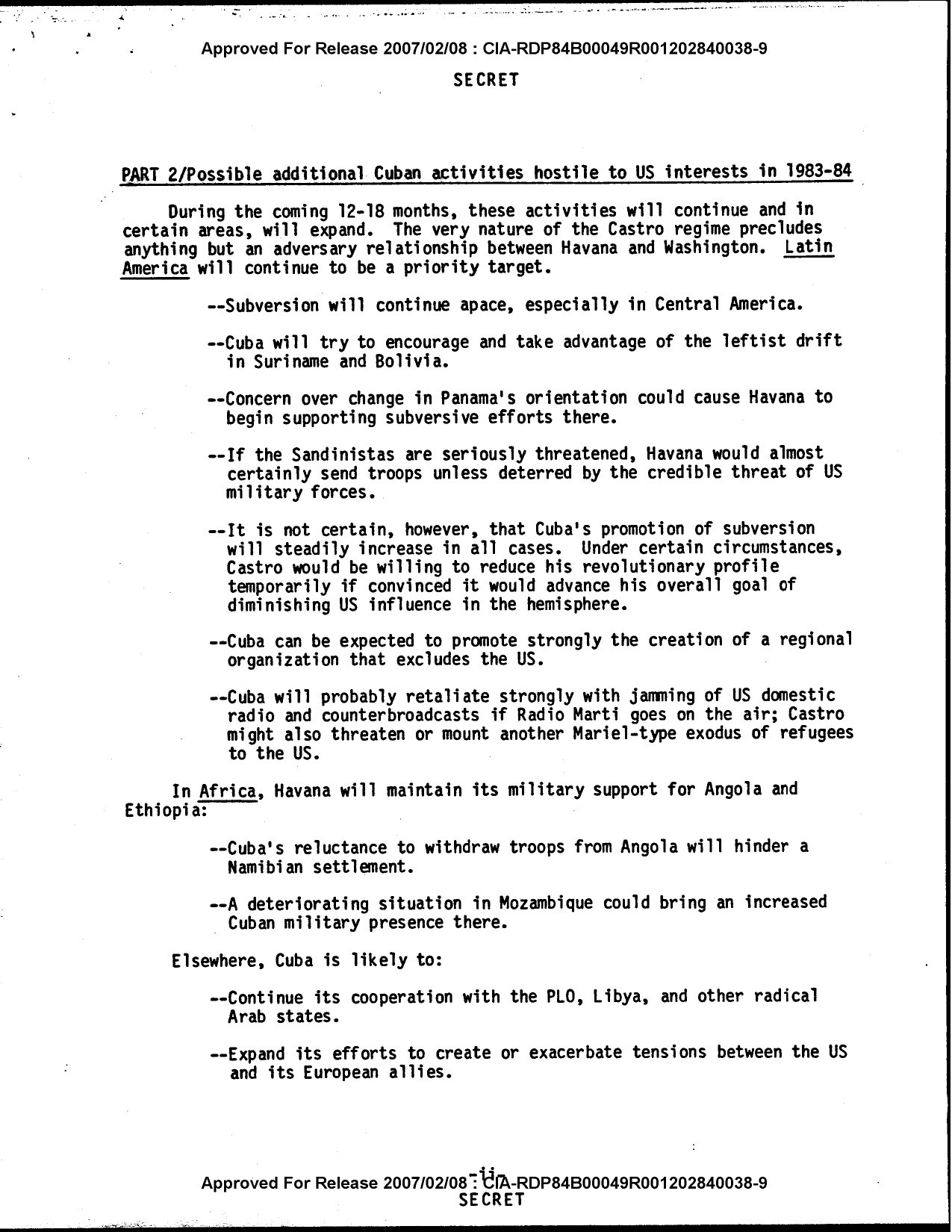
PART 2: Possible Additional Cuban Activities Hostile to US Interests in 1983-84
During the coming 12-18 months, these activities will continue and in certain areas, will expand. The very nature of the Castro regime precludes anything but an adversary relationship between Havana and Washington. Latin America will continue to be a priority target.
- Subversion will continue apace, especially in Central America.
- Cuba will try to encourage and take advantage of the leftist drift in Suriname and Bolivia.
- Concern over change in Panama’s orientation could cause Havana to begin supporting subversive efforts there.
- If the Sandinistas are seriously threatened, Havana would almost certainly send troops unless deterred by the credible threat of US military forces.
- It is not certain, however, that Cuba’s promotion of subversion will steadily increase in all cases. Under certain circumstances, Castro would be willing to reduce his revolutionary profile temporarily if convinced it would advance his overall goal of diminishing US influence in the hemisphere.
- Cuba can be expected to promote strongly the creation of a regional organization that excludes the US.
- Cuba will probably retaliate strongly with jamming of US domestic radio and counterbroadcasts if Radio Marti goes on the air; Castro might also threaten or mount another Mariel-type exodus of refugees to the US.
In Africa, Havana will maintain its military support for Angola and Ethiopia:
- Cuba’s reluctance to withdraw troops from Angola will hinder Namibian settlement.
- A deteriorating situation in Mozambique could bring an increased Cuban military presence there.
Elsewhere, Cuba is likely to:
- Continue its cooperation with the PLO, Libya, and other radical Arab states.
- Expand its efforts to create or exacerbate tensions between the US and its European allies.
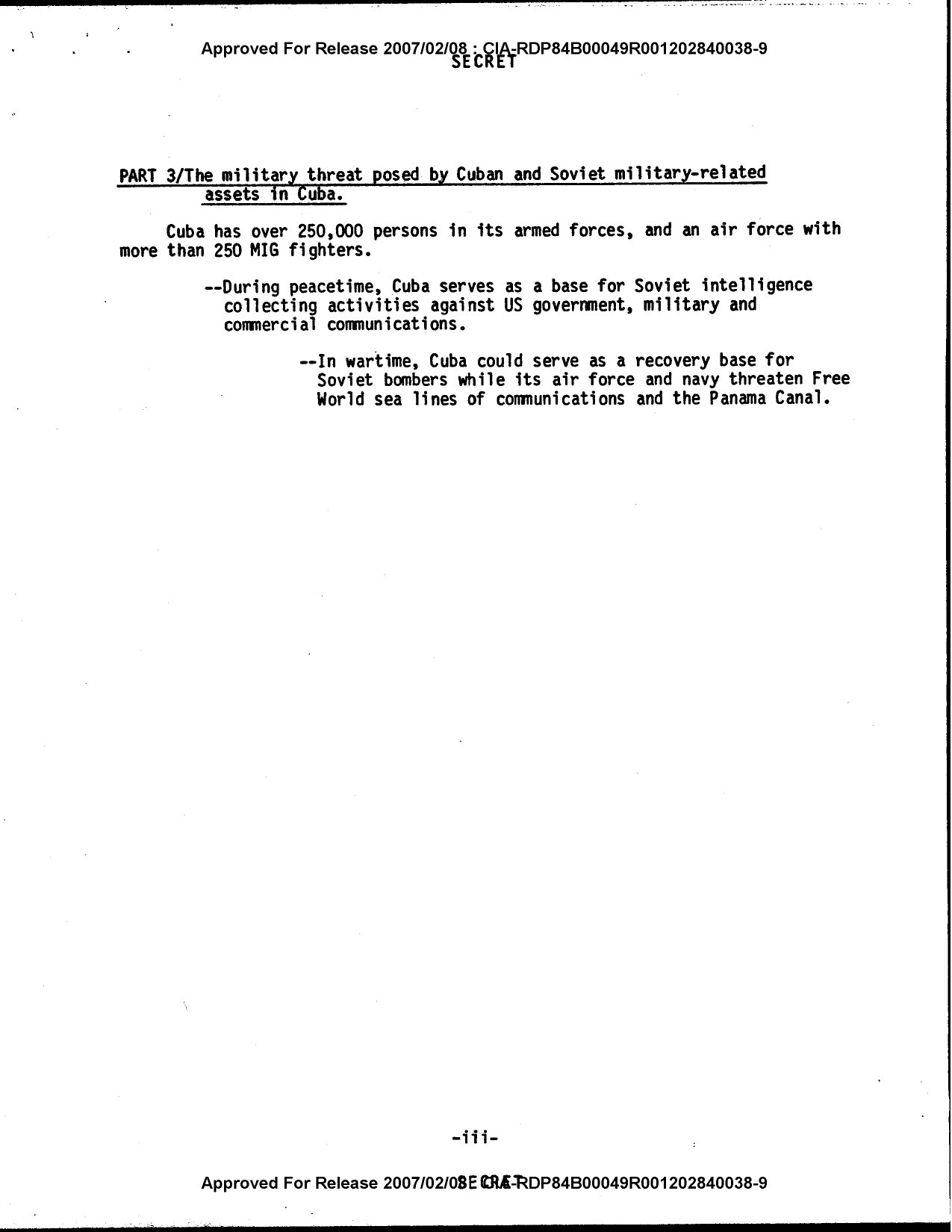
PART 3: The Military Threat Posed by Cuban and Soviet Military-Related Assets in Cuba
Cuba has over 250,000 persons in its armed forces, and an air force with more than 250 MIG fighters.
- During peacetime, Cuba serves as a base for Soviet intelligence collecting activities against US government, military, and commercial communications.
- In wartime, Cuba could serve as a recovery base for Soviet bombers while its air force and navy threaten Free World sea lines of communications and the Panama Canal.
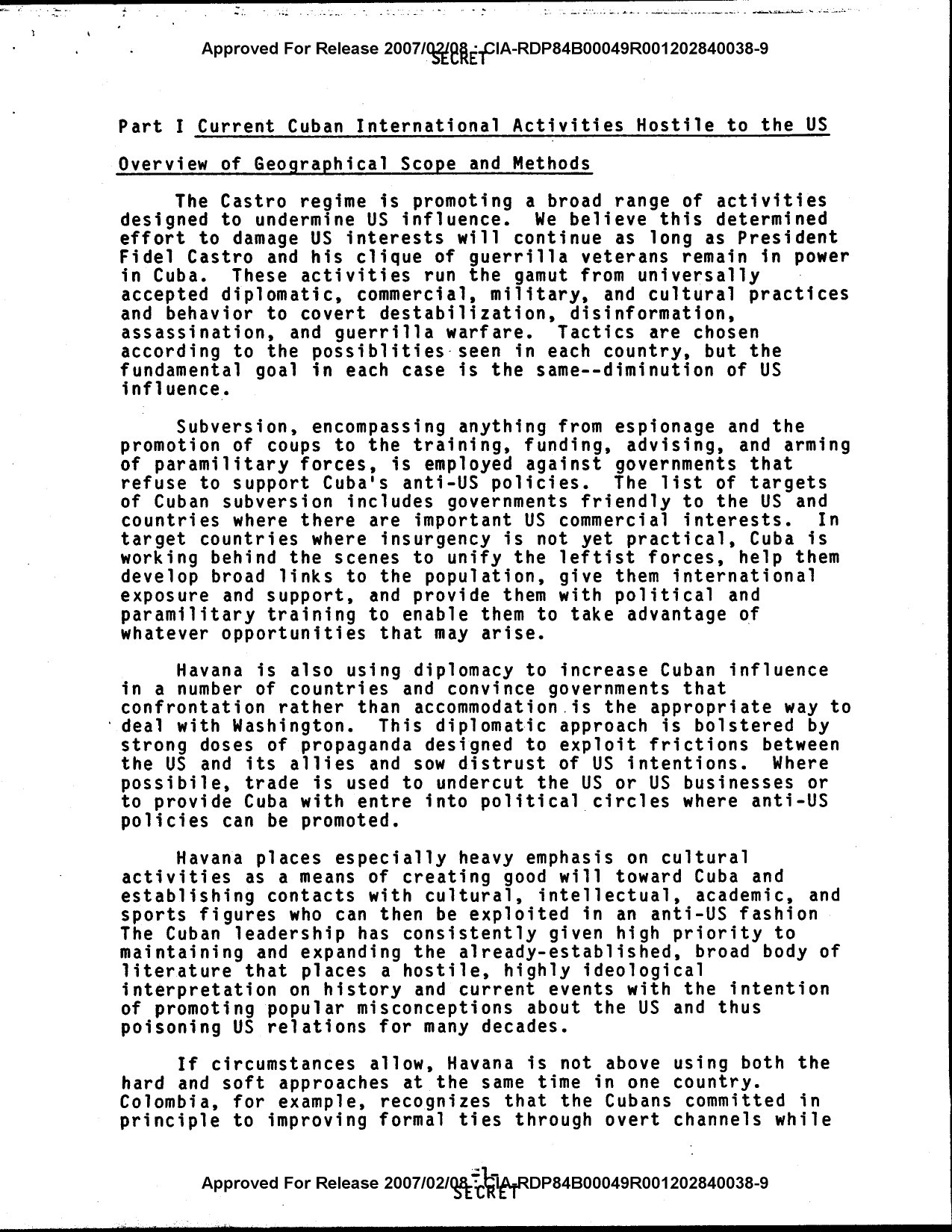
Part I: Current Cuban International Activities Hostile to the
Overview of Geographical Scope and Methods
The Castro regime is promoting a broad range of activities designed to undermine US influence. We believe this determined effort to damage US interests will continue as long as President Fidel Castro and his clique of guerrilla veterans remain in power in Cuba. These activities run the gamut from universally accepted diplomatic, commercial, military, and cultural practices and behavior to covert destabilization, disinformation, assassination, and guerrilla warfare. Tactics are chosen according to the possibilities seen in each country, but the fundamental goal in each case is the same—diminution of US influence.
Subversion, encompassing anything from espionage and the promotion of coups to the training, funding, advising, and arming of paramilitary forces, is employed against governments that refuse to support Cuba’s anti-US policies. The list of targets of Cuban subversion includes governments friendly to the US and countries where there are important US commercial interests. In target countries where insurgency is not yet practical, Cuba is working behind the scenes to unify the leftist forces, help them develop broad links to the population, give them international exposure and support, and provide them with political and paramilitary training to enable them to take advantage of whatever opportunities may arise.
Havana is also using diplomacy to increase Cuban influence in a number of countries and convince governments that confrontation rather than accommodation is the appropriate way to deal with Washington. This diplomatic approach is bolstered by strong doses of propaganda designed to exploit frictions between the US and its allies and sow distrust of US intentions. Where possible, trade is used to undercut the US or US businesses or to provide Cuba with entrée into political circles where anti-US policies can be promoted.
Havana places especially heavy emphasis on cultural activities as a means of creating goodwill toward Cuba and establishing contacts with cultural, intellectual, academic, and sports figures who can then be exploited in an anti-US fashion. The Cuban leadership has consistently given high priority to maintaining and expanding the already-established, broad body of literature that places a hostile, highly ideological interpretation on history and current events with the intention of promoting popular misconceptions about the US and thus poisoning US relations for many decades.
If circumstances allow, Havana is not above using both the hard and soft approaches at the same time in one country. Colombia, for example, recognizes that the Cubans are committed in principle to improving formal ties through overt channels while continuing covert support for Colombian insurgents. Some governments, however, have not learned that the existence of diplomatic relations with the Castro regime is no insurance against Cuban subversion.
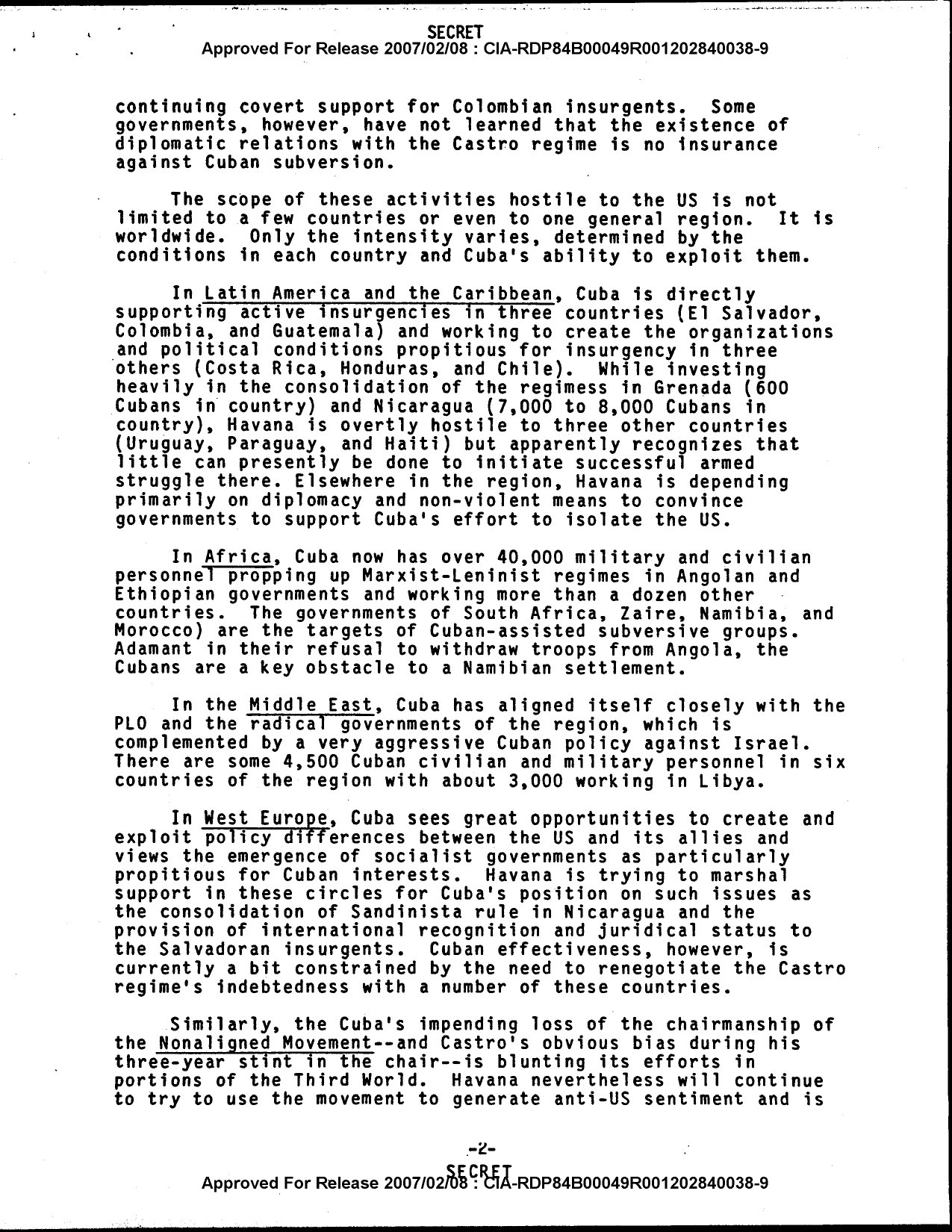
The scope of these activities hostile to the US is not limited to a few countries or even to one general region. It is worldwide. Only the intensity varies, determined by the conditions in each country and Cuba’s ability to exploit them.
In Latin America and the Caribbean
- Cuba is directly supporting active insurgencies in three countries (El Salvador, Colombia, and Guatemala) and working to create the organizations and political conditions propitious for insurgency in three others (Costa Rica, Honduras, and Chile).
- While investing heavily in the consolidation of the regimes in Grenada (600 Cubans in country) and Nicaragua (7,000 to 8,000 Cubans in country), Havana is overtly hostile to three other countries (Uruguay, Paraguay, and Haiti) but apparently recognizes that little can presently be done to initiate successful armed struggle there.
- Elsewhere in the region, Havana is depending primarily on diplomacy and non-violent means to convince governments to support Cuba’s effort to isolate the US.
In Africa
- Cuba now has over 40,000 military and civilian personnel propping up Marxist-Leninist regimes in Angola and Ethiopia and working in more than a dozen other countries.
- The governments of South Africa, Zaire, Namibia, and Morocco are the targets of Cuban-assisted subversive groups.
- Adamant in their refusal to withdraw troops from Angola, the Cubans are a key obstacle to a Namibian settlement.
In the Middle East
- Cuba has aligned itself closely with the PLO and the radical governments of the region, which is complemented by a very aggressive Cuban policy against Israel.
- There are some 4,500 Cuban civilian and military personnel in six countries of the region, with about 3,000 working in Libya.
In West Europe
- Cuba sees great opportunities to create and exploit policy differences between the US and its allies and views the emergence of socialist governments as particularly propitious for Cuban interests.
- Havana is trying to marshal support in these circles for Cuba’s position on such issues as the consolidation of Sandinista rule in Nicaragua and the provision of international recognition and juridical status to the Salvadoran insurgents.
- Cuban effectiveness, however, is currently a bit constrained by the need to renegotiate the Castro regime’s indebtedness with a number of these countries.
- Similarly, Cuba’s impending loss of the chairmanship of the Nonaligned Movement—and Castro’s obvious bias during his three-year stint in the chair—is blunting its efforts in portions of the Third World. Havana nevertheless will continue to try to use the movement to generate anti-US sentiment and is certain to take advantage of the seventh summit in India early next year as a launching platform for anti-US rhetoric.
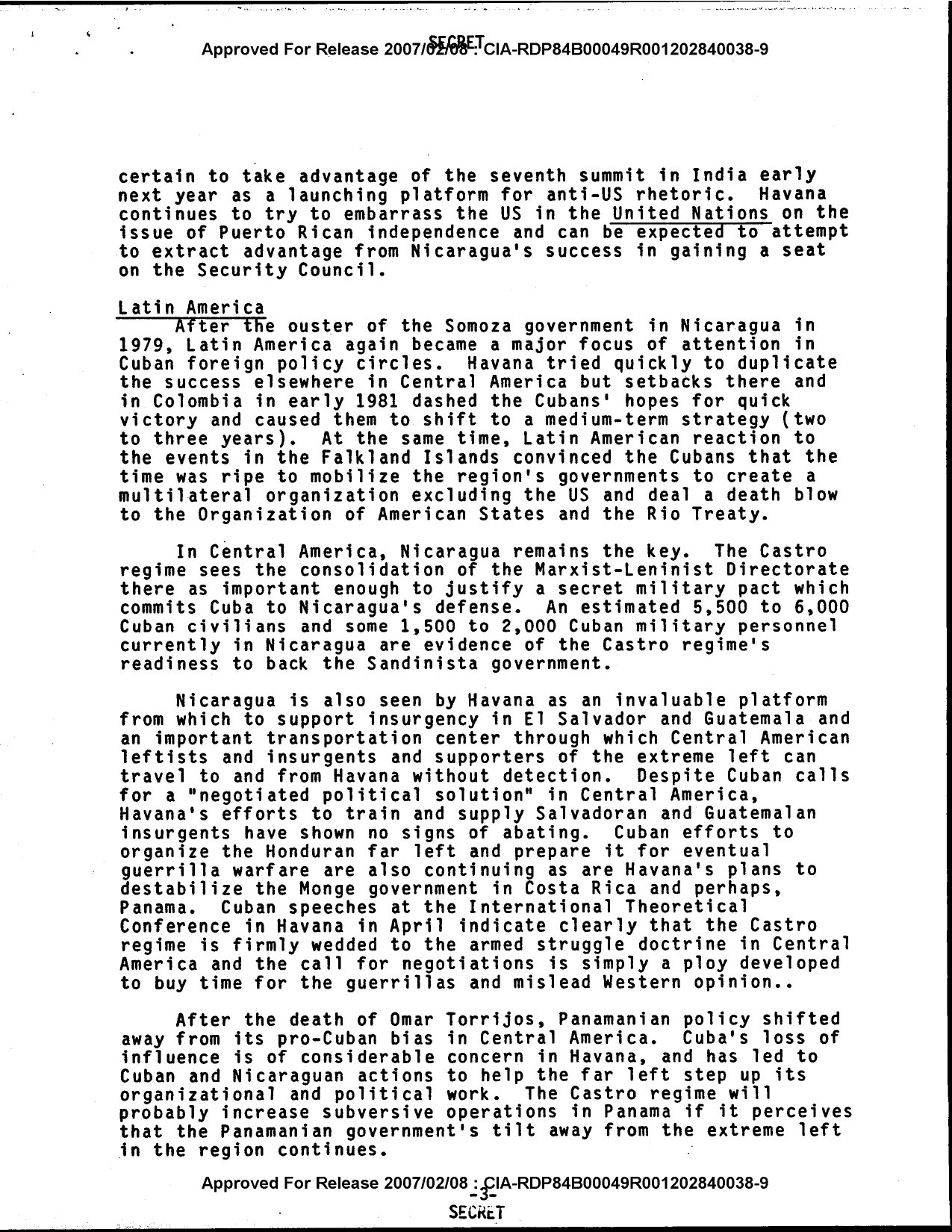
- Havana continues to try to embarrass the US in the United Nations on the issue of Puerto Rican independence and can be expected to attempt to extract advantage from Nicaragua’s success in gaining a seat on the Security Council.
Latin America Detailed Activities
- After the ouster of the Somoza government in Nicaragua in 1979, Latin America again became a major focus of attention in Cuban foreign policy circles. Havana tried quickly to duplicate the success elsewhere in Central America but setbacks there and in Colombia in early 1981 dashed the Cubans’ hopes for quick victory and caused them to shift to a medium-term strategy (two to three years).
- At the same time, Latin American reaction to the events in the Falkland Islands convinced the Cubans that the time was ripe to mobilize the region’s governments to create a multilateral organization excluding the US and deal a death blow to the Organization of American States and the Rio Treaty.
Central America
- Nicaragua remains the key. The Castro regime sees the consolidation of the Marxist-Leninist Directorate there as important enough to justify a secret military pact which commits Cuba to Nicaragua’s defense.
- An estimated 5,500 to 6,000 Cuban civilians and some 1,500 to 2,000 Cuban military personnel currently in Nicaragua are evidence of the Castro regime’s readiness to back the Sandinista government.
- Nicaragua is also seen by Havana as an invaluable platform from which to support insurgency in El Salvador and Guatemala and as an important transportation center through which Central American leftists and insurgents and supporters of the extreme left can travel to and from Havana without detection.
- Despite Cuban calls for a “negotiated political solution” in Central America, Havana’s efforts to train and supply Salvadoran and Guatemalan insurgents have shown no signs of abating.
- Cuban efforts to organize the Honduran far left and prepare it for eventual guerrilla warfare are also continuing, as are Havana’s plans to destabilize the Monge government in Costa Rica and perhaps Panama.
- Cuban speeches at the International Theoretical Conference in Havana in April indicate clearly that the Castro regime is firmly wedded to the armed struggle doctrine in Central America, and the call for negotiations is simply a ploy developed to buy time for the guerrillas and mislead Western opinion.
Panama
- After the death of Omar Torrijos, Panamanian policy shifted away from its pro-Cuban bias in Central America.
- Cuba’s loss of influence is of considerable concern in Havana and has led to Cuban and Nicaraguan actions to help the far left step up its organizational and political work.
- The Castro regime will probably increase subversive operations in Panama if it perceives that the Panamanian government’s tilt away from the extreme left in the region continues.
Mexico
- Cuba highly values its close diplomatic ties with Mexico and professes to understand that the Mexican government will not tolerate interference in internal politics.
- Nonetheless, Mexico allows extensive Cuban intelligence operations directed against the US and Cuban contacts in Mexico with representatives of revolutionary groups from Central and South America.
- Though information is sketchy, Cuba generally abides by the restriction on interference in Mexican domestic politics.
- At the same time, Cuban intelligence officers reportedly maintain a wide range of contacts with opposition extreme leftist leaders, as well as with leftists in the government and ruling party, and provide the Marxist-Leninist parties with organizational advice and presumably other forms of nonmilitary support.
- While the Cubans are still confident about their close ties to the Mexican government, they probably are wary that Mexico’s economic problems could have far-reaching political repercussions. It is reasonable to expect Havana to have contingency plans to limit damage to Cuban-Mexican relations and to exploit any opportunities to exacerbate Mexico-US frictions.
Caribbean
- Havana is quick to take advantage of opportunities as they arise but, except for Suriname, does not currently have good prospects for a dramatic expansion in Cuban influence.
- The Cuba-Grenada alliance, and the alarming Cuban-sponsored military buildup there, has raised sensitivities in the Caribbean ministates, and Havana will probably find local fears of Cuban meddling difficult to overcome.
- The Cubans continue efforts to expand contacts with leftists and intellectuals in the region and probably intend to use Radio Free Grenada to blanket the area with anti-US propaganda.
- Cuba is also working vigorously to ingratiate itself with the Bouterse government in Suriname, and the Cuban presence in Paramaribo is likely to increase.
- Guyana appears to have very low priority in Cuba’s Caribbean scheme, largely due to Forbes Burnham’s proclivity for corruption rather than ideological radicalism.
- The cooling in Cuban-Guyanese relations has made it possible for Havana to improve its image in Caracas by shifting to a more neutral position in the Guyana-Venezuela dispute over the Essequibo region.
South America
- Chile remains the target of occasional infiltrations by Cuban-trained terrorists, but Havana realizes that conditions for a successful insurgency in Chile—as in Uruguay and Paraguay—simply do not exist.
- Nevertheless, Havana is working to develop the infrastructure necessary for organized opposition once conditions improve.
- Havana is wooing Bolivia, Argentina, and Venezuela with an eye to promoting the demise of the OAS and replacing it with an all-Latin American organization through which the region, acting as a whole, can confront the US and force its demands on Washington.
- Even the new government in Bogota has demonstrated a willingness to downplay Havana’s blatant intervention with the M-19 insurgents in early 1981. The Cubans probably view Colombia in the same fashion they view Argentina, Bolivia, and Venezuela—countries where emphasis on diplomacy, at least for the moment, is more likely to produce dividends than an aggressive, subversive approach.
Africa
Cuba remains active in Africa but clearly does not view the area as having the same political potential that it had in the 1970s when Havana was involved in a major effort to expand formal ties in the Third World as a means of reducing the Castro regime’s diplomatic isolation. Bogged down in Angola, Cuba has reason to act with restraint when tempted to embark on large-scale military operations elsewhere. The remarkably successful drive during the last decade to expand Cuban influence has slowed markedly as Havana’s attention has shifted to Latin America and Cuba’s chairmanship of the Nonaligned Movement draws to an end. Nevertheless, the Castro regime’s revolutionary commitments in Africa and its need to support Soviet policy and to export labor, plus the desire not to alienate African allies, all point to Havana’s continued strong interest in the region and probably an increase in the Cuban civilian presence there.
Angola
- Havana will not risk the collapse of the hardline dominated Marxist regime by withdrawing Cuban troops.
- The Cubans have indicated clearly that they intend to keep their 20,000 to 25,000 combat troops in country as long as the Marxist-Leninist regime there is threatened by South African-backed guerrillas.
- The Cubans were reported to have modestly increased their forces in late summer with veteran reinforcements from Cuba and now seem to be taking a greater part in the actual fighting against Angolan insurgents.
- The civilian presence in Angola remains about 4,500.
- Even though Havana now has formed diplomatic ties with Zaire, Cubans in Angola presumably continue to support insurgents who hope to seize power in Zaire’s Shaba Province.
- Insurgents of the African National Congress of South Africa also reportedly receive Cuban support at their training camps in Angola.
Ethiopia
- The Cubans apparently are restricted largely to garrison duty, having been withdrawn from combat after the defeat of Somali forces in the Ogaden campaign.
- There are now an estimated 11,000 to 13,000 Cuban military personnel in Ethiopia with another 1,000 civilians aiding the Mengistu government in various capacities such as public health, construction, and education.
Mozambique
- Cuba now has an estimated 800 to 1,000 military personnel with another 1,000 civilians in political and technical advisory positions.
- The current threat to the Machel government posed by South African-backed guerrillas raises the possibility that Maputo may ask for Cuban combat troops.
- We believe Havana’s response would depend largely on Soviet wishes. The Cubans clearly have a distaste for taking casualties in combat but they would probably provide a large number of troops at Moscow’s urging and with the proviso that the Soviets assured logistical support.
Namibia
- Cuba continues to work with and support the SWAPO forces in Angola and has little stake in the success of the current negotiations.
- Cuba would undoubtedly view a SWAPO-dominated Namibia as a major success for Cuban foreign policy.
- Should SWAPO come into control in Namibia, Cuba, along with the Soviets and the East Germans, would offer to provide technical and security assistance.
- Although Namibia is not well-suited as a base for guerrilla activities against South Africa, the Cubans no doubt would support subversive activities there.
- In the meantime, however, there is little likelihood that Cuban troops will become more heavily involved in the Namibian “liberation struggle.”
Middle East
Cuban efforts to expand its influence in the Middle East enjoyed a measure of success until the war between Iran and Iraq forced the Castro regime, as chairman of the Nonaligned Movement, into the role of mediator. Relations between Havana and Baghdad soured as the Iraqis perceived a Cuban tilt toward Iran. A top Cuban emissary visited Baghdad late last month on a fence-building mission but it is unlikely that he was successful in restoring ties to their former good standing.
- Cuba has let about 500 of its civilian personnel stay in Iraq—mainly medical teams—to try to soothe Iraqi sensitivities.
- As in Africa, Cuba will continue to protect its interests in the Middle East and, to earn hard currency, will try to increase its non-diplomatic presence there, but the main focus of its attention will continue to be Latin America.
The presence of some 3,000 Cubans in Libya, mainly involved in the fields of construction and public health, suggests a warmth in bilateral ties that is deceiving. Castro’s and Qadhafi’s egos have clashed on more than one occasion and neither appears to place much trust in the other. At the same time, Cuba is anxious to develop access to Libya’s wealth and, in addition to increasing the number of Cuban workers in Libya, Castro may be willing to provide Cuban support for Libyan adventurism as a means of ingratiating himself with Qadhafi. The relationship has already paid off for Cuba in terms of Libyan financial support for Havana’s allies in Grenada and Nicaragua.
- Havana has good relations with the PLO and continues to provide training in Cuba for PLO personnel.
- The Cubans apparently were incensed at Moscow’s failure to help the PLO in the recent debacle in Lebanon, but Havana itself was in no position to provide more than propaganda support and backing in international forums. Cooperation with the PLO enhances Havana’s ability to engage in subversion worldwide and increases the likelihood that Cuba’s clandestine resources will be used to help achieve PLO goals.
- Cuba also has provided training for Polisario forces and continues to maintain a medical team of about 200 Cubans at a Polisario camp in Algeria.
- There may be a handful of Cuban military advisers there, but Algeria’s reluctance to permit Havana to increase its assistance means that Cuba’s support will be limited mainly to propaganda and backing in the UN and Nonaligned Movement. The Castro regime nevertheless is strongly committed to backing the Polisario in its war against Morocco.
- Cuba still has an estimated 650 military and civilian personnel in South Yemen providing military advice, training the militia, and ensuring the government’s leftist political orientation.
- Some Cubans have been involved in training foreign insurgents—for example, Omani guerrillas and dissidents from North Yemen—and we assume this type of activity persists.
Other International Actions
- Heartened by the emergence of various democratic socialist parties as leading forces in a number of countries of West Europe, Havana sees great opportunities to exacerbate frictions between Washington and its Western allies.
- The Castro regime, for example, would like to generate West European diplomatic pressure on Washington to cease its military support for the government in El Salvador; the Cubans are convinced that without US arms, the government would succumb to the insurgents.
- Havana would also like to see a repetition of French military sales to Nicaragua or similar actions that embarrass Washington and damage US prestige.
- The Cubans are finding, however, that their ability to exploit frictions is being hampered by Havana’s necessity of renegotiating outstanding loans with a number of creditors in Europe and Japan.
- Havana is continuing its program of long-standing influence on both public and private opinion in the US.
- A key aspect of this effort is to create opposition to continued US military assistance to the government of El Salvador.
- Toward this end, the Castro regime is promoting the concept of a negotiated political solution in Central America, knowing it has great appeal for the US media.
- It is also promoting a comparison with the US military experience in Vietnam as a means of souring US public opinion on additional military aid to the Salvadoran government.
- In the Nonaligned Movement, Cuba continues to represent Soviet interests and is working to alienate the Third World from the US.
- Cuba’s effectiveness, however, has been reduced markedly by its blatant, repeated abuse of its role as chairman over the past three years.
- Cuba has a vast, well-organized infrastructure for expanding its influence abroad in a variety of ways, legal and illegal.
- The Cuban Communist Party Central Committee’s America Department determines what approach is to be used in a particular country.
- At times, Havana utilizes both the diplomatic approach and subversion coincidentally, and then becomes directly involved in policy execution.
- If a decision is made to follow the armed struggle route in a particular country, the Central Committee’s Department of Special Operations provides logistical support, ensuring that the appropriate facilities of the Cuban armed forces and security services are prepared for any task, from training foreign recruits to shipping munitions secretly.
- The party, in coordination with Moscow, periodically holds International Theoretical Conferences to establish the ideological lines it expects revolutionary groups to follow.
- The Cuban Interior Ministry uses its elite Special Troops to train foreign recruits in any skills needed for clandestine or insurgent activity:
- Frogman training
- Paratroop training
- Guerrilla tactics
- Hand-to-hand combat
- Weapons familiarization
- Communications
- Use of demolition charges
- Cuba also has an outstanding propaganda apparatus:
- Radio Havana, Prensa Latina, newspapers, magazines, covert publications and radios
- Journalists’ organizations
- A stable of foreign writers and intellectuals
- Used to shape public opinion worldwide, give international exposure and prestige to insurgent groups, and undercut US credibility
- The Interior Ministry also has an efficient intelligence collection apparatus, the DGI, and an internal security force, the DSE, which penetrates exile communities abroad to promote friction and discredit refugees.
- Any Cuban ministry or governmental entity can be, and has been, used to support insurgent operations when necessary:
- The Communications Ministry provides communications links for agents abroad, Cuban missions, and Cuban embassies.
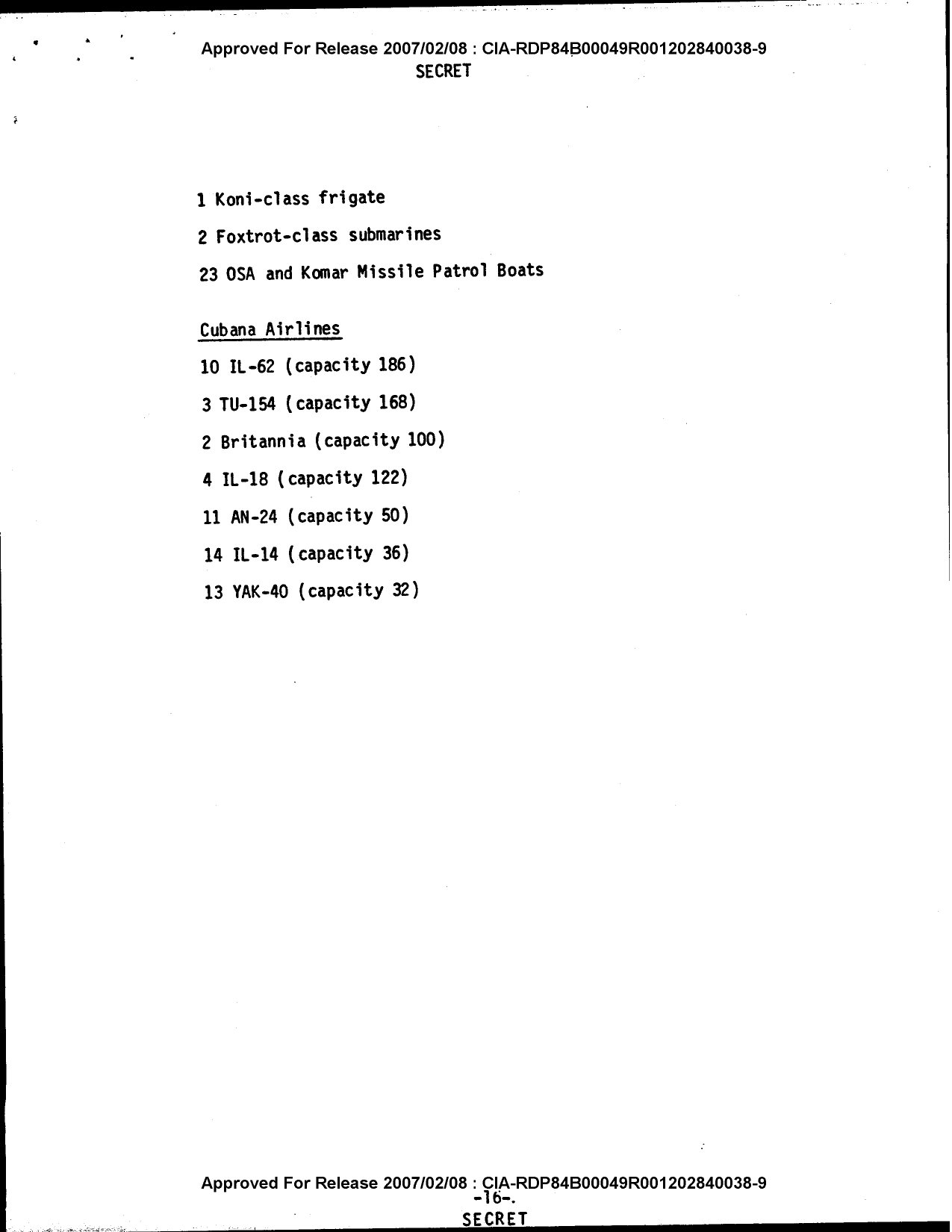
- The Ministry of the Fishing Industry and Ministry of Merchant Marine and Ports provide facilities for shipping arms clandestinely, as does Cubana Airlines, a branch of the Transportation Ministry.
- Even Cuba’s mass organizations—for women, students, peasants, union members, and the general population—operate schools where foreigners are trained in ideology and techniques for organizing and promoting mass organizations in their own countries.
- The Cuban experience in subversive operations dates from the time the current leadership was carrying out the Cuban revolution in the 1950s.
- The Castro regime therefore has a large number of experienced cadres ready to train foreign insurgents in the skills of the trade or take the field with them to carry out the revolution.
Part II: Possible Additional Cuban International Actions Hostile to US Interests in 1983-8
Overview
- The very nature of the Castro regime precludes anything but an adversary relationship between Havana and Washington. Castro needs this adversary relationship:
- To guarantee Soviet aid indispensable to his survival (he would hardly expect the Soviets to take kindly to rapprochement with Washington that threatened Soviet interests in Cuba).
- To justify and excuse continued austerity at home (he uses the US as the standard whipping boy whenever in need of a scapegoat).
- To allow him to assume a major role on the world stage (the hostile US permits him to assume the hero’s role in a David vs. Goliath drama).
- This adversary relationship will not change as long as Castro is in power.
- The guerrilla elite that dominates the current leadership developed its political beliefs during the guerrilla struggle against former dictator Batista.
- The experiences of that campaign and the initial years of power consolidation created an unswerving commitment to the philosophy of armed struggle and a visceral distrust of US intentions.
- From their perspective, the US is, and always will be, the principal threat. Promoting revolution is seen as a means of defending Cuba from the US threat (i.e., the US has limited resources and cannot make war on Cuba if it is busy fighting a number of small wars elsewhere).
- The future holds no change in the Castro regime’s anti-US orientation. Strategy and tactics may change to suit the opportunity, but the general policy goal—to reduce US influence—will remain the same. Havana’s efforts are likely to be directed in several different areas.
LATIN AMERICA
- Latin America will be the priority target probably for the remainder of the decade. Subversion will continue apace, especially in Central America, and Cuban support for Nicaragua will remain a very high priority.
- In the event of a war between Nicaragua and Honduras, or a serious threat to Sandinista control posed by armed exile groups, Cuba would probably lend direct military support to Nicaragua.
- The Cuban Air Force and Cubana Airlines have the capability to fly several thousand combat troops with their personal weapons into the Managua area within about two weeks.
- Control of the airfields in Nicaragua is critical to the performance of this operation. Cuban Air Force fighters could fly directly to the Managua area and operate from there if fuel and ordnance are prepositioned. Inserting MIG fighters directly from Cuba would be a very difficult and risky operation, however, unless the runway at Puerto Cabezas on the Atlantic coast is lengthened to provide a refueling stop.
- Cuba has the ability to airlift up to a battalion of ground troops or paratroopers to several smaller airfields in Nicaragua, and could even air drop them if necessary. Cuba lacks the capability to airlift bulk cargo, however, and would have to send any tanks, artillery, helicopters, and large radars by ship. Most heavy equipment would have to transit the Panama Canal because Nicaragua’s Atlantic coast ports lack the facilities to unload them.
- Cuban merchant vessels provide a modest sealift capability, but only a few small draft vessels can use the Atlantic coast ports. The Soviets have recently delivered one amphibious landing ship to Cuba—a second is en route—but their capacity is small.
- Panama is obviously becoming a serious concern in Havana, and an effort is likely to be made to convince the Panamanian left that resorting to armed struggle will eventually be necessary to achieve true independence.
- Cuba will urge the left to send recruits to Cuba for training as a contingency, should the Castro regime’s efforts to improve relations with the Panamanian government fail and the Cuban presence in Panama be threatened.
- Havana will watch events in Mexico carefully to guard its interests there and take advantage of any opportunity to sabotage US-Mexican relations.
- Cuba will try to expand its influence in Suriname and will devote considerable effort to consolidating the revolution in Grenada.
- It is reasonable to expect Havana to use Grenada as a base from which to propagandize the eastern Caribbean and to conduct liaison with leftists in that area.
- Cuba’s greatest potential for military intervention in the eastern Caribbean will be realized when the new airfield in Grenada is completed next year.
- Although it is not scheduled to open until 1984, it could be ready for military operations before then once the runway is complete and fuel storage is provided.
- Grenada could then serve as a staging base for Cuban ground and air operations in support of its friends in the area. Grenada, Suriname, and possibly Guyana would find this potential for swift military support comforting, while others like Venezuela and Trinidad and Tobago might find it intimidating.
- The airfield will also give Cuba a convenient stopover for troops en route to Africa.
- Havana is certain to expand its efforts to destroy or at least weaken the OAS and, through wooing new governments in a number of Latin American countries, to create a new regional organization that excludes Washington.
- This is a major preoccupation of the Castro regime, and it may be willing to reduce its subversive profile in certain countries if convinced such temporary retrenchment would contribute significantly toward that end.
AFRICA AND THE MIDDLE EAST
- Africa will remain a second priority after Latin America.
- The Cuban presence in Angola, military and civilian, will continue at high levels because Havana fears the collapse of the Marxist regime if the Cubans leave.
- Although the Cubans are reluctant to become more deeply involved in combat in Angola or elsewhere in Africa—such as Mozambique—Havana will do so if necessary to remain in Moscow’s good graces. Cuba is simply too dependent on Soviet economic assistance to say no without a major justification.
- As for a Namibian settlement, Havana will work to scuttle it if Moscow so desires. Without such pressure, however, Havana would probably want to avoid the onus of such meddling so long as settlement meant nothing more than a token withdrawal of Cuban troops.
- On the other hand, if a total Cuban troop withdrawal is a condition of a settlement, Havana and Luanda would not comply, no matter what the outcome for SWAPO. In any event, Cuban support in Angola for SWAPO and the African National Congress will continue.
- The Cuban combat forces in Angola and Ethiopia are primarily dedicated to defending Marxist regimes in those two countries from their foreign and domestic enemies.
- Providing additional military advisors and instructors to these or other African regimes is well within Cuba’s current capabilities. Providing combat troops to Mozambique or any other nation would be much more difficult unless the troops could be taken from those already in Africa.
- Calling up additional reservists for internationalist combat duty would raise the domestic costs to the Castro regime and would require another large airlift and sealift operation. Considerable Soviet assistance to airlift heavy equipment and to provide logistical support would also be necessary.
- The Middle East will also remain an area of secondary importance behind Latin America.
- Havana will try to increase the number of civilian workers it now has in some of the Arab countries and thus acquire hard currency.
- Cuban construction workers will go to Algeria to satisfy construction contracts in much the same manner as Cubans are now working in Libya.
- Cuba may become more closely linked to radical Middle East groups, supporting their efforts in Latin America and profiting from their contacts and facilities in other parts of the world.
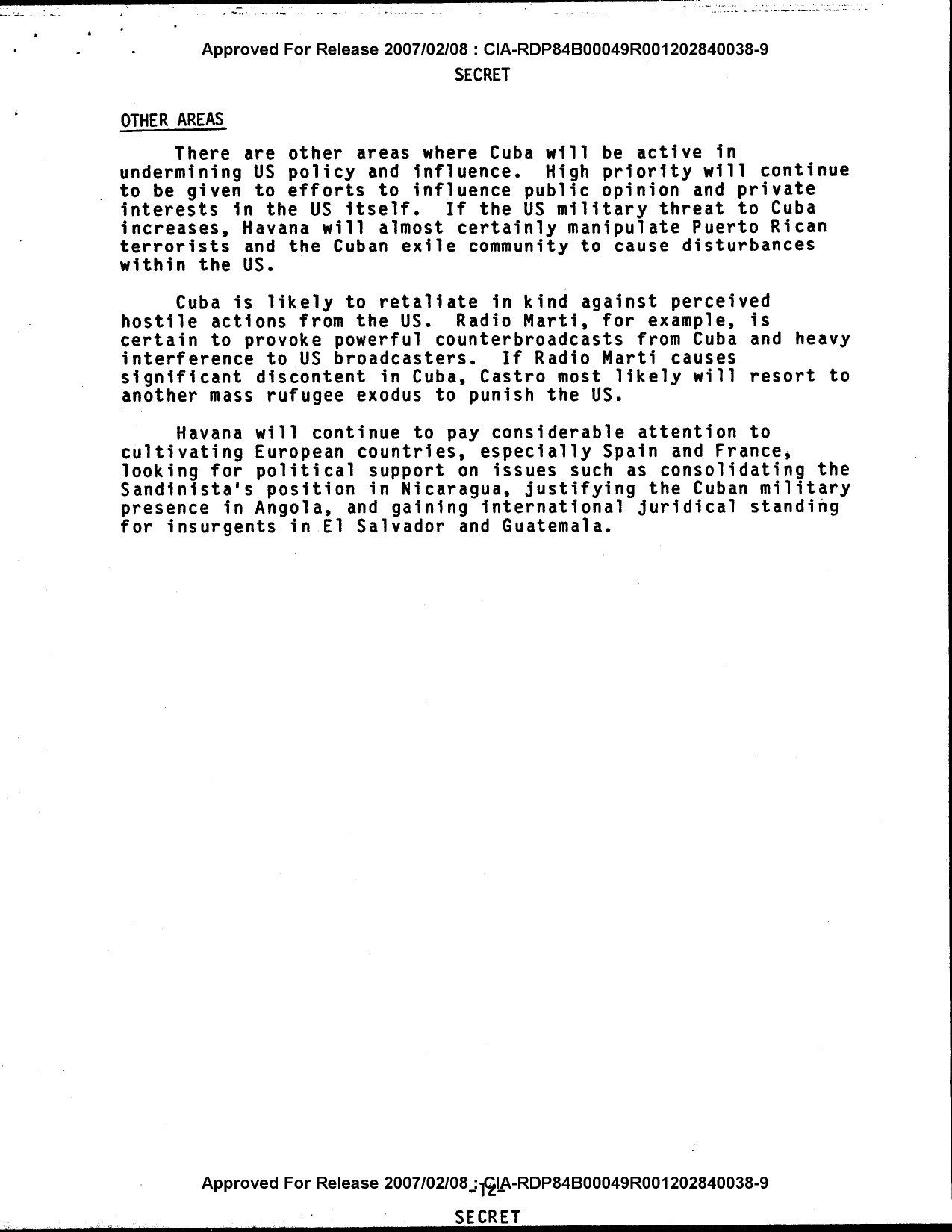
OTHER AREAS
- There are other areas where Cuba will be active in undermining US policy and influence. High priority will continue to be given to efforts to influence public opinion and private interests in the US itself.
- If the US military threat to Cuba increases, Havana will almost certainly manipulate Puerto Rican terrorists and the Cuban exile community to cause disturbances within the US.
- Cuba is likely to retaliate in kind against perceived hostile actions from the US.
- Radio Marti, for example, is certain to provoke powerful counterbroadcasts from Cuba and heavy interference to US broadcasters.
- If Radio Marti causes significant discontent in Cuba, Castro most likely will resort to another mass refugee exodus to punish the US.
- Havana will continue to pay considerable attention to cultivating European countries, especially Spain and France, looking for political support on issues such as:
- consolidating the Sandinistas’ position in Nicaragua,
- justifying the Cuban military presence in Angola, and
- gaining international juridical standing for insurgents in El Salvador and Guatemala.
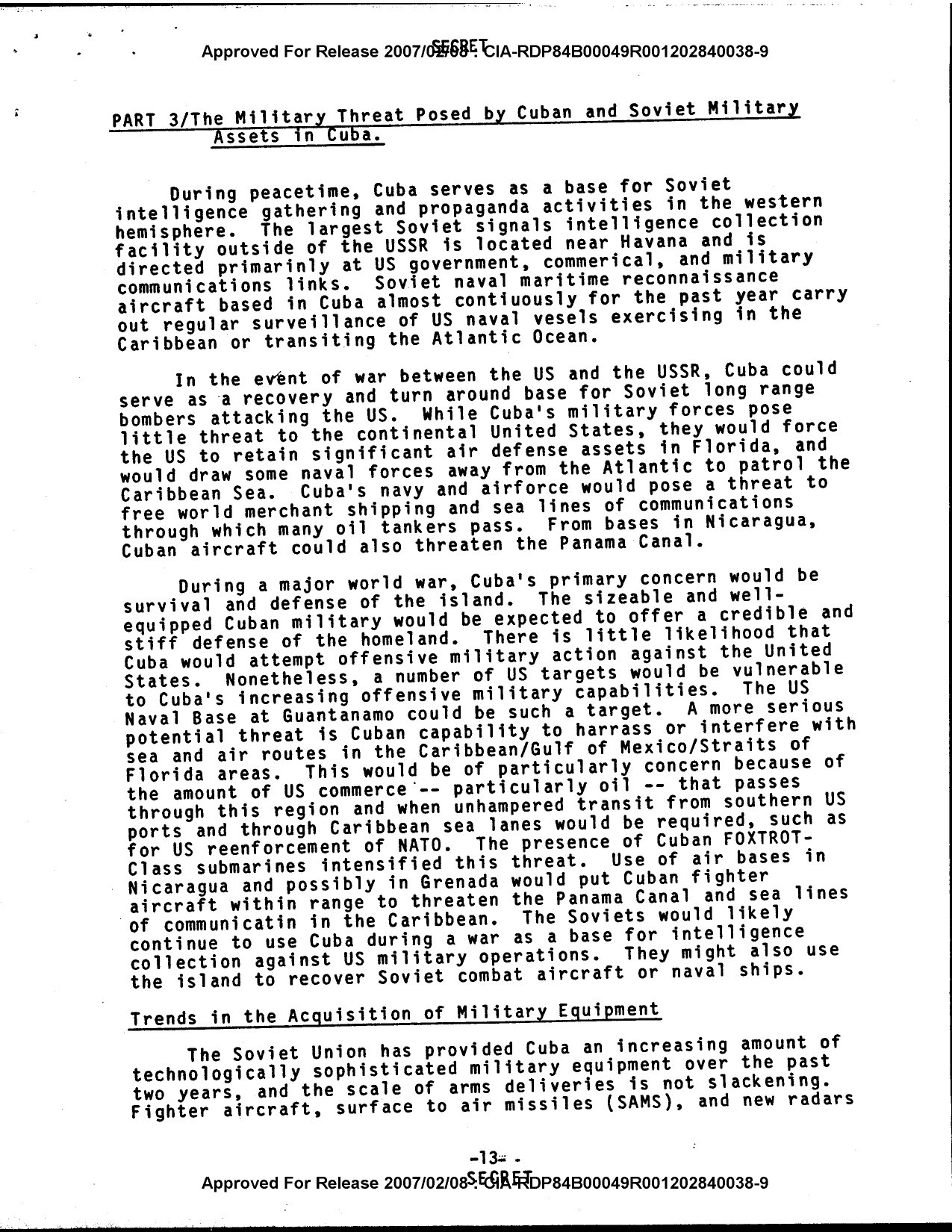
PART 3 / The Military Threat Posed by Cuban and Soviet Military Assets in Cuba
- During peacetime, Cuba serves as a base for Soviet intelligence gathering and propaganda activities in the western hemisphere.
- The largest Soviet signals intelligence collection facility outside of the USSR is located near Havana and is directed primarily at US government, commercial, and military communications links.
- Soviet naval maritime reconnaissance aircraft based in Cuba almost continuously for the past year carry out regular surveillance of US naval vessels exercising in the Caribbean or transiting the Atlantic Ocean.
- In the event of war between the US and the USSR, Cuba could serve as a recovery and turnaround base for Soviet long-range bombers attacking the US.
- While Cuba’s military forces pose little threat to the continental United States, they would force the US to retain significant air defense assets in Florida and would draw some naval forces away from the Atlantic to patrol the Caribbean Sea.
- Cuba’s navy and air force would pose a threat to free world merchant shipping and sea lines of communications through which many oil tankers pass.
- From bases in Nicaragua, Cuban aircraft could also threaten the Panama Canal.
- During a major world war, Cuba’s primary concern would be survival and defense of the island.
- The sizeable and well-equipped Cuban military would be expected to offer a credible and stiff defense of the homeland.
- There is little likelihood that Cuba would attempt offensive military action against the United States.
- Nonetheless, a number of US targets would be vulnerable to Cuba’s increasing offensive military capabilities.
- The US Naval Base at Guantanamo could be such a target.
- A more serious potential threat is Cuban capability to harass or interfere with sea and air routes in the Caribbean/Gulf of Mexico/Straits of Florida areas. This is of particular concern because of the amount of US commerce—particularly oil—that passes through this region and when unhampered transit from southern US ports and through Caribbean sea lanes would be required, such as for US reinforcement of NATO.
- The presence of Cuban FOXTROT-class submarines intensified this threat.
- Use of air bases in Nicaragua and possibly in Grenada would put Cuban fighter aircraft within range to threaten the Panama Canal and sea lines of communication in the Caribbean.
- The Soviets would likely continue to use Cuba during a war as a base for intelligence collection against US military operations. They might also use Soviet combat aircraft or naval ships on the island to recover.
Trends in the Acquisition of Military Equipment
- The Soviet Union has provided Cuba an increasing amount of technologically sophisticated military equipment over the past two years, and the scale of arms deliveries is not slackening.
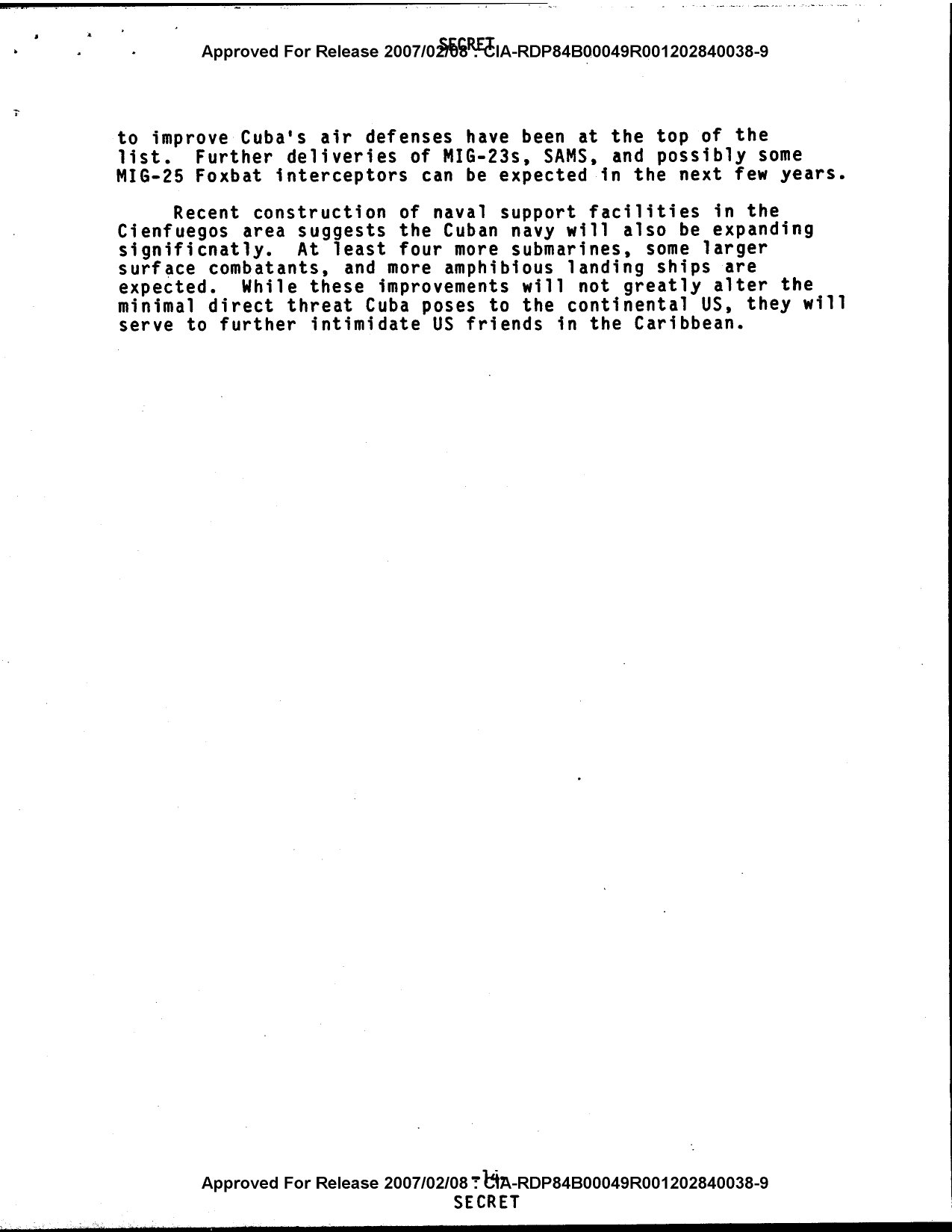
- Fighter aircraft, surface-to-air missiles (SAMS), and new radars to improve Cuba’s air defenses have been at the top of the list.
- Further deliveries of MIG-23s, SAMS, and possibly some MIG-25 Foxbat interceptors can be expected in the next few years.
- Recent construction of naval support facilities in the Cienfuegos area suggests the Cuban navy will also be expanding significantly.
- At least four more submarines, some larger surface combatants, and more amphibious landing ships are expected.
- While these improvements will not greatly alter the minimal direct threat Cuba poses to the continental US, they will serve to further intimidate US friends in the Caribbean.
Date:
November 8, 1982