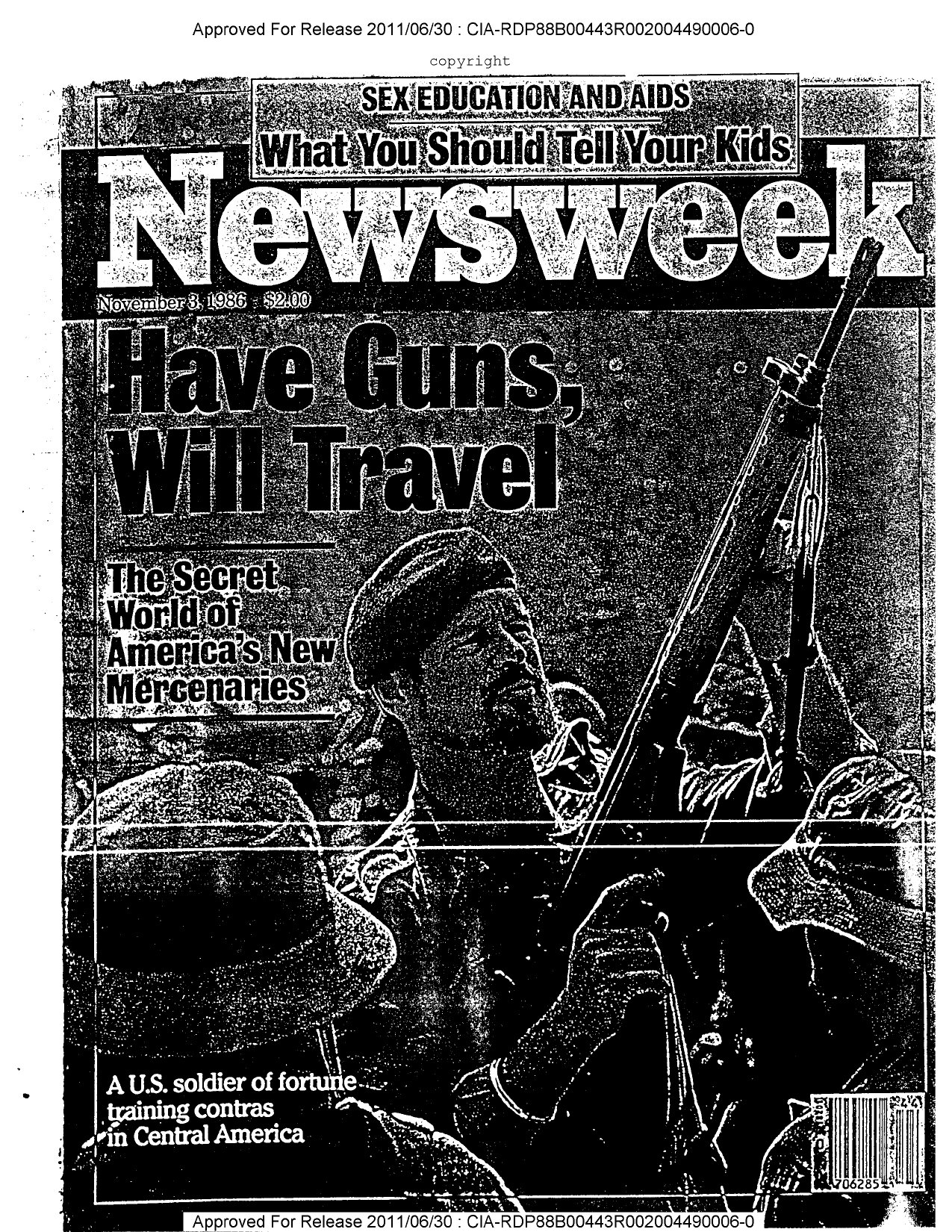
Have Guns, Will Travel – 3 November 1986
CIA-RDP88B00443R002004490006-0
Newsweek
The Secret World of New America’s Mercenaries – 3 November 1986
The Private War: Heroes and Zeroes
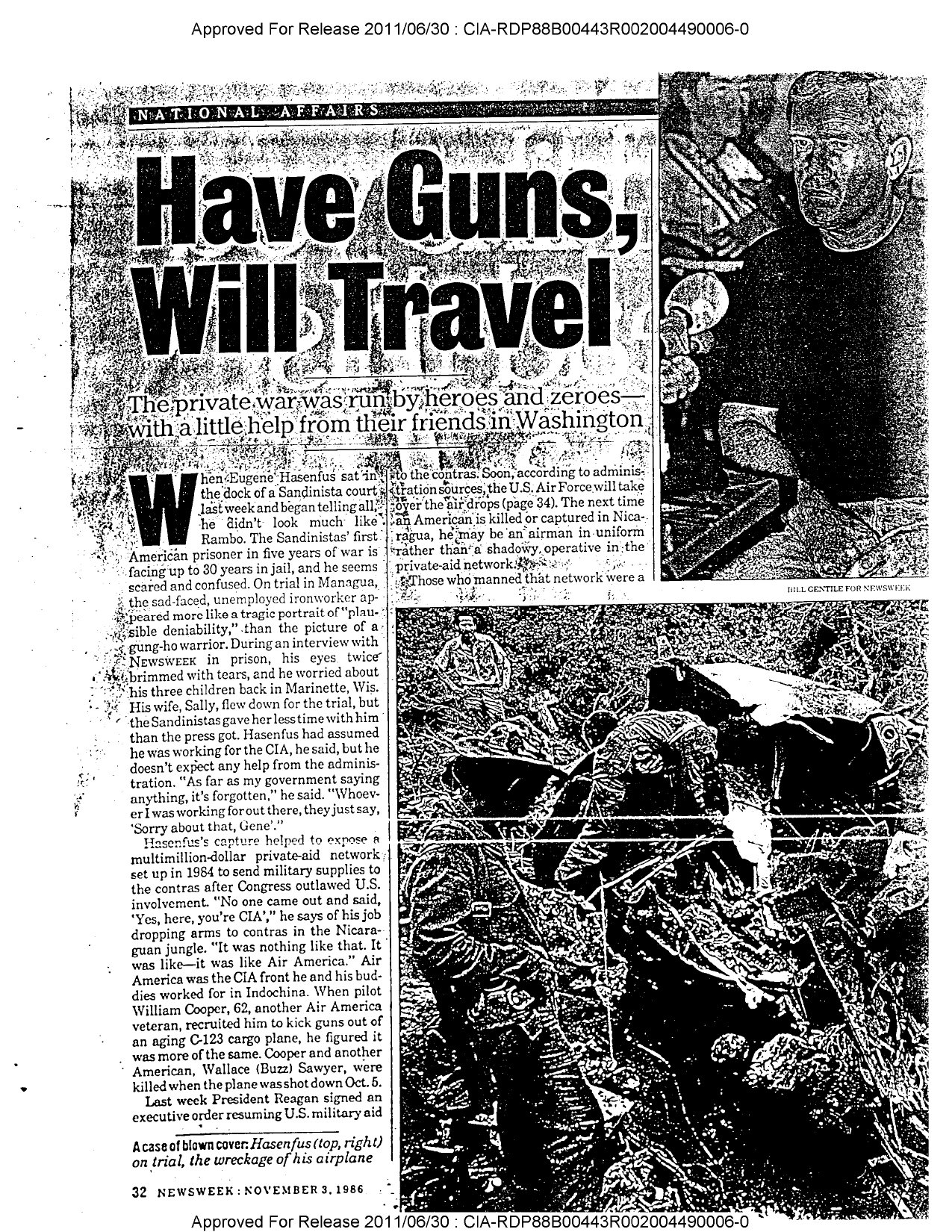
The private war was run by heroes and zeroes with a little help from their friends in Washington. When Eugene Hasenfus sat in the dock of a Sandinista court last week and began telling all he didn’t look much like Rambo. The Sandinistas’ first American prisoner in five years of war is facing up to 30 years in jail, and he seems scared and confused. On trial in Managua, the sad-faced, unemployed ironworker appeared more like a tragic portrait of “plausible deniability” than the picture of a gung-ho warrior.
During an interview with NEWSWEEK in prison, his eyes twice brimmed with tears, and he worried about his three children back in Marinette, Wis. His wife, Sally, flew down for the trial, but the Sandinistas gave her less time with him than the press got. Hasenfus had assumed he was working for the CIA, he said, but he doesn’t expect any help from the administration. “As far as my government saying anything, it’s forgotten,” he said. “Whoever I was working for out there, they just say, ‘Sorry about that, Gene’.”
Hasenfus’s capture helped to expose a multimillion-dollar private-aid network set up in 1984 to send military supplies to the contras after Congress outlawed U.S. involvement. “No one came out and said, ‘Yes, here, you’re CIA’,” he says of his job dropping arms to contras in the Nicaraguan jungle. “It was nothing like that. It was like—it was like Air America.” Air America was the CIA front he and his buddies worked for in Indochina. When pilot William Cooper, 62, another Air America veteran, recruited him to kick guns out of an aging C-123 cargo plane, he figured it was more of the same. Cooper and another American, Wallace (Buzz) Sawyer, were killed when the plane was shot down Oct. 5.
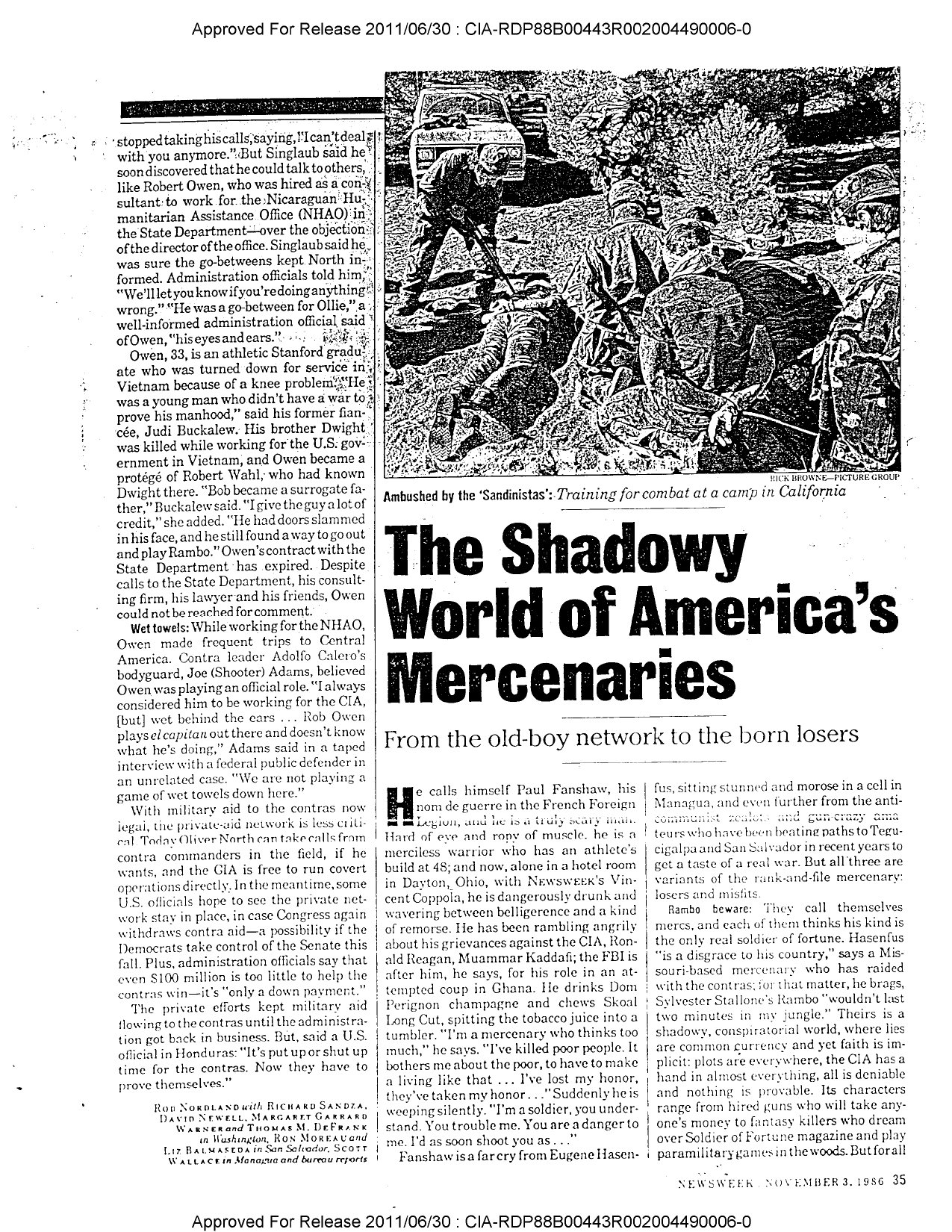
Last week President Reagan signed an executive order resuming U.S. military aid to the contras. Soon, according to administration sources, the U.S. Air Force will take over the air drops. The next time an American is killed or captured in Nicaragua, he may be an airman in uniform rather than a shadow operative in the private-aid network. Those who manned that network were a motley bunch of heroes and zeroes, from much-decorated generals and Green Berets to ex-cons who had never before pulled a trigger in anger. Some of these soldiers of misfortune were men like Hasenfus, who had learned a skill in war that wasn’t much in demand during peace. Many were veterans of the Indochina wars, looking for a chance to even the score by killing Sandinistas in Nicaragua or leftist guerrillas in Salvador. Others were Cuban-Americans still seeking to settle accounts with Castro—through his Central American clients. And not a few were just armchair warriors, finally acting out their jungle-fatigue fantasies in real wars.
“There’s a little Rambo in all of us,” said one State Department official. President Reagan set the tone with his famous remark, “I’m a contra, too.” Some of the president’s men may have taken it too much to heart. Congressional critics have charged that Lt. Col. Oliver North organized the private-aid network from his office in the White House’s National Security Council, pulling together private donors and even foreign governments to do what the United States could not legally do.
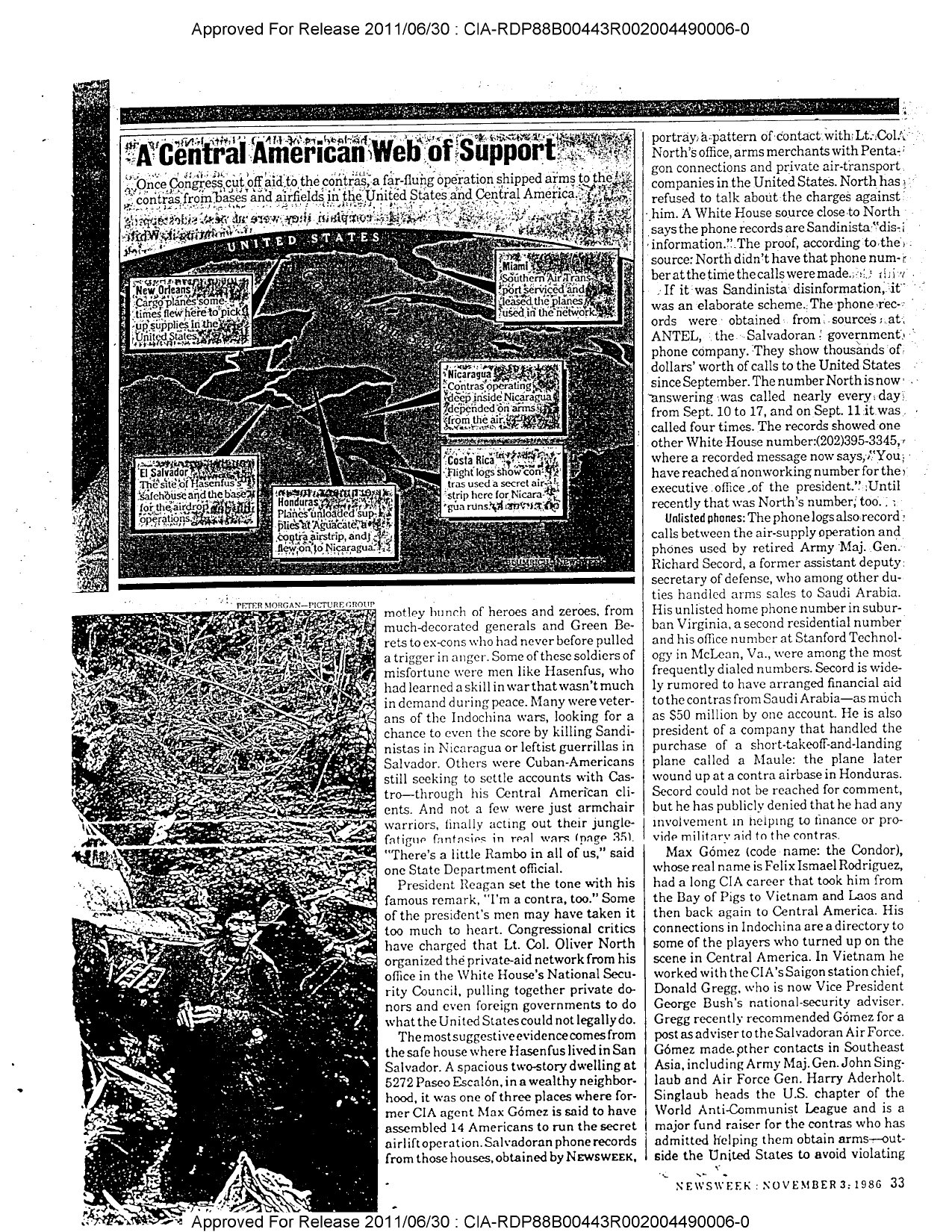
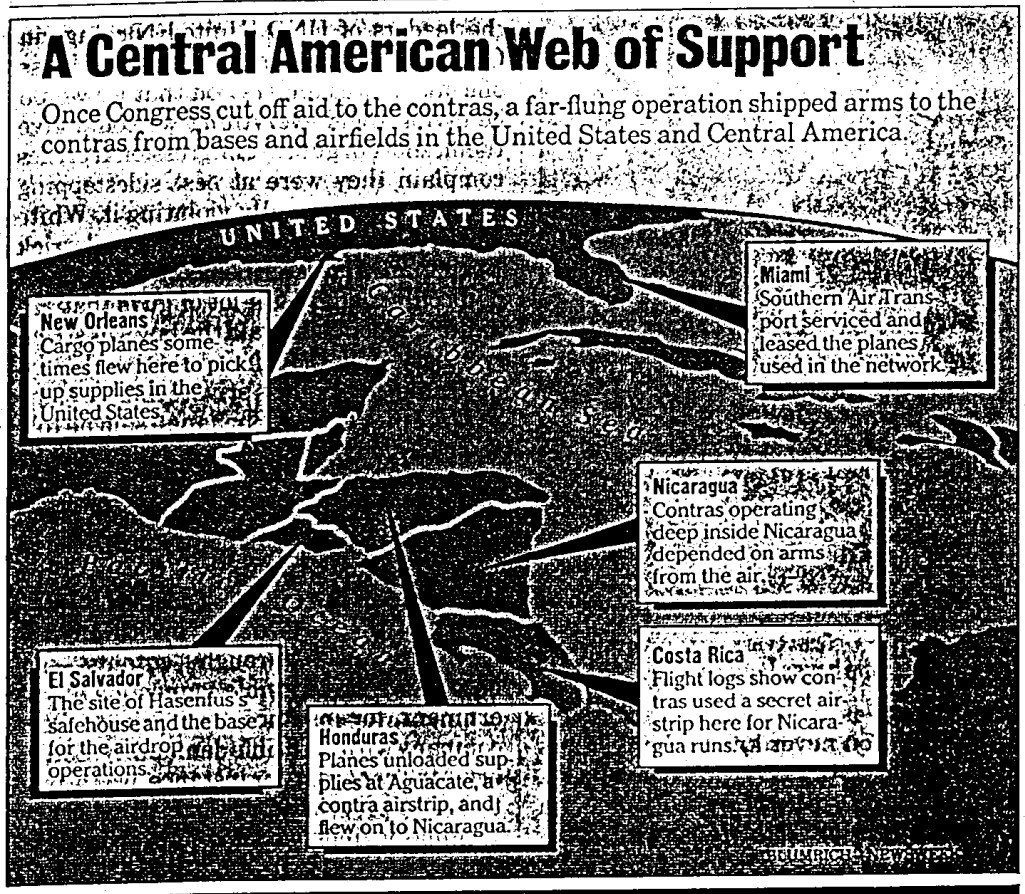
The most suggestive evidence comes from the safe house where Hasenfus lived in San Salvador. A spacious two-story dwelling at 5272 Paseo Escalón, in a wealthy neighborhood, it was one of three places where former CIA agent Max Gómez is said to have assembled 14 Americans to run the secret airlift operation. Salvadoran phone records from those houses, obtained by NEWSWEEK, portray a pattern of contact with Lt. Col. North’s office, arms merchants with Pentagon connections, and private air-transport companies in the United States. North has refused to talk about the charges against him. A White House source close to North says the phone records are Sandinista “disinformation” [CENSORED]. The proof, according to the source: North didn’t have that phone number at the time the calls were made.
If it was Sandinista disinformation, it was an elaborate scheme. The phone records were obtained from sources at ANTEL, the Salvadoran government phone company. They show thousands of dollars’ worth of calls to the United States since September. The number North is now answering was called nearly every day from Sept. 10 to 17, and on Sept. 11 it was called four times. The records showed one other White House number: (202) 395-3345, where a recorded message now says, “You have reached a nonworking number for the executive office of the president.” Until recently, that was North’s number, too.
Unlisted phones: The phone logs also record calls between the air-supply operation and phones used by retired Army Maj. Gen. Richard Secord, a former assistant deputy secretary of defense, who among other duties handled arms sales to Saudi Arabia. His unlisted home phone number in suburban Virginia, a second residential number, and his office number at Stanford Technology in McLean, Va., were among the most frequently dialed numbers. Secord is widely rumored to have arranged financial aid to the contras from Saudi Arabia—as much as $50 million by one account. He is also president of a company that handled the purchase of a short-takeoff-and-landing plane called a Maule; the plane later wound up at a contra airbase in Honduras. Secord could not be reached for comment, but he has publicly denied that he had any involvement in helping to finance or provide military aid to the contras.
Max Gómez (code name: the Condor), whose real name is Felix Ismael Rodriguez, had a long CIA career that took him from the Bay of Pigs to Vietnam and Laos and then back again to Central America. His connections in Indochina are a directory to some of the players who turned up on the scene in Central America. In Vietnam he worked with the CIA’s Saigon station chief, Donald Gregg, who is now Vice President George Bush’s national-security adviser. Gregg recently recommended Gómez for a post as adviser to the Salvadoran Air Force. Gómez made other contacts in Southeast Asia, including Army Maj. Gen. John Singlaub and Air Force Gen. Harry Aderholt. Singlaub heads the U.S. chapter of the World Anti-Communist League and is a major fundraiser for the contras who has admitted helping them obtain arms outside the United States to avoid violating American laws. Aderholt, now head of Florida’s Air Commando Association, reportedly has been linked to contra aid, though his group denies it. Singlaub and Aderholt both knew Lt. Col. North in Vietnam.
The old-boy network went into operation, intelligence sources say, when Congress ordered the CIA to keep hands off the contras in 1984. The CIA has denied all association with Gómez or the private-aid network. “We’re clean as the driven snow,” said CIA spokesman George Lauder. Whatever was happening with Gómez’s operation, “we don’t want to know,” Lauder added. “The links are now indirect,” said Thomas Polgar, who retired from the post of CIA director of personnel in 1981 but is still on friendly terms with the agency. “There is no smoking gun or paper trail to Langley.”
Pure zeal: There still isn’t, but questions remain about North’s role. “It [contra support] was his account before the aid was cut off, and it was still his account, even while his hands were tied,” a White House official said. North’s hands may have been tied, but he was not gagged. He made many pro-contra speeches and visited contra camps in Honduras. One colleague called him “nothing short of a hero, the heart and soul of the contra movement in the United States.” As others put it, if there were ever anyone who might have stepped across the line, it would have been North, just out of pure zeal. “You never know where Ollie’s been on weekends,” a Reagan aide said. “Don’t ever tell me where you were,” an admirer joked to North. “I may be under oath someday.”
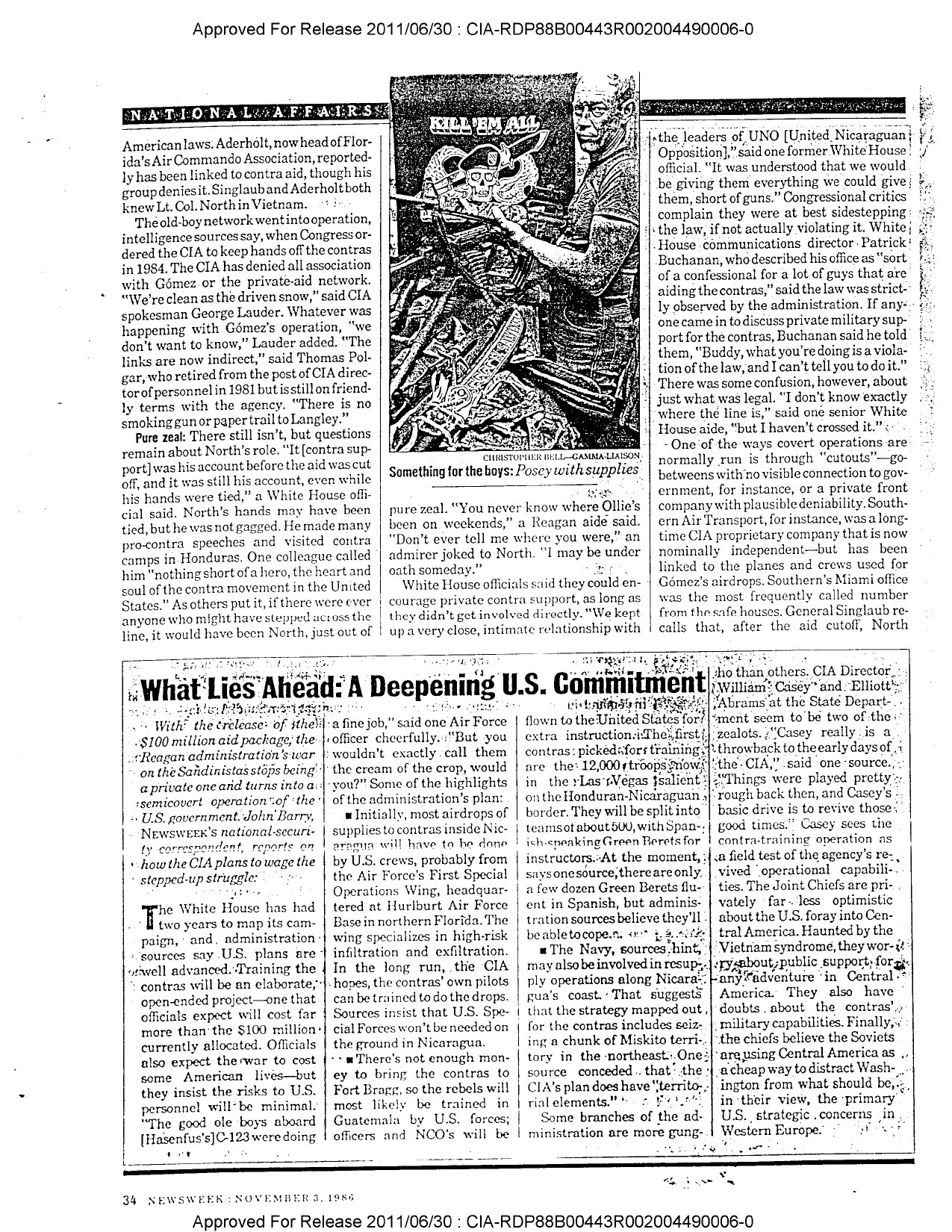
White House officials said they could encourage private contra support, as long as they didn’t get involved directly. “We kept up a very close, intimate relationship with the leaders of UNO [United Nicaraguan Opposition],” said one former White House official. “It was understood that we would be giving them everything we could give them, short of guns.” Congressional critics complain they were at best sidestepping the law, if not actually violating it. White House communications director Patrick Buchanan, who described his office as “sort of a confessional for a lot of guys that are aiding the contras,” said the law was strictly observed by the administration. If anyone came in to discuss private military support for the contras, Buchanan said he told them, “Buddy, what you’re doing is a violation of the law and I can’t tell you to do it.”
There was some confusion, however, about just what was legal. “I don’t know exactly where the line is,” said one senior White House aide, “but I haven’t crossed it.”
One of the ways covert operations are normally run is through “cutouts”—go-betweens with no visible connection to government, for instance, or a private front company with plausible deniability. Southern Air Transport, for instance, was a longtime CIA proprietary company that is now nominally independent—but has been linked to the planes and crews used for Gómez’s airdrops. Southern’s Miami office was the most frequently called number from the safe houses.
General Singlaub recalls that, after the aid cutoff, North stopped taking his calls, saying, “I can’t deal with you anymore.” But Singlaub said he soon discovered that he could talk to others, like Robert Owen, who was hired as a consultant to work for the Nicaraguan Humanitarian Assistance Office (NHAO) in the State Department—over the objection of the director of the office. Singlaub said he was sure the go-betweens kept North informed. Administration officials told him, “We’ll let you know if you’re doing anything wrong.” “He was a go-between for Ollie,” a well-informed administration official said of Owen, “his eyes and ears.”
Owen, 33, is an athletic Stanford graduate who was turned down for service in Vietnam because of a knee problem. “He was a young man who didn’t have a war to prove his manhood,” said his former fiancée, Judi Buckalew. His brother Dwight was killed while working for the U.S. government in Vietnam, and Owen became a protégé of Robert Wahl, who had known Dwight there. “Bob became a surrogate father,” Buckalew said. “I give the guy a lot of credit,” she added. “He had doors slammed in his face, and he still found a way to go out and play Rambo.” Owen’s contract with the State Department has expired. Despite calls to the State Department, his consulting firm, his lawyer, and his friends, Owen could not be reached for comment.
Wet towels: While working for the NHAO, Owen made frequent trips to Central America. Contra leader Adolfo Calero’s bodyguard, Joe (Shooter) Adams, believed Owen was playing an official role. “I always considered him to be working for the CIA, [but] wet behind the ears… Rob Owen plays el capitan out there and doesn’t know what he’s doing,” Adams said in a taped interview with a federal public defender in an unrelated case. “We are not playing a game of wet towels down here.”
With military aid to the contras now legal, the private-aid network is less critical. Today Oliver North can take calls from contra commanders in the field, if he wants, and the GIA is free to run covert operations directly. In the meantime, some U.S. officials hope to see the private network stay in place, in case Congress again withdraws contra aid—a possibility if the Democrats take control of the Senate this fall. Plus, administration officials say that even $100 million is too little to help the contras win—it’s “only a down payment.”
The private efforts kept military aid flowing to the contras until the administration got back in business. But, said a U.S. official in Honduras: “It’s put up or shut up time for the contras. Now they have to prove themselves.”
Byline: ROD NORDLAND with RICHARD SANDZA, DAVIO NEWELL, MARGARET GARRARD WARNER, and THOMAS M. DEFRANK in Washington; RON MOREAU and LIZ BALMASEDA in San Salvador, Scott WALLACE in Managua and Bureau Reports
Coups And Collapses
Soldiers of fortune have had their successes in recent years, but far more stalemates and more than a few outright fiascos:
- Comoro Islands: In the last big coup for a soldier of fortune, Frenchman Robert Denard took over the government in 1978—and managed to keep power.
- Angola: American mercenaries fought with the losers in the 1975-76 civil war, and a few are once again supporting rebels against the Marxist regime.
- Zimbabwe: About 400 Americans enlisted with Ian Smith in 1977 to preserve the white government of what was then Rhodesia. They lost the fight.
- Dominica: Grand Wizard Don Black of the Alabama Ku Klux Klan was arrested with 9 mercenaries in 1981 trying to impose a white supremacist regime. [CENSORED]
- Libya: In 1981 renegade ex-CIA men Edwin Wilson and Francis Terpil hired as many as 50 Americans to help support Muammar Kaddafi’s government.
- The Seychelles: “Mad Mike” Hoare, leader of the famed “wild geese,” came to comic-opera grief in 1981 trying to unseat President Albert Rene.
Source:
Link:
Internal Link:
Date:
November 3, 1986