Intelligence Memorandum – Western Hemisphere The Economics Of Vestigial Colonialism 1971
CIA-RDP85T00875R001700020033-2
formatted with chagpt // not checked
Introduction
1 – The Western Hemisphere retains the largest number of remnants of European colonial empires of any major geographic area. Their number poses the question of what economic and other factors are binding them to their mother countries—the United Kingdom, the Netherlands, and France—and delaying their independence.
In contrast, many former European possessions in Africa and Asia have become sovereign states since World War II. This memorandum examines the economic characteristics of Europe’s Western Hemisphere possessions and their relations with the mother country. It also assesses their recent economic trends and outlook, as well as other factors affecting their prospects for gaining independence during the next several years.
Discussion
Europe and Its Western Hemisphere Possessions
2 – The present-day remnants of Europe’s once-great colonial empires in the Western Hemisphere encompass a total land area of approximately 111,000 square miles—about the size of Arizona—and a population of 2.3 million persons, mostly black or mulatto. These territories are characterized by narrow resource bases, tiny markets, and heavy dependence on imports. Moreover, there are strong population pressures on the islands, which account for 75% of the population but only 10% of the land area.
3 – The possessions contribute little economically to their mother countries, and many of them have become financial burdens. They are neither important sources of raw materials nor significant markets for manufactures. European direct investments in them—and thus profit remittances—are generally small. The more prosperous British and Dutch territories are more closely oriented economically to the United States than to Europe.
At the same time, most of the territories are dependent on economic aid from their mother countries for infrastructure development and also need budget support to help provide educational and other services.
Britain’s Dependencies
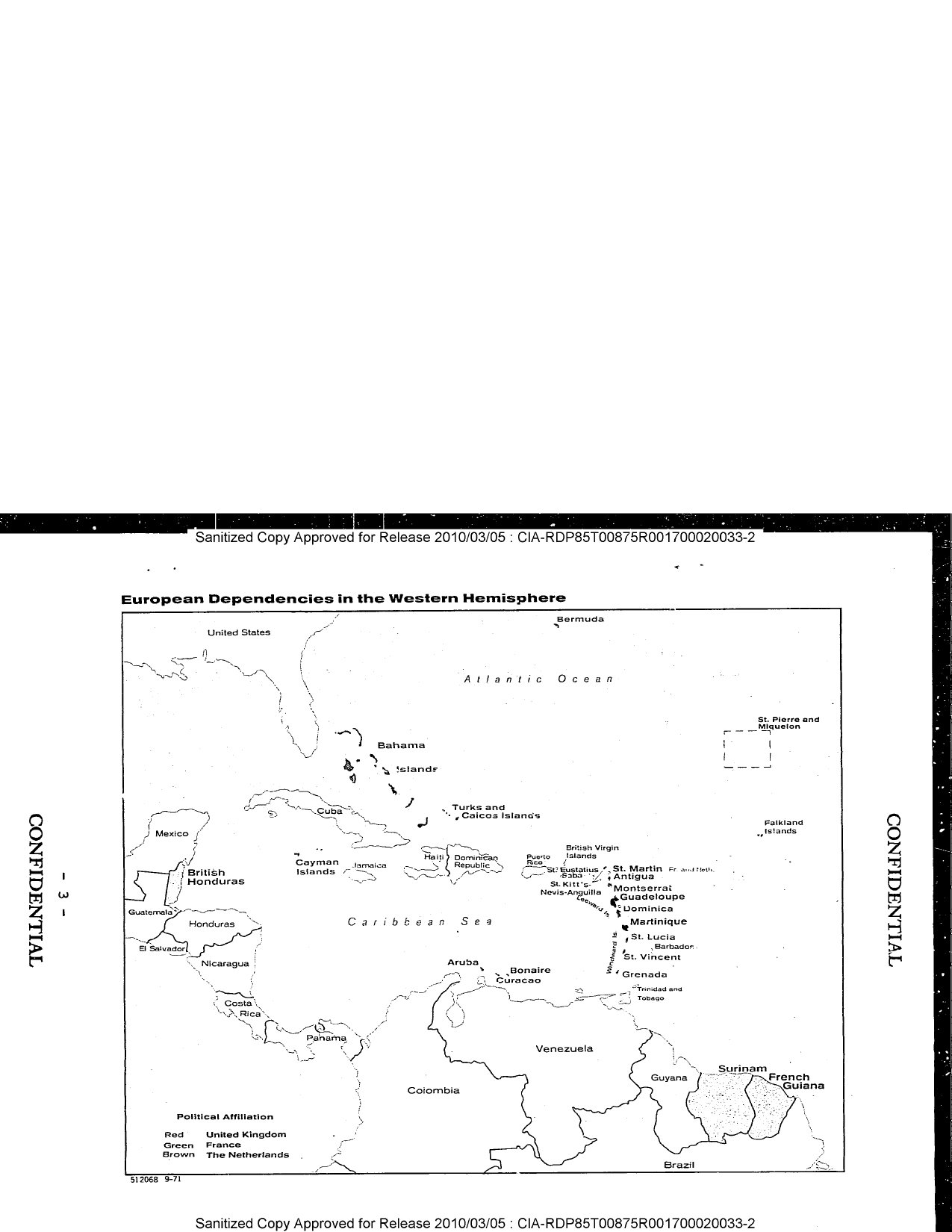
4 – Britain’s remaining possessions—the British West Indies¹ and the crown colonies of Bermuda, British Honduras, and the Falkland Islands² (see the map)—are the most numerous, although they make up only 17% of the land area and about 40% of the population of Europe’s colonial areas³.
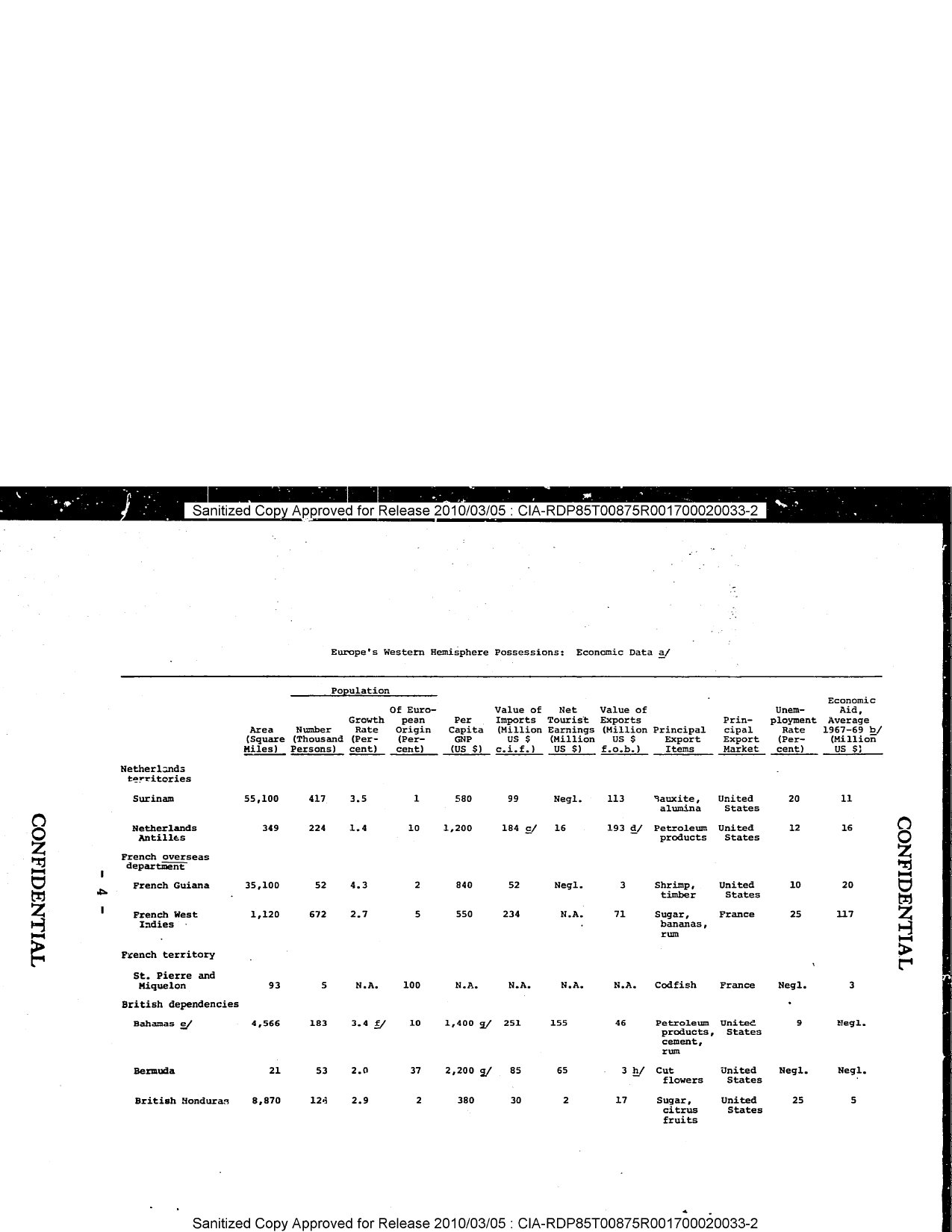
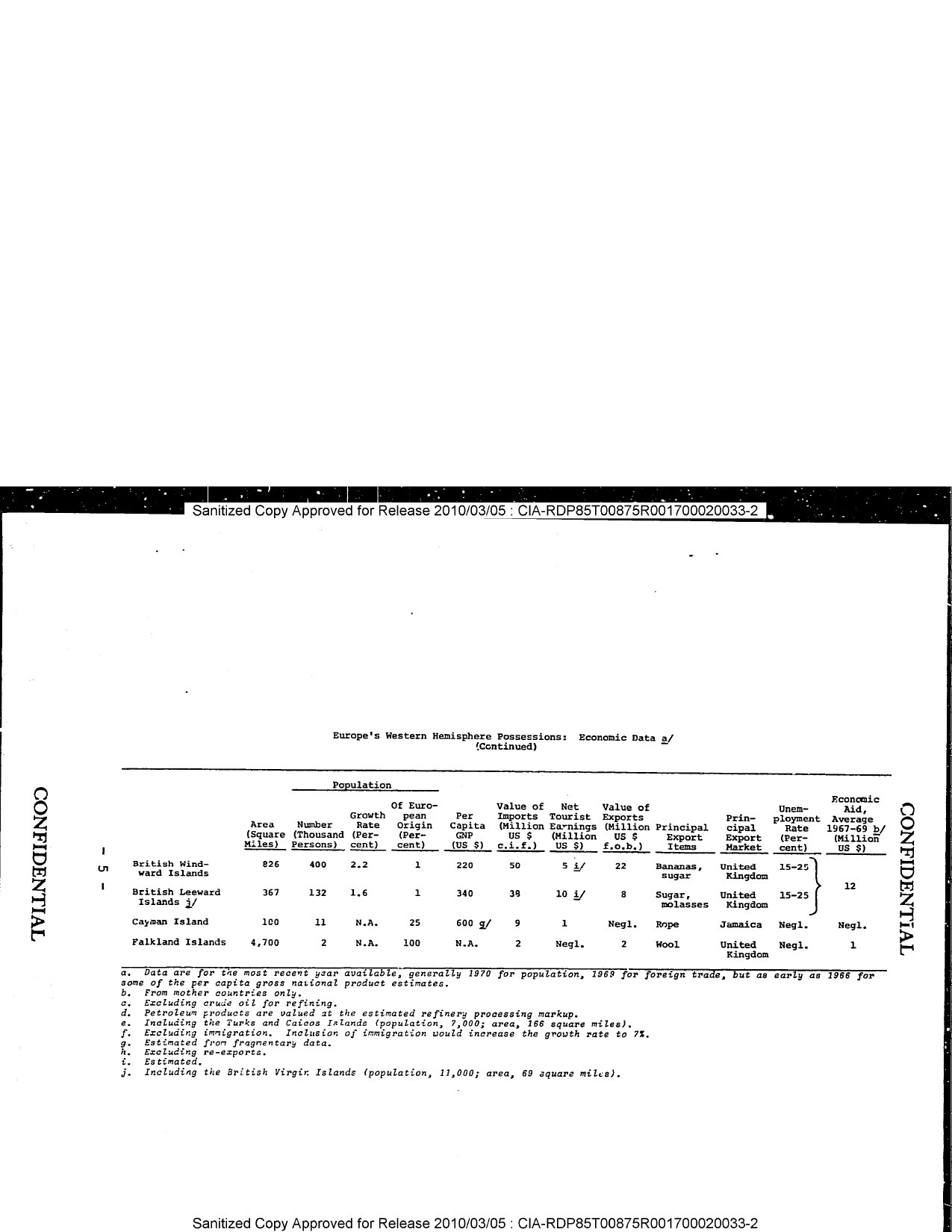
Aside from sentimental attachments and small receipts of economic aid, the possessions have few ties with the United Kingdom. Only the Falkland Islands has a population predominantly of European origin. Whites make up about one-third of the population in Bermuda, 25% in the Cayman Islands, 10% in the Bahamas, and 1–2% in the remaining possessions (see the table). Britain exercises relatively little political and economic control over its dependencies. All continue to have London-appointed royal governors, but the granting of full autonomy in all but foreign affairs and external security—mainly in the last decade—has left the governors as little more than figureheads.
5 – British investments, while larger than those of other mother countries, are overshadowed by rising U.S. investments in the Caribbean. Small agricultural processing plants, public utilities and transportation, trading outlets, and tourist facilities have received most UK funds. In the Windward and Leeward Islands and, to a lesser extent, in British Honduras, corporation-owned plantations controlled by UK residents remain economically dominant.
Imports from the United Kingdom average about $105 million annually, but exports to it total only about $40 million. Deliveries to Britain consist mainly of sugar and bananas sold under Commonwealth trade preferences. The economies of the Bahamas and Bermuda are much more closely linked to the United States than to Britain. The U.S. takes most of their very small exports and supplies most of their imports; U.S. tourist expenditures account for nearly all of their relatively large foreign exchange earnings. U.S. firms predominate in the foreign holdings in the Bahamas and Bermuda; U.S. investments in the former—mainly in tourist facilities and infrastructure—amount to about $1.2 billion, or nearly one-third of the Western Hemisphere total outside of Canada.
6 – British aid to its possessions totals only about $18 million annually, with approximately 90% in the form of grants. Budget support for current expenditures, which totaled $5.6 million in 1968, is limited to the British Windward and Leeward Islands. In addition, all possessions receive grants for capital projects, although the amounts going to the Bahamas and Bermuda are negligible. In 1968, development grants approximated $10 million and accounted for two-thirds or more of the capital expenditures of the smaller possessions. Britain also provides funds for salaries for some 3,000 educational and public administration personnel and supports the training in the United Kingdom of about 1,200 students annually.
The Netherlands’ Territories
7 – The Netherlands’ possessions—Surinam (formerly Dutch Guiana) on the South American mainland and the Netherlands Antilles⁴—are, along with the Bahamas and Bermuda, the most important economically of Europe’s possessions in the Hemisphere.
Surinam is a major source of bauxite, and Curacao and Aruba have sizable petroleum refineries established during 1915–28 by Royal Dutch Shell and Standard Oil of New Jersey to process Venezuelan crude oil. Like the British dependencies, the Netherlands’ territories have full autonomy in domestic affairs, but they retain greater economic and political ties to the mother country. Only about 5% of their population is of European origin.
Although Dutch private investments—primarily in petroleum refining—are sizable and rising, they are still smaller than U.S. investments. Much of Surinam’s bauxite is mined and processed by U.S. firms, mainly for shipment to the United States and Canada. The United States supplies about 47% of Surinam’s imports, compared with a European share of 36% (and a Dutch share of 20%). Similarly, almost all Netherlands Antilles imports (excluding crude oil) come from the United States, and oil exports—largely frozen out of Europe by cheaper Middle Eastern supplies—go mostly to the United States.
8 – Dutch aid to the Western Hemisphere territories averaged about $27 million annually during 1967–69, a fraction of The Hague’s total foreign aid outlays. About 60% goes to the Netherlands Antilles, about half as grants and half as long-term loans; this aid is used mostly for infrastructure development. The remainder, consisting primarily of grants, goes to Surinam—mainly for investments in infrastructure, although an increasing share has been allocated for supporting current outlays in the last 2–3 years.
Since 1965, Dutch aid to the two territories has been supplemented by small grants from the European Development Fund (EDF) due to their status as associate members of the European Community.
France’s Possessions
9 – In sharp contrast to the United Kingdom and the Netherlands, France has sought to maintain firm control and close economic ties with its Western Hemisphere possessions. These consist of French Guiana on the South American mainland, the French West Indies—Martinique in the Windward Islands and Guadeloupe in the Leeward Islands—and St. Pierre and Miquelon, off the coast of Nova Scotia.
Although only 5% or less of the populations of French Guiana, Martinique, and Guadeloupe are of European origin—in sharp contrast to St. Pierre and Miquelon—France made them overseas departments and conferred full French citizenship on their populations in 1946. Especially in the last decade, Paris has supplied aid liberally to boost education and other social services to levels comparable to those in metropolitan France.
10 – Reflecting high French-imposed tariffs on goods from other countries, more than two-thirds of the possessions’ imports—some $290 million annually—come from the mother country. The French market absorbs a comparable share of their limited exports, mostly sugar, bananas, and rum. Nevertheless, these possessions contribute little to the French economy. French private investments, mostly in agricultural processing and tourism, are very small. The products exported, for which France pays subsidized prices, could be acquired more cheaply elsewhere. Paris’ only non-sentimental stake in the Hemisphere is its $100 million space center in French Guiana, constructed during 1964–69 to replace a similar center lost when Algeria gained independence in 1962.
11 – French aid to its dependencies has grown substantially during the past decade and is now fairly large. It averages some $140 million annually and consists mainly of grants aimed at supporting both current and capital expenditures. About $117 million is distributed to Martinique and Guadeloupe in approximately equal shares—a sum amounting to roughly one-third of their combined gross national product. Another $20 million goes to French Guiana, and the remaining $3 million is allocated to St. Pierre and Miquelon. Apart from direct aid, Paris provides (at French expense) an extensive civil service, including most professional and clerical personnel as well as the bulk of the police forces. As a result of their status as French overseas departments, the Caribbean territories receive small amounts of EDF aid.
Economic Structure and Trends
12 – Poorly endowed for the most part with natural resources, Europe’s Western Hemisphere possessions engage in a narrow range of economic activities, and most are experiencing economic stagnation and considerable unemployment. Except for Surinam and possibly French Guiana, mineral resources are almost nonexistent, and manufacturing remains underdeveloped. Gross national product (GNP) per capita ranges from an estimated $2,200 annually in Bermuda to only $220 in the British Windward Islands.
Owing to their narrow resource bases and limited industrial development, the possessions are dependent on imports for sizable shares of their food and for nearly all of their manufactured consumer and capital goods. Consequently, they have very high ratios of imports to GNP—for example, 40% in Surinam and 100% in the Bahamas.
13 – The economies of the Windward and Leeward Islands, French Guiana, British Honduras, and the Falkland Islands rest on production of a small number of agricultural products, chiefly sugar, bananas, rum, and—in the case of the Falkland Islands—wool. St. Pierre and Miquelon depends heavily on codfish. Except for France’s Caribbean possessions, economic growth in the dependencies barely keeps pace with population growth rates of 1.5%–4.0% annually.
Aside from the Falkland Islands and St. Pierre and Miquelon, unemployment is high, ranging from 8%–10% of the labor force in French Guiana to as high as 25% in some of the islands. Sparked by French aid, real economic growth in the French West Indies averaged 5%–6% annually during much of the 1960s, and growth received a substantial boost in French Guiana during construction of the space center. In the British Windward Islands, economic advance has been based on rising banana sales to the United Kingdom, while in the British Leeward Islands, expanding tourist expenditures have helped to compensate for declining sugar production.
14 – Aside from Surinam, the remaining possessions—Bermuda, the Bahamas, the Cayman Islands, and the Netherlands Antilles—lack significant agricultural resources. The relative prosperity of Bermuda and the Bahamas depends largely on U.S. tourist expenditures, which rose from $114 million in 1966 to $190 million in 1970, and on U.S. investments in tourist facilities. The two possessions also benefit from tax laws that have encouraged numerous international companies to establish their nominal headquarters there.
The Bermudan economy has also been aided by the presence of a U.S. air force base, lease payments for which make up about one-third of government revenues. Both colonies experience some labor shortages, partly due to immigration restrictions. However, cutbacks in tourist expenditures and investment in tourist facilities in the Bahamas in 1970–71 temporarily resulted in an 8%–10% unemployment rate.
Although the Cayman Islands’ exports are negligible, remittances by subjects employed in Caribbean-area merchant marines and in the United States, together with moderate tourist earnings, have provided the population with a living standard roughly average for Europe’s Western Hemisphere possessions.
Surinam
15 – Surinam’s economy rests on bauxite. Output reached 6 million tons in 1970 – about 14% of the world total. Although one-fourth of the labor force is engaged in agriculture, most farm workers are on subsistence
units. Once a prosperous plantation economy, Surinam now has only small agricultural exports and, like the rest of Europe’s remaining possessions, depends on imports for a large share of its food supplies.
After experiencing an economic boom during the mid-1960s—when large U.S. investments expanded bauxite production and initiated alumina refining and aluminum smelting—the economy slowed sharply in 1968–70, contributing to rising inflationary pressures. Although a sizable share of the rapidly growing labor force has been absorbed into government employment in recent years, the unemployment rate remains around 20%.
16 – The Netherlands Antilles’ long-standing prosperity derives almost entirely from oil refining. The industry provides 52% 6/ of export earnings and until the 1960s employed about one-third of the labor force. After a long period of expansion, refining capacity has stagnated since the mid-1950s at about 800,000 barrels per day. Two factors were responsible: expanded refining in Venezuela and restrictions on demand for Venezuelan oil caused by US oil import restrictions and rising competition from Middle Eastern suppliers.
GNP probably declined in the first half of the 1960s but has risen in the last 4–5 years due to investments to modernize refineries, rising tourist earnings, and a modest expansion of manufacturing. However, refinery modernization reduced employment by 1970 to about one-fourth of its earlier peak, contributing to a 12% unemployment rate. Downward pressure on wages culminated in mid-1969 in a violent labor uprising with racial overtones in Curaçao. The dispute was resolved by providing a large share of the workforce with 20%–30% pay increases.
Movements Toward Independence
17 – Relatively poor living standards have limited internal pressures for full independence among Europe’s remaining Western Hemisphere possessions. Since World War II, only four British possessions among approximately 20 European dependencies in the Hemisphere have sought and gained independence. Currently, only three more—the Bahamas, British Honduras, and possibly Surinam—are seriously contemplating such a move.
Experience elsewhere shows that small area and population do not necessarily prevent colonies from seeking independence. The now-independent countries of Barbados, Fiji, and Equatorial Africa, for example, are smaller than several of Europe’s remaining Western Hemisphere possessions. In addition to economic weakness, major factors restraining independence include the lack of strong national identities—partly due to varied population origins—and the willingness of mother countries to either grant full autonomy in domestic matters (as in the British and Dutch possessions) or provide generous economic aid (as in the French possessions).
18 – The attitudes of mother countries have strongly influenced independence movements. The Netherlands has warmly embraced its Western Hemisphere possessions since losing Indonesia, while France has vigorously repressed independence activity. In contrast, the United Kingdom’s postwar policy of curtailing overseas commitments precipitated the hemisphere’s only major independence movement in recent years.
In 1958, the UK formed the West Indies Federation, including most of its Caribbean island possessions, aiming to combine economically weak small islands with the stronger economies of Jamaica, Trinidad and Tobago, and Barbados to create a viable independent state. However, the Federation lacked popular support within the territories, and London did not provide financial incentives to make it work. Political rivalries among the three stronger members and between them and the smaller islands prevented the Federation from becoming viable, and it collapsed in 1962 with the withdrawal of Jamaica and Trinidad and Tobago to become independent states.
Most remaining possessions returned to their former colonial status, but six of the Windward and Leeward Islands became “associated states” of the United Kingdom, retaining the option of becoming independent at will.
19 – The European powers’ benevolent policies have helped to ease racial frictions in the predominantly non-white possessions that could have turned them against the mother countries as instruments of foreign white domination. The granting of full local autonomy and the elinination of property and income restrictions on voting eligibility by the United Kingdom and the Netherlands generally have permitted political control to pass to the non-white majorities. In Bermuda, however, the dominant political party is biracial, although white-controlled. Economic power, nevertheless, has remained in white hands in nearly all the territories. This circumstance recently has resulted in more frequent outbursts of racial animosity throughout the area except for the French Caribbean possessions, where extensive inter-marriage has helped to blur the race issue.
20 – Racial animosity was a factor in pressures for independence in the four British possessions that have recently achieved it and has become increasingly important in Surinam and to a lesser extent in the Bahamas. Since 1967, small, radical black power movements have attempted to fan racial antagonisms in most of the remaining possessions with a little success, helping in varying degrees to precipitate outbreaks of racial violence in Antigua (1968) and Bermuda (1968 and 1970). Nevertheless, the independence issue has remained largely somnolent.
In the French possessions, serious pressures for change that have resulted in occasional strikes and scattered violence in recent years have been aimed merely at gaining greater local autonomy from the French bureaucracy. The British possessions’ interest in independence and political federation may be rekindled by black Prime Minister Forbes Burnham of Guyana, however. Using the common bond of blackness as one potentially unifying theme, Burnham organized a meeting of representatives from Guyana, Trinidad and Tobago, and five of the six “associated states” of the British Windward and Leeward Islands in July 1971.
Although the representatives reached an agreement in principle on eventual federation, many formidable obstacles remain.
Economic Outlook
21 – With few exceptions, the prospects for Europe’s remaining Western Hemisphere possessions over the next several years are for continuing stagnation in output and high unemployment levels. Their narrow resource bases generally preclude investments that could significantly stimulate economic growth. Since few of them export goods demanded by the others, the recently-formed Caribbean Free Trade Association (CARIFTA)² is not likely to provide much benefit.
The main hope of most of the island possessions in trying to maintain economic advance commensurate with population growth is to woo increasing numbers of US tourists, along with investments in tourist facilities. But tourist earnings remain highly vulnerable to racial violence, which could erupt without warning at any time. Moreover, worldwide competition to attract tourists is strong, and food and hotel prices in the area are relatively high. In sum, per capita incomes and employment rates at best are likely to remain substantially at present levels in most of the possessions over the next several years.
22 – The bleak economic outlook for most of the possessions undoubtedly will help to put a damper on any new independence stirrings. The next several years thus probably will not see a significant upswing in the formation of new, independent states in the Western Hemisphere.
At the same time, there is little evidence that the mother countries’ policies will change. Britain will continue to pay lip service to independence but probably will offer its possessions few financial inducements. The Netherlands probably will stand ready, as in the past, to tolerate but not encourage independence, and Paris will continue to vigorously repress independence activity on the part of any of its dependencies so foolhardy as to envision sacrificing French aid.
23 – Even the possessions now contemplating independence may move slowly. Unless US tourist expenditures revive sharply in 1971–72, the Bahamas, which has a 1973 independence target, may be forced into further delays. Surinam’s continuing financial and unemployment difficulties also could cause it to postpone independence, set for 1975, despite the prospect of a limited revival of US bauxite and alumina investments in the next year or so.
Even the independence efforts of British Honduras, which have not been hampered by economic difficulties, seem destined to be blocked indefinitely by Guatemala’s claims to its territory—claims that could be deterred only by UK or possibly US border guarantees. Neither country seems willing so far to provide such guarantees.
As for a possible federation of the British Windward and Leeward Islands with Guyana or Trinidad and Tobago, past experience indicates that such efforts are likely to become hung up on political rivalries unless Britain moves to provide strong financial incentives to union.
24 – The prospective entry of the United Kingdom into the enlarged European Community (EC) is not likely to be a major factor in the decisions of the British possessions to seek independence. Either as British dependencies or as independent states of the EC, their present preferences in the British market probably would be replaced by similar EC preferences and, under certain circumstances, they would qualify for EDF economic aid in addition to any obtainable from the United Kingdom.
Notes
Source: This memorandum was prepared by the Office of Economic Research and coordinated within the Directorate of Intelligence.
- British West Indies Definition:
- The term British West Indies includes:
(a) Crown colonies:- The Bahamas
- The Cayman Islands
- The Turks and Caicos Islands (a dependency of the Bahamas since 1965)
- The British Virgin Islands and Montserrat in the Leeward Islands
(b) Associated States: - Dominica, St. Lucia, St. Vincent, and Grenada in the Windward Islands
- Antigua and St. Kitts-Nevis-Anguilla in the Leeward Islands
- The term British West Indies includes:
- Falkland Islands (Malvinas):
- Also known as the Malvinas, these islands have been claimed by Argentina since 1833.
- Recent Independence of British Possessions:
- Four of Britain’s most economically and politically viable long-standing possessions gained independence during the 1960s:
- Jamaica and Trinidad and Tobago – 1962
- Guyana and Barbados – 1966
- Four of Britain’s most economically and politically viable long-standing possessions gained independence during the 1960s:
- Netherlands Antilles:
- Comprises:
- Curacao (capital), Aruba, and Bonaire (near the Venezuelan coast)
- Leeward Islands: St. Eustatius, Saba, and the southern half of St. Martin (the northern half belongs to France and is included in the Department of Guadeloupe)
- About 90% of the Netherlands Antilles’ population resides in Curacao and Aruba.
- Comprises:
- Oil Exports:
- Valued at the estimated refinery processing markup.
- West Indies Federation Members (1958–1962):
- Jamaica, Trinidad and Tobago, Barbados
- Cayman Islands, Turks and Caicos Islands
- British Windward Islands and British Leeward Islands (except the Virgin Islands)
- Britain’s other Caribbean possessions chose to remain separate.
- British Caribbean Federation Observers (1971 Meeting):
- Representatives included Dominica, Grenada, St. Lucia, St. Vincent, and St. Kitts-Nevis-Anguilla.
- A representative of Antigua also attended as an observer.
- CARIFTA Members (Established 1968):
- Barbados, Guyana, Jamaica, Trinidad and Tobago
- Antigua, Dominica, Grenada, Montserrat
- St. Kitts-Nevis-Anguilla, St. Lucia, St. Vincent
Source:
Link:
Internal Link: