Latin America Review – 13 September 1985
CIA-RDP87T00289R000200890001-0
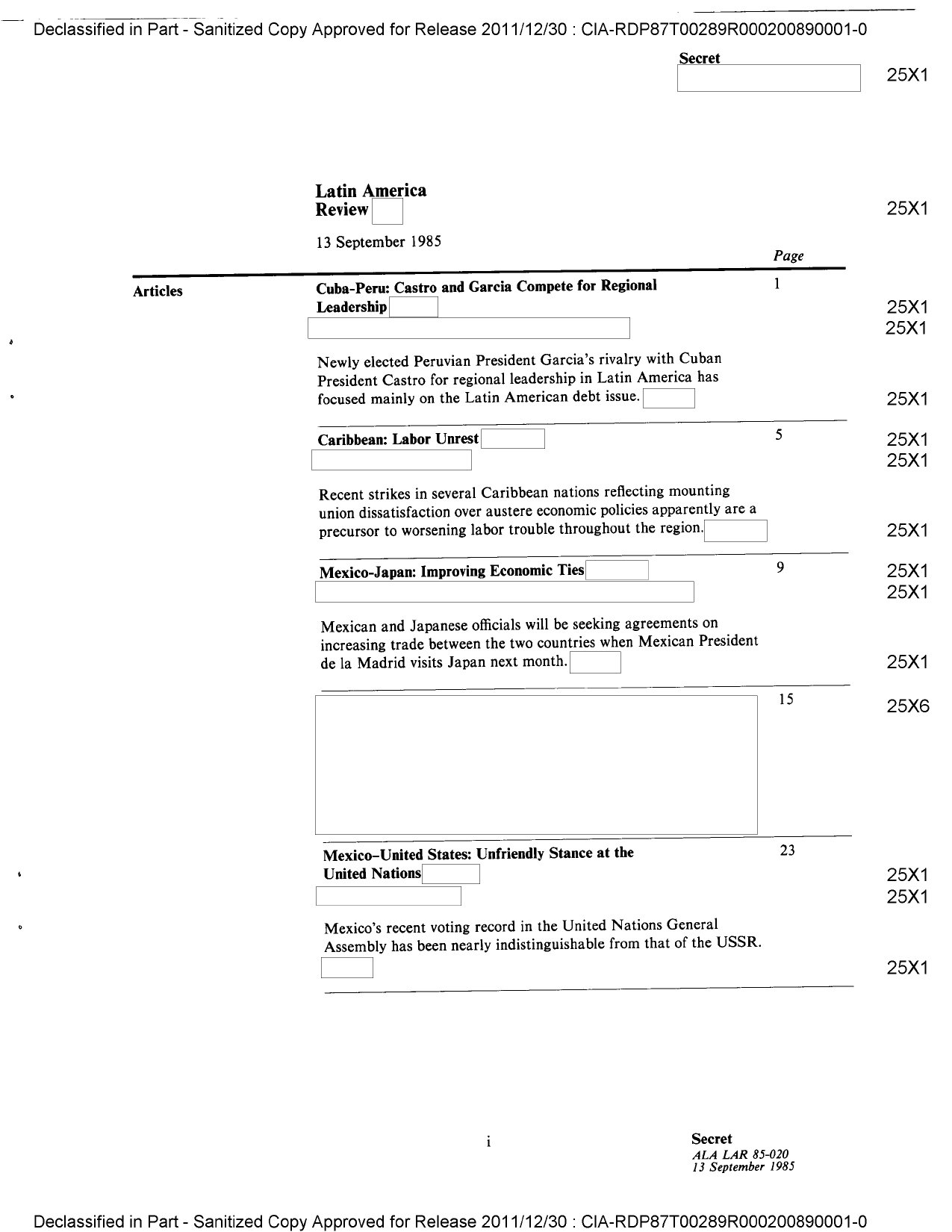
Index
| Title | Page |
|---|---|
| Cuba-Peru: Castro and Garcia Compete for Regional Leadership | 1 |
| Caribbean: Labor Unrest | 5 |
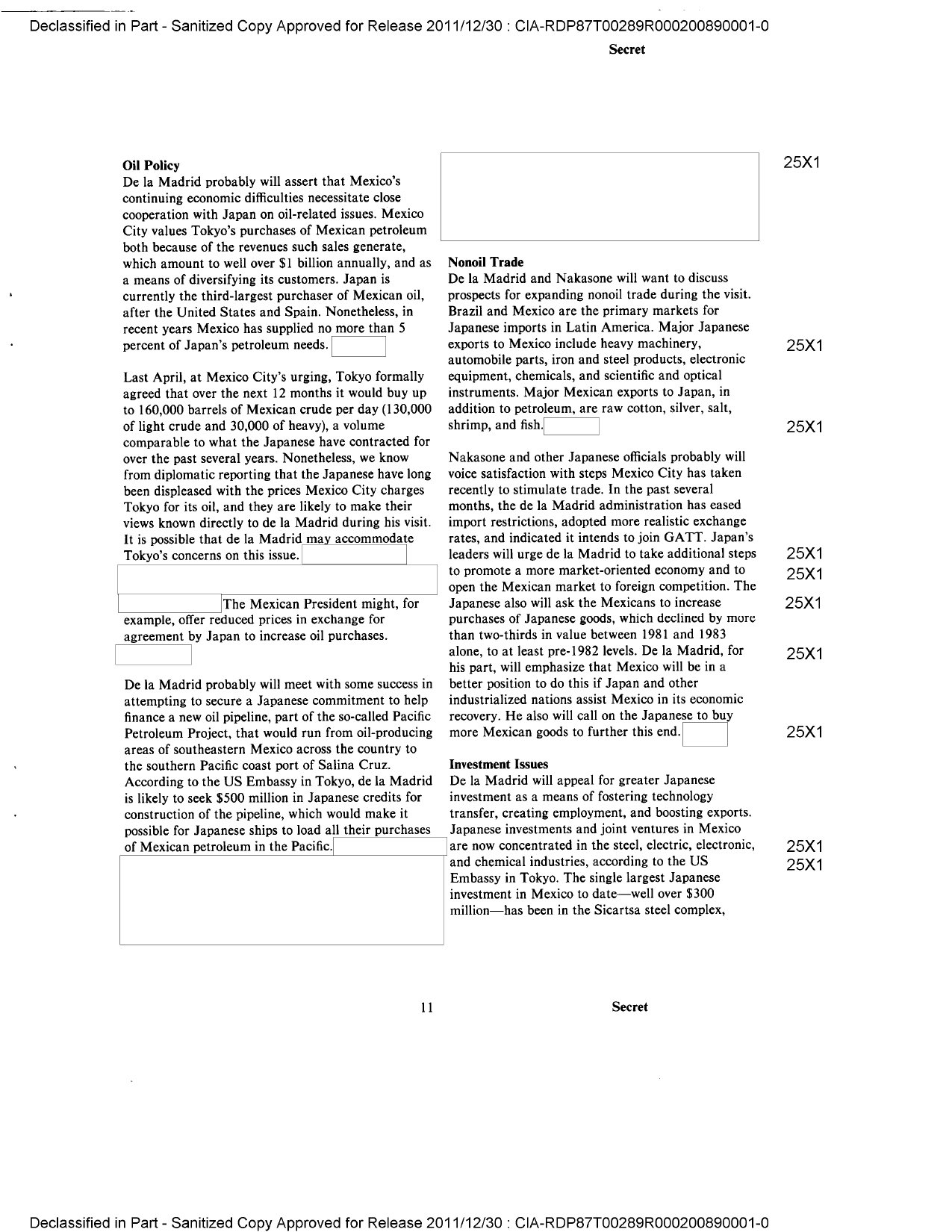
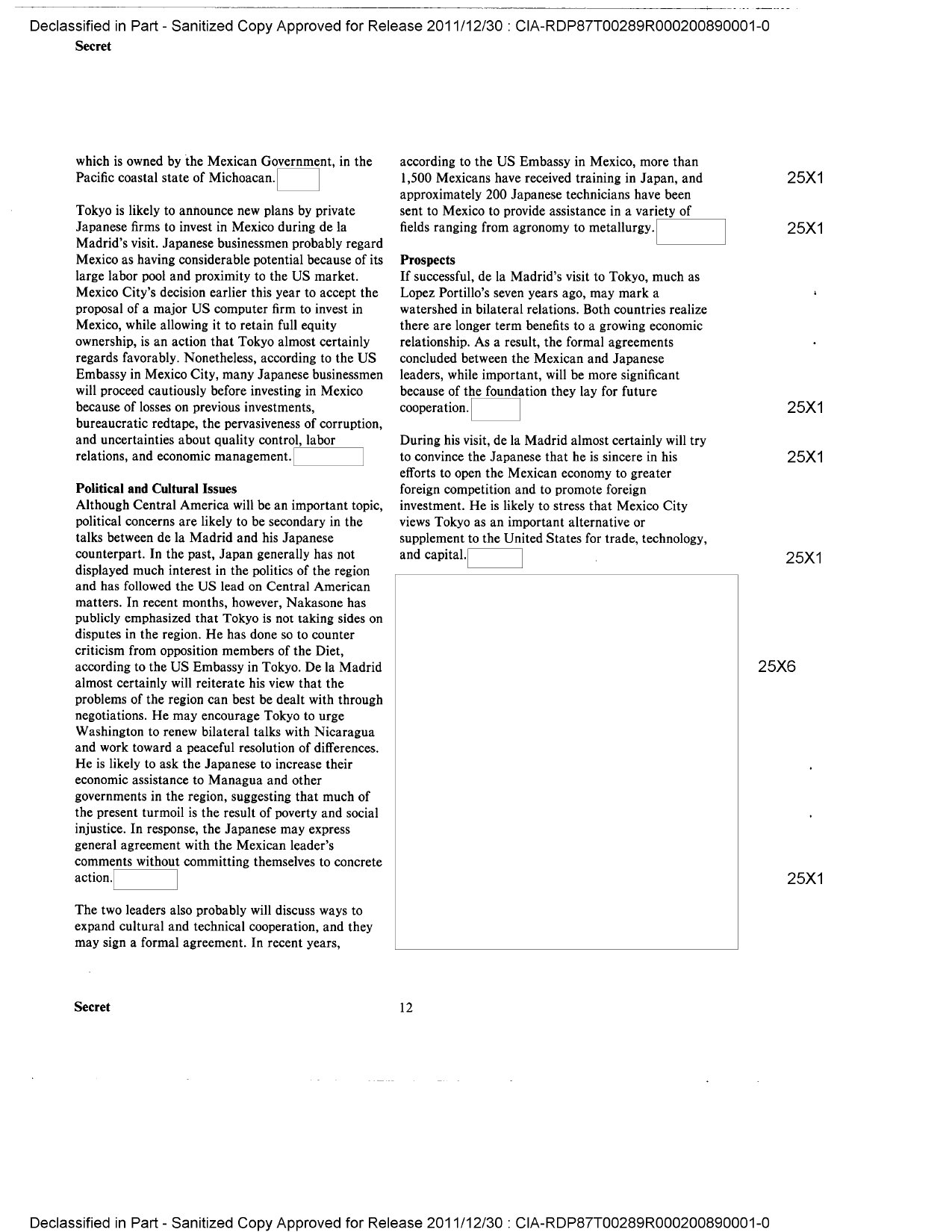
| Mexico-Japan: Improving Economic Ties | 9 |
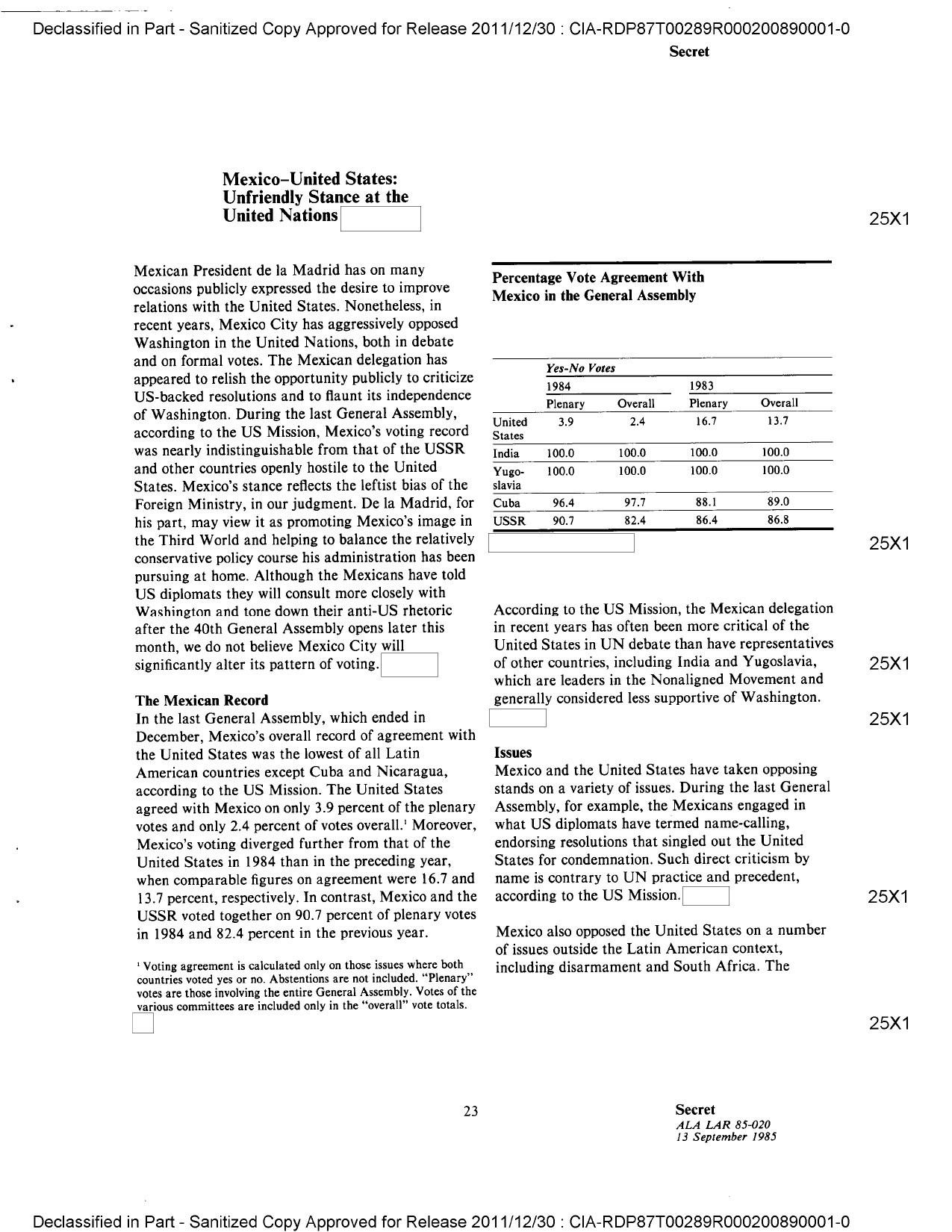
| Mexico-United States: Unfriendly Stance at the United Nations | 23 |
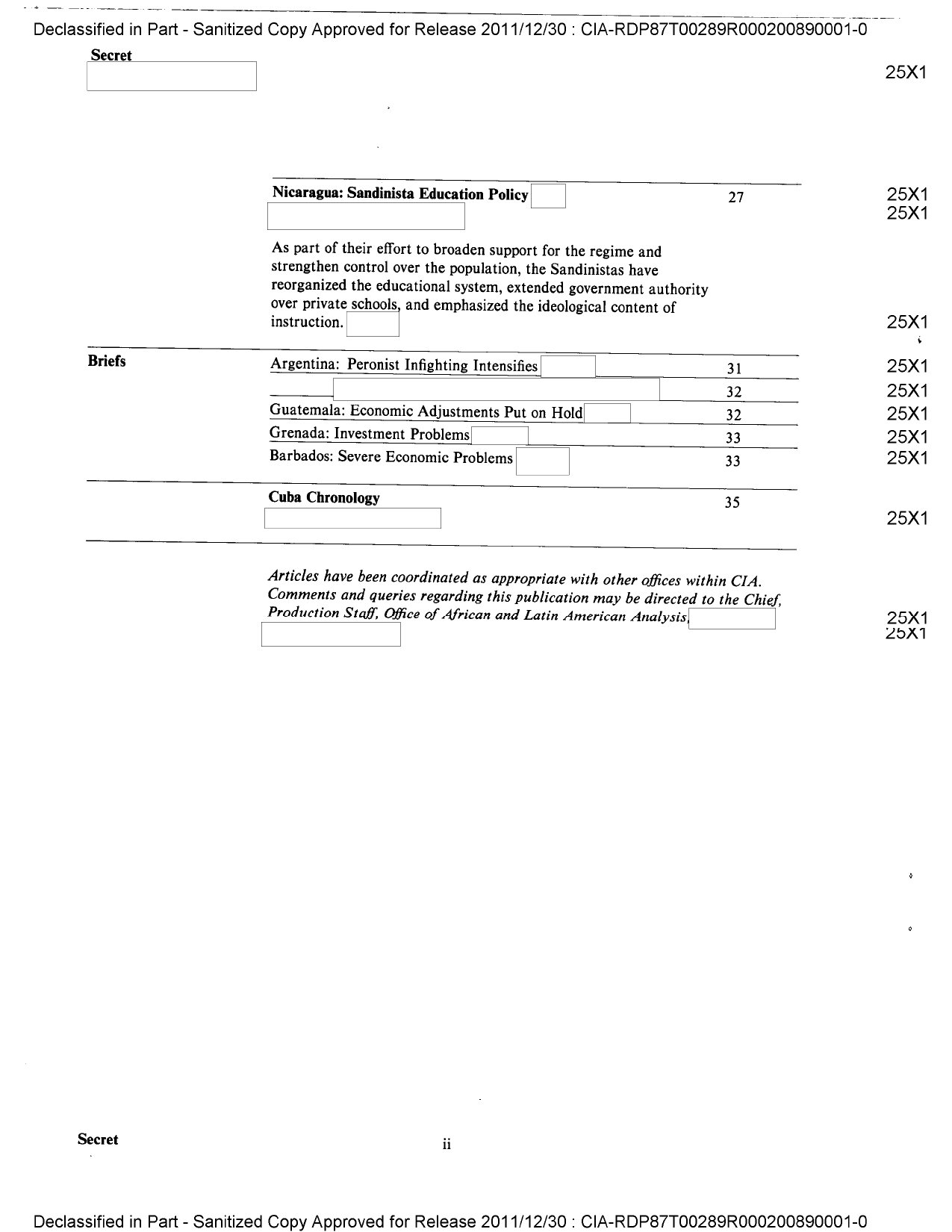
| Nicaragua: Sandinista Education Policy | 27 |
| Argentina: Peronist Infighting Intensifies | 31 |
| Guatemala: Economic Adjustments Put on Hold | 32 |
| Grenada: Investment Problems | 33 |
| Barbados: Severe Economic Problems | 33 |
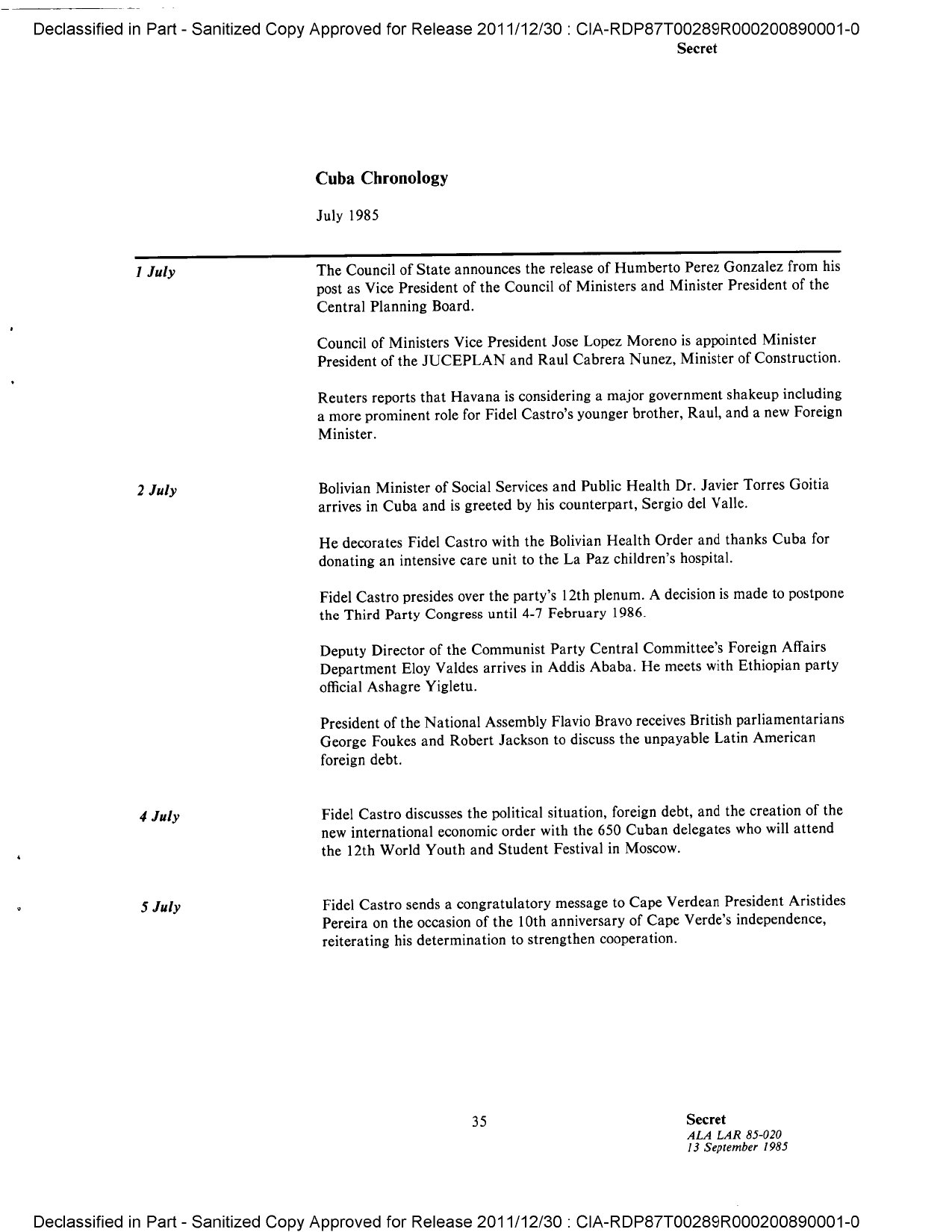
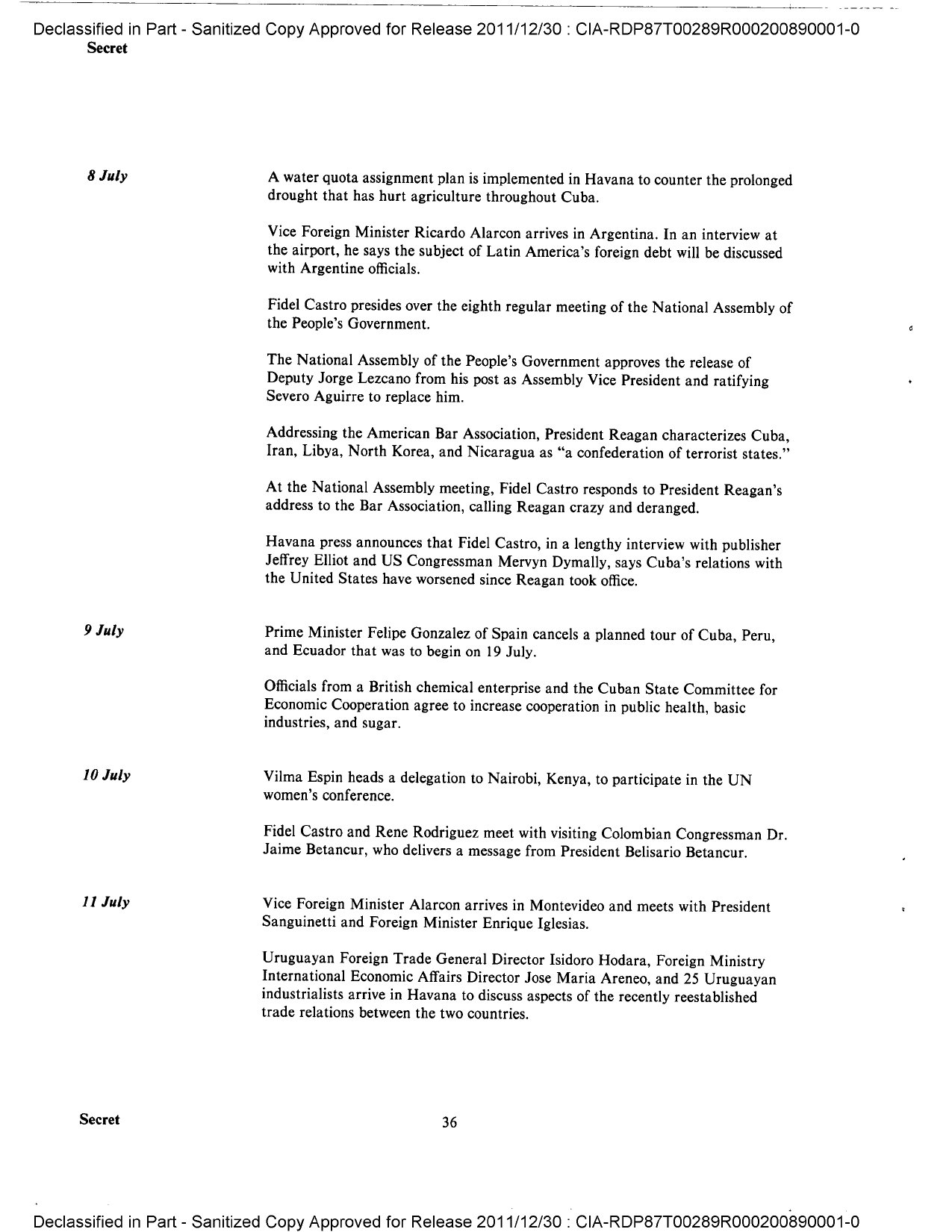
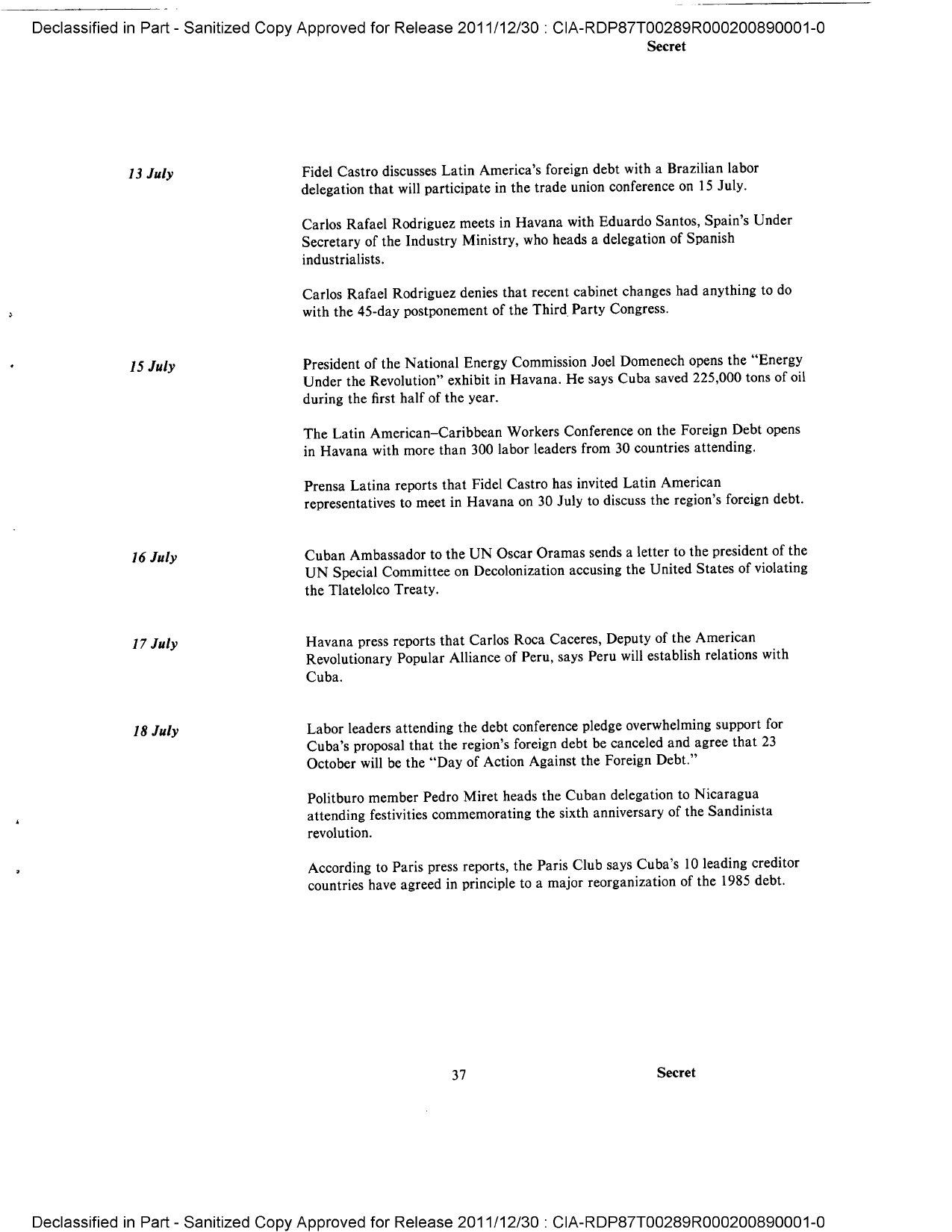
| Cuba Chronology | 35 |
Notes:
- Articles have been coordinated as appropriate with other offices within CIA.
- Comments and queries regarding this publication may be directed to the Chief, Production Staff, Office of African and Latin American Analysis.
Articles
Cuba-Peru: Castro and Garcia Compete for Regional Leadership
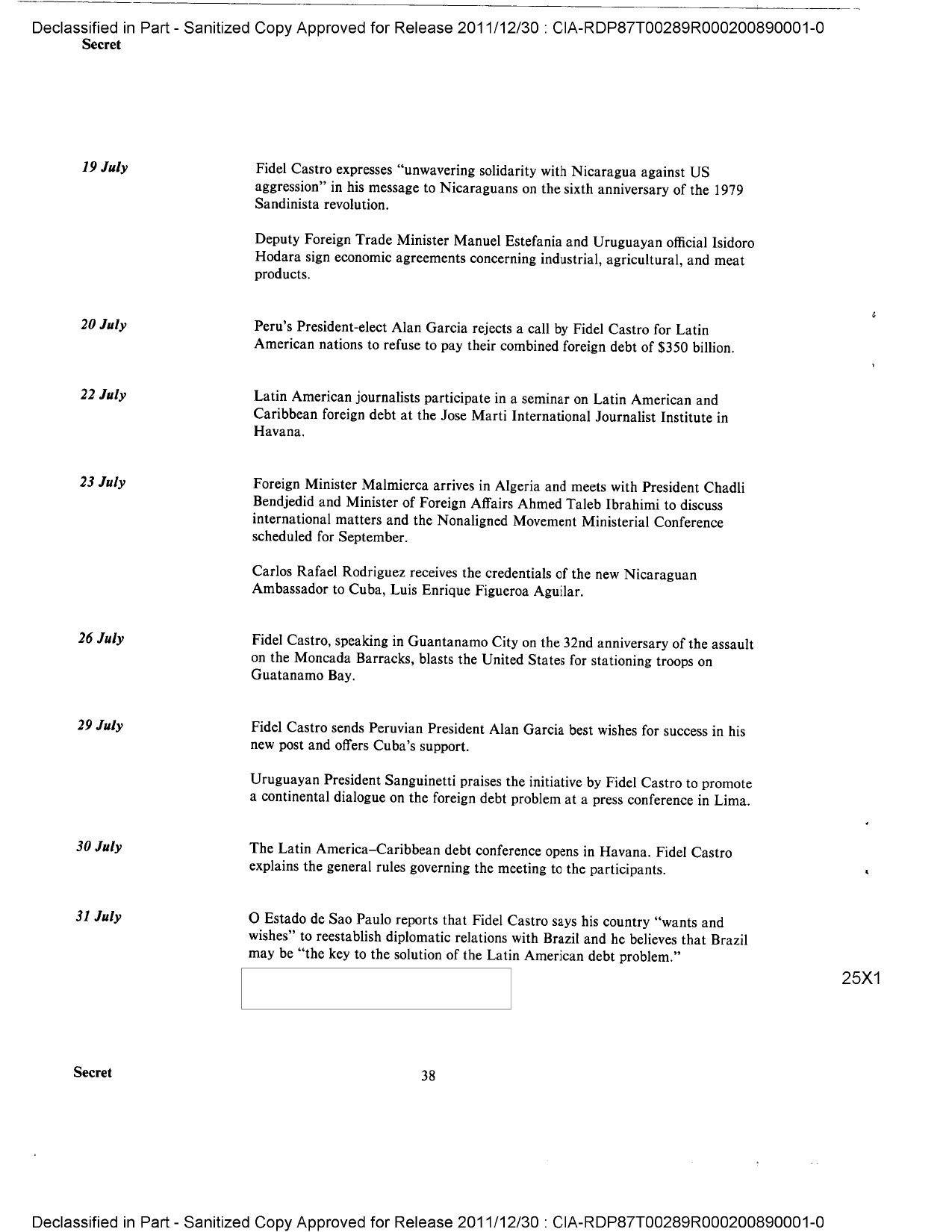
New Peruvian President Alan Garcia’s bid for regional leadership has collided with Fidel Castro’s effort to reduce his regional isolation and gain credibility as the spokesman for Latin America’s economically distressed nations. The debt issue has become the focal point of acerbic personal rivalry, with both leaders using vigorous diplomacy to gain support for their respective radical proposals.
Underlying their differences in ideological and national perspectives is a fundamental clash of egos. Despite the public feuding between the two men, Garcia probably will follow through on his declared intent to normalize presently limited diplomatic relations with Cuba. Nevertheless, more tangible forms of cooperation will be obstructed by personal enmity. Most analysts believe that the Cuban leader, who has a tendency to react emotionally against perceived slights, might try to incite the far left in Peru against Garcia’s leadership if the level of animosity rises. Other analysts, noting the extensive equities Cuba has in Peru, believe that Havana would not resort to such actions at any time in the foreseeable future.
Diplomatic Shadowboxing
Castro, who staked out his position on Third World debt several years ago, seems miffed by Garcia’s more recent seizure of the debt issue. The Cuban leader probably views Garcia’s rhetoric as a threat to his own strategy for becoming Latin America’s debt spokesman.
Before Garcia took power, Castro urged the new government to proceed with caution on debt, suggesting that Garcia let others—that is, Castro—take the lead, according to US Embassy reporting. Castro’s further recommendation that Peru negotiate with the IMF apparently was a tactical move to undercut Garcia as a competitor.
Dismissing Castro’s proposals as rhetoric, Garcia pointed out that it is Peru and other Latin American countries that have incurred a major debt to the West, not Cuba. A short time later, in a conversation with the US Ambassador, Garcia repeated his criticism of Castro, objecting to the Cuban President’s portrayal of the problem as an East-West rather than a North-South issue and declaring his intention not to let Castro wrest leadership from him. Moreover, to combat Castro’s initiatives, Garcia requested information on Cuba’s foreign debt from the US Embassy.
Garcia went public with his complaints against Castro during a press conference in mid-July, calling Castro’s debt moratorium proposal unrealistic and publicly repeating his earlier contention that debt is a North-South problem. He pointedly added that most of Cuba’s trade is with the Soviet Bloc and thus Havana has no real stake in the matter.
Battling for the Limelight
Both Castro and Garcia viewed the Peruvian President’s inauguration as a chance to seize the initiative on regional debt.
Castro wanted an invitation to the inauguration to enhance his credibility as a regional statesman and give him a chance to win other foreign leaders over to his approach. Garcia, out of deference to the United States and possibly wary of being upstaged by the Cuban leader, did not invite Castro. Garcia probably also wished to avoid complications in his efforts to get as many signatories as possible for the Lima Declaration, a communique embodying his views on debt repayment.
Describing Peru as one of the most backward countries in the hemisphere, Castro condescendingly offered Garcia his assistance if Garcia was really “serious” about struggling against mass poverty and suffering. An angry Castro had earlier reacted to Garcia’s July press conference by downgrading the level of Cuban representation at the inauguration, according to the US Embassy.
The official who did attend, Vice President Jose Ramon Fernandez, reportedly had two “difficult conversations” with Garcia and concluded that Peru and Cuba could perhaps be “friends” but not “allies.”
Ego Entanglements
Frustrated by over a decade of pariah treatment in the hemisphere, Castro probably views Garcia’s regional ambitions as those of a brash upstart. Castro may have mistakenly anticipated playing tutor to the new Peruvian President and was indignant that the youthful Garcia presumed to act on his own without seeking Castro’s advice. Castro’s inaugural message was probably intended as a slap on the wrist to bring the errant Garcia back into line.
Prospects
Although current feuding between the two leaders may delay restoration of full diplomatic ties, in time each probably will support normalization of relations for different reasons. Ties to a new democratic regime would help to reduce Havana’s longstanding regional isolation and promote Castro’s sought-after image as a hemispheric statesman. In addition, Castro may find that continuing the bickering would cause problems for him with the USSR. The Soviet leadership probably will remind the Cuban leader not to take any actions that could upset Moscow’s goal of expanded influence in Peru.
For his part, Garcia probably will come to recognize that a failure to paper over differences with Castro would greatly complicate his own efforts to acquire a leadership role in the Nonaligned Movement. Moreover, a prolonged refusal by Garcia to normalize relations with Havana would cause friction with important leftist groups in Peru.
Nevertheless, the early clash of egos suggests that tangible forms of cooperation between the two countries will prove elusive. Havana may hope to pressure the Garcia administration toward more radical, anti-US positions through its links to the left wing of Garcia’s party, the United Left, a faction of the Catholic Church, or a large Communist-dominated labor confederation. If Havana’s attempts to influence Lima directly or to exploit internal tensions prove ineffectual, a frustrated Castro might intensify efforts to cultivate ties to Peruvian insurgents.
Cuban officials, discussing the potential for Cuban influence in Peru, recently stated their belief that, in the long run, armed revolution is the only way to bring about radical change in Latin America. The Cubans further implied they believe the doctrinaire Maoist Sendero Luminoso insurgent group eventually will play a more important role in Peru than a legal leftist coalition. Havana has been frustrated by its inability to establish contact with members of Sendero Luminoso thus far. The Cubans, however, have a more natural ideological affinity for the Tupac Amaru Revolutionary Movement. This group, some of whose leaders received Cuban backing in the 1960s, probably would accept support from Havana, but we have no evidence that Cuba presently is providing any aid.
For his part, Garcia has several political advantages in his contest of wills with Castro. Peru and other Latin American debtor nations share a common problem, in marked contrast to Cuba, whose recently rescheduled debt to the West is relatively small. Garcia’s proposal to tie debt payments to export levels has some appeal in the region, while Castro’s proposal for a debt moratorium has received a cold reception. Moreover, since Castro has no direct stake in the issue, Latin American leaders, typically suspicious of his motives on most issues, may doubt his sincerity.
Although leaders of major Latin debtor nations, such as Mexico and Argentina, have privately expressed strong reservations about the wisdom of Garcia’s approach, they almost certainly admire his courage. If economic conditions in the hemisphere deteriorate further, and contribute to widespread popular discontent, Garcia’s stock may rise rapidly as others come to view him as a more credible regional spokesman than Castro.
Caribbean: Labor Unrest
Strikes in several Caribbean nations over the past few months reflect mounting union dissatisfaction with the imposition of austere economic policies. Although government countermeasures have so far succeeded in keeping a lid on labor dissidence throughout the region, the area’s dim economic outlook suggests that worsening labor troubles are likely in most Caribbean countries. Moreover, opposition leftists will attempt to take advantage of deteriorating economic circumstances by urging trade unionists to switch traditional party allegiances. To the degree these efforts are successful, popular support for the conservative administrations now dominating the region would be sharply reduced and political tensions would rise.
Recent Labor Agitation
The most serious example of a labor backlash over austerity occurred in Jamaica this summer. Following weeks of small-scale, sporadic work stoppages, a three-day general strike in late June by public-sector workers protesting low government wage offers and increased layoffs—at least 6,000 during the last two years—nearly paralyzed the nation. According to press reports, the strike, shutting down utility services and schools throughout the country, was the most serious labor action in over 40 years. Kingston was particularly hard hit, according to the US Embassy. Although private-sector workers did not join the action, commercial activity also was seriously affected. Tourist areas on the island’s northern coast that are major generators of foreign exchange, however, were relatively unscathed.
We believe Prime Minister Seaga’s repeated unwillingness to consult with union leaders over harsh economic adjustment measures contributed to the unusual solidarity among Jamaica’s disparate unions. For the first time in recent years, leaders of the ruling Jamaica Labor Party’s union affiliate, the Bustamante Industrial Trade Union, dropped their longstanding reluctance to press Seaga openly to modify his austerity program and joined other unions in the strike, according to press and US Embassy sources. We believe their willingness to cooperate with the union affiliate of the leftist-leaning People’s National Party, the National Worker’s Union, was the key to the strike’s early success. 25X1
Labor unrest also intensified elsewhere in the region during June and July:
- In the Dominican Republic, leftist-backed unions called a nationwide work stoppage in mid-June to protest President Jorge Blanco’s veto of a minimum wage increase for public-sector workers. The strike was effective in several small interior cities, according to US Embassy reports, but bickering among union leaders limited its success elsewhere.
- In Suriname, bauxite workers at the Royal Dutch Shell-owned Billiton operation held a work slowdown to back up their demands for a 13-percent wage hike.
- In the Netherlands Antilles, a proposed across-the-board wage cut prompted demonstrations by unions that government officials feared might turn violent. 25X1
- In Martinique, striking electrical workers cut power to parts of the islands. 25X1
Government Response
Regional decisionmakers have employed varying tactics to prevent labor unrest from spreading. Jorge Blanco compromised to avoid a confrontation even though labor unions in the Dominican Republic are relatively weak. On the eve of a second planned general strike supported by all major labor confederations in July, the President agreed to raise public-sector wages.
In the Netherlands Antilles, head of government Peters followed a different tactic, quickly postponing implementation of the wage cut and proposing a tax increase instead.
Other leaders took a tougher tack. Jamaica’s Seaga, despite the strong political influence of organized labor, refused to negotiate until the striking workers returned to work, according to the US Embassy. As enthusiasm for the strike waned, Seaga hardened his stand, withdrawing offers to talk with union spokesmen, ordering additional layoffs, and authorizing disciplinary action against recalcitrant strikers. He also deployed security forces to operate key public services. Union leaders, stymied by the Prime Minister’s moves, decided to “suspend” strike action.
For his part, Surinamese leader Bouterse, after originally endorsing labor’s moves, withdrew his support and urged workers to end their slowdown. Without the backing of the Surinamese strongman, the union had little choice but to at least temporarily quiet their demands for a wage boost.
Opposition Moves
Minority parties on the left clearly are trying to take advantage of growing union frustration to enhance their own chances at the polls. In our view, opposition strategists have focused on winning labor support as the key to challenging the political status quo.
For example, the US Embassy in Kingston indicates that Michael Manley’s People’s National Party tried to use the recent strike to promote a longtime goal by generating labor pressure on Seaga to call early elections. At the same time, US officials indicate that leftists in Dominica courted labor heavily in the general election last July. According to US officials, separatist groups in Guadeloupe have successfully exploited the island’s racial tensions and high unemployment in spearheading pro-independence demonstrations and labor strikes in July.
Leftists in the Dominican Republic probably have made more progress than their counterparts elsewhere in expanding support among unionists. According to US Embassy officials, various factions of the left control some 30 percent of unionized labor.
Leftist efforts to shore up their traditionally weak links with organized labor are being bolstered by outside aid. The Marxist Worker’s Party of Jamaica received $40,000 from North Korea to help build links with disgruntled unionists. Recognizing the crucial role of labor unions in most Caribbean political systems and their loss of influence with most area governments, Havana recently has sponsored several conferences of regional labor groups. Similarly, Moscow has made overtures toward unionists in Suriname by inviting them to attend a conference in the USSR.
What Lies Ahead
We believe deteriorating economic conditions will continue to disrupt labor peace in the Caribbean over the near term, but several factors will limit labor’s willingness to use confrontational tactics. US missions throughout the Caribbean indicate that the principal concern of many workers is job preservation. It is generally understood that excessive wage demands could well force employers, particularly multinational firms with competitive options elsewhere, to shut down. In some countries, factionalism among the various unions will work against concerted action.
Nevertheless, most workers are unlikely to mute their responses to sacrifice indefinitely. Those in the oil-based economies—particularly Trinidad and the Netherlands Antilles—are unaccustomed to the harsh austerity we foresee in the next few years. Because we doubt that an emphasis on job preservation will suffice for long during a period of protracted stagflation, rank-and-file pressure for more militant stands is likely to grow. For their part, many union leaders, anxious to prevent inroads by radical organizers, are likely to press employers and governments alike to implement more expansionary economic policies.
We believe any restructuring of traditional union-party alliances will be gradual, but the current trend is likely to continue until the region’s economic deterioration is reversed.
Source:
Link:
Internal Link:
Date:
September 13, 1985