Latin America Review – The Caribbean Vulnerabilities to Libyan Inroads – 18 July 1986
CIA-RDP87T00289R000301600001-9
Overview
Many Caribbean countries or organizations that were receptive to overtures from the Qadhafi regime have backed away from earlier commitments, but Tripoli has some prospects for generating unrest in Haiti and the French Departments of Guadeloupe, Martinique, and French Guiana.
Haiti
The willingness of some leftists to accept Libyan aid may provide the best opportunity for Tripoli to expand its influence in the Caribbean through support of revolutionary groups.
Suriname
Tripoli’s failure to provide promised economic aid prompted Surinamese leader Bouterse to back out of a military accord with Libya, but he probably will keep open the door to closer ties to Tripoli.
French Departments
Growing ties between radical separatists and Tripoli suggest that a recent increase in the separatists’ use of violence has been partially Libyan-inspired.
English-Speaking Countries
Libya still has strong ties to leftist leaders in Dominica, Antigua, St. Lucia, and a loosely organized regional group, but most leftists in the English-speaking islands fear the consequences of the violent tactics favored by Tripoli.
Overtures to Muslims
The generally apolitical nature of Caribbean Muslims is limiting the success of Tripoli’s campaign to gain influence among Muslims in the region, but small groups of radical Black Muslims remain susceptible to Libyan initiatives.
Cuba’s Response
Increased Libyan involvement in the Caribbean has led to competition with Cuba for the loyalty of the small leftist movements in the region.
Articles have been coordinated as appropriate with other offices within CIA.
Comments and queries regarding this publication may be directed to the Chief, Production Staff, Office of African and Latin American Analysis.
Articles
Many Caribbean countries or organizations that initially demonstrated a willingness to forge closer ties to Libya in exchange for financial favors have backed off earlier commitments, but Tripoli is continuing its efforts to undercut US influence. The Qadhafi regime has some prospects for generating unrest in Haiti and the French Departments of Guadeloupe, Martinique, and French Guiana, but has experienced setbacks elsewhere.
Several factors have emerged to reduce the region’s receptiveness to Libyan overtures:
- Libya’s support for terrorist activity at the expense of legitimate political gains has strained relations with leftist groups, particularly in the English-speaking eastern Caribbean. Area leftists, intent on making legitimate electoral gains, rebuffed Tripoli’s call for participation in a global terrorist network last fall.
- Tripoli’s poor track record in following through on aid promises has lessened its credibility with Caribbean governments. Partly as a result of Libya’s nonfulfillment of economic aid promises, Suriname has apparently backed out of a reported military accord.
- Local governments are aware of Washington’s concern with Libyan activities in the region, and this has dampened their interest in expanding contacts with Tripoli. As part of an overall strategy of improving relations with the United States, Guyana resisted strong Soviet pressure to condemn the US bombing of Libya, and so far has been unwilling to permit the reopening of a People’s Bureau in Georgetown, according to the US Embassy there.
- Leftists’ expectations that local security services would quickly identify, arrest, and prosecute terrorists have undercut schemes for such activity.
In some countries, however, the immediate danger of Libyan-backed violence remains high:
- In Haiti, the fragile government is ill equipped to monitor or control the activities of the Libyan-funded Popular Front for the Liberation of Haiti. [CENSORED] two members of this group approached other Caribbean leftists for assistance in smuggling Libyan-supplied small arms into Haiti. Although there is no evidence that the Popular Front enjoys much domestic political support, even a small group of subversives could cause serious problems for the Namphy government if they were to undertake terrorist or sabotage activity.
- In the French Departments, radical separatist groups apparently have decided to increase bombings with Libyan support. Although the groups are unlikely to achieve their goal of independence, sporadic terrorist activity will strain the capabilities of the islands’ security forces and drive down important tourist earnings.
Tripoli’s involvement in the Caribbean is seen by Cuba as interference in an area considered by the Castro regime as its own sphere of influence. Cuba, in our judgment, considers Libya’s tactics as inappropriate and counterproductive. As a result, Havana is beginning to take actions to counter the Libyan campaign.
Nevertheless, over the longer term, the risk of Libyan-backed violence will grow throughout the region if deteriorating economic or security situations favor the growth of nascent radical splinter groups, or if leftists abandon their current strategy of seeking legitimate political gains:
- In Guyana and Trinidad and Tobago, small radical groups sympathetic to Libya could use growing unemployment to broaden their membership.
- In Jamaica, a slackening in security forces’ capabilities could embolden violence-prone leftists.
- In Dominica and Jamaica, failure to make electoral gains could encourage leftist leaders to abandon their current policies of moderation and cause them to revert to more radical tactics espoused in the past.
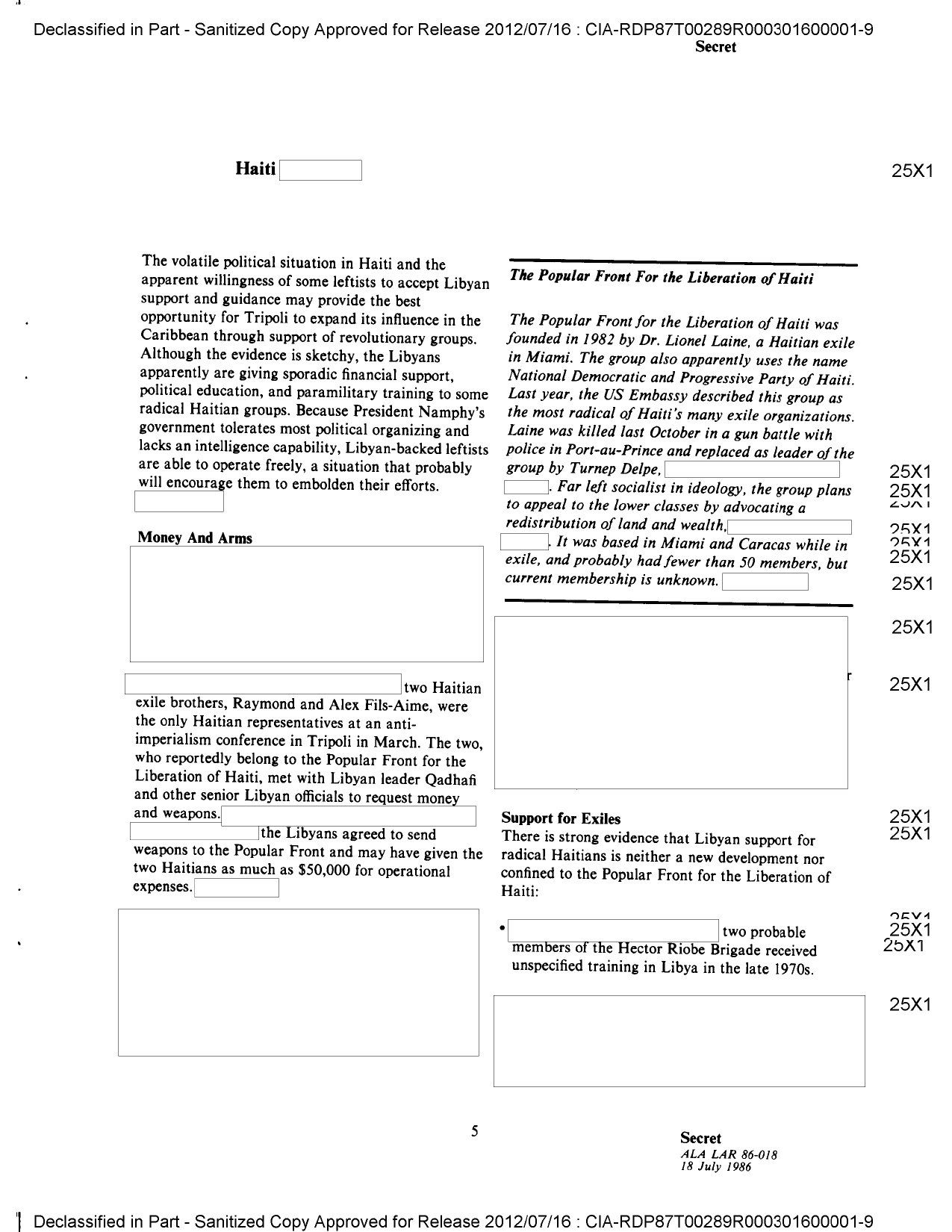
Haiti
The Popular Front For the Liberation of Haiti
The Popular Front for the Liberation of Haiti was founded in 1982 by Dr. Lionel Laine, a Haitian exile in Miami. The group also apparently uses the name National Democratic and Progressive Party of Haiti. Last year, the US Embassy described this group as the most radical of Haiti’s many exile organizations.
Laine was killed last October in a gun battle with police in Port-au-Prince and replaced as leader of the group by Turnep Delpe.
Far left socialist in ideology, the group plans to appeal to the lower classes by advocating a redistribution of land and wealth. [CENSORED]
It was based in Miami and Caracas while in exile, and probably had fewer than 50 members, but current membership is unknown.
The volatile political situation in Haiti and the apparent willingness of some leftists to accept Libyan support and guidance may provide the best opportunity for Tripoli to expand its influence in the Caribbean through support of revolutionary groups.
Although the evidence is sketchy, the Libyans apparently are giving sporadic financial support, political education, and paramilitary training to some radical Haitian groups.
Because President Namphy’s government tolerates most political organizing and lacks an intelligence capability, Libyan-backed leftists are able to operate freely, a situation that probably will encourage them to embolden their efforts.
Money And Arms
Two Haitian exile brothers, Raymond and Alex Fils-Aime, were the only Haitian representatives at an antiimperialism conference in Tripoli in March.
The two, who reportedly belong to the Popular Front for the Liberation of Haiti, met with Libyan leader Qadhafi and other senior Libyan officials to request money and weapons.
The Libyans agreed to send weapons to the Popular Front and may have given the two Haitians as much as $50,000 for operational expenses.
Support for Exiles
There is strong evidence that Libyan support for radical Haitians is neither a new development nor confined to the Popular Front for the Liberation of Haiti:
- Two probable members of the Hector Riobe Brigade received unspecified training in Libya in the late 1970s.
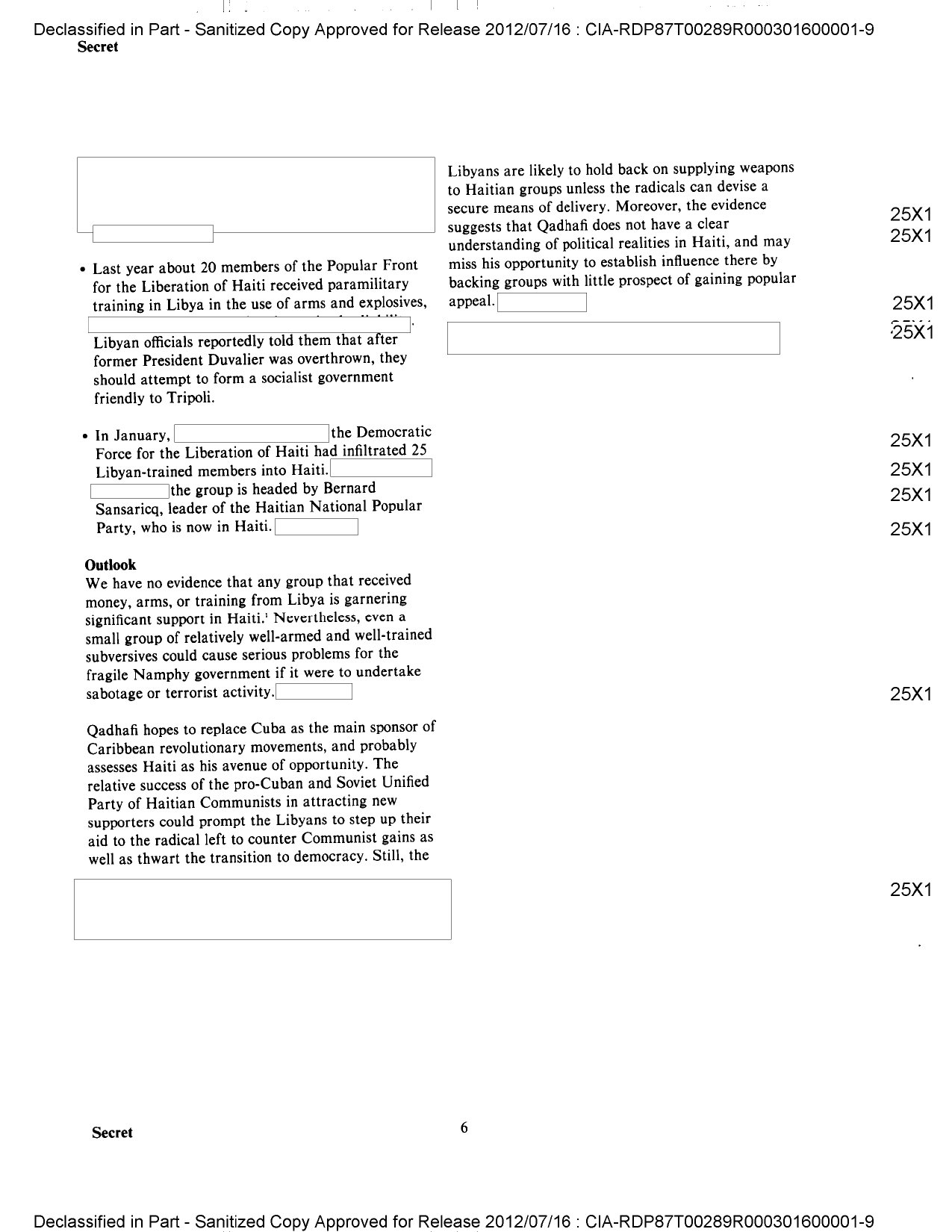
- Last year about 20 members of the Popular Front for the Liberation of Haiti received paramilitary training in Libya in the use of arms and explosives. Libyan officials reportedly told them that after former President Duvalier was overthrown, they should attempt to form a socialist government friendly to Tripoli.
- In January, the Democratic Force for the Liberation of Haiti had infiltrated 25 Libyan-trained members into Haiti.
The group is headed by Bernard Sansaricq, leader of the Haitian National Popular Party, who is now in Haiti.
Outlook
We have no evidence that any group that received money, arms, or training from Libya is garnering significant support in Haiti.
Nevertheless, even a small group of relatively well-armed and well-trained subversives could cause serious problems for the fragile Namphy government if it were to undertake sabotage or terrorist activity.
Qadhafi hopes to replace Cuba as the main sponsor of Caribbean revolutionary movements, and probably assesses Haiti as his avenue of opportunity.
The relative success of the pro-Cuban and Soviet Unified Party of Haitian Communists in attracting new supporters could prompt the Libyans to step up their aid to the radical left to counter Communist gains as well as thwart the transition to democracy.
Still, the Libyans are likely to hold back on supplying weapons to Haitian groups unless the radicals can devise a secure means of delivery.
Moreover, the evidence suggests that Qadhafi does not have a clear understanding of political realities in Haiti, and may miss his opportunity to establish influence there by backing groups with little prospect of gaining popular appeal.
Suriname
In late 1984 Suriname seemed to offer the greatest opportunity for Libya to expand its influence in the Caribbean basin. The military regime headed by Comdr. Desi Bouterse signed a military pact with Tripoli and later received promises from Libya of up to $100 million in economic aid. Since then, however, relations have cooled as a result of unfulfilled bilateral agreements and Surinamese sensitivity to anti-Libyan Western pressure.
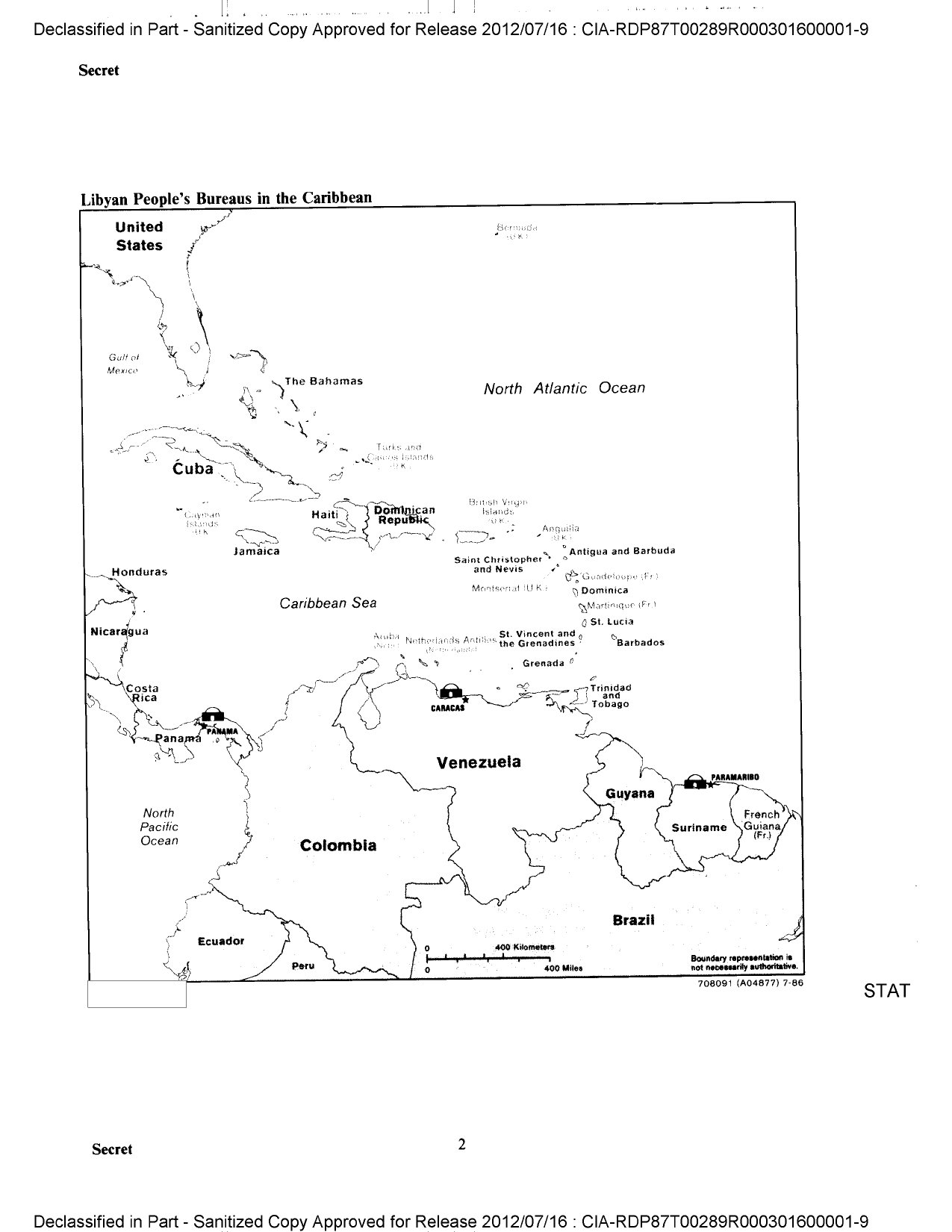
The Libyans reportedly failed to provide promised economic aid, prompting Bouterse to back out of the military accord. Nevertheless, the Surinamese leader continues to permit radicals from throughout the region to meet at the Libyan People’s Bureau in Paramaribo, and probably will keep open the door to closer ties to Tripoli.
Reneging Partners
Under the military accord, Libya was to provide military training to a number of Surinamese armed forces cadets as well as to members of Suriname’s security services. In return, Suriname would allow Libya to use Surinamese territory to transship arms and material to proindependence forces in the French Departments, and would permit members of the Libyan Revolutionary Committee to conduct political indoctrination in Suriname. The agreement also stipulated that the two countries would allow reciprocal use of military and civilian airports, land, air space, and territorial waters.
The Surinamese ruling junta apparently began to have second thoughts about the agreement soon after it was signed. On one occasion, Tripoli sent a special aircraft to Paramaribo to pick up about 100 Surinamese for military and ideological training in Libya. Bouterse sent back only 14 trainees. This mission cost the Libyan Government close to $200,000. Paramaribo’s refusal to abide by the agreement has apparently convinced Tripoli that Bouterse is lacking in revolutionary fervor, and is therefore ineligible for the $100 million in aid pledged to Suriname in early …
According to the US Ambassador, this aid was the primary reason for Paramaribo’s interest in Libya. When it did not materialize, Paramaribo began to send Tripoli signs that it no longer welcomed closer relations. For example, Paramaribo has refused Libyan requests to open a cultural-educational center in the Surinamese capital. Suriname reportedly sent no official delegates to the anti-imperialist conference in Tripoli last March. Official statements following the US airstrike on Libya also avoided any overt criticism of the United States.
Tilt Toward the West
Libya’s waning influence reflects Bouterse’s recent efforts to improve relations with the West. To encourage US and Dutch aid, the regime has taken token steps toward democratization, and probably views close ties to Tripoli as a barrier to renewed assistance. In addition, junta members may fear that large-scale military cooperation would lead to a Grenada-style intervention in Suriname.
Open Door
Nevertheless, the Surinamese Government continues to cooperate with Libya to a limited degree, and could increase links if Western economic aid is not forthcoming. Although the government has the capability to control leftist activities in Suriname, it allows the Libyan People’s Bureau to serve as a base for contact with separatists from the French Departments and with radicals from throughout the Caribbean.
Libya would like to use Suriname as a coordinating base for operations in French Guiana and in neighboring countries that have separatist or radical groups. The People’s Bureau in Paramaribo has reportedly been involved in plans to commit terrorist acts against US embassies in the region.
Suriname’s tolerance for such activities probably reflects unwillingness to close the door to possible Libyan economic aid. Without new financial assistance, the economy—limping along since the early 1980s—will register substantial reverses this year as foreign exchange reserves are depleted and imports are slashed. Potential Western aid donors thus far have shown no indication of reversing their suspension of assistance imposed after the regime murdered political opposition leaders in 1982.
In addition, military discontent with the handling of the economy is growing. The US Ambassador states that a fast and steep economic decline could spark a coup attempt. If serious challenges to his power emerge, Bouterse could reverse himself again and offer concessions to the Qadhafi regime—such as using Suriname as a base of operations—in exchange for greater Libyan assistance.
French Departments
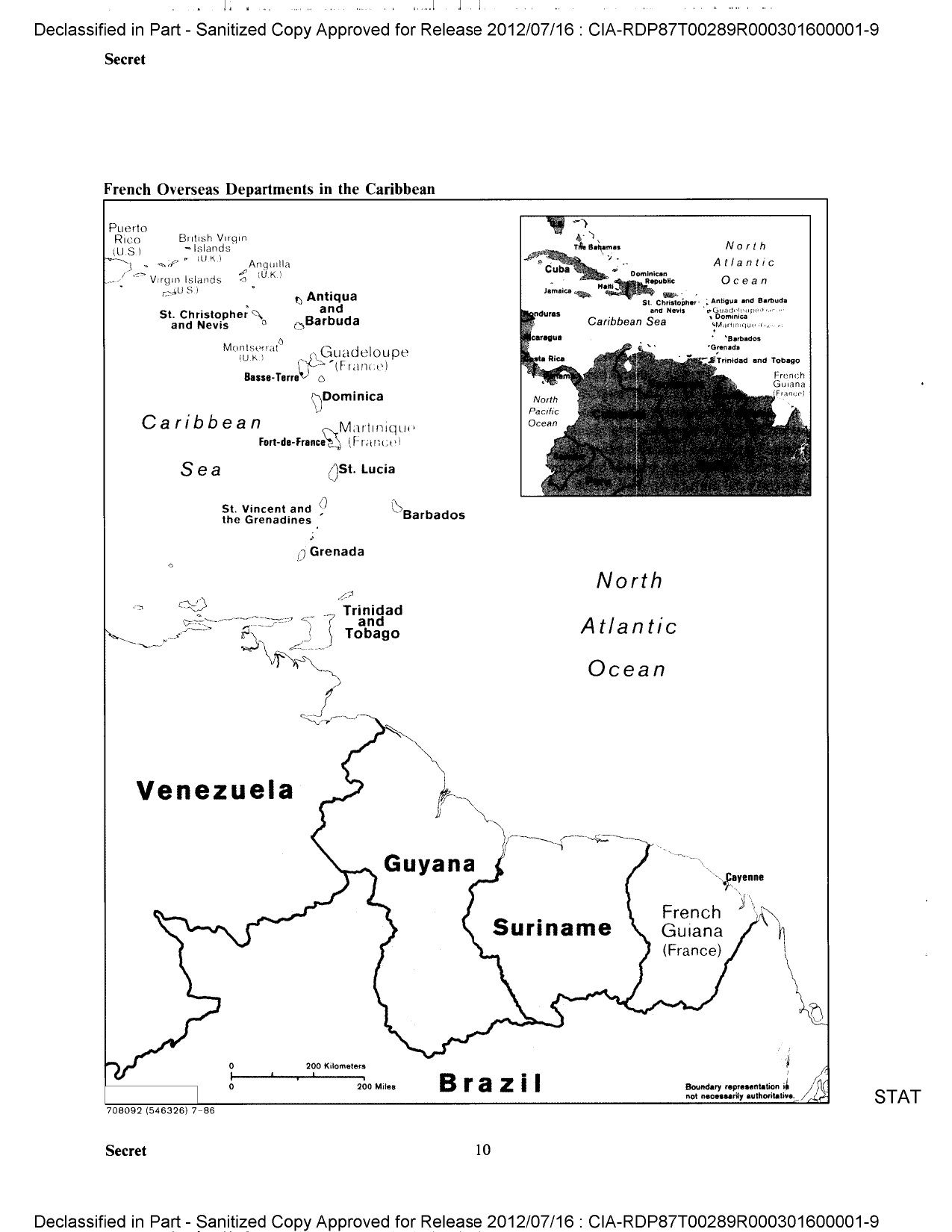
French Caribbean separatists, after 20 years of sporadic violence and unsuccessful proindependence activity, are demonstrating a broader approach that portends a more active and militant independence movement. Since 1983, separatists in Guadeloupe, Martinique, and French Guiana have increased their use of violence and tried to strengthen their organizations and popular support to increase pressure on the Mitterrand government.
Growing ties between Tripoli and radical separatists suggest that some of this violence has been Libyan inspired. While the separatists’ multifaceted approach has met with little success, greater Libyan involvement could improve their ability to act as a destabilizing force in the region.
Separatist Groups
The refusal of local leaders of the French Communist and Socialist parties to support independence publicly, calling instead for some form of autonomy that would retain generous subsidies from Paris, spawned the formation of a number of proindependence parties and splinter groups.
In Martinique, for example, the Revolutionary Group of Socialists and the Communist Party for Independence and Socialism became offshoots of the Martinique Communist Party in the early 1970s and 1980s. These groups have been unable to attract much support from Communist and Socialist constituents, however, and have had little impact on local politics, according to the US Consul General.
The Martinique Independence Movement, another proindependence group, has limited public support, mostly among young intellectuals. French Guiana also has several splinter proindependence groups. The Anti-Colonial and Anti-Imperialist Guianese Nationalists’ Party has a small but militant membership, and has begun to forge close ties to Libya. The Union of Guianese Workers became politically involved in supporting independence, but has decided to withdraw from politics and return to labor activity, while its leadership plans to form a new party to take its place. Although it has publicly condemned terrorism, the labor group says violence may become necessary for liberation.
Because Guadeloupe—unlike Martinique and French Guiana—has no official independence parties, it has had more extraconstitutional separatist activity. In recent years, the Popular Union for the Liberation of Guadeloupe (UPLG) has emerged as the most active independence group in the Caribbean departments, according to local officials.
For the past year, we have seen the following evidence that the UPLG has adopted a broader and more active approach to achieving independence:
- The party has been trying to cultivate support among youth and workers hurt by Guadeloupe’s depressed economy. The US Consul General reports that local officials believe the UPLG played a major role in a number of recent strikes.
- The UPLG and other separatist groups have been taking steps to exploit racial tensions. For example, violent protests for four days by about 600 separatists and a strike in Guadeloupe last July—supporting a black separatist leader imprisoned for attacking a white teacher—succeeded in forcing the release of the prisoner.
- The UPLG, along with other proindependence organizations, has also increased contacts with Caribbean leftists and has hosted several regional conferences on labor and leftwing political unity. The UPLG provided cash for the leftist campaign in Dominica last year.
Use of Violence
Unlike fellow leftists in the English-speaking Caribbean, separatists in the French Departments have not shrunk from the use of violence for political ends. Frustrated by the lack of progress through political action, a small number have formed a variety of clandestine terrorist groups.
The US Consul General reports that less than 50 separatists have used violent tactics and that Guadeloupe groups tend to have overlapping memberships.
In 1983, a series of 17 coordinated bombings in all three departments and in Paris by the newly formed Revolutionary Caribbean Alliance (ARC) suggested the development of a more sophisticated organizational network of radical separatists. Between 1983 and late 1984, when 20 of their leaders were arrested, ARC may have been responsible for over 60 bombings that left seven dead, numerous injured, and extensive property damage, according to local officials. The ARC used more spectacular actions than earlier separatist groups, and shifted from bombing unoccupied government property to targeting tourist spots.
The Libyan Connection
The willingness of the separatists to use violence apparently has attracted Libya’s attention. French independence radicals have been meeting with Libyan officials in Panama, Suriname, and Tripoli since at least early 1985.
In April 1985, Libya funded a conference of independence groups from French territories in Guadeloupe.
In addition, a number of French separatists have received military training from the Libyans. Last year, Tripoli reportedly gave 11 separatists from French Guiana several months of paramilitary and terrorist training in Libya.
Three Guadeloupans left for training in Libya in April 1986, and the UPLG plans to send one member per month to Libya for training over the next year, according to US diplomatic reporting.
In February and March 1986, French Caribbean separatists—most likely aided by Tripoli—resumed acts of violence to disrupt elections. At that time, two separatist groups in Guadeloupe had sizable weapons caches, including hand grenades from Libya. Some separatists were anxious to resume bombings to justify Libyan aid.
At least four separatist leaders, some of whom had already received Libyan aid, were reportedly prepared to push for violent action.
Libya apparently intends to expand its support for the proindependence groups. For example, members of ARC have been organizing a conference of pro-Libyan Caribbean and Latin American radicals to be held in French Guiana in July. Because this group lacks adequate financial resources, Tripoli is probably providing funding for the conference. The Libyans have also agreed to finance the establishment of secretariats for the various independence groups in Paris and Guadeloupe.
Libyan support for an interisland ferry service intended to transport arms, material, and possibly personnel to French independence radicals.
The UPLG plans to step up its use of violence with Libyan help and may target the tourist industry.
Outlook
Increased training and funding from Libya could significantly improve the separatists’ organization and enhance their capabilities for violence.
Paris has been concerned enough about separatist agitation and Libyan meddling to upgrade its security capabilities in the region. France’s ability to counter the separatists may be hampered, however, by reported infiltration of key government services by proindependence sympathizers. This infiltration is so extensive that separatist sympathizers are able to operate a clandestine radio from inside military headquarters, and on one occasion permitted Roosevelt Douglas to enter Guadeloupe in violation of a ban by French authorities.
More violence, especially if it is targeted at French officials or the tourist industry, would almost certainly prompt a massive crackdown by French authorities.
France’s hardline conservative Minister of Overseas Departments and Territories, Bernard Pons, is probably prepared to bolster significantly the security forces and gendarmerie in the same way that he has dispatched forces to police the more vocal and larger independence movement in New Caledonia.
It is virtually impossible that France would grant independence as long as the vast majority of the Caribbean population favors continued incorporation in France. Greater Libyan support may, however, increase the costs of French control.
English-Speaking Countries
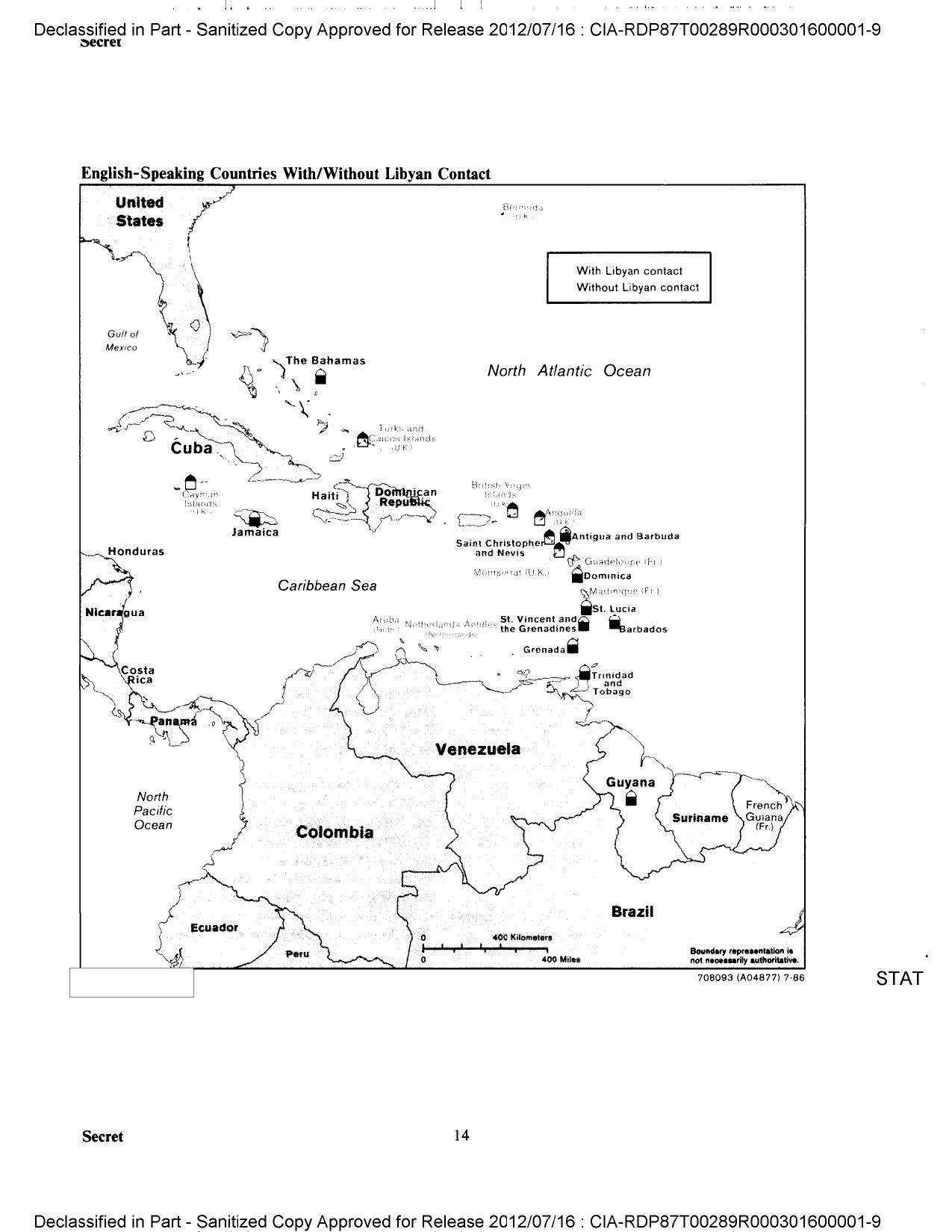
Although leftists initially were willing to cooperate with Tripoli as it sought broader contacts in English-speaking Caribbean countries, relations have deteriorated in the wake of Libya’s recent push for violence in the region. Most Caribbean leftists are attracted by the prospect of Libyan financial assistance, but fear the consequences of violent tactics. Nevertheless, the Libyans still have strong ties to leftist leaders in Dominica, Antigua, St. Lucia, and the faltering Caribbean Nation Movement (CNM)—a loosely organized regional leftist group.
While pressing regional leftists to adopt violent tactics, Libya also is trying to improve ties to selected governments in the region. For example, Tripoli is seeking aid agreements with Guyana, and plans to approach the newly elected government in Barbados about improving relations. So far, however, these efforts have achieved few gains. Most Caribbean governments are highly suspicious of the Qadhafi regime. Over the near term, at least, Tripoli will be hard pressed to score significant gains in the region.
Early Initiatives
In the late 1970s and early 1980s Caribbean leftists, including government officials, responded favorably to Libyan offers of money in return for their support of an anti-US position. Trinidad and Tobago was the primary target for Libyan overtures in the early 1980s because of its influential position in the region. To bolster relations, Libya reportedly offered to support Trinidad and Tobago’s efforts to join OPEC. Other Caribbean nations also were courted by Tripoli during this period. Manley’s party did maintain close ties to Libya. Libyan influence in Grenada [25X1] was expanding until the fall of Maurice Bishop in 1983, after which diplomatic relations were broken. Tripoli also funded leftist organizations, [25X1] Libya absorbs all of the CNM’s operating expenses.
Rejection of Violence
Caribbean receptiveness to Libyan overtures declined in March after delegates attending the International Conference of the Center for Anti-Imperialism in Tripoli were told that only the armed revolutionary approach to solving international problems would receive full Libyan support.
Tripoli would provide only token funding to Caribbean groups that continue to eschew terrorist tactics. Libya was not forthcoming with promised funding for a CNM congress planned for later this year, probably due to the failure of CNM members to instigate [25X1] “revolutionary acts.” Caribbean unwillingness to adopt violent tactics springs from a variety of concerns. Leftists, pleased by their ability to make gradual electoral gains, are unwilling to alienate voters. Both Jamaican opposition leader Michael Manley and Ralph Gonsalves, leader of the Movement for National Unity in St. Vincent, maintain their distance from the CNM because they feel it is too radical and, therefore, a political liability.
Some radicals are deterred by local security forces. Jamaica’s Hervin Chung refused a Libyan proposal to organize a bombing attack against the US Embassy in Kingston because he said the authorities would descend on him.
In addition, the US intervention in Grenada is seen by many leftists as a strong deterrent against violent tactics.
In elections in Dominica last July, the leftists tripled their Parliamentary representation to six of 21 seats and gained 43 percent of the vote. In Jamaica, a poll conducted in June showed that Michael Manley’s socialist party was favored by 62 percent of the respondents.
Official Stance
Most governments are wary of Libyan ties to leftists in their respective countries, and are working against Tripoli’s efforts to expand its influence. In St. Lucia, for example, police confiscated the passports of 14 St. Lucians who, Prime Minister John Compton said, were bound for Libya and terrorist training. In Trinidad and Tobago, according to Embassy reporting in April, only one bearer of a Libyan passport had been permitted to enter the country in the past seven months. Eugenia Charles, Prime Minister of Dominica, has publicly denounced the efforts of the Libyans to destabilize her country, and she plans to continue to hammer away at the Libyans.
Even countries with previously cordial official relations with Tripoli have backed off. Guyana resisted strong Soviet pressure to condemn the US airstrike on Libya and in April rebuffed a Libyan proposal to reopen its People’s Bureau in Georgetown, according to the US Embassy. Guyana’s moves probably are motivated by hopes for better relations with Washington and renewed financial aid from Western countries.
Prospects for a Turnaround
Apparently undeterred by lack of success in fomenting terrorism, Libya continues to work to expand its influence in the region. Tripoli has approved plans for an interisland ferry service between the English-speaking Eastern Caribbean island states and the French West Indies.
According to Roosevelt Douglas, part of the profits will go to the Labor Party of Dominica, and Libya will benefit by being able to move personnel and weapons to the proindependence groups in the French Departments of Guadeloupe and Martinique. There has been no indication, however, that the governments involved would agree to the project.
The Libyans may have limited success with nonviolent projects. For example, Tripoli apparently sees an opportunity for increased activity in Barbados under the new government. The executive officer of the Islamic Teaching Center in Barbados, Muhammad Sa’id, is considering approaching the new Barrow government to see about setting up an Islamic Call Society in Barbados. Although Prime Minister Barrow’s nationalistic rhetoric that frequently is critical of the United States might encourage Tripoli, his moderate views probably will preclude significantly closer ties to Libya.
In Guyana, the government reportedly has accepted a Libyan offer to pay hard currency costs in a joint agricultural project and to build a new road. In addition, Tripoli has started to ship free textbooks and medical equipment to entice Guyana to reopen the People’s Bureau.
Over the long term, prospects for violence could increase if leftists perceive no chance of making legitimate electoral gains. In Jamaica and Dominica, Manley and Douglas have adopted a moderate approach, but could revert to more radical policies if their current tactics fail. Violence also could develop if deteriorating economies encourage the growth of radical splinter groups. In Guyana, where President Hoyte’s expectations for greatly improved Western aid are unlikely to be fulfilled soon, a “Revolutionary Committee” loyal to Tripoli reportedly has been established and another is being formed. And, as Trinidad and Tobago’s economy continues to worsen, its Muslim community may become more vulnerable to Libyan approaches.
Overtures to Muslims
In the past several years a Libyan campaign to gain influence among the Caribbean’s several hundred thousand Muslims has become evident. Tripoli apparently feels that shared religious beliefs make this population ripe for subversion and has increased its efforts during the past several years. The generally apolitical nature of the area’s Muslims is limiting Libya’s success, but small groups of radical-leaning Black Muslims remain susceptible to Libyan initiatives.
Tripoli’s Expanding Ties
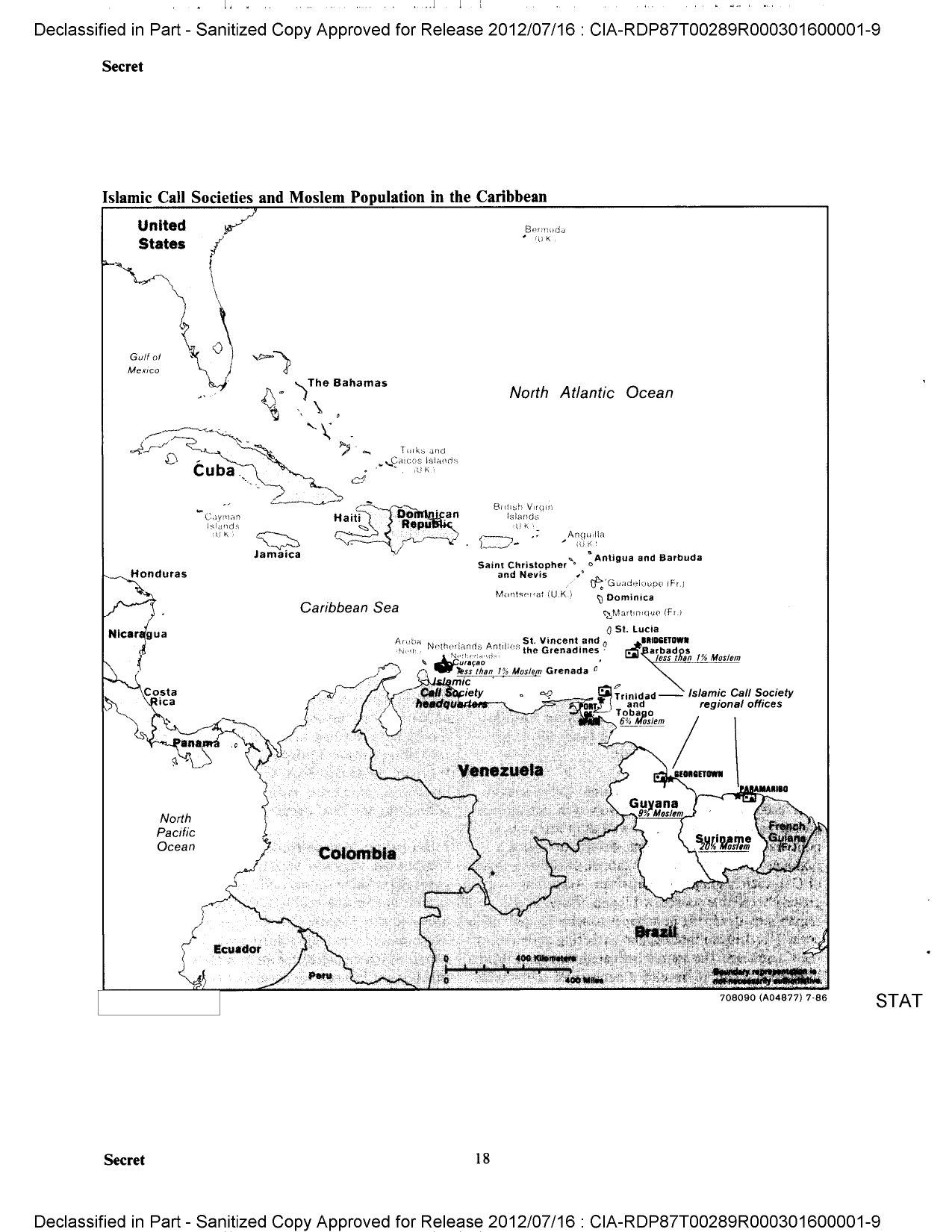
In our judgment, the Islamic Call Society has been Libya’s principal tool in its efforts to influence Caribbean Muslims. The regional office for the society is located in Curacao, with smaller units sprinkled throughout the Caribbean islands. Guyana, Trinidad and Tobago, and Barbados have the most active Muslim communities.
When first established in 1971, this society, which is funded by Tripoli through Libyan workers’ payroll deductions, had an almost purely religious function. Activities included, for example, financing construction of new mosques for Muslim communities abroad, or providing funds for missionary projects.
In the past several years, the Islamic Call Societies have become more and more involved in intelligence gathering and subversion, as well as in attempts to politicize Caribbean Muslims. Efforts to launch a regional newspaper are one example of the new thrust of Call society-supported activities. The Libyans have been trying to develop a network of contacts in the area, and have already made preliminary contacts with individuals in Dominica, Grenada, St. Lucia, St. Vincent, and the Grenadines.
The Islamic Call Society supports a number of other activities and projects that have also aided Tripoli’s intelligence and subversive objectives. Libya has funded three regional Call Society conferences that, [25X1] have served as a cover for meetings of revolutionary committee operatives and intelligence service representatives.[2] Call Society Chief Muhammad Ahmad Sharif and Musa Kusa, the de facto head of Libyan subversive activities, attended all three meetings.
The establishment and funding of Islamic cultural and educational centers throughout the Caribbean provide another important vehicle for intelligence and subversive activities. Funded by the Islamic Call Society, these organizations play more than a purely educational or cultural role. Libya has made no secret of its desire to politicize the Caribbean’s otherwise largely placid Muslims.
The Libyans have been trying to develop a network of contacts in the area, and have already made preliminary contacts with individuals in Dominica, Grenada, St. Lucia, St.
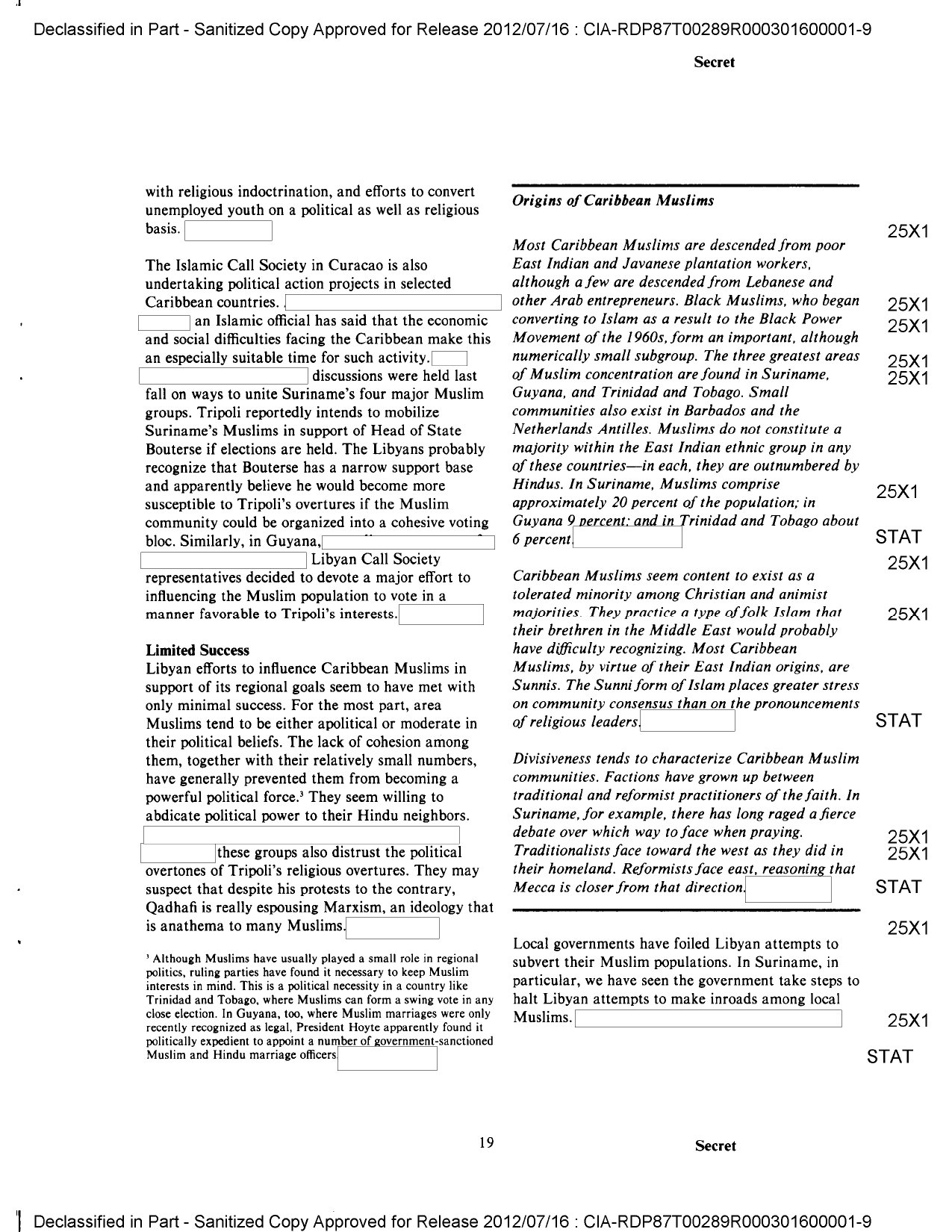
Libya’s Islamic Call Society should not be confused with the Shia or Sunni Call Societies, neither of which is operated by Libya. At the last regional Islamic conference held in Curacao, Libyan officials proposed that Islamic Call societies be used to draw Muslims and regional radicals closer together. The Libyan proposal called for an expansion of the functions of Islamic missionaries to combine political with religious indoctrination, and efforts to convert unemployed youth on a political as well as religious basis.
The Islamic Call Society in Curacao is also undertaking political action projects in selected Caribbean countries. An Islamic official has said that the economic and social difficulties facing the Caribbean make this an especially suitable time for such activity.
Discussions were held last fall on ways to unite Suriname’s four major Muslim groups. Tripoli reportedly intends to mobilize Suriname’s Muslims in support of Head of State Bouterse if elections are held. The Libyans probably recognize that Bouterse has a narrow support base and apparently believe he would become more susceptible to Tripoli’s overtures if the Muslim community could be organized into a cohesive voting bloc. Similarly, in Guyana, Libyan Call Society representatives decided to devote a major effort to influencing the Muslim population to vote in a manner favorable to Tripoli’s interests.
1 Libya’s Islamic Call Society should not be confused with the Shia or Sunni Call Societies, neither of which is operated by Libya
2 These conferences occurred in Trinidad in 1981, in Barbados in 1983, and in Curacao in 1985.
Limited Success
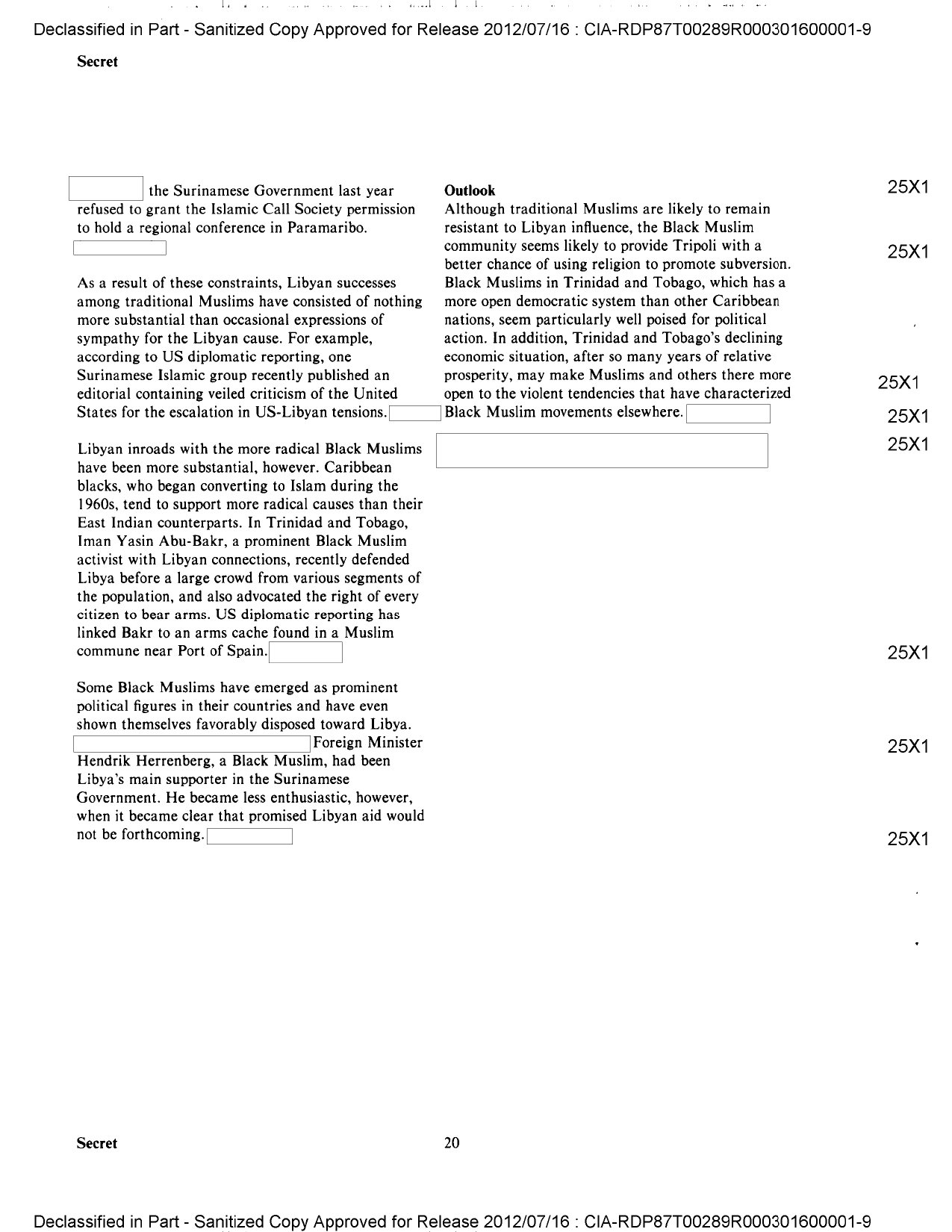
Libyan efforts to influence Caribbean Muslims in support of its regional goals seem to have met with only minimal success. For the most part, area Muslims tend to be either apolitical or moderate in their political beliefs. The lack of cohesion among them, together with their relatively small numbers, have generally prevented them from becoming a powerful political force. They seem willing to abdicate political power to their Hindu neighbors. These groups also distrust the political overtones of Tripoli’s religious overtures. They may suspect that despite his protests to the contrary, Qadhafi is really espousing Marxism, an ideology that is anathema to many Muslims. Local governments have foiled Libyan attempts to subvert their Muslim populations. In Suriname, in particular, we have seen the government take steps to halt Libyan attempts to make inroads among local Muslims.
The Surinamese Government last year refused to grant the Islamic Call Society permission to hold a regional conference in Paramaribo. As a result of these constraints, Libyan successes among traditional Muslims have consisted of nothing more substantial than occasional expressions of sympathy for the Libyan cause. For example, according to US diplomatic reporting, one Surinamese Islamic group recently published an editorial containing veiled criticism of the United States for the escalation in US-Libyan tensions.
Libyan inroads with the more radical Black Muslims have been more substantial, however. Caribbean blacks, who began converting to Islam during the 1960s, tend to support more radical causes than their East Indian counterparts. In Trinidad and Tobago, Iman Yasin Abu-Bakr, a prominent Black Muslim activist with Libyan connections, recently defended Libya before a large crowd from various segments of the population, and also advocated the right of every citizen to bear arms. US diplomatic reporting has linked Bakr to an arms cache found in a Muslim commune near Port of Spain.
Some Black Muslims have emerged as prominent political figures in their countries and have even shown themselves favorably disposed toward Libya. Foreign Minister Hendrik Herrenberg, a Black Muslim, had been Libya’s main supporter in the Surinamese Government. He became less enthusiastic, however, when it became clear that promised Libyan aid would not be forthcoming.
Outlook
Although traditional Muslims are likely to remain resistant to Libyan influence, the Black Muslim community seems likely to provide Tripoli with a better chance of using religion to promote subversion. Black Muslims in Trinidad and Tobago, which has a more open democratic system than other Caribbean nations, seem particularly well poised for political action. In addition, Trinidad and Tobago’s declining economic situation, after so many years of relative prosperity, may make Muslims and others there more open to the violent tendencies that have characterized Black Muslim movements elsewhere.
Cuba’s Response
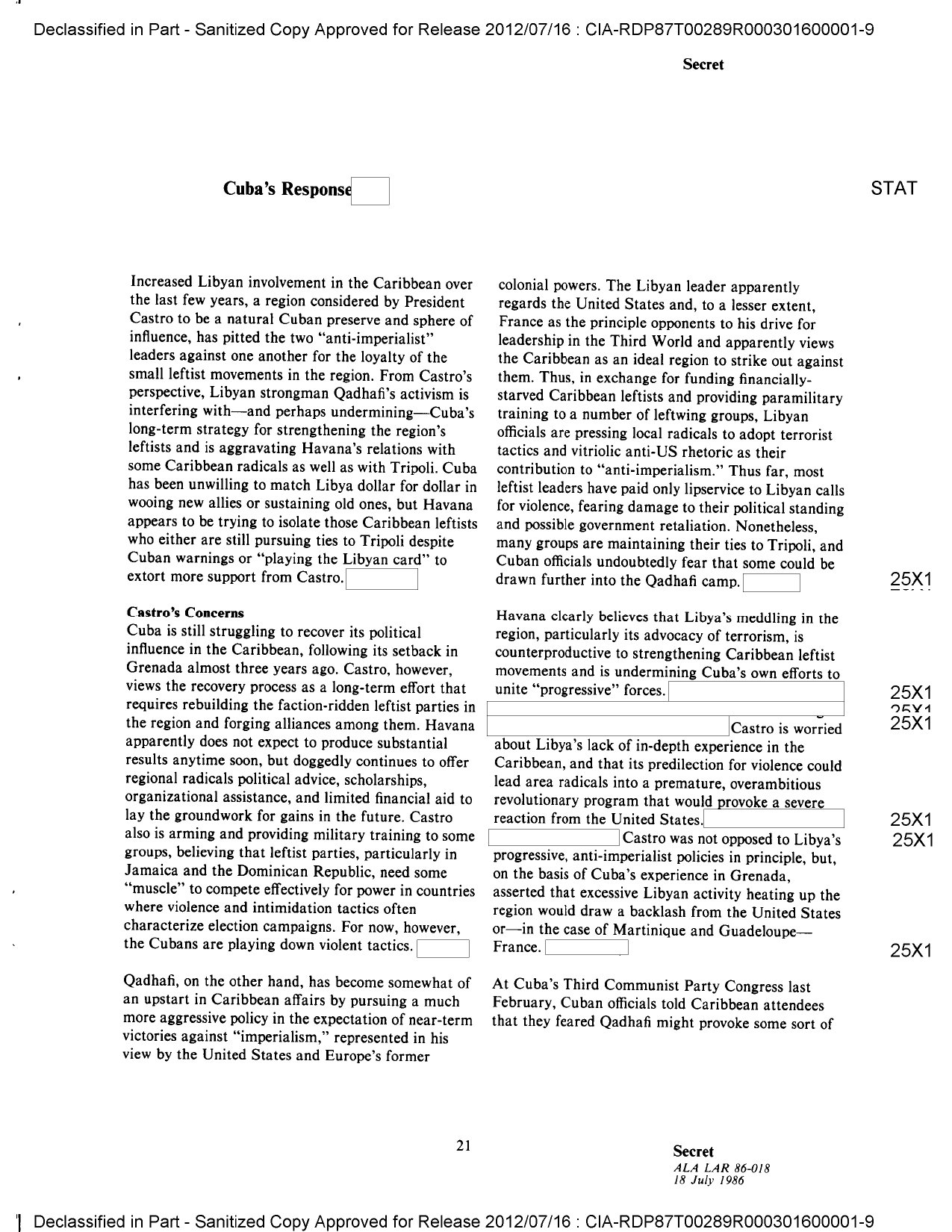
Increased Libyan involvement in the Caribbean over the last few years, a region considered by President Castro to be a natural Cuban preserve and sphere of influence, has pitted the two “anti-imperialist” leaders against one another for the loyalty of the small leftist movements in the region. From Castro’s perspective, Libyan strongman Qadhafi’s activism is interfering with—and perhaps undermining—Cuba’s long-term strategy for strengthening the region’s leftists and is aggravating Havana’s relations with some Caribbean radicals as well as with Tripoli. Cuba has been unwilling to match Libya dollar for dollar in wooing new allies or sustaining old ones, but Havana appears to be trying to isolate those Caribbean leftists who either are still pursuing ties to Tripoli despite Cuban warnings or “playing the Libyan card” to extort more support from Castro.
Castro’s Concerns
Cuba is still struggling to recover its political influence in the Caribbean, following its setback in Grenada almost three years ago. Castro, however, views the recovery process as a long-term effort that requires rebuilding the faction-ridden leftist parties in the region and forging alliances among them. Havana apparently does not expect to produce substantial results anytime soon, but doggedly continues to offer regional radicals political advice, scholarships, organizational assistance, and limited financial aid to lay the groundwork for gains in the future. Castro also is arming and providing military training to some groups, believing that leftist parties, particularly in Jamaica and the Dominican Republic, need some “muscle” to compete effectively for power in countries where violence and intimidation tactics often characterize election campaigns. For now, however, the Cubans are playing down violent tactics.
Qadhafi, on the other hand, has become somewhat of an upstart in Caribbean affairs by pursuing a much more aggressive policy in the expectation of near-term victories against “imperialism,” represented in his view by the United States and Europe’s former colonial powers. The Libyan leader apparently regards the United States and, to a lesser extent, France as the principal opponents to his drive for leadership in the Third World and apparently views the Caribbean as an ideal region to strike out against them. Thus, in exchange for funding financially starved Caribbean leftists and providing paramilitary training to a number of leftwing groups, Libyan officials are pressing local radicals to adopt terrorist tactics and vitriolic anti-US rhetoric as their contribution to “anti-imperialism.”
Thus far, most leftist leaders have paid only lip service to Libyan calls for violence, fearing damage to their political standing and possible government retaliation. Nonetheless, many groups are maintaining their ties to Tripoli, and Cuban officials undoubtedly fear that some could be drawn further into the Qadhafi camp.
Havana clearly believes that Libya’s meddling in the region, particularly its advocacy of terrorism, is counterproductive to strengthening Caribbean leftist movements and is undermining Cuba’s own efforts to unite “progressive” forces. Castro is worried about Libya’s lack of in-depth experience in the Caribbean, and that its predilection for violence could lead area radicals into a premature, overambitious revolutionary program that would provoke a severe reaction from the United States.
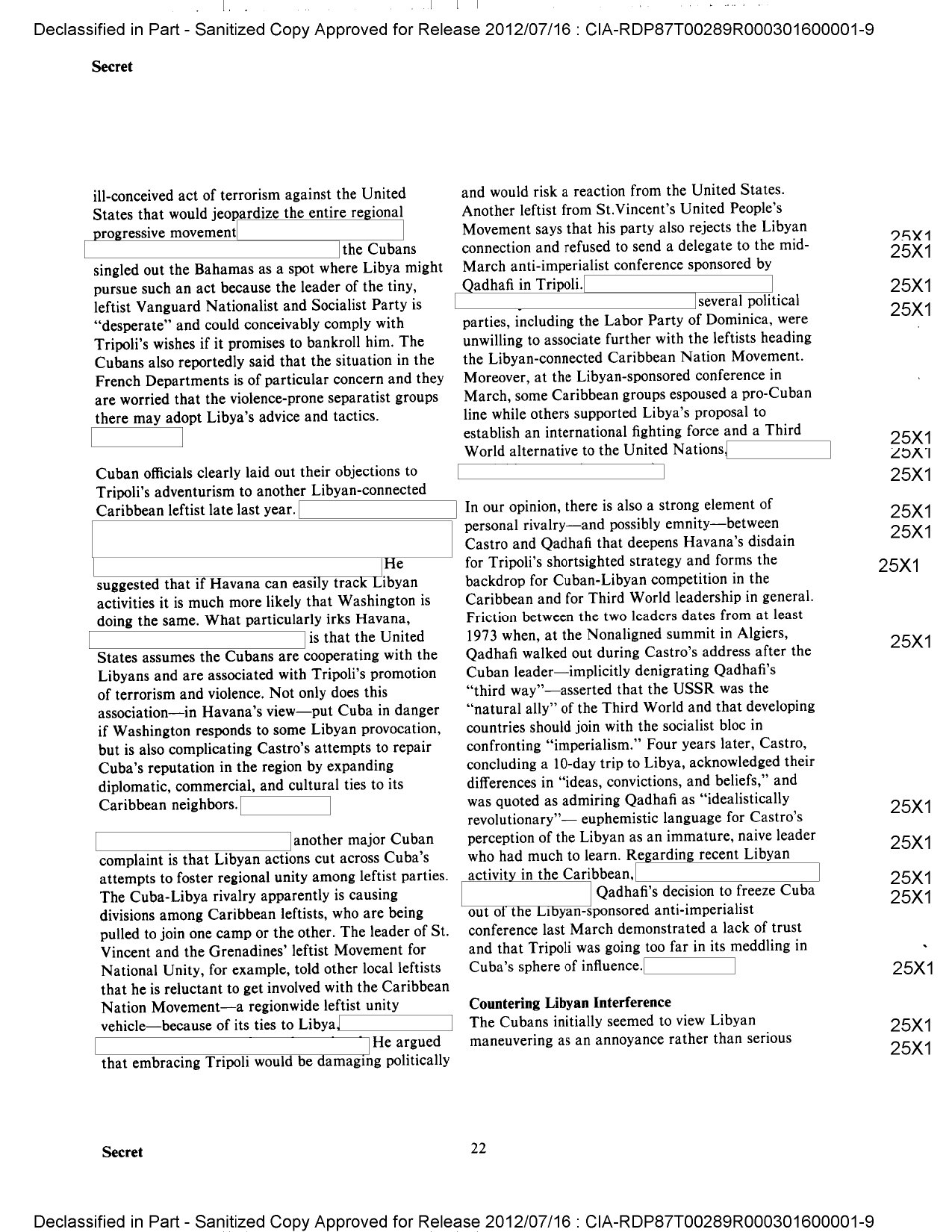
Castro was not opposed to Libya’s progressive, anti-imperialist policies in principle, but, on the basis of Cuba’s experience in Grenada, asserted that excessive Libyan activity heating up the region would draw a backlash from the United States or—in the case of Martinique and Guadeloupe—France. At Cuba’s Third Communist Party Congress last February, Cuban officials told Caribbean attendees that they feared Qadhafi might provoke some sort of ill-conceived act of terrorism against the United States that would jeopardize the entire regional progressive movement.
The Cubans singled out the Bahamas as a spot where Libya might pursue such an act because the leader of the tiny, leftist Vanguard Nationalist and Socialist Party is “desperate” and could conceivably comply with Tripoli’s wishes if it promises to bankroll him. The Cubans also reportedly said that the situation in the French Departments is of particular concern and they are worried that the violence-prone separatist groups there may adopt Libya’s advice and tactics.
Cuban officials clearly laid out their objections to Tripoli’s adventurism to another Libyan-connected Caribbean leftist late last year. He suggested that if Havana can easily track Libyan activities, it is much more likely that Washington is doing the same. What particularly irks Havana is that the United States assumes the Cubans are cooperating with the Libyans and are associated with Tripoli’s promotion of terrorism and violence. Not only does this association—in Havana’s view—put Cuba in danger if Washington responds to some Libyan provocation, but it is also complicating Castro’s attempts to repair Cuba’s reputation in the region by expanding diplomatic, commercial, and cultural ties to its Caribbean neighbors.
Another major Cuban complaint is that Libyan actions cut across Cuba’s attempts to foster regional unity among leftist parties. The Cuba-Libya rivalry apparently is causing divisions among Caribbean leftists, who are being pulled to join one camp or the other. The leader of St. Vincent and the Grenadines’ leftist Movement for National Unity, for example, told other local leftists that he is reluctant to get involved with the Caribbean Nation Movement—a region-wide leftist unity vehicle—because of its ties to Libya. He argued that embracing Tripoli would be damaging politically and would risk a reaction from the United States.
Another leftist from St. Vincent’s United People’s Movement says that his party also rejects the Libyan connection and refused to send a delegate to the mid-March anti-imperialist conference sponsored by Qadhafi in Tripoli. Several political parties, including the Labor Party of Dominica, were unwilling to associate further with the leftists heading the Libyan-connected Caribbean Nation Movement. Moreover, at the Libyan-sponsored conference in March, some Caribbean groups espoused a pro-Cuban line while others supported Libya’s proposal to establish an international fighting force and a Third World alternative to the United Nations.
In our opinion, there is also a strong element of personal rivalry—and possibly enmity—between Castro and Qadhafi that deepens Havana’s disdain for Tripoli’s shortsighted strategy and forms the backdrop for Cuban-Libyan competition in the Caribbean and for Third World leadership in general. Friction between the two leaders dates from at least 1973 when, at the Nonaligned summit in Algiers, Qadhafi walked out during Castro’s address after the Cuban leader—implicitly denigrating Qadhafi’s “third way”—asserted that the USSR was the “natural ally” of the Third World and that developing countries should join with the socialist bloc in confronting “imperialism.”
Four years later, Castro, concluding a 10-day trip to Libya, acknowledged their differences in “ideas, convictions, and beliefs,” and was quoted as admiring Qadhafi as “idealistically revolutionary”—euphemistic language for Castro’s perception of the Libyan as an immature, naive leader who had much to learn. Regarding recent Libyan activity in the Caribbean, Qadhafi’s decision to freeze Cuba out of the Libyan-sponsored anti-imperialist conference last March demonstrated a lack of trust and that Tripoli was going too far in its meddling in Cuba’s sphere of influence.
Countering Libyan Interference
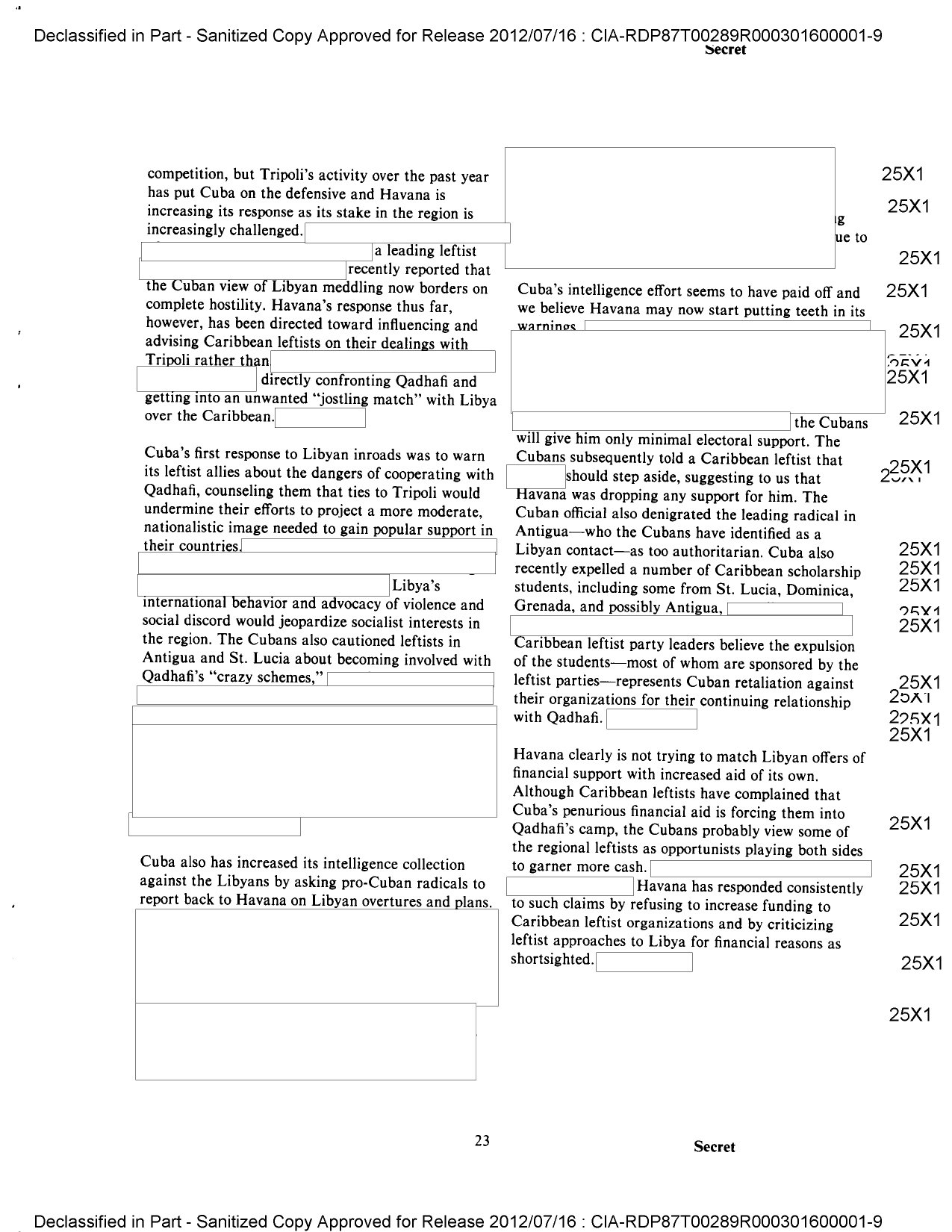
The Cubans initially seemed to view Libyan maneuvering as an annoyance rather than serious competition, but Tripoli’s activity over the past year has put Cuba on the defensive and Havana is increasing its response as its stake in the region is increasingly challenged.
A leading leftist recently reported that the Cuban view of Libyan meddling now borders on complete hostility. Havana’s response thus far, however, has been directed toward influencing and advising Caribbean leftists on their dealings with Tripoli rather than directly confronting Qadhafi and getting into an unwanted “jostling match” with Libya over the Caribbean.
Cuba’s first response to Libyan inroads was to warn its leftist allies about the dangers of cooperating with Qadhafi, counseling them that ties to Tripoli would undermine their efforts to project a more moderate, nationalistic image needed to gain popular support in their countries.
Libya’s international behavior and advocacy of violence and social discord would jeopardize socialist interests in the region. The Cubans also cautioned leftists in Antigua and St. Lucia about becoming involved with Qadhafi’s “crazy schemes.”
Cuba also has increased its intelligence collection against the Libyans by asking pro-Cuban radicals to report back to Havana on Libyan overtures and plans.
Cuba’s intelligence effort seems to have paid off, and we believe Havana may now start putting teeth in its warnings. The Cubans will give him only minimal electoral support. The Cubans subsequently told a Caribbean leftist that he should step aside, suggesting that Havana was dropping any support for him. The Cuban official also denigrated the leading radical in Antigua—who the Cubans have identified as a Libyan contact—as too authoritarian.
Cuba also recently expelled a number of Caribbean scholarship students, including some from St. Lucia, Dominica, Grenada, and possibly Antigua. Caribbean leftist party leaders believe the expulsion of the students—most of whom are sponsored by the leftist parties—represents Cuban retaliation against their organizations for their continuing relationship with Qadhafi.
Havana clearly is not trying to match Libyan offers of financial support with increased aid of its own. Although Caribbean leftists have complained that Cuba’s penurious financial aid is forcing them into Qadhafi’s camp, the Cubans probably view some of the regional leftists as opportunists playing both sides to garner more cash.
Havana has responded consistently to such claims by refusing to increase funding to Caribbean leftist organizations and by criticizing leftist approaches to Libya for financial reasons as shortsighted.
Outlook (Cuba vs Libya)
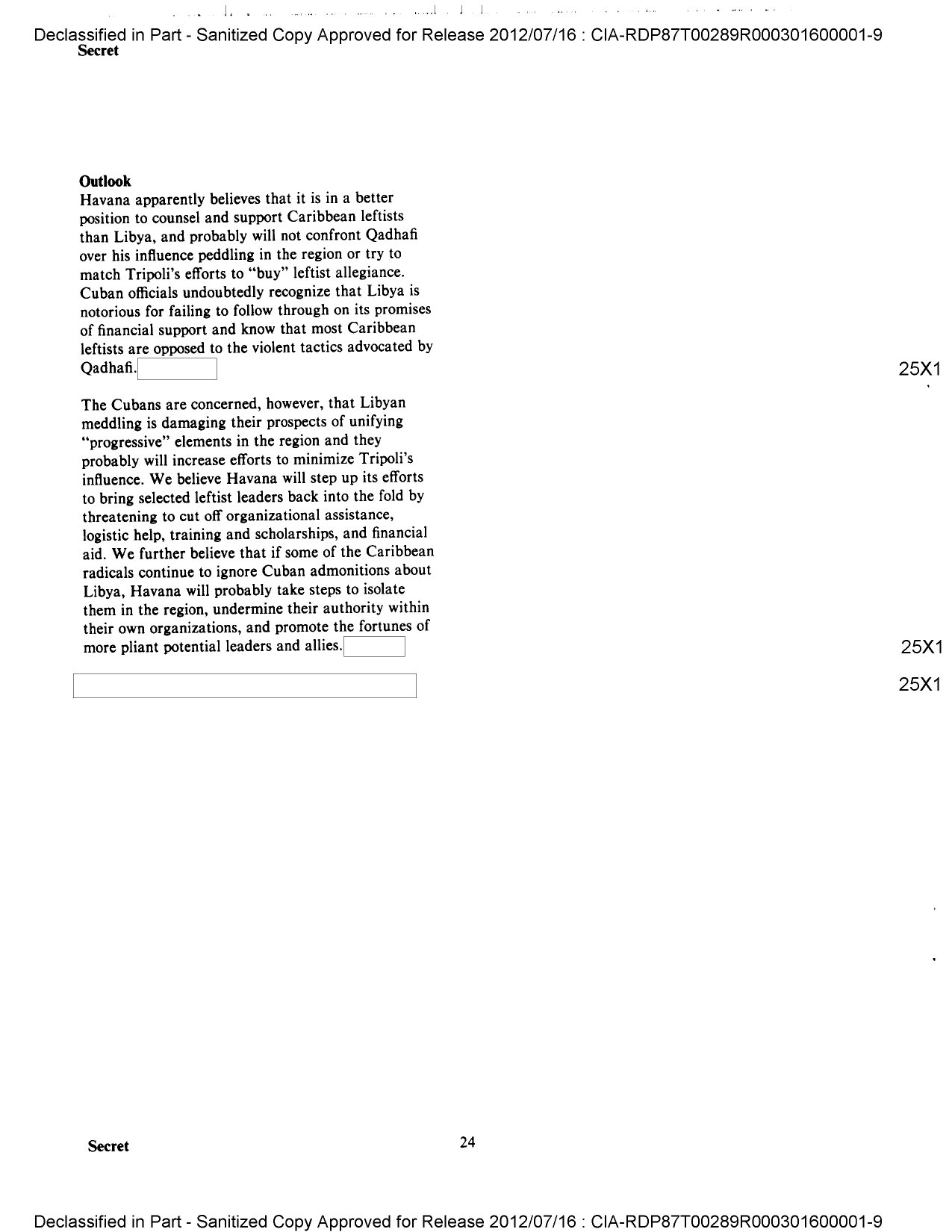
Havana apparently believes that it is in a better position to counsel and support Caribbean leftists than Libya, and probably will not confront Qadhafi over his influence peddling in the region or try to match Tripoli’s efforts to “buy” leftist allegiance.
Cuban officials undoubtedly recognize that Libya is notorious for failing to follow through on its promises of financial support and know that most Caribbean leftists are opposed to the violent tactics advocated by Qadhafi.
The Cubans are concerned, however, that Libyan meddling is damaging their prospects of unifying “progressive” elements in the region and they probably will increase efforts to minimize Tripoli’s influence. We believe Havana will step up its efforts to bring selected leftist leaders back into the fold by threatening to cut off organizational assistance, logistic help, training and scholarships, and financial aid. We further believe that if some of the Caribbean radicals continue to ignore Cuban admonitions about Libya, Havana will probably take steps to isolate them in the region, undermine their authority within their own organizations, and promote the fortunes of more pliant potential leaders and allies.
Origins of Caribbean Muslims
Most Caribbean Muslims are descended from poor East Indian and Javanese plantation workers, although a few are descended from Lebanese and other Arab entrepreneurs. Black Muslims, who began converting to Islam as a result of the Black Power Movement of the 1960s, form an important, although numerically small, subgroup.
The three greatest areas of Muslim concentration are found in Suriname, Guyana, and Trinidad and Tobago. Small communities also exist in Barbados and the Netherlands Antilles. Muslims do not constitute a majority within the East Indian ethnic group in any of these countries—in each, they are outnumbered by Hindus. In Suriname, Muslims comprise approximately 20 percent of the population; in Guyana, 9 percent; and in Trinidad and Tobago, about 6 percent.
Caribbean Muslims seem content to exist as a tolerated minority among Christian and animist majorities. They practice a type of folk Islam that their brethren in the Middle East would probably have difficulty recognizing. Most Caribbean Muslims, by virtue of their East Indian origins, are Sunnis. The Sunni form of Islam places greater stress on community consensus than on the pronouncements of religious leaders.
Divisiveness tends to characterize Caribbean Muslim communities. Factions have grown up between traditional and reformist practitioners of the faith. In Suriname, for example, there has long raged a fierce debate over which way to face when praying. Traditionalists face toward the west as they did in their homeland. Reformists face east, reasoning that Mecca is closer from that direction.
Anti-Imperialism Conference
The Second International Anti-Imperialism Conference, held in Tripoli in mid-March, set forth Libya’s increased emphasis on violence. Qadhafi urged radicals from around the world to adopt armed struggle and become part of an international fighting force. He reportedly offered military equipment and training, but only limited financial aid to the Caribbean representatives.
Caribbean leftists from the English-speaking countries seemed unwilling to support violence. Both Dominica’s Roosevelt Douglas and George Odlum of St. Lucia spoke against it during the conference. In contrast, it appears that the French-speaking countries would be more amenable to violence. Haitian representatives met privately with Qadhafi and may have been promised material support. The Libyans probably view Haiti as fertile ground for radical activity because of the current political and economic instability there.
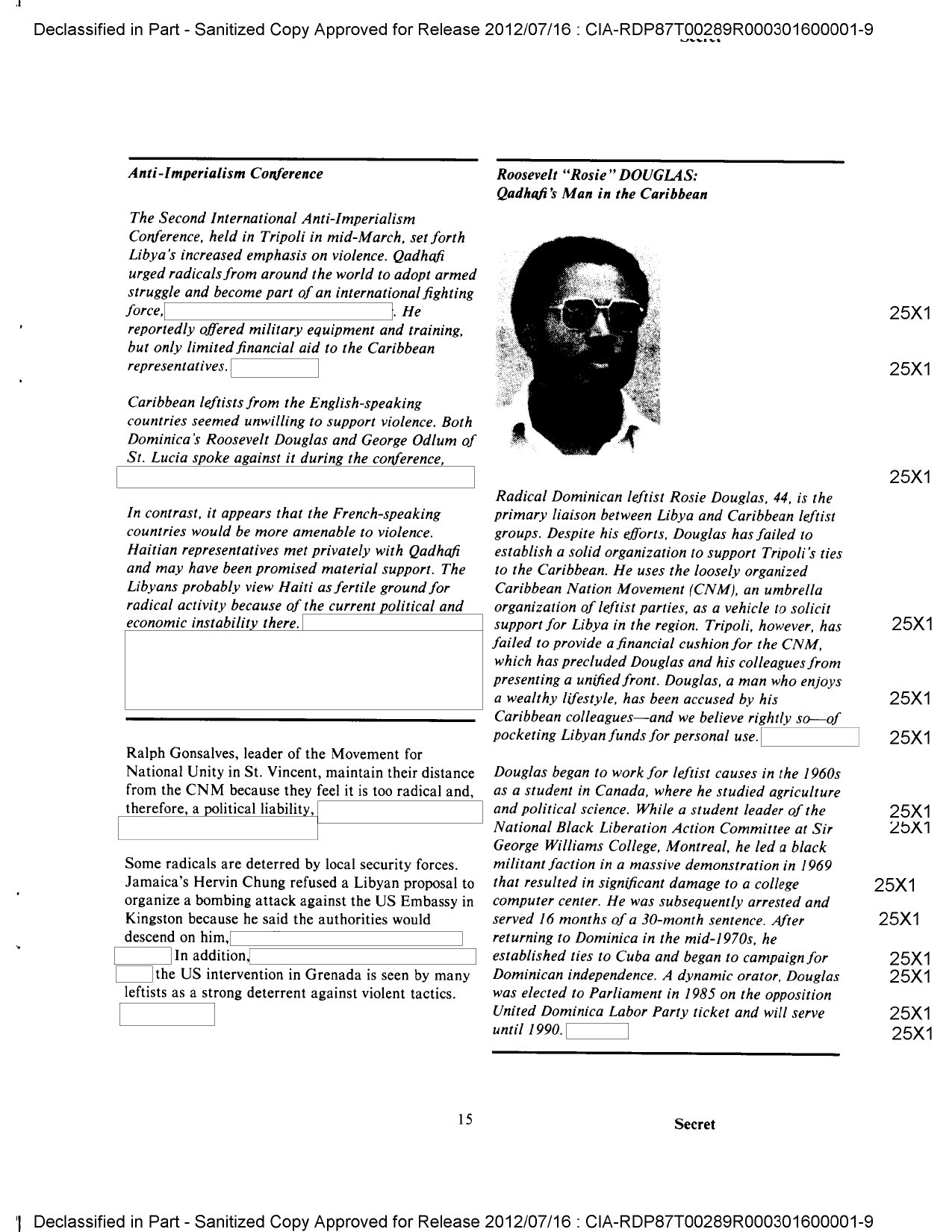
Roosevelt “Rosie” Douglas: Qadhafi’s Man in the Caribbean
Radical Dominican leftist Rosie Douglas, 44, is the primary liaison between Libya and Caribbean leftist groups. Despite his efforts, Douglas has failed to establish a solid organization to support Tripoli’s ties to the Caribbean. He uses the loosely organized Caribbean Nation Movement (CNM), an umbrella organization of leftist parties, as a vehicle to solicit support for Libya in the region. Tripoli, however, has failed to provide a financial cushion for the CNM, which has precluded Douglas and his colleagues from presenting a unified front.
Douglas, a man who enjoys a wealthy lifestyle, has been accused by his Caribbean colleagues—and we believe rightly so—of pocketing Libyan funds for personal use. Douglas began to work for leftist causes in the 1960s as a student in Canada, where he studied agriculture and political science. While a student leader of the National Black Liberation Action Committee at Sir George Williams College, Montreal, he led a black militant faction in a massive demonstration in 1969 that resulted in significant damage to a college computer center. He was subsequently arrested and served 16 months of a 30-month sentence.
After returning to Dominica in the mid-1970s, he established ties to Cuba and began to campaign for Dominican independence. A dynamic orator, Douglas was elected to Parliament in 1985 on the opposition United Dominica Labor Party ticket and will serve until 1990.
Source:
Link:
Internal Link:
Date:
July 18, 1986