Latin America Review – Suriname: Drug Arrest Shakes Regime – 11 April 1986
CIA-RDP87T00289R000201070001-9
Articles
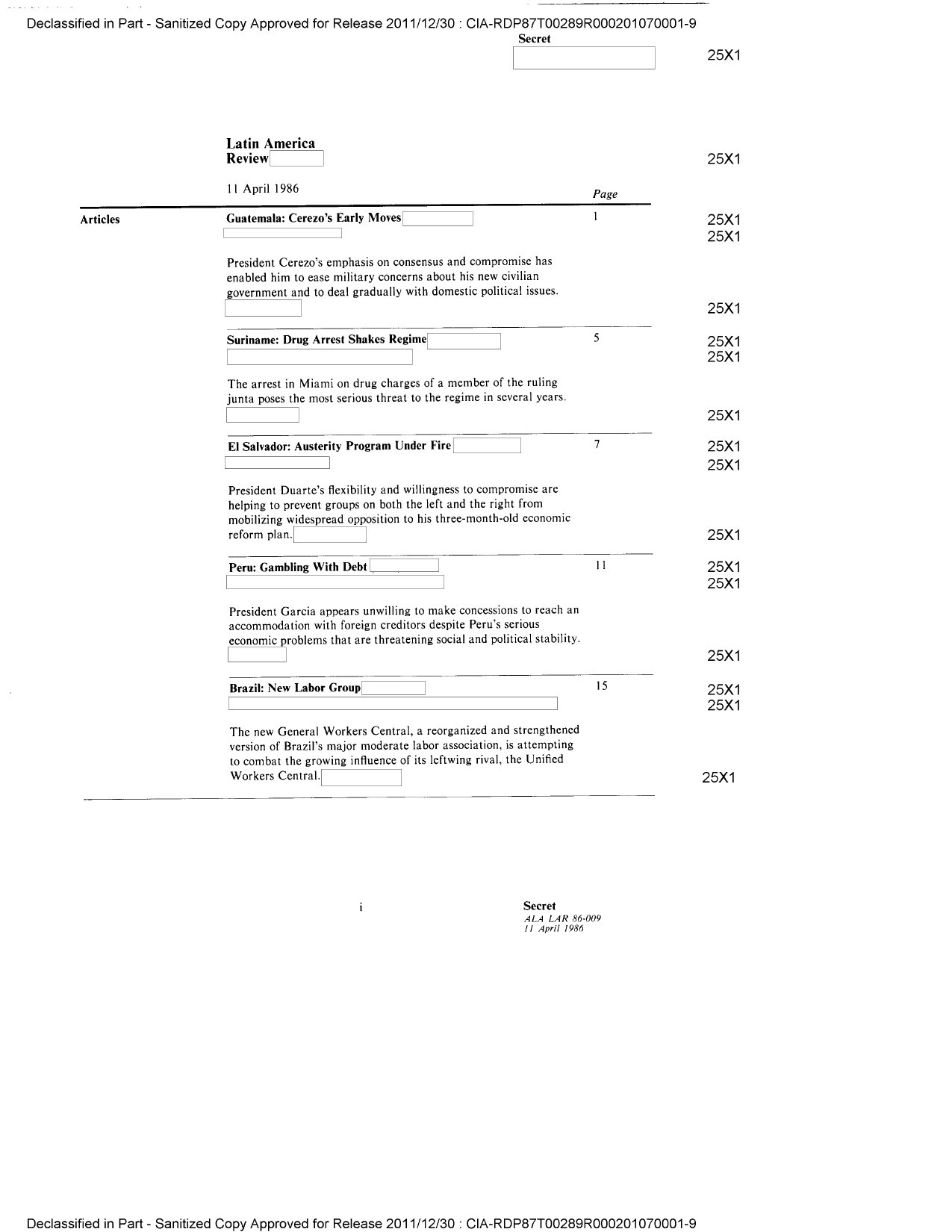
The arrest in Miami on drug charges of a member of the ruling junta poses the most serious threat to the regime in several years.
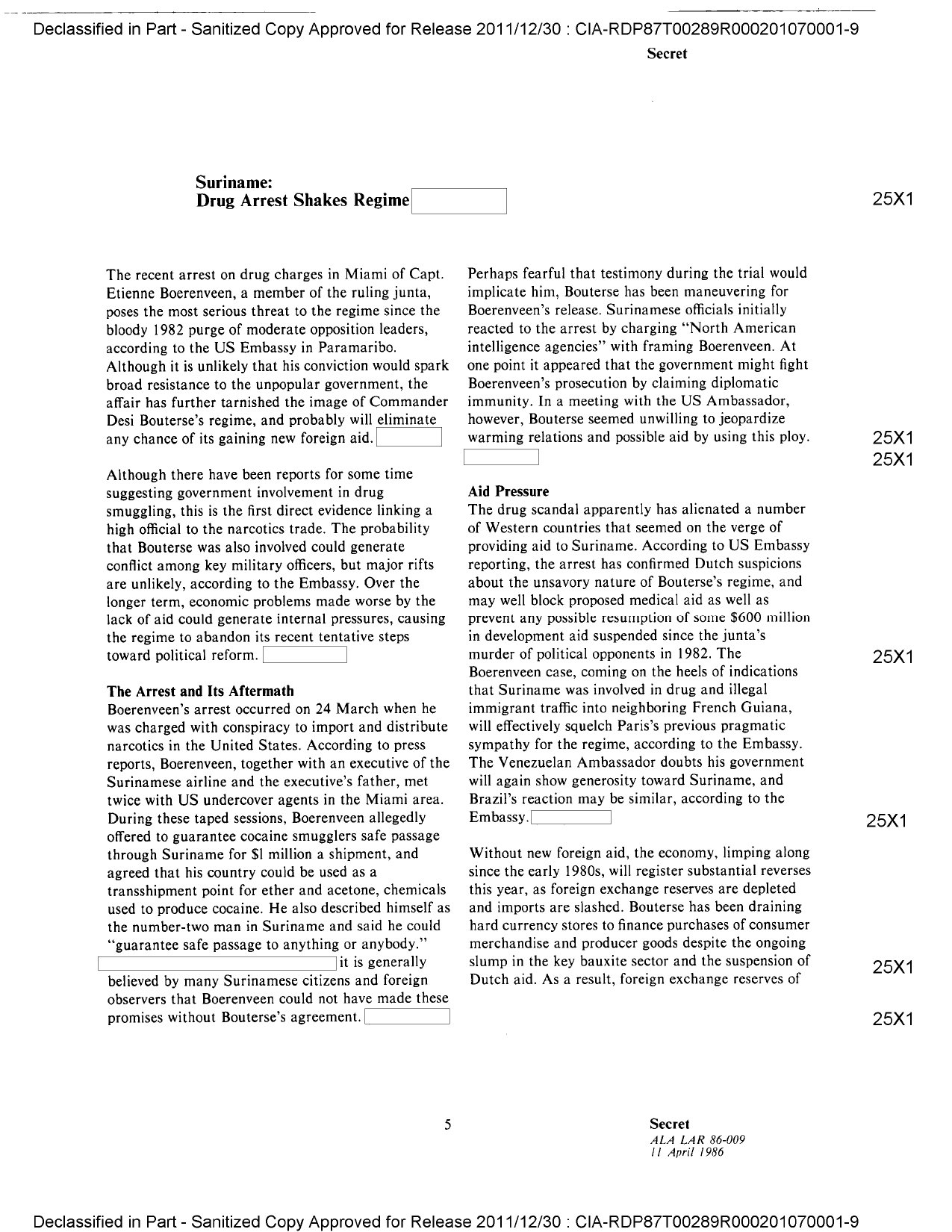
The recent arrest on drug charges in Miami of Capt. Etienne Boerenveen a member of the ruling junta, poses the most serious threat to the regime since the bloody 1982 purge of moderate opposition leaders, according to the US Embassy in Paramaribo.
Although it is unlikely that his conviction would spark broad resistance to the unpopular government, the affair has further tarnished the image of Commander Desi Bouterse’s regime, and probably will eliminate any chance of its gaining new foreign aid.
Although there have been reports for some time suggesting government involvement in drug smuggling, this is the first direct evidence linking a high official to the narcotics trade. The probability that Bouterse was also involved could generate conflict among key military officers, but major rifts are unlikely, according to the Embassy. Over the longer term, economic problems made worse by the lack of aid could generate internal pressures, causing the regime to abandon its recent tentative steps toward political reform.
The Arrest and Its Aftermath
Boerenveen’s arrest occurred on 24 March when he was charged with conspiracy to import and distribute narcotics in the United States. According to press reports, Boerenveen, together with an executive of the Surinamese airline and the executive’s father, met twice with US undercover agents in the Miami area. During these taped sessions, Boerenveen allegedly offered to guarantee cocaine smugglers safe passage through Suriname for $1 million a shipment, and agreed that his country could be used as a transshipment point for ether and acetone, chemicals used to produce cocaine. He also described himself as the number-two man in Suriname and said he could “guarantee safe passage to anything or anybody.”
It is generally believed by many Surinamese citizens and foreign observers that Boerenveen could not have made these promises without Bouterse’s agreement.
Perhaps fearful that testimony during the trial would implicate him, Bouterse has been maneuvering for Boerenveen’s release. Surinamese officials initially reacted to the arrest by charging “North American intelligence agencies” with framing Boerenveen. At one point it appeared that the government might fight Boerenveen’s prosecution by claiming diplomatic immunity. In a meeting with the US Ambassador, however, Bouterse seemed unwilling to jeopardize warming relations and possible aid by using this ploy.
Aid Pressure
The drug scandal apparently has alienated a number of Western countries that seemed on the verge of providing aid to Suriname. According to US Embassy reporting, the arrest has confirmed Dutch suspicions about the unsavory nature of Bouterse’s regime, and may well block proposed medical aid as well as prevent any possible resumption of some $600 million in development aid suspended since the junta’s murder of political opponents in 1982.
The Boerenveen case, coming on the heels of indications that Suriname was involved in drug and illegal immigrant traffic into neighboring French Guiana, will effectively squelch Paris’s previous pragmatic sympathy for the regime, according to the Embassy. The Venezuelan Ambassador doubts his government will again show generosity toward Suriname, and Brazil’s reaction may be similar, according to the Embassy.
Without new foreign aid, the economy, limping along since the early 1980s, will register substantial reverses this year, as foreign exchange reserves are depleted and imports are slashed. Bouterse has been draining hard currency stores to finance purchases of consumer merchandise and producer goods despite the ongoing slump in the key bauxite sector and the suspension of Dutch aid. As a result, foreign exchange reserves of over $200 million in the early 1980s have deteriorated to about $20 million at present, or enough to cover about three weeks’ worth of imports. Payment difficulties recently delayed completion of a Brazilian natural gas delivery, and similar actions by other commodity suppliers are likely over the next few months as arrearages mount.
Domestic Threats
Worsening economic conditions are likely to increase popular dissatisfaction with the regime and complicate Bouterse’s efforts to create an image of progress toward political reform.
Political leaders already are resisting pressure from Bouterse to become full members of the Supreme Council because they believe the government will collapse by the end of the year. Businessmen, for their part, reportedly are threatening to withdraw from the National Assembly and Supreme Council to protest the government’s Marxist thrust. [CENSORED]
The Boerenveen affair might also worsen tensions among junta members already concerned about Bouterse’s support for democratization measures.
In our [CENSORED] judgment, the rift in the junta could widen if convincing evidence surfaces that Bouterse and Boerenveen were working together in a major drug trafficking scheme. [CENSORED]
Outlook
The economic and political impact of the drug scandal may work to reverse the slight shift toward the West that Suriname has demonstrated over the past year. If increasing economic problems spark popular unrest, the regime could abandon its preliminary steps toward political reform and crack down on the opposition to maintain its power. With little prospect of Western assistance, Bouterse could try once again to seek help from Libya or the Soviet bloc.
Source:
Link:
Internal Link:
Date:
April 11, 1986