Latin America Review – Suriname: Limited Democratization – 4 July 1986
CIA-RDP87T00289R000301570001-3
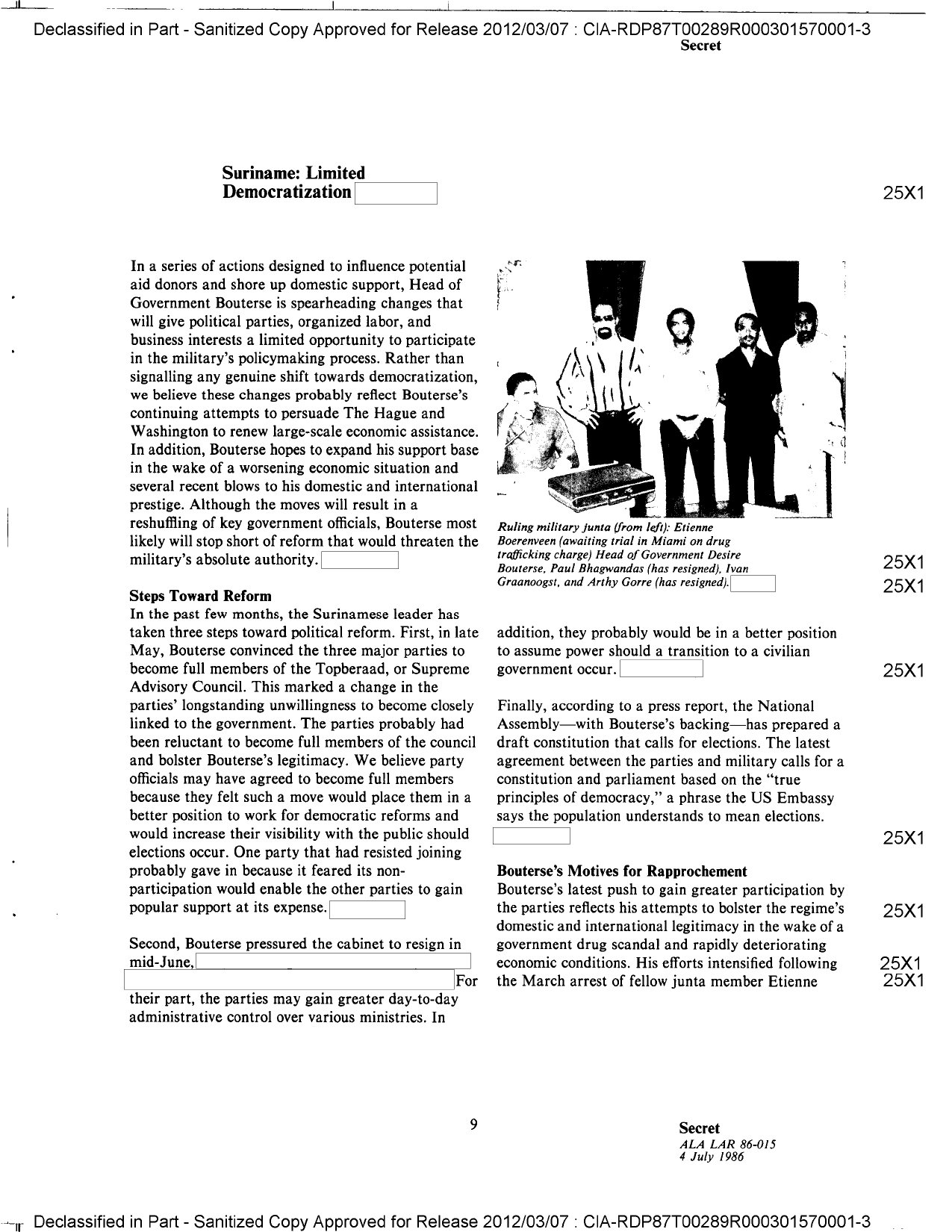
Head of State Bouterse is spearheading changes that will give political parties, organized labor, and business interests a limited opportunity to participate in the policymaking process.
In a series of actions designed to influence potential aid donors and shore up domestic support, Head of Government Bouterse is spearheading changes that will give political parties, organized labor, and business interests a limited opportunity to participate in the military’s policymaking process. Rather than signalling any genuine shift towards democratization, we believe these changes probably reflect Bouterse’s continuing attempts to persuade The Hague and Washington to renew large-scale economic assistance.
In addition, Bouterse hopes to expand his support base in the wake of a worsening economic situation and several recent blows to his domestic and international prestige. Although the moves will result in a reshuffling of key government officials, Bouterse most likely will stop short of reform that would threaten the military’s absolute authority.
Steps Toward Reform
In the past few months, the Surinamese leader has taken three steps toward political reform.
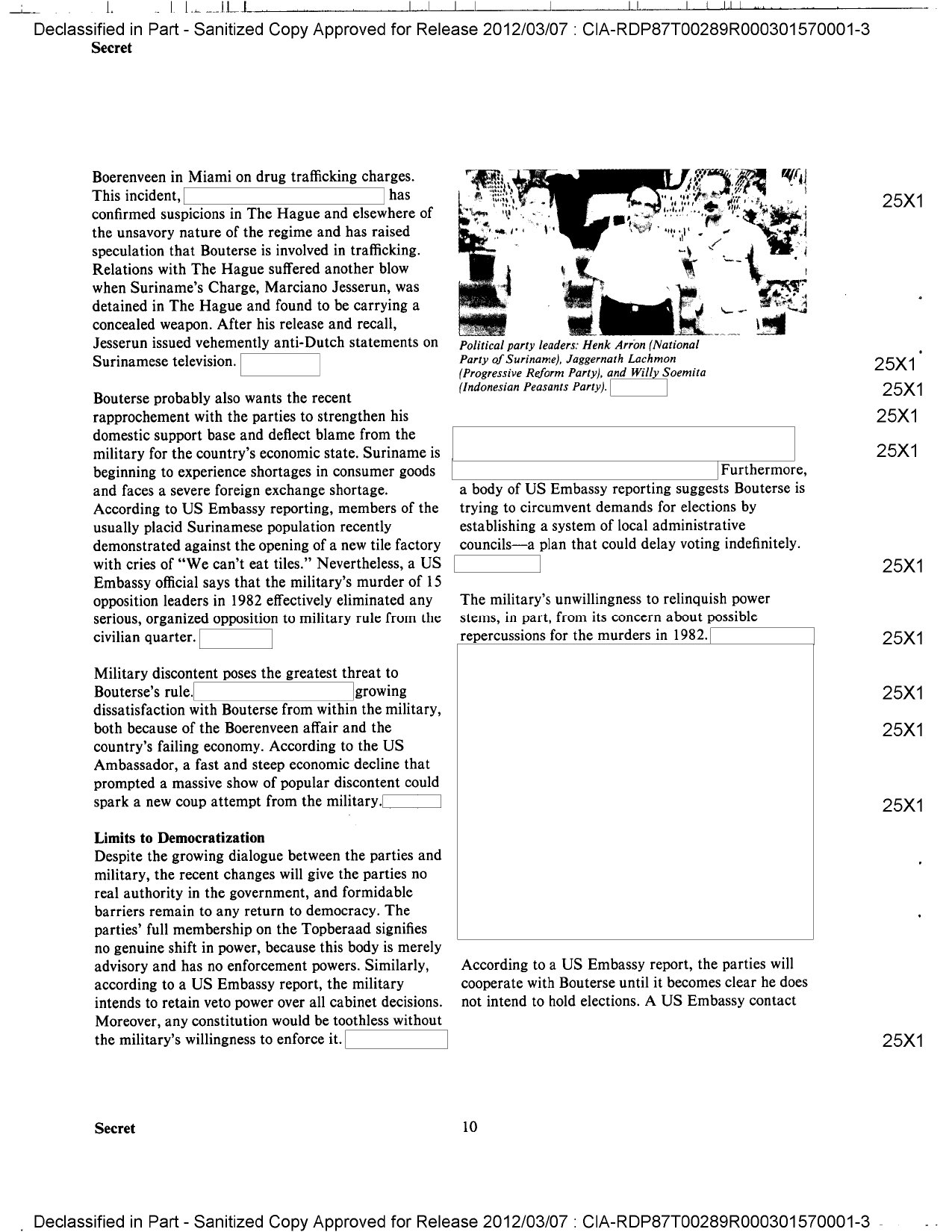
First, in late May, Bouterse convinced the three major parties to become full members of the Topberaad, or Supreme Advisory Council. This marked a change in the parties’ longstanding unwillingness to become closely linked to the government. The parties probably had been reluctant to become full members of the council and bolster Bouterse’s legitimacy. We believe party officials may have agreed to become full members because they felt such a move would place them in a better position to work for democratic reforms and would increase their visibility with the public should elections occur. One party that had resisted joining probably gave in because it feared its nonparticipation would enable the other parties to gain popular support at its expense.
Second, Bouterse pressured the cabinet to resign in mid-June, [CENSORED] their part, the parties may gain greater day-to-day administrative control over various ministries. In addition, they probably would be in a better position to assume power should a transition to a civilian government occur.
Finally, according to a press report, the National Assembly—with Bouterse’s backing—has prepared a draft constitution that calls for elections. The latest agreement between the parties and military calls for a constitution and parliament based on the “true principles of democracy,” a phrase the US Embassy says the population understands to mean elections.
Bouterse’s Motives for Rapprochement
Bouterse’s latest push to gain greater participation by the parties reflects his attempts to bolster the regime’s domestic and international legitimacy in the wake of a government drug scandal and rapidly deteriorating economic conditions. His efforts intensified following the March arrest of fellow junta member Etienne Boerenveen in Miami on drug trafficking charges.
This incident [CENSORED] has confirmed suspicions in The Hague and elsewhere of the unsavory nature of the regime and has raised speculation that Bouterse is involved in trafficking. Relations with The Hague suffered another blow when Suriname’s Charge, Marciano Jesserun, was detained in The Hague and found to be carrying a concealed weapon. After his release and recall, Jesserun issued vehemently anti-Dutch statements on Surinamese television.
Bouterse probably also wants the recent rapprochement with the parties to strengthen his domestic support base and deflect blame from the military for the country’s economic state. Suriname is beginning to experience shortages in consumer goods and faces a severe foreign exchange shortage.
According to US Embassy reporting, members of the usually placid Surinamese population recently demonstrated against the opening of a new tile factory with cries of “We can’t eat tiles.” Nevertheless, a US Embassy official says that the military’s murder of 15 opposition leaders in 1982 effectively eliminated any serious, organized opposition to military rule from the civilian quarter.
Military Discontent
Military discontent poses the greatest threat to Bouterse’s rule, [CENSORED] growing dissatisfaction with Bouterse from within the military, both because of the Boerenveen affair and the country’s failing economy. According to the US Ambassador, a fast and steep economic decline that prompted a massive show of popular discontent could spark a new coup attempt from the military.
Limits to Democratization
Despite the growing dialogue between the parties and military, the recent changes will give the parties no real authority in the government, and formidable barriers remain to any return to democracy. The parties’ full membership on the Topberaad signifies no genuine shift in power, because this body is merely advisory and has no enforcement powers. Similarly, according to a US Embassy report, the military intends to retain veto power over all cabinet decisions. Moreover, any constitution would be toothless without the military’s willingness to enforce it.
[CENSORED]
Furthermore, a body of US Embassy reporting suggests Bouterse is trying to circumvent demands for elections by establishing a system of local administrative councils—a plan that could delay voting indefinitely. The military’s unwillingness to relinquish power stems, in part, from its concern about possible repercussions for the murders in 1982.
[CENSORED]
According to a US Embassy report, the parties will cooperate with Bouterse until it becomes clear he does not intend to hold elections. A US Embassy contact says the parties want the Topberaad to draft an “action platform” that would include an elections timetable, a political parties law, and a way to update the voters’ registry. [CENSORED] if agreement is not reached quickly on such a plan, the parties will withdraw support from the government and leave the Topberaad. Nevertheless, we believe the parties are prepared to work with Bouterse for as long as possible before removing their support. According to Western observers cited in the Embassy report, it would take at least a year to revise voters’ lists.
In the meantime, Bouterse will work to capitalize on his largely cosmetic democratic reforms.
[CENSORED]
Source:
Link:
Internal Link:
Date:
July 4, 1986