Military Coups: Likely Third World Targets 1986
CIA-RDP87T01127R000500430008-8
A Research Paper
This paper was prepared by [CENSORED] Office of Global Issues. Comments and queries are welcome and may be addressed to the Chief, Foreign Subversion and Instability Center, OGI, [CENSORED]
PAGE NUMBERS: 19
TOTAL NUMBER OF COPIES: 860
DISSEM DATE: 86-04-07
EXTRA COPIES: 573-62N
RECORD CENTER: 625-874
Declassified in Part
JOB NUMBER: 0436
Summary
Information available as of 15 January 1986 was used in this report.
On the basis of extensive research of past military coups and discussions with academic specialists, we have identified four key groups of factors—the sociopolitical environment, the predisposition of the military (toward coup plotting), motivation, and precipitating events—for determining a country’s vulnerability to military intervention.
Our research showed that the most significant conditions in the environment are the lack of strong political institutions and eroding regime legitimacy. We also discerned that the key factors in a military establishment predisposed to coup plotting are its self-image as the protector of the country’s values and an active involvement in the political process.
The primary motive, according to our research, is the existence of major policy differences between government and military leaders. Actions taken by the government, such as the sudden imposition of unpopular socioeconomic measures or a major purge of the armed forces, and the leader’s departure from the country have been the most common precipitating events.
By weighting the factors in each group—according to their frequency and degree of applicability in past coups—we have sought to determine which Third World countries are most vulnerable to a military coup.
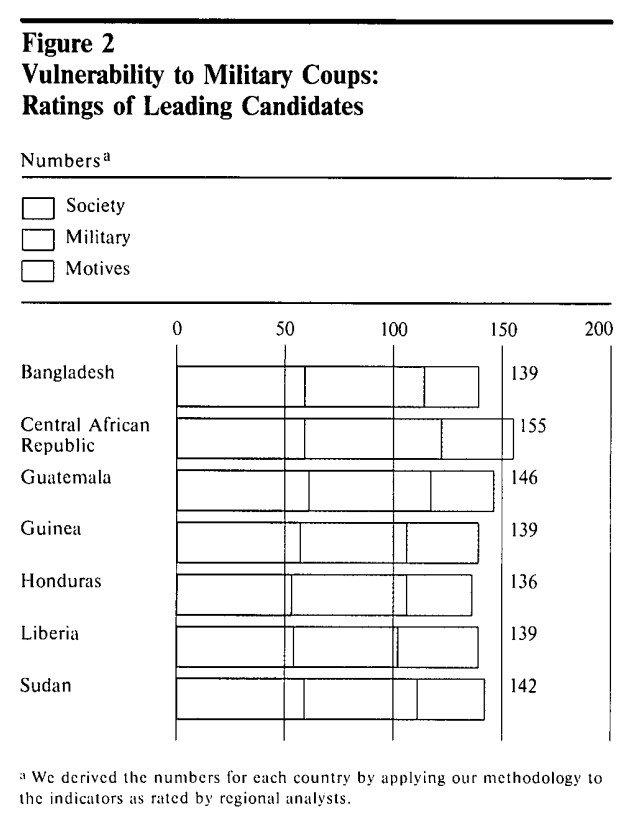
At the beginning of this year, the following countries stood out as the leading candidates because they rated high in coup-prone environmental conditions, military predisposition, and motivation:
Bangladesh
Senior military officers are becoming increasingly concerned over Martial Law Administrator Ershad’s indecision, corruption, and vacillation in confronting civilian opposition groups.
Central African Republic
President Kolingba presides over a personalistic and factionalized political system as well as a military disposed to intervene; the French, however, virtually can dictate whether a coup attempt will be successful.
Guatemala
Although the military—with a long history of political involvement—at present has few grievances against newly elected President Cerezo, it will be paying close attention to his attitude toward protecting its professional autonomy and corporate interests.
Guinea
President Conte’s position has improved in the past several months, but continued support for his government will hinge on his ability to implement his economic reform program and balance competing interests among military and tribal groups.
Honduras
The Armed Forces remains the key institution and probably will allow newly inaugurated President Azcona a grace period, after which the decision to intervene will depend on its ability to shape policy behind the scenes.
Liberia
Civilian discontent with Head of State Doe is growing over his arbitrary and corrupt behavior, especially since his arrests and executions of numerous followers of popular General Quiwonkpa, who led the abortive coup in November.
Sudan
The Transitional Military Council has not resolved any of the key problems that led to its intervention last year, and, despite elections scheduled for April, political forces remain in disarray.
Regional analysts rated each country on the basis of data available in December 1985.
Since then, the insurgent National Resistance Army has toppled Uganda’s government, and a military-led rebellion has unseated President Marcos in the Philippines. Elements of the military in South Yemen, moreover, have overthrown the President after his failed attempt to remove leaders of the opposing faction. There also has been an irregular regime change in Haiti, although it did not constitute a military coup.
A detailed explanation of the methodology appears in the appendix.
By focusing on each specific group of factors, we also can identify countries where the likelihood of military intervention would dramatically increase if changes occurred in the environment, the armed forces, or the motives.
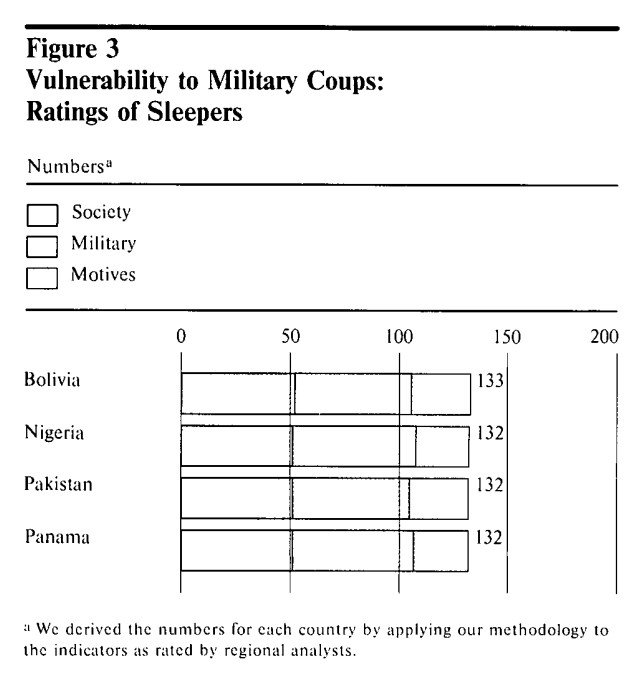
Four countries—Bolivia, Nigeria, Pakistan, and Panama—display most of the critical environmental and military conditions conducive to coup plotting but rate low in motives. In our view, these “sleepers” already have a propensity toward coup plotting, and the addition of more motives or precipitating events could provoke the military to intervene.
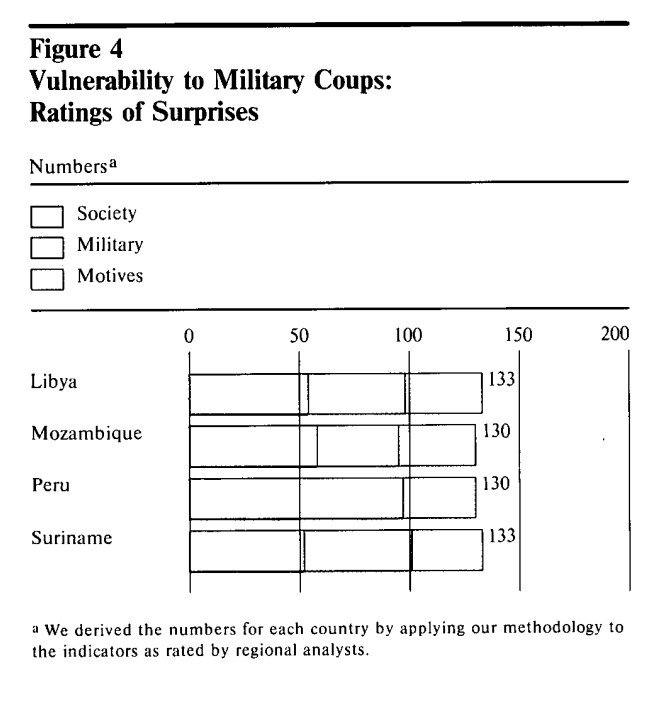
Four other countries—Libya, Mozambique, Peru, and Suriname—already rate high in motivation but lower in coup-prone environmental conditions and military predisposition. Thus, the prospects of intervention in these countries would appear less likely. We surmise, however, that only marginal changes in the environment or armed forces would significantly raise the probability of a “surprise” coup.
We believe events in two other countries—Uganda and the Philippines—have confirmed the assessments we made based on their ratings at the end of 1985. Uganda then ranked as the most vulnerable of 81 countries to military intervention because it rated extremely high in every group of indicators.
Indeed, General Okello’s government was toppled in January by insurgent leader Yuweri Museveni and his National Resistance Army.
In December, the Philippines was our leading “surprise” candidate, in that its coup-prone environmental conditions and motivation rated high, but the armed forces then displayed little proclivity to intervene. The predisposition of reformist elements in the military, however, shifted significantly during the recent election campaign, and the blatantly fraudulent results prompted them to move against the Marcos government.
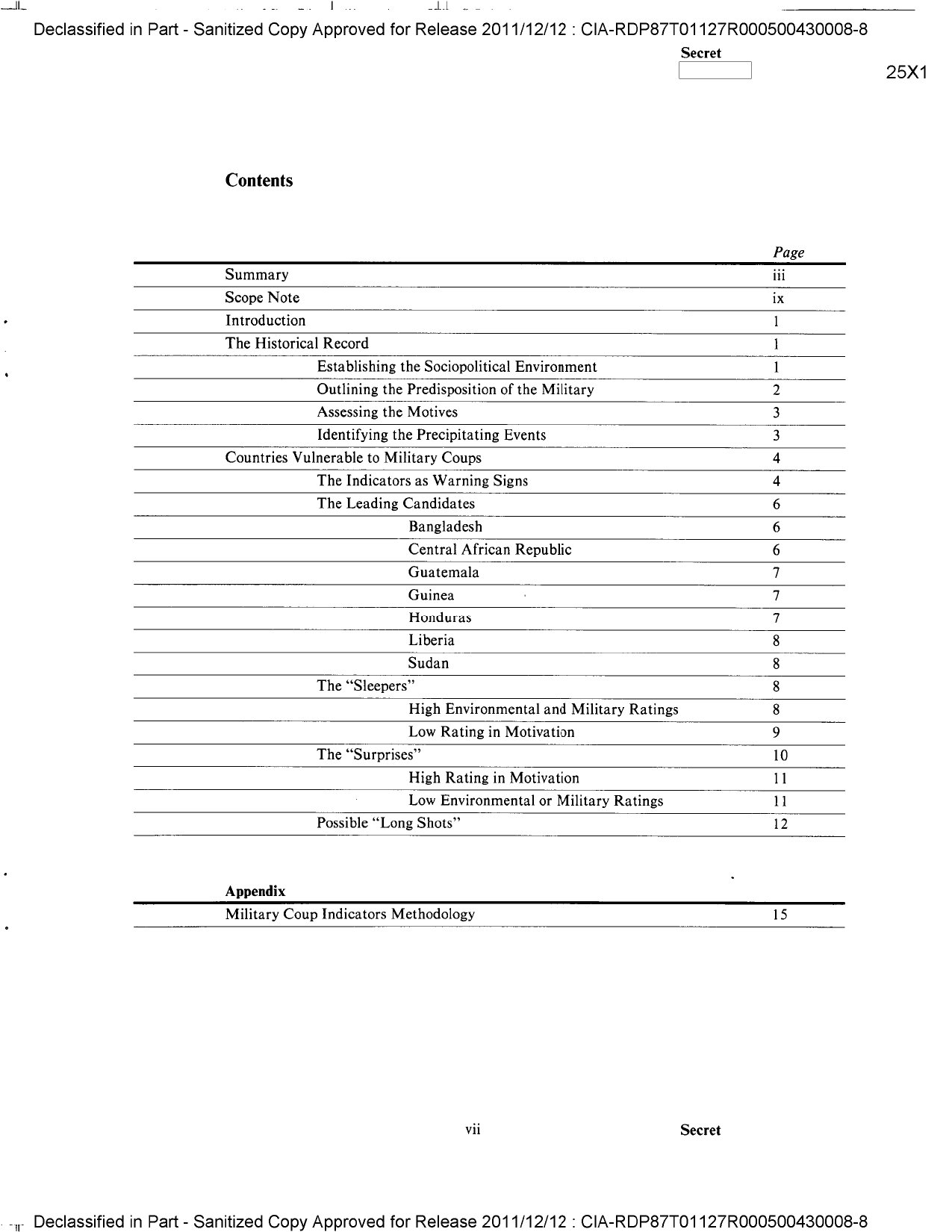
Contents
| Section | Page |
|---|---|
| Secret | |
| Summary | iii |
| Scope Note | ix |
| Introduction | 1 |
| The Historical Record | 1 |
| Establishing the Sociopolitical Environment | 1 |
| Outlining the Predisposition of the Military | 2 |
| Assessing the Motives | 3 |
| Identifying the Precipitating Events | 3 |
| Countries Vulnerable to Military Coups | 4 |
| The Indicators as Warning Signs | 4 |
| The Leading Candidates | 6 |
| Bangladesh | 6 |
| Central African Republic | 6 |
| Guatemala | 7 |
| Guinea | 7 |
| Honduras | 7 |
| Liberia | 8 |
| Sudan | 8 |
| The “Sleepers” | 8 |
| High Environmental and Military Ratings | 8 |
| Low Rating in Motivation | 9 |
| The “Surprises” | 10 |
| High Rating in Motivation | 11 |
| Low Environmental or Military Ratings | 11 |
| Possible “Long Shots” | 12 |
| Appendix | |
| Military Coup Indicators Methodology | 15 |
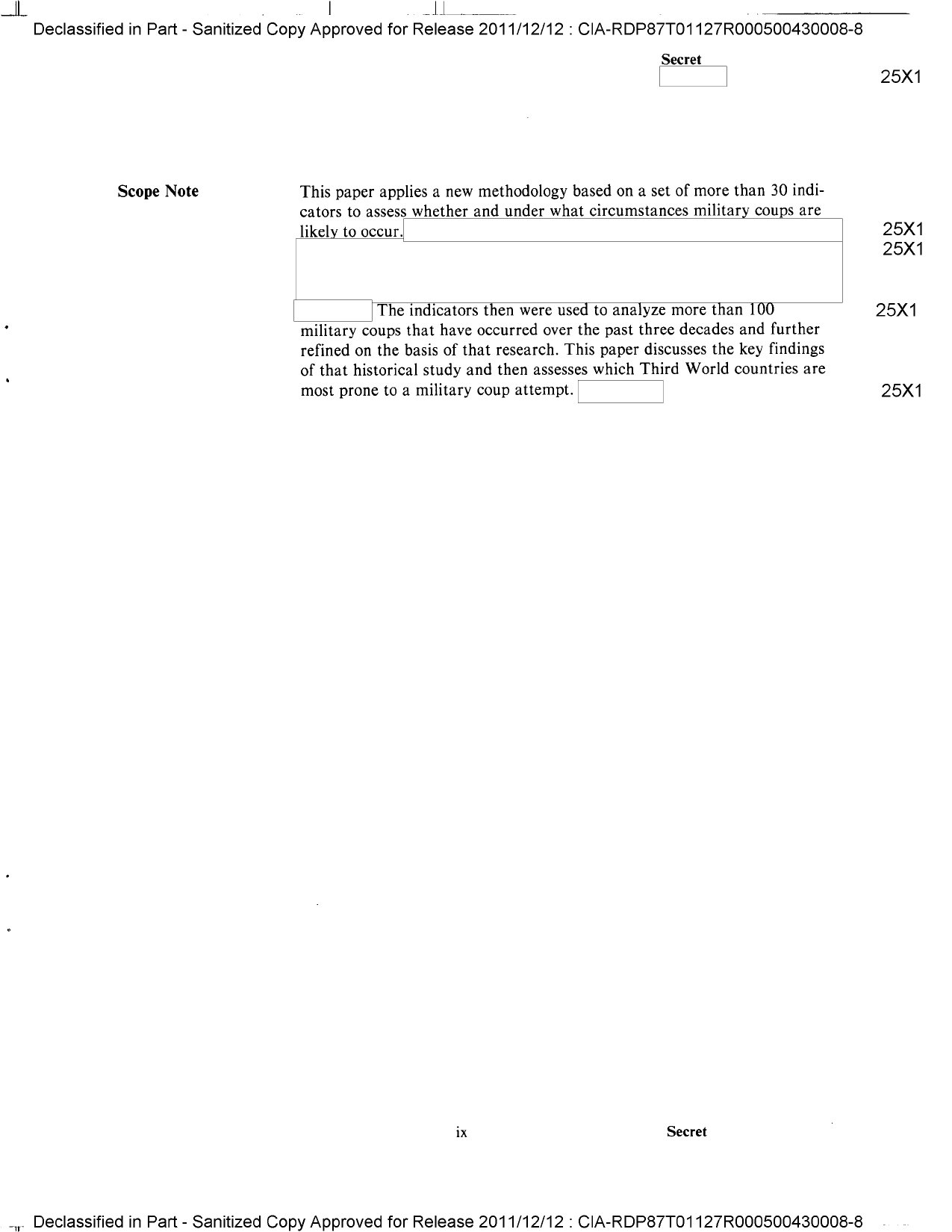
Scope Note
This paper applies a new methodology based on a set of more than 30 indicators to assess whether and under what circumstances military coups are likely to occur.
The indicators then were used to analyze more than 100 military coups that have occurred over the past three decades and further refined on the basis of that research. This paper discusses the key findings of that historical study and then assesses which Third World countries are
most prone to a military coup attempt.
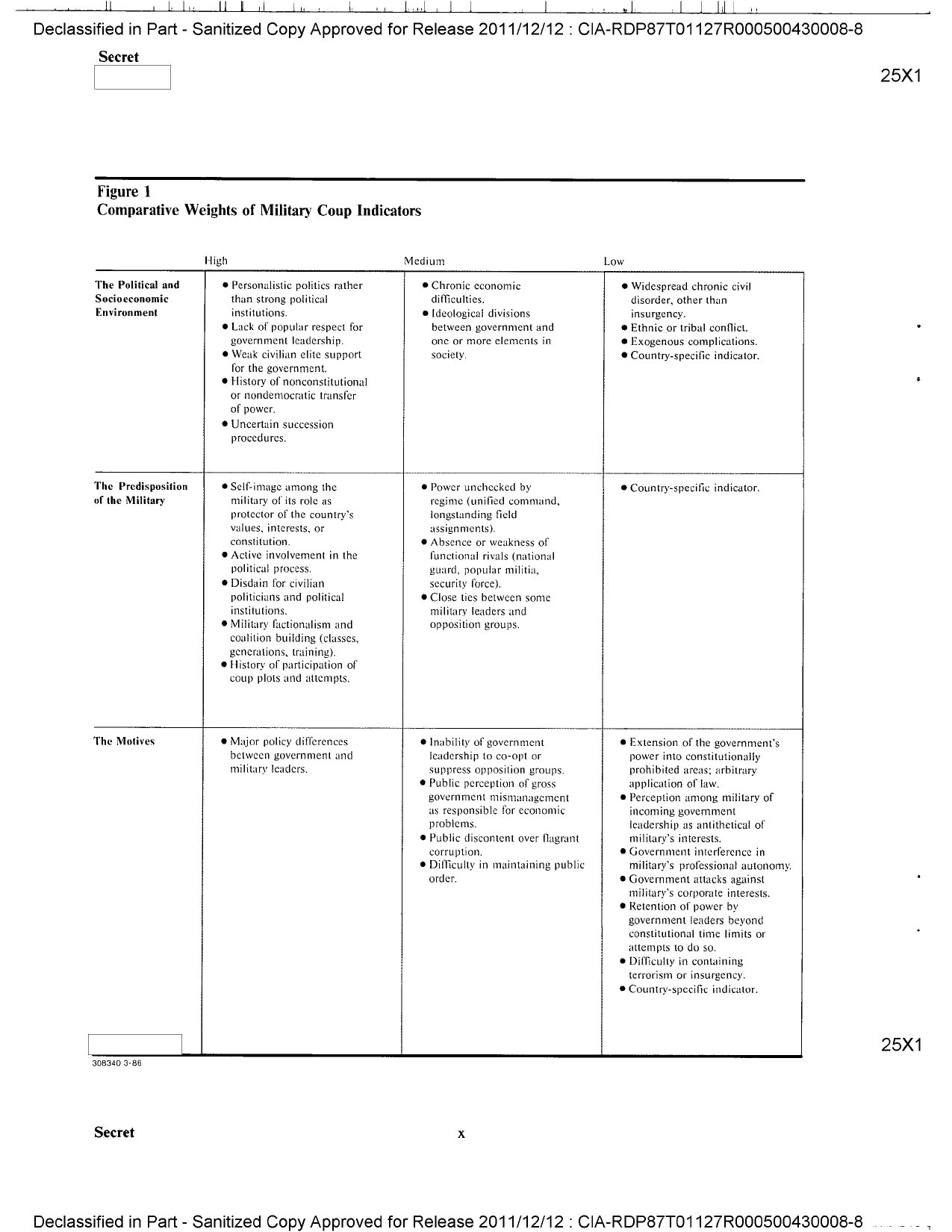
Figure 1
Comparative Weights of Military Coup Indicators
| High | Medium | Low | |
|---|---|---|---|
| The Political and Socioeconomic Environment | • Personalistic politics rather than strong political institutions. • Lack of popular respect for government leadership. • Weak civilian elite support for the government. • History of nonconstitutional or nondemocratic transfer of power. • Uncertain succession procedures. |
• Chronic economic difficulties. • Ideological divisions between government and one or more elements in society. |
• Widespread chronic civil disorder, other than insurgency. • Ethnic or tribal conflict. • Exogenous complications. • Country-specific indicator. |
| The Predisposition of the Military | • Self-image among the military of its role as protector of the country’s values, interests, or constitution. • Active involvement in the political process. • Disdain for civilian politicians and political institutions. • Military factionalism and coalition building (classes, generations, training). • History of participation in coup plots and attempts. |
• Power unchecked by regime (unified command, longstanding field assignments). • Absence or weakness of functional rivals (national guard, popular militia, security force). • Close ties between some military leaders and opposition groups. |
• Country-specific indicator. |
| The Motives | • Major policy differences between government and military leaders. |
• Inability of government leadership to co-opt or suppress opposition groups. • Public perception of gross government mismanagement as responsible for economic problems. • Public discontent over flagrant corruption. • Difficulty in maintaining public order. |
• Extension of the government’s power into constitutionally prohibited areas; arbitrary application of law. • Perception among military of incoming government leadership as antithetical of military’s interests. • Government interference in military’s professional autonomy. • Government attacks against military’s corporate interests. • Retention of power by government leaders beyond constitutional time limits or attempts to do so. • Difficulty in containing terrorism or insurgency. • Country-specific indicator. |
Military Coups: Likely Third World Targets 1986
Introduction
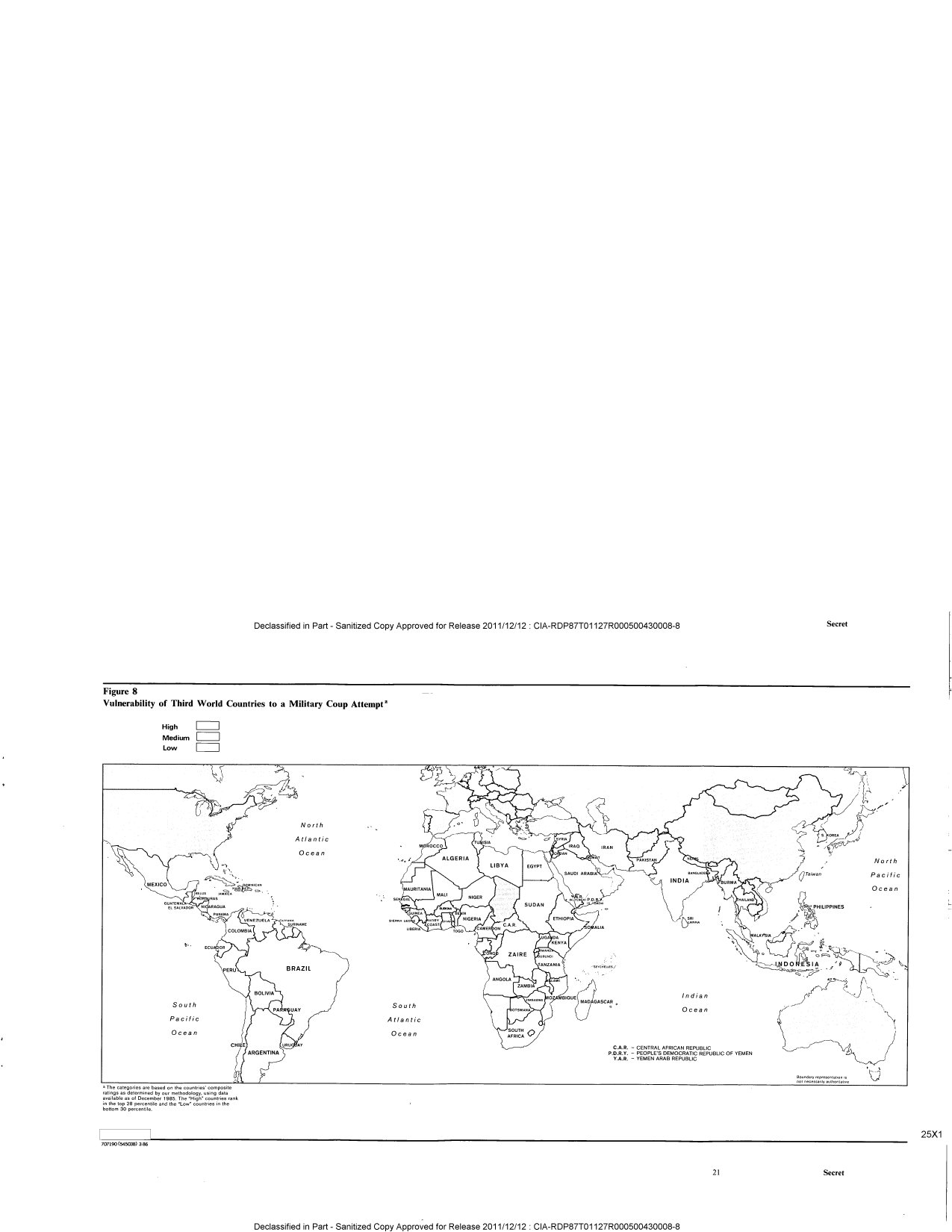
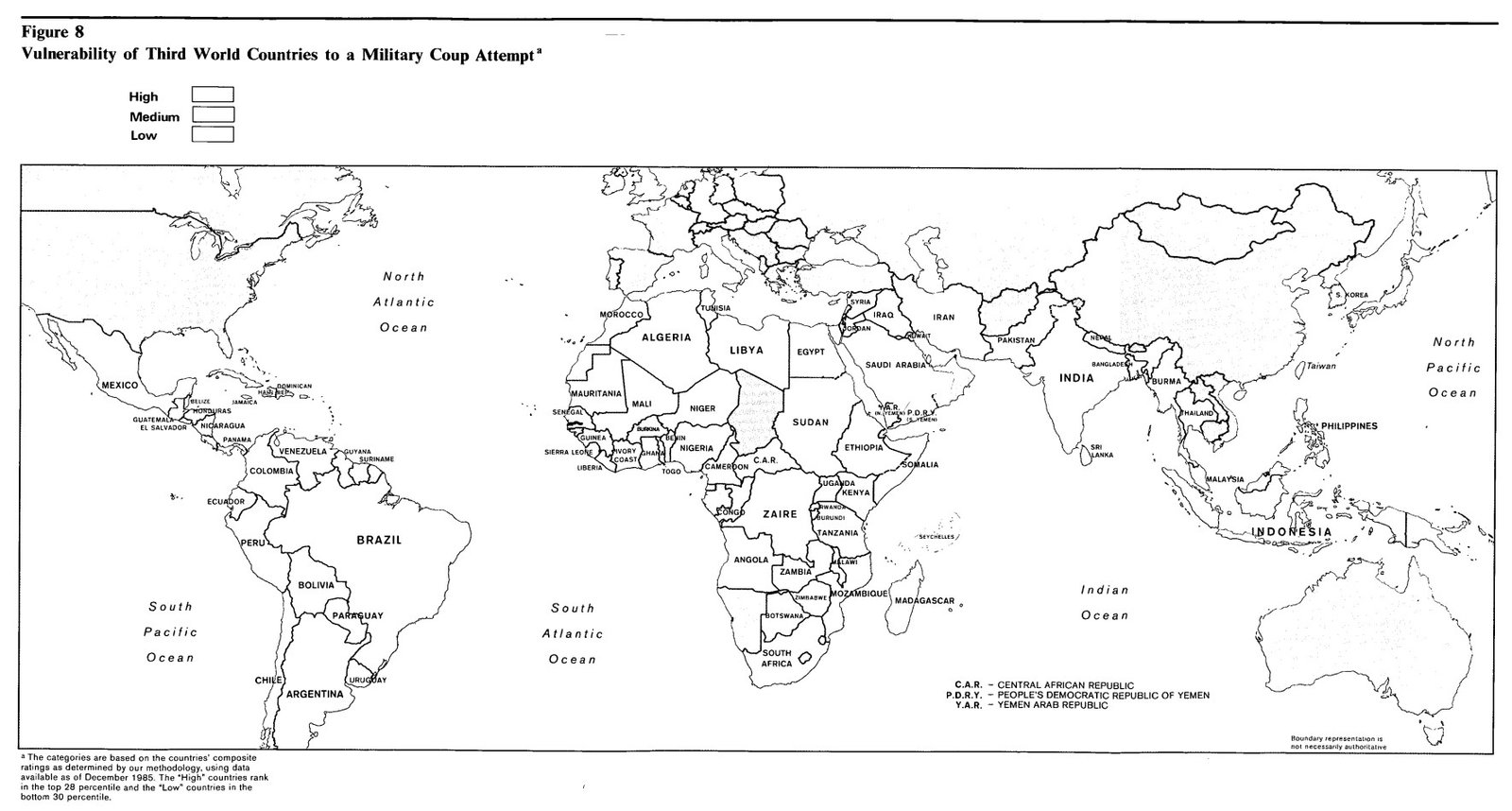
Our research shows that a military coup rarely is a random event but grows out of a complex interplay of political, socioeconomic, and military factors. We believe the mere desire of a general (or sergeant) to seize power is insufficient to ensure a successful coup; certain conditions in the society and the armed forces seem to be necessary prerequisites. Specific motives or grievances that would prompt the military to plot a coup, in our view, are additional critical factors in this equation. Finally, we believe a precipitating event—or trigger mechanism—usually is necessary to spur the conspirators to act. This paper examines the significance of the factors that historically have motivated the military to intervene and then assesses the current likelihood of a military coup’s occurring in 81 Third World countries (see figure 8, a foldout).
Countries Vulnerable to Military Coups
The Indicators as Warning Signs
We designed our list of indicators to serve two functions. While a country’s aggregate rating reflects the potential for a military coup, a shift in the salience of a particular indicator or group of indicators also can provide strategic warning that the likelihood of a coup attempt is increasing. We do not intend our indicators to predict exactly when a coup might occur, since the dynamics of past coups suggest that the time between conditions’ becoming conducive to coup plotting and an actual coup attempt can vary greatly.
Specifically, our research suggests that countries with:
- A low rating in the environment and the armed forces are least prone to military intervention and, in most cases, would have to accumulate a large number of coup-prone conditions and motives before experiencing a coup; however, if such countries already have a high concentration of motives, changes in the environment or armed forces could dramatically increase the potential for a coup attempt.
- A high rating in both the environment and the armed forces are predisposed toward military intervention; in our opinion, the addition of a few motives—along with some triggers—could easily provoke a coup attempt.
- A high rating in the environment, the armed forces, and the motives probably only lack provocation, and one or two precipitating events could trigger the military conspirators; in such cases we believe intervention would quickly follow the trigger event.
As a general rule, we have found that factors relating to the environment and the military are slow to change while those included in the motives are more volatile and thus more critical in determining the overall rating.
The Historical Record
Establishing the Sociopolitical Environment
We believe a society must exhibit coup-prone conditions for the military even to consider intervention. Thus, we first examine a country’s predisposition in terms of its political, economic, and social systems as well as its historical record of leadership change. Our research suggests that several conditions reflecting the nature of the regime consistently have ranked high before the military intervened (figure 1). Key factors have been the lack of strong political institutions and eroding government legitimacy.
Specifically:
- The leadership’s use of personal ties and influence to operate the political system.
- The lack—or loss—of popular respect for the government leadership.
- Weak support for the government from the civilian elites.
We found, moreover, that the pattern of leadership change has played a critical role in contributing to a coup-prone environment. In most instances of military intervention, the country has had a history of nonconstitutional or nondemocratic transfers of power as well as uncertain or untested succession procedures. Also influential, but less significant, in creating coup-prone environmental conditions have been the presence of chronic economic difficulties—usually reflected by spiraling inflation, balance-of-payments problems, and cuts in government spending—as well as deep-seated ideological divisions between the government leadership and one or more groups in the society.
Other conditions that contributed only marginally include:
- Widespread chronic civil disorder.
- Ethnic or tribal conflict.
- Exogenous complications, such as severe drought or an international oil or debt crisis.
Our research pointed up one political factor—a government’s patron-client relationship with a superpower—that applied infrequently but in some cases contributed significantly to a coup-prone environment. In these cases, the loss—or potential loss—of the superpower’s protection or financial aid undercut the government’s perceived legitimacy and ability to rule. On the other hand, a strong relationship with a superpower on occasion has proved to be the key factor prohibiting a military takeover, in that the superpower’s presence has been viewed by potential conspirators as posing too great a risk.
*Our conclusions as to the role and significance of specific environmental conditions, military factors, and motives in military coups are based on analysis of their frequency and degree of applicability in more than 100 past successful coups. A detailed explanation of the overall methodology appears in the appendix.
Military Versus Civilian Regimes
Our research on past military coups suggests many similarities in assessing the likelihood of intervention against military and civilian governments. Nonetheless, we observed two important differences:
- Military-led countries generally displayed more coup-prone conditions, and members of the armed forces required less motivation to conspire against their leaders.
- Countries with military governments previously had experienced at least one military coup; in many instances, the military leaders who were overthrown had seized power themselves through a coup.
In addition to a history of nonconstitutional transfer of power, military governments generally exhibited the same key coup-prone sociopolitical conditions before a coup as civilian governments—notably the lack of strong political institutions and eroding regime legitimacy. The predisposition of the armed forces in the two regime types also was similar, rating high in previous coup plotting, politicization, praetorianism, and factionalism.
As with civilian governments, moreover, those factors that proved most likely to spark a coup against a military government were major policy differences between the rulers and the conspirators and the inability of the government to deal with its opposition, often including factions in the armed forces. Other important motives involved the failure to maintain order, manage the economy, and refrain from corruption. In many cases, however, these motives rated low at the time the conspirators overthrew their military rulers.
We believe that, based on our assessment of past coups, the indicators focusing on the environmental conditions and predisposition of the armed forces should be monitored in countries with military governments. Because we would anticipate a high rating in the indicators that assess the military’s predisposition in these countries, the accumulation of coup-prone environmental conditions takes on added importance. In the cases where both the society and military already rate as highly coup prone, attention should be focused on potential precipitating events.
According to our research, conspirators in military-led countries frequently have mounted coups with little motivation.
Outlining the Predisposition of the Military
The likelihood of a military coup hinges on several key characteristics of the plotters. Based on our evaluation of various attitudinal, political, and organizational aspects of a country’s armed forces, we believe the most consistent characteristics of military leaders in past coups are praetorianism and politicization. Specifically, the conspirators:
- Perceived themselves—as members of the armed forces—primarily responsible for protecting their country’s values, interests, or constitution.
- Already were actively involved in the political process before they overthrew the government leadership.
- Held civilian politicians and political institutions in disdain.
Moreover, the plotters frequently have come from a factionalized military establishment and have been involved in previous coup plots and attempts. We observed that, once the military has intervened to effect a regime change, in many cases the armed forces has become the established vehicle for transferring power, even among civilian politicians.
To a lesser degree, we noted that government leaders have abetted the conspirators in staging a coup by maintaining inadequate control over the armed forces. For example, the government has:
- Allowed a unified military command or field officers to retain their commands for long periods of time, thereby facilitating the organization and implementation of a coup attempt.
- Failed to develop functional rivals such as a national guard, a popular militia, or a separate security force—at times manned by foreigners—that could contend for power and influence with the armed forces.
- Permitted plotters to establish close ties to opposition groups who have co-opted the plotters into supporting a coup.
We also looked at the military’s previous guerrilla experience in a recent revolution or struggle for independence but found it a significant factor in only a limited number of cases. Another indicator—the existence of a charismatic, ambitious leader in the armed forces—appeared infrequently but proved to be an important factor.
Assessing the Motives
We believe that a coup-prone society and military are insufficient by themselves to initiate a coup. Specific motives also must be present to prompt the plotters to conspire against the government. In our opinion, sorting out the precise motives is more complex than evaluating the social environment and the role of the armed forces.
Our indicators examined a range of motivations, taking into account illegal or arbitrary actions by government leaders, their inability to rule effectively, and policies or behavior disliked by the public or the military in particular. The one motive that appeared in our research as consistently significant was the existence of major policy differences between government and military leaders.
Motives that frequently played a role but appeared less critical in persuading the military to mount a coup usually were associated with the government’s inability to rule. Specifically, the armed forces often launched coups when:
- The government proved unable to co-opt or suppress opposition groups.
- The public blamed the government for mismanaging the economy and for living standards dropping sharply.
- Discontent over flagrant government corruption was widespread.
- The government appeared increasingly unable to maintain public order.
According to our research, a government’s unconstitutional or illegal behavior as well as actions that threaten the armed forces’ interests generally rated much lower as motives. Our indicators focused on illegal behavior in terms of the government leadership’s extension of power into constitutionally prohibited areas or arbitrary application of laws and the retention of power beyond constitutional time limits.
We defined government threats to the military in terms of:
- The military’s perception of an incoming regime as antithetical to its interests.
- Government policies attacking military pay, benefits, promotions, and equipment procurement.
- Government decisions that military leaders viewed as undermining their professional autonomy.
Motives we found that only marginally influenced the plotters to intervene included tensions between the military and government leaders over a border conflict or foreign war and a government’s investigation or prosecution of human rights abuses by military officers. We suspect, however, that the latter factor has been gaining relevance in recent years because of increased international attention on human rights. In a small number of cases, government action to promote a strong functional rival—such as a popular militia or presidential guard—has proved to be a key factor alienating elements of the military from the government and eventually leading them to overthrow it.
Identifying the Precipitating Events
We believe that a coup-prone society and military, as well as the accumulation of a substantial number of motives, may not necessarily spur the military to attempt a coup. In our view, a precipitating event—a trigger mechanism—usually is required to provoke the conspirators to act. We have found that a trigger mechanism generally is necessary even in the case of intervention by a praetorian military accustomed to seizing power.
Our research pointed up a number of events that frequently have sparked a military coup. Most triggers have involved actions taken by the government leadership, such as:
- The departure of the leader from the country or the capital.
- The sudden imposition of unpopular economic or social measures.
- The arrest or execution of a key military or civilian leader with a large following in the military.
- A major purge or reorganization of the armed forces.
Other important precipitating events include the assassination of a key figure in the government or military and a sudden or acute political crisis, such as a conflict over leadership succession or constitutional powers.
We also noted in our research that motives sometimes operate as trigger mechanisms. For example, while continued government attacks against military corporate interests can motivate a coup-prone military to initiate a conspiracy, the announcement of severe pay cuts or political promotions actually can provoke a military already involved in a conspiracy to intervene. Another motive that has operated as a trigger has been an election—recent or impending—that portended a political environment hostile to the military.
Nonetheless, we believe that motives usually can be differentiated from triggers in that motives, which form the bridge from coup-proneness to plotting, are more diffuse and develop over a period of time while triggers tend to be more sudden and discrete.
Regional Patterns
In our historical assessment, we could discern no significant regional differences in examining what prompted military coups. Although several of the less influential indicators applied more often to countries in one or two regions, the key environmental and military indicators as well as key motives rated consistently high in every region. Moreover, all of the indicators were evident in more than one region.
The lack of strong political institutions and eroding regime legitimacy proved to be critical in almost every military coup—regardless of region. Among the other coup-prone conditions in the environment, several appeared more significant in one or more regions:
- Ideological disputes between the government and groups in society ranked higher in more Latin American countries than elsewhere.
- Ethnic and tribal conflict showed up most frequently in African countries.
- Chronic economic difficulties were more common to countries in Africa and Latin America than in the Near East and Asia.
The profile of the military’s predisposition before a coup was virtually identical in all regions.
Major policy differences between military and government leaders and the government’s inability to suppress the opposition were the key motives for coups in every region. Nonetheless, we believe some other less critical motives probably bear watching in specific regions because of their more frequent appearance:
- Public perception of the government’s mismanagement as responsible for economic difficulties and discontent over flagrant corruption was more important in Latin America.
- The government’s excessive retention of power or its arbitrary use of power was noted more often in the Near East and Asia.
- Antimilitary attitudes and policies on the part of the government were more discernible in Africa and Latin America.
Countries Vulnerable to Military Coups
The Indicators as Warning Signs
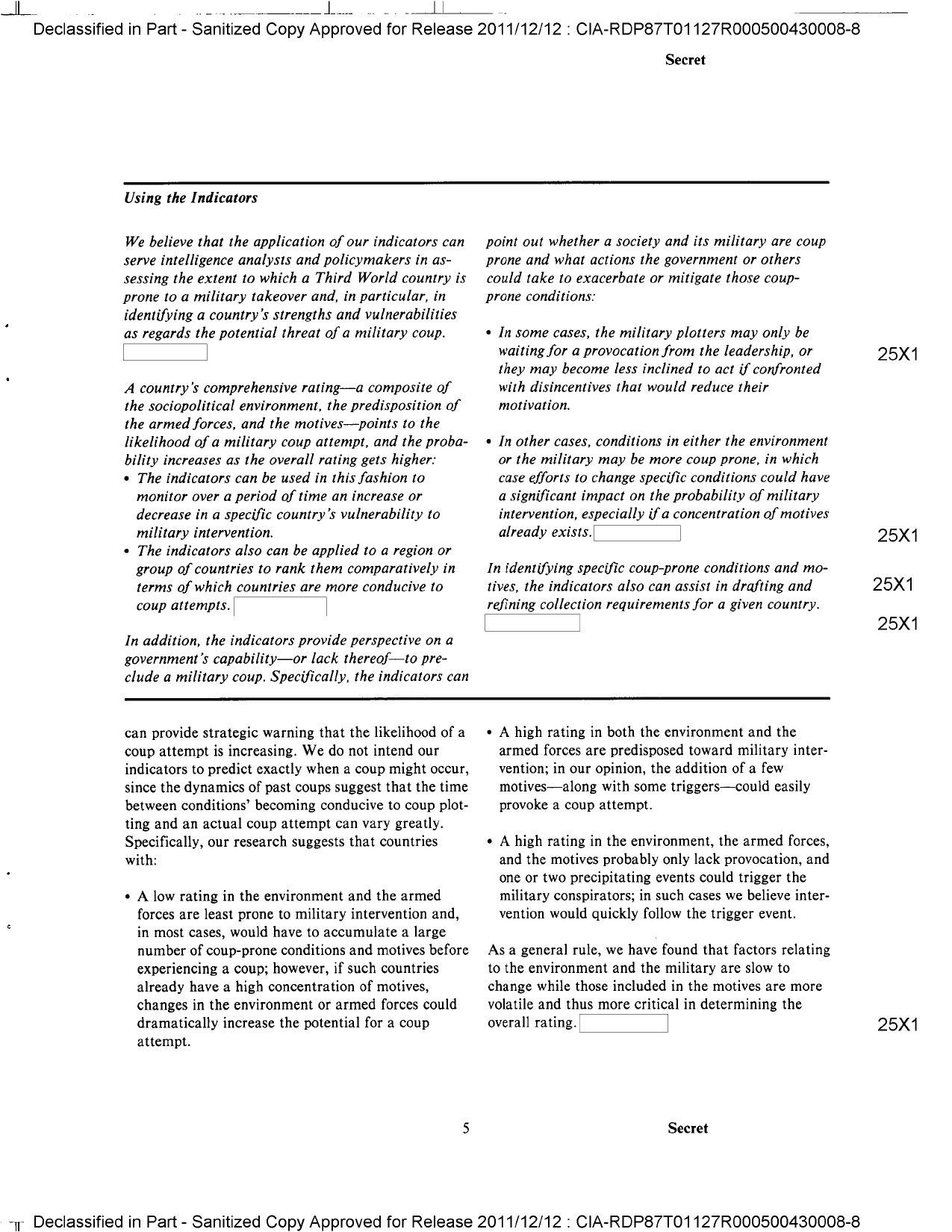
We designed our list of indicators to serve two functions. While a country’s aggregate rating reflects the potential for a military coup, a shift in the salience of a particular indicator or group of indicators also can provide strategic warning that the likelihood of a coup attempt is increasing. We do not intend our indicators to predict exactly when a coup might occur, since the dynamics of past coups suggest that the time between conditions’ becoming conducive to coup plotting and an actual coup attempt can vary greatly.
Specifically, our research suggests that countries with:
- A low rating in the environment and the armed forces are least prone to military intervention and, in most cases, would have to accumulate a large number of coup-prone conditions and motives before experiencing a coup; however, if such countries already have a high concentration of motives, changes in the environment or armed forces could dramatically increase the potential for a coup attempt.
- A high rating in both the environment and the armed forces are predisposed toward military intervention; in our opinion, the addition of a few motives—along with some triggers—could easily provoke a coup attempt.
- A high rating in the environment, the armed forces, and the motives probably only lack provocation, and one or two precipitating events could trigger the military conspirators; in such cases we believe intervention would quickly follow the trigger event.
As a general rule, we have found that factors relating to the environment and the military are slow to change while those included in the motives are more volatile and thus more critical in determining the overall rating.
Using the Indicators
We believe that the application of our indicators can serve intelligence analysts and policymakers in assessing the extent to which a Third World country is prone to a military takeover and, in particular, in identifying a country’s strengths and vulnerabilities as regards the potential threat of a military coup.
A country’s comprehensive rating—a composite of the sociopolitical environment, the predisposition of the armed forces, and the motives—points to the likelihood of a military coup attempt, and the probability increases as the overall rating gets higher.
The indicators can be used in this fashion to monitor over a period of time an increase or decrease in a specific country’s vulnerability to military intervention.
The indicators also can be applied to a region or group of countries to rank them comparatively in terms of which countries are more conducive to coup attempts.
In addition, the indicators provide perspective on a government’s capability—or lack thereof—to preclude a military coup. Specifically, the indicators can point out whether a society and its military are coup prone and what actions the government or others could take to exacerbate or mitigate those coup-prone conditions:
- In some cases, the military plotters may only be waiting for a provocation from the leadership, or they may become less inclined to act if confronted with disincentives that would reduce their motivation.
- In other cases, conditions in either the environment or the military may be more coup prone, in which case efforts to change specific conditions could have a significant impact on the probability of military intervention, especially if a concentration of motives already exists.
In identifying specific coup-prone conditions and motives, the indicators also can assist in drafting and refining collection requirements for a given country.
The Leading Candidates
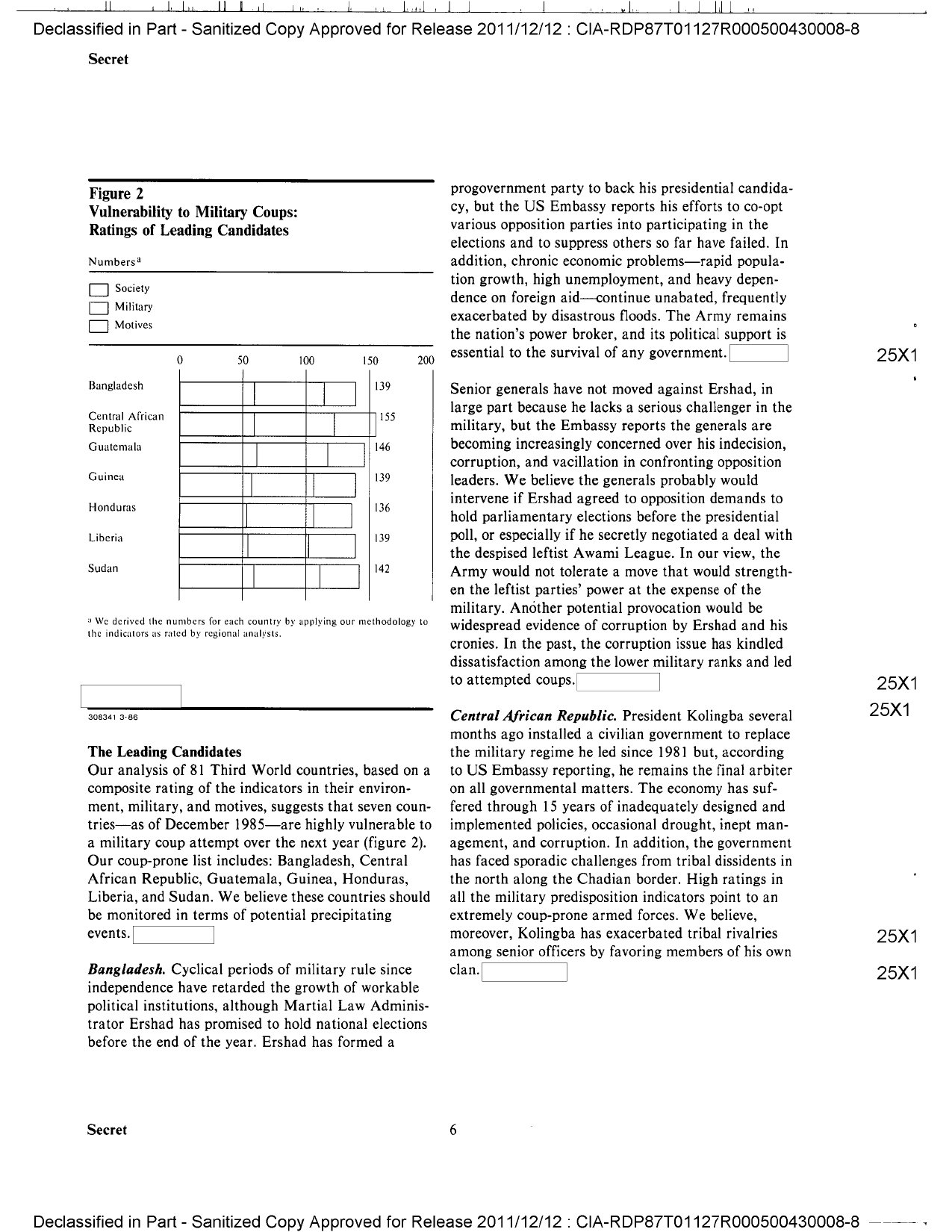
Our analysis of 81 Third World countries, based on a composite rating of the indicators in their environment, military, and motives, suggests that seven countries—as of December 1985—are highly vulnerable to a military coup attempt over the next year (figure 2).
Our coup-prone list includes: Bangladesh, Central African Republic, Guatemala, Guinea, Honduras, Liberia, and Sudan. We believe these countries should be monitored in terms of potential precipitating events.
Bangladesh. Cyclical periods of military rule since independence have retarded the growth of workable political institutions, although Martial Law Administrator Ershad has promised to hold national elections before the end of the year. Ershad has formed a pro-government party to back his presidential candidacy, but the US Embassy reports his efforts to co-opt various opposition parties into participating in the elections and to suppress others so far have failed.
In addition, chronic economic problems—rapid population growth, high unemployment, and heavy dependence on foreign aid—continue unabated, frequently exacerbated by disastrous floods. The Army remains the nation’s power broker, and its political support is essential to the survival of any government.
Senior generals have not moved against Ershad, in large part because he lacks a serious challenger in the military, but the Embassy reports the generals are becoming increasingly concerned over his indecision, corruption, and vacillation in confronting opposition leaders. We believe the generals probably would intervene if Ershad agreed to opposition demands to hold parliamentary elections before the presidential poll, or especially if he secretly negotiated a deal with the despised leftist Awami League.
In our view, the Army would not tolerate a move that would strengthen the leftist parties’ power at the expense of the military. Another potential provocation would be widespread evidence of corruption by Ershad and his cronies. In the past, the corruption issue has kindled dissatisfaction among the lower military ranks and led to attempted coups.
The economy has suffered through 15 years of inadequately designed and implemented policies, occasional drought, inept management, and corruption. In addition, the government has faced sporadic challenges from tribal dissidents in the north along the Chadian border. High ratings in all the military predisposition indicators point to an extremely coup-prone armed forces. We believe, moreover, Kolingba has exacerbated tribal rivalries among senior officers by favoring members of his own clan.
Central African Republic. President Kolingba several months ago installed a civilian government to replace the military regime he led since 1981 but, according to US Embassy reporting, he remains the final arbiter on all governmental matters.
[CENSORED]
A number of motives are evident—some public discontent over continued economic austerity, corruption, and Kolingba’s arbitrary exercise of power.
Nonetheless, this is a case where the support of a foreign country—France, in this instance—plays a critical role in determining the likelihood of a military coup. France has maintained close ties to the Central African Republic since independence and, indeed, was instrumental in Kolingba’s assumption of power in 1981. Thus, we believe that continued French support for Kolingba could deter a military coup.
Guatemala. Despite an orderly transfer of power from military rule to civilian President Cerezo in January, the environmental conditions are highly coup prone. Against the backdrop of a long history of rigged elections and weak political institutions, the government faces a dire need for foreign exchange to pay for fuel and other imports, rising inflation, and mounting pressure to renegotiate Guatemala’s foreign debt.
Moreover, the government has to contend with traditional class, religious, and ethnic tensions as well as a leftist insurgency. The armed forces, driven by their self-image as protector of Guatemalan values and interests, has a long history of coup plotting and involvement in the political system. While it never has had much respect for civilian politicians and the democratic process, all levels of the military, in our view, continue to endorse the transition to civilian rule.
Cerezo’s public statements so far have been cautious and have not provoked significant negative reaction from the armed forces, but we believe their apprehension will increase as the government settles in. Senior officers will pay close attention to the new civilian government’s willingness to protect their professional autonomy and corporate interests. In our opinion, the officers would be provoked to act if Cerezo imposed economic austerity measures that slashed defense spending, interfered in the military’s counterinsurgency campaign, or prosecuted military personnel for past human rights abuses.
Guinea. President Conte, who seized power in April 1984, and his ruling Military Committee for National Redress lack strong political institutions, popular respect, and civilian elite support. Since November, however, Conte has reshuffled his Cabinet, demoting military members who posed the greatest challenge and improving its tribal balance. He also has moved to liberalize the socialist, state-controlled economy. According to US Embassy reporting, Conte’s initiatives have increased his public and military support, but keeping such support will depend on his ability to continue his economic reform program and balance competing interests among the military and tribal groups.
In particular, Conte will face continued pressure from the Malinke, who dominated under former President Sekou Toure and strongly resent their replacement by Conte’s minority tribesmen. The predisposition of the military, even though it comprises the government, also rates high in previous coup plotting, involvement in politics, disdain for civilian politicians, and no functional rival. The armed forces is becoming increasingly factionalized as discontent with Conte spreads through the lower ranks.
The most significant motives stem from Conte’s problems in dealing with personal rivals and with the Malinke, as well as his perceived mismanagement of economic policy. In particular, as reported by the US Embassy, some elements of the military—junior officers and enlisted ranks—blame Conte for failing to improve their living conditions and for procrastinating on pay increases while tolerating corruption among their superiors. We believe a move by Conte to put arrested influential Malinke leaders on trial or to impose stronger austerity measures on the armed forces could trigger another coup attempt.
Honduras. The military, the key social institution, has launched numerous coups in this century and has governed in all but two of the 18 years before President Suazo’s election in 1982. The current constitutional mechanisms for succession were tested for the first time in January with the election and inauguration of President Azcona. We believe Azcona’s chances of completing a four-year term, however, are even at best.
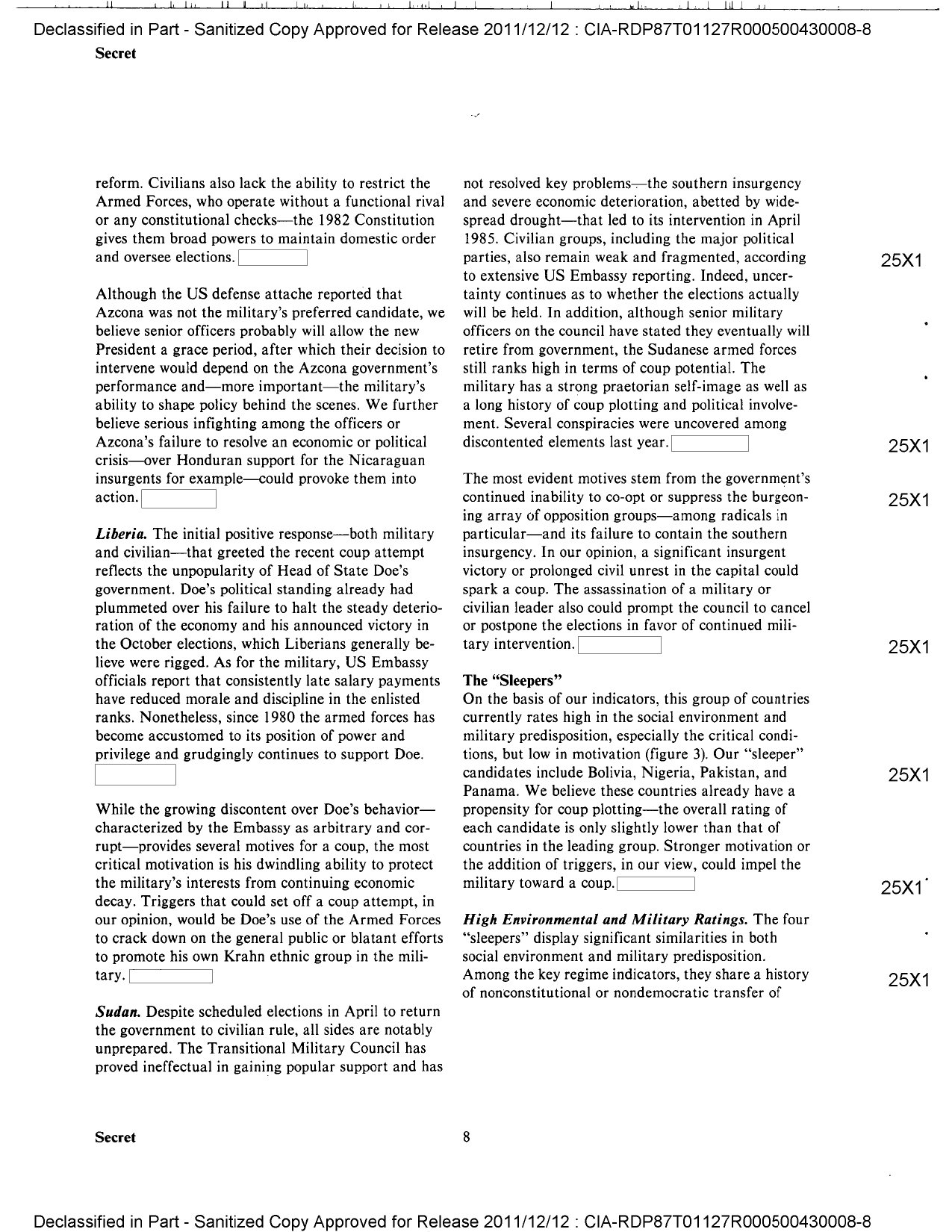
Civilian governments rarely have been efficient or honest enough to earn public respect; most leaders, including Suazo, have pursued patronage, power, and privilege rather than genuine reform. Civilians also lack the ability to restrict the Armed Forces, who operate without a functional rival or any constitutional checks—the 1982 Constitution gives them broad powers to maintain domestic order and oversee elections.
Although the US defense attache reported that Azcona was not the military’s preferred candidate, we believe senior officers probably will allow the new President a grace period, after which their decision to intervene would depend on the Azcona government’s performance and—more important—the military’s ability to shape policy behind the scenes. We further believe serious infighting among the officers or Azcona’s failure to resolve an economic or political crisis—over Honduran support for the Nicaraguan insurgents for example—could provoke them into action.
Liberia. The initial positive response—both military and civilian—that greeted the recent coup attempt reflects the unpopularity of Head of State Doe’s government. Doe’s political standing already had plummeted over his failure to halt the steady deterioration of the economy and his announced victory in the October elections, which Liberians generally believe were rigged.
As for the military, US Embassy officials report that consistently late salary payments have reduced morale and discipline in the enlisted ranks. Nonetheless, since 1980 the armed forces has become accustomed to its position of power and privilege and grudgingly continues to support Doe. While the growing discontent over Doe’s behavior—characterized by the Embassy as arbitrary and corrupt—provides several motives for a coup, the most critical motivation is his dwindling ability to protect the military’s interests from continuing economic decay.
Triggers that could set off a coup attempt, in our opinion, would be Doe’s use of the Armed Forces to crack down on the general public or blatant efforts to promote his own Krahn ethnic group in the military.
Sudan. Despite scheduled elections in April to return the government to civilian rule, all sides are notably unprepared. The Transitional Military Council has proved ineffectual in gaining popular support and has not resolved key problems—the southern insurgency and severe economic deterioration, abetted by widespread drought—that led to its intervention in April 1985. Civilian groups, including the major political parties, also remain weak and fragmented, according to extensive US Embassy reporting. Indeed, uncertainty continues as to whether the elections actually will be held.
In addition, although senior military officers on the council have stated they eventually will retire from government, the Sudanese armed forces still ranks high in terms of coup potential. The military has a strong praetorian self-image as well as a long history of coup plotting and political involvement. Several conspiracies were uncovered among discontented elements last year.
The most evident motives stem from the government’s continued inability to co-opt or suppress the burgeoning array of opposition groups—among radicals in particular—and its failure to contain the southern insurgency. In our opinion, a significant insurgent victory or prolonged civil unrest in the capital could spark a coup. The assassination of a military or civilian leader also could prompt the council to cancel or postpone the elections in favor of continued military intervention.
Figure 2 – Vulnerability to Military Coups – Ratings of Leading Candidates
The “Sleepers”
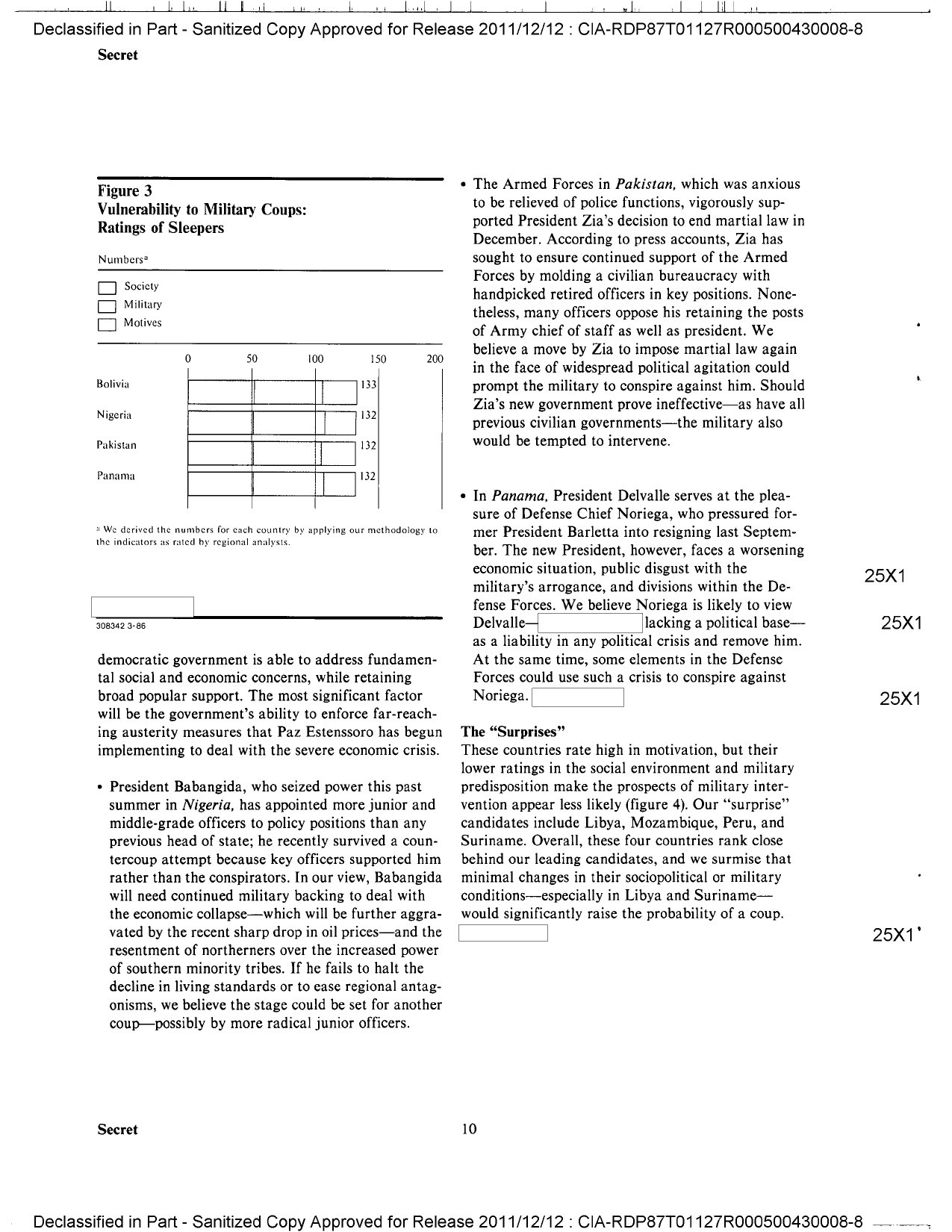
On the basis of our indicators, this group of countries currently rates high in the social environment and military predisposition, especially the critical conditions, but low in motivation (figure 3). Our “sleeper” candidates include Bolivia, Nigeria, Pakistan, and Panama. We believe these countries already have a propensity for coup plotting—the overall rating of each candidate is only slightly lower than that of countries in the leading group. Stronger motivation or the addition of triggers, in our view, could impel the military toward a coup.
High Environmental and Military Ratings. The four “sleepers” display significant similarities in both social environment and military predisposition. Among the key regime indicators, they share a history of nonconstitutional or nondemocratic transfer of power and weak political institutions. For the most part, all four also face chronic economic difficulties and serious exogenous pressures—balance-of-payments problems and, in Pakistan’s case, the loss of its overseas labor market. The four militaries rate high in previous involvement in coups, praetorian self-image, unchecked power, and—to a lesser extent in Bolivia—factionalism and the absence of a functional rival. As with virtually all the highly coup-prone countries, moreover, the military plays a critical role in the survival of the four governments.
Low Rating in Motivation. The profiles of the four countries’ motivation are more varied, although each “sleeper” rates high in at least one motive concerning economic mismanagement and low in disagreement between government and military leaders over policies or military prerogatives. Given the powerful role of the armed forces in these countries, we believe that a change in the military’s attitude toward the government leadership—concerning its ability to maintain order or resolve economic problems without threatening the armed forces’ interests, for example—could spur coup plotting.
We also believe that, if senior military officers in these countries lose confidence in the government, any one of the precipitating events could trigger their action: In Bolivia the election last summer of moderate President Paz Estenssoro somewhat diminished the prospects for military intervention. Nonetheless, the US Embassy reports that the armed forces’ willingness to remain within the confines of the constitution will depend on its perception of how well the [CENSORED] democratic government is able to address fundamental social and economic concerns, while retaining broad popular support. The most significant factor will be the government’s ability to enforce far-reaching austerity measures that Paz Estenssoro has begun implementing to deal with the severe economic crisis.
President Babangida, who seized power this past summer in Nigeria, has appointed more junior and middle-grade officers to policy positions than any previous head of state; he recently survived a countercoup attempt because key officers supported him rather than the conspirators. In our view, Babangida will need continued military backing to deal with the economic collapse—which will be further aggravated by the recent sharp drop in oil prices—and the resentment of northerners over the increased power of southern minority tribes. If he fails to halt the decline in living standards or to ease regional antagonisms, we believe the stage could be set for another coup—possibly by more radical junior officers.
The Armed Forces in Pakistan, which was anxious to be relieved of police functions, vigorously supported President Zia’s decision to end martial law in December. According to press accounts, Zia has sought to ensure continued support of the Armed Forces by molding a civilian bureaucracy with handpicked retired officers in key positions. Nonetheless, many officers oppose his retaining the posts of Army chief of staff as well as president. We believe a move by Zia to impose martial law again in the face of widespread political agitation could prompt the military to conspire against him. Should Zia’s new government prove ineffective—as have all previous civilian governments—the military also would be tempted to intervene.
In Panama, President Delvalle serves at the pleasure of Defense Chief Noriega, who pressured former President Barletta into resigning last September. The new President, however, faces a worsening economic situation, public disgust with the military’s arrogance, and divisions within the Defense Forces. We believe Noriega is likely to view Delvalle lacking a political base as a liability in any political crisis and remove him. At the same time, some elements in the Defense Forces could use such a crisis to conspire against Noriega.
Figure 3 – Vulnerability to Military Coups – Ratings of Sleepers
The “Surprises”
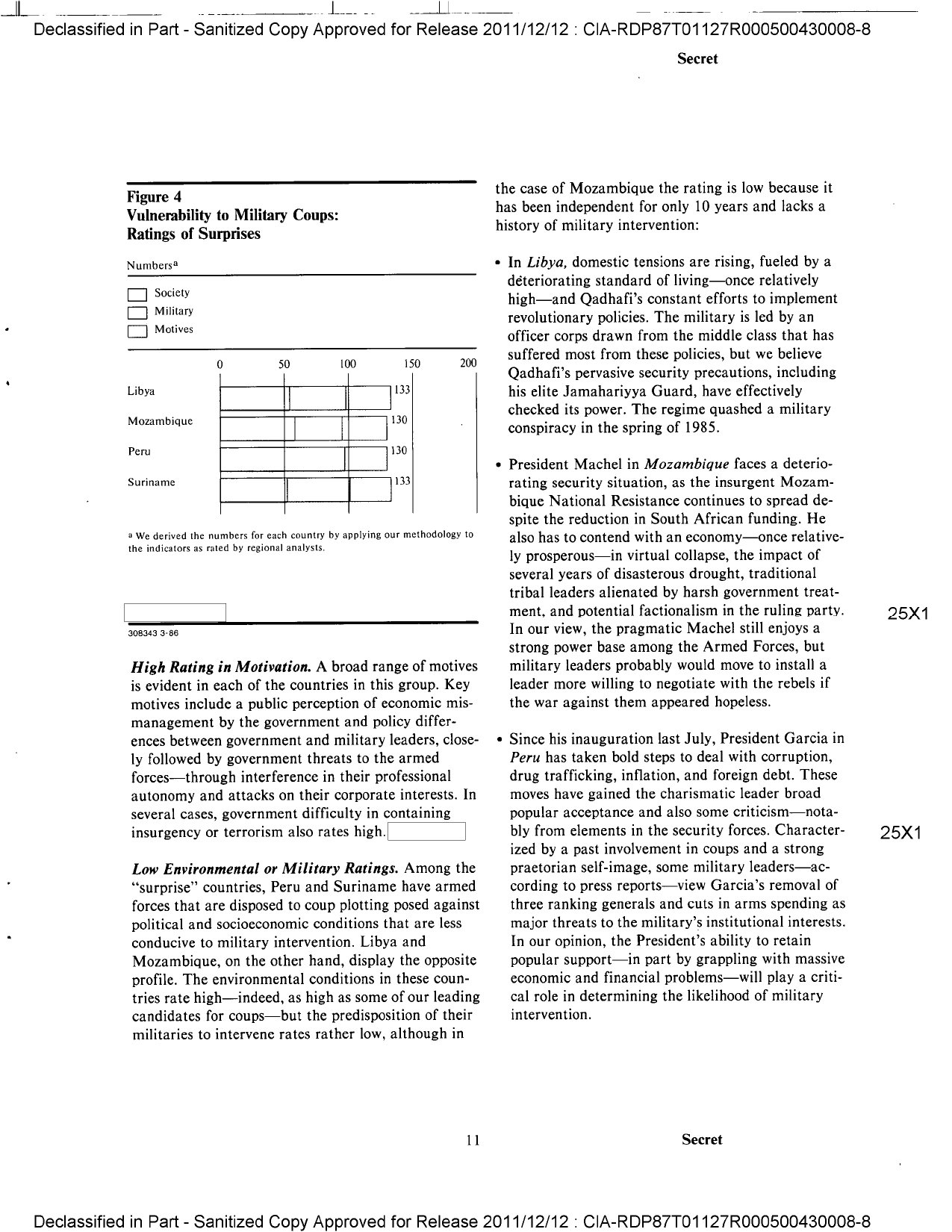
These countries rate high in motivation, but their lower ratings in the social environment and military predisposition make the prospects of military intervention appear less likely (figure 4). Our “surprise” candidates include Libya, Mozambique, Peru, and Suriname. Overall, these four countries rank close behind our leading candidates, and we surmise that minimal changes in their sociopolitical or military conditions—especially in Libya and Suriname—would significantly raise the probability of a coup.
High Rating in Motivation. A broad range of motives is evident in each of the countries in this group. Key motives include a public perception of economic mismanagement by the government and policy differences between government and military leaders, closely followed by government threats to the armed forces—through interference in their professional autonomy and attacks on their corporate interests. In several cases, government difficulty in containing insurgency or terrorism also rates high.
Low Environmental or Military Ratings. Among the “surprise” countries, Peru and Suriname have armed forces that are disposed to coup plotting posed against political and socioeconomic conditions that are less conducive to military intervention. Libya and Mozambique, on the other hand, display the opposite profile. The environmental conditions in these countries rate high—indeed, as high as some of our leading candidates for coups—but the predisposition of their militaries to intervene rates rather low, although in the case of Mozambique the rating is low because it has been independent for only 10 years and lacks a history of military intervention.
In Libya, domestic tensions are rising, fueled by a deteriorating standard of living—once relatively high—and Qadhafi’s constant efforts to implement revolutionary policies. The military is led by an officer corps drawn from the middle class that has suffered most from these policies, but we believe Qadhafi’s pervasive security precautions, including his elite Jamahariyya Guard, have effectively checked its power. The regime quashed a military conspiracy in the spring of 1985.
President Machel in Mozambique faces a deteriorating security situation, as the insurgent Mozambique National Resistance continues to spread despite the reduction in South African funding. He also has to contend with an economy—once relatively prosperous—in virtual collapse, the impact of several years of disastrous drought, traditional tribal leaders alienated by harsh government treatment, and potential factionalism in the ruling party. In our view, the pragmatic Machel still enjoys a strong power base among the Armed Forces, but military leaders probably would move to install a leader more willing to negotiate with the rebels if the war against them appeared hopeless.
Since his inauguration last July, President Garcia in Peru has taken bold steps to deal with corruption, drug trafficking, inflation, and foreign debt. These moves have gained the charismatic leader broad popular acceptance and also some criticism—notably from elements in the security forces. Characterized by a past involvement in coups and a strong praetorian self-image, some military leaders—according to press reports—view Garcia’s removal of three ranking generals and cuts in arms spending as major threats to the military’s institutional interests.
In our opinion, the President’s ability to retain popular support—in part by grappling with massive economic and financial problems—will play a critical role in determining the likelihood of military intervention.
In Suriname, leader Commander Bouterse recently agreed to consider a proposal from two traditional political parties to liberalize the political system.
We believe he probably hopes such a decision will broaden his support and, more important, persuade the Netherlands to resume economic aid, halted in 1982 in retaliation for the Army’s killing of 15 party leaders.
This dialogue, however, has heightened dissatisfaction among the armed forces.
In our opinion, military leaders worry Bouterse may jeopardize their interests—particularly by backing off from a demand that those involved in the 1982 killings be granted amnesty—to institutionalize his own control.
Figure 4 – Vulnerability to Military Coups – Ratings of Surprises
The Case of Uganda
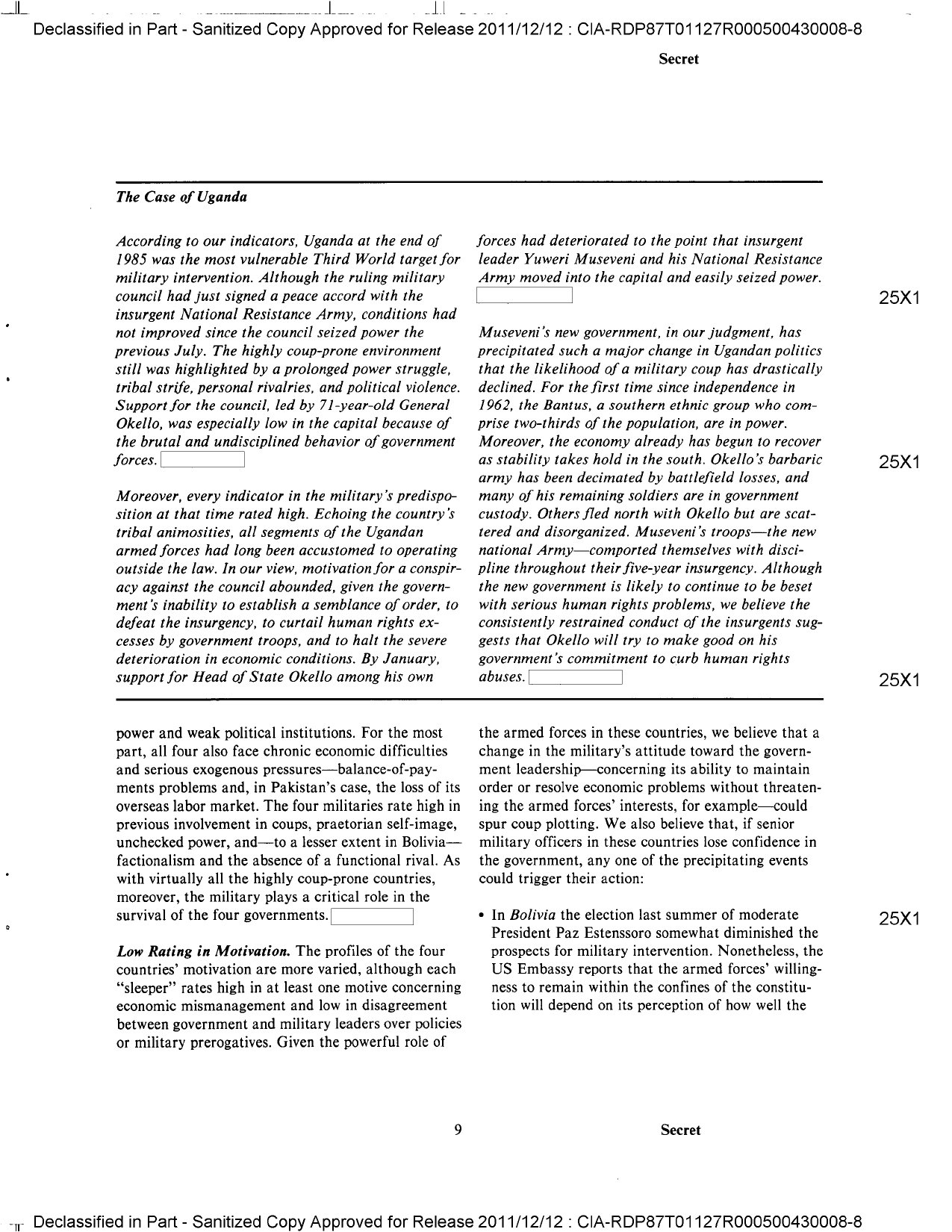
According to our indicators, Uganda at the end of 1985 was the most vulnerable Third World target for military intervention. Although the ruling military council had just signed a peace accord with the insurgent National Resistance Army, conditions had not improved since the council seized power the previous July. The highly coup-prone environment still was highlighted by a prolonged power struggle, tribal strife, personal rivalries, and political violence.
Support for the council, led by 71-year-old General Okello, was especially low in the capital because of the brutal and undisciplined behavior of government forces.
Moreover, every indicator in the military’s predisposition at that time rated high. Echoing the country’s tribal animosities, all segments of the Ugandan armed forces had long been accustomed to operating outside the law. In our view, motivation for a conspiracy against the council abounded, given the government’s inability to establish a semblance of order, to defeat the insurgency, to curtail human rights excesses by government troops, and to halt the severe deterioration in economic conditions.
By January, support for Head of State Okello among his own forces had deteriorated to the point that insurgent leader Yuweri Museveni and his National Resistance Army moved into the capital and easily seized power.
Museveni’s new government, in our judgment, has precipitated such a major change in Ugandan politics that the likelihood of a military coup has drastically declined. For the first time since independence in 1962, the Bantus, a southern ethnic group who comprise two-thirds of the population, are in power. Moreover, the economy already has begun to recover as stability takes hold in the south.
Okello’s barbaric army has been decimated by battlefield losses, and many of his remaining soldiers are in government custody. Others fled north with Okello but are scattered and disorganized. Museveni’s troops—the new national Army— comported themselves with discipline throughout their five-year insurgency.
Although the new government is likely to continue to be beset with serious human rights problems, we believe the consistently restrained conduct of the insurgents suggests that Okello will try to make good on his government’s commitment to curb human rights abuses.
The “Surprise” in the Philippines
At the end of 1985 the Philippines was our leading candidate in the “surprise” group. The country displayed a large number of coup-prone sociopolitical conditions and motives, but its military showed little proclivity to intervene. In addition to a highly personalized and unresponsive political system, an economy in shambles, and a steadily growing Communist insurgency, President Marcos appeared determined to stay in office until he died.
The Philippine armed forces, on the other hand, then viewed itself as the country’s protector against a Communist takeover but had no history of coup plotting. More important, officers disgruntled over pay, promotion opportunities, and insufficient logistic support to fight the insurgents were poorly organized, and senior officers loyal to President Marcos controlled virtually all military resources.
Statements and actions by reformist military officers during the election campaign in February, however, pointed to a significant shift in the predisposition of the armed forces. We observed that factionalism was increasing, ties between some officers and the political opposition were becoming stronger, and a growing number of reform-minded officers were adopting the belief that it was now up to the military to safeguard the country’s security, economic well-being, and integrity. Anticipation of a government crackdown against reformist officers in the wake of the blatantly fraudulent election, in our view, did in fact provoke leaders of the anti-Marcos elements of the armed forces into action—from a demand that those involved in the 1982 killings be granted amnesty to institutionalize his own control.
Possible “Long Shots”
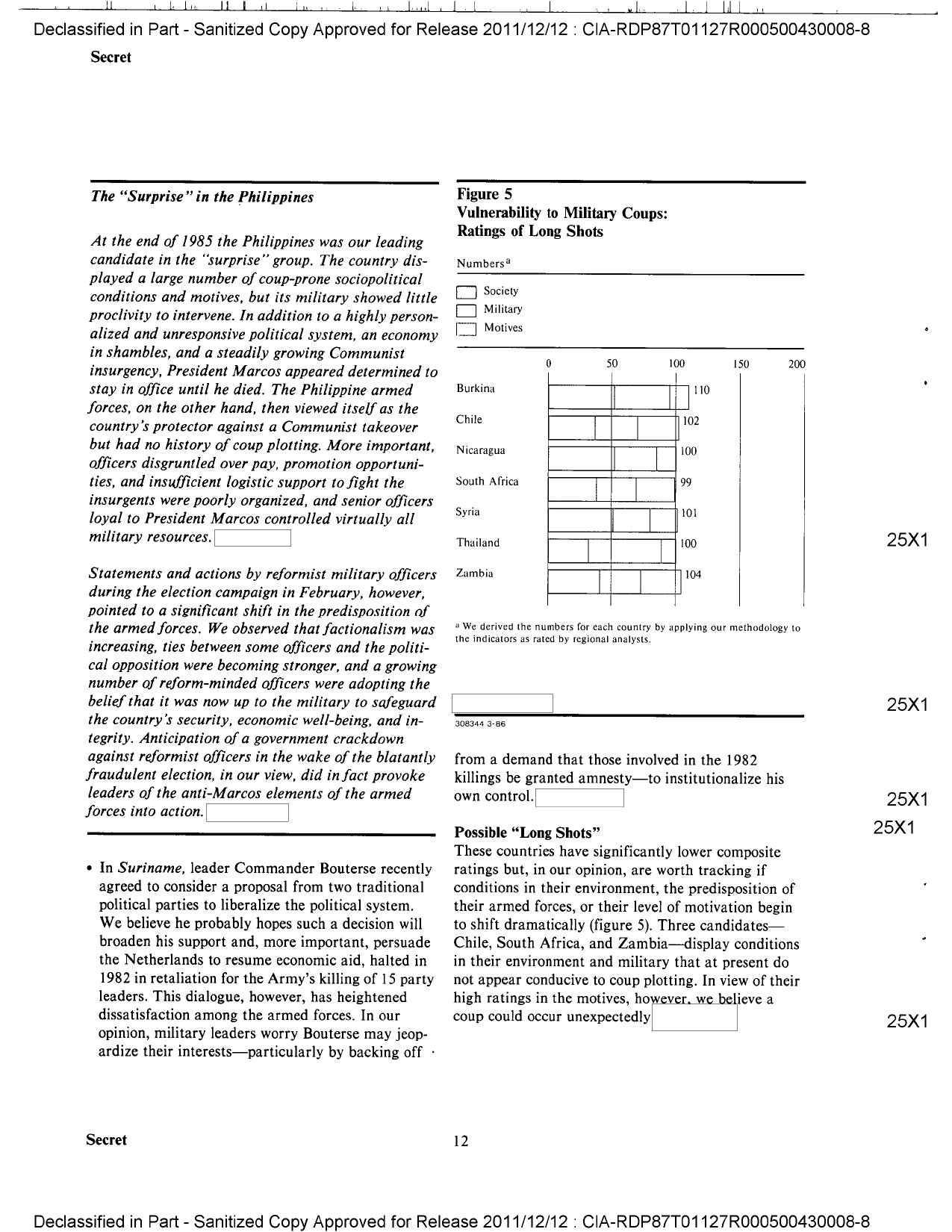
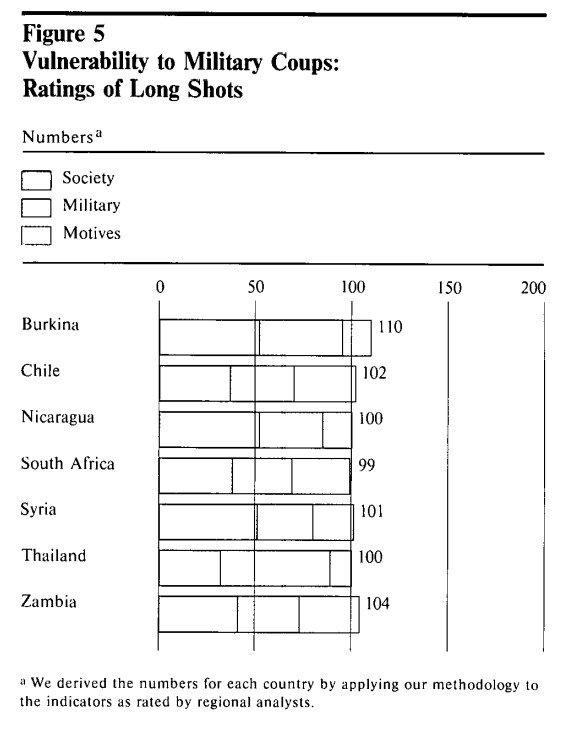
These countries have significantly lower composite ratings but, in our opinion, are worth tracking if conditions in their environment, the predisposition of their armed forces, or their level of motivation begin to shift dramatically (figure 5). Three candidates—Chile, South Africa, and Zambia—display conditions in their environment and military that at present do not appear conducive to coup plotting. In view of their high ratings in the motives, however, we believe a coup could occur unexpectedly [CENSORED]
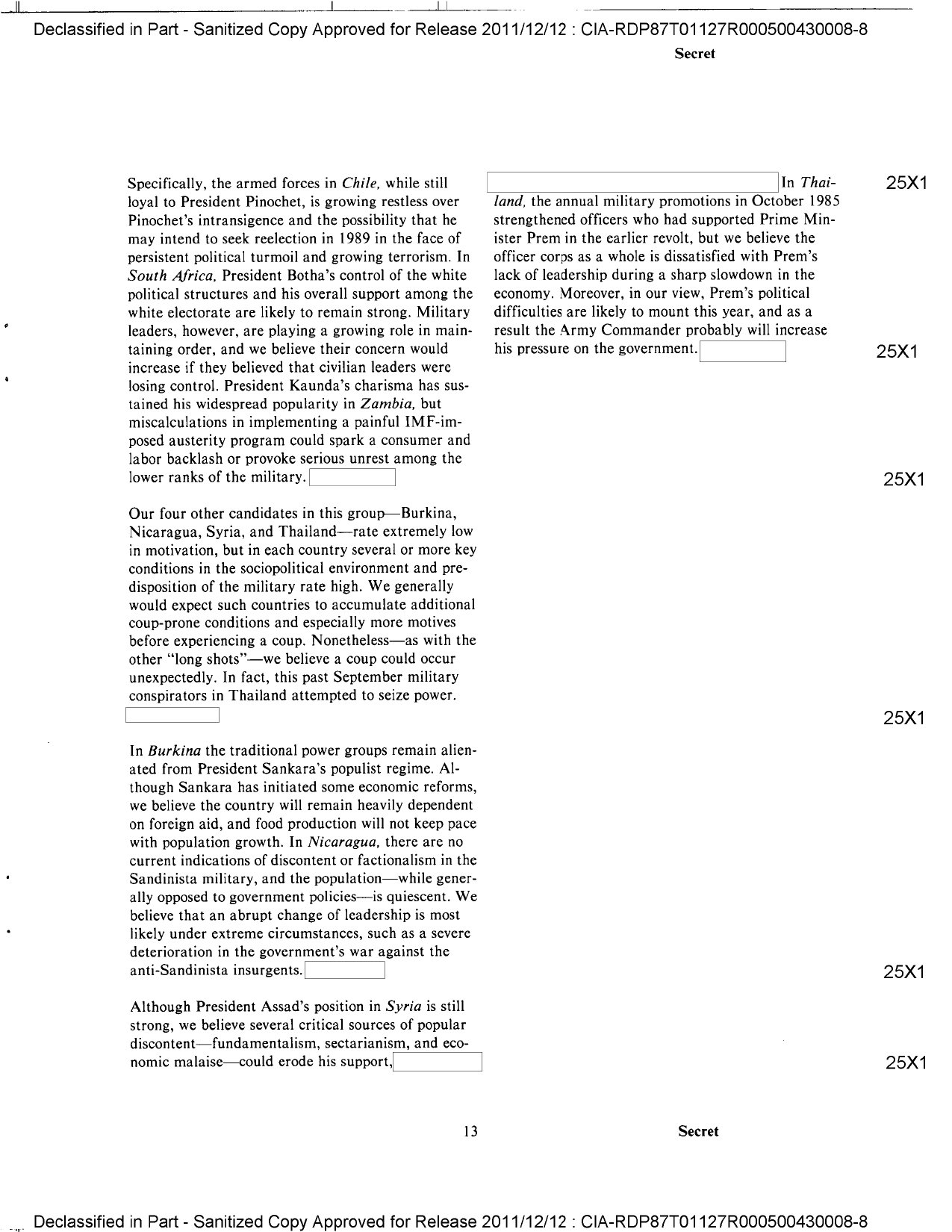
Specifically, the armed forces in Chile, while still loyal to President Pinochet, is growing restless over Pinochet’s intransigence and the possibility that he may intend to seek reelection in 1989 in the face of persistent political turmoil and growing terrorism.
In South Africa, President Botha’s control of the white political structures and his overall support among the white electorate are likely to remain strong. Military leaders, however, are playing a growing role in maintaining order, and we believe their concern would increase if they believed that civilian leaders were losing control.
President Kaunda’s charisma has sustained his widespread popularity in Zambia, but miscalculations in implementing a painful IMF-imposed austerity program could spark a consumer and labor backlash or provoke serious unrest among the lower ranks of the military.
Our four other candidates in this group—Burkina, Nicaragua, Syria, and Thailand—rate extremely low in motivation, but in each country several or more key conditions in the sociopolitical environment and predisposition of the military rate high. We generally would expect such countries to accumulate additional coup-prone conditions and especially more motives before experiencing a coup. Nonetheless—as with the other “long shots”—we believe a coup could occur unexpectedly. In fact, this past September military conspirators in Thailand attempted to seize power.
In Burkina the traditional power groups remain alienated from President Sankara’s populist regime. Although Sankara has initiated some economic reforms, we believe the country will remain heavily dependent on foreign aid, and food production will not keep pace with population growth.
In Nicaragua, there are no current indications of discontent or factionalism in the Sandinista military, and the population—while generally opposed to government policies—is quiescent. We believe that an abrupt change of leadership is most likely under extreme circumstances, such as a severe deterioration in the government’s war against the anti-Sandinista insurgents.
Although President Assad’s position in Syria is still strong, we believe several critical sources of popular discontent—fundamentalism, sectarianism, and economic malaise—could erode his support.
[CENSORED] In Thailand, the annual military promotions in October 1985 strengthened officers who had supported Prime Minister Prem in the earlier revolt, but we believe the officer corps as a whole is dissatisfied with Prem’s lack of leadership during a sharp slowdown in the economy. Moreover, in our view, Prem’s political difficulties are likely to mount this year, and as a result the Army Commander probably will increase his pressure on the government.
Figure 5 – Vulnerability to Military Coups – Ratings of Long Shots
Appendix
Military Coup Indicators Methodology
[CENSORED]
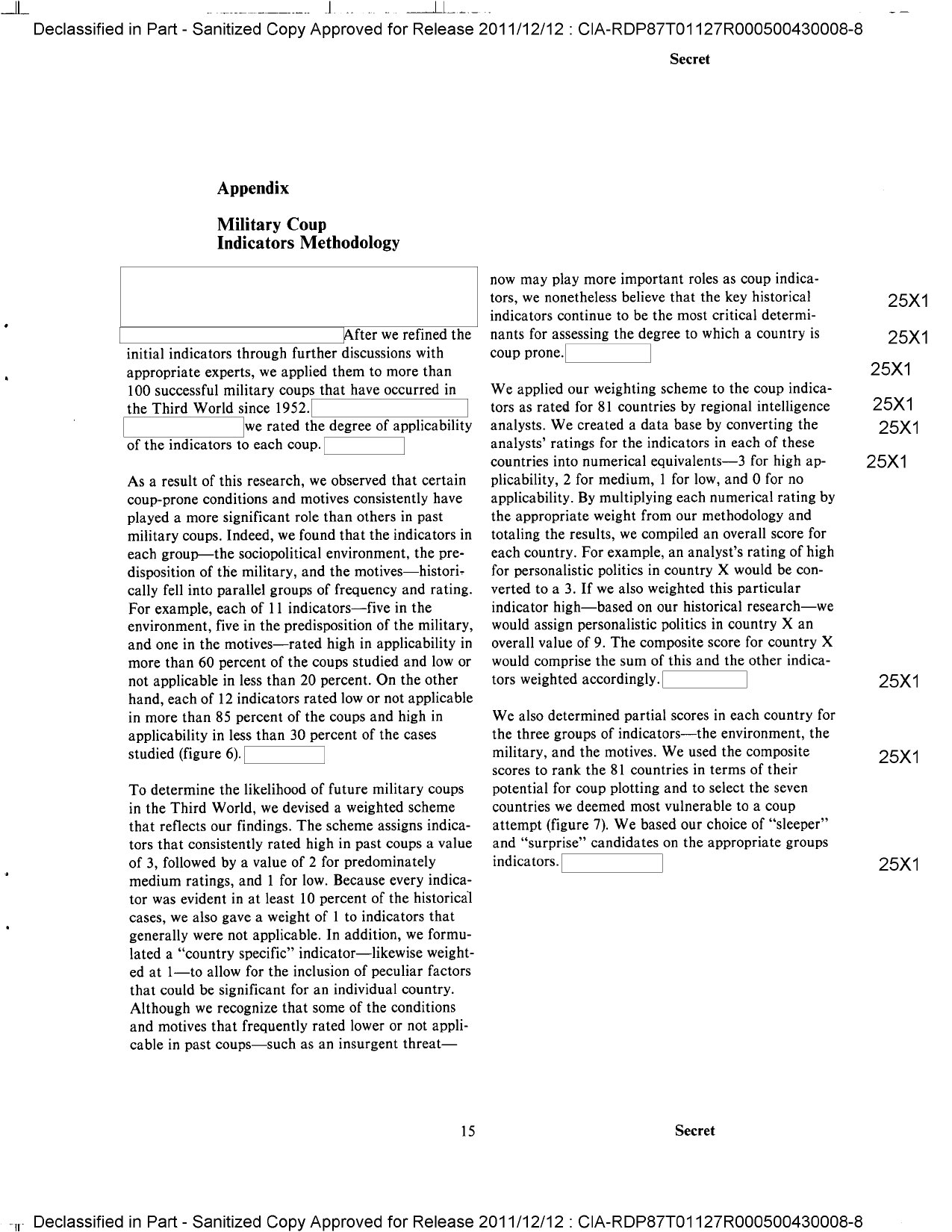
[CENSORED] After we refined the initial indicators through further discussions with appropriate experts, we applied them to more than 100 successful military coups that have occurred in the Third World since 1952. [CENSORED] we rated the degree of applicability of the indicators to each coup.
As a result of this research, we observed that certain coup-prone conditions and motives consistently have played a more significant role than others in past military coups. Indeed, we found that the indicators in each group—the sociopolitical environment, the predisposition of the military, and the motives—historically fell into parallel groups of frequency and rating.
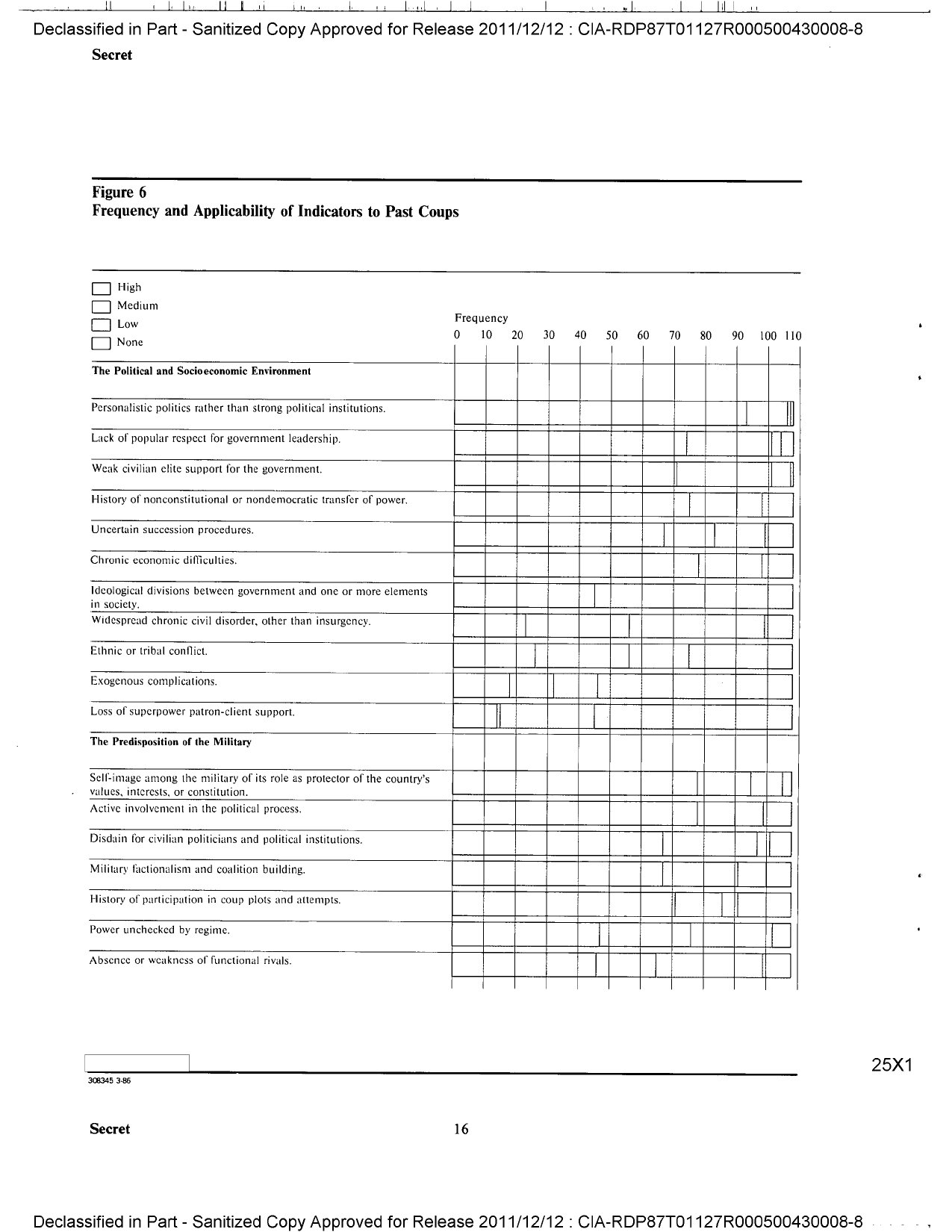
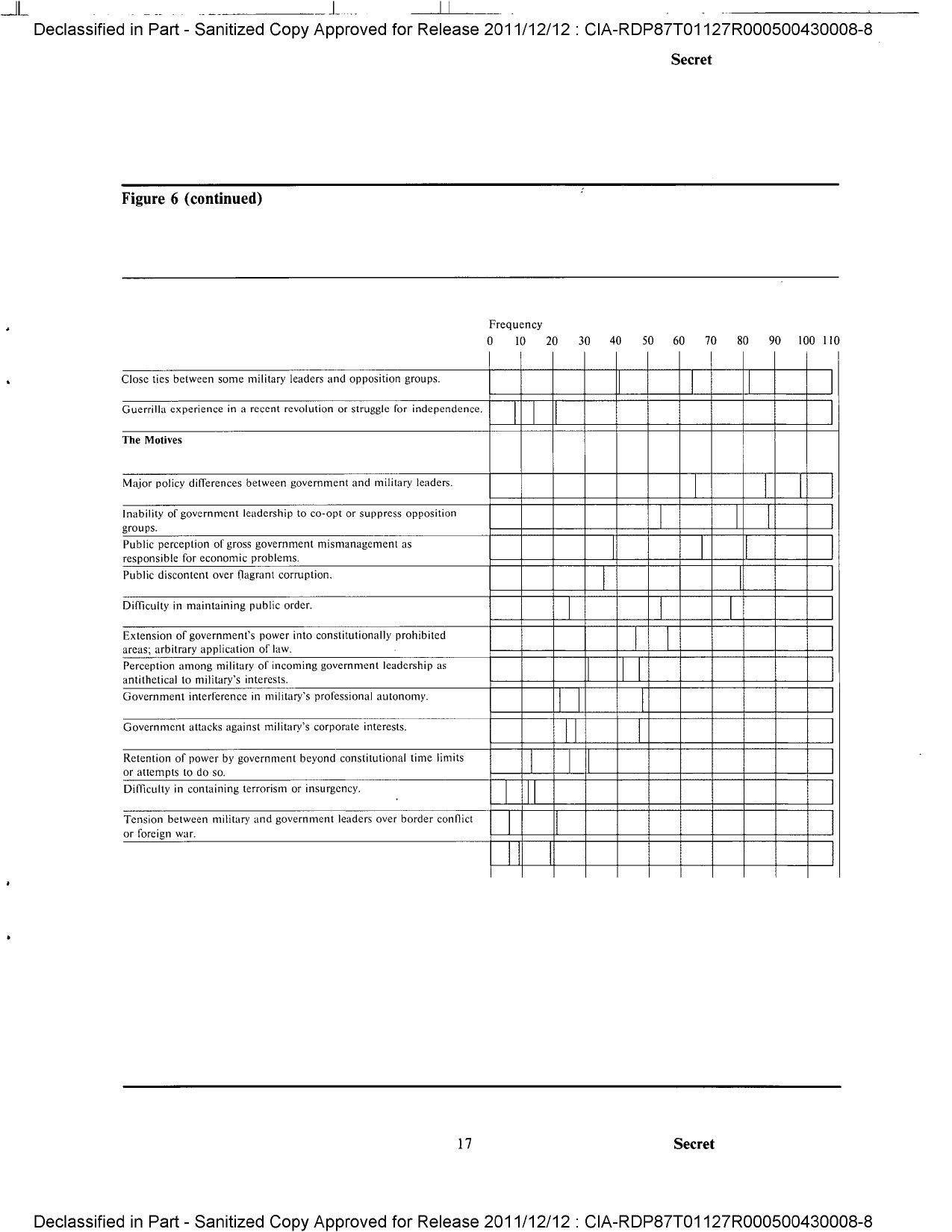
For example, each of 11 indicators—five in the environment, five in the predisposition of the military, and one in the motives—rated high in applicability in more than 60 percent of the coups studied and low or not applicable in less than 20 percent. On the other hand, each of 12 indicators rated low or not applicable in more than 85 percent of the coups and high in applicability in less than 30 percent of the cases studied (figure 6).
To determine the likelihood of future military coups in the Third World, we devised a weighted scheme that reflects our findings. The scheme assigns indicators that consistently rated high in past coups a value of 3, followed by a value of 2 for predominately medium ratings, and 1 for low. Because every indicator was evident in at least 10 percent of the historical cases, we also gave a weight of 1 to indicators that generally were not applicable. In addition, we formulated a “country specific” indicator—likewise weighted at 1—to allow for the inclusion of peculiar factors that could be significant for an individual country.
Although we recognize that some of the conditions and motives that frequently rated lower or not applicable in past coups—such as an insurgent threat—now may play more important roles as coup indicators, we nonetheless believe that the key historical indicators continue to be the most critical determinants for assessing the degree to which a country is coup prone.
We applied our weighting scheme to the coup indicators as rated for 81 countries by regional intelligence analysts. We created a data base by converting the analysts’ ratings for the indicators in each of these countries into numerical equivalents—3 for high applicability, 2 for medium, 1 for low, and 0 for no applicability. By multiplying each numerical rating by the appropriate weight from our methodology and totaling the results, we compiled an overall score for each country.
For example, an analyst’s rating of high for personalistic politics in country X would be converted to a 3. If we also weighted this particular indicator high—based on our historical research—we would assign personalistic politics in country X an overall value of 9. The composite score for country X would comprise the sum of this and the other indicators weighted accordingly.
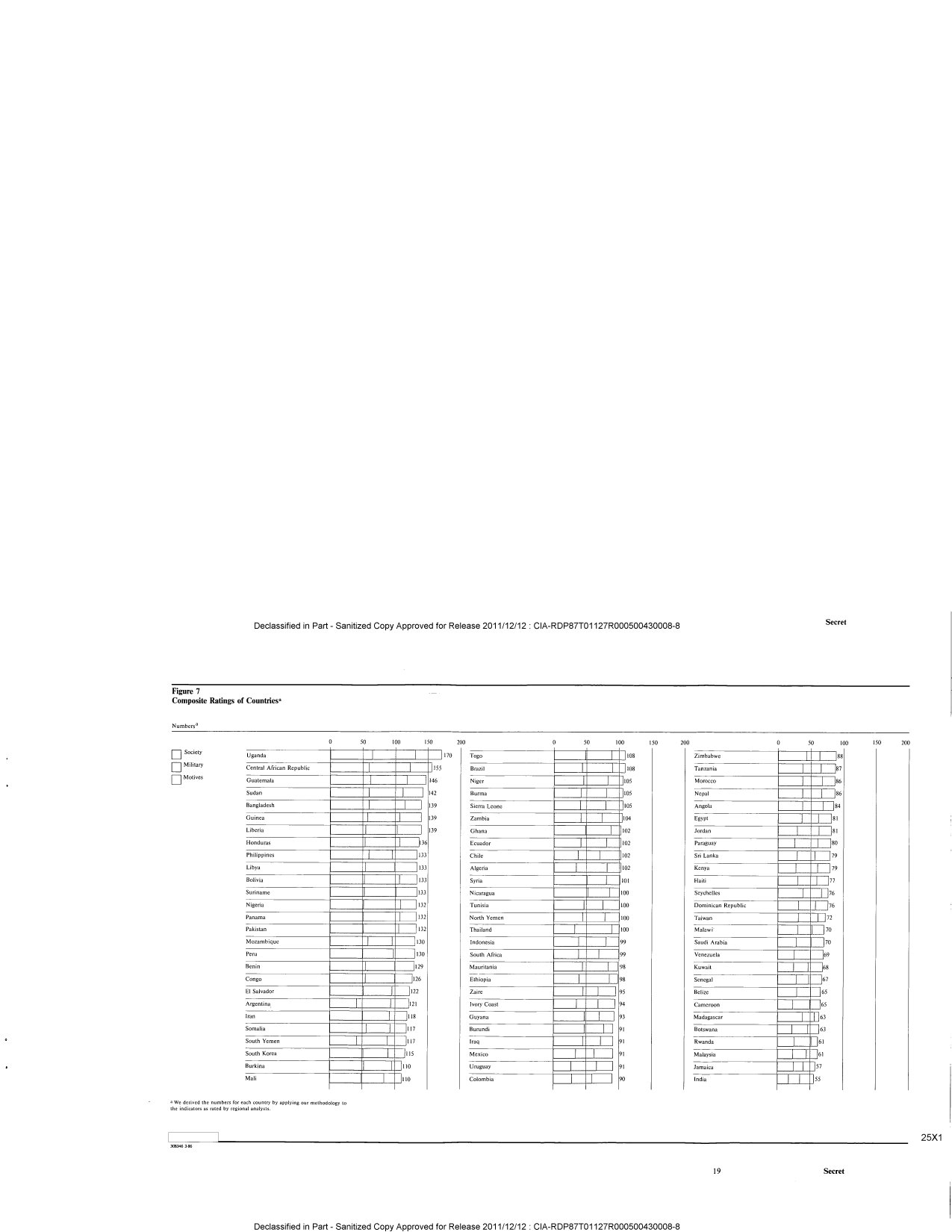
We also determined partial scores in each country for the three groups of indicators—the environment, the military, and the motives. We used the composite scores to rank the 81 countries in terms of their potential for coup plotting and to select the seven countries we deemed most vulnerable to a coup attempt (figure 7). We based our choice of “sleeper” and “surprise” candidates on the appropriate groups of indicators.
Figure 6: Frequency and Applicability of Indicators to Past Coups
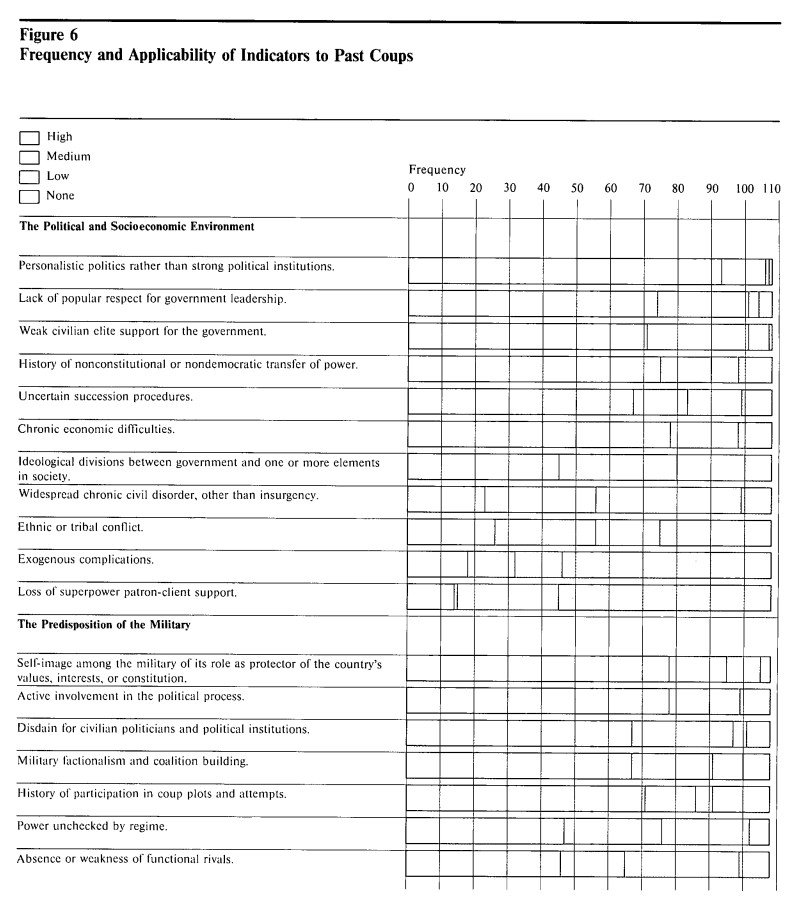
Figure 6 (continued): Frequency and Applicability of Indicators to Past Coups
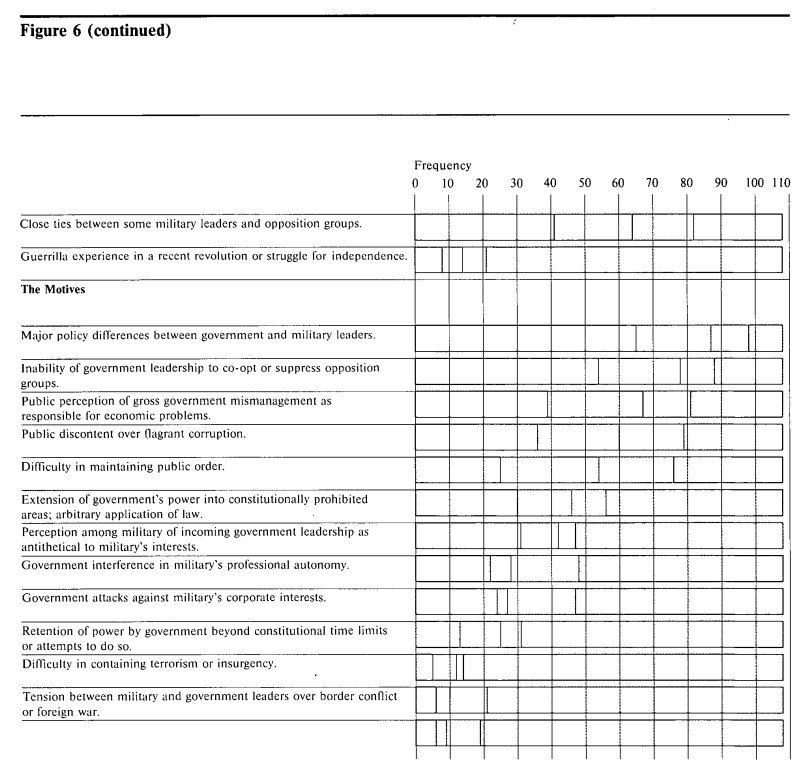
Figure 7: Composite Ratings of Countries
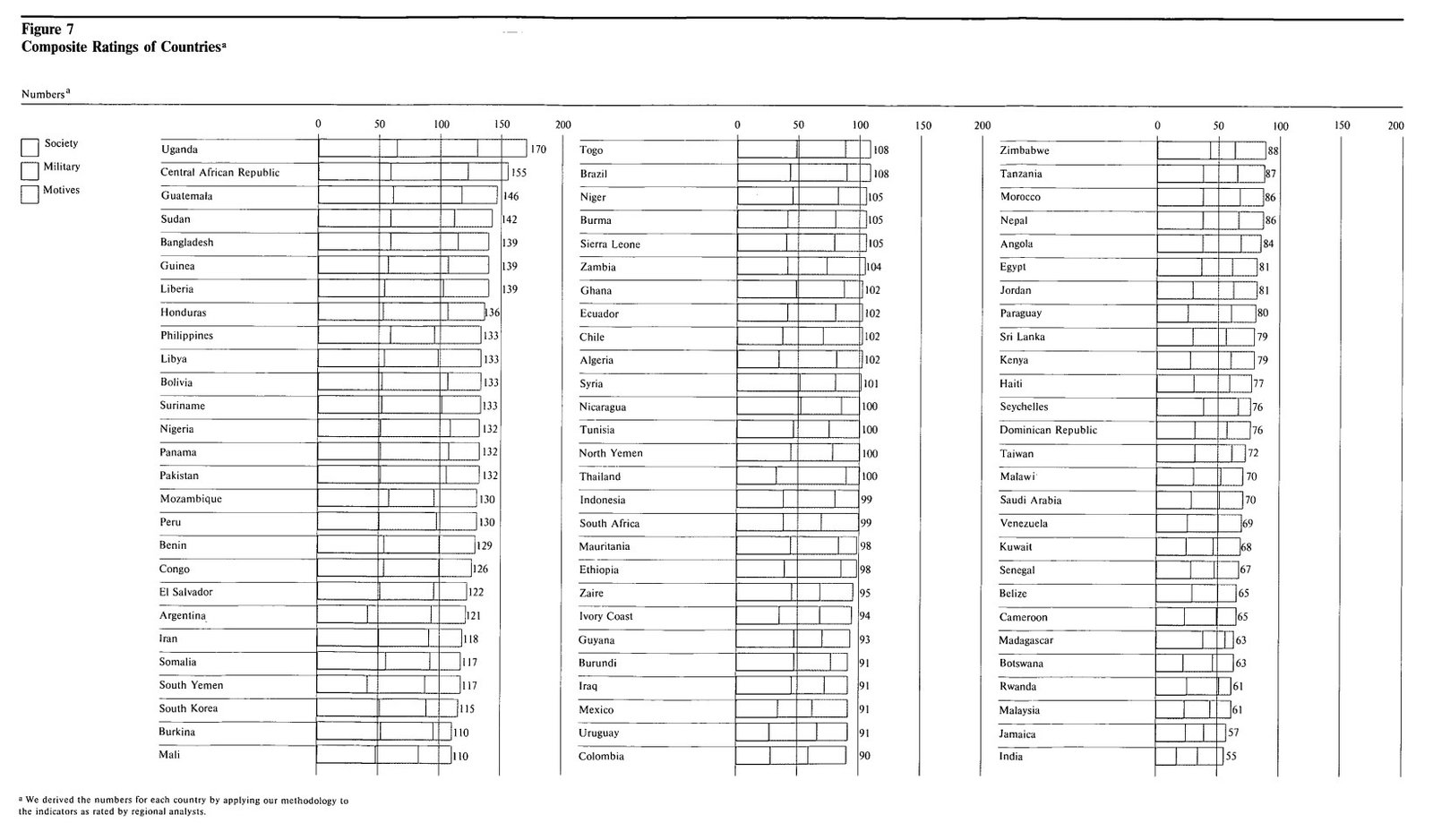
Figure 8: Vulnerability of Third World Countries to a Military Coup Attempt
Source:
Link:
Internal Link:
Date:
January 15, 1986