Monthly Warning Assessment: Latin America – 29 July 1982
CIA-RDP83B01027R000300040006-8
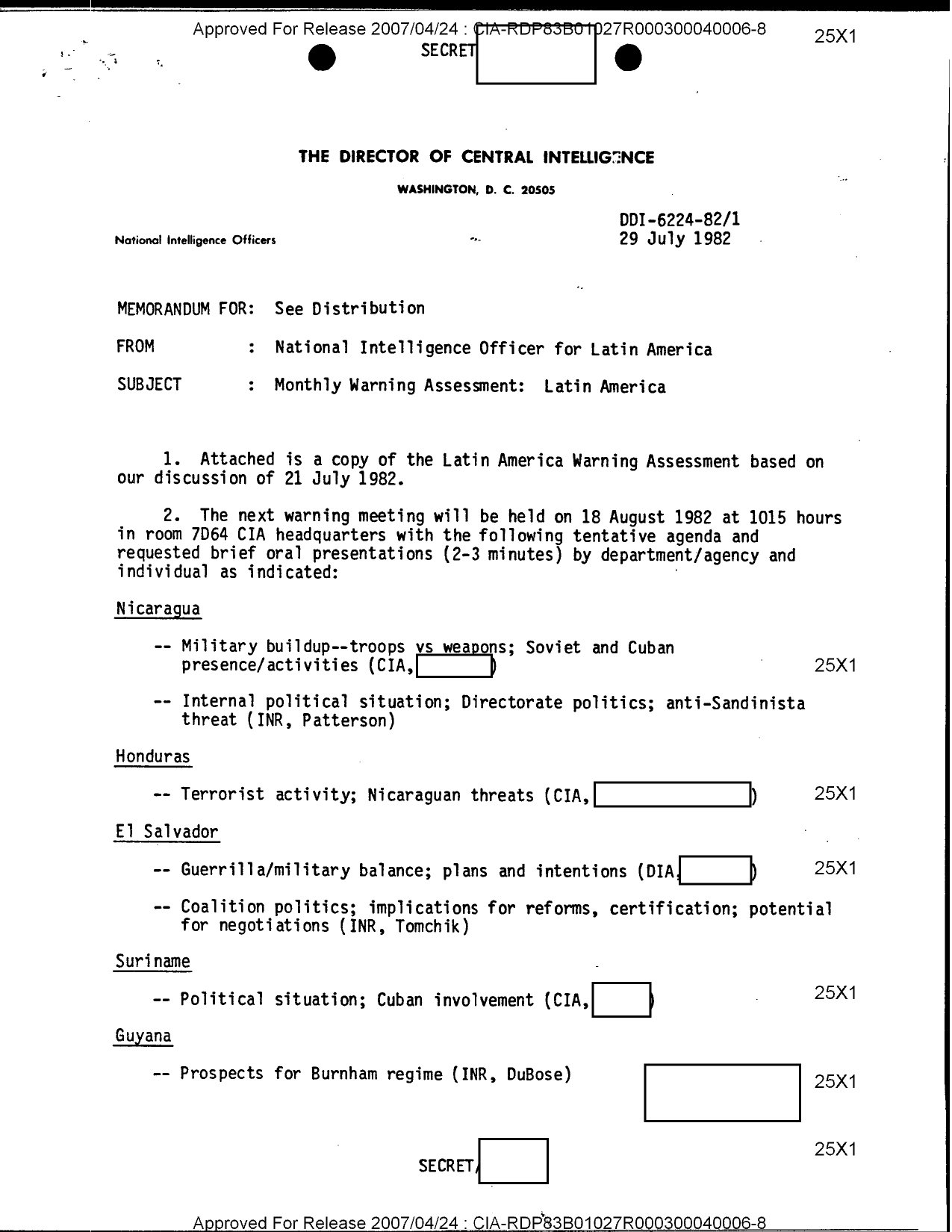
THE DIRECTOR OF CENTRAL INTELLIGENCE
WASHINGTON, D.C. 20505
DDI-6224-82/1
29 July 1982
MEMORANDUM FOR: See Distribution
FROM: National Intelligence Officer for Latin America
Attached is a copy of the Latin America Warning Assessment based on our discussion of 21 July 1982.
The next warning meeting will be held on 18 August 1982 at 1015 hours in room 7D64 CIA headquarters with the following tentative agenda and requested brief oral presentations (2-3 minutes) by department/agency and individual as indicated.
Nicaragua
— Military buildup—troops vs weapons; Soviet and Cuban presence/activities (CIA)
— Internal political situation; Directorate politics; anti-Sandinista threat (INR, Patterson)
Honduras
— Terrorist activity; Nicaraguan threats (CIA)
El Salvador
— Guerrilla/military balance; plans and intentions (DIA)
— Coalition politics; implications for reforms, certification; potential for negotiations (INR, Tomchik)
Suriname
— Political situation; Cuban involvement (CIA)
Guyana
— Prospects for Burnham regime (INR, DuBose)
Argentina
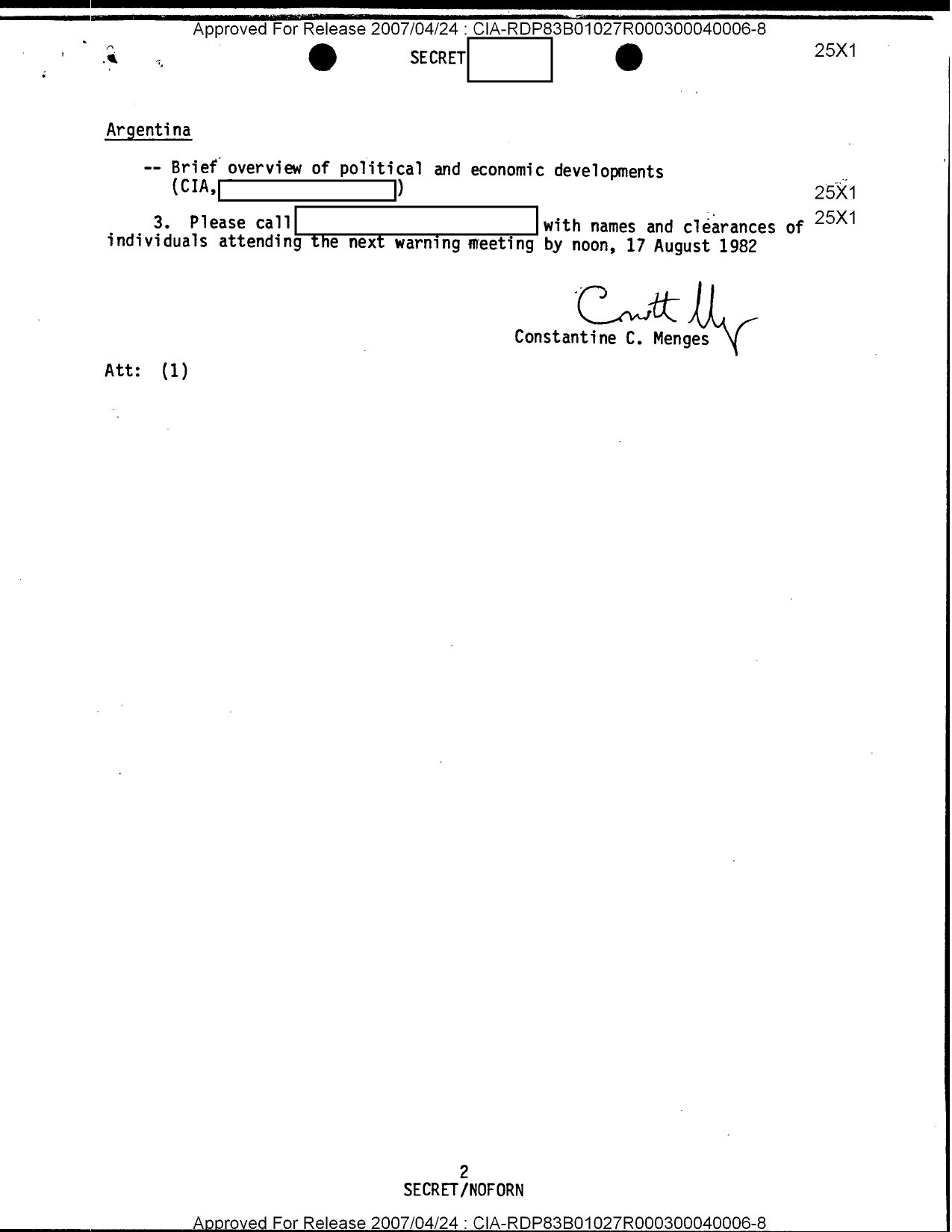
— Brief overview of political and economic developments (CIA)
Please call ☐ with names and clearances of individuals attending the next warning meeting by noon, 17 August 1982.
Att: (1) Constantine Caust, C. Menges
Argentina
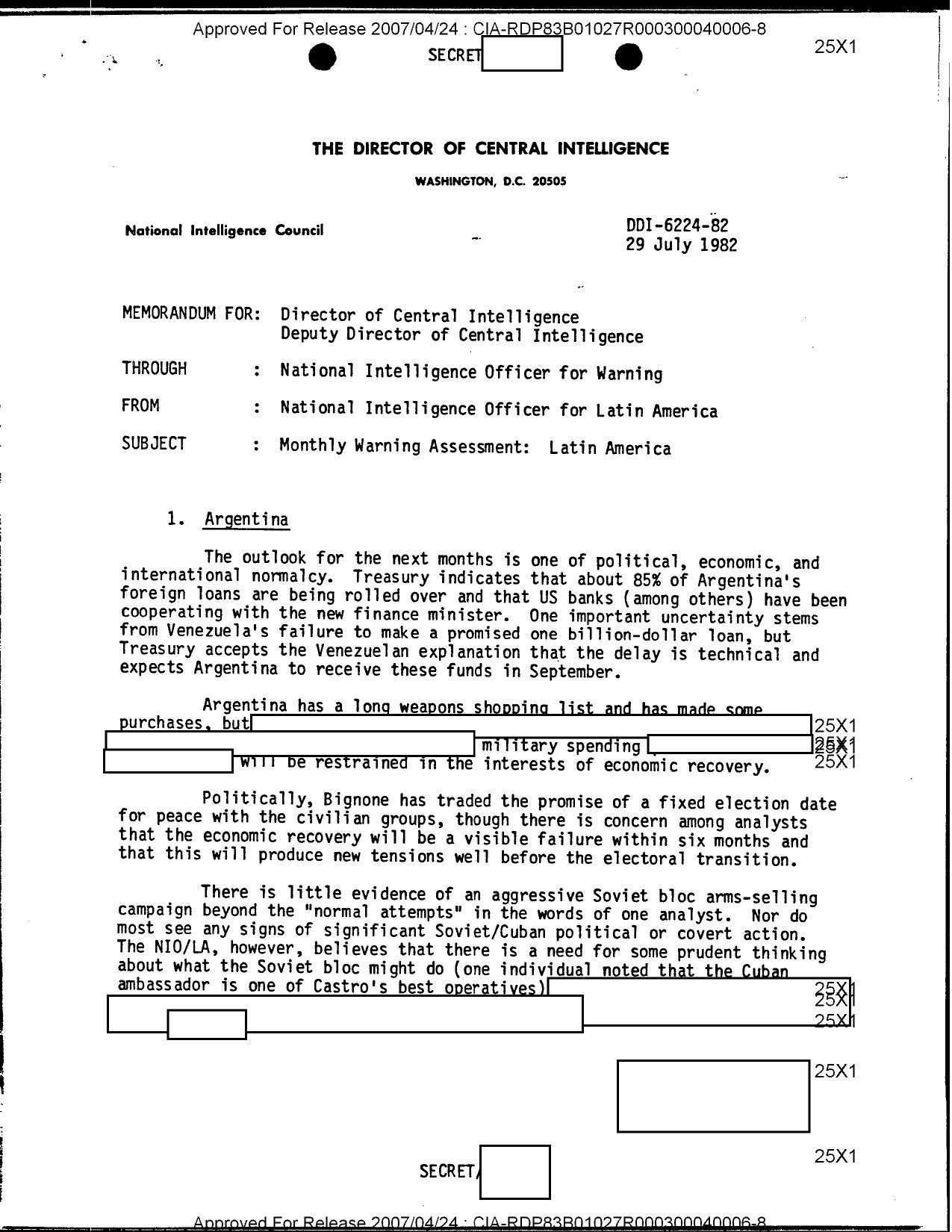
The outlook for the next months is one of political, economic, and international normalcy. Treasury indicates that about 85% of Argentina’s foreign loans are being rolled over and that US banks (among others) have been cooperating with the new finance minister. One important uncertainty stems from Venezuela’s failure to make a promised one billion-dollar loan, but Treasury accepts the Venezuelan explanation that the delay is technical and expects Argentina to receive these funds in September.
Argentina has a long weapons shopping list and has made some purchases, but military spending will be restrained in the interests of economic recovery.
Politically, Bignone has traded the promise of a fixed election date for peace with the civilian groups, though there is concern among analysts that the economic recovery will be a visible failure within six months and that this will produce new tensions well before the electoral transition.
There is little evidence of an aggressive Soviet bloc arms-selling campaign beyond the “normal attempts,” in the words of one analyst. Nor do most see any signs of significant Soviet/Cuban political or covert action.
The NIO/LA, however, believes that there is a need for some prudent thinking about what the Soviet bloc might do (one individual noted that the Cuban ambassador is one of Castro’s best operatives).
El Salvador
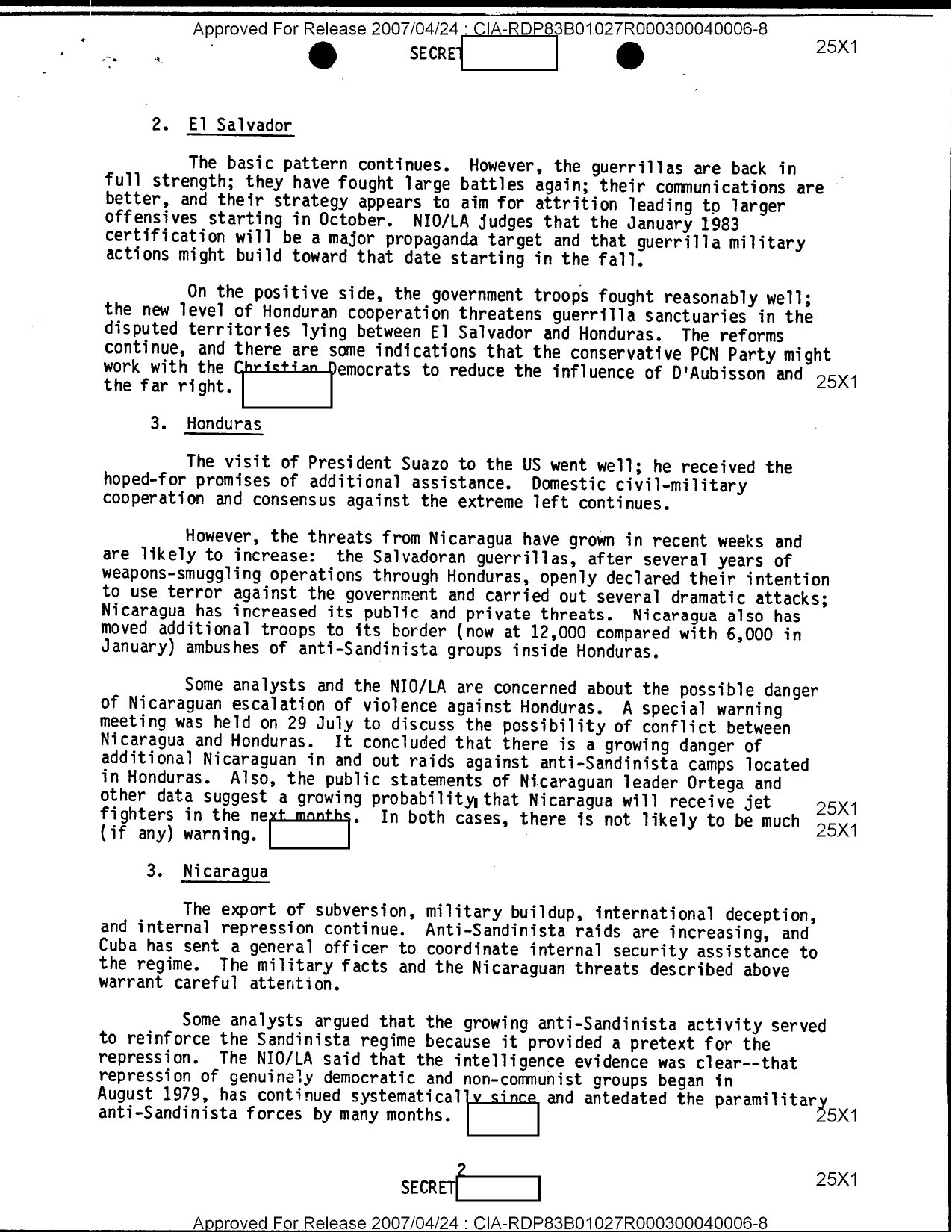
The basic pattern continues. However, the guerrillas are back in full strength; they have fought large battles again; their communications are better, and their strategy appears to aim for attrition leading to larger offensives starting in October. NIO/LA judges that the January 1983 certification will be a major propaganda target and that guerrilla military actions might build toward that date starting in the fall.
On the positive side, government troops fought reasonably well; the new level of Honduran cooperation threatens guerrilla sanctuaries in the disputed territories lying between El Salvador and Honduras. The reforms continue, and there are some indications that the conservative PCN Party might work with the Christian Democrats to reduce the influence of D’Aubisson and the far right.
Honduras
The visit of President Suazo to the US went well; he received the hoped-for promises of additional assistance. Domestic civil-military cooperation and consensus against the extreme left continues.
However, the threats from Nicaragua have grown in recent weeks and are likely to increase: the Salvadoran guerrillas, after several years of weapons-smuggling operations through Honduras, openly declared their intention to use terror against the government and carried out several dramatic attacks; Nicaragua has increased its public and private threats. Nicaragua also has moved additional troops to its border (now at 12,000 compared with 6,000 in January) ambushes of anti-Sandinista groups inside Honduras.
Some analysts and the NIO/LA are concerned about the possible danger of Nicaraguan escalation of violence against Honduras. A special warning meeting was held on 29 July to discuss the possibility of conflict between Nicaragua and Honduras. It concluded that there is a growing danger of additional Nicaraguan in-and-out raids against anti-Sandinista camps located in Honduras. Also, the public statements of Nicaraguan leader Ortega and other data suggest a growing probability that Nicaragua will receive jet fighters in the next months. In both cases, there is not likely to be much (if any) warning.
Nicaragua
The export of subversion, military buildup, international deception, and internal repression continue. Anti-Sandinista raids are increasing, and Cuba has sent a general officer to coordinate internal security assistance to the regime. The military facts and the Nicaraguan threats described above warrant careful attention.
Some analysts argued that the growing anti-Sandinista activity served to reinforce the Sandinista regime because it provided a pretext for the repression. The NIO/LA said that the intelligence evidence was clear—that repression of genuinely democratic and non-communist groups began in August 1979, has continued systematically since, and antedated the paramilitary anti-Sandinista forces by many months.
Suriname
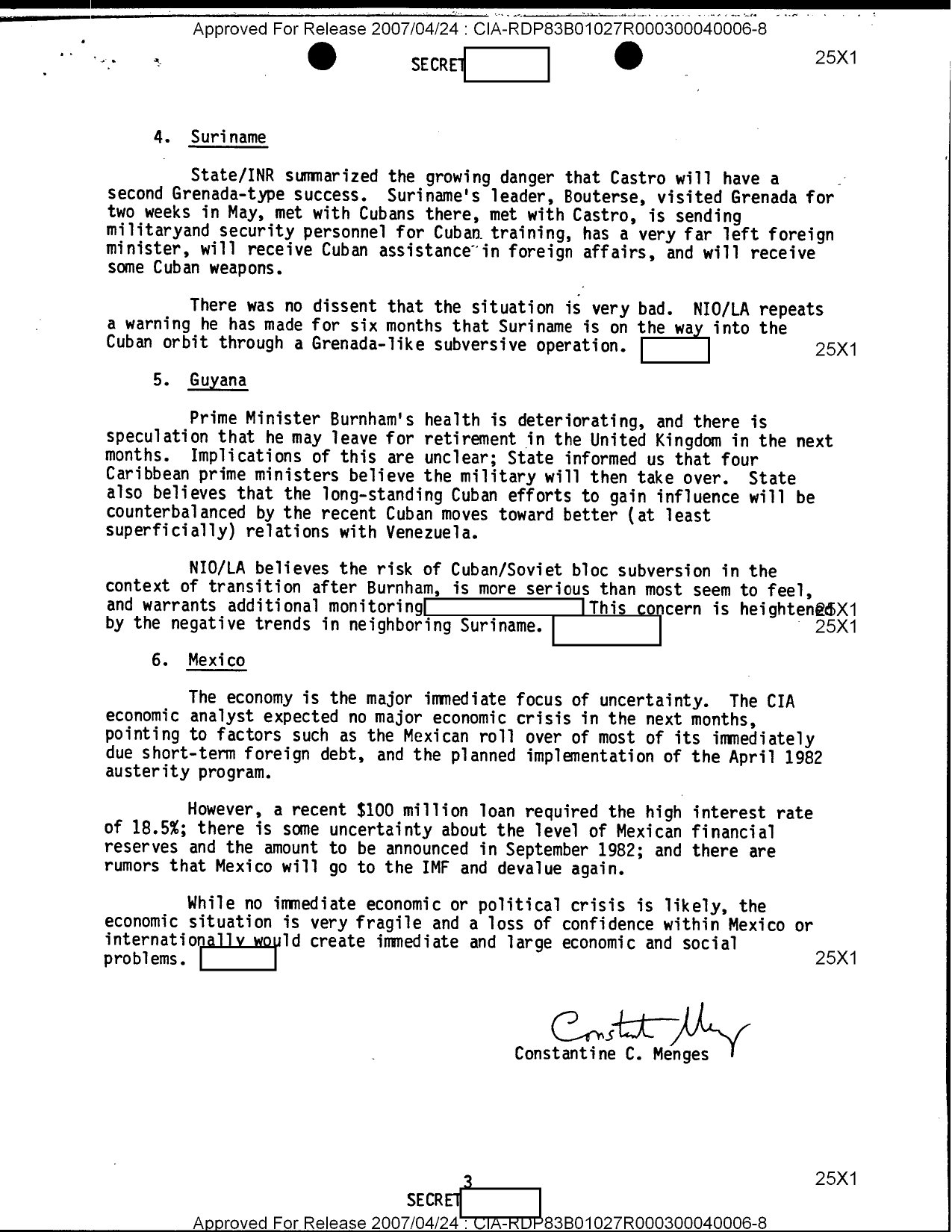
State/INR summarized the growing danger that Castro will have a second Grenada-type success. Suriname’s leader, Bouterse, visited Grenada for two weeks in May, met with Cubans there, met with Castro, is sending military and security personnel for Cuban training, has a very far left foreign minister, will receive Cuban assistance in foreign affairs, and will receive some Cuban weapons.
There was no dissent that the situation is very bad. NIO/LA repeats a warning he has made for six months that Suriname is on the way into the Cuban orbit through a Grenada-like subversive operation.
Guyana
Prime Minister Burnham’s health is deteriorating, and there is speculation that he may leave for retirement in the United Kingdom in the next months. Implications of this are unclear; State informed us that four Caribbean prime ministers believe the military will then take over. State also believes that the long-standing Cuban efforts to gain influence will be counterbalanced by the recent Cuban moves toward better (at least superficially) relations with Venezuela.
NIO/LA believes the risk of Cuban/Soviet bloc subversion in the context of transition after Burnham is more serious than most seem to feel, and warrants additional monitoring. This concern is heightened by the negative trends in neighboring Suriname.
Mexico
The economy is the major immediate focus of uncertainty. The CIA economic analyst expected no major economic crisis in the next months, pointing to factors such as the Mexican roll over of most of its immediately due short-term foreign debt, and the planned implementation of the April 1982 austerity program.
However, a recent $100 million loan required the high interest rate of 18.5%; there is some uncertainty about the level of Mexican financial reserves and the amount to be announced in September 1982; and there are rumors that Mexico will go to the IMF and devalue again.
While no immediate economic or political crisis is likely, the economic situation is very fragile and a loss of confidence within Mexico or internationally would create immediate and large economic and social problems.
Att: Constantine Custt, C. Menges
Source:
Link:
Internal Link:
Date:
July 29, 1982