National Security Council Report on the Caribbean Basin 1982
CIA-RDP84B00049R000200400017-3
19 February 1982
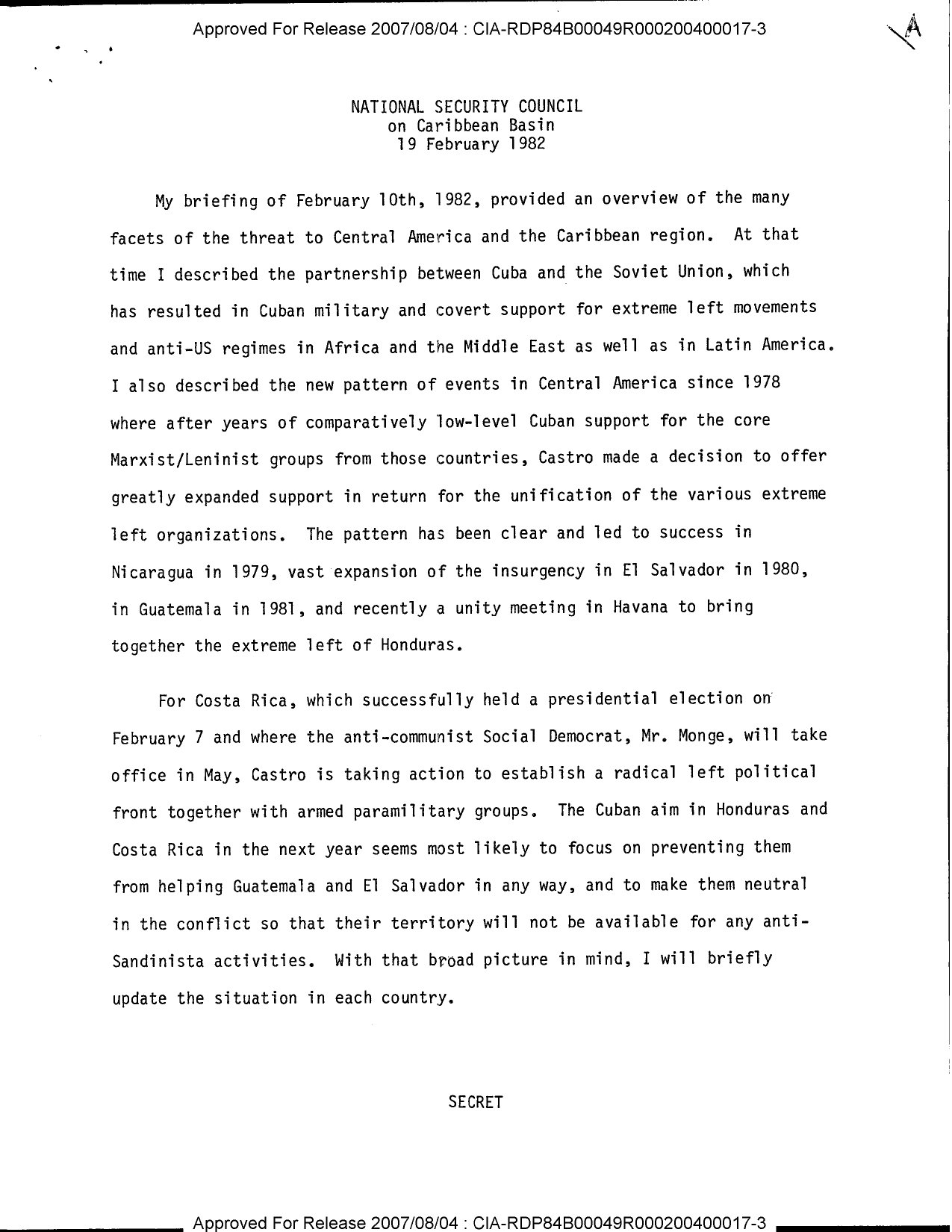
My briefing of February 10th, 1982, provided an overview of the many facets of the threat to Central America and the Caribbean region. At that time I described the partnership between Cuba and the Soviet Union, which has resulted in Cuban military and covert support for extreme left movements and anti-US regimes in Africa and the Middle East as well as in Latin America. I also described the new pattern of events in Central America since 1978, where after years of comparatively low-level Cuban support for the core Marxist/Leninist groups from those countries, Castro made a decision to offer greatly expanded support in return for the unification of the various extreme left organizations. The pattern has been clear and led to success in Nicaragua in 1979, vast expansion of the insurgency in El Salvador in 1980, in Guatemala in 1981, and recently a unity meeting in Havana to bring together the extreme left of Honduras.
For Costa Rica, which successfully held a presidential election on February 7 and where the anti-communist Social Democrat, Mr. Monge, will take office in May, Castro is taking action to establish a radical left political front together with armed paramilitary groups. The Cuban aim in Honduras and Costa Rica in the next year seems most likely to focus on preventing them from helping Guatemala and El Salvador in any way, and to make them neutral in the conflict so that their territory will not be available for any anti-Sandinista activities. With that broad picture in mind, I will briefly update the situation in each country.
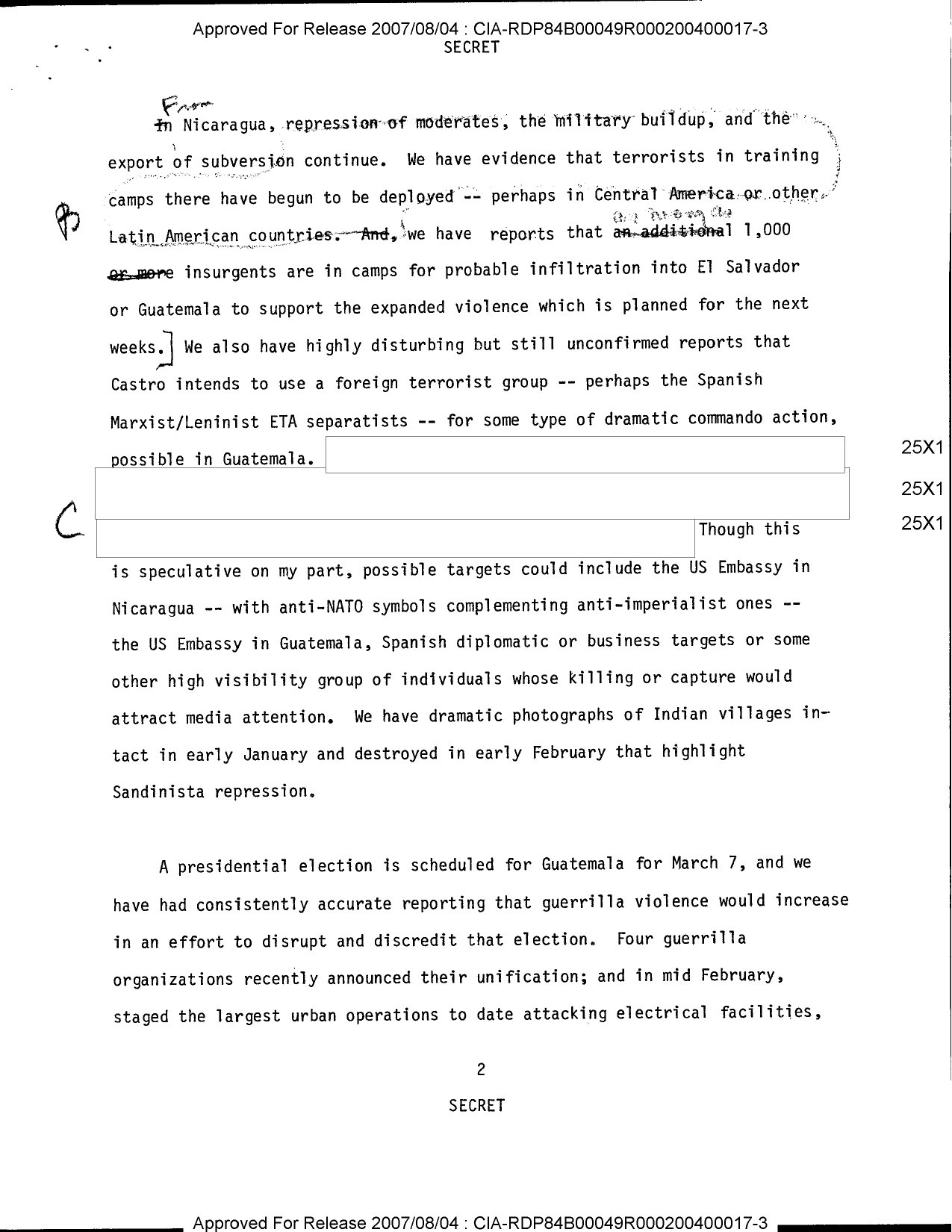
In Nicaragua, repression of moderates, the military buildup, and the export of subversion continue. We have evidence that terrorists in training camps there have begun to be deployed—perhaps in Central America or other Latin American countries. And, we have reports that an additional 1,000 or more insurgents are in camps for probable infiltration into El Salvador or Guatemala to support the expanded violence which is planned for the next weeks. We also have highly disturbing but still unconfirmed reports that Castro intends to use a foreign terrorist group—perhaps the Spanish Marxist/Leninist ETA separatists—for some type of dramatic commando action, possibly in Guatemala. [CENSORED]
Though this [CENSORED] is speculative on my part, possible targets could include the US Embassy in Nicaragua—with anti-NATO symbols complementing anti-imperialist ones—the US Embassy in Guatemala, Spanish diplomatic or business targets, or some other high visibility group of individuals whose killing or capture would attract media attention. We have dramatic photographs of Indian villages attacked in early January and destroyed in early February that highlight in-Sandinista repression.
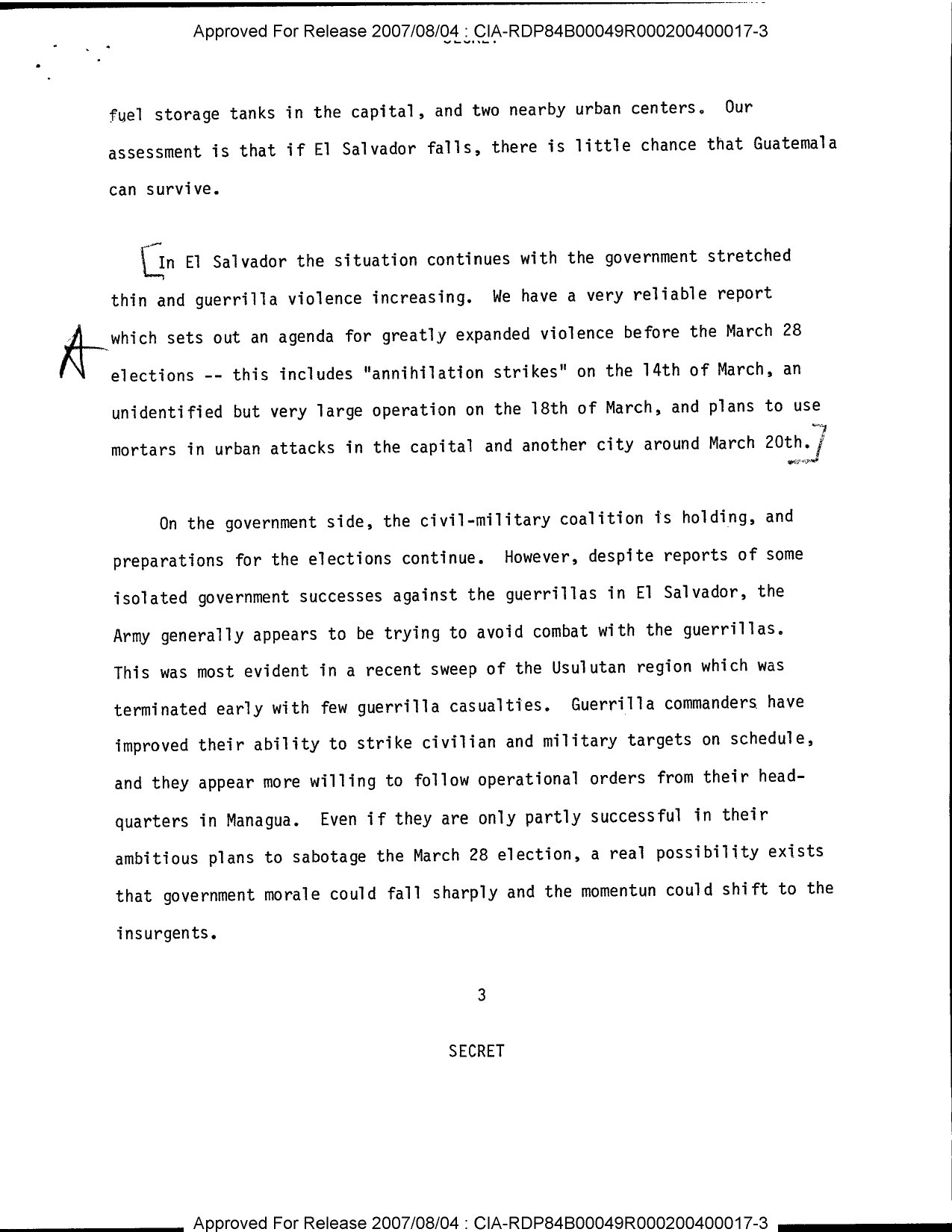
A presidential election is scheduled for Guatemala for March 7, and we have had consistently accurate reporting that guerrilla violence would increase in an effort to disrupt and discredit that election. Four guerrilla organizations recently announced their unification; and in mid-February staged the largest urban operations to date attacking electrical facilities, fuel storage tanks in the capital, and two nearby urban centers. Our assessment is that if El Salvador falls, there is little chance that Guatemala can survive.
In El Salvador the situation continues with the government stretched thin and guerrilla violence increasing. We have a very reliable report which sets out an agenda for greatly expanded violence before the March 28 elections—this includes “annihilation strikes” on the 14th of March, an unidentified but very large operation on the 18th of March, and plans to use mortars in urban attacks in the capital and another city around March 20th. On the government side, the civil-military coalition is holding, and preparations for the elections continue. However, despite reports of some isolated government successes against the guerrillas in El Salvador, the Army generally appears to be trying to avoid combat with the guerrillas.
This was most evident in a recent sweep of the Usulutan region which was terminated early with few guerrilla casualties. Guerrilla commanders have improved their ability to strike civilian and military targets on schedule, and they appear more willing to follow operational orders from their headquarters in Managua. Even if they are only partly successful in their ambitious plans to sabotage the March 28 election, a real possibility exists that government morale could fall sharply and the momentum could shift to the insurgents.
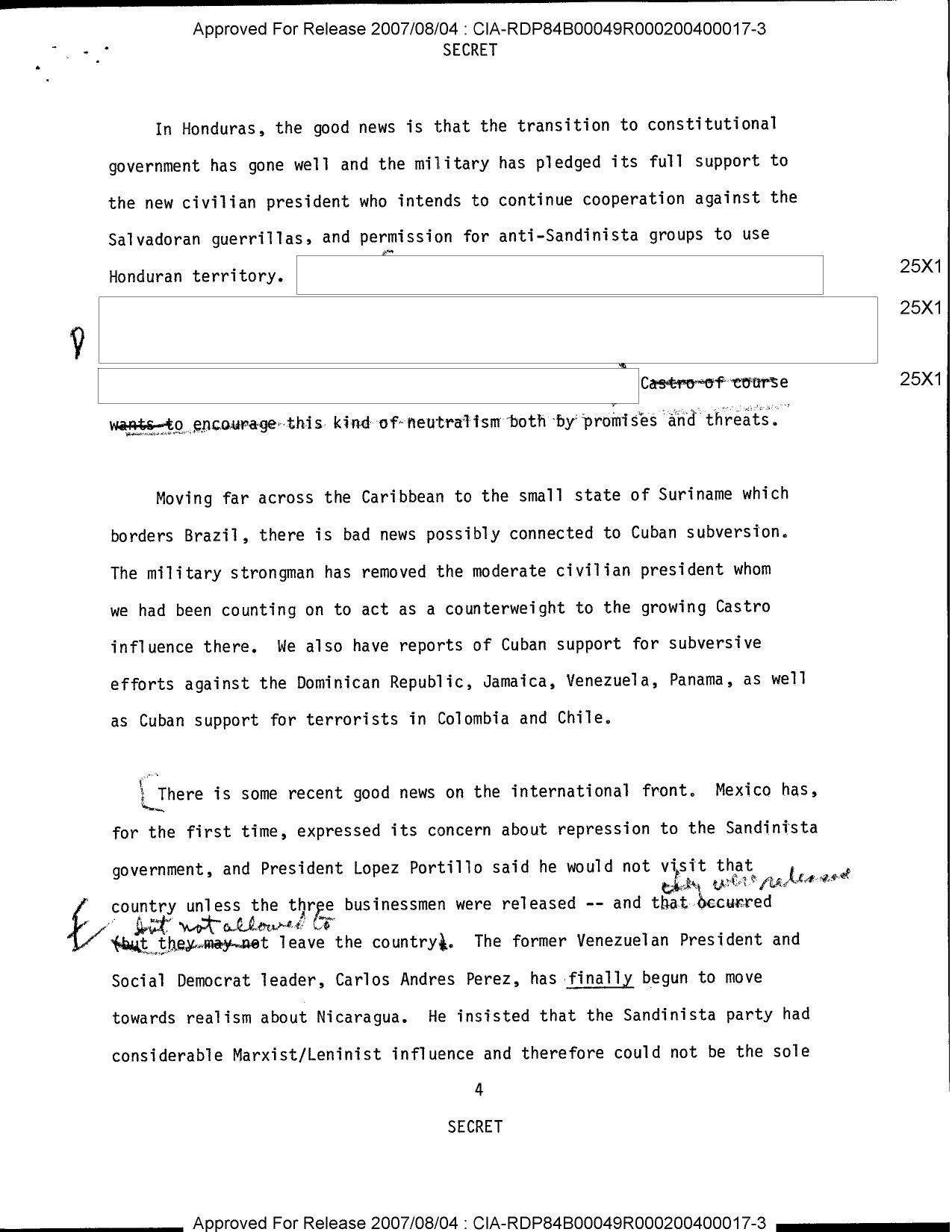
In Honduras, the good news is that the transition to constitutional government has gone well and the military has pledged its full support to the new civilian president who intends to continue cooperation against the Salvadoran guerrillas, and permission for anti-Sandinista groups to use Honduran territory.
Castro, of course, wants to encourage this kind of neutralism both by promises and threats. Moving far across the Caribbean to the small state of Suriname which borders Brazil, there is bad news possibly connected to Cuban subversion. The military strongman has removed the moderate civilian president whom we had been counting on to act as a counterweight to the growing Castro influence there. We also have reports of Cuban support for subversive efforts against the Dominican Republic, Jamaica, Venezuela, Panama, as well as Cuban support for terrorists in Colombia and Chile.
There is some recent good news on the international front. Mexico has, for the first time, expressed its concern about repression to the Sandinista government, and President Lopez Portillo said he would not visit that country unless the three businessmen were released—but that occurred but not allowed; they may not leave the country. The former Venezuelan President and Social Democrat leader, Carlos Andres Perez, has finally begun to move towards realism about Nicaragua. He insisted that the Sandinista party had considerable Marxist/Leninist influence and therefore could not be the sole representative of Nicaragua at the scheduled February 22 Socialist International meeting in Caracas, Venezuela.
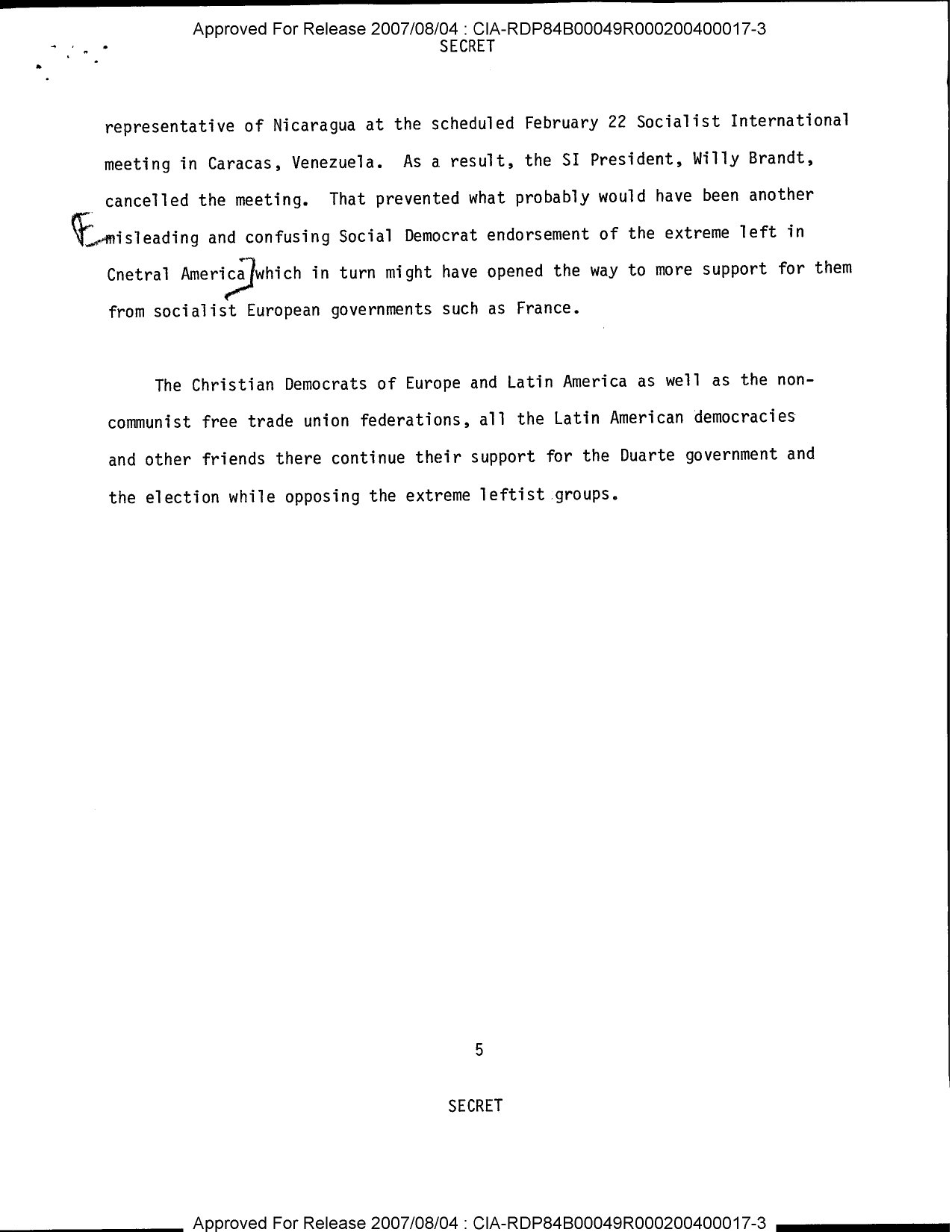
As a result, the SI President, Willy Brandt, cancelled the meeting. That prevented what probably would have been another misleading and confusing Social Democrat endorsement of the extreme left in Central America, which in turn might have opened the way to more support for them from socialist European governments such as France.
The Christian Democrats of Europe and Latin America, as well as the non-communist free trade union federations, all the Latin American democracies, and other friends there continue their support for the Duarte government and the election while opposing the extreme leftist groups.
Source:
Link:
Internal Link: