NIOs Analyses of Possible Contingencies 1982
CIA-RDP83T00966R000100100002-8
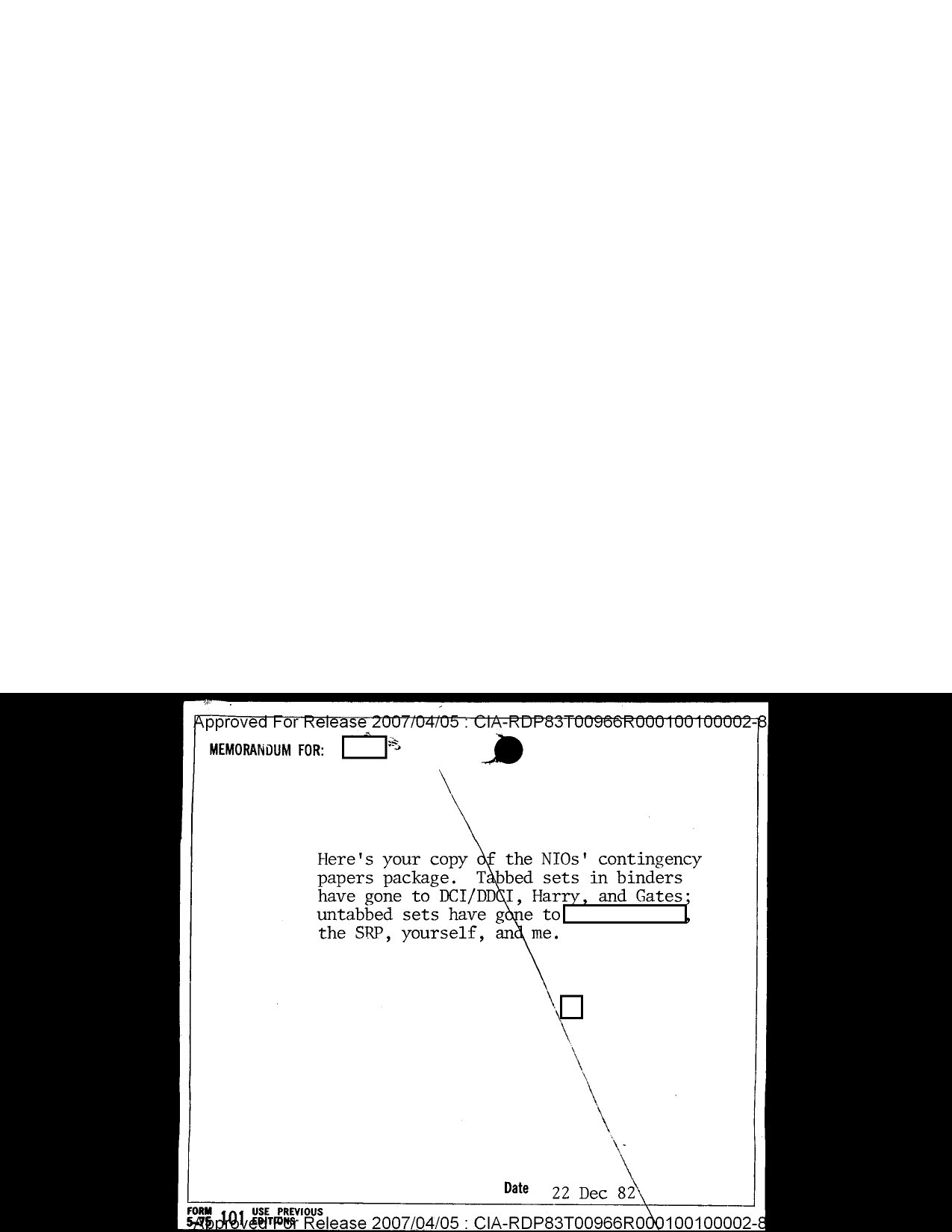
MEMORANDUM FOR:
Here’s your copy of the NIOs’ contingency papers package. Tabbed sets in binders have gone to DCI/DDOI, Harry, and Gates; untabbed sets have gone to the SRP, yourself, and me.
THE DIRECTOR OF CENTRAL INTELLIGENCE
WASHINGTON, D.C. 20505
National Intelligence Council
22 December 1982
MEMORANDUM FOR:
Director of Central Intelligence
Deputy Director of Central Intelligence
SUBJECT: NIOs Analyses of Possible Contingencies
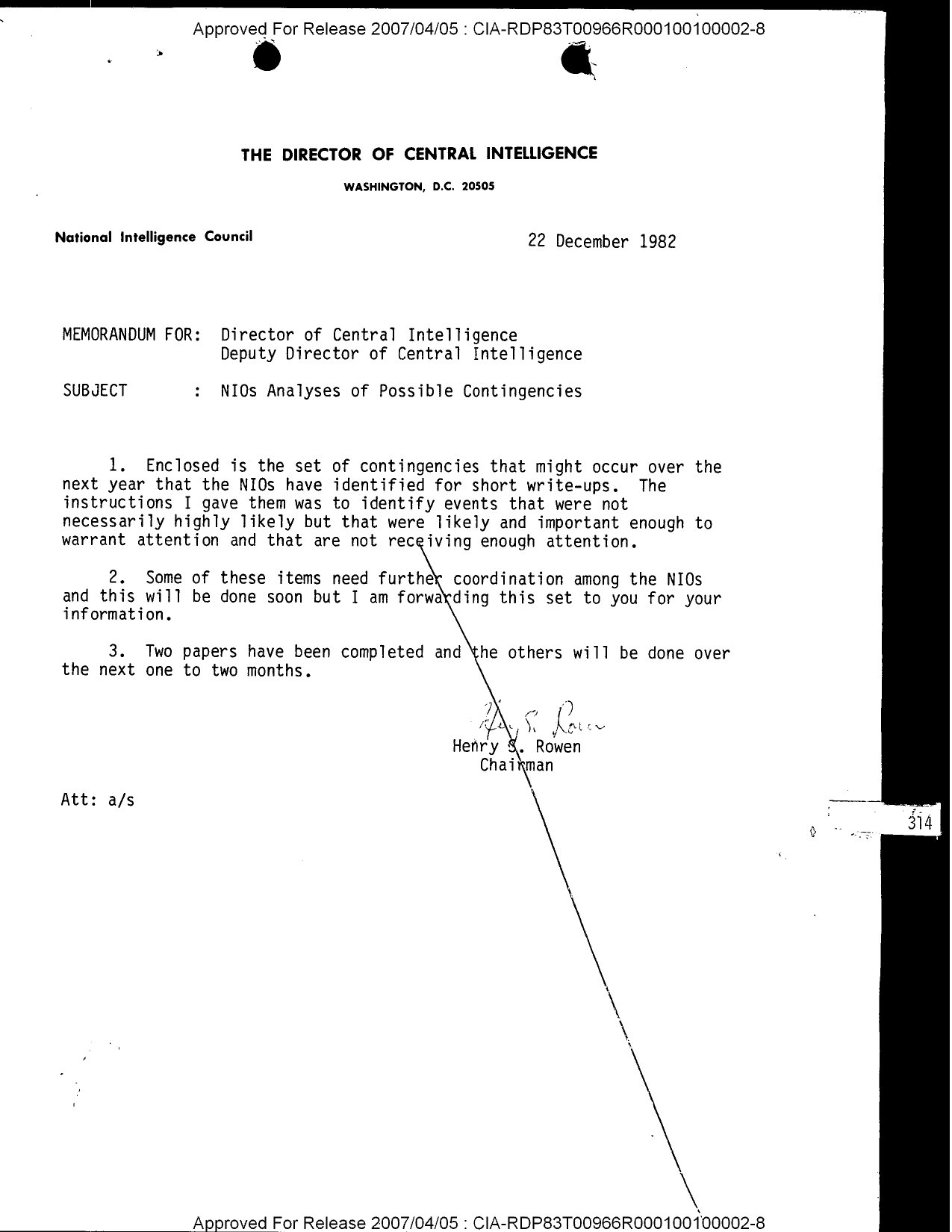
- Enclosed is the set of contingencies that might occur over the next year that the NIOs have identified for short write-ups. The instructions I gave them was to identify events that were not necessarily highly likely but that were likely and important enough to warrant attention and that are not receiving enough attention.
- Some of these items need further coordination among the NIOs and this will be done soon but I am forwarding this set to you for your information.
- Two papers have been completed and the others will be done over the next one to two months.
A loi
Henry S. Rowen
Chairman
Attachment: a/s
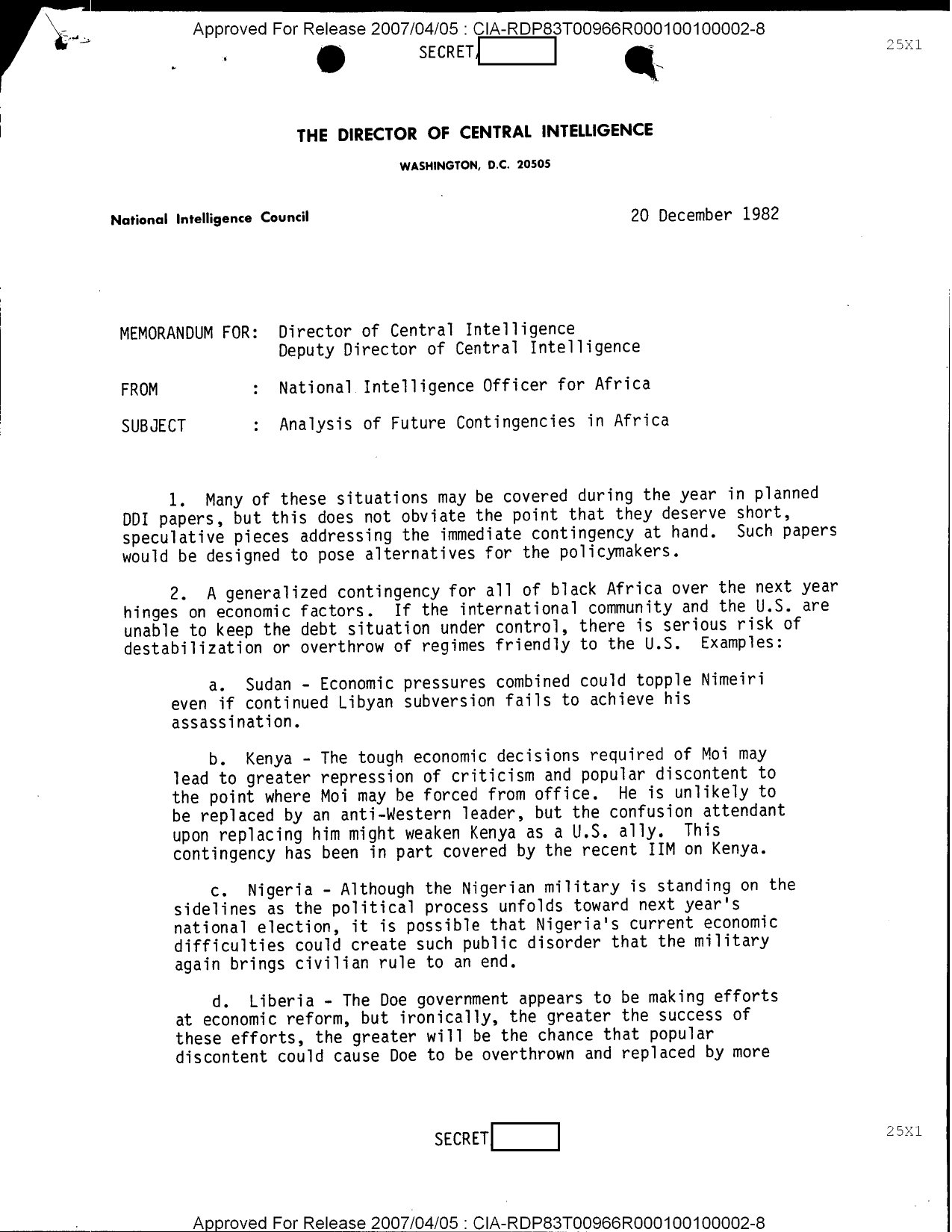
THE DIRECTOR OF CENTRAL INTELLIGENCE
National Intelligence Council
WASHINGTON, D.C. 20505
20 December 1982
MEMORANDUM FOR:
Director of Central Intelligence
Deputy Director of Central Intelligence
FROM: [CENSORED]
SUBJECT: National Intelligence Officer for Africa – Analysis of Future Contingencies in Africa
- Many of these situations may be covered during the year in planned DDI papers, but this does not obviate the point that they deserve short, speculative pieces addressing the immediate contingency at hand. Such papers would be designed to pose alternatives for the policymakers.
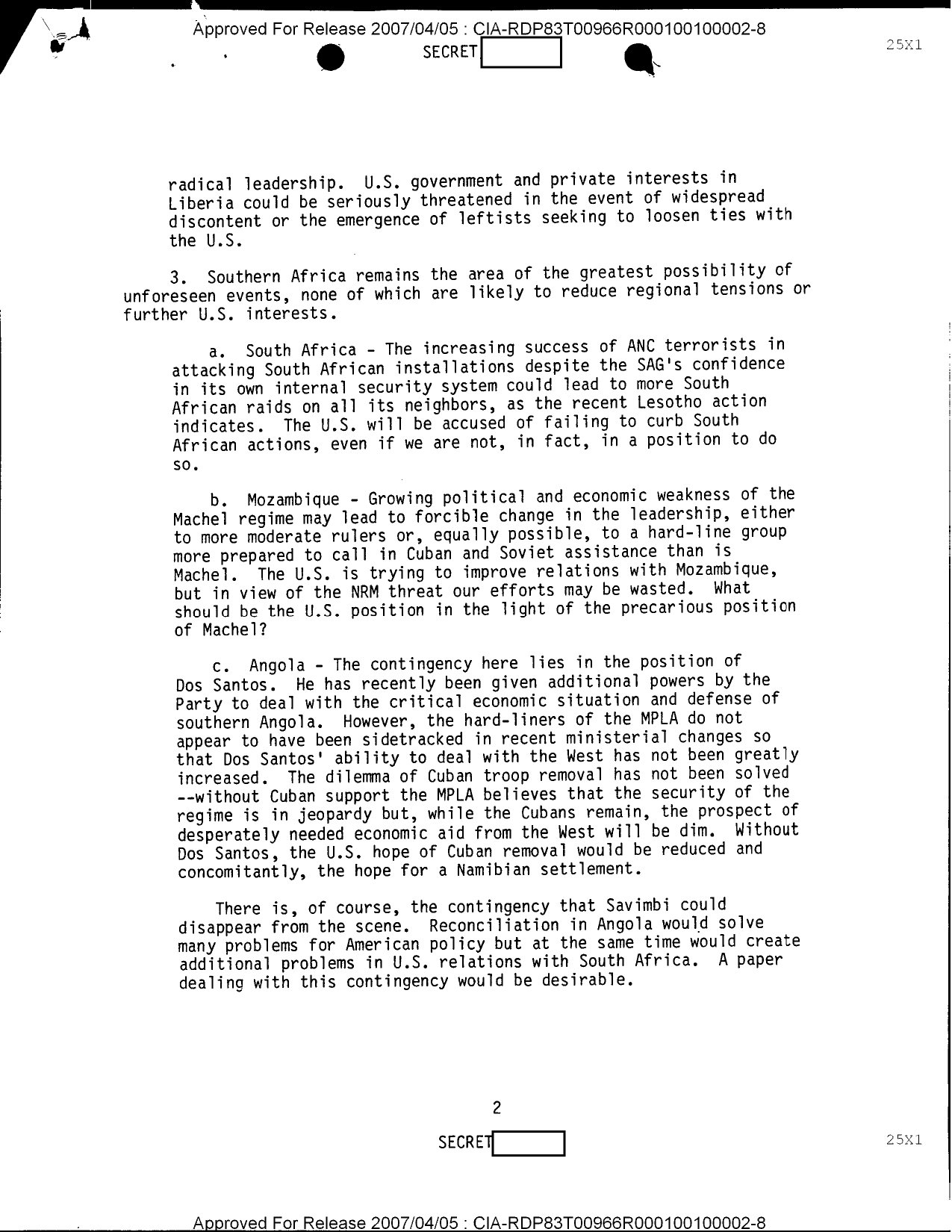
- A generalized contingency for all of black Africa over the next year hinges on economic factors. If the international community and the U.S. are unable to keep the debt situation under control, there is serious risk of destabilization or overthrow of regimes friendly to the U.S. Examples: a. Sudan – Economic pressures combined could topple Nimeiri even if continued Libyan subversion fails to achieve his assassination. b. Kenya – The tough economic decisions required of Moi may lead to greater repression of criticism and popular discontent to the point where Moi may be forced from office. He is unlikely to be replaced by an anti-Western leader, but the confusion attendant upon replacing him might weaken Kenya as a U.S. ally. This contingency has been in part covered by the recent IIM on Kenya. c. Nigeria – Although the Nigerian military is standing on sidelines as the political process unfolds toward next year’s national election, it is possible that Nigeria’s current economic difficulties could create such public disorder that the military again brings civilian rule to an end. d. Liberia – The Doe government appears to be making efforts at economic reform, but ironically, the greater the success of these efforts, the greater will be the chance that popular discontent could cause Doe to be overthrown and replaced by more radical leadership. U.S. government and private interests in Liberia could be seriously threatened in the event of widespread discontent or the emergence of leftists seeking to loosen ties with the U.S.
- Southern Africa remains the area of the greatest possibility of unforeseen events, none of which are likely to reduce regional tensions or further U.S. interests. a. South Africa – The increasing success of ANC terrorists in attacking South African installations despite the SAG’s confidence in its own internal security system could lead to more South African raids on all its neighbors, as the recent Lesotho action indicates. The U.S. will be accused of failing to curb South African actions, even if we are not, in fact, in a position to do so. b. Mozambique – Growing political and economic weakness of the Machel regime may lead to forcible change in the leadership, either to more moderate rulers or, equally possible, to a hard-line group more prepared to call in Cuban and Soviet assistance than is Machel. The U.S. is trying to improve relations with Mozambique, but in view of the NRM threat our efforts may be wasted. What should be the U.S. position in the light of the precarious position of Machel? c. Angola – The contingency here lies in the position of Dos Santos. He has recently been given additional powers by the Party to deal with the critical economic situation and defense of southern Angola. However, the hard-liners of the MPLA do not appear to have been sidetracked in recent ministerial changes so that Dos Santos’ ability to deal with the West has not been greatly increased. The dilemma of Cuban troop removal has not been solved – without Cuban support the MPLA believes that the security of the regime is in jeopardy but, while the Cubans remain, the prospect of desperately needed economic aid from the West will be dim. Without Dos Santos, the U.S. hope of Cuban removal would be reduced and concomitantly, the hope for a Namibian settlement.
There is, of course, the contingency that Savimbi could disappear from the scene. Reconciliation in Angola would solve many problems for American policy but at the same time would create additional problems in U.S. relations with South Africa. A paper dealing with this contingency would be desirable.
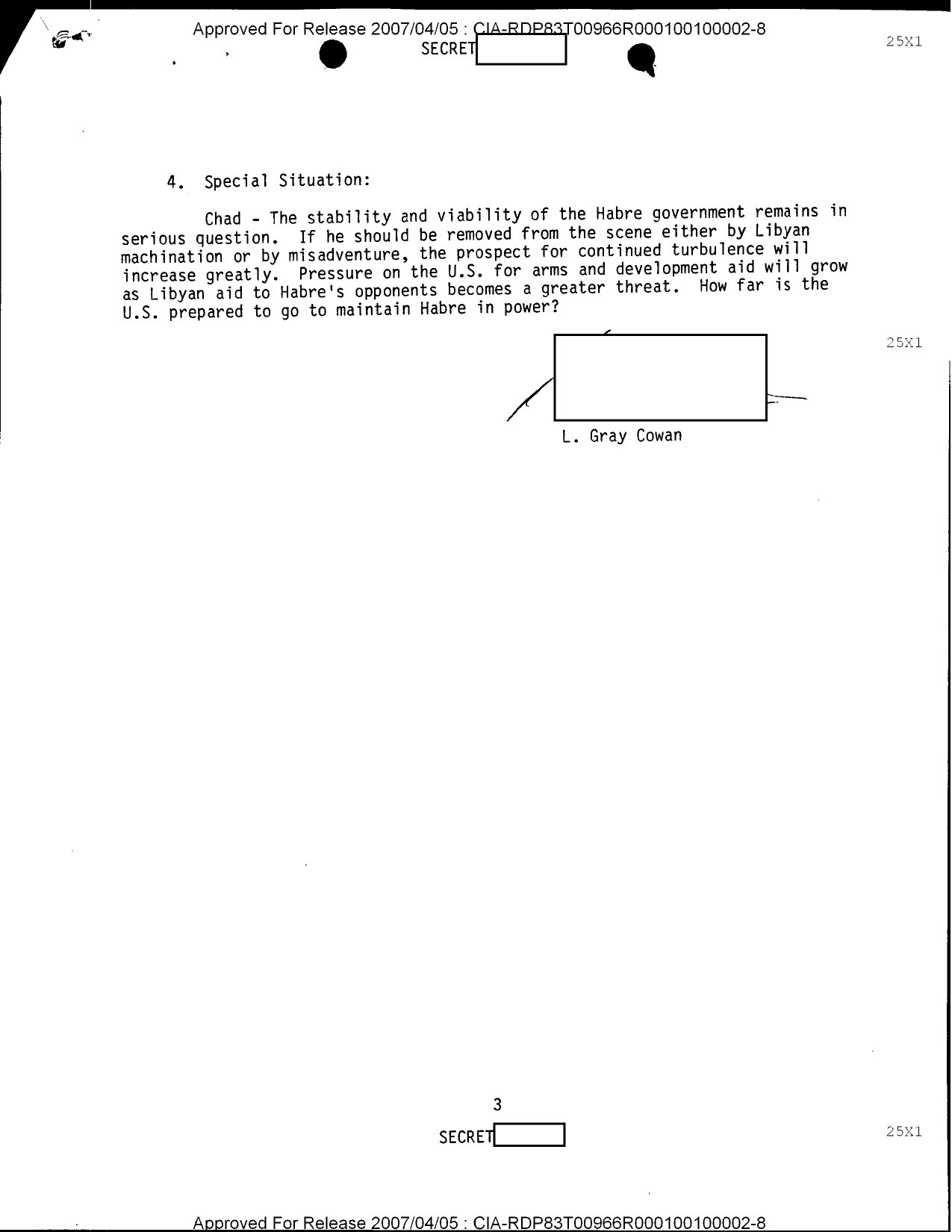
- Special Situation: Chad – The stability and viability of the Habre government remains in serious question. If he should be removed from the scene either by Libyan machination or by misadventure, the prospect for continued turbulence will increase greatly. Pressure on the U.S. for arms and development aid will grow as Libyan aid to Habre’s opponents becomes a greater threat. How far is the U.S. prepared to go to maintain Habre in power?
L. Gray Cowan
THE DIRECTOR OF CENTRAL INTELLIGENCE
WASHINGTON, D.C. 20505
National Intelligence Council
30 November 1982
MEMORANDUM FOR:
Director of Central Intelligence
Deputy Director of Central Intelligence
THROUGH:
Chairman, National Intelligence Council
FROM:
David D. Gries
National Intelligence Officer for East Asia
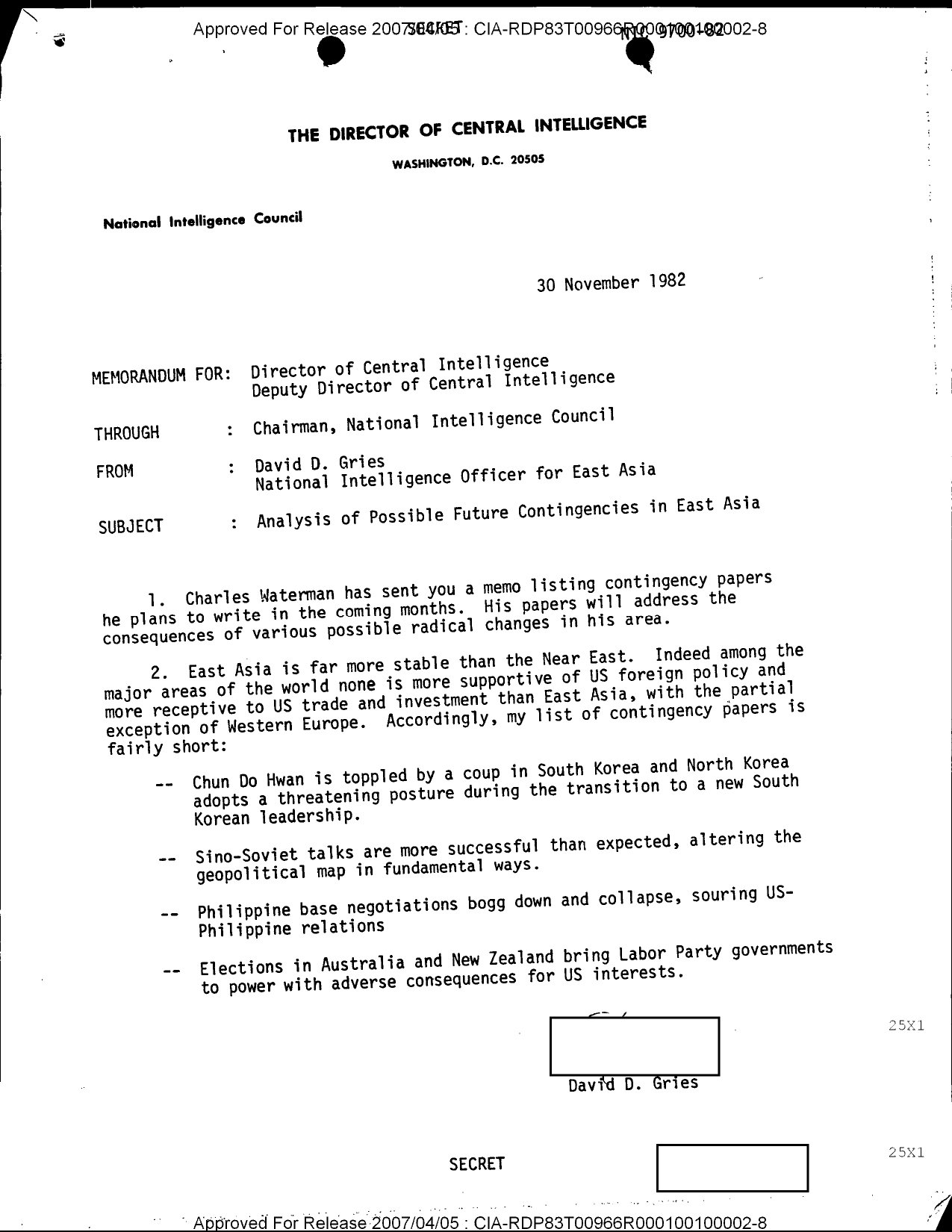
SUBJECT: Analysis of Possible Future Contingencies in East Asia
- Charles Waterman has sent you a memo listing contingency papers he plans to write in the coming months. His papers will address the consequences of various possible radical changes in his area.
- East Asia is far more stable than the Near East. Indeed, among the major areas of the world none is more supportive of US foreign policy and more receptive to US trade and investment than East Asia, with the partial exception of Western Europe. Accordingly, my list of contingency papers is fairly short:
- Chun Do Hwan is toppled by a coup in South Korea and North Korea adopts a threatening posture during the transition to a new South Korean leadership.
- Sino-Soviet talks are more successful than expected, altering the geopolitical map in fundamental ways.
- Philippine base negotiations bog down and collapse, souring US-Philippine relations.
- Elections in Australia and New Zealand bring Labor Party governments to power with adverse consequences for US interests.
[CENSORED]
David D. Gries
THE DIRECTOR OF CENTRAL INTELLIGENCE
National Intelligence Council
WASHINGTON, D.C. 20505
NIC 9487-82
22 November 1982
MEMORANDUM FOR:
Director of Central Intelligence
Deputy Director of Central Intelligence
FROM:
Charles E. Waterman, NIO/NESA
SUBJECT: Analysis of Possible Future Contingencies
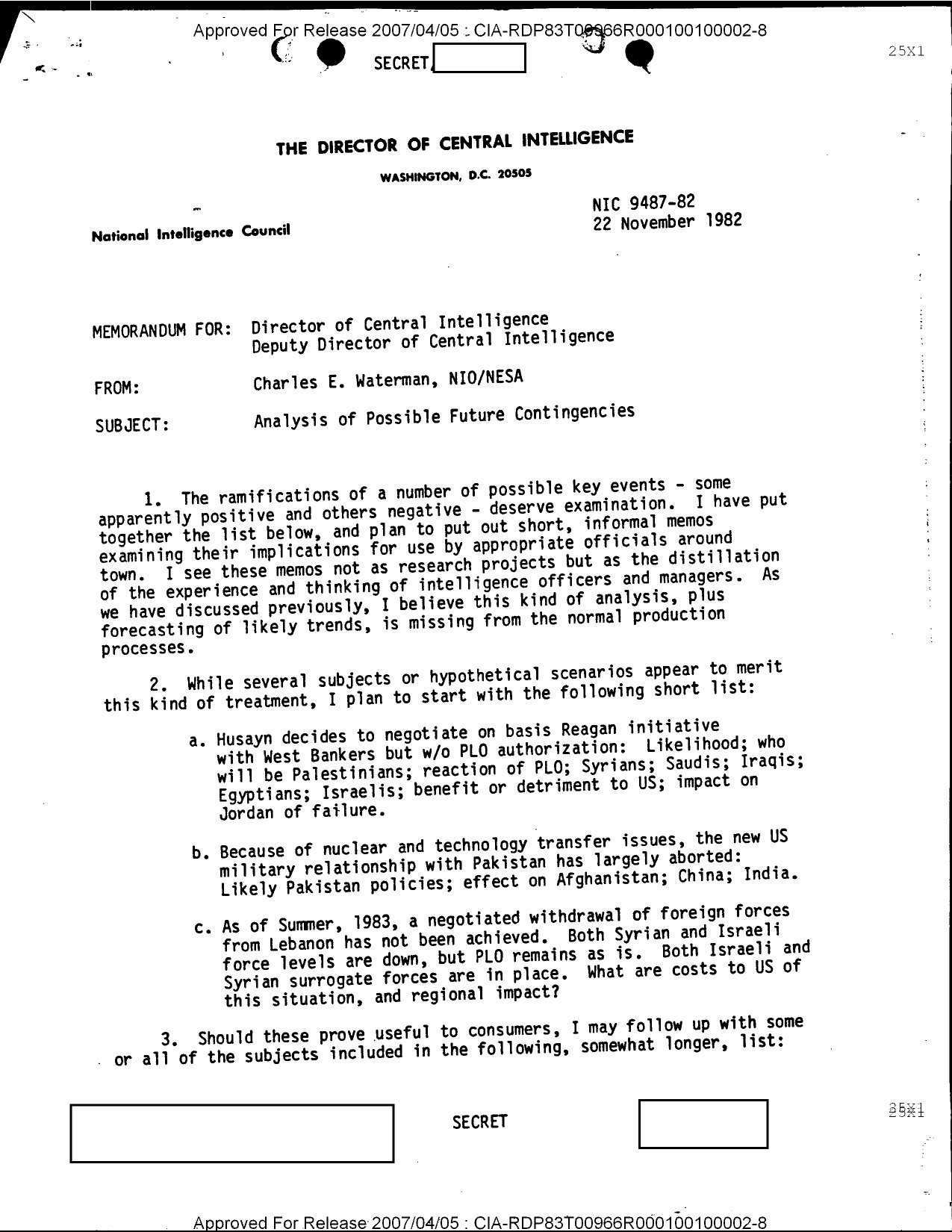
- The ramifications of a number of possible key events – some apparently positive and others negative – deserve examination. I have put together the list below, and plan to put out short, informal memos examining their implications for use by appropriate officials around town. I see these memos not as research projects but as the distillation of the experience and thinking of intelligence officers and managers. As we have discussed previously, I believe this kind of analysis, plus forecasting of likely trends, is missing from the normal production processes.
- While several subjects or hypothetical scenarios appear to merit this kind of treatment, I plan to start with the following short list: a. Husayn decides to negotiate on basis Reagan initiative with West Bankers but w/o PLO authorization: Likelihood; who will be Palestinians; reaction of PLO; Syrians; Saudis; Iraqis; Egyptians; Israelis; benefit or detriment to US; impact on Jordan of failure. b. Because of nuclear and technology transfer issues, the new US military relationship with Pakistan has largely aborted: Likely Pakistan policies; effect on Afghanistan; China; India. c. As of Summer, 1983, a negotiated withdrawal of foreign forces from Lebanon has not been achieved. Both Syrian and Israeli force levels are down, but PLO remains as is. Both Israeli and Syrian surrogate forces are in place. What are costs to US of this situation, and regional impact?
- Should these prove useful to consumers, I may follow up with some or all of the subjects included in the following, somewhat longer, list:
[CENSORED]
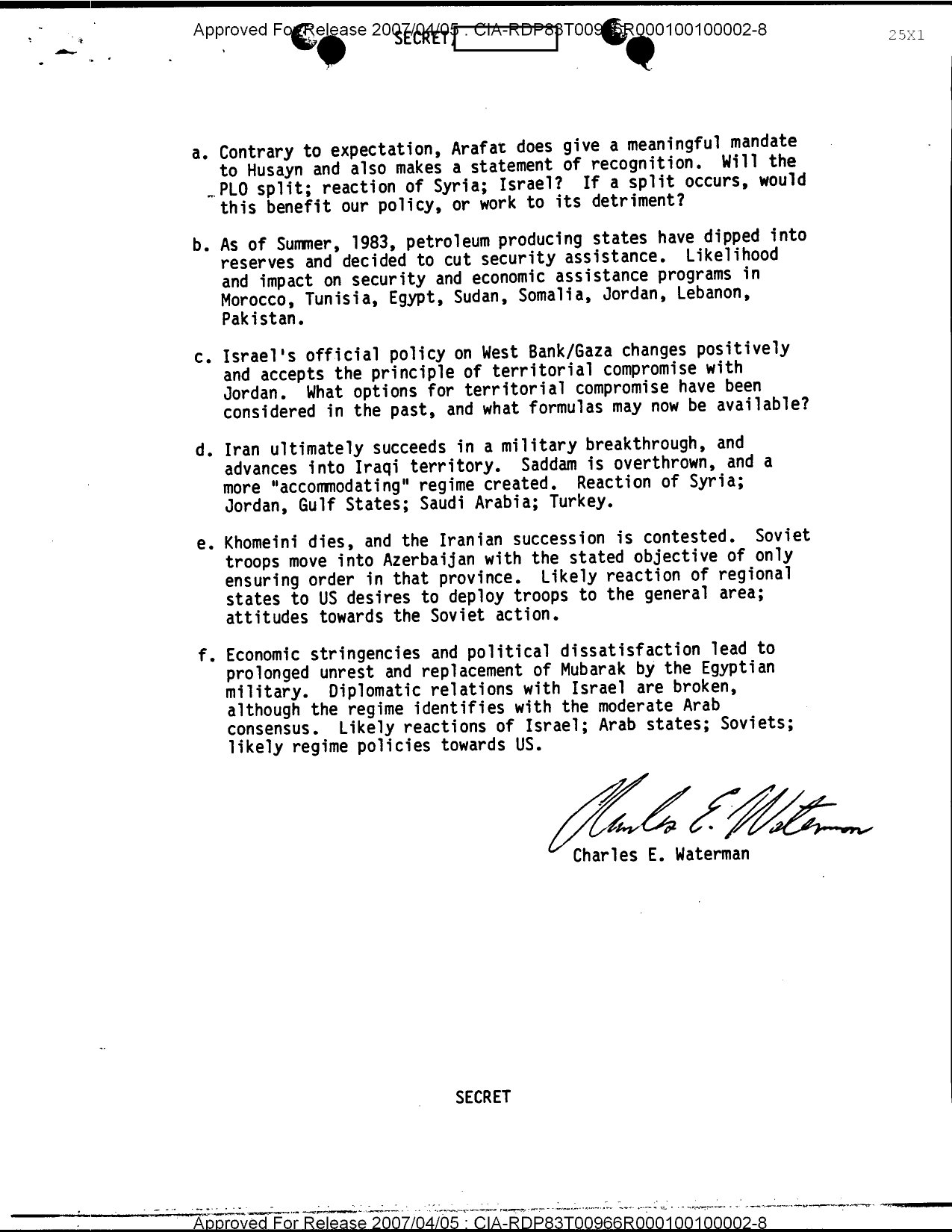
a. Contrary to expectation, Arafat does give a meaningful mandate to Husayn and also makes a statement of recognition. Will the PLO split; reaction of Syria; Israel? If a split occurs, would this benefit our policy, or work to its detriment?
b. As of Summer, 1983, petroleum producing states have dipped into reserves and decided to cut security assistance. Likelihood and impact on security and economic assistance programs in Morocco, Tunisia, Egypt, Sudan, Somalia, Jordan, Lebanon, Pakistan.
c. Israel’s official policy on West Bank/Gaza changes positively and accepts the principle of territorial compromise with Jordan. What options for territorial compromise have been considered in the past, and what formulas may now be available?
d. Iran ultimately succeeds in a military breakthrough, and advances into Iraqi territory. Saddam is overthrown, and a more “accommodating” regime created. Reaction of Syria; Jordan, Gulf States; Saudi Arabia; Turkey.
e. Khomeini dies, and the Iranian succession is contested. Soviet troops move into Azerbaijan with the stated objective of only ensuring order in that province. Likely reaction of regional states to US desires to deploy troops to the general area; attitudes towards the Soviet action.
f. Economic stringencies and political dissatisfaction lead to prolonged unrest and replacement of Mubarak by the Egyptian military. Diplomatic relations with Israel are broken, although the regime identifies with the moderate Arab consensus. Likely reactions of Israel; Arab states; Soviets; likely regime policies towards US.
Charles E. Waterman
Implications of Saddam’s Departure
6 December 1982
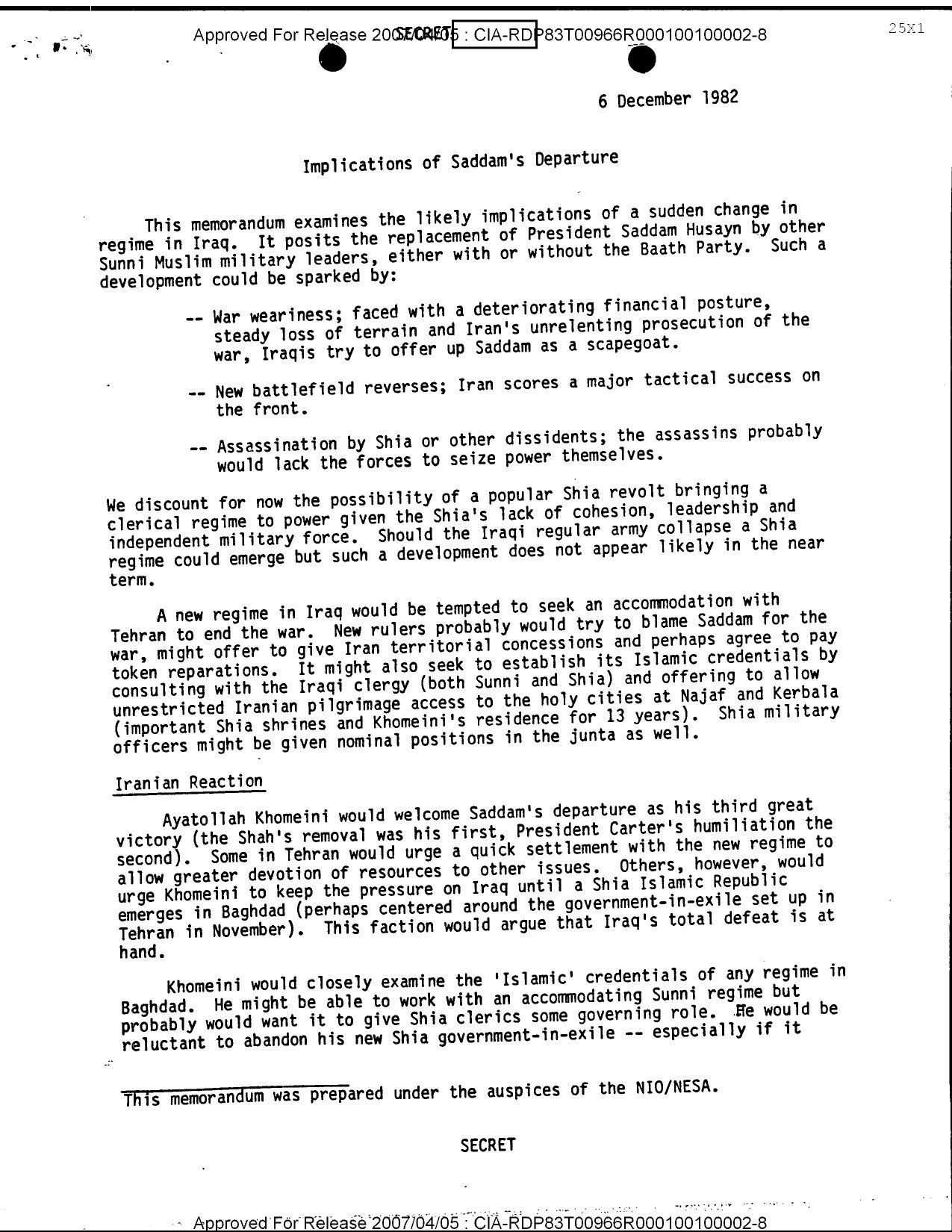
This memorandum examines the likely implications of a sudden change in regime in Iraq. It posits the replacement of President Saddam Husayn by other Sunni Muslim military leaders, either with or without the Baath Party. Such a development could be sparked by:
- War weariness; faced with a deteriorating financial posture, steady loss of terrain and Iran’s unrelenting prosecution of the war, Iraqis try to offer up Saddam as a scapegoat.
- New battlefield reverses; Iran scores a major tactical success on the front.
- Assassination by Shia or other dissidents; the assassins probably would lack the forces to seize power themselves.
We discount for now the possibility of a popular Shia revolt bringing a clerical regime to power given the Shia’s lack of cohesion, leadership and independent military force. Should the Iraqi regular army collapse, a Shia regime could emerge but such a development does not appear likely in the near term.
A new regime in Iraq would be tempted to seek an accommodation with Tehran to end the war. New rulers probably would try to blame Saddam for the war, might offer to give Iran territorial concessions and perhaps agree to pay token reparations. It might also seek to establish its Islamic credentials by consulting with the Iraqi clergy (both Sunni and Shia) and offering to allow unrestricted Iranian pilgrimage access to the holy cities at Najaf and Kerbala (important Shia shrines and Khomeini’s residence for 13 years). Shia military officers might be given nominal positions in the junta as well.
Iranian Reaction
Ayatollah Khomeini would welcome Saddam’s departure as his third great victory (the Shah’s removal was his first, President Carter’s humiliation the second). Some in Tehran would urge a quick settlement with the new regime to allow greater devotion of resources to other issues. Others, however, would urge Khomeini to keep the pressure on Iraq until a Shia Islamic Republic emerges in Baghdad (perhaps centered around the government-in-exile set up in Tehran in November). This faction would argue that Iraq’s total defeat is at hand.
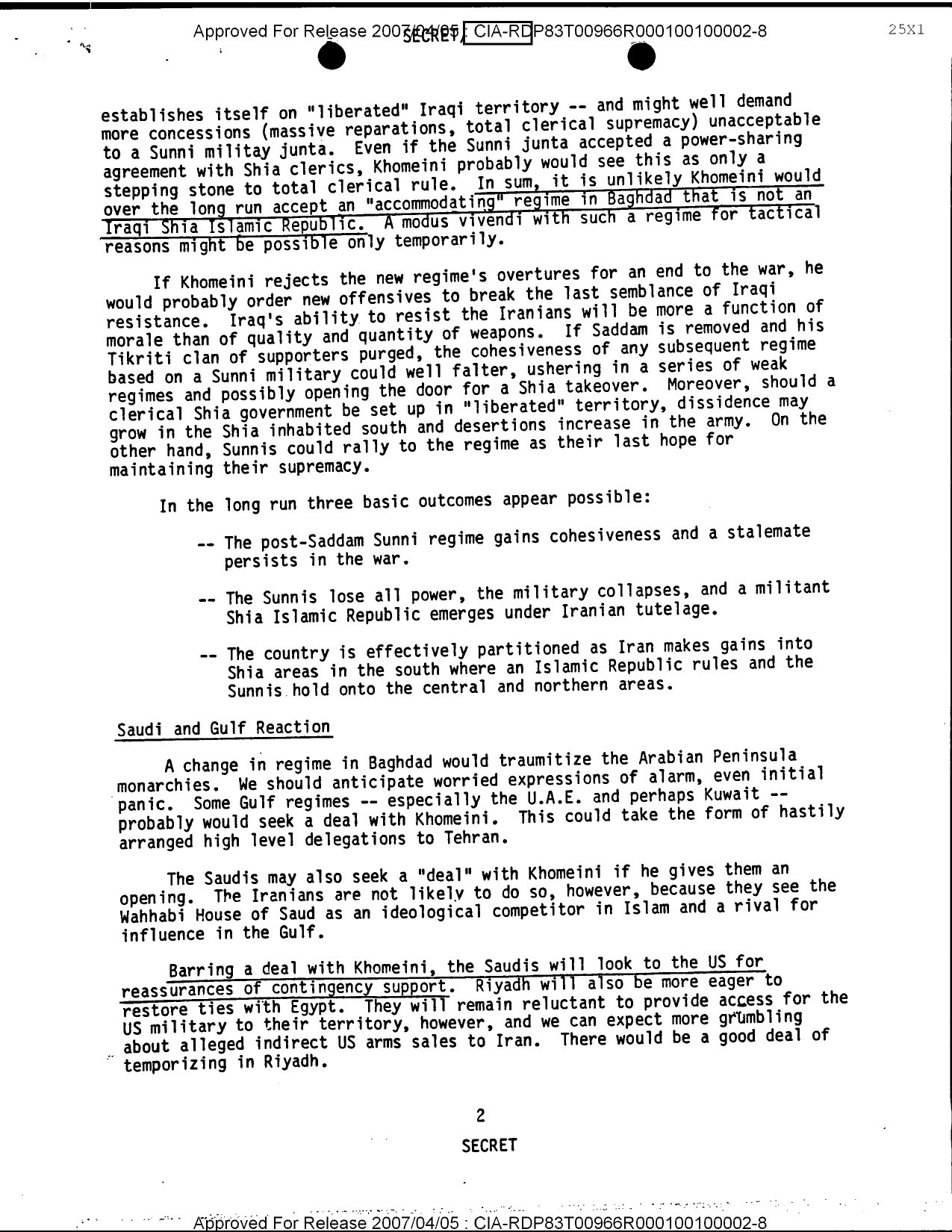
Khomeini would closely examine the ‘Islamic’ credentials of any regime in Baghdad. He might be able to work with an accommodating Sunni regime but probably would want it to give Shia clerics some governing role. He would be reluctant to abandon his new Shia government-in-exile—especially if it establishes itself on “liberated” Iraqi territory—and might well demand more concessions (massive reparations, total clerical supremacy) unacceptable to a Sunni military junta. Even if the Sunni junta accepted a power-sharing agreement with Shia clerics, Khomeini probably would see this as only a stepping stone to total clerical rule. In sum, it is unlikely Khomeini would over the long run accept an “accommodating” regime in Baghdad that is not an Iraqi Shia Islamic Republic. A modus vivendi with such a regime for tactical reasons might be possible only temporarily.
If Khomeini rejects the new regime’s overtures for an end to the war, he would probably order new offensives to break the last semblance of Iraqi resistance. Iraq’s ability to resist the Iranians will be more a function of morale than of quality and quantity of weapons. If Saddam is removed and his Tikriti clan of supporters purged, the cohesiveness of any subsequent regime based on a Sunni military could well falter, ushering in a series of weak regimes and possibly opening the door for a Shia takeover. Moreover, should a clerical Shia government be set up in “liberated” territory, dissidence may grow in the Shia-inhabited south and desertions increase in the army. On the other hand, Sunnis could rally to the regime as their last hope for maintaining their supremacy.
In the long run, three basic outcomes appear possible:
- The post-Saddam Sunni regime gains cohesiveness and a stalemate persists in the war.
- The Sunnis lose all power, the military collapses, and a militant Shia Islamic Republic emerges under Iranian tutelage.
- The country is effectively partitioned as Iran makes gains into Shia areas in the south where an Islamic Republic rules and the Sunnis hold onto the central and northern areas.
Saudi and Gulf Reaction
A change in regime in Baghdad would traumatize the Arabian Peninsula monarchies. We should anticipate worried expressions of alarm, even initial panic. Some Gulf regimes—especially the U.A.E. and perhaps Kuwait—probably would seek a deal with Khomeini. This could take the form of hastily arranged high-level delegations to Tehran.
The Saudis may also seek a “deal” with Khomeini if he gives them an opening. The Iranians are not likely to do so, however, because they see the Wahhabi House of Saud as an ideological competitor in Islam and a rival for influence in the Gulf.
Barring a deal with Khomeini, the Saudis will look to the US for reassurances of contingency support. Riyadh will also be more eager to restore ties with Egypt. They will remain reluctant to provide access for the US military to their territory, however, and we can expect more grumbling about alleged indirect US arms sales to Iran. There would be a good deal of temporizing in Riyadh.
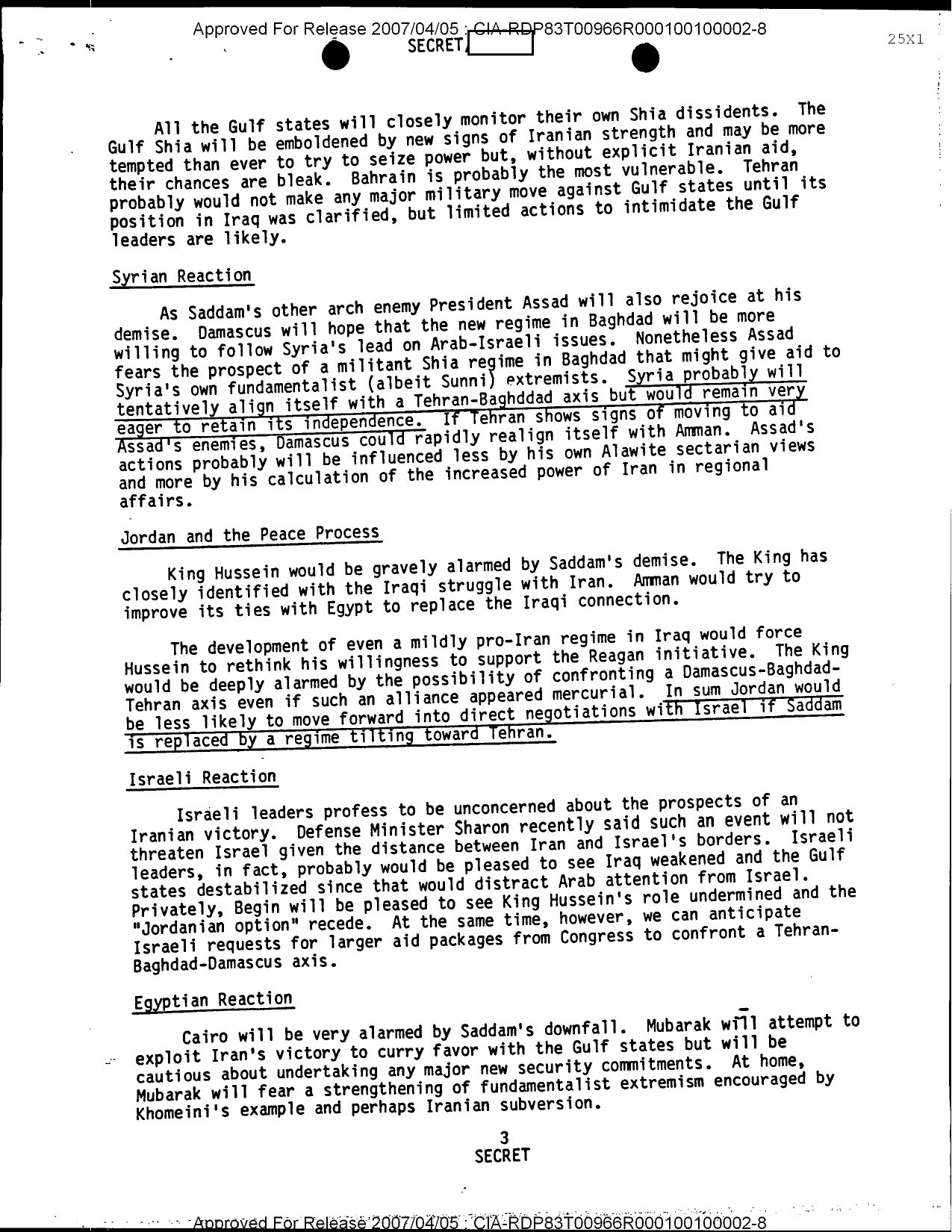
All the Gulf states will closely monitor their own Shia dissidents. The Gulf Shia will be emboldened by new signs of Iranian strength and may be more tempted than ever to try to seize power but, without explicit Iranian aid, their chances are bleak. Bahrain is probably the most vulnerable. Tehran probably would not make any major military move against Gulf states until its position in Iraq was clarified, but limited actions to intimidate the Gulf leaders are likely.
Syrian Reaction
As Saddam’s other arch enemy, President Assad will also rejoice at his demise. Damascus will hope that the new regime in Baghdad will be more willing to follow Syria’s lead on Arab-Israeli issues. Nonetheless, Assad fears the prospect of a militant Shia regime in Baghdad that might give aid to Syria’s own fundamentalist (albeit Sunni) extremists. Syria probably will tentatively align itself with a Tehran-Baghdad axis but would remain very eager to retain its independence. If Tehran shows signs of moving to aid Assad’s enemies, Damascus could rapidly realign itself with Amman. Assad’s actions probably will be influenced less by his own Alawite sectarian views and more by his calculation of the increased power of Iran in regional affairs.
Jordan and the Peace Process
King Hussein would be gravely alarmed by Saddam’s demise. The King has closely identified with the Iraqi struggle with Iran. Amman would try to improve its ties with Egypt to replace the Iraqi connection.
The development of even a mildly pro-Iran regime in Iraq would force Hussein to rethink his willingness to support the Reagan initiative. The King would be deeply alarmed by the possibility of confronting a Damascus-Baghdad-Tehran axis even if such an alliance appeared mercurial. In sum, Jordan would be less likely to move forward into direct negotiations with Israel if Saddam is replaced by a regime tilting toward Tehran.
Israeli Reaction
Israeli leaders profess to be unconcerned about the prospects of an Iranian victory. Defense Minister Sharon recently said such an event will not threaten Israel given the distance between Iran and Israel’s borders. Israeli leaders, in fact, probably would be pleased to see Iraq weakened and the Gulf states destabilized since that would distract Arab attention from Israel. Privately, Begin will be pleased to see King Hussein’s role undermined and the “Jordanian option” recede. At the same time, however, we can anticipate Israeli requests for larger aid packages from Congress to confront a Tehran-Baghdad-Damascus axis.
Egyptian Reaction
Cairo will be very alarmed by Saddam’s downfall. Mubarak will attempt to exploit Iran’s victory to curry favor with the Gulf states but will be cautious about undertaking any major new security commitments. At home, Mubarak will fear a strengthening of fundamentalist extremism encouraged by Khomeini’s example and perhaps Iranian subversion.
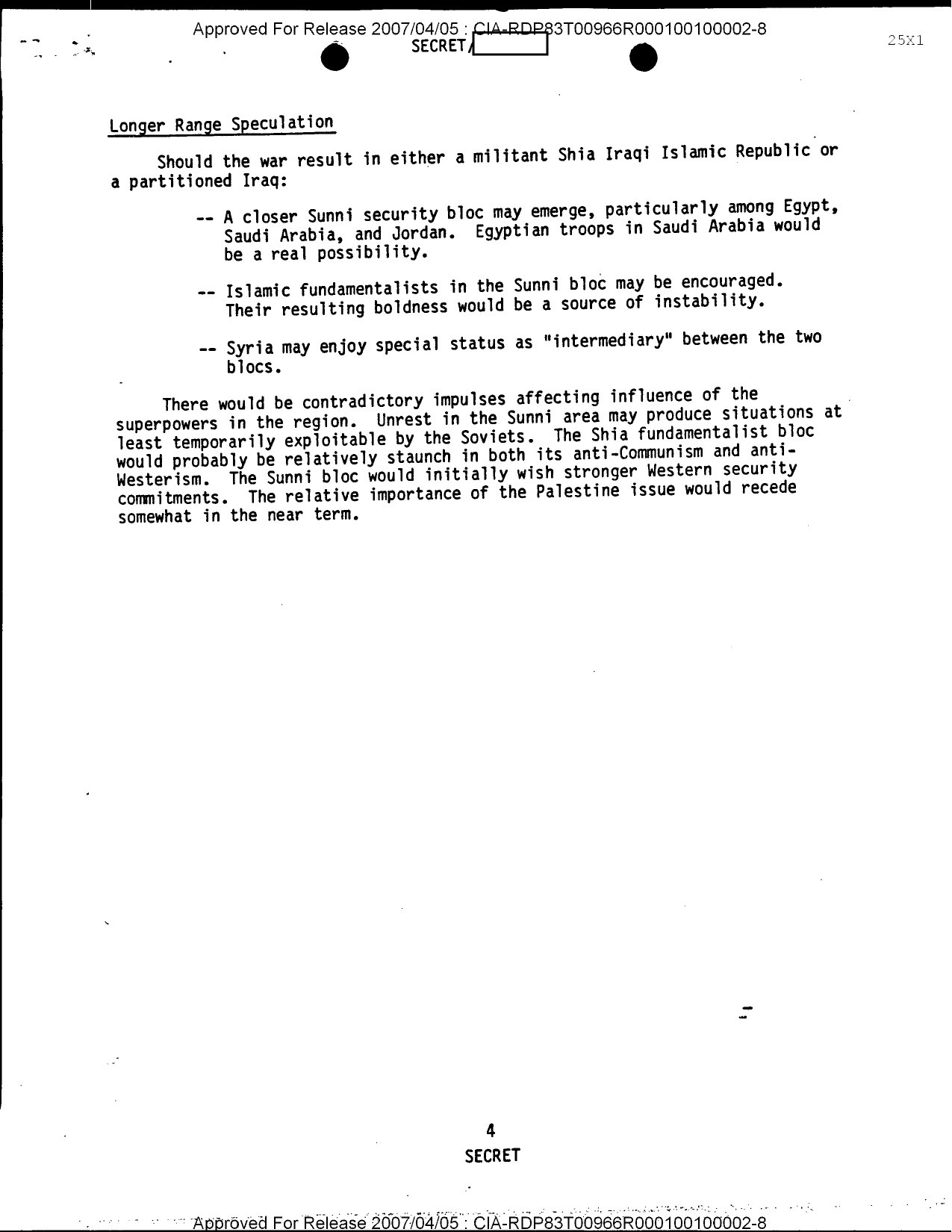
Longer Range Speculation
Should the war result in either a militant Shia Iraqi Islamic Republic or a partitioned Iraq:
- A closer Sunni security bloc may emerge, particularly among Egypt, Saudi Arabia, and Jordan. Egyptian troops in Saudi Arabia would be a real possibility.
- Islamic fundamentalists in the Sunni bloc may be encouraged. Their resulting boldness would be a source of instability.
- Syria may enjoy special status as “intermediary” between the two blocs.
There would be contradictory impulses affecting influence of the superpowers in the region. Unrest in the Sunni area may produce situations at least temporarily exploitable by the Soviets. The Shia fundamentalist bloc would probably be relatively staunch in both its anti-Communism and anti-Westerism. The Sunni bloc would initially wish stronger Western security commitments. The relative importance of the Palestine issue would recede somewhat in the near term.
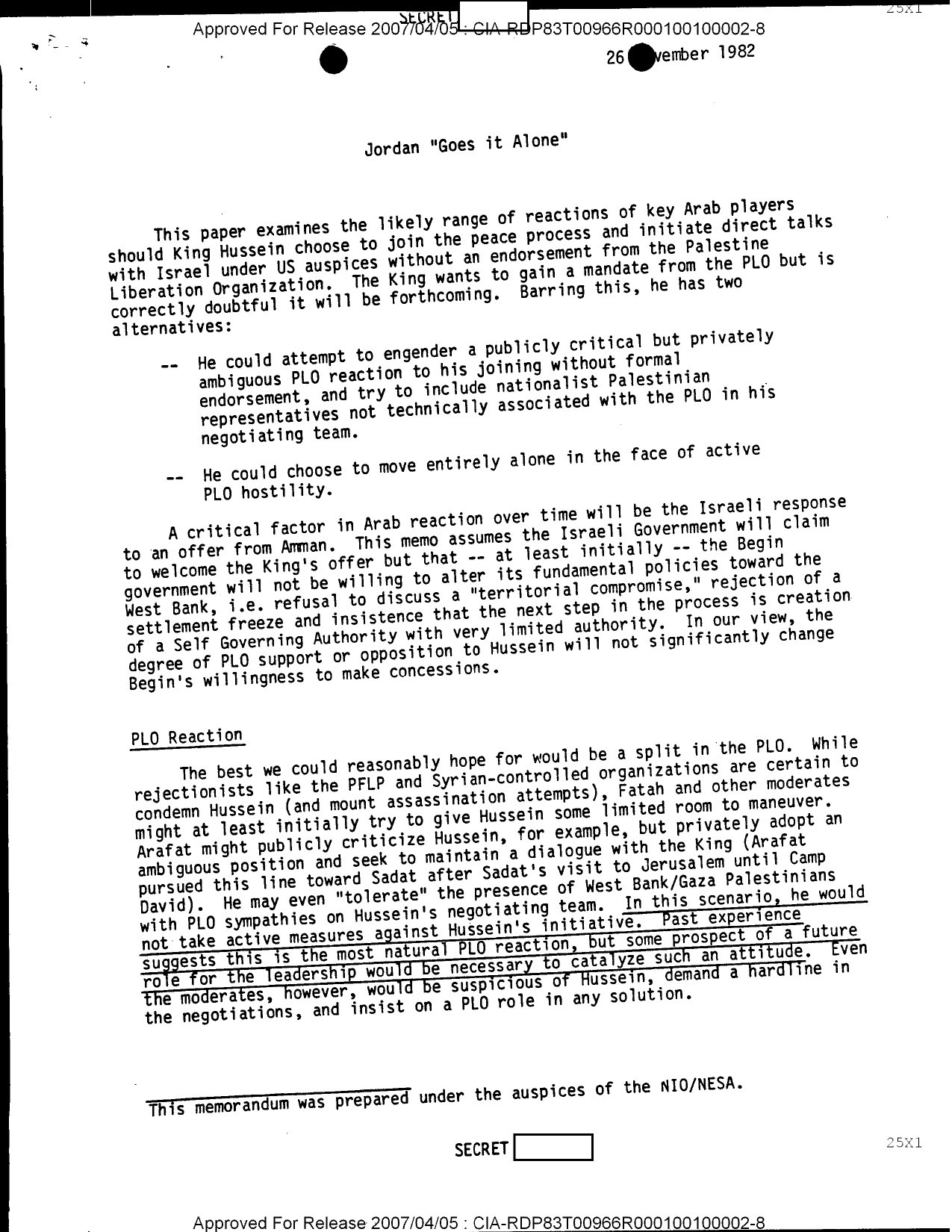
Jordan “Goes it Alone”
26 November 1982
This paper examines the likely range of reactions of key Arab players should King Hussein choose to join the peace process and initiate direct talks with Israel under US auspices without an endorsement from the Palestine Liberation Organization. The King wants to gain a mandate from the PLO but is correctly doubtful it will be forthcoming. Barring this, he has two alternatives:
- He could attempt to engender a publicly critical but privately ambiguous PLO reaction to his joining without formal endorsement, and try to include nationalist Palestinian representatives not technically associated with the PLO in his negotiating team.
- He could choose to move entirely alone in the face of active PLO hostility.
A critical factor in Arab reaction over time will be the Israeli response to an offer from Amman. This memo assumes the Israeli Government will claim to welcome the King’s offer but that—at least initially—the Begin government will not be willing to alter its fundamental policies toward the West Bank, i.e., refusal to discuss a “territorial compromise,” rejection of a settlement freeze, and insistence that the next step in the process is creation of a Self Governing Authority with very limited authority. In our view, the degree of PLO support or opposition to Hussein will not significantly change Begin’s willingness to make concessions.
PLO Reaction
The best we could reasonably hope for would be a split in the PLO. While rejectionists like the PFLP and Syrian-controlled organizations are certain to condemn Hussein (and mount assassination attempts), Fatah and other moderates might at least initially try to give Hussein some limited room to maneuver.
Arafat might publicly criticize Hussein, for example, but privately adopt an ambiguous position and seek to maintain a dialogue with the King (Arafat pursued this line toward Sadat after Sadat’s visit to Jerusalem until Camp David). He may even “tolerate” the presence of West Bank/Gaza Palestinians with PLO sympathies on Hussein’s negotiating team. In this scenario, he would not take active measures against Hussein’s initiative. Past experience suggests this is the most natural PLO reaction, but some prospect of a future role for the leadership would be necessary to catalyze such an attitude. Even the moderates, however, would be suspicious of Hussein, demand a hardline in the negotiations, and insist on a PLO role in any solution.
This memorandum was prepared under the auspices of the NIO/NESA.
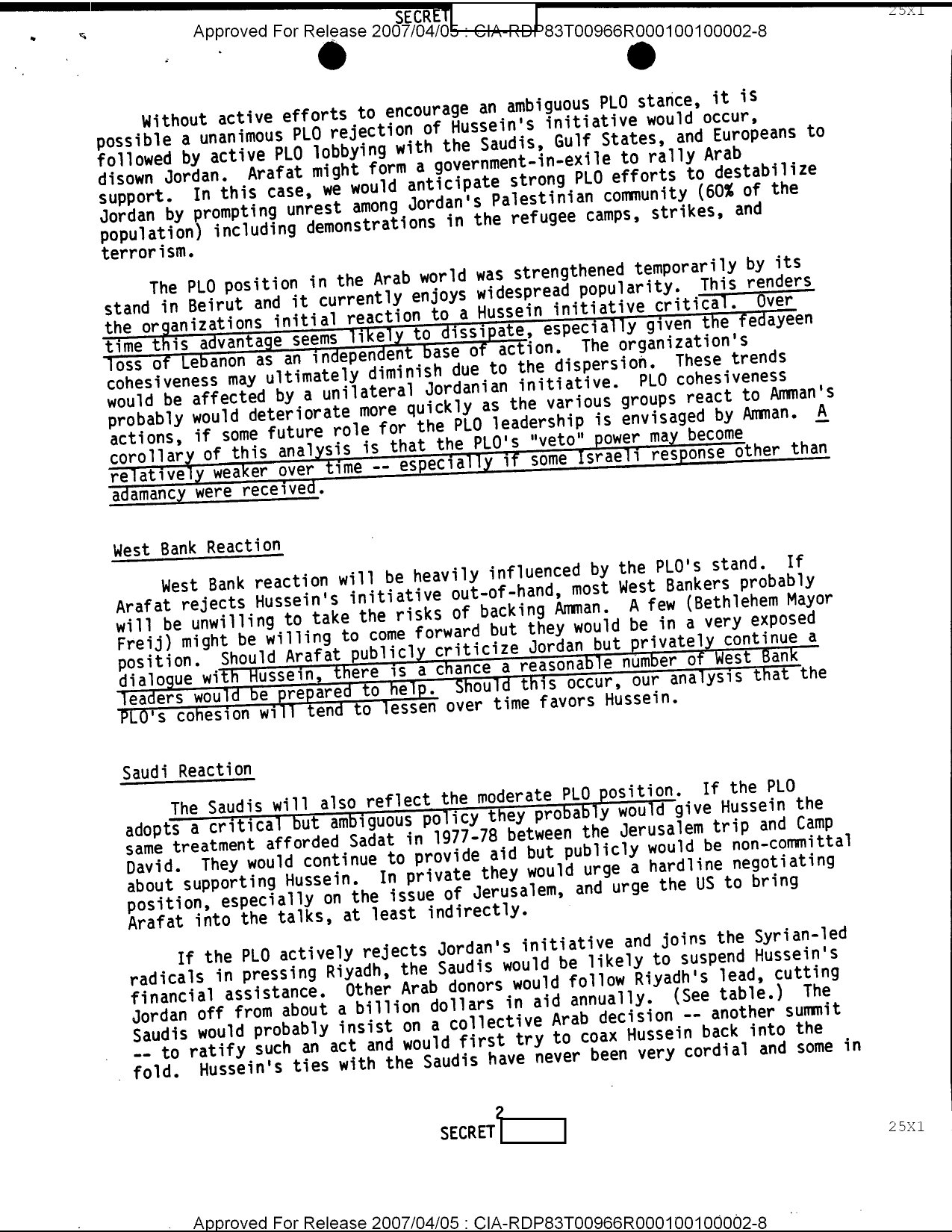
Without active efforts to encourage an ambiguous PLO stance, it is possible a unanimous PLO rejection of Hussein’s initiative would occur, followed by active PLO lobbying with the Saudis, Gulf States, and Europeans to disown Jordan. Arafat might form a government-in-exile to rally Arab support. In this case, we would anticipate strong PLO efforts to destabilize Jordan by prompting unrest among Jordan’s Palestinian community (60% of the population) including demonstrations in the refugee camps, strikes, and terrorism.
The PLO position in the Arab world was strengthened temporarily by its stand in Beirut and it currently enjoys widespread popularity. This renders the organization’s initial reaction to a Hussein initiative critical. Over time this advantage seems likely to dissipate, especially given the fedayeen loss of Lebanon as an independent base of action. The organization’s cohesiveness may ultimately diminish due to the dispersion. These trends would be affected by a unilateral Jordanian initiative. PLO cohesiveness probably would deteriorate more quickly as the various groups react to Amman’s actions, if some future role for the PLO leadership is envisaged by Amman. A corollary of this analysis is that the PLO’s “veto” power may become relatively weaker over time—especially if some Israeli response other than adamancy were received.
West Bank Reaction
West Bank reaction will be heavily influenced by the PLO’s stand. If Arafat rejects Hussein’s initiative out-of-hand, most West Bankers probably will be unwilling to take the risks of backing Amman. A few (Bethlehem Mayor Freij) might be willing to come forward but they would be in a very exposed position. Should Arafat publicly criticize Jordan but privately continue a dialogue with Hussein, there is a chance a reasonable number of West Bank leaders would be prepared to help. Should this occur, our analysis that the PLO’s cohesion will tend to lessen over time favors Hussein.
Saudi Reaction
The Saudis will also reflect the moderate PLO position. If the PLO adopts a critical but ambiguous policy, they probably would give Hussein the same treatment afforded Sadat in 1977-78 between the Jerusalem trip and Camp David. They would continue to provide aid but publicly would be non-committal about supporting Hussein. In private they would urge a hardline negotiating position, especially on the issue of Jerusalem, and urge the US to bring Arafat into the talks, at least indirectly.
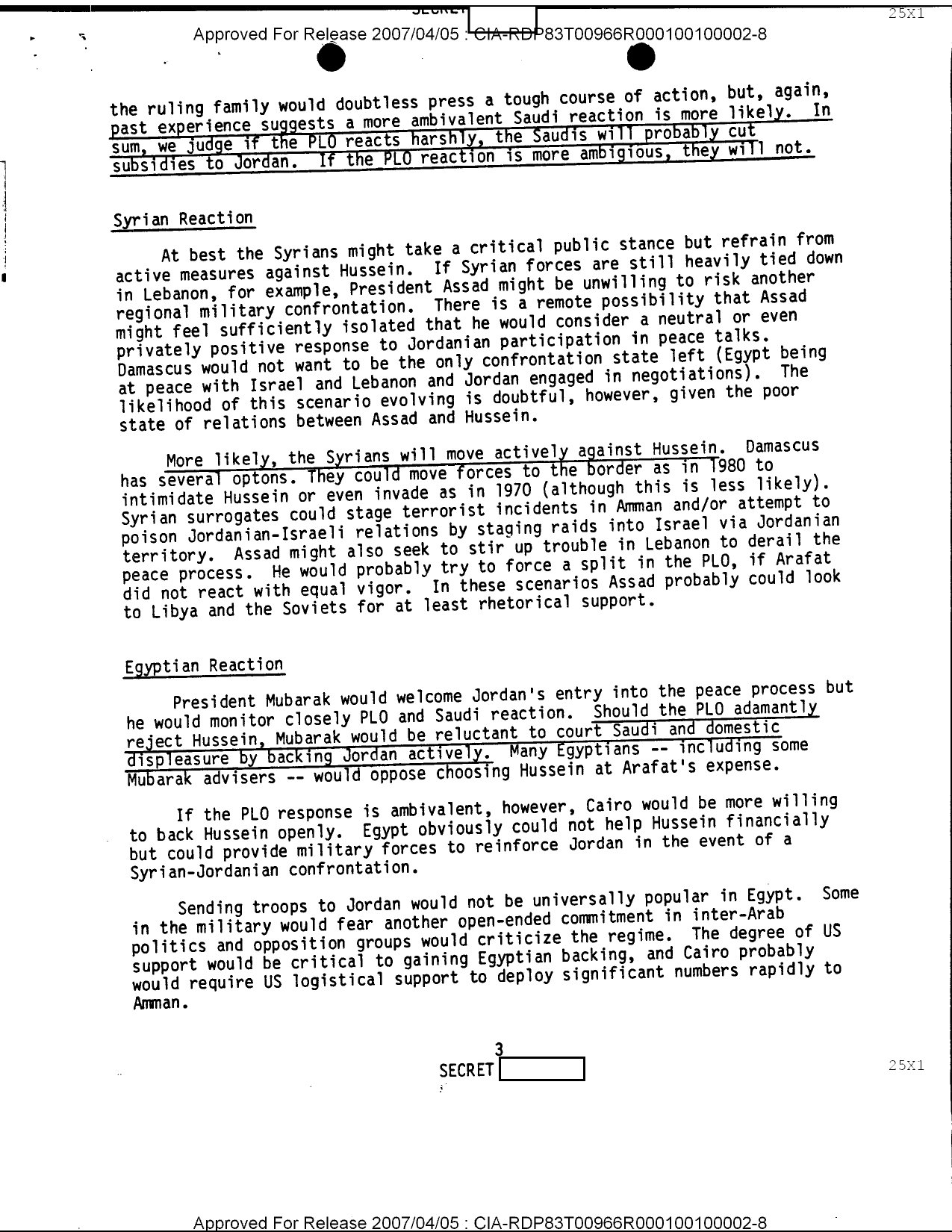
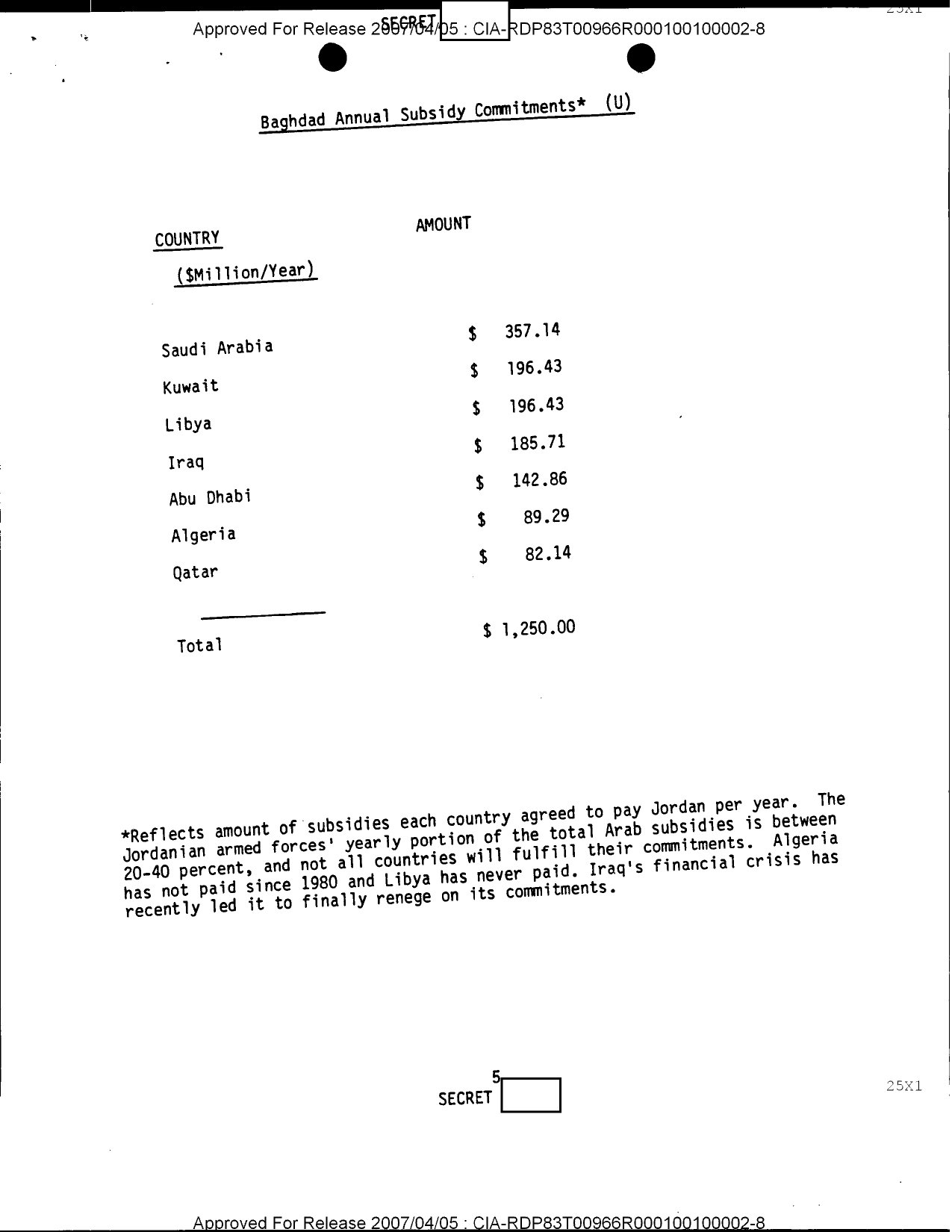
If the PLO actively rejects Jordan’s initiative and joins the Syrian-led radicals in pressing Riyadh, the Saudis would be likely to suspend Hussein’s financial assistance. Other Arab donors would follow Riyadh’s lead, cutting Jordan off from about a billion dollars in aid annually. The Saudis would probably insist on a collective Arab decision—another summit—to ratify such an act and would first try to coax Hussein back into the fold. Hussein’s ties with the Saudis have never been very cordial and some of the ruling family would doubtless press a tough course of action, but, again, past experience suggests a more ambivalent Saudi reaction is more likely. In sum, we judge if the PLO reacts harshly, the Saudis will probably cut subsidies to Jordan. If the PLO reaction is more ambiguous, they will not.
Syrian Reaction
At best the Syrians might take a critical public stance but refrain from active measures against Hussein. If Syrian forces are still heavily tied down in Lebanon, for example, President Assad might be unwilling to risk another regional military confrontation. There is a remote possibility that Assad might feel sufficiently isolated that he would consider a neutral or even privately positive response to Jordanian participation in peace talks.
Damascus would not want to be the only confrontation state left (Egypt being at peace with Israel and Lebanon and Jordan engaged in negotiations). The likelihood of this scenario evolving is doubtful, however, given the poor state of relations between Assad and Hussein.
More likely, the Syrians will move actively against Hussein. Damascus has several options. They could move forces to the border as in 1980 to intimidate Hussein or even invade as in 1970 (although this is less likely). Syrian surrogates could stage terrorist incidents in Amman and/or attempt to poison Jordanian-Israeli relations by staging raids into Israel via Jordanian territory. Assad might also seek to stir up trouble in Lebanon to derail the peace process. He would probably try to force a split in the PLO, if Arafat did not react with equal vigor. In these scenarios Assad probably could look to Libya and the Soviets for at least rhetorical support.
Egyptian Reaction
President Mubarak would welcome Jordan’s entry into the peace process but he would monitor closely PLO and Saudi reaction. Should the PLO adamantly reject Hussein, Mubarak would be reluctant to court Saudi and domestic displeasure by backing Jordan actively. Many Egyptians—including some Mubarak advisers—would oppose choosing Hussein at Arafat’s expense.
If the PLO response is ambivalent, however, Cairo would be more willing to back Hussein openly. Egypt obviously could not help Hussein financially but could provide military forces to reinforce Jordan in the event of a Syrian-Jordanian confrontation.
Sending troops to Jordan would not be universally popular in Egypt. Some in the military would fear another open-ended commitment in inter-Arab politics and opposition groups would criticize the regime. The degree of US support would be critical to gaining Egyptian backing, and Cairo probably would require US logistical support to deploy significant numbers rapidly to Amman.
[CENSORED]
Iraqi Reaction
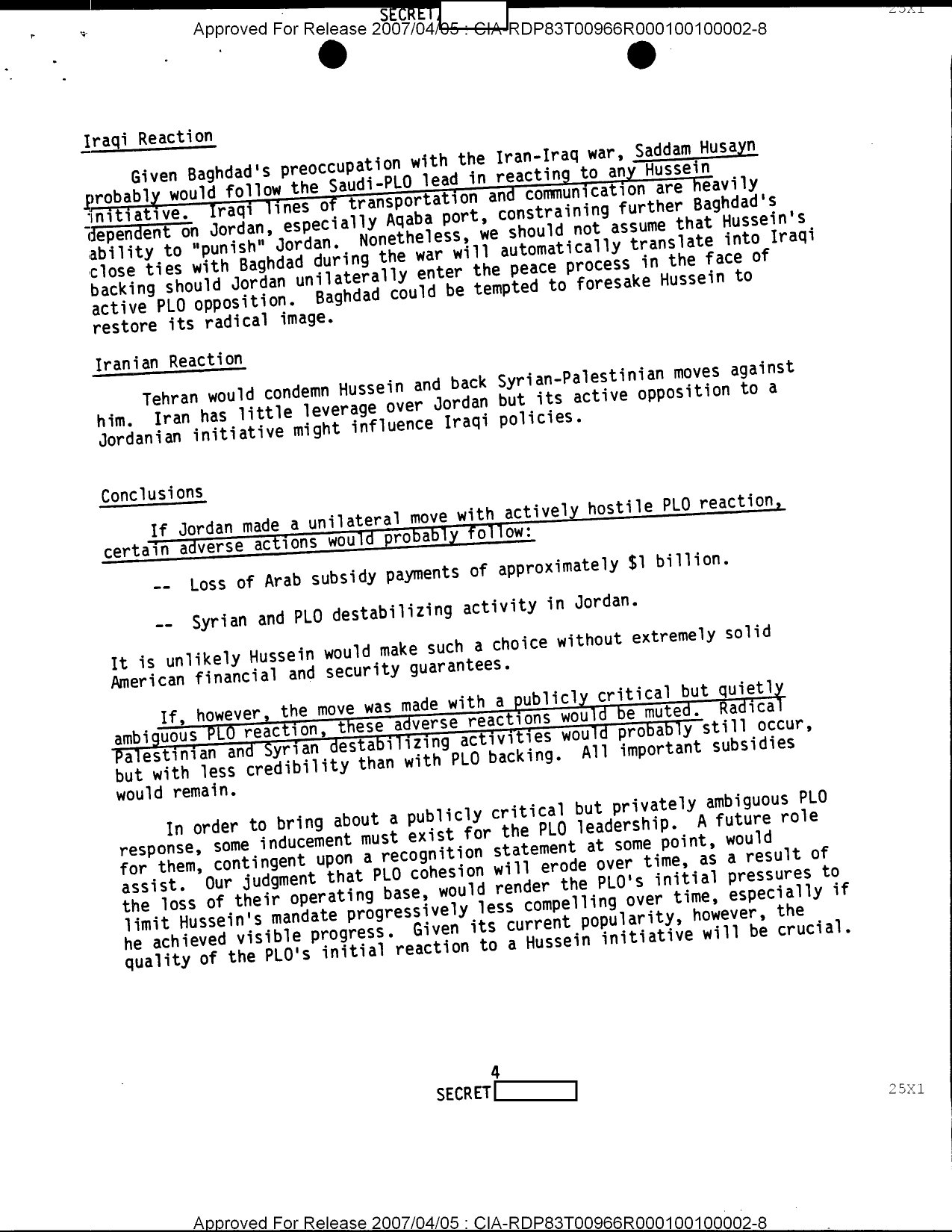
Given Baghdad’s preoccupation with the Iran-Iraq war, Saddam Husayn probably would follow the Saudi-PLO lead in reacting to any Hussein initiative. Iraqi lines of transportation and communication are heavily dependent on Jordan, especially Aqaba port, constraining further Baghdad’s ability to “punish” Jordan. Nonetheless, we should not assume that Hussein’s close ties with Baghdad during the war will automatically translate into Iraqi backing should Jordan unilaterally enter the peace process in the face of active PLO opposition. Baghdad could be tempted to forsake Hussein to restore its radical image.
Iranian Reaction
Tehran would condemn Hussein and back Syrian-Palestinian moves against him. Iran has little leverage over Jordan but its active opposition to a Jordanian initiative might influence Iraqi policies.
Conclusions
If Jordan made a unilateral move with actively hostile PLO reaction, certain adverse actions would probably follow:
- Loss of Arab subsidy payments of approximately $1 billion.
- Syrian and PLO destabilizing activity in Jordan.
It is unlikely Hussein would make such a choice without extremely solid American financial and security guarantees.
If, however, the move was made with a publicly critical but quietly ambiguous PLO reaction, these adverse reactions would be muted. Radical Palestinian and Syrian destabilizing activities would probably still occur, but with less credibility than with PLO backing. All important subsidies would remain.
In order to bring about a publicly critical but privately ambiguous PLO response, some inducement must exist for the PLO leadership. A future role for them, contingent upon a recognition statement at some point, would assist. Our judgment that PLO cohesion will erode over time, as a result of the loss of their operating base, would render the PLO’s initial pressures to limit Hussein’s mandate progressively less compelling over time, especially if he achieved visible progress. Given its current popularity, however, the quality of the PLO’s initial reaction to a Hussein initiative will be crucial.
20 December 1982
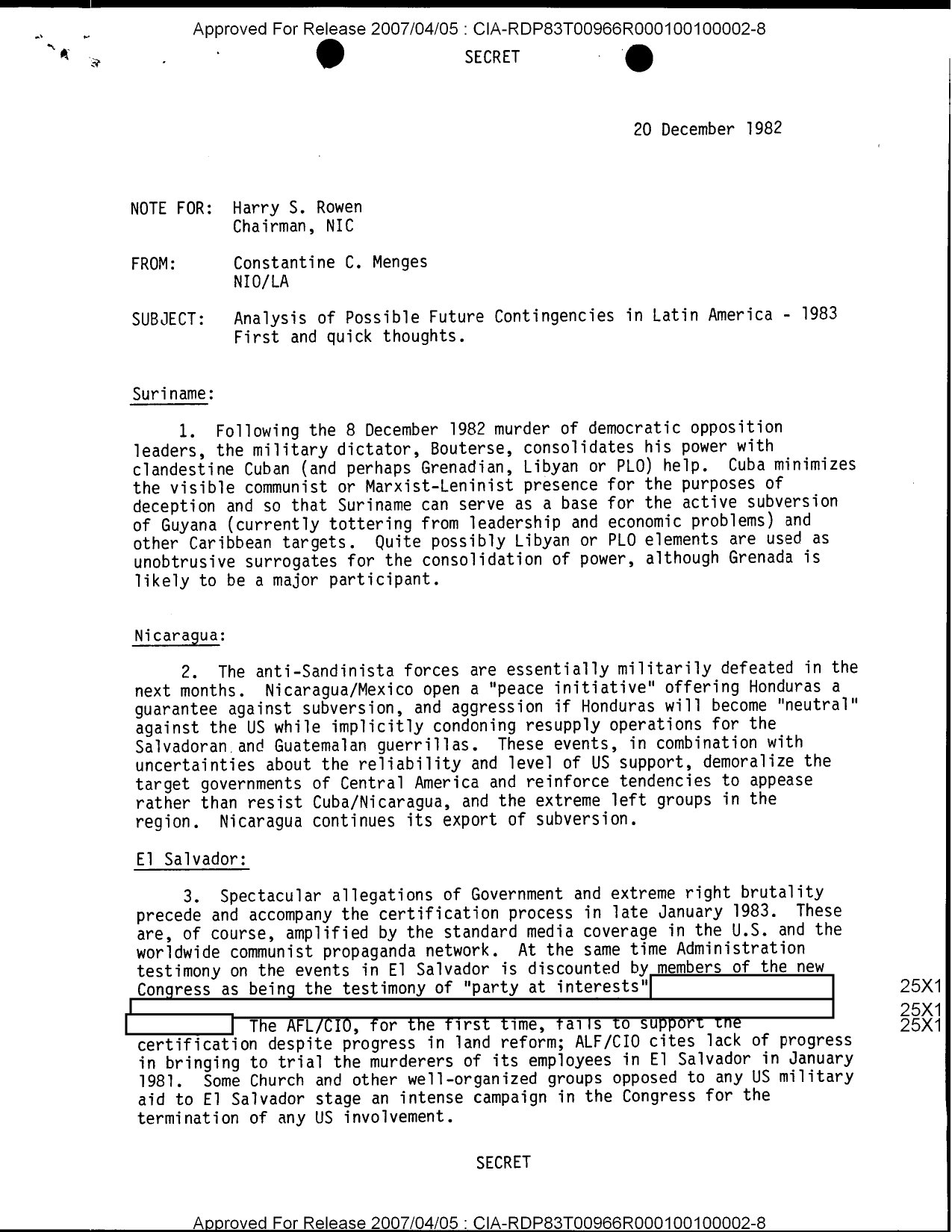
NOTE FOR: Harry S. Rowen
Chairman, NIC
FROM: Constantine C. Menges
NIO/LA
SUBJECT: Analysis of Possible Future Contingencies in Latin America – 1983
First and quick thoughts.
Suriname:
1. Following the 8 December 1982 murder of democratic opposition leaders, the military dictator, Bouterse, consolidates his power with clandestine Cuban (and perhaps Grenadian, Libyan or PLO) help. Cuba minimizes the visible communist or Marxist-Leninist presence for the purposes of deception and so that Suriname can serve as a base for the active subversion of Guyana (currently tottering from leadership and economic problems) and other Caribbean targets. Quite possibly Libyan or PLO elements are used as unobtrusive surrogates for the consolidation of power, although Grenada is likely to be a major participant.
Nicaragua:
2. The anti-Sandinista forces are essentially militarily defeated in the next months. Nicaragua/Mexico open a “peace initiative” offering Honduras a guarantee against subversion, and aggression if Honduras will become “neutral” against the US while implicitly condoning resupply operations for the Salvadoran and Guatemalan guerrillas. These events, in combination with uncertainties about the reliability and level of US support, demoralize the target governments of Central America and reinforce tendencies to appease rather than resist Cuba/Nicaragua, and the extreme left groups in the region. Nicaragua continues its export of subversion.
El Salvador:
3. Spectacular allegations of Government and extreme right brutality precede and accompany the certification process in late January 1983. These are, of course, amplified by the standard media coverage in the U.S. and the worldwide communist propaganda network. At the same time Administration testimony on the events in El Salvador is discounted by members of the new Congress as being the testimony of “party at interests.”
- The AFL/CIO, for the first time, fails to support the certification despite progress in land reform; AFL/CIO cites lack of progress in bringing to trial the murderers of its employees in El Salvador in January 1981. Some Church and other well-organized groups opposed to any US military aid to El Salvador stage an intense campaign in the Congress for the termination of any US involvement.
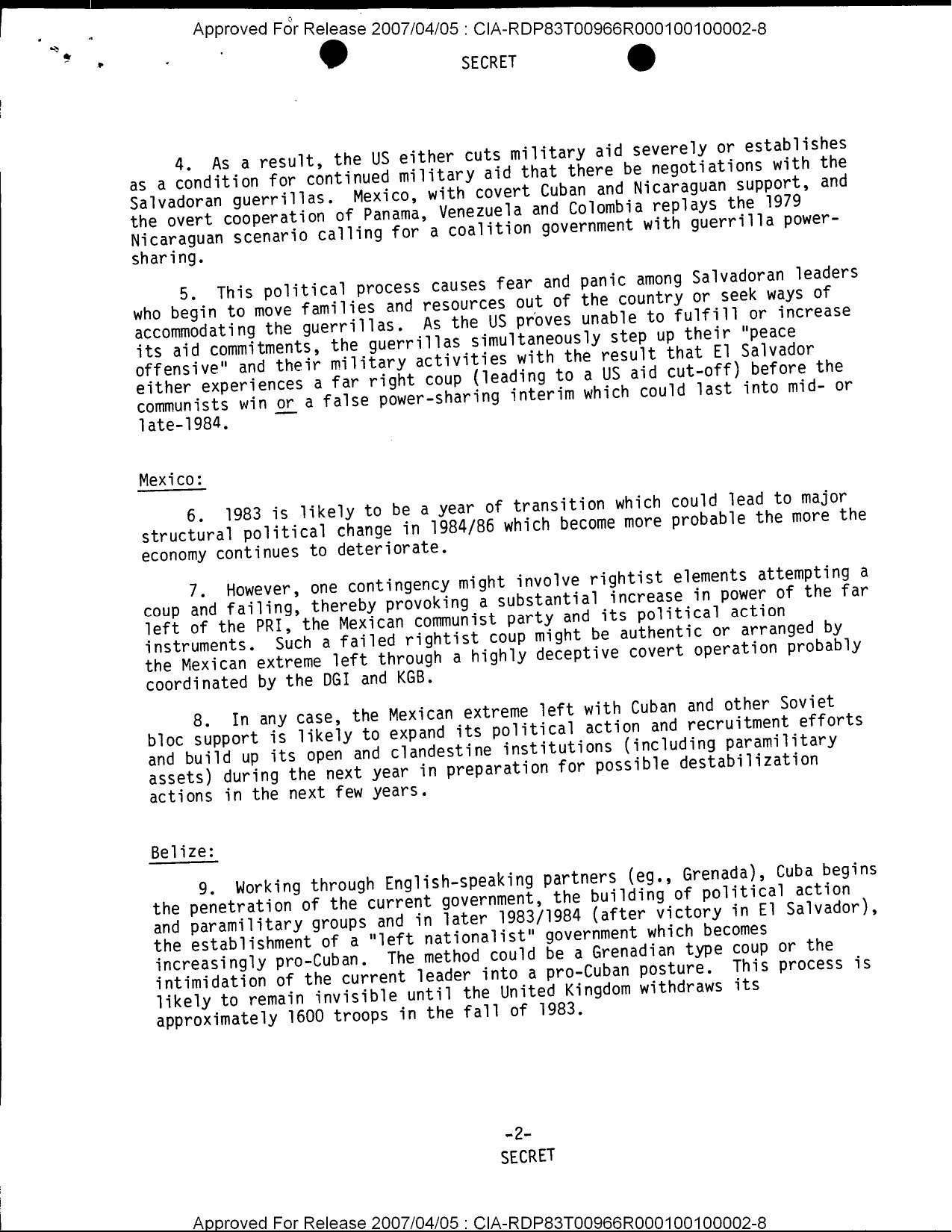
4. As a result, the US either cuts military aid severely or establishes as a condition for continued military aid that there be negotiations with the Salvadoran guerrillas. Mexico, with covert Cuban and Nicaraguan support, and the overt cooperation of Panama, Venezuela and Colombia replays the 1979 Nicaraguan scenario calling for a coalition government with guerrilla power-sharing.
5. This political process causes fear and panic among Salvadoran leaders who begin to move families and resources out of the country or seek ways of accommodating the guerrillas. As the US proves unable to fulfill or increase its aid commitments, the guerrillas simultaneously step up their “peace offensive” and their military activities with the result that El Salvador either experiences a far right coup (leading to a US aid cut-off) before the communists win or a false power-sharing interim which could last into mid- or late-1984.
Mexico:
6. 1983 is likely to be a year of transition which could lead to major structural political change in 1984/86, which becomes more probable the more the economy continues to deteriorate.
- However, one contingency might involve rightist elements attempting a coup and failing, thereby provoking a substantial increase in power of the far left of the PRI, the Mexican communist party, and its political action instruments. Such a failed rightist coup might be authentic or arranged by the Mexican extreme left through a highly deceptive covert operation probably coordinated by the DGI and KGB.
- In any case, the Mexican extreme left with Cuban and other Soviet bloc support is likely to expand its political action and recruitment efforts and build up its open and clandestine institutions (including paramilitary assets) during the next year in preparation for possible destabilization actions in the next few years.
Belize:
9. Working through English-speaking partners (e.g., Grenada), Cuba begins the penetration of the current government, the building of political action and paramilitary groups, and in later 1983/1984 (after victory in El Salvador), the establishment of a “left nationalist” government which becomes increasingly pro-Cuban. The method could be a Grenadian type coup or the intimidation of the current leader into a pro-Cuban posture. This process is likely to remain invisible until the United Kingdom withdraws its approximately 1,600 troops in the fall of 1983.
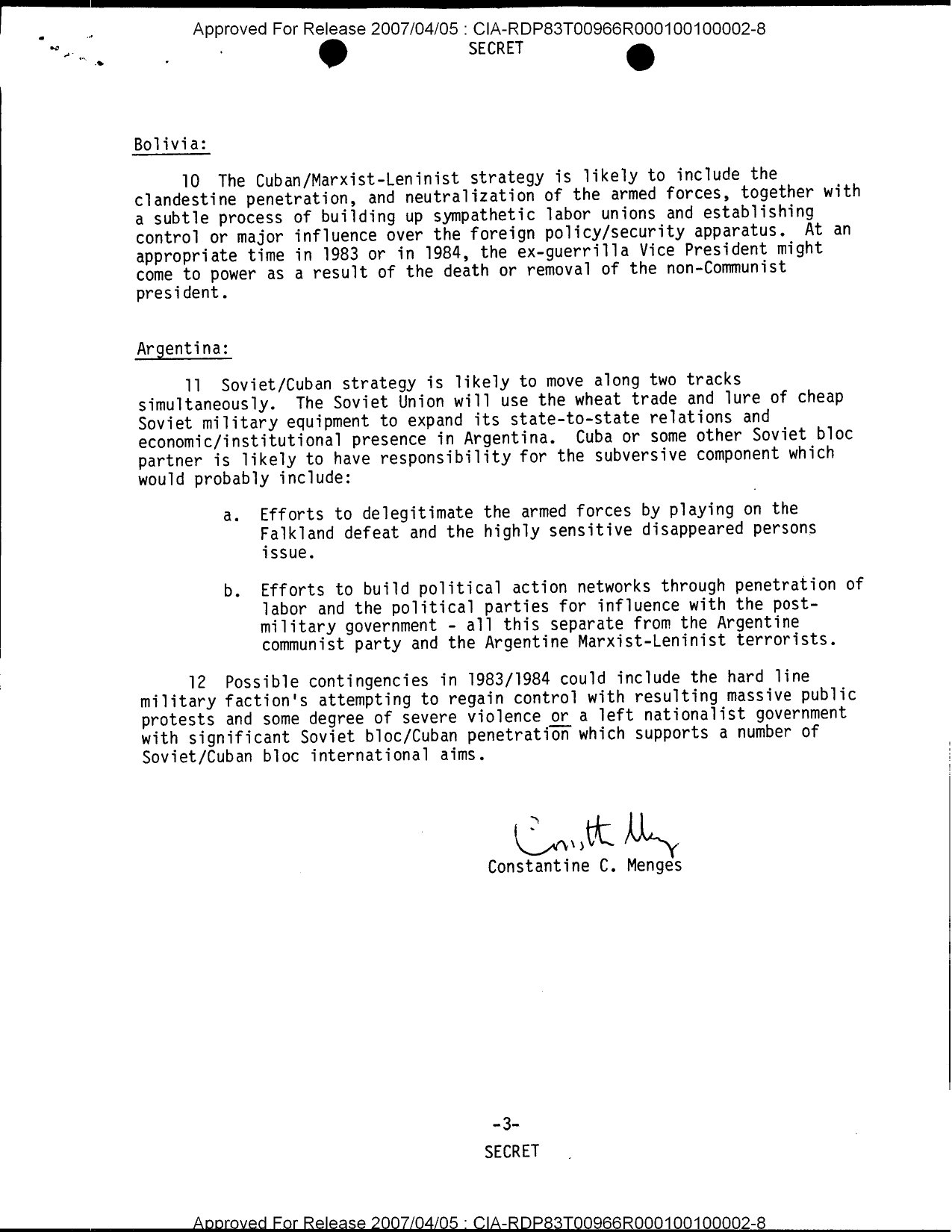
Bolivia:
10. The Cuban/Marxist-Leninist strategy is likely to include the clandestine penetration, and neutralization of the armed forces, together with a subtle process of building up sympathetic labor unions and establishing control or major influence over the foreign policy/security apparatus. At an appropriate time in 1983 or 1984, the ex-guerrilla Vice President might come to power as a result of the death or removal of the non-Communist president.
Argentina:
11. Soviet/Cuban strategy is likely to move along two tracks simultaneously. The Soviet Union will use the wheat trade and lure of cheap Soviet military equipment to expand its state-to-state relations and economic/institutional presence in Argentina. Cuba or some other Soviet bloc partner is likely to have responsibility for the subversive component which would probably include:
- a. Efforts to delegitimate the armed forces by playing on the Falkland defeat and the highly sensitive disappeared persons issue.
- b. Efforts to build political action networks through penetration of labor and the political parties for influence with the post-military government—all this separate from the Argentine communist party and the Argentine Marxist-Leninist terrorists.
- Possible contingencies in 1983/1984 could include the hardline military faction attempting to regain control with resulting massive public protests and some degree of severe violence, or a left nationalist government with significant Soviet bloc/Cuban penetration which supports a number of Soviet/Cuban bloc international aims.
[CENSORED]
Signed:
Constantine C. Menges
THE DIRECTOR OF CENTRAL INTELLIGENCE
National Intelligence Council
WASHINGTON, D.C. 20505
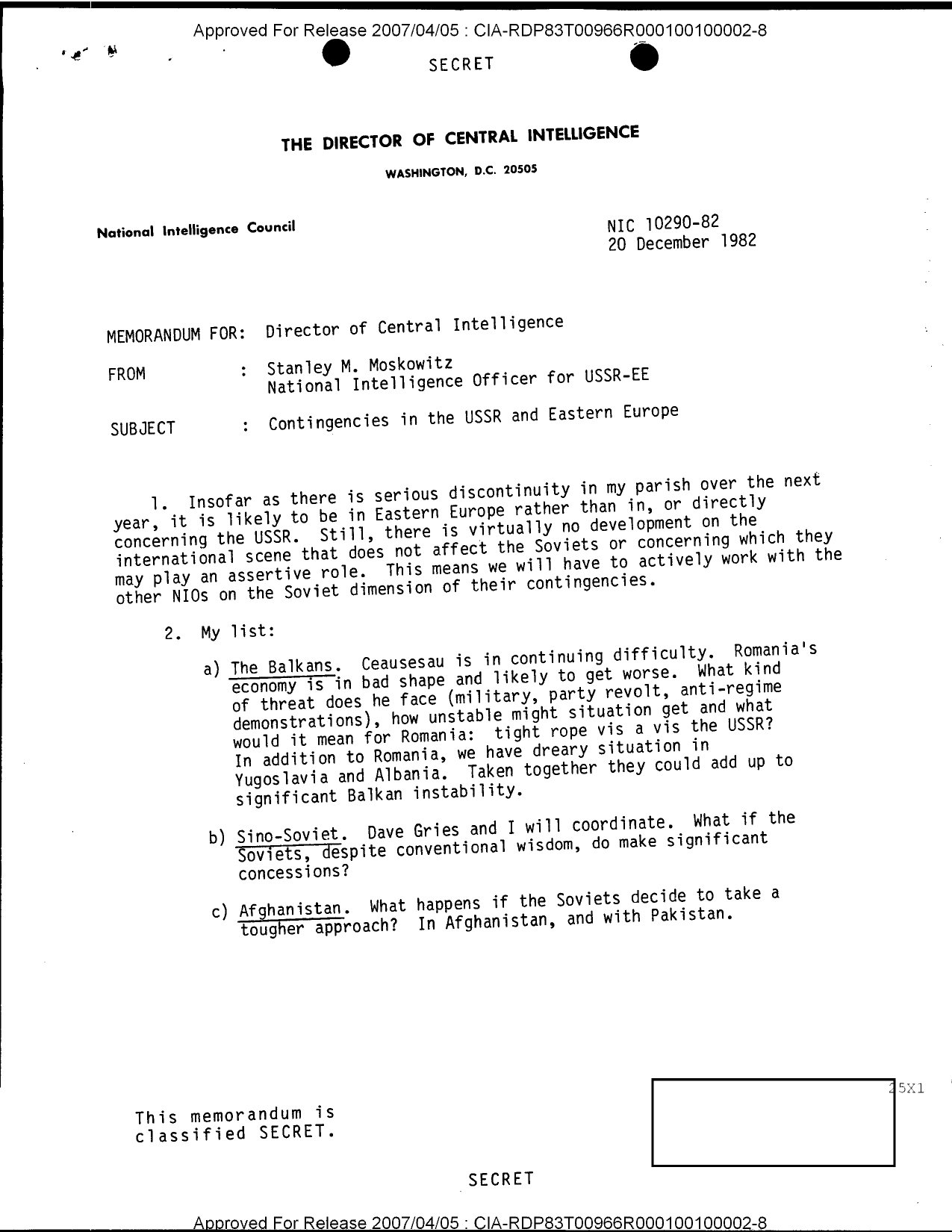
NIC 10290-82
20 December 1982
MEMORANDUM FOR: Director of Central Intelligence
FROM: Stanley M. Moskowitz
National Intelligence Officer for USSR-EE
SUBJECT: Contingencies in the USSR and Eastern Europe
- Insofar as there is serious discontinuity in my parish over the next year, it is likely to be in Eastern Europe rather than in, or directly concerning the USSR. Still, there is virtually no development on the international scene that does not affect the Soviets or concerning which they may play an assertive role. This means we will have to actively work with the other NIOs on the Soviet dimension of their contingencies.
- My list:
a. The Balkans.
Ceausescu is in continuing difficulty. Romania’s economy is in bad shape and likely to get worse. What kind of threat does he face (military, party revolt, anti-regime demonstrations), how unstable might situation get, and what would it mean for Romania: tight rope vis-à-vis the USSR? In addition to Romania, we have a dreary situation in Yugoslavia and Albania. Taken together, they could add up to significant Balkan instability.
b. Sino-Soviet.
Dave Gries and I will coordinate. What if the Soviets, despite conventional wisdom, do make significant concessions?
c. Afghanistan.
What happens if the Soviets decide to take a tougher approach? In Afghanistan, and with Pakistan.
This memorandum is classified SECRET.
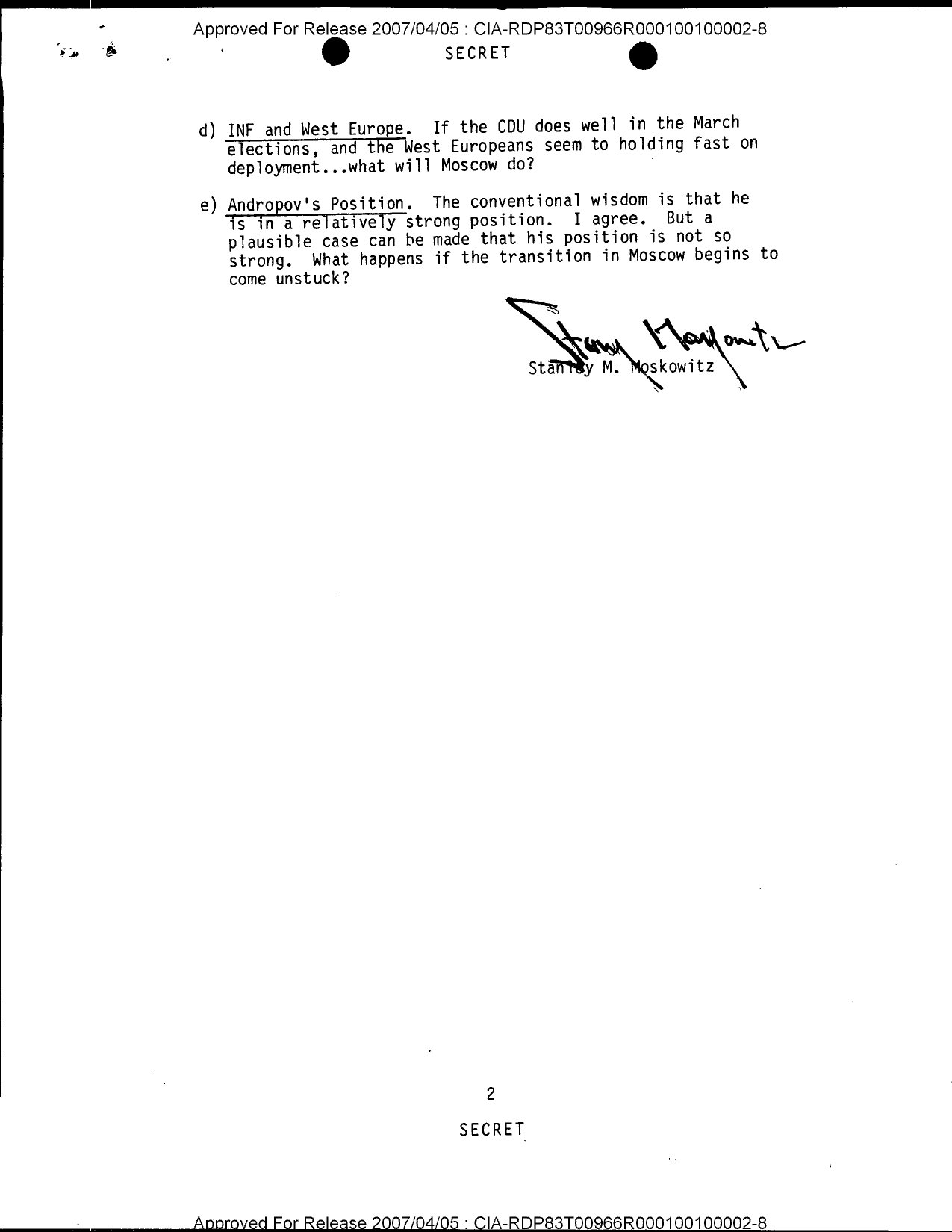
d. INF and West Europe.
If the CDU does well in the March elections, and the West Europeans seem to be holding fast on deployment… what will Moscow do?
e. Andropov’s Position.
The conventional wisdom is that he is in a relatively strong position. I agree. But a plausible case can be made that his position is not so strong. What happens if the transition in Moscow begins to come unstuck?
[CENSORED]
Signed:
Stanley M. Moskowitz
THE DIRECTOR OF CENTRAL INTELLIGENCE
National Intelligence Council
WASHINGTON, D.C. 20505
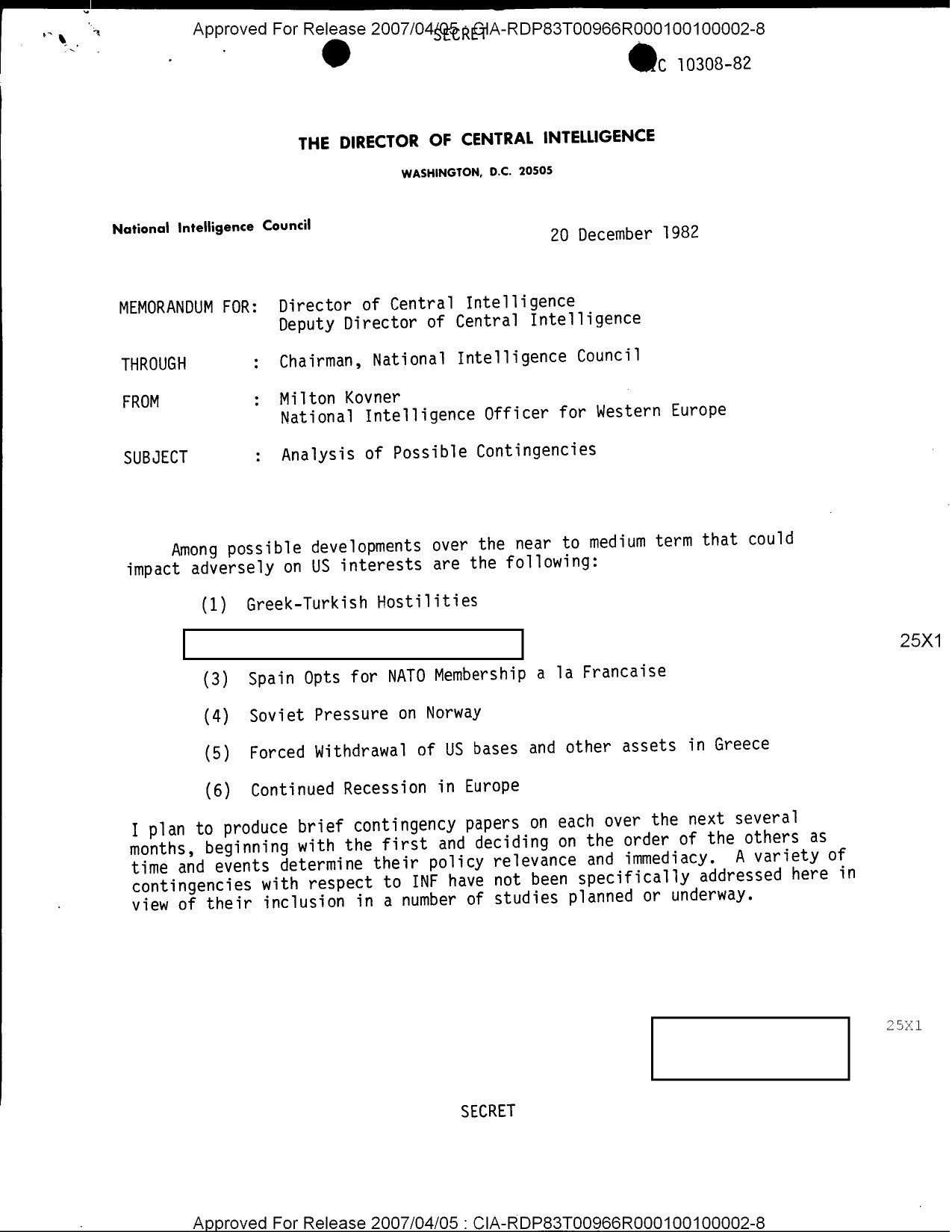
C 10308-82
20 December 1982
MEMORANDUM FOR: Director of Central Intelligence
Deputy Director of Central Intelligence
THROUGH: Chairman, National Intelligence Council
FROM: Milton Kovner
National Intelligence Officer for Western Europe
SUBJECT: Analysis of Possible Contingencies
Among possible developments over the near to medium term that could impact adversely on US interests are the following:
- Greek-Turkish Hostilities
- [CENSORED]
- Spain Opts for NATO Membership à la Française
- Soviet Pressure on Norway
- Forced Withdrawal of US bases and other assets in Greece
- Continued Recession in Europe
I plan to produce brief contingency papers on each over the next several months, beginning with the first and deciding on the order of the others as time and events determine their policy relevance and immediacy. A variety of contingencies with respect to INF have not been specifically addressed here in view of their inclusion in a number of studies planned or underway.
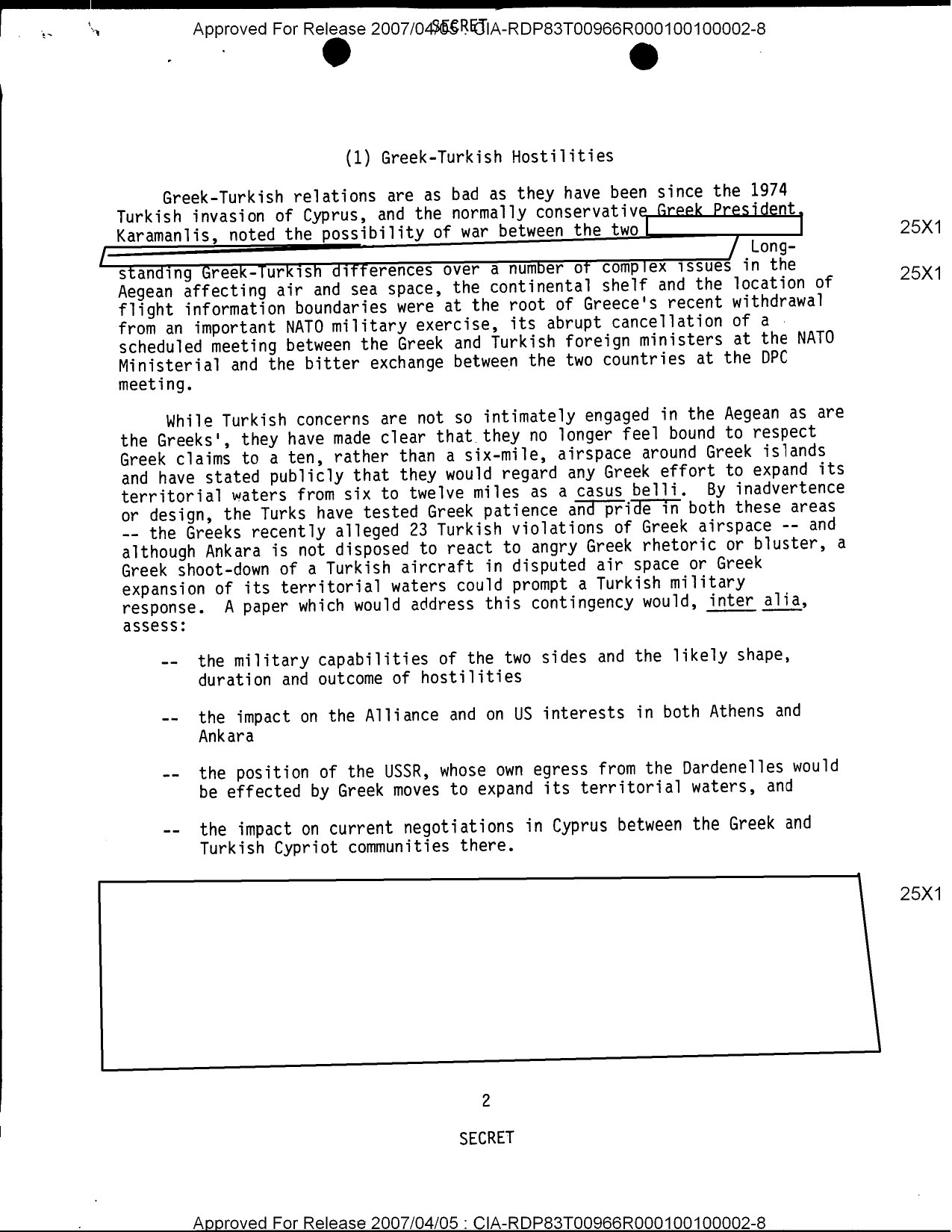
(1) Greek-Turkish Hostilities
Greek-Turkish relations are as bad as they have been since the 1974 Turkish invasion of Cyprus, and the normally conservative Greek President Karamanlis noted the possibility of war between the two.
Longstanding Greek-Turkish differences over a number of complex issues in the Aegean affecting air and sea space, the continental shelf, and the location of flight information boundaries were at the root of Greece’s recent withdrawal from an important NATO military exercise, its abrupt cancellation of a scheduled meeting between the Greek and Turkish foreign ministers at the NATO Ministerial, and the bitter exchange between the two countries at the DPC meeting.
While Turkish concerns are not so intimately engaged in the Aegean as are the Greeks’, they have made clear that they no longer feel bound to respect Greek claims to a ten, rather than a six-mile, airspace around Greek islands and have stated publicly that they would regard any Greek effort to expand its territorial waters from six to twelve miles as a casus belli. By inadvertence or design, the Turks have tested Greek patience and pride in both these areas — the Greeks recently alleged 23 Turkish violations of Greek airspace — and although Ankara is not disposed to react to angry Greek rhetoric or bluster, Greek shoot-down of a Turkish aircraft in disputed airspace or Greek expansion of its territorial waters could prompt a Turkish military response.
A paper which would address this contingency would, inter alia, assess:
- the military capabilities of the two sides and the likely shape, duration and outcome of hostilities
- the impact on the Alliance and on US interests in both Athens and Ankara
- the position of the USSR, whose own egress from the Dardanelles would be affected by Greek moves to expand its territorial waters
- the impact on current negotiations in Cyprus between the Greek and Turkish Cypriot communities there
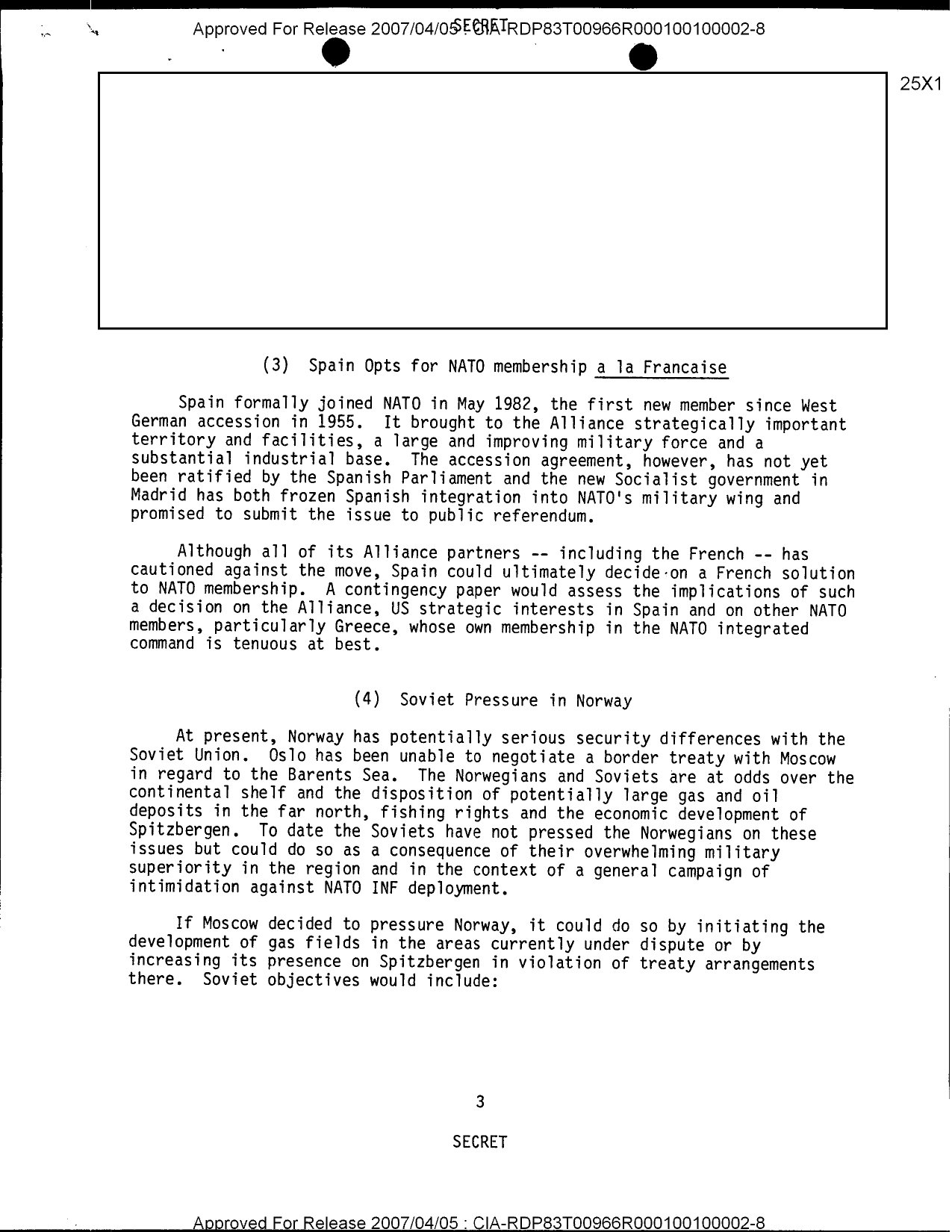
(3) Spain Opts for NATO Membership à la Française
Spain formally joined NATO in May 1982, the first new member since West German accession in 1955. It brought to the Alliance strategically important territory and facilities, a large and improving military force, and a substantial industrial base. The accession agreement, however, has not yet been ratified by the Spanish Parliament and the new Socialist government in Madrid has both frozen Spanish integration into NATO’s military wing and promised to submit the issue to public referendum.
Although all of its Alliance partners — including the French — have cautioned against the move, Spain could ultimately decide on a French solution to NATO membership. A contingency paper would assess the implications of such a decision on the Alliance, US strategic interests in Spain, and on other NATO members, particularly Greece, whose own membership in the NATO integrated command is tenuous at best.
(4) Soviet Pressure on Norway
At present, Norway has potentially serious security differences with the Soviet Union. Oslo has been unable to negotiate a border treaty with Moscow in regard to the Barents Sea. The Norwegians and Soviets are at odds over continental shelf and the disposition of potentially large gas and oil deposits in the far north, fishing rights, and the economic development of Spitzbergen. To date the Soviets have not pressed the Norwegians on these issues but could do so as a consequence of their overwhelming military superiority in the region and in the context of a general campaign of intimidation against NATO INF deployment.
If Moscow decided to pressure Norway, it could do so by initiating the development of gas fields in the areas currently under dispute or by increasing its presence on Spitzbergen in violation of treaty arrangements there. Soviet objectives would include:
- encouragement of neutralist, anti-nuclear, and anti-INF sentiment in Norway and promotion of support for a Nordic Nuclear-Free Zone, already proposed by the Palme Government in Sweden
- prevention of Norway from becoming a competitor of the USSR in gas sales to Western Europe
- furthering Soviet control over the Barents and Greenland Seas
A contingency paper would address the likely impact of Soviet pressure on the Norwegian government, public attitudes on issues of concern to the Alliance, and NATO’s strategic position in the area.
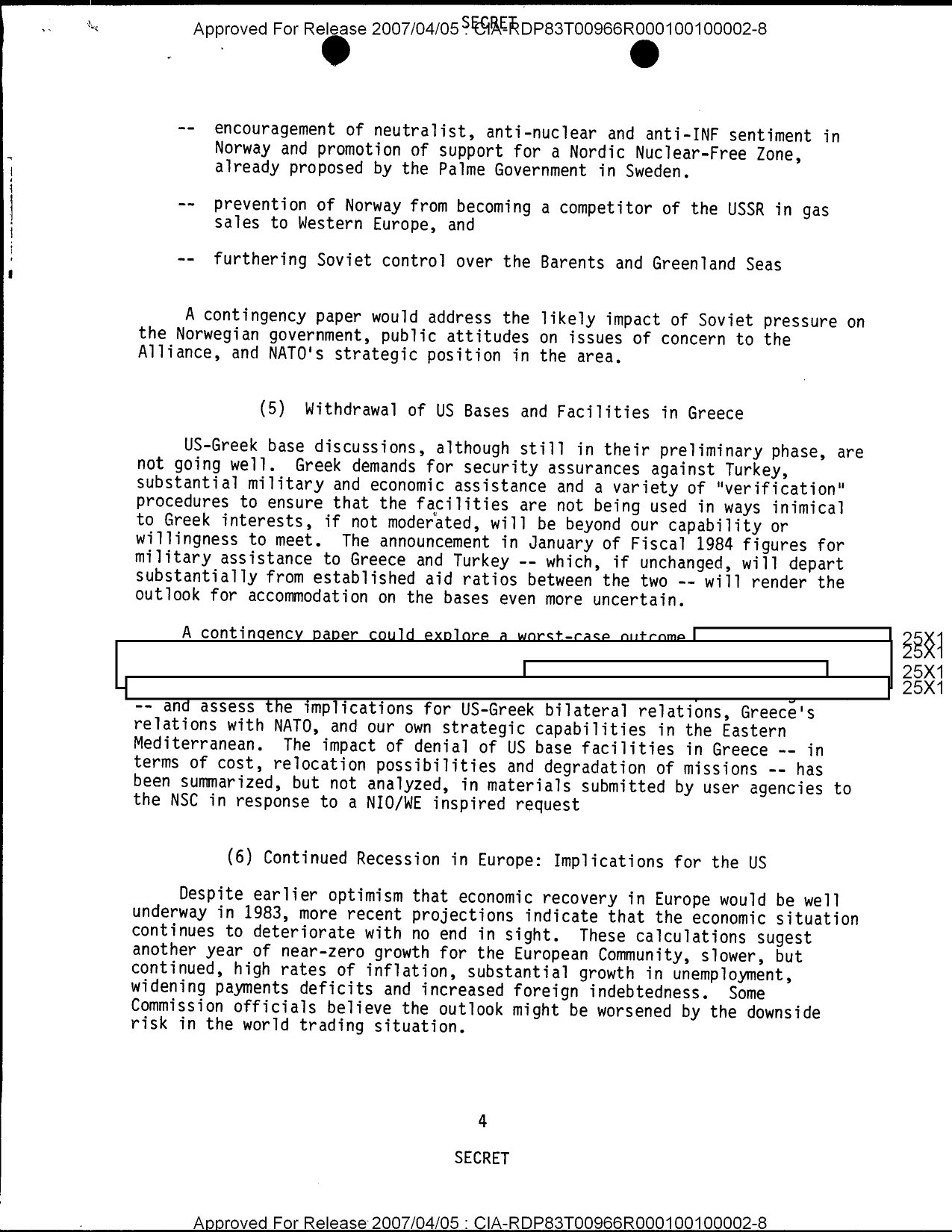
(5) Withdrawal of US Bases and Facilities in Greece
US-Greek base discussions, although still in their preliminary phase, are not going well. Greek demands for security assurances against Turkey, substantial military and economic assistance, and a variety of “verification” procedures to ensure that the facilities are not being used in ways inimical to Greek interests, if not moderated, will be beyond our capability or willingness to meet. The announcement in January of Fiscal 1984 figures for military assistance to Greece and Turkey — which, if unchanged, will depart substantially from established aid ratios between the two — will render the outlook for accommodation on the bases even more uncertain.
A contingency paper could explore a worst-case outcome and assess the implications for US-Greek bilateral relations, Greece’s relations with NATO, and our own strategic capabilities in the Eastern Mediterranean. The impact of denial of US base facilities in Greece — in terms of cost, relocation possibilities, and degradation of missions — has been summarized, but not analyzed, in materials submitted by user agencies and the NSC in response to a NIO/WE-inspired request.
(6) Continued Recession in Europe: Implications for the US
Despite earlier optimism that economic recovery in Europe would be well underway in 1983, more recent projections indicate that the economic situation continues to deteriorate with no end in sight. These calculations suggest another year of near-zero growth for the European Community, slower, but continued, high rates of inflation, substantial growth in unemployment, widening payments deficits, and increased foreign indebtedness. Some Commission officials believe the outlook might be worsened by the downside risk in the world trading situation.
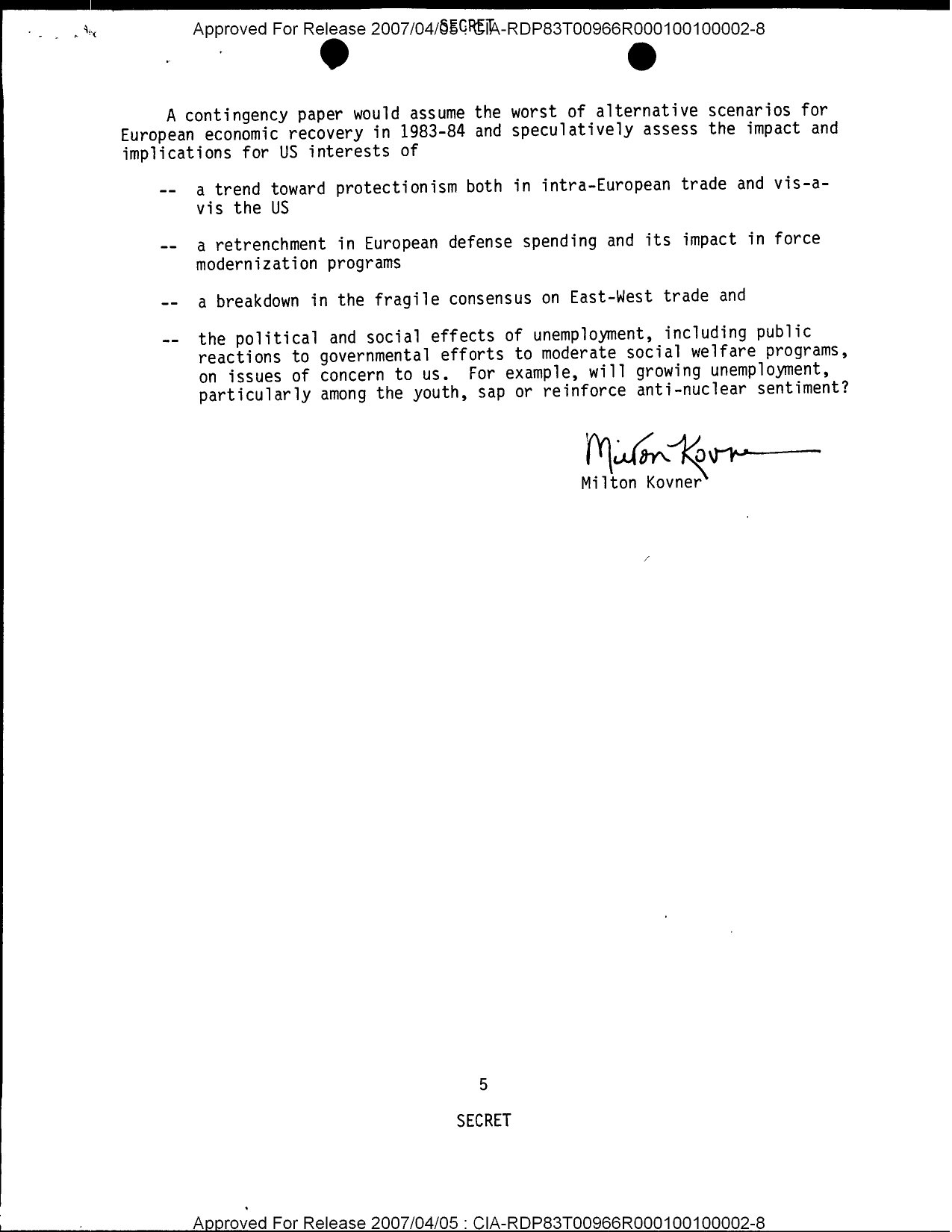
A contingency paper would assume the worst of alternative scenarios for European economic recovery in 1983–84 and speculatively assess the impact and implications for US interests of:
- a trend toward protectionism both in intra-European trade and vis-à-vis the US
- a retrenchment in European defense spending and its impact on force modernization programs
- a breakdown in the fragile consensus on East-West trade
- the political and social effects of unemployment, including public reactions to governmental efforts to moderate social welfare programs
For example, will growing unemployment, particularly among the youth, sap or reinforce anti-nuclear sentiment?
Signed:
Milton Kovner
THE DIRECTOR OF CENTRAL INTELLIGENCE
National Intelligence Council
WASHINGTON, D.C. 20505
NIC #10379-82
22 December 1982
MEMORANDUM FOR: Director of Central Intelligence
Deputy Director of Central Intelligence
VIA: Chairman, National Intelligence Council
Vice Chairman, National Intelligence Council
FROM: Major General Edward B. Atkeson, USA
National Intelligence Officer for General Purpose Forces
SUBJECT: Analysis of Future Contingencies (U)
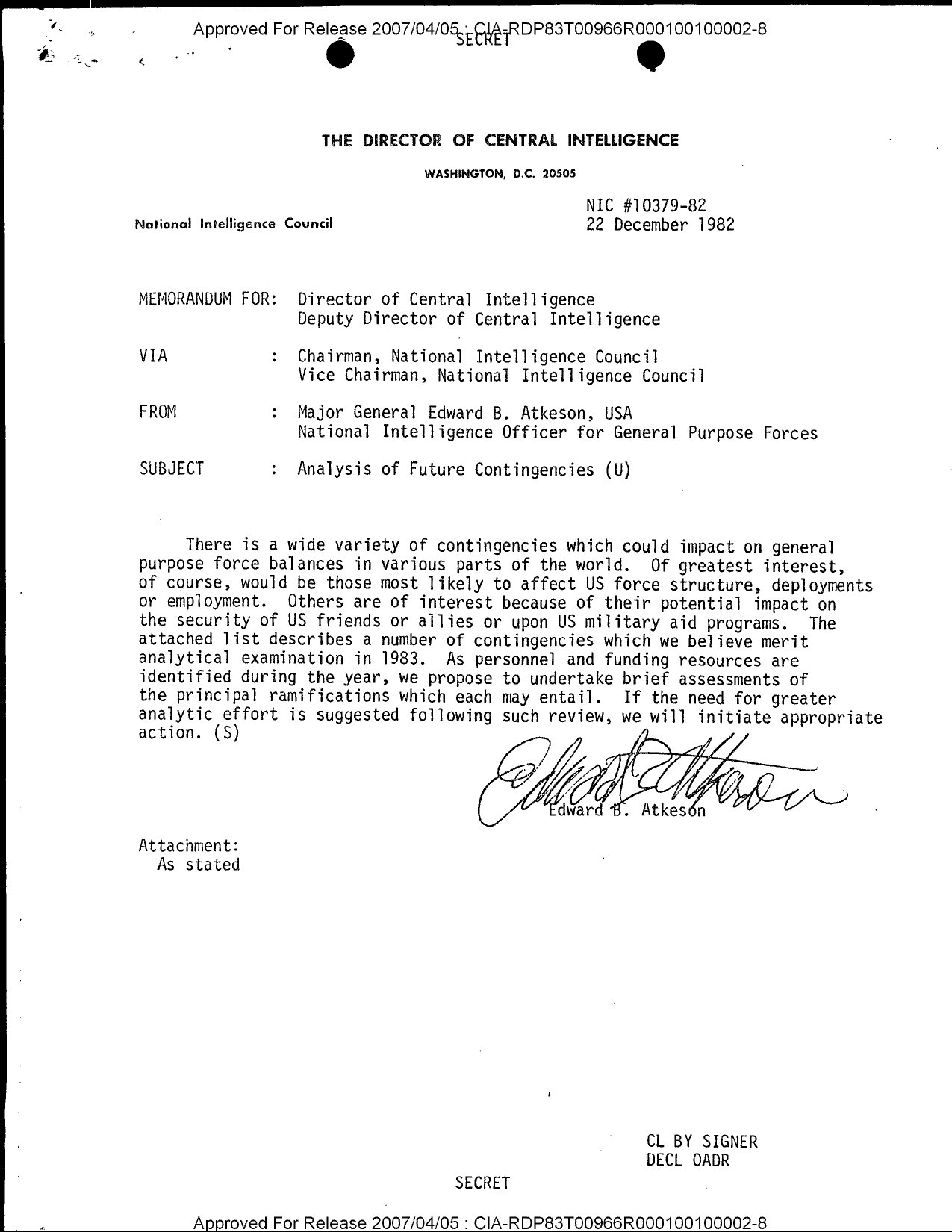
There is a wide variety of contingencies which could impact on general purpose force balances in various parts of the world. Of greatest interest, of course, would be those most likely to affect US force structure, deployments, or employment. Others are of interest because of their potential impact on the security of US friends or allies or upon US military aid programs.
The attached list describes a number of contingencies which we believe merit analytical examination in 1983. As personnel and funding resources are identified during the year, we propose to undertake brief assessments of the principal ramifications which each may entail. If the need for greater analytic effort is suggested following such review, we will initiate appropriate action. (S)
Signed:
Major General Edward B. Atkeson
Attachment: As stated
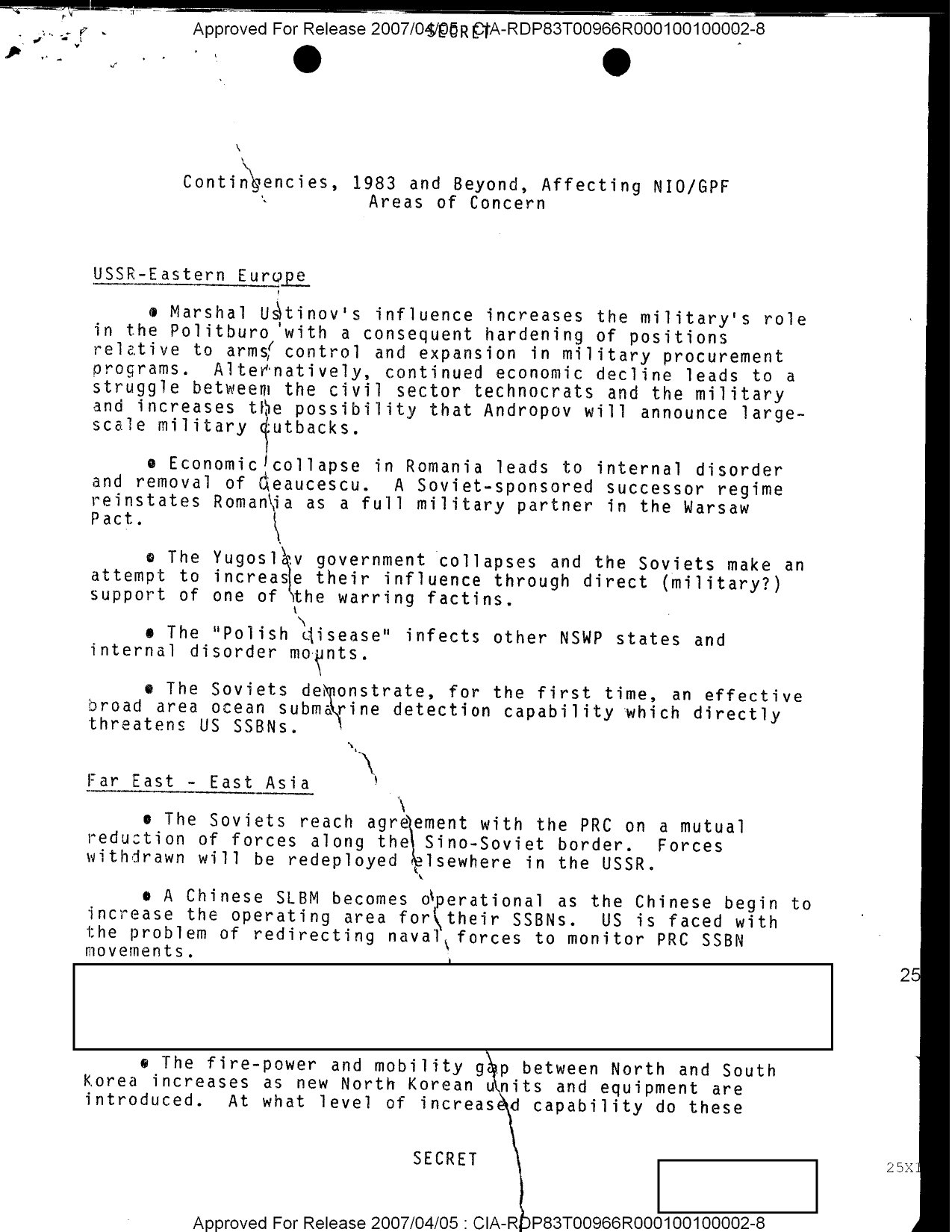
Contingencies, 1983 and Beyond, Affecting NIO/GPF Areas of Concern
USSR-Eastern Europe
- Marshal Ustinov’s influence increases the military’s role in the Politburo with a consequent hardening of positions relative to arms, control, and expansion in military procurement programs. Alternatively, continued economic decline leads to a struggle between the civil sector technocrats and the military and increases the possibility that Andropov will announce large-scale military cutbacks.
- Economic collapse in Romania leads to internal disorder and removal of Ceausescu. A Soviet-sponsored successor regime reinstates Romania as a full military partner in the Warsaw Pact.
- The Yugoslav government collapses and the Soviets make an attempt to increase their influence through direct (military?) support of one of the warring factions.
- The “Polish disease” infects other NSWP states and internal disorder mounts.
- The Soviets demonstrate, for the first time, an effective broad area ocean submarine detection capability which directly threatens US SSBNs.
Far East – East Asia
- The Soviets reach agreement with the PRC on a mutual reduction of forces along the Sino-Soviet border. Forces withdrawn will be redeployed elsewhere in the USSR.
- A Chinese SLBM becomes operational as the Chinese begin to increase the operating area for their SSBNs. US is faced with the problem of redirecting naval forces to monitor PRC SSBN movements.
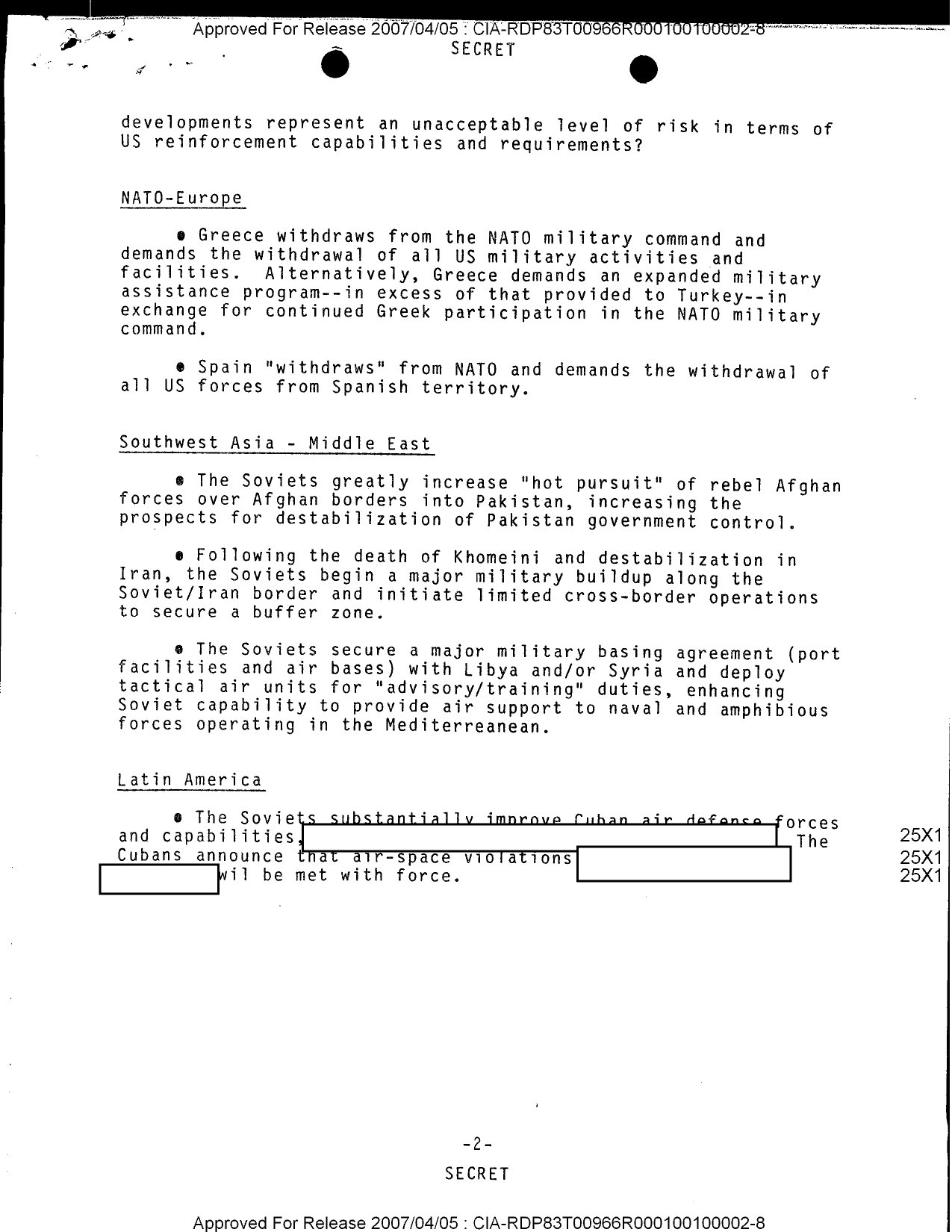
- The fire-power and mobility gap between North and South Korea increases as new North Korean units and equipment are introduced. At what level of increased capability do these developments represent an unacceptable level of risk in terms of US reinforcement capabilities and requirements?
NATO-Europe
- Greece withdraws from the NATO military command and demands the withdrawal of all US military activities and facilities. Alternatively, Greece demands an expanded military assistance program—in excess of that provided to Turkey—in exchange for continued Greek participation in the NATO military command.
- Spain “withdraws” from NATO and demands the withdrawal of all US forces from Spanish territory.
Southwest Asia – Middle East
- The Soviets greatly increase “hot pursuit” of rebel Afghan forces over Afghan borders into Pakistan, increasing the prospects for destabilization of Pakistan government control.
- Following the death of Khomeini and destabilization in Iran, the Soviets begin a major military buildup along the Soviet/Iran border and initiate limited cross-border operations to secure a buffer zone.
- The Soviets secure a major military basing agreement (port facilities and air bases) with Libya and/or Syria and deploy tactical air units for “advisory/training” duties, enhancing Soviet capability to provide air support to naval and amphibious forces operating in the Mediterranean.
Latin America
- The Soviets substantially improve Cuban air defense forces and capabilities. The Cubans announce that air-space violations will be met with force.
THE DIRECTOR OF CENTRAL INTELLIGENCE
WASHINGTON, D.C. 20505
National Intelligence Council
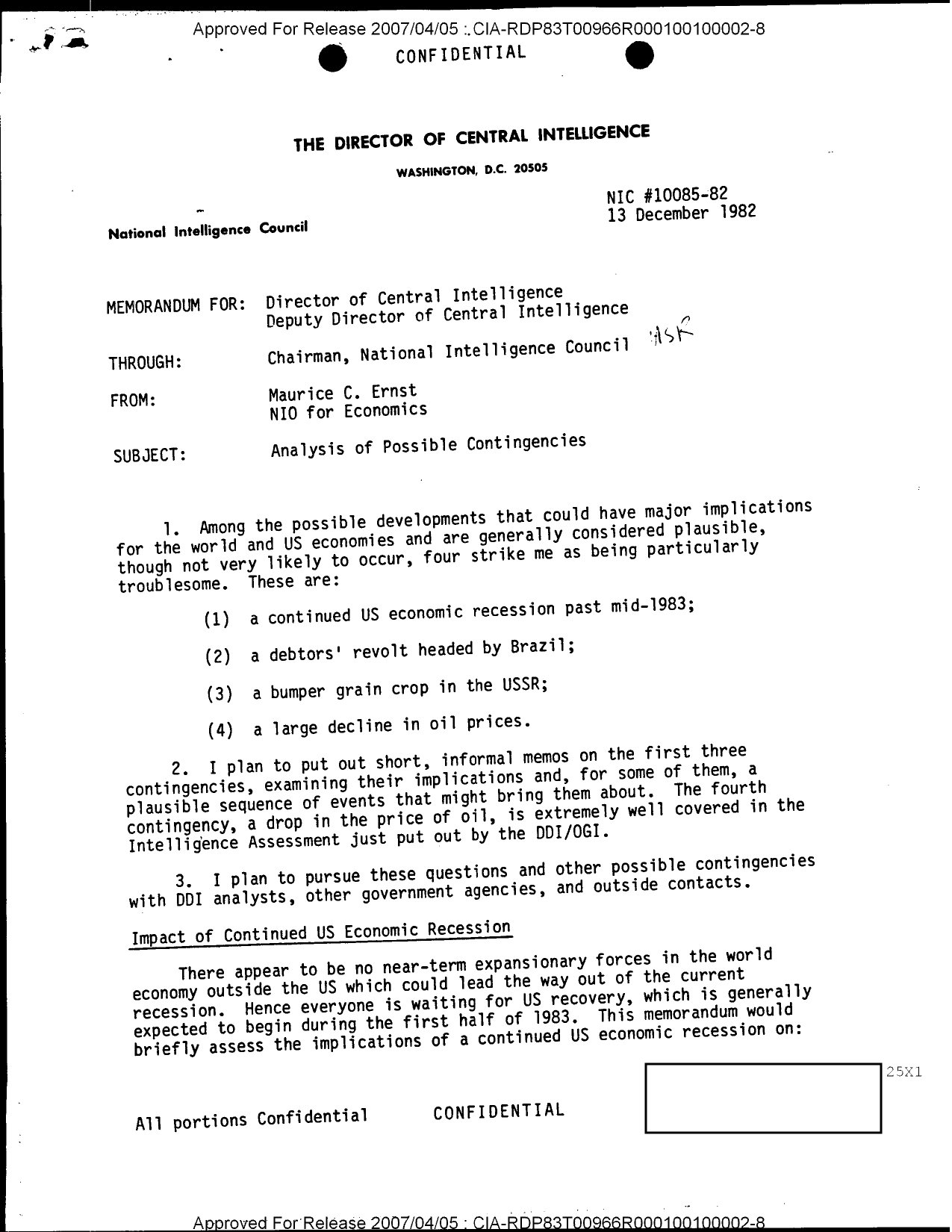
NIC #10085-82
13 December 1982
MEMORANDUM FOR: Director of Central Intelligence
Deputy Director of Central Intelligence
THROUGH: Chairman, National Intelligence Council
FROM: Maurice C. Ernst
NIO for Economics
SUBJECT: Analysis of Possible Contingencies
1. Among the possible developments that could have major implications for the world and US economies and are generally considered plausible, though not very likely to occur, four strike me as being particularly troublesome. These are:
- a continued US economic recession past mid-1983;
- a debtors’ revolt headed by Brazil;
- a bumper grain crop in the USSR;
- a large decline in oil prices.
2. I plan to put out short, informal memos on the first three contingencies, examining their implications and, for some of them, a plausible sequence of events that might bring them about. The fourth contingency, a drop in the price of oil, is extremely well covered in the Intelligence Assessment just put out by the DDI/OGI.
3. I plan to pursue these questions and other possible contingencies with DDI analysts, other government agencies, and outside contacts.
Impact of Continued US Economic Recession
There appear to be no near-term expansionary forces in the world economy outside the US which could lead the way out of the current recession. Hence everyone is waiting for US recovery, which is generally expected to begin during the first half of 1983. This memorandum would briefly assess the implications of a continued US economic recession on:
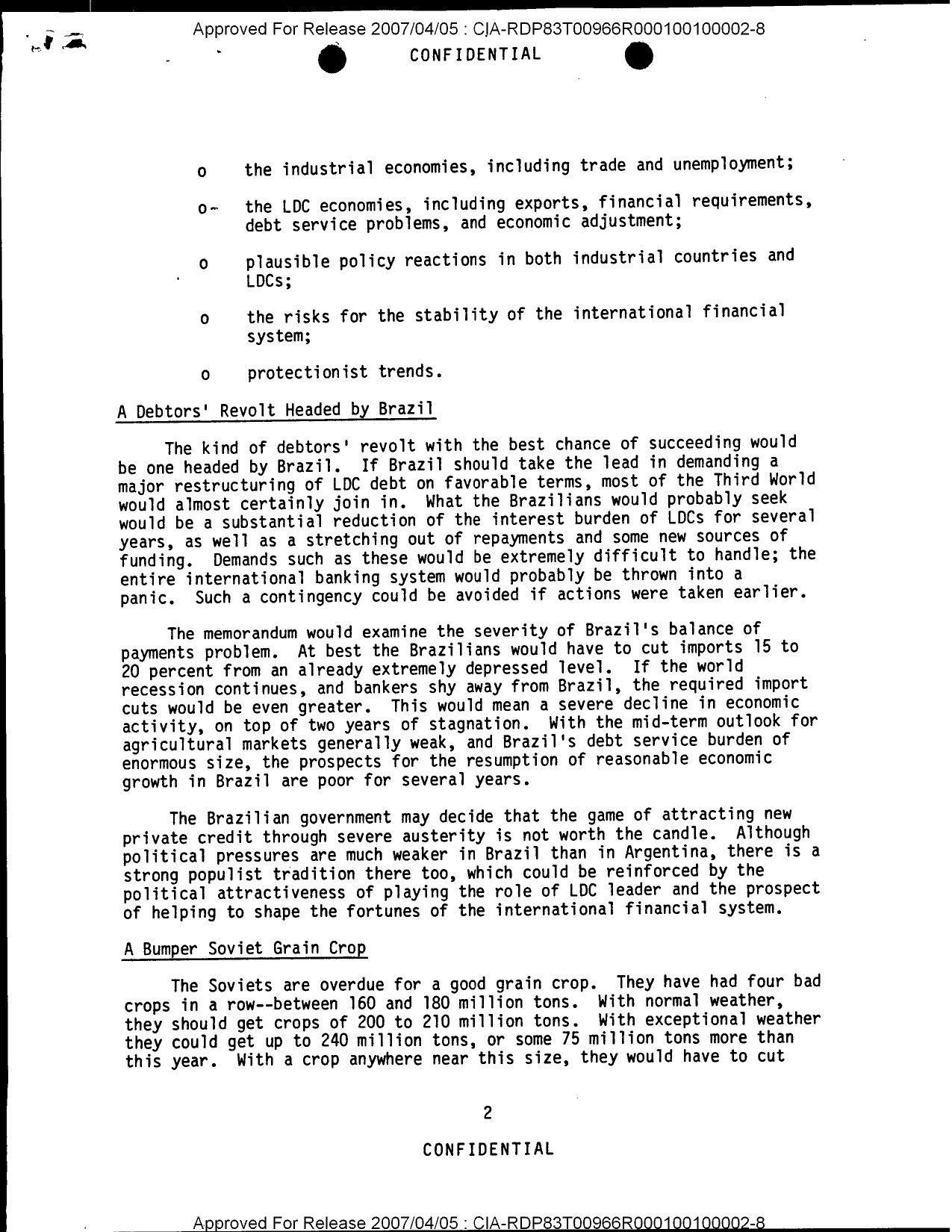
- the industrial economies, including trade and unemployment;
- the LDC economies, including exports, financial requirements, debt service problems, and economic adjustment;
- plausible policy reactions in both industrial countries and LDCs;
- the risks for the stability of the international financial system;
- protectionist trends.
A Debtors’ Revolt Headed by Brazil
The kind of debtors’ revolt with the best chance of succeeding would be one headed by Brazil. If Brazil should take the lead in demanding a major restructuring of LDC debt on favorable terms, most of the Third World would almost certainly join in. What the Brazilians would probably seek would be a substantial reduction of the interest burden of LDCs for several years, as well as a stretching out of repayments and some new sources of funding. Demands such as these would be extremely difficult to handle; the entire international banking system would probably be thrown into a panic. Such a contingency could be avoided if actions were taken earlier.
The memorandum would examine the severity of Brazil’s balance of payments problem. At best the Brazilians would have to cut imports 15 to 20 percent from an already extremely depressed level. If the world recession continues, and bankers shy away from Brazil, the required import cuts would be even greater. This would mean a severe decline in economic activity, on top of two years of stagnation. With the mid-term outlook for agricultural markets generally weak, and Brazil’s debt service burden of enormous size, the prospects for the resumption of reasonable economic growth in Brazil are poor for several years.
The Brazilian government may decide that the game of attracting new private credit through severe austerity is not worth the candle. Although political pressures are much weaker in Brazil than in Argentina, there is a strong populist tradition there too, which could be reinforced by the political attractiveness of playing the role of LDC leader and the prospect of helping to shape the fortunes of the international financial system.
A Bumper Soviet Grain Crop
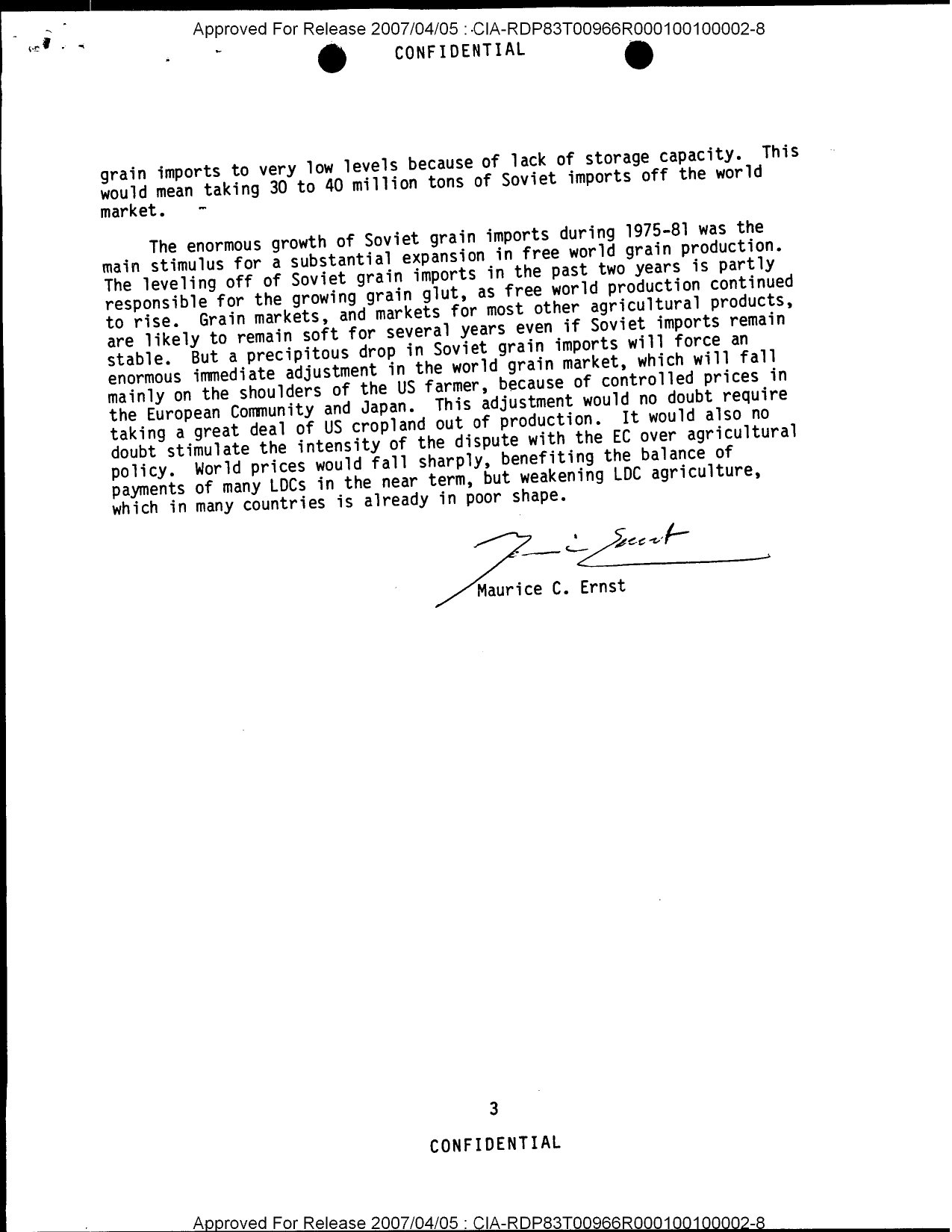
The Soviets are overdue for a good grain crop. They have had four bad crops in a row—between 160 and 180 million tons. With normal weather, they should get crops of 200 to 210 million tons. With exceptional weather, they could get up to 240 million tons, or some 75 million tons more than this year. With a crop anywhere near this size, they would have to cut grain imports to very low levels because of lack of storage capacity. This would mean taking 30 to 40 million tons of Soviet imports off the world market.
The enormous growth of Soviet grain imports during 1975-81 was the main stimulus for a substantial expansion in free world grain production. The leveling off of Soviet grain imports in the past two years is partly responsible for the growing grain glut, as free world production continued to rise. Grain markets, and markets for most other agricultural products, are likely to remain soft for several years even if Soviet imports remain stable. But a precipitous drop in Soviet grain imports will force an enormous immediate adjustment in the world grain market, which will fall mainly on the shoulders of the US farmer, because of controlled prices in the European Community and Japan. This adjustment would no doubt require taking a great deal of US cropland out of production. It would also no doubt stimulate the intensity of the dispute with the EC over agricultural policy. World prices would fall sharply, benefiting the balance of payments of many LDCs in the near term, but weakening LDC agriculture, which in many countries is already in poor shape.
Maurice C. Ernst
THE DIRECTOR OF CENTRAL INTELLIGENCE
WASHINGTON, D.C. 20505
National Intelligence Council
MEMORANDUM FOR: Harry S. Rowen
Chairman, National Intelligence Council
NIC 10319-82
22 December 1982
FROM: Hans Heymann, Jr.
National Intelligence Officer at Large
SUBJECT: Possible Future Contingencies
The following are my two candidates:
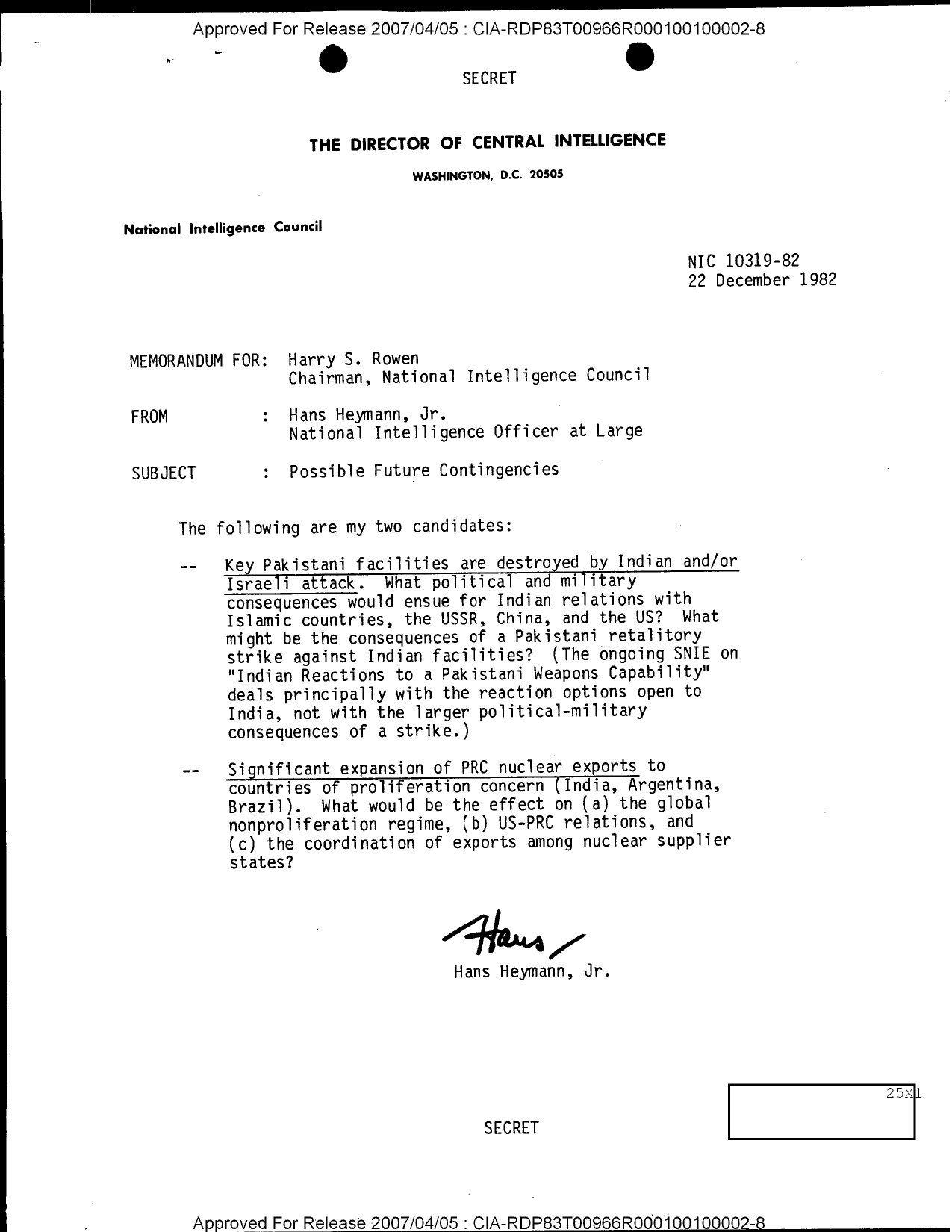
- Key Pakistani facilities are destroyed by Indian and/or Israeli attack. What political and military consequences would ensue for Indian relations with Islamic countries, the USSR, China, and the US? What might be the consequences of a Pakistani retaliatory strike against Indian facilities? (The ongoing SNIE on “Indian Reactions to a Pakistani Weapons Capability” deals principally with the reaction options open to India, not with the larger political-military consequences of a strike.)
- Significant expansion of PRC nuclear exports to countries of proliferation concern (India, Argentina, Brazil). What would be the effect on:
- (a) the global nonproliferation regime,
- (b) US-PRC relations, and
- (c) the coordination of exports among nuclear supplier states?
Hans Heymann, Jr.
Source:
Link:
Internal Link:
Date:
December 20, 1982