Prepared statement to be given by MG Hilliam E. Odom – 8 June 1982
CIA-RDP84B00049R000902210012-0
Top secret channels only
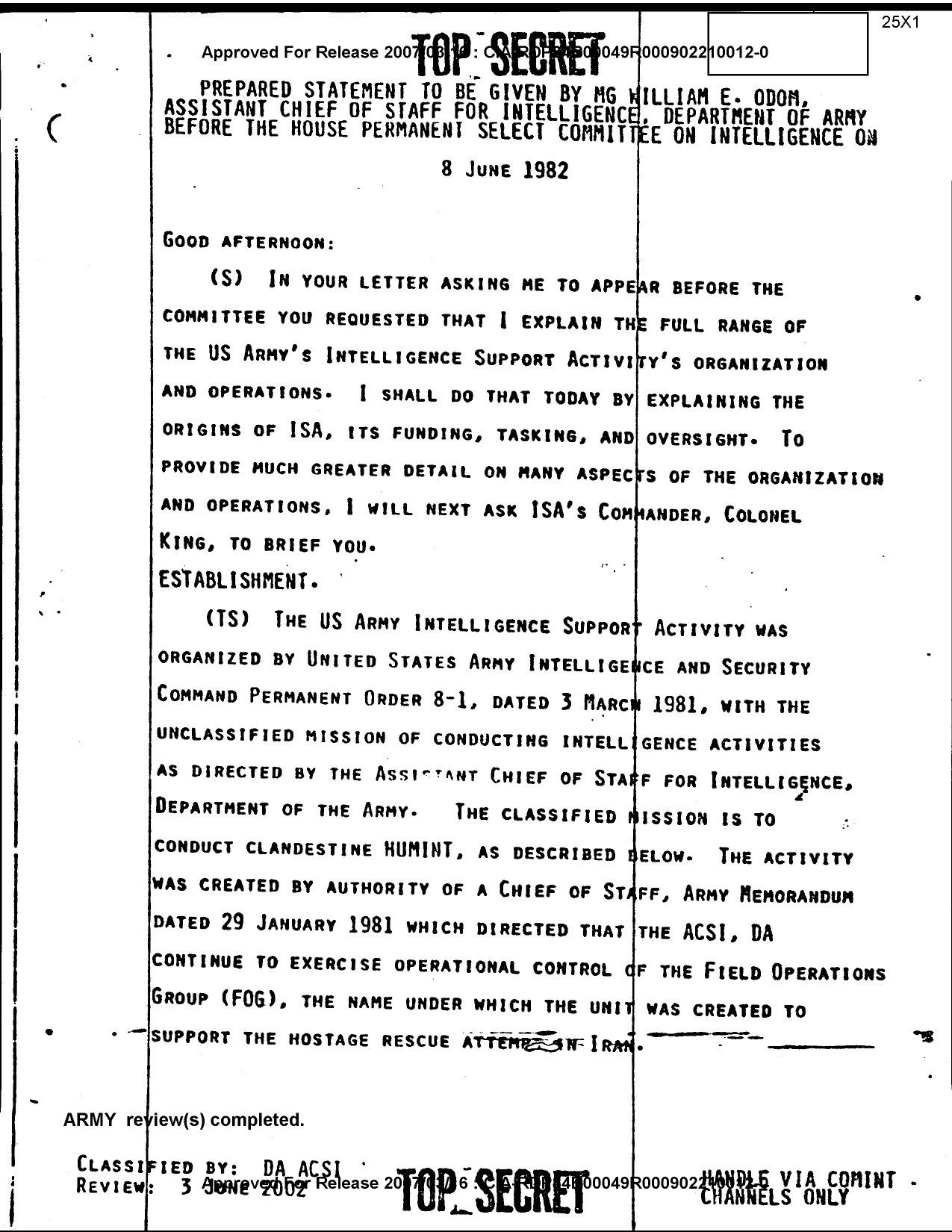
Prepared statement to be given by MG Hilliam E. Odom, Assistant Chief of Staff for Intelligence, Department of Army before the House Permanent Select Committee on Intelligence on 8 June 1982
Good afternoon:
(S) In your letter asking me to appear before the committee you requested that I explain the full range of the US Army’s Intelligence Support Activity’s organization and operations. I shall do that today by explaining the origins of ISA, its funding, tasking, and oversight. To provide much greater detail on many aspects of the organization and operations, I will next ask ISA’s commander, Colonel King, to brief you.
Establishment
(TS) The US Army Intelligence Support Activity was organized by United States Army Intelligence and Security Command Permanent Order 8-1, dated 3 March 1981, with the unclassified mission of conducting intelligence activities as directed by the Assistant Chief of Staff for Intelligence, Department of the Army. The classified mission is to conduct clandestine HUMINT, as described below. The activity was created by authority of a Chief of Staff, Army memorandum dated 29 January 1981 which directed that the ACSI, DA continue to exercise operational control of the Field Operations Group (FOG), the name under which the unit was created to support the hostage rescue attempt.
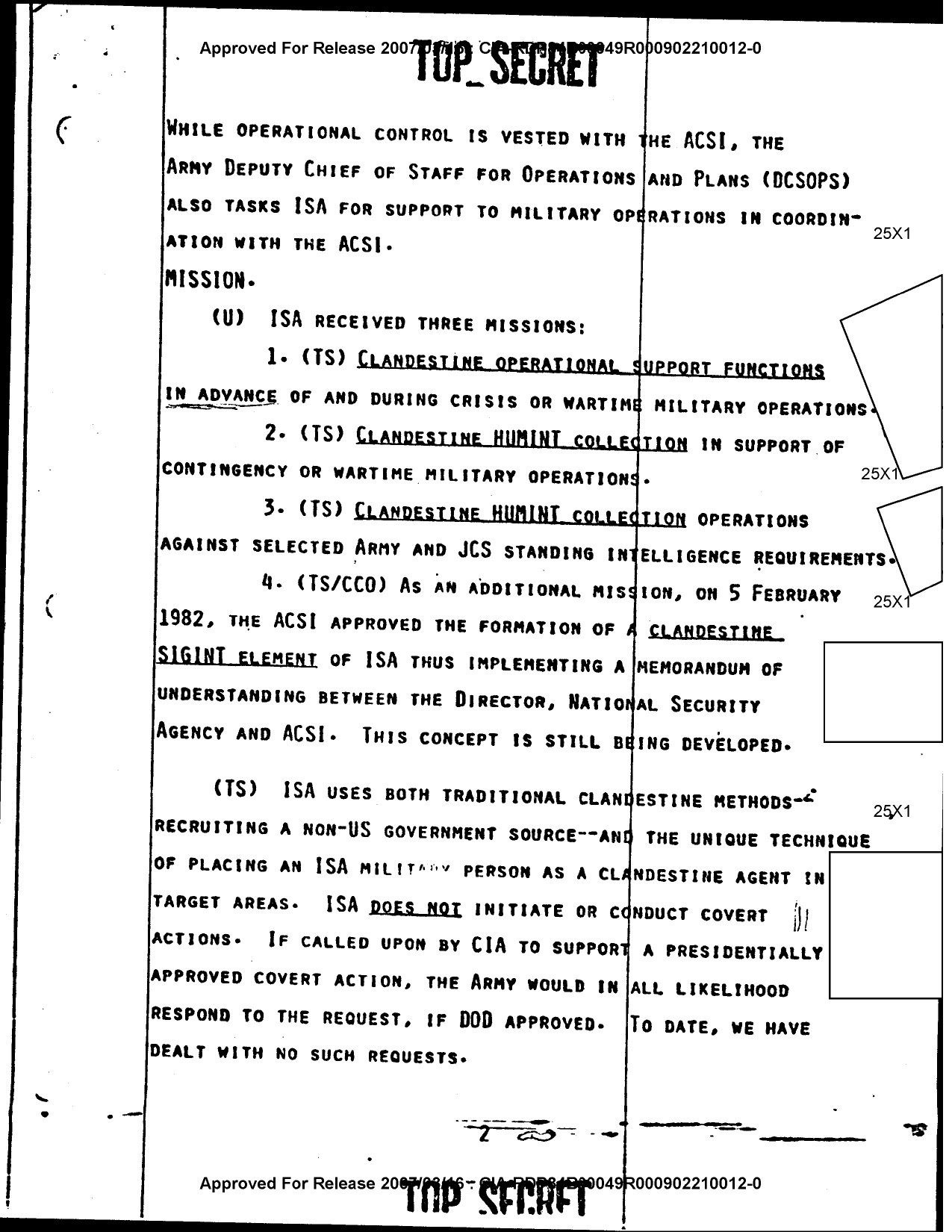
While operational control is vested with the ACSI, the Army Deputy Chief of Staff for Operations and Plans (DCSOPS) also tasks ISA for support to military operations in coordination with the ACSI.
Mission
(U) ISA received three missions:
- (TS) Clandestine operational support functions in advance of and during crisis or wartime military operations.
- (TS) Clandestine HUMINT collection in support of contingency or wartime military operations.
- (TS) Clandestine HUMINT collection operations.
(TS/CCO) As an additional mission, on 5 February 1982, the ACSI approved the formation of a clandestine SIGINT element of ISA, thus implementing a memorandum of understanding between the Director, National Security Agency and ACSI. This concept is still being developed.
(TS) ISA uses both traditional clandestine methods—recruiting a non-US government source—and the unique technique of placing an ISA military person as a clandestine agent in target areas. ISA does not initiate or conduct covert actions. If called upon by CIA to support a presidentially approved covert action, the Army would in all likelihood respond to the request, if DOD approved. To date, we have dealt with no such requests.
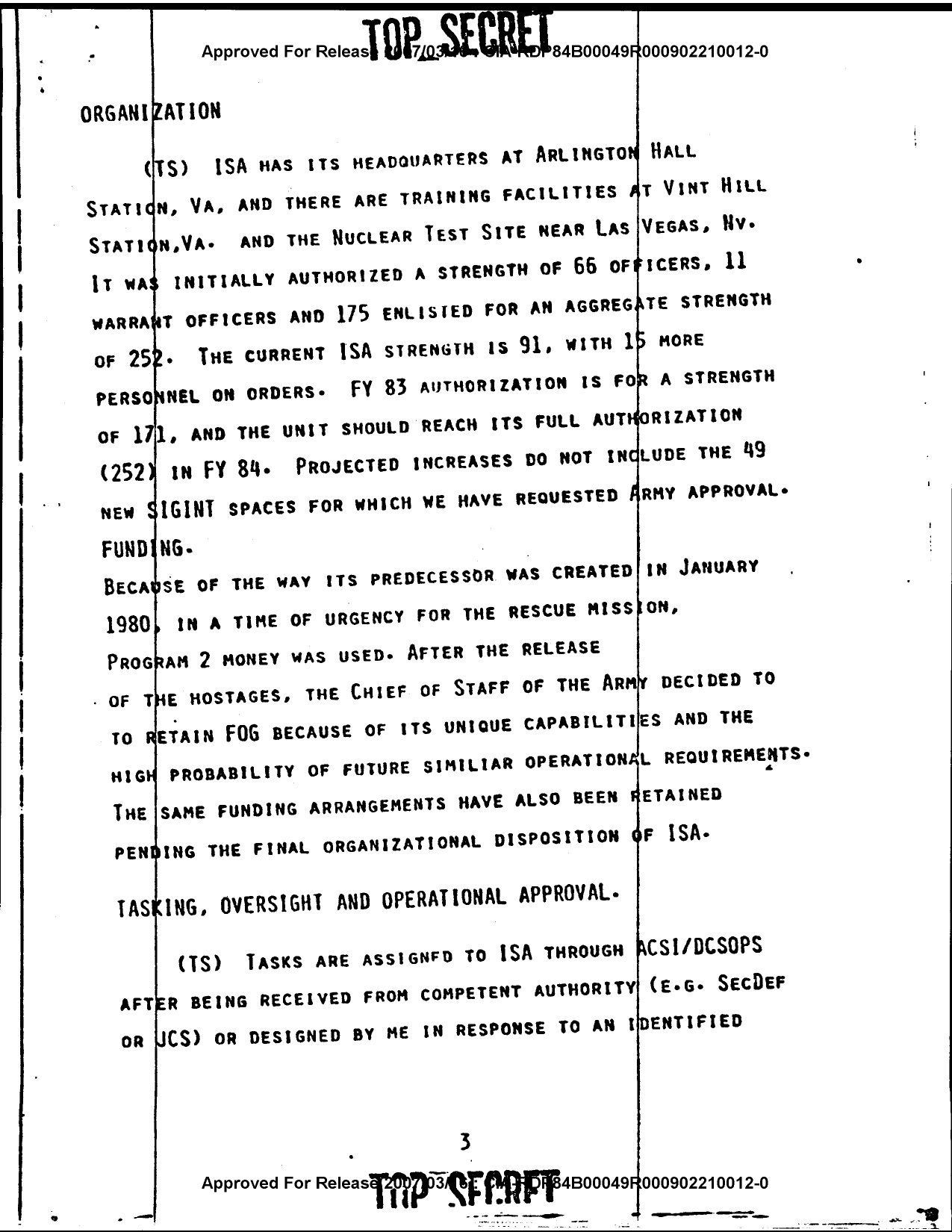
Organization
(TS) ISA has its headquarters at Arlington Hall Station, VA, and there are training facilities at Vint Hill Station, VA, and the nuclear test site near Las Vegas, NV. It was initially authorized a strength of 66 officers, 11 warrant officers and 175 enlisted for an aggregate strength of 252. The current ISA strength is 91, with 15 more personnel on orders. FY 83 authorization is for a strength of 171, and the unit should reach its full authorization (252) in FY 84. Projected increases do not include the 49 new SIGINT spaces for which we have requested Army approval.
Funding — Because of the way its predecessor was created in January 1980 in a time of urgency for the rescue mission, Program 2 money was used. After the release of the hostages, the Chief of Staff of the Army decided to retain FOG because of its unique capabilities and the high probability of future similar operational requirements. The same funding arrangements have also been retained pending the final organizational disposition of ISA.
Tasking, oversight, and operational approval
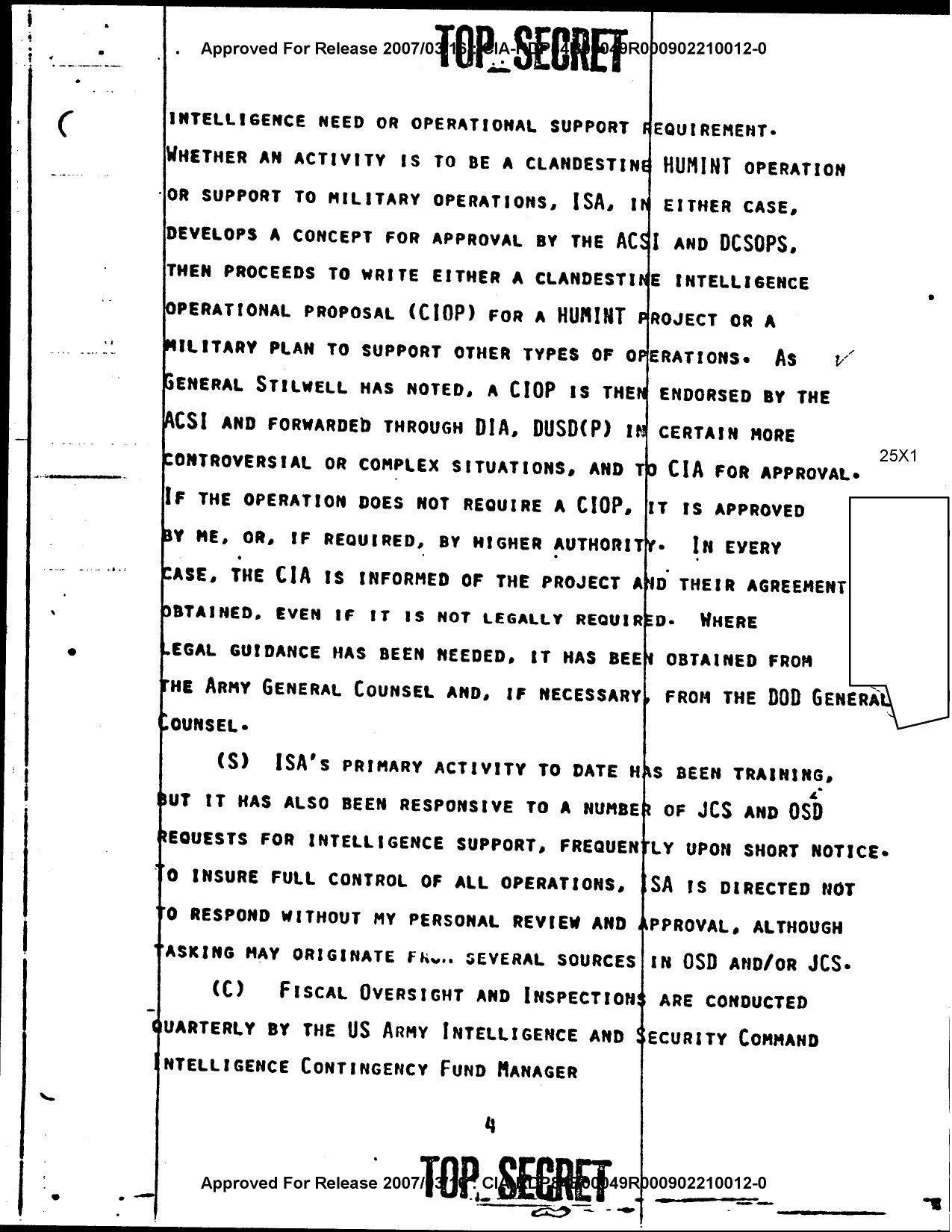
(TS) Tasks are assigned to ISA through ACSI/DCSOPS after being received from competent authority (e.g., SecDef or JCS) or designed by me in response to an identified intelligence need or operational support requirement. Whether an activity is to be a clandestine HUMINT operation or support to military operations, ISA, in either case, develops a concept for approval by the ACSI and DCSOPS, then proceeds to write either a clandestine intelligence operational proposal (CIOP) for a HUMINT project or a military plan to support other types of operations. As General Stilwell has noted, a CIOP is then endorsed by the ACSI and forwarded through DIA, DUSD(P) in certain more controversial or complex situations, and to CIA for approval. If the operation does not require a CIOP, it is approved by me, or, if required, by higher authority. In every case, the CIA is informed of the project and their agreement obtained, even if it is not legally required. Where legal guidance has been needed, it has been obtained from the Army General Counsel and, if necessary, from the DOD General Counsel.
(S) ISA’s primary activity to date has been training, but it has also been responsive to a number of JCS and OSD requests for intelligence support, frequently upon short notice. To ensure full control of all operations, ISA is directed not to respond without my personal review and approval, although tasking may originate from several sources in OSD and/or JCS.
(C) Fiscal oversight and inspections are conducted quarterly by the US Army Intelligence and Security Command Intelligence Contingency Fund Manager.
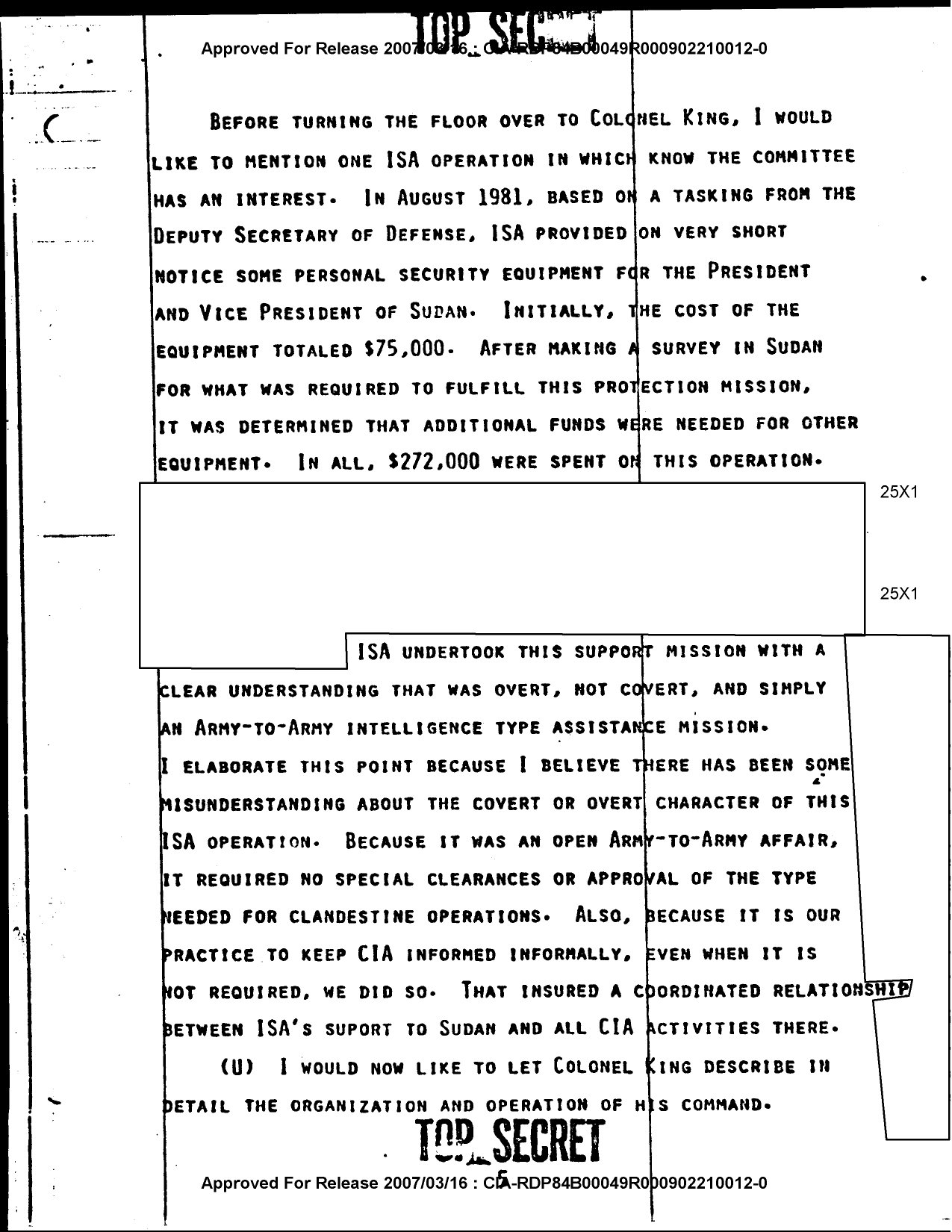
Before turning the floor over to Colonel King, I would like to mention one ISA operation in which I know the committee has an interest. In August 1981, based on a tasking from the Deputy Secretary of Defense, ISA provided on very short notice some personal security equipment for the President and Vice President of Sudan. Initially, the cost of the equipment totaled $75,000. After making a survey in Sudan for what was required to fulfill this protection mission, it was determined that additional funds were needed for other equipment. In all, $272,000 were spent on this operation.
ISA undertook this support mission with a clear understanding that it was overt, not covert, and simply an Army-to-Army intelligence type assistance mission. I elaborate this point because I believe there has been some misunderstanding about the covert or overt character of this ISA operation. Because it was an open Army-to-Army affair, it required no special clearances or approval of the type needed for clandestine operations. Also, because it is our practice to keep CIA informed informally, even when it is not required, we did so. That insured a coordinated relationship between ISA’s support to Sudan and all CIA activities there.
(U) I would now like to let Colonel King describe in detail the organization and operation of his command.
Source:
Link:
Internal Link: