Recent Killings Of Surinamese Concern U.S.
Jack Anderson – Washington Post
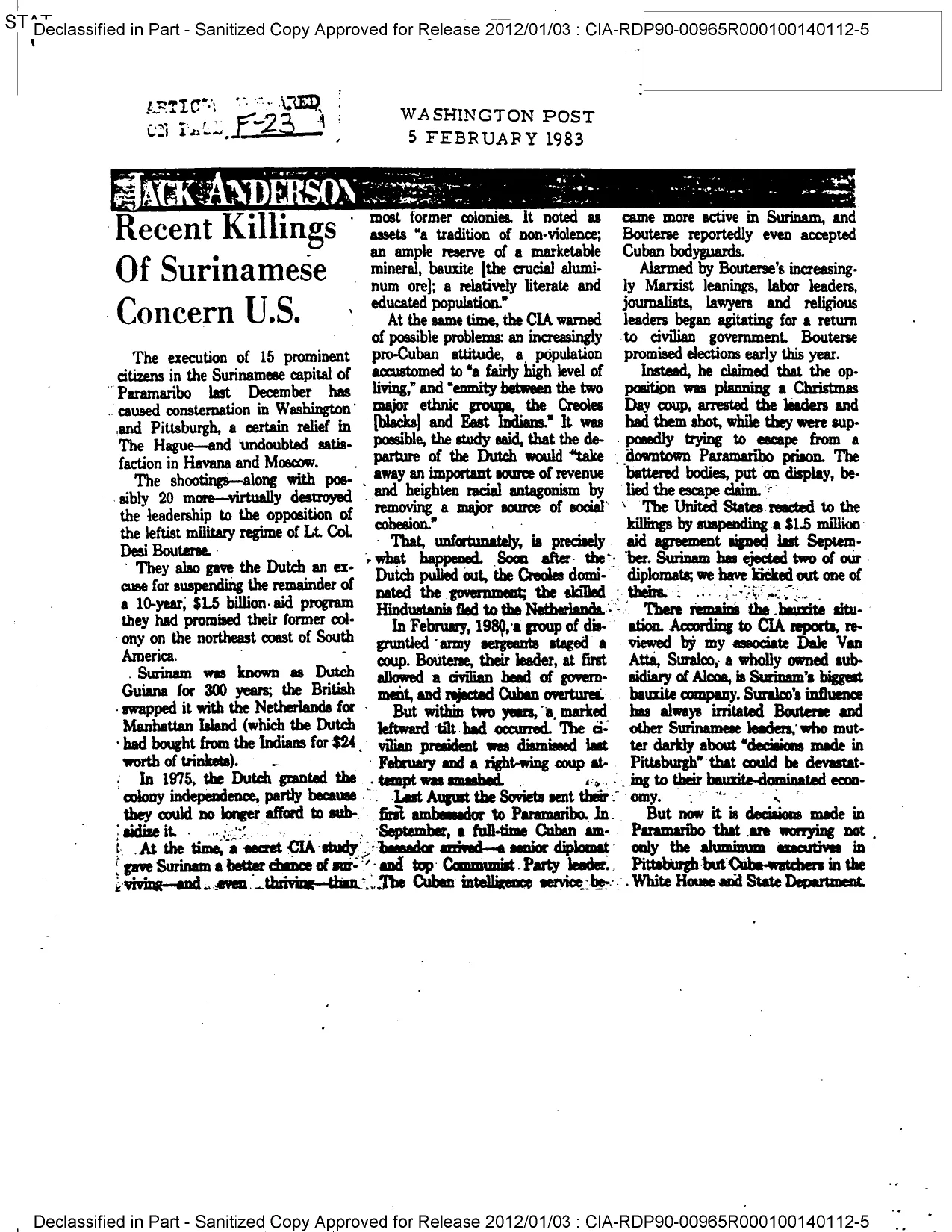
The execution of 15 prominent citizens in the Surinamese capital of Paramaribo last December has caused consternation in Washington and Pittsburgh, a certain relief in The Hague and undoubted satisfaction in Havana and Moscow. The shootings—along with possibly 20 more—virtually destroyed the leadership to the opposition of the leftist military regime of Lt. Col. Desi Bouterse. They also gave the Dutch an excuse for suspending the remainder of a 10-year, $1.5 billion aid program they had promised their former colony on the northeast coast of South America.
Surinam was known as Dutch Guiana for 300 years; the British swapped it with the Netherlands for Manhattan Island (which the Dutch had bought from the Indians for $24 worth of trinkets). In 1975, the Dutch granted the colony independence, partly because they could no longer afford to subsidize it. At the time, a secret CIA study gave Surinam a better chance of surviving—and even thriving—than most former colonies. It noted as assets “a tradition of non-violence; an ample reserve of a marketable mineral, bauxite [the crucial aluminum ore]; a relatively literate and educated population.”
At the same time, the CIA warned of possible problems: an increasingly pro-Cuban attitude, a population accustomed to “a fairly high level of living,” and “enmity between the two major ethnic groups, the Creoles [blacks] and East Indians.” It was possible, the study said, that the departure of the Dutch would “take away an important source of revenue and heighten racial antagonism by removing a major source of social cohesion.” That, unfortunately, is precisely what happened. Soon after the Dutch pulled out, the Creoles dominated the government; the skilled Hindustanis fled to the Netherlands.
In February 1980, a group of disgruntled army sergeants staged a coup. Bouterse, their leader, at first allowed a civilian head of government, and rejected Cuban overtures. But within two years, a marked leftward tilt had occurred. The civilian president was dismissed last February and a right-wing coup attempt was smashed.
Last August the Soviets sent their first ambassador to Paramaribo. In September, a full-time Cuban ambassador arrived—a senior diplomat and top Communist Party leader. The Cuban intelligence service became more active in Surinam, and Bouterse reportedly even accepted Cuban bodyguards. Alarmed by Bouterse’s increasingly Marxist leanings, labor leaders, journalists, lawyers and religious leaders began agitating for a return to civilian government. Bouterse promised elections early this year. Instead, he claimed that the opposition was planning a Christmas Day coup, arrested the leaders and had them shot while they were supposedly trying to escape from a downtown Paramaribo prison. The battered bodies, put on display, belied the escape claim.
The United States reacted to the killings by suspending a $1.5 million aid agreement signed last September. Surinam has ejected two of our diplomats, we have kicked out one of theirs. There remains the bauxite situation. According to CIA reports, reviewed by my associate Dale Van Atta, Suralco, a wholly owned subsidiary of Alcoa, is Surinam’s biggest bauxite company. Suralco’s influence has always irritated Bouterse and other Surinamese leaders, who mutter darkly about “decisions made in Pittsburgh” that could be devastating to their bauxite-dominated economy. But now it is decisions made in Paramaribo that are worrying not only the aluminum executives in Pittsburgh but Cuba-watchers in the White House and State Department.
Source:
Link:
Internal Link:
Date:
February 5, 1983