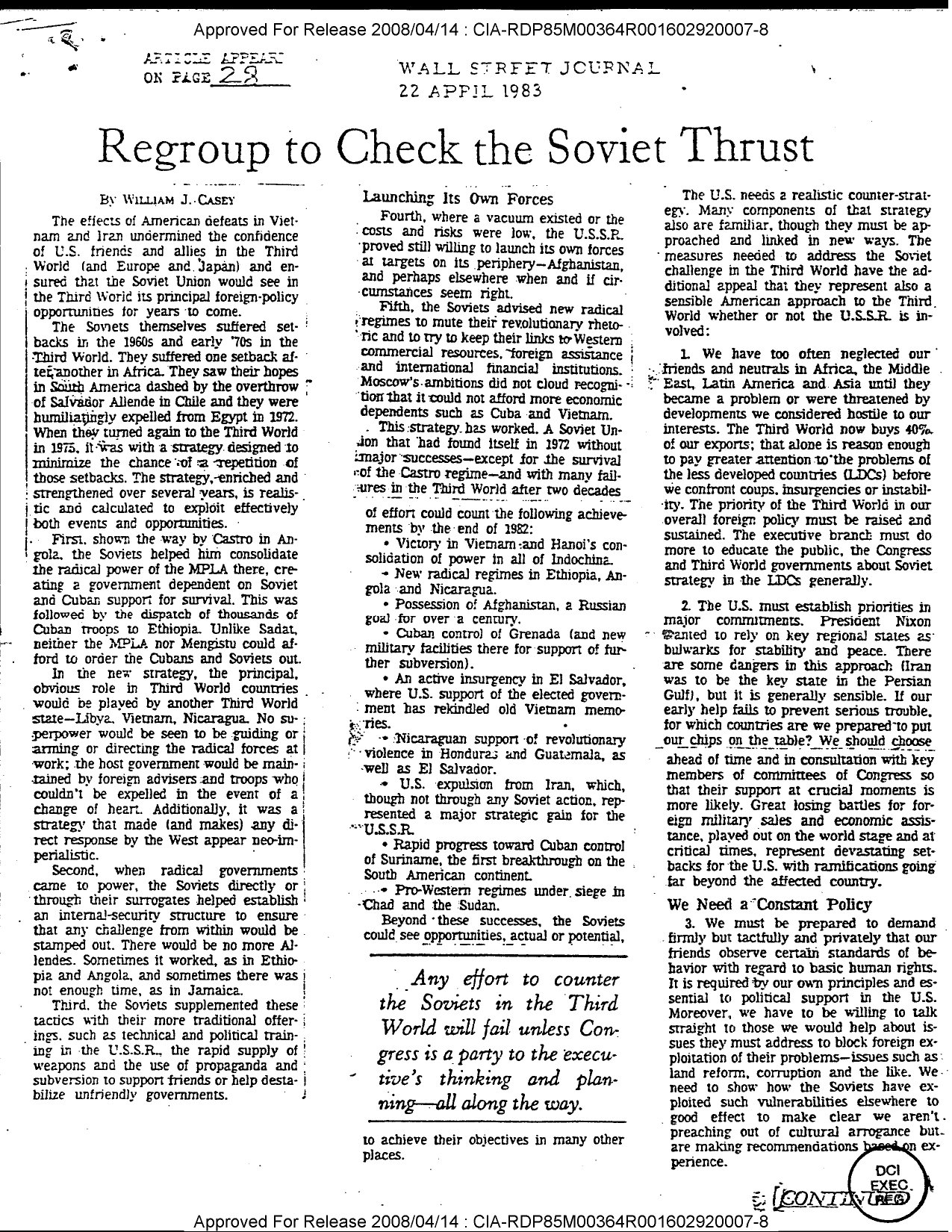
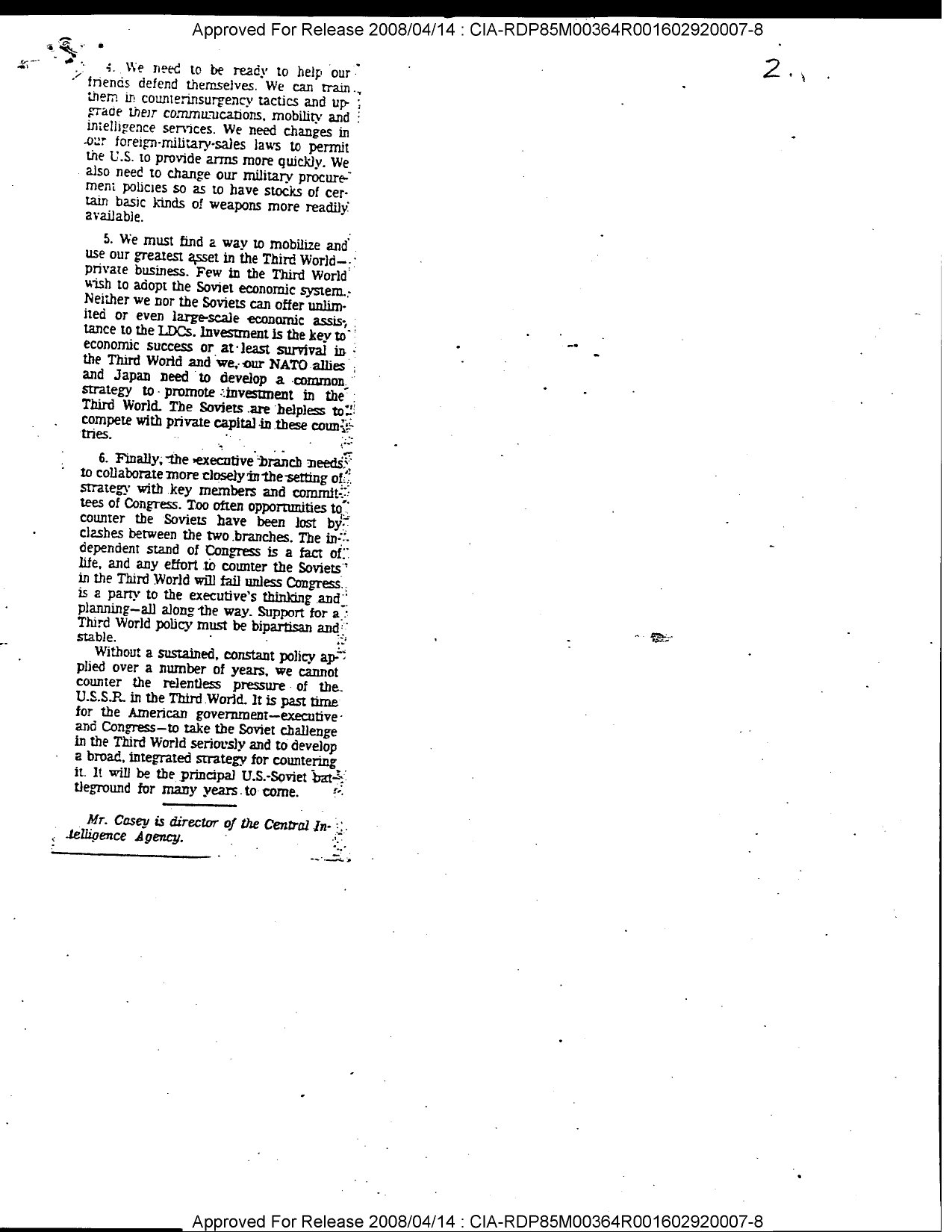
Regroup to Check the Soviet Thrust
BY WILLIAM J. CASEY
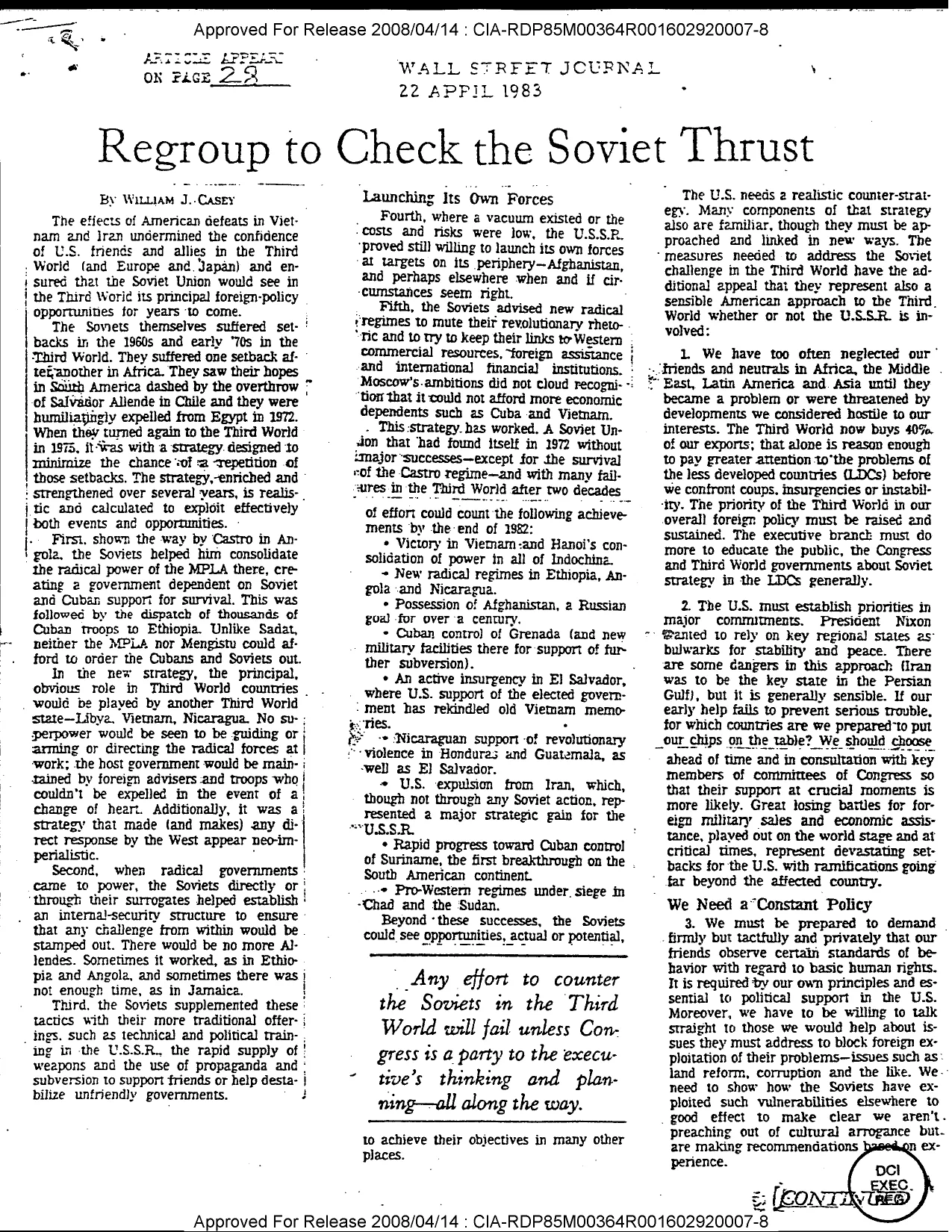
Any effort to counter the Soviets in the Third World will fail unless Congress is a party to the executive’s thinking and planning—all along the way.
The effects of American defeats in Vietnam and Iran undermined the confidence of U.S. friends and allies in the Third World (and Europe and Japan) and ensured that the Soviet Union would see in the Third World its principal foreign-policy opportunities for years to come.
The Soviets themselves suffered setbacks in the 1960s and early ’70s in the Third World. They suffered one setback after another in Africa. They saw their hopes in South America dashed by the overthrow of Salvador Allende in Chile, and they were humiliatingly expelled from Egypt in 1972.
When they turned again to the Third World in 1975, it was with a strategy designed to minimize the chances of a repetition of those setbacks. The strategy, enriched and strengthened over several years, is realistic and calculated to exploit effectively both events and opportunities.
First, shown the way by Castro in Angola, the Soviets helped him consolidate the radical power of the MPLA there, creating a government dependent on Soviet and Cuban support for survival. This was followed by the dispatch of thousands of Cuban troops to Ethiopia. Unlike Sadat, neither the MPLA nor Mengistu could afford to order the Cubans and Soviets out.
In the new strategy, the principal, obvious role in Third World countries would be played by another Third World state—Libya, Vietnam, Nicaragua. No superpower would be seen to be guiding or arming or directing the radical forces at work; the host government would be maintained by foreign advisers and troops who couldn’t be expelled in the event of a change of heart. Additionally, it was a strategy that made (and makes) any direct response by the West appear neo-imperialistic.
Second, when radical governments came to power, the Soviets directly or through their surrogates helped establish an internal-security structure to ensure that any challenge from within would be stamped out. There would be no more Allendes. Sometimes it worked, as in Ethiopia and Angola, and sometimes there was not enough time, as in Jamaica.
Third, the Soviets supplemented these tactics with their more traditional offerings, such as technical and political training in the U.S.S.R., the rapid supply of weapons, and the use of propaganda and subversion to support friends or help destabilize unfriendly governments.
Launching Its Own Forces
Fourth, where a vacuum existed or the costs and risks were low, the U.S.S.R. proved still willing to launch its own forces at targets on its periphery—Afghanistan, and perhaps elsewhere when and if circumstances seemed right.
Fifth, the Soviets advised new radical regimes to mute their revolutionary rhetoric and to try to keep their links to Western commercial resources, foreign assistance, and international financial institutions. Moscow’s ambitions did not cloud recognition that it could not afford more economic dependents such as Cuba and Vietnam.
This strategy has worked. A Soviet Union that had found itself in 1972 without major successes—except for the survival of the Castro regime—and with many failures in the Third World after two decades of effort could count the following achievements by the end of 1982:
- An active insurgency in El Salvador, where U.S. support of the elected government has rekindled old Vietnam memories.
- Nicaraguan support of revolutionary violence in Honduras and Guatemala, as well as El Salvador.
- U.S. expulsion from Iran, which, though not through any Soviet action, represented a major strategic gain for the U.S.S.R.
- Rapid progress toward Cuban control of Suriname, the first breakthrough on the South American continent.
- Pro-Western regimes under siege in Chad and the Sudan.
Beyond these successes, the Soviets could see opportunities, actual or potential, to achieve their objectives in many other places:
- Victory in Vietnam and Hanoi’s consolidation of power in all of Indochina.
- New radical regimes in Ethiopia, Angola, and Nicaragua.
- Possession of Afghanistan, a Russian goal for over a century.
- Cuban control of Grenada (and new military facilities there for support of further subversion).
The U.S. needs a realistic counter-strategy. Many components of that strategy also are familiar, though they must be approached and linked in new ways. The measures needed to address the Soviet challenge in the Third World have the additional appeal that they represent also a sensible American approach to the Third World whether or not the U.S.S.R. is involved:
We have too often neglected our friends and neutrals in Africa, the Middle East, Latin America, and Asia until they became a problem or were threatened by developments we considered hostile to our interests. The Third World now buys 40% of our exports; that alone is reason enough to pay greater attention to the problems of the less developed countries (LDCs) before we confront coups, insurgencies, or instability. The priority of the Third World in our overall foreign policy must be raised and sustained. The executive branch must do more to educate the public, Congress, and Third World governments about Soviet strategy in the LDCs generally.
The U.S. must establish priorities in major commitments. President Nixon wanted to rely on key regional states as bulwarks for stability and peace. There are some dangers in this approach (Iran was to be the key state in the Persian Gulf), but it is generally sensible. If our early help fails to prevent serious trouble, for which countries are we prepared to put our chips on the table? We should choose ahead of time and in consultation with key members of committees of Congress so that their support at crucial moments is more likely. Great losing battles for foreign military sales and economic assistance, played out on the world stage and at critical times, represent devastating setbacks for the U.S. with ramifications going far beyond the affected country.
We Need a Constant Policy
We must be prepared to demand firmly but tactfully and privately that our friends observe certain standards of behavior with regard to basic human rights. It is required by our own principles and essential to political support in the U.S. Moreover, we have to be willing to talk straight to those we would help about issues they must address to block foreign exploitation of their problems—issues such as land reform, corruption, and the like. We need to show how the Soviets have exploited such vulnerabilities elsewhere to good effect to make clear we aren’t preaching out of cultural arrogance but are making recommendations based on experience.
We need to be ready to help our friends defend themselves. We can train them in counterinsurgency tactics and upgrade their communications, mobility, and intelligence services. We need changes in our foreign-military-sales laws to permit the U.S. to provide arms more quickly. We also need to change our military procurement policies so as to have stocks of certain basic kinds of weapons more readily available.
We must find a way to mobilize and use our greatest asset in the Third World—private business. Few in the Third World wish to adopt the Soviet economic system. Neither we nor the Soviets can offer unlimited or even large-scale economic assistance to the LDCs. Investment is the key to economic success or at least survival in the Third World, and we, our NATO allies, and Japan need to develop a common strategy to promote investment in the Third World. The Soviets are helpless to compete with private capital in these countries.
Finally, the executive branch needs to collaborate more closely in the setting of strategy with key members and committees of Congress. Too often opportunities to counter the Soviets have been lost by clashes between the two branches. The independent stand of Congress is a fact of life, and any effort to counter the Soviets in the Third World will fail unless Congress is a party to the executive’s thinking and planning—all along the way. Support for a Third World policy must be bipartisan and stable.
Without a sustained, constant policy applied over a number of years, we cannot counter the relentless pressure of the U.S.S.R. in the Third World. It is past time for the American government—executive and Congress—to take the Soviet challenge in the Third World seriously and to develop a broad, integrated strategy for countering it. It will be the principal U.S.-Soviet battleground for many years to come.
Mr. Casey is director of the Central Intelligence Agency.
Source:
Link:
Internal Link: