Summary Record of NATO Meeting 6 April 1983 -format
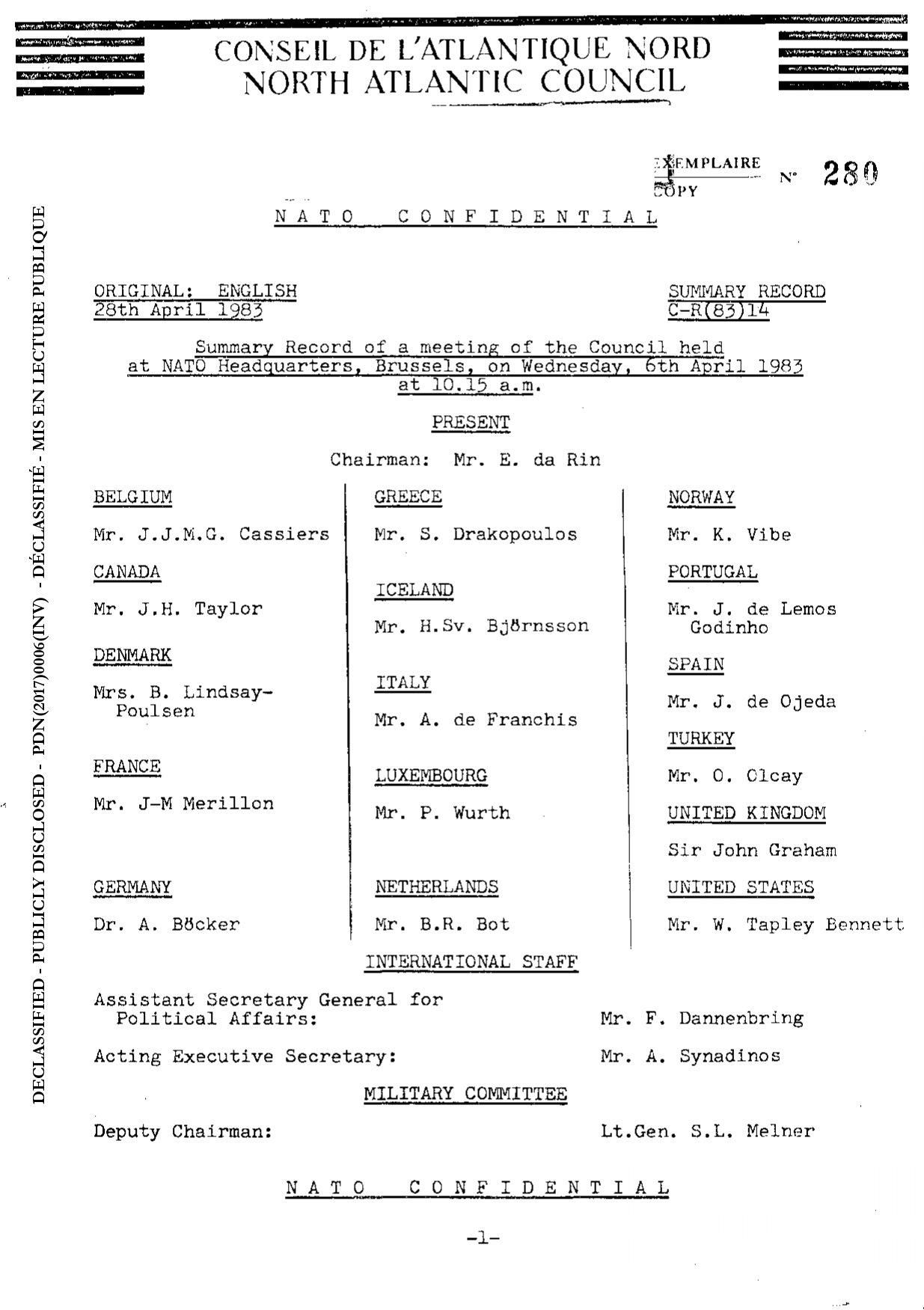
Summary Record of a meeting of the Council held at NATO Headquarters, Brussels, on Wednesday, 6th April 1983 at 10.15 a.m.
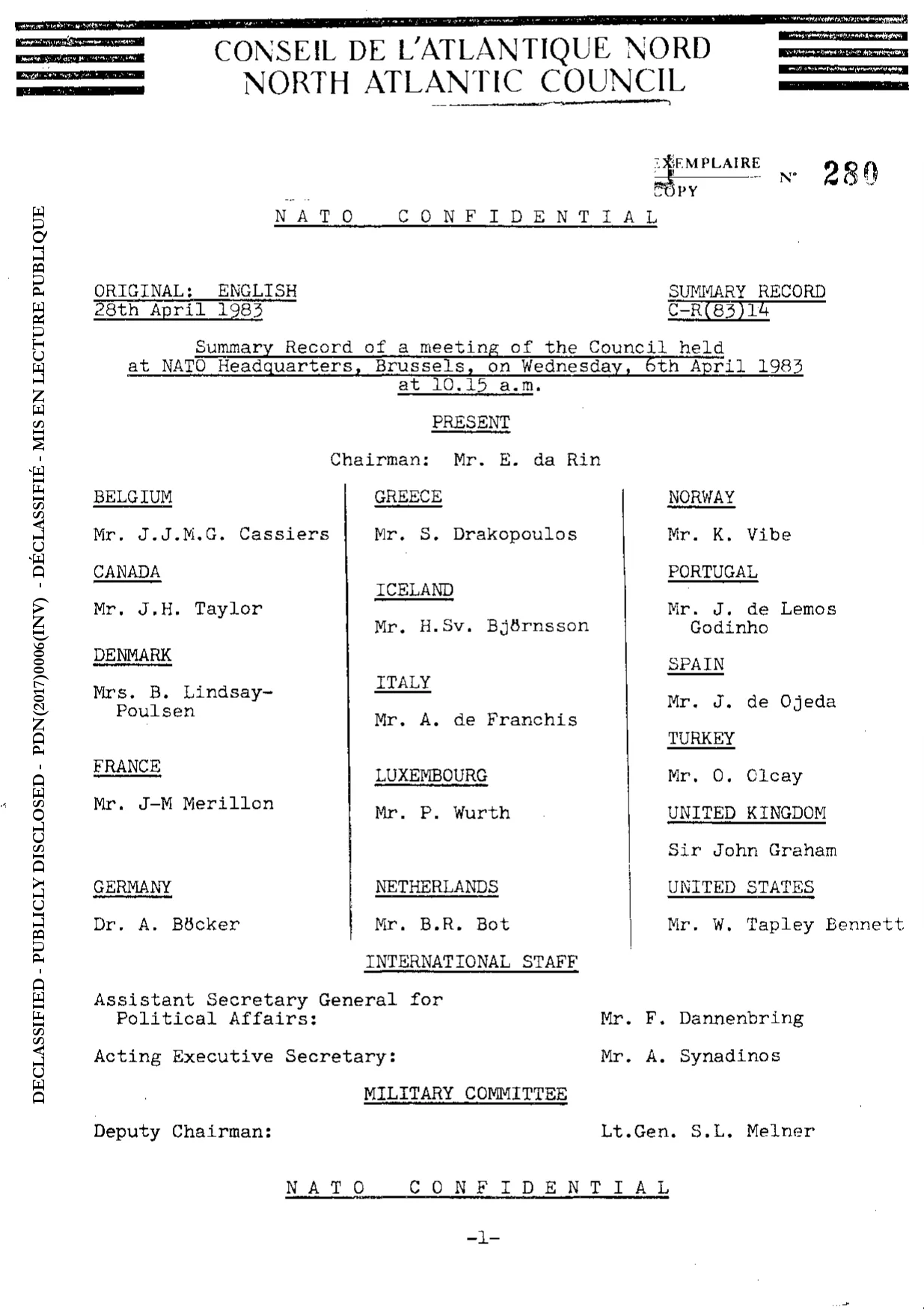
_ CONSEIL DEATLANTIQUE NORD NORTH ATLANTIC COUNCIL
NATO CONFIDENTIAL
ORIGINAL: ENGLISH SUMMARY RECORD
28th April 1983 C-R(83)14
|
|
|
|
| PRESENT
Chairman: Mr. È. da Rin |
| BELGIUM GREECE NORWAY
| Мг. J.J.M.G. Cassiers Mr. S. Drakopoulos Mr. K. Vibe
|
| CANADA PORTUGAL
ICELAND |
| Mr, J.H. Taylor Mr. J. de Lemos
| Mr. H.5v. Björnsson Godinho
| DENMARK SPAIN
ITALY Mrs. B. Lindsay- Mr. J. de Ojeda Poulsen Mr. A. de Franchis | TURKEY
| FRANCE LUXEMBOURG Mr. 0. Clcay
Mr. J-M Merillon Mr. P. Wurth UNITED KINGDOM
GERMANY NETHERLANDS UNITED STATES
Dr. A. Böcker Mr. B.R. Bot Mr. М. Tapley Bennett
|
|
| Sir John Graham
|
|
| INTERNATIONAL STAFF
| | Assistant Secretary General for | Political Affairs: Mr. F. Dannenbring
Acting Executive Secretary: Mr. A. Synadinos
| | MILITARY COMMITTEE
Deputy Chairman: Lt.Gen. S.L. Meiner
NATO CONFIDENTIAL
i
DECLASSIFIED – PUBLICLY DISCLOSED – PDN(2017)0006(INV) – DÉCLASSIFIÉ – MIS EN LECTURE PUBLIQUE
Item
I.
Ii.
IV.
NATO. CONFIDENTIAL
-2- C-R(83)14
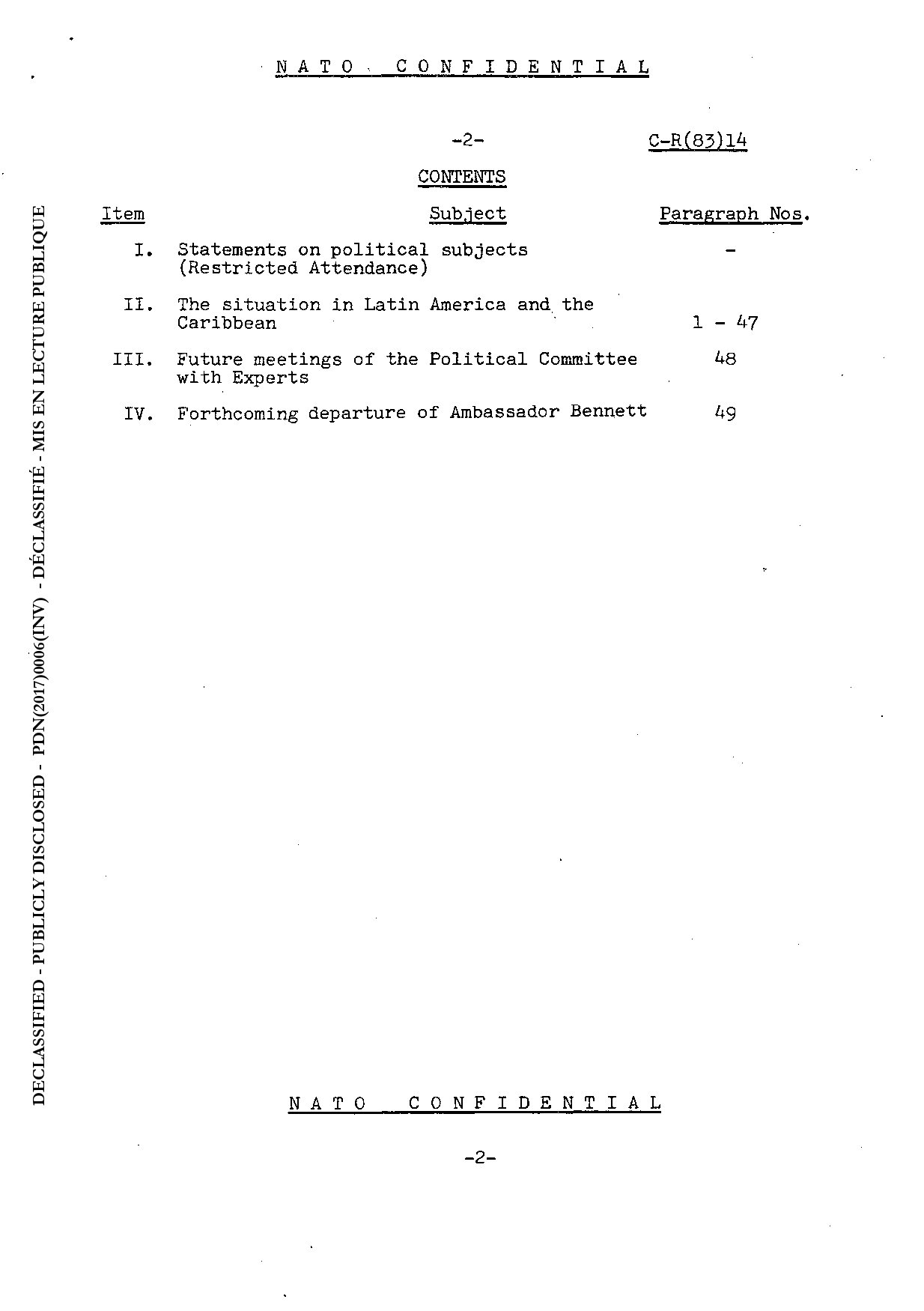
CONTENTS
subject Paragraph Nos,
Statements on political subjects – (Restricted Attendance)
The situation in Latin America and the
Caribbean | — 1 – 47
Future meetings of the Political Committee 48
with Experts |
Forthcoming Geparture of Ambassador Bennett 49
NATO CONFIDENTIAL
-2-
DECLASSIFIED – PUBLICLY DISCLOSED – PDN(2017)0006(INV) – DÉCLASSIFIÉ – MIS EN LECTURE PUBLIQUE
N ATO CONFIDENTIAL
-3- C-R(83)14
NATO UNCLASSIFIED
i, DIATEMENTS ON POLITICAL SUBJECTS
(Restricted Attendance)
NATO CONFIDENTIAL
- THE SITUATION IN LATIN AMERICA AND THE CARIBBEAN
Document: C-M(83)9 dated 17th March 1983. - Introducing the report by the Expert Group on the
Situation in Latin America and the Caribbean, the CHAIRMAN noted that the region was still characterized mainly by serious economic
problems, a generally poor human rights record, and, as far as
Central America was concerned, by continuing instability. However,
he urged the Allies not to overlook the hopeful signs for a return
to democratic government in a number of countries, a trend which
it was in all their interests to support. - The САМАОТАМ REPRESENTATIVE informed the Council that he would be circulating some additional remarks concerning Central
America, Venezuela, Argentina, Brazil and Chile and reporting the
talks which had taken place on 16th March when the new Mexican
Foreign Minister had visited Ottawa. In his discussions with the
Canadian Government, the Mexican Foreign Minister had spoken of
the international oil market and his country’s position on that
subject, as well as on the Summit Meeting of the Non-Aligned
Movement and his Government’Ss view on the situation in Central
America. - The UNITED STATES REPRESENTATIVE said that his Authorities considered that the Experts! report was a sound and balanced
representation of events in Latin America and the Caribbean during
the period under review. The International Staff had again put
together a report of high quality. Although there were many
important developments elsewhere in the region, he wished to focus
his remarks during the present discussion on recent developments
in Central America.
4, He recalled that, as a first step in the new peace
initiative which had emerged for Central America, a meeting would
be convened of the Foreign Ministers of Costa Rica, El Salvador,
Honduras, Nicaragua and Guatemala. This meeting would be
witnessed by the Foreign Ministers of Mexico, Venezuela, Colombia,
Panama and the Dominican Republic. The Foreign Ministers of
Costa Rica, El Salvador and Honduras had already issued a Joint
statement endorsing such a meeting on 24th February, - For their part, the United States had indicated a
positive attitude towards such a meeting on several occasions.
President Reagan had done so in speeches on Zend February and
10th March, and the Secretary of State had echoed this position
NATO CONFIDENTIAL
—3=
DECLASSIFIED – PUBLICLY DISCLOSED – PDN(2017)0006(INV) – DÉCLASSIFIÉ – MIS EN LECTURE PUBLIQUE
NATO CONFIDENTIAL
Ly C-R(83)14
in public Congressional Hearings on 16th and 22nd March.
Washington had been in touch with the meetingt!s sponsors, but
had not been a party to diplomatic efforts to organize it, - However, 1$ now appeared that plans for the meeting
were faltering for lack of a positive response from Nicaragua
and possibly Mexico too. Other governments had indicated a
willingness to participate.
т. With regard Фо specific countries, he noted that the
report singled out El Salvador and Guatemala for human rights
abuses but said that it was unfortunate that it did not mention
Nicaragua, where the Sandinista Government hadbecome increasingly
oppressive towards opposition groups, the private sector, and even
the Church. - In Nicaragua, the recent fighting appeared to be
confined largely to Boaco, Matalgalpa, Jinoteja, Nueva Segovia,
Madriz and Esteli, with little or no fighting in the other eight
Nicaraguan provinces. There was also some fighting between
Miskito Indians, large numbers of whom had been expelled from their
homes by the Nicaraguan Government, and the Sandinistas in Zelaya
province. - Although scant information was available, it was suspected
that Sandinista and rebel claims alike were exaggerating casualties.
Thus far, it appeared that the Sandinista militia, rather than its
better trained army, had borne the brunt of the fighting. - The opposition to the Sandinista Government comprised
Miskito Indians, former national guardsmen, former Sandinistas,
such as the rebel leader Eden Pastora, former members of the
governing junta such as Alfonso Robelo and other anti-Somocista
groups. The opposition was diverse, nationalistic and independent. - He went on to say that the Sandinista government was also
attempting tc obscure its refusal to engage in any meaningful
diplomatic attempts to defuse regional tensions. The San José Final
Act explicitly addressed the very concerns raised by the Sandinistas,
including the presence of foreign advisors or trainers, arms flows
and external support for insurgency in neighbouring countries. - For their part, the United States would continue to search
for a peaceful solution to regional disputes in this part of the
world where right and wrong were so often confused and would hope
that those Allies in a position to do so would support such efforts. - The NORWEGIAN REPRESENTATIVE expressed his appreciation
to the International Staff and to the Expert Working Group for a
most useful survey of developments in the region during the period
under review,
NATO CONFIDENTIAL
Li
DECLASSIFIED – PUBLICLY DISCLOSED – PDN(2017)0006(INV) – DÉCLASSIFIÉ – MIS EN LECTURE PUBLIQUE
NATO CONFIDENTIAL
-5- C-R(83)14
14, Norway, too, believed that the report struck the correct
balance on the relative importance of internal political and
social factors on the one hand and external factors on the other,
However, it was felt to be slightly too descriptive here and there
on certain events, at the expense of assessments and evaluations. - He went on to say that the situation in Nicaragua was
still somewhat unsettled, in spite of the ongoing consolidation
efforts, and relations between Nicaragua and its neighbours
remained tense, particularly in the case of Honduras from which
anti-Sandinista forces were operating. Norway believed that armed conflict between Nicaragua and Honduras could not be entirely
ruled out and therefore welcomed the peace initiative referred to
by the United States Representative. - In paragraph 18, reference was made to the continuing
Soviet assistance to Nicaragua, particularly in the military
field. Norway was of the opinion that the Sandinistas, nevertheless,
continued to attach great importance to improving their relations
with the West European nations as a means of restoring and
developing the Nicaraguan economy. An assessment of these relations
might have been useful in the report since there could be room for
positive Western influence, although the Sandinista takeover had
brought many disappointments. - As far as Peru was concerned, Norway agreed with the
assessment of the situation in that country but believed that, in judging the viability of the present government one should bear
in mind that the opposition in Peru was divided and diverse. With
regard to paragraph 44 of the report on the resurgent Sendero
Luminoso group, he recalled that its support was limited to the South Eastern part of Peru, which was largely populated by
non-Spanish speaking Indians. Consequently, he did not believe
that one should attach too much importance to this group in spite
of the latest incidents reported in that day’s press. - Turning to Argentina, his Authorities agreed with the
evaluation in the report that the political dynamics seemed to have shifted decisively in favour of the civilians and that the
performance of the military régime was subject to mounting criticism, In the present situation, what appeared to be really lacking was a
generally recognized and respected central political authority with
the ability to take coherent and consistent decisions. Norway
believed that Argentina might be facing a further period where
authoritarian measures might alternate with democratic social
measures in response to conflicting tensions. A real stabilization
of Argentinian society might still be far away. - Finally, in light of the attention which had been devoted internationally to human rights problems in Chile over the last
decade, his Authorities felt that somewhat more extensive coverage
should have been given in the report to the human rights record
of this country, which, on the whole, had shown no improvement in
the period under review, even if some encouraging moves had been
registered here and there.
NATO CONFIDENTIAL
-5-—
DECLASSIFIED – PUBLICLY DISCLOSED – PDN(2017)0006(INV) – DÉCLASSIFIÉ – MIS EN LECTURE PUBLIQUE
NATO CONFIDENTIAL
-6- C-R(83)14
20, The SPANISH REPRESENTATIVE said that his Authorities were grateful to the Group of Experts and its Chairman for the report which it had drafted on the situation in Latin America and
the Caribbean, The report was all the more valuable and important
since it dealt with developments in a part of the world which, as he had pointed out on previous occasions, was the only so-called “Third World” region that was definitely a part of the West, and
as such, was of great importance and interest to the Alliance. To this fact was added the increasing concern of the Spanish Authorities at the difficulties which the region was undergoing at present and its political instability in the future. - He recognized that the report was subject to shortcomings
by the very fact of its joint elaboration by experts of various
nations with different approaches to the same problems. As had been
the case with previous reports on Latin America and other areas,
the document engaged the sole responsibility of its drafters and he
would therefore go no further in developing the extent to which the Spanish analysis was somewhat divergent from that contained in the
report, both with regard to particular issues and on its overall
approach contained in Part I “General Trends and Main Events”.
Developments in Central America, in particular, appeared to be influenced by a set of factors of a social, economic and political
nature which were not sufficiently highlighted in the report. The
same could apply to situations as complex as the aftermath of the
Falklands Conflict. - He recalled that his Delegation had already expressed
its views on these outstanding questions during the Council’s
examination of the previous report on developments in the region.
He wished to inform the Council that the Spanish Authorities
expected to contribute to the preparation of the next report in a
more comprehensive and detailed way so that the general considerations
which he had outlined might find their way into its text. - The UNITED KINGDOM REPRESENTATIVE wished to be associated
with earlier speakers who had already congratulated the Expert
Working Group and its Chairman on a fine report.
24, In supporting his United States colleagues! remarks in
favour of the proposed peace conference on the situation in Central
America, he would recall that the United Kingdom had already
welcomed the efforts underway in this direction in the recent
Security Council debate and had suggested that the United Nations
Secretary General might play a useful rôle in overcoming any
remaining obstacles to such a gathering. - With regard to relations between Belize and Guatemala, the United Kingdom deeply regretted the breakdown of negotiations
and the lack of any immediate prospect for their revivial. At the
same time, the United Kingdom Government would like to encourage
broader economic support for Belize in order to demonstrate the
isolation of Guatemala!ls claims, In the meantime, the small British
garrison would remain in Belize, although it was recognized that it
could not do so indefinitely. The need was to ensure Belize*s
security, and the United Kingdom was considering ways of developing
the country’s small national defence force to this end.
NATO CONFIDENTIAL -5- es
DECLASSIFIED – PUBLICLY DISCLOSED – PDN(2017)0006(INV) – DÉCLASSIFIÉ – MIS EN LECTURE PUBLIQUE
NATO CONFIDENTIAL
—-7- C-R(83)14
26, Turning to the Falklands, he said that the position of
the United Kingdom Government was well known. The United Kingdom
could see no possibility of negotiating the sovereignty of the
Islands with Argentina as if nothing had happened. As the report
itself pointed out, there had still been no formal declaration by
Argentina of the cessation of hostilities and, indeed, warlike
statements continued to emanate from Buenos Aires. Consequently,
the United Kingdom Government remained concerned that Argentina
should not obtain military supplies which were likely to increase
the threat tothe Falkland Islands. It therefore hoped that
potential arms suppliers would exercise restraint, or would at
least co-operate with the United Kingdom in providing in confidence
information on sales of sensitive weapons. - On this subject, the United Kingdom Government had been
somewhat disappointed with the resolution resulting from the recent
summit of the so-called Non-Aligned Movement, This had been adopted
in preference to the original Indian draft which had, at least,
suggested a genuine attempt at pursuing a moderate line between the
parties concerned. The United Kingdom found it hard to understand
that, despite the events of 1982, the Non-Aligned Movement should
still feel able to support Argentina’s extreme position virtually
without qualification. Moreover, the United Kingdom found it
offensive to suggest that its military presence in the South
Atlantic affected stability in the region. The garrison in the
Falkland Islands was essential while the threat remained, as was
pointed out by the report, and would stay there, - The GERMAN REPRESENTATIVE said that he, too, wished to
express his appreciation to the Expert Working Group and to its
Chairman for a valuable report. His Authorities could agree in
general with its contents and his remarks would therefore concentrate
on the events since its compietion. - As far as the situation in Argentina was concerned, his
Authorities believed that President Bignone was serious in his
intention to hold elections on 30th October. The announcement of
these elections had relaxed considerably the tensions between the
Government and the political parties on the one hand and the trade
unions on the other. However, there were visible rifts between the
two major parties in Argentina and he feared that this might lead
to their disintegration before elections could take place. - He went on to suggest that the growing political pressures
on Bignone, as demonstrated by the call for an illegal strike on
28th March, seemed to explain Buenos Aires! more neutral line and
might have enabled Argentina to secure stronger support for her
claim to sovereignty over the Falklands at the Non-Aligned summit,
even though Bignone!s meeting with Castro and Arafat had been
sharply criticised on his return,
NATO CONFIDENTIAL
—7-
DECLASSIFIED – PUBLICLY DISCLOSED – PDN(2017)0006(INV) – DÉCLASSIFIÉ – MIS EN LECTURE PUBLIQUE
NATO CONFIDENTIAL
-8- C-R(83)14 - Turning to Brazil, he said that in spite of the
success of the Brazilian Government in obtaining IMF credits,
it was doubtfui whether this would solve the country’s balance
of payments problem for the current year. Certainly, the objective of a § fixed billion budget surplus in 1983 was
uniixely to be achieved, and debt re~scheduling negotiations
might well prove necessary before the end of the year. On the
other hand, it was premature to assess the effect on Brazil’s
balance of payments of falling interest rates and falling oil
prices. The overall economic situation remained very bad and
could well account for the most recent eruptions of violence,
32, As far as the situation in Bolivia was concerned,
there appeared to be increasing concern in some neighbouring
countries that Cubans and Nicaraguans who recently entered
Bolivia might establish training camps for terrorists and
subversive activities in the region. The situation should
therefore be carefully monitored. - The German Authorities also believed that some attention
should have been paid in the report to the situation in Ecuador,
where the Government and Ecuador’s democratic system as a whole
appeared to have been weakened by recent events, The strike which
had been called by both the unions and the employers? organizations on 23rd and 24th March had paralyzed the economic life of the
country almost completely. Although, by skilful tactics, the
Government had been able to avoid clashes between the military and
the police on the one hand and the strikers on the other, the
large following which the strike had received demonstrated the
grave discontent within the country, which the German Authorities
expected to worsen rather than improve.
34, In Central America, Nicaragua was and would no doubt
remain an element of instability for the foreseeable future.
The German Government welcomed the proposed meeting of Foreign
Ministers of the region referred to by the United States Representative
and hoped that it would be the beginning of a regional settlement.
Overall, the situation continued to be tense and unsatisfactory.
IT was for this reason that Germany had instructed its Ambassador to
the United Nations Security Council to express its disappointment at
the evolution of Nicaragua since 1979, - The NETHERLANDS REPRESENTATIVE said that since the
comprehensive and useful report by the Expert Working Group had not
given rise to specific comments by his Authorities, he wished to
use this occasion to say a few words on Surinam, - Since the execution of the fifteen leading critics of
the military régime in December 1982 and the murder of former deputy
Army Commander Horb in February 1983, no blatant violations of human
rights in Surinam had been reported, However, there was still no
NATO CONFIDENTIAL
_8—
DECLASSIFIED – PUBLICLY DISCLOSED – PDN(2017)0006(INV) – DÉCLASSIFIÉ – MIS EN LECTURE PUBLIQUE
NATO CONFIDENTIAL
-9- C-R(83)14
question whatsoever of a return to democracy, or of the
restoration of press freedom and of the independence of the
Judiciary. Moreover, there were clear signs that prisoners
were still treated very harshly.
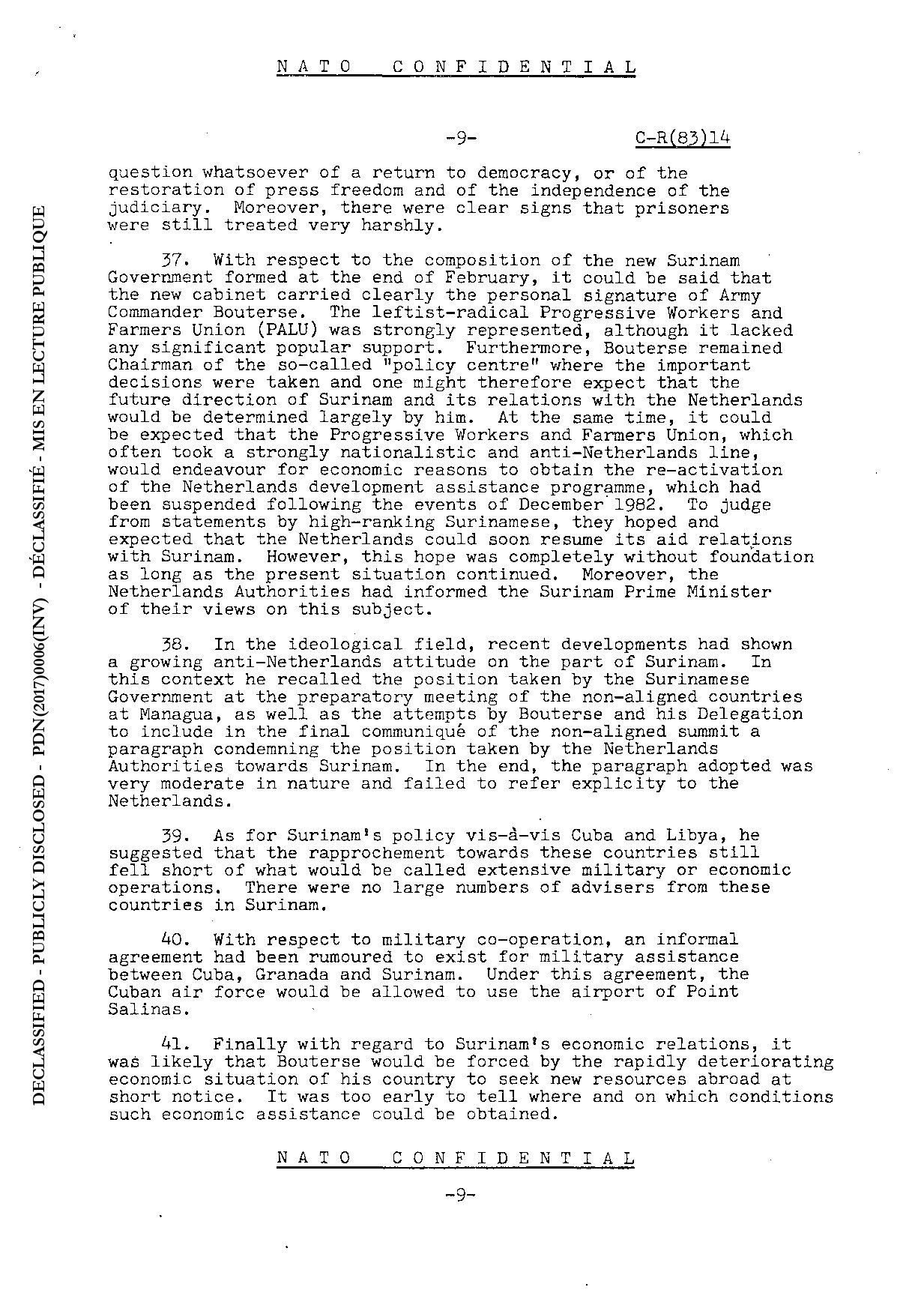
57, With respect to the composition of the new Surinam
Government formed at the end of February, it could be said that the new cabinet carried clearly the personal signature of Army
Commander Bouterse, The leftist-radical Progressive Workers and
Farmers Union (PALU) was strongly represented, although it lacked
any significant popular support. Furthermore, Bouterse remained Chairman of the so-called “policy centre” where the important
decisions were taken and one might therefore expect that the
future direction of Surinam and its relations with the Netherlands would be determined largely by him. At the same time, it could
be expected that the Progressive Workers and Farmers Union, which
often took a strongly nationalistic and anti-Netherlands line,
would endeavour for economic reasons to obtain the re-activation
of the Netherlands development assistance programme, which had
been suspended following the events of December 1982. To Judge
from statements by high-ranking Surinamese, they hoped and expected that the Netherlands could soon resume its aid relations
with Surinam. However, this hope was completely without foundation
as long as the present situation continued. Moreover, the
Netherlands Authorities had informed the Surinam Prime Minister
of their views on this subject. - In the ideological field, recent developments had shown
a growing anti-Netherlands attitude on the part of Surinam. In
this context he recalled the position taken by the Surinamese
Government at the preparatory meeting of the non-aligned countries
at Managua, as well as the attempts by Bouterse and his Delegation
to include in the final communique of the non-aligned summit a
paragraph condemning the position taken by the Netherlands
Authorities towards Surinam. In the end, the paragraph adopted was
very moderate in nature and failed to refer explicity to the
Netherlands. - As for Surinam!s policy vis-à-vis Cuba and Libya, he
suggested that the rapprochement towards these countries still
fell short of what would be called extensive military or economic
operations. There were no large numbers of advisers from these
countries in Surinam, - With respect to military co-operation, an informal
agreement had been rumoured to exist for military assistance
between Cuba, Granada and Surinam. Under this agreement, the
Cuban air force would be allowed to use the airport of Point
Salinas. - Finally with regard to Surinam’s economic relations, it
was likely that Bouterse would be forced by the rapidly deteriorating
economic situation of his country to seek new resources abroad at
short notice. It was too early to tell where and on which conditions
such economic assistance could be obtained.
NATO CONFIDENTIAL
-9-
DECLASSIFIED – PUBLICLY DISCLOSED – PDN(2017)0006(INV) – DÉCLASSIFIÉ – MIS EN LECTURE PUBLIQUE
NATO CONFIDENTIAL
-10- | C-R(83)14
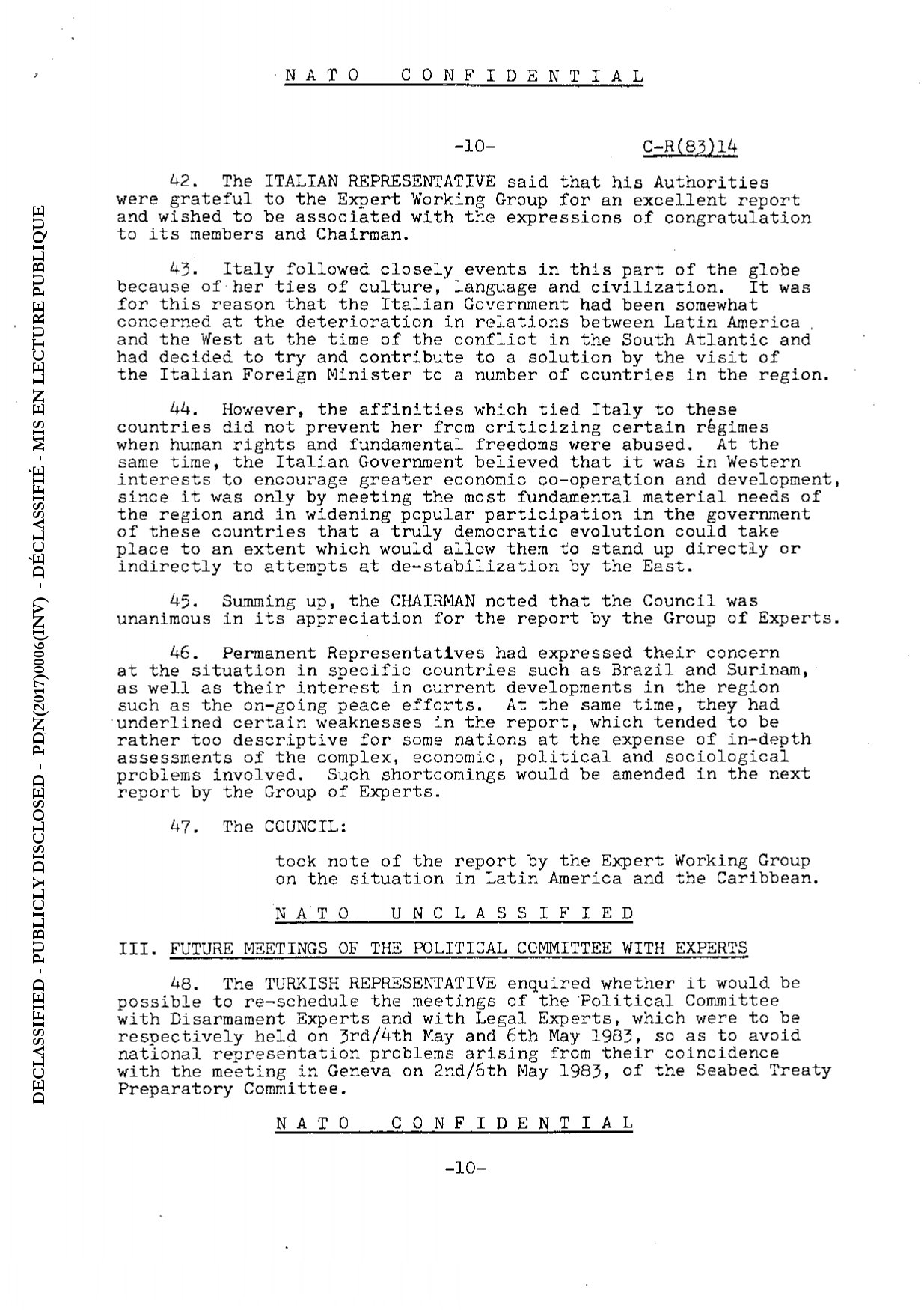
42, The ITALIAN REPRESENTATIVE said that his Authorities
were grateful to the Expert Working Group for an excellent report
and wished to be associated with the expressions of congratulation
to its members and Chairman.
43, Italy followed closely events in this part of the globe
because of her ties of culture, language and civilization. It was
for this reason that the Italian Government had been somewhat
concerned at the deterioration in relations between Latin America ,
and the West at the time of the conflict in the South Atlantic and
had decided to try and contribute to a solution by the visit of
the Itallan Foreign Minister to a number of countries in the region.
44, However, the affinities which tied Italy to these
countries did not prevent her from criticizing certain régimes
when human rights and fundamental freedoms were abused. At the
same time, the Italian Government believed that it was in Western
interests to encourage greater economic co-operation and development,
since it was only by meeting the most fundamental material needs of
the region and in widening popular participation in the government
of these countries that a truly democratic evolution could take
place to an extent which would allow them to stand up directly or
indirectly to attempts at de-stabilization by the East. - Summing up, the CHAIRMAN noted that the Council was
unanimous in its appreciation for the report by the Group of Experts. - Permanent Representatives had expressed their concern
at the situation in specific countries such as Brazil and Surinam,
as well as their interest in current developments in the region
such as the on-going peace efforts. At the same time, they had
‘underlined certain weaknesses in the report, which tended to be
rather too descriptive for some nations at the expense of in-depth
assessments of the complex, economic, political and sociological
problems involved. Such shortcomings would be amended in the next
report by the Group of Experts. - The COUNCIL:
took note of the report by the Expert Working Group
on the situation in Latin America and the Caribbean,
NATO UNCLASSIFIED
III. FUTURE MEETINGS OF THE POLITICAL COMMITTEE WITH EXPERTS
48, The TURKISH REPRESENTATIVE enquired whether it would be
possible to re-schedule the meetings of the Political Committee
with Disarmament Experts and with Legal Experts, which were to be
respectively held on 3rd/4th May and 6th May 1983, so as to avoid
national representation problems arising from their coincidence with the meeting in Geneva on 2nd/6th May 1983, of the Seabed Treaty
Preparatory Committee.
NATO CONFIDENTIAL
—10-
DECLASSIFIED – PUBLICLY DISCLOSED – PDN(2017)0006(INV) – DÉCLASSIFIÉ – MIS EN LECTURE PUBLIQUE
NATO CONFIDENTIAL
-ll- C-R(83)14
NATO UNCLASSIFIED
IV. FORTHCOMING DEPARTURE OF AMBASSADOR BENNETT
49, The CHAIRMAN said that it was with regret that he had
learned of the Imminent departure of Ambassador Bennett,
Permanent Representative of the United States. The Council would have the opportunity to bid him an official farewell in due course,
NATO,
1110 Brussels.
NATO CONFIDENTIAL
DECLASSIFIED – PUBLICLY DISCLOSED – PDN(2017)0006(INV) – DÉCLASSIFIÉ – MIS EN LECTURE PUBLIQUE
Date:
April 28, 1983