Suriname – An Economy Under Siege 1983
CIA-RDP85T00287R000400150001-3
same as
CIA-RDP85T00287R000400150002-2
CIA-RDP85M00363R000601450022-6
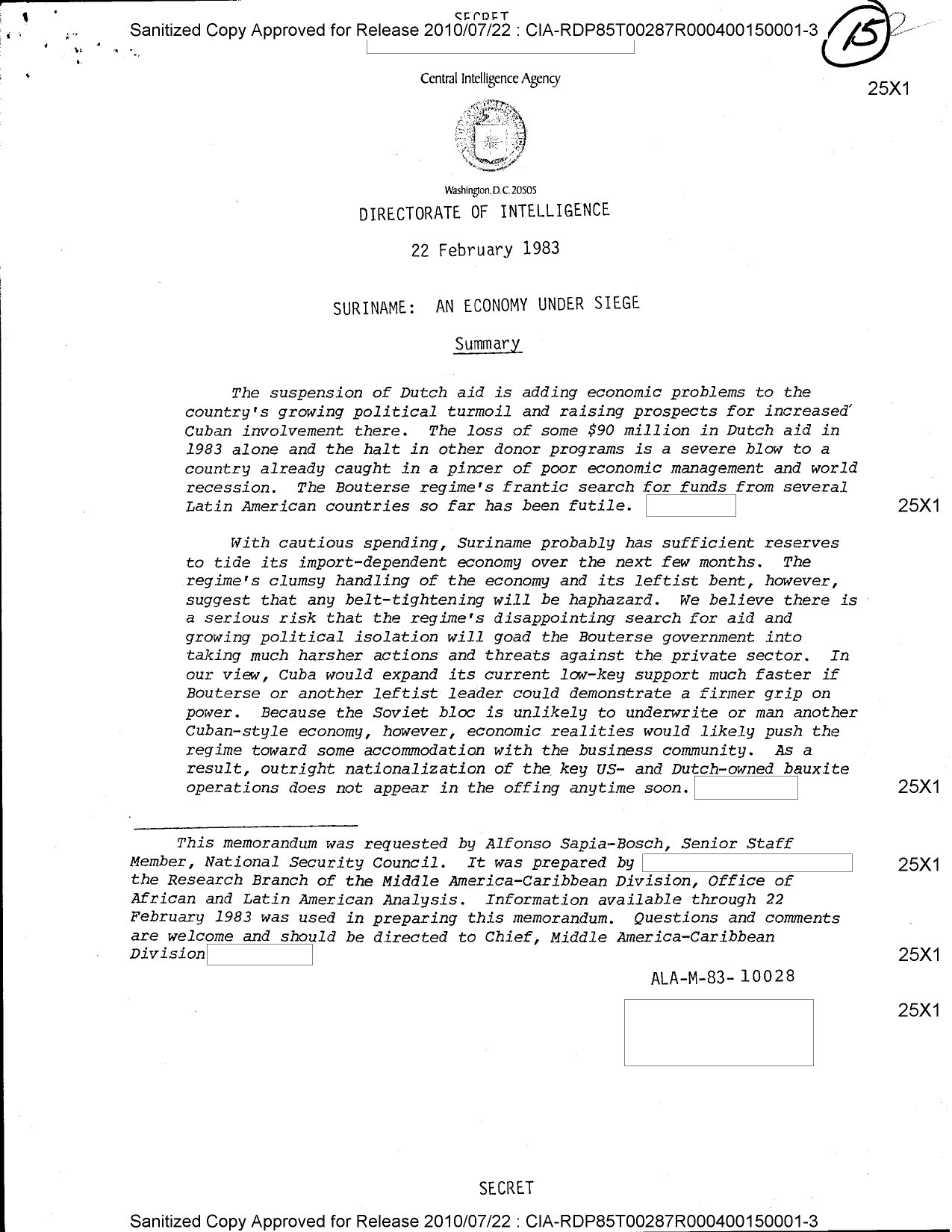
Central Intelligence Agency
Washington, D.C. 20505
DIRECTORATE OF INTELLIGENCE
22 February 1983
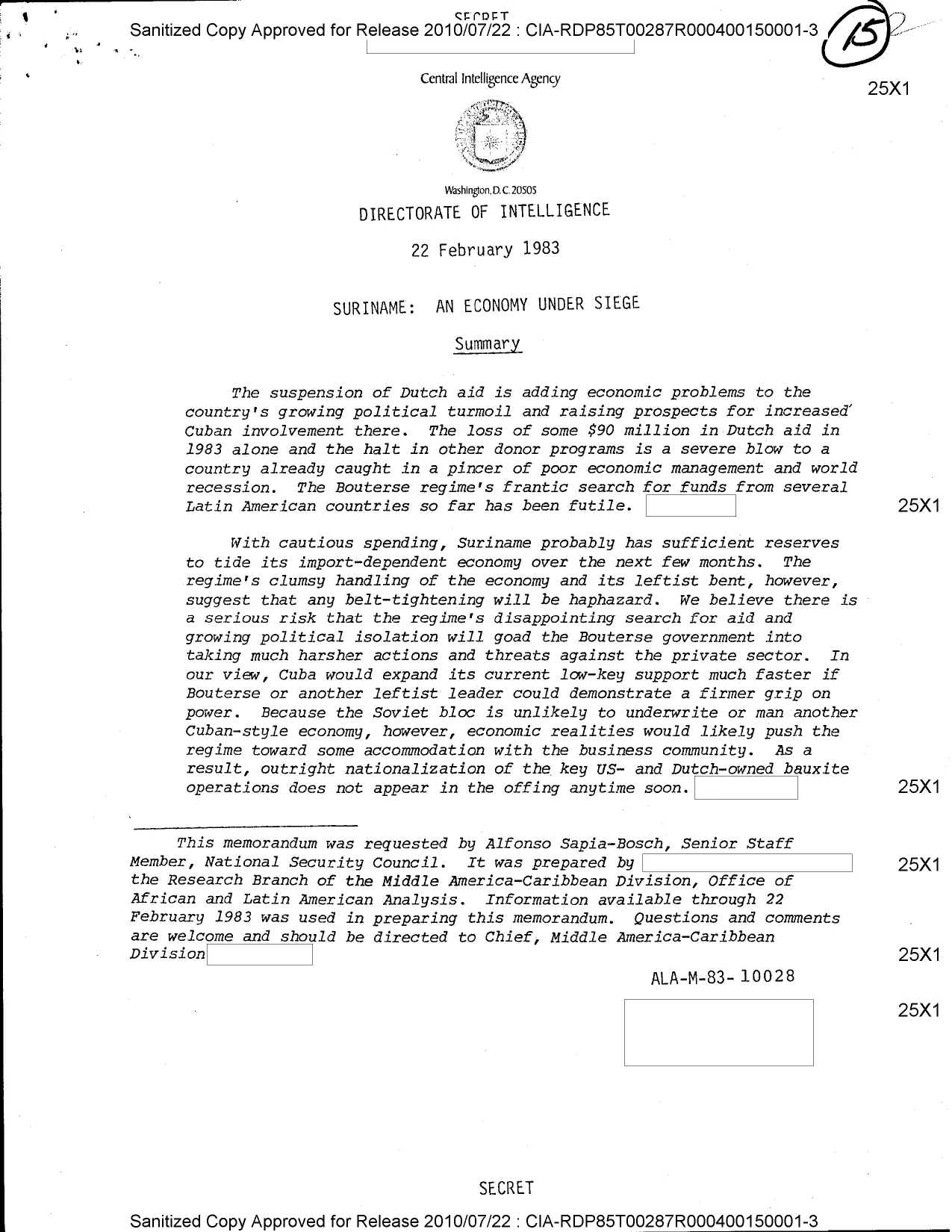
SURINAME: AN ECONOMY UNDER SIEGE
Summary
The suspension of Dutch aid is adding economic problems to the country’s growing political turmoil and raising prospects for increased Cuban involvement there. The loss of some $90 million in Dutch aid in 1983 alone and the halt in other donor programs is a severe blow to a country already caught in a pincer of poor economic management and world recession. The Bouterse regime’s frantic search for funds from several Latin American countries so far has been futile.
With cautious spending, Suriname probably has sufficient reserves to tide its import-dependent economy over the next few months. The regime’s clumsy handling of the economy and its leftist bent, however, suggest that any belt-tightening will be haphazard. We believe there is a serious risk that the regime’s disappointing search for aid and growing political isolation will goad the Bouterse government into taking much harsher actions and threats against the private sector. In our view, Cuba would expand its current low-key support much faster if Bouterse or another leftist leader could demonstrate a firmer grip on power. Because the Soviet bloc is unlikely to underwrite or man another Cuban-style economy, however, economic realities would likely push the regime toward some accommodation with the business community. As a result, outright nationalization of the key US- and Dutch-owned bauxite operations does not appear in the offing anytime soon.
This memorandum was requested by Alfonso Sapia-Bosch, Senior Staff Member, National Security Council. It was prepared by the Research Branch of the Middle America-Caribbean Division, Office of African and Latin American Analysis. Information available through 22 February 1983 was used in preparing this memorandum. Questions and comments are welcome and should be directed to Chief, Middle America-Caribbean Division.
Background
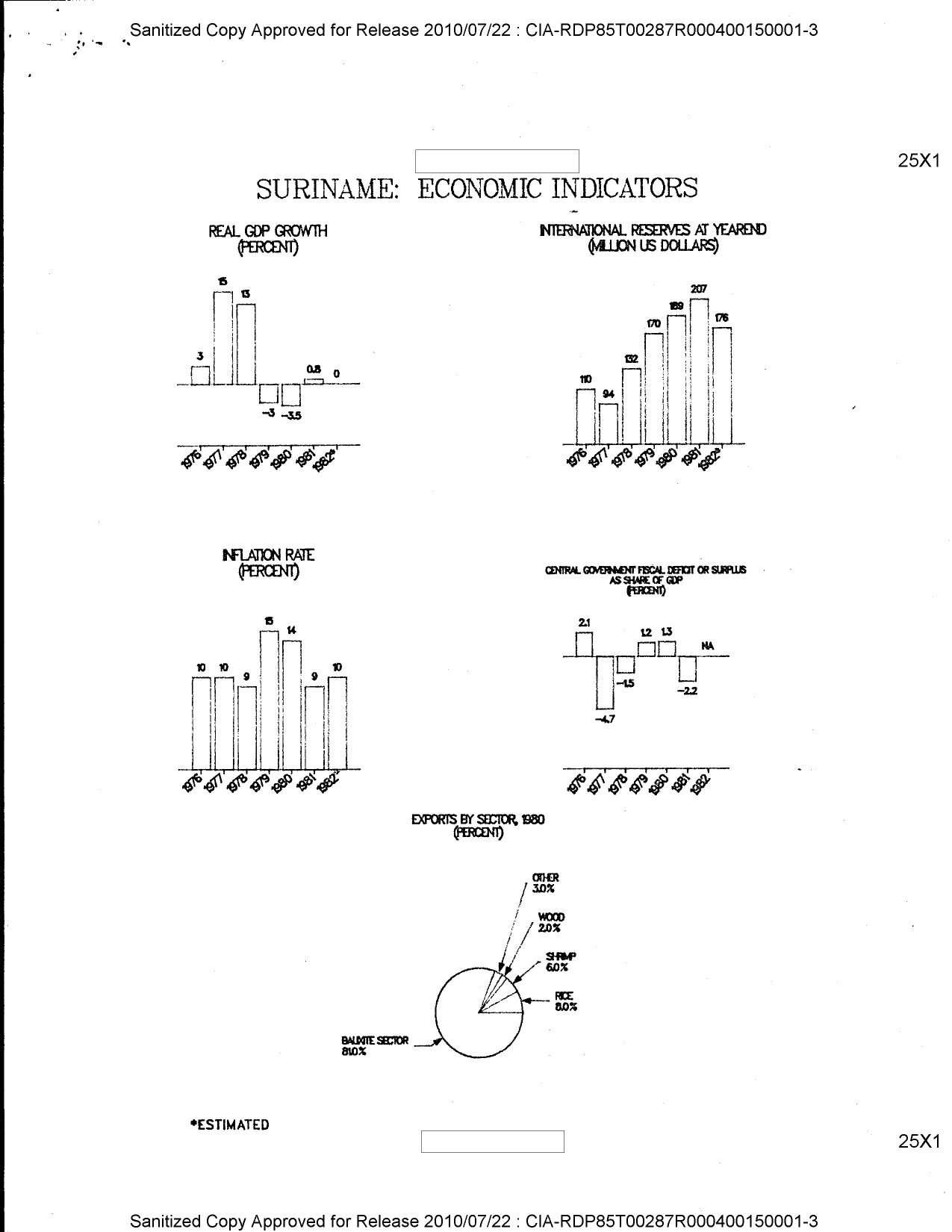
Under the tutelage of the Dutch, who provided the lion’s share of foreign aid, Suriname managed to achieve unusually robust economic growth during the initial years following independence in 1975 (see the Appendix for details). The tiny economy’s heavy dependence on an increasingly less competitive bauxite sector, however, left Suriname particularly vulnerable to the global recession and soft demand for aluminum. Meanwhile, weakening business confidence in the coalition government’s ability to rule slowed investment. In these circumstances, economic activity declined 3 percent in 1979.
The military-dominated government, in place since a group of noncommissioned officers seized power in February 1980, has been unable to brake the economic decline begun in 1979. In 1980, economic activity fell almost 4 percent, and the economy stagnated over the past two years. A 35 percent drop in bauxite output—owing to continuing world recession and rising production costs—and the worsening investment climate at home drove this poor performance between 1980 and 1982. Only the public sector showed strong growth. Even then, government expenditures were directed more toward consumption—civil service pay raises, make-work jobs to sop up rising unemployment, social welfare programs, military spending, and subsidy payments to state enterprises—than toward growth-sustaining investment.
The government’s limited capacity to prepare and implement large development projects increasingly constrained growth. Mismanagement, caused by a shortage of technical and managerial talent in government, badly delayed aid disbursements. Suriname’s weakening competitive edge in a softening world aluminum market also caused the government to shift its development strategy. In 1981, the regime scuttled large bauxite and aluminum smelter undertakings, the Kabalebo hydroelectric project, and construction of a new port city. Less ambitious agricultural projects, which would provide quick benefits to small farmers, were left intact. Output in the small agricultural sector nudged ahead, based primarily on expanded acreage cultivated for export-oriented rice and palm oil, but high labor and transport costs continued to undermine Suriname’s international competitiveness.
At the same time, the regime’s increasingly leftist tone—although longer on rhetoric than on action—and increasingly erratic approach to decisionmaking started to alarm investors. Market intervention and inefficiencies became more pervasive. Under the process of “surinamization” (nationalization or joint ventures with government participation), the state has expanded its involvement in national production. Constrained by fixed prices, key commercial enterprises with government participation such as sugar, shipping, and electricity last year alone required some $50 million in subsidies to offset operating losses.
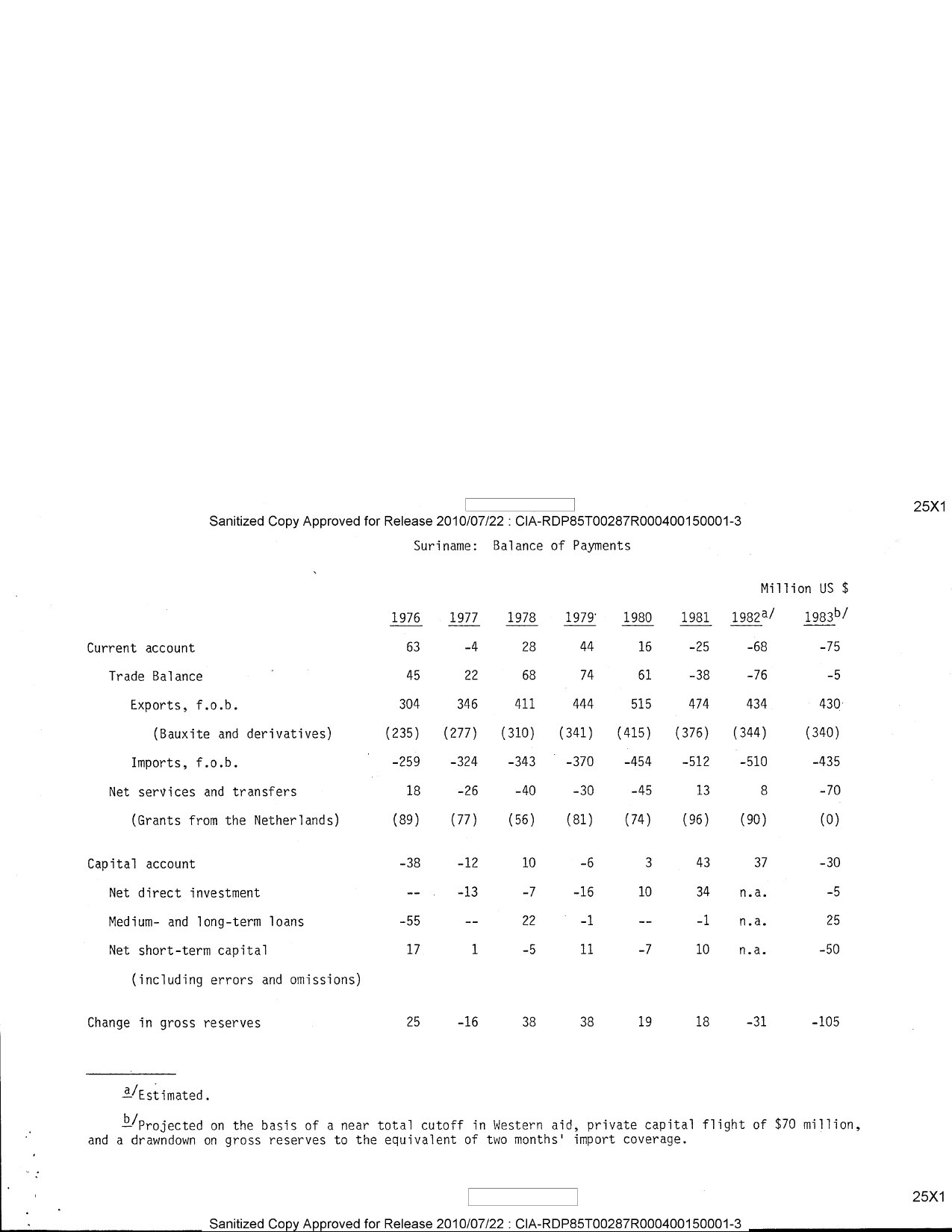
Suriname’s foreign payments situation matched the deterioration in key producing sectors. By 1981, the deteriorating trade balance had resulted in Suriname’s first balance-of-payments deficit in five years. Spot world aluminum prices plummeted over 40 percent between 1980 and 1982. Led by the bauxite industry, nominal export earnings fell 15 percent during this period. Meanwhile, foreign aid slackened as project priorities were reshuffled. Rather than depleting its international reserves or resort to a devaluation that could have hobbled foreign purchases of critical producer goods, the regime selectively tightened import restrictions on consumer goods. Consequently, the country still retained international reserve holdings that were roughly equivalent to about four months’ import coverage at yearend 1982.
Gloomy Outlook in 1983
Meeting Economic Needs
The regime’s most pressing economic need is to find replacement aid and to reassure the country’s nervous business community. Until the Netherlands suspended aid following the December executions, the Dutch had accounted for more than 90 percent of total bilateral aid to Suriname. Dutch aid had been scheduled to reach some $90 million this year; more than half of the $1.5 billion package promised in 1975 remains to be drawn. Led by the United States, most other Western donors have suspended their small programs in response to the regime’s brutal handling of its opponents. Meanwhile, we think private capital flight will continue to strain Suriname’s coffers despite the recent banking clampdown.
We believe the chilling effect of Bouterse’s increasingly heavy-handed tactics to quell dissent and to consolidate his power will deter potential donors. The regime’s frantic search for aid, trade, and technical cooperation—aimed mainly at Brazil, Venezuela, Colombia, and other Latin American countries—is likely to prove disappointing. These countries are suffering from serious financial troubles and—in any event—seem reluctant to support the Bouterse regime.
Prudent economic management would allow Suriname to muddle through the next few months even if sizable funds do not materialize quickly. Bouterse’s myopic decisionmaking practices and his obsession with retaining power, however, suggest that belt-tightening may be delayed and that the foreign reserve cushion will continue to be tapped. The regime recently secured a $50 million bridge loan from the Central Bank, contrary to the recommendations of the bank’s president, who has since fled the country. Moreover, the government reportedly is resorting to rapid monetary expansion to help cover its immediate expenses and to maintain consumption levels. This temporary palliative, however, risks a spurt in import demand and soaring inflation that would require harsher austerity measures later this year.
The course of the economy through the rest of 1983 is harder to predict. Much will depend on Bouterse’s staying power.
By brutally eliminating his main opponents and intimidating important elements of society, however, Bouterse has reduced the chance of an internal uprising anytime soon. He will remain vulnerable to an externally launched attack, but the exile groups appear disorganized and ineffective.
Even if the regime succeeds in consolidating its power, the Surinamese economy can be expected to become increasingly the chink in Bouterse’s armor. In the unlikely event that the flow of Western aid resumes later this year, we estimate that the Surinamese economy at best would stagnate in 1983. Weak world recovery and inherent lags in aluminum demand will leave export earnings at about last year’s level. Moreover, blocked aid in the pipeline would be hard to quickly restore to the levels originally planned. Alternatively, if the near-total cutoff in Western aid sticks through 1983, this constraint would likely usher in much tighter import cuts and fiscal austerity measures that could cause a sharp economic decline. Emigration, mainly to the Netherlands, neighboring French Guiana, and the Netherlands Antilles, would be expected to rise even faster as many of the 6,000 workers assigned to Dutch-financed projects alone are laid off. While this exodus will help to vent political frustration and cap unemployment, it will further drain the availability of skilled labor needed to maintain economic activity.
Threats to the Private Sector
We believe Bouterse’s political insecurity and reliance on a shrinking circle of advisers will likely cause him to take heavy-handed actions, consistent with his history as a high-strung former drill sergeant. What economic forms these reactions will take are hard to assess since Bouterse lacks a well-defined ideology. The deteriorating economy could well goad him into both cajoling and threatening the business community in the coming months; businessmen already have been asked to donate $300,000 to the coup anniversary celebrations this week and have been prohibited from laying off employees. Such conditions would only serve to increase the tensions between the government and the entrepreneurial and professional classes.
Although some of Bouterse’s closest advisers apparently espouse nationalization of foreign firms, we think that the soft world aluminum market, lack of skilled technicians, and steep modernization costs will cause Bouterse to resist such measures in the near future. Ongoing tax negotiations between the regime and the aluminum companies have been acrimonious and could provide the first real test of Bouterse’s intentions toward them. While the regime may unilaterally hike bauxite levies as a quick revenue fix, this action would be shortsighted. More than 90 percent of Suriname’s bauxite exports and 40 percent of its alumina sales are directed toward the United States and the Netherlands. Both countries, which rely on Suriname for only 10 percent and 30 percent of their bauxite/alumina supplies, respectively, could easily shift to alternative suppliers. Large stockpiles overhanging the world aluminum market could make it hard for Suriname to find other buyers.
Opportunities for Cuban Mischief
Bouterse already has warned publicly that he will turn for aid to the Soviet bloc states should his demarches to Western countries not pan out. After a coup attempt from within the military almost succeeded in March 1982, Bouterse turned to Havana for political support. Exploiting Bouterse’s growing isolation and sense of insecurity, Cuba has gained considerable influence and is likely to press for more. The Cuban Ambassador to Suriname recently stated that Cuba wants to increase trade with that country. Moreover, the Soviet Ambassador to Suriname has expressed interest in a possible barter deal in which Surinamese rice and lumber would be delivered to Cuba to save costs in shipping Soviet supplies. In exchange, Soviet vehicles, consumer goods, and possible light machinery—goods that would do little to sustain economic activity—would be sent to Suriname.
We believe Bouterse’s reliance on the Cubans will continue as long as he believes his domestic support is insecure and Havana is not perceived to be acting against his interests. Cuba does not want to provide much economic support to Suriname at this time because of its own economic problems and a concern that Bouterse’s revolution may yet be reversed. Moreover, Havana is acting cautiously to avoid jeopardizing its recent efforts to improve relations with several South American countries and alienating Western powers as Cuba attempts to renegotiate its debt. Under these circumstances, the Castro regime will likely pursue a low-key expansion of its influence in the country using minimal economic aid, military and security advisers, technical and medical assistance, and its ambassador’s access to Bouterse as principal sources of leverage. We believe Cuban influence in Suriname would expand faster if Bouterse or another leftist leader could demonstrate a firmer grip on power.
Lasting Economic Problems
Even if political stabilization and a reopening of the aid spigot occur, a variety of factors would likely prevent a return in the next few years to the high growth rates that the country enjoyed following independence. Although we expect aluminum prices to rise over the medium term with improved economic conditions in the industrialized world, earnings from Suriname’s bauxite sector will be constrained by a diminishing supply of easily accessible bauxite, high operating expenses, and steep modernization costs. Moreover, economic diversification will be harder than in the past. The shrinking domestic market will dampen further development of food processing and other light industries. Surinamese businessmen, foreign investors, and potential donors understandably will be cautious and probably will not undertake many projects until they can be assured of long-term political stability. In addition, the flight of technical and managerial talent will have lasting repercussions throughout the economy.
Appendix: The Economy in a Nutshell
Suriname shares many of the economic constraints that are commonplace in the Caribbean area. Suriname’s problems include:
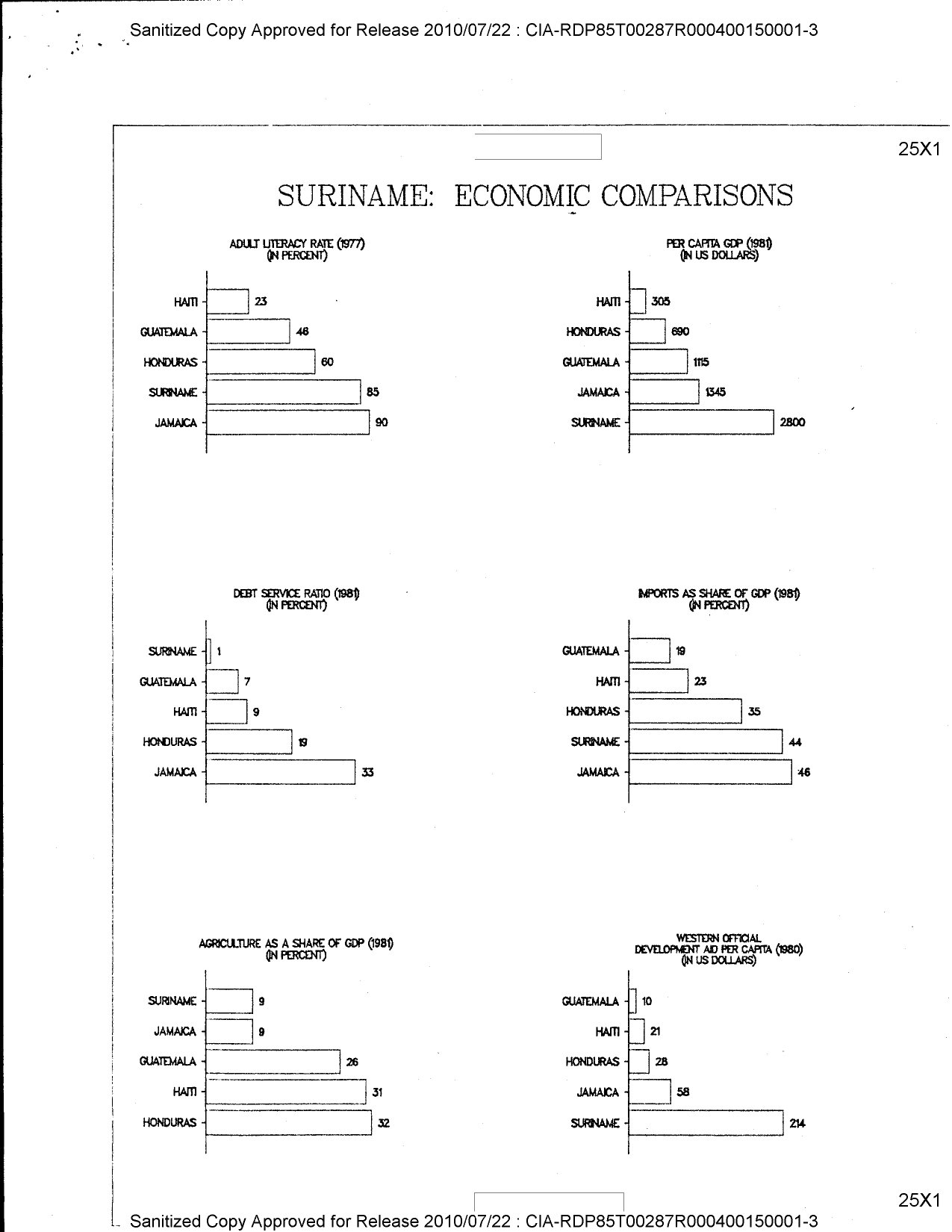
- A high import-dependence that leaves the country vulnerable to world inflationary trends and complicates domestic economic management; imports are equivalent to 45 percent of GDP.
- A one-commodity economy that holds the country hostage to world mineral prices; production of bauxite, alumina, and aluminum provide 80 percent of total export earnings, nearly 20 percent of GDP, and over 20 percent of government revenues.
- A tiny domestic market that crimps development of the manufacturing sector; roughly the size of Wisconsin, Suriname’s population totals only 350,000.
- Substantial emigration that helps to relieve high unemployment yet saps the country of skilled labor in the process; at least one out of every three Surinamers lives in the Netherlands because of Suriname’s political uncertainty and poor job opportunities. The unemployment rate nonetheless hovers around 20 percent, supported by an influx of Guyanese workers.
- An agricultural sector that contributes less than 10 percent of GDP; farming is handicapped by high labor costs and poor utilization of existing resources; dense rainforests cover 90 percent of the country while large tracts of cultivated land have been left fallow by the steady exodus of Surinamese and Dutch plantation owners.
Still, generous Dutch aid until recently had cushioned Suriname from the severity of economic problems besetting its Caribbean neighbors. At the time of Suriname’s independence in 1975, the Netherlands forgave all outstanding Surinamese debt and agreed to supply more than $1.5 billion in aid, mostly grants, over a 10-15 year period. This largesse enabled Suriname to mount extensive rural development and hydroelectric projects while balancing government budgets and maintaining large foreign reserve holdings and a low debt service burden. At the same time, the aid inflows, combined with large-scale emigration, contributed to a per capita income that was among the highest in the non-oil-exporting Caribbean countries and more than double that of bauxite-rich Guyana or Jamaica.
Against this background, Suriname achieved unusually strong economic growth in the initial years after independence. During 1976-78, real GDP growth climbed by an average annual rate of nearly 10 percent. Bauxite production and earnings quickly recovered from the effects of the 1973/74 world oil price hikes, based on a surge in aluminum prices and the increased share of bauxite processed into alumina or aluminum. At the same time, a sharp increase in public investment, largely funded by Dutch grants, stimulated construction and other service activities. High consumption levels, buoyed by rising real wages and low domestic interest rates, boosted growth of the fledgling light manufacturing sector—mainly food processing firms geared to the local market. Moreover, prudent economic policies kept inflation at an average annual rate of below 10 percent over the period.
By 1979, however, soaring oil and nonfuel import costs and the world slump had begun to take their toll on the economy. Economic activity declined by 3 percent. Bauxite output and processing began to falter as world aluminum demand sagged and the government eliminated minimum production requirements in hopes of retaining the US- and Dutch-owned operations that were gradually shifting to lower-cost, richer, and more dependable sources outside the Caribbean region. Meanwhile, public investment slowed, following the completion of the large Western Suriname railroad. Private investment also cooled as political uncertainty grew following the coalition government’s impasse over the national budget and the ensuing elections scheduled for March 1980.
Source:
Link:
Internal Link:
Date:
February 22, 1983