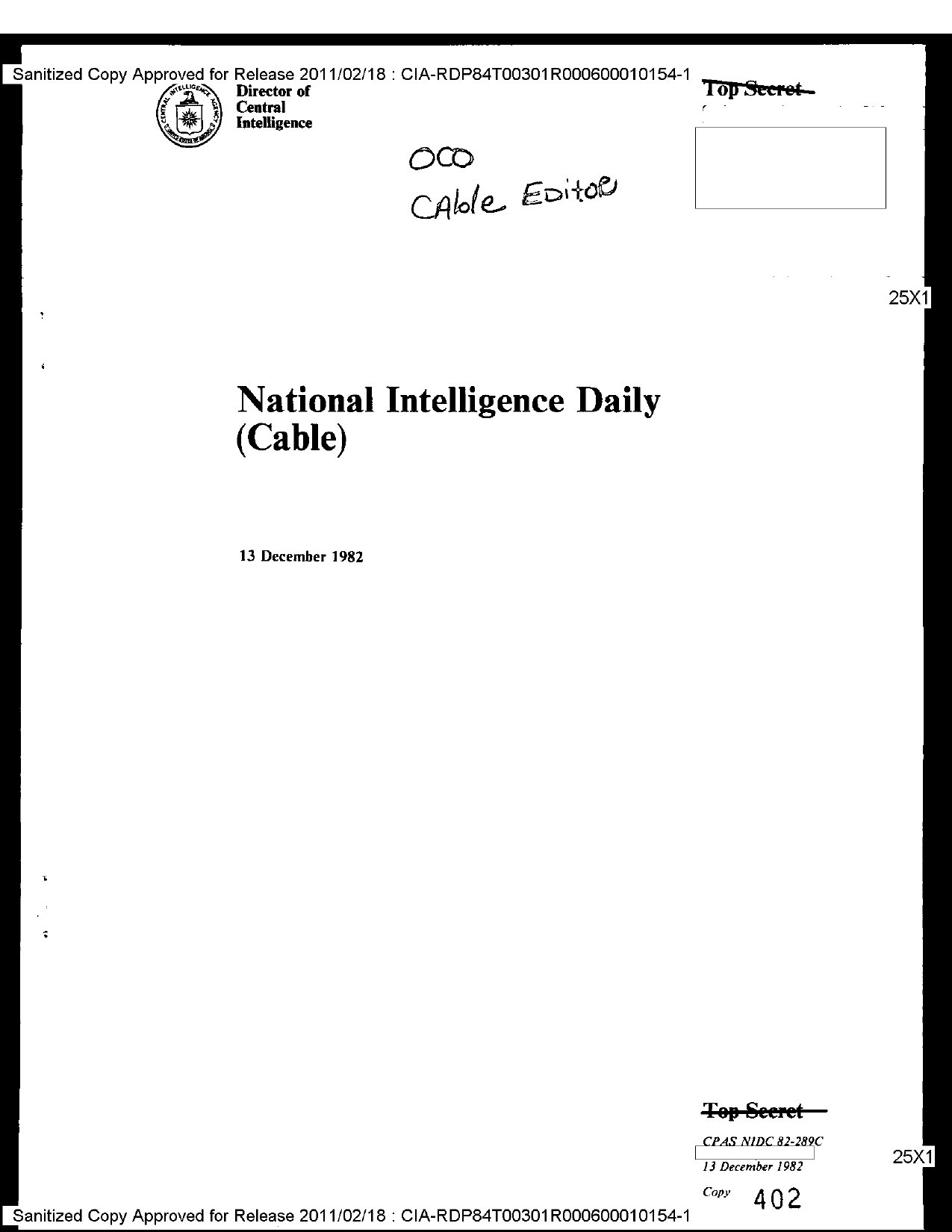
Suriname: Bouterse Consolidates Power – National Intelligence Daily – 13 December 1982
CIA-RDP84T00301R000600010154-1
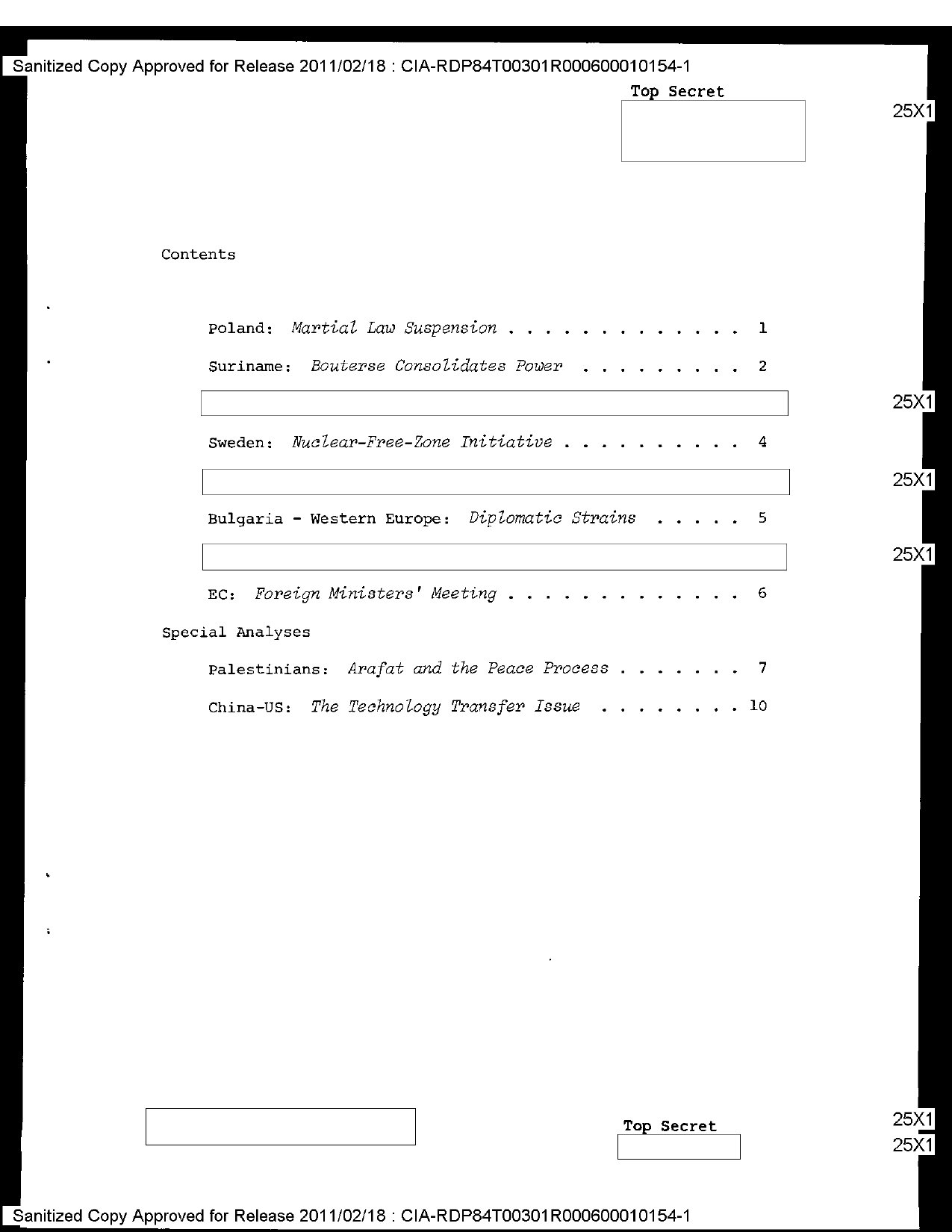
| Topic | Page |
|---|---|
| Poland: Martial Law Suspension | 1 |
| Suriname: Bouterse Consolidates Power | 2 |
| Sweden: Nuclear-Free-Zone Initiative | 4 |
| Bulgaria – Western Europe: Diplomatic Strains | 5 |
| EC: Foreign Ministers’ Meeting | 6 |
| Palestinians: Arafat and the Peace Process (Special Analysis) | 7 |
| China-US: The Technology Transfer Issue (Special Analysis) | 10 |
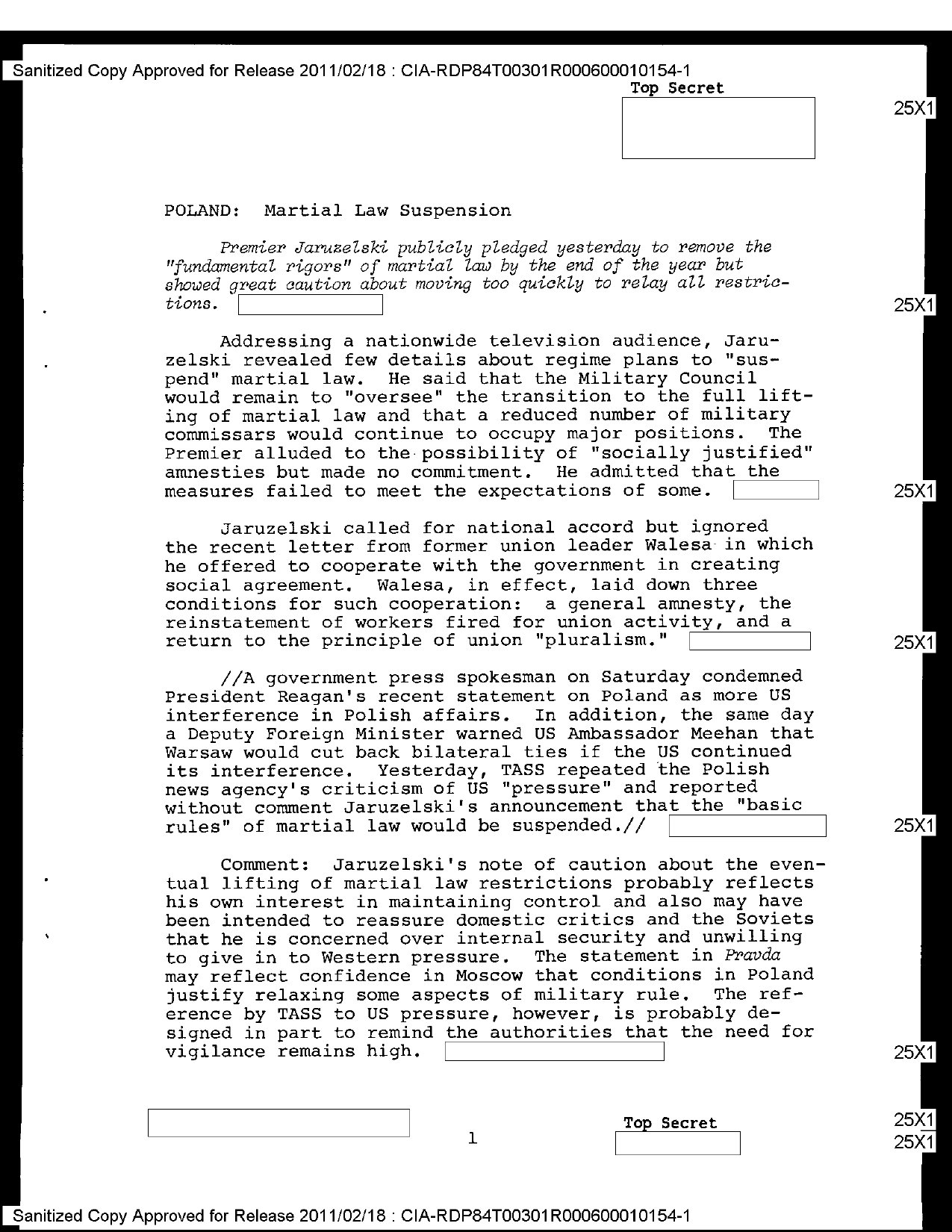
POLAND: Martial Law Suspension
Premier Jaruzelski publicly pledged yesterday to remove the “fundamental rigors” of martial law by the end of the year but showed great caution about moving too quickly to relay all restrictions. Addressing a nationwide television audience, Jaruzelski revealed few details about regime plans to “suspend” martial law. He said that the Military Council would remain to “oversee” the transition to the full lifting of martial law and that a reduced number of military commissars would continue to occupy major positions. The Premier alluded to the possibility of “socially justified” amnesties but made no commitment. He admitted that the measures failed to meet the expectations of some.
Jaruzelski called for national accord but ignored the recent letter from former union leader Walesa in which he offered to cooperate with the government in creating social agreement. Walesa, in effect, laid down three conditions for such cooperation: a general amnesty, the reinstatement of workers fired for union activity, and a return to the principle of union “pluralism.”
[A government press spokesman on Saturday condemned President Reagan’s recent statement on Poland as more US interference in Polish affairs. In addition, the same day a Deputy Foreign Minister warned US Ambassador Meehan that Warsaw would cut back bilateral ties if the US continued its interference. Yesterday, TASS repeated the Polish news agency’s criticism of US “pressure” and reported without comment Jaruzelski’s announcement that the “basic rules” of martial law would be suspended.]
Comment: Jaruzelski’s note of caution about the eventual lifting of martial law restrictions probably reflects his own interest in maintaining control and also may have been intended to reassure domestic critics and the Soviets that he is concerned over internal security and unwilling to give in to Western pressure. The statement in Pravda may reflect confidence in Moscow that conditions in Poland justify relaxing some aspects of military rule. The reference by TASS to US pressure, however, is probably designed in part to remind the authorities that the need for vigilance remains high.
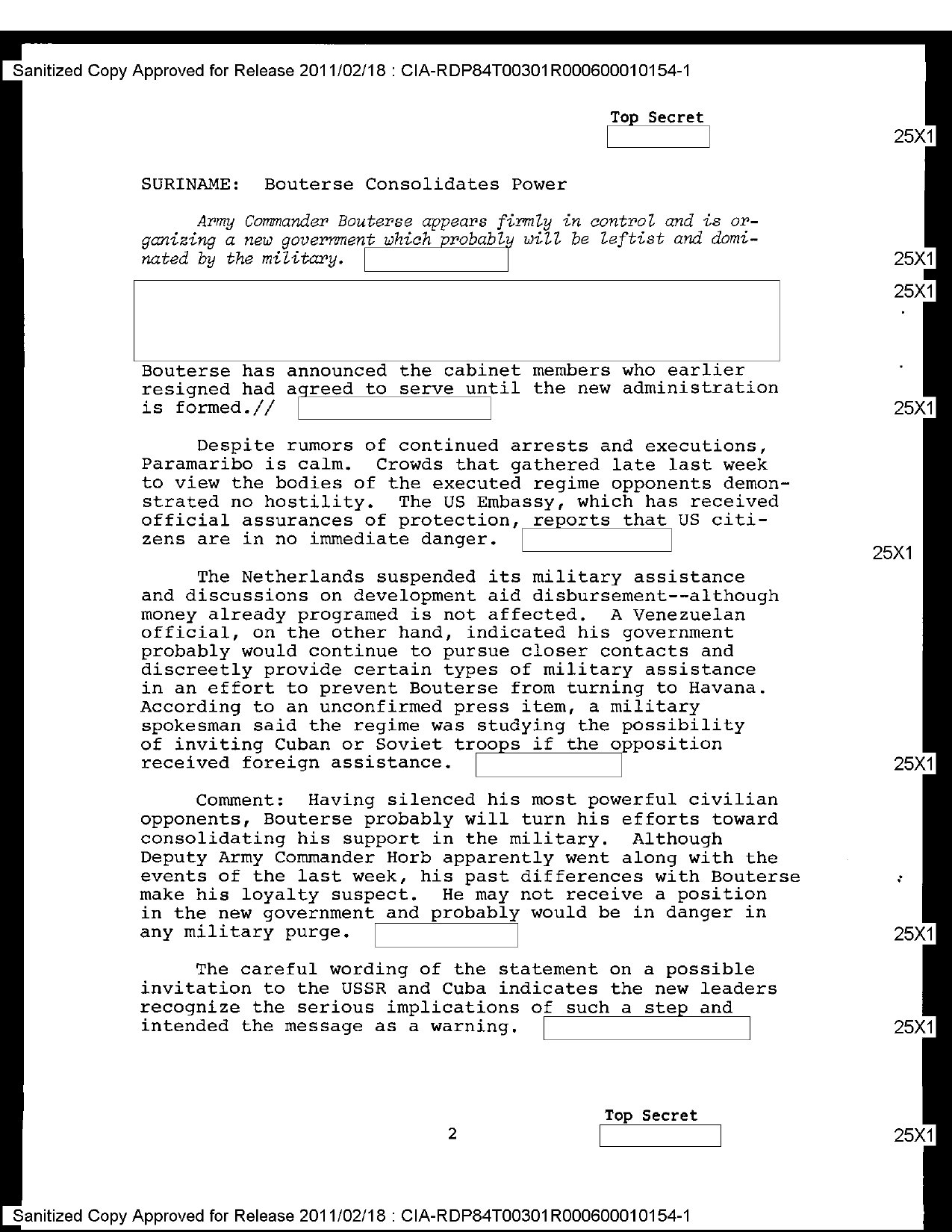
SURINAME: Bouterse Consolidates Power
Army Commander Bouterse appears firmly in control and is organizing a new government which probably will be leftist and dominated by the military. Bouterse has announced the cabinet members who earlier resigned had agreed to serve until the new administration is formed.
Despite rumors of continued arrests and executions, Paramaribo is calm. Crowds that gathered late last week to view the bodies of the executed regime opponents demonstrated no hostility. The US Embassy, which has received official assurances of protection, reports that US citizens are in no immediate danger.
The Netherlands suspended its military assistance and discussions on development aid disbursement—although money already programmed is not affected. A Venezuelan official, on the other hand, indicated his government probably would continue to pursue closer contacts and discreetly provide certain types of military assistance in an effort to prevent Bouterse from turning to Havana. According to an unconfirmed press item, a military spokesman said the regime was studying the possibility of inviting Cuban or Soviet troops if the opposition received foreign assistance.
Comment: Having silenced his most powerful civilian opponents, Bouterse probably will turn his efforts toward consolidating his support in the military. Although Deputy Army Commander Horb apparently went along with the events of the last week, his past differences with Bouterse make his loyalty suspect. He may not receive a position in the new government and probably would be in danger in any military purge. The careful wording of the statement on a possible invitation to the USSR and Cuba indicates the new leaders recognize the serious implications of such a step and intended the message as a warning.
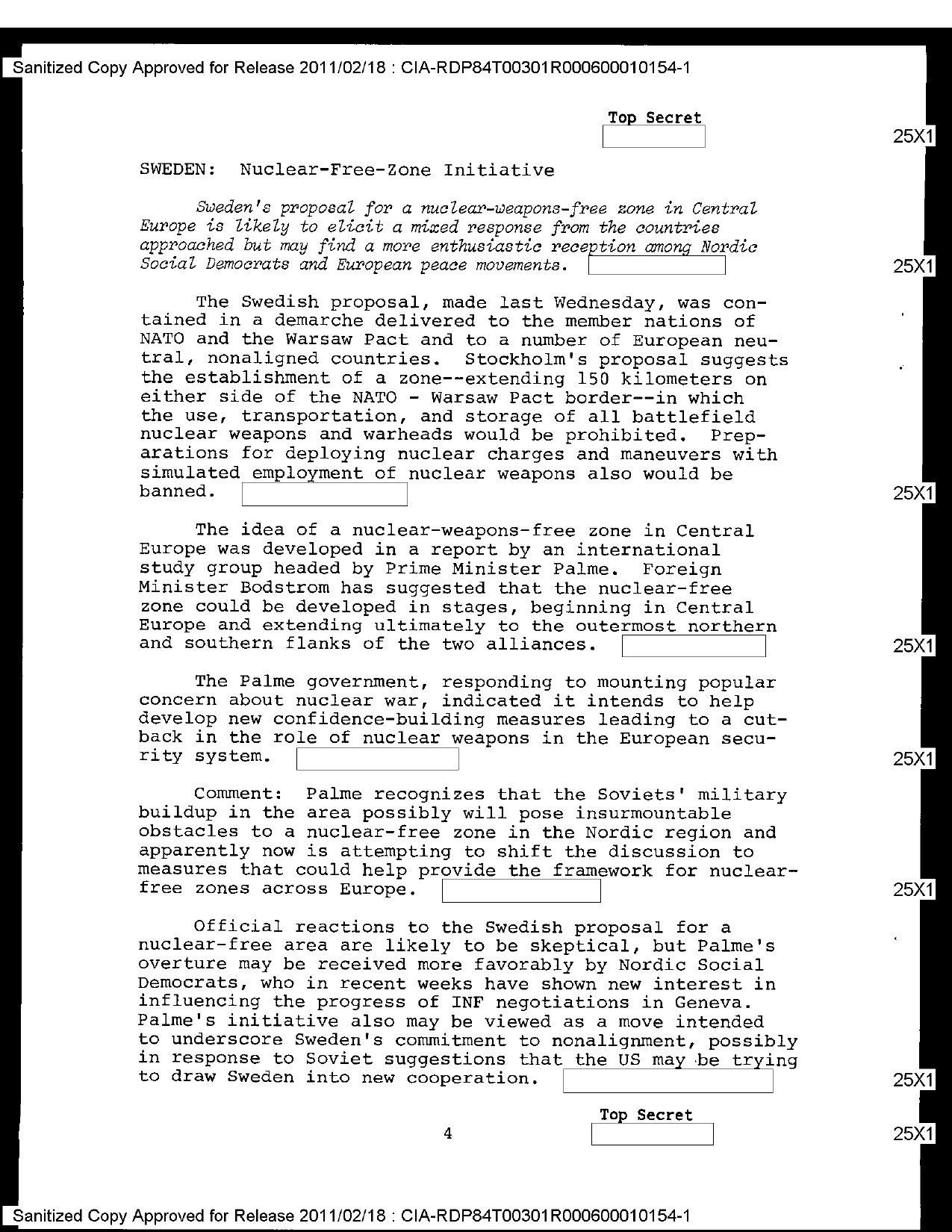
SWEDEN: Nuclear-Free-Zone Initiative
Sweden’s proposal for a nuclear-weapons-free zone in Central Europe is likely to elicit a mixed response from the countries approached but may find a more enthusiastic reception among Nordic Social Democrats and European peace movements.
The Swedish proposal, made last Wednesday, was contained in a demarche delivered to the member nations of NATO and the Warsaw Pact and to a number of European neutral, nonaligned countries. Stockholm’s proposal suggests the establishment of a zone—extending 150 kilometers on either side of the NATO-Warsaw Pact border—in which the use, transportation, and storage of all battlefield nuclear weapons and warheads would be prohibited. Preparations for deploying nuclear charges and maneuvers with simulated employment of nuclear weapons also would be banned.
The idea of a nuclear-weapons-free zone in Central Europe was developed in a report by an international study group headed by Prime Minister Palme. Foreign Minister Bodstrom has suggested that the nuclear-free zone could be developed in stages, beginning in Central Europe and extending ultimately to the outermost northern and southern flanks of the two alliances.
The Palme government, responding to mounting popular concern about nuclear war, indicated it intends to help develop new confidence-building measures leading to a cutback in the role of nuclear weapons in the European security system.
Comment: Palme recognizes that the Soviets’ military buildup in the area possibly will pose insurmountable obstacles to a nuclear-free zone in the Nordic region and apparently now is attempting to shift the discussion to measures that could help provide the framework for nuclear-free zones across Europe. Official reactions to the Swedish proposal for a nuclear-free area are likely to be skeptical, but Palme’s overture may be received more favorably by Nordic Social Democrats, who in recent weeks have shown new interest in influencing the progress of INF negotiations in Geneva. Palme’s initiative also may be viewed as a move intended to underscore Sweden’s commitment to nonalignment, possibly in response to Soviet suggestions that the US may be trying to draw Sweden into new cooperation.
BULGARIA – WESTERN EUROPE: Diplomatic Strains
Bulgaria’s alleged involvement in the shooting of the Pope and other questionable activities has set off negative diplomatic reactions in some West European capitals. Italy recalled its Ambassador to Bulgaria on Saturday for “consulations” following Bulgaria’s recall last week of its Ambassador to Rome. According to Western press reports, Italian Foreign Minister Colombo said that, despite insufficient corroboration of Bulgaria’s involvement, Rome remains concerned over possible other illegal activities by Bulgarians. Officials in Bonn also stressed that they are concerned about reports of Sofia’s toleration of heroin trafficking between Bulgaria and West Germany and of possible links between Palestinian guerrillas in Bulgaria and West German terrorist groups.
Comment: Sofia is clearly embarrassed by the Italian accusations and concerned about the negative impact on its image abroad. Bulgarian officials probably hoped the arrest last week of Bekir Celenk—a smuggler based in Sofia accused by Turkish media of involvement in the plot to kill the Pope—would help its tarnished reputation. With Western attention also focused on reported Bulgarian willingness to provide a safehaven for arms and narcotics traffickers and possible support for terrorism, it will be difficult for Sofia to limit additional damage to its reputation.
EC: Foreign Ministers’ Meeting
The Foreign Ministers begin a two-day meeting in Brussels today at which they will discuss the extension of trade restrictions on certain Soviet imports. The measures, enacted last January in response to Warsaw’s imposition of martial law, will expire on 31 December unless renewed.
Comment: The UK and France in particular would like to see the sanctions renewed. Other EC members, including Denmark and Greece, claim that the measures have been ineffective and unpopular. Most members, however, agree that conditions in Poland have not improved substantially over the past year and that members will need to evaluate the effects of the suspension of martial law. The Foreign Ministers, therefore, probably will postpone a decision on renewing the sanctions until late this month, when they may decide on an extension of one or two months.
PALESTINIANS: Arafat and the Peace Process
PLO leader Arafat enjoys widespread support in the Palestinians’ umbrella organization for his strategy to link it with the negotiations called for by President Reagan’s Middle East peace proposals. He has not been able, however, to form a consensus behind a specific approach. Some PLO radicals, encouraged by Syria, have intensified their opposition to his policies. To maintain maximum flexibility, Arafat is moving ahead with efforts to strengthen PLO-Jordanian relations.
The US initiative has increasingly become the focus of debate in PLO councils and between the PLO and Jordan. Arafat and other PLO leaders publicly continue to give equal attention to the Fez summit proposals, but they have clearly concluded the PLO’s future role in the peace process depends mainly on its approach to the US initiative.
The PLO Central Council’s decision last month in Damascus not to reject the US initiative amounted to a reaffirmation of Arafat’s dominant position and support for his efforts to promote a peaceful solution to the Palestinian problem.
The council’s failure to vote on recognition of Israel, relations with Jordan, and other specific issues, indicates the lack of consensus on the PLO’s next move. President Assad refused to meet with Arafat while he was in Damascus for the council meeting.
West Bank Activities
The PLO’s claim to be the only legitimate representative of the Palestinians recently has been strengthened. A group of independent West Bank political leaders failed to obtain significant support for a draft petition urging the PLO to be more conciliatory about recognizing Israel.
If these independents had succeeded, they might have emerged eventually as an alternative to the PLO as a representative of the West Bank population. There seems little chance for now that any sizable number of West Bankers would support King Hussein’s participation in negotiations unless he has the PLO’s approval.
Jordan’s Role
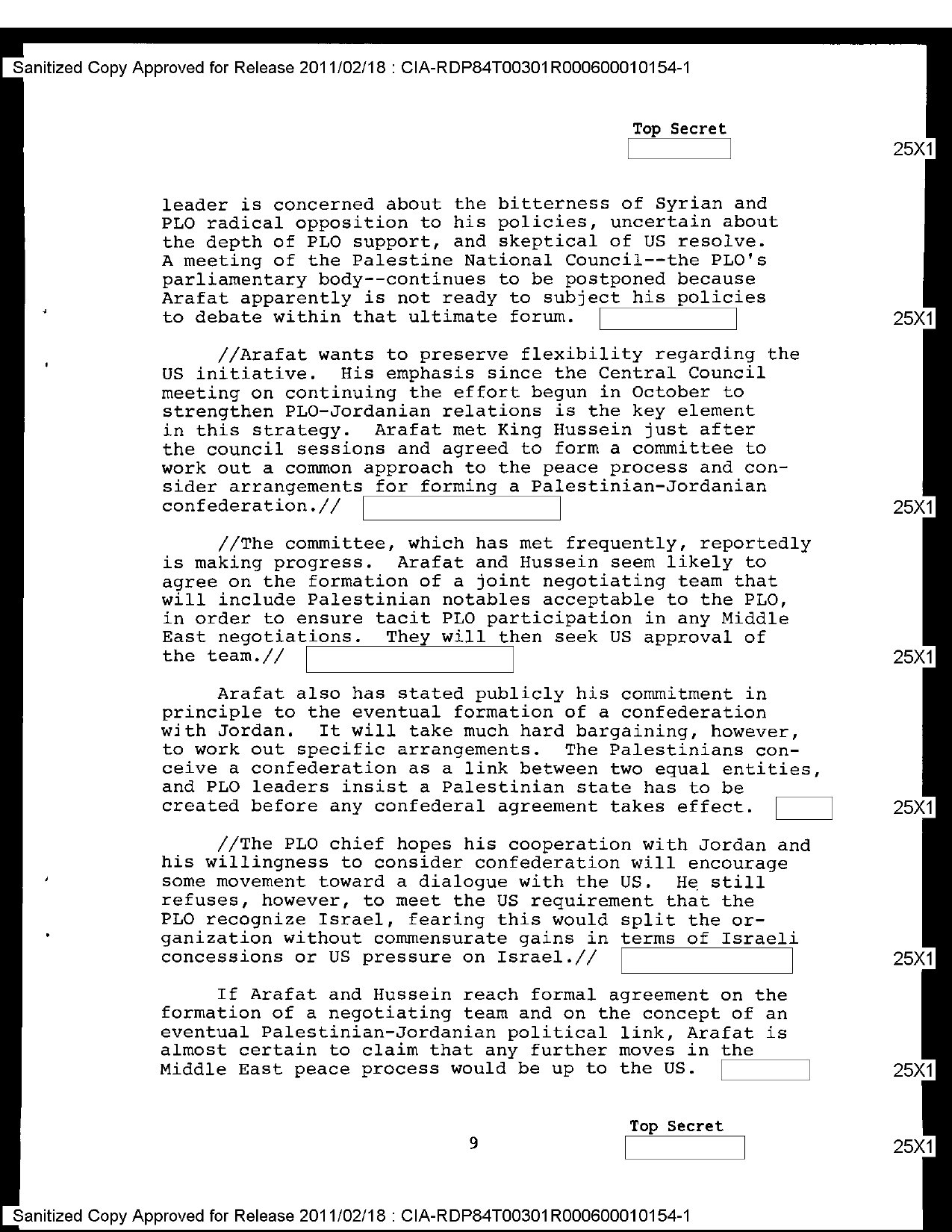
Despite the majority support for Arafat in the Central Council, he continues to move cautiously toward involving the PLO in the negotiating process. The PLO leader is concerned about the bitterness of Syrian and PLO radical opposition to his policies, uncertain about the depth of PLO support, and skeptical of US resolve. A meeting of the Palestine National Council—the PLO’s parliamentary body—continues to be postponed because Arafat apparently is not ready to subject his policies to debate within that ultimate forum.
Arafat wants to preserve flexibility regarding the US initiative. His emphasis since the Central Council meeting on continuing the effort begun in October to strengthen PLO-Jordanian relations is the key element in this strategy. Arafat met King Hussein just after the council sessions and agreed to form a committee to work out a common approach to the peace process and consider arrangements for forming a Palestinian-Jordanian confederation.
The committee, which has met frequently, reportedly is making progress. Arafat and Hussein seem likely to agree on the formation of a joint negotiating team that will include Palestinian notables acceptable to the PLO, in order to ensure tacit PLO participation in any Middle East negotiations. They will then seek US approval of the team.
Arafat also has stated publicly his commitment in principle to the eventual formation of a confederation with Jordan. It will take much hard bargaining, however, to work out specific arrangements. The Palestinians conceive a confederation as a link between two equal entities, and PLO leaders insist a Palestinian state has to be created before any confederal agreement takes effect.
The PLO chief hopes his cooperation with Jordan and his willingness to consider confederation will encourage some movement toward a dialogue with the US. He still refuses, however, to meet the US requirement that the PLO recognize Israel, fearing this would split the organization without commensurate gains in terms of Israeli concessions or US pressure on Israel.
If Arafat and Hussein reach formal agreement on the formation of a negotiating team and on the concept of an eventual Palestinian-Jordanian political link, Arafat is almost certain to claim that any further moves in the Middle East peace process would be up to the US.
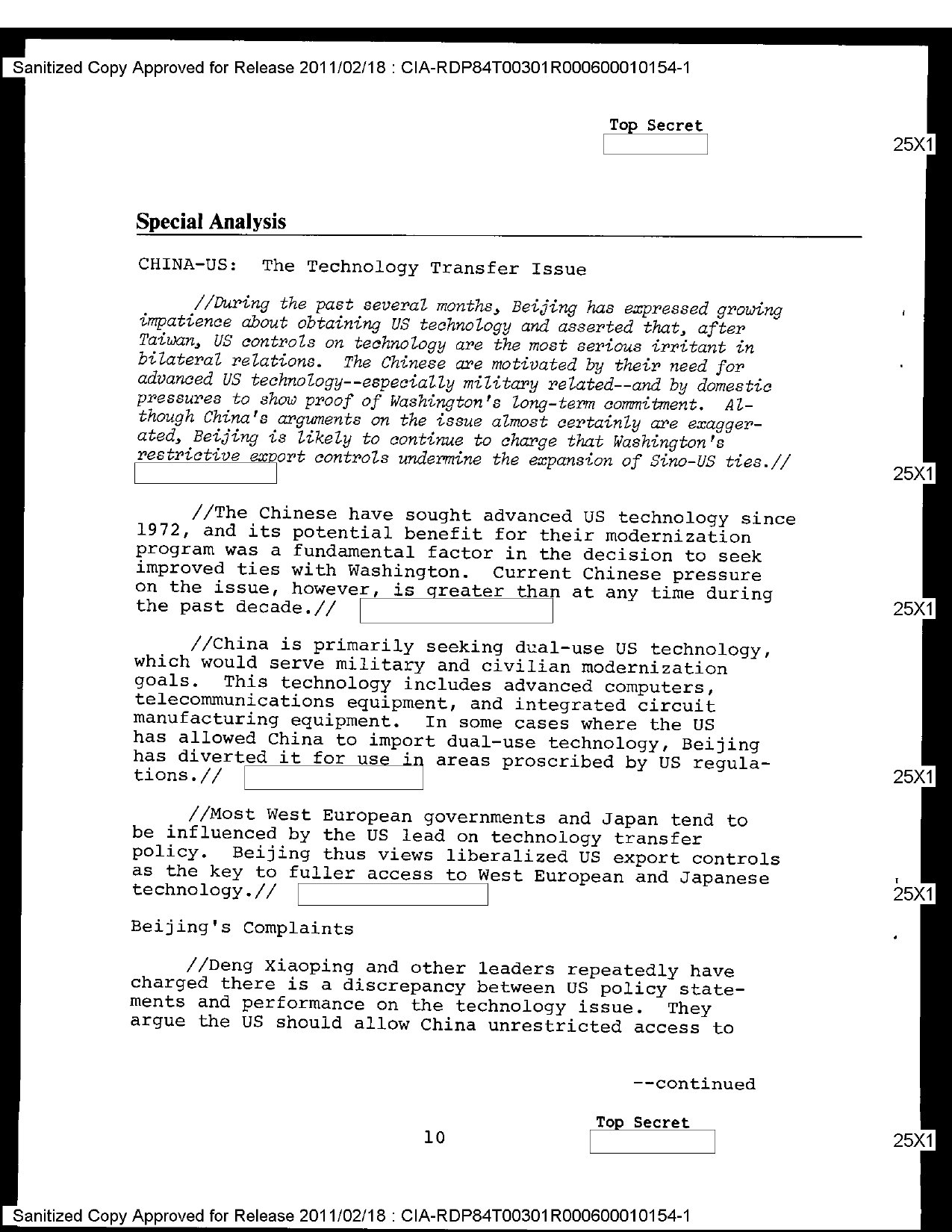
CHINA-US: The Technology Transfer Issue
During the past several months, Beijing has expressed growing impatience about obtaining US technology and asserted that, after Taiwan, US controls on technology are the most serious irritant in bilateral relations. The Chinese are motivated by their need for advanced US technology—especially military related—and by domestic pressures to show proof of Washington’s long-term commitment. Although China’s arguments on the issue almost certainly are exaggerated, Beijing is likely to continue to charge that Washington’s restrictive export controls undermine the expansion of Sino-US ties.
The Chinese have sought advanced US technology since 1972, and its potential benefit for their modernization program was a fundamental factor in the decision to seek improved ties with Washington. Current Chinese pressure on the issue, however, is greater than at any time during the past decade.
China is primarily seeking dual-use US technology, which would serve military and civilian modernization goals. This technology includes advanced computers, telecommunications equipment, and integrated circuit manufacturing equipment. In some cases where the US has allowed China to import dual-use technology, Beijing has diverted it for use in areas proscribed by US regulations.
Most West European governments and Japan tend to be influenced by the US lead on technology transfer policy. Beijing thus views liberalized US export controls as the key to fuller access to West European and Japanese technology.
Beijing’s Complaints
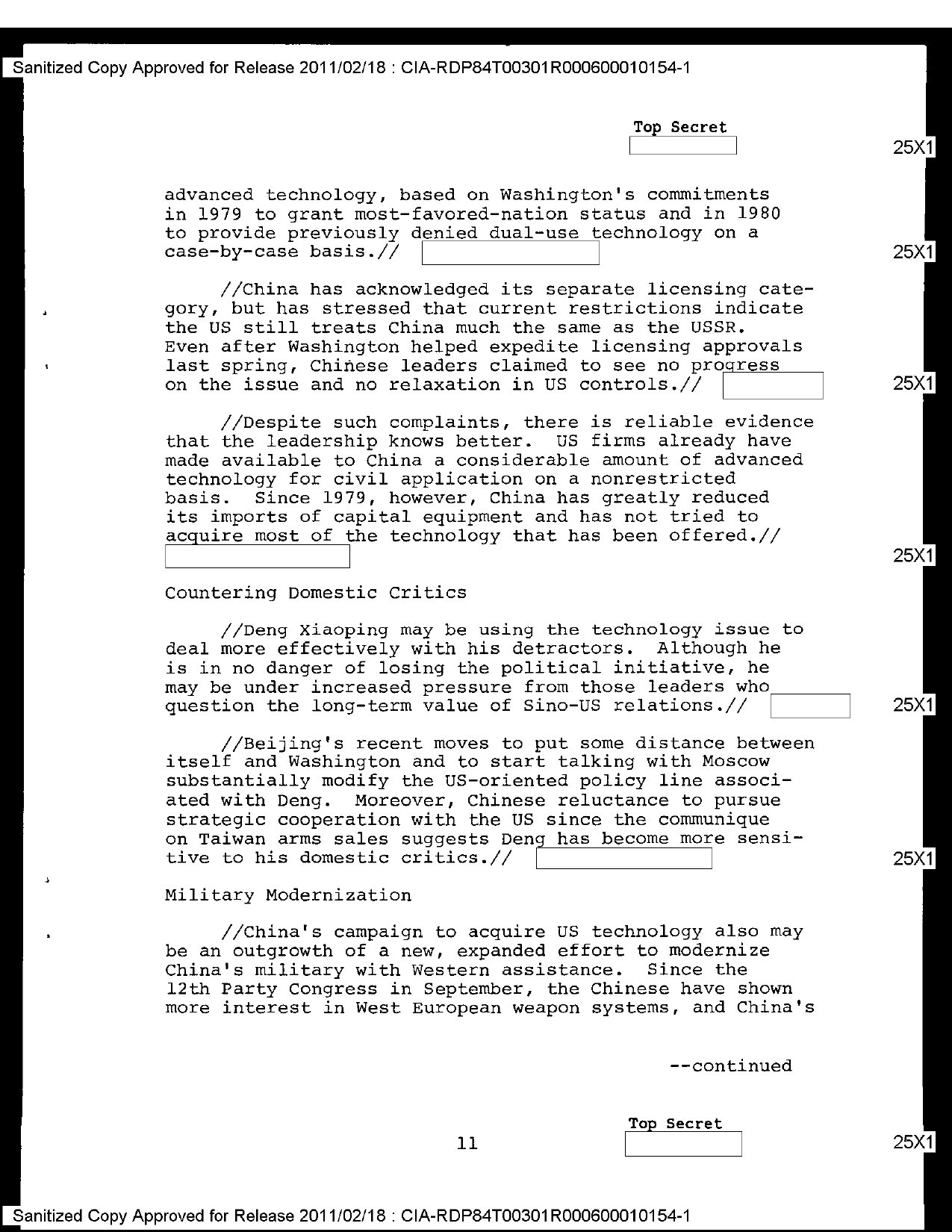
Deng Xiaoping and other leaders repeatedly have charged there is a discrepancy between US policy statements and performance on the technology issue. They argue the US should allow China unrestricted access to advanced technology, based on Washington’s commitments in 1979 to grant most-favored-nation status and in 1980 to provide previously denied dual-use technology on a case-by-case basis.
China has acknowledged its separate licensing category, but has stressed that current restrictions indicate the US still treats China much the same as the USSR. Even after Washington helped expedite licensing approvals last spring, Chinese leaders claimed to see no progress on the issue and no relaxation in US controls.
Despite such complaints, there is reliable evidence that the leadership knows better. US firms already have made available to China a considerable amount of advanced technology for civil application on a nonrestricted basis. Since 1979, however, China has greatly reduced its imports of capital equipment and has not tried to acquire most of the technology that has been offered.
Countering Domestic Critics
Deng Xiaoping may be using the technology issue to deal more effectively with his detractors. Although he is in no danger of losing the political initiative, he may be under increased pressure from those leaders who question the long-term value of Sino-US relations.
Beijing’s recent moves to put some distance between itself and Washington and to start talking with Moscow substantially modify the US-oriented policy line associated with Deng. Moreover, Chinese reluctance to pursue strategic cooperation with the US since the communique on Taiwan arms sales suggests Deng has become more sensitive to his domestic critics.
Military Modernization
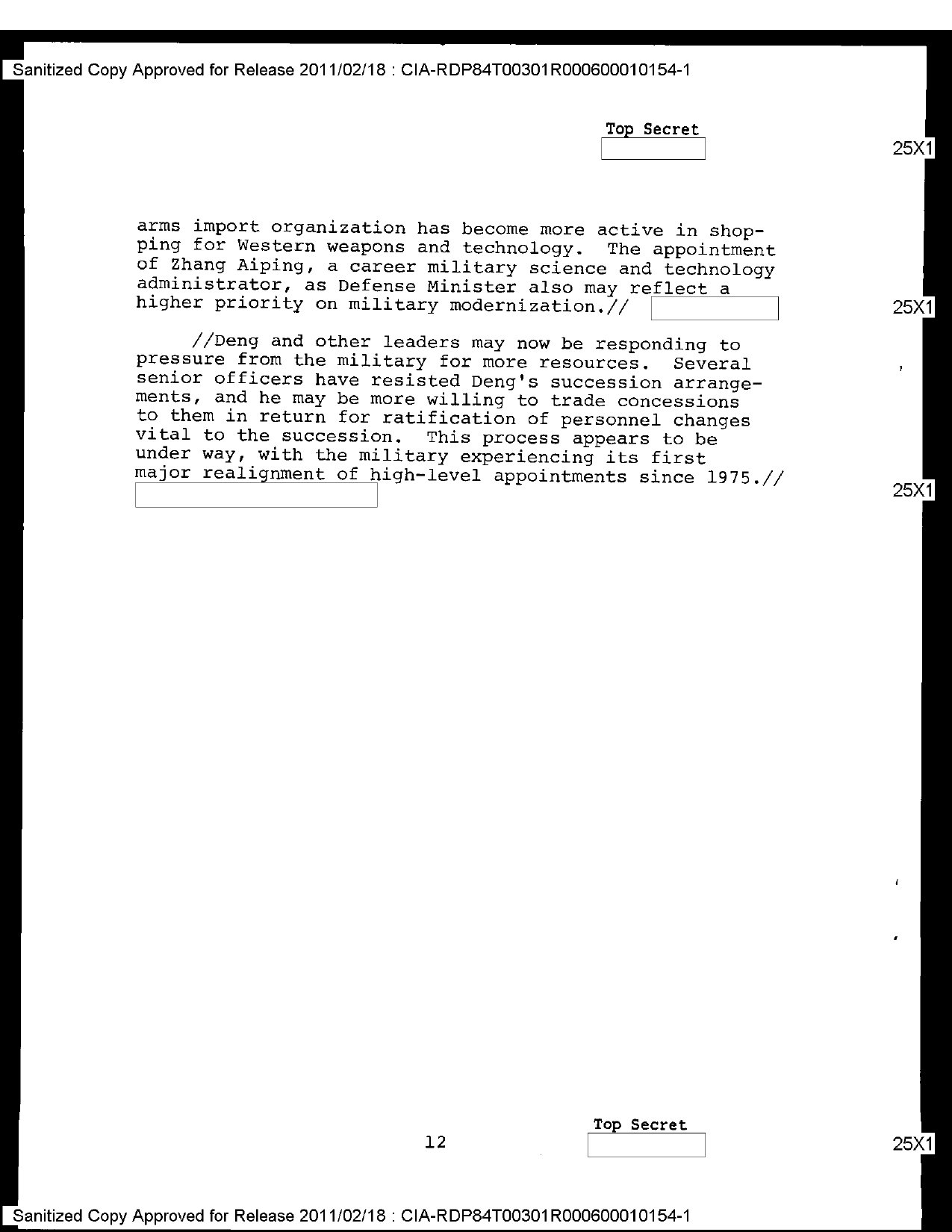
China’s campaign to acquire US technology also may be an outgrowth of a new, expanded effort to modernize China’s military with Western assistance. Since the 12th Party Congress in September, the Chinese have shown more interest in West European weapon systems, and China’s arms import organization has become more active in shopping for Western weapons and technology.
The appointment of Zhang Aiping, a career military science and technology administrator, as Defense Minister also may reflect a higher priority on military modernization.
Deng and other leaders may now be responding to pressure from the military for more resources. Several senior officers have resisted Deng’s succession arrangements, and he may be more willing to trade concessions to them in return for ratification of personnel changes vital to the succession. This process appears to be under way, with the military experiencing its first major realignment of high-level appointments since 1975.
Source:
Link:
Internal Link:
Date:
December 13, 1982