Suriname: Coup Attempt – National Intelligence Daily – 12 March 1982
CIA-RDP84T00301R000200010043-8
Director of Central Intelligence
OCO/CE Top Secret 25X1
National Intelligence Daily (Cable)
12 March 1982
Top Secret
CO NIDC 82-059C
12 March 1982
Copy 402
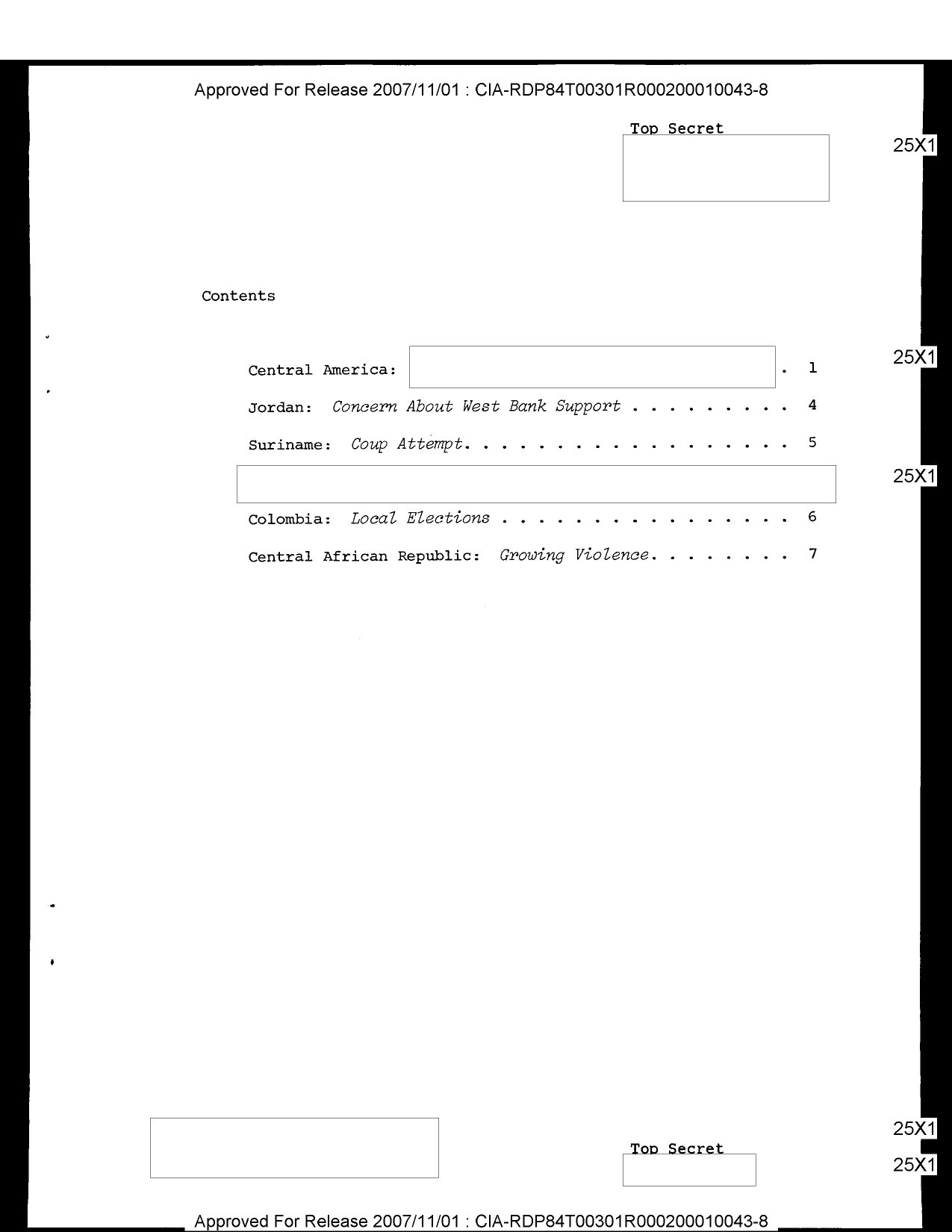
| Section | Page |
|---|---|
| Central America | 1 |
| Jordan: Concern About West Bank Support | 4 |
| Suriname: Coup Attempt | 5 |
| Colombia: Local Elections | 6 |
| Central African Republic: Growing Violence | 7 |
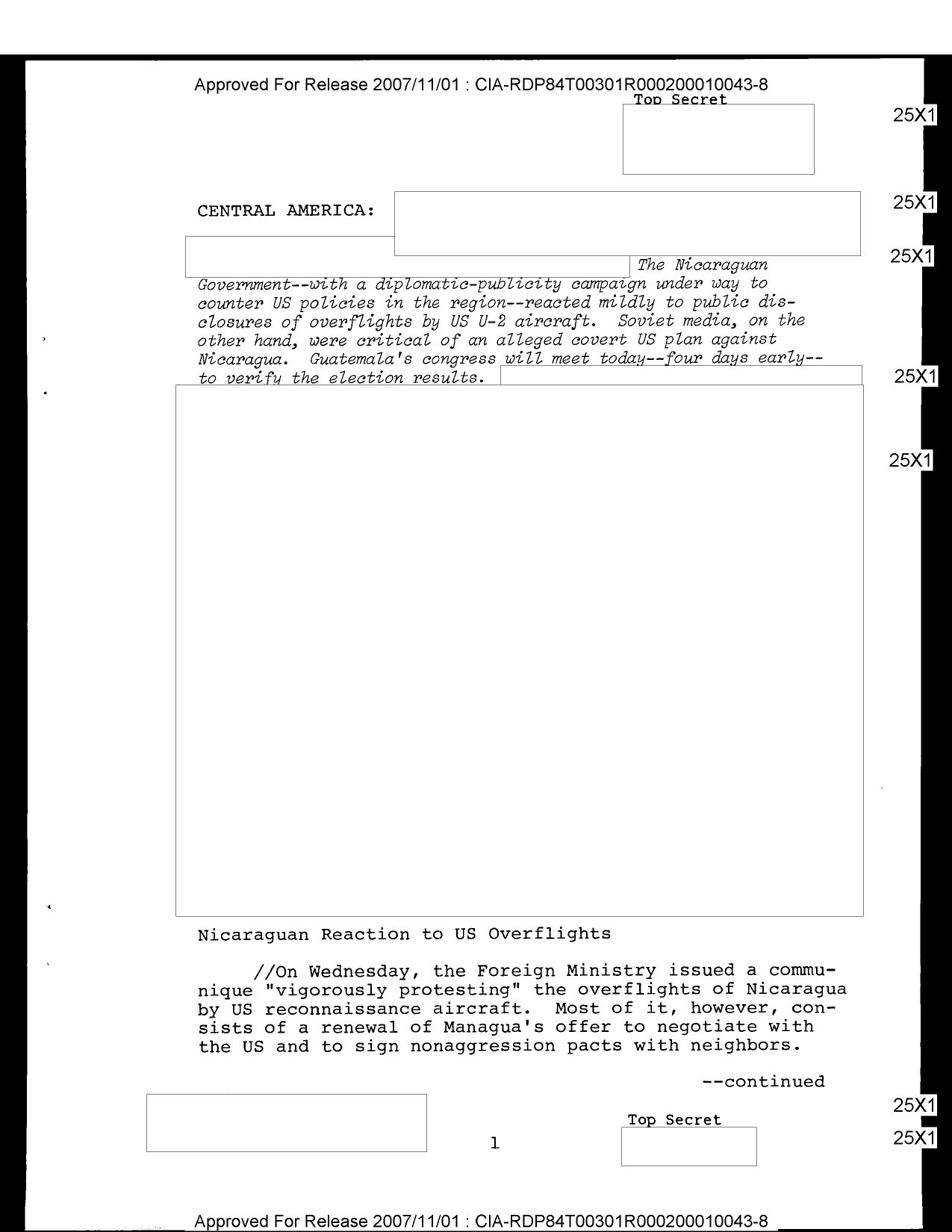
CENTRAL AMERICA
The Nicaraguan Government — with a diplomatic-publicity campaign under way to counter US policies in the region — reacted mildly to public disclosures of overflights by US U-2 aircraft. Soviet media, on the other hand, were critical of an alleged covert US plan against Nicaragua. Guatemala’s congress will meet today — four days early — to verify the election results.
Nicaraguan Reaction to US Overflights
//On Wednesday, the Foreign Ministry issued a communique “vigorously protesting” the overflights of Nicaragua by US reconnaissance aircraft. Most of it, however, consists of a renewal of Managua’s offer to negotiate with the US and to sign nonaggression pacts with neighbors.//
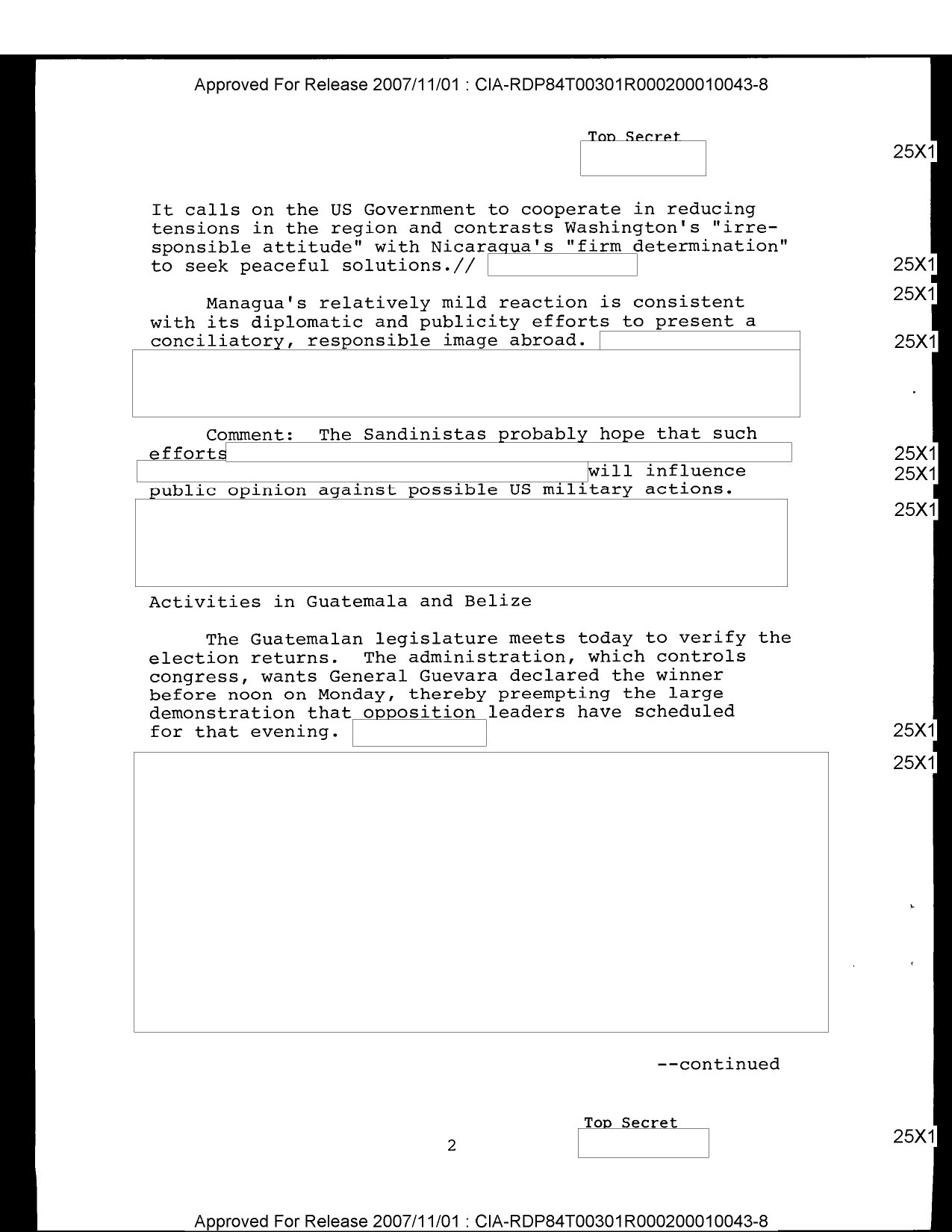
It calls on the US Government to cooperate in reducing tensions in the region and contrasts Washington’s “irresponsible attitude” with Nicaragua’s “firm determination” to seek peaceful solutions.//
Managua’s relatively mild reaction is consistent with its diplomatic and publicity efforts to present a conciliatory, responsible image abroad.
Comment: The Sandinistas probably hope that such efforts will influence public opinion against possible US military actions.
Activities in Guatemala and Belize
The Guatemalan legislature meets today to verify the election returns. The administration, which controls congress, wants General Guevara declared the winner before noon on Monday, thereby preempting the large demonstration that opposition leaders have scheduled for that evening.
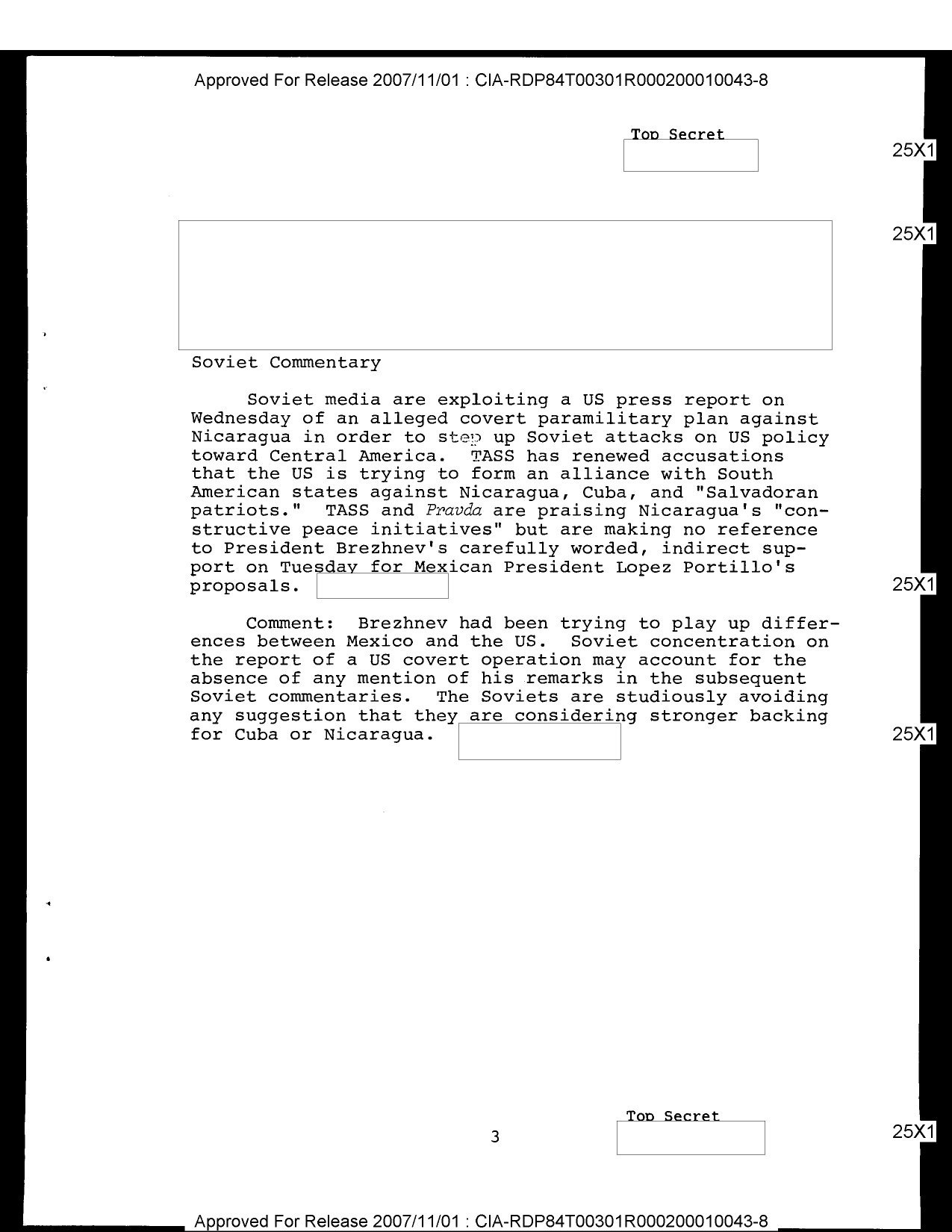
Soviet Commentary
Soviet media are exploiting a US press report on Wednesday of an alleged covert paramilitary plan against Nicaragua in order to step up Soviet attacks on US policy toward Central America. TASS has renewed accusations that the US is trying to form an alliance with South American states against Nicaragua, Cuba, and “Salvadoran patriots.” TASS and Pravda are praising Nicaragua’s “constructive peace initiatives” but are making no reference to President Brezhnev’s carefully worded, indirect support on Tuesday for Mexican President Lopez Portillo’s proposals.
Comment: Brezhnev had been trying to play up differences between Mexico and the US. Soviet concentration on the report of a US covert operation may account for the absence of any mention of his remarks in the subsequent Soviet commentaries. The Soviets are studiously avoiding any suggestion that they are considering stronger backing for Cuba or Nicaragua.
JORDAN: Concern About West Bank Support
Pressure by Jordan on Arabs who have joined the Village Leagues established by Israel in the occupied West Bank apparently reflects concern that the organizations are undercutting support for Amman in the area.
The Village Leagues draw their membership from the rural, clan-oriented areas of the West Bank that have traditionally supported King Hussein. Jordanian Prime Minister Badran has warned League officials that they have one month to resign or face treason charges.
The first two Village Leagues were set up three years ago in rural areas of the West Bank by the Israeli military government there shortly after the Camp David accords were signed. They remained generally inactive until last year, when military government officials began to strengthen and expand the Leagues — there are now five — as a counterweight to the pro-PLO town mayors.
Officials of the Leagues were given substantial financial powers and control over important local administrative procedures. Some were allowed to carry weapons, and most received protection from Israeli bodyguards.
Comment: Jordan’s action may backfire. The Leagues have not substantially undercut popular support either for Jordan or the PLO in the area, and few West Bankers regard the Leagues as anything more than Israeli fronts. The publicity surrounding Badran’s order, however, could give the Leagues a measure of attention that they otherwise would not have received.
SURINAME: Coup Attempt
//Dissident military officers opposing the leftist trend of the military leadership launched a coup yesterday, but forces loyal to the government are still resisting.//
//The group, calling itself the Army of National Liberation, is led by two officers who have been associated with conservative elements of Surinamese society. The rebels have called for the immediate formation of a new civilian government and the holding of elections within six months.//
Although the rebels have control of the Army’s main barracks and ammunition depot in Paramaribo, government strongman Army Commander Bouterse and troops loyal to him apparently have taken up a defensive position in the capital’s military police camp some 6 kilometers away. Fighting subsided somewhat last night, with both sides claiming to be in control and appealing for support from military troops and citizenry.
Comment: //A large number of rank-and-file military, who had objected to Bouterse’s leftist policies several months ago, probably will join the dissidents if Bouterse’s position weakens further. If the rebel group does not achieve control quickly, however, the advantage could swing back to regime loyalists. Some of Bouterse’s more radical supporters may even request aid from Cuba in an attempt to turn the tide.//
//If successful, the coup’s participants probably will attempt to restore constitutional rule. Their effectiveness, however, would be severely limited by their inexperience, pressures from leftist politicians, and the country’s growing economic problems.//
COLOMBIA: Local Elections
Legislative and municipal elections will be held on Sunday under tight security because extremist groups are threatening to sabotage the balloting. Security forces, however, believe they can prevent any major violence. The local elections center on personalities rather than issues, and the success of slates headed by the country’s leading presidential candidates is one of the few indicators of personal following.
Comment: The presence of leftist slates in many local races may cause some terrorist groups to focus their major efforts on the presidential election on 30 May. Alfonso Lopez Michelsen, the presidential candidate of the governing Liberal Party, faces a challenge from a dissident leftist who may split the party’s traditional majority sufficiently to improve the prospects of the conservative candidate.
CENTRAL AFRICAN REPUBLIC: Growing Violence
//Sympathizers of Ange Patasse, the main civilian opposition leader, are engaging in mob violence in the north following their unsuccessful coup attempt last week. The northerners are taking revenge against members of President Kolingba’s southern tribe for their part in the government’s crackdown in Bangui, in which some 40 northerners were killed and 100 wounded. Many soldiers reportedly are deserting the Army. French presidential adviser Penne visited Bangui earlier this week to try to ease tension after Patasse took refuge in the French Embassy.//
Comment: //The disturbances could unravel the weak and divided military government. Kolingba’s authority appears to be eroding under pressure from fellow tribesmen calling for even harsher measures. If the French stand aside, the situation could become vulnerable to Libyan exploitation. Tripoli, which allegedly supported Patasse’s party, would like to see France forced to withdraw the 1,300 troops it maintains in the country.//
Source:
Link:
Internal Link:
Date:
March 12, 1982