Suriname: Coup Thwarted – National Intelligence Daily – 13 March 1982
CIA-RDP84T00301R000200010047-4
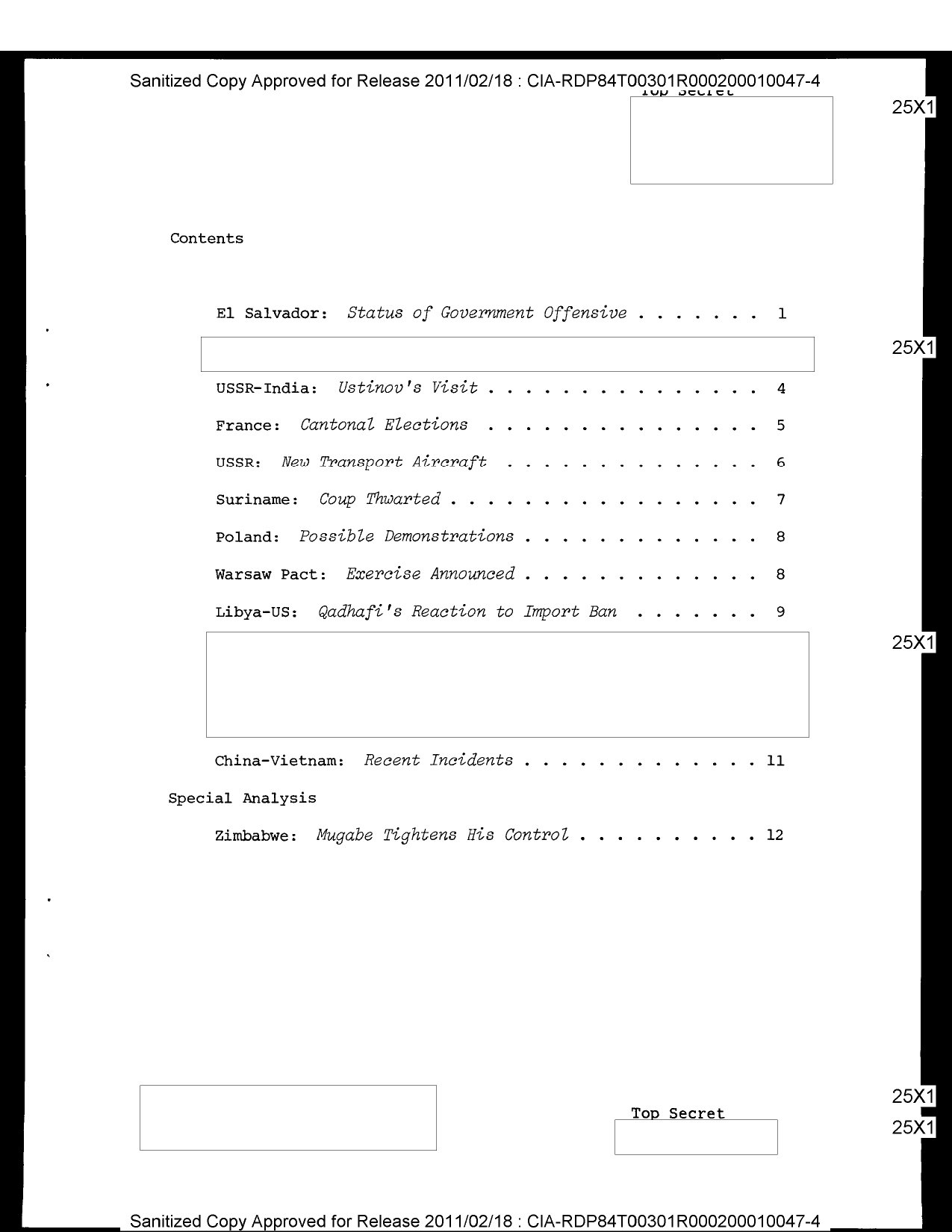
| Section / Topic | Page |
|---|---|
| El Salvador: Status of Government Offensive | 1 |
| USSR–India: Ustinov’s Visit | 4 |
| France: Cantonal Elections | 5 |
| USSR: New Transport Aircraft | 6 |
| Suriname: Coup Thwarted | 7 |
| Poland: Possible Demonstrations | 8 |
| Warsaw Pact: Exercise Announced | 8 |
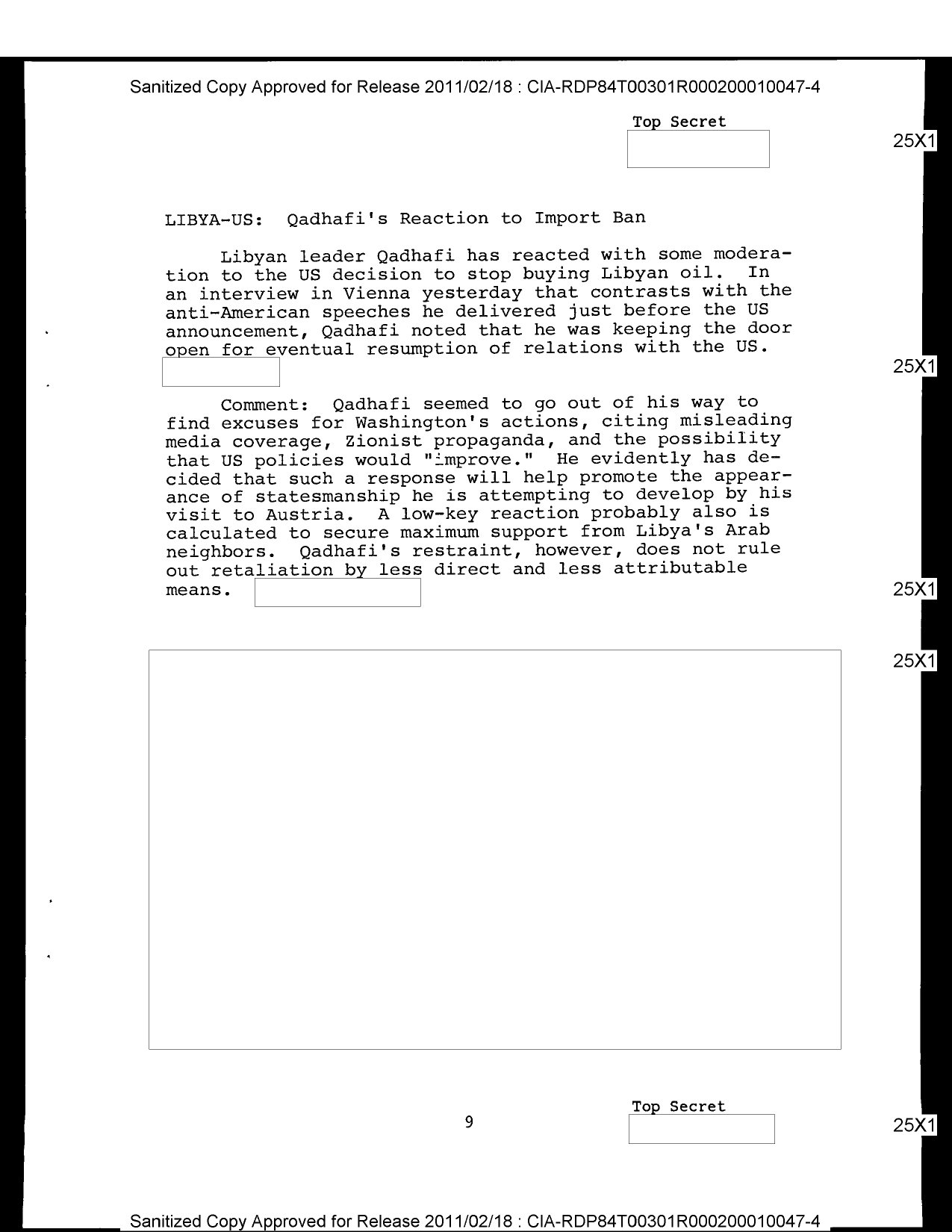
| Libya–US: Qadhafi’s Reaction to Import Ban | 9 |
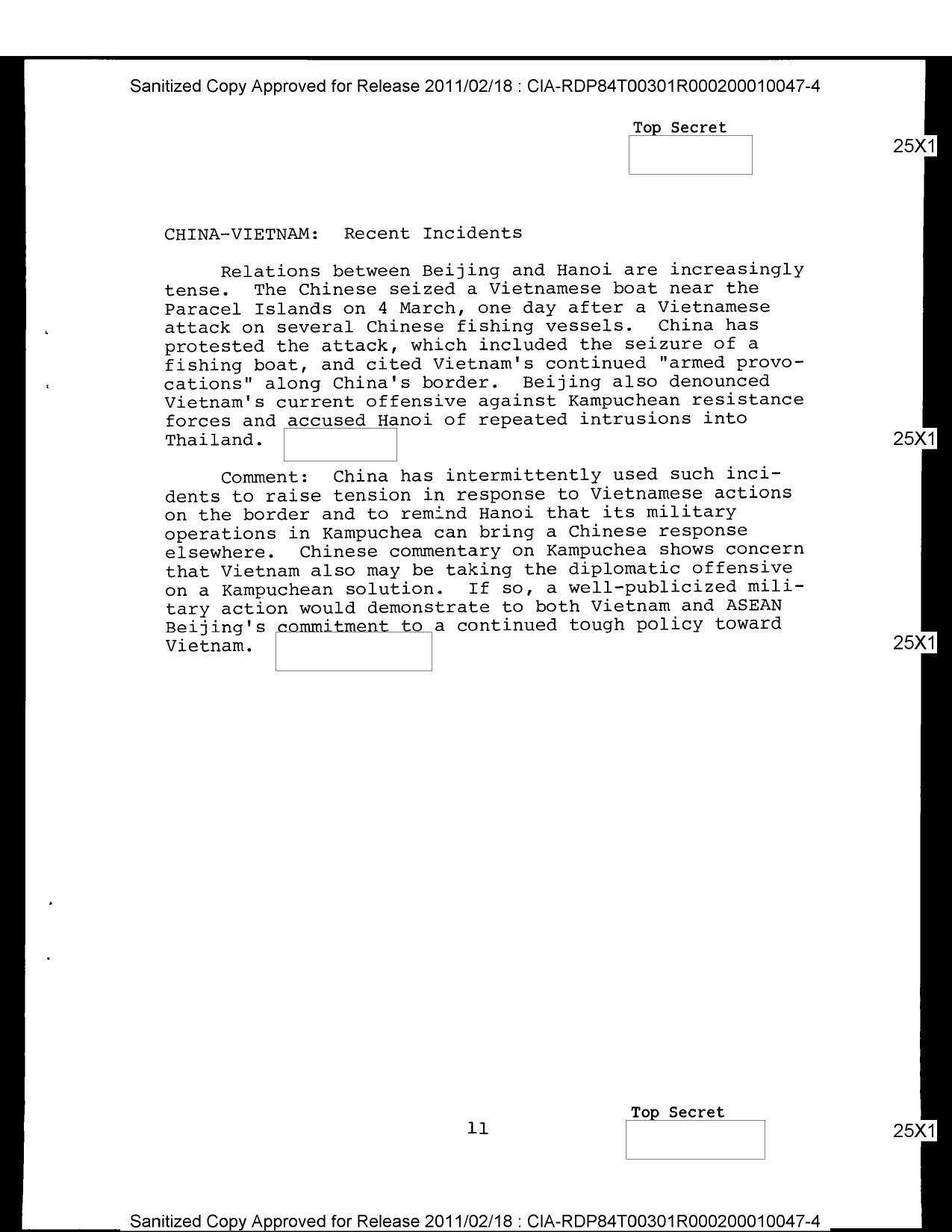
| China–Vietnam: Recent Incidents | 11 |
| Special Analysis | |
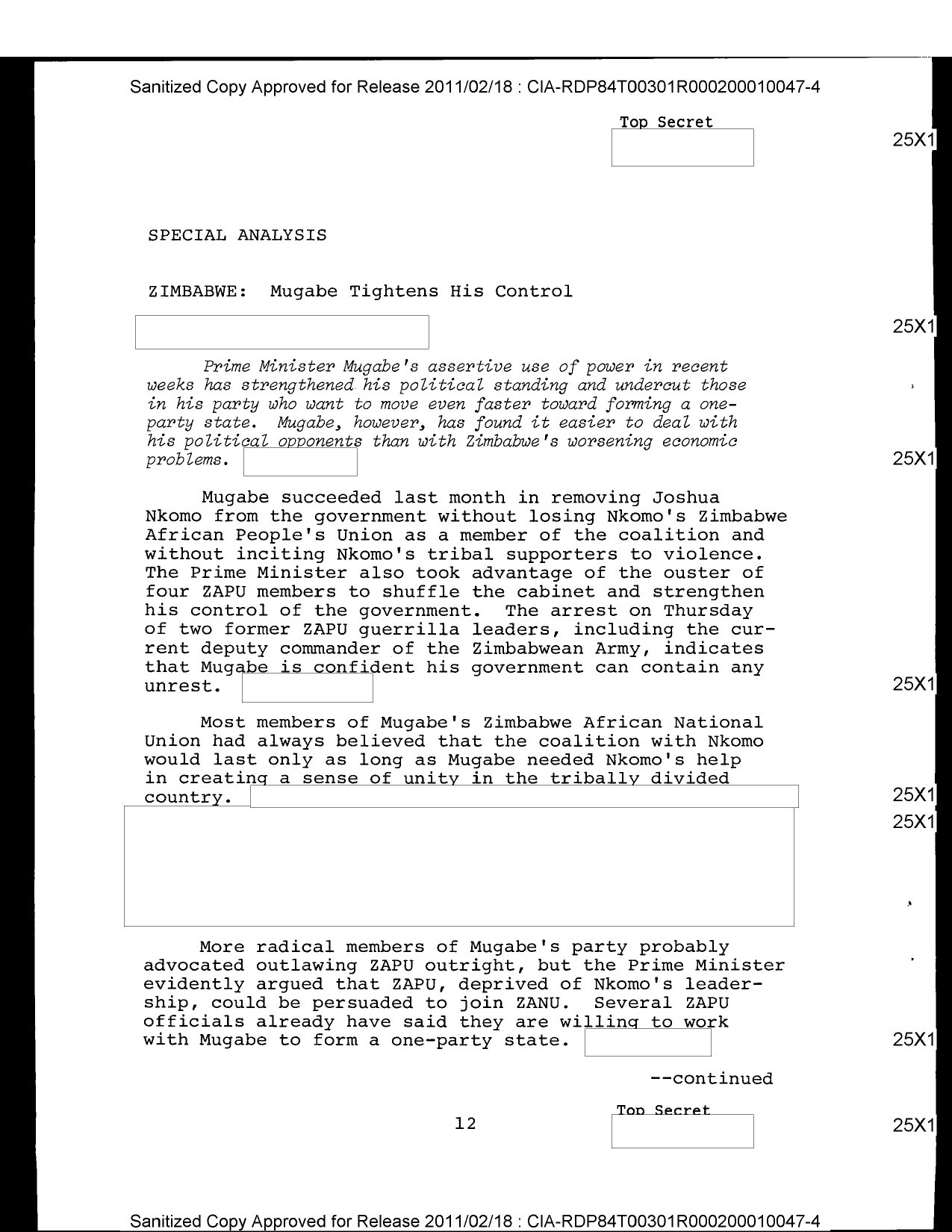
| Zimbabwe: Mugabe Tightens His Control | 12 |
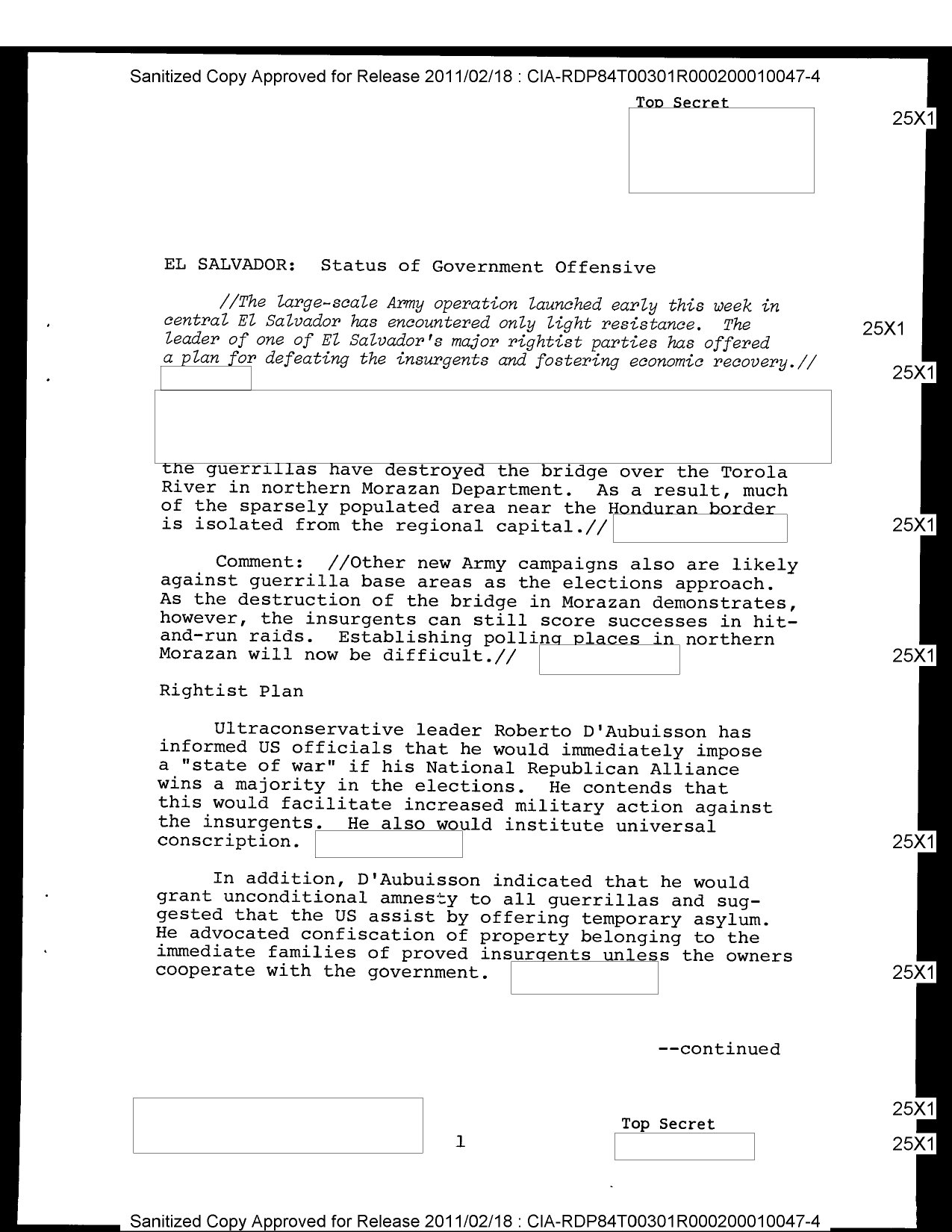
EL SALVADOR: Status of Government Offensive
//The large-scale Army operation launched early this week in central El Salvador has encountered only light resistance. The leader of one of El Salvador’s major rightist parties has offered a plan for defeating the insurgents and fostering economic recovery.//
The guerrillas have destroyed the bridge over the Torola River in northern Morazan Department. As a result, much of the sparsely populated area near the Honduran border is isolated from the regional capital.//
Comment: //Other new Army campaigns also are likely against guerrilla base areas as the elections approach. As the destruction of the bridge in Morazan demonstrates, however, the insurgents can still score successes in hit-and-run raids. Establishing polling places in northern Morazan will now be difficult.//
Rightist Plan
Ultraconservative leader Roberto D’Aubuisson has informed US officials that he would immediately impose a “state of war” if his National Republican Alliance wins a majority in the elections. He contends that this would facilitate increased military action against the insurgents. He also would institute universal conscription.
In addition, D’Aubuisson indicated that he would grant unconditional amnesty to all guerrillas and suggested that the US assist by offering temporary asylum. He advocated confiscation of property belonging to the immediate families of proved insurgents unless the owners cooperate with the government.
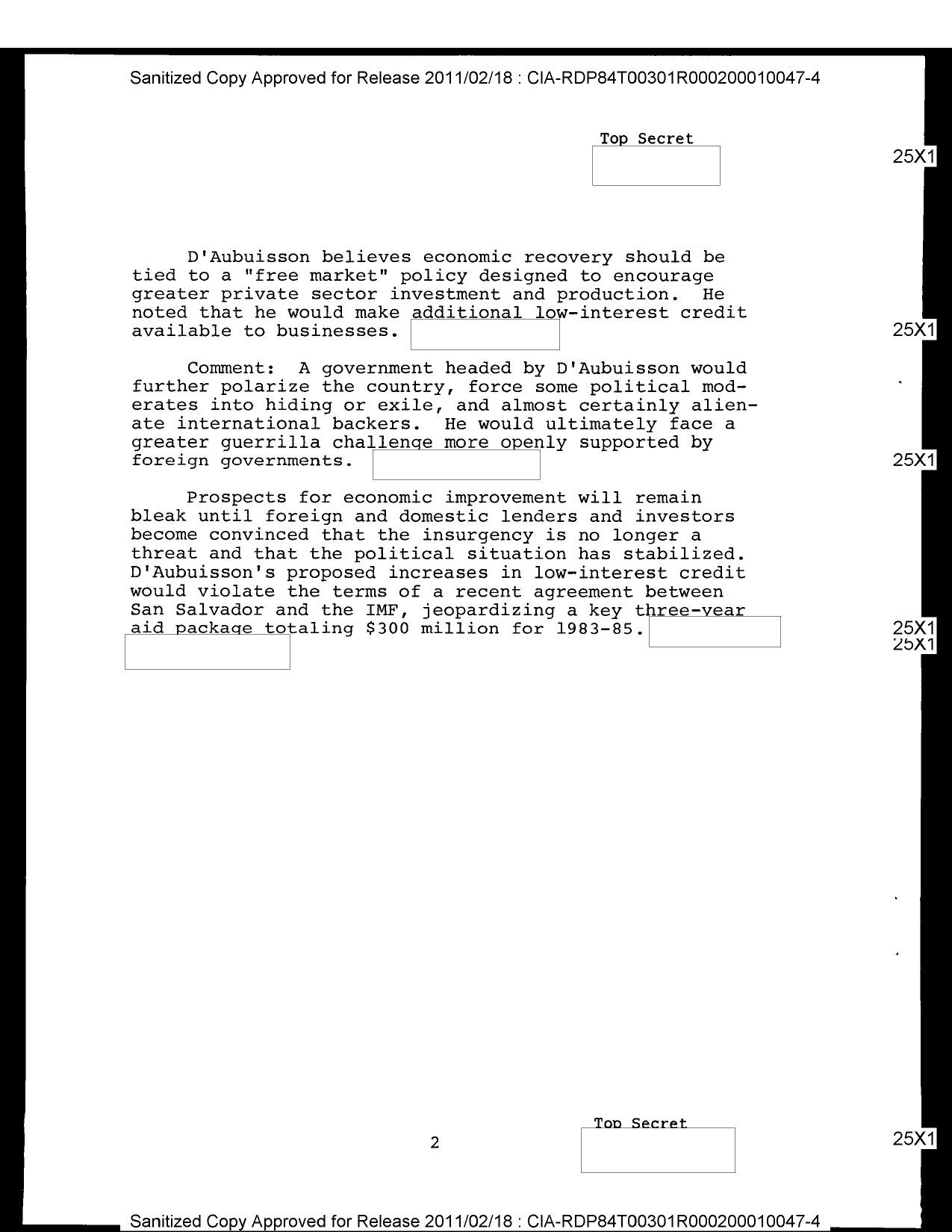
D’Aubuisson believes economic recovery should be tied to a “free market” policy designed to encourage greater private sector investment and production. He noted that he would make additional low-interest credit available to businesses.
Comment: A government headed by D’Aubuisson would further polarize the country, force some political moderates into hiding or exile, and almost certainly alienate international backers. He would ultimately face a greater guerrilla challenge more openly supported by foreign governments.
Prospects for economic improvement will remain bleak until foreign and domestic lenders and investors become convinced that the insurgency is no longer a threat and that the political situation has stabilized. D’Aubuisson’s proposed increases in low-interest credit would violate the terms of a recent agreement between San Salvador and the IMF, jeopardizing a key three-year aid package totaling $300 million for 1983–85.
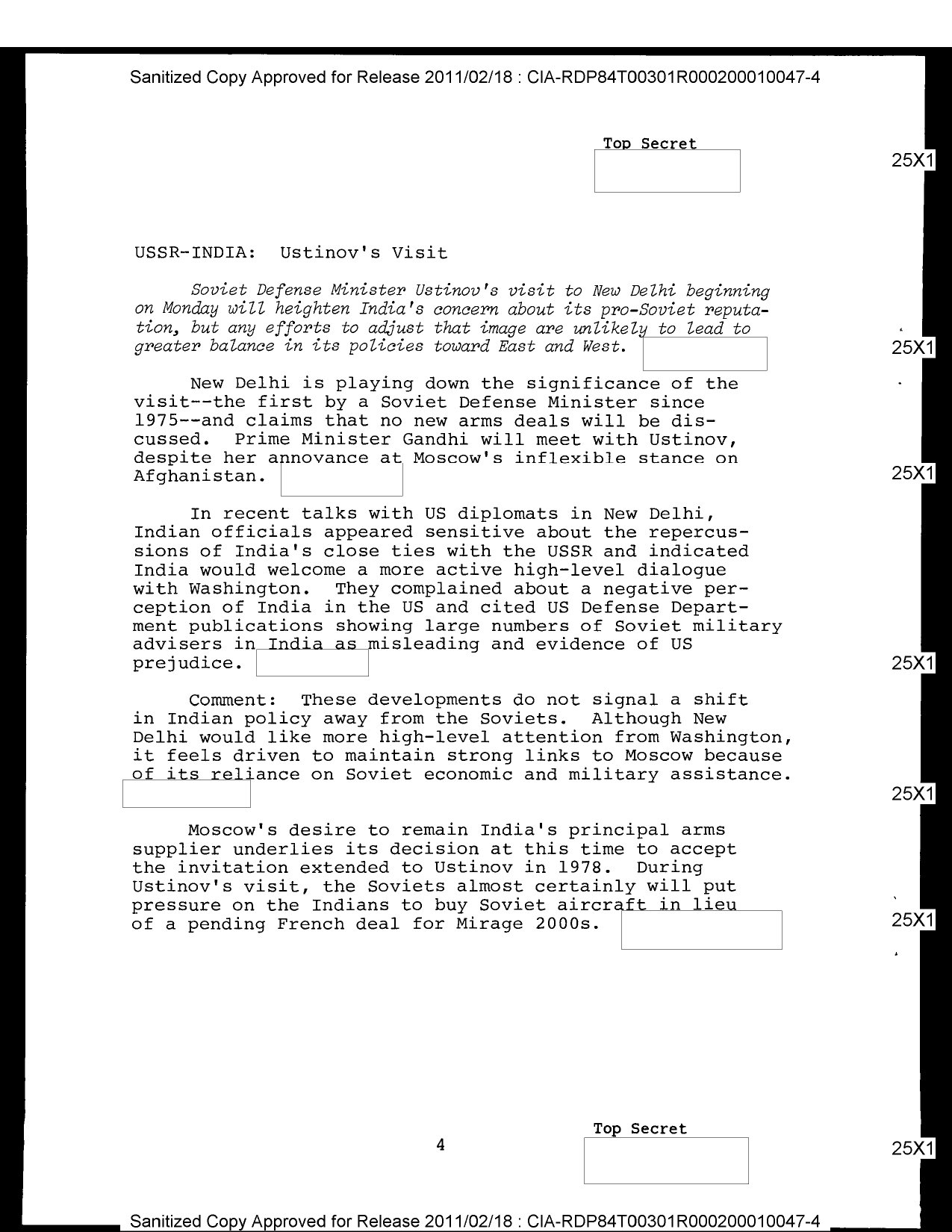
USSR–INDIA: Ustinov’s Visit
Soviet Defense Minister Ustinov’s visit to New Delhi beginning on Monday will heighten India’s concern about its pro-Soviet reputation, but any efforts to adjust that image are unlikely to lead to greater balance in its policies toward East and West.
New Delhi is playing down the significance of the visit—the first by a Soviet Defense Minister since 1975—and claims that no new arms deals will be discussed. Prime Minister Gandhi will meet with Ustinov, despite her annoyance at Moscow’s inflexible stance on Afghanistan.
In recent talks with US diplomats in New Delhi, Indian officials appeared sensitive about the repercussions of India’s close ties with the USSR and indicated India would welcome a more active high-level dialogue with Washington. They complained about a negative perception of India in the US and cited US Defense Department publications showing large numbers of Soviet military advisers in India as misleading and evidence of US prejudice.
Comment: These developments do not signal a shift in Indian policy away from the Soviets. Although New Delhi would like more high-level attention from Washington, it feels driven to maintain strong links to Moscow because of its reliance on Soviet economic and military assistance.
Moscow’s desire to remain India’s principal arms supplier underlies its decision at this time to accept the invitation extended to Ustinov in 1978. During Ustinov’s visit, the Soviets almost certainly will put pressure on the Indians to buy Soviet aircraft in lieu of a pending French deal for Mirage 2000s.
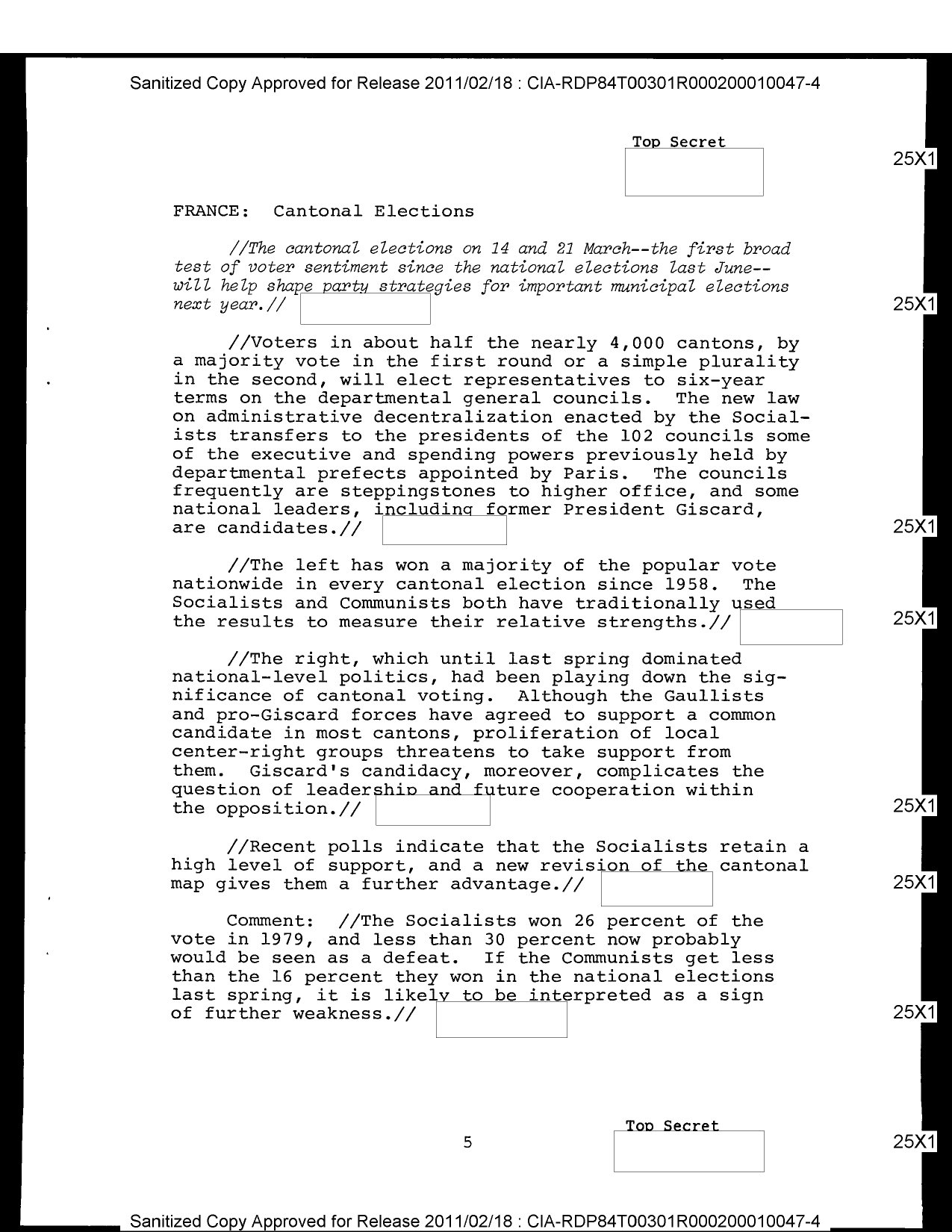
FRANCE: Cantonal Elections
//The cantonal elections on 14 and 21 March—the first broad test of voter sentiment since the national elections last June—will help shape party strategies for important municipal elections next year.//
//Voters in about half the nearly 4,000 cantons, by a majority vote in the first round or a simple plurality in the second, will elect representatives to six-year terms on the departmental general councils. The new law on administrative decentralization enacted by the Socialists transfers to the presidents of the 102 councils some of the executive and spending powers previously held by departmental prefects appointed by Paris. The councils frequently are stepping stones to higher office, and some national leaders, including former President Giscard, are candidates.//
//The left has won a majority of the popular vote nationwide in every cantonal election since 1958. The Socialists and Communists both have traditionally used the results to measure their relative strengths.//
//The right, which until last spring dominated national-level politics, had been playing down the significance of cantonal voting. Although the Gaullists and pro-Giscard forces have agreed to support a common candidate in most cantons, proliferation of local center-right groups threatens to take support from them. Giscard’s candidacy, moreover, complicates the question of leadership and future cooperation within the opposition.//
//Recent polls indicate that the Socialists retain a high level of support, and a new revision of the cantonal map gives them a further advantage.//
Comment: //The Socialists won 26 percent of the vote in 1979, and less than 30 percent now probably would be seen as a defeat. If the Communists get less than the 16 percent they won in the national elections last spring, it is likely to be interpreted as a sign of further weakness.//
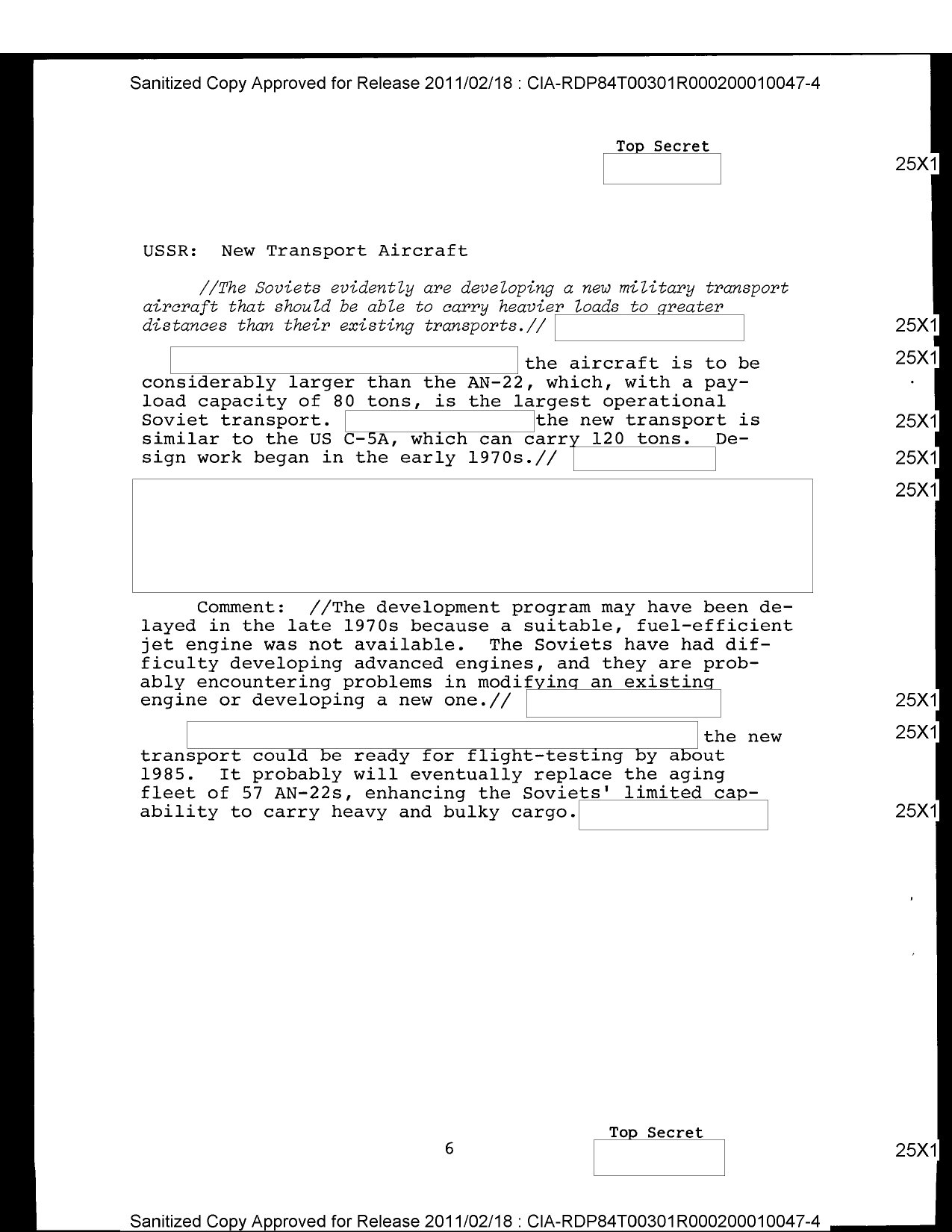
USSR: New Transport Aircraft
//The Soviets evidently are developing a new military transport aircraft that should be able to carry heavier loads to greater distances than their existing transports.// [CENSORED]
The aircraft is to be [CENSORED] considerably larger than the AN-22, which, with a payload capacity of 80 tons, is the largest operational Soviet transport. The new transport is similar to the US C-5A, which can carry 120 tons. De[CENSORED]sign work began in the early 1970s.// [CENSORED]
Comment: //The development program may have been delayed in the late 1970s because a suitable, fuel-efficient jet engine was not available. The Soviets have had difficulty developing advanced engines, and they are probably encountering problems in modifying an existing engine or developing a new one.// [CENSORED]
The new [CENSORED] transport could be ready for flight-testing by about 1985. It probably will eventually replace the aging fleet of 57 AN-22s, enhancing the Soviets’ limited capability to carry heavy and bulky cargo. [CENSORED]
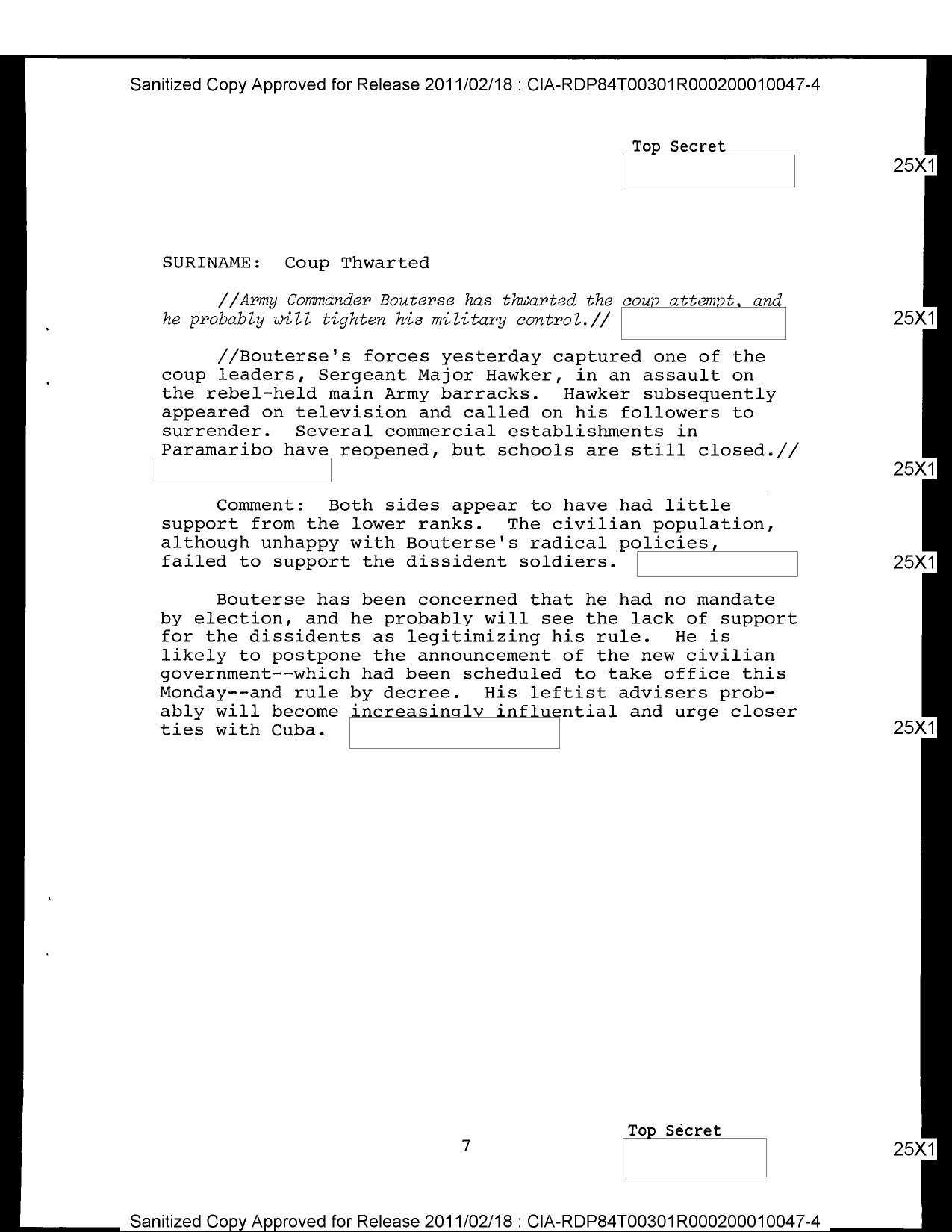
SURINAME: Coup Thwarted
//Army Commander Bouterse has thwarted the coup attempt, and he probably will tighten his military control.// [CENSORED]
//Bouterse’s forces yesterday captured one of the coup leaders, Sergeant Major Hawker, in an assault on the rebel-held main Army barracks. Hawker subsequently appeared on television and called on his followers to surrender. Several commercial establishments in Paramaribo have reopened, but schools are still closed.// [CENSORED]
Comment: Both sides appear to have had little support from the lower ranks. The civilian population, although unhappy with Bouterse’s radical policies, failed to support the dissident soldiers. [CENSORED]
Bouterse has been concerned that he had no mandate by election, and he probably will see the lack of support for the dissidents as legitimizing his rule. He is likely to postpone the announcement of the new civilian government—which had been scheduled to take office this Monday—and rule by decree. His leftist advisers probably will become increasingly influential and urge closer ties with Cuba.
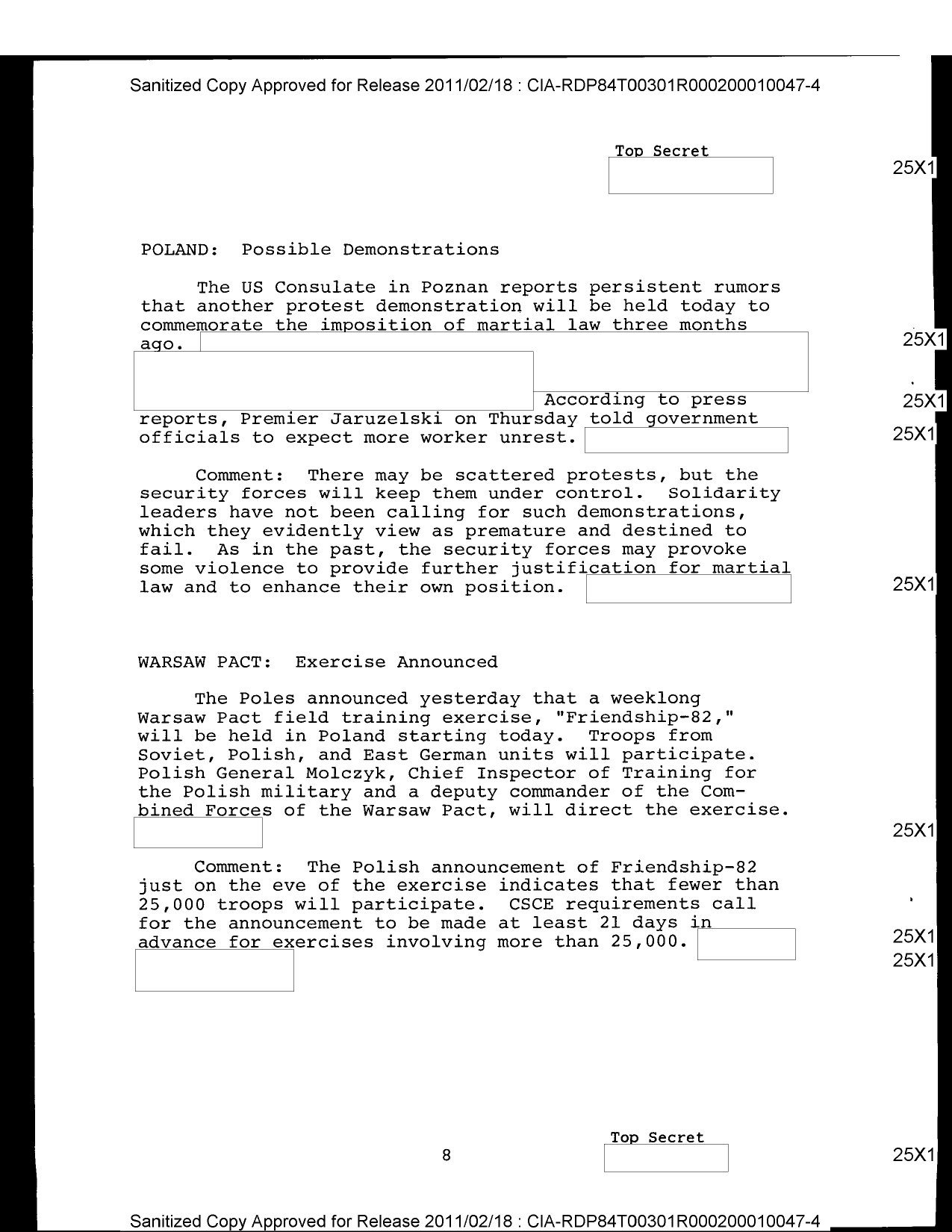
POLAND: Possible Demonstrations
The US Consulate in Poznan reports persistent rumors that another protest demonstration will be held today to commemorate the imposition of martial law three months ago.
According to press reports, Premier Jaruzelski on Thursday told government officials to expect more worker unrest.
Comment: There may be scattered protests, but the security forces will keep them under control. Solidarity leaders have not been calling for such demonstrations, which they evidently view as premature and destined to fail. As in the past, the security forces may provoke some violence to provide further justification for martial law and to enhance their own position.
WARSAW PACT: Exercise Announced
The Poles announced yesterday that a weeklong Warsaw Pact field training exercise, “Friendship-82,” will be held in Poland starting today. Troops from Soviet, Polish, and East German units will participate. Polish General Molczyk, Chief Inspector of Training for the Polish military and a deputy commander of the Combined Forces of the Warsaw Pact, will direct the exercise.
Comment: The Polish announcement of Friendship-82 just on the eve of the exercise indicates that fewer than 25,000 troops will participate. CSCE requirements call for the announcement to be made at least 21 days in advance for exercises involving more than 25,000.
LIBYA–US: Qadhafi’s Reaction to Import Ban
Libyan leader Qadhafi has reacted with some moderation to the US decision to stop buying Libyan oil. In an interview in Vienna yesterday that contrasts with the anti-American speeches he delivered just before the US announcement, Qadhafi noted that he was keeping the door open for eventual resumption of relations with the US.
Comment: Qadhafi seemed to go out of his way to find excuses for Washington’s actions, citing misleading media coverage, Zionist propaganda, and the possibility that US policies would “improve.” He evidently has decided that such a response will help promote the appearance of statesmanship he is attempting to develop by his visit to Austria. A low-key reaction probably also is calculated to secure maximum support from Libya’s Arab neighbors. Qadhafi’s restraint, however, does not rule out retaliation by less direct and less attributable means.
CHINA–VIETNAM: Recent Incidents
Relations between Beijing and Hanoi are increasingly tense. The Chinese seized a Vietnamese boat near the Paracel Islands on 4 March, one day after a Vietnamese attack on several Chinese fishing vessels. China has protested the attack, which included the seizure of a fishing boat, and cited Vietnam’s continued “armed provocations” along China’s border. Beijing also denounced Vietnam’s current offensive against Kampuchean resistance forces and accused Hanoi of repeated intrusions into Thailand.
Comment: China has intermittently used such incidents to raise tension in response to Vietnamese actions on the border and to remind Hanoi that its military operations in Kampuchea can bring a Chinese response elsewhere. Chinese commentary on Kampuchea shows concern that Vietnam also may be taking the diplomatic offensive on a Kampuchean solution. If so, a well-publicized military action would demonstrate to both Vietnam and ASEAN Beijing’s commitment to a continued tough policy toward Vietnam.
SPECIAL ANALYSIS
ZIMBABWE: Mugabe Tightens His Control
Prime Minister Mugabe’s assertive use of power in recent weeks has strengthened his political standing and undercut those in his party who want to move even faster toward forming a one-party state. Mugabe, however, has found it easier to deal with his political opponents than with Zimbabwe’s worsening economic problems.
Mugabe succeeded last month in removing Joshua Nkomo from the government without losing Nkomo’s Zimbabwe African People’s Union as a member of the coalition and without inciting Nkomo’s tribal supporters to violence. The Prime Minister also took advantage of the ouster of four ZAPU members to shuffle the cabinet and strengthen his control of the government. The arrest on Thursday of two former ZAPU guerrilla leaders, including the current deputy commander of the Zimbabwean Army, indicates that Mugabe is confident his government can contain any unrest.
Most members of Mugabe’s Zimbabwe African National Union had always believed that the coalition with Nkomo would last only as long as Mugabe needed Nkomo’s help in creating a sense of unity in the tribally divided country.
More radical members of Mugabe’s party probably advocated outlawing ZAPU outright, but the Prime Minister evidently argued that ZAPU, deprived of Nkomo’s leadership, could be persuaded to join ZANU. Several ZAPU officials already have said they are willing to work with Mugabe to form a one-party state.
[CENSORED]
[CENSORED]
[CENSORED]
[CENSORED]
[CENSORED]
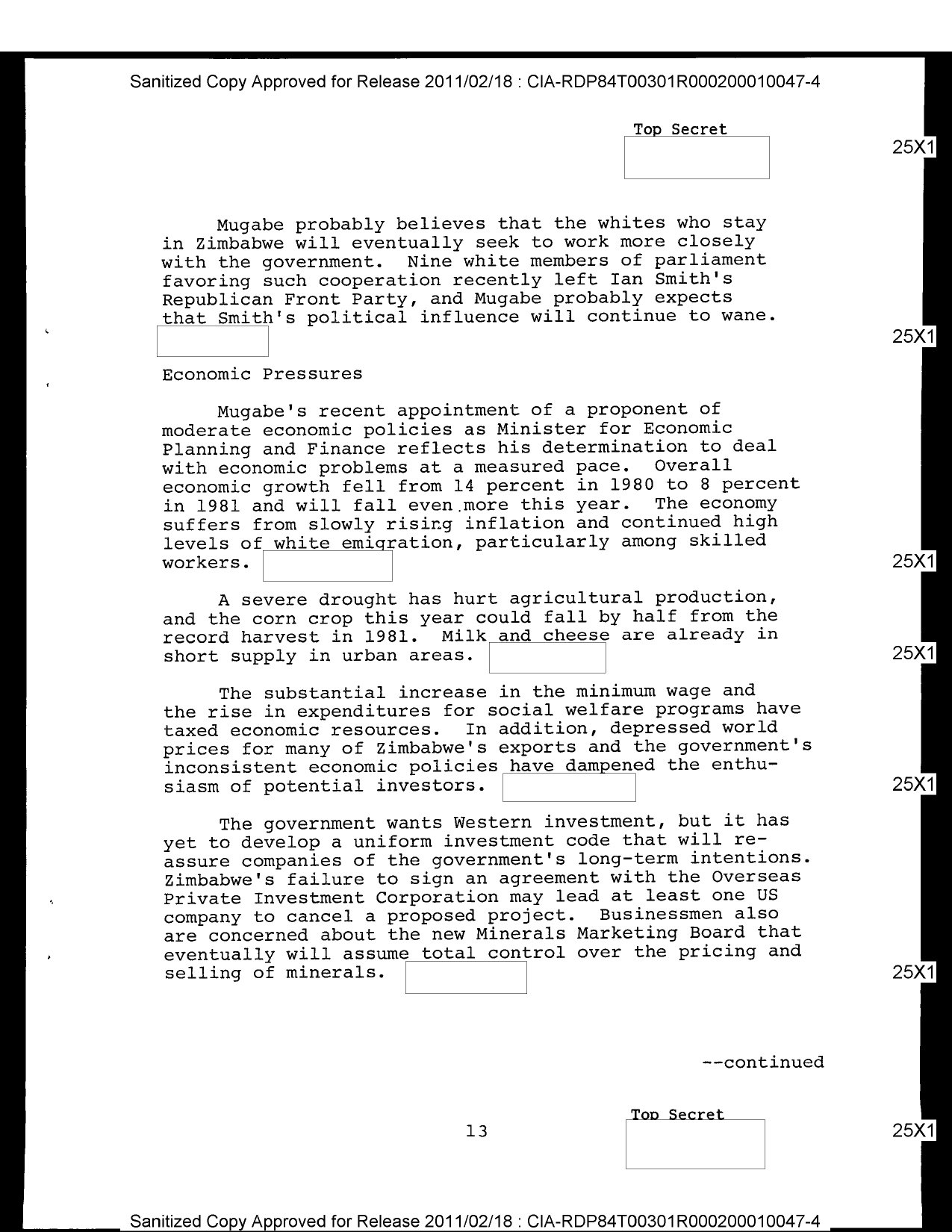
Mugabe probably believes that the whites who stay in Zimbabwe will eventually seek to work more closely with the government. Nine white members of parliament favoring such cooperation recently left Ian Smith’s Republican Front Party, and Mugabe probably expects that Smith’s political influence will continue to wane.
[CENSORED]
[CENSORED]
Economic Pressures
Mugabe’s recent appointment of a proponent of moderate economic policies as Minister for Economic Planning and Finance reflects his determination to deal with economic problems at a measured pace. Overall economic growth fell from 14 percent in 1980 to 8 percent in 1981 and will fall even more this year. The economy suffers from slowly rising inflation and continued high levels of white emigration, particularly among skilled workers.
A severe drought has hurt agricultural production, and the corn crop this year could fall by half from the record harvest in 1981. Milk and cheese are already in short supply in urban areas.
The substantial increase in the minimum wage and the rise in expenditures for social welfare programs have taxed economic resources. In addition, depressed world prices for many of Zimbabwe’s exports and the government’s inconsistent economic policies have dampened the enthusiasm of potential investors.
The government wants Western investment, but it has yet to develop a uniform investment code that will reassure companies of the government’s long-term intentions. Zimbabwe’s failure to sign an agreement with the Overseas Private Investment Corporation may lead at least one US company to cancel a proposed project. Businessmen also are concerned about the new Minerals Marketing Board that eventually will assume total control over the pricing and selling of minerals.
[CENSORED]
[CENSORED]
[CENSORED]
[CENSORED]
Foreign Policy
//Mugabe will remain committed to a nonaligned foreign policy. He is concerned over Soviet attempts to gain influence in the country [CENSORED]. At the same time, he will resist any attempts to link Western economic aid to Zimbabwe’s foreign policy positions.//
Relations with South Africa will remain troublesome, but Mugabe is prepared to deal with Pretoria at a practical level. Salisbury is currently attempting to renegotiate a preferential trade agreement with South Africa.
Prospects
[CENSORED]
[CENSORED]
[CENSORED]
[CENSORED]
[CENSORED]
[CENSORED]
The government will gradually become more authoritarian as ZANU moves toward a one-party state. Mugabe is personally committed to more state control of the economy and to social reforms, but he probably will support some moves to attract more Western investment.
The Prime Minister may soon decide to arrest Nkomo and try him for antigovernment activities. In addition, Mugabe probably will attempt to consolidate his party’s power by imposing new restrictions on press freedom and enlarging the security services. Tensions will remain high, and any precipitate moves against ZAPU could lead to violence.
Mugabe’s political successes could eventually be undermined by the government’s inability to solve basic economic problems. Blacks are expecting significant improvements in their standard of living, but the economy cannot expand quickly enough to meet their demands.
Source:
Link:
Internal Link:
Date:
March 13, 1982