Suriname-Cuba: Closer Ties – National Intelligence Daily – 29 May 1982
CIA-RDP84T00301R000300010099-6
Top Secret
CPAS NIDC 82-126C
29 May 1982
Copy 402
Contents
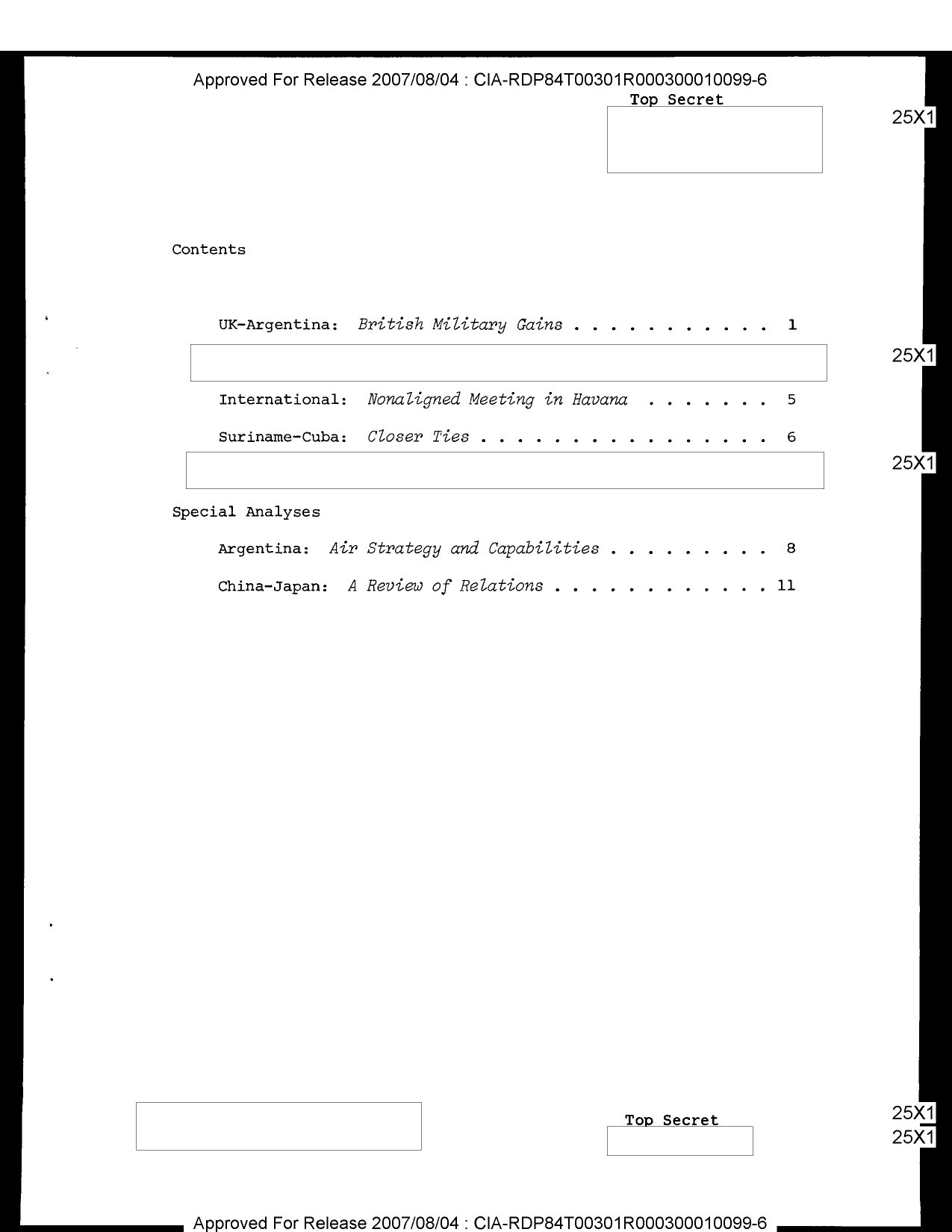
| Title | Page |
|---|---|
| UK-Argentina: British Military Gains | 1 |
| International: Nonaligned Meeting in Havana | 5 |
| Suriname-Cuba: Closer Ties | 6 |
| Special Analyses | |
| Argentina: Air Strategy and Capabilities | 8 |
| China-Japan: A Review of Relations | 11 |
UK–ARGENTINA: British Military Gains
(Information as of 0030)
Success at Darwin and Goose Green will enhance British ability to move on Stanley. Argentina is working to increase its capabilities against ground, air, and naval targets in the Falklands. No movement has been reported in negotiations.
//The British Ministry of Defense announced yesterday that its forces had captured Goose Green and Darwin, suffering only light casualties. The Argentine Joint Chiefs of Staff denied the claim. Press reports indicate that other units, supported by artillery and light tanks, are moving eastward toward Stanley.//
British Harrier aircraft continued raids on the Stanley area as well as support of ground operations. The Ministry of Defense confirmed the loss of a Harrier to Argentine ground fire on Thursday.
The Ministry of Defense confirmed Argentine airstrikes on the San Carlos beachhead, but gave no indication of damage. Casualties total four killed and 20 wounded.
Skies will be partly cloudy over the Falkland Islands today with good visibility. Tomorrow skies will be partly to mostly cloudy, with good visibility deteriorating by midday. Winds will be about 25 knots, and seas will be rough today and tomorrow.
Comment:
//The British ground offensive has begun in earnest. The British needed to defeat the Argentine forces in the Darwin–Goose Green area before they could fully develop their main thrust toward Stanley. The seizure of Darwin and Goose Green removes the threat posed by Argentine forces there to the flank of the principal British thrust, provides an additional operating base for Harrier aircraft, and places British forces astride the main east–west route to Stanley.//
//The weather over the next few days should not be a problem for ground forces, but the lack of extended periods of good visibility tomorrow and Monday should hamper air operations.//
OAS Resolution
Latin American Foreign Ministers meeting in emergency session in Washington are expected to approve an Argentine resolution calling on the US to stop assisting the UK. The resolution also condemns Britain’s “armed aggression,” invites OAS members to take “measures they deem appropriate” to assist Argentina, and calls on the US to lift sanctions imposed on Buenos Aires last month. Most Foreign Ministers, however, reportedly do not favor economic or diplomatic sanctions against the UK.
Comment:
//Argentina hopes that strong support from OAS members will neutralize EC support for the UK and put pressure on the US to intercede with London. Buenos Aires is likely to muster the required 14 votes to pass its resolution and could receive as many as 18, thereby underscoring growing US isolation in the OAS.//
British Conservatives Riding High
//The Conservatives easily retained a parliamentary seat in a byelection on Thursday, with the margin greater than anticipated before the Falklands crisis. A new poll of 400 Britishers shows that if a national election were held now, the Conservatives would defeat Labour by a two-to-one margin. Eighty-four percent were satisfied with Prime Minister Thatcher’s handling of the crisis, a substantial increase.//
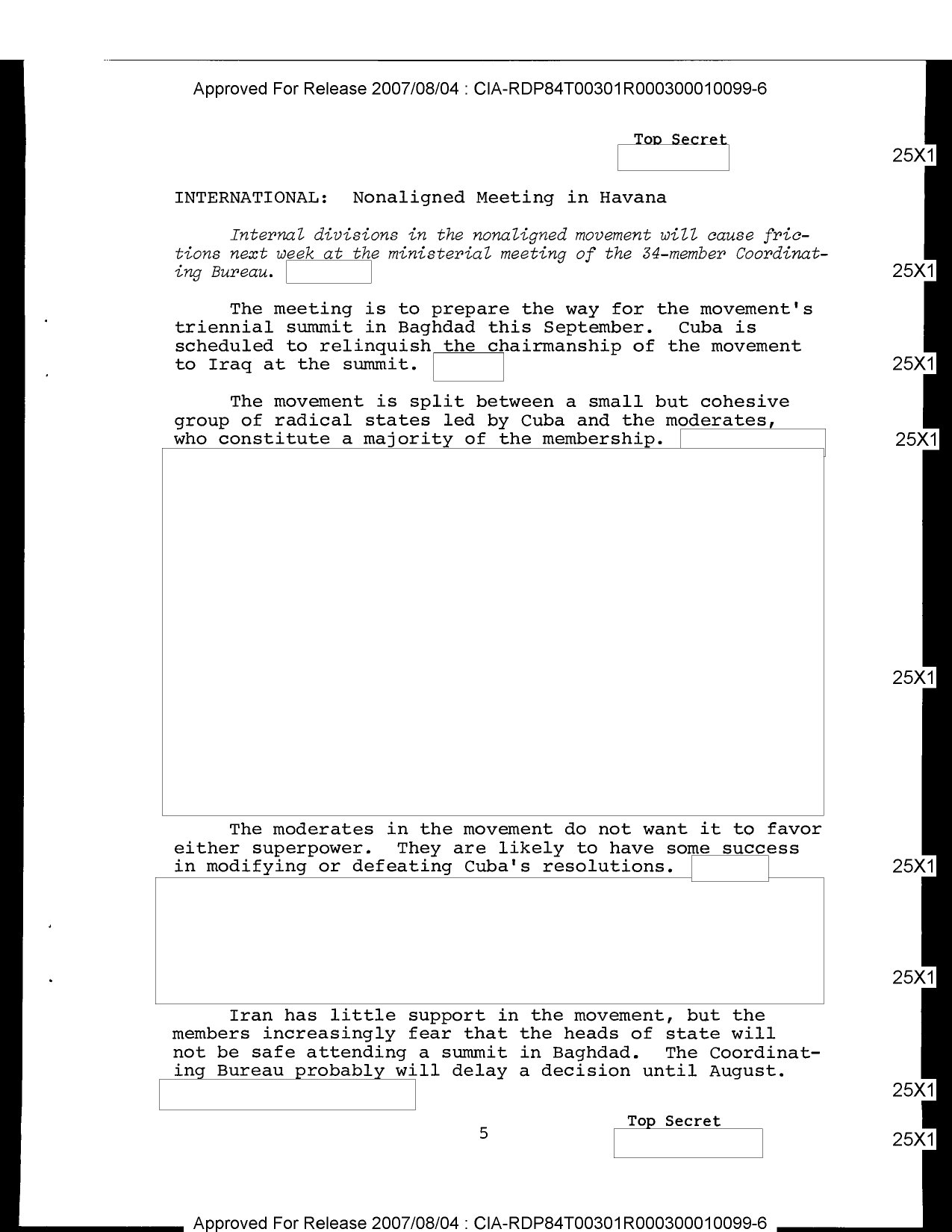
INTERNATIONAL: Nonaligned Meeting in Havana
Internal divisions in the nonaligned movement will cause frictions next week at the ministerial meeting of the 34-member Coordinating Bureau.
The meeting is to prepare the way for the movement’s triennial summit in Baghdad this September. Cuba is scheduled to relinquish the chairmanship of the movement to Iraq at the summit.
The movement is split between a small but cohesive group of radical states led by Cuba and the moderates, who constitute a majority of the membership.
The moderates in the movement do not want it to favor either superpower. They are likely to have some success in modifying or defeating Cuba’s resolutions.
Iran has little support in the movement, but the members increasingly fear that the heads of state will not be safe attending a summit in Baghdad. The Coordinating Bureau probably will delay a decision until August.
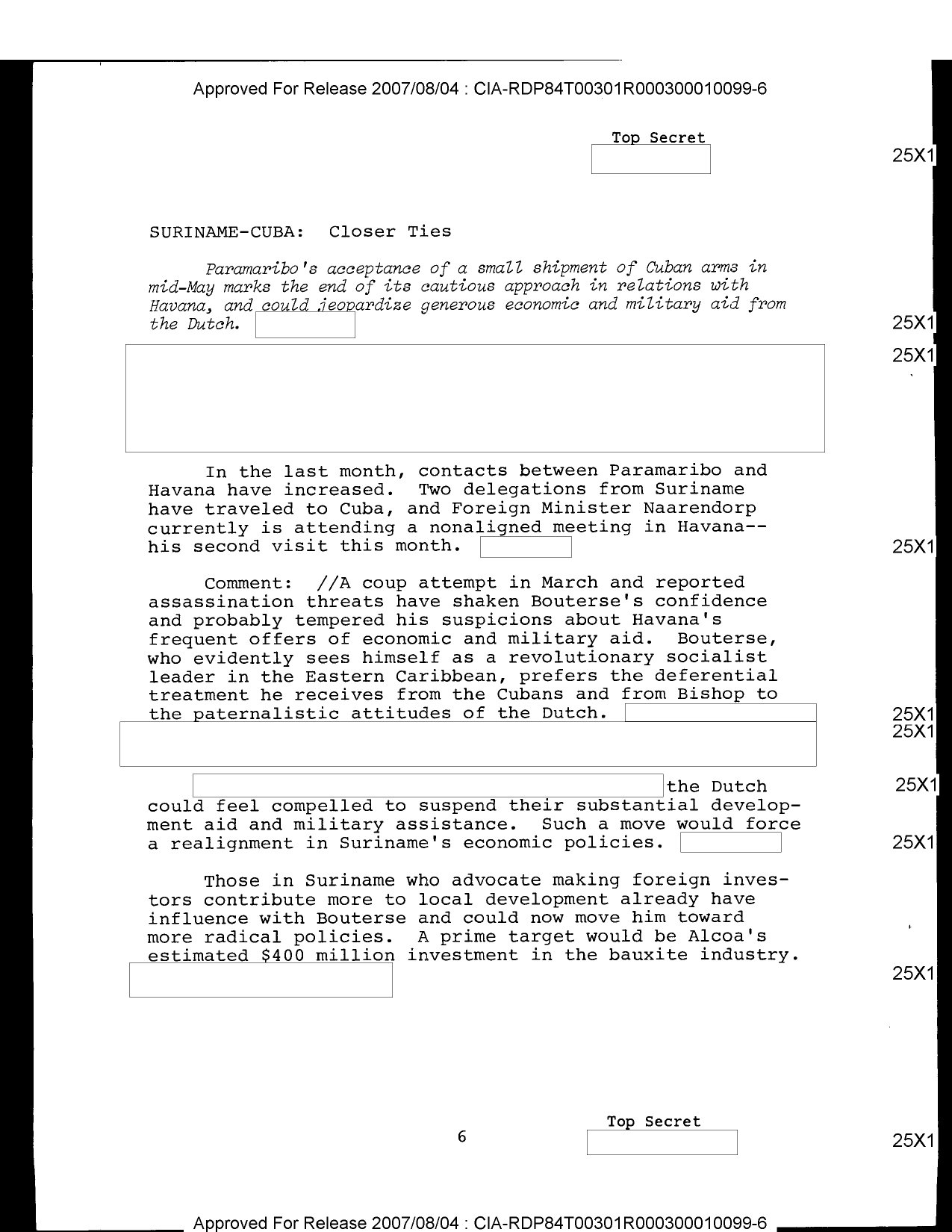
SURINAME–CUBA: Closer Ties
Paramaribo’s acceptance of a small shipment of Cuban arms in mid-May marks the end of its cautious approach in relations with Havana and could jeopardize generous economic and military aid from the Dutch.
In the last month, contacts between Paramaribo and Havana have increased. Two delegations from Suriname have traveled to Cuba, and Foreign Minister Naarendorp currently is attending a nonaligned meeting in Havana—his second visit this month.
Comment:
//A coup attempt in March and reported assassination threats have shaken Bouterse’s confidence and probably tempered his suspicions about Havana’s frequent offers of economic and military aid. Bouterse, who evidently sees himself as a revolutionary socialist leader in the Eastern Caribbean, prefers the deferential treatment he receives from the Cubans and from Bishop to the paternalistic attitudes of the Dutch.//
//The Dutch could feel compelled to suspend their substantial development aid and military assistance. Such a move would force a realignment in Suriname’s economic policies.//
Those in Suriname who advocate making foreign investors contribute more to local development already have influence with Bouterse and could now move him toward more radical policies. A prime target would be Alcoa’s estimated $400 million investment in the bauxite industry.
SPECIAL ANALYSIS
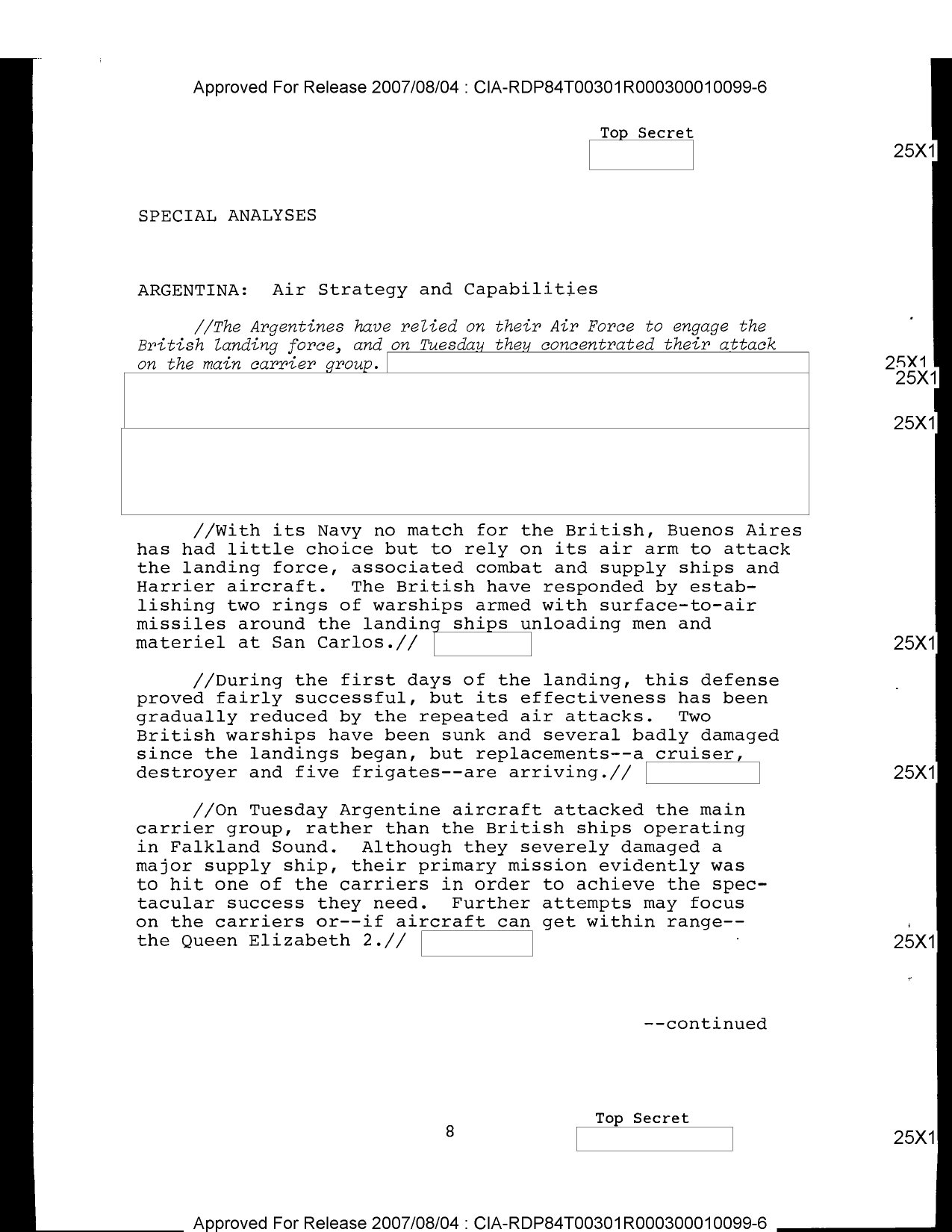
ARGENTINA: Air Strategy and Capabilities
//The Argentines have relied on their Air Force to engage the British landing force, and on Tuesday they concentrated their attack on the main carrier group.//
//With its Navy no match for the British, Buenos Aires has had little choice but to rely on its air arm to attack the landing force, associated combat and supply ships, and Harrier aircraft. The British have responded by establishing two rings of warships armed with surface-to-air missiles around the landing ships unloading men and materiel at San Carlos.//
//During the first days of the landing, this defense proved fairly successful, but its effectiveness has been gradually reduced by repeated air attacks. Two British warships have been sunk and several badly damaged since the landings began, but replacements—a cruiser, destroyer, and five frigates—are arriving.//
//On Tuesday Argentine aircraft attacked the main carrier group, rather than the British ships operating in Falkland Sound. Although they severely damaged a major supply ship, their primary mission evidently was to hit one of the carriers in order to achieve the spectacular success they need. Further attempts may focus on the carriers or—if aircraft can get within range—the Queen Elizabeth 2.//
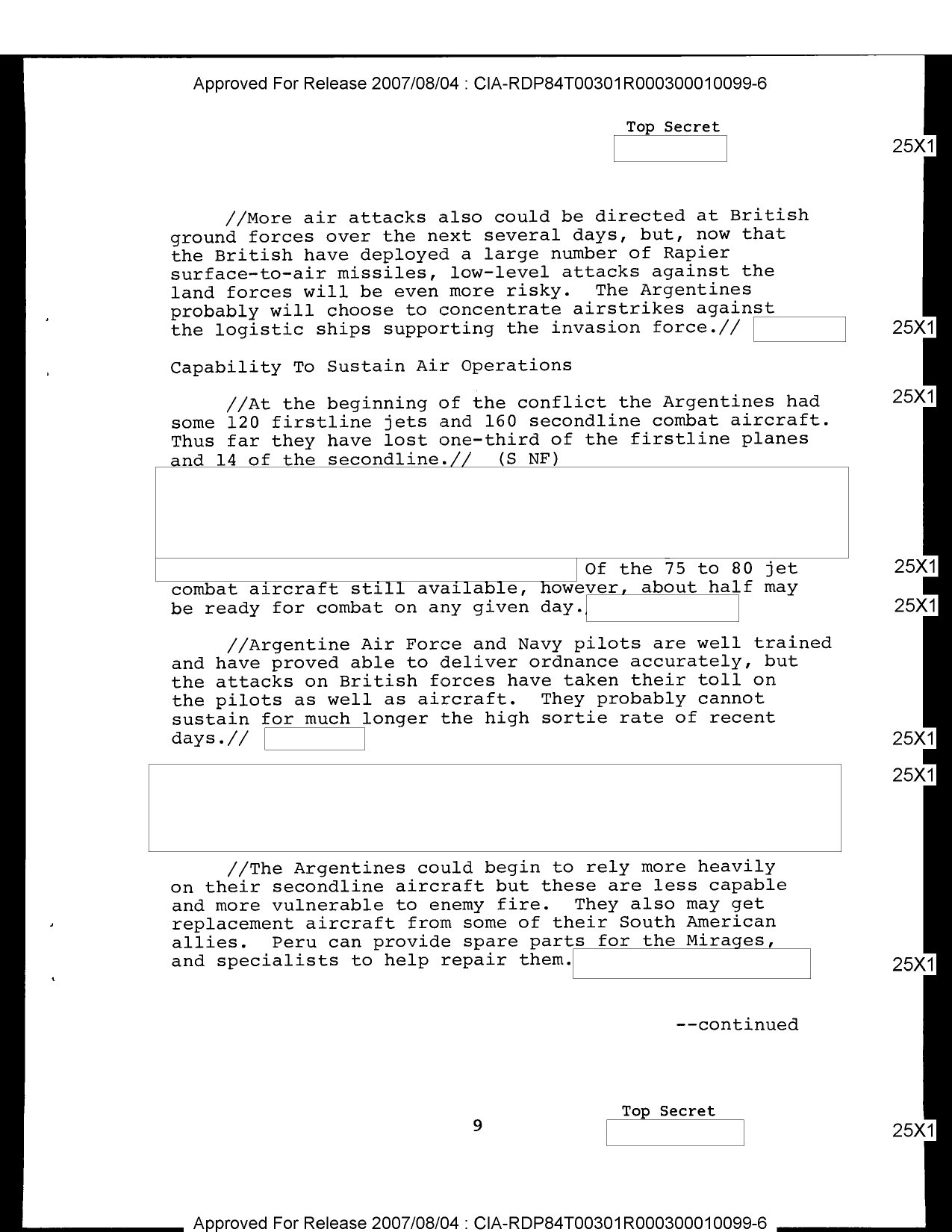
//More air attacks also could be directed at British ground forces over the next several days, but now that the British have deployed a large number of Rapier surface-to-air missiles, low-level attacks against the land forces will be even more risky. The Argentines probably will choose to concentrate airstrikes against the logistic ships supporting the invasion force.//
Capability to Sustain Air Operations
//At the beginning of the conflict the Argentines had some 120 first-line jets and 160 second-line combat aircraft. Thus far they have lost one-third of the first-line planes and 14 of the second-line.//
Of the 75 to 80 jet combat aircraft still available, however, about half may be ready for combat on any given day.
//Argentine Air Force and Navy pilots are well trained and have proved able to deliver ordnance accurately, but the attacks on British forces have taken their toll on the pilots as well as aircraft. They probably cannot sustain for much longer the high sortie rate of recent days.//
//The Argentines could begin to rely more heavily on their second-line aircraft but these are less capable and more vulnerable to enemy fire. They also may get replacement aircraft from some of their South American allies. Peru can provide spare parts for the Mirages and specialists to help repair them.//
The Missile Factor
//If the Argentines are able to obtain additional air-to-surface Exocet missiles with a range of 50 to 75 kilometers, they might reduce the scale of aircraft attacks and concentrate on getting their Super Étendard aircraft in position to launch these missiles against British carriers.//
Status of the Harriers
//One major uncertainty is the current status of the UK’s Harrier force. The British brought at least 40 Harriers with them and say they have lost only six. In recent days Argentine air losses have been attributed more often to ships and land-based surface-to-air missiles than to Harriers, as was the case at the start of the invasion.//
//Many of the Harriers may have been committed to protecting the carriers rather than supporting the invasion at San Carlos. Alternatively, the British could have sustained significantly higher aircraft losses than they admit.//
CHINA–JAPAN: A Review of Relations
Premier Zhao Ziyang’s arrival in Tokyo on Monday to commemorate the normalization of diplomatic relations between China and Japan 10 years ago marks a decade of growth in bilateral cooperation and a recent steady convergence in strategic views. Zhao’s talks with Prime Minister Suzuki will focus on policies toward the US and the USSR and on a mutual commitment to consolidate economic relations—playing down past frictions and highlighting the benefits from long-term trade and investment ties.
China and Japan still differ in their assessment of the Soviet threat and how to meet it, but the gap between their views has narrowed considerably since the early 1970s. Although wrangling over an implicitly anti-Soviet clause delayed the signing of a peace treaty between Tokyo and Beijing until 1978, the Soviets’ subsequent military actions in Afghanistan and their growing military presence in East Asia have helped bring Japan closer to China.
Beijing now also recognizes the need to tolerate Tokyo’s more cautious behavior toward Moscow. China applauds—and discreetly promotes—Japan’s moves to strengthen its defenses, encouraging Tokyo to take a firm line toward Moscow.
In private, Zhao is likely to emphasize that China’s recent expansion in trade and in nonpolitical contacts with the USSR does not portend a reduction in Chinese opposition to Soviet expansionism. Japanese leaders see a continuation of the Sino-Soviet split as fundamental to Japan’s own security and are therefore wary about any signs of potential accommodation.
The US Role
China’s continued encouragement of a strong alliance between the US and Japan and Tokyo’s recent urging that both Beijing and Washington compromise on the Taiwan issue illustrate the importance of the US in Japanese–Chinese relations.
Economic Ties
Beijing and Tokyo remain convinced that solid ties will lead to important economic gains. The Chinese still view Japan as one of their most important markets and the primary source of credit, technology, and capital equipment for modernization.
Both nations see strong bilateral relations as strategically vital to maintaining balance in East Asia.
Source:
Link:
Internal Link:
Date:
May 29, 1982