Suriname-Cuba: Expansion of Relations 1982
CIA-RDP84B00049R001604010011-3
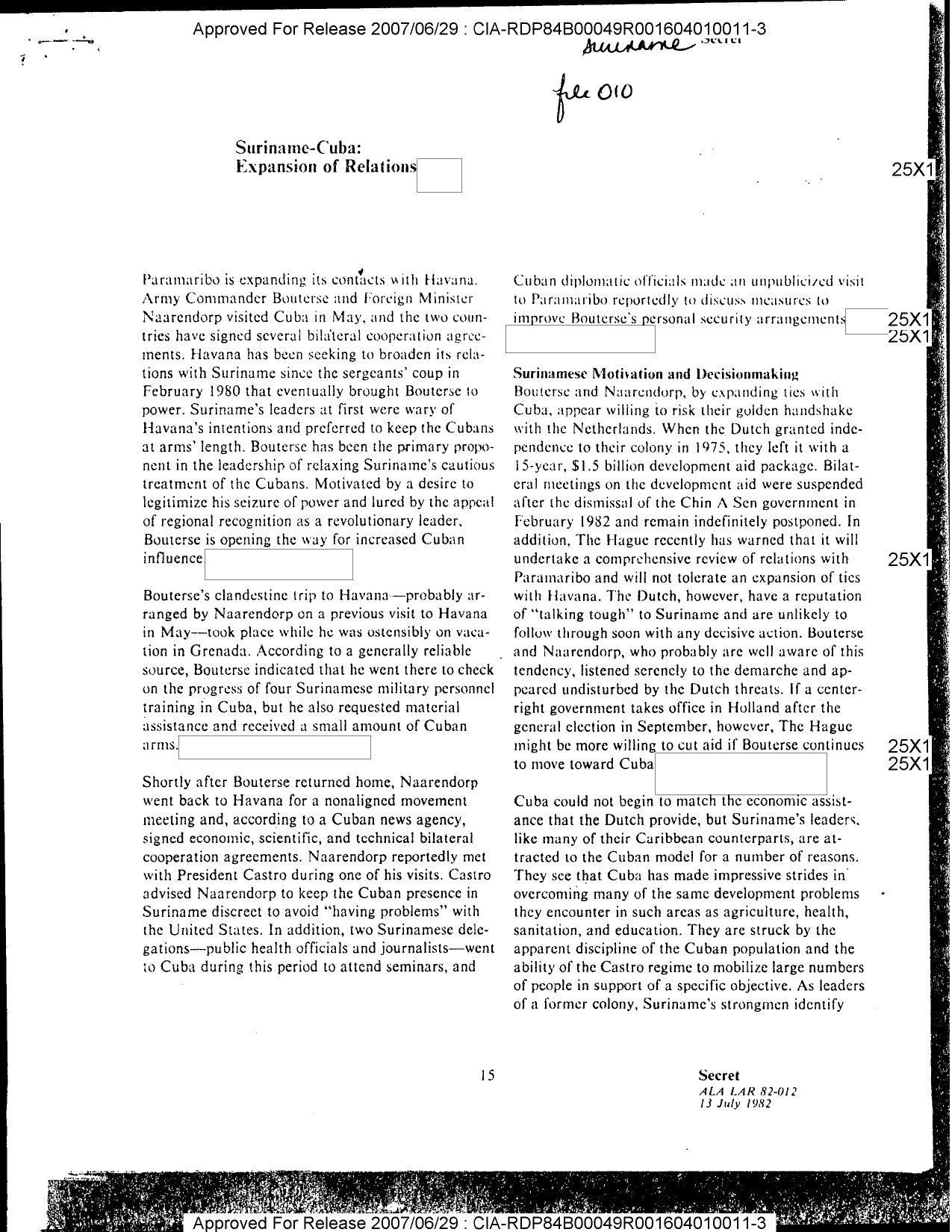
Paramaribo is expanding its contacts with Havana.
Amy Commander Bouterse and Foreign Minister Naarendorp visited Cuba in May, and the two countries have signed several bilateral cooperation agreements. Havana has been seeking to broaden its relations with Suriname since the sergeants’ coup in February 1980 that eventually brought Bouterse to power. Suriname’s leaders at first were wary of Havana’s intentions and preferred to keep the Cubans at arms’ length. Bouterse has been the primary proponent in the leadership of relaxing Suriname’s cautious treatment of the Cubans. Motivated by a desire to legitimize his seizure of power and lured by the appeal of regional recognition as a revolutionary leader, Bouterse is opening the way for increased Cuban influence.
Bouterse’s clandestine trip to Havana—probably arranged by Naarendorp on a previous visit to Havana in May—took place while he was ostensibly on vacation in Grenada. According to a generally reliable source, Bouterse indicated that he went there to check on the progress of four Surinamese military personnel training in Cuba, but he also requested material assistance and received a small amount of Cuban arms.
Shortly after Bouterse returned home, Naarendorp went back to Havana for a nonaligned movement meeting and, according to a Cuban news agency, signed economic, scientific, and technical bilateral cooperation agreements. Naarendorp reportedly met with President Castro during one of his visits. Castro advised Naarendorp to keep the Cuban presence in Suriname discreet to avoid “having problems” with the United States. In addition, two Surinamese delegations—public health officials and journalists—went to Cuba during this period to attend seminars, and Cuban diplomatic officials made an unpublicized visit to Paramaribo reportedly to discuss measures to improve Bouterse’s personal security arrangements.
Surinamese Motivation and Decisionmaking
Bouterse and Naarendorp, by expanding ties with Cuba, appear willing to risk their golden handshake with the Netherlands. When the Dutch granted independence to their colony in 1975, they left it with a 15-year, $1.5 billion development aid package. Bilateral meetings on the development aid were suspended after the dismissal of the Chin A Sen government in February 1982 and remain indefinitely postponed. In addition, The Hague recently has warned that it will undertake a comprehensive review of relations with Paramaribo and will not tolerate an expansion of ties with Havana. The Dutch, however, have a reputation of “talking tough” to Suriname and are unlikely to follow through soon with any decisive action. Bouterse and Naarendorp, who probably are well aware of this tendency, listened serenely to the demarche and appeared undisturbed by the Dutch threats. If a center-right government takes office in Holland after the general election in September, however, The Hague might be more willing to cut aid if Bouterse continues to move toward Cuba.
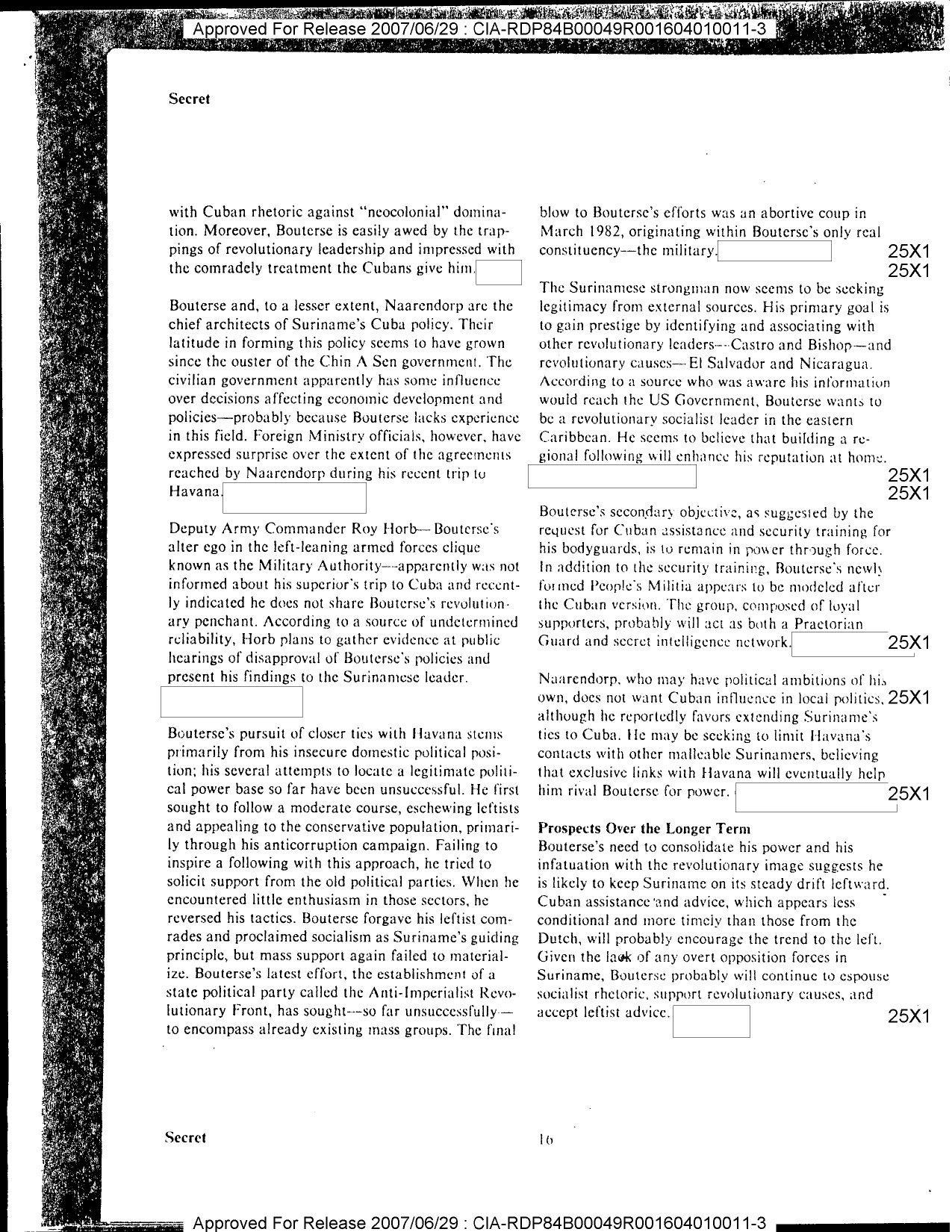
Cuba could not begin to match the economic assistance that the Dutch provide, but Suriname’s leaders, like many of their Caribbean counterparts, are attracted to the Cuban model for a number of reasons. They see that Cuba has made impressive strides in overcoming many of the same development problems they encounter in such areas as agriculture, health, sanitation, and education. They are struck by the apparent discipline of the Cuban population and the ability of the Castro regime to mobilize large numbers of people in support of a specific objective. As leaders of a former colony, Suriname’s strongmen identify with Cuban rhetoric against “neocolonial” domination. Moreover, Bouterse is easily awed by the trappings of revolutionary leadership and impressed with the comradely treatment the Cubans give him.
Bouterse and, to a lesser extent, Naarendorp are the chief architects of Suriname’s Cuba policy. Their latitude in forming this policy seems to have grown since the ouster of the Chin A Sen government. The civilian government apparently has some influence over decisions affecting economic development and policies—probably because Bouterse lacks experience in this field. Foreign Ministry officials, however, have expressed surprise over the extent of the agreements reached by Naarendorp during his recent trip to Havana.
Deputy Army Commander Roy Horb—Bouterse’s alter ego in the left-leaning armed forces clique known as the Military Authority—apparently was not informed about his superior’s trip to Cuba and recently indicated he does not share Bouterse’s revolutionary penchant. According to a source of undetermined reliability, Horb plans to gather evidence at public hearings of disapproval of Bouterse’s policies and present his findings to the Surinamese leader.
Bouterse’s pursuit of closer ties with Havana stems primarily from his insecure domestic political position; his several attempts to locate a legitimate political power base so far have been unsuccessful. He first sought to follow a moderate course, eschewing leftists and appealing to the conservative population, primarily through his anticorruption campaign. Failing to inspire a following with this approach, he tried to solicit support from the old political parties. When he encountered little enthusiasm in those sectors, he reversed his tactics. Bouterse forgave his leftist comrades and proclaimed socialism as Suriname’s guiding principle, but mass support again failed to materialize. Bouterse’s latest effort, the establishment of a state political party called the Anti-Imperialist Revolutionary Front, has sought—so far unsuccessfully—to encompass already existing mass groups. The final blow to Bouterse’s efforts was an abortive coup in March 1982, originating within Bouterse’s only real constituency—the military.
The Surinamese strongman now seems to be seeking legitimacy from external sources. His primary goal is to gain prestige by identifying and associating with other revolutionary leaders—Castro and Bishop—and revolutionary causes—El Salvador and Nicaragua. According to a source who was aware his information would reach the US Government, Bouterse wants to be a revolutionary socialist leader in the eastern Caribbean. He seems to believe that building a regional following will enhance his reputation at home.
Bouterse’s secondary objective, as suggested by the request for Cuban assistance and security training for his bodyguards, is to remain in power through force. In addition to the security training, Bouterse’s newly formed People’s Militia appears to be modeled after the Cuban version. The group, composed of loyal supporters, probably will act as both a Praetorian Guard and secret intelligence network.
Naarendorp, who may have political ambitions of his own, does not want Cuban influence in local politics, although he reportedly favors extending Suriname’s ties to Cuba. He may be seeking to limit Havana’s contacts with other malleable Surinamers, believing that exclusive links with Havana will eventually help him rival Bouterse for power.
Prospects Over the Longer Term
Bouterse’s need to consolidate his power and his infatuation with the revolutionary image suggests he is likely to keep Suriname on its steady drift leftward. Cuban assistance and advice, which appears less conditional and more timely than those from the Dutch, will probably encourage the trend to the left. Given the lack of any overt opposition forces in Suriname, Bouterse probably will continue to espouse socialist rhetoric, support revolutionary causes, and accept leftist advice.
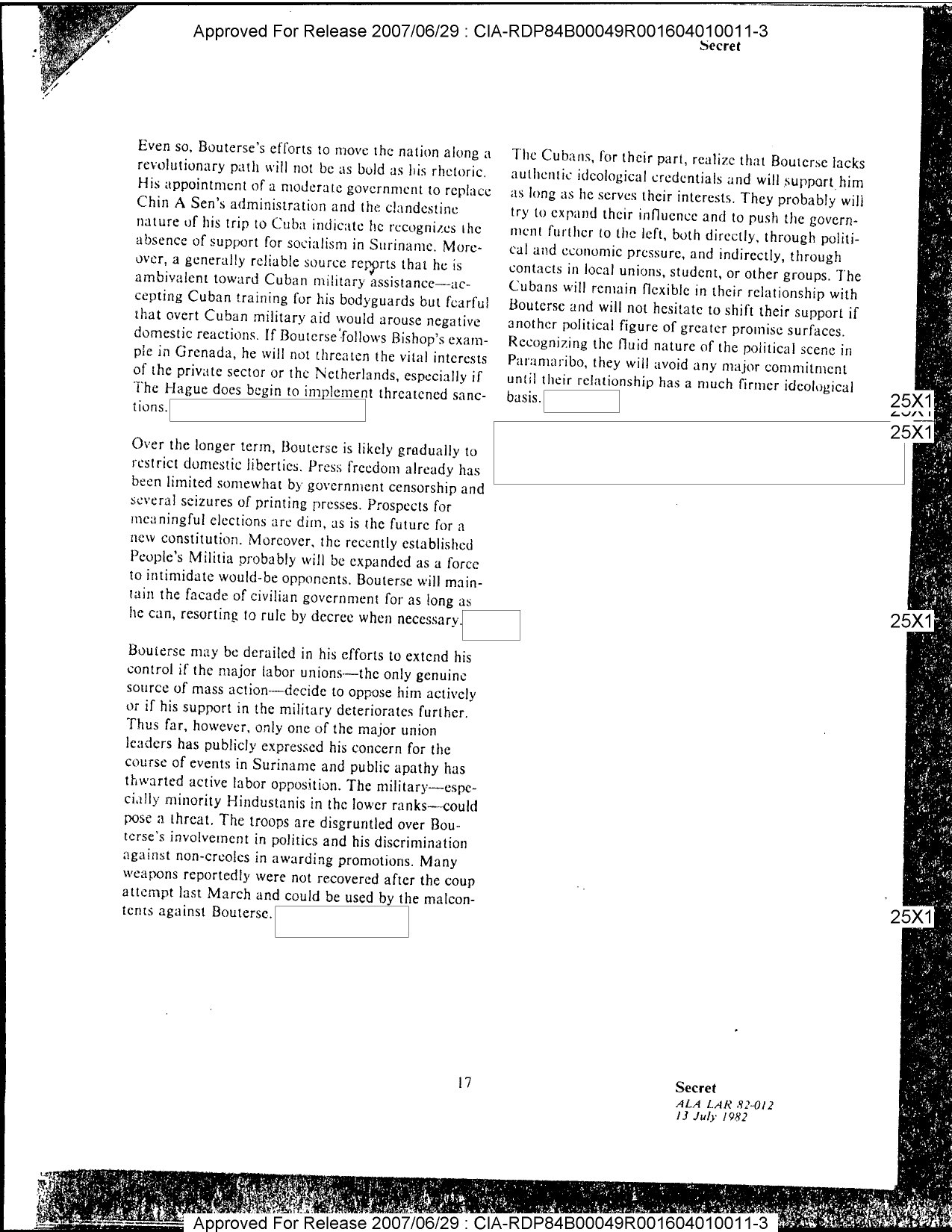
Even so, Bouterse’s efforts to move the nation along a revolutionary path will not be as bold as his rhetoric. His appointment of a moderate government to replace Chin A Sen’s administration and the clandestine nature of his trip to Cuba indicate he recognizes the absence of support for socialism in Suriname. Moreover, a generally reliable source reports that he is ambivalent toward Cuban military assistance—accepting Cuban training for his bodyguards but fearful that overt Cuban military aid would arouse negative domestic reactions. If Bouterse follows Bishop’s example in Grenada, he will not threaten the vital interests of the private sector or the Netherlands, especially if The Hague does begin to implement threatened sanctions.
Over the longer term, Bouterse is likely gradually to restrict domestic liberties. Press freedom already has been limited somewhat by government censorship and several seizures of printing presses. Prospects for meaningful elections are dim, as is the future for a new constitution. Moreover, the recently established People’s Militia probably will be expanded as a force to intimidate would-be opponents. Bouterse will maintain the facade of civilian government for as long as he can, resorting to rule by decree when necessary.
Bouterse may be derailed in his efforts to extend his control if the major labor unions—the only genuine source of mass action—decide to oppose him actively or if his support in the military deteriorates further. Thus far, however, only one of the major union leaders has publicly expressed his concern for the course of events in Suriname and public apathy has thwarted active labor opposition. The military—especially minority Hindustanis in the lower ranks—could pose a threat. The troops are disgruntled over Bouterse’s involvement in politics and his discrimination against non-creoles in awarding promotions. Many weapons reportedly were not recovered after the coup attempt last March and could be used by the malcontents against Bouterse.
The Cubans, for their part, realize that Bouterse lacks authentic ideological credentials and will support him as long as he serves their interests. They probably will try to expand their influence and to push the government further to the left, both directly, through political and economic pressure, and indirectly, through contacts in local unions, student, or other groups. The Cubans will remain flexible in their relationship with Bouterse and will not hesitate to shift their support if another political figure of greater promise surfaces. Recognizing the fluid nature of the political scene in Paramaribo, they will avoid any major commitment until their relationship has a much firmer ideological basis.
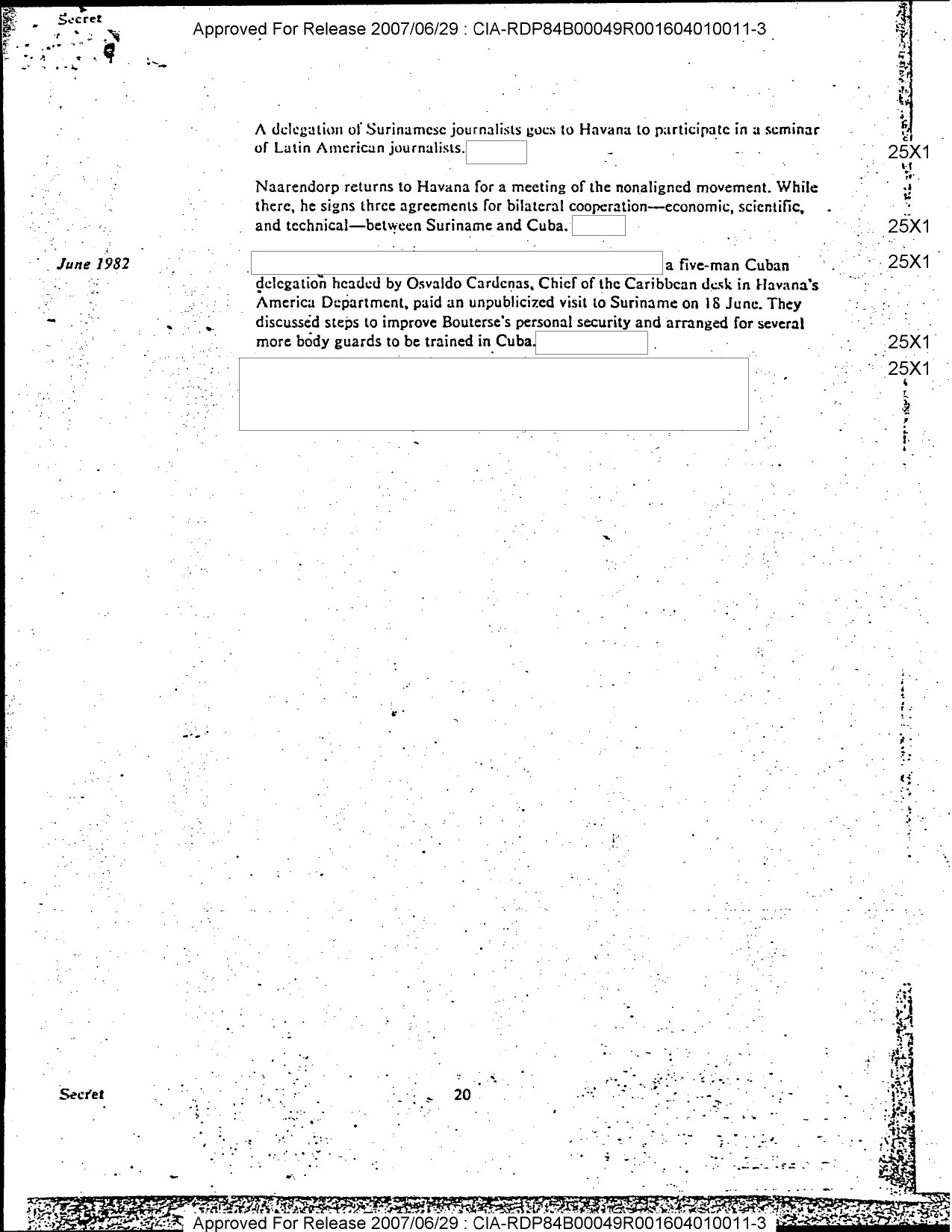
| Date | Event | Participants / Notes |
|---|---|---|
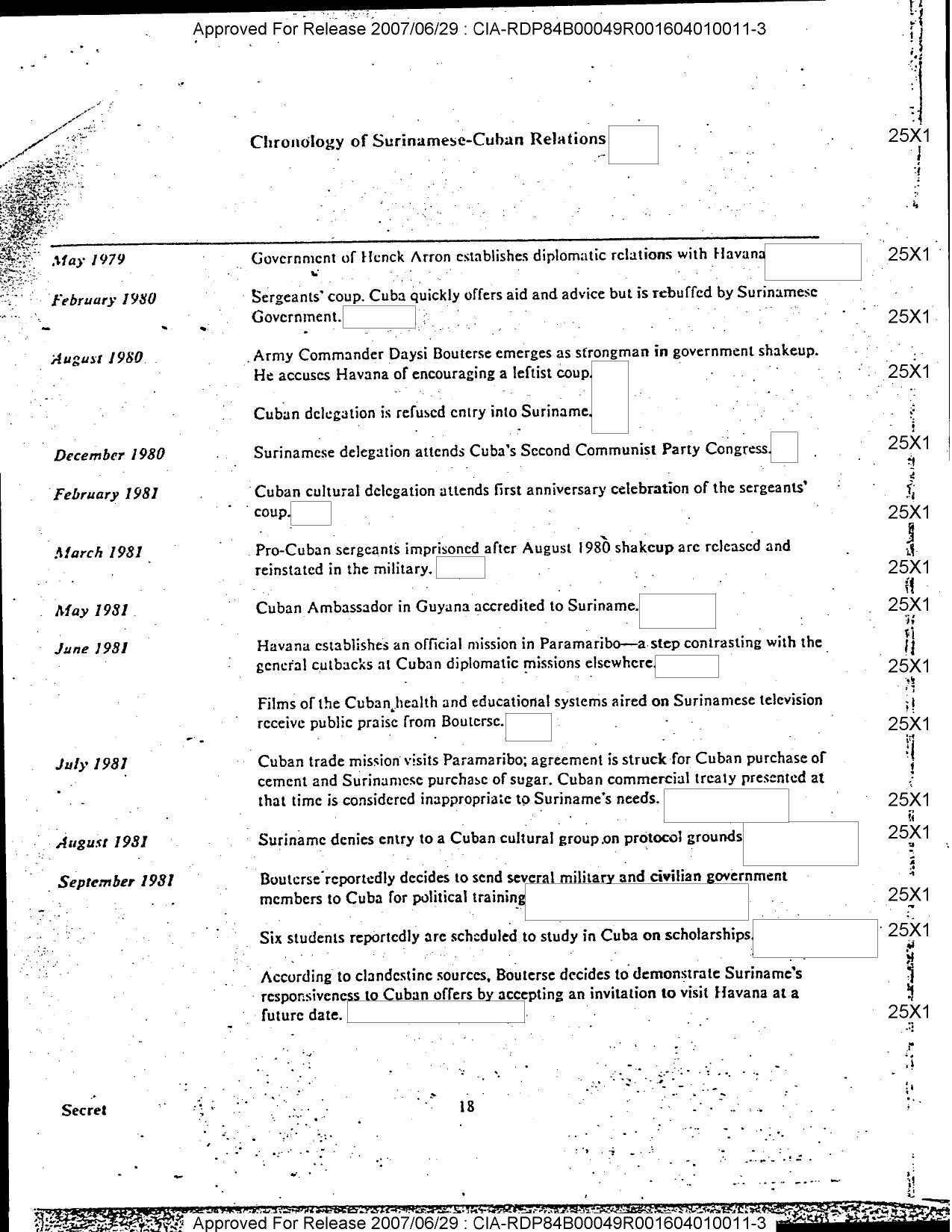
| May 1979 | Diplomatic relations established between Suriname and Cuba | Government of Henck Arron |
| February 1980 | Sergeants’ coup; Cuba offers aid but is initially rebuffed | Suriname, Cuba |
| August 1980 | Army Commander Dési Bouterse emerges as strongman; accuses Havana of encouraging a leftist coup | Bouterse; Cuban delegation refused entry |
| December 1980 | Surinamese delegation attends Cuba’s Second Communist Party Congress | Suriname delegation |
| February 1981 | Cuban cultural delegation attends first anniversary of the sergeants’ coup | Cuba |
| March 1981 | Pro-Cuban sergeants imprisoned after August 1980 shakeup are released and reinstated | Surinamese military |
| May 1981 | Cuban Ambassador in Guyana accredited to Suriname | Cuba |
| June 1981 | Havana establishes official mission in Paramaribo; Cuban films on health/education aired in Suriname | Cuba, Suriname |
| July 1981 | Cuban trade mission visits Paramaribo; agreement on cement/sugar; commercial treaty considered inappropriate | Cuba, Suriname |
| August 1981 | Suriname denies entry to Cuban cultural group | Suriname |
| September 1981 | Bouterse decides to send military/civilian personnel to Cuba for training; six students scheduled for scholarships | Suriname, Cuba |
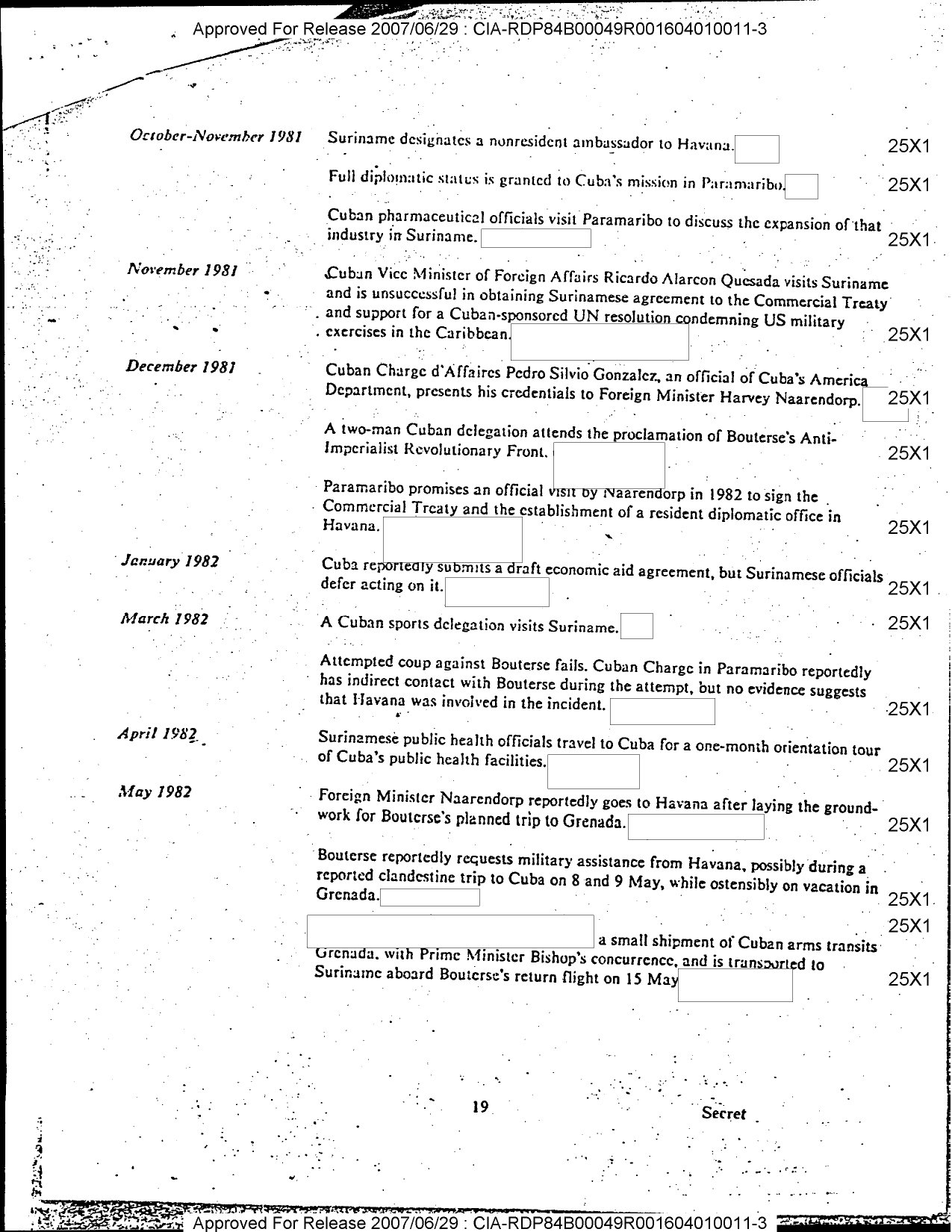
| October-November 1981 | Suriname designates nonresident ambassador to Havana; Cuba granted full diplomatic status; Cuban pharmaceutical officials visit | Suriname, Cuba |
| November 1981 | Cuban Vice Minister of Foreign Affairs Ricardo Alarcon Quesada visits Suriname; fails to gain support for commercial treaty and UN resolution | Cuba, Suriname |
| December 1981 | Cuban Chargé d’Affaires Pedro Silvio Gonzalez presents credentials; two-man Cuban delegation attends Anti-Imperialist Revolutionary Front proclamation; Suriname promises official visit by Naarendorp in 1982 | Cuba, Suriname |
| January 1982 | Cuba submits draft economic aid agreement; Suriname defers action | Cuba, Suriname |
| March 1982 | Cuban sports delegation visits Suriname; attempted coup against Bouterse fails | Cuba, Suriname |
| April 1982 | Surinamese public health officials travel to Cuba for orientation | Suriname, Cuba |
| May 1982 | Naarendorp visits Havana; Bouterse reportedly makes clandestine trip to Cuba requesting military assistance; small shipment of Cuban arms transported via Grenada | Suriname, Cuba, Grenada |
| May 1982 | Surinamese journalists visit Havana for seminar | Suriname, Cuba |
| May 1982 | Naarendorp returns to Havana for Nonaligned Movement meeting; signs three bilateral cooperation agreements (economic, scientific, technical) | Suriname, Cuba |
| June 1982 | Five-man Cuban delegation visits Suriname to improve Bouterse’s personal security; arrangements made for additional bodyguards to train in Cuba |
Source:
Link:
Internal Link:
Date:
July 13, 1982