Suriname: Discontent Increasing – National Intelligence Daily – 31 August 1982
CIA-RDP84T00301R000400010210-0
TELLIGEA Director of Central Intelligence
National Intelligence Daily (Cable)
31 August 1982
State Dept. review completed
Top Secret STAT
25X1
[CENSORED] [Approved For Release 2008/08/06: CIA-RDP84T00301R000400010210-0]
Top Secret
CPAS NIDC 82-204С
31 August 1982
Copy 402
25X1
[CENSORED] Page Denied
[CENSORED] [Approved For Release 2008/08/06: CIA-RDP84T00301R000400010210-0]
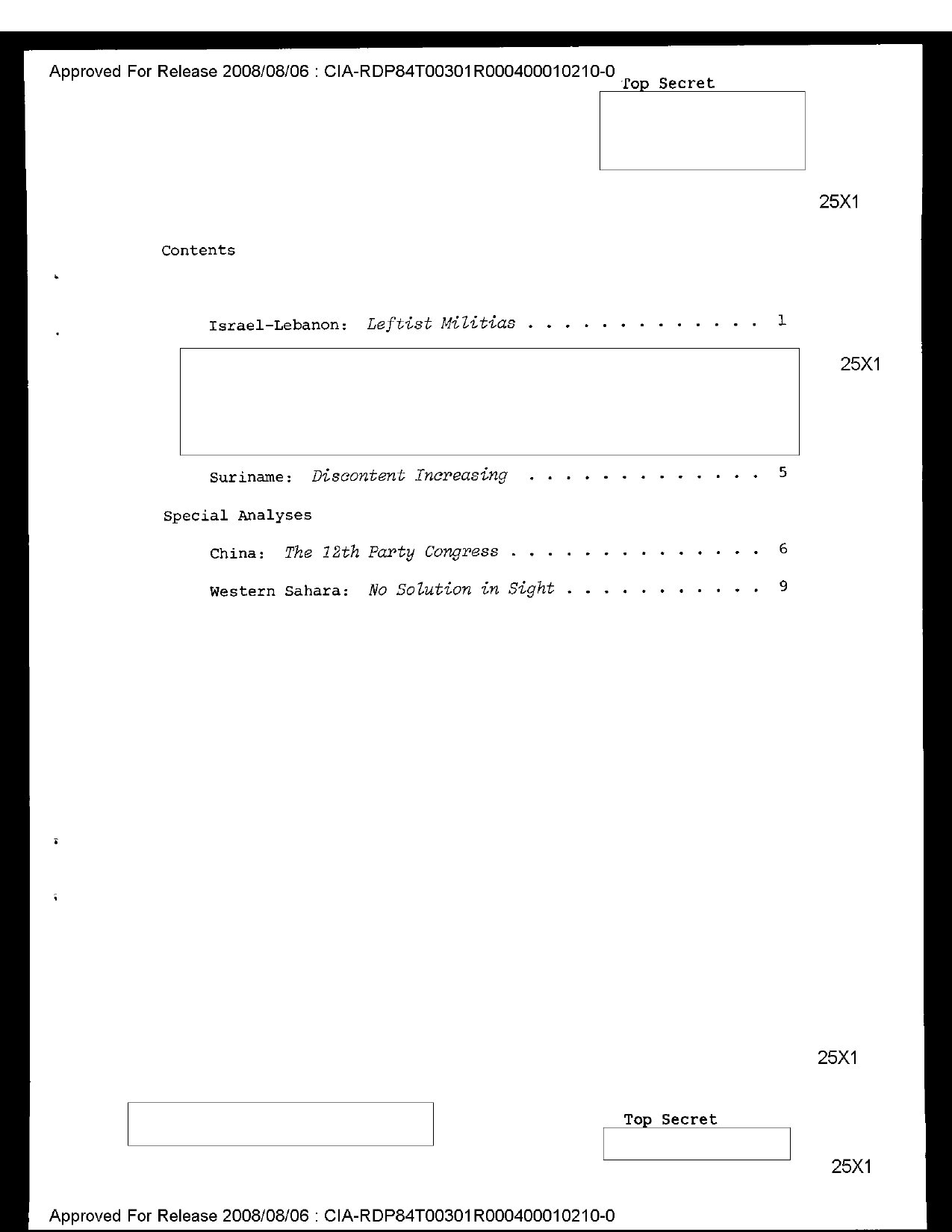
| Topic / Description | Page |
|---|---|
| Israel-Lebanon: Leftist Militias | 1 |
| Suriname: Discontent Increasing | 5 |
| Special Analyzes | |
| China: The 12th Party Congress | 6 |
| Western Sahara: No Solution in Sight | 9 |
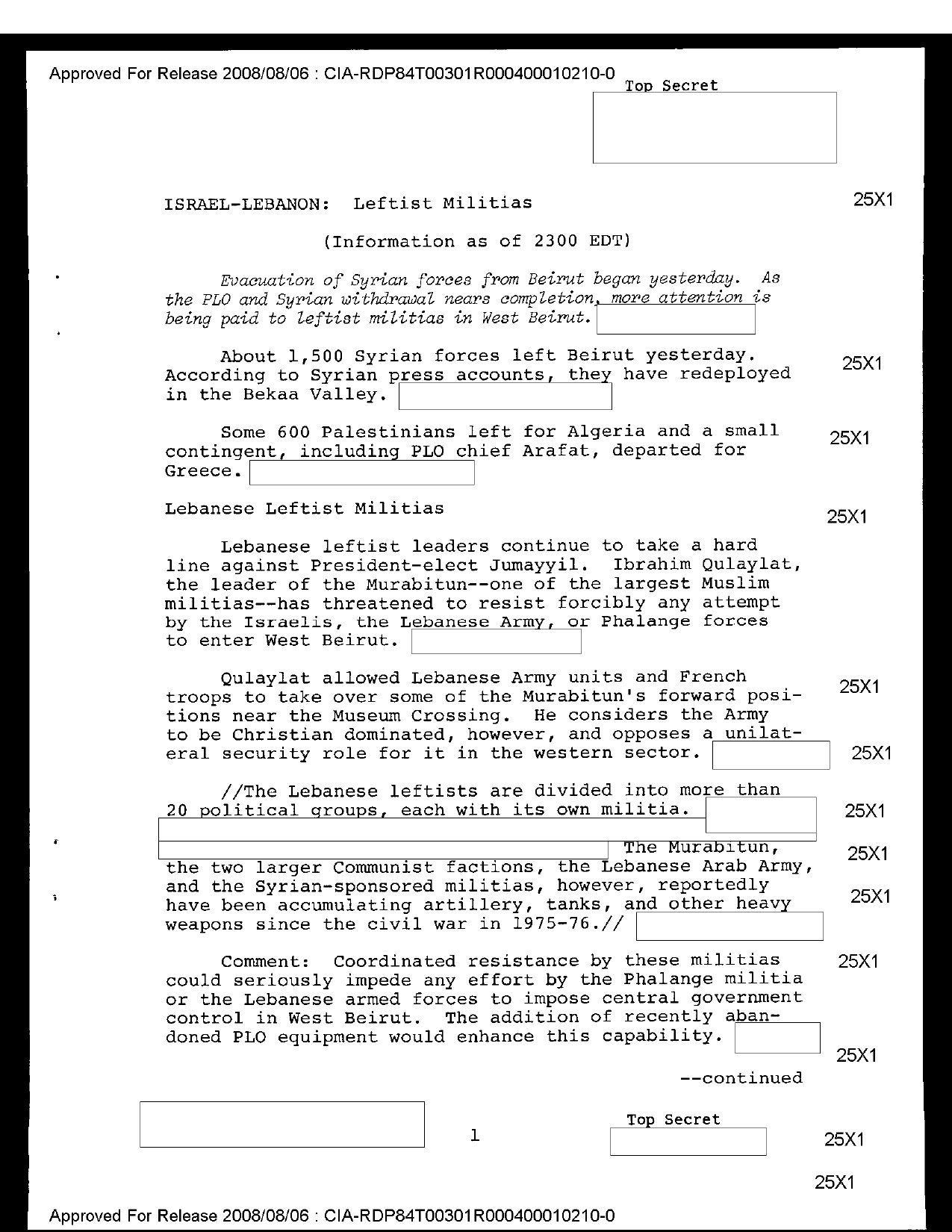
ISRAEL-LEBANON: Leftist Militias
(Information as of 2300 EDT)
Evacuation of Syrian forces from Beirut began yesterday. As the PLO and Syrian withdrawal nears completion, more attention is being paid to leftist militias in West Beirut.
About 1,500 Syrian forces left Beirut yesterday. According to Syrian press accounts, they have redeployed in the Bekaa Valley.
Some 600 Palestinians left for Algeria and a small contingent, including PLO chief Arafat, departed for Greece.
Lebanese Leftist Militias
Lebanese leftist leaders continue to take a hard line against President-elect Jumayyil. Ibrahim Qulaylat, the leader of the Murabitun—one of the largest Muslim militias—has threatened to resist forcibly any attempt by the Israelis, the Lebanese Army, or Phalange forces to enter West Beirut.
Qulaylat allowed Lebanese Army units and French troops to take over some of the Murabitun’s forward positions near the Museum Crossing. He considers the Army to be Christian dominated, however, and opposes a unilateral security role for it in the western sector.
[CENSORED] //The Lebanese leftists are divided into more than 20 political groups, each with its own militia.//
The Murabitun, [CENSORED] the two larger Communist factions, the Lebanese Arab Army, and the Syrian-sponsored militias, however, reportedly have been accumulating artillery, tanks, and other heavy weapons since the civil war in 1975-76.
Comment: Coordinated resistance by these militias [CENSORED] could seriously impede any effort by the Phalange militia or the Lebanese armed forces to impose central government control in West Beirut. The addition of recently abandoned PLO equipment would enhance this capability.
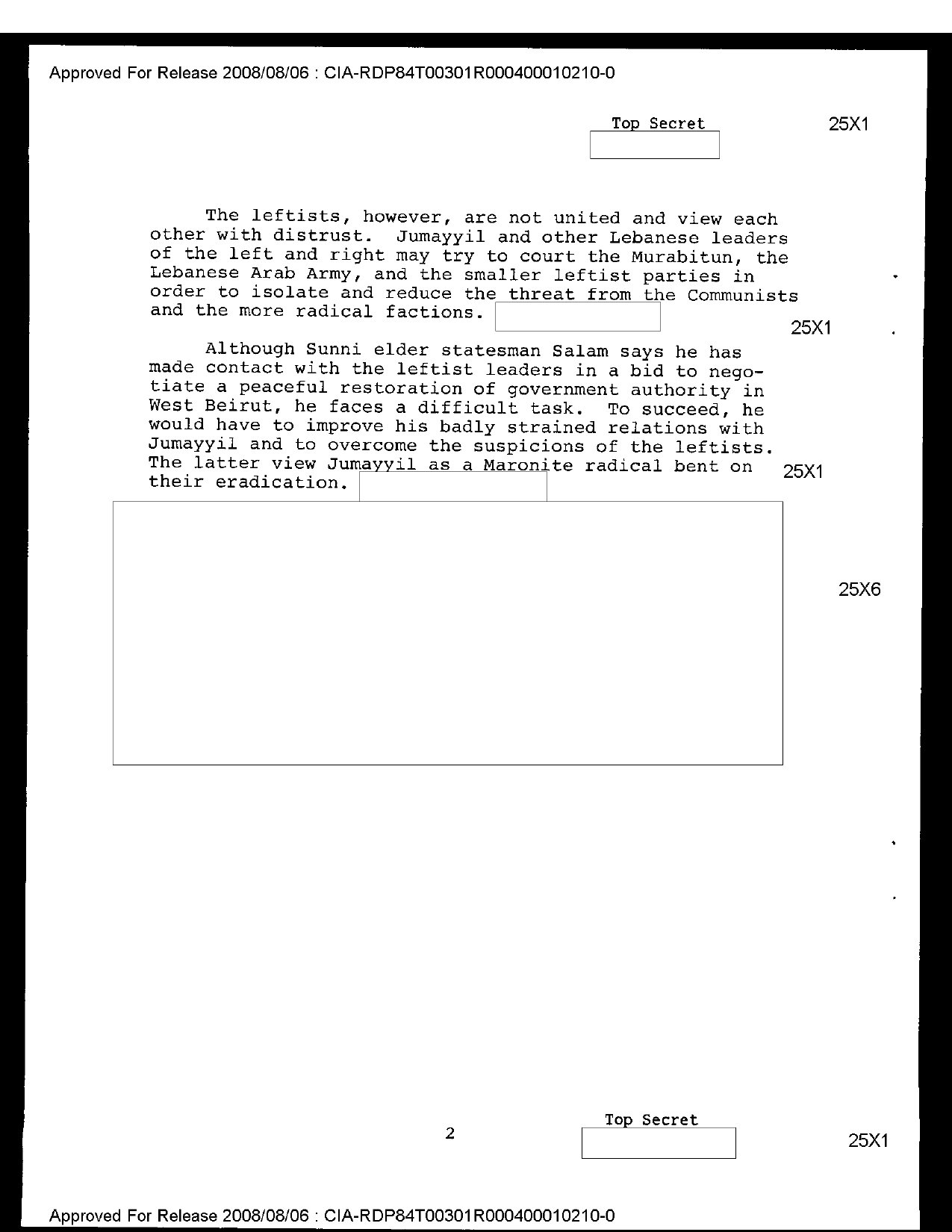
The leftists, however, are not united and view each other with distrust. Jumayyil and other Lebanese leaders of the left and right may try to court the Murabitun, the Lebanese Arab Army, and the smaller leftist parties in order to isolate and reduce the threat from the Communists and the more radical factions.
Although Sunni elder statesman Salam says he has made contact with the leftist leaders in a bid to negotiate a peaceful restoration of government authority in West Beirut, he faces a difficult task. To succeed, he would have to improve his badly strained relations with Jumayyil and to overcome the suspicions of the leftists. The latter view Jumayyil as a Maronite radical bent on their eradication.
[CENSORED]
[CENSORED] Page Denied — Next 1 Page(s) In Document Denied
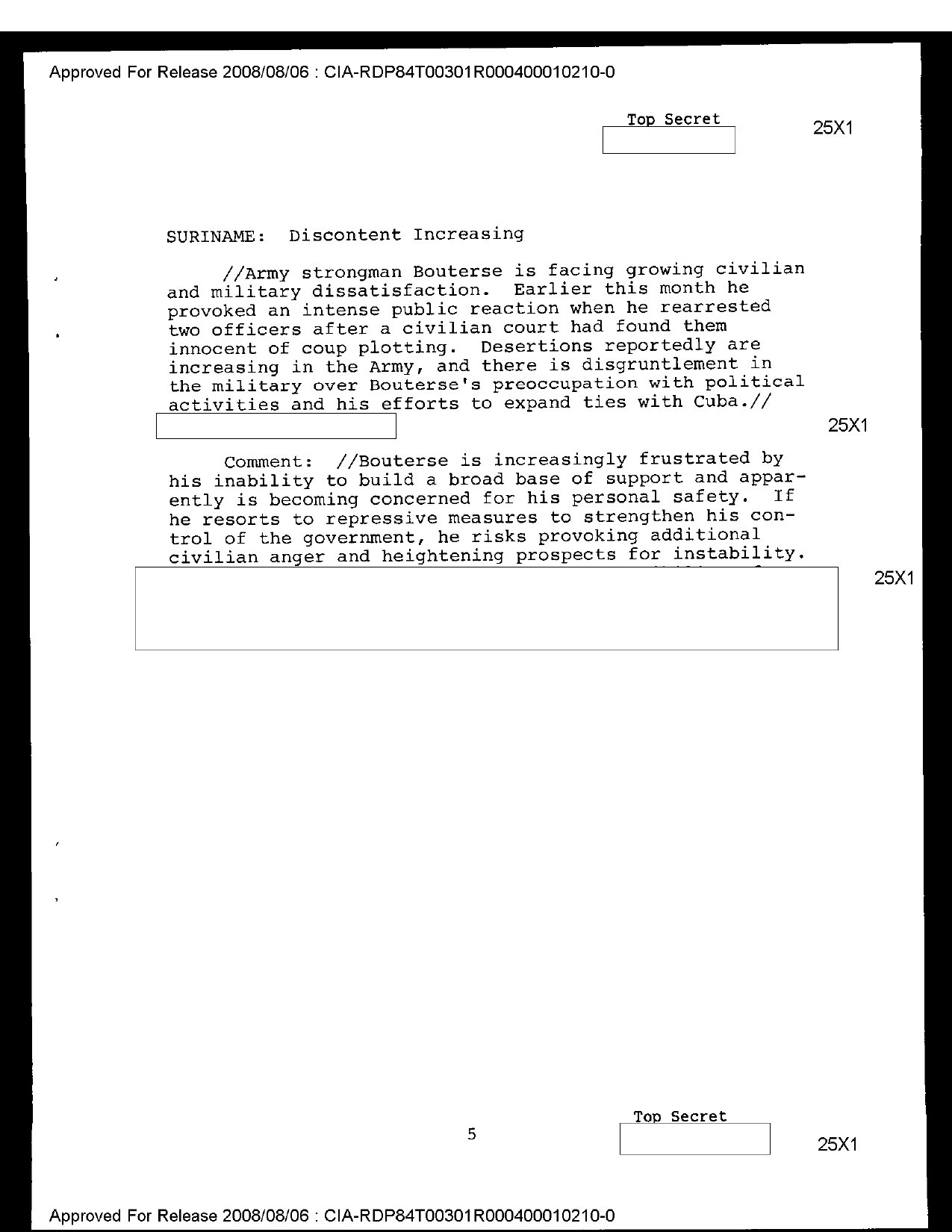
SURINAME: Discontent Increasing
[CENSORED] //Army strongman Bouterse is facing growing civilian and military dissatisfaction. Earlier this month he provoked an intense public reaction when he rearrested two officers after a civilian court had found them innocent of coup plotting. Desertions reportedly are increasing in the Army, and there is disgruntlement in the military over Bouterse’s preoccupation with political activities and his efforts to expand ties with Cuba.//
Comment: //Bouterse is increasingly frustrated by his inability to build a broad base of support and apparently is becoming concerned for his personal safety. If he resorts to repressive measures to strengthen his control of the government, he risks provoking additional civilian anger and heightening prospects for instability.//
SPECIAL ANALYSES
CHINA: The 12th Party Congress
Vice Chairman Deng Xiaoping will score impressive gains at the 12th Congress of the Chinese Communist Party that opens tomorrow in Beijing. Although Deng and his allies have had to compromise with opponents and will have to do so again in the future, the meeting will strengthen the positions of Deng’s chosen successors.
The congress will cap Deng’s five-year effort to rebuild party institutions damaged during the Cultural Revolution. When Deng formally proposed the organizational changes two years ago, his supporters expected quick approval. Opposition from conservative and military interests, however, forced him to delay and modify his plans.
The party conclave is likely to increase the latitude of Deng’s heir apparent, General Secretary Hu Yaobang. Deng will lead the top party elders to the political sidelines, gambling that he will be able to limit their influence and interference as the reformers enhance their position.
Structural Changes
Chinese leaders have said the congress will approve establishment of a new Advisory Commission of older party figures, headed by Deng, who will provide broad policy guidance. This commission will join the Central Committee and the Discipline Inspection Commission to form a troika of leading party bodies.
In addition, the congress will elevate the Secretariat, headed by Hu, to the “first line” of responsibility and demote the Politburo—China’s governing body since 1949—to an essentially advisory role. It will retire the titles of chairman and vice chairman of the Central Committee, leaving Hu at the top of the hierarchy. It also will adopt a new party constitution that will for the first time limit the tenure of leaders.
[CENSORED]
Problems and Prospects
The reformers will still have to reckon with the important reservoirs of conservative sentiment in the Advisory Council, Politburo, and Central Committee. Chinese politics depends more on personal networks than on institutional roles, and semiretired party elders will remain more influential than their titles suggest. This will constrain the reformers to practice collective leadership and to moderate their initiatives.
Former Party Chairman Hua Guofeng also seems to be troubling the reformers. Recent comments by Hu and articles in the media indicate Hua remains unwilling to undergo self-criticism. This tarnishes the image of stability and unity the reformers have sought to convey in advance of the congress.
Hua was personally disgraced at a party plenary session last year, and he will lose his last major title as party vice chairman at the congress. Nonetheless, he continues to stand as a symbol of resistance to reformist policies for those party members who have suffered at Deng’s hand.
Once the congress is over, China’s leaders also will shift their attention to economic planning and to reforming the governmental apparatus at lower levels. In 1980, the communique of the party’s fifth plenum announced that the 12th Congress would approve a new five-year plan. This has been dropped from the formal agenda, however, and may be left for the National People’s Congress in November.
Foreign Policy Outlook
Deliberations at the congress will occur in an unusually xenophobic atmosphere. Strong signs of opposition to China’s “open door” policy have emerged in the press and elsewhere since the beginning of the year. The leadership has acknowledged this attitude by cracking down on unregulated dealings with foreigners and by launching a campaign to oppose the influence of “bourgeois liberalism.”
Deng enters the congress with the issue of arms sales to Taiwan receding, but the Japanese textbook controversy continues to boil. Deng’s uncompromising public posture toward Tokyo may be intended to preempt those in the party who seek to discredit the reform program by attacking its outward-looking foreign policy.
The political climate in Beijing remains cool to new initiatives toward the West, and the congress probably will reinforce the independent-minded approach to foreign policy adopted last year.
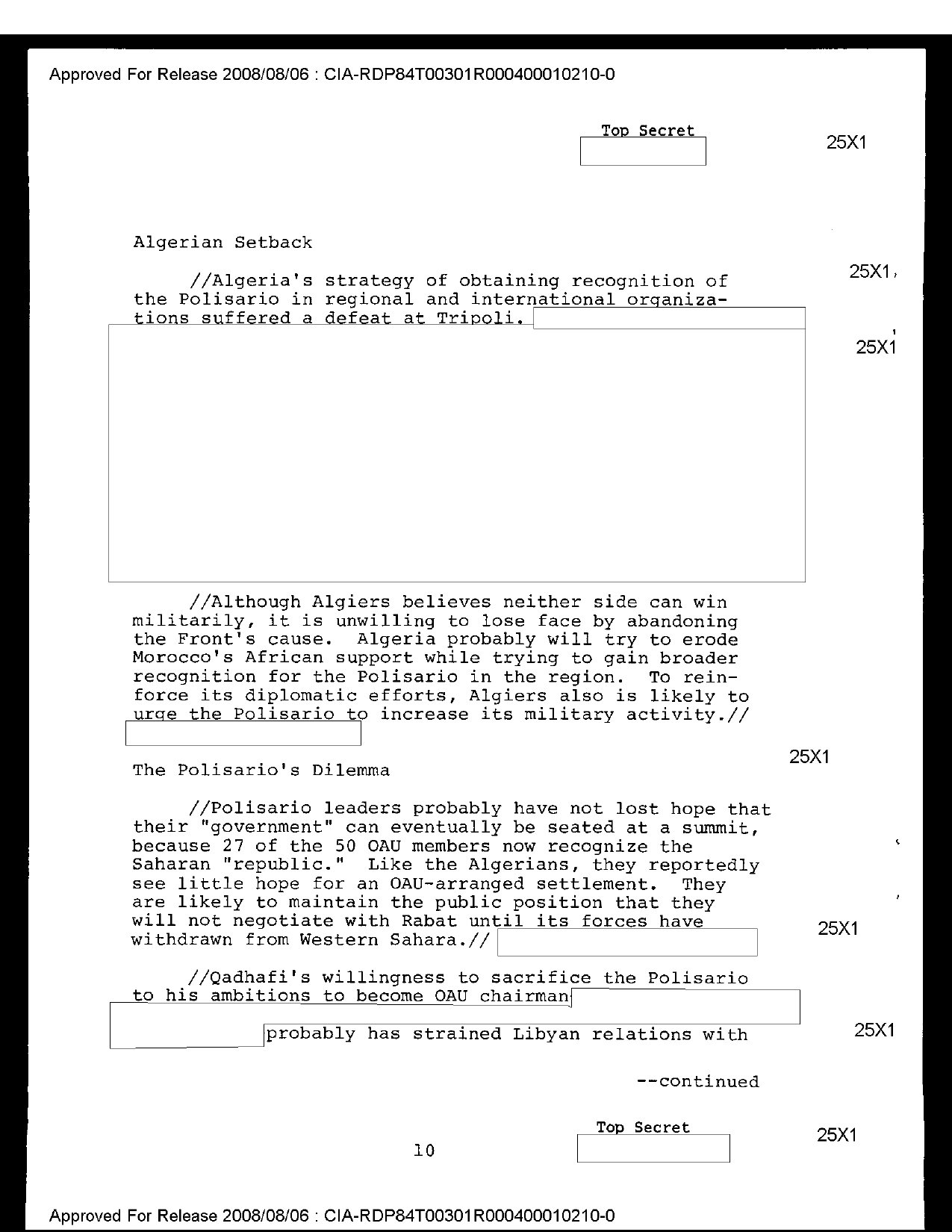
WESTERN SAHARA: No Solution in Sight
The continuing impasse in the OAU over whether to grant Polisario Front insurgents formal membership is likely to harden the positions of all parties to the seven-year-old dispute over Western Sahara. Both the Moroccans and the Algerians will continue their lobbying efforts, and the Polisario probably will intensify military activity.
[CENSORED] //When the summit that was to be held in Tripoli earlier this month collapsed for lack of a quorum, a contact group consisting of Congo, Libya, Mali, Mozambique, Tanzania, and Zambia was given the task of working out a compromise on the disputed issues that would assure a quorum for a summit before the end of the year. Further delay in convening a summit appears likely, however, because of African opposition to Libyan leader Qadhafi’s assumption of the chairmanship of the OAU and because all sides in the dispute show no willingness to compromise.//
[CENSORED] //Morocco’s confidence has been increased by its success—with strong support from Egypt and from non-OAU member Saudi Arabia—in blocking the meeting in Tripoli. Rabat believes moderate African states will continue to support its position against admitting the Polisario.//
[CENSORED] //Morocco is thus likely to remain intransigent and continue to avoid any situation where it would have to recognize tacitly or negotiate directly with the Polisario.//
Algerian Setback
[CENSORED] //Algeria’s strategy of obtaining recognition of the Polisario in regional and international organizations suffered a defeat at Tripoli. Although Algiers believes neither side can win militarily, it is unwilling to lose face by abandoning the Front’s cause. Algeria probably will try to erode Morocco’s African support while trying to gain broader recognition for the Polisario in the region. To reinforce its diplomatic efforts, Algiers also is likely to urge the Polisario to increase its military activity.//
The Polisario’s Dilemma
[CENSORED] //Polisario leaders probably have not lost hope that their “government” can eventually be seated at a summit, because 27 of the 50 OAU members now recognize the Saharan “republic.” Like the Algerians, they reportedly see little hope for an OAU-arranged settlement. They are likely to maintain the public position that they will not negotiate with Rabat until its forces have withdrawn from Western Sahara.//
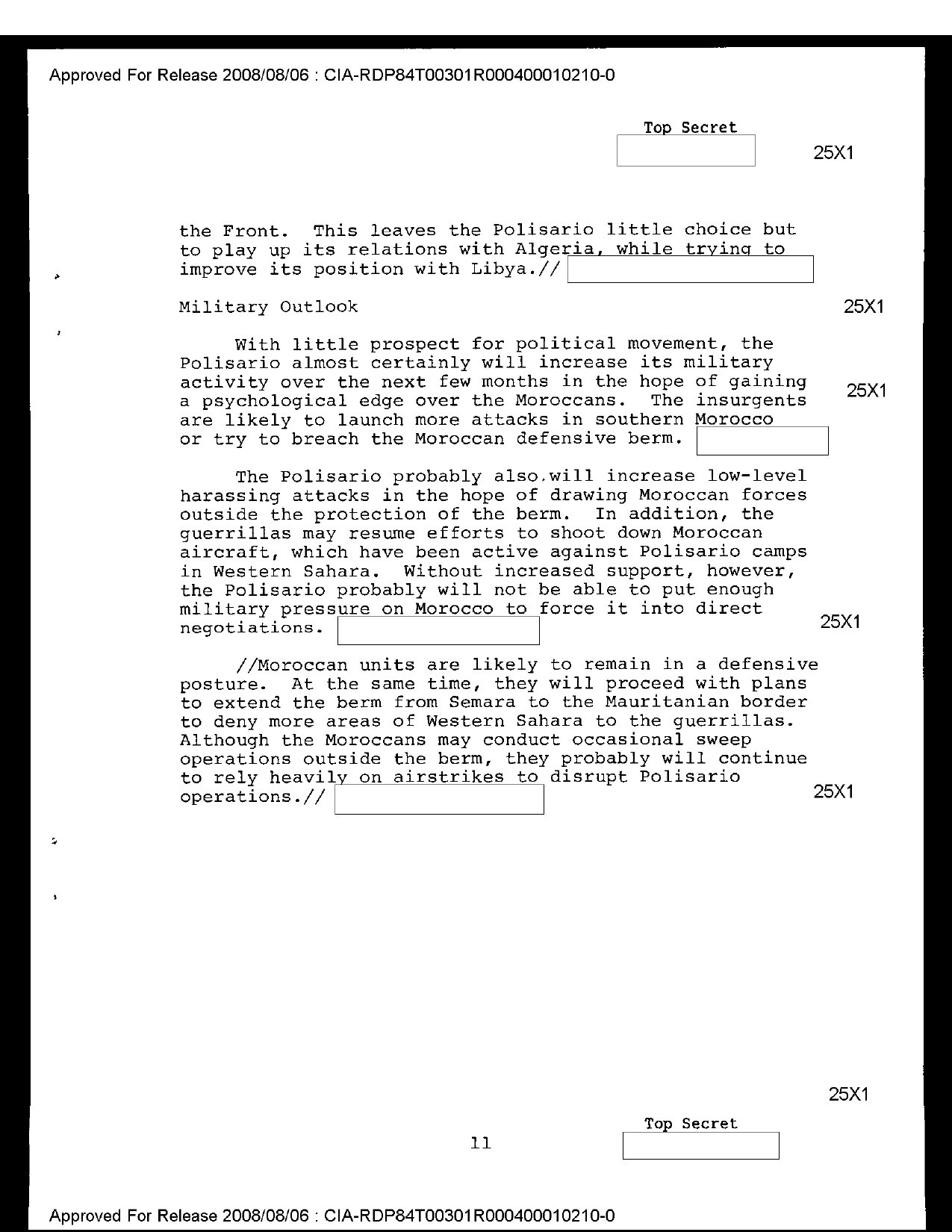
[CENSORED] Qadhafi’s willingness to sacrifice the Polisario to his ambitions to become OAU chairman probably has strained Libyan relations with the Front. This leaves the Polisario little choice but to play up its relations with Algeria, while trying to improve its position with Libya.
Military Outlook
With little prospect for political movement, the Polisario almost certainly will increase its military activity over the next few months in the hope of gaining a psychological edge over the Moroccans. The insurgents are likely to launch more attacks in southern Morocco or try to breach the Moroccan defensive berm.
The Polisario probably also will increase low-level harassing attacks in the hope of drawing Moroccan forces outside the protection of the berm. In addition, the guerrillas may resume efforts to shoot down Moroccan aircraft, which have been active against Polisario camps in Western Sahara. Without increased support, however, the Polisario probably will not be able to put enough military pressure on Morocco to force it into direct negotiations.
[CENSORED] //Moroccan units are likely to remain in a defensive posture. At the same time, they will proceed with plans to extend the berm from Semara to the Mauritanian border to deny more areas of Western Sahara to the guerrillas. Although the Moroccans may conduct occasional sweep operations outside the berm, they probably will continue to rely heavily on airstrikes to disrupt Polisario operations.//
Source:
Link:
Internal Link:
Date:
December 31, 1982