Suriname Economic Troubles Compound Political Uncertainty 1983
CIA-RDP84S00552R000300090003-6
An Intelligence Assessment
This assessment was prepared by the Office of African and Latin American Analysis. It was coordinated with the Directorate of Operations and the National Intelligence Council. Comments and queries are welcome and may be directed to the Chief, Middle America-Caribbean Division, ALA.
Key Judgments
Information available as of 5 July 1983 was used in this report.
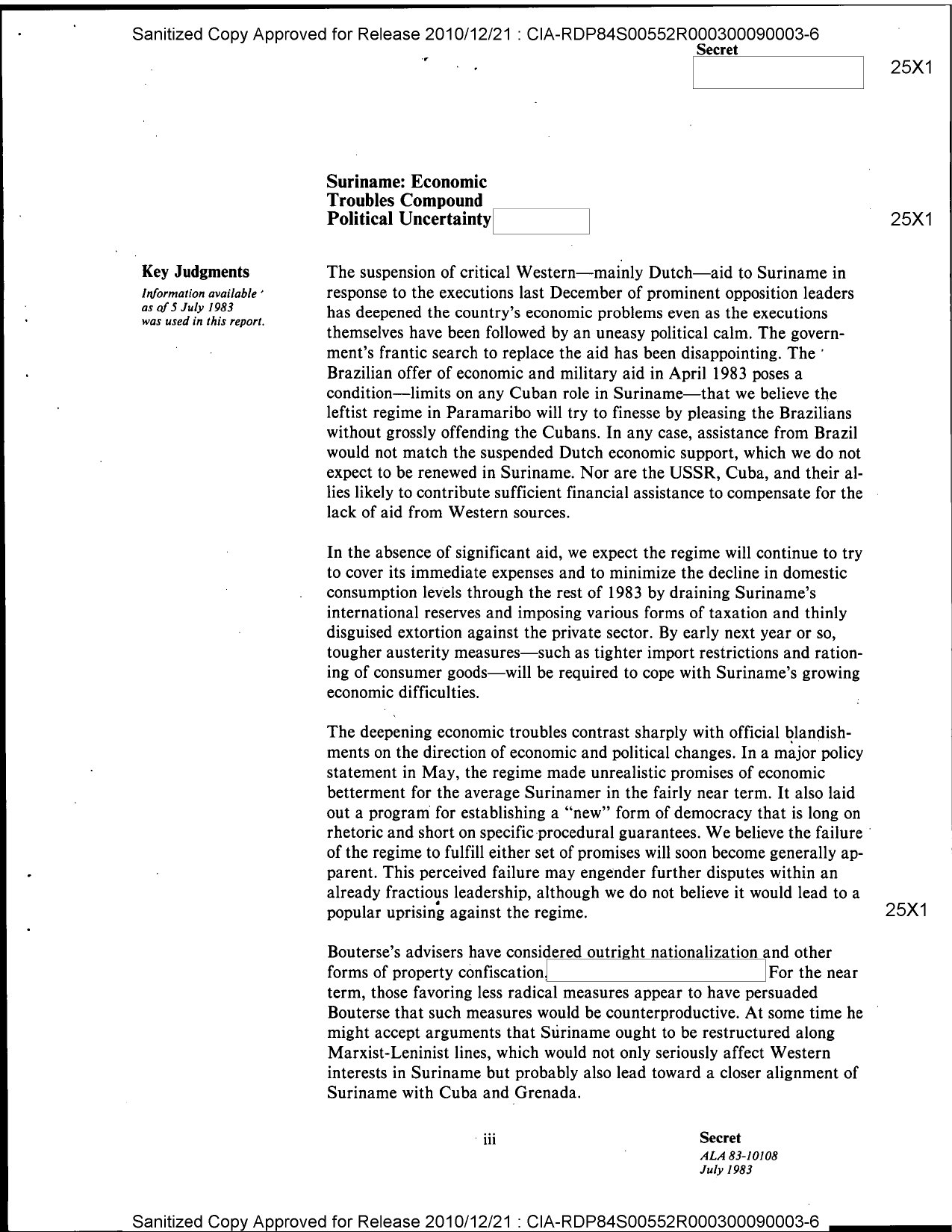
The suspension of critical Western—mainly Dutch—aid to Suriname in response to the executions last December of prominent opposition leaders has deepened the country’s economic problems even as the executions themselves have been followed by an uneasy political calm. The government’s frantic search to replace the aid has been disappointing. The Brazilian offer of economic and military aid in April 1983 poses a condition—limits on any Cuban role in Suriname—that we believe the leftist regime in Paramaribo will try to finesse by pleasing the Brazilians without grossly offending the Cubans. In any case, assistance from Brazil would not match the suspended Dutch economic support, which we do not expect to be renewed in Suriname. Nor are the USSR, Cuba, and their allies likely to contribute sufficient financial assistance to compensate for the lack of aid from Western sources.
In the absence of significant aid, we expect the regime will continue to try to cover its immediate expenses and to minimize the decline in domestic consumption levels through the rest of 1983 by draining Suriname’s international reserves and imposing various forms of taxation and thinly disguised extortion against the private sector. By early next year or so, tougher austerity measures—such as tighter import restrictions and rationing of consumer goods—will be required to cope with Suriname’s growing economic difficulties.
The deepening economic troubles contrast sharply with official blandishments on the direction of economic and political changes. In a major policy statement in May, the regime made unrealistic promises of economic betterment for the average Surinamer in the fairly near term. It also laid out a program for establishing a “new” form of democracy that is long on rhetoric and short on specific procedural guarantees. We believe the failure of the regime to fulfill either set of promises will soon become generally apparent. This perceived failure may engender further disputes within an already fractious leadership, although we do not believe it would lead to a popular uprising against the regime.
Bouterse’s advisers have considered outright nationalization and other forms of property confiscation. For the near term, those favoring less radical measures appear to have persuaded Bouterse that such measures would be counterproductive. At some time he might accept arguments that Suriname ought to be restructured along Marxist-Leninist lines, which would not only seriously affect Western interests in Suriname but probably also lead toward a closer alignment of Suriname with Cuba and Grenada.
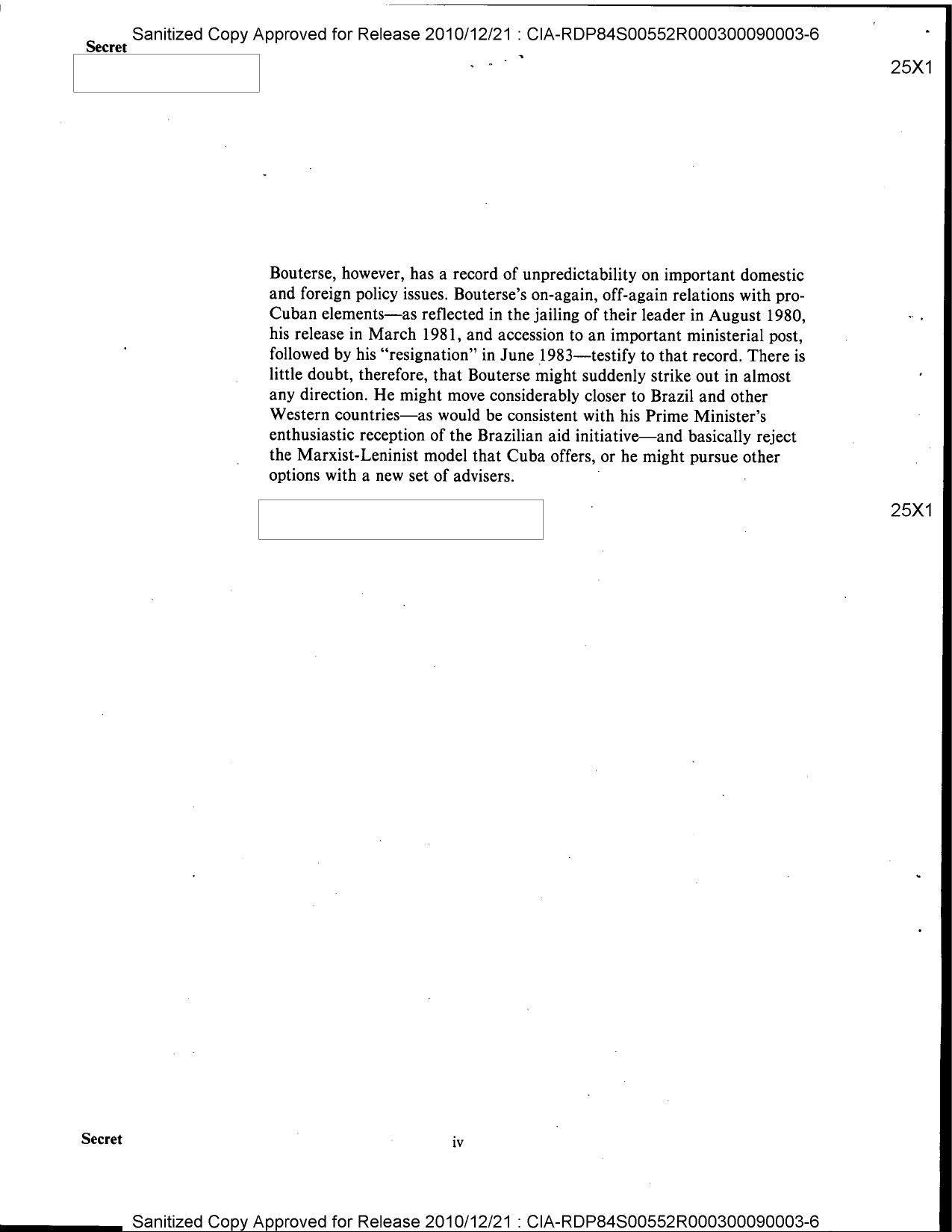
Bouterse, however, has a record of unpredictability on important domestic and foreign policy issues. Bouterse’s on-again, off-again relations with pro-Cuban elements—as reflected in the jailing of their leader in August 1980, his release in March 1981, and accession to an important ministerial post, followed by his “resignation” in June 1983—testify to that record. There is little doubt, therefore, that Bouterse might suddenly strike out in almost any direction. He might move considerably closer to Brazil and other Western countries—as would be consistent with his Prime Minister’s enthusiastic reception of the Brazilian aid initiative—and basically reject the Marxist-Leninist model that Cuba offers, or he might pursue other options with a new set of advisers.
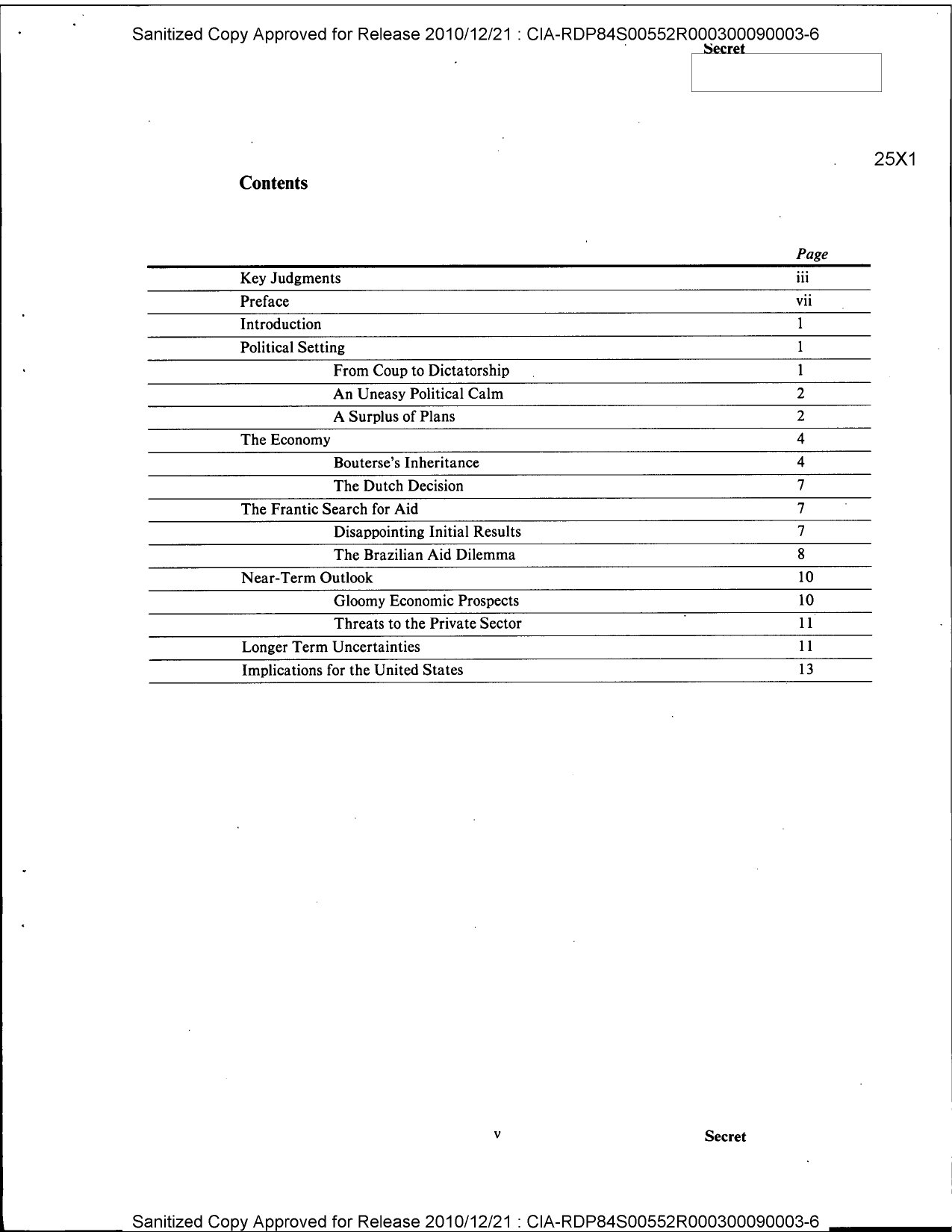
Contents
| Section | Page |
|---|---|
| Key Judgments | iii |
| Preface | vii |
| Introduction | 1 |
| Political Setting | 1 |
| From Coup to Dictatorship | 1 |
| The Economy | 2 |
| An Uneasy Political Calm | 2 |
| A Surplus of Plans | 4 |
| Bouterse’s Inheritance | 4 |
| The Dutch Decision | 7 |
| The Frantic Search for Aid | 7 |
| Disappointing Initial Results | 7 |
| The Brazilian Aid Dilemma | 8 |
| Near-Term Outlook | 10 |
| Gloomy Economic Prospects | 10 |
| Threats to the Private Sector | 11 |
| Longer Term Uncertainties | 11 |
| Implications for the United States | 13 |
Preface
US policy interests regarding Suriname are focused primarily on the internal political turbulence since 1980 and the security issues raised by deepening Cuban involvement, the suspension of Dutch aid in December 1982, and the Brazilian diplomatic initiative last April. The intelligence community monitors these developments in current publications, aware that major changes in these areas can occur with little or no warning. We also are aware of the risk that a more in-depth assessment on Suriname is highly vulnerable to such changes. Nevertheless, we seek to broaden understanding of the Suriname problem by incorporating the economic dimension, which is visible beneath the turbulence of political developments and could become a significant political factor in its own right.
Introduction
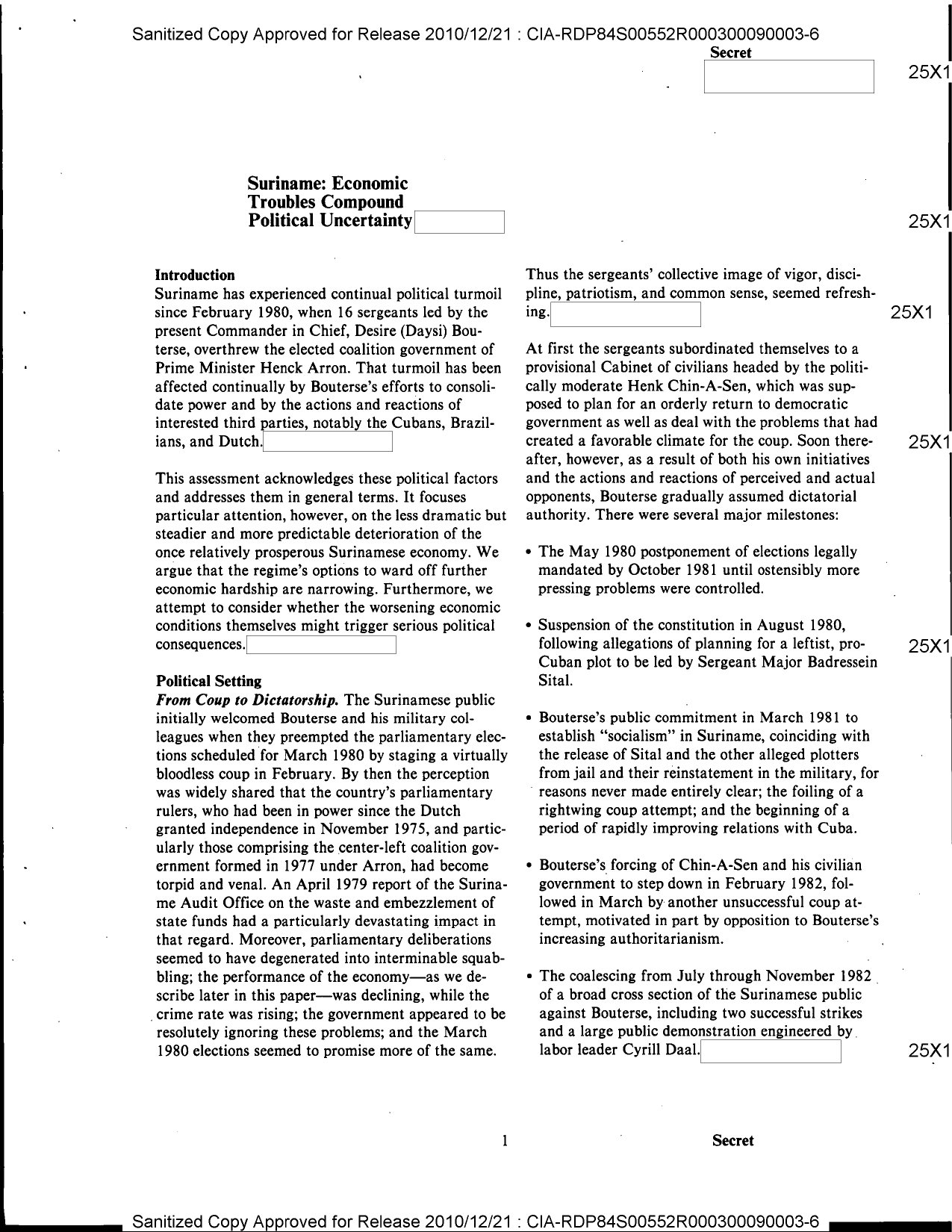
Suriname has experienced continual political turmoil since February 1980, when 16 sergeants led by the present Commander in Chief, Desire (Daysi) Bouterse, overthrew the elected coalition government of Prime Minister Henck Arron. That turmoil has been affected continually by Bouterse’s efforts to consolidate power and by the actions and reactions of interested third parties, notably the Cubans, Brazilians, and Dutch.
This assessment acknowledges these political factors and addresses them in general terms. It focuses particular attention, however, on the less dramatic but steadier and more predictable deterioration of the once relatively prosperous Surinamese economy. We argue that the regime’s options to ward off further economic hardship are narrowing. Furthermore, we attempt to consider whether the worsening economic conditions themselves might trigger serious political consequences.
Political Setting
From Coup to Dictatorship
The Surinamese public initially welcomed Bouterse and his military colleagues when they preempted the parliamentary elections scheduled for March 1980 by staging a virtually bloodless coup in February. By then, the perception was widely shared that the country’s parliamentary rulers, who had been in power since the Dutch granted independence in November 1975, and particularly those comprising the center-left coalition government formed in 1977 under Arron, had become torpid and venal. An April 1979 report of the Suriname Audit Office on the waste and embezzlement of state funds had a particularly devastating impact in that regard. Moreover, parliamentary deliberations seemed to have degenerated into interminable squabbling; the performance of the economy—as we describe later in this paper—was declining, while the crime rate was rising; the government appeared to be resolutely ignoring these problems; and the March 1980 elections seemed to promise more of the same.
Thus, the sergeants’ collective image of vigor, discipline, patriotism, and common sense seemed refreshing.
At first, the sergeants subordinated themselves to a provisional Cabinet of civilians headed by the politically moderate Henk Chin-A-Sen, which was supposed to plan for an orderly return to democratic government as well as deal with the problems that had created a favorable climate for the coup. Soon thereafter, however, as a result of both his own initiatives and the actions and reactions of perceived and actual opponents, Bouterse gradually assumed dictatorial authority. There were several major milestones:
- The May 1980 postponement of elections legally mandated by October 1981 until ostensibly more pressing problems were controlled.
- Suspension of the constitution in August 1980, following allegations of planning for a leftist, pro-Cuban plot to be led by Sergeant Major Badressein Sital.
- Bouterse’s public commitment in March 1981 to establish “socialism” in Suriname, coinciding with the release of Sital and the other alleged plotters from jail and their reinstatement in the military, for reasons never made entirely clear; the foiling of a rightwing coup attempt; and the beginning of a period of rapidly improving relations with Cuba.
- Bouterse’s forcing of Chin-A-Sen and his civilian government to step down in February 1982, followed in March by another unsuccessful coup attempt, motivated in part by opposition to Bouterse’s increasing authoritarianism.
- The coalescing from July through November 1982 of a broad cross-section of the Surinamese public against Bouterse, including two successful strikes and a large public demonstration engineered by labor leader Cyrill Daal.
In December, the Surinamese citizenry was traumatized when Bouterse ordered the execution of key labor, business, academic, legal, and media personalities, including Cyrill Daal. This brutality—unprecedented in Suriname—provoked the Dutch to abandon their long tolerance for Bouterse’s political experimentation and to suspend all aid to their former colony. Bouterse’s political purge of the military in January 1983 and his elimination of a potential rival, Deputy Army Commander Roy Horb in early February, further reduced the chances of an internal uprising despite the overwhelming unpopularity of the regime.
An Uneasy Political Calm
Since then, Bouterse has concentrated all significant public power in his own person. He leads the “Group of 16,” a cast of noncommissioned officers who engineered the February 1980 coup; the dozen or so remaining members of that group now function as an ad hoc advisory body and informal guarantee of military support for him.
In addition, Bouterse chairs the so-called Policy Center, which deliberates key decisions affecting the regime. In its most recent incarnation, this body consisted of himself and the most important members of the Cabinet: Prime Minister and Minister of Foreign and General Affairs Errol Alibux; Minister of Finance and Planning and Deputy Prime Minister Winston Caldeira; and, until his “resignation” in early June, Minister of People’s Mobilization and Culture Sital.
The mix of leading personalities appears unstable, and policy direction seems equally unsettled. Bouterse has left a trail of policy inconsistency that seems to reflect the unresolved conflicts among his supporters. We believe that Alibux and his small leftist, nationalist political party, the Progressive Workers and Farmers Union (PALU), are resistant to the efforts by Sital and his tiny Marxist-Leninist group, the Revolutionary People’s Party (RVP), to make Suriname a close ally of Cuba. The views of PALU and the RVP about how to consolidate the regime also diverge. As of early July, the less radical Alibux line appeared ascendant, but Bouterse’s record leaves little doubt that he is capable of lurching back toward a more extremist position with little warning.
A Surplus of Plans
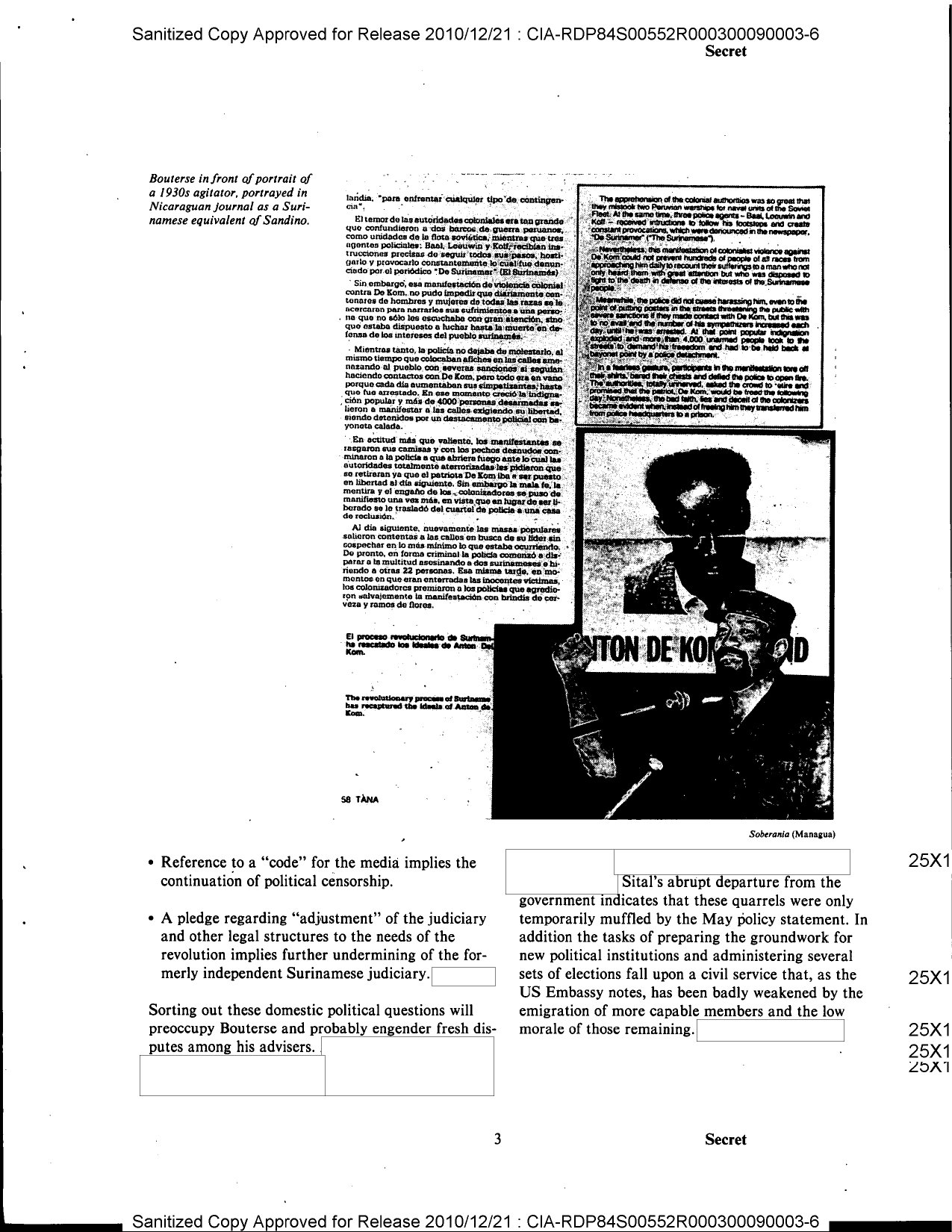
The regime’s plans for building a new political structure to supplement Bouterse’s ad hoc rule are vague, clouded by revolutionary rhetoric and pseudophilosophical jargon. Bouterse has announced publicly on several occasions that parliamentary democracy is dead in Suriname since it “brought only chaos.” Instead, he called for a governing system that was uniquely Surinamese and based on anti-imperialism, anticolonialism, and the “establishment of an independent and prosperous country.”
As part of his anti-imperialism campaign, Bouterse has continued to try to rally Surinamers against perceived externally sponsored threats to his regime. In his May Day speech, he renewed his intention to build up a “people’s militia.” He was typically ambiguous about how this potentially large force might be recruited, equipped, commanded, or employed. Bouterse is using recent media revelations of an alleged CIA plot to overthrow him to justify his stated determination to establish “anti-intervention committees” as well as the militia.
On the same day, Prime Minister Alibux announced a relatively moderate but sweeping program of economic, political, and social reform drawn mainly from the PALU philosophy. The three-year program (1983–86) outlined a major restructuring of the country’s political institutions and the creation of several new entities on the national and local levels. It also reiterated the regime’s positions on many issues included in 1 May policy statements over the last three years. Major features of the plan include the establishment of:
- A national congress to serve in a consultative capacity to the Policy Center.
- An advisory council of state.
- A commission to begin drafting a new constitution by 1986.
- Locally elected neighborhood and district councils, perhaps by the end of 1983.
In several respects, the Alibux program offers no more than a facade of democracy. We believe, for example, that postponing the drafting of a constitution promises general confusion about political rights, responsibilities, and decision-making. Moreover, the military rejected a previous draft because it did not ensure the military a significant role in the political process and may veto any effort that seeks to limit its power.
Reference to a “code” for the media implies the continuation of political censorship.
- A pledge regarding “adjustment” of the judiciary and other legal structures to the needs of the revolution implies further undermining of the formerly independent Surinamese judiciary.
Sorting out these domestic political questions will preoccupy Bouterse and probably engender fresh disputes among his advisers. Sital’s abrupt departure from the government indicates that these quarrels were only temporarily muffled by the May policy statement. In addition, the tasks of preparing the groundwork for new political institutions and administering several sets of elections fall upon a civil service that, as the US Embassy notes, has been badly weakened by the emigration of more capable members and the low morale of those remaining.
All of these pursuits tend to distract the regime from an increasingly troubled economy. As we discuss below, the May 1983 PALU program is more likely to aggravate these troubles.
The Economy
Bouterse’s Inheritance
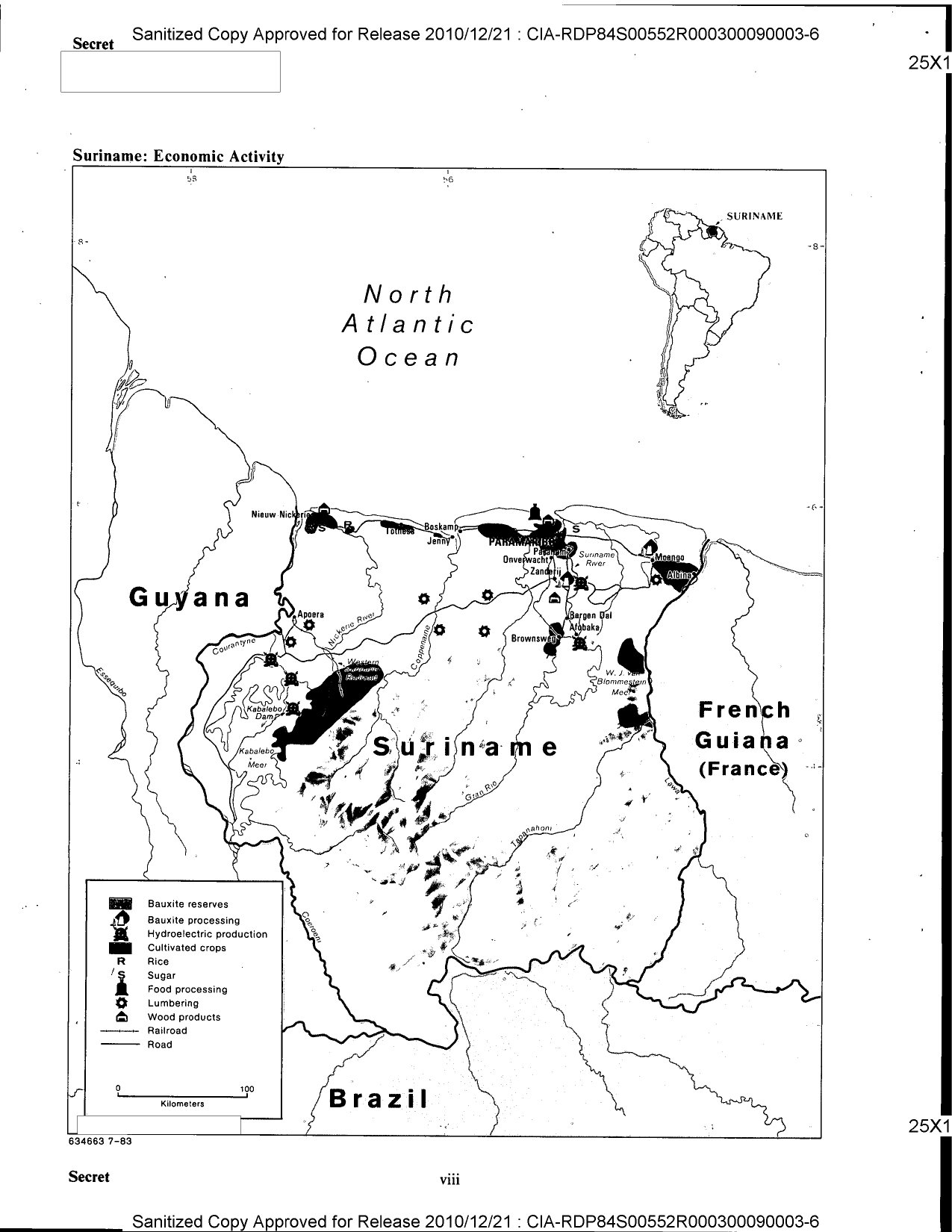
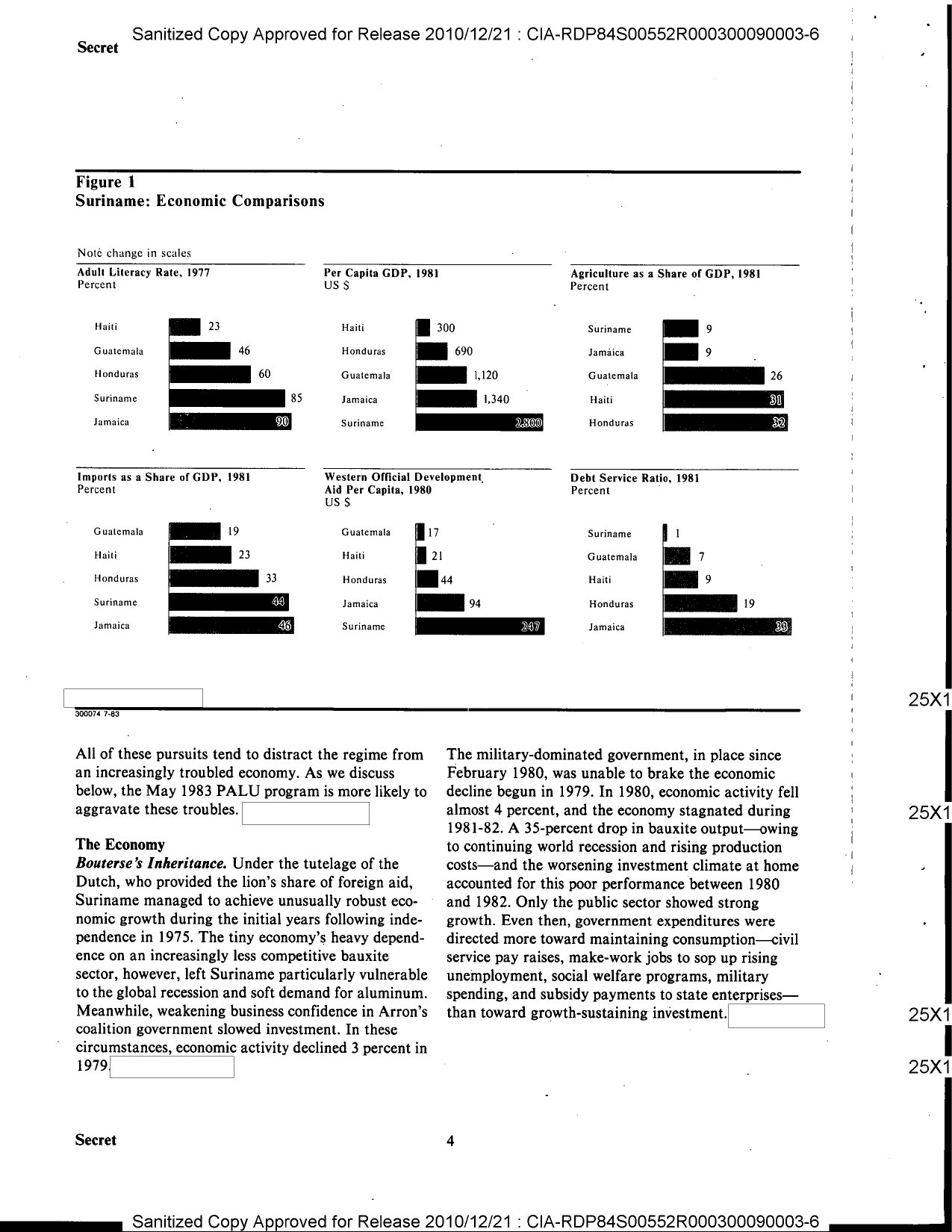
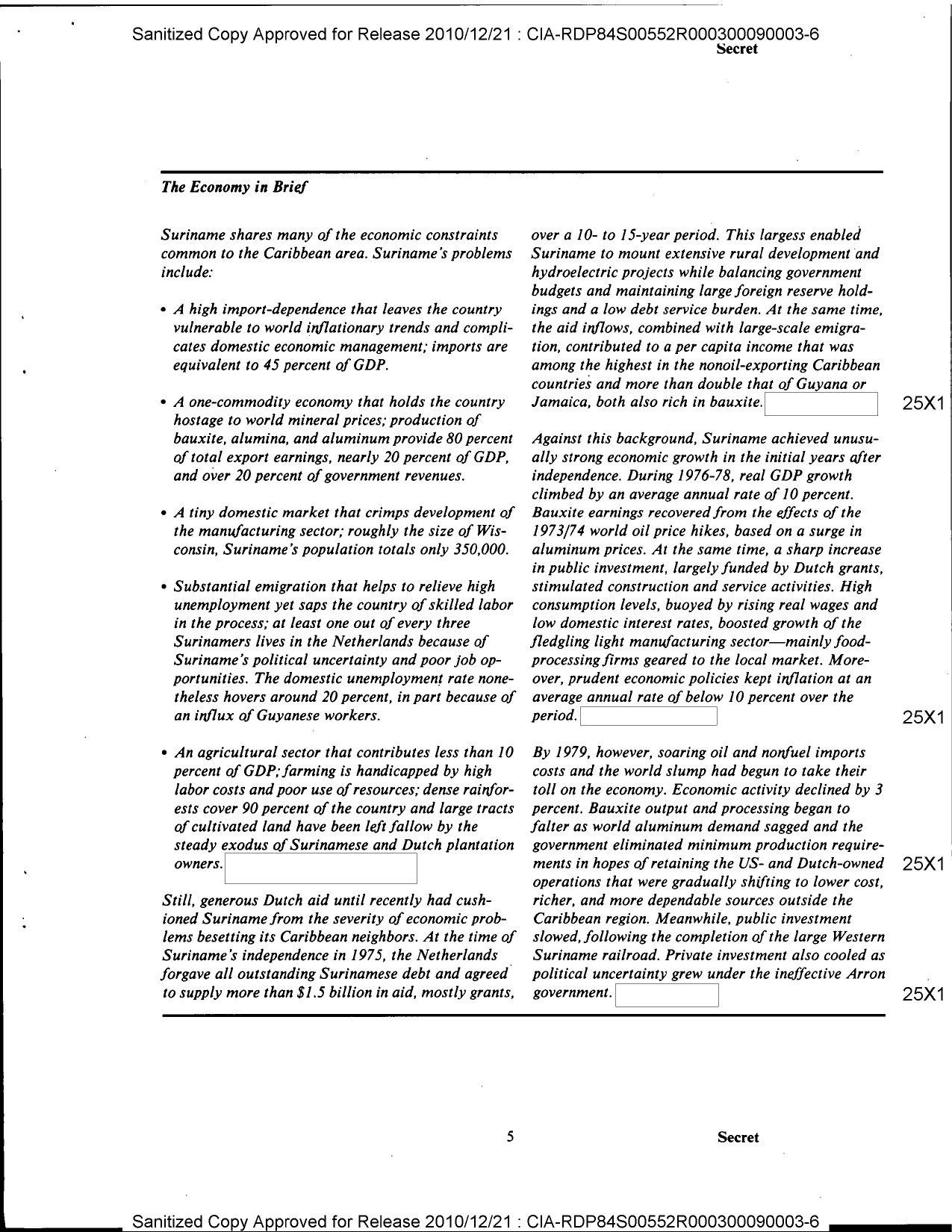
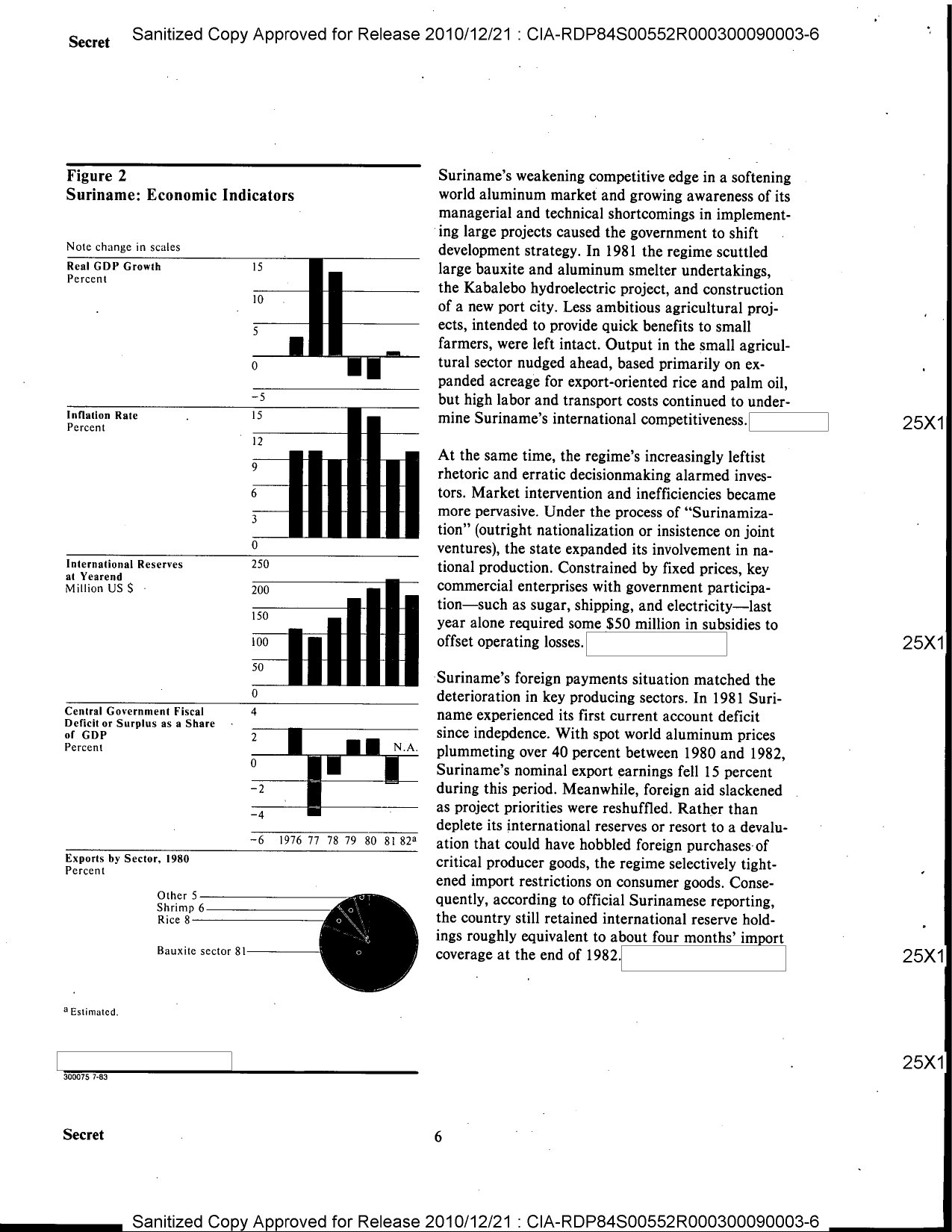
Under the tutelage of the Dutch, who provided the lion’s share of foreign aid, Suriname managed to achieve unusually robust economic growth during the initial years following independence in 1975. The tiny economy’s heavy dependence on an increasingly less competitive bauxite sector, however, left Suriname particularly vulnerable to the global recession and soft demand for aluminum. Meanwhile, weakening business confidence in Arron’s coalition government slowed investment. In these circumstances, economic activity declined 3 percent in 1979.
The military-dominated government, in place since February 1980, was unable to brake the economic decline begun in 1979. In 1980, economic activity fell almost 4 percent, and the economy stagnated during 1981–82. A 35-percent drop in bauxite output—owing to continuing world recession and rising production costs—and the worsening investment climate at home accounted for this poor performance between 1980 and 1982. Only the public sector showed strong growth. Even then, government expenditures were directed more toward maintaining consumption—civil service pay raises, make-work jobs to sop up rising unemployment, social welfare programs, military spending, and subsidy payments to state enterprises—than toward growth-sustaining investment.
Suriname’s weakening competitive edge in a softening world aluminum market and growing awareness of its managerial and technical shortcomings in implementing large projects caused the government to shift development strategy. In 1981, the regime scuttled large bauxite and aluminum smelter undertakings, the Kabalebo hydroelectric project, and construction of a new port city. Less ambitious agricultural projects, intended to provide quick benefits to small farmers, were left intact. Output in the small agricultural sector nudged ahead, based primarily on expanded acreage for export-oriented rice and palm oil, but high labor and transport costs continued to undermine Suriname’s international competitiveness.
At the same time, the regime’s increasingly leftist rhetoric and erratic decisionmaking alarmed investors. Market intervention and inefficiencies became more pervasive. Under the process of “Surinamization” (outright nationalization or insistence on joint ventures), the state expanded its involvement in national production. Constrained by fixed prices, key commercial enterprises with government participation—such as sugar, shipping, and electricity—last year alone required some $50 million in subsidies to offset operating losses.
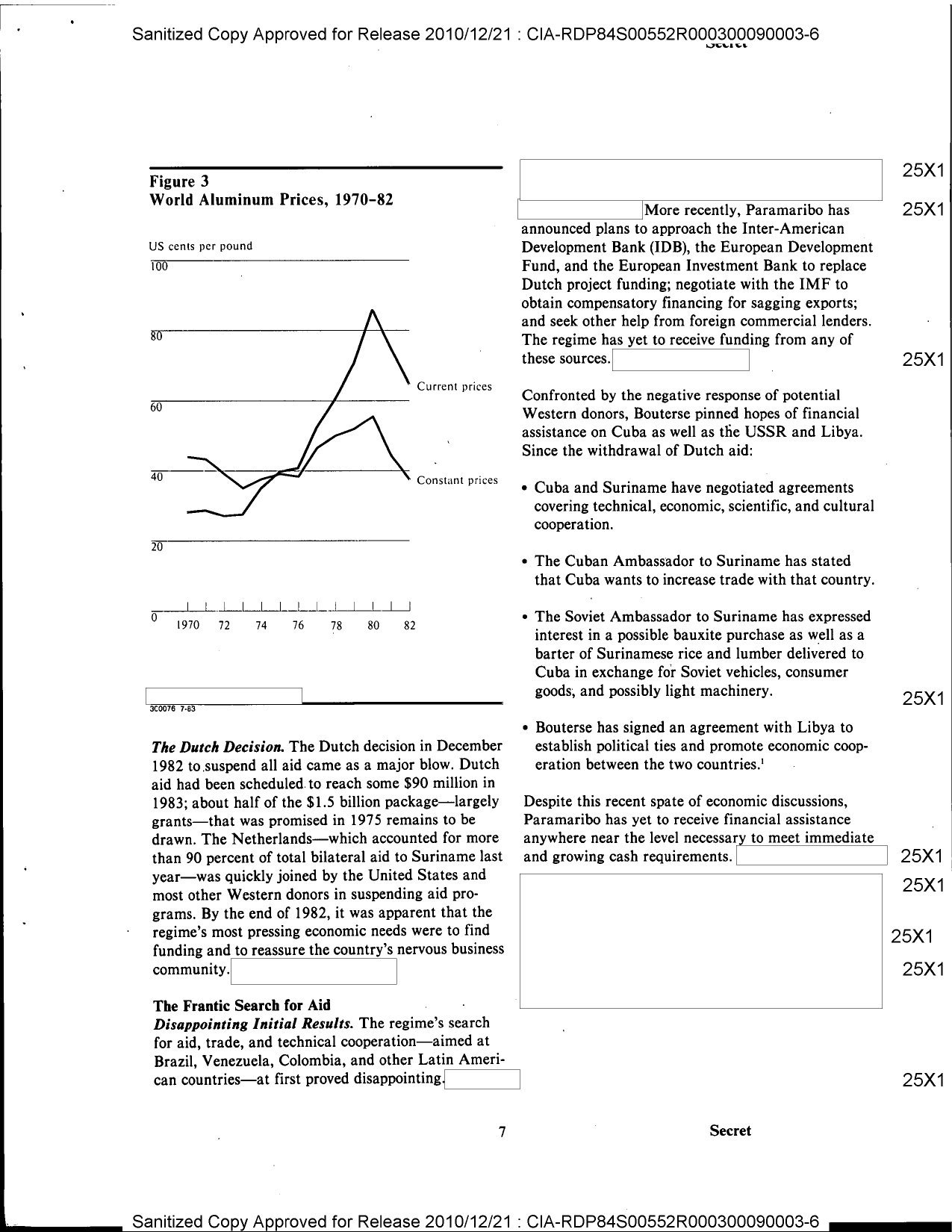
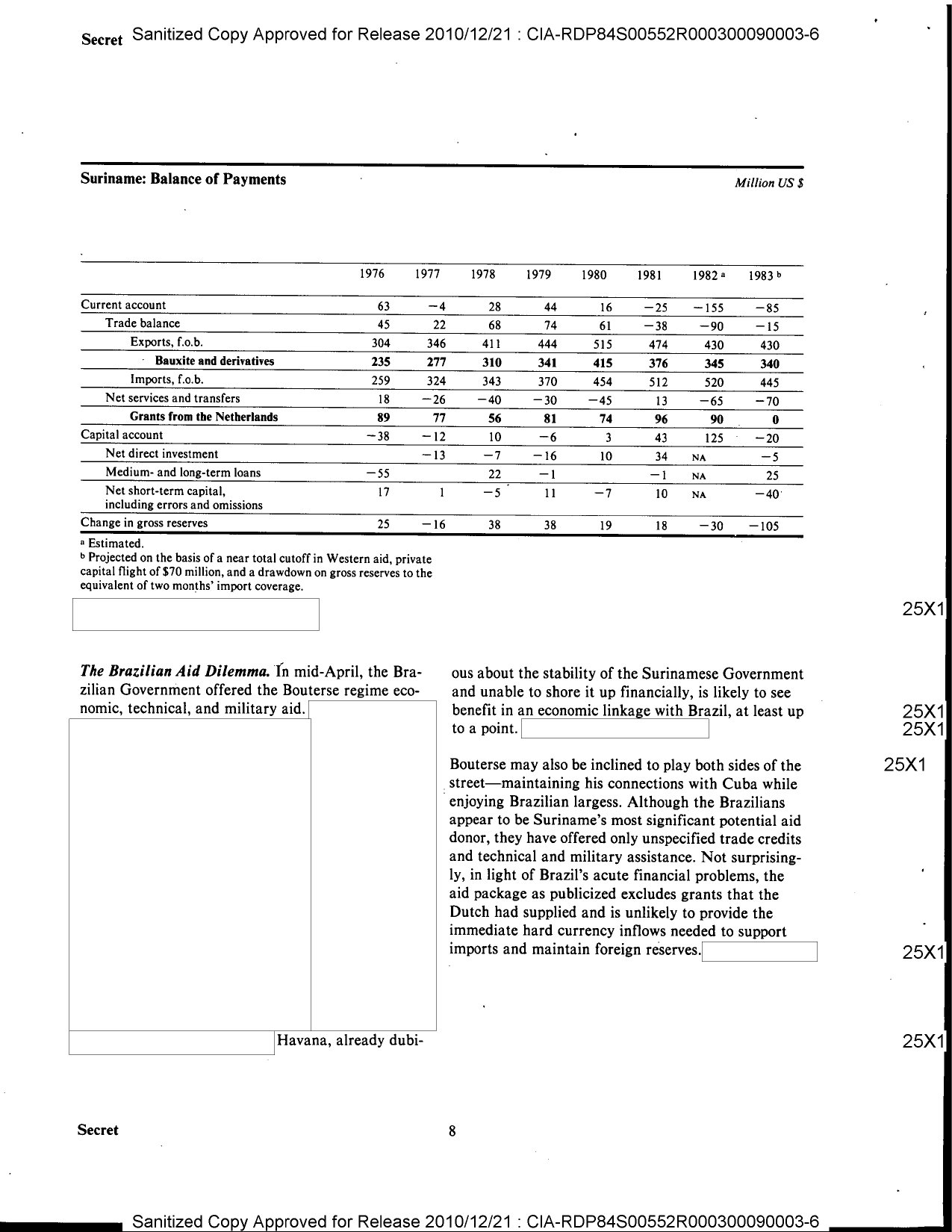
Suriname’s foreign payments situation matched the deterioration in key producing sectors. In 1981, Suriname experienced its first current account deficit since independence. With spot world aluminum prices plummeting over 40 percent between 1980 and 1982, Suriname’s nominal export earnings fell 15 percent during this period. Meanwhile, foreign aid slackened as project priorities were reshuffled. Rather than deplete its international reserves or resort to a devaluation that could have hobbled foreign purchases of critical producer goods, the regime selectively tightened import restrictions on consumer goods. Consequently, according to official Surinamese reporting, the country still retained international reserve holdings roughly equivalent to about four months’ import coverage at the end of 1982.
The Dutch Decision
The Dutch decision in December 1982 to suspend all aid came as a major blow. Dutch aid had been scheduled to reach some $90 million in 1983; about half of the $1.5 billion package—largely grants—that was promised in 1975 remains to be drawn. The Netherlands—which accounted for more than 90 percent of total bilateral aid to Suriname last year—was quickly joined by the United States and most other Western donors in suspending aid programs. By the end of 1982, it was apparent that the regime’s most pressing economic needs were to find funding and to reassure the country’s nervous business community.
The Frantic Search for Aid
Disappointing Initial Results
The regime’s search for aid, trade, and technical cooperation—aimed at Brazil, Venezuela, Colombia, and other Latin American countries—at first proved disappointing. More recently, Paramaribo has announced plans to approach the Inter-American Development Bank (IDB), the European Development Fund, and the European Investment Bank to replace Dutch project funding; negotiate with the IMF to obtain compensatory financing for sagging exports; and seek other help from foreign commercial lenders. The regime has yet to receive funding from any of these sources.
Confronted by the negative response of potential Western donors, Bouterse pinned hopes of financial assistance on Cuba as well as the USSR and Libya. Since the withdrawal of Dutch aid:
- Cuba and Suriname have negotiated agreements covering technical, economic, scientific, and cultural cooperation.
- The Cuban Ambassador to Suriname has stated that Cuba wants to increase trade with that country.
- The Soviet Ambassador to Suriname has expressed interest in a possible bauxite purchase as well as a barter of Surinamese rice and lumber delivered to Cuba in exchange for Soviet vehicles, consumer goods, and possibly light machinery.
- Bouterse has signed an agreement with Libya to establish political ties and promote economic cooperation between the two countries.
Despite this recent spate of economic discussions, Paramaribo has yet to receive financial assistance anywhere near the level necessary to meet immediate and growing cash requirements.
The Brazilian Aid Dilemma
In mid-April, the Brazilian Government offered the Bouterse regime economic, technical, and military aid. Havana, already dubious about the stability of the Surinamese Government and unable to shore it up financially, is likely to see benefit in an economic linkage with Brazil, at least up to a point.
Bouterse may also be inclined to play both sides of the street—maintaining his connections with Cuba while enjoying Brazilian largess. Although the Brazilians appear to be Suriname’s most significant potential aid donor, they have offered only unspecified trade credits and technical and military assistance. Not surprisingly, in light of Brazil’s acute financial problems, the aid package as publicized excludes grants that the Dutch had supplied and is unlikely to provide the immediate hard currency inflows needed to support imports and maintain foreign reserves.
Brazilian aid could benefit the Surinamese economy indirectly more than directly by imbuing the Bouterse regime with some respectability. Brazil’s involvement would probably encourage at least some other Western trade partners and donors (for example, the Swiss, the French, and the Germans) to be more helpful as well. Moreover, Brazil is well positioned at the Inter-American Development Bank to push Suriname’s request for $50 million in project loans; the two countries are represented by the same senior official at the bank.
Near-Term Outlook
Gloomy Economic Prospects
We believe Bouterse’s myopic decisionmaking and obsession with personal power will leave little room for a reasoned approach to economic policy. The course he has followed suggests that, even if sizable funds do not materialize quickly, Bouterse will hesitate to install tough import and domestic spending restrictions this year. Instead, he will try to maintain domestic consumption levels at the expense of the producing sectors that are the basis for any future growth.
In this regard, Bouterse probably will choose to continue the expedient begun earlier this year of draining the foreign reserve cushion and using various forms of taxation and thinly disguised extortion against the private sector (for example, contributions solicited by uniformed soldiers). Despite the recent establishment of a commission to screen import requests, there has been no effective imposition of strict import controls and other austerity measures that could gain the regime breathing space in handling the looming financial crisis. The regime has secured at least $50 million from the Central Bank; the bank’s president, who opposed the loan, has since fled the country. Moreover, the government reportedly is resorting to rapid monetary expansion to help cover its immediate expenses and to maintain consumption levels. This temporary palliative, however, risks a spurt in import demand and soaring inflation that would require harsher austerity measures by early next year.
Even with Bouterse’s foot-dragging on imposing harsh import cuts and fiscal austerity measures, the Surinamese economy at best would stagnate and could yet decline sharply in 1983. Moreover, under these circumstances a recent banking clampdown is likely to be ineffective in stemming private capital flight, which in itself represents a further drain on Suriname’s international reserves. Emigration, mainly to the Netherlands, neighboring French Guiana, and the Netherlands Antilles, would probably rise even faster if, as is likely, many of the 6,000 workers assigned to Dutch-financed projects are laid off. While such an exodus would help vent political frustration and curtail unemployment, the drain of skilled labor would further hurt economic activity.
The course of the economy over the near term will depend heavily on whether or not the Dutch resume aid to the Bouterse regime. After the December executions, a Dutch official indicated that the Netherlands would do so only with the removal of Bouterse and a return to constitutional government. Moreover, initial Dutch reaction to the 1 May Surinamese policy statement indicated that The Hague would stick to these conditions for at least the near term.
Various accounts of Dutch Prime Minister Lubbers’s visit to Brazil at the end of May suggest that the Dutch may be softening their preconditions for aid resumption and, specifically, may no longer be insisting that Bouterse be replaced. Moreover, the Dutch have expressed concern that the Surinamese might be able to embarrass them publicly by bringing the aid suspension before the International Court of Justice.
In our judgment, however, there remains a significant difference between Dutch and Brazilian perceptions, with the Dutch apparently far more concerned with Paramaribo’s human rights performance and the Brazilians intent on the unwelcome Cuban dimension. Thus, by satisfying the Brazilian aid conditions, the Bouterse regime would not necessarily satisfy the Dutch.
In the unlikely event that Western aid equivalent to the suspended Dutch aid should resume later this year, we estimate that the Surinamese economy at best would stagnate in 1983. Aid blocked in the pipeline would be hard to restore quickly to the levels originally planned. Weak world recovery and inherent lags in aluminum demand would leave export earnings at about last year’s level at best. At the same time, any Western aid would ease pressure on Suriname’s international reserves. It would also delay even further the imposition of some austerity measures, and reduce the severity of others, particularly in the area of import restrictions.
Threats to the Private Sector
Bouterse’s political insecurity, untrained leadership, and reliance on a small circle of squabbling advisers are likely to translate into clumsy, heavy-handed responses to mounting economic problems. As the economy deteriorates this year, he may further press the business community—which was asked to donate $170,000 to the coup anniversary celebrations in February and has been prohibited from laying off employees—in ways that will only increase the tensions between the government and private enterprise.
Although some of Bouterse’s advisers reportedly espouse nationalization of US and Dutch bauxite interests, which they allege are financing the political opposition, we think that Suriname’s poor competitive position in the world aluminum market, lack of skilled technicians, and steep modernization costs will at least delay such a decision for a considerable period. Moreover, the regime recently has sought to reassure the aluminum companies; in April and May 1983, Suriname and the US-owned Suralco, the country’s largest aluminum firm, reached preliminary accord for a significant cut in bauxite production taxes through 1985 and concluded a labor agreement. The aluminum companies could yet confront increasing revenue demands and restrictions on their autonomy with regard to employment, production, and marketing. Continuing negotiations between the regime and these companies over such issues will provide another test of Bouterse’s intentions.
The nationalization of service industries such as banks and insurance companies seems to us more likely, although the government policy statement of 1 May does not forecast any specific moves of that kind. While “Surinamization” of these institutions would further dim chances of Western investment and aid, the regime might eventually be tempted to nationalize them to gain quick access to foreign exchange and tightened leverage over other sectors by directly controlling their domestic funding sources.
Longer Term Uncertainties
Even with a reopening of the aid spigot, a variety of factors would probably prevent a return in the next few years to the high growth rates that the country enjoyed following independence. Although we expect aluminum prices to rise over the medium term with improved economic conditions in the industrialized world, earnings from Suriname’s bauxite sector will be constrained by a diminishing supply of easily accessible bauxite as well as high operating expenses and modernization costs. Economic diversification, the alternative to rigid dependence on the bauxite industry, will prove harder to achieve than in the past, if, as we expect:
- A shrinking domestic market, owing to continued emigration, dampens further development of food processing and other light industries.
- The flight of technical and managerial talent continues to weaken the economy.
- Surinamese businessmen and potential foreign investors remain unwilling to undertake new projects because they lack assurances that the rules of the game will not change.
Making the economic prospects even bleaker is the strong possibility that Suriname over the near future will not receive aid in the amounts or degree of concessionality that characterized the Dutch program. At best, the Cuban, Soviet, and Libyan offers are likely to translate into various kinds of technical assistance and commercial programs that cannot begin to address the country’s growing foreign financial needs associated with any economic recovery. We expect the Brazilians to continue to give priority to the kinds of aid that would allow them to compete with the Cubans for political influence, such as technical assistance and military aid. Nor do we believe that the Dutch would be willing over the next few years to set aside their revulsion toward the Bouterse regime’s human rights violations and provide aid at anywhere near past levels.
We judge that by early next year or so, shrinking foreign reserve levels and poor prospects for import-financing aid will pressure Bouterse to institute long-delayed austerity measures. These are likely to include import cuts, rationing of consumer goods, higher taxes, and budget cuts in social services and civil service wages. Such austerity measures contrast sharply with the 1 May policy statement composed by Alibux and Finance Minister Caldeira, which made unrealistic promises of economic betterment for the population at large. Over the next few years, we expect the gap between actual austerities and these promises to widen.
The ways in which these economic maladies might manifest themselves politically remain uncertain. Considering that PALU’s “new democracy” is not likely to make the government less authoritarian, we expect that the average Surinamer’s realization that PALU’s economic promises had also proven empty would be added cause for popular antipathy toward the regime. Nevertheless, we doubt that the regime faces a serious danger of an internally sponsored popular uprising; the December 1982 executions have probably left any remaining anti-regime elements too intimidated for that.
We see a stronger possibility, on the other hand, that Suriname’s economic problems could become an additional factor in the continuing power struggle between PALU and RVP, as spokesmen for the latter cast about for additional ways to discredit PALU. But the RVP is less well entrenched in the government and more beholden to the Cubans for political advice. Thus we believe the Cubans would have to provide direct encouragement and material help to the RVP in this power struggle to tip the balance to the RVP; although this scenario is possible, we have no indication that the Cubans are planning to do so in the near future.
In any case, the variable is Bouterse. His statements and actions since his emergence as a political figure in February 1980 do not yet provide us an adequate basis for predicting his behavior. They suggest at best that he will act to maintain his power. Beyond that strong instinct for survival, a firm faith in the efficacy and worth of his own political authority, and a vaguely egalitarian sympathy for “socialism” and “socialist leaders” such as Castro and Bishop of Grenada, he seems to have no clear-cut political goals, either domestic or international, nor specific understanding of the economic problems facing his country and how to cope with them.
Implications for the United States
We doubt that continued decline of the Surinamese economy is likely to have significant material impact on US interests as long as the Bouterse regime remains intact and under the influence of PALU. In searching for scapegoats, the regime can be expected to boost its anti-Western rhetoric (including the US-owned Suralco), as well as the collectivization of agriculture. He might find attractive the RVP argument that only in this way could the regime gain sufficient control of economic assets to reallocate them properly; such an argument might appeal to his sporadic egalitarian leanings. A Suriname heavily influenced by the RVP would probably also move toward closer alignment with Cuba and Grenada.
Other outcomes are equally possible, however. Premier Alibux appears to have developed a personal stake in achieving closer Surinamese relations with Brazil. At some point in his dealings with the Brazilians, Alibux might feel obliged to counsel Bouterse that only by weakening the Cuban connection could Suriname attain what it needs economically (and perhaps militarily) from Brazil and other countries inclined to follow Brazil’s lead. Bouterse might accept that counsel, thereby risking strong Cuban reaction; or he might strike out in an entirely different direction, with newly appointed advisers devising yet another set of political and economic plans for Suriname.
As the economy declines we believe Bouterse will reassess his political and economic options. He might then be far more amenable to the RVP’s longstanding arguments—reflected in a secret memorandum of April 1981 drafted principally by Sital—that Suriname ought to be restructured along Marxist-Leninist lines. In that event Bouterse might consent to full nationalization of banks and important industries (including the US-owned Suralco), as well as the collectivization of agriculture. He might find attractive the RVP argument that only in this way could the regime gain sufficient control of economic assets to reallocate them properly; such an argument might appeal to his sporadic egalitarian leanings. A Suriname heavily influenced by the RVP would probably also move toward closer alignment with Cuba and Grenada.
Other outcomes are equally possible, however. Premier Alibux appears to have developed a personal stake in achieving closer Surinamese relations with Brazil. At some point in his dealings with the Brazilians, Alibux might feel obliged to counsel Bouterse that only by weakening the Cuban connection could Suriname attain what it needs economically (and perhaps militarily) from Brazil and other countries inclined to follow Brazil’s lead. Bouterse might accept that counsel, thereby risking strong Cuban reaction; or he might strike out in an entirely different direction, with newly appointed advisers devising yet another set of political and economic plans for Suriname.
Source:
Link:
Internal Link:
Date:
July 5, 1983