Suriname: Leftist Charges Against the US – National Intelligence Daily – 2 November 1982
CIA-RDP84T00301R000600010023-6
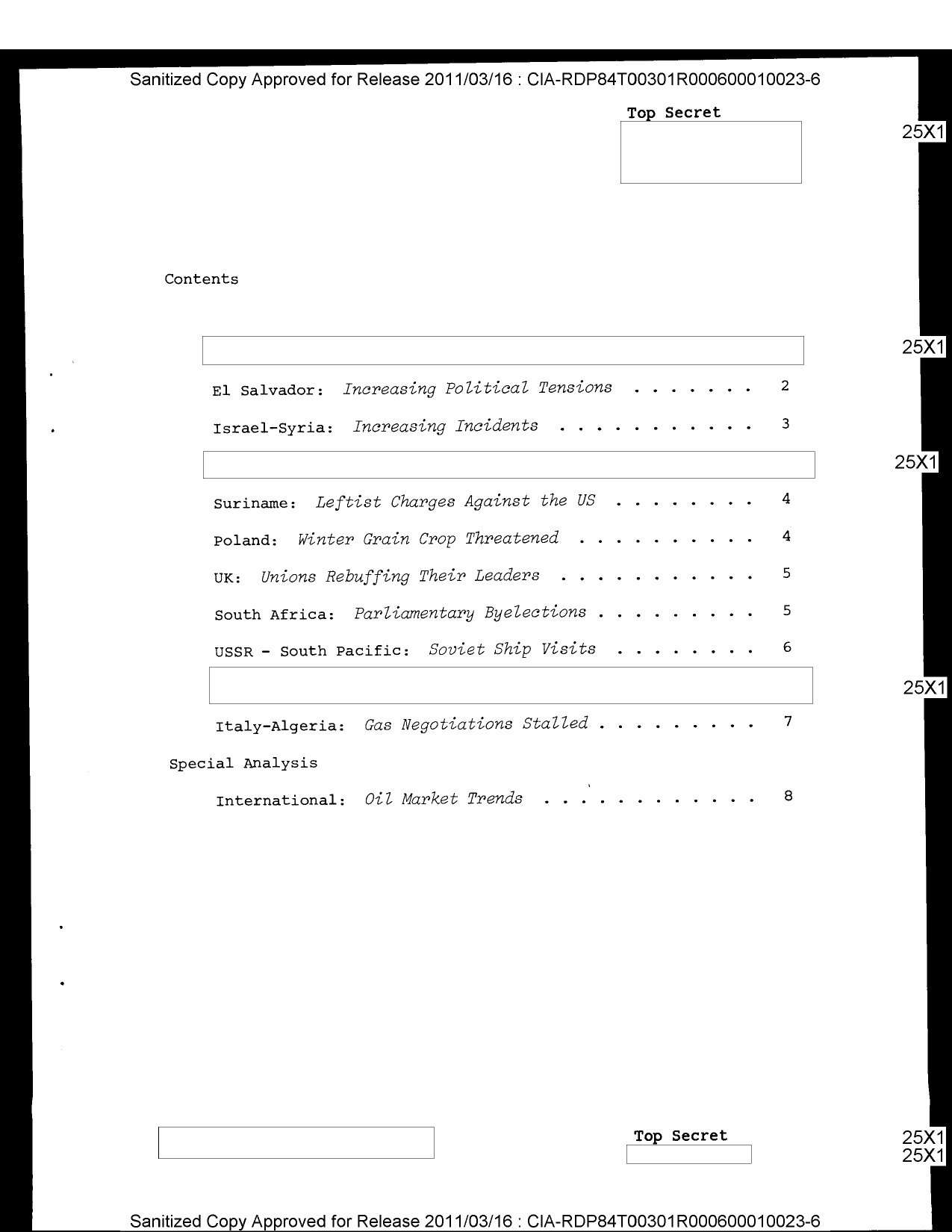
| Topic / Description | Page |
|---|---|
| El Salvador: Increasing Political Tensions | 2 |
| Israel-Syria: Increasing Incidents | 3 |
| Suriname: Leftist Charges Against the US | 4 |
| Poland: Winter Grain Crop Threatened | 4 |
| UK: Unions Rebuffing Their Leaders | 5 |
| South Africa: Parliamentary Byelections | 5 |
| USSR – South Pacific: Soviet Ship Visits | 6 |
| Italy-Algeria: Gas Negotiations Stalled | 7 |
| International: Oil Market Trends | 8 |
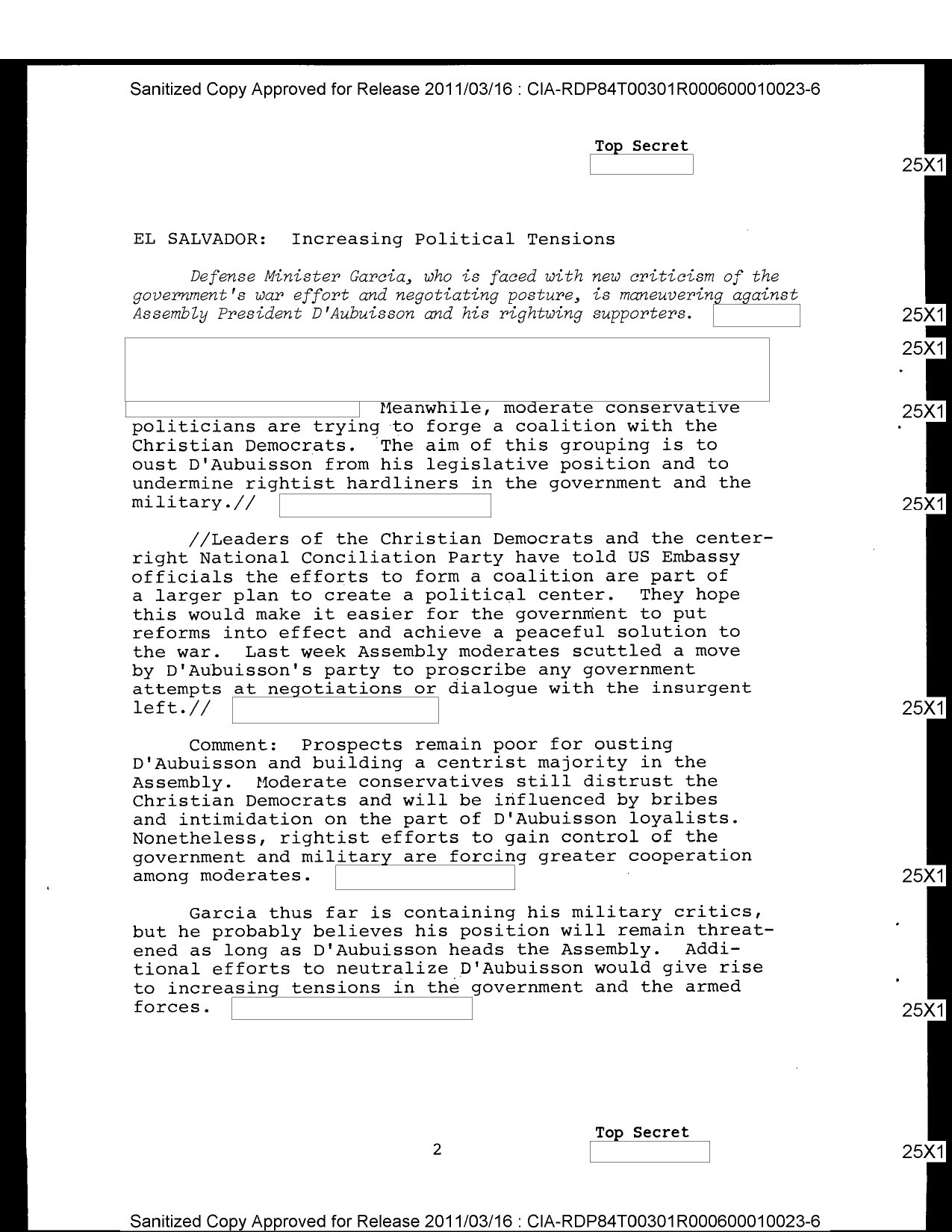
EL SALVADOR: Increasing Political Tensions
Defense Minister Garcia, who is faced with new criticism of the government’s war effort and negotiating posture, is maneuvering against Assembly President D’Aubuisson and his rightwing supporters. Meanwhile, moderate conservative politicians are trying to forge a coalition with the Christian Democrats. The aim of this grouping is to oust D’Aubuisson from his legislative position and to undermine rightist hardliners in the government and the military.
//Leaders of the Christian Democrats and the center-right National Conciliation Party have told US Embassy officials the efforts to form a coalition are part of a larger plan to create a political center. They hope this would make it easier for the government to put reforms into effect and achieve a peaceful solution to the war. Last week Assembly moderates scuttled a move by D’Aubuisson’s party to proscribe any government attempts at negotiations or dialogue with the insurgent left.//
Comment: Prospects remain poor for ousting D’Aubuisson and building a centrist majority in the Assembly. Moderate conservatives still distrust the Christian Democrats and will be influenced by bribes and intimidation on the part of D’Aubuisson loyalists. Nonetheless, rightist efforts to gain control of the government and military are forcing greater cooperation among moderates. Garcia thus far is containing his military critics, but he probably believes his position will remain threatened as long as D’Aubuisson heads the Assembly. Additional efforts to neutralize D’Aubuisson would give rise to increasing tensions in the government and the armed forces.
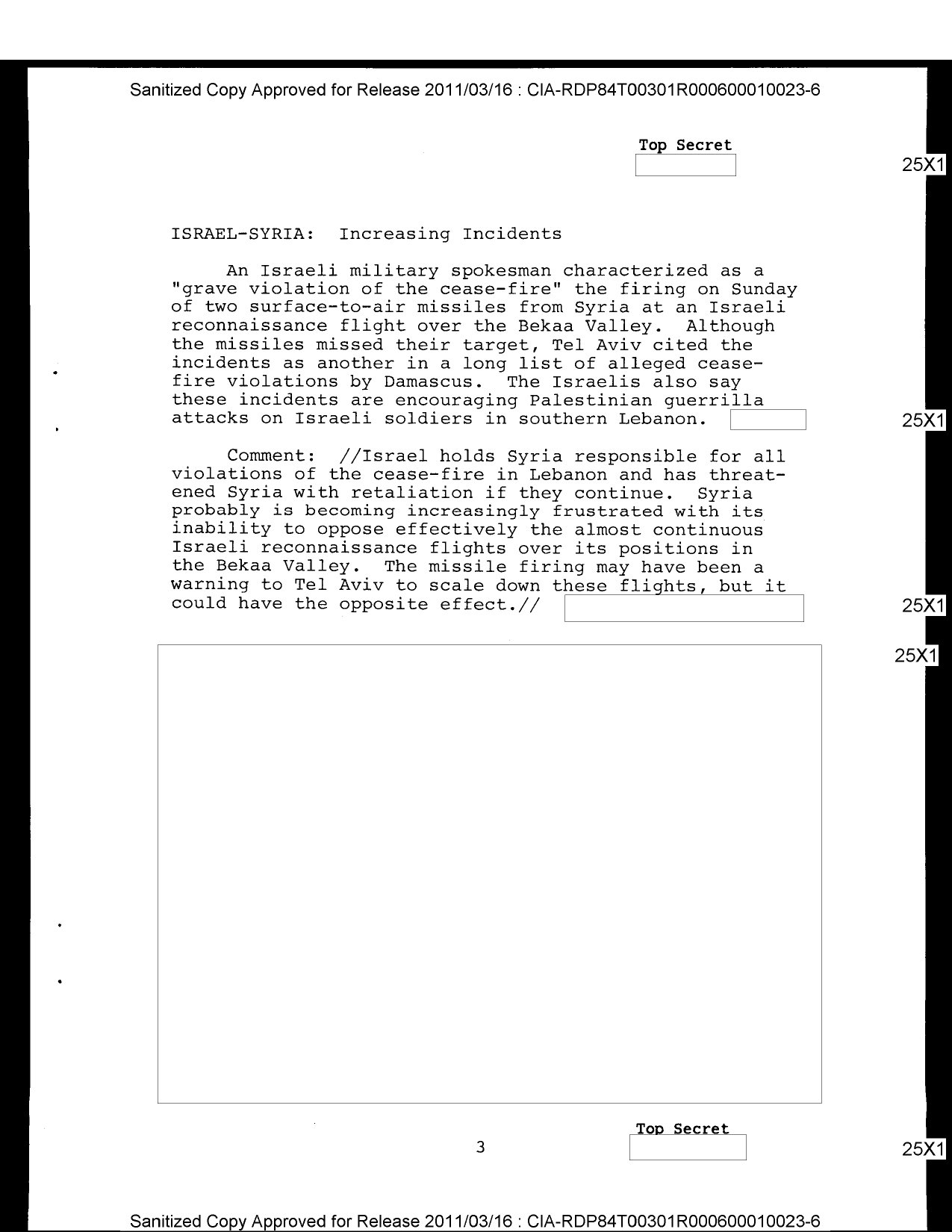
ISRAEL-SYRIA: Increasing Incidents
An Israeli military spokesman characterized as a “grave violation of the cease-fire” the firing on Sunday of two surface-to-air missiles from Syria at an Israeli reconnaissance flight over the Bekaa Valley. Although the missiles missed their target, Tel Aviv cited the incidents as another in a long list of alleged cease-fire violations by Damascus. The Israelis also say these incidents are encouraging Palestinian guerrilla attacks on Israeli soldiers in southern Lebanon.
Comment: Israel holds Syria responsible for all violations of the cease-fire in Lebanon and has threatened Syria with retaliation if they continue. Syria probably is becoming increasingly frustrated with its inability to oppose effectively the almost continuous Israeli reconnaissance flights over its positions in the Bekaa Valley. The missile firing may have been a warning to Tel Aviv to scale down these flights, but it could have the opposite effect.
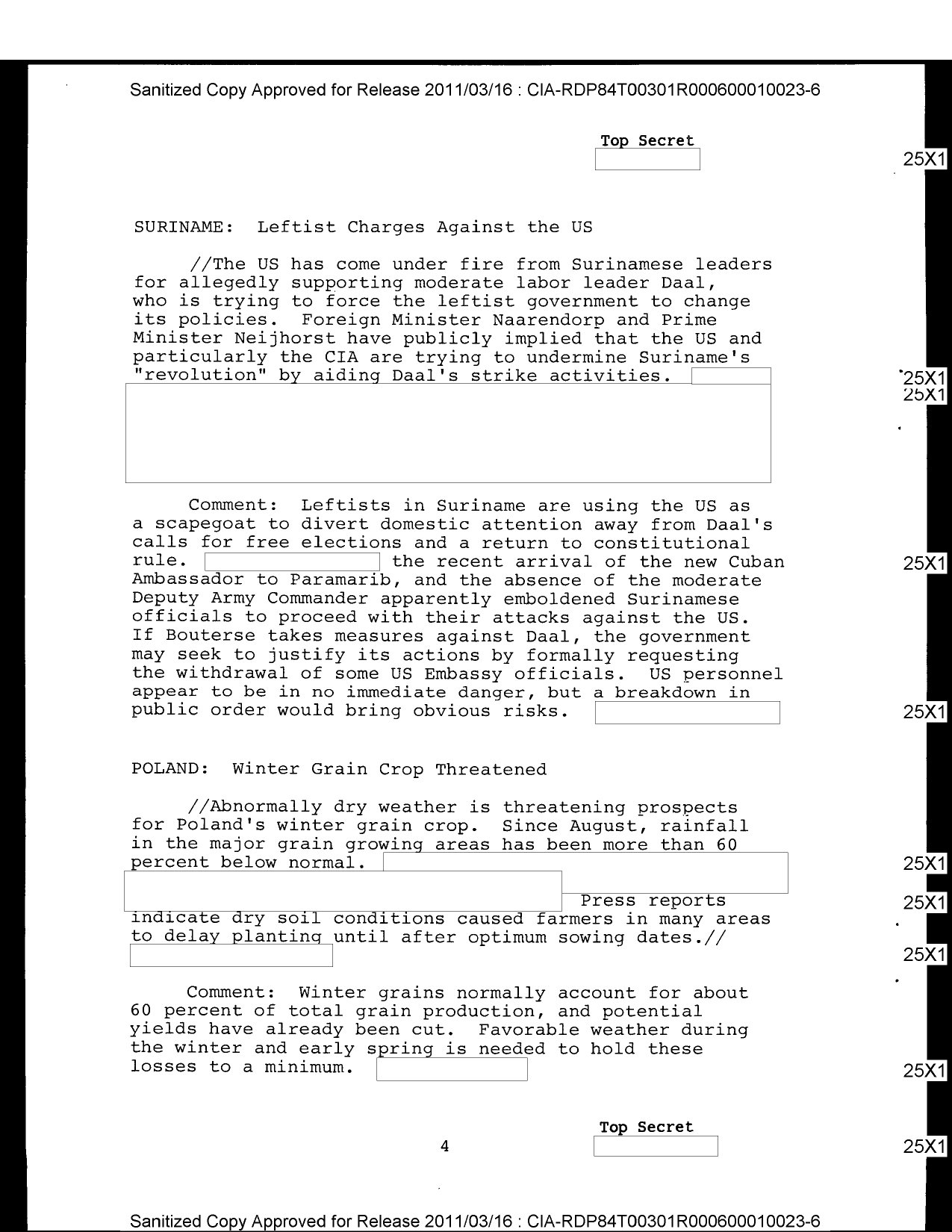
SURINAME: Leftist Charges Against the US
//The US has come under fire from Surinamese leaders for allegedly supporting moderate labor leader Daal, who is trying to force the leftist government to change its policies. Foreign Minister Naarendorp and Prime Minister Neijhorst have publicly implied that the US and particularly the CIA are trying to undermine Suriname’s “revolution” by aiding Daal’s strike activities.//
Comment: Leftists in Suriname are using the US as a scapegoat to divert domestic attention away from Daal’s calls for free elections and a return to constitutional rule. The recent arrival of the new Cuban Ambassador to Paramaribo, and the absence of the moderate Deputy Army Commander apparently emboldened Surinamese officials to proceed with their attacks against the US. If Bouterse takes measures against Daal, the government may seek to justify its actions by formally requesting the withdrawal of some US Embassy officials. US personnel appear to be in no immediate danger, but a breakdown in public order would bring obvious risks.
POLAND: Winter Grain Crop Threatened
//Abnormally dry weather is threatening prospects for Poland’s winter grain crop. Since August, rainfall in the major grain growing areas has been more than 60 percent below normal. Press reports indicate dry soil conditions caused farmers in many areas to delay planting until after optimum sowing dates.//
Comment: Winter grains normally account for about 60 percent of total grain production, and potential yields have already been cut. Favorable weather during the winter and early spring is needed to hold these losses to a minimum.
UK: Unions Rebuffing Their Leaders
//The government’s political position probably has been strengthened by the results of two recent union votes on new wage contracts. Workers at the ailing British Leyland automobile company have accepted by a wide margin a two-year contract with annual raises of about 6 percent. Early returns from the militant National Union of Mineworkers indicate it will accept the National Coal Board’s offer of an 8- to 9-percent increase. Leftwing union leader Scargill, who has vowed to bring down Prime Minister Thatcher’s government, has been urging the union to strike.//
Comment: A rebuff of Scargill by the mineworkers would be the second this year. Union militancy has moderated as a result of government firmness, high unemployment, and the gradual drop in the rate of inflation. Other unions are likely to continue accepting moderate wage settlements, strengthening the case of those in the government who want to call an election next spring.
SOUTH AFRICA: Parliamentary Byelections
The ruling National Party tomorrow faces its first major electoral test since its right wing broke away earlier this year to form the Conservative Party. Of the four seats being contested, the one in the Orange Free State is drawing the greatest attention. The Conservatives and another rightwing party are vying for the support of conservative Afrikaners, who make up the bulk of the state’s electorate. The campaign has focused almost entirely on Prime Minister Botha’s proposals for constitutional reforms that would grant limited political rights to Coloreds and Asians.
Comment: The National Party is likely to win the seat in the Orange Free State, but perhaps with only a plurality. A strong showing there by the Conservative Party would solidify its claim to leadership of South Africa’s right wing and might force Botha to reassess his proposed reforms.
USSR – SOUTH PACIFIC: Soviet Ship Visits
Leaders of two Pacific island nations suggest that they might open their ports to Soviet ships. Prime Minister Lini of Vanuatu says Soviet vessels that are not nuclear powered or nuclear armed would be allowed to call. Fiji’s Foreign Minister said the ban on all Soviet shipping, which was imposed in July after the USSR was accused of funding opposition candidates for parliament, might be lifted.
Comment: Soviet warships do not call at ports in the area, but Soviet fishing and oceanographic ships are active in the region. Moscow’s occasional attempts to establish influence in the region have not gotten far. Most of the island nations would be reluctant to jeopardize aid and investments from Australia, New Zealand, and the West by being too friendly with the USSR. Although Fiji and a few others welcome the income from occasional visits by Soviet ships, they probably would not welcome warships.
ITALY-ALGERIA: Gas Negotiations Stalled
//Negotiations to sell Algerian natural gas to Italy remain stalled. Negotiators for the two governments reached agreement in principle in early October to raise the price to $4.41 per million Btu, but the Italian distribution company has refused to sign the contract. The company wants the Italian Government to pay the difference between the price of costly Algerian gas and that of other imported gas in the Italian market—about $0.60 per million Btu. The USSR has indicated it is willing to give Italy more time to negotiate for Soviet gas.//
Comment: Rome and Algiers hope to sign a contract by mid-November, but negotiations probably will drag on much longer because both sides are showing signs of inflexibility on a number of technical issues. Unanticipated production problems are limiting Algeria’s ability to meet export commitments and encouraging it to maintain a hard line on the pricing issue. Opposition is likely to increase in the Italian Government because of the high cost to the Treasury. Prolonging the talks with Algeria probably will further delay Italian negotiations for Soviet gas, but a failure to reach a settlement altogether would make Italy more likely to buy Soviet gas.
INTERNATIONAL: Oil Market Trends
The oil market remains depressed with no end in sight to the decline in consumption, despite a recent increase in OPEC oil production and a rise in spot prices. OPEC oil production in October was nearly 2 million barrels per day above levels in August, and spot crude oil prices have risen by $1 to $2 per barrel in recent weeks to approximate official prices. Nevertheless, the availability of excess production capacity, coupled with continued aggressive marketing by some OPEC members and some other oil exporters, will tend to hold contract prices down.
The rise in OPEC production is in response to the normal seasonal increase in oil consumption and perhaps to the end of the drawdown of excess commercial inventories. Companies usually build inventories during the summer, when consumption is low, to meet seasonal increases during the winter season. According to industry sources, the combination of high carrying costs, surplus productive capacity, and the increased flexibility of the refining system is causing oil companies to carry smaller inventories and keep their purchases more closely adjusted to the seasonal pattern of oil consumption. As a result, OPEC production probably will change throughout the year in response to the seasonal rise and fall in consumption.
Demand for OPEC oil will rise slightly during the remainder of the year—perhaps up to another 1 million barrels per day. It is likely to remain at that level through the first three months of 1983.
Disagreements Within OPEC:
Despite the limited rise expected in output, soft market conditions will prevent most OPEC countries from realizing their desired level of production and will keep the cartel in disarray. Disagreement on appropriate price differentials between African and Persian Gulf crudes and the determination of some OPEC countries, including Iran, Libya, and Venezuela, to go their own way have already divided OPEC.
Earlier this month the OPEC states of Saudi Arabia, Kuwait, the United Arab Emirates, and Qatar, which are members of the six-nation Gulf Cooperation Council, warned they might set their own prices and output levels unilaterally if errant OPEC members continue to underprice their oil. OPEC will try to resolve differences on production and pricing at the next ministerial meeting scheduled for 9 December in Lagos.
Possible New Market Pressures:
If companies succeed in shifting most of the burden of seasonal adjustment to oil producers, demand for OPEC oil could fall by up to 2 million barrels per day during the second and third quarters of 1983. At the same time, there is little prospect that much more oil will be required as the result of an economic recovery. Most observers do not expect strong economic growth in the industrialized nations.
Market pressures would be further intensified if Iran and Iraq were to raise production substantially next spring. Mexico also may be tempted to increase production, but softness in world demand—particularly for the poor quality crude oil that Mexico could easily deliver—will limit its ability to expand sales.
If the demand for OPEC oil falls by as much as 2 million barrels per day next spring, there will be strong pressure to cut prices. Most industry sources believe these problems will not lead to a collapse in the price of oil, but some believe Saudi Arabia and other politically moderate oil producers in the Persian Gulf may lower prices slightly to regain market control. This, however, would risk starting a price war.
The possibility of much lower prices cannot be ruled out. The growing financial difficulties of such producers as Mexico and Nigeria and the erratic behavior of Iran and Libya could encourage aggressive competition. Moreover, if oil consumption continues to decline next year, the cartel will have a difficult time keeping prices at their current level.
Source:
Link:
Internal Link:
Date:
November 2, 1982